




Abstract
Invisible power—the ability to resist changing one’s behavior because of an unspoken consensus that the status quo is natural or inevitable—upholds gender inequality in different-gender marriages. Yet the “consensus” that Aafke Komter documented more than 30 years ago—one in which both men and women endorsed male primacy and believed it natural for women to enjoy housework and men to pursue professional ambition—has weakened among the college-educated, upper middle class. We ask: What is the new consensus upholding gendered power imbalances among contemporary highly educated couples? We draw on 112 interviews with members of 44 such couples making career and family decisions to update theorizing on invisible power. Examination of decision-making processes and outcomes across work and family domains over time, including in cases of apparent agreement, reveals the consensus now upholding men’s interests to be couples’ conviction they are practicing mutuality. Partners’ belief that they are mutually pursuing both individuals’ and the family’s best interests by emphasizing “us” and balancing a decision portfolio helps them overlook unsuccessful attempts to minimize power imbalances. Progress toward gender equality among different-gender couples will likely remain stalled as long as efforts to practice mutuality overshadow critical evaluation of their success.
Power relations are fundamental to sociological inquiry on different-gender couples’ marital and family dynamics, including dating (Lamont 2020), cohabiting (Miller and Carlson 2016), housework (Daminger 2019; Tichenor 2005), balancing careers (Wong 2023), and parenting (Moore 2008). Consistent evidence of women’s greater domestic labor burden and limited career freedom indicates that gendered marital power imbalances persist in work and family (Damaske 2011, 2021; Perry-Jenkins and Gerstel 2020).
Komter’s (1989) tripartite conception of marital power as manifest, latent, or invisible is a key framework for studying gendered power inequalities. Manifest power emerges in disagreement, when one spouse advocates change and the other resists. Latent power operates without visible conflict, when the less-powerful person anticipates opposition and becomes resigned or resentful rather than raising an issue. Finally, invisible power is the ability to resist change because of a shared, unspoken consensus that a power-imbalanced situation is natural.
Undoubtedly, all three forms of power shape contemporary couples’ interactions. But the antagonistic nature of manifest and latent power contradicts widespread ideals of equal, companionate marriage among the young, college-educated, upper middle class (Cherlin 2004; Gerson 2011; Lamont 2020). Thus, invisible power is key to understanding gender-unequal marital outcomes. Yet the underlying “consensus” Komter (1989) documented—one in which both men and women endorsed male primacy and believed it is natural for women to enjoy housework and men to pursue professional ambition—may be outdated given attitudinal changes among this group (Daminger 2020; Knight and Brinton 2017; Scarborough, Sin, and Risman 2019). Recent research documents how such couples navigate (un)employment (e.g., Damaske 2021; Rao 2020) and domestic labor (e.g., Daminger 2020). However, this scholarship pays limited attention to power and does not elucidate the ideological consensus underpinning partners’ prioritization of men’s paid work and acceptance of women’s disproportionate unpaid labor burden. We seek to identify the new consensus underpinning gendered power imbalances among this group of couples, the strategies they draw upon to manage their power dynamic, and the effectiveness of those strategies.
We draw on 112 interviews with members of 44 highly educated, different-gender couples to update and extend theorizing on invisible power. We show that couples’ conviction that they are practicing mutuality serves as the ideological consensus upholding men’s interests. Adherence to this updated “family myth” (Hochschild 1989)—that partners are mutually pursuing both individuals’ and the family’s best interests—directs partners’ attention to their efforts at practicing mutuality. Simultaneously, it helps couples downplay unsuccessful outcomes of those efforts. Progress toward gender equality among different-gender couples will likely remain stalled as long as the gap between couples’ mutualistic intentions and gendered behaviors remains obscured (England 2010).
Revisiting Theories Of Marital Power
Building on Lukes’ and Gramsci’s work, Komter’s (1989, 192) study of marital power identified three ways one spouse may “affect consciously or unconsciously the emotions, attitudes, cognitions, or behavior” of the other. Manifest power operates when one spouse desires change and the other thwarts that desire. In the housework context, manifest power may look like men’s explicit refusal to complete household chores (Miller and Carlson 2016). In the career space, it is visible when husbands expressly oppose women’s job searches (Damaske 2021; Rao 2020). Latent power operates without visible conflict, when the less-powerful partner anticipates opposition and avoids raising an issue: For instance, men hold out long enough that women stop requesting their housework contributions (Lamont 2020), or working women stop asking their unemployed husbands to do more housework (Damaske 2021; Rao 2020). Resignation and resentment are key indicators of latent power.
Finally, invisible power is the ability to resist change because of an unspoken agreement that a power-imbalanced situation is inevitable. Invisible power is difficult to detect because it involves neither conflict nor latent grievance. Instead, Komter (1989, 192) identifies “systematic gender differences in mutual and self-esteem [and] differences in perceptions of, and legitimations concerning, everyday reality.” In Komter’s data, this meant tacit consensus that men’s interests are general interests and that a status quo built on male breadwinning and female homemaking is natural. Invisible power operates when couples agree that women “naturally” enjoy and excel at housework (Lamont 2020) or that men’s job searches are paramount (Damaske 2021; Rao 2020).
All three forms of power are gendered, work to men’s advantage (Komter 1989), and continue to shape contemporary couples’ interactions (Lamont 2020; Miller and Carlson 2016; Rao 2020). Yet changes in romantic partnership ideals suggest an increasingly important role for invisible power. Exercising manifest power to dominate a partner is inconsistent with expectations for spouses to be mutually supportive in employment and domestic activities (Cherlin 2004; Lamont 2020). Exercising latent power to prevent one’s partner from speaking up undermines desires for open communication and sharing in all aspects of life (Gerson 2011; Lamont 2020).
Therefore, invisible power likely contributes to gendered power imbalances that persist across the career (Becker and Moen 1999; Wong 2023) and domestic spheres (Killewald and Gough 2010; Perry-Jenkins and Gerstel 2020). Invisible power may explain why women in different-gender relationships typically complete more unpaid labor, particularly the least flexible tasks (Perry-Jenkins and Gerstel 2020), and why conflicting professional and family responsibilities more often lead women to scale back their career ambitions (Stone and Lovejoy 2004), whereas men’s paid work is treated as a fixed point around which women adjust (Killewald and García-Manglano 2016).
However, the ideological “consensus” around male breadwinning and female homemaking that Komter documented in the 1980s may be outdated. Support for women’s achievement in market work has grown (Knight and Brinton 2017; Scarborough, Sin, and Risman 2019), as has openness to men’s participation at home (Dernberger and Pepin 2020), although essentialist attitudes regarding women’s family responsibilities appear more persistent (Pepin and Cotter 2018). Recent studies of unemployment (Damaske 2021; Rao 2020) and domestic labor (Daminger 2020) suggest that couples rarely enact these stated beliefs. Yet this scholarship does not directly name the ideological consensus driving partners’ agreement to prioritize men’s job searches and accept women’s greater housework and childcare burden. For example, Rao (2020) finds that families rally to help men but not women meet the “ideal job seeker norm,” and Daminger (2020) reveals that partners “de-gender” the allocation processes that assign more household labor to women. Still, neither explicitly identifies the ideological consensus shaping these couples’ behaviors. Without centering interpersonal power dynamics in their analyses, theories regarding how gender inequality works in different-gender couples remain incomplete.
Given such complex views about gender and power in careers and family, along with persistently gender-unequal outcomes in these domains, we ask: What is the new consensus upholding gendered power imbalances among contemporary, highly educated couples? What tactics do they use to manage their power dynamic, consciously or not, and how effective are those practices at achieving their aims?
Decision-Making, Power, And Labor
To answer these questions, we build on scholarship inferring power dynamics from decision-making patterns. As early as 1960, Blood and Wolfe assessed relative power via contested decision outcomes. If Partner A prefers to relocate and Partner B prefers to remain in place, Partner A is more powerful if the couple ultimately moves. Although no single decision can stand in for the couple’s overall power dynamic, the aggregation of multiple decisions may be a good proxy. Blood and Wolfe (1960) weighed individual decisions equally, but later studies accounted for differences in decision significance (Gillespie 1971), recognizing that the final say on whether one relocates for work is likely more impactful than the final say on the weekly meal plan. Scholars also pivoted from emphasizing decision outcomes to examining decision processes (Hill and Scanzoni 1982), as the how of decision-making (i.e., the process by which couples reach resolution) is as or more important than the what (i.e., the resolution itself).
Our examination of invisible power in couples’ decision-making expands on these innovations in three ways. First, we investigate consensus-driven decision-making, where neither “winner” nor “loser” is apparent. Although disagreement is a hallmark of manifest power, and resignation a feature of latent power, neither characterizes invisible power. In our samples, joint decision-making with the goal of attending to both partners’ interests prevails, suggesting episodes of collaboration may be as relevant for power as episodes of conflict.
Second, we consider the labor inherent in bringing an issue to and through the decision stage. Feminist scholars recognize that invisible labor makes other forms of production possible (DeVault 1991; Papanek 1979). Less-powerful groups, such as women, are disproportionately burdened with doing this devalued, uncompensated work, while more powerful groups disproportionately benefit (Pupo and Duffy 2012). We consider decision-making a subtype of invisible work requiring mental effort (Daminger 2019) that may accrue benefits to others besides the laborer. Along with the physical work of driving a child to school, for example, there is the cognitive work of deciding which school the child should attend. Mothers may do the work of researching and visiting schools but share the benefits of this work with children—and with fathers, who can claim to be sending their child to a good school (Brown 2022).
Understanding decision-making as labor that can serve others’ interests complicates the assumption that decision-making authority translates into more power for the decider (e.g., Kranichfeld 1987). Instead, decision-making is better understood as a complex mix of labor “inputs” and power “outputs.” At one extreme, having the final say without doing the work required to bring an issue to and through the decision stage would suggest maximal power. At the other, performing decision-related cognitive labor such as researching options but ceding the final decision to a partner would suggest minimal power. 1 Framing decision-making as labor extends Daminger’s (2020) framework of de-gendered processes/gendered outcomes by recognizing processes as work and outcomes as benefits, thereby tying it to theories of invisible marital power.
Finally, we contextualize couples’ decisions by focusing on interactions and sequences over time and across spheres. Geist and Ruppanner’s (2018, 254) “relationship capital” theory recognizes that “currency developed (or lost) in previous conflicts” shapes the power balances partners bring to later negotiations. Partners accrue credit for supporting a spouse in one decision they can use to get their way in the next. We extend the notion of relationship capital by documenting how it is generated and spent across the domains of work and family, in addition to over time. Although Geist and Ruppanner write about housework, the pattern of dual-career partners taking turns in the “lead” career role (Becker and Moen 1999) suggests that couples apply this logic to employment, too.
Furthermore, we take decision beneficiaries into account, asking how men and women “spend” their capital on their own versus children’s or the family’s interests. Prior research associates women with greater altruism, particularly vis-à-vis children. England (1989) theorizes female-typed selves as more connective than separative, apt to prioritize emotional ties and weigh others’ utility the same as one’s own. Others document a maternal tendency toward self-sacrifice and attunement to children’s needs (Damaske 2011; Ruddick 1995). Comparing the power dynamics of parents and nonparents allows us to assess the continued relevance of these characterizations.
We use this expanded framework for studying marital power to identify the consensus upholding gendered power imbalances among highly educated contemporary couples. In investigating areas of agreement, paying close attention to decision-making labor and considering whose interests are served in a range of work and family decisions over time, we document couples’ efforts to manage their power dynamic and evaluate their effectiveness. Our findings offer important insights for longstanding questions about the persistence of gender inequalities despite changing ideology and the nature of decision-making and invisible power dynamics within cooperative groups.
Data And Methods
We analyze 112 interviews from two studies of different-gender couples’ decision-making. These complementary data sets give us a broad view of couples’ dynamics across domains. One study emphasizes high-level career decisions affecting the broad circumstances of partners’ lives; the other emphasizes everyday decisions about housework and childcare shaping couples’ routine experiences. The combined data set lets us examine socially valued (career) and socially devalued (domestic) decision areas within the same framework (Pupo and Duffy 2012; Sarti, Bellavitis, and Martini 2018). Although couples’ decisions about paid and unpaid labor are regularly studied, simultaneous examination of both domains in such detail is less common.
Career Decisions Study
One data set, the Career Decisions Study (CDS), comes from a larger study of how young, different-gender couples make career decisions. We primarily analyze 48 in-depth interviews collected from 24 partners of 12 highly educated couples (one baseline and follow-up interview per person) who were married (10 couples) or engaged (two couples) and childfree at baseline. Although the larger study included unmarried couples, we excluded them to hold marital status constant across the data sets. One or both partners were conducting a national job search or applying broadly for further education. The extreme case of deciding whether to move for career opportunities emphasizes high-stakes decision-making dynamics, as the opportunity costs of being a trailing spouse were particularly high for these young professionals. However, “smaller” career decisions such as taking a promotion with more responsibilities likely involve related dynamics. Baseline and follow-up interviews captured decision-making as it unfolded over time. We reference an additional 48 interviews (two follow-up interviews per person collected 1 and 5 years from baseline) for data on decision outcomes and consequences.
Couples were recruited through graduate and professional school email lists at several elite private and large public universities in a Midwestern metropolitan area. Theoretical sampling ensured even representation of couples across primary job seeker gender (her, his, or both partners’ career opportunity) and professional field(s). The mean age in CDS was 28 years (range: 23–35), and 71 percent identified as white. Average relationship duration was just over 6 years (range: 1.5–15), with the average length of marriage, if applicable, 2.5 years (range: 0.5–10). Table 1 summarizes CDS participants’ characteristics. Notably, partners were similar in educational attainment and professional field, enabling an especially clear view into how gender shapes power dynamics.
Career Decisions Study Participants and Time 1 Characteristics
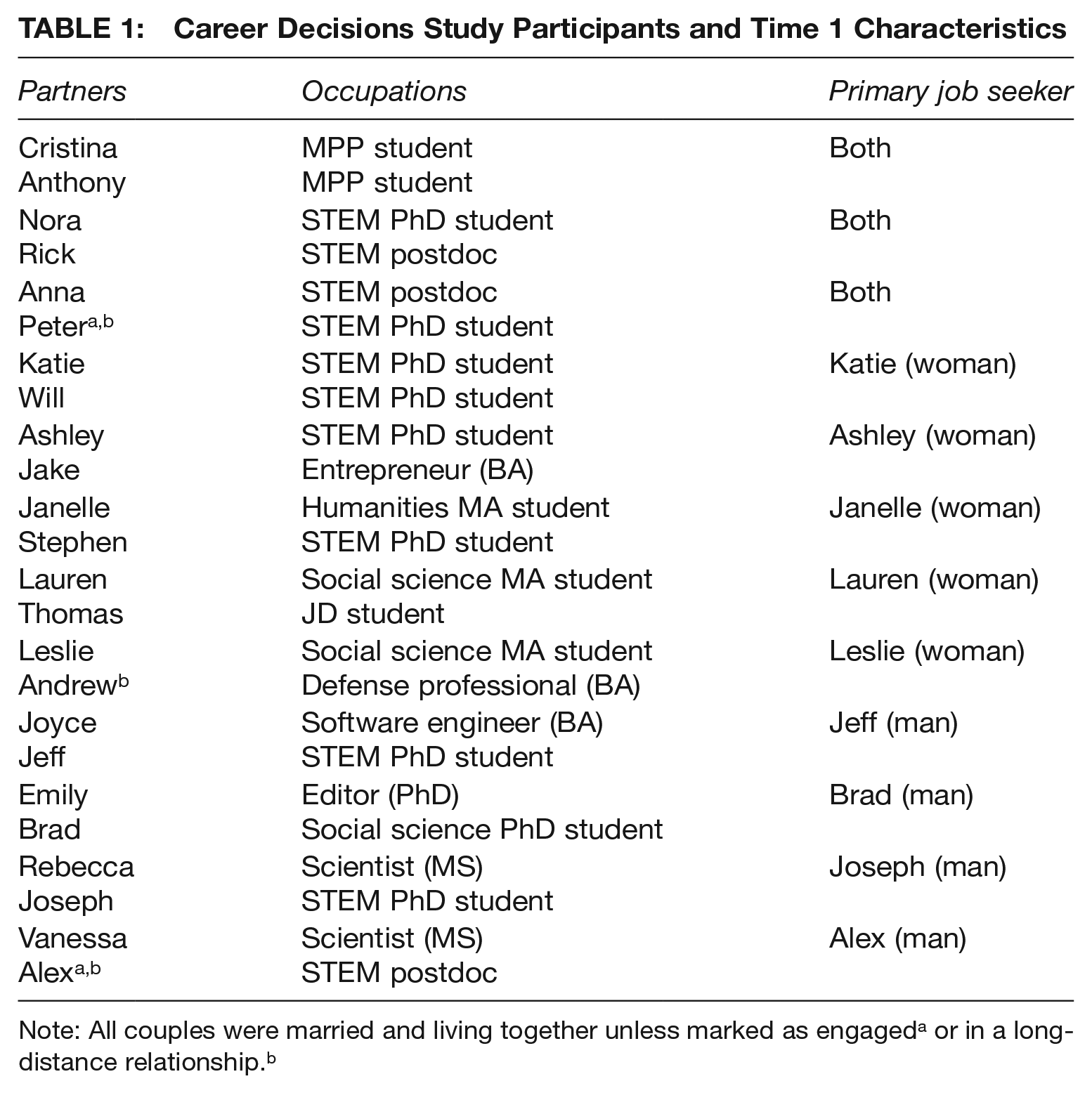
Note: All couples were married and living together unless marked as engageda or in a long-distance relationship.b
Baseline interviews collected January to April 2013 captured couples’ initial job search approaches, including how job seekers involved their partners. Partners were interviewed separately within a week and asked not to share study details with each other. Follow-up interviews conducted approximately 4 months later (April–August 2013) assessed how couples reached final decisions following receipt of school or job offers (or lack thereof). Most interviews were conducted in person in the researcher’s office, cafes, or participants’ workplaces or homes; three were conducted via phone. Both baseline and follow-up interviews averaged 1 hour. Additional follow-up interviews were conducted by phone 8 to 12 months after baseline (August 2013–August 2014; average 35 minutes), and over Zoom 5 years later (November 2018–June 2019; average 2–3 hours).
Housework Decisions Study
The second data set, the Housework Decisions Study (HDS), comes from a broader study of household labor among members of 32 different-gender couples (64 interviews). Respondents were married, 2 were college-educated, 3 and had at least one child under 5 years. Participants were recruited primarily via online parenting forums and email lists in a Northeastern metropolitan area, and secondarily through the researcher’s network and participant referrals. The advertised topic was “how parents make decisions,” to avoid priming on gender or household labor. Stay-at-home fathers were oversampled to achieve rough balance in men’s and women’s employment status.
The average HDS participant was 35.5 years old (range: 28–50). Couples had been married an average of 6.6 years (range: 1–22). No racial exclusion criteria were advertised, but 81% of men and 78% of women identified as white. Most men (78%) and women (66%) worked full-time for pay in fields including law, medicine, finance, education, and academia. Employed women worked a median of 40 hours per week and earned $70,000; employed men worked a median of 46 hours and earned $107,500. In a substantial minority of couples, the female partner earned (34%) or worked (41%) as much as or more than her partner. Couples averaged 1.5 children, and the mean age of the youngest child was 2 years. Table 2 summarizes HDS participants’ characteristics.
Housework Decisions Study Participant Demographics
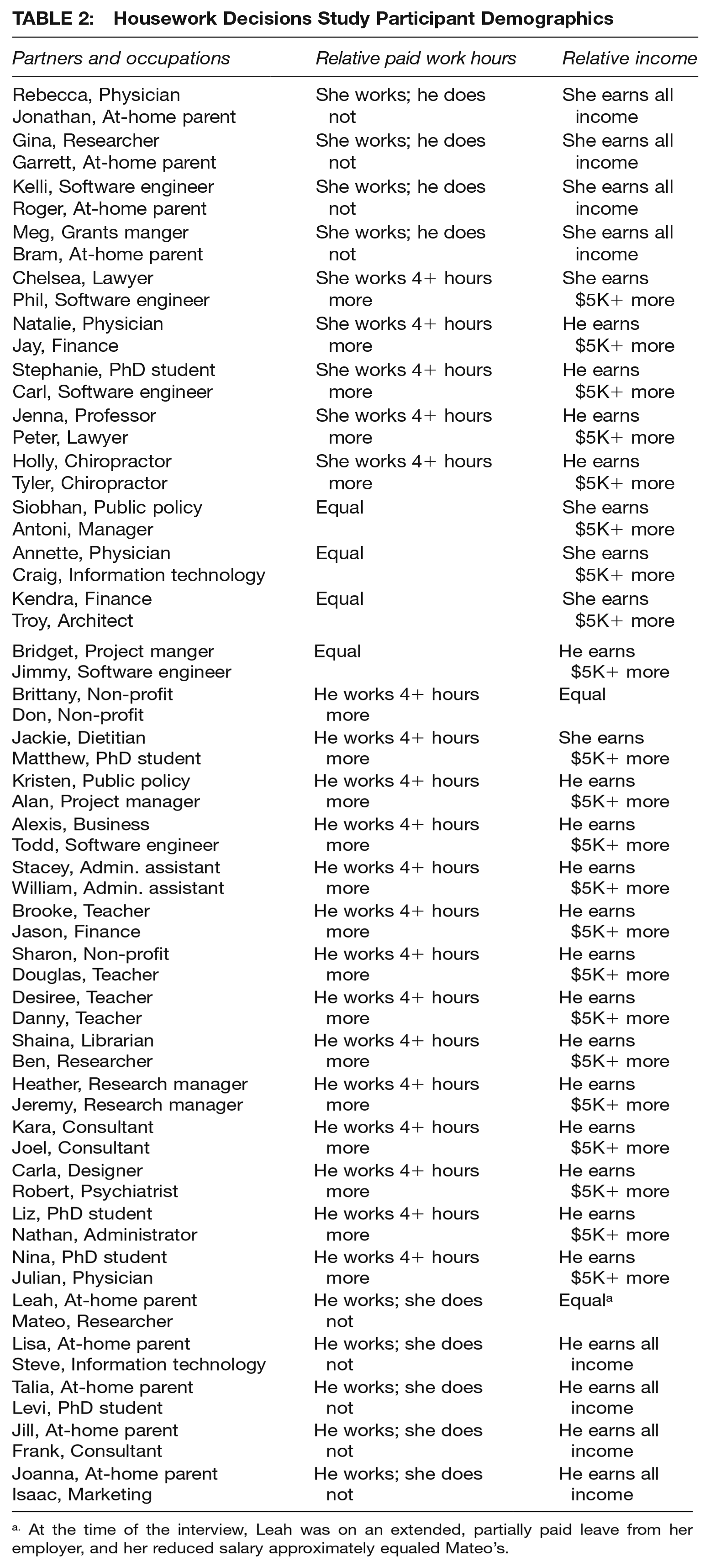
At the time of the interview, Leah was on an extended, partially paid leave from her employer, and her reduced salary approximately equaled Mateo’s.
In-person interviews 4 conducted in 2017 averaged 1 hour. As with CDS, partners were interviewed separately and asked not to discuss the study until both interviews were complete. Prior to each interview, respondents completed a “decision log” recording all family-related decisions made and contemplated over a 24-hour period. These logs structured the beginning of each interview, in which respondents detailed the circumstances surrounding logged decisions, including any partner involvement. Then respondents answered broader questions about their decision-making processes and ideal/actual division of domestic labor.
Combining and Analyzing the Samples
Both studies included interview questions about the nonfocal domain. CDS asked how couples’ career decisions impacted choices about family planning and household routines. HDS asked how daily household decisions interacted with decisions regarding paid work. Our data therefore allow us to explore whether and how relationship capital is used in decision-making across domains in couples’ shared lives.
The studies feature distinct samples of couples at slightly different life stages: childfree couples versus parents of young children. Because we did not co-develop our interview guides, we could not analyze responses to identical questions across studies. We acknowledge the resulting limits but emphasize the value of combining data sets to triangulate findings. Given the demographic similarity of the two samples, we suspect patterns seen in each would appear in the other if the nonfocal domain were more prominent. We present findings consistent across our studies and connect differences to variations in our research protocols, leveraging them to explore differences in decision-making across contexts.
The experiences of our privileged interviewees may not generalize to other populations. However, studying privileged actors allows us to observe decision-making agency among people who are not “forced” to make choices out of economic need or safety concerns. Furthermore, because interviewees self-selected into our studies, our analyses may best reflect patterns among couples with high relationship quality and openness to egalitarianism. Still, no partners were perfectly aligned with one another, and our study designs allowed us to directly compare attitudes with behaviors to analyze gendered power.
To do this, we closely read our respective transcripts and independently coded them by interview question or topic (Deterding and Waters 2021). We also wrote summaries of individual interviewees’ responses to situate them in their broader contexts: The first author compared respondents’ baseline decision-making approaches with their revised approaches and outcomes at follow-up; the second author compared how respondents talked about decision-making in the abstract and how they described specific, recent decisions. Because couples were the main unit of analysis, both authors compared partners’ accounts to identify couple-level dynamics. Last, we considered how decision-making in focal and nonfocal domains differed. Each author compiled this information in analytic memos that guided discussions of emerging findings. We discussed differences between data sets to understand how power relations vary across domains, time scales, and life stages. After meeting, we independently applied new codes to deductively analyze transcripts and generate revised memos. We repeated this process until we converged on a unified argument.
For example, each author independently observed that multiple respondents emphasized “working as a team” and prioritizing “the couple” and described setting aside personal preferences in service of this goal. We labeled this shared, reciprocal commitment to pursuing both individuals’ and the family unit’s best interests mutuality. In the deductive coding round, we assessed the prevalence of this theme in the full data set. Dissonant partner views alerted us to contradictory cases, which we connected to decision domains or other couple characteristics. Discussing dissonant partner interviews also called our attention to how couples fell short of mutuality and reproduced gender inequality, which became the next theme we coded and discussed.
Findings
What is the consensus upholding contemporary couples’ invisible power dynamics? Couples’ conviction that they were mutually sharing power by emphasizing “us” in all decisions and balancing a decision portfolio led many to overlook gendered power imbalances that emerged in their decision-making processes and outcomes. Partners’ focus on their efforts to practice mutuality rendered resulting power imbalances irrelevant and thus invisible.
Mutuality: Pursuing the Collective Good and Sharing Decision-Making Burdens
Rather than seeing decision-making as an opportunity to accumulate personal “wins” (i.e., drive a decision outcome to serve personal interests), 10 of 12 CDS and 24 of 32 HDS couples strongly aspired to mutuality, seeking to advance everyone’s interests. When Brittany (HDS) advocated for more equitable exercise opportunities following their daughter’s birth, her husband acquiesced, though that meant reducing his own workouts. Don explained, “It was important, because [working out] is a part of our routine that we really enjoy. I don’t think either one of us wants to resent our partner for [keeping us from] that.” Similarly, Alex (CDS) restricted his job search to Washington, DC, where his long-distance fiancée Vanessa targeted her own job hunt, because unilateral decision-making that primarily benefited his career would harm their relationship:
I would prefer it not to be me being like, “Hey, I’ve decided to move to San Francisco. Pack your stuff.” Vanessa enjoys her work a lot so uprooting her is not going to be good for our relationship or good for her.
For Don and Alex, it was more important to equally weight their own and their partner’s wishes than to get exactly what they wanted. Exercising manifest power by telling Vanessa what to do, or latent power by ignoring Brittany’s request for change, were unpalatable options. Rather than assuming male primacy, these couples expected mutuality.
Respondents’ desire for mutuality extended beyond equally weighing each person’s interests: Decision-making labor, they argued, should also be equally distributed. Although scholars often equate decision-making authority with individual power (e.g., Kranichfeld 1987), respondents like Liz (HDS) sometimes found independent decision-making “exhausting” rather than empowering. In turn, Liz experienced her husband Nathan’s involvement as a relief rather than an intrusion on her authority: “I like making him make—not making him, but getting his input or making sure that he’s involved in the decision making. Because it feels exhausting to make all the decisions.” When Nathan decided the family dinner plan, for example, Liz felt that “whatever you put in front of me I will eat gladly and appreciate that you took the mental burden, the actual logistical burden, away.”
Likewise, Nora (CDS) considered her husband’s involvement in her career decisions a helpful check on her tendency to perseverate rather than an unwelcome constraint on her autonomy. Nora and Rick were both pursuing academic jobs. Because Rick sought a permanent faculty position whereas Nora sought a short-term fellowship, the couple decided Nora would apply in cities where Rick was a candidate for a tenure-track job. Nora welcomed this restriction:
The postdoc [application] process would seem really overwhelming [otherwise] because I could literally go anywhere . . . Being an indecisive person that tends to be a worrier, being able to go anywhere would be completely overwhelming . . . I would constantly be wanting to delay making that decision.
Respondents saw the mental work of decision-making as a cost and were grateful to share that burden with their partner. Nathan’s participation in meal planning and Rick’s encouragement of Nora’s fellowship applications bucked assumptions of men’s singular focus on paid work and women’s “natural” place at home and instead suggested that partners aspired to mutual support in both domains.
Although no one expressed overtly selfish
5
approaches to decision-making, partners varied in their commitment to advancing everyone’s interests and equally distributing decision-making labor. One CDS and five HDS women feared that if they did not proactively assert themselves, their interests would be overrun. Desiree (HDS) worried about how she and her husband Danny would divide housework after the end of her parental leave and his summer vacation from teaching:
I really don’t want to start fighting about this kind of stuff. I’ve brought it up a couple times. I’m like, “We should really start designating jobs so that each person can do what they’re supposed to do. Then I don’t feel like I have to ask you to do things, or remind you, you just know.”
By assigning laundry to herself and cooking to Danny, Desiree hoped to avoid becoming overburdened. Danny had so far resisted her suggestion, suggesting latent power was at play. He acknowledged transitioning back to work would present challenges (“When I go back to school, it will be hard. It’s a new class, in a new school, so I can’t take too much time off”) but seemed confident their existing practice of informally allocating housework would hold: “For me [assigning chores] is, whoever has time to do it, I’m fine with . . . .I don’t think about [an ideal allocation].”
Others (one CDS man and members of four HDS couples) seemed to disrespect, though not fully dismiss, their partner’s interests and/or feel disrespected by their partner. Resentment tinged Garrett’s (HDS) description of how he and wife Gina made financial decisions together:
We don’t. My family’s money has been supporting us for the last five years, and when she was really busy in the first half of grad school, she was too busy to even do anything other than grad school so I managed everything . . . Ostensibly, she has been pursuing her career.
Garrett’s tone and phrasing (“ostensibly”; “I managed everything”) implied some combination of contempt for Gina and frustration at her perceived selfishness. Gina, meanwhile, had frustrations of her own. When it came to managing household logistics, she felt Garrett was insufficiently collaborative: “He is a very introverted person, and he does not like to be in charge. Sometimes that can cause some tension, where I’m like, ‘Someone else make a frigging decision!’” The spouses’ palpable dissatisfaction suggested both recognized a gap between a mutualistic ideal and their own relationship.
Exceptions aside, mutuality was central to most couples’ performance of intimacy. Even if joint decision-making was inefficient, building consensus around mutuality allowed partners to reaffirm their bond. Isaac (HDS) and his wife consulted each other on most issues, perhaps even “more than we need to,” because “it’s nice to decide things with your partner. It’s nice to have your life together, and so forth.” Respondents felt similarly about joint career decision-making. Explaining why he would turn down an ideal job offer, Rick (CDS; husband of postdoctoral candidate Nora, introduced above) said:
Any decision I make in the long run is a couple decision. It’s a proxy for how much I care about Nora. I mean, I really care about her. If you tell somebody “I am moving there, you can follow me,” it’s because you don’t give anything about it.
Rick’s commitment to Nora and their marriage led him to turn down offers that would be bad for her academic career and to negotiate job opportunities on her behalf.
Couples’ commitment to mutuality extended beyond platitudes. Partners described two tactics they mixed and matched in hopes of achieving “our way”: emphasizing “us” and balancing a decision portfolio. By deliberately and explicitly allocating labor and benefits equally across partners, couples could theoretically balance each person’s power. We detail these tactics before discussing how invisible power imbalances nevertheless crept in.
Couples’ first resort was to emphasize “us” by subsuming individual perspectives within a single vision. They framed this as different from compromise, which implies two distinct positions that must be reconciled. Rather, emphasizing “us” ideally meant co-generating a joint position. For occasional, major decisions like moving or changing careers, partners generated consensus via formal planning. Joyce said she and Jeff (CDS) used this method to map out how their lives would look if Jeff pursued two different career paths:
We did our usual thing, which was, we both went off and thought about it and wrote everything down—we did this with several life decisions before, where we meet for two or three hours and . . . .we diagrammed out what we thought was good for the short term, what we thought was good for the longer term, what our reasoning was, and then an open debate.
Joyce was pleased their session revealed that “We want things that involve settling down.” Jeff agreed: “If we’re not moving out of [our current city], we can get a house, we can think about having kids, we can consider the dog, we can . . . .move on to the next phase of life.” With this joint vision in mind, the partners agreed Jeff would only consider jobs in their current city. From this point forward, there was no more talk of Jeff’s perspective or Joyce’s; rather, they focused on how to execute their shared vision.
Because formal planning to emphasize “us” took so much deliberate work, couples more commonly engaged in ongoing conversation that blurred the boundaries between partners’ individual viewpoints and contributions. Jeremy (HDS) half-jokingly referred to himself and his wife as “the parenting committee.” “We’re constantly consulting,” he said, even regarding low-stakes issues like what to do with a child on a weekend morning. “I don’t know if necessarily it’s indecision or if it’s sort of an insecurity with the decisions,” he mused. “Sort of wanting to make sure that, ‘Hey, is this the right thing to do, what do you think about this?’ Sending it to the parenting committee rather than you just acting unilaterally.”
Jake and Ashley (CDS) used constant communication to consider options for Ashley’s career. “We’re big into discussing things,” said Jake:
We’re very communicative, open about talking about issues and what we want to do, and we’re very supportive. We talk a lot about this, like, “What are we going to do, how is this going to work?”. . . . Ashley will talk about, like, “I think we should move to [a country abroad].” She talks about this a lot. And it’s almost not a joke anymore, it’s almost a thing where I’m like, “You know what, sure, let’s consider that.”
Ashley concurred that “we just kind of talk all the time about . . . .‘What do we want to be doing? What kind of jobs?’” to brainstorm a solution for “us” rather than stake out opposing claims for two “me’s.” Constant communication turned a possibly contentious negotiation into an open-ended discussion.
When emphasizing “us” was impractical, or impossible because partners had opposing interests, couples turned to an additional tactic: balancing their decision portfolio. They sought to ensure partners had similar levels of decision-making responsibility and roughly equivalent opportunities to “win” across the broad landscape of their life together. Sometimes “balance” meant each partner led decision-making in distinct arenas. For any given decision area, one partner was implicitly or explicitly designated primary decision maker and the other secondary—but, importantly, these roles were reversed elsewhere. Lisa (HDS) described a clear delineation between her own and her husband’s areas of authority:
Financial decisions, Steve will often say to me, “Hey, do you want to learn about this and such, or do you want me to explain what’s going on with this?” [I’ll say,] “No, no, I haven’t got the mental space for that, you just figure it out, and I trust you to do that which needs to be done.”
While Lisa happily deferred to Steve on finances, both partners agreed she led travel and social planning.
Similarly, partners could pursue balance by dividing a multifaceted decision into subissues, with each partner taking the lead on some. When Rebecca (CDS) agreed to quit her job so Joseph could pursue career opportunities in other regions, Joseph made sure the couple moved to a location Rebecca preferred:
I know location’s important to her. . . .there’s been jobs I haven’t applied for because of the location. . . . .I think Florida would be her first choice.. . . . If it was just me, I would probably look more towards Pennsylvania. . . .but there’s two people, and [I’m] worrying about what Rebecca wants, too.
To balance out his career “win” and Rebecca’s career “loss,” Joseph accepted “losing” some locations so Rebecca could “win” by picking where the couple lived.
Other times, balance was interpreted longitudinally, such that both partners would have equal opportunity to win in the same domain over time. Andrew and Leslie (CDS) followed this approach to manage two demanding careers. When Andrew accepted a 5-year contract requiring frequent travel and periodic relocation—conditions that made it hard for Leslie to work continuously or pursue her PhD in one place—he explained, “The next five years, at least, are going to be for her. I mean, she’s followed me around through everything. I think I owe her everything.” In 5 years, he vowed, Leslie would dictate their location, even if Andrew had to turn down other opportunities to move for her. Such explicit efforts at sharing power underscore couples’ joint commitment to mutuality and rejection of a consensus built on male primacy (Komter 1989).
Falling Short: The Persistence of Gender Inequality
Couples’ power-equalizing tactics were not foolproof. All but five couples in each study reproduced gender inequality via a gender-traditional division of household labor and/or prioritization of men’s careers. We identify several nonexclusive mechanisms by which such inequalities could emerge but remain invisible. In short, couples insisted they were successfully practicing mutuality without accurately tracking whose interests were served and whose labor promoted those interests, suggesting that an uninterrogated belief in the mutuality myth constitutes the updated consensus upholding men’s invisible power (Komter 1989).
In CDS, couples fell short when emphasizing “us” looked more like emphasizing “him”: They made decisions that better served men’s interests, even as partners argued that both spouses’ interests were served. Cristina declined her first-choice job offer with a local policy group in Chicago when she sensed her partner Anthony would rather enroll in a graduate program in Washington, DC, than accept a Chicago-based program’s offer. Although the couple only considered locations that broadly worked for both partners’ careers, Cristina gave up her dream job in city-level policy making to move to DC without a job offer. Anthony would only have given up a slightly better-ranked PhD program by accepting the Chicago offer.
Still, Cristina, who previously worked in international policy but returned to school to transition into local policy, insisted she could better pursue her former field in Washington, DC:
I think this is the right decision. I kind of feel sad because coming [to meet you] today, I have nothing. I don’t even have an interview in DC. But I am very, very comfortable that this is the right decision. I think that is going to open more doors, to have the DC network and all the international organizations.. . . . Yes, both in Anthony’s life and also in mine.
Anthony agreed this decision would benefit both partners: “The priority for us as a couple right now is for me to get the best possible outcome from the PhD . . . It should be something that will be valuable for us in the future.” Anthony did not force Cristina to decline her offer (manifest power). Neither did Cristina grudgingly anticipate Anthony’s resistance to her career pursuits (latent power). Instead, both accepted this as the right decision because they believed it accomplished their shared goal of mutuality (invisible power). By glossing over the discrepancy in how much this decision benefited each person’s interests—Anthony entered his first-choice program while Cristina became unemployed—couples like Cristina and Anthony could believe they were emphasizing “us” while in fact emphasizing him.
Gendered power imbalances also emerged in CDS when couples’ attempts to balance career decisions over time were thwarted by failure to anticipate how his early decision wins might foreclose her later wins. Brad and Emily agreed Brad should apply widely for data scientist jobs first so Emily could then target her applications wherever Brad accepted an offer. After relocating, the partners were surprised that the types of museums Emily trained to work in did not exist in their new region. Brad vowed to help Emily return to her career (“She could pick up freelancing.. . . .I’ve talked to some people at work about her [research]”), but follow-up interviews revealed that after 5 years of informal consulting and lead parenting, Emily had yet to find the full-time work she hoped for. Nevertheless, she emphasized Brad’s commitment to her professional pursuits: “Brad’s still working at [high-paying company] so fortunately we can afford for me to. . . .get a babysitter four days a week or so in the mornings. . . .and I either edit or write.” Emily concluded, “We’re a good team. I’ve always felt like we were on the same team.” Emily’s focus on the mutuality myth—“we’re a good team”—obscured the couple’s career imbalance.
Finally, CDS couples sometimes fell short of practicing mutuality in expending decision-making labor. As her husband Joseph’s “job search coordinator,” Rebecca invested mental energy to support his career:
I’m just sort of compiling all the jobs together to look at.. . . . Me having a job and not being in school, it kind of frees up my stress level.. . . . When you’re in school and doing research [like Joseph is], it’s just like, it never ends. . . .but I go home and can not worry about [my job], so it’s not stressful at all for me to do extra work in that sense.
Given Joseph’s school and work responsibilities, Rebecca volunteered to share the cognitive work of job hunting. In contrast, after the couple eventually moved for his position, Joseph downplayed the urgency of Rebecca’s job search: “In our [financial] situation it wouldn’t be necessary.” He provided minimal instrumental and emotional support, to Rebecca’s frustration:
I don’t feel that we talk enough or talk about certain things that I need to talk about. Just in this process of job searching—like, I tend to not understand things I feel unless I talk about them.. . . . So, I tried to communicate that to Joseph. If nobody asks me how I feel about certain things, I’ll never explore it myself fully.
This dynamic corroborates previous empirical findings (Damaske 2021; Rao 2020). Extending the broader theoretical conversation about invisible marital power, we posit that Joseph’s failure to invest cognitive labor into Rebecca’s job search resulted in a gendered power imbalance in which both partners worked together to promote Joseph’s interests, but Rebecca labored alone to advance hers. Still, Rebecca considered Joseph to be committed to mutuality because he was financially “supporting me for no reason, really” during her unemployment.
Imbalances in men’s and women’s expenditure of cognitive labor also appeared in HDS, where couples’ household decisions were influenced by the presence of children. Mothers and fathers alike were committed to serving their children’s interests, and most described making parenting decisions together. Kara said she and husband Joel “never make [child-related] decisions unilaterally.” Danny, father to a newborn, said, “We aren’t good at making [unilateral] decisions, but also the baby is so young and new that we want to make sure that everything is, we are agreeing with it.”
But alongside this commitment to mutually advancing children’s interests was an assumption that women were better attuned to those interests, which translated into women’s greater parenting decision contributions. Douglas explained of wife Sharon, “She just is thinking about [our baby] and just all of his needs more than I am. Just for the fact that she is who she is, and the fact that she is his mom.” Sharon concurred: “I think it is maybe a function of being a nursing mom, or just a mom in general, where you tend to be very aware of all the things going on with the body of this little person.” Consequently, women like Sharon overwhelmingly tracked infants’ changing nutritional needs and suggested opportune moments to introduce new foods. They initiated childcare discussions and came up with a shortlist of daycares or nannies. They monitored health concerns and raised an alarm when it was time to seek medical attention.
HDS couples acknowledged women’s cognitive burden and sought to balance decision-making labor by including men in parenting decisions. Yet these attempts fell short when men’s involvement meant rubber-stamping women’s work. Kara, who avowed her commitment to joint parenting decisions, was pleased that “Joel likes to be involved and give his opinion on things.” Yet she noted that when she raises issues with Joel, she often “[has] a feeling he’d be like, ‘That’s fine.’” Recently, she shared her plans for their son’s birthday party: “I wanted to make sure that we talked about it. So it was, ‘Okay, great. I think we should get bagels.’ [He said,] ‘Great! Bagel sounds good.’” The couple’s commitment to mutuality made Joel’s agreement important, even if it took the form of a rubber stamp on Kara’s carefully considered recommendation. Their disproportionate focus on the most visible part of the cognitive labor process (decision-making; Daminger 2019) enabled them to overlook labor imbalances elsewhere.
Similarly, HDS couples fell short of equally distributing decision-making labor when men’s involvement took the form of wielding veto power or selectively participating in matters they felt passionate about. As Alan said regarding parenting decisions, “If I have issue with something, we’ll talk about it.” He could challenge his wife Kristen’s recommendations without the obligation to come up with his own. In practice, however, Alan typically agreed with Kristen’s parenting decisions because he assumed she had their son’s interests in mind: “I just trust that she’s got it. There’s a lot of trust there, I think. At least from my perspective . . . She’s a great mom.” Alan rarely reviewed Kristen’s decisions because “she’s got it.” On other domestic issues, Kristen described Alan as:
the big-picture guy.. . . . He gets really excited about something, anything—it could be a trip, it could be whatever—and wants to do it. And then I’m the wet blanket that says, “Okay, how do we get there and what do we have to do first?”
After planting an idea he believed would benefit “us,” Alan often left the planning—and related labor—to Kristen. Alan’s active participation in shaping household life, coupled with the partners’ inattention to disparities in the effort involved in executing their shared vision, bolstered the couple’s sense of themselves as a team.
These patterns are not explained by differences in work hours and earnings. HDS men partnered with unemployed women leaned into the idea of domestic decision-making labor as her purview. Isaac noted with some frustration his wife Joanna’s habit of calling him at work to solicit input on childcare decisions:
She might ask me, “Should I try to put [the baby] down for a nap now? Or should we just go out?” “Well, I’m not there. I can’t see the baby. I have no idea. . . .You just have to make this decision.”
Meanwhile, women partnered with unemployed men felt compelled to provide support from afar, hinting at a subtly different understanding of how to enact their commitment to mutuality. Meg noted, with empathy rather than frustration, that husband Bram “involves” her in decisions such as what to buy while he is out shopping:
Sometimes there are so many choices that you finally whittle them down, and you’re like, “I don’t know, I’ve had enough of this.” And the other person can come in and say, “To me I would prioritize this over that.”
Meg looked for proactive ways to contribute to the couple’s mutuality project when not physically present, whereas Isaac felt that his physical distance let him off the hook.
Last, HDS couples fell short when they counted partners’ nonequivalent decision wins as “balanced.” Although couples rarely recognized the unequal labor costs of home-centered decisions, they were not oblivious to women’s default authority on domestic matters. To “balance” women’s domestic leadership, men often retained precedence in the career domain. Couples implied this was a fair trade. But while day-to-day details of the household might be driven by women, many couples lived within a broader landscape dictated by men’s career interests. Nathan offered a metaphor for his dynamic with wife Liz regarding child-related decisions:
I’m the sort of CEO of the household . . . But here’s the kicker: she’s the chairman of the board and owns 51% of the company. So she—this is her thing, and I’ll kind of come up with some fun ideas and be party planner and support and do all that stuff . . . It’s our company, but she’s the chairman.
Later, Nathan said the situation was reversed for their careers and “global” issues such as whether and where to move:
[In] our career right now, it’s not balanced . . . And I’m more particular of what kind of house we buy, where we live, stuff like that . . . It’s sort of the global, the local. I care a lot about the global, and she focuses on the local, and then we reverse sometimes . . . I’m supporting her vision when she wants to set vision, and she’s supporting my vision when I want to set vision. But we don’t typically have competing visions.
For her part, Liz said Nathan “doesn’t always notice” details related to their shared domestic life. “There have been times where I’ve felt resentful,” she admitted. “Like, ‘Why do I have to keep track of X?’ But. . . . I feel like we’ve found a good balance that feels really good to me.” Nathan and Liz pointed to their respective leadership roles as evidence of a balanced decision portfolio and commitment to mutuality. Nathan traded the relationship capital (Geist and Ruppanner 2018) earned through supporting Liz’s domestic vision for Liz’s support of his “global” and career vision. Yet their solution to the problem of sharing power reified the longstanding gendering of public and private spheres. Men’s greater concentration of career-related wins was frequently juxtaposed with women’s domestic shot-calling, but in a capitalist society, the “winner” in the work domain accrues greater prestige and resources that afford them more power beyond a particular relationship (England and Kilbourne 1990).
The five CDS and five HDS couples who were more successful at equalizing marital power (or tipped it in women’s favor) were disproportionately likely to emphasize “us” via formal planning (like CDS couple Jeff and Joyce). Men in these couples also conscientiously reciprocated or exceeded their partners’ cognitive labor investments in career and family decisions (like Rick in CDS, who negotiated job opportunities for Nora). Further analysis is beyond the scope of this article, but these tactics may have helped equalize power outputs and labor inputs across partners.
Discussion And Conclusion
Gender inequalities in the allocation of material and symbolic resources persist despite changing ideologies and growing desire, particularly among highly educated individuals, to minimize overtly antagonistic marital decision-making (Gerson 2011; Lamont 2020; Scarborough, Sin, and Risman 2019). This apparent contradiction prompts questions about what upholds gendered power imbalances, given support for women’s labor market pursuits (Scarborough, Sin, and Risman 2019) and openness to men’s engagement at home (Dernberger and Pepin 2020). We revisit and update Komter’s (1989) concept of invisible power for the 21st century. The “ideological consensus” upholding men’s invisible power in Komter’s (1989) day was the assumption of male primacy. We found little direct evidence of this assumption in our data sets. Instead, the dominant consensus involved a myth of mutuality.
Our analysis of 112 interviews with the partners of 44 couples reveals how couples who intentionally use multiple tactics to share power can nevertheless perpetuate men’s advantage. Power imbalances crept in when CDS couples adopted “his” vision as “ours” and both partners did cognitive labor to advance his career interests. Power imbalances emerged in HDS when “her” vision was adopted as “ours” but women invested more decision-making labor to advance the interests of children and the family. Temporal balance proved troublesome in CDS, and balance across work and family domains reinforced gendered separate spheres in HDS. Yet couples rarely tracked these inequalities, allowing them to claim they were “working together” to get “our way.”
The presumption of mutuality helped obscure the persistence of power imbalances in couples’ decision-making. The mutuality myth adds to our understanding of couples’ mobilization in support of men’s job searches (Damaske 2021; Rao 2020) and acceptance of women’s disproportionate domestic labor burden (Daminger 2020). Seeing themselves as emphasizing “us” and balancing a decision portfolio across work and home to benefit the family unit helped couples overlook evidence they subtly emphasized “his” preferences and relied disproportionately on “her” cognitive labor. Invisible power operates in contemporary different-gender couples when adherence to this new “family myth” (Hochschild 1989)—which couples connect to intimacy and coupledom—points partners toward appreciating deliberate efforts at mutuality while de-emphasizing critical evaluation of their success. Although most couples fell short of equalizing marital power, a greater proportion of CDS couples than HDS couples successfully practiced mutuality, corroborating previous findings that egalitarian employment attitudes outpace those in the domestic sphere (Pepin and Cotter 2018).
We suspect that couples’ reliance on constant communication contributes to the adoption of “his” goal as “our” goal. Whereas formal negotiation facilitates accurate tracking of decision benefits and labor, constant communication blurs individuals’ viewpoints and contributions, consequently obscuring each person’s decision labor and benefits. In business negotiations, outcomes are often commodifiable. In marital negotiations, by contrast, quantitative comparison of individual effort and benefits is rarely possible or, from partners’ perspectives, desirable. Tracking individual wins and losses and the labor involved in achieving these appears anathema to love and intimacy. Yet the avoidance of scorekeeping creates its own problems, as individual interests (empirically, men’s) can quietly overtake the collective good.
Similarly, the fallback approach of balancing an overall decision portfolio can backfire. Couples were not oblivious to men’s greater career decision wins. Yet their primary response was to offset his wins with her wins in the domestic realm, without interrogating the equivalence of such offsets or factoring in the labor involved. That men’s leadership in the career space could, in respondents’ view, be balanced by women’s leadership in the domestic space, or by a planned role reversal in the future, implies couples understood “relationship capital”—credit accrued for supporting a spouse in one decision that can be leveraged in subsequent decisions—as common currency portable across time and between work and home (Becker and Moen 1999; Geist and Ruppanner 2018).
There are at least two problems with this “common currency” interpretation. First, partners considered getting one’s way in paid work and getting one’s way at home as equivalent. In a capitalist society where status and power are linked to economic resources (England and Kilbourne 1990; Pupo and Duffy 2012), however, domestic- and career-related “currencies” carry different weights. It is significant that men in our sample disproportionately won in career decisions, with clear economic advantages, even as they deferred to their wives on issues related to home and children—with some notable exceptions regarding “big-ticket” items like what type of house to buy (Hardill et al. 1997).
Second, couples’ focus on giving each partner equivalent opportunities to “set vision” did not account for the labor costs of decision-making. When couples “balanced” men’s career and women’s domestic decision “wins,” they did not acknowledge the heavy cognitive labor load associated with driving household decisions (Daminger 2019; Robertson et al. 2019). One notable exception was women partnered with at-home men, who proactively provided decision support from afar—a behavior rarely seen in men partnered with at-home women. Career decision-making also involved considerable cognitive labor. Here, too, women routinely mobilized in service of men’s career goals without reciprocal efforts from men. Altogether, women’s relationship capital seems not to have as much purchase power as men’s, echoing previous findings that men’s and women’s financial capital do not carry equivalent weight (Tichenor 2005).
We acknowledge that both our framework and our theoretical conclusions may be most applicable to highly educated, White, different-gender couples. Our self-selected, privileged samples prevent us from documenting the full range of decision-making tactics and power dynamics among contemporary couples, which may vary for partners with different relationship satisfaction levels or those sitting at different intersections of race, class, gender, and sexuality. For example, Moore’s (2008) work on power among Black lesbian stepfamilies suggests a positive correlation between power and labor: Biological mothers leverage greater household labor contributions into family decision-making authority. Although this finding does not directly contradict our work, which also demonstrates a complex linkage between labor and authority, it does reveal a need for further research on the applicability of our findings to couples in other relational contexts.
Limitations aside, our respondents represent a useful case for examining gendered power via decision-making, as socially privileged actors often support egalitarianism and can access resources that facilitate egalitarian practices, even if they ultimately behave in gender-unequal ways (Usdansky 2011). This research adds to literature on gendered power relations in 21st-century families (e.g., Lamont 2020; Miller and Carlson 2016; Rao 2020) by revealing how endorsing mutuality and developing strategies for equalizing power are promising but insufficient steps on the path to equality in different-gender relationships. Further progress will require careful evaluation of the effectiveness of those strategies and vigilance regarding common pitfalls, such as the inadvertent substitution of “his” vision for “ours” or the presumption of balance across incommensurate spheres. Without careful consideration of who gets their way, how they do so, and the social context surrounding these interactions, couples and scholars alike may overlook key processes that inscribe and reinscribe gender inequalities in everyday life.
Footnotes
Authors’ note:
Both authors thank the respondents who generously contributed their time and shared their stories with us. We are grateful for the incisive feedback of Sasha Killewald, Ellen Lamont, Monica Liu, Isabel Nuñez Salazar, Abigail Ocobock, Ariane Ophir, Joanna Pepin, Richard Petts, Jessi Streib, Jocelyn Viterna, and participants in the 2021 ASA Annual Meeting and the UW-Madison FemSem. The first author also thanks Yonatan Kogan for serving as a regular sounding board for nascent ideas. The second author received funding from the Weatherhead Initiative on Gender Inequality at Harvard University and from the James M. and Cathleen D. Stone PhD Fellowship in Inequality and Wealth Concentration.

Notes
Jaclyn S. Wong is an assistant professor of sociology at the University of South Carolina. Her multimethod research examines gender inequality in families over the life course. She recently published Equal Partners? How Dual-Professional Couples Make Career, Relationship, and Family Decisions (University of California Press).
Allison Daminger is an assistant professor of sociology at the University of Wisconsin, Madison. Her research, which focuses on gender inequality in family life, has been published in the American Sociological Review. She is currently at work on a book about cognitive labor, under advance contract with Princeton University Press.