



Abstract
Occupational sex segregation persists in part because men seldom enter female-dominated occupations. Whereas programs providing women with gender-atypical learning experiences aim to increase female representation in male-dominated domains, similar programs for men—despite their potential to counteract the prevailing lack of men in female-dominated occupations—are rare. In this paper, I investigate whether men’s gender-atypical learning experiences affect their likelihood of entering female-dominated occupations by studying the effect of participation in Germany’s civilian service. The civilian service offered a social-sector alternative to compulsory military service, and its suspension in 2011 induced exogenous variation in men’s gender-atypical learning experiences. Combining register data from Germany’s social security system with data from the German Microcensus shows that men’s likelihood of entering the labor market in female-dominated occupations declined by about 21 percent when the civilian service was suspended. Scaling the estimate by participation in the civilian service indicates that having completed the civilian service increased men’s likelihood of entering female-dominated occupations by about 12 percentage points. This illustrates that programs exposing men to gender-atypical learning experiences can promote occupational integration and could “unstall” the gender revolution.
Keywords
Occupational sex segregation is one of the primary mechanisms behind gender inequalities in labor market outcomes (Busch 2013a; England 1992). Some occupations have been desegregated since the 1960s, when increased numbers of women joined the labor force and entered better-paid, male-dominated fields. Yet occupational integration has been asymmetrical, and men still seldom enter female-dominated occupations, such as health, early education, and domestic work (Blau, Brummund, and Liu 2013; Busch 2013b; England 2010). Men’s reluctance to enter these fields becomes increasingly important in light of industrial restructuring, which has reduced employment opportunities in traditionally male-dominated, blue-collar occupations and has increased the demand for workers in female-dominated social service sectors (Esping-Andersen 2009). So why are more men not entering female-dominated occupations?
Several explanations have been proposed to explain occupational sex segregation in general and the lack of men in female-dominated occupations in particular. Social role theory (Eagly 1987) and the circumscription and compromise model (Gottfredson 1981) emphasize congruity between gender identity and essentialist notions of gendered skills, on the one hand, and occupational stereotypes about occupational roles and skills needed on the other. This applies especially to men, who are subject to harsher social punishments than women for transgressing gender boundaries, and the rigidity of masculinity norms deters them from taking on social and caring roles (Friedman 2015; Vandello and Bosson 2013). Accordingly, men avoid female-typed occupations due to fears of social disapproval (Williams 1995), of a lack of belonging (Tellhed, Bäckström, and Björklund 2017), or because of anticipated discrimination (Yavorsky, Ruggs, and Dill 2021). Additionally, England (2010) attributes the asymmetry between women entering male-dominated occupations more often than men entering female-dominated occupations to the persistent economic devaluation of feminized tasks. Whereas (highly educated) women have an incentive to enter prestigious and higher-paying male-dominated occupations, on average lower wages offered for feminized tasks remain a barrier that deters men from crossing occupational gender boundaries.
To counteract occupational sex segregation, some have proposed programs that promote gender-atypical learning experiences. Gendered socialization processes tend to provide boys and girls with different gender-typed learning experiences, which in turn affect occupational aspirations (Schaub and Tokar 2005; Williams and Subich 2006). Consequently, gender-segregated learning experiences are an additional factor contributing to occupational sex segregation. However, the importance of gendered learning experiences simultaneously points to a mechanism of occupational desegregation. The deliberate exposure of individuals to gender-atypical learning experiences counteracts gendered learning and can spark interest in gender-atypical occupations (Betz and Schifano 2000). This reasoning underlies several initiatives, with prominent examples being SciGirls Connect (www.scigirlsconnect.org) and various science, technology, engineering, and math (STEM) summer schools in the United States (Kitchen, Sonnert, and Sadler 2018), as well as the annual Girls’ Day in Germany (Wentzel 2011). These programs encourage female students to explore male-dominated and especially STEM occupations, provide them with opportunities to meet women working in these fields, build their STEM skills and self-confidence, and ultimately encourage them to pursue careers in STEM fields. Some correlational evidence backs up the effectiveness of such programs (Betz and Schifano 2000; Funk and Wentzel 2014; Kitchen, Sonnert, and Sadler 2018).
By contrast, programs that expose men to learning experiences in female-typed tasks are rare. For instance, a Boys’ Day was only introduced in Germany 10 years after the first Girls’ Day (Wentzel 2011). Block et al. (2019, 127) highlight that the lower level of support for increasing the number of men in female-dominated occupations is another expression of the devaluation of female-dominated occupations, with views of their lower status rendering these fields “less deserving of attention and social action toward change than occupations where women are underrepresented.” Yet programs directed to men may be especially relevant to counteract gendered occupational stereotypes and income barriers underlying men’s greater reluctance to transgress gender boundaries. Simultaneously, this reluctance raises the question of whether programs promoting gender-atypical learning experiences would be equally effective in raising men’s interest in gender-atypical occupations as they are in raising women’s interest.
To assess the effect of gender-atypical learning experiences on men’s occupational choices, I utilize the 2011 suspension of the German civilian service, which was an alternative to compulsory military service for German men. As the majority of men completed their civilian service in nursing homes, hospitals, childcare centers, or social welfare organizations, the unanticipated suspension of the civilian service mimics a natural experiment of varying men’s exposure to gender-atypical learning experiences. Additionally, the civilian service is of great relevance because it affected a large number of individuals (around a fifth of conscription-age German men completed the civilian service) and it occurred in the crucial life stage between graduation from secondary school and entry into the labor market.
My analysis reveals that gender-atypical learning experiences increase men’s likelihood to enter female-dominated occupations. Combining register data from Germany’s social security system with the German Microcensus shows that men’s likelihood of starting their first job in a female-dominated occupation decreased by 21.5 percent when the civilian service was suspended. Conversely, having completed the civilian service while it was still in place increased men’s likelihood of subsequently entering a female-dominated occupation by 11.9 percentage points. While this effect is identified across birth half-years, descriptive evidence from a 2009 survey of men ages 18–32 years underlines its robustness via individual-level associations.
This study contributes novel evidence on how to promote occupational integration. Previously, less attention has been devoted to the lack of gender-atypical learning experiences encountered by men as a potential explanation for the asymmetry of fewer men entering female-dominated occupations than women entering male-dominated occupations. Although the civilian service is an extreme case of programs of fostering such experiences, it highlights their potential to counteract the prevailing lack of men in female-dominated occupations. Programs that promote gender-atypical learning experiences should therefore not be limited to women, as they can also be effective for men in reducing occupational segregation. Moreover, the obtained evidence is also relevant to policy discussions on mandatory community services, as proposed, for instance, in the United States (Brooks 2020) and France (France 24 2019) to increase civic engagement. Although the effectiveness of such programs remains contested (Henderson, Brown, and Pancer 2012, 2019), the example of the German compulsory civilian service indicates that community services may have the unintended consequence of increasing openness to gender-atypical occupations.
Effects of Gender-Atypical Learning Experiences Among Men
How can gender-atypical learning experiences foster men’s entrances into female-dominated occupations? One evident mechanism involves learned skills. If learning experiences are gained in job-like environments and include actual tasks required in occupations, the learned skills represent human capital endowments that can be best utilized by choosing an occupation that requires the respective skills (G. S. Becker 1993). Thus, gender-atypical learning experiences can transmit skills for gender-atypical occupations and provide an introduction to respective working environments, both facilitating entry into these occupations. The human capital gained through such experiences would be lost by subsequently entering other, gender-typical occupations, albeit its potential benefits for entering female-dominated occupations later in life or for other life domains, such as the domestic sphere or civic participation.
Established contacts during learning experiences may also facilitate subsequent job search processes in respective fields (Granovetter 1995). This lowers entry barriers for gender-atypical occupations and might thereby prompt entrances into them. Yet because men are overwhelmingly hesitant to enter female-dominated occupations in the first place, they can be expected to seldom leverage such social capital in their job search.
Apart from human capital and social capital, gender-atypical learning experiences can also change perceptions of the congruity of one’s gender identity and occupational roles (Cech et al. 2011). In line with status beliefs about men’s superior competence and abilities (Ridgeway 2009), qualitative interviews with employees, clients, and customers highlight that men are welcomed into female-dominated occupations for bringing presumed “male” traits of physical strength or authority to the workplace, for diversifying the work environment, and for raising the status of the respective occupations (Moskos 2020). This is mirrored by some men in female-dominated occupations who report receiving explicit recognition from supervisors and clients and being assigned to positions of greater responsibility than female coworkers, allowing them to grow on such challenges (Simpson 2009; Williams 1995). Moreover, Hirschi (2012) shows that the communal aspect of care work in female-dominated occupations also lends meaningfulness to the tasks involved, enhancing self-efficacy beliefs regarding these types of tasks. Accordingly, gender-atypical learning experiences can lead to acknowledgment, increased self-confidence, and self-efficacy beliefs, which, in turn, amplify interest in female-dominated occupations.
Yet experiences of role strain can undermine openness to gender-atypical roles. This is underlined by qualitative evidence on men in female-dominated occupations, who report that family members, customers, patients, and coworkers often remind them that they are different from stereotypical men, going as far as accusing men of homosexuality or pedophilia when they work in caring or nurturing roles (Evans and Blye 2003; Simpson 2005; Williams 1995). Regardless of such stigmatization, an experiment conducted in the United States showed how men who were instructed to perform a stereotypically feminine task (brushing a mannequin and binding a pink tie) experienced role strain and subsequently more often chose a masculine punching task to reinstall their masculinity than a control group that performed a braiding activity framed as a rope-strengthening task (Bosson et al. 2009). While positive experiences can help to neutralize perceived role incompatibility for some men (Lupton 2006; Shen-Miller and Smiler 2015), minority men especially (such as Black and migrant men as well as men from lower social classes) experience role strain, and the negative effects of their token status often outweigh positive experiences (Dill, Price-Glynn, and Rakovski 2016; Smith 2012; Williams 2013). Ultimately, negative experiences in female-dominated occupations can culminate in disproportional exits toward more gender-typical occupations (Torre 2018).
Thus, gender-atypical learning experiences might foster entrances into gender-atypical occupations via skills learned through these experiences, social ties into respective fields, and self-confidence and recognition for serving in a gender-atypical field. By contrast, experiences of stigmatization and role strain may lead to subsequent avoidance of gender-atypical occupations. Therein, selection into gender-atypical learning experiences likely shapes which of these effects applies (Simpson 2005). Williams and Villemez (1993) highlight two entry dynamics for men into female-dominated occupations: On the one hand, “seekers” deliberately entering nontraditional occupations because they provide them with opportunities to pursue their own personal abilities and goals (Barber 2008; Dodson and Di Borders 2006); on the other hand, “finders” ending up in female-dominated occupations in response to constraints, such as involuntary unemployment (Yavorsky and Dill 2020) or limited employment opportunities for men from working-class backgrounds (Bagilhole and Cross 2006; Seehuus 2019). Correspondingly, seekers’ openness to nontraditional occupations likely mitigates potential role strain in gender-atypical learning experiences, while a lack of endorsement of gender-atypical occupational roles renders finders more vulnerable to role strain (Lupton 2006; Sobiraj et al. 2015). To address the fact that the extent of role strain and positive experiences in gender-atypical domains depends on the selection processes into them, I use the exogenous variation in men’s gender-atypical learning experiences caused by the suspension of Germany’s compulsory civilian service.
The Civilian Service as a Treatment
In 1953, compulsory military service (Grundwehrdienst) was introduced in Germany, and in the 1960s, a civilian service was added for conscientious objectors. 1 Men with German citizenship between the ages of 18 to 23 years were required to serve nine months 2 and received financial compensation (around €10 per day in 2010). Women and foreigners were not subject to conscription and therefore could not serve in the civilian service, but could enlist voluntarily for military service. While the purpose of conscription was to provide young people with military education and training that could lead to potential future military careers or become useful in case of a need to expand the military in an emergency, the civilian service was intended to contribute to public well-being. Accordingly, the majority completed their civilian service in nursing homes, childcare institutions, hospitals, or welfare organizations. Because the civilian service had to be labor market neutral and required no vocational training, men in the civilian service were largely supposed to take on supporting roles for regular employees. Nevertheless, many participants reported that their main activities were similar to those of the overwhelmingly female regular co-workers and consisted of care tasks, such as assisting with custodial care or personal hygiene and providing meals or activities for children, patients, and elderly or disabled individuals; only a minority served in gender-neutral or male-typed roles such as ambulance drivers, janitors, or administrative positions (Bartjes 1996; C. Becker et al. 2011; see also Online APPENDIX, Figure A1).
Although participation in the civilian service might have been perceived generally as a rejection of military service and less as a gender norm violation (Bartjes 1996), men who served in the civilian service had to relate their experiences to their male identity (Tremel and Cornelißen 2008). Studies indicate that, comparable with men working in female-dominated occupations, most men experienced role strain during their civilian service, with their sexuality being questioned (Bartjes 1996) and feeling urged to emphasize male-typed activities as part of their service (C. Becker et al. 2011). Yet their special status as members of the compulsory civilian service with no prior work experience meant that employers and clients held them to lower standards and allowed them greater flexibility in their work compared with regular employees in the same institutions (Bartjes 1996), thereby mitigating the role strain. Men in the civilian service reported that they were highly regarded by customers, patients, and their predominantly female co-workers, and they evaluated the civilian service overwhelmingly positively (Bartjes 1996; C. Becker et al. 2011; Blank 2003).
Evidence on potential effects of participation in the civilian service is scarce, however. Qualitative research shows that at the end of their service, some participants reported a change toward more egalitarian gender ideologies, increased esteem for care professions, and improved skills in working in teams or autonomously (C. Becker et al. 2011; Blank 2003). Despite gains in perceived meaningfulness of social work, only a few stated that the civilian service had affected their occupational aspirations (C. Becker et al. 2011; Blank 2003). Moreover, whereas the majority of participants in the civilian service who served shortly after graduating from academic-track secondary school reported experiencing the civilian service as a welcome orientation phase before entering vocational training or college, a considerable share of graduates from lower- or intermediate-track secondary school had already begun vocational training or employment and experienced the civilian service as a waste of time (Bartjes 1996; C. Becker et al. 2011). This is also backed up by a quantitative study by Eberl, Collischon, and Jahn (2022) which revealed that only men who graduated from lower- or intermediate-track secondary school (but not those who graduated from academic-track secondary school) experienced an increase in their life satisfaction following the suspension of compulsory military and civilian service, as this eliminated a major career interruption for them. Yet no study has quantitatively examined the causal effect of participation in the civilian service on occupational choices.
Although serving in either military or civilian service was mandatory, only a (self-selected) group of young German men turning 18 completed civilian service. First, men without German citizenship, married men, fathers, and men with two siblings who had already served were exempted from any service. Second, the remaining men had to undergo medical examinations, with some being classified as unfit to serve. Men were also allowed to postpone either service to finish current vocational training, diminishing the likelihood of conscription for men who completed secondary school before the age of 18 years (Schneider 2003). Third, the remaining men who were conscripted had to file for conscientious objector status based on moral objections in order to enter the civilian service instead of the military service. This self-selection resembles selection into female-dominated occupations to some degree (Hardie 2015). For instance, higher educational attainment was positively associated with filing for conscientious objector status (C. Becker et al. 2011), and for some applicants, not only moral grounds but also a rejection of hierarchies and of masculinity ideals in the military guided their decision (Bartjes 1996). By contrast, a desire to try out the actual tasks one would perform in the civilian service was less important to those who filed for conscientious objector status (C. Becker et al. 2011).
The fact that only about half of all men in the 1980s birth years actually served in the military or civilian service stoked debates over the justification for conscription (Schneider and Trabold 2004). In June 2010, a commission to reform the armed forces proposed the abolition of compulsory military service. This was rapidly adopted and led to the suspension of compulsory military and civilian service in March 2011. Whereas a suspension had been debated for years, prospective draftees could not anticipate its quick implementation: Similar to the years before, about 100,000 men (19.1 percent of men age 19 years) were in the civilian service in 2010, indicating no postponement of serving based on an anticipation of the suspension; this number dropped to zero in the following year (Figure 1; see also Online APPENDIX, Figure A2 for related Google search trends).
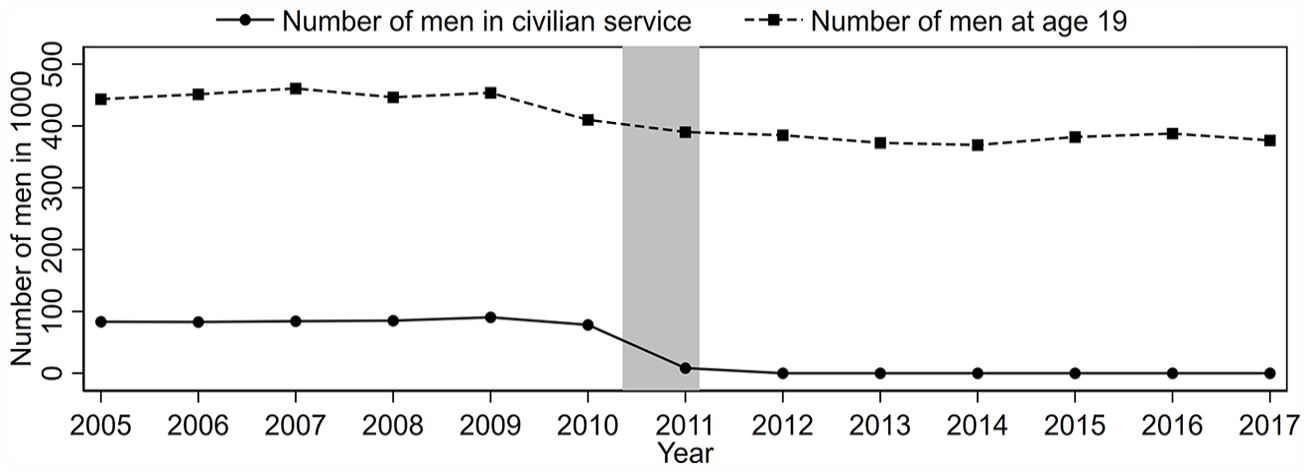
Men Completing Civilian Service Over Historical Time
The theoretical discussion indicates that gender-atypical learning experiences in the civilian service could have increased the likelihood of subsequently working in female-dominated occupations or strengthened a reluctance via role strain and experiences of stigmatization. Because selection into gender-atypical learning experiences likely moderates this effect, it is important to note that participation in the civilian service was also selective, especially since it required individuals to file for conscientious objector status. Nevertheless, the timing of the suspension of compulsory service was not anticipated and provides a natural experiment of varying men’s gender-atypical learning experiences to obtain causal evidence: Analyzing the exogenous variation induced by the suspension allows us to assess whether a potential association between having completed the civilian service and subsequently working in female-dominated occupations is not based on selection itself (as it would be if men who joined the civilian service would enter female-dominated occupations regardless of having participated in the civilian service or not) or whether gender-atypical learning experiences in the civilian service had an effect in and of themselves on entries into female-dominated occupations. Therein, the obtained effect size depends on the extent that the identified effect varies across characteristics that also drive the selection into the civilian service, which will be addressed in the Discussion.
Methods and Data
Analytic Strategy
To assess the effect of the suspension of the civilian service on the likelihood of working in a female-dominated occupation, I first compared both phenomena across men’s birth half-years. I calculated birth-half-year–specific likelihoods of men completing civilian service and of men entering a female-dominated occupation as their first job. To preclude potential period effects of divergent labor market conditions at job entry, I employed women as a comparison group. Women could not serve in the civilian service, so their likelihood of starting their first job in a female-dominated occupation should be only indirectly affected by the suspension of the civilian service.
Second, I used linear probability models to estimate the change in men’s likelihood of entering female-dominated occupations induced by the suspension of the civilian service. 3 This provides an intention-to-treat effect, which applies to men’s birth half-years, regardless of whether they actually served in the civilian service. Scaling this estimate by the birth-half-year–specific participation rates in the civilian service provides a treatment effect on the treated under the assumption that birth half-years only affected entrances into female-dominated occupations via the decrease in participation in the civilian service (Angrist and Krueger 1992; Pacini and Windmeijer 2016). This captures the effect of gender-atypical learning experiences in the civilian service on gendered occupational choices of men who participated in the civilian service and is backed up by an individual-level association of similar size obtained from a robustness check.
Data and Measurements
I used two data sets for my main analyses. First, I drew on register data from the Sample of Integrated Labor Market Biographies (SIAB; vom Berge et al. 2021) for occupations in first jobs. It is a 2 percent random sample of all employed individuals who contribute to the German social security system (excluding civil servants, self-employed individuals, individuals in compulsory service, and individuals in marginal part-time jobs), for whom it contains all employment spells between 1975 and 2019. I omitted spells of vocational training, student traineeships, internships, voluntary service, and part-time employment (which omits occasional jobs while pursuing education), and limited the analysis to first regular employment spells after turning 18. Because only men with German citizenship were eligible for military and civilian service, I dropped foreigners from the analyses. Additionally, I restricted the sample to individuals born in the 11-year period from 1985 through 1995 who started their first jobs between 2003 and 2019—thus, before and after the suspension of the civilian service in 2011. I partitioned birth years into half-years to rule out the possibility that observed patterns were based on distinct changes between years. I split this sample by gender, with women as the comparison group (62,226 observations of men and 52,593 of women).
The dependent variable is working in a female-dominated occupation in the first job after turning 18. I calculated the share of female employees in an occupation for all birth years across 144 unique three-digit codes of the German Classification of Occupations (KldB2010) based on employment spells of all individuals ages 18–65 in the time frame 2003 to 2019. 4 Any change in men’s likelihood to enter female-dominated occupations in response to the suspension of the civilian service would also have altered the occupational sex composition of all affected occupations. To tease out the effect on men’s occupational choices from the effect of the suspension on occupational sex compositions, I calculated the average share of female employees across the analytical period instead of using year-specific shares. I merged the occupation-specific shares of female employees to the three-digit KldB2010 codes of first jobs in the analytical sample and dichotomized them at the 75 percent cut-off to mark female-dominated occupations (Table 1 lists all occupations with at least 75 percent female employees). The dichotomization warrants that the estimated effect denotes changes with respect to female-dominated occupations instead of a reduction of the share of female employees at any other point in the distribution. Because the choice of a cut-off point is to some extent arbitrary and various cut-off values have been employed in the literature (e.g., Torre 2018 uses a 66.7 percent cut-off, and Yavorsky and Dill 2020 use a 70 percent cut-off; see also Anker 1998, 82–84 for a review), I employed several specifications of the dependent variable to ensure that my results do not depend on this decision. Comparing annually varying shares of female employees to the employed dichotomizations reveals that most occupations consistently exceed respective cut-off values across the analytical period, thus corroborating the approach (Table A1 in the Online APPENDIX).
Overview of Occupations With at Least 75 Percent Female Employees
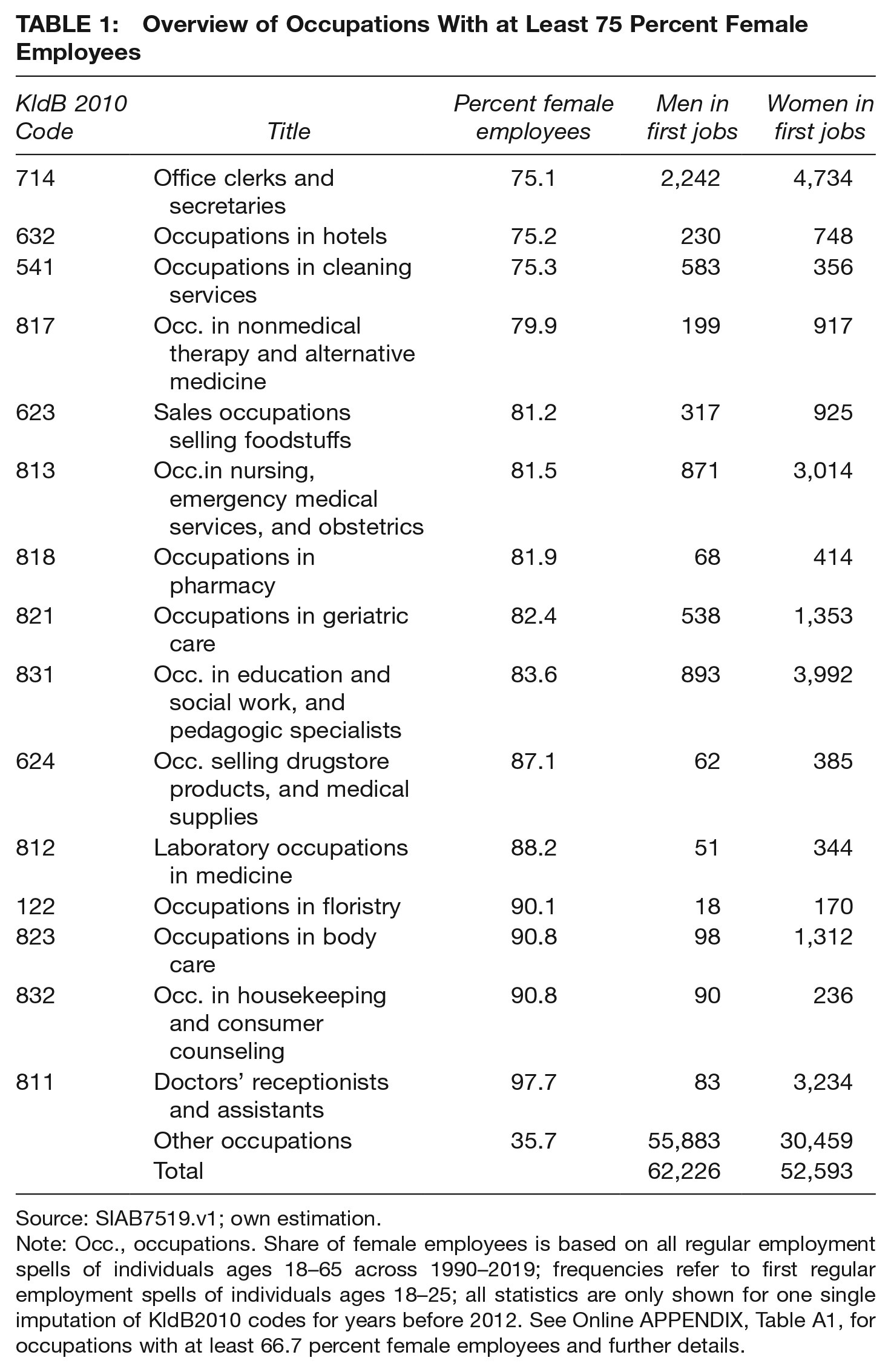
Source: SIAB7519.v1; own estimation.
Note: Occ., occupations. Share of female employees is based on all regular employment spells of individuals ages 18–65 across 1990–2019; frequencies refer to first regular employment spells of individuals ages 18–25; all statistics are only shown for one single imputation of KldB2010 codes for years before 2012. See Online APPENDIX, Table A1, for occupations with at least 66.7 percent female employees and further details.
Second, because the SIAB register data do not allow for observation of civilian service participation, I supplemented these data with data from the German Microcensus (1996–2017 [https://doi.org/10.21242/12211.2017.00.00.1.1.0]). The latter is an annual household survey in which 1 percent of Germany’s residents are selected for mandatory participation. Based on respondents’ answers about whether they were in civilian service at the time of the interview, I calculated birth-half-year-specific probabilities of having served for the same population as the SIAB sample (men with German citizenship, ages 18–25 for birth years from 1985 through 1995; see Online APPENDIX for an explanation of how birth-half-year-specific probabilities were calculated from the annual Microcensus surveys and Tables A2 and A3). I merged the shares of civilian service participation to the SIAB register data by birth half-years.
Because educational attainment affected both participation in the civilian service and working in female-dominated occupations, I adjusted for educational attainment (graduation from lower and intermediate-track secondary schools, typically around age 16, vs. graduation from academic-track schools that provide university entrance qualifications, typically around age 18) as observed in the SIAB data. 5 Additionally, adjusting for respondents’ age at labor market entry in the SIAB data accounted for potential age and period effects on entering female-dominated occupations. Descriptive statistics of the sample are provided in Table A4 in the Online APPENDIX.
The SIAB register data impose some restrictions. First, only employment spells that are subject to social security contributions are recorded, which leaves out self-employed people and civil servants. Whereas a potential effect on respective female-dominated occupations, such as teaching in some federal states or self-employed doctors, cannot be tested, the underlying population of the analytic sample still covers 80 percent of the working population in Germany. Second, the data are restricted to labor market entries between the ages of 18 and 25 years, as later entries for later birth years would have occurred after 2019. This restriction does not allow for an assessment of potential long-term adjustments, for instance, if men exit female-dominated occupations at higher rates (Torre 2018). Third, the analysis omits unemployment and inactivity spells. However, as employment rates for men ages 18–25 were stable in the analyzed period (Dohmen et al. 2020), it seems unlikely that the suspension of the civilian service imposed variation in employment by men forgoing human capital from the service and hence being more often unemployed. 6 Fourth, the field of vocational and college education was not observed, and while the civilian service might have prompted some men to enter education in female-dominated fields, they also might have switched their major before entering the labor market (Riegle-Crumb, King, and Moore 2016). Nevertheless, the analyzed transitions to first occupations are highly consequential for the working life, as occupational mobility is comparatively low in Germany (Breen 2004).
Results
Figure 2 depicts, for each birth-half-year, the share of men who worked in a female-dominated occupation (left y-axis) and that served in the civilian service (right y-axis). Across birth half-years, the share of men who served in the civilian service decreased gradually. While this presents a contrast to the sharp drop across calendar years after the suspension of the civilian service in Figure 1, the divergence can be explained by the fact that men served from ages 18 to 23, with most serving at the age of 19 (43.6 percent) and 20 (32.3 percent; see Online APPENDIX, Figures A3 and A4). For instance, 9.8 percent of men born in the first half of 1991 served before turning 20 in 2011, when the civilian service was suspended. Nevertheless, the probability of entering the labor market in a female-dominated occupation decreased with the suspension of the civilian service. Although the share of men born 1985 through 1990 entering female-dominated occupations increased slightly from around 10 percent to above 11 percent, this trend flipped when the number of men participating in the civilian service declined. No men born in the first half of 1993 served in the civilian service, and less than 8 percent of that birth half-year entered the labor market in a female-dominated occupation. This share remained relatively constant after the suspension of the civilian service, which indicates that any explanation alternative to the suspension of the compulsory services (such as changing demands for male workers in these occupations) would have to have induced changes solely across the three birth years of 1989–1992.
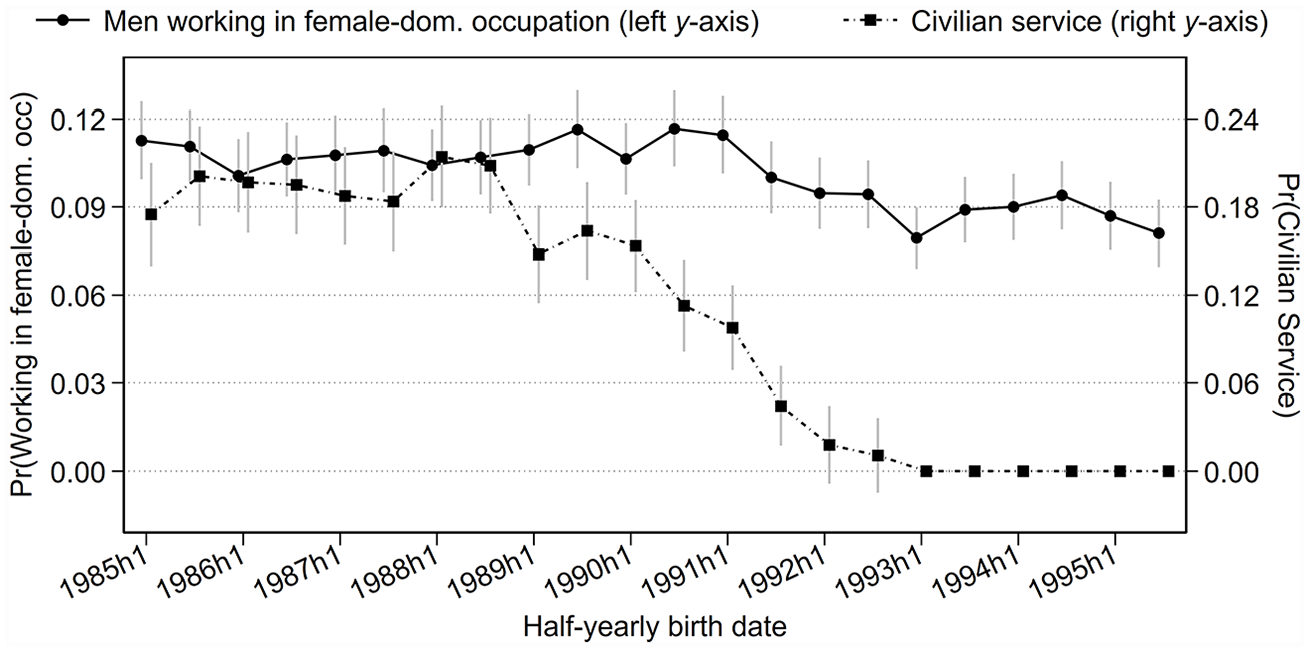
Probability of Men’s First Job in Female-Dominated Occupation and of Doing Civilian Service by Birth Half-Years
To rule out that the alignment of the civilian service and men entering female-dominated occupations was driven by period effects in the labor market, I employed women as a comparison group. Figure 3 shows that women’s probability to enter a female-dominated occupation was around four times that of men (note the scales of the y-axes). Parallel to men’s probability to enter female-dominated occupations, the probability for women hovers around 42 percent across the birth years from 1985 to 1990. This trend continued for subsequent female birth years, indicating that neither period effects in the labor market nor the suspension of the civilian service changed women’s likelihood of entering female-dominated occupations: The absence of civilian service conscripts and the suspension-induced decrease in men entering female-dominated occupations could have increased the demand for women to fill resulting vacancies, I do not observe a change in the trend of women entering female-dominated occupations as first jobs (Figure 3). Women and men also did not enter the labor market in greater numbers over the analytical period (Figure A5 in the Online APPENDIX), which precludes that increases in women’s labor market entries pushed men out of female-dominated occupations. By contrast, only for men the trend of entering female-dominated occupations was disrupted across those birth half-years that were directly affected by the suspension of the civilian service (significantly different trends for men and women are denoted by hollow markers).
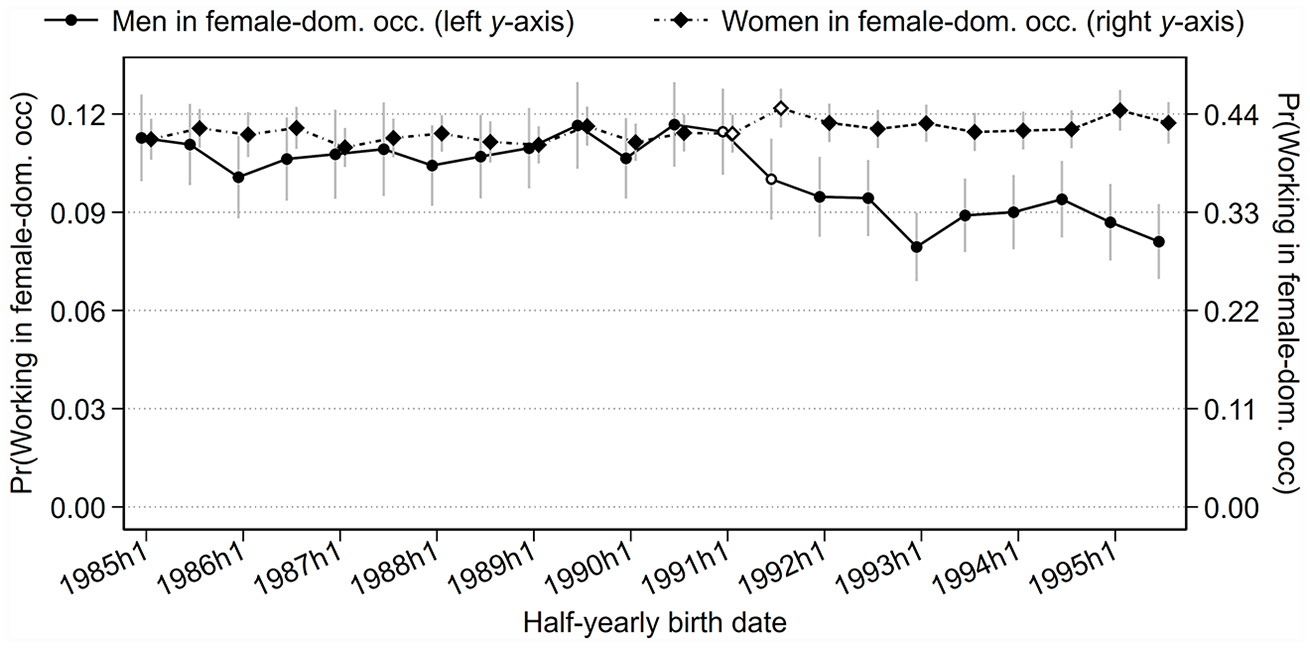
Probability of Men’s and Women’s First Job in Female-Dominated Occupation by Birth Half-Years
Table 2 expresses the effect of the suspension of the civilian service for men in numbers. As the participation rates in the civilian service across men’s birth years decreased gradually, there is no clear cut-off point to distinguish those who were required to serve and those who were not. Yet, for an intuitive estimate, I dichotomized the suspension via the cut-off for individuals born after June 1992 and compared the average probability of working in a female-dominated occupation before and after this cut-off. The resulting coefficient shows a drop of 2 percentage points in the share of men entering female-dominated occupations after the suspension of civilian service (Model 1). This estimate marginally increased to 2.3 percentage points when adjusting for age and secondary school track (Model 2) and to 2.5 percentage points when omitting the birth years 1989 to 1992, in which participation in the civilian service gradually decreased (Model 3). While the negative effect for men seems small in size, relative to 10.7 percent of men entering female-dominated occupations when the civilian service was still in place, the suspension decreased the share of men entering female-dominated occupations substantially by (0.023/0.107 =) 21.5 percent. Considering that each birth year contains around 400,000 men (see Figure 1), the effect amounts to 9,200 men per birth year missing from female-dominated occupations due to the suspension of the civilian service.
Linear Probability Models of Working in Female-Dominated Occupation by Birth Half-Years and Civilian Service
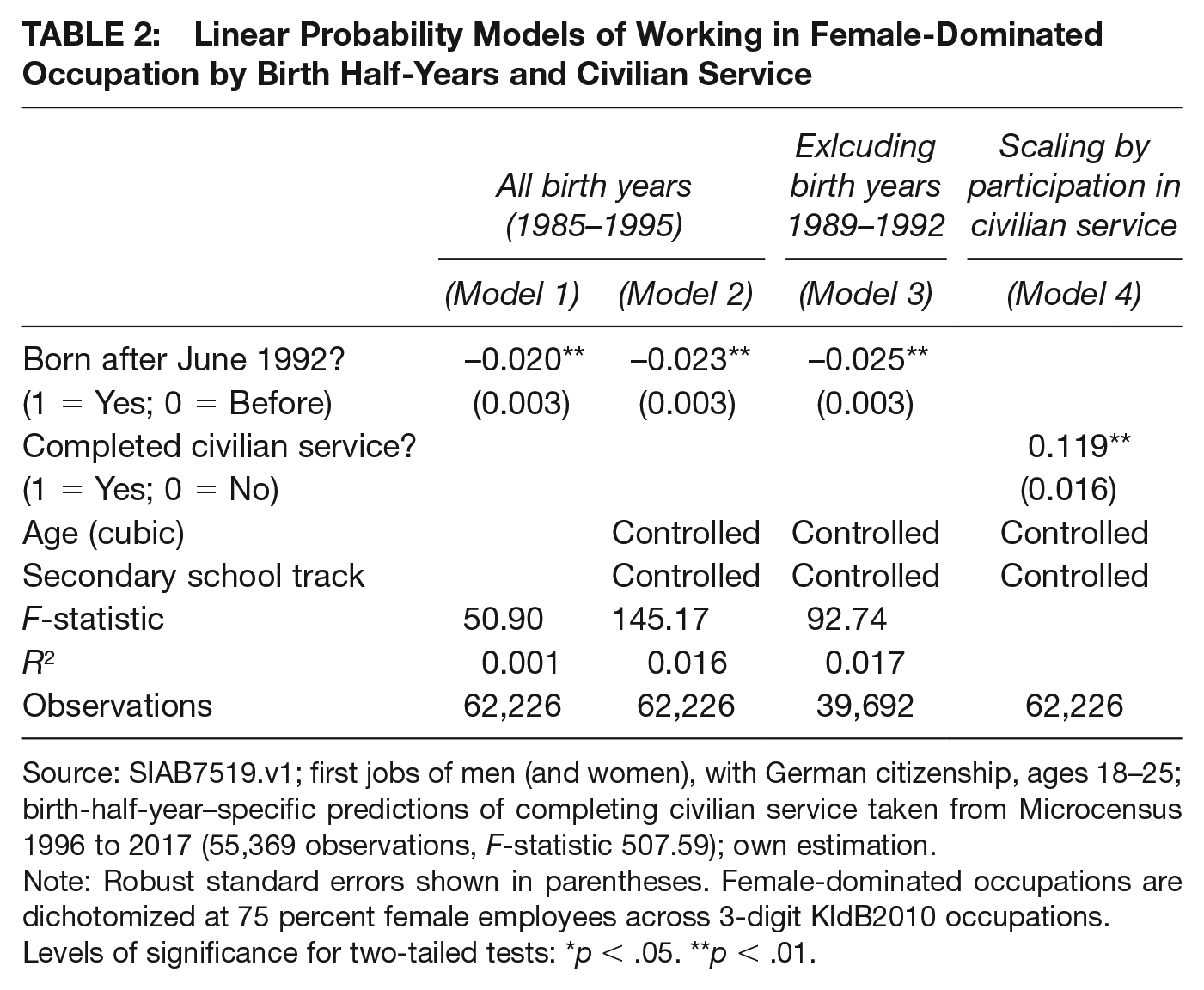
Source: SIAB7519.v1; first jobs of men (and women), with German citizenship, ages 18–25; birth-half-year–specific predictions of completing civilian service taken from Microcensus 1996 to 2017 (55,369 observations, F-statistic 507.59); own estimation.
Note: Robust standard errors shown in parentheses. Female-dominated occupations are dichotomized at 75 percent female employees across 3-digit KldB2010 occupations.
Levels of significance for two-tailed tests: *p < .05. **p < .01.
The previous comparison provides information about the decrease in men’s likelihood of working in female-dominated occupations for all of the men in a given birth half-year. To estimate the effect of the civilian service on those who actually served, I regressed working in a female-dominated occupation on the birth half-year specific shares of civilian service depicted in Figure 2. Thereby, the change in men’s likelihood to enter female-dominated occupations across birth half-years is scaled by the rate of civilian service participation. This yields an average treatment effect on the treated (Table 2, Model 4) under the assumption of no direct effect of birth half-years on the likelihood of entering female-dominated occupations. Because women’s slightly increasing trend in entrances in female-dominated occupations was constant across birth years and only men’s trend is disrupted, this assumption seems to hold. Thus, those who participated in the civilian service were 11.9 percentage points more likely to enter a female-dominated occupation as their first job compared with those who did not. This is a substantial effect relative to the baseline of only 8.7 percent men entering female-dominated occupations after the suspension of the civilian service. 7
Finally, replicating the main analysis from Model 2 of Table 2 separately for each female-dominated occupation yields some of the strongest reductions after the suspension of the civilian service for occupations that are most closely related to activities in the civilian service (occupations in cleaning services, education, social work, and geriatric care; Figure 4). Thus, participants of the civilian service were not prompted to work in female-dominated occupations in general, but rather they were prone to work in the specific sectors they experienced, which suggests that skills learned as well as potential contacts established during the civilian service are likely underlying the identified effect.
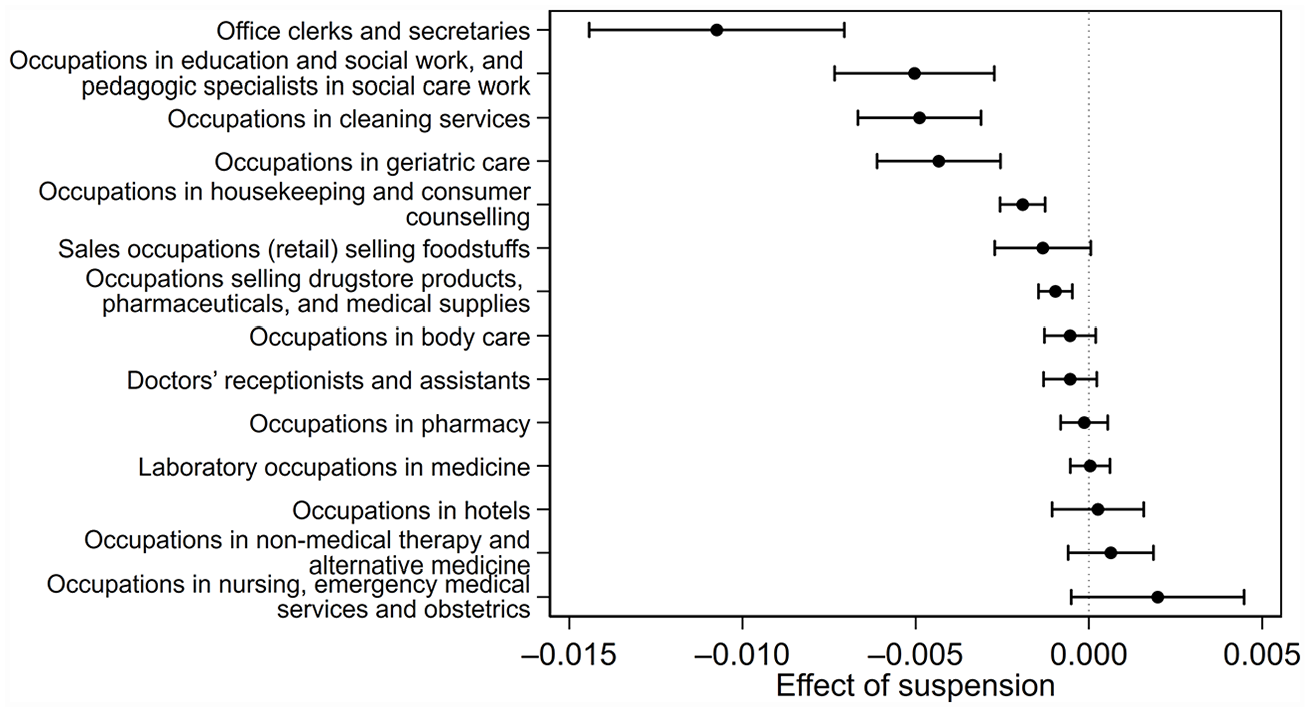
Effect of Suspension of Civilian Service Across KdlB2010-Occupations With at Least 75 Percent Female Employees
Note that voluntary services co-existed with the civilian service, and a new federal volunteer service (Bundesfreiwilligendienst) was established to compensate for the suspension of the civilian service. While the number of participants in voluntary services rose over time, this should not invalidate my empirical design for three reasons: First, their effect on men’s gender-atypical occupational choices at labor market entry can be expected to be weaker because they are less restricted in terms of the kind of activities and some are open to all age groups. Second, all volunteer service programs are also open to the comparison group of women; thus, only a disproportionate change for men would introduce bias. Third, even disproportional entrances into voluntary services of men who would have selected into the civilian service before its suspension would render the estimated effect of the civilian service only as underestimated and conservative.
Robustness Checks
I checked the robustness of the finding that gender-atypical learning experiences in the civilian service increased men’s likelihood of entering female-dominated occupations through four additional analyses. First, using a 66.7 percent cut-off value to define female-dominated occupations provides a 16.7 percent decrease of likelihood of men entering female-dominated occupations after the suspension of the civilian service, whereas using an 80 percent cut-off value leads to a relative reduction of 21.2 percent (Online APPENDIX, Figure A6 and Table A5). A comparison with the 21.5 percent relative reduction when using the 75 percent cut-off value in the main analyses underlines not only the robustness of the finding via similar estimates, but also indicates that the effect is more pronounced among occupations with at least 75 percent female employees, as these are also most closely linked to the content of the civilian service. Moreover, using continuous, year-varying shares of female employees as the dependent variable reveals that after the suspension, men entered occupations that had on average 2.6 percentage points fewer women (Online APPENDIX, Table A5, Model 3). This is based partly on men entering different occupations, but is also driven by men’s departure from female-dominated occupations altering the sex compositions of respective occupations and leading to greater shares of female employees in women’s first occupations (Online APPENDIX, Figure A6).
Second, regressing working in a female-dominated occupation at the age of the interview on having completed the civilian service among respondents of a 2009 representative household survey called “Aufwachsen in Deutschland: Alltagswelten” (AID:A; Deutsches Jugendinstitut 2012) yielded a similar estimate on the individual level (Online APPENDIX, Table A6). This indicates that the existence of the civilian service did not increase the likelihood of entering female-dominated occupations for all men in a given birth year (which would be the case if social acceptance of the civilian service were so influential that it increased men’s entry into female-dominated occupations regardless of their participation in it); nor did the simultaneous suspension of the military service seem to have sent a signal that it is okay to be less masculine and thereby increased the likelihood of men to enter female dominated occupations; instead, the treatment effect is driven by actual participation in the civilian service. A lack of an association between military service and working in female-dominated occupations in the AID: A data also does not support the reduction of conscripts in the military service as an alternative explanation for the observed trends (Online APPENDIX, Table A6, Model 4).
Third, in the aftermath of the economic crisis of 2008, men could have turned to higher-paying occupations and avoided female-dominated occupations as a result. Similarly, the suspension of both compulsory services increased the labor supply of young men, which might have changed men’s reservation wages and their selection into differently paying occupations. Yet median wages in men’s first occupations only marginally differ across birth years (Online APPENDIX, Table A7, Model 1).
Finally, I tested the extent to which the effect of the suspension of the civilian service was moderated by secondary school tracks. As men who had graduated from intermediate or lower-track secondary schools graduated before turning 18, they might have started vocational training or employment before being drafted and were thus likely to perceive civilian service as an interruption. Accordingly, the suspension of compulsory service less strongly affected their likelihood of entering a female-dominated occupation (Online APPENDIX, Table A7, Model 2). By contrast, the effect identified was more pronounced among those who had graduated from academic-track secondary schools, which is usually around age 18 and qualifies graduates for university entrance.
Discussion
The goal of this study was to assess whether gender-atypical learning experiences can increase men’s likelihood of entering female-dominated occupations. I analyzed the suspension of the compulsory civilian service in Germany, which provides exogenous variation in gender-atypical learning experiences for men. Whereas women’s likelihood to enter female-dominated occupations remained relatively stable across birth years, men entering the labor market in female-dominated occupations decreased by about 21.5 percent when birth half-years were affected by the suspension of the civilian service. Scaling the change by civilian service participation rates reveals that participation increased the likelihood to enter female-dominated occupations by 11.9 percentage points (relative to an 8.7 percent likelihood of entering female-dominated occupations after the civilian service was suspended).
This treatment effect on the treated applies only to those who participated in the civilian service, and is thus partly shaped by selection into the civilian service. For instance, more highly educated men were more likely to participate in the civilian service (C. Becker et al. 2011). Simultaneously, I observed a stronger effect for them. This might be attributable to graduates from academic-track secondary schools not having entered employment before being drafted and welcoming civilian service as an opportunity to look at prospective occupations. At the same time, greater openness to gender-atypical learning experiences is also associated with educational attainment (Hardie 2015) and less role strain within female-dominated environments (Lupton 2006). Similarly, respondents from the AID:A survey who selected to participate in the civilian service stated that they value a high income in an occupation less than those who did not serve or those who completed military service (Online APPENDIX, Figure A7). While this difference could partly capture changes induced by participating in the civilian service, it likely also drove selection into it and for those who prioritized high wages, the civilian service might have been less consequential for subsequently entering on average lower-paid female-dominated occupations. Accordingly, the average effect size can be expected to be smaller if gender-atypical learning experiences are fostered for men, who are the least likely to select themselves into such exposure in the first place.
Although the underlying mechanisms could not be tested directly, evidence points toward learned skills as being most relevant. Research has shown that mentioning an occupation’s title triggers occupational stereotypes and deters men from entering female-dominated occupations (Fox and Barth 2017); hence, “programs wishing to recruit more men should not draw attention to issues of gender” (Williams 2015, 391). This was the case for the civilian service, and participation in it was widely perceived as a rejection of military service and, to a lesser degree, as a gender norm violation (Bartjes 1996). This allowed men to utilize their gender-atypical learning experiences without triggering gender stereotypes. However, it could also be the reason why only few men who completed the civilian service reported that the civilian service affected their view of male- and female-dominated occupations; rather, the majority of participants stated increased knowledge and skills in care work and housekeeping, which is in line with the strongest suspension effect occurring among female-dominated occupations, in which men could utilize respective skills (C. Becker et al. 2011).
Nevertheless, the estimated treatment effect of a 11.9 percentage points higher likelihood of working in female-dominated occupations implies that a considerable proportion of men did not use their acquired skills to enter female-dominated occupations after their civilian service; for them, serving came with opportunity costs. Participants in the civilian service attributed the limited impact of the civilian service on their occupational choices to the relatively low earnings in female-dominated occupations as an entry barrier (C. Becker et al. 2011). Thus, wage increases in female-dominated occupations are an important pathway for occupational integration as well, and the provided evidence that programs fostering men’s gender-atypical learning experiences reduce occupational segregation complements this existing explanation of men’s reluctance to enter female-dominated occupations.
Conclusion
Occupational integration has been asymmetric, with women’s expanded entrances into male-dominated occupations being unmatched by stagnating entrances of men into female-dominated occupations (Blau, Brummund, and Liu 2013; Busch 2013b; England 2010). This asymmetry has been attributed to the lack of economic incentives for men to enter lower-paying female-dominated occupations (England 2010) and widespread masculinity norms acting as a barrier to change in men’s attitudes and behavior (Friedman 2015). Less attention has been devoted to the lack of gender-atypical learning experiences encountered by men. While programs that foster gender-atypical learning experiences have been established for women, this study reveals that programs of providing gender-atpyical learning experiences for men also can be effective in fostering men’s entrances into female-dominated occupations.
Establishing similar programs can have individual- and societal-level effects. On the individual-level, they provide men insights into occupational fields that otherwise they might not have considered, which should be situated before labor-market entrances, as otherwise they can be perceived as an interruption to their career (Eberl, Collischon, and Jahn 2022). The estimated effect indicates that such programs come with some opportunity costs, as those who do not utilize learned skills by entering respective occupations forgo the opportunity to acquire skills that are beneficial for their alternative occupational choices. Nevertheless, the effectiveness of exposure to gender-atypical learning experiences in altering the occupational choices of a substantial number of men implies that programs that foster such experiences have the societal benefit of counteracting the prevailing lack of men in female-dominated occupations, of decreasing occupational sex segregation, and of addressing shortages in social and caring occupations caused by industrial restructuring (Esping-Andersen 2009). The latter became particularly evident during the COVID-19 pandemic in Germany (Fischer et al. 2020). Ultimately, benefits of gender-atypical learning experiences also reach beyond labor market effects, with some men stated that participating in the civilian service improved their empathy for socially disadvantaged people and their awareness of social problems (Bartjes 1996; C. Becker et al. 2011).
Therein, the evidence also speaks to discussions on mandatory community services. While the effectiveness of such programs in fostering civic engagement is an open question (Henderson, Brown, and Pancer 2012, 2019), the example of Germany’s compulsory civilian service indicates that even if the programs fall short of this intended goal, they may have the unintended positive consequence of counteracting occupational sex segregation and raising awareness of social problems. Simultaneously, incorporating gender-atypical learning experiences into mandatory community service could avoid triggering gendered occupational stereotypes that keep men from female-dominated occupations (Williams 2015) and even outweigh the lack of societal support for measures that directly address the lack of men in female-dominated occupations (Block et al. 2019). Yet more research is needed for effective implementations of gender-atypical learning experiences.
Supplemental Material
sj-docx-1-gas-10.1177_08912432231177650 – Supplemental material for Gender-Atypical Learning Experiences of Men Reduce Occupational Sex Segregation: Evidence From the Suspension of the Civilian Service in Germany
Supplemental material, sj-docx-1-gas-10.1177_08912432231177650 for Gender-Atypical Learning Experiences of Men Reduce Occupational Sex Segregation: Evidence From the Suspension of the Civilian Service in Germany by Maik Hamjediers in Gender & Society
Footnotes
Author’s note:
I thank Sascha Riaz, Jill Yavorsky, Maximilian Sprengholz, and the participants of the HU Berlin and WZB Berlin joint Social Demography Writing Workshop for immensely constructive feedback on earlier drafts. The three data sources used in this project are not publicly available due to privacy regulations, but can be obtained by signing a data user agreement with the respective publishers.

Supplemental Material
Supplemental material for this article is available online.
Notes
Maik Hamjediers is a research associate and doctoral candidate at the Department of Social Sciences of the Humboldt-Universität zu Berlin. His research focuses on gender inequalities in the labor market and family and on quantitative methodology. His work has been published in the European Sociological Review, Sociological Methodology, and Work & Occupations.
References
Supplementary Material
Please find the following supplemental material available below.
For Open Access articles published under a Creative Commons License, all supplemental material carries the same license as the article it is associated with.
For non-Open Access articles published, all supplemental material carries a non-exclusive license, and permission requests for re-use of supplemental material or any part of supplemental material shall be sent directly to the copyright owner as specified in the copyright notice associated with the article.
