




Abstract
While we know that career interruptions shape men’s and women’s professional trajectories, we know less about how job loss may matter for this process. Drawing on interviews with unemployed, college-educated men and women in professional occupations, I show that while both men and women interpret their job loss as due to impersonal “business” decisions, women additionally attribute their job loss as arising from employers’ “personal” decisions. Men’s job loss shapes their subsequent preferred professional pathways, but never in a way that diminishes the importance of their participation in the labor force. For some women in this study, job loss becomes a moment to reflect on their professional pathways, often pulling them back from paid work. This study identifies job loss as an event that, on top of gendered workplace experiences and caregiving obligations, may curtail some women’s participation in paid work.
Job loss is prevalent in the contemporary U.S. economy. In 2020, the economic downturn triggered by the COVID-19 pandemic resulted in the loss of millions of jobs in the United States (Kochhar 2020). Downsizing is now built into organizational logics (Davis and Kim 2015). Job loss is so prevalent that it touches the lives of advantaged workers who have college degrees and work in professional roles (Damaske 2020; Rao 2020; Sharone 2013). Job loss impacts workers’ finances and also their professional self-understanding (Gershon 2017). Prior research has paid little attention to how job loss—experienced on top of gendered workplace experiences and uneven caregiving obligations—may shape men’s and women’s professional pathways differently.
I draw on interviews with privileged but unemployed men and women to elucidate how gender matters for interpretations of job loss and how men and women imagine their professional pathways after losing their jobs. Participants were college-educated, heterosexual parents in dual-earner marriages. I found that men typically interpreted their job loss as a “business” decision, whereas women additionally attributed a “personal” reason for their job loss. Men separated unemployment from their professional worth and emphasized how, when losing their jobs, their professional value was reinforced. Paid work remained central to men in this study. The three professional pathways men pursued were the search for standard, full-time employment; contract work; and entrepreneurial pathways. Women in this study demonstrated greater variation in their interpretations of job loss. More than half of these women pursued standard, full-time employment, including some who interpreted their job loss as personal. For women with younger children, job loss served as a catalyst to question their labor market attachment and consider prioritizing the domestic over the professional.
With this study I make the following contributions to research on gender and unemployment. First, I show how the interpretation of job loss itself is gendered. Extending prior research on women’s devaluation in paid work, I show that devaluation experiences become salient for some women as they try to understand their job loss. Second, this article bridges research on unemployment with research on gender inequality in the labor force by explaining how job loss is emerging as a pivotal experience shaping men’s and women’s professional pathways. Layered on top of gendered obligations in heterosexual marriages as well as gendered workplace experiences, job loss may clamp down on some women’s professional aspirations, at least temporarily. Even temporary career interruptions, however, have significant implications in terms of gendered economic inequality over the long term. In the COVID-19 context of massive unemployment, workers’ responses to these events are important for understanding long-term implications for gender inequalities.
How Women Get Pushed Out of Paid Work
Gender operates at individual, interactional, and institutional levels as a social structure (Risman 2004). At the institutional level, gendered workplaces reward an “ideal” worker who can prioritize paid work above all else (Acker 1990; Williams 2000). Disregard for caregiving obligations—which typically fall on women—are built into organizational assumptions. Organizations are also gendered because deep-rooted beliefs about who is competent or has leadership abilities tend to overwhelmingly favor men (Schilt 2006).
Women routinely report having their contributions devalued, experiencing sexual harassment, and encountering fewer promotion opportunities, and these experiences may be more acute for women of color (Alegria 2019; Gerson 1985; McLaughlin, Uggen, and Blackstone 2017; Steinberg 1990; Wingfield 2009). Schilt (2006) demonstrates how transmen in her study who were able to comply with the expectations of hegemonic masculinity in the United States—for instance being white or tall—recounted being treated as competent and authoritative in their workplaces compared with how they were treated when they were previously recognized as women. Black and Asian transmen did not reap these rewards of masculinity (Schilt 2006). Adverse experiences matter because rejection from a specific employer discourages women to compete for future positions with that employer (Brands and Fernandez-Mateo 2017). Lack of employer support for caregiving also pushes women out of working for a particular employer, sometimes out of the industry, and even out of paid work altogether for a period of time (Stone 2007; Stone and Lovejoy 2019).
Furthermore, pregnancy discrimination and the motherhood penalty remain fixtures of women’s employment experiences (Byron and Roscigno 2014; Correll, Benard, and Paik 2007; England et al. 2016). In contrast, fatherhood catalyzes a remuneration “bonus,” especially among high-earning men (Glauber 2018). Employers additionally view anticipated caregiving as a reason to not hire women, especially in elite professions (Rivera and Tilcsik 2016). However, when individuals scale back on paid work, as for caregiving, employers are less likely to want to hire men than comparable women, because deviation from an ideal worker may be viewed as an especially negative signal about men’s commitment to paid work (Weisshaar 2018). Workplaces inscribe gendered understandings of an individual’s obligations within their families.
These processes in the workplace coalesce with gendered processes at home. Among married, heterosexual couples with children, the care burden on women is higher (Pepin, Sayer, and Casper 2018). Gendered caregiving obligations, especially childcare, catalyze women’s temporary exits from the labor force (Stone 2007), and this is particularly acute for working-class women (Damaske 2011). Limited policy provision exacerbates this (Collins 2019). Mothers may appear to be making a “choice” about prioritizing caregiving, but this “choice” is made in a fraught context of extremely unsupportive organizations (Stone 2007). Tracing the re-entry pathways of professional mothers, Stone and Lovejoy (2019) show that women’s professional trajectories take three forms: “changing course,” “course correcting,” and “making a comeback.” Career interruptions thus have long-lasting and professionally detrimental impacts. The gender pay gap alongside the ideology of “intensive motherhood” (Hays 1996) among white middle-class mothers in the United States, in a context of a limited policy infrastructure for caregiving, facilitates mothers’ prioritization of the domestic.
This research encapsulates the push factors of women’s experiences in the workplace ostensibly in the best of economic times. With layoffs and downsizing now built into organizational practices, we need to better understand how this uncertainty inherent to contemporary workplaces may be layered on top of gendered workplace experiences to shape professional pathways (Williams, Muller and Kilanski 2012).
Job Loss as a Gendered Career Interruption
The employment landscape is rife with uncertainty, even for highly educated professionals (Gershon 2017; Sharone 2013). In response, professionals have developed new orientations toward employers, seeing themselves as being “portfolio” (Neely 2020) workers who function as “companies of one” (Lane 2011). The experience of unemployment is often critical in shaping workers’ subjectivities too. In research conducted before the Great Recession, Sharone (2013) argued that the job-searching process in the United States emphasizes individual traits that make unemployed job seekers blame themselves rather than the limited availability of jobs. The Great Recession demonstrated the availability of a broader range of cultural frames through which to interpret unemployment. In research conducted after the Great Recession, Lopez and Phillips (2019) found that unemployed U.S. workers pointed to neoliberal ideologies and practices as a central cause of their unemployment, rather than solely blaming themselves. One gap in this literature, however, is the limited attention given to how gender may matter in these processes. Because employment precarity affects men and women differently and also intersects with gendered workplace experiences and family obligations, this is an important omission.
Precarity is not uniformly felt and experienced. Women tend to be concentrated in lower-paying and less prestigious occupations (England 2010). Roles occupied by women of all races and by men of color are typically downsized before those of white men (Kalev 2014). Managers prioritize retaining the jobs of heterosexual, married, white men precisely because they view these employees as breadwinners (Williams 2019). The current COVID-19 pandemic bears this out as women of all races (and especially women of color) have disproportionately suffered job losses, alongside a retreat from paid work due to caregiving obligations (Alon et al. 2020; Collins et al. 2021). Job loss has long-lasting implications for professional trajectories, including job instability, wage scarring, and re-employment in lower-quality jobs (Brand 2015). Yet we know little about how job loss shapes unemployed individuals’ conceptions of their professional pathways, including in gendered ways.
Emerging research focused on job searching compares the unemployment experiences of men and women in the professional middle class and offers insights. White-collar mothers who lose their jobs embrace motherhood identities (Norris 2016). Unemployed middle-class mothers also find it difficult to prioritize job searching because of gendered dynamics at home, wherein they are expected to take over the majority of unpaid work (Rao 2020). Other studies, however, find that job searching is more important for middle-class women than for men (Damaske 2020; Lane 2011). The middle-class women in Damaske’s (2020) study differentiated themselves from stay-at-home mothers through their “deliberate” job searching, compared with middle-class men who searched for jobs by “taking time.” Economic necessity meant that working-class men had “urgent” job searches, whereas working-class women had job searches “diverted” by caregiving. Damaske’s study offers important insights into how job searching is gendered and classed. Job searching and professional pathways are conceptually distinct, although they may at times overlap. For example, it is possible to “take time” in terms of a job-searching approach, but to also decide to envision working only full time or only part time. The job-searching approach remains the same, but the professional pathway differs due to the extent of importance of paid work in the part-time or full-time scenarios.
In the present study, I build on these findings by showing how interpretations of job loss too are gendered. For some women, experiences of workplace devaluation are salient in making sense of their job loss. Extending insights from prior research on job searching, this study illuminates how men and women divergently conceptualize their professional pathways after job loss. These contributions bridge research on gender inequalities in the labor force with research on unemployment to show how job loss may be a crucial experience that can obstruct some women’s professional pathways.
Methods
Sample and Recruitment Criteria
This study is part of a broader project on how dual-earner, heterosexual, married couples with children in the U.S. professional middle class experience unemployment, especially in terms of their division of paid and unpaid work. For this article, I draw on in-depth interviews with 25 unemployed men and 23 unemployed women, and follow-up interviews with 11 unemployed men and 13 unemployed women (see Table 1).
Sample
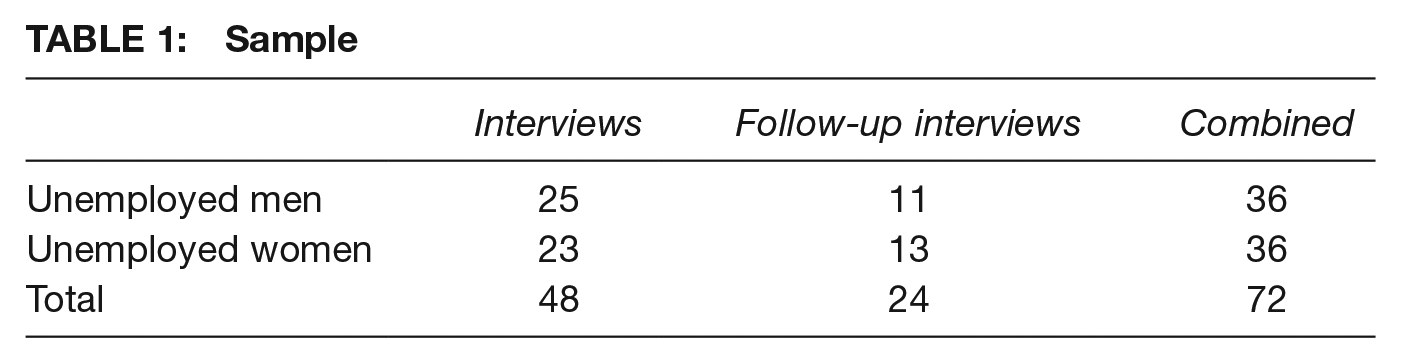
This is a non-random sample of unemployed professionals recruited from a variety of sites in the U.S. northeast, including career coaching workshops, job-searching clubs, parent list-servers, and flyers placed in community spaces. Three participants were recruited through referrals from participants recruited at these sites. Recruiting through a diversity of sites should mitigate some concerns about sampling bias. Nevertheless, these recruitment sites may disproportionately yield unemployed individuals who are particularly optimistic and well-adjusted to their unemployment, since they are actively engaging in job searching. Women recruited from these sites may be potentially more likely to prioritize their professional aspirations. The findings I describe may thus offer conservative representations of gendered differences.
Participants were currently unemployed or had been unemployed until at least 3 months before the first interview and had at least a 4-year college degree (see Table 2). The resulting sample is privileged in terms of family structure, social class, and often race. Participants’ dual-earner status buffers the families against some of the worst economic impacts of unemployment. Participants held jobs that can be characterized as “good jobs”: high salaries, health insurance, retirement plans, and paid leave. This is a largely white sample, and this too can be a source of privilege in employment. Hiring discrimination advantages white applicants, especially when they indicate an upper-class status (Rivera and Tilcsik 2016). Yet these privileges are not uniformly distributed. Women’s class advantage in hiring is muted by the “commitment penalty” they encounter relative to men from their social class (Rivera and Tilcsik 2016). Privilege is not evenly distributed among these men and women.
Descriptive Data on Unemployed Men and Unemployed Women
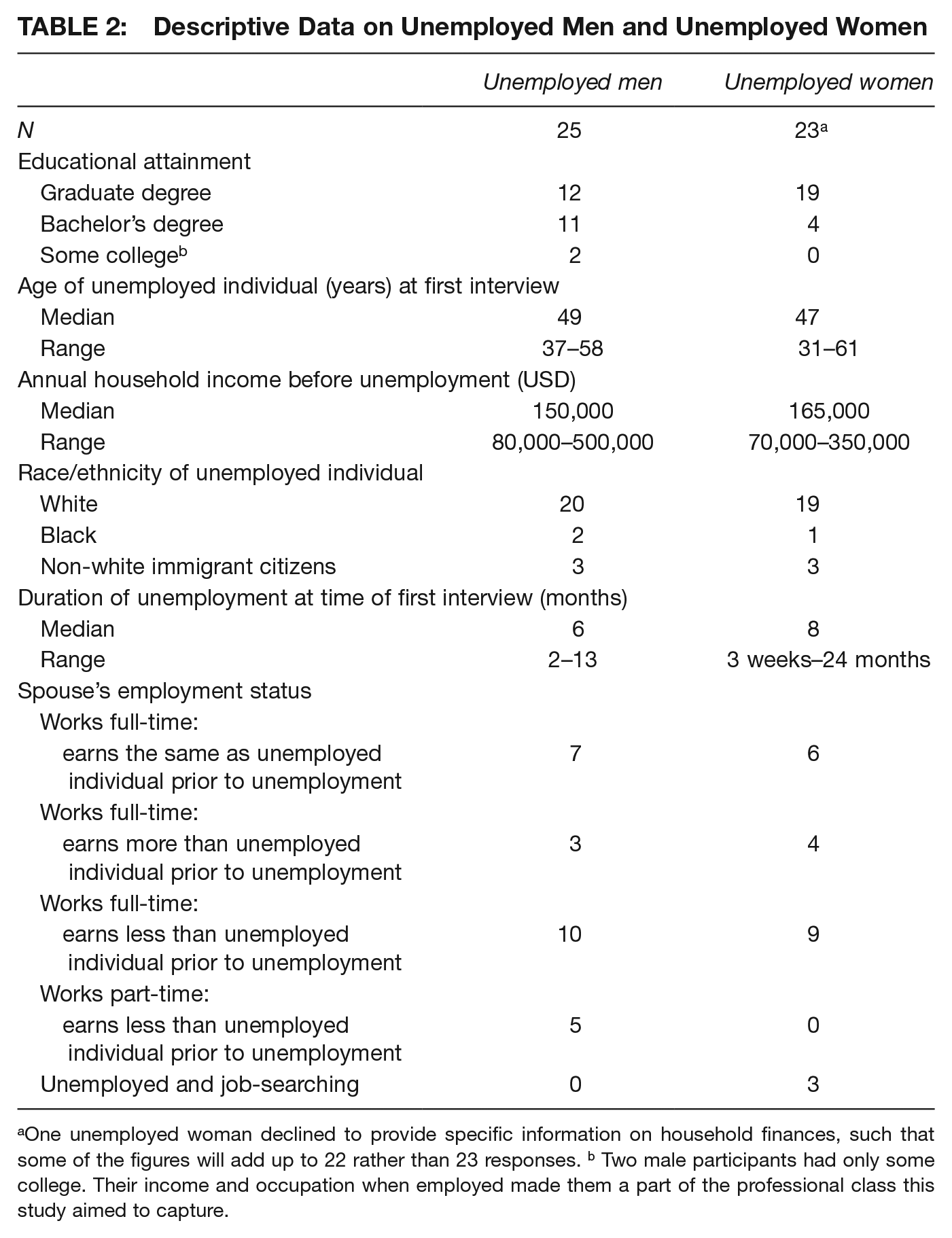
One unemployed woman declined to provide specific information on household finances, such that some of the figures will add up to 22 rather than 23 responses. b Two male participants had only some college. Their income and occupation when employed made them a part of the professional class this study aimed to capture.
As job loss increasingly pervades elite jobs, sociological attention is warranted. Yet this sample has limitations. Key is how race and social class intersect. For the predominantly white men in this study, breadwinning is culturally paramount and also enabled by their stronger position in the labor market compared with other demographic groups. White women in the professional middle class, predominant in this study, typically have jobs that better enable them to manage caregiving and paid work than do working-class women (Damaske 2011), and they also tend to be held accountable to the ideology of intensive mothering. Findings presented in this study should be interpreted with these limitations in mind.
Interviews
These unemployed men and women had worked in roles ranging from marketing and project management to law and engineering. To protect participants’ identities, I sometimes do not use participants’ real profession, instead selecting a similar one. All names are pseudonyms.
I conducted original interviews between 2013 and 2015. I continued data collection until reaching saturation (Small 2009). Interviews averaged 2 hours, and most were conducted in person. Interviews were semi-structured and allowed me to pursue individualized lines of questioning. Here, I draw from the questions in the interview guide on participants’ professional history, the process of their job loss, job-searching strategies, and their career and personal goals.
I conducted follow-up interviews between 2014 and 2015 with those who responded to my request, approximately half the sample. Follow-up interviews focused on job-searching practices and how preferences pertaining to professional pathways had evolved. I probed for explanations on deviations from preferred pathways when applicable. Follow-up interviews averaged an hour. Two-thirds were conducted in person, and the rest over phone or Skype. I reached out only to people who were still unemployed at the time of the first interview. However, participants who were employed at the time of the original interview also informed me about crucial moments in their unemployment trajectory.
I was initially aggressive with trying to obtain maximum follow-up interviews. I typically contacted participants 6 months after their first interview. If my initial email went unanswered, I emailed again within 2 weeks. If this too went unanswered, I called the participant on their mobile phone and left a voicemail if no one picked up. My aim was to receive a definitive “no” or “yes” response. Partly through data collection, a critical experience made me soften this approach. I emailed Brian, and he replied to my email saying that things were busy but he hoped to speak to me soon. I followed up via email again, and I received a polite, direct email from Brian explaining that his unemployment had been challenging and he preferred not to speak to me yet. This foregrounded that my data collection needed to better take into account the emotional toll of unemployment on participants. Following feminist praxis of qualitative data collection, I revised my approach to better prioritize participants’ well-being over achieving a high completion rate for follow-up interviews. After two attempts to obtain a yes or no for a follow-up interview, I waited for participants to reach out to me. Follow-up interviews were completed between 6 months to a year after the first interview. Whereas some participants responded relatively quickly, others responded agreeing to the second interview only after weeks. Often there was also an additional lag in scheduling the interview. Although there were no discernible differences in the demographic characteristics of participants interviewed twice and those interviewed once, it is possible that participants having a particularly difficult time opted out of the follow-up interviews. The follow-up interviews I did conduct showed a variation of experiences, indicating that the study was at least somewhat successful in retaining even participants who were experiencing acute challenges.
Given the focus of the broader project, I prioritized family structure and social class, rather than length of unemployment, for recruitment purposes. The duration of unemployment in this study aligns with recent research, which also tends to have a range of unemployment durations (i.e., Damaske 2020; Sharone 2013). Follow-up interviews help address the issue of how duration of unemployment may matter for participants’ reflections on their professional pathways.
Data Analysis
Interviews were fully transcribed. I maintained analytical and methodological memos. I used “flexible coding” (Deterding and Waters 2021), which entailed using both deductive and inductive codes, reading transcripts several times, and searching for disconfirming evidence. Throughout this process, I refined coding categories such that the encompassing code of “personal” was divided into subcodes including “questioning professional competence” and “scapegoating.” I used the qualitative data analysis software Dedoose to facilitate coding.
Findings
“It was a Business Decision”: How Men Understood their Job Loss
Unemployed men in this study understood unemployment to be an expected aspect of paid work in the contemporary United States. Robert, a white unemployed communications professional, compared the economic landscape after the Great Recession with the tragic events of September 11, 2001: Part of your post-9/11 world was knowing people that died as a result of terrorism. The same thing is true with the [Great] Recession, right? . . . After the Recession you know somebody who was unemployed . . . People that really should be working.
The pervasiveness of unemployment rendered it normal, as Robert indicates. Gary, a white chemist concurred: “unemployment and layoffs have gotten so common, people are more empathetic.” Men drew on systemic conditions of the economy as a dominant framing to explain their unemployment (Table 3). Men typically understood their unemployment to be driven by employers’ impersonal “business decision,” rather than an issue of performance. John, a white man who had worked in pharmaceuticals, said:
Summary of Findings (n/N (%))
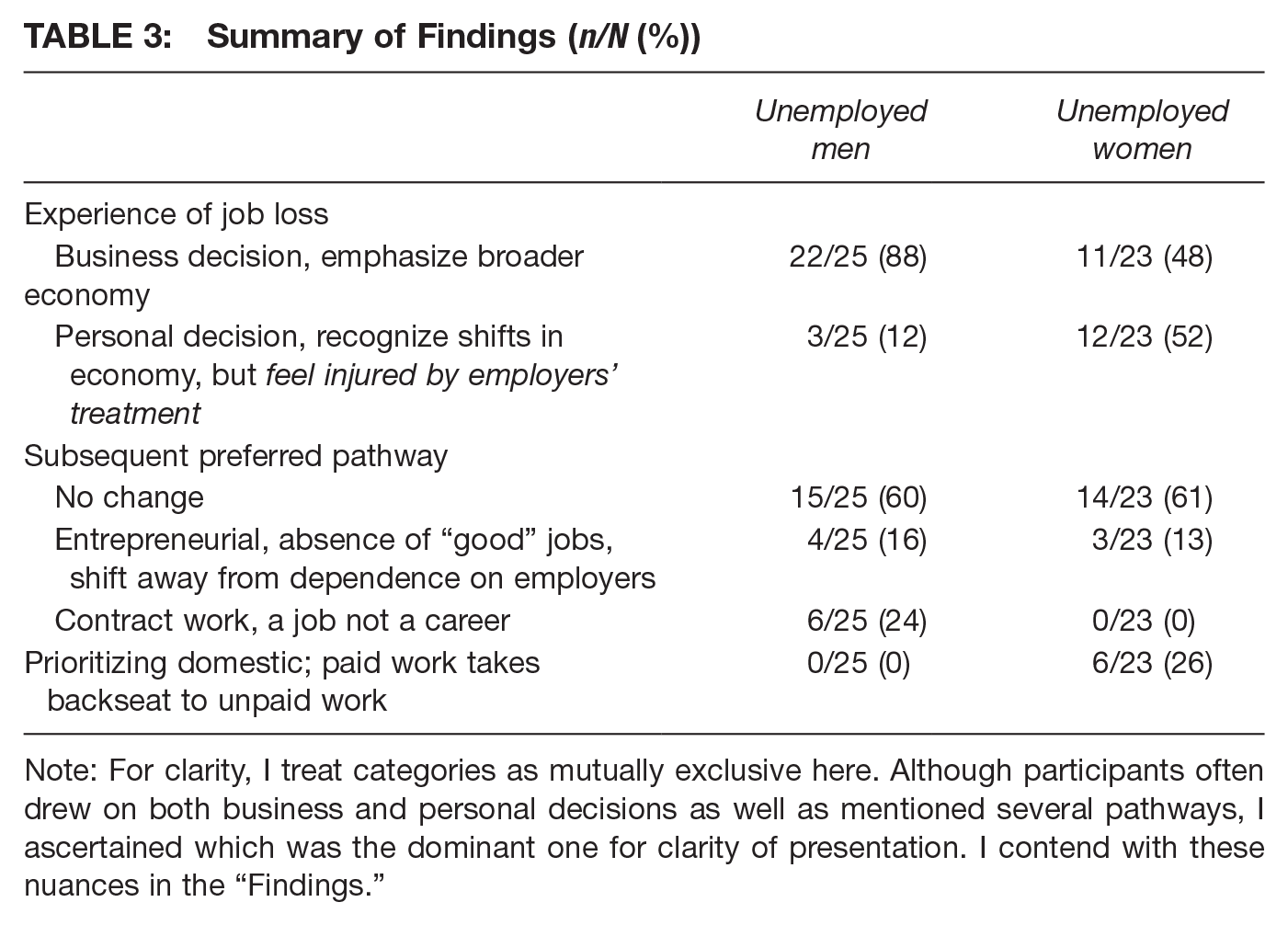
Note: For clarity, I treat categories as mutually exclusive here. Although participants often drew on both business and personal decisions as well as mentioned several pathways, I ascertained which was the dominant one for clarity of presentation. I contend with these nuances in the “Findings.”
A work superior explained to me that the business outlook was not looking good for the upcoming months. And consequently, it was a business decision, and not related to my work performance.
John added, “it was all based on dollars.” William, a white man who had worked in real estate, said that his former organization was receiving less work, and empathetically noted that “They had no choice [to lay me off]. I mean, they wouldn’t survive.” William added that his superiors emphasized “That you’re a good guy, this isn’t any kind of reflection on you.”
Men echoed William’s experience, reporting that superiors emphasized men’s professional worth even when they relayed news of job loss. James, a white project manager in healthcare, described the meeting on the elimination of his position as “awkward” because his superiors “did not want to see this happen . . . Based on their professional and personal respect for me and based on the contribution and the value that I represented.” The worth that was communicated to (white) men in the workplace through favorable pay gaps and opportunities for promotions also appeared to be communicated even when men were losing their jobs.
A few men in this study saw their job loss and unemployment in very personal terms and felt injured by employers’ treatment. The publication at which Dave, a white editor, had worked was shut down because of dwindling subscriptions. Dave understood this decision but was irked about his company’s next steps. He said, “Months later, they announced that they’re gonna do another executive publication that’s gonna come out quarterly and have an online presence.” Dave indignantly said, “We were kind of like ‘Fuck them!’ You couldn’t have done that with us?!” He explained, “You have the staff . . . that knows the industry!”
Men’s emphasis on framing job loss as a “business decision” could have been a way of claiming a moral self, given the importance of employment for a respectable masculinity in the United States (Killewald 2016; Townsend 2002). Although losing their jobs was a challenging experience, men in this study usually did not report seeing it as a reason to question their professional worth.
It’s not Just Business, It’s Personal, too: How Women Viewed their Job Loss
Women in this study were more evenly divided in terms of seeing their job loss as a business decision or a personal one (Table 3). A little less than half the women in this study saw their job loss as primarily a business decision. Claire, a white woman who worked in media, explained that she was aware that her company was in talks for a merger, which could mean mass layoffs: “I knew the dangers of taking the job. But no risk no reward.” Claire saw herself primarily as a casualty of an industry that has been undergoing major upheaval. When women saw job loss as a business decision, they tended to place it in a long view of a professional life where they felt they had made enormous sacrifices for their careers without appropriate rewards. For Claire, knowing the reality of her industry “didn’t make it any easier when it fell apart.” She described her long work hours, noting “I have two kids, I wasn’t seeing them.” These personal sacrifices may have resonated deeply with women because the cultural and practical onus of caregiving disproportionately falls on women.
A significant portion of women in this study also saw their job loss as an extremely personal decision by their employers. These women interpreted their job loss as a culmination of a longer period of devaluation. Women who viewed their job loss as personal reported that their former superiors—men and women—often questioned their professional skills and tried to frame women as incompetent. This started weeks, sometimes months before the actual job loss. Kelly, a white writer who worked in communications, recalled being assigned a new manager whom she felt was contemptuous of her. She recounted that the manager asked her: “You mean you’ve been here this long and this is all you are?” Kelly was convinced that her new manager “was trying to set me up to get rid of me, and that’s eventually what ended up happening.” This was a tough time for Kelly. She felt that “I certainly must be doing something wrong. I must be awful at this job.” She continued, “So I kind of absorbed that and for a long time I carried that with me.” She added, “I would cry my eyes out because I felt so worthless. It was just a cruel way to leave and I felt bad for a long time.” Sighing, she said “I was so crushed emotionally.” Some women in this study, such as Kelly, emphasized workplace experiences preceding their job loss as questioning their value as professionals.
How Job Loss Shaped Men’s Conceptions of their Professional Pathways
Unemployed men in this study envisioned three main professional pathways for themselves following their job loss. They yearned for stable and standard jobs. Even as they hoped for these kinds of jobs, some men nonetheless pursued contract work as they reconciled with the dearth of full-time, standard jobs available to them, whereas others pursued entrepreneurial pathways. Men’s various choices emphasized the importance of remaining full-time in the labor force. This cannot be attributed solely to how men understood their job loss. Men’s professional aspirations were enormously shaped by the hegemonic norm of male breadwinning in the United States. Job loss did not diminish the centrality of paid work for these men, for example, by catalyzing a shift toward prioritizing the domestic (Chesley 2011; Kaufman 2013).
Pursuing Standard and Stable Employment
Doug, a white man who worked in the finance sector before being unemployed for nearly 2 years, was adamant that he wanted a stable and secure position: “I’m looking for a full-time job . . . I want a career, I don’t want to be working temporarily.” Doug specifically referenced consulting and contract work as non-ideal: “You do [consulting] if you have to pay the bills . . . I’ve heard enough bad stories about consulting that I don’t want a series of consulting jobs.” Doug was able to hold out for a permanent job over consulting contracts because what he earned in his prior job allowed him to accumulate savings. Paying the bills had not yet become a major concern for him.
Nate, a white man who had worked in a senior executive position in a multinational corporation, thought similarly and explained that his job loss had not sapped him of his professional ambitions. He confidently said, “I know the industries that I want to work in. [My] target positions are CEO, CCO which is chief commercial officer, divisional president, senior execs. Here’s the titles I want, here’s the industries.” Nate, in his late 40s, imagined himself working for decades yet: “I’ll probably be working till I’m 70.” Nate earned considerably more than his wife, whose employment had been interrupted, particularly due to taking care of their four children. Their affluence was attributable to his job, which had also allowed his wife to not participate in paid work; “I made enough money to sustain her not working.” Underlining that his own job was integral for their family, Nate described his wife’s income as “pocket money for her.” These dynamics around his and her money likely arose from their status as white families in the professional middle class, where men accrue advantages in the labor force that enable them to be in some of the strongest labor market positions (Stone 2007; Yavorsky et al., 2019).
Although men in this study saw their job loss as primarily an artifact of the contemporary economy, they echoed Rubin’s (1976) findings as they worried about what enduring unemployment meant for their “moral self” (Goffman 1963) in their domestic—not professional—roles. Marcus, a Black financial analyst said, “I kind of feel that I’m failing in my part to provide for my family.” William said that “sitting back here is a little voice: ‘you’re a bum.’” These responses were likely shaped by the intersection of gender and social class positions, where privilege often manifests in gender traditionalism, even in seemingly progressive couples (Daminger 2019). 1
Pursuing Contract Work
Other men in this study believed that full-time, standard jobs with benefits were no longer available to them. They focused on pursuing contract work. These men were clustered among older respondents, typically in their 50s, who had often put in decades with prior employers which entitled them to continuing retirement and health benefits.
Scott, a white man who worked in healthcare, saw older workers such as himself as being more expensive for companies: “I do know that a lot of older people have a hard time.” In his 50s, Scott saw himself as being at the tail end of his career, explaining that he preferred contract work over standard employment: “The difference now is I’m not really looking for a career. I’m just looking for a job.” He added, “Because let’s face it, I mean I’m not going to be there another 30 years.” Scott saw his income, even if from a job without any potential of upward professional mobility, as necessary for his family because he and his wife have two children. He may think of retiring—“depends on when I can say I’m done with my kids. My youngest is 13, so five to nine years at least.” Although Scott’s wife had a six-figure income, his unemployment tightened their finances; “If I’m starting to work that would let [my wife] be more free with the money.” Demands on their finances came from pursuits of the decidedly privileged, such as ballet lessons for their daughter.
In his follow-up interview, about 7 months later, Scott had been working on a contract basis. His pension and healthcare remained covered through a relatively generous benefits package through his former employer, inaccessible to most workers in the United States. His wife’s employment also provided healthcare benefits. Nonchalantly, Scott shrugged his shoulders and added “As one [contract] falls off, another one will start.” Having held a long-term job in the past that continued to provide important benefits to him, combined with his wife’s income, meant that he saw contract work as a perfectly reasonable career step.
Terry, a white engineer also on the contract path, would have preferred to be in a standard employment relationship. Terry said “If I could do anything, I would like to go back into [my prior industry]. But I don’t see that happening.” As Terry described the labor market, “A lot of work now is contract work as opposed to employment.” When I met Terry for a follow-up interview 7 months later, he was in a contract position, and he explained “I think the job is pretty straightforward. It’s a simple project management job. And it’s an hourly rate—it’s $52 an hour—so it’s not that much.” At 40 hours per week, this job provided $8,320 monthly, well above the median among American workers (Semega et al. 2020). Terry’s jobs in the past have paid more and come with benefits such as health insurance and employer contribution to a 401(k) account. Instead, Terry enumerated what this job does not provide: “There’s no vacation, it’s all hourly,” and there was no paid sick leave either. Terry received a pension and health insurance from his former employer, for whom he had worked for more than 25 years. Terry hoped that this position would translate into standard employment with benefits: “We’ll just see where it goes. My sense is there’s a fair amount of opportunity here.” Men in this category often continued hoping for a standard employment relationship but were reconciled to working in contract positions.
Entrepreneurial Pathways
Another subset of men in this study seriously explored an entrepreneurial, self-employment pathway. Pierre, a Black man who had worked in the finance sector, said: That way I position myself is to a different career, where I can work with my brothers. One of them is doctor here, one is in Spain and we can bring him here. We open a clinic. I can manage the clinic . . . I can do that and get paid.
When I spoke with Pierre approximately 7 months later, he had pursued this path by moving to a different state where his brother was located as they intended to open the clinic in that state, with Pierre handling the business side of things. “I’m right now with my brother. He’s an OB/GYN and we’re opening a medical practice for him.” Enthusiastically he continued, “So I’ll be my own boss and having a job once we open the clinic.” Pierre could pursue this type of an opportunity specifically because of his rootedness in a professional middle-class life, where his kin, such as his brothers, were also in professional jobs. Furthermore, maintaining two households across states was an option for Pierre’s family because of savings made possible by his well-paid prior job and his wife’s continuing employment. Once the medical clinic opens, Pierre anticipated moving his wife and two children to the southern U.S. state where he was living and where the clinic will be located.
Brian, a white man who had worked in telecommunications, wanted a stable and full-time job with benefits of the kind he had lost, saying “my hopes are obviously to get a job like I had.” But his experiences in the labor market made him cautious: “Even if you land another job, [job loss is] gonna happen to you again . . . There’s unknowns even after you get the job.” Brian’s perspective of the inherent uncertainty in the economy that could de-stabilize employer–employee relationships prompted him to examine an entrepreneurial option. He explained, “So one of the jobs that I found, it’s kind of . . . like being in business for yourself.” He continued, “Basically I have to start out at a lower salary, but then if I apply myself I have the potential to make double of what I’m making today.” He added, “I’m not sure I want to do that . . . I’ve never been in business for myself.” Brian kept this, as he put it, “in my back pocket.” Brian too emphasized his family’s need for his income, saying: “Can’t [retire right now]. I have two boys to put through college still!” These men often framed their paid work as crucial to their parenting in terms of meeting financial obligations to children.
Men in this study who pursued self-employment, such as Pierre and Brian, often had unstable employment histories, for instance experiencing a couple of job losses just a few years apart as Brian did, or holding down different part-time and full-time positions as Pierre did. Tired of unreliable employers, they may have found self-employment particularly appealing. Job loss altered the kinds of career trajectories these men imagined for themselves, but not the primacy of paid work.
How Women Thought about their Professional Pathways after Job Loss
For women, too, the dominant category was “no change,” but job loss often served as a jolt to reflect on their attachment to the labor force. For some, job loss catalyzed a reimagining of their professional pathways such that their career took a backseat to their family obligations. For others, self-employment offered an appealing prospect, but for reasons that differed from those of men.
No Change in Preferred Professional Pathways
The dominant response of women who saw their job loss as a business decision and those who saw it as a personal decision was “no change.” Claire saw her job loss as a business decision, and she continued hoping to land a full-time, standard position in her industry. She was resolute that she wouldn’t be pushed out of her industry, which she understood to be in decline, saying “I’ve been through this before, this wasn’t my first layoff.”
Women who saw their job loss as a personal decision drew on several reasons, often combined, as they explained why their negative experience had not pushed them to change their relationship to paid work. Some like Lisa, a white woman, emphasized their personalities as “resilient.” Others described themselves as professionally committed, using words like “obsessed” with work; yet others, like Darlene, a white woman who earned significantly more than her husband, pragmatically referenced anticipated expenses such as a child’s college education.
What paid work meant to their sense of self for women also mattered. Kelly had described a harrowing period preceding her job loss, where she felt diminished as a professional. Yet Kelly described how paid work remained important to her: “I never liked the idea of being a stay-at-home mom and just being there to pick up my kids and make them meals and run them places and go shopping for them . . . I liked being a working mom.” She added how paid work added to her worth as a mom: “When [kids] see you so much, they’re not as excited to see you anymore. Like when dad comes home, the kids are ecstatic.” Despite ill-treatment in the workplace, paid work remained important for women’s sense of self, and some sought to separate themselves from stay-at-home mothers (Damaske 2020).
Prioritizing the Domestic over the Professional
Losing their jobs pushed another subset of women to reconsider how to combine their careers with domestic demands. For Grace, a white woman who had worked in local government, losing her job at an organization she had been with for 14 years “left a really bad taste in my mouth, the way the whole thing went down. And I just didn’t want to look back and revisit any of it.” Losing her job prompted Grace to rethink her professional pathway: “I realized that you don’t always have to follow the track that you’re on. I was on a full-time career track and miserable in it.” She continued, “I never thought ‘Well can we [manage finances] if I go to part-time or consult?’ Until I was forced in that position.” In reconsidering her position in the labor market, Grace was developing “a different perspective” wherein she removed herself from a full-time career. Grace saw this as being temporary, saying “I’m not checked out of the work force forever. I’m sure I’ll go back sometime more full-time.” By my follow-up interview with her, 2 years after she had lost her job, Grace was still searching for a job that would allow her to meet her domestic preferences.
Padma was an Indian-American woman who worked in healthcare. The recent loss of her mother and an earlier loss of her younger brother became particularly salient for Padma: “I lost my brother and I lost my mother and life is too short.” Padma started thinking about the finite amount of time she had with her own children: “My older one’s 11. And I can count on my hands—they’ll be gone in this many years.” Although Padma was job searching, she was adamant about protecting her time with her children; “This is a very prime time in my children’s ages.” Padma’s job loss led her to decide that “I’m looking for part-time type roles.” She reached out to a contact on LinkedIn specifically saying “Hey, if you ever need people to come and fill in when you have directors who have gone out on maternity [leave] . . . I can come in and fill in periodically.” Resolutely she added, “Or something truly part time that could be created for me.”
When I interviewed Padma 8 months later, she had accepted a full-time position, saying “My job is, probably 85 to 90 percent work from home, and the remaining portion of it is travel.” She continued, “But this organization actually believes in family-friendly type of arrangements. So, for a lot of these trips, you can actually take your kids with you.” Padma saw her new job as allowing her to prioritize her personal life. We were speaking during her children’s summer vacations, and to prove this point Padma said “So I didn’t actually have to sign up the kids for camps.” She added, “Normally with a full-time position you’d have to essentially enroll your children in camps or other kinds of programs. But I really didn’t need to.”
These women explicitly positioned their paid work against their childcare obligations. Job loss dovetailed with the practical difficulties of gendered caregiving obligations and the ideological imperative of intensive mothering. Although not all women with children responded in this way, it is important to note that the women who did were all ones with at least one child 11 years or younger. Job loss—regardless of whether they saw it as business or personal—may simply offer a relief from the challenges of managing paid and unpaid work in an unsupportive policy context (Collins 2019).
Entrepreneurial Pathways
Another pathway for women in this study was entrepreneurial. For women who saw job loss as a personal decision, entrepreneurship appealed because it severed dependence on a mercurial superior; for those who saw job loss as a business decision, entrepreneurship offered them the flexibility to better manage caregiving responsibilities. Anne, a white woman who worked as a therapist in a large organization and saw her job loss as a personal decision, explained how this disheartening experience made her question whether she wants to be in an employer–employee relationship: “I really was disillusioned and disenfranchised with working for somebody else.” She added, “as a salaried employee there’s sort of this illusion of stability.” She continued, “Some guy just comes in and decides he doesn’t like me . . . And then all of a sudden I’m not there anymore.” Anne saw her boss’s dislike of her as being entirely about gender: “We got a new CEO who—this is totally and completely my opinion—didn’t like strong women.” She added, “So I can think of four strong women, we were all pushed out in different ways.” Emphatically she said, “Versus if I had my own business, never in a million years would that happen.” Anne had always maintained a small, private practice of her own. Although she initially searched for standard positions, she eventually decided to focus solely on expanding her private practice. An entrepreneurial pathway of self-employment appealed to Anne as a way of avoiding being beholden to unpredictable superiors.
Kiara was a Black woman who worked in education. Her husband, who did not complete college, worked in real estate and had recently started earning more than she did. Kiara had earlier brought in about half the household income, and her job had also provided health benefits for her husband and two daughters. Despite the ostensible importance of her job for her family, Kiara said “The reality is life is not going to end for me if I don’t find a job. That’s not the end of my story.” Kiara added, “We’re not going to be homeless.” Kiara’s job loss had been quite cordial, and she did not see it as personal. Kiara had decided to pursue event planning as her main career because of the flexibility it offered. Kiara and her husband did not see event planning as bringing in a stable income and benefits, but that was also not a primary concern. Kiara explained that her husband had said “If that brings in a couple of hundred dollars every month, great!” This was a relatively negligible amount for the couple, because they usually earned considerably more. Kiara’s husband’s income from his real estate business was key to her own selective approach to her professional life: “We’re blessed that my husband can afford a home. I just got a new car and I don’t have a job. I’m grateful. I’m in a place where I can say no to a job that I don’t want.” The gendered organization of families often meant that the importance of women’s income from paid work was downplayed and their caregiving role highlighted. Kiara justified this trade-off of flexibility but less income: “Because I’m home with my girls.” Self-employment appealed to Kiara by enabling her to be at home with her young daughters while her husband took the helm of their financial affairs.
When I spoke with Kiara 6 months later, she said “I actually got a job. It’s not a stressful job. It’s the perfect mom job.” Her new job allowed her more energy and time for her daughters than her prior work did: “I only work 30 hours a week. I don’t work on Fridays. It’s less than a mile from my house.” Kiara contrasted this to the job she had lost, “Whereas this job, the stress level is very low . . . Even if I get to work at 8:00 or 9:00 in the morning, when I get home, I still have . . . mental energy to be present for my family.” A job that did not exhaust her to the extent of draining her mental energy was important for Kiara because she wanted to practice intensive motherhood, which too requires considerable energy. She said “I can come home and still be the kind of mom that I want to be. Instead of just making it through the night.” It was a perfect “mom” job because Kiara and her husband positioned him as the clear breadwinner, with Kiara being responsible for caregiving for their two daughters. After job loss, some women saw entrepreneurial pathways as offering schedule flexibility or respite from the push factors of a hostile workplace.
Discussion
This research shows that gendered interpretations of job loss may feed into how unemployed individuals imagine their professional pathways. Men in this study predominantly saw their job loss as a business decision which did not corrode, and indeed often emphasized, their professional worth. Some women viewed their job loss as a business decision; but unlike men, they did not emphasize that their professional worth was reinforced through the job loss process. Other women interpreted their job loss as a personal decision by employers that undermined their professional worth. Paid work remained integral to men’s professional pathways; but women imagined varied professional pathways with job loss tamping down on some women’s professional aspirations.
The interpretations that men and women drew on may be potentially vested in distinct objective realities—for instance, if men are predominant in parts of the economy that have been particularly weakened by macrolevel forces, and women are not. Yet women such as Claire referenced the economic context but then also emphasized sacrifices, rather than emphasizing a sense of professional worth. Furthermore, perhaps men in this study had lost their jobs due to reasons unrelated to their performance, whereas women that this study captured had not. Yet women such as Kelly and others who had experienced a painful process of losing their jobs also noted that these losses occurred in the face of larger restructuring and downsizing efforts. These differences may also have been vested in gendered communications styles (Babcock and Laschever 2003), particularly where men may also feel more of a need than women to underscore that their unemployment does not cast aspersions on their moral self. These, too, provide information on how men and women understand and experience their job loss. These data are suited for explaining how job loss and unemployment are experienced and interpreted differently by men and women, with this potentially shaping subsequent preferred career paths. Future, large-scale quantitative studies could examine such patterns for correlations of perception of job loss and subsequent career decisions.
Men’s and women’s interpretations are also likely based in actual experience. Equally competent men and women do not have similar experiences in the workplace. In their workplaces, women encounter a lack of flexibility for caregiving needs (Collins 2019; Stone 2007), limited promotions (Correll 2017), sexual harassment (McLaughlin, Uggen, and Blackstone 2017), pregnancy discrimination (Byron and Roscigno 2014), and the motherhood penalty (Correll 2017; England et al. 2016). Women thus understandably often viewed their job loss as a culmination of being slighted, overlooked, and even poorly treated in the workplace.
The findings from women in this study show that even when women viewed their job loss as a personal decision, many nonetheless respond by pursuing standard, full-time jobs. Negative experiences in the workplace do not typically mean a wholesale rejection of their careers by women. Prior experience of rejection from an employer is more important for women’s than men’s decisions to “lean out” of competition for a role with that same employer (Brands and Fernandez-Mateo 2017). When women who exit the labor force due to caregiving then seek to re-enter their former occupation, they eschew working with employers whom they remember adversely (Stone and Lovejoy 2019). Often these women end up in feminized fields unrelated to their prior professional experience, and which typically pay less than what they had earned, or in nonstandard positions in their occupations (which also paid less). Furthermore, even women who describe wanting full-time jobs after unemployment may find themselves pulled into gendered obligations of unpaid work, retracting from their ability to search for a job (Rao 2020). Career interruptions, whether due to caregiving obligations or job loss, have adverse implications for women’s lifetime earnings.
In this study, job loss was particularly a catalyst for mothers with children 11 years or younger to weaken their ties to the labor force. For this subset of women, regardless of whether they interpreted their job loss as a business or a personal decision, job loss served as important in considering how to manage caregiving and paid work in a context where caregiving is largely privatized and falls on individual families to bear.
The data for this article drew on time-intensive methods, including longitudinal interviews with participants. While it is well suited to exploring experiences of job loss, it has limitations. Interpretations of job loss were gendered, but these interpretations may also be shaped by the intersection of other aspects of one’s structural position in the labor market—such as race, social class, and sexual orientation. The predominant interpretation of job loss as a business decision for men in this study may not be the case for working-class men, whose structural position in the labor market is considerably weaker and who, in earlier research, have indicated feeling significantly diminished by their job loss (Rubin 1976). For working-class women, caregiving likely eclipses other concerns in shaping their professional pathways (Damaske 2011). Because experiences in both paid work and the institution of family are shaped immensely by race (Dow 2016; Wingfield 2019), this requires further exploration in future research. Participants’ parental status is important. Earning remains important for these men partly due to expectations of financial obligations to children. Withdrawing from the labor force also appeals to some of these women because of their children. For men and women without children, or for those who are in different kinds of family formations, job loss and unemployment may have different implications. This study focuses on the “family” as conceived in its most heteronormative form. The heterosexual marriage plays an important role in reproducing gender inequalities, so this focus is warranted. Future research should examine how job loss matters for individuals in different family structures (Ocobock 2013; Pfeffer 2017).
Job loss and unemployment need to be studied as events that are interpreted in gendered ways and, further, as events that may shape gendered professional pathways. Interruptions to paid work have lasting re-employment and economic impacts on individuals and their families (Brand 2015; Weisshaar 2018). Given the prevalence of career interruptions because of job loss and unemployment—felt acutely during the COVID-19 pandemic—it is important to understand how this may shape professional aspirations and pathways, especially in terms of gender inequality.
Footnotes
Author’S Note:
Research for this article was supported by the NSF DDRIG grant no. 1538951. Thanks to Megan Tobias Neely, Rachel Ellis, and Peter Francis Harvey for their comments on earlier versions of this manuscript. Thanks also to the editor and anonymous reviewers for their thoughtful and helpful guidance through this review process.
1.
For more on how job loss shapes sense of self—an important topic in its own right—see Sharone (2013) and  .
.
Aliya Hamid Rao is an assistant professor in the Department of Methodology at LSE. Her research focuses on how people contend with the insecurities of paid work. On this, she has most recently studied unemployment. Her research has been published in journals such as the Journal of Marriage and Family, Sociological Methods and Research, and Industrial and Labor Relations Review. She has authored a book published by the University of California Press. She received her PhD in Sociology from the University of Pennsylvania and completed a Postdoctoral Fellowship at the Clayman Institute for Gender Research at Stanford.