



Abstract
Contemporary U.S. organizations are increasingly adopting diversity initiatives. However, what diversity means and how these efforts are implemented remain contested. This article uses the case of women in policing to examine how organizational diversity initiatives can either alleviate or entrench existing inequalities. Drawing on 1 year of ethnographic fieldwork at four police training academies and 40 in-depth interviews with officers, I argue that during the onboarding process, police departments use women to bolster the existing masculine organizational ethos of policing. Police departments use a framework of essentialized utility, in which essentialized perspectives of minoritized groups—in this case, women—are used to reify organizational inequalities.
Organizations in the United States are increasingly concerned with the issue of diversity. The dominant narrative conceptualizes diversity as a means to address inequality but also as something that offers social, intellectual, and financial benefits to organizations. This push for diversity has been especially prominent in policing organizations, which have historically been highly masculinized and white. As instances of police violence continue to capture attention, increasing the level of gender diversity by hiring more women has emerged as a potential remedy for the masculinist, violent culture of policing. These initiatives have rapidly gained popularity. For example, 187 U.S. law enforcement agencies have signed a pledge with the 30 × 30 Initiative (https://30×30initiative.org), a nationwide coalition whose stated goal is to “increase the representation of women in police recruit classes to 30% by 2030.”
In this article, I use the case of women working in policing to ask the following question: Might organizational diversity initiatives intensify existing inequalities? I draw on 1 year of ethnographic fieldwork at four municipal police training academies to argue that the hiring and training of new officers used women to bolster the existing masculinist organizational ethos of these departments. Police academies positioned women in a framework of what I call essentialized utility, in which formulaic perspectives of minoritized groups—in this case, women—are mobilized to bolster existing organizational inequalities. In the case of policing, as women have been integrated into the occupation, the gendered norms at work have remained intact. The workers and leadership in these organizations reify the qualities associated with women to maintain gendered inequalities in the workplace. In other words, there is an essentializing utility to incorporating women in police organizations. The incorporation of women officers gestures at change but, in reality, reinscribes the status quo.
Essentialized utility manifested in three ways: First, women were deemed valuable because they handled “female issues” at the academy. Second, women’s value as officers was limited to their ability to offer legal protection to men officers by handling women civilians and, consequently, preventing police sexual misconduct and easing men officers’ anxieties about being accused of sexual misconduct. Third, women cadets and officers were sexualized and humiliated by men officers to facilitate misogynistic bonding. My findings call into question the usefulness of compositional diversity initiatives that do not address organizational processes. Furthermore, these findings explain why diversity initiatives in policing fail: because policing organizations adapt to maintain, and in fact deepen, the existing masculinist, violent culture prevalent in policing.
Gendered and Racialized Organizations
Organizations are structured in gendered and racialized ways, where the guiding logics, practices, processes, policies, and rules of the organization maintain forms of inequality (Acker 1990, 2006; Ray 2019). Workers do not simply bring their gender and race with them to work. Rather, the organization itself is structured in ways that reproduce these social categories and their resulting inequalities (Acker 1990). For example, gendered expectations are embedded within job requirements and evaluations, and racialized schemas constitute organizational formation, hierarchies, and internal processes, such as credentialing, hiring, and promotions (Ray 2019; Ray, Ortiz, and Nash 2018).
Many organizations are structured around the gender binary and are filled disproportionately either by men or women. Gender scholars have studied how male-dominated organizations operate, including what happens when those who do not embody hegemonic masculine ideals join the organization. Women working in male-dominated occupations are often treated as tokens—as representatives for all women (Kanter 1993). Men working in fields dominated by women, however, are fast-tracked to leadership positions (Williams 1992), a process that is also deeply shaped by race (Wingfield 2009; Wingfield and Chavez 2020).
Male-dominated organizations tend to reflect normative conceptions of masculinity, including an investment in dominating and repudiating anything feminine (Bourdieu 2001; Britton and Williams 1995; Contreras 2012; Pascoe 2011). High school boys, for example, assert their masculinity by diminishing those who display femininity and by violently describing sexual conquests of girls (Pascoe 2011). Men and boys in many contexts—including policing (J. Brown 2007; Martin 1980; Prokos and Padavic 2002), the military (Barrett 1996; Bonnes 2022; Britton and Williams 1995; Pershing 2006), prisons (Contreras 2012; Jenness and Fenstermaker 2016), fraternities (Nuwer 2002; Sanday 2007), civilian firearms schools (Carlson 2015; Shapira and Simon 2018; Stroud 2015), and Hollywood talent agencies (Simon 2019)—accomplish masculinity through the dominance and degradation of the feminine. This systematic devaluation of femininity, called femmephobia, works to maintain the gender binary, patriarchal systems, and gendered violence (Hoskin 2019, 2020). One way femmephobia manifests in workplaces is through sexual harassment (Aycock et al. 2019; Collins 2004; Dresden et al. 2018; Gruber and Morgan 2004; McLaughlin, Uggen, and Blackstone 2012; Quinn 2002; Steinþórsdóttir and Pétursdóttir 2018; Williams 1998). Such forms of sexual and gendered harassment alienate women by marking them as “other” in masculine institutions.
Policing is a white, masculinist institution. Highly gendered and racialized images and ideologies about running toward danger, fighting crime, and saving innocent people permeate the institution, reflecting an investment in normative conceptions of whiteness and masculinity (Sierra-Arévalo 2019; Simon 2023). Indeed, the origins of U.S. policing are rooted in histories of colonialism and slavery, where slave patrols constituted some of the first forms of law enforcement in the country (Hadden 2003). Thus, primarily white, masculine, heterosexual men have been considered best suited for police work. Before the 1960s, southern states prohibited Black people from applying to police departments. Departments in the North that employed Black officers assigned them primarily to foot-patrol positions in Black neighborhoods and, in some cases, barred them from arresting white people (Leinen 1984).
Policing has historically resisted the inclusion of women and feminization of the occupation. Some of the first women officers faced structural barriers to employment, including higher entrance requirements, admission quotas, and separate promotion lists (Martin 1980). These women officers were assigned to nonpatrol positions and worked in separate white or Black units (Appier 1998; Martin 1980). Once women gained entry to policing, the organization positioned women officers in a bind, where they could either be a feminine woman or a respected officer, but not both (Martin 1980). Moreover, race mattered. Susan Martin (1980) explains that although white men officers expected that both Black and white women would be liabilities, they drew on racialized stereotypes to conceptualize white women as “pets” or “mothers” while considering Black women to be “lazy.”
In the 1970s and 1980s, many men officers resisted movement toward a community policing model. Community policing, which included increased foot patrols, community substations, and neighborhood watches, promised better interactions between officers and civilians (Greene and Mastrofski 1988; Herbert 2001; Trojanowicz and Bucqueroux 1999). However, community policing implied “a definition of the police role that runs counter to the masculinist crime fighter image” and was “so inconsistent with their masculinist self-image that many officers refuse[d] to redefine their role” (Herbert 2001, 56).
Most recently, police reform movements have demanded that officers learn to de-escalate situations and that police departments hire more women officers as a way to make policing less violent. In this article, I show that policing organizations have adapted to these efforts by relying on a framework of essentialized utility, where women’s presence is used to bolster the gender binary and gendered hierarchies within the organization.
Organizational Diversity Initiatives
In the post-civil rights era, the concept of diversity has proliferated as a potential strategy to promote racial and gender inclusion in the United States. Pushes toward diversity initiatives have taken many forms but primarily describe policies intended to recruit, retain, and promote women and racial minorities, create affinity groups for underrepresented communities, and develop mentorship programs and diversity trainings. However, because there is no singular definition of diversity, the concept has become increasingly diluted (Berrey 2015), which undermines efforts at addressing institutionalized inequality (Thomas 2020).
Contemporary diversity initiatives are charged with three primary criticisms. First, diversity efforts often place the responsibility of bringing equality on those meant to benefit from them. Drawing on her study of Black medical professionals, Adia Harvey Wingfield (2019, 34) calls this concept “racial outsourcing,” which is the process whereby “organizations fail to do the work of transforming their culture, norms, and workforces to reach communities of color and instead rely on black professionals for this labor.” In the context of higher education, this labor is called “racialized equity labor,” which falls disproportionately on students of color (Lerma, Hamilton, and Nielsen 2020). Critics of diversity initiatives also argue that these efforts allow organizations to perform diversity without making meaningful changes. In a study of diversity initiatives in private firms, for example, these efforts were implemented as “window dressing, to inoculate themselves against liability, or to improve morale rather than to increase managerial diversity” (Kalev, Dobbin, and Kelly 2006, 610). Similarly, in a study of engineering firms, gender equity efforts were ineffective because they did “not address the male dominance of sexual politics in engineering organizations” (Sharp et al. 2012, 557).
At their worst, diversity initiatives can further intensify inequalities for underrepresented groups. The presence of diversity initiatives can cause an “illusion of fairness,” resulting in majoritarian group members being less sensitive to claims of discrimination by minority group members (Kaiser et al. 2013). This “illusion of fairness” allows majority group members, and the organization itself, to continue operating in unequal ways while believing they are not. Similarly, in a study of women working in the oil and gas industry, Christine Williams (2021) found that organizational gaslighting led women to blame themselves for the unequal treatment they experienced. The companies’ diversity efforts, which included recruitment and retention policies, mentoring programs, and affinity groups, did not advance women’s careers (Williams 2021; Williams, Kilanski, and Muller 2014).
Within the context of policing, compositional diversity initiatives have been proposed as one way to change policing organizations, where women officers might reduce overall rates of violence, and officers of color might foster trust between the police and communities of color. Scholars have exerted considerable effort in trying to determine whether departments employing more women and men of color officers use force differently and/or less often. However, these studies do not present one clear narrative.
Some studies show that Black officers are less likely to use their firearms than white officers (McElvain and Kposowa 2008), are more likely than white officers to use “supportive” activities in majority-Black neighborhoods (Sun and Payne 2004), and make fewer stops and arrests and use force less than white officers, especially against Black civilians (Ba et al. 2021). However, studies also show that Black officers are more coercive than white officers in their responses to conflicts (Sun and Payne 2004); that Black officers may be more likely than white officers to arrest Black civilians (R. A. Brown and Frank 2006); and that the race of an officer does not predict their likelihood of shooting civilians (Johnson et al. 2019). These findings are further complicated by the fact that Black officers are often assigned to patrol Black neighborhoods. Still, other studies suggest that the racial composition of departmental leadership matters; for example, the rate of fatal police shootings are up to 50 percent higher in cities where the police department is led by a white police chief than in cities with Black police chiefs (Wu 2021).
Studies that focus on gender similarly offer complex findings. Some found that women officers are less likely than men officers to use excessive force or their firearms (Lonsway et al. 2002; McElvain and Kposowa 2008). Others show that women are not any less likely to use force and are not more likely to provide comfort to civilians during encounters (DeJong 2004; Hoffman and Hickey 2005). Other scholars have found no direct link between an officer’s gender and race and the outcome of a civilian encounter (Frydl and Skogan 2004) and that more gender-/race-diverse departments do not have lower rates of police-caused homicides (Smith 2003).
In the case of policing, the public has demanded an investment in compositional diversity initiatives. However, the assumption that higher rates of compositional diversity in policing will necessarily lead to different outcomes is not wholly supported by the existing research. Here, I contribute to this literature by offering a way to theoretically conceptualize how organizations use diversity. I examine how women are essentialized and used to deepen the existing masculine ethos of the organization.
Data and Methodology
This article draws on ethnographic and interview data collected from 2018 through 2019. I completed 600 hours of fieldwork in hiring and training units at four urban police departments in one southern state. To maintain anonymity, I use pseudonyms for each department, which I have named Rollingwood PD, Terryville PD, Hudson PD, and Clarkston PD. Table 1 includes the basic characteristics of each department.
Description of Field Sites
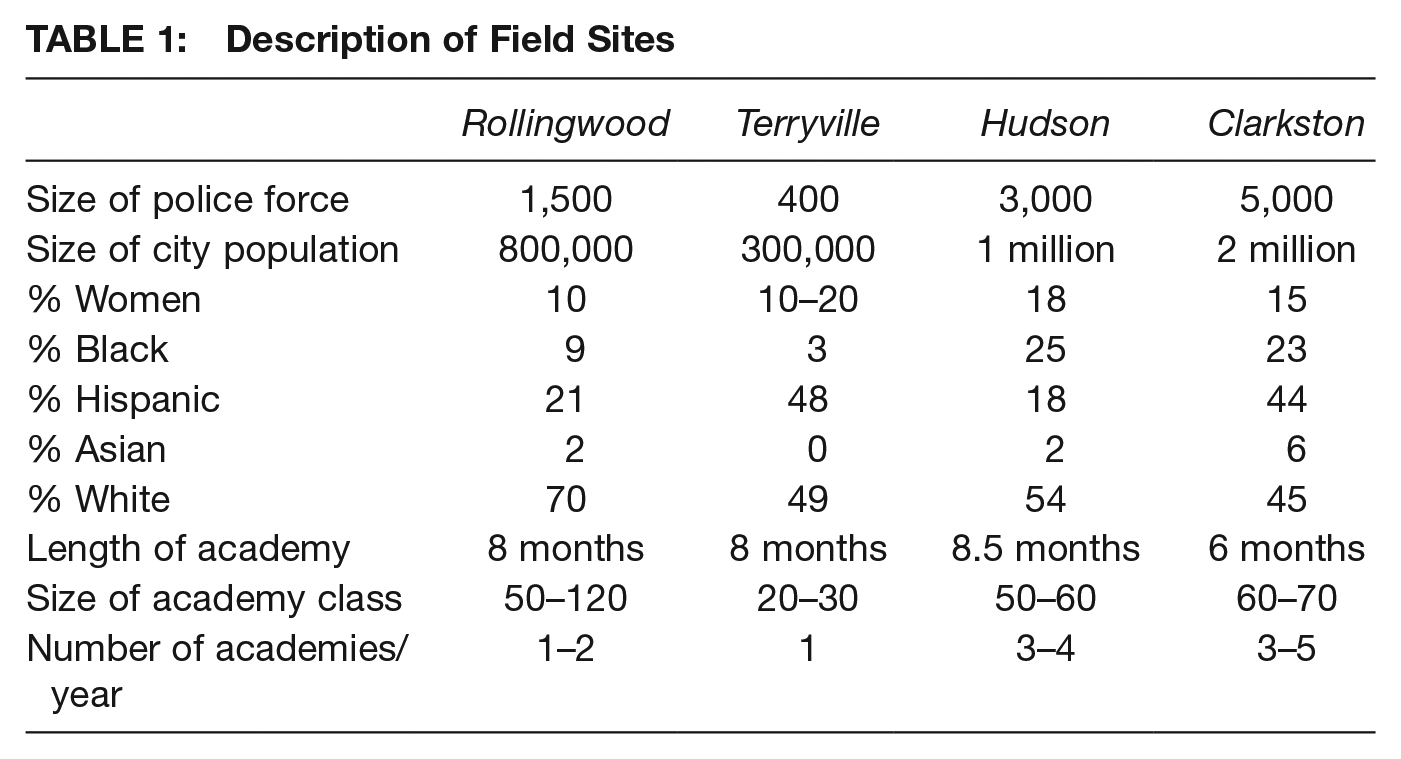
The departments varied in size and served cities with different racial compositions and political leanings. Their training academies varied slightly in length, and the demographic makeup of their police forces varied. The departments, however, shared several similarities: The hiring processes were comparable; they recruited at many of the same events; they taught the same 600 hours of state-mandated instruction to cadets; they had instructors who specialized in classroom curricula, defensive tactics, and firearms; and they each added training focused on department policies, physical training (PT), and scenario-based training.
The hiring process at these departments took 3–12 months to complete. The process generally included the following steps: (1) submitting an interest form, which confirmed the basic eligibility requirements for hire, including being a citizen, being 20.5–40 years old, and meeting educational requirements; (2) completing applicant testing, which included a physical fitness test, a written test, a personality test, and a one-on-one meeting with an assigned background investigator; (3) completing an interview with a board of three officers; (4) filling out a 25- to 40-page questionnaire including the last 10 years of employment, housing, education, and romantic relationship history, information about financial debt, disciplinary action in school or work, family members’ arrest histories, traffic violations and collisions, any illegal activity engaged in, repossessed property or accounts, alcohol and illegal drug use, and a list of all law enforcement agencies to which they had applied; (5) passing the background history investigation in which an assigned officer delved into the information provided in the background history questionnaire; (6) passing a polygraph exam; and finally, (7) completing a physical and psychiatric evaluation. At Terryville, just 5 percent of the total applicant pool made it through this entire process.
The applicants who accepted an offer of employment began training at the academy. The academies included in this study were 6–8.5 months long with between 20 and several hundred cadets on their respective campuses. There are roughly 700 state and local law enforcement training academies operating in the United States that, over the past decade, have provided instruction to 45,000–60,000 cadets annually (Buehler 2021; Reaves 2016). On average, cadets attending U.S. police academies spend the most time learning about the law (88 hours), firearms skills (73 hours), and defensive tactics (61 hours) (Buehler 2021). In 2018, roughly 14 percent of cadets who began an academy in the United States did not complete it; the majority of these cadets were non-white and/or female (Buehler 2021).
My fieldwork at these departments included observing applicant testing and interviews, recruiting events, classroom instruction and scenario-based training, and participation in physical conditioning, defensive tactics, and shooting drills. The extent to which I participated depended on my level of access at each department. At Terryville, for example, I was granted permission to participate in anything, whereas at Rollingwood, I was only allowed to observe.
This article also draws on 40 in-depth interviews, 38 of which were with officers who worked in hiring and training units as well as patrol units at nine police departments, and two of which were with cadets who left the academy. The officers included in the sample worked at the four departments where I completed fieldwork, as well as five additional departments. These departments ranged in size from around a dozen to several thousand officers. Following the interview, each respondent filled out a demographic form. Of the 40 respondents interviewed, 34 were men, and six were women. The respondents ranged in age from 23 to 65 years. Twenty-four respondents were white, seven were Black, five were Hispanic, one was Asian, one was South Asian, one was bi-racial (white/Black), and one wrote in “other.” Table 2 includes demographic information for the respondents.
Demographic Information of Interviewees
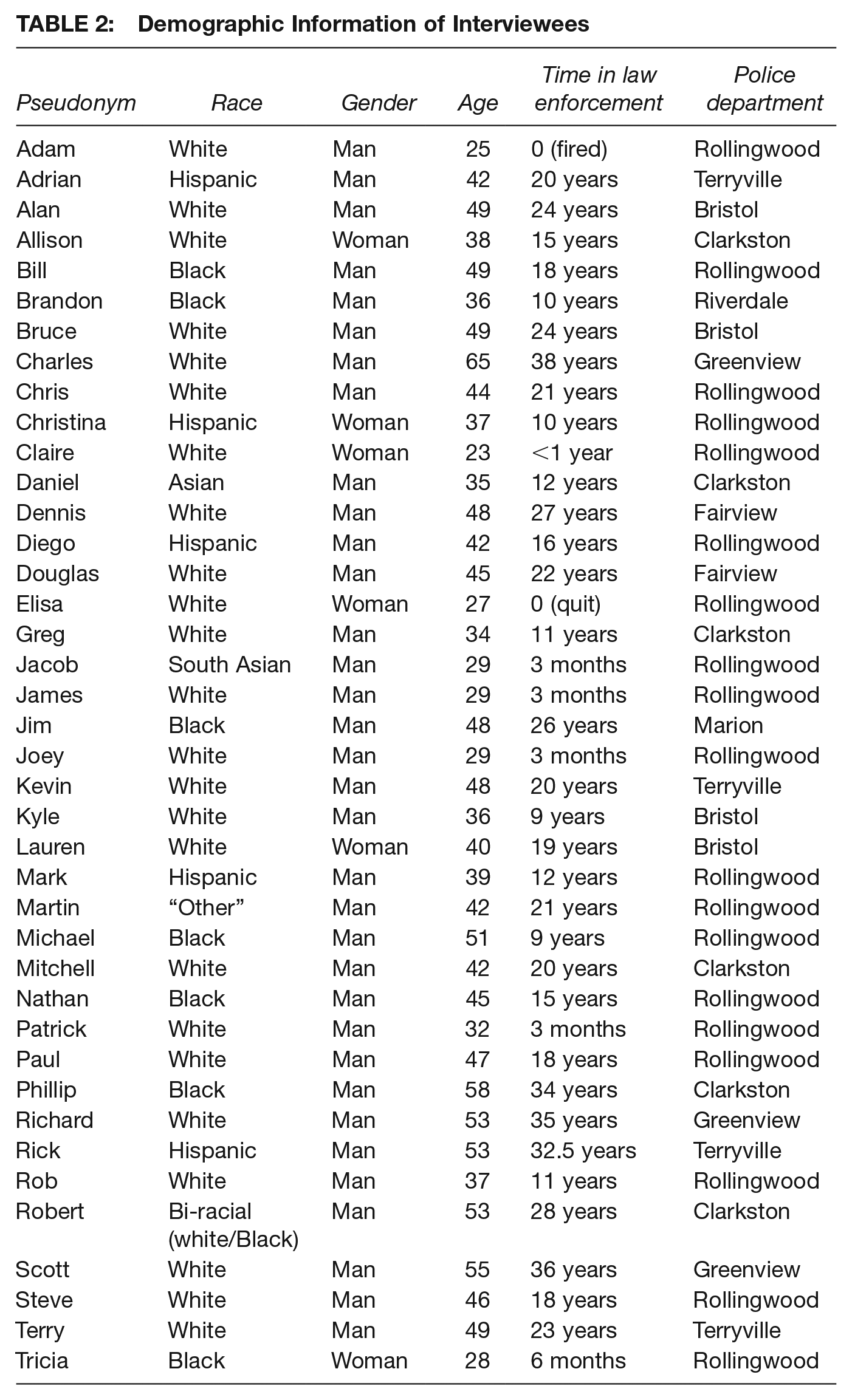
I recruited interview respondents during fieldwork and through personal contacts and snowball sampling. The interviews lasted 45–120 minutes and were conducted in-person (n = 31) or by phone (n = 9) for logistical reasons. In each interview, I asked the respondent about their career trajectories, their decision to pursue law enforcement, their experiences with training, and what they thought about police reform efforts.
My positionality as a young white woman shaped this research in several ways. Being a woman in this male-dominated space meant that I was often one of very few women. The cadets and officers were mostly white men in their 20s and 30s, with some instructors in their 40s and 50s. This sometimes introduced a paternal dynamic, whereby instructors drew parallels between me and their daughters. Other times, as feminist ethnographers have highlighted (Hanson and Richards 2019), this meant I was subjected to sexual harassment by men participants. Being a woman also granted me access to women cadets and officers. The women cadets often worked out, ate lunch, and partnered up together, so my being a woman gave me access to these spaces.
My own treatment at police departments reflected the organization’s investment in the gender binary. That people occupying the organization might be trans or nonbinary was not considered, and cadets and officers discussed gender in binary terms. In this article, when I refer to women, I am engaging with the conception of the gender binary in which the policing organization is invested.
Findings
At each of the departments I studied, the officers working in hiring units expressed a commitment to hiring more women. Reflecting normative logics about gender, these officers explained that women were naturally better communicators and more empathetic than men, making them uniquely suited for police work. However, I found that rather than valuing women, the organization exploited them in ways that further solidified the existing masculinist violent core of the institution. In this section, I outline the three primary ways that this framework, which I call essentialized utility, manifested. I begin by describing how these departments defined women’s utility through their ability to handle “female issues” for the organization in ways that reinforced the ostensible neutrality of men’s issues in police work. Next, I explain how the organization positioned women to provide legal protection to men by preventing police sexual misconduct and easing men officers’ anxieties about being accused of sexual misconduct. Last, I show how men bonded with one another by sexualizing and humiliating women coworkers.
Police Issues Versus “Female” Issues
Women working in policing have historically been relegated to tasks considered gender appropriate, which has usually meant interacting with women and children (Hamilton 1924; Martin 1980). This has shifted as women have gained access to patrol positions, where they now work as patrol officers, detectives, and academy trainers. Throughout my fieldwork, though, I found that this gendered structure of the organization has remained intact, where women academy instructors were often expected to handle “female issues” that arise. As in other male-dominated occupations (Simon 2019), women’s value is tied to their “femaleness.” At these academies, men’s issues were simply considered police issues, highlighting the neutrality of men and how masculinity structured policing spaces. This process, whereby only women’s issues were considered gender-specific, reinforced perceptions of women as special cases in policing.
Women academy instructors were specifically tasked with explaining the dress code that applied to women cadets. These dress codes were organized around a strict gender binary, where rules about long hair and makeup were addressed only to women, and rules about facial hair were addressed only to men. This came up on the first day of Clarkston’s academy when the cadets learned the rules of the organization, including how to address superiors, how the chain of command operated, and how to wear their uniforms. During this last part, a man instructor stopped his instruction to call up Erica, a woman instructor, to explain how the women cadets should dress and do their hair. Erica, who was Black and looked to be in her 30s or early 40s, moved to the front of the classroom and briefly explained that women needed to wear their hair in a style that prevented it from touching their collar. Makeup was permitted, she went on, but it would probably come off during physical fitness training. This instruction took 1 minute, and then Erica returned to the back of the classroom. Although Erica did not explicitly refer to race in her instruction, rules that dictate acceptable ways of wearing one’s hair are rooted in racialized histories, where, for example, Black women have experienced systematic discrimination based on their hair. Advocacy groups have pushed against hair discrimination (Powell 2019; Roberson 2021), including efforts such as the 2023 CROWN Act, which was created to “ensure protection against discrimination based on race-based hairstyles” (CROWN Coalition 2023).
A similar situation happened on the second day of Terryville’s academy, when the only two women instructors there—Faith and Sabrina—pulled the women cadets into a separate room to have “a talk.” Faith worked as the PT instructor at Terryville. She was just over five feet tall, Filipina, and in her 40s. Sabrina worked as Terryville’s Field Training Officer (FTO) coordinator, which meant she assigned each cadet a supervising officer after graduation. Sabrina was white and looked to be in her 30s. For the next hour, Faith and Sabrina showed the class how to arrange their hair in a bun, warned them not to engage in sexual or romantic relationships with cadets or officers, and commiserated about the difficulties of being a woman officer. Faith concluded the instruction by warning the cadets that “as a woman, you have to work twice as hard to be taken seriously.”
Tasking women instructors with “female issues” also came up in my interview with Allison, an instructor at Clarkston. Allison was white and 38 years old and had 15 years of law enforcement experience. When I asked how she ended up working in training, she explained, “Actually, a guy called me—the lieutenant, and he said, ‘Hey, I wanna get a female over here.’” Because there were more women cadets entering the academy, she went on, the lieutenant felt she would be better at addressing “female issues that males feel very uncomfortable handling.” When asked to elaborate, Allison responded: Sometimes it’s hygiene. It’s not anything different. I think guys just tippy toe because you have a different gender. It’s nothing they couldn’t have handled. I just think they wanna put it off on a girl because you have to pull a girl in the office and have a talk with her. They’d rather a girl be with them for whatever purpose.
Allison then described an instance in which, during class, a woman cadet disclosed a past experience of sexual assault. Allison was specifically tasked with talking to the cadet about her “outcry.” She noted that the men instructors could have handled these issues, but because they felt uncomfortable, they asked her do it instead. The lieutenant who hired her was explicit that her value was rooted in her “femaleness” and her ability to handle “female issues” for the academy.
Women were also tasked with recruiting women officers for the department. Scholars have shown that women being recruited into male-dominated fields may feel alienated when there are no women recruiters present at events (Wynn and Correll 2018). However, sending women officers to recruit women cadets meant that women were made responsible for increasing the number of women officers. Nathan, a 45-year-old Black recruiting officer at Rollingwood with 15 years of law enforcement experience talked about how they recruited women and persons of color. “Get out there and talk to ‘em he explained, “Sometimes when we go to different career fairs, we might take a female to go, so you . . . can see a female officer, and they can tell you about, you know, my career, how I started, and you know, I guess you can talk to ’em. And then also, they have an info session that’s all women, and we kind of use that as a tool.” In this case, recruiting men was just considered recruiting, whereas recruiting women was considered a special case, highlighting the neutrality of men and masculinity within policing.
The neutralization of men and men’s issues was also accomplished through either ignoring or describing women’s bodily functions as disgusting. This erasure of women’s bodies in masculine contexts constructs women as intruders while men’s bodies and issues are considered to be the norm (Steidl and Brookshire 2019). For example, that cadets may need to use the bathroom for reasons related to menstruation was not acknowledged nor accommodated. Claire, a 23-year-old white officer at Rollingwood, recounted the difficulty of being on her period at the academy. She explained: It was more of the stupid things, like our hair . . . . We would get critiqued a lot more on our hair. The guys didn’t have to worry about that . . . . Then being on your period in the academy sucked . . . . I mean, we had to deal with that all the time. Not being able to just get up and go to the bathroom whenever you wanted, that sucked.
To clarify, I asked Claire, “Is that because logistically it’s hard to find time to change a tampon?” She responded, “Well, yeah, and you just—that type of thing, and you don’t know when you’re about to go outside and get smoked 1 for an hour or two. You’re like, ‘Should I change my tampon now or—?’ Then you have to deal with all that.” Claire highlighted that it was not an option to go to the bathroom during a smoke session. In this way, women—or any cadets who menstruated—were expected to silently adapt to the existing masculine organization.
When men instructors were confronted with women’s bodily functions, they often expressed disgust. This came up at Rollingwood when the cadets were learning defensive tactics. As I stood with the instructors, Rob, a white instructor in his 30s, told the group a story about a cadet who was in the tactics group the previous week. One of the drills required a “buddy carry,” where one person carries their partner over their shoulder. Grimacing, Rob recounted that one of the cadets—a woman who had given birth multiple times, he said—urinated on herself during the buddy carry. “She came up to me and said, ‘sir I need to go to the bathroom and change my panties and pants,’” Rob recalled. He held his hands up in a defensive position as he got to the word “panties” and added, “and I was like, ‘Okay TMI [too much information], I already said go ahead.’” For someone who had given birth multiple times, which can damage or weaken the pelvic floor muscles, it was easy to imagine how a buddy carry could be difficult. Instead of being accommodating, however, Rob expressed disgust and continued to tell the story to his coworkers the following week.
A similar instance occurred at Rollingwood when the instructors discussed cadets who had filed workers’ compensation paperwork for training-related injuries. Josh, a white instructor in his 30s, mentioned a cadet who told him she had “a bruise from my vagina to my upper thigh.” Josh cringed as he said the word “vagina” and lamented, “Okay, you could have just motioned to the area or said groin, come on.” Josh’s reaction to the word “vagina” stands in stark contrast to the repeated references made to penises and testicles. For example, if the cadets’ push-up form deteriorated during training, Josh would shout for them to get their “nut sacks” off the ground.
This process of highlighting “female issues” and appointing women to address these issues reinforced the perception that women in policing are special cases. Importantly, “female issues” were not anything that the broader department needed to be involved in or address. If the organization conceptualized women’s inclusion as required for all officers, there would not be a need for this gender-segregated coaching on hair, office romances, and the like. I am not arguing that the solution is to ignore women and their bodily functions. However, at these academies, only women were perceived as having gender and having issues associated with their gender, which alienated them and further emphasized the neutrality of men and men’s issues within policing.
Legal Protection for Men Officers
Women officers were also considered useful to the organization insofar as they could offer legal protection to men officers who might be accused of police sexual misconduct when interacting with women civilians. This legal protection took form in two primary ways: (1) Women officers on patrol were described as being useful in conducting searches of women civilians, thus preventing men from being accused of sexual misconduct; and (2) women cadets’ bodies were regarded as tools for men cadets to use to practice searching women civilians in ways that would prevent potential accusations of sexual misconduct.
These departments had policies dictating the process of same-sex and opposite-sex frisks and searches. A frisk is completed if an officer believes someone is armed and involves the officer touching someone over their clothing to feel for weapons. A full search—which involves turning out pockets, taking off shoes, and shaking out clothing—cannot be conducted until after an arrest. There were rules specifying how an officer should inspect “sensitive areas,” which included the groin, butt, and breasts. This also applied to women officers searching men’s “sensitive areas,” although instructors did not spend nearly as much time discussing this scenario.
This sense that having women officers was useful so that they could search women civilians came up with Jacob, a 29-year-old South Asian American who graduated from the Rollingwood academy I observed. When I asked Jacob if he thought diversity in policing was important, he replied that, in his experience, “no one’s more willing to talk to me over a white or Black cop . . . . They look at the uniform all the same way.” “I think gender diversity is important,” he added, “I think that having women available—female cops available—to do searches on females” was good for the department because it allowed male officers to “still give the impression that you respect her dignity by having a female search her” (emphasis added). This view also came up with women officers. Tricia, a 28-year-old Black officer, explained: You need the females because—before our bodycams, you had too many situations where females were like, “Oh, I was touched inappropriately by this officer.” We didn’t have bodycams to prove that he touched or he didn’t touch you. Now, when we have female officers, you have those officers to go do a search on a female or a frisk because it’s like, “Hey, I did this. This is how we’re trained to do it.” Then we don’t have an issue with the male officers.
Tricia explained that women officers were useful because they prevented both the opportunity for men officers to assault women civilians as well as false allegations made by women civilians. Before body cameras were available, she said, the department could not substantiate allegations of sexual misconduct by men officers. However, even now, with body cameras, Tricia explained that women are still useful in preventing sexual misconduct as well as false allegations.
At the academy, women officers were also used to help men cadets learn how to frisk and search women. At Rollingwood, the cadets spent a full day learning how to conduct same-sex and opposite-sex frisks and searches. Before the cadets practiced on one another, Tyler, a white tactics instructor in his 30s, demonstrated how to conduct a frisk and search by demonstrating on himself. Tyler pressed his hand against his pants, into the crease where his groin and leg met. “You need to go all the way to where the body ends,” he insisted “because there are weapons there.” “It’s uncomfortable,” he said, “but you need to do it.” Tyler then called up a man cadet to demonstrate same-sex searches between men. The cadet stared straight ahead, chin high, while Tyler touched his back, waistline, chest, and legs. Tyler clarified that when men frisk women, they should use the back of their hand on the breasts and then use their extended thumb to press between the breasts, and curve around, so the back of their hand presses underneath each breast, and up into their armpit. Tyler commented, “We all know what breasts feel like,” so although it might be difficult to immediately tell if something hard is the underwire in a bra, you should be able to determine if it is a weapon.
Tyler then called on a woman cadet to come to the front of the class. Tyler reiterated that for an opposite-sex frisk, the sensitive areas on a woman are the groin, butt, and chest. He started the frisk the same way, reminding the men in the class that touching the waistband, stomach area, and back on a woman are all the same as when frisking a man. When he got to the cadet’s chest, he again explained that men needed to use the back of their hand, and he demonstrated, swiping the back of his hand across the top of her breasts. As Tyler got to her chest, her breathing got heavier, her sternum moving up and down dramatically. The corners of her mouth drooped more noticeably while she stared at the ground.
Talking us through it, Tyler slid his thumb along her sternum and then moved the back of his hand underneath her breasts, in a half circle, and up the side of her armpit. As he did this, Tyler insisted, “it’s the thumb side guys, not the other one, like you’re a fucking weirdo.” He explained that if he used the other side of his hand, he would end up cupping each individual breast with his palm, which was more invasive and would make them more vulnerable to accusations of misconduct. He then demonstrated the wrong way as he said this, cupping each of the cadet’s breasts in his hand. Her shoulders shivered. Tyler again insisted that the cadets get comfortable with this: “Oh no, it’s a girl, she has boobs. No, you can’t do that.”
For the next hour, every man cadet practiced on the two women cadets in the group. The women cadets, with an airtight professionalism, moved from one group to the next, repeatedly being searched by more than a dozen men in their class. Afterward, the instructors asked the cadets if they had any questions. The cadets’ questions focused on the specifics around how men could frisk women. One man asked for clarification on how to search a woman who is wearing a skirt or dress. Another man asked whether he would be allowed to pull and shake a woman’s sports bra to let weapons drop out. In answering these questions, the instructors highlighted the oft-expressed anxiety that men officers would be falsely accused of sexual misconduct by women civilians. They reminded the cadets that everything would be on camera, so if they frisked within policy, no one could accuse them of harassment or assault. In this case, they explained, the body cameras were your best friend. The concern here was that women civilians would create false stories or misinterpret men officer’s touch as sexually invasive, not that men officers may actually inappropriately touch women’s bodies while on duty, despite the evidence suggesting the prevalence and persistence of police sexual misconduct (Kraska and Kappeler 1995; Maher 2003; Rabe-Hemp and Braithwaite 2013; Stinson et al. 2015).
This anxiety around men officers being falsely accused of harassing or assaulting women while on patrol also came up when cadets were put through scenario-based training. Officers served as role-players while the instructors evaluated the cadets. In one scenario at Rollingwood, the cadets were required to make a traffic stop, run the driver’s and passenger’s names through dispatch to check for warrants, and, upon finding out that the driver had a warrant, arrest and search her. The cadets were supposed to find a gun in her shorts and a small bag of drugs hidden in the side of her sports bra. When Jacob completed this scenario, he lifted the woman officer’s shirt completely up to her neck, exposing her entire bra to his partner and the pair of officers evaluating the scenario. When the instructors asked why he did this, he explained that he wanted to make sure his search was captured on his body camera to avoid any complaints from the woman. The concern here was avoiding what Jacob perceived to be false accusations of misconduct, and in the process, Jacob exposed the officer’s body to his classmates and her colleagues. Jason, one of the tactics instructors at Rollingwood, laughed during the scenario and told several other instructors about it—maintaining that it was hilarious—for the next 2 days, highlighting the nonchalance with which these training exercises were regarded by men instructors.
While women were useful to the policing organization in that they could offer men officers legal protection by searching women civilians, there was a disturbing irony to these practices, where there was no expressed concern that the training itself, which used women’s bodies as props, involved invasive or sexualized touch. Women’s bodies were regarded within a frame of essentialized utility, which exploited their value to sustain the organization.
Sexualizing and Humiliating Women
In addition to being assigned to deal with “female issues” or to shield men legally, women officers were also sexualized and humiliated by men to facilitate misogynistic bonding. One way this dynamic materialized was through pranks, and the subsequent retelling of these pranks, that men played on women that sexualized and humiliated them. During lunch at Clarkston one day, Wes, a white officer in his 50s, told me about a prank he played on Royce, another white officer in his 50s. Wes recalled that an older Asian-American woman officer came into the firing range once, and, pointing at her, he asked Royce, “You fucked her, didn’t you?” Royce denied it, Wes told me, and later in the day, Wes took Royce’s phone and texted the woman officer: “I’m coming over later, we’re fucking.” “Then she responds!” Wes shouted, slapping the table and laughing, “something like ‘What time?’ So then I was like, ‘oh damn they really did fuck!’” Wes described the woman as older and suggested that she was physically unattractive, both of which were meant to further humiliate Royce for being involved with a woman considered undesirable within conventional understandings of gender, youth, and beauty. It is also entirely possible that Wes drew on racial tropes that sexualize and fetishize Asian women in his decision to specifically target an Asian-American woman officer in this prank (Anandavalli 2022; Zheng 2016). After describing the officer in this way, Wes laughed, adding, “I mean a kill’s a kill.” Through repeated narrations, Wes put his colleague on sexual display, humiliated her for his own entertainment, and then continued to re-tell the story to others.
Sometimes, these pranks targeted me. At Rollingwood, during tactics training, the instructors told me that John, a white cadet in his 20s, would not “stop staring” at me. One afternoon, the instructors paired up the cadets to practice frisking one another. Once the cadets were arranged into two lines, the instructors moved a few of them so that John was positioned in front of me, switching positions with his partner so that he was even closer to me, facing me directly. They had never rearranged cadets like this before, so I knew they were doing it to put John close to me. When I confronted the instructor, he laughed, and replied in singsong voice, “I don’t know what you’re talking about.” Annoyed, but playing along, I said, “Well when I have a stalker case, I’m gonna have you guys testify.” The instructor laughed and replied, “Are you kidding? We’ll take care of it ourselves.” He then referenced the collection of guns he owned. In this case, the instructors put my body on display to make me uncomfortable for their own amusement. Then, they ostensibly resolved the issue by suggesting they would physically hurt or kill a man if he stalked me. In both pranks, the men instructors sexualized women to facilitate their misogynistic bonding with one another at the expense of the woman involved.
Conclusion
Local and national newspapers continue to report that recruiting women will improve policing. For example, a recent National Public Radio story averred that increasing women police recruits by 30 percent could help change deparments’ culture (Corley 2022). However, my fieldwork at police academies complicates this narrative. As I show, the police organization used women to bolster, rather than disrupt, the existing masculinized culture. I term this essentialized utility, which worked through typecasting women and exploiting their presence to reify existing organizational hierarchies. Essentialized utility materialized in three primary ways. First, women’s value depended on their ability to handle “female issues.” In contrast, men instructors were not hired for their expertise in “male” issues because the implicit understanding was that police work was built by and for men. Second, women officers were considered useful because they offered legal protection for men officers by handling women civilians to shield men officers from accusations of sexual misconduct. Moreover, women cadets’ bodies were used to train their men coworkers. Third, men officers sexualized and humiliated women to facilitate bonding with other men while simultaneously alienating women.
Since their inception, U.S. police forces have experienced periods of contestation and reform, a pattern that usually hinges on issues related to racialized violence. The push to hire more women, who would be tasked with changing the masculine and violent police culture, is a continuation of this debate. It is entirely possible that without these compositional diversity initiatives, or with even fewer women entering these academies, the gendered dynamics documented here could be more explicitly sexist. However, the way that these police academies addressed “women’s issues” was rooted in sexist assumptions, reproducing the existing masculinist organizational ethos. In addition, this focus on women allows police departments to sideline the persistence of racial inequalities in police actions. Women become a way to address “violence” generally without ever acknowledging the role of race and racism in patterns of police violence.
These patterns are not exclusive to the police, and indeed, the arguments made here can apply across different organizational contexts. Other scholars have rightly lodged critiques at diversity efforts for being window treatments rather than meaningful changes to practices, policies, or culture (Ahmed 2012; Bell and Hartmann 2007; Berrey 2015; Embrick 2011; Gonzalez, Simon, and Rogers 2022; Kaiser et al. 2013; Kalev, Dobbin, and Kelly 2006; Lerma, Hamilton, and Nielsen 2020; Sharp et al. 2012; Thomas 2020; Williams 2021; Wingfield 2019). This article adds to this important area of scholarship by highlighting how the onboarding process at these departments used women, who are seen as essential to change according to diversity discourses, to highlight their exclusion.
Last, the concept of essentialized utility I propose offers a theoretical understanding of how organizational processes reify systems of inequality. Other scholars have made important contributions to this area of literature by theorizing how, for example, masculine institutions devalue femininity (Bonnes 2022; Hoskin 2019; Williams 2021). In this article, I have suggested that in addition, essentialized utility works not just to devalue or alienate women members in a masculine organization but also uses them to further maintain existing cultures of harm.
Although the four departments included in this study were located in different cities, the percentage of women in each was small, ranging between 10 and 20 percent. This reflects the overall status of women in policing, where women make up just 12 percent of police forces nationally (Gardner and Scott 2022). Women working at these departments—like most women working in policing—were a numerical minority. It is possible that the ways in which essentialized utility manifests could be less severe in departments where women make up a larger percentage of the workforce. However, studies of tokenism and workplace inequality have shown that the isolation, heightened visibility, discrimination, and harassment that marginalized individuals experience worsen as their numbers increase in the workplace (Laws 1975; Ott 1989; Reskin 1988; Yoder 1991). As the numbers of a lower-status, minority group (in this case, women) increases, the majority group may interpret this as intrusion and further tighten the boundaries around the existing occupational practices, norms, and expectations. Although I can only speculate, it is possible that as more women enter policing, rather than becoming more equitable, the onboarding process may become even more hostile toward women.
It is also possible that some police departments have incorporated diversity efforts in ways other than what I observed during fieldwork. However, there is likely uniformity in the way that police departments operate. For example, several professional organizations, like the National Association of Police Organizations, the International Association of Chiefs of Police, and the International Law Enforcement Educators and Trainers Association, hold annual conferences where they share information and strategies for policing. Also, on websites and social media pages, police officers across the country engage with one another about police-related topics. Police officers also travel across the country to recruit cadets or attend trainings.
As organizations continue to wrestle with defining and engaging with the concept of diversity, it is important that scholars investigate how these initiatives are developed and implemented. This article provides a window into how police departments have adopted diversity discourses into their onboarding processes. Organizations are self-perpetuating, so disrupting systems that sustain inequality remains a pressing societal challenge. As I demonstrate, in the case of police onboarding processes, essentialized perspectives of minoritized groups are used to reify existing organizational inequalities. For organizations to operate in more equitable ways, they need to concentrate on both achieving compositional diversity and making changes to the practices, policies, and ideologies structuring and guiding the organization.
Footnotes
Acknowledgements
The author is grateful to editors Barbara J. Risman, Sharmila Rudrappa, and Patricia Richards and the anonymous reviewers for their insightful and generous feedback.
This research was supported by a National Science Foundation Doctoral Dissertation Research Improvement Award, Number 1904407, and the University of Texas at Austin Osher Lifelong Learning Institute.

1.
Getting “smoked” refers to intense physical workouts announced at random throughout the academy. Instructors directed the workouts, which could last anywhere from 15 minutes to more than 2 hours. Getting “smoked” was used as a punishment for any misstep, which could include rule infractions such as not shining boots adequately, talking back to an instructor, or generally exhibiting a lack of effort.
Samantha J. Simon is an assistant professor in the School of Government and Public Policy and the School of Sociology at The University of Arizona. Simon uses ethnographic and qualitative methods to study violence, gender, race, and organizational inequality. She is the author of Before the Badge: How Academy Training Shapes Police Violence (NYU Press), which explores how the policing organization socializes new cadets into enacting state violence.