




Abstract
While workforce development can create skilled workers and better jobs, employer engagement is often limited. This article analyzes the case of Tennessee Pathways and draws on interviews with highly engaged employers, including those that hosted youth worker interns. The author investigates how employers accounted for their involvement and how program design shaped the benefits they perceived. Despite a traditional focus on skills gaps, the author finds that most employers sustained their engagement due to workforce challenges rooted in a mismatch between new hires’ expectations and the realities of the job, which resulted in high turnover of incumbent adult workers. Employers perceived that youth programs addressed this issue by fostering “career embeddedness” and deepening youth workers’ commitment to a nascent career interest or by redirecting them to other viable options. The author argues that practitioners should promote the potential of workforce development to yield long-term workforce reproduction and next-generation career development.
The need to both serve and engage employers is a core principle of workforce development in the United States. Following the job-seeker-focused poverty reduction and “work first” efforts of mid-20th-century programs, workforce development leaders have begun promoting the ways that programs can shape positive changes to employers’ internal workforce practices, including limiting the use of staffing firms, creating advancement opportunities, and raising wages (Bernhardt et al., 2001; Lowe, 2007; Lowe et al., 2021; Schrock, 2013). Despite these strategic shifts, the consistent message has been that workforce development is beneficial to employers because it promotes workforce skill development by furnishing high-quality training to job seekers and incumbent workers (Lautsch & Osterman, 1998), as well as by creating a sustainable pool of trained workers to feed local industries (Buford & Dresser, 2014; Lowe et al., 2011).
Skill development is doubtless an important benefit to employers and spurs their engagement in workforce development programs. However, several additional determinants of employer engagement have been noted, including the nature of the workforce intermediary, the nature of the population being served, and the costs to employers to engage (Laufer & Winship, 2004; Lowe, 2010; Schrock, 2013). Additionally, there is evidence of employer engagement in programs that promote workers’ long-term career development, including programs that mainly benefit other firms or industries by launching workers into alternative careers (Glover, 2023). Given the multifaceted nature of employer engagement, it is troubling that research rarely provides an in-depth view of the employer perspective on key motivations, challenges, and benefits of workforce development. This perspective is critical to understand given evidence that employers’ subjective perceptions can matter more than objective program outcomes in shaping their engagement (Laufer & Winship, 2004).
To address this gap, this article presents an analytic case study of employer engagement in youth workforce development programs in Tennessee. It addresses the following questions: How do particularly engaged employers account for their involvement in workforce development programs? How do these employers characterize the benefits of workforce development programs? (In other words, what do these programs do for employers?) And finally, how does program design shape these perceived benefits? The analysis largely draws on semistructured interviews conducted in 2016 and 2017 with 20 manufacturing and health care employers involved with youth career pathways programs in two multicounty regions in Tennessee.
I find that skills gaps and community involvement are initial motivators for some employers, but most sustain their engagement due to their perception that the programs foster a committed workforce that can be grown, retained, and shared throughout their regions and industries. These findings suggest that, through skills training and industry exposure, workforce development programs can furnish these important secondary benefits and motivate employer engagement. Specifically, I show how the career pathways programs are designed to have an iterative process of formal skill development and informal workplace immersion, which promotes the perception that they foster career embeddedness in the regions’ future workforce. I define career embeddedness as the extent to which people are enmeshed in specific industries, occupations, and organizations in ways that produce a coherent and lasting career focus (see Lee et al. [2014] for a similar construct). These findings add to workforce development research by showing that an emphasis on skill development is an incomplete explanation of employer engagement and risks understating the impact of regional workforce development programs.
Going Beyond Skills Training for Employer Engagement in Workforce Development
For decades, effective workforce development programs have taken an approach that serves both job seekers and employers (Fitzgerald, 2004; Giloth, 2004). Many programs continue to prioritize poverty reduction, while others push employers to improve job quality by changing practices related to supervision, diversity, mentorship, incentives, and advancement (e.g., Dedrick, 2014; Giloth, 2000; Lowe et al., 2021). Above all, workforce development programs focus on providing training to upskill workers to meet employer needs. In fact, despite the replacement of the federal Job Training Partnership Act with newer legislation in 1998, workforce development programs are still colloquially referred to as “job training programs,” underscoring the primacy of skill development (Jacobs & Hawley, 2009).
Recent case studies have focused on the long-term benefits of building collaborative, multistakeholder programs, as opposed to siloed training efforts (Lowe et al., 2011, 2021; Schrock, 2013). An exemplar is the biomanufacturing sector in North Carolina, which is supported by a network of community colleges and agencies (Lowe, 2014; Lowe & Freyer, 2015). These regional programs require employer engagement in ways that go beyond a willingness to hire newly trained workers. They rely on employer-provided resources and leadership, including through advisory board membership, local hiring and referral agreements, long-term relationship-building with job seekers, information on skill needs and industry trends, and the provision of qualified trainers (e.g., Bernhardt et al., 2001; Giloth, 2000; Lowe et al., 2011).
Securing deep employer engagement is known to be a significant challenge for workforce development leaders. For instance, a recent study of the Genesis Movement by the Illinois Manufacturing Excellence Center conducted by Lowe et al. (2021) found that nearly fourfold fewer employers took up the program than expected. Berry (2004) described how 1,200 employers participated in a detailed survey of workforce needs distributed by the Cleveland Jobs and Workforce Initiative, while a much smaller number participated in ongoing focus groups and training curriculum development.
While it is less often discussed, there is evidence that workforce development programs may furnish important benefits to employers in addition to meeting their skill needs. Several recent case studies show that large employers may invest in programs that provide frontline workers with training and exposure to alternative career paths, explicitly creating benefits “beyond the [focal] business,” but also building brand loyalty and incumbent employee engagement (Glover, 2023, p. 1). Similarly, in their commentary on the Manufacturing Extension Partnership centers, Lowe et al. (2023) identified that the centers are concerned with combatting an “interest gap” as well as a “skills gap.” Their interventions target worker morale and aim to create “careers where the employees stay and grow with the company” (Lowe et al., 2023, p. 20). These cases show that workforce development can be an important mechanism for workforce reproduction—the creation of a committed, sustainable workforce as a collective resource for the broader region and industry (Forbes, 2018; Lowe et al., 2021). Beyond furnishing skilled workers for immediate employer needs, these programs focus on next-generation career development (Giloth, 2019; Poppe et al., 2004).
Workforce reproduction is a less obvious benefit than skill development because it cannot be measured simply by the number of workers trained or hired. It also requires collective, long-term involvement from employers. It is therefore important to hear directly from employers regarding how they weigh the benefits of workforce reproduction versus skill development and how programs can be effectively designed to promote broad, long-term benefits.
Employer motives beyond skill development are likely to be particularly salient for youth workforce development programs, including the secondary-to-postsecondary career pathways programs that are the focus of this study. New labor market entrants, such as youth workers, often have limited information about their career options and demonstrate high turnover (Zhou et al., 2023). Employers involved in youth workforce development might accept a delayed or limited return-on-investment, since youth workers, depending on their age, are not expected to immediately join the workforce. However, many adult programs also focus on entry-level positions and individuals without prior experience in the target industry (e.g., Lowe, 2007; Schrock, 2013). Thus, they face similar challenges around turnover and labor market matching. Additionally, there are some commonalities between some adult programs and the advanced stages of the youth programs profiled here, as both may involve community colleges and target young adult participants. Despite its specificity, this setting provides a useful case study in a policy environment that increasingly emphasizes the importance of creating sustained workforce pipelines (e.g., The White House, 2023).
Methods
This study uses qualitative, inductive methods that are appropriate for generating—rather than testing—hypotheses on topics that are theoretically underdeveloped (Yin, 2017), such as the employer perspective on workforce development programs.
The setting of this study is two multicounty regions that adopted Tennessee Pathways, a state-level initiative that began in 2012 to improve and expand career technical education (CTE) programs in high schools and connect them to area colleges and employers (Myers & Kellogg, 2022). These career pathways programs include sequences of career-focused courses spanning secondary and postsecondary education, employer engagement in furnishing work-based learning opportunities for students, and regional workforce intermediary governance (Hoffman & Schwartz, 2017). This setting can be understood as an “extreme case” because it is one that resembles a population of related workforce development cases but strongly demonstrates the construct of interest (Yin, 2017). Extreme cases offer unique opportunities worth documenting and are useful because the processes under consideration are likely to be especially visible (Yin, 2017). In this study, the career pathways programs feature many best practices for governance and design that have been identified in workforce development research, but multiple motivations for employer engagement are likely to be especially salient given the programs’ focus on youth.
Workforce development efforts within the two regions, which I call “Rural” and “Suburban,” each involved approximately 60–80 employers at the time of the study. At the time of publication, both regions had sustained or grown their employer engagement and expanded the programs to include new occupations and student activities. See Table 1 for a description of the regions, as well as illustrative data on student and employer participation in their career pathways programs.
Description of Two Regions.
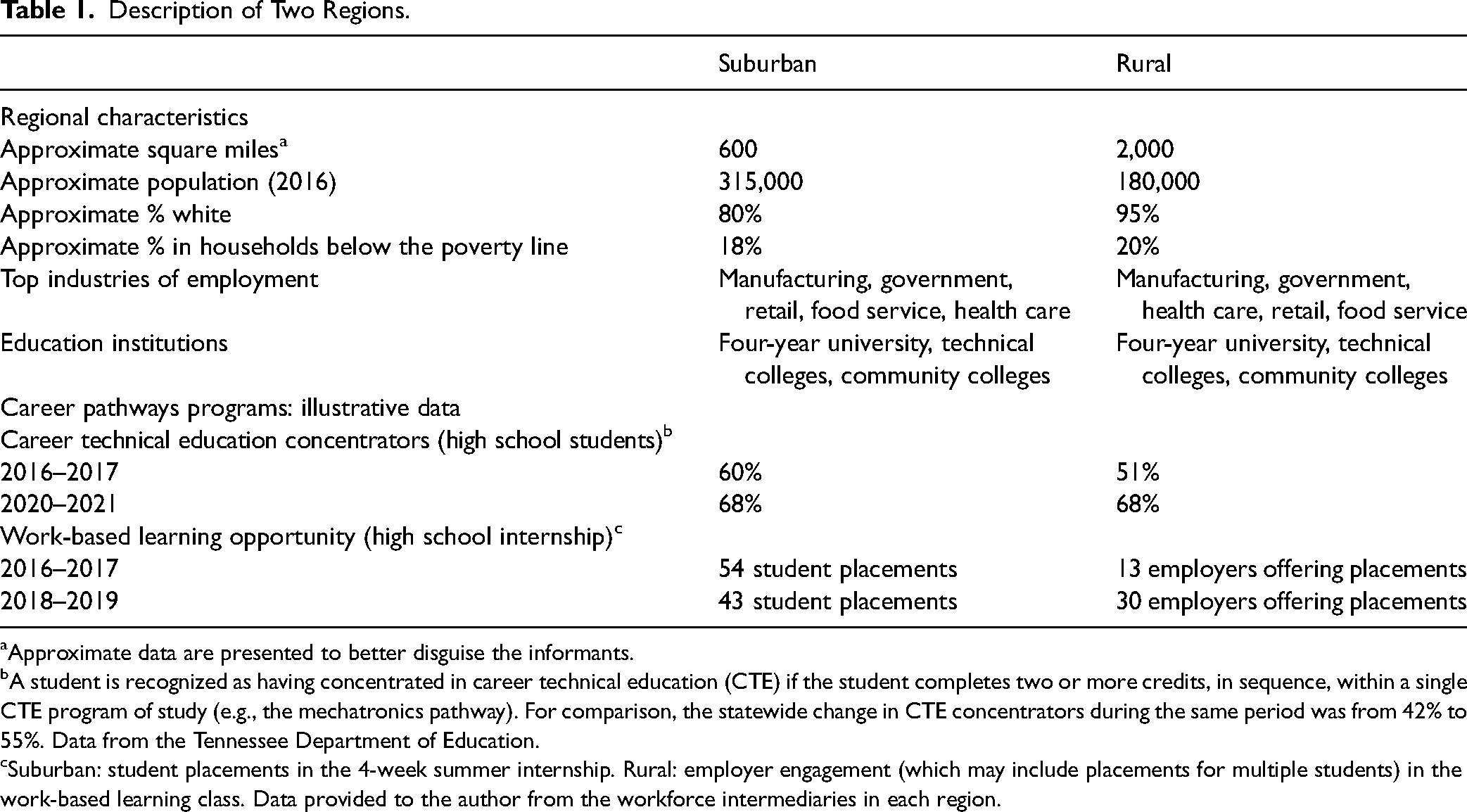
Approximate data are presented to better disguise the informants.
A student is recognized as having concentrated in career technical education (CTE) if the student completes two or more credits, in sequence, within a single CTE program of study (e.g., the mechatronics pathway). For comparison, the statewide change in CTE concentrators during the same period was from 42% to 55%. Data from the Tennessee Department of Education.
Suburban: student placements in the 4-week summer internship. Rural: employer engagement (which may include placements for multiple students) in the work-based learning class. Data provided to the author from the workforce intermediaries in each region.
Under the Tennessee Pathways initiative, both Rural and Suburban implemented similar programs in health care and manufacturing and thus sought comparable types of employer engagement. These programs were governed by regional chambers of commerce, which convened industry-based committees composed of regional employers and educators. While this study focuses largely on youth programs, both regions also developed adult programs under state initiatives that provided opportunities and funding for adult workers to earn postsecondary degrees.
This study leverages variation at multiple levels to reduce the likelihood that the findings reflect region-, sector-, or employer-specific factors. First, the two regions differ in urbanicity and economic growth, with Suburban being more urban and experiencing greater economic growth during the time of the study. Second, the two sectors differ in the nature of the career ladders and training for middle-skill workers, with the health care sector having more formal career ladders and licensure requirements than manufacturing. Third, employer establishments varied widely by size, from less than a dozen employees to more than 10,000 employees, and by ownership type, from small family-owned businesses to large multinational corporations. In Rural, for example, some of the most engaged employers were small businesses.
Program Design
While the career pathways programs in Rural and Suburban differed somewhat in their design, they were characterized by common components. In early secondary school (grades 6–8), students chose an occupation-focused pathway such as mechatronics (an interdisciplinary mechanical and electrical engineering field) or nursing. In both regions, students were given basic exposure to their options. For example, in Suburban, 8th-grade students attended a “pathways fair” hosted by schools and regional employers. Employers were also involved as classroom guest speakers. In late secondary school (grades 9–12), students took courses in their chosen pathway and sometimes participated in industry-related extracurricular activities, through organizations such as HOSA-Future Health Professionals. Some pathways allowed students to earn valuable industry certifications like the Siemens Mechatronics Systems Certification Level 1. Employers hosted job shadowing days, sponsored student organization events, and offered internship placements for high school students, as well as other work-based learning opportunities (e.g., Holzer & Lerman, 2014). In Rural, students could take a work-based learning class during the school year that involved an employer placement for several hours per day. In Suburban, students could apply to a 4-week summer internship hosted at an employer. At the secondary level, students’ participation in these courses and work-based learning opportunities was guided by parents, teachers, and other CTE professionals. For instance, high school students in Rural who performed well in their initial pathways’ classes were recommended by teachers to take the work-based learning class. While some students changed pathways during or after high school, others pursued postsecondary education at colleges or universities in the same pathway. At this level, many employers hosted formal medical rotations, apprenticeship opportunities, or part-time jobs that provided students with deeper immersion and more advanced skills.
Figure 1 presents the components of these career pathways. As will be discussed in the following sections, Figure 1 shows how the programs promoted an iterative process of formal skill development (in both schools and workplaces) and informal immersion in workplaces (work-based learning), with each element serving as a precondition to the other.
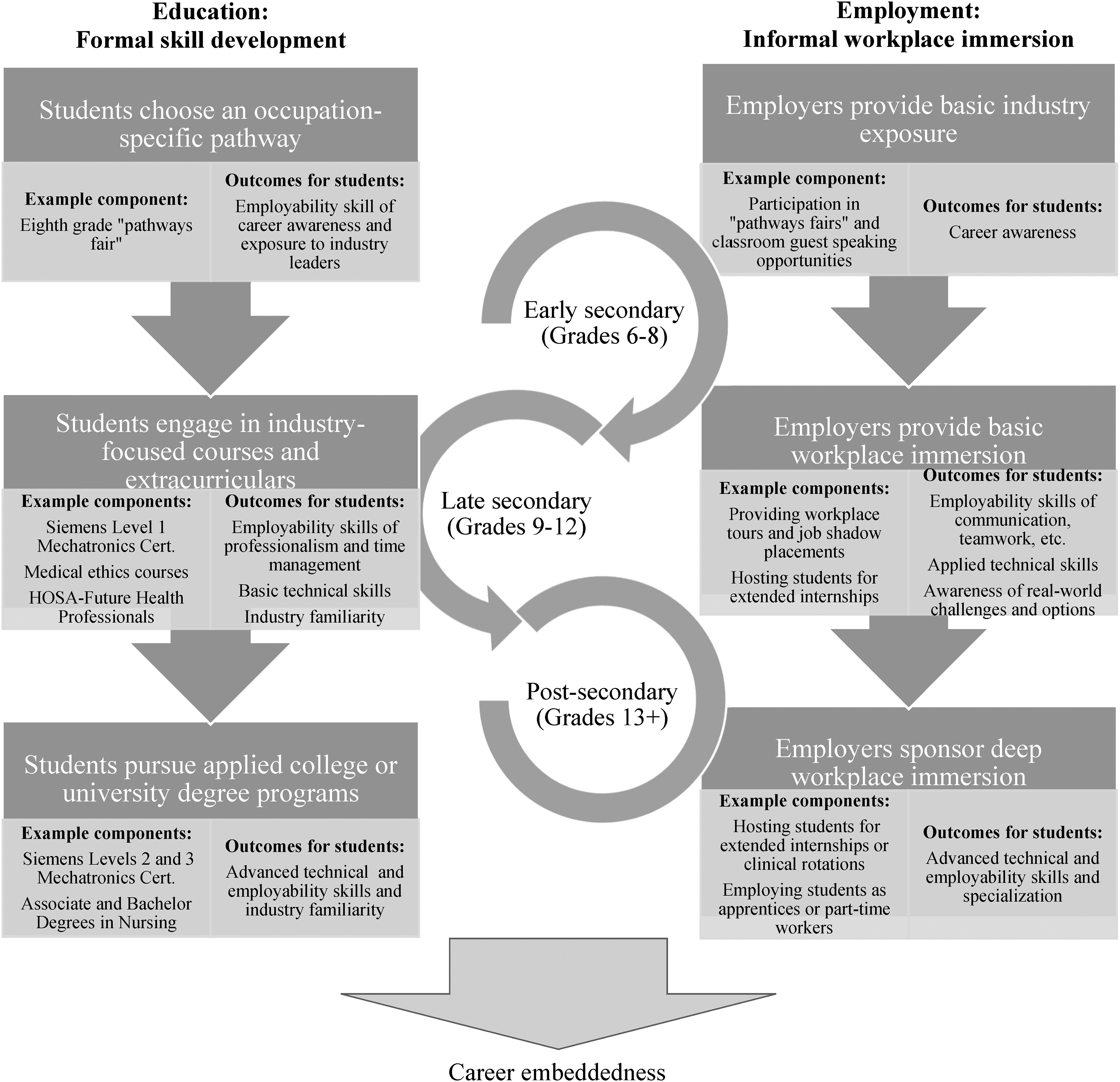
Iterative and scaffolded model of formal skill development and informal workplace immersion through youth career pathways.
Interview Data
In 2016 and 2017, I conducted a total of 20 semistructured interviews lasting between 30 and 60 minutes with manufacturing and health care employers in Rural and Suburban. While this paper largely relies on these employer interviews, it is informed by the 20 months of observations and additional interviews I conducted in Tennessee and other states implementing career pathways—more specifically by the 12 interviews that I conducted with educators and workforce leaders in Suburban and Rural, as well as over 70 hours of meeting observations and informal conversations with stakeholders in the two regions. See Table 2 for a description of the employer interview sample and supplemental data collection.
Description of Interview Data.
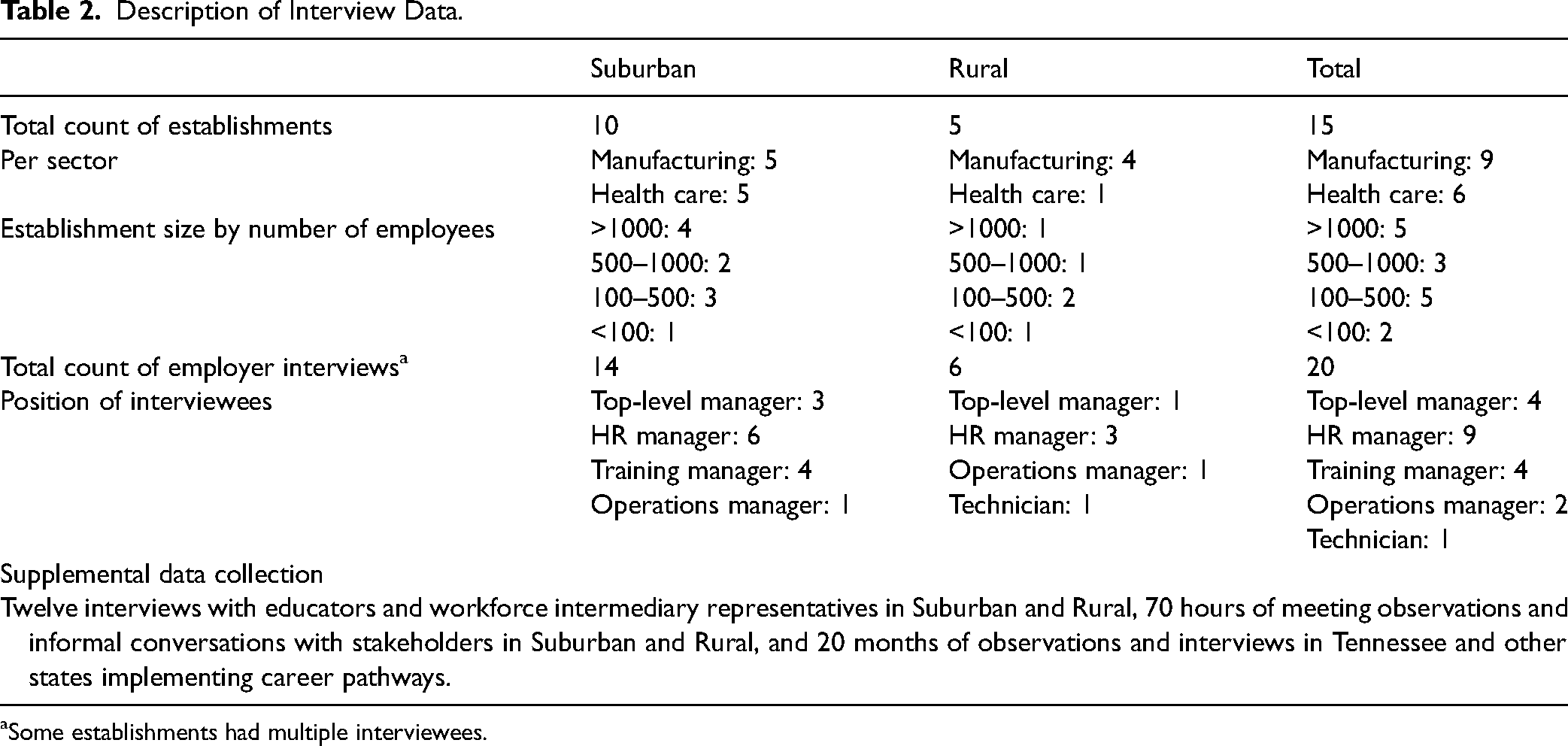
Some establishments had multiple interviewees.
To identify prospective interviewees, I used purposive sampling, which differs from random sampling in that it aims to select the respondents who are most likely to provide in-depth, useful information (Miles & Huberman, 1994). I identified interviewees by asking workforce intermediary leaders to connect me with the most involved employers in the regions. Many of these employers had engaged in the most resource-intensive activity of hosting students during internship placements, while others had only hosted students for job shadowing but were highly involved in committee work. To encourage honest accounts, I offered employers anonymity at the individual and firm levels. I identify interviewees only by the region, role, and sector of their employer, and I identify establishments by sector and size.
Most of the interview questions focused on the facilitators, barriers, motivations, and implementation process for each career pathways activity in which the employer was involved, such as job shadowing or internship hosting. (See the Supplementary Online Appendix for the full interview guide.) At the conclusion of my data collection, I coded the interviews in the qualitative software Atlas.ti to identify emergent themes (Miles & Huberman, 1994). I noted patterns in these themes, including that many employers connected their involvement in the career pathways programs to their challenges with workforce turnover and retention.
Employer Engagement in Youth Career Pathways Programs
Turnover and Retention Concerns
Because workforce development programs generally assist employers in sourcing and training potential workers, employers’ involvement is often assumed to be motivated by their perception of skills gaps. Some of the employers I interviewed did complain of skills gaps when asked about their workforce challenges. However, the most common account across the two regions and sectors was the high turnover of employers’ frontline (adult) workforces. One manufacturing training manager indicated that the problem was largely due to a mismatch between the expectations of new hires and the realities of the job: There are several [new hires] that we bring in, and they’re very excited and very enthusiastic … They get out on the floor and realize what they got themselves into. By the first break, they’re gone. They won’t stay. I would bet if you asked every other company to be honest about it, they would have the same problem. (Suburban, manufacturing training manager 2)
Health care employers gave similar accounts, even for new hires in positions requiring high skills and credentials. One health care manager said: I hate it whenever people get out of school and they come to work and see whatever environment and say, “Oh, that's not what I thought it was, and I don’t want to do that”. They’ve wasted 4 years of their life [in college], and then [they go and do] something else. (Rural, health care HR manager)
Another health care HR manager posited that the problem stemmed from poor career advising and changes to nursing school curricula: I think many times people have been guided [toward nursing], and they had really no idea what that meant. … I think nursing schools have conformed to guidelines and structures that they’ve been given, but unfortunately at the cost of clinical time—time spent at the bedside with patients—and I think that has contributed quite a bit to the initial dissatisfaction in nursing that they feel when they get out. Because it's not a true picture … Nursing turnover rates in this area run between 17% and 20%. First-year turnover is horrid. And it goes back to that whole thing about not meeting expectations. (Suburban, health care training manager)
Employers articulated this problem in various ways, including as an inability to find adult workers with “the right mindset, the right heart,” or the “inner drive,” the “acumen,” or the “aptitude” for the work. While several employers implemented extensive onboarding and internal training to promote retention, they found these practices to be insufficient. As one health care manager said, “It's not a big deal to [new hires]—if they don’t feel like they get what they need or what they want in their current position—to just go in search of [another job]” (Suburban, health care HR manager 2).
The Benefit of Promoting “Career Embeddedness” Sustained Employer Engagement
Most employers stated that they did not initially connect their engagement with the career pathways programs to their desire to increase worker retention. They became involved with the programs through the personal solicitations of a workforce intermediary leader or because their organizations had been involved in other regional economic and workforce development efforts. Some employers became involved to promote community service. As one manager said, “For us, I would say it really started from a community outreach standpoint” (Suburban, health care HR manager 4). Further, employers’ involvement was sustained, in part, because the career pathways programs were led by respected regional intermediaries and were designed to meet labor market demand.
However, what sustained most employers’ involvement was the perception that the career pathways programs contribute to the viability of the regions’ next-generation workforce. I develop the concept of career embeddedness to describe the benefit perceived by these employers. I use this term in a similar way that prior research has used job embeddedness (e.g., Lee et al., 2014; Mitchell et al., 2001), which refers to the extent of a worker's enmeshment within the larger social system of the workplace and feeling that a particular occupation is a good fit. I define career embeddedness as the extent to which an individual is enmeshed with specific industries, occupations, and organizations in ways that produce a coherent and lasting career focus. It is distinct from a worker's motivation or skill level, since even highly motivated and skilled workers may find it difficult to form a clear picture of the opportunities and challenges presented by a specific career and may thus be uncommitted to it or perceive a poor fit with it.
Sometimes, the career pathways programs produced career embeddedness in youth workers as the workers became more deeply committed to and qualified for a career path in which they had an interest. One manufacturing manager said: “I’m sure [one of my student interns] will be a maintenance mechanic here one day; that's what he wanted to do from the day he came in the door” (Suburban, manufacturing operations manager). Career embeddedness also occurred as individuals who may have been unlikely to develop embeddedness in a given occupation were redirected into a different occupation within the same industry. One health care manager said: I can’t tell you how many times I’ve sat there and [youth workers initially] told me they want to be an ER nurse, and they spend a week in the ER, and they’re like, “Oh gosh, I don’t want to do this” … but they had no idea what people in the lab do, and [they find out] it's actually something that really interests them, and now they’re going to look into becoming a medical lab technician. (Suburban, health care HR manager 4)
Of course, some youth workers changed career paths entirely after their initial exposure, which some employers believed was a critical step in identifying a better fit, as this manufacturing manager explained: The real goal is supposed to be that [youth workers] get a taste of what it's like and see if that's what they want to do as a career. That has been successful from the standpoint that people have changed careers because it's not what they thought it was going to be. They backed out of it and looked at other options. (Rural, manufacturing HR manager)
Employers perceived both short- and long-term benefits from their involvement in efforts that promoted career embeddedness in youth workers. In the short term, the programs supplemented recruitment efforts. One manufacturing technician commented that hosting internships helped her identify and develop future workers: When [youth workers] come into this environment, they’re taught to work efficiently, and the things that they have learned … [they] can put into a real-life application on the job … It is a nice thing, because you can learn about somebody's work ethic and their ability to learn and catch on. It's a good opportunity for the employers as well as the student. (Rural, manufacturing technician)
In the longer term, employers believed that the programs would grow workforce pipelines and improve regional capacity for further workforce and economic development. A health care manager said that hosting high school students for nursing internships fostered a commitment that produced several long-term employees for her hospital: Seven or eight of the high school students that have done [nursing] rotations here, we have ended up hiring. A couple of those folks, we hired them on as nurse techs. They worked as nurse techs as they worked their way through nursing school, and then we flipped them to nurses. (Suburban, health care HR manager 4)
One manufacturing manager spoke of the benefits of collaborating with educators in terms of creating a local qualified labor pool: If the business community would … pause and think how this could benefit them in filling positions, maybe not now, but down the road, by creating a culture of collaboration … I think that could have a very positive impact on a community. You have your business and educators together. (Rural, manufacturing operations manager)
The perception that the programs promoted workforce reproduction within the manufacturing and health care sectors was critical to sustaining employer engagement.
Key Elements of Program Design
A full statistical analysis is necessary to identify the extent to which career embeddedness relates to important workforce outcomes like growth, retention, and turnover. However, employers’ perceptions motivated their engagement even without the presence of systematic evidence. Taking employers’ perceived benefits at face value, policy makers may consider how program design might promote career embeddedness in youth workers. As previously mentioned, the programs demonstrated key best practices, such as being led by trusted intermediaries, preempting common employer objections like cost and liability, and targeting areas of regional economic importance (Giloth, 2004). My analysis also reveals several elements of program design that generate novel recommendations for practitioners and policy makers (see Table 3 for a summary).
Recommendations for Workforce Development Program Governance to Promote Employer Engagement.
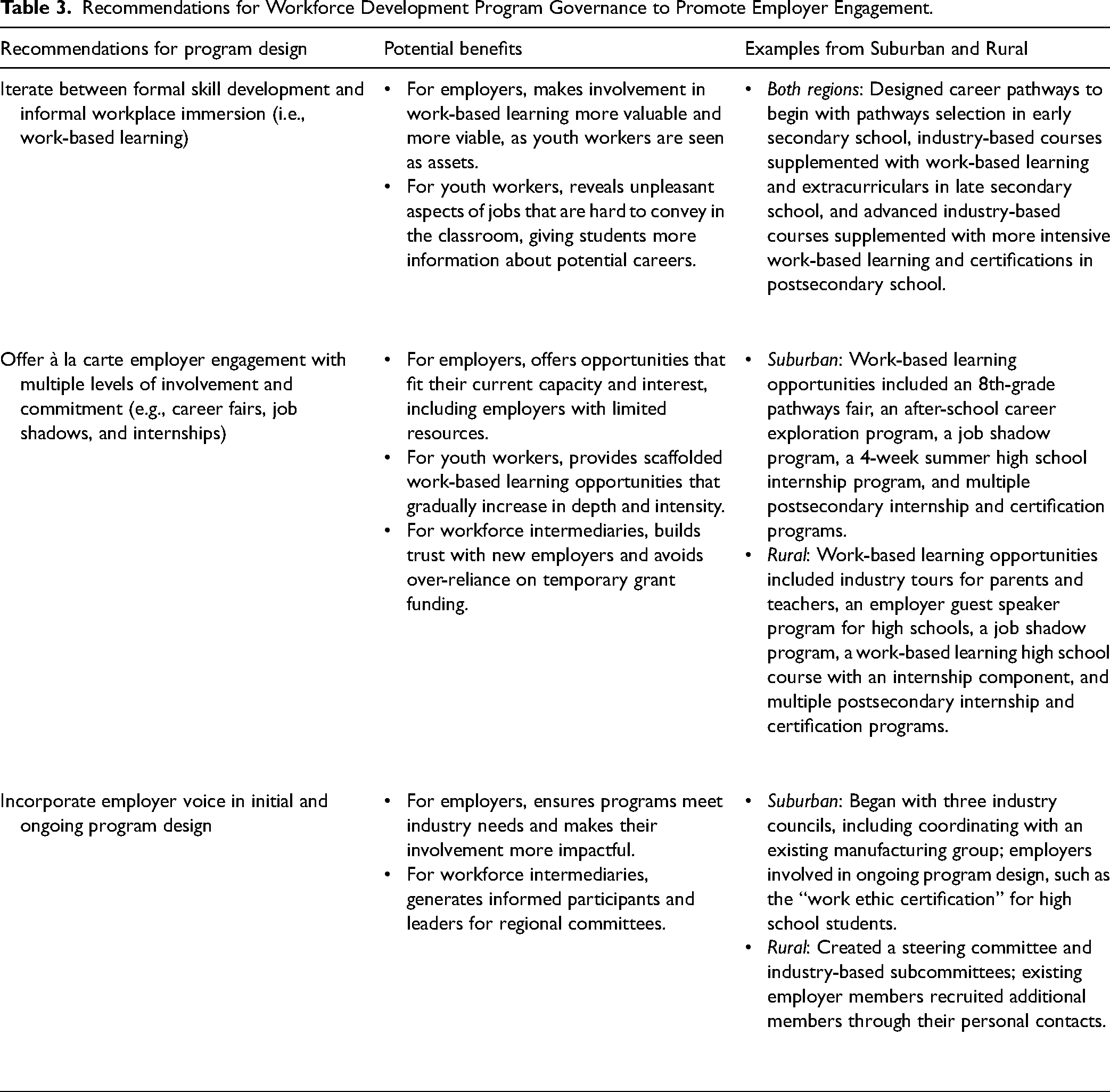
First, iterative, repeated cycles of formal skill development and informal workplace immersion (known as “work-based learning”; e.g., Holzer & Lerman, 2014) are critical to motivate and enable employer engagement (see Figure 1). For the youngest students, participation in the career pathways programs provided basic knowledge of career opportunities and fostered employability skills like commitment and the ability to talk to industry leaders. One manufacturing manager said: I think you need to start younger and younger, giving kids an idea of the various careers available to them … We shouldn’t be trying to push any of those kids too hard in anything specific. It's about having an awareness of what's out there and hopefully something inspires them. (Rural, manufacturing top-level manager)
At the late secondary level, the pathways fostered more advanced technical and employability skills, as youth workers were exposed to context-specific skills through work-based learning. One health care manager spoke of this value by saying: To me, that's probably better than any course they can sit through in high school, is to go and see. Go see how the cancer center works, go see how somebody gets their chemo. We have the robot in the pharmacy department if they want to be a pharmacist. That kind of thing. So, it's hands-on. (Rural, health care HR manager)
Beyond skills training, deep immersion in the workplace was critical to producing career embeddedness. This included exposure to unpleasant aspects of each job that were hard to convey in the classroom, as a health care manager explained: Patients come in, and they don’t feel good, and they can be cranky. And you think they’re going to be so appreciative of everything that you do. They may not always be that way, but [youth workers] need to learn how to deal with it early on. (Suburban, health care HR manager 2)
Employers benefited as youth workers became more deeply skilled and immersed in their chosen career pathways. The iterative design of the career pathways programs was critical to creating these benefits. Several employers described how prior workforce development programs in the regions had failed because they were not well designed. One health care manager said, “I was involved a few years back with an initiative to bring more biomedical jobs to Tennessee … It didn’t work out as well as it could have. The education side wasn’t ready” (Suburban, health care HR manager 1). Another health care manager described how her organization's past experiences supervising high school students during job shadows was “a chore” and “almost like babysitting.” Yet, she said that offering work-based learning through the career pathways programs was a radically different experience: These [high school seniors] come to you with 4 years already of health care experience. They’ve had HIPPA and OSHA, medical ethics—very impressive young people … Their [internship] orientation used to be about 4 hours long back when we first started. I do that orientation in an hour now … It's just amazing how much they already know … [Our managers] love having the students, so it's been a good thing for us. (Suburban, health care HR manager 4)
Because the career pathways were years-long experiences that involved both education and industry exposure, employers found it feasible and beneficial to engage in the programs, as this health care manager said: It almost seemed like a waste of time [to be involved at first] … How is a high school student going to know what they want to be? But now they start with the career paths in sixth, seventh, eighth grade, so they do know what they want to be, and they are very passionate about it, and very dedicated to the medical field. And those are the kind of employees that we want coming out soon. I think I have convinced our managers—and these students have also convinced our managers—that these students are our future in health care. (Suburban, health care HR manager 2)
One manufacturing manager said that allowing youth workers to build formal skills and industry familiarity through their high school courses made hosting job shadowing more viable and valuable for him: We had yesterday a job shadow with a lot of kids from [the local] high school … You can tell some [students] in there, just talking with them and the questions they ask, this one is going to be an engineer, this one is going to be an applications person. You can tell the interest they have and how they’ve already immersed themselves into PLCs or more mechanical type applications [in class]. The training they’re getting in school is allowing them to be exposed to—ok, I like this [versus that]. (Suburban, manufacturing operations manager)
The second key element of the career pathways programs was their emphasis on à la carte employer engagement in which employers provided work-based learning opportunities and other support in ways that fit their current capacity and interest. Some employers only offered job shadows to high school students, while others only sent representatives to career fairs and other school events. A postsecondary education administrator in Rural articulated the value of these opportunities to employers, “We’re trying to get students at the youngest age to understand what someone that works in mechatronics does—it's a marketing issue.” Each region had dozens of employers involved in furnishing more advanced work-based learning opportunities to students, such as internships or co-ops. One hospital manager said, referring to both high school and college students, “On any given day, we could have 40 to 60 students in our building” (Suburban, health care HR manager 4). Some employers changed their internal hiring or training practices in response to the opportunities available through the career pathways programs. One manufacturing manager spoke of the ways that the career pathways programs supported his efforts to build an apprenticeship program by allowing him to focus on applied, rather than classroom, skills: I was asked to create an apprenticeship program here like they had at our parent company in Germany … [I saw that our students] were getting the same technical training [that was in the German curriculum]. I said, “Why should I spend the money to invest in an instructor and the space [here in our shop]?” I want my floor space making money, not training people. So, I’ll train [apprentices] on my production line and let someone else do the technical [classroom] training. (Suburban, manufacturing operations manager)
Offering scaffolded work-based learning opportunities to youth workers allowed career embeddedness to deepen over time as the youth advanced through the programs. In turn, encouraging multiple levels of employer engagement made involvement more feasible for employers with limited interest or resources. It also built trust between employers and workforce intermediaries, as involvement did not require a large upfront commitment by employers who had not previously interacted with intermediary leaders or who were wary of committing to another uncertain workforce development initiative. Notably, maintaining flexibility in employer engagement also promoted the overall sustainability of the career pathways programs. Each region received some grant support for specific aspects of their programming, but these funding sources were considered precarious and time-limited. Overall employer engagement was not tied to specific grant-funded initiatives but could be tailored to opportunities that shift over time.
The third key element of the career pathways programs is a responsiveness to employer voices in initial and ongoing program design. Both regions in this study convened industry-based committees composed of both employers and educators. Employers found committee work to be valuable in providing opportunities to create and modify the programs to fit their needs. In Rural, one manufacturing manager said, “After 4 or 5 years of effort, we now have mechatronics programs addressing a specific area of need of our company and several others here. And all it took was a few people to get involved” (Rural, manufacturing upper management). Others pointed out that their ongoing involvement allowed them to suggest improvements to classroom teaching, not only to the work-based learning elements of the programs. One employer said, “We’ve made a push, for what it's worth, for project work, and working in teams, because the one thing I think I can assure you of is when you go to work in your life, you are going to have to work with somebody” (Rural, manufacturing HR manager). Another explained how he helped lead the creation of a “work ethics certificate” for high school students. So many of the young folks that we hire, they always want to be on their cell phones, they come in late to work—the whole “dog ate my homework” thing … It gives [students] the opportunity to at least get a work ethic distinction so when they’re going out and getting hired it says, hey, I may not have done everything right, but I’m responsible, I’m accountable. Those type of folks fit well into a manufacturing work environment. (Suburban, manufacturing operations manager)
For their part, educators and workforce intermediaries welcomed ongoing employer voices. Employers’ involvement in work-based learning programs familiarized them with youth workers’ competencies and weaknesses. This made employers more informed participants and leaders in industry committees, as one administrator said: I think [our Career and Technical Education director] could say this too—that our advisory board meetings were better because of [employer engagement in work-based learning]. I believe because [employers] knew more about what was going on at the high school, they had a little more input at the meetings. They felt more comfortable speaking aloud by saying, “The student I had was doing amazing in this, but what do y’all think about showing them how to do this right here?” I think I just brought more conversation from them. (Rural, secondary school district administrator)
Conclusion
In workforce development research, it is common to hear of employer engagement challenges, even for promising initiatives with demonstrable benefits. While the present study has some limitations due to its setting and methodology, its in-depth and comparative approach suggests important lessons for workforce development researchers, policy makers, and practitioners by encouraging them to look beyond skills training when pursuing employer engagement.
In an analysis of employers involved in youth programs under the Tennessee Pathways initiative, I first asked how employers accounted for their engagement. My interviews reveal the counterintuitive finding that employers are attracted to the youth programs to solve issues related to adult workforce retention and turnover. I articulate employers’ core challenge as one of building career embeddedness in new hires. Career embeddedness is distinct from workers’ motivation or skill level because it is rooted in a willingness to commit to deepening one's investment in a career path despite encountering mundane challenges that may test initially held expectations. In my interviews, some employers believed this problem was particular to younger generations who are inherently less likely to commit to a job. Some also spoke of problems with modern career advising and curriculum design. Regardless of the perceived underlying issues, almost all employers attributed their sustained engagement in the programs to their desire to foster career embeddedness in their future workforce.
Workforce development leaders may be inherently skeptical of trusting employers’ rhetoric, especially their oft-cited complaints about unqualified labor pools and lazy workers. Some skepticism is warranted, and my findings are not intended to shift responsibility or blame onto educators or workers. Instead, they are an argument for the need to better understand how employers perceive challenges and benefits so that outcomes can be improved for all stakeholders. Specifically, workforce development leaders and policy makers should probe deeply when examining industry needs, as the language of “skills gaps” and “worker shortages” may conceal more complex issues. In some cases, employers may actually be articulating an “interest gap” (Lowe et al., 2023) that must be filled before skills training efforts are likely to be effective.
Second, I asked what workforce development programs do for employers out of the many potential benefits that have been identified by prior research. While I did not initially expect employers to point to important benefits beyond skill development, I found that employers highly valued the ways in which the career pathways programs fostered career embeddedness and promoted workforce reproduction as a shared resource for their regions and industries. In some cases, the programs deepened youth workers’ exposure to specific occupations and industries, solidifying their decision to pursue a particular career path. In other cases, the programs reduced the risk of switching career paths for students, since students could explore career options at an early age without committing to a specific degree program. In either case, employers felt they benefited from a growing pool of potential workers that were more embedded in their career choices and thus less likely to contribute to turnover in the future.
This finding implies that workforce development leaders should focus on promoting the ways their efforts can yield long-term benefits for employers rather than focusing only on short-term skill needs. In this way, workforce development can be a powerful complement to economic development by creating and reproducing a local workforce that is committed to pursuing careers with local industries. This resembles the argument for cluster-based development policies in economic development research, in which employers are understood to benefit from specialized supply chains and knowledge spillovers in their local agglomerations (e.g., Wolman & Hincapie, 2015). I argue that such policies should also promote the value and reproduction of a highly committed workforce that can serve as an input to the low- and mid-skill occupations for local industries.
When policy makers and workforce development leaders frame skills training as the primary benefit of workforce development, they may be unintentionally weakening the case for deep and sustained employer engagement. Employers focused on skills training may determine their engagement through cost–benefit calculations to ensure they will receive a quick return on their training investments (Becker, 1964). Though the underprovision of employer-sponsored training as predicted by Becker's (1964) classic human capital theory is not generally borne out in macrolevel data (Acemoglu & Pischke, 1999; Osterman, 2022), it is common to hear of employers’ concerns about investing in general or transferable skills, due to the risk that newly trained workers will leave to obtain higher wages elsewhere. Employers may be less likely to engage in workforce development programs during weak labor markets or economic downturns if they are primarily focused on their immediate skill needs. Focusing on long-term workforce reproduction through the promotion of career embeddedness is one way to overcome such short-term thinking.
Third, I focused on identifying how program design shaped employers’ experiences. I show that career pathways programs may promote career embeddedness in youth workers when they are designed to alternate between formal skill development and informal workplace immersion (i.e., work-based learning). Critically, each component relates to the other. On the one hand, employers can more deeply engage with workforce development programs when youth workers have some industry familiarity and basic skills. Note that some employers find it easier to support the Tennessee Pathways programs as compared to prior, uncoordinated programs in the regions. On the other hand, workers may be more likely to persist through education and training when employers provide early exposure to the opportunities and challenges inherent in the work. I also identified that providing multiple levels of employer engagement and welcoming ongoing employer voice in program design are critical elements.
These findings suggest that workforce development leaders should focus on the ways that formal training and informal workplace immersion can be mutually constitutive of positive outcomes. They encourage an understanding of skill as being grounded in context, rather than as an objective attribute of an individual (Attewell, 1990; Jovanovic, 1979). In effect, employers cannot benefit from workers’ capacity to perform a task (achieved through training) without workers’ realized commitment to remaining in that job (achieved through deep career embeddedness). A lack of attention to career embeddedness in past training investments may be part of the overall poor reputation and outcomes of the U.S. workforce development system (King & Heinrich, 2011; Laufer & Winship, 2004).
Because this study relies on inductive, qualitative methods and features one focal initiative (Tennessee Pathways), it has some limitations that should be considered when assessing the applicability of its findings to other settings. It is important to note that employer engagement occurred against a backdrop of coordinated state and regional efforts to align education, economic development, and workforce development (Myers & Kellogg, 2022). The findings are likely most transferable to settings that have programs with similar scale and similar stakeholders, rather than isolated job training programs that lack integration with educational institutions. There are also differences between employer engagement in youth versus adult workforce development. Youth programs may be particularly well-suited to fostering career embeddedness because they focus on the early career exploration period. However, emerging research suggests that career embeddedness and workforce reproduction are also important considerations for adult workforce development (Lowe et al., 2021, 2023), and my recommendations for program design complement other recommendations that have been identified in prior research (e.g., Berry, 2004; Giloth, 2019; Holzer & Lerman, 2014). Nevertheless, it is important to consider how career embeddedness might be promoted in adult programs, which are often relatively brief and tend to specialize in specific industry- or occupation-based training. By contrast, youth programs can span many years, allow participants to explore an array of options, and have minimal consequences for participants whose goals or interests change over time. It may be that career embeddedness and workforce reproduction are equally important in youth and adult workforce development but are more difficult to achieve in the latter.
Overall, the transferability of the findings to other settings should be assessed on a case-by-case basis. The detailed description presented here provides researchers and practitioners with the means to assess the contextual similarity of other settings. Additionally, my findings from this single setting could be translated into testable hypotheses that would allow researchers to verify and quantify the relationships between employer engagement, career embeddedness, and workforce turnover more generally. While understanding employers’ perceived benefits is critical, it is also important to identify the realized benefits of workforce development.
In conclusion, while employer engagement in workforce development programs has the potential to create pools of skilled workers and to improve practices for hiring, training, pay, and advancement to create better quality jobs, there remain significant obstacles to achieving such engagement at depth and scale. Understanding the perspectives of the employers that do engage, like the employers featured in this analysis, can help workforce development leaders better frame their programs to attract employer engagement, help employers make sense of the varied benefits that stem from their engagement, and help communities and workers share in these benefits through coordinated and thriving regional economies. Workforce development leaders should take note that programs’ capacity to develop career embeddedness and stimulate workforce reproduction may be particularly promising benefits to pursue and promote.
Supplemental Material
sj-docx-1-edq-10.1177_08912424241265331 - Supplemental material for What Motivates Employer Engagement? Promoting Youth Career Embeddedness in Two Tennessee Regions
Supplemental material, sj-docx-1-edq-10.1177_08912424241265331 for What Motivates Employer Engagement? Promoting Youth Career Embeddedness in Two Tennessee Regions by Jenna E. Myers in Economic Development Quarterly
Footnotes
Declaration of Conflicting Interests
The author declared no potential conflicts of interest with respect to the research, authorship, and/or publication of this article.
Funding
The author disclosed receipt of the following financial support for the research, authorship, and/or publication of this article: This work was supported by the MIT Sloan Good Companies Good Jobs Institute.

Supplemental Material
Supplemental material for this article is available online.
Author Biography
References
Supplementary Material
Please find the following supplemental material available below.
For Open Access articles published under a Creative Commons License, all supplemental material carries the same license as the article it is associated with.
For non-Open Access articles published, all supplemental material carries a non-exclusive license, and permission requests for re-use of supplemental material or any part of supplemental material shall be sent directly to the copyright owner as specified in the copyright notice associated with the article.
