




Abstract
Innovation districts are being advocated for their potential to create or revitalize communities, produce neighborhoods with housing near work, and benefit surrounding communities by creating jobs for a wide range of skill sets. However, these aspirations are often mismatched with the application of innovation districts. Analyzing four innovation districts (Boston, Detroit, St. Louis, and San Diego), we demonstrate how the direction of innovation district development determines whether community goals are realized. Promoting innovation involves prioritizing high-skilled workers. When real estate development takes center stage, market demands become the focus. The construction of high-end housing, entertainment, and retail amenities may leave affordable housing options for lower-skilled workers as secondary considerations. Surging real estate prices within and around an innovation district can eventually push out long-standing residents, further negating the innovation district as a space for a diversity of people, ages, resources, and amenities.
Throughout the past two decades, the study and practice of economic development has addressed globalization and economic restructuring pressures by adopting place-based approaches to city and regional development (Barca et al., 2012). Place-based economic development policies aim to reduce spatial inequality, ideally through multistakeholder engagement and deliberative models of decision making that incorporate the social, political, economic, and institutional diversity of their localities (Kline & Moretti, 2014). Within place-based economic development, it is thought that inclusivity and attention to local factors ultimately are more effective than templated, wholly top-down approaches to generating city and regional prosperity.
The innovation district—a space for scientific research, university spillovers, and fast-tracking innovations to the market—sometimes is promoted as an example of such socially inclusive place-based economic development strategies (Katz & Wagner, 2014). Beginning slowly in 2000 with Barcelona's 22@bcn, but then rapidly ramping up following Boston's Seaport Innovation District in 2010, economic developers, planners, and politicians quickly adopted innovation district strategies as a tool to create jobs and spur local economic activity (Drucker et al., 2019). In its design, the innovation district intrinsically connects the global and local scales. It adopts a global orientation in focusing on innovation activities and attracting the footloose talent and firms of the knowledge economy. The innovation district aims locally through attempting to concentrate a portion of the entrepreneurial energy of a city region in a defined district where knowledge spillovers and other spatial synergies can generate mutually reinforcing external economies (Castells, 1992).
In most cases, innovation districts are built in the city and often over post-industrial sites, such as former manufacturing and warehousing districts. By focusing on placemaking and the types of amenities that appeal specifically to knowledge workers and firms, innovation district strategies also have become an instrument for urban revitalization. An innovation district may create employment opportunities for low-income communities proximate to its location. Although an innovation district primarily is a top-down approach, it can tap into area institutions and locally based growth coalitions to spearhead and/or implement portions of the strategy. Thus, at least conceptually, the innovation district can seem a promising strategy to revitalize lagging regions and reinvigorate urban cores, moving economic development a step closer to being a practice that considers the type of development and for whom (Pike et al., 2010).
However, innovation districts may not live up to promoted expectations for more inclusive development. That which is attractive to knowledge economy firms and talent may be at odds with the preferences of other area residents. If real estate development interests take center stage, the drive for the construction of hotels, high-end condominiums, and boutique amenities takes precedence. Affordable housing options for lower-income workers and the provision of public services become secondary considerations if they are included at all (Lawrence et al., 2019). The pace of development may undercut community aims for both incoming and long-standing communities as surging real estate prices within and around an innovation district hold the potential to push out residents and services, further negating the innovation district as a space for a diversity of people, ages, resources, and amenities.
We study the development of four U.S. innovation districts and ask: To what degree do innovation districts serve as tools of inclusive social development? In this paper, we focus on existing residents rather than attracted populations, and we employ the term community to refer to individuals already residing in or near the innovation district locations. Each case treats community development differently but not one case stands out as a successful example of preventing the displacement of these long-standing communities. Though we do not have enough data to definitively declare that innovation districts are unable to achieve broad revitalization without displacement, we do highlight the potential hazards of innovation districts for marginalized surrounding communities.
The Innovation District Concept Defined
Even though the first so-called innovation district, Barcelona's 22@bcn, has been around since 2000, innovation districts remain a young, evolving, and understudied concept. Though not without critiques, Barcelona's achievement with 22@bcn has become a celebrated model for its ability to launch the previously post-industrial Poble Nou neighborhood into a completely modernized technology campus (Casellas & Pallares-Barbera, 2009; Lawrence et al., 2019; Pareja-Eastaway, 2009). The success of 22@bcn informed the first branded innovation district in the United States, Boston's Seaport Innovation District, which was established in 2010 (Katz & Bradley, 2013). In the decade since the inauguration of Boston's Seaport Innovation District, city developers across the globe have embraced the innovation district concept (Talkington, 2019). Some, such as St. Louis’ Cortex, have reshaped and rebranded themselves as innovation districts even though efforts to harness a technology-based economy existed prior to the popular designation. These three developments—along with prior iterations sharing similar aims and ambitions, such as Kendall Square in Cambridge, Massachusetts, and North Carolina's 100-acre “Hub RTP” development located in the Research Triangle Park—became case studies for the Brookings Institution's now widely cited report on innovation districts (Katz & Wagner, 2014).
Innovation districts share three commonalities relevant to the themes raised in this paper. First, innovation districts are urban developments delineated by some form of political boundary, be it the fixed area of a tax increment financing district (as in the case of Cortex in St. Louis), an outline in a master plan (Boston's Seaport Innovation District), or a boundary promoted on marketing materials (the Detroit Innovation District [DiD] and San Diego's Innovation + Design + Education + Arts [IDEA] district). The existence of a recognized boundary is critical as it targets the location for financial investments and supportive programing, separating the “within” community from proximate neighborhoods. In this way, the innovation district strategy is similar to other place-based economic development tools to induce private sector investment, job creation, and higher productivity, but is thus also susceptible to critiques of these policies on incurring sunk costs and long-lasting negative detriments (Duranton & Venables, 2018; Kline & Moretti, 2014; Neumark & Simpson, 2015).
Second, innovation districts are dense developments that concentrate on work, housing, and entertainment amenities. Though variations existed (Christopherson & Clark, 2007), prior to the advent of the innovation district, industrial activity was heavily concentrated outside of the city following postwar patterns of urban decentralization. California's Silicon Valley, Boston's Route 128, and North Carolina's Research Triangle Park are progenitors to the innovation district and demonstrate the prior model of science and research industrial activity isolated in car-dependent remote office parks or suburban corridors (Mozingo, 2011; Saxenian, 1996). In more recent decades, scientific research and industry have become more urbanized to be in closer proximity to networks of firms and specialized labor markets (Clark, 2014). Globalization, the burgeoning importance of knowledge spillovers as critical to the innovation process, shifts in living preferences, the importance of amenities factoring into the return of young, educated workers to the city, and the revitalization of the urban core have paved interests for innovation districts (Couture et al., 2019; Duranton & Puga, 2020; Glaeser, 2011). As such, the design of an innovation district supports not only office buildings but also favors mixed-use development that incorporates housing and retail. In theory, individuals no longer need to commute substantial distances to remote suburban office parks but instead may walk, bicycle, or use public transportation to reach the well-connected innovation district.
Design plays a critical role in breaking down boundaries and making the process of innovation more porous between public and private realms (Wagner & Watch, 2017). The live–work–play combination is meant to form an optimal environment for innovation and generate the vibrancy and buzz that economic geographers from as far back as Alfred Marshall (1890) have identified as pivotal for innovation. The play component, while alluding to entertainment, is also closely associated with networking for work-related purposes (Autant-Bernard et al., 2007; Christopherson et al., 2008; Granovetter, 1973; Storper & Venables, 2004). Innovation district management might include free workshops for entrepreneurs to learn from experienced entrepreneurs, as well as social events for like-minded individuals to mingle and share their experiences.
The live–work–play aspiration is targeted primarily toward the highly skilled, educated, professional individuals of the creative class and the firms that hire them (Florida, 2002). These are the individuals who form the “within” community of the innovation district. They may already be living or working in the area or, commonly, are people with sufficient resources to relocate to access opportunities. It is important to highlight that lower-skilled, service-class workers constitute a secondary demographic. Most often, service-class workers are incumbent residents living inside the new innovation district or in proximate neighborhoods. As Katz and Wagner (2014) stated, innovation districts “offer the prospect of expanding employment and educational opportunities for disadvantaged populations given that many districts are close to low- and moderate-income neighborhoods” (p. 2). Innovation districts, though aiming to support start-ups and entrepreneurs and to host multinational firms, depend heavily on lower-skilled workers to take on the tasks of cleaning buildings, maintaining operations, and running the gyms, bars, restaurants, and coffee shops that support the “play” component of the live–work–play trifecta. However, as we discuss below, when housing near the innovation district becomes unaffordable for service workers, the evolution of the innovation moves in the direction of becoming “uncoupled” so that low-income residents are pushed out and removed from proximity to their jobs (Mallach, 2015).
The third commonality is the coalition of invested innovation district stakeholders. Marketing materials for innovation districts prominently reference the collaboration between government, academia, industry, and/or civil society leaders driving the strategy. The makeup of stakeholders varies by location. In three of our cases, innovation district leadership includes government representation such as mayors and other elected authorities. Stakeholders of anchor institutions are also common. They can be executives or officers of proximate universities, hospitals, and cultural institutions such as the Missouri Botanical Garden in St. Louis’ Cortex and the Institute of Contemporary Art in Boston's Seaport Innovation District. Representatives from prominent private-sector firms play an influential role in innovation district strategies. These include private development, real estate, and construction firms, as well as large local firms, such as Detroit's Quicken Loans, a mortgage lending company, and Cortex's Express Scripts, a pharmacy benefit management organization. Nonprofit organizations and foundations might have a guiding role, as is the case with the DiD where the executives from the New Economy Initiative spearheaded the strategy. Included also are the voices of start-ups interested in or relocating to the area and community development organizations. In some instances, the bulk of the decision making comes from a designated group charged with implementing and managing the innovation district. Two such examples are the Cortex Innovation Community, which is a registered 501(c)3 nonprofit organization, and the Research Triangle Park Foundation, spearheading the Hub RTP.
Building an entrepreneurial ecosystem and placemaking are integral to the innovation district strategy. Urban revitalization is a key goal of contemporary urban development. In combination, these aims create tensions for the residents who will be most impacted by incoming development. It is well documented that there is a long-standing tension between place development and social equity (Bluestone & Harrison, 2000; Scott & Storper, 2003). The city, as a contested space, magnifies these frictions with the primary critique being that disadvantaged communities are pushed out to prime the designated area for capital investment (Catungal & Leslie, 2009; Donegan & Lowe, 2008; McCann, 2007). More generally, Harvey (1996) argued that if economic development policies do not consider aspects of democracy, equity, justice, and solidarity at the onset, then sustained increases in employment, income, and productivity will not happen when market forces are dominant. Development strategies, in particular, are often criticized for failing to deliver the types of jobs amenable to lower-skilled and low-income people. Instead, they rely on an implicit “rising tide” approach that favors high-end development and higher-skilled labor, and have frequently led to gentrification more than to relief (Elmedni et al., 2018; Florida, 2017). For most incumbent residents, the employment benefits of innovation districts primarily come in the form of tertiary jobs that support and cater to the needs and tastes of the (new) knowledge elites: baristas, security guards, servers, artisans, shopkeepers, delivery drivers, etc.
There are forms of indirect benefits, as well. Existing property owners may gain advantages from increased land values and new tax revenues may lead to more support for public services, such as local schools. There is often implicit confidence that physical improvements (e.g., infrastructure repairs, enhanced streetscapes, parks, and façade renovations) will improve the quality of life of incumbent residents, even if such improvements originally are motivated by the desire to attract newcomers. Diversifying the socioeconomic mix of residents in a neighborhood may reduce class segregation and connect residents to networks and a greater range of opportunities (Granovetter, 1973; Montgomery, 1991; Podolny & Baron, 1997).
Nevertheless, there is considerable debate as to whether these indirect benefits lead to tangible improvements in resident welfare, particularly for the most vulnerable people. There is little empirical evidence on the efficacy of place-making strategies on local economic development from a distributive perspective (Kline & Moretti, 2014). Some have argued that increasing local job opportunities is far less important than other factors, such as building social networks, establishing supportive institutions, expanding skills training and job readiness programs, and implementing effective policies to counter discrimination (Chapple, 2006; Galster, 2012). Rather than relying on economic multiplier effects, Chrisinger et al. (2012) recommended targeting occupations within interrelated clusters presenting skill requirements that better match those of people in or near poverty while also providing potential pathways from lower- to higher-wage jobs.
Attempts to engage in a more robust economic development practice remain challenged by the tensions between the efficiency sought by the private market and the democratic and public-participatory process at the core of planning and economic development practice (Rubin, 1988). Constrained by limited resources, austerity, and reliance on a viable real estate market, the greatest challenge for economic development becomes curtailing the market. Although the concentration of the activity in the urban core is beneficial for the general economic development aim of creating jobs, tokenistic community engagement that does not involve meaningful partnerships and power delegation, contesting established patterns of development, and advancing action toward social equity, means that the needs of marginalized populations will remain unmet (Arnstein, 1969; Blue et al., 2019; Laskey & Nicholls, 2019). It is these same marginalized residents who are most likely to suffer the negative consequences. This conflict sets the stakes for the siting of the innovation district in the city, making it critical to investigate our research question: To what degree do innovation districts serve as tools of inclusive social development?
Methods
Our empirical findings are based on comparative case studies of four U.S.-based innovation districts. In selecting these cases, we sought to produce variation along several dimensions: geographic location, predominant regional economic structure and trajectory, organizational ownership of the innovation district strategy, and the degree of involvement from anchor institutions and leadership (see Table 1 for apparent differences across cases). Boston and San Diego are coastal cities with a long history of innovation-led development. Detroit and St. Louis represent Rust Belt Midwest cities that have undergone three decades of employment and population decline. The innovation districts also vary in the physical area.
Elements of Innovation District Case Studies.
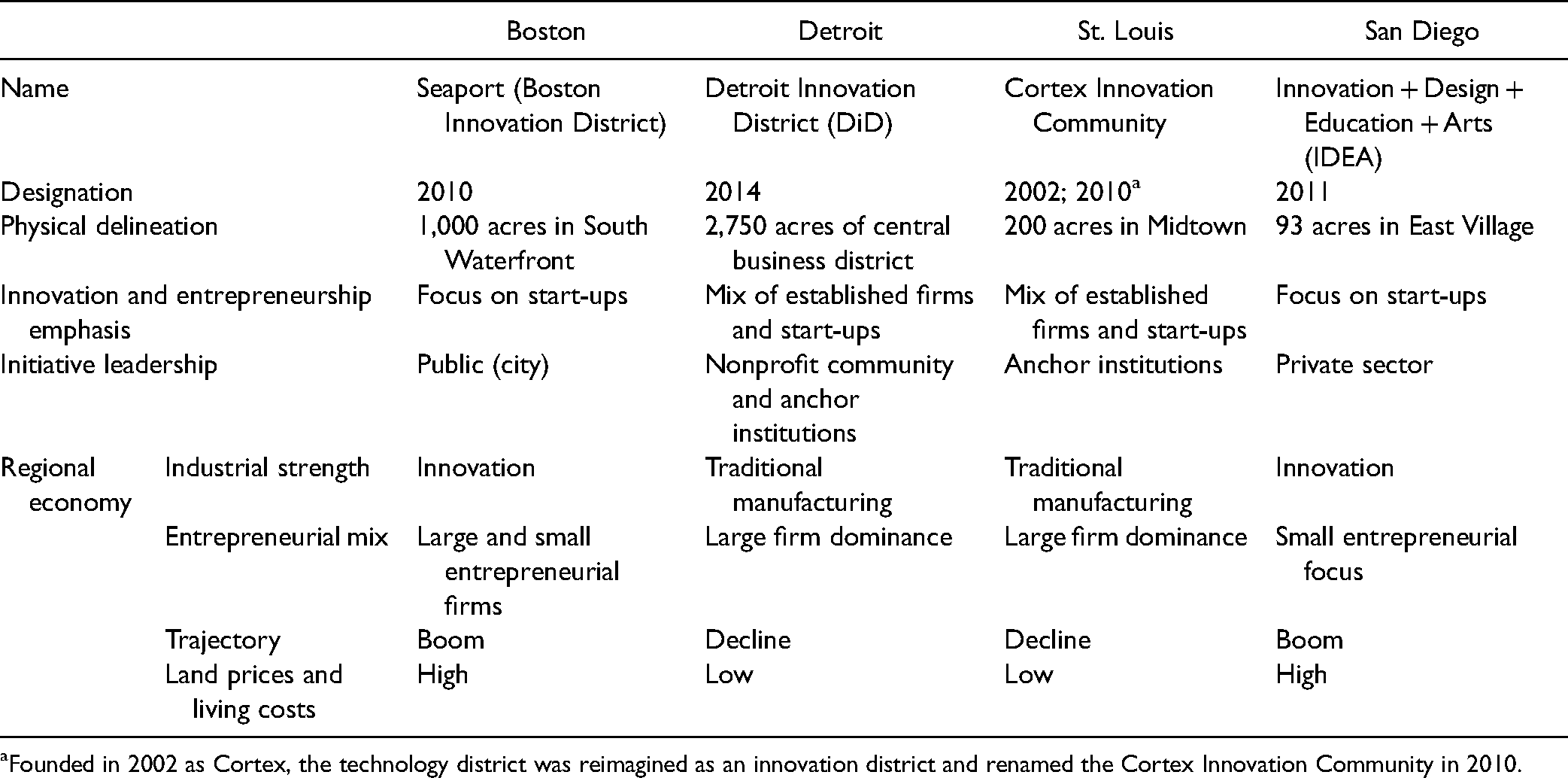
Founded in 2002 as Cortex, the technology district was reimagined as an innovation district and renamed the Cortex Innovation Community in 2010.
We began with a content analysis for each innovation district. News items and media publications, reports authored by organizations involved in the innovation district, archival references, policy documents, development plans, and marketing materials for each innovation district were thoroughly read and cataloged. These documents provided the economic, financial, political, and social background for each case. These documents also directed us to individuals and organizations closely associated with each innovation district.
From March 2015 to August 2017, we conducted 119 semistructured interviews with key individuals involved in the creation, implementation, and operation of the innovation districts. The type of organization the respondents represented and their connections to the innovation district varied by location; respondents included innovation district founders and representatives, public officials, economic development planners, university and other anchor institution representatives, entrepreneurs and entrepreneurial support organizations, influential private sector firms, community development representatives, and local activists. Our recruitment process entailed searching media and marketing channels for contact information, followed by email and telephone requests for interviews. At the conclusion of each interview, we asked respondents to suggest other stakeholders to contact. We continued this form of snowball sampling until few or no new stakeholders were being proposed.
The interviews inquired into the goals of the innovation district from the respondents’ perspectives, allowing us to assess how (if at all) respondents discussed community and community engagement and providing insights into intended outcomes for the innovation district (see online Supplemental material for a sample interview guide). The responses were variously recorded and transcribed or noted, and then coded to identify and organize by recurring themes. We also conducted site observations during two separate field visits (except for San Diego, which we visited once); when possible, members of the research team attended local meetings or events related to the development of the district.
Analysis
In this section, we analyze the elements most closely pertaining to stakeholder engagement with their respective communities (for further details and explanations, see Drucker et al., 2019). In these four cases, innovation districts followed varied paths to community engagement, ranging from cautious distance to coaxing to direct assistance. The outcomes are also varied. Yet, the cases are consistent in that none of the four innovation districts provide positive examples of meaningful community building.
Boston
At his final inaugural address in 2010, long-time Boston Mayor Thomas Menino unveiled his intentions to transform the South Boston Seaport into an innovation district modeled after Barcelona@22 (The Honorable Thomas M. Menino Inaugural Address, 2010). The Big Dig, a decades-long multibillion-dollar infrastructure project, primed the area for investment by connecting it to Logan Airport and the city center (Daniel, 2006). Early plans envisioning a new “Downtown South” never fully materialized, though the peninsula was home to existing communities such as Fort Point and South Boston. Still, Boston did not have a strong underlying community structure within the boundaries of the innovation district.
The mayor planned to build upon the emergent start-up and entrepreneurial activity that had already begun occupying the area's old factory buildings. He applied aggressive branding and marketing, expedited permitting, established innovation and public-use set-asides, streetscaping, and revised zoning to allow for high-density micro-apartments with shared living spaces and other communal elements. The city convinced developer Joseph Fallon to lease free space in one of his underutilized office towers to the MassChallenge accelerator program. A second early success was the creation of District Hall, an innovation-themed community center. District Hall offers a Wi-Fi-ready exhibition and conference space open to the public that helps give the district a more cohesive identity and character (Farrell, 2013). Within 3 years of the mayor's announcement, the innovation district claimed to have added over 200 new start-ups and 4,000 jobs to the tech economy, along with supporting entities such as co-working spaces, tech incubators, and entrepreneurship colleges.
On the surface, community engagement initially appeared to be a priority for the mayor's office. One of Menino's earliest acts was to hire a district liaison to court businesses, work with developers, and meet with area residents and businesses to allay fears of possible gentrification. Nevertheless, the work of the liaison was more often to sell the community on the mayor's vision than to create space for grassroots engagement. Active community groups in the vicinity (Friends of Fort Point Channel and Fort Point Neighborhood Association) and the only formally registered Community Development Corporation (CDC) in proximity (South Boston Neighborhood Development Corporation) played a role in announcing incoming development through their media channels and networks. However, as evident from the archives of their media feeds, the Boston Redevelopment Authority (BRA) and incoming developers did not give the public enough time or transparency to adequately address and resolve the issues important to them. It is apparent that the community was not part of the innovation district strategy, but rather a bystander to the process.
As the real estate market picked up, development in the seaport reverted to its original intentions as a high-end business district (Logan, 2017). Many financial and legal firms based in Boston's central business district moved to the Seaport, and the area began drawing the attention of legacy technology giants, such as General Electric, looking for a way to reinject their corporate images and attract young talent. By 2017, commercial leases had risen to above $50, and in some cases $80, per square foot—effectively pricing out all but the most established and successful companies (Logan, 2016; McMorrow, 2013). Rents quickly exceeded affordability for recent graduates and working households. The expanding commercial space exacerbated gentrification pressures in the traditional working-class neighborhoods nearby, such as South Boston.
St. Louis
The origins of Cortex are fragmented, with respondents pinpointing different start dates. One reason is that the assembly of parcels and buildings that now form the Cortex Innovation Community were added through a piecemeal process. Cortex has been consistent since its inception, however, in maintaining its focus on innovation. Efforts to create a technology corridor between St. Louis University and Washington University date to the early 1990s, with reports labeling the area as Technopolis (Winter, 2006). The legally recognized beginning of Cortex occurred in 2002 when founding members from area institutions and the civic realm incorporated as a tax exempt 501(c)3 organization under the name Center of Research, Technology, and Entrepreneurial eXpertise (known as Cortex for its acronym). Over the course of almost two decades, Cortex would take full legal control over development in the innovation district area. Key steps were gaining eminent domain rights in 2006 and a tax increment finance district in 2012 (St. Louis Innovation District Tax Increment Financing [TIF] Redevelopment Plan, 2012).
Drawing on regional strength in the biomedical and pharmaceutical sector, Cortex's original focus and its prime draw were life science workers, who were presumed to be older, well-educated individuals with a preference for suburban lifestyles (Spencer, 2015). The physical form and composition of Cortex prominently display this focus, looking like a suburban-style development located in the city. Parking lots surround the three most prominent buildings, which are, as a result, spread well apart. Despite a convenient light rail station, most Cortex workers use private automobiles for their commutes to work.
Neighboring communities have been peripherally involved in Cortex development decisions. In fact, a representative from Park Central, a formally recognized CDC, sat on the innovation district advisory board. However, Park Central was not invited to regular advisory board meetings, and the relationship was based on Cortex as a funder of the CDC, generating power pressures. Tellingly, Park Central learned about an IKEA store establishment adjacent to, and was enticed by, Cortex only 2 weeks before the news was announced to the general public.
The overarching concern of Cortex regarding the areas near the innovation district is to facilitate the development of residential options attractive to Cortex's life science workers. The suburban-style development of Cortex means that housing units are not ultimately part of the master plan of the innovation district itself. A few were initially slated for development, but as real estate interests dominated, housing was postponed while a hotel went forward (Feldt, 2018). Sensitivity to interactions with surrounding communities will remain critical as Cortex seeks to expand its footprint and its influence. The adjacent neighborhoods are starting to feel the negative impacts of rising housing and living costs, loss of community, and forfeiture of control over the pace and direction of development.
Detroit
In 2014, Mayor Mike Duggan announced the DiD following the devastation of the 2008 global financial crisis and the 2013 bankruptcy of the city (Broda, 2014). This financial backdrop and the decline of the city meant that growth coalitions in Detroit were desperately seeking investment opportunities (Bomey, 2017; Galster, 2012; Sugrue, 2014; Tabb, 2015; Thomas, 2013). In this climate, Governor Snyder and the Michigan state government—along with Bruce Katz of the Brookings Institution—conceived the idea to develop an innovation district. Though it started as a state strategy, implementation rested on Detroit leadership largely funded by foundations and philanthropies, many of which had a public remit, or organizations such as Midtown, Inc., which was previously the University Cultural Center Association, a formally registered CDC.
Despite the inclusion of organizations focused on community development, the primary emphasis of the strategy was to stimulate market development. As expressed by an executive of a foundation heavily involved in the implementation of the DiD, “among government officials the strategy became about activating blighted areas and less about the innovation piece for the city.” As the strategy grew in popularity among leadership (though the public was hardly aware of the initiative), the border of the DiD expanded. The extended border presented the opportunity to target more vacant, derelict, and abandoned spaces with innovation district resources. Ultimately, the final border of the DiD was too big and spread out to support a strategy predicated on density and proximity. In addition, although employers such as Dan Gilbert's Quicken Loans subsidized employees to live in Detroit, the majority (70%) of workers within the innovation district boundary commute from suburbs (Detroit Future City: 2012 Detroit Strategic Framework Plan, 2013).
When it became clear that the concept of the innovation district would not genuinely hold, the border became even more fluid and reached out to the community to extend the concept and spread financial resources. In part, this was in response to criticisms that, in an ailing and bankrupt Detroit, the majority of the federal, state, and city resources myopically focused on the relatively small downtown, with $880 million in investments between 2010 and 2012 previously targeting the area (7.2 SQ MI Report: A Report on Greater Downtown Detroit, 2013). Neglecting the surrounding neighborhoods rang deeply of perpetuating racial inequalities and injustices (Moskowitz, 2015).
Ultimately, the DiD concept failed. The advisory group was split between those who wanted to pursue a medical cluster strategy and those who wanted to extend efforts to outside communities. Even for those championing the extension of the boundary, the innovation concept (i.e., supporting start-ups and entrepreneurs) remained. This group continued to engage the start-up mentality by proposing that any Detroit community, regardless of how distant from the innovation district, could pitch an idea for how to improve its neighborhood with successful groups receiving funding from innovation district resources. Community engagement happening outside of the district boundary challenged the original aims of the innovation district strategy to concentrate activity within a specified geography.
San Diego
Of the four cases, San Diego's IDEA district has maintained the furthest removal from community engagement. The IDEA district included artist residents who were perceived as spillovers from the neighboring regions. The focus of the innovation district strategy was on redefining local character, rather than creating or improving the functioning of the existing community. There has not been any formal involvement of a CDC, though the originators of the district, developers David Malmuth and Pete Garcia, did conduct a handful of community meetings.
We attribute the lack of connection to the fact that the innovation district has been driven by two private real estate developers, in partnership with Lowe Enterprises, a real estate development firm. After touring Barcelona's 22@bcn, Malmuth and Garcia conceived of the innovation district as a project to propel San Diego's entrepreneurial and innovation communities while satisfying expectations for investment return in the vigorous San Diego real estate market. In response to potential plans to relocate the National Football League's Chargers to a new downtown venue alongside a new convention center, Malmuth and Garcia promoted the IDEA district as a more publicly palatable and inclusive alternative to stadium development (Showley, 2015).
The IDEA district does not enjoy financial or in-kind support from local government agencies, nonprofit institutions, or other anchoring establishments. The market-based necessity to demonstrate profit from real estate development thus engenders conflicts with the aim of pursuing innovation. The overarching strategy has become more about crafting a location attractive to entrepreneurs and innovators, instead of finding support to create or financially subsidize entrepreneurial and innovative businesses. In this setting, the originators and proponents of the IDEA district argued that gentrification was inevitable.
From its inception, the IDEA district strategy met reflexive resistance from residents and neighbors who perceived the development as exclusive and feared dislocation. The transformation of the area indeed has resulted in rising costs and displacement. The popularity of the placemaking efforts has pushed out low-income individuals, artists, and people reliant on social assistance. San Diego's strong residential market and the lack of public investment—a disregard for any social return on investment—has translated to a dearth of effective tools to combat gentrification and displacement. The desired blend of mixed- residential and mixed employment opportunities is proving difficult to achieve within the financial structure of the private real estate market.
Discussion
Can successful urban economic revitalization be inclusive in the context of an innovation district? Our analysis cannot answer definitively, but none of the four otherwise quite varied cases present an affirmative example. Instead, their trajectories raise important considerations around the nature and evolution of public and private developments. Our findings also force questions about whom the innovation district on a small scale, and the city region on a larger scale, are serving.
Table 2 documents neighborhood changes in each innovation district since 2000, a period before the designation of each innovation district. We selected common indicators of social and housing conditions from public sources that could be consistently measured over time. We determined the boundaries for each innovation district from planning/organizational documents, which were then adjusted to fit census block groups with an outer boundary that could be consistently defined from 2000 to 2019. We also reported similar changes for neighboring areas to account for possible spillover effects. These were defined as modified adjacent block groups, allowing for marginal adjustments to ensure consistent measurement over time. Because we are primarily interested in relative changes in the composition of each area’s population and housing stock, we measured changes by the percentage point increase or decrease from 2000 and from 2015 to 2019, unless otherwise noted.
Change in Population and Housing Attributes, 2000 to 2015–2019.
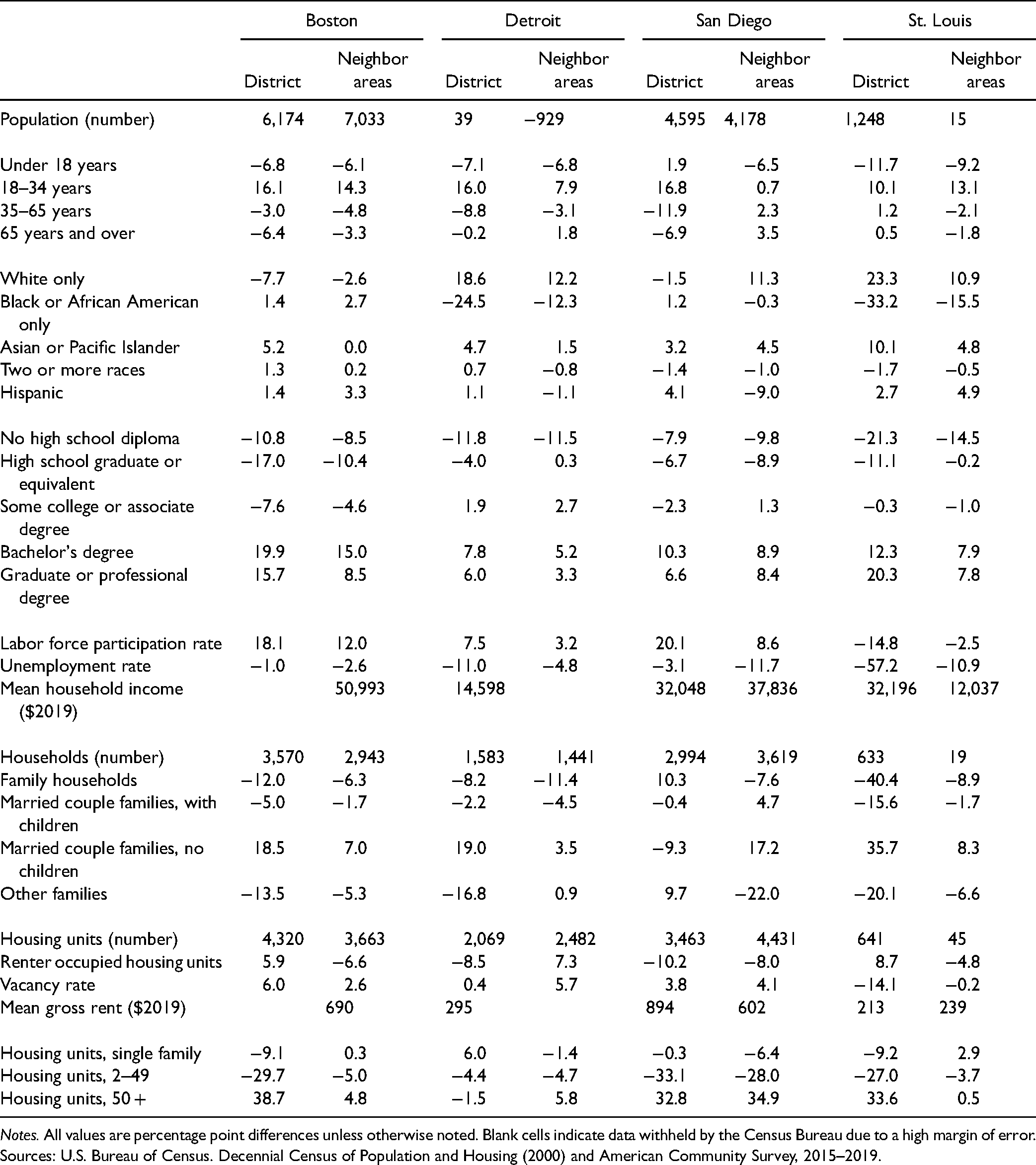
Notes. All values are percentage point differences unless otherwise noted. Blank cells indicate data withheld by the Census Bureau due to a high margin of error.
Although the purpose of Table 2 is to document changes and not to attribute strict causality, some interesting trends coincide with the building of the innovation district. In the San Diego, St. Louis, and Boston innovation districts, we find a notable increase in educated, childless, and young professionals, and in the density of housing as indicated by an upsurge in housing structures larger than 50 units. In Detroit, we see a rise in young adults (aged 18–34 years) and married families without children, but no shift in the educational profile of residents. Changes in surrounding long-standing communities demonstrate consistent indicators of potential gentrification. In terms of population demographics, in Detroit and St. Louis, the decrease in Black populations and increase in White populations within and around the innovation district is overwhelming. The opposite happened in Boston, although to a much lesser extent. Here we found a relative decline in the traditional White working-class population, which was offset by a more educated and ethnically diverse new resident profile. In all cases, there is an increase in the Asian population within the innovation district. In Detroit, although the professional population has swelled within and around the innovation district, the anticipated housing development trends are less strongly borne out than in the other cases. This may reflect the greater diversity of the large area encompassed by Detroit's innovation district.
Though emergent, signs already point to the possibility of innovation districts contributing to the same type of spatial inequalities created by previous urban development projects. First, by targeting high-skilled job creation, innovation districts contribute to a socioeconomic restructuring of the city that caters to a wealthier and higher-skilled demographic. Second, the focus on the live–work–play combination boosts the opportunity for higher-skilled workers to live close to home, as they can afford the newly constructed condominiums built within or around the innovation district. When not relocating permanently, these individuals comprise the target audience for the apart-hotel model: long-term but still temporary apartment-like stays in the comfort of a hotel. Apart-hotels are popping up near innovation districts, such as the Aloft Hotel in both St. Louis’ Cortex and Boston's Seaport Innovation District. Third, extensive public funds often finance large-scale urban developments. Problematically, these investments do not always come to fruition or, more commonly, tax breaks and subsidies contribute to investors, developers, and anchor tenants who consume public returns (Kline & Moretti, 2014; Reese, 2014). Substantial public resources were applied to catalyze the innovation districts in Boston and St. Louis.
The innovation district strategy engages in placemaking to create a live–work-play place. The emphasis on the importance of living near work becomes problematic with respect to inclusivity if support to ensure affordable living for a diversity of residents does not remain firmly in place. Particularly evident in the brisk development environments of Boston and San Diego, real estate interests end up favoring developments that bring higher returns on investments. Affordable housing units simply do not compete in this regard. Super high-density construction in Boston allowed the return on investment to developers to increase, but the additional housing supply still failed to dampen area rents since there were no protections to ensure the units favored full-time residents nor those truly needing affordable housing. The cases also demonstrate the need to operate sheltered from real estate market logic. This is understandably challenging when simultaneously there is the need to provide a return on investment, such as in the case of Cortex's tax increment financing district.
Beyond new builds, effective policies are necessary to ensure that long-term residents can remain in the neighborhoods surrounding the innovation district. Already, in terms of public services, coworking space and IKEA have replaced the Salvation Army in Cortex and Boston's Seaport Innovation District has been critiqued for lacking schools and a public library. If innovation districts follow similar forms of urban regeneration projects, existing residents will eventually be priced out of their neighborhoods and pushed further away. Considering that the innovation district depends on the labor of an active service class, this outcome would translate to a disconnect between compact living in proximity to work and lower-income workers having to commute.
In the case of the Boston Seaport, strong support from the mayor's office was key to successfully branding the district and facilitating key events, such as the initial siting of MassChallenge and crafting the public use set-asides that ultimately led to the construction of District Hall. But early successes notwithstanding, there was no true long-term vision for the Seaport nor any real effort to garner community support to shape its future beforehand. The announcement of the innovation district in the mayor's inaugural speech was a surprise to nearly everyone. There was no preceding community outreach or participatory planning to speak of; the role of the district liaison was primarily to mitigate negative reactions. With little in the way of an established residential community in the Seaport to help shape or resist the new development, the need to craft a long-term and sustainable vision for the future rested squarely in the hands of municipal leaders. And the city seemed more than eager to modify its original vision to accommodate the pressures of the market. The completion of the mayor's final term marked the end of any lingering support for the vision of an enduring innovation district. By the time Mayor Walsh took office in 2014, the city had already begun scaling back its active promotion of the Seaport as the Boston Innovation District, and instead was supporting several innovation hubs in various (typically working class) neighborhoods.
Finally, the role of racism and increasing efforts to trace the role of racial capitalism (Robinson, 2000) on urban development and spatial planning should not be neglected in a discussion of innovation district strategies (Dorries et al., 2019; Hackworth, 2018; Toews, 2018). Detroit and St. Louis share the complexities and challenges of shrinking populations, struggling economies, and a diminishing resource base (Beauregard, 2013; Hollander et al., 2009). In addition, both cities have legacies of racial conflict and failures in securing housing for Black populations (Farley, 2005; Sugrue, 2014). That the DiD strategy is no longer a leading economic development effort is not necessarily a negative conclusion, as its dissipation speaks to local stakeholders concerned about an exclusionary strategy focused on growing a central business district surrounded by severely declining neighborhoods. In St. Louis, the innovation district hit a temporary obstacle when minority leaders criticized Cortex for not meeting minority participation goals (Rivas, 2012). Though CDCs and other community-focused organizations might be driven by the needs of the local populations they serve, without adequate funding they cannot achieve their aims. Park Central was invited to advise on St. Louis’ innovation district but having Cortex as a funder limited the organization's ability to criticize development decisions. Boston's innovation district received a harsh critique by the Boston Globe's Spotlight investigative team for the absence of Black people in the history of the Seaport Innovation District—from development decisions, to leadership, to residential accommodations (Ryan, 2017). Mayor Menino, known for playing favorites, hiring his own, and using his power through the BRA (Diesenhouse, 2015; McMorrow, 2014), demonstrated a politics of exclusion and indifference to diversity.
Conclusion
Economic development practice often is separated from community development. Innovation district strategies raise questions about this distinction. Innovation districts are physically rooted in a community yet aim to attract global firms and footloose talent. They demand local resources (financial, political, and cultural) in support of creating jobs and building live–work–play places. Proactive policies are necessary if communities are to be meaningfully involved, and residents need to be fully identified and met. Treating the impacts on existing populations as secondary considerations or overlooking them entirely is not a good policy.
COVID-19 has highlighted the existence of urban spatial inequalities, and innovation districts are likely to exacerbate these problems. COVID-19's effects on the economy, people's behavior, and the planning profession might precipitate an attitude change toward innovation districts (Florida et al., 2020). Although the extent of change versus durability is far from clear: developments focused on community resilience will stand a better chance of surviving unanticipated situations.
Innovation districts are still a youthful strategy, one that is continuing to evolve as it flourishes across the nation and the globe, making it especially important for policy makers to be clear about the connections between innovation districts and the communities in which they are embedded. More local-level research is needed to evaluate possible conflicts among municipal goals in the design of innovation districts and to determine appropriate recommendations for each respective innovation district. Additionally, research that probes into the roles of the municipal and state governments, and how their investments, or lack thereof, in the innovation district directly impact existing communities, would start to address the important questions around who is ultimately responsible for community displacement.
Footnotes
Declaration of Conflicting Interests
The authors declared no potential conflicts of interest with respect to the research, authorship, and/or publication of this article.
Funding
The authors disclosed receipt of the following financial support for the research, authorship, and/or publication of this article: This work was supported by the Ewing Marion Kauffman Foundation (grant 20152098).

Supplemental Material
Supplemental material for this article is available online.
Author Biographies
References
Supplementary Material
Please find the following supplemental material available below.
For Open Access articles published under a Creative Commons License, all supplemental material carries the same license as the article it is associated with.
For non-Open Access articles published, all supplemental material carries a non-exclusive license, and permission requests for re-use of supplemental material or any part of supplemental material shall be sent directly to the copyright owner as specified in the copyright notice associated with the article.
