




Abstract
This article explores the cineforum, an activity where participants collectively decide which film to watch and lead its discussion, as an ethnographic device for investigating sensitive knowledge, particularly emotional border experiences. Borders are arbitrary political constructs that gain unique meanings from historical, cultural, and sociopolitical contexts. Anthropologists have long analyzed borders through ethnographic research fostering encounters with field actors. Yet, as borders increasingly manifest in symbolic dimensions, anthropology must offer inventive ethnographic responses. Drawing on short-term ethnographies at the Irish (three months), Spanish-Moroccan (two months), and Turkish-Syrian (two months) borders, this article reflects on how film discussions can reveal intimate narratives that give meaning to the border. It also considers the potential of using film in contexts marked by silent trauma, indifference, and polarization to avoid harm while accounting for participants’ emotional realities.
Introduction
For many years, borders were understood primarily as tangible markers of separation established by nation-states. However, over the past two decades, since the publication of Bordering, Ordering and Othering by van Houtum and Van Naerssen (2002), border studies have undergone a significant shift, with borders now also conceptualized as sociocultural practices, experiences, and discourses. This shift has been crucial as it highlights the multidimensional nature of borders and how they are continuously produced and experienced, rather than being fixed or static (Konrad and Amilhat-Szary 2023). Scholars now examine how borders operate at multiple levels, from local spaces to transnational regions, and how they shape social differentiation (Brambilla 2014). Foundational research emphasized that borders are sites where power is enacted and identities are negotiated (Wilson and Donnan 1999), while contemporary work explores the emotional, sensory, and embodied dimensions of border experiences—for example, the feelings associated with living at borders (Anzaldúa 1987; Svašek 2000), how border technologies are designed as sensory cues (Møhl 2020), and how borders shape space alongside the body (Peña 2021). These approaches illuminate the many ways in which borders are continually imagined, experienced, and enacted in everyday life (Balibar 1998; Yuval-Davis et al. 2019).
While these perspectives have generated significant interest in the epistemological and ontological interpretations of borders, methodological challenges have received less attention. Ethnography, often adopted as the default methodology for border studies, has underscored the social construction and negotiation of borders through identity formation, power dynamics, and social relations (Vila 2003). Ethnography has illuminated situations in which borders transcend state boundaries and become integral to the everyday experiences of local populations, migrants, cross-border workers, and other groups whose lives intersect with them. Nevertheless, the complex nature of borders—particularly regarding processes of inclusion and exclusion, as well as their intensifying securitization and militarization—has introduced new methodological challenges for ethnographic research (Cooper 2019).
Along these lines, visual artifacts such as photos, videos, and films have recently expanded hegemonic and counter-hegemonic narratives of borders, leading researchers to consider their potential for the methodological development of the field (Kudžmaitė and Pauwels 2020). According to Moze and Spiegel (2022), visual methodologies have been productive in highlighting everyday border subjectivities. This approach has inspired the use of participatory visual methods (e.g., Gutiérrez-Torres 2024; Vila 2013) to demonstrate the relevance of exploring other ways of generating knowledge about borders.
This article explores the potential of film as a participatory field device within ethnography. In border contexts often marked by silenced trauma, political polarization, and everyday violences, researchers face the challenge of developing methodological tools to avoid harming participants while making visible the emotional realities experienced. Visual methods—particularly film—offer a promising avenue for fostering dialogic encounters that invite participants not only to express their perspectives but also to reflect critically on their own experiences (Mitchell et al. 2018). Grounded in the understanding that films uniquely evoke emotional resonance and facilitate connections to personal and collective experiences (Tan 2011), this article explores the cineforum as participatory ethnographic device that foreground the lived, emotional realities of borders. By involving participants in the selection, viewing, and collective discussion of films, this approach offers a sensitive way of addressing these experiences. Rather than resorting to potentially intrusive questions, this method creates a mediated reflective space in which participants can address delicate issues at their own pace and through the emotional and narrative framework provided by the films themselves. Drawing on three vignettes from short-term ethnographies across diverse border contexts, this article reflects on how the cineforum can enrich the study of emotional expressions of borders by bringing sensitive knowledge about the border experience to light.
Rethinking Methods on Border and Emotions
Imagination and creativity are crucial to ethnography since, as Culhane (2017) states, these elements shape the social relations, politics, and cultural formations that permeate lived experiences. Borders are also shaped by imaginary processes that construct social reality and materialize through the sovereignty of states, as borders resonate with political projects of governance and belonging. Anthropologists have therefore understood the agency of borders in terms of the capacity to politically and socially generate and illustrate the perception of the other (Agier 2016). Recently, the notion of borderscapes (Dell’Agnese and Amilhat Szary 2015) has highlighted the various ways borders are represented, focusing on the stories, images, and ideas that shape how we understand them. Brambilla (2014) stresses that the concept helps us see borders as fluid and changing, shaped by bodies, discourses, practices, and relationships. The imagined aspects of borders are both constructed and experienced as real, with cultural artifacts playing a key role in sustaining these imaginaries.
Understanding how members of a given society perceive and perform these borderscapes requires examining their intimate experiences. As Rumford (2012) notes, ordinary people contribute to “constructing, shifting or even erasing borders” (p. 897), which trigger emotional reactions in their everyday experiences, memories, and perceptions. Regarding border emotions, Svašek (2000) points out that borders, as key geopolitical scenarios, shape people’s emotional lives. Scholars of emotional geography have long emphasized how emotions represent genuine personal experiences linked to places (Pile 2010). In this sense, emotions are closely related to the narratives that circulate and help shape both collective and individual experiences (Konrad 2020).
However, beyond participant observation, little thought is given to more analytical aspects of ethnographic practice in borderscapes. Indeed, border research is among those fields with the greatest demand for researchers to actively use imaginative processes of data collection to analyze these constructed realities. The need for such methods is due to the increasing ubiquity of borders and their prevailing logics of surveillance. Expanding the field of border studies with a critical methodological gaze encourages reflection on the cultural and social manifestations of borders and its emotional condition. Emotions lie at the interface of individual experiences, collective meanings, and social constraints. According to Ahmed (2014), these are not limited to interpersonal interactions but include objects, artifacts, places, and images. However, research on emotions involves methodological challenges in establishing relevant data, as emotional expressions acquire intersubjective and contextual elements that are difficult to observe directly (Flam 2015).
Given these methodological challenges, Estalella and Criado (2023) suggest that anthropologists must continuously devise inventive modes of interaction during fieldwork, since “anthropologist always invents how to pose relevant questions in the field” (p. 1). Using their concept of a field device, they argue that, beyond participant observation, it is necessary to attend to the various materialities, spatialities, and agencies involved in ethnographic encounters, which include reflecting on modes of data collection. In contexts marked by major field challenges, anthropologists invent devices that emerge from this reality to structure the arrangements of ethnographic relations. This assumption implies the involvement of participatory models of knowledge construction in combination with reflection on the methods that allow us to detach our research from hierarchies of power. It is in this spirit that film has been used as a field device to understand complex realities during ethnography.
Film-Viewing and Ethnography
According to Gilmore (2019), films exploit imagination to generate sensory and emotional responses that often relate to the ability of films to evoke experiential imagining based on our circumstances and empathy. Similarly, key studies on film spectatorship (Staiger 2000; Tan 2011) have emphasized the affective and emotional dimensions of the cinematic experience. When watching a film, viewers encounter a constructed reality that evokes the depicted events, engaging the same cognitive processes of perception, emotion, and understanding that they use in everyday life. This mediated process of meaning-making is created through the capacity of film narratives to yield socio-spatial cartographies that are entwined through memories and material landscapes (Cupples et al. 2015). According to MacDougall (2006), film operates by trying to affect viewers corporeally through the construction of imaginary spaces and the evocation of real ones. Thus, film is not only an audiovisual experience but also a sensory one. Through sight and touch-like perception, it creates a multisensory reality that engages the body in the act of viewing. In this regard, Vaage (2009) argues that film facilitates self-reflection in response to empathy, which might influence viewers through the systematic emotions evoked by the film. This idea suggests that spectators actively make sense of films and emphasizes “the cognitive and emotional mechanisms that all the spectators presumably share” (p. 161).
Considering the multiplicity of meanings derived from film-viewing, it is pertinent to note that films acquire different connotations in different contexts (Martin-Jones 2006). Given such diversity of views, many authors propose that the emphasis should no longer be on representational meaning but on what representations do and how they do it (Lukinbeal 2019). In that sense, Marks (2000) highlights how haptic visuality assigns a different kind of intimacy related to memory. Haptic visuality refers to a way of experiencing cinema that involves the senses, allowing viewers to “feel” the images and connect them with memory and emotion. Pink (2015) also addresses the role of film in understanding how discourses and sensory experiences are expressed and remembered in culturally meaningful ways. If we understand films as open to the contingent meanings of what occurs around them, then the experience of a given audience must be connected to the situated realities and the sensorial experience (Staiger 2000).
Following Pink (2015), sensory ethnography uses visual elicitation to invite people to interpret others’ experiences and reflect on their own. Although Pink (2006) acknowledges that image elicitation might privilege the visual, she argues that by recognizing visual images as a common mode of communication and evoking other senses, ethnographers can help viewers engage with the film’s sensory experience through their own memories and empathy with characters. Thus, while the visual remains important, greater emphasis is placed on other senses and the recreation of experiences and emotions.
On this basis, visual anthropologists have used film elicitation to explore how certain groups interpret images. Krebs (1975), a pioneer of this method, examined how a film she made of a traditional dance impacted a community in Bangkok. She and later researchers (Acland and Wasson 2011) began by showing their own films and collecting participants’ reactions and associations. As Krebs (1975) notes, “if the film elicitation technique is employed skillfully, the researcher may obtain some of the most exciting data of anthropology—how members conceptualize and structure the world in which they live” (p. 284). Film clips have since been used in ethnographic research to spark discussion, including in border contexts. For example, Horsti (2019) uses film to explore migrants’ experiences in Europe, though the focus on a single participant limits its broader social insights.
Researchers using these techniques rely on a visual stimulus as the basis for knowledge generation (Pauwels 2015). Yet film-viewing goes beyond the visual: sight and sound, combined with the emotions, memories, and imaginings the film evokes, offer viewers a fuller experience, fostering empathy with characters and eliciting emotions unlikely to arise from sight alone. As an “emotion machine” (Tan 2011), cinema creates an affective state that enables diverse interpretations of an experience.
Setting the Cineforum: Field Device and Limitations
This research was conducted as part of the Reel Borders European Research Council (ERC) project, which explored border experiences through ethnographic fieldwork in three locations: the Irish-UK border, the Spanish-Moroccan border (Ceuta and Melilla), and the Turkish-Syrian border. Fieldwork in each location lasted between two and three months and combined traditional ethnographic methods—such as participant observation and interviews—with a visual field device we refer to as the cineforum. The selection of these three borderlands was not intended for comparative purposes but to explore the flexibility and applicability of the cineforum across diverse border contexts. These sites were chosen because of their shared legacies of imperial governance and contested sovereignties, which continue to shape ambiguous forms of belonging and local subjectivities. Aware of critiques about the lack of historical sensitivity in border studies (O’Dowd 2010), we avoid oversimplifying each border’s dynamics. Instead, we aim to foreground methodological challenges and open a discussion on sensitive strategies in border narratives.
Ethnographic knowledge, as Malkki (2007) reminds us, does not derive from rigid or standardized procedures, but from a dialogical process marked by improvisation, sensitivity, and uncertainty. Rather than applying a fixed protocol, we follow Estalella and Criado (2023), who emphasize that ethnography is not so much about applying fixed procedures as it is about cultivating the ability to tune in, adapt, and invent in response to the contingencies of the field. We frame our methodology as a situated practice, shaped by the fluidity of borders as dynamic constellations of practices, discourses, and global entanglements (Mezzadra and Neilson 2013).
We conceived the cineforum as a field device to access narratives and emotional registers that that interviews alone rarely make visible. In doing so, we advanced visual anthropology (Banks 2025) and inventive ethnographic methods (Ballestero and Ross 2021) by making the cinematic experience the focal point of the ethnographic encounter. Unlike traditional visual elicitation—where participants respond to preselected clips (Pauwels 2015)—our cineforum design empowered participants to choose the film themselves. Following ethnographic encounters based on the practices of forum and film (Castro-Varela 2018), we valued the terminology and idea of a “forum” because it evokes a dialogical engagement as a space for reflection, discussion, and the articulation of individual and collective experiences.
Across the three field sites, we organized a total of nineteen cineforums, involving 110 participants. These sessions were formed through relationships developed during fieldwork, using participant observation, in-depth interviews, and informal interactions (see also Figure 1) to identify and invite participants from local film clubs, activist associations, student groups, or migrant networks. Cineforums were created with them to foster an environment where participants already knew each other and to encourage dialogue. Each cineforum included a maximum of seven participants, in line with established practices in visual elicitation (Pauwels 2015), ensuring active participation and manageable group dynamics.
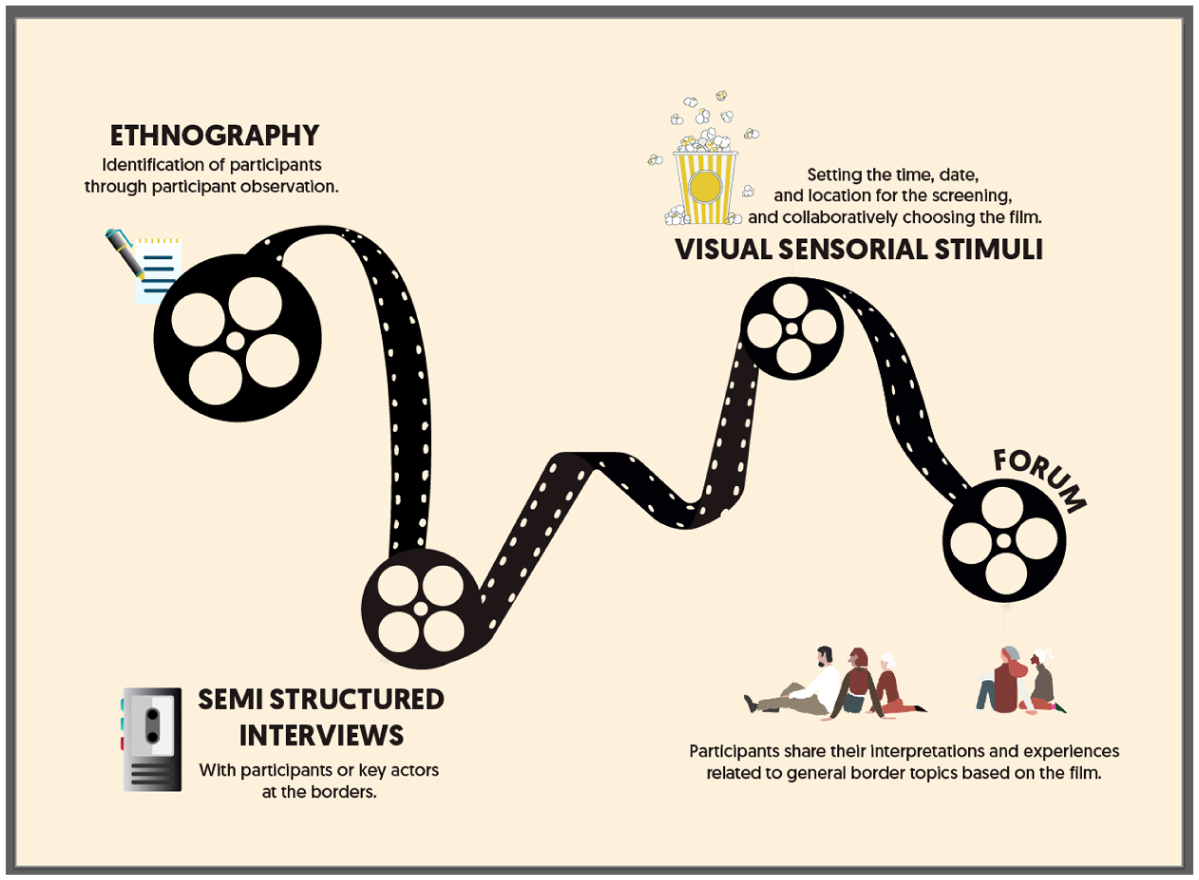
Visual representation of the steps involved in the cineforum process. Designed by Andrés Silva Polanco.
After initial contact, either through snowball sampling or by reaching out to local groups, each group was invited to participate in a cineforum. The session was scheduled at a mutually convenient time and location, and participants collectively selected one film from a curated list of six. Following the screening, a group discussion was held, moderated by the researchers, in a semistructured format. The initial prompt was always open-ended—“What did you think of the film?”—allowing the conversation to flow organically from there.
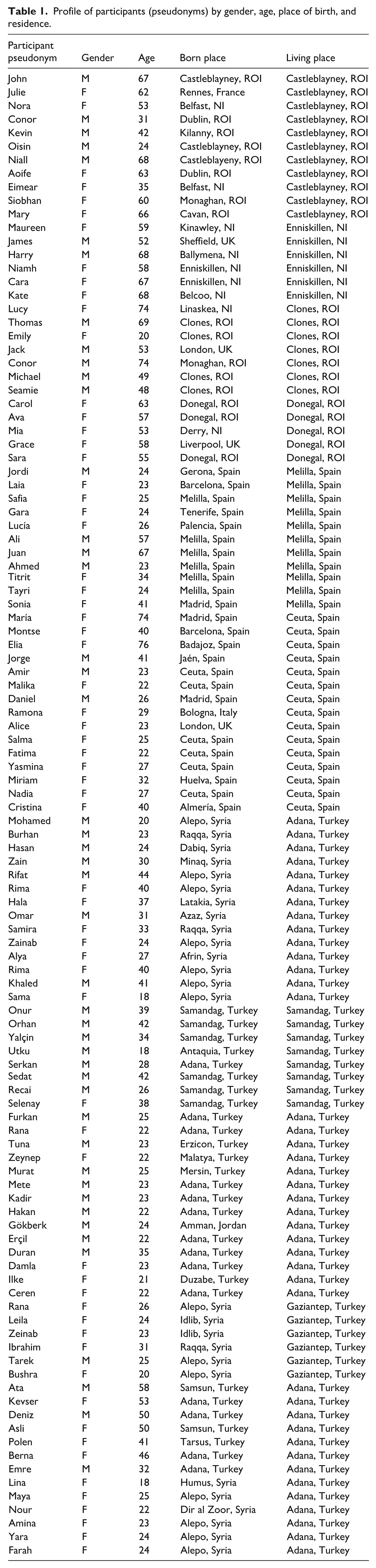
The participant profiles were very diverse (Almenara-Niebla 2024; Almenara-Niebla and Smets 2024) (see Table 1). For instance, at the Irish-UK border, most participants were members of local film clubs. Because of the idiosyncrasies of the conflict, which is marked by border animosity, most groups were comprised exclusively of Catholics or Protestants. The only mixed group was the Clones film club, which reflects the highly specific social dynamic of that town. In Ceuta and Melilla, the participants were local activists of different associations, which correspond to the prevailing rationale of border securitization in the cities. Finally, at the Turkish-Syrian border, the groups consisted of either Turks or Syrians due to the polarization of the society toward migration. The only exception was in Hatay, which is consistent with the specificities of the region due to its intertwined transnational history. The participants were part of local associations, student groups, or Syrian migrant networks.
Profile of participants (pseudonyms) by gender, age, place of birth, and residence.
In some cases, social hierarchies, gender norms, or dominant personalities shaped group dynamics. At times, the researchers addressed these issues by taking a more active role in moderating speaking turns. Prior knowledge gained through informal interviews and previous interactions helped anticipate group dynamics, such as a tendency to dominate or remain silent. To counteract this, we gently encouraged quieter participants and subtly redirected conversations to encourage a diversity of perspectives. On the other hand, according to Kamberelis and Dimitriadis (2014), group research techniques produce a “synergy of memory” and a “political synergy” among participants. To counter these tendencies, we emphasized individual experiences, helping them to navigate different points of view constructively during the discussions, as well as encouraging participants to take turns of speaking or rotating speaking turns to facilitate all participants’ interventions. In that sense, we framed the cineforum as a space for multiple narratives to coexist without requiring consensus.
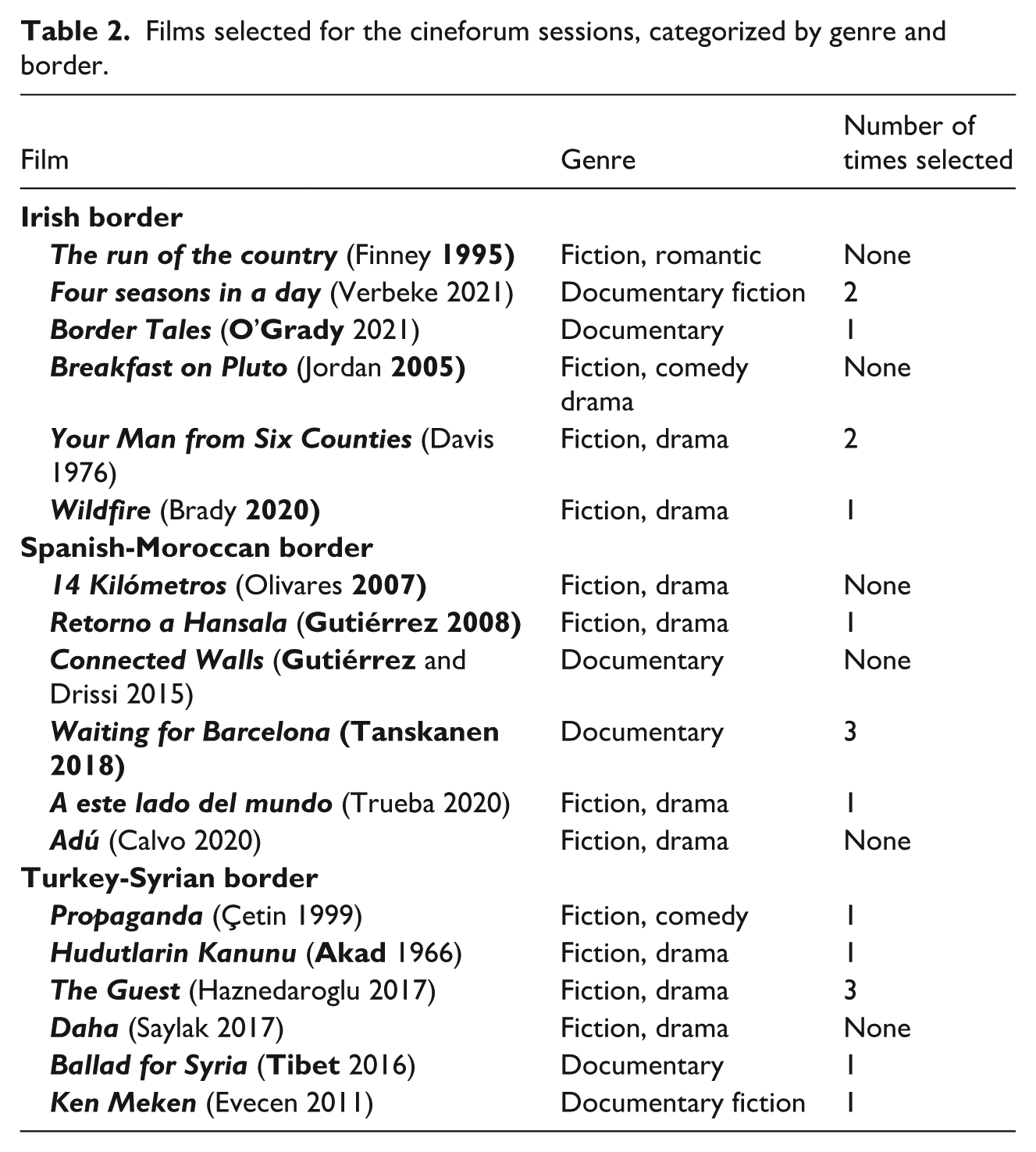
The film selection process was an integral part of the cineforum, as it added a layer of participant agency in the research. In each case, the researchers offered six films drawn from a project database, 1 accompanied by written summaries and curated excerpts (see Table 2). We chose to show excerpts instead of trailers because of the variation in trailers and the fact that the story was often quite obvious from them. The selection criteria of the films across sites included: (1) diversity of genres (four fiction, two documentaries), (2) participants’ linguistic and cultural backgrounds, (3) access to high-quality copies, and (4) thematic relevance to different border imaginaries (e.g., identity, exclusion, conflict, memory). The selection process by participants was observed and documented in field notes. In the vast majority of cases, participants generally selected the film they had not previously seen or the shortest option, often due to time constraints. The cineforum activity lasted approximately three hours, including the screening (90–120 min) and post-film discussion (60 min). To enhance the convivial atmosphere and mitigate the fatigue of lengthy sessions, popcorn and food were provided. These elements also softened the researcher–participant divide and facilitating deeper conversation.
Films selected for the cineforum sessions, categorized by genre and border.
One of the main challenges of the cineforum was its length, which often led participants to choose the shortest film. The activity, which lasted several hours, prevented some people from attending due to other commitments. People with a keen interest in film were more likely to participate, and in each group, at least one film lover inspired enthusiasm among the others, which encouraged the rest to participate in the activity. However, this limitation made it necessary to complement the cineforum with methods such as in-depth interviews and participant observation in order to analyze the border more broadly. Despite this, the median age of participants was 31.5 years, suggesting a relatively balanced representation across life stages. Another limitation concerned previous group dynamics and the gender balance in regard to speaking. At times, the researcher addressed these issues by assuming a more active role in moderating the speaking turns. Because of linguistic issues in the case of the Turkish-Syrian border, the researchers were assisted by other field collaborators who had knowledge of English.
All cineforum discussions were audio-recorded, transcribed, and triangulated with field notes, informal conversations and interviews. However, the results presented in the vignettes in this article are based exclusively on the verbal responses of the cineforum sessions. A thematic analysis was conducted in NVivo using an inductive coding approach. We focused on how participants connected their own lives to the film’s sensory and narrative dimensions. In the group discussions, they shared memories, emotions, and perspectives that helped articulate a broader sense of the border in relation to the film.
Given the sensitive nature of the topics addressed—conflict, displacement, migration, and belonging—ethical considerations were central to the cineforum design. Films were chosen to avoid re-traumatization while allowing emotional engagement, with a variety of genres, tones, and narrative styles. Participants were informed of the session’s aims, gave informed consent, and guided discussions while moderators practiced active listening rather than interrogative questioning. After each cineforum, informal debriefings offered support and ensured no one felt exposed or distressed. This ethical approach reflected a commitment to care, reflexivity, and co-creating knowledge in a respectful, emotionally safe environment.
Border Narratives: An Emotional Approach Evoked by Film
To clarify the focus of the cineforum and explore its potential and limitations as a field device, this section examines the emotions elicited during sessions in various border areas. Drawing on Ballestero and Ross (2021), we frame the cineforum as a mode of open, creative inquiry. We present three vignettes from different border ethnographies to illustrate its key features in practice, focusing on postscreening responses to foreground the themes, memories, and experiences evoked. This highlights the cineforum’s capacity to “discuss matters of which the ethnographer was not aware” (Banks 2025: 85).
Cineforum to Break Silences
The first vignette, drawn from cineforums at the Irish border, reflects how the shared act of watching and discussing films opened space for participants to share memories that were otherwise left unspoken. During fieldwork, asking questions about painful or intimate experiences proved challenging. In interviews and informal conversations, participants often spoke about moments of tension and conflict, but they seldom touched on the more sensitive dimensions of their relationship with the border. In contrast, the cineforum setting sometimes shifted these silences: the films evoked subtle emotional responses or fragments of personal and family memory. These recollections did not always emerge easily, and the atmosphere remained crucial for personal openness. Rather than directly prompting disclosure, the cineforums offered a mediated, collective encounter—one in which certain memories could be felt or partially articulated in ways that had not occurred in other ethnographic settings.
In that sense, the cineforum shaped the stories participants were willing or able to share. In individual interviews, “direct” questions about trauma or family histories often felt intrusive or were avoided to respect boundaries and acknowledge the enduring culture of division (Hayward 2006). The cineforum offered an alternative: film narratives enabled participants to approach sensitive topics indirectly, processing their own memories through on-screen characters. This indirectness fostered a sense of safety, allowing stories to surface in a more relational and less exposing way.
Analyzing the discussion following the screening of the film Border Tales (O’Grady 2021), participants in the Castleblayney cineforum elucidated how the notion of the border in Ireland relates to political and social animosity that created a culture of fear and suspicion. The group discussion addressed some stories told in the documentary. In the film, schoolchildren from Derry interview their grandparents about what the border means to them and any memories of The Troubles. The film inspired many of the participants to do the same, as they shared their own stories about it and linked them to their current thoughts about the border. Some participants quickly remarked that the film narrated stories that were very common at the time. For younger people, these experiences resonated with stories they heard in their families. These collective experiences led to sharing intimate stories.
The border is division. There are two sides. It’s not about rational thinking. It’s about emotional thinking, you know.
Yeah, and let me tell you this other story. This is all about not only fear but also animosity, if you want to put it that way. Look, I did a course for two or three years up in the north. I never knew any of them, never knew their family. They never told, they never told each other [about their families]. We met every week for three hours over a period, and there was always a sense of how much you tell and how much you absorb. So, we have to sit back and say: “Why is that what?” “What is this suspicion that we have?” Of course, it is because it’s divisive. There are two histories of it, obviously.
Nora and John’s accounts suggest the emotional complexity of the border, sharing fragments of their personal experiences and briefly addressing the collective silences surrounding the conflict. The border that Nora described as “emotional” reflects, as John pointed out, a sense of otherness linked to the broader order of border practices and division (Wilson and Donnan 1999).
Another example of the cineforum’s potential to open onto intimate memories and the silences around conflict comes from the session in Enniskillen, Northern Ireland. Fieldwork in the North, unlike in border towns on the Republic’s side, was more complex due to persistent undercurrents of mistrust shaping conversations about animosities embedded in local memory (Nash et al. 2013). These dynamics also emerged in interviews with residents—film club members, bookshop owners, and small business owners—who spoke of a reluctance to discuss certain events and a sense that some memories are best left undisturbed.
In this context, film storytelling provided a way for participants to reflect indirectly on sensitive emotional landscapes, enabling them to express their own or others’ experiences through the cinematic narrative. In this session, participants watched Wildfire (Brady 2020), which portrays the traumatic story of two sisters growing up on the Irish border after their mother’s suicide. The screening took place in the hall of a cultural center where a women’s association used to meet. The group had a segregated character, with no Protestant women participating—a common pattern in Northern Ireland. After the screening, we opened the discussion with the question, “What did you think of the film?” Two participants responded:
Well, it’s a secret that nobody talks about. And I think when she said in the film, you know, there’s a border and it’s invisible, it comes to suicide, you know.
That’s right. That is the real border.
You know, and the same thing happened in my family. I didn’t know until I was in my late twenties that my grandfather had killed himself. Because it wasn’t talked about because of the shame. And then when we did talk about it, you know, it was hush because, back, you know, it’s a subject that nobody really talks about now. We have an extremely high suicide rate and the problems. It’s the effects of The Troubles. So, you know, that’s an invisible, you know, part of the conflict that nobody really talks about.
Here, the film inspired a debate about the meaning of the border in relation to silenced stories, shame, discomfort around embarrassing topics, and stigma. As the film evoked both personal stories and emotions linked to a traumatic memory, Cara’s words reveal another meaning of the border based on an open wound (Anzaldúa 1987). For Niamh, calling suicide “the real border” reframed the border beyond a line on a map, but as a metaphor for the silences and emotional divisions that fracture communities. For participants, the border depicted in the film resonated with family experiences marked by guilt and shame around mental health. Research links the Northern Ireland conflict to poorer mental health and high suicide rates (Tomlinson 2007). Cara’s account highlights the intimate dimensions of the border conflict, with its meaning becoming symbolic and tied to bordering processes shaping everyday life (Yuval-Davis et al. 2019).
In analyzing discourses of emotion, Cerulo and Scribano (2021) explain that social and historical context influences social interactions through their underlying emotional expressions. They argue that emotions are imbued with a visibility that can be considered external to the inner self because they can be shaped by the cultural context. In the cineforum with members of the Clones film club, participants also raised the topic of silence in the selected film, Your Man from Six Counties (Davis 1976), which depicts a boy’s new life with his family across the border after the murder of his father in Belfast. Notably, the film did not address silence in particular, but the question arose in the ensuing conversation, which signals how certain emotions connected to a specific historical context emanate on their own.
I think you probably are aware of the philosophy at the border during The Troubles. Whatever you say, say nothing. Yeah, you know, and that’s why we lived. You’re very careful. You keep your ideas to yourself. I’m very careful who to say it to. You have to kind of get the lay of the land first before you do so. We were too grown up that way.
The cineforum sessions along this border highlighted how incorporating film into fieldwork can create the conditions for participants to address sensitive issues without being directly prompted to do so. The film’s narrative structure provided a mediated entry point, allowing participants to relate their own experiences while maintaining a certain distance from the events portrayed on screen. This methodological intervention proved effective in fostering an environment in which the Irish border could be discussed not only as a political or geographical construct but also in relation to its intimate associations with trauma and silence. At times, attention shifted away from the film and participants engaged in broader conversations about the border, sharing personal stories that might otherwise have remained hidden in in-depth interviews or field observations. The collective dynamics of the cineforum, a space in which the emotional dimensions of life on the border could be critically examined.
Cineforum to Reflect on Compassion
The second vignette, from our research at the Spanish-Moroccan border in Ceuta and Melilla, shows how the cineforum became a space for exploring compassion as an emotional and political act. Through shared viewing and discussion, participants reflected on the complexities of critical empathy—balancing the ethical imperative to engage with others’ suffering against the challenges of doing so amid border spectacle (De Genova 2012) and control infrastructures. Fieldwork in these cities was shaped by widespread “research fatigue,” as many residents, weary of repeated attention from journalists and researchers, were reluctant to engage. Those who did participate were often already sensitized to migration issues, including activists and civil society members, which shaped the discussions. Unlike the Irish context, where participants often shared intimate border-related memories, here reflections were less personal and more focused on political critique and expressions of solidarity. Rather than surfacing silenced experiences, the cineforum provided a platform for activists to articulate collective concerns and reaffirm their ethical and political commitments. This suggests that in contexts marked by research fatigue and activism, the cineforum serves to sustain critical conversations rather than uncover hidden narratives.
The question of how film fosters empathy through its exploration of moral and ethical dilemmas has been extensively examined by film scholars (Sinnerbrink 2015). In our case, however, the cineforum did not merely elicit abstract empathetic responses, but provided a collective space in which local activists could reflect on their own position and their pro-migrant political commitment. It is worth noting that, even in the in-depth interviews conducted in both cities, the themes that emerged were often similar to those addressed in the cineforums. However, the variety and depth of perspectives were richer in the cineforums, as the collective setting allowed participants to draw on each other’s ideas and engage in shared reflection. In a context often marked by public indifference and compassion fatigue, the shared viewing and discussion of the films allowed participants to articulate narratives about their own experiences that were intertwined with their ethical awareness.
In one session, which was organized with a group of activists in Melilla, the participants selected the film Retorno a Hansala (Gutiérrez 2008), which narrates a woman’s journey from Spain to Morocco to bury her brother, who lost his life while attempting to cross into Spain. When we asked the participants what they thought about the film, Gara, a twenty-four-year-old woman who moved to Melilla to join the association, replied, “I was thinking, the film, it’s very old, but that it’s something that hasn’t changed at all. It could have been filmed the day before yesterday.” The conversation shifted to one scene where a boy asks the protagonist if he can hide under his car to cross into Spain. The participants referenced this scene during the forum to allude to their sadness about the fact that people in Melilla have normalized this situation.
I also think it’s a bit strong. Not at the level of the film, but like, in general, the fact that we have reached the point of normalizing this, of normalizing that a person is sneaking onto a boat and you don’t know . . . or under a car, or whatever. That they are risking their lives.
In Ceuta and Melilla, the emotions that surfaced were shaped by a collective orientation toward justice, compassion, and responsibility in the face of ongoing border violence and general indifference. During these sessions, participants’ engagement took place through the mediated affective encounter of witnessing the suffering of others rather than through the power of film to evoke an individual’s memories, as in the previous case. This particularity relates to their own experiences as activists, motivated more by civic emotions, such as compassion.
As Nussbaum (1996) suggests for compassion, such civic emotions foster our ability to empathize with others, thus acting as a link between individuals and the community. This compassion was on prominent display in another session conducted in Melilla with members of a local association, who reflected on their own responsibility as activists to make the reality of the border visible. The empathy evoked in one participant, Ali, demonstrated the empathetic character of witnessing. The group selected the film Waiting for Barcelona (Tanskanen 2018), which tells the story of a migrant whose undocumented status leads him to develop mental health issues. Simultaneously, it highlights the vital role of pro-migrant organizations in advocating and taking action.
I was unlucky enough to see a camp being burned here. I witnessed it. Besides there they were, poor people, watching their things being burned. This is the reality. So, the work of the activists is fundamental right now. Because we are their eyes, their mouths, their throats, their ears, we are everything. If we were not there, I don’t know what they would be doing here. I really don’t know what they would be doing here.
Although the film did not depict any similar situation, Ali’s statement reveals the connection between the memories the film evokes in him and the responsibility of activists to use their privilege to highlight certain realities. Similarly, at a cineforum in Ceuta with members of an association supporting “people on the move,” the participants watched the same film and reflected on similar topics.
When I went to Morocco yesterday, I met loads of like—five Moroccan boys who came up to me asking for money and they were like, “We want to go to Spain, we want to go to Spain. We’re going to try to get to Spain.” And I was just like, I didn’t know what to say. And I wanted to be like, “No, you don’t.” And I definitely didn’t encourage them, but I was wondering. And then afterwards I was like, why did I not encourage them? I don’t think it should be encouraged, but because it’s so tricky.
In this situation, I think the problem is not tell them not to try. I think is to give the right information. That’s what’s lacking the majority of the time. People have this grand idea as soon as they just step out of the border then everything is going to be much easier in their lives, and that’s just wrong information. It is sad to see that their expectations are not achieved.
Both quotes show how the films surfaced ethical dilemmas faced by activists in their encounters with migrants. Feelings of anxiety about how to act, or sadness over systemic failures, revealed the emotional weight of being activist in the cities. Unlike in the Irish border, discussions here focused less on the border’s meaning and more on the responsibilities of inhabiting a space shaped by migratory necropolitics —where political and social systems determine whose lives are valued and whose are exposed to harm (Mbembe 2019). Yet the cineforum also created openings for more personal and affective accounts of activist experience. As participants reflected on their own fatigue, doubts, and emotional entanglements, the films helped shift the conversation from political statements to the intimate ways activists embody and negotiate these dilemmas. In this sense, the cineforum functioned not only as a catalyst for debating institutional limits and border securitization but also as a tool for uncovering more vulnerable narratives of engagement.
Cineforum for Ethical Deliberation
The final vignette, from cineforums held separately with Turkish and Syrian participants in Adana, Gaziantep, and Samandağ, highlights film’s potential to surface ethically charged narratives, particularly around refugee inclusion and exclusion. Informal conversations during fieldwork underscored deep societal polarization and entrenched precarity, reflecting complex social and political bordering dynamics. These tensions were heightened as we conducted the fieldwork in the aftermath of the February 2023 earthquakes, which intensified anti-Syrian rhetoric amid widespread vulnerability. Within this context, the cineforum was introduced to elicit participants’ narratives about these topics and foster dialogue on bordering practices. Notably, of the six proposed films, Syrian participants selected those addressing their migration journeys, while Turkish participants favored films engaging broader border themes.
In this case, looking at both previous experiences in Ireland and Ceuta and Melilla, the cineforums provided a mediated space in which participants could address often traumatic aspects of life on the border, in the case of the Syrians, but also issues related to ethical dilemmas and compassion, in the case of the Turks. In both contexts, the storytelling of the films allowed participants to address sensitive issues that were rarely discussed openly, whether in relation to personal memories of displacement or the precarious and controversial situation of Syrians in Turkey. However, while on the previous borders the discussions often led to intimate, biography-based memories, in Turkey the conversations focused more on the collective conditions of vulnerability and ethical tensions in the relations between hosts and refugees.
In a cineforum conducted with Syrian students in the city of Gaziantep, a deeply emotional conversation took place after viewing Ballad for Syria (Tibet 2016). The film tells the story of a Syrian refugee and musician living in Turkey who tries to create a new life after displacement. Some participants in this cineforum were musicians, which were their main reason for selecting the film. However, after appreciating the involvement of music in the film, Rana and Leila explained,
You know, but the film isn’t that old, they [the Turks] were like that before. We all know how much they helped us. But I think that when they saw us starting to do business and open houses, they forgot about the hard life we led and the empathy they felt for us. When they saw us settling down, they started asking, “How much does the government pay you?”
Yes, there is a daily struggle to prove that I am a good person, because there is always prejudice if you are Syrian. You’re going to do something bad. [. . .] So, that love I felt, that they accepted us, was only temporary. Now it’s impossible to believe in it, and it is exhausting.
Rana and Leila’s words reflect the change in their daily relationship with Turkish people compared to the initial situation presented in the film. With the word “exhausting,” Leila conveyed an emotional state of daily struggle against discrimination. Despite the solidarity of Turks shown in the film, the protracted situation of displacement has changed perceptions of Syrians, who, in several cases, have been associated with criminality (Şahin-Mencütek et al. 2023). This emotional estrangement of the situation in the film from the current reality reflects not only the potential of film to understand their experiences but also the moral interrogations of what was not presented in the film as such due to the evolution of bordering dynamics. The Turkish participants perceived this daily struggle similarly. In a cineforum held in Adana with members of a film club, most of whom were secondary school teachers, participants expressed a similar situation. Although their selected film, Hudutlarin Kanunu (Akad 1966), focuses on smuggling at the border as a way of life rather than the Syrian war, a debate emerged regarding the meaning of the border.
I realized that some Turkish parents especially tell the teacher, “Don’t let a Syrian sit next to my child.” I have seen this.
It happens a lot.
A Syrian should not sit next to my child. They have measles, it’s contagious . . .
Yes, and when you analyze the root cause, it’s something completely different, but it’s linked to the border in the film. Let me tell you what I think about it. I mean, I can criticise the AKP’s immigration policy. But as soon as I direct my criticism toward Syrians, I direct my anger, my lack of love . . . And when people see them as a rival, they make a mistake. First of all, this goes against our culture of hospitality, as in the film.
Regarding the emotional nature of social reality, Bericat (2016) suggests that certain collective phenomena generate an intense passion that takes center stage. In both cineforums, the question of the border was automatically transferred to the topic of Syrian refugees, which occupied an intense and central space in the conversation. According to Secen et al. (2024), public opinion data show that 86 percent of Turkish citizens want refugees to be sent back home. Thus, Syrian displacement, its associated discourses, and partisan use of the refugee issue have generated a hostile scenario. In the cineforum with the Adana film club, Berna and Deniz drew attention to discrimination against the Syrian population, while Emre directly highlighted how certain political discourses are mobilized to make people miss the human component of the situation. From both dialogues, it became clear that discussing the border in Turkey today was linked to refugee policies, even if the film did not address the latter. Thus, the context conditioned the emotional reality permeating the associated discourses and, in turn, the connection with the film itself.
In a cineforum with members of a local association formed after the 2023 earthquake in Samandağ, the selected film was Propaganda (Çetin 1999), which adopts a surreal, comedic approach to narrating the creation of the Turkish-Syrian border. Here, the conversation moved into a more emotional understanding of the border and the current reality.
Now, moving on to the debate, I want to say that borders change things a lot. At first, when a new border is drawn, yes, there are things in common, yes, the cultures are similar, etc. But over time, the border really shows its effect and becomes very different. Because the collective mentality changes . . . And we also criticise the Syrians here. Why? Because when the Syrians arrived, they were crowded together and desperate, and we didn’t want them here because we didn’t want them to be able to live like us.
But, you know, there are people who live with financial anxiety. And now desperate people have arrived. They can be hired and do the same work for less money. In this sense, the boss prefers this. But while doing so, he is also spreading that underlying nationalism.
The social dynamics described by Furkan and Ozan reflect the fear and anxiety surrounding issues of belonging. The arrival of Syrian refugees changed the labour market, as Syrians’ acceptance of lower wages exacerbated competition for jobs among local workers (Şanlıer and İçduygu 2018). In this context, the cineforum did not elicit very personal or biographically intimate stories. Rather, it facilitated ethical reflections on the moral and political positioning of participants with regard to the “Syrian question” and the tensions it generated in everyday life. These sensitive issues could be addressed through films that encouraged them to think beyond current political and media discourses. For the Turkish participants, the discussions often focused on perceptions of economic precarity and social fragmentation, while for the Syrians, the focus was on feelings of stigmatization and displacement, which brought back memories and experiences when watching the film. However, these testimonies of exclusion, although they could be understood as expressions of collective trauma, emerged less as autobiographical confessions and more as political comments shaped by the polarized public discourse surrounding migration. This contrast highlights the situational nature of the method: in contexts where the border is experienced less as a place of repressed memory and more as a space of contestation, the cineforum created a space for participants to articulate critical forms of empathy and moral reasoning in relation to the border regime in general. The film facilitated ethical reflection on the group’s moral understanding of the Syrian issue, which is related to the film’s ability to elicit empathy (Sinnerbrink 2015). Unlike previous borders, the cineforums on the Turkish-Syrian border gave meaning to the emotional and existential complexities of the social situation beyond the films and the link to current reality.
Conclusions
This article has explored the possibilities and limitations of the cineforum as an ethnographic device. More than simply illustrating border experiences, screening a film in a collective setting creates an experimental space where participants collaboratively explore the silences, tensions, and emotional dimensions of borderscapes. As a shared experience, the cineforum enables diverse actors—ethnographers, participants, and filmic narratives—to engage in sensitive knowledge production.
As Pink (2021) suggests, ethnography benefits from valuing diverse ways of knowing and feeling, often in combination with other methods. In border studies, where the complexity of everyday experiences often implies ethical considerations while doing research, data collection requires careful, context-sensitive strategies to explore intimate and emotional relations. Following Estalella and Criado (2023), we approached the cineforum as a creative format for designing ethnographic encounters. By treating film as an emotional artifact, we sought to create conditions for participants to reflect on their own border experiences indirectly, through cinematic storytelling.
The vignettes above illustrate how the cineforum can elicit rich verbal and affective responses, fostering collective reflection on borders and the emotions they evoke. In contexts where direct questions about violence or trauma risk retraumatization or silence, shared film viewing offered a less intrusive entry point. The method allowed participants to navigate their expert role in the conversation and address sensitive topics indirectly, refracted through the film’s narrative. This dialogic structure positioned the cineforum as more than a research tool: it became a space for co-creating meaning around borders and their emotional landscapes.
However, the cineforum also has limitations. Participation is not universal: for some, watching a film risks reopening painful memories, while others may feel disengaged from cinematic representations that fail to resonate with their lived realities. Films themselves can impose dominant imaginaries of borders as sites of conflict and surveillance, requiring careful selection and contextualization to avoid reproducing these frames. Framing the cineforum as participant-led—allowing individuals to shape their level of engagement—was key to mitigating these constraints, but it underscores the need to situate the method within broader ethnographic strategies.
Despite these challenges, the cineforum demonstrated its potential for eliciting ethical and emotional insights that might remain inaccessible in more conventional interview settings. As a nondirected discussion format, where the researcher moderates but avoids imposing specific questions, it allows participants to build conversations around filmic storytellings while weaving in their own experiences. In this way, the film becomes a way of speaking through “the other,” enabling participants to reflect on their own lives with a degree of emotional distance.
We see our contribution primarily as methodological, but the cineforum also enriches border studies literature by revealing how film can evoke emotions that connect to personal and collective stories. Unlike traditional film analysis, our approach centered on participants’ emotional responses and the evocative power of cinematic storytelling. This reflective engagement yielded perspectives that might otherwise remain silenced, demonstrating how film—as an embodied medium—can facilitate memory-work and intimate ethnographic encounters. Rather than offering a fixed recipe, we propose the cineforum as an inspiration for researchers seeking creative and sensitive ways of engaging with borderlands and the emotions they hold.
Footnotes
Acknowledgements
The authors would like to thank all those who participated in the ethnography for their dedication and time. We are also grateful to Sally Hllouby, Ilke Şanlier, Asli Ilgit, Özge Nilay Erbalaban Gürbüz and Mehmet Ali for their help as research assistants on the border between Turkey and Syria. Their help as translators and co-researchers was also invaluable.

Funding
The author(s) disclosed receipt of the following financial support for the research, authorship, and/or publication of this article: by the European Research Council. Starting Grant project Reel Borders [ERC Starting Grant #948278; PI Kevin Smets].
Declaration of Conflicting Interests
The authors declared no potential conflicts of interest with respect to the research, authorship, and/or publication of this article.