




Abstract
Drawing on ethnographic research, this article examines a relatively unexplored set of urban scenarios for human–animal interactions in Berlin, Germany, which I have named “animal enclosures.” Animal enclosures are public spaces where people see and pet captive domesticated farmed animals. The article first unpacks those locations by paying attention to their structural and managerial composition and discusses their ethical implications regarding welfare and captivity. Additionally, focusing on two enclosures, the Tierpark Neukölln and the Kinderbauernhof in Görlitzer Park, it problematizes captivity as an infrastructure limiting animals’ mobility and simultaneously allowing and restring human–animal encounters. Right after, it explores the notions of encounter and contact zones and uses them as analytical resources to analyze how human visitors interact with animals in those urban scenarios mediated by different levels of animal captivity. Finally, it introduces the idea of partial encounters, which are incomplete and biased more-than-human modes of engagement.
Introduction
This article explores the city as a multispecies commons (Houston et al. 2017; Rigby 2018). However, it expands that notion beyond understanding the urban space as an ideal, optimistic, and livable scenario (Hinchliffe and Whatmore 2006; Metzger 2015) but a complex entanglement of contradictions “where species come together in ways that defy singular explanations and challenge disciplinary boundaries” (Baynes-Rock 2013, 223). It also follows Arcari, Fiona, and Haley’s (2021, 15–16) critique of the city as a space of entanglement and conviviality with nature that, at the same time, serves as a scenario where “other ‘natures’ are still slaughtered, bred, traded, confined, raced, tested on, put to work, abused and killed.”
To achieve that exploration, it focuses on a type of agencement between humans and animals that will later be problematized as partial encounters. Partial encounters are temporary, structured, interactive, and unfinished more-than-human entanglements molded through different degrees of animal captivity. While syntactically, there may be a similarity, the core of partial encounters runs perpendicularly through Strathern’s (2005) partial connections since both concepts point to different ontologies and practices of partiality and incompleteness.
Additionally, this multiple analytical setting lies at the ontological core of animal enclosures, which are spaces that promote human–animal encounters. This is particularly true in an urban context, where people do not have direct contact with farmed animals—at least not alive—in their everyday lives. Still, they keep other beings captive, controlling, among other things, their diet, reproduction, and mobility.
The more-than-human entanglements introduced along with this document were collected during a 9-month ethnographic exploration of a bunch of public and open urban spaces created to promote the interactions and encounters between humans and captive (mostly) farmed animals in European cities: the urban petting zoo. Although captivity will also be problematized through its ethical dimension, it will mainly be unpacked and analyzed as an infrastructure that conditions animal mobility and simultaneously allows and limits human–animal encounters and interactions.
Traditionally, the term “petting zoo” has been used to name either a section of a zoological garden or an independent institution where people, generally children, can pet and ride mostly farmed animals. This article focuses on two locations: The Kinderbauernhof (Children’s Urban Farm) in Görlitzer Park and the Tierpark (Animal Park) Neukölln in Hasenheide Park, both in Berlin, Germany. Although urban petting zoos are not an exclusively German phenomenon, 1 Berlin is the European city with most of those mentioned spaces.
After a comprehensive search, more than forty locations around the city were initially examined. 2 I selected the two sites mentioned above because they work as archetypes for a dual typology of places for human–animal encounters. This topology will be unpacked in the next section. As a preliminary outcome of this exploration around Berlin, instead of continuing to use “petting zoo” as a rhetoric construction pointing to a playful and didactic human sensory activity over other beings, this article proposes and employs the term “animal enclosure.”
Moved by an entangled empathy (Gruen 2015), this conceptual shift serves as a critical tool, directing attention to the infrastructural and managerial logics and daily life conditions of captivity experienced by the animals inhabiting those scenarios. Following that critical interest, urban animal enclosures become a fruitful arena for observing, analyzing, and (re) imagining the role and participation of humans and other-than-humans, particularly pet and farmed breeds, in the city, traditionally conceived as a multispecies commons.
This article aims to make three main contributions to studying the city as a more-than-human construction from a multispecies ethnographic perspective (Kirksey and Helmreich 2010; Latimer and Miele 2013). The first input, deployed in section number two, introduces animal enclosures as urban scenarios for more-than-human exchange and cohabitation. By unpacking the two selected locations, it plans to explore their different levels of captivity and describe how individual infrastructural and managerial practices affect particular species differently.
The second contribution in section three explores how captivity is structured through different levels and conditions. It proposes an incomplete cartography of captivity and examines two ethical and methodological complications that appeared during fieldwork. Deployed in sections four and five, this document’s last and most important contribution is to present and discuss the notion of partial encounters.
Section four proposes a brief state-of-the-art on encounters and unpacks the idea of contact zones to situate them in a disciplinary context. The last part of the article focuses on partial encounters as a specific mode of engagement that describes how people approach captive animals in urban enclosures. The document ends by proposing two research directions on more-than-human urban entanglements: one regarding the possible behavioral outcomes of animals resulting from their captive condition and interactions with humans, and the other focuses on visitors' attitudes and perceptions toward animals.
An Animal Enclosure Typology
Animal enclosure is a term used here to refer to different urban and public spaces where animals, mainly those linked to farm activities, are kept in captivity. Grosso modo, animal enclosures are anthropocentric scenarios designed for human recreation, learning, and socializing among each other. They are also spaces where animals live under human surveillance and control and scenarios for human–animal exchange and cohabitation.
Despite its multiple setups, many animal enclosures in Berlin were created by or following the communitarian work of the Verband der Kleingärtner, Siedler und Kleintierzüchter, the Association of Gardeners, Settlers, and Animal Breeders of the former German Democratic Republic, GDR (Archivportal-D n.d.), and the GDR Spielwagenbewegung (Toy Cart Movement), a program using trucks and vans to create temporal and didactic playgrounds for children (AKiB n.d.).
Animal enclosures are also workplaces based on human inclusion and care. Since 2012, the Tierpark Neukölln has been operated by the Union of Social Institutions (die Union Sozialer Einrichtungen), a nonprofit organization that connects people with mental illnesses and disabilities with the labor market. The work of the Tierpark includes caring for the animals and maintaining the facility. Meanwhile, the Children’s Urban Farm in Görlitzer Park partners with different institutions focused on the well-being of children and teenagers.
The urban farm acts as an emergency island (Notinsel), a safe place for children. If they are involved in a dangerous situation outside, they can go to the Kinderbauernhof. The location also partners with the Man-Environment-Animal Association (Mensch·Umwelt·Tier), an institution that supports other institutions working with animals to fulfill their social goals. In this case, the goal is to connect kids with animals and teach them about animal care and environmental protection.
Although the two scenarios this article discusses are located inside city parks, they differ from traditional parks since, in conventional parks, wildlife can thrive freely most of the time. Moreover, human–animal interactions used to happen accidentally. They are also different from conventional zoos, at least in two aspects. First, the animals they host are domesticated, 3 mostly pet and farmed breeds. Although some locations have unusual species, such as emus, parrots, or alpacas, they do not keep traditional exotic zoo animals such as tigers, elephants, or polar bears.
Second, animal enclosures are open and free-of-charge spaces that tend to create stronger ties with their communities. Most of their efforts are to enact spaces to serve as communitarian hubs for the entertainment and education of their primary category of visitors: children and families. Precisely, this ethnographic exercise is focused on tracking and reflecting on the encounters between captive animals and that type of visitor. To create a kind of classification of animal enclosures that facilitates their comparative examination, below, two macro-categories are proposed to temporally organize those urban spaces in a flimsy dialectic structural spectrum of animal captivity.
First Category: Interactive Landscapes for Social Integration
The first group of animal enclosures comprises locations offering a closer experience with animals. Some of those scenarios attempt to recreate a rural living experience in the middle of the city. In Germany, the locations inside this group can often be identified under the labels Bauernhöfe (urban farms), Kinderbauernhöfe (children’s urban farms), and Tierhöfe (animal yards). Usually, their landscape includes barns and pens with goats, ponies, sheep, and, eventually, poultry walking around. Some playgrounds in Berlin called Abenteuerspielplätze (adventure playgrounds) also keep animals in captivity for people to interact with.
A particularity of this first improvised group is the type of human–animal engagement they promote: The places attempt to include their visitors, particularly kids, in different farmstead working routines by offering programs designed for schools, childcare centers, and families. Visitors can pet the animals as part of pedagogical activities focused on social integration and child and youth personal growth. They can also participate as volunteers taking care of them and their stables. Additionally, on special occasions, particularly on weekends, children are allowed to ride—always supervised by animal-keepers—those animals that can be ridden.
Talking about the Children’s Urban Farm in Görlitzer Park, it can be conceived as an interactive landscape with stables and barns that fosters an agrarian-like experience in an urban context by bringing people closer to domesticated and farmed animals through immersive participation. In that location, and under the direct surveillance of their parents and enclosure workers, children are eventually allowed to pet and feed—only with the food they can buy on the farm— certain animals like ducks and goats. Additionally, Saturdays at the Kinderbauernhof are exclusively for kids (Figure 1).
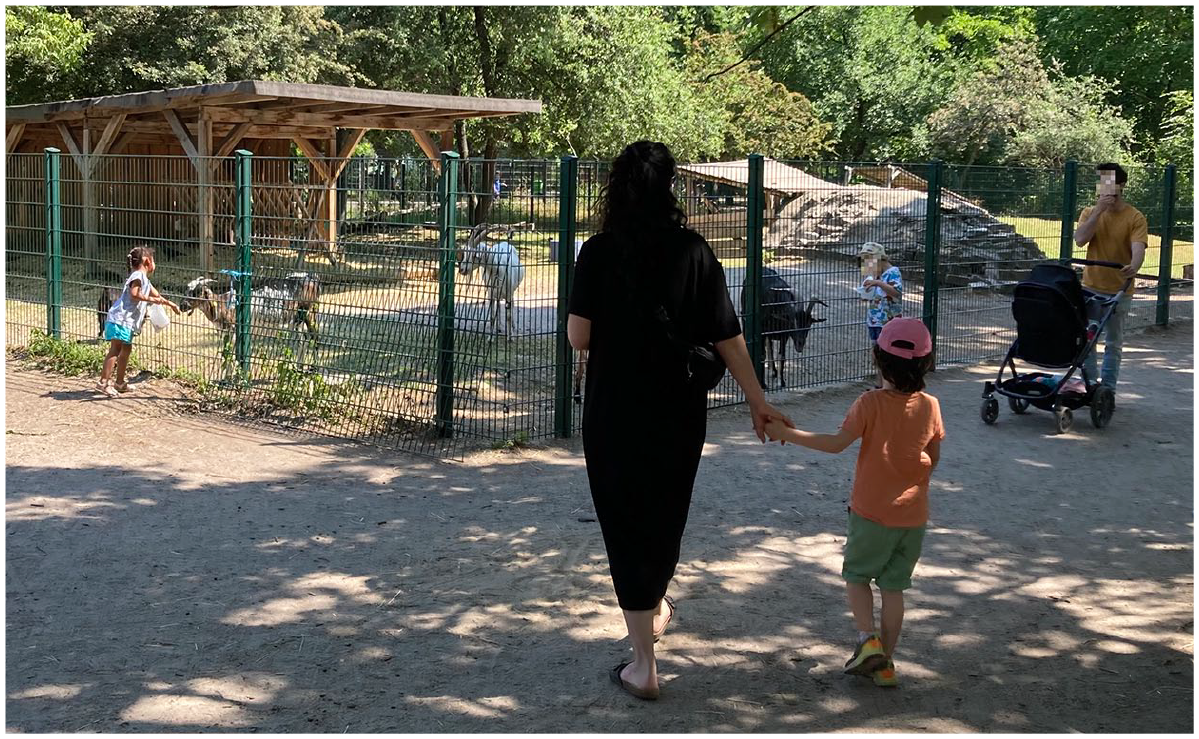
Kinderbauernhof in Görlitzer Park.
Following an animal welfarist approach (Hill and Broom 2009; Norton et al. 1995) that advocates a more humane treatment for animals involved in human productive activities, the practices above point out a second characteristic of those urban farm-like locations: The usage of animals as learning and entertainment tools. Despite animal welfare being a disputed term (Broom 2011), Kagan, Carter, and Allard (2015, S2) link this concept to practical caring actions related to “what is provided to animals [in terms of] access to food, water, and shelter, as well as to veterinary care.”
Although animal welfare advocacy is not written anywhere on the enclosures’ websites and is also not a discourse enclosure workers repeat, it certainly can be appreciated with different shades in the daily interactions of animals and people—keepers and visitors—and through how the enclosures are designed. As Mancini (2017, 59) has noticed, welfare is tied to two conditions that must be satisfied simultaneously: “That an animal is healthy and that they have what they want.” What an animal wants, according to Mancini (2017, 60), is the individual fulfillment of those two “interdependent conditions or requirements.”
In other words, captivity is not perceived as wrong if the captive animals are in good health, have constant access to food, and have their needs met. For example, animals who enjoy running should have enough space in their barns to move around. However, although this article does not align with an animal welfare perspective, it recognizes its importance as an analytical resource to reflect on the concept that visitors and animal enclosures have of farmed animals. After introducing the second category of animal enclosures, this issue of visitors’ perceptions of captivity and animal enclosures will be expanded.
Second Category: Living Exhibitions for Leisure and Education
Also structured under a welfarist perspective, the second group of animal enclosures is made of locations with more generic designations: Wildtiergehege (wildlife enclosures), Tierparks (Animal parks), and the one inspiring the broad concept that arranges all those urban spaces around this work: Tiergehege (Animal enclosures). What maintains those places together as an improvised collective is that within their domains, the human–animal interactions are more distant, mainly limited to people observing the animals. Despite being locations open to human visitors, captive animals are regularly kept in spaces where people cannot touch or ride them.
In the Tierpark Neukölln, distance is achieved by granting some animals more space in their enclosures and/or using a more restrictive enclosing infrastructure for human–animal physical contact. For example, the yard where donkeys, ponies, and eventually sheep spend time is surrounded by a double fence that limits their possible interaction with humans. There is just one small spot where people can be closer to the animals to possibly touch them. That place is in between the two fences. However, achieving any interaction is sometimes impossible due to the size of the stable and the few animals outside simultaneously, usually two or three (Figure 2).
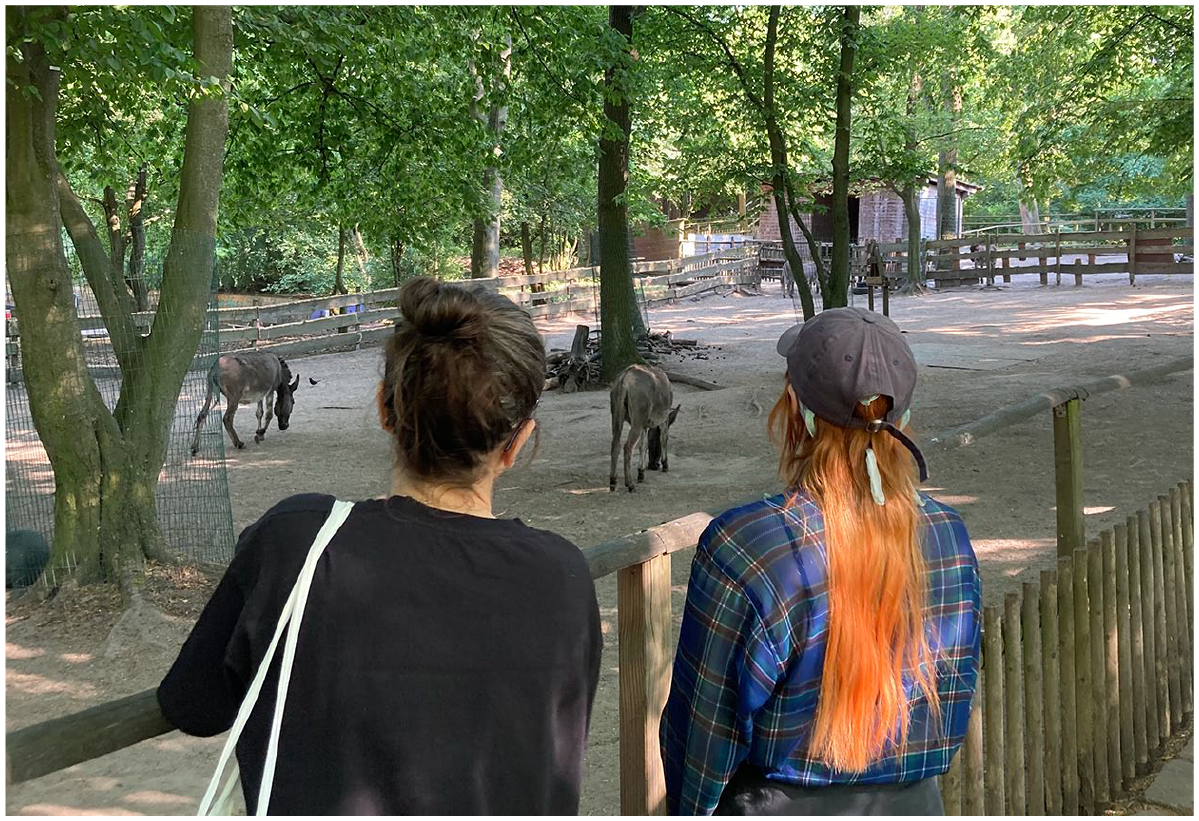
Tierpark Neukölln.
Additionally, the condition of just observing animals is also linked to a double dynamic of hiding and showing. On the one hand, there is this situation where animals decide not to be in the open areas of their exhibitions but remain inside their cages. Also, as it continually happens, despite being outside, the animals are not interested in being petted or even staying near humans. Although some visitors try to attract them near to the fences by making noises, using sticks, or offering food —even when that is prohibited—nobody forces the animals to be near people.
On the other hand, human-managerial logic determines what species are displayed and which should stay in the shadows. In the Tierpark, some species are not exhibited regularly, and they can be appreciated only on special occasions: reptiles in birthday celebrations, for example. Another particularity of the Tierpark Neukölln that may help to understand the distance and type of relation between most animals and visitors is that since 2015, the location has centered its efforts on becoming an Ark park. It means to turn itself into an institution that advocates for the conservation of and education about endangered farmed breeds such as the German saddle pig (Deutsches Sattelschwein), the linen goose (Leinegans), or the Vorwerk chicken (Vorwerkhuhn).
Despite the structural and managerial particularities of each group of animal enclosures, mainly introduced through the descriptions of the Children’s Urban Farm in Görlitzer Park and the Tierpark Neukölln, in practice, each of those locations has its own operative logic. That logic is usually a combination of the two macro-categories but with different degrees of intensity in terms of captivity represented in the daily life of individual species. There are two ways of observing this phenomenon.
The first is about paying attention to the specific locations where those species live: their barns, stables, and cages. The following section will address that matter. The second way explores the encounters between animals and visitors in the enclosures, which is the main topic of this study. So, now that the animal enclosures have been unpacked, a spatial and operational “grammar of difference” (Rovisco 2010) can be appreciated. Specifically, it may be discovered by paying attention to the design, size, and organization of any scenario conceived to let people watch and pet animals.
The last subtitle of this section attempts to describe Berlin’s animal enclosures fully. It introduces one of their most crucial and notorious features: the captive keeping of animals. Additionally, it problematizes the approach to animal welfare regarding the conditions and ethical justifications for keeping farmed animals in captivity and visitors’ perceptions of animal captivity.
Animal Welfare and Visitor’s Perceptions of Animal Captivity
As previously stated, urban animal enclosures differ from traditional zoological gardens. The fact that animal enclosures keep domesticated animals rather than wild or exotic species is essential when discussing their ontology and role as urban scenarios for more-than-human exchange. However, it gives the impression that those locations have been discarded and ignored by contemporary discussions on the ethics behind animal captivity. There are two reasons why.
On the one hand, perhaps because those locations are not globally spread, there is a lack of academic studies from social sciences on animal enclosures as urban scenarios for multispecies exchange. The academic efforts to study animal captivity and human domination over other beings in the city have been focused on other spaces such as zoos, slaughterhouses, and circuses (Arcari et al. 2021; Böhm and Ullrich 2019; Todd and Hynes 2017; Yates 2009) or different types of beings: coyotes (Couturier 2013), elephants (Barua 2014), and dogs (Włodarczyk 2021).
On the other hand, as this subtitle expects to problematize, there is the assumption—as well as the resignation—that domesticated farmed animals belong to productive farms or scenarios like the ones this paper is about, and because of that, we should just talk about improving animals’ lives in captivity. Pierce and Bekoff (2018, 43) criticize animal welfare approaches in the context of animals in zoos because “instead of talking about freedom and captivity [they] seek to improve the lives of animals [. . .] by reducing sources of stress [. . .] and by adding ‘enrichments’ such as plastic toys or food puzzles to animals’ cages.”
According to them, rather than talking about enlightening animal conditions, a sort of “humane-washing” procedure (Pierce and Bekoff 2018, 43), we should address captivity as the real problem captive animals face. Notwithstanding, once this is translated to the context of urban animal enclosures, that ethical position starts to crack. The reason, however, is not theoretical but practical. It means nothing is wrong with discussing and advocating for other beings’ freedom—at the opposite—but where should a domesticated animal be? For Jones (2014, 92), a farmed animal would not survive independently, so there are only two options: “death or captivity.”
A similar position is shared around the visitors of the Tierpark and the Kinderbauernhof. As part of a statistical study on visitors’ perceptions regarding the conditions in which animals are kept in captivity, sixty individuals ranging from eight to fifty-two years old were interviewed. 4 The exercise was conducted on May 28th and June 4th, 2023, by approaching 15 people daily in each location. 5 Among other questions, visitors were asked where they think the animals in the urban enclosures should be. The possible answers were (1) in the enclosure, (2) in traditional farms, (3) in the countryside or their places of origin, or (4) in a different location they should specify.
At the Kinderbauernhof, 67% of the surveyed agreed that the children’s farm was the best place for the animals. A total of 10% thought the animals would be better on traditional farms, and 23% considered they should be either in their places of origin or in the countryside. At the Tierpark, 50% of the people believed animals should stay there, 13% agreed to put them on farms, and 37% concluded animals must be in the countryside or the places they came from. That strong support for animal enclosures is linked to the positive visitors’ perceptions of captive animals’ environments.
Rather than being conceived as a qualitative activity based on sorting animals’ captivity into good and bad degrees of imprisonment and to know what people think about the conditions of animals in the urban enclosures, visitors were asked to rate four aspects of animals’ daily lives. The two graphs below show the results per location, ranging from one to five. The aspects studied were mobility, space, amenities, and freedom (Figure 3).
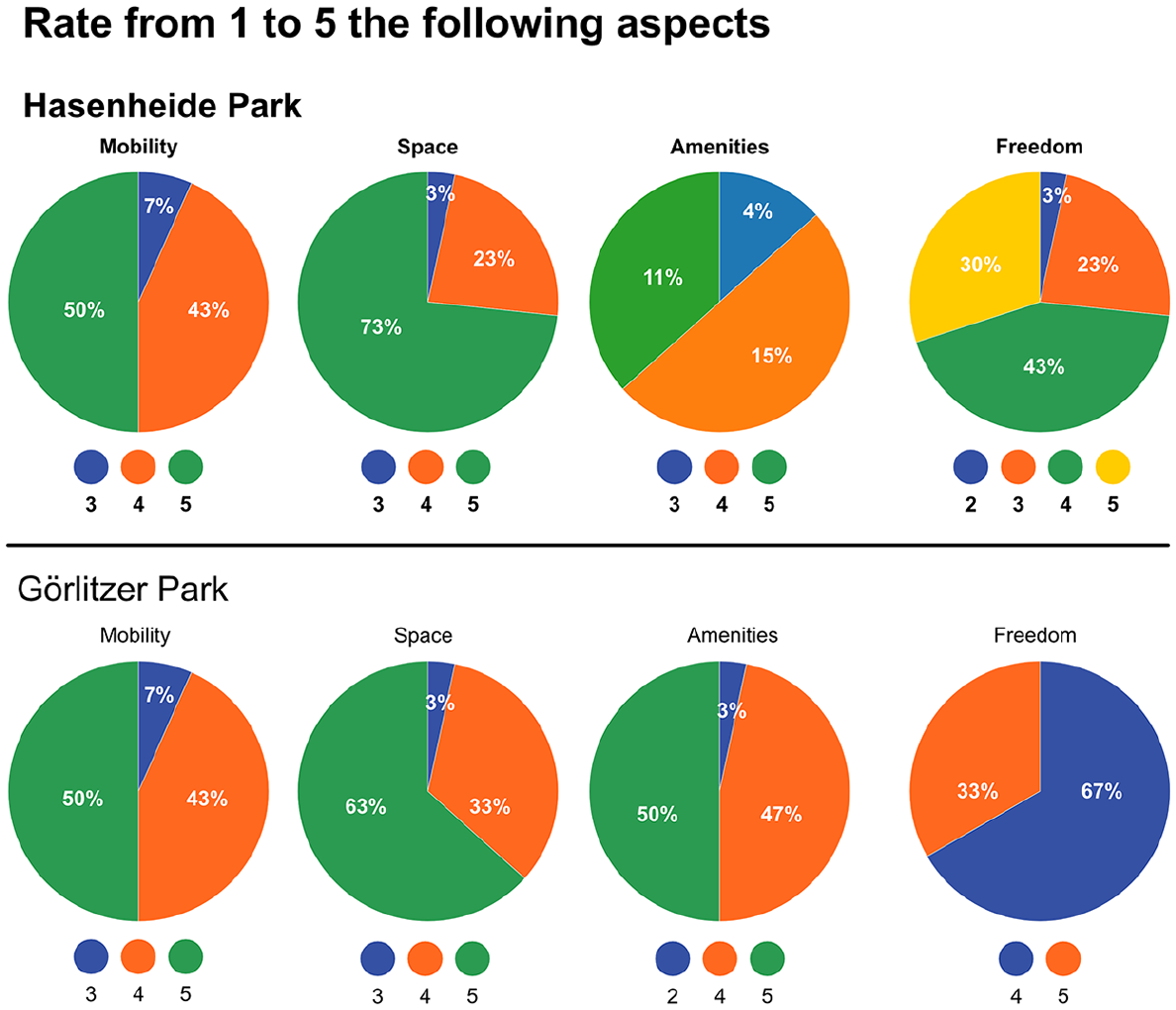
Visitor’s Perceptions of Animal Captivit.
However, can captivity be measured? This is a controversial topic, but it can indeed be approached that way. Notwithstanding, it does not have to be done in terms of reference; it means cataloging and quantifying elements and situations. Instead, it may be achieved by paying attention to how captivity is “handled in practice” (Mol 2002, 5). The following section proposes an exercise based on attentiveness, exploring how captivity can be materialized.
Unpacking the Field Through Its Level of Captivity
As further discussed in the following subtitles, the human–animal (partial) encounters explored in Berlin animal enclosures produce an organized, interactive, and incomplete spatiality. However, as Jones (2000, 267) has stated, “human-animal relations are inevitably embedded in the complex spatialities of the world.” That double geographical condition is relevant to analyze due to its ethical dimension, which adds another level of complexity to studying more-than-human interactions in urban places.
In other words, the encounters this article is about occurred in two related types of urban space that were individually designed to provoke and contain specific forms of multispecies exchange. Despite their compositions, those spatialities bring to the discussion of the urban as a multispecies construction (Franklin 2016) new political and ethical questions that somehow challenge the pretensions and hopes of the urban as a multispecies site of conviviality (Rigby 2018). How can we think about the city as a more-than-human scenario (Duhn 2017) if those other beings we construct our daily life with are trapped in human-centered relations of power and spatial domination? But if we liberate them, what would we do with them? Shall we grant those animals the condition of urban citizens? Shall we deport them? To where?
While conducting an ethical analysis of captivity (Gruen 2014) in urban animal enclosures, as well as speculating about its possible outcomes exceeds the scope of this work, this section aims to use an empirical ethical perspective (Puig de la Bellacasa 2017) to explore the spaces and structures where human–animal encounters happen. Conceiving captivity as an analytical device, the idea is to pay attention to the enclosures’ degrees of captivity and how those nuances are spatially represented in a sort of more-than-human “(un)ethical geography” (Jones 2000) by highlighting the relational aspects of ethics and the ethical implications of facing others.
The strategy is simple: to build an incomplete assembly of different locations by creating tiny but detailed descriptions of how captivity was embodied and interlaced in various scenarios of multispecies engagement. Although this strategy seeks to provide a sense of situatedness (Haraway 1988) by using a partial approach focused on the infrastructures that simultaneously separate and bring together humans and farmed animals, it also includes two complications—incompleteness and reductionism—that appear at different moments of the fieldwork.
Incompleteness
It is relevant to say that partial and situated descriptions offer a strongly bounded epistemological path shaped by meticulous attention to the particular. Although this approach is a central methodological movement for elaborating the (un)ethical geography proposed for this section, and as a first downside, what also makes this project incomplete are the animals that will not be included in this exercise.
Perhaps the main reason for discarding some animals and privileging others was the impossibility of studying their encounters and interactions with humans. For example, while doing fieldwork, the sheep (Waldschaf) in the Tierpark Neukölln were nowhere to be seen. Although the animals remained inside their stalls most of the time, eventually, one could hear them and read about their behavior and geographical distribution in some informative signs, but no further interaction was possible.
Another reason for excluding some animals from this work, like lamas in the Tierpark or ponies in the Kinderbaernhof, is tied to a methodological decision similar to what Krause (2021, 2) has proposed as “model cases.” Translating the idea of “model organisms” from biology into the social sciences, Krause suggests an epistemological movement of prioritizing the study of certain places, elements, and situations over others.
That preference is based on the possibility the first ones have to help analysts follow more accurate patterns and structures to understand better “more general categories in disproportionate ways” (Krause 2021). Following that proposal, the incompleteness shaping the topological descriptions below is also based on selecting certain animals based on two criteria: (1) Animals were located in scenarios where the levels of captivity were more evident or accessible to see, and (2) their encounters with people were regular or, at least, that human visitors were constantly trying to get some type of interaction or response from them.
Reductionism
Another argument for caring about how captivity is reproduced differently in the spaces where the animals live is to attempt to overcome what Jones (2000, 268) has pointed out: “animals are often seen as part of a collective but rarely as individuals.” Even so, the idea of individualizing animals as singularities, at least in the context of this work, is problematic not only operatively but also analytically speaking. The reason is that individualization can tend to be reductionist due to its lack of “consideration of the generative social and environmental context” (Jones 2000) of the captive animals.
It happened during the first stages of my fieldwork. It was perhaps the lack of a critical perspective or maybe the romanticization of that kind of places full of kids, families, and animals, but my initial observations were focused on two settings: (1) how particular captive animals were serving as ambassadors (Packer and Ballantyne 2010; Spooner et al. 2021), as teaching devices, to educate urban children about species and environments kids did not have access in their daily lives. (2) The moments where there was direct contact between humans and nonhumans. It means when a person touches, pets, or even feeds an animal. The rest of the situations were not considered relevant or interesting enough.
However, as the fieldwork passed, the perception regarding those animals and locations was also transformed in multiple ways. That change was achieved through a series of comparison exercises, this time paying attention to the differences and similarities between the farmed animals living in urban enclosures and those located in rural and urban productive scenarios. On the one side, as Buller (2013, 160) has argued, traditionally, farmed animals in productive rural and urban environments are mechanistically reduced “to a component within a multitudinous productive unit, to ‘meat on legs’, to ‘egg-layer’ to ‘walking bacon’” or perceived as labor force as well.
Meanwhile, in urban animal enclosures, captive animals are mainly conceived as entertainment tools “to perform for the pleasure of humans” (Urbanik 2012, 76) and as educational devices “to further understanding of either animals, products, human systems, or the environment” (Urbanik 2012). Still, neither the romanticized perspective that positively sees captive animals as representative agents of their species and nature nor the one that reduces them to educative and entertainment devices were enough to appreciate the complexity and shades of captivity.
Incomplete Cartography of Captivity
The two places this article is about are intricate patchwork quilts made of different levels of captivity materialized in the spaces animals live in and their daily routines and interactions. Those captivity degrees are exclusively linked to the condition of each species inhabiting the urban animal enclosure. In other words, those levels do not depend on the category of each location, regardless of whether it is an animal park, an urban farm, an adventure playground, or the whole individual place as if it were a single ontological and managerial unity.
At the children’s urban farm at Görlitzer Park, for instance, chickens are allowed to move freely around the entire farm, but mainly because they escape from the area they are supposed to be. Since they are frequently unsupervised, it is easy to see them sniffing and digging wherever they want: in other animal barns and stables, in the garbage, or around the children’s playground, one of the most popular locations of the whole farm.
Their freedom, however, is conditioned by the presence of humans. Chickens constantly look for places to hide and run away from people, even when humans are not interested in being near them. Although children can touch, pet, and even grab chickens, this activity usually occurs in a more controlled way. It means it is developed in a secure scenario where a farmkeeper directs the whole activity, takes care of the chickens’ mobility and security, and pays attention to how kids approach the animals.
Meanwhile, other birds inhabiting the Kinderbauernhof, such as ducks, geese, and guineafowls, give the impression of having less freedom of movement than the chickens exploring around the farm. They all—including the chickens—live together in a bounded but vast space bordered by a fence and a thin net. That location comprises a coop area, a little pond, and a broad terrain surrounding the water. The bright side of those confined birds is that they do not need to hide or run away from anyone. Human visitors can watch the animals, but no additional interaction is possible.
A little bit further, but in the same animal enclosure, bunnies live surrounded by metal bars inside an installation composed of a wooden house and a small terrain the animals use to dig holes and run around. Kids and families frequently visit this exhibition and attentively follow the bunnies moving from one place to another. Due to the metal bars surrounding the bunnies, petting the animals is impossible, which does not mean people have not tried to do it. The enclosure has signs warning visitors that the bunnies can bite hard and nobody should touch or feed them. Nevertheless, although this is not something happening regularly, occasionally, one can see people trying to reach the animals.
As the last example in the Kinderbauernhof, sheep are kept in a large stable bounded by wooden boards. Human visitors are allowed to feed and pet them, using the food the farm sells and without trespassing into the stable. Children are regularly the most interested in petting sheep. Some kids used to lean on and climb the fence to be near the sheep. However, despite children’s efforts, human–sheep interactions are not frequent. During my observations at the Kinderbauernhof, sheep seemed to prefer being alone—at least not with humans—and just meet people when they are offering the animals something to eat. They leave once the food is gone.
On the other hand, in the Tierpark Neukölln, some of the barriers between human visitors and captive animals are stricter. They not only limit human–animal interactions, but a few seriously affect the capacity various animals have to move around. Besides the apparent reason for a fence in a context like this—to prevent animals from escaping and keep people away from animals—some specific structures of captivity constrain even animals’ most basic behaviors and routines. Two tiny brown wooden houses on opposite sides in the Tierpark exemplify this situation.
The first house is shared by padovana chickens (Zwerg-Paduaner), those birds that look like they are wearing wigs, and frillback pigeons (Lockentaube), an interesting type whose main characteristic is their curly feathers. The second house hosts a collection of three pigeon breeds native to Berlin: the Berliner Kurze, the Berliner Langlatschige Tümmler, and the Schöneberger Streifige. The size and structure of those constructions are made for those watching the animals. However, the situation seems different for the birds inside.
Unlike other breeds of chickens inhabiting the Tierpark, such as the Vorwerk (Vorwerkhühner) and the Saxon (Sachsenhühner), living in bigger coops and having more freedom to move, Padovana chickens are limited to the small area inside the walls enclosing their house. They cannot run around looking for worms, insects, or stones. Their lives are constrained and less exciting than the rest of the chickens. The same situation occurs with the pigeons from both houses. They are condemned to spend their whole life staying on poles, sitting on artificial nets, and without any chance to fly.
Despite the efforts to keep animals safe from human visitors, people find ways to transgress the Tierpark rules and demarcations. For instance, it does not matter how many signs ask not to feed animals or how long and compact the fences are in the European fallow deer’s (Damhirsche) exhibition; some visitors find ways to give them food. Bread, pretzels, and apple slices were the products I saw people sharing with the animals.
However, regarding the geographies of captivity in urban animal enclosures, the most significant difference in terms of captivity is related to the human–animal disparity in terms of will and mobility. It does not matter how big a stable is or how much space a species has inside its cage. Animals are conditioned to live behind bars or fences and under surveillance. We can argue whether captivity is good or bad for farmed animals, what levels of captivity are desirable, and under which circumstances it is morally acceptable to have captive animals. Still, at the end of the day, this is just a human-centered discussion over other beings’ lives.
Situating Human–Animal Encounters
Encounters are acts that go beyond accidentally finding and converging with other beings. Although encountering someone or something implies an action of co-presence, as Wilson (2017a, 451) argues, encounter is “far from a general term for meeting. [It] is a conceptually charged construct that is worthy of sustained and critical attention.” As an initial epistemological direction, encounters are conceived as complex temporary semiotic-material assemblages with dissimilar shapes, spaces, and power structures.
Besides its relational and operative capability of gathering and bringing together diverse elements, encounters are charged with various meanings, somehow ontologizing their linkages and becomings. This conceptual multiplicity is the unfinished result of a fluxed liaison mainly among geography (Valentine 2008), anthropology (Steffen 2019), sociology (Goffman 1961), critical literary theory (Pratt [1992] 2008), and urban studies (Darling and Wilson 2016).
The ontologies of encounter have been extended and problematized in this transdisciplinary amalgam by creating a varied and precise typological repertoire of agencements among strangers (Ahmed 2000). They have been labeled as meaningful (Askins and Pain 2011), inventive (Pratt [1992] 2008), ethical (Gibson 2010; Jones 2000), emphatic (Gruen 2015), organized (Wilson 2017a), planned (Førde 2019), and affective (Anderson 2014). However, encounters have also been conceived as awkward (Hitchings 2007), as spaces of discomfort (Wilson 2020), fear and exclusion (Watson 2006), and as devices—among others—for racial and speciesist boundary-making imaginaries (Kim 2015).
Mediated by the material and symbolic aspects of city life and by the moral expectations of strangers (Wise 2016), urban encounters are spatialized muddles of divergences and strangeness. The solid reference for otherness and difference is a critical element in all types of encounters. “Encounters forge ‘contact zones’ where people [. . .] with different histories come together into composition, interact and intertwine. However, encounters are also between beings of biologically different origins, equally vital to such histories and world-making” (Barua 2015, 265).
Inspired by Allport’s (1954) contact theory, the notion of contact zones was developed by Pratt ([1992] 2008, 8) to describe those spaces where “cultures meet, clash and grapple with each other, often in contexts of highly asymmetrical relations of power.” Haraway (2008) extended the notion of contact zones to a more-than-human context through her work on companion species. However, Wilson (2019) is perhaps the scholar who has strongly mobilized the critical core of contact zones to a multispecies discussion.
Wilson’s (2019, 2) particular attention to the interactions and the resulting “violences of asymmetrical relations” between humans and nonhumans is conducted through the analysis of encounters with “embodied differences.” In both Berlin’s animal enclosures, those differences have been presented regarding human–animal inequality in terms of freedom and mobility, as well as by paying attention to the dissimilarities between species. If, as Böhm and Ullrich (2019) suggest, contact zones are anthropocentric constructions made to facilitate the encounters and interactions between humans and animals, the Tierpark Neukölln and the Kinderbauernhof in Görlitzer Park could be conceived as such.
What does it mean to understand those places as contact zones? Better yet, what possibilities and challenges does the idea of contact zones provide for studying human–animal encounters in urban animal enclosures? The rest of this document will explore both locations, imagining them as contact zones to address the questions above. However, it does not intend to review Pratt’s theory but to use it as an analytical resource to explore human–animal encounters.
Interaction and Transformation
The study of the two animal enclosures as spaces created for humans to meet animals, which means understanding them as contact zones, has four main elements to analyze: (1) their interactive component, (2) their transformative outcome, (3) their organized structure, and (4) the types of encounters produced inside those spaces. The dynamic is to present those elements through a brief theoretical construction and finally merge them in an ethnographic exercise focused on human–animal encounters in the two animal enclosures.
As Böhm and Ullrich (2019, 5) highlight, interaction is a fundamental component in the human–animal contact zone since both parties should be “actively engaged in the encounter, and the agency is attributed to both of them. [Aditionally,] the processual, interactive event of the encounter transforms humans as well as animals and thereby forms something new.” In the same line, Todd and Hynes (2017, 730) conceive human–animal encounters as zones of transformation and rupture that should provoke “an event or difference in thought.”
Rupture is also an essential part of encounters in the contact zone. Approaching them from an anthropocentric perspective, Wilson (2017b, 25) conceives them as “events of relation” that bring us, humans, to scenarios of transformation by disturbing—surprising and shocking—us, humans, at the time we, as humans, encounter that “ultimate other” (Hobson-West 2007; Wolch and Emel 1995). The strong emphasis on the human side in the studies of human–animal encounters is an interesting remark that goes along the same line as how animals are conceived in urban animal enclosures: as learning devices and, in the case of this perspective, as elements that allow people to have a sort of transformative experience.
Wilson (2017b, 30) proposes some cases of encounters as spaces or events for human transformation: When, for instance, the encounter with animals is carried out in violent scenarios, such as in slaughterhouses, that experience may take us “to think differently.” Also, when animals serve as therapeutic devices that have “the potential to impact on human physiological states, loneliness, or morale.”
But is this transformative outcome—for humans or humans and animals—really happening in daily life in more-than-human interactions in those two locations? Well, yes and no. That fruitful ambiguity is tied to using contact zones as an analytical resource. As Wilson (2019, 15) argues, contact zones uncover and explore a tremendous complexity in terms of encounters and the assemblage of “different configurations and forms of power as they are reworked to different effects.” To unpack that assertion, let us explore two situations, one from the Kinderbauernhof and the other from the Tierpark.
A couple takes their five-year-old son to the Tierpark. That is a regular activity they have repeated almost twice a month during the past year. The kid, according to his parents, is currently obsessed with goats. But first, it was donkeys, then deer, and then something else they cannot recall. The family enters the animal enclosure together, and once inside, the parents move to a bench to talk and watch their phones while the boy runs toward the goat’s stable. The kid leans on the fence to see the animals. He points at one in particular—his favorite goat—and starts loudly calling the animal to be near him, but he fails. Still, despite the goats not paying attention to him, the child spent more than 45 minutes observing them until his parents called him to leave the place. Carefully grabbing a chicken, an animal keeper shows the animal to a group of five kids around her. Three children seem excited and interested in touching the chicken. One looks scared of having the bird near, and the final kid appears like she does not care. The keeper bends down a little and brings the chicken closer to the children. Surprisingly, the situation changed. Two of the ones excited to have the animal near now seem to doubt whether to touch the bird or not. The scared kid, still visibly frightened, is the first to do it. We witnessed how he moved from a fearful attitude to a joyful mood, being comfortable with the presence and interaction with the animal. When his turn was over, two more children were brave enough to touch the bird. But the chicken, in a similar mood to the girl who does not care, looks disconnected, far away from what is happening.
Organization
The vignettes above display a type of more-than-human space whose main characteristic is that it has been planned. This planning can be seen in two interlaced levels. First, there is a structural one: the animal enclosure is designed as an open-access location to facilitate encounters between urban human visitors and different species of animals that we, as urban individuals, do not regularly see living or freely wandering in the city. By focusing on wild animals, that type of otherness has been problematized by Beardsworth and Bryman (2001, 85) as a form of embodiment that characterizes caged animals as “both ‘outside’ [urban] human society, and ‘inside’ [urban] human culture.”
The second one is tied to people planning to see—or take their children to observe and interact with—caged animals in urban enclosures. These types of two-level planned encounters with farmed animals are similar to what Wilson (2017a) describes as organized encounters. These encounters are self-explanatory events of relation, different from spontaneous and accidental forms of contact. Organized encounters often require “careful facilitation and management” (Wilson 2017a, 610) Wilson classifies them into three states. Some just imply conflict and disparity, while others are based on the conscious participation of both sides to seek mutual transformation. The final type is “more concerned with the pursuit of self-transformation and thus tends to be one-sided, involving the instrumentalization of one group or individual for the transformation of another” (Wilson 2017a, 611). The last type of organized encounters occurs in the Kinderbauernhof and the Tierpark, but they are not the only ones occurring there.
The unidirectionality of the last type of organized encounter is perhaps one of the most critical aspects in describing how animals are used as entertainment, educational tools, devices to improve people’s skills, and ambassadors of nature and their own species. However, despite all those encounters being organized, at least structurally speaking, there is room for improvisation. Take, for instance, this article’s initial vignette of a kid chasing a chicken, or the story of the chicken being exhibited by an animal keeper and what happened when the animal was brought near the children.
The unpredictability and inventiveness of organized encounters state that despite their planned structure, they are not staged scenarios. Neither visitors nor animals follow any script. Despite the warming signs and tight fences, people still try to touch bunnies at the Kinderbauernhof or feed animals at the Tierpark, and animals just do what they want in normal circumstances and without caring for people unless food is involved. Additionally, when we say an encounter is planned, it does not mean it is ethically organized. In more-than-human encounters in urban animal enclosures, captivity is still a complex issue that needs further discussion.
Entangled Presentation
Despite both having a planned nature, and being considered as partial, it is not the same type of engagement where a person runs after an animal as one where a person watches an animal behind a fence. In fact, according to Beardsworth and Bryman (2001), that second type of encounter should not be considered as such. They identify four modes of engagement people use when they face animals: (1) encounter, (2) representation, (3) presentation, and (4) quasification. Representation, the figurative portrayal of animals, and quasification, a mode of representation that caricatures animals intending to entertain the viewer, will not be further discussed here. Instead, this subtitle will focus on the other two ways.
Encounter is the most direct mode of engagement. “It entails the individual actually being in the physical presence of the unrestrained animal in its own environment, so it can be perceived via one or more of the senses” (Beardsworth and Bryman 2001, 85). Meanwhile, presentation is a mediated human–animal gathering. It “differs from representation in that perception of the animal is not mediated but is direct. However, it differs from encounter in that the animal is not unrestrained in a ‘natural’ setting but is held captive and it is presented for viewing by its captors” (Beardsworth and Bryman 2001, 86).
As shown in this document, both types of interactions are common forms of engagement with animals in urban animal enclosures. However, as Beardsworth and Bryman acknowledge, those ways of being with animals are often interlaced among them through an experiential structure of media sources. In the case of human–animal interactions in the two animal enclosures, that entanglement inevitably passes through the already explored ethical and spatial-infrastructural discussions on captivity. Where should farmed animals be?
If we agree with Jones (2014, 92) that the only available options for most of those animals 6 are “death or captivity,” urban enclosures should then ethically be considered those animals’ environment. The main reason is that domesticated animals cannot live outside independently, and some humans would seriously threaten them if they were released. Following those lines, seeing and petting farmed animals in urban enclosures could be viewed as a form of encounter, even if a restrictive infrastructure mediates it.
Conversely, it could be argued that the more-than-human engagements produced in urban animal enclosures are just presentations and that captive animals are no more than living elements inside dioramas or ambassadors of other realities. As human-made spaces to present and display animals, urban enclosures work on two levels: as scenarios to get urban people closer to non-urban beings and as institutions that reproduce colonialist discourses about animals as the “ultimate other” (Pedersen 2010).
What is interesting about urban animal enclosures is that both modes of engagement occur simultaneously in the daily interactions of humans and animals. On the one hand, captive animals live under human infrastructural and managerial logics. Their space is limited, their food, routines, and reproduction are controlled, and they are often used as educational and entertainment devices. On the other hand, people go to those places to have first-hand, organized contact with other beings, animals that they do not have access to in their daily lives.
Notwithstanding, that direct approach to animals in urban enclosures does not necessarily mean touching or petting them. Sometimes, it is about having the animals near but without further interaction. Grosso modo and it will be expanded below, those types of more-than-human modes of engagement happening in urban animal enclosures are what I call partial encounters.
Partial Encounters
Throughout a set of vignettes, descriptions, and problematizations on two urban animal enclosures in Berlin, the Kinderbauernhof in Görlitzer Park and the Tierpark Neukölln in Hasenheide Park, we have explored the spatial and infrastructural set-up of and a specific type of multispecies co-presence I would like to define as partial encounters. Partial encounters are organized, interactive, temporal, and incomplete more-than-human entanglements shaped by different levels of animal captivity. They are partial because they are incomplete and biased at the same time. Still, as with any other type of encounter, they keep a cloak of unpredictability even despite their planned core. Additionally, despite their multiple possible set-ups and outcomes, partial encounters share three main characteristics.
First, they are mediated by restrictive infrastructures that keep humans and nonhumans separated from each other. Fences, nets, and walls set the tone for those types of interaction. In normal circumstances, animals can only be approached through vision, hearing, and smell. That last sense becomes particularly relevant in summer, especially around big species. There are moments of subversion, like when chickens escape from their coops or when people try to reach, touch, and feed animals when it is not allowed to do so. And, of course, one can find other kinds of planned situations in the urban enclosures that promote encounters where physical presence, regarding touch and pet animals, is desired and encouraged. Still, even during those modes of engagement, there is a sense of partiality, of incompleteness.
Even when the more-than-human encounters in the Kinderbauernhof and the Tierpark are meant to be physical and interactive—and as a second characteristic—the transformative outcome of those interactions is strongly human-centered. They are what Wilson (2017a) identified as events focused on self-transformation, privileging one side and instrumentalizing the other. Even though the animals are well maintained and have all their physical needs covered, their encounters with human visitors do not represent any rupture or transformation in their lives.
Of course, a transformation, in this case, does not have to be something positive. Still, I could not see any physical harm during my observations of human–animal interactions in the two selected locations, and identifying animal stress symptoms is a topic overpassing the scope of this research and my knowledge as an urban ethnographer. Nevertheless, this article can stimulate new lines of research on more-than-human urban entanglements; one focused on exploring the effects of captivity and human interaction on animal behavior in urban enclosures.
The third and final characteristic of partial encounters is that despite being human-centered modes of engagement, there is no guarantee of producing a transformation or any other event of difference in thought for human visitors. However, it does not mean it could not happen. Although there is a sort of spectacularization when talking about the power of encounters to produce ruptures and transformations (Todd and Hynes 2017), in the Tierpark and the Kinderbauernhof, those events—when they happened—were way more subtle.
Two are the most common transformative moments in urban animal enclosures. One is tied to the educational aspect of those spaces: a group of children learning about farmed animals and the environment in a planned event. The other is about attitudinal changes toward particular animals in specific moments: a kid who overcomes their fear and touches or rides an animal. However, are people really going to those places to experience ruptures, transformations, or change their thinking?
According to the survey results on visitors’ perceptions, leisure is the main reason people go to the Kinderbauernhof (47%). Learning is the second most popular activity there (42%). Then, playing in the farm’s playground (9%) and, finally, meeting friends (2%) are the last reasons people visit that place. Meanwhile, at the Tierpark, most visitors affirm they go to the urban enclosure to learn (47%). There, leisure occupies the second position (42%). To play (5%), to be with their kids (2%), and to think (2%) are the other activities the Tierpark is used for.
As a final remark, another line of research that could result from this exploratory study of Berlin’s animal enclosures and the type of human–animal encounters could be about the visitors’ attitudes toward animals. It would be interesting to deeply examine what occurs with people’s perceptions and actions toward animals, themselves, captivity, and those locations during and after contact with other beings. Those types of urban places are also worthwhile scenarios for an anthropological exploration of more significant questions on multispecies conviviality and the city as a more-than-human construction.
Supplemental Material
sj-xlsx-1-jce-10.1177_08912416241309857 – Supplemental material for Partial Encounters: Exploring More-Than-Human Entanglements in Berlin’s Animal Enclosures
Supplemental material, sj-xlsx-1-jce-10.1177_08912416241309857 for Partial Encounters: Exploring More-Than-Human Entanglements in Berlin’s Animal Enclosures by Santiago Orrego in Journal of Contemporary Ethnography
Footnotes
Declaration of Conflicting Interests
The author declared no potential conflicts of interest with respect to the research, authorship, and/or publication of this article.
Funding
The author disclosed receipt of the following financial support for the research, authorship, and/or publication of this article: This work was supported by The Deutsche Forschungsgemeinschaft (DFG, German Research Foundation) through the Walter-Benjamin Fellowship.

Supplemental Material
Supplemental material for this article is available online.
Notes
Author Biography
References
Supplementary Material
Please find the following supplemental material available below.
For Open Access articles published under a Creative Commons License, all supplemental material carries the same license as the article it is associated with.
For non-Open Access articles published, all supplemental material carries a non-exclusive license, and permission requests for re-use of supplemental material or any part of supplemental material shall be sent directly to the copyright owner as specified in the copyright notice associated with the article.
