




Abstract
In this article I focus on stigma, and more specifically on territorial stigma in a Dutch suburb built in the 1970s. This publication is based on ethnographic fieldwork that lasted two and half years and which took place at the end of the 1980s. The data is reanalyzed in the light of recent developments in studies on stigma and territorial stigma, specifically how this is countered. I will use the conceptual pair—doing stigma and undoing stigma—to unpack stigma as a complex and dynamic process in which a diverse range of actors, such as inhabitants, civil servants and youth, are involved. The aim of this article is twofold: to describe and analyze the social construction of territorial stigma (doing stigma) of the neighborhood over a period of ten years and whether and how this stigma is countered (undoing stigma). This article highlights the agency of those targeted by stigma by paying attention to local narratives and using a multi-perspective ethnographic lens. The narratives show that stigma did not gain a master status because (1) the stigma producers were marginal in the social world of the targeted inhabitants and (2) it did not align with structural stigma (as in e.g., housing, health care, income, and education).
Introduction
In this article I will focus on stigma, and more specifically on territorial stigma in a Dutch suburb built in the 1970s. This publication is based on ethnographic fieldwork that lasted two and half years and which took place at the end of the 1980s. The rich data is gathered via a range of methods, such as participant observation, interviews and questionnaires. The data is reanalyzed in the light of recent developments in studies on stigma and territorial stigma, specifically how this is countered. In the original Dutch publication (Laar & Müller 1991) 1 I did not reflect in a conceptual way on stigma as I will do here. The aim of this article is twofold: to describe and analyze the social construction of territorial stigma (doing stigma) of the neighborhood over a period of ten years and whether and how this stigma is countered (undoing stigma).
With his publications on a Parisian banlieue and South Chicago (e.g., 1993, 2008, 2010), Wacquant opened the field of territorial stigma. He describes it as a symbolic denigration, referring to Bourdieu’s concept of symbolic power 2 that enhances urban advanced marginality. Inhabitants internalize the negative reputation, also known as self-stigma (Corrigan 2004), and do not have community pride nor a sense of belonging. In reaction, many publications confirmed territorial stigma but also indicated that this does not automatically lead to self-stigma. These studies have nuanced Wacquant’s perspective by focusing on doing/undoing stigma in cases with a different geographical and social-economic context (e.g., Hastings 2004, Horgan 2020, Jensen and Christensen 2012, Tuominen 2020, Watt 2020). I will further develop the field of territorial stigma by zooming with an ethnographic lens in on the local narratives of doing/undoing stigma and how they interact with the social, cultural, economic, and historical context.
This article contributes on different levels to the field of territorial stigma. First, in line with the moral and symbolic character of stigma (e.g., Horgan 2020, Wacquant 2010, Yang et al. 2007), this article presents a theoretical innovation, with the introduction of insights from studies that focus on moral enterprises and moral entrepreneurs as agents in the social production of territorial stigma (e.g., Becker 1963, Cohen 1972). With the moral enterprise approach, I specifically refer to a multi-perspective method that focusses on a wide range of actors and their local moral narratives and practices that shape the dynamic social process of doing/undoing stigma.
Second, the studied neighborhood has no large concentration of deprivation and exclusion, which makes it possible to recognize territorial stigma as “a distinct and complex form of othering and discrimination” (Kusenbach 2020, 74). In addition, this article discusses a type of (social housing) stigma (Horgan 2020)—suburban family homes built in the 1970s—that is rarely studied within this field. This makes this case even more relevant. How is it possible that an area with modern comfortable houses became stigmatized so quickly after it was completed in 1978?
Third, a unique trait of this case is its relatively short historical trajectory of eight years (1980–1988) at the start of the study, which makes it possible to retrace the step-by-step development of the stigmatization process using ethnographic data. I will use the concept “stigma springtide” for a situation in which different structural forces collide and create a threatening social transformation which social actors explain by creating a stigma narrative. In this case, developments in the housing and financial markets, coincided and created the conditions (high mobility and vacancy) that triggered territorial stigmatization. A final contribution is that in my approach of territorial stigma I will not only focus on the overall territorial stigma narrative but also on the social construction of each of the stigma claims that constitute this narrative.
In this article, I will focus on a new neighborhood in Alkmaar, called Newhome 3 which consists of 8500 inhabitants. The area consists of three subsections: Zone 1 was built in the first half of the 1970s and consists of a grid pattern of streets with suburban single-family houses, of which most are social housing. Zones 2 and 3 were built in the second half of the 1970s. Zone 2 consists of modern and luxurious homeowner houses within a street pattern that is not rectangular and is therefore described as a “cauliflower neighborhood.” Zone 3 has a similar design and has a large section of social housing.
The research is related to a grant of the national government to evaluate anti-vandalism projects such as public youth meeting places (similar to large bus stops) and the fencing of secondary schools, to prevent teenagers causing damage. When it became clear that the neighborhood was stigmatized, the research was reformulated to include whether stigma played a role in the choice of Newhome as the location of the anti-vandalism projects. Here I will focus on the period 1980–1990 and one specific sub-section of Zone 3, called Willow Road, which was labeled as a place of high mobility, vandalism, social disintegration, and decay.
Doing/undoing stigma implies, in line with similar concepts such as “doing gender” (West and Zimmerman 1987) and “doing justice” (Johnson 1995) that to understand stigma one has to focus on how stigma is narrated and enacted in daily social life from the perspectives of social actors using a micro sociological lens. This angle has resulted here in findings that highlight the agency of inhabitants creating local urban narratives that are diverse and nuanced (see also Borer 2006, Sisson 2021). Using the contemporary (territorial) stigma lens, the analytic revisiting of the data uncovered a wide variety of reactions including undoing stigma or what is also known as destigmatization (Horgan 2018, 2020, Lamont et al. 2016, Lamont 2018).
Stigma
According to Goffman stigma is “an attribute that is deeply discrediting” (1963, 3), it disqualifies the stigmatized “from full social acceptance” (ibid, Preface) and reduces him or her to “a tainted, discounted” person (ibid, 3). Goffman did not relate stigma to space, he focused on (1) physicality deformity (2), “weaknesses” of moral character and (3) group stigma related to race and religion. Goffman is mainly interested in how stigma creates social order. He does not focus on the moral enterprise of stigma nor on how stigma is countered. Goffman has been criticized for not paying attention to the power dynamics behind stigma and how it marginalizes categories of outsiders (Hannem 2012; Tyler 2020). Several sociologists have recently opted to include this in stigma studies by focusing on stigma power (Link and Phelan 2014), which refers to using stigma to exploit, control, or exclude people and stigma machines (Tyler 2020), which are social forces that construct and use stigma “as a violent practice of exploitation and social control” (ibid, 252).
A range of deviance studies focus on doing stigma as a moral enterprise, which is largely ignored within the territorial stigma field (e.g., Becker 1963; Best 2013; Cohen 1972; Douglas, Rasmussen and Flanagan 1977; Spector and Kitsuse 1977). These studies show how moral narratives are developed during a set of interactions in which a diverse range of social actors shape the meaning making process in relation to transgressive acts.
Becker distinguishes two categories of moral entrepreneurs: rule creators and rule enforcers. The typical rule creator is what Becker calls the “crusading reformer”: “The existing rules do not satisfy him (sic!) because there is some evil which profoundly disturbs him” (Becker 1963, 147). The other category is the “rule enforcer” (ibid., 156, 159) (e.g., the police). The rule enforcer is more pragmatic and focuses on getting the job done. Moral entrepreneurs use their position of power to stigmatize those who are already in a marginal position. A moral enterprise produces a moral narrative that stigmatizes transgressive actions and categories that are associated with these actions. As such a moral enterprise is similar to a stigma machine, using stigma power to create “structural stigma,” a concept used by Hannem (2012) to refer to the structural effects of exclusion and discrimination in areas such as housing, education, health, and work (see also Link and Phelan 2001). An example of how the state creates a moral enterprise targeting a community with territorial stigma is given by Watt (2020) in his discussion of the application of the Sink Estate-label to Aylesbury in London. Prime Minister Tony Blair acted as a crusading moral entrepreneur by calling it a hell hole of dealers and junkies. 4
Crusading moral enterprises include a highly moralistic and emotive narrative. Atrocity tales (Best 1987) are used as examples of social acts that need to be eliminated. These tales tend to describe transgressive incidents to symbolize a category of persons to other, degrade and demonize them, thus creating folk devils (Cohen 1972). This is used to emphasize cultural boundaries between us and them, the (law-abiding) established and the (law-breaking) outsiders (see also Erikson 1966, Elias and Scotson 1965). There is a reference to a dystopian future if nothing is done. Here I will use moral enterprise as a conceptual yardstick to analyze the social meanings of territorial stigma and answer the following question: can we see a dominant crusading moral enterprise with a degrading narrative targeting Willow Road?
To understand the impact of doing stigma, we can concept of master status (1945) which Becker discusses Outsiders (1963) When the label becomes the master status of a person or group of persons, social institutions, such as educational institutions and the criminal justice system, operate as a stigma machine applying stigma power by sustaining a dominant negative label. The master status will shape the way people see and define them. This will result in structural stigma, excluding them from respectable society and triggering a deviant career leading to self-stigma; they internalize the stigma and feel degraded, disempowered and demoralized.
An example of this stigmatization process is described by Elias and Scotson (1965) in their study on a new neighborhood in an English town. The negative label is created by the established because their social status is being threatened by the new inhabitants from marginalized areas of large cities. They cannot counter the degrading moral narrative as they lack social cohesion. They are described as “powerless” and “helpless” (ibid, 75, 87). They adopt the stigma, believe in it to an extent that they internalize the spoiled identity of the “outsider,” similar to Wacquant’s territorial stigma. As social cohesion—neighborly contact and support—is also described as problematic in Willow Road, the question arises how this impacts doing/undoing stigma in this area.
In more recent times, studies emphasize the agency of those who are targeted by stigma narratives (e.g., Carrasco et al. 2017; Ferrell 1993; Kusenbach 2009; Kusow 2004; Lamont 2018; Snow and Anderson 1993). They describe a wide range of strategies of undoing stigma. For instance, Kusenbach (2009) describes strategies such as distancing—“separating oneself and one’s community from others who fit the existing stereotype” (Ibid, 406)—and normalizing, indicating that there are similarities between the stigmatized and the respected members of society. Another vital strategy is stigma reversal: the stigmatization of a (member of a) dominant group by a (member of a) group with a marginal social status (Killian, 1985).
These studies show that even when there is a strong stigma narrative it is not automatically internalized. For instance, Kusow (2004) describes how Somalian immigrants react to race stigma in Canada by tapping into a cultural discourse which is rooted in their community. Because of their involvement in different social worlds the self is not defined by a dominant and coherent audience of stigmatizers. The stigma label does not become their master status because they are able to create a separate narrative of honor and respect, which includes rejecting Canadian identities, race-based stigma and stigma reversal, as they see themselves as superior to Canadians.
Lamont highlights that stigmatization defines categories as less valuable and creates “recognition gaps” which are “disparities of cultural membership between groups” (2018, 423). Lamont and others (2016) show that destigmatization depends on national cultural repertoires, perspectives that people use to make sense of their social world. For instance, in the United States the dominant reaction among the African American research participants was confronting, that is, highlighting their self-worth by defending dignity and claiming respect. This is enabled “by readymade scripts about repeated racist interactions between blacks and whites, which are sustained by a collective awareness of racial exclusion, inequality, and history. . .” (2018, 428).
Most studies that focus on territorial stigmatization have done this in the context of neo-liberalism, a cultural repertoire that blames the marginalized for their social position and relates it to their flawed moral character. By stigmatizing those who are not able to attain middle class status the neo-liberal narrative aggravates the recognition-gap. This means that the stigmatized feel that they are not treated in a fair way and seen as second-class citizens. As this study focusses on the 1980s in the Netherlands in a period in which the social democratic welfare state perspective was waning, but still dominant, the following question has to be asked: can we see a moral enterprise of doing stigma with a similar othering and degrading connotation resulting in a recognition-gap in the case of Willow Road?
Territorial Stigma
Wacquant’s work on territorial stigma opened a new subfield within urban studies. He relates this form of stigma to advanced marginality as it shapes urban desolation, social fragmentation and collective demoralization. The dominant theme in Wacquant’s work is (1993, 2008) that the urban outcasts are powerless and cannot resist the symbolic violence of territorial stigma in times of neo-liberal capitalism.
Negative representations and sociofugal practices then become articulated to set off a deadly self-fulfilling prophecy through which public taint and collective dishonour end up producing that which they claim merely to record: namely social atomism, community “disorganization” and cultural anomie. (2008: 184, italics in original)
Wacquant describes how territorial stigma shapes the self-identities of those living in marginalized areas in an absolute and brutal way. They have no resources that they can use to construct counter-narratives and positive self-identities. They can only resort to strategies which insulate inhabitants, such as distancing from others by focusing on micro-differences, denigrating others using the stigma gaze, retreating in the private sphere and moving out.
Wacquant’s work triggered a strong reaction within urban studies describing that persons targeted by territorial stigma are involved in undoing stigma (e.g., August 2014; Hastings 2004; Horgan 2018; Jensen and Christensen 2012; Kirkness 2014; Sisson 2021; Slater & Anderson 2012; Tuominen 2020; Watt 2020). These publications show that inhabitants of stigmatized neighborhoods challenge stigma, and create counter narratives of empowerment and pride. These studies also changed Wacquant’s perspective stating that resistance is indeed possible, though he does not reflect on this in detail (Wacquant, Slater, and Pereira 2014, 1276).
Within the scope of this article, it is impossible to discuss these studies in detail. I will focus here on two publications because of their relevance for this article. Jensen and Christensen (2012) highlight in their study on Aalborg East the agency and autonomy of its inhabitants in the face of territorial stigmatization. The inhabitants share positive views on the neighborhood and feel at home where they live. They are aware of the negative reputation of their neighborhood and are emotionally affected by it, but they have not internalized it. Jensen and Christensen explain this by referring to the Danish national context shaped by a long social democratic history, similar to the Dutch situation, supporting the less privileged. Another reason why their study is relevant here lies in a second explanation for the limited social psychological effects of territorial stigma. They explain that in Aalborg East social projects supporting pride and dignity, as part of the urban renewal program, had a positive impact on empowerment and belonging. Here, I will discuss whether this also applies to Newhome, especially in the case of the anti-vandalism projects.
The second relevant publication I discuss here, is a comparative study of two stigmatized social housing neighborhoods in Finland (Junnilainen 2020). This study integrates Lamont’s concept of cultural repertoire to analyze the local narratives of undoing stigma in the specific context of each neighborhood. The cultural repertoires used by inhabitants is socially constructed by referring to different class positions: working class and middle class. The first react in a collective and confrontational way and the second in a individualistic way aimed at negotiation. The first reduce the recognition-gap by blaming the proprietors. They use the cultural repertoire of “class struggle”—us against them—to empower themselves. The second reduce the recognition-gap by trivializing the actions of the proprietors, defining themselves as “entitled” middle class and refusing to feel powerless. In the case of Willow Road, we can also identify a recognition-gap. I will explain how its inhabitants dealt with non-recognition and which cultural repertoire they used to empower themselves.
Methods
The study consisted of qualitative and quantitative methods. The main method was participant observation. Beside regular visits to the neighborhood for observations and interviews, the researchers, me and Hans van Laar, lived in Newhome in two periods (eight months and four months). The participant observation focused primarily on the local youth, the professionals involved in the project and the residents in the suburb. In addition, we did semi-structured interviews with fourteen professionals and eighty inhabitants, of which nine were involved in local volunteering organizations such as the church and the residents’ association. These interviews focused on gaining a deeper understanding of social life in the neighborhood, its history over two decades (1970–1990), including its stigmatization and the experience of vandalism. We used snowball sampling to get into contact with inhabitants. In addition to this we had many open-ended short conversations with a range of social actors such as adult inhabitants, teenagers and civil servants. We also did a questionnaire three times during the research period to see what the effect was of the projects on the experience of vandalism. We also did four rounds of systematic photo-reportage along a fixed trajectory to observe whether the projects had an effect on vandalism and graffiti. In addition, we had access to police records and demographic data. Finally, we studied documents on the neighborhood, such as media and government publications.
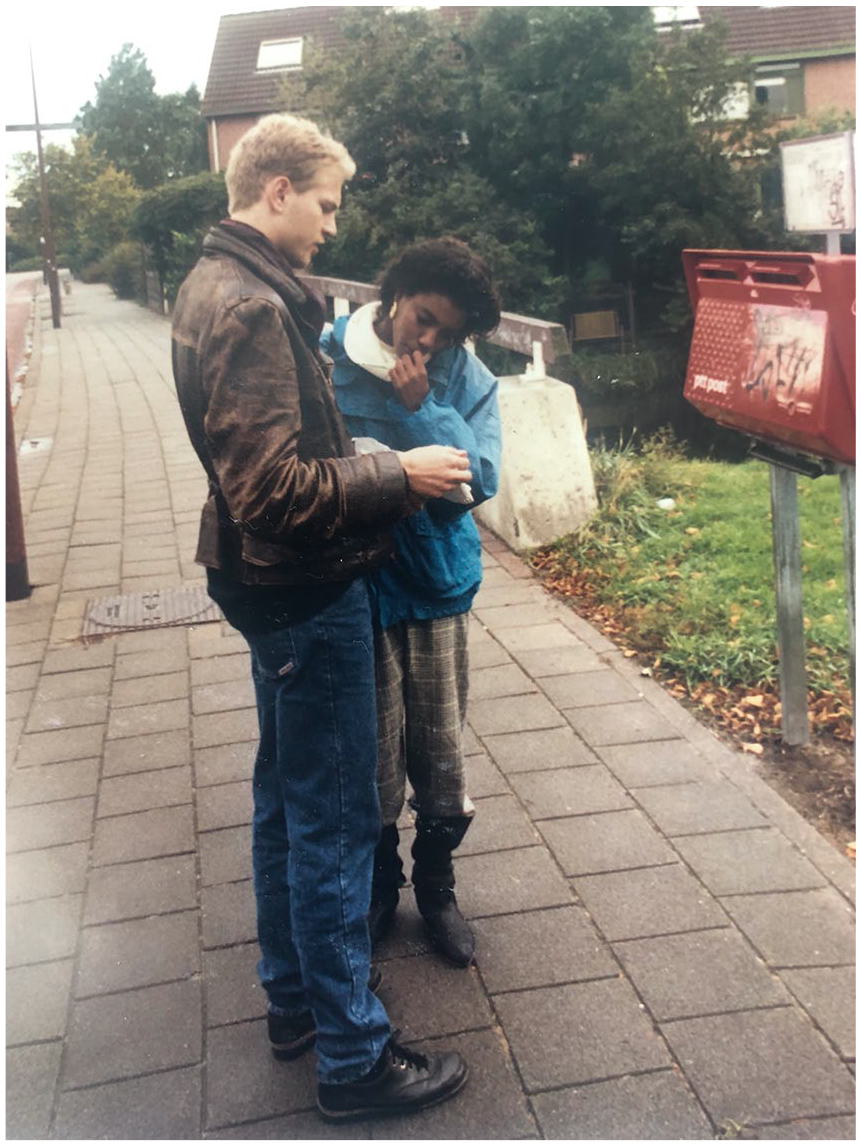
Street interview.
Findings
In the following pages I will present the findings by focusing on the questions and concepts that I have introduced in the previous pages. First, I will describe the beginnings of the stigmatization process, in which I will discuss how transformations in the housing and financial market triggered a stigma springtide. In this section I will also focus on three stigma claims which are linked to these transformations: “badly kept gardens as disorder,” “social disintegration” and “problem cases,” which refers to marginalized households that are labelled as less respectable because of anti-social behavior. In relation to these claims doing/undoing stigma had an individual character, in contrast with the stigma claims related to “foreigners” and “youth gangs and vandalism,” which triggered a collective response that will be discussed in the following sections. Finally, I will discuss the effect of the anti-vandalism projects on territorial stigma.
Stigma Springtide
When the research started in 1988 territorial stigma was widespread. Research participants encountered it in interactions with a range of people such as colleagues, shopkeepers, and acquaintances. Another source was the local newspaper reporting incidents. It was also part of the hearsay at sport clubs, hairdressers, and schoolyards. A woman in her early forties gave an example of the normality of the stigmatization of Willow Road.
She visited a swimming pool in another neighbourhood, where the speaker announced that people should watch their money because a wallet was stolen. A woman next to her said, “that must have been people from Willow Road.”
How was it possible that Willow Road gained such a bad reputation in a couple of years? Before focusing on the period 1980–1990, it is important to pay attention to the 1970s as already in the beginning Newhome was confronted with a process of doing stigma. According to the original inhabitants of Alkmaar, that consisted in the early 1970s of 51,000 inhabitants, it was a place that was barren and without any of the social warmth of the older part of the city. The new suburb was also seen as a place where less respectable urbanites from marginalized places within big cities such as Amsterdam would be “dumped,” which resembles Goffman’s stigma of moral weakness (see also Elias and Scotson 1965). However, contrary to this narrative impacting the new inhabitants in a negative way, they were successful in undoing stigma. In reaction to the initial scarce facilities, such as shops and a day-care, a flourishing community developed in which the new inhabitants created social networks of friendships and mutual aid, which shaped positive self-identities (Müller, forthcoming, 2024).
However, in the first half of the eighties, doing stigma targeted fiercely one specific area in Zone 3, Willow Road, which consisted of social housing. It is crucial to understand that stigma was not inherently related to social housing in the Netherlands. It was an accepted way of obtaining a house in the Netherlands for decades. 5 There was no inherent stigma related to people living in social housing areas, as they did not tend to be seen as marginalized (see for social housing stigma: Sisson 2022; Vassenden and Lie 2013; Schultz Larsen 2014; Watt 2020).
In the first three years of the 1980s, transformations in the housing market and the financial market coincided and created a stigma springtide. The transformation consisted of three layers. (1) To attract inhabitants, the rents for the houses in Willow Road were kept low in 1978. As planned the rents increased signifcantly over a period of three years (1978–1981). Those with a low income could apply for a financial compensation, which was not available for those with a middle-class income. (2) The mortgage rate in the beginning of the 1980s changed dramatically. Where in 1980 it was just above 13%, it gradually decreased to just below 7% in 1985. Our research participant with a middle-class background said that it was financially more profitable to get a mortgage than to keep paying the increased rent. (3) In the same period North of Newhome many new houses were built which could compete with the houses in Zone 3. For many it was more economical to buy or rent North of Newhome.
This combination of structural transformations within the housing and financial market triggered a move of inhabitants who could afford to profit from the developments within these markets. This created a situation of high mobility resulting in permanent vacancy. Starting in 1980 every year between 20 and 25% of the population left Willow Road. In 1987 this was even 27%. In the other parts of Newhome this was around 12%. High mobility and vacancy became claims in doing stigma. Research participants said that it came to be known as a “transitional neighborhood”: a place where nobody wants to stay. These transformations were linked to three stigma claims which I will discuss now: (1) badly kept garden as signs of disorder, (2) social disintegration and (3) “problem cases.”
The empty houses with badly kept gardens became symbols of disorder and a neighborhood in decline. The state of the front garden, together with other symbols of disorder such as litter, graffiti, and vandalism, shaped the overall negative image of the neighborhood. This form of doing stigma is related to certain “garden ethics” which were common in those days: research participants stated that the front-garden reflected the decency of the inhabitants (see also Kusenbach 2009). Those who claimed decency had to look after their garden in a proper way, as this stood for how a family would run their household. A woman in her seventies voiced this perspective as follows:
people who cannot take care of their garden and create a big mess, are messy people, who also cannot manage their household.
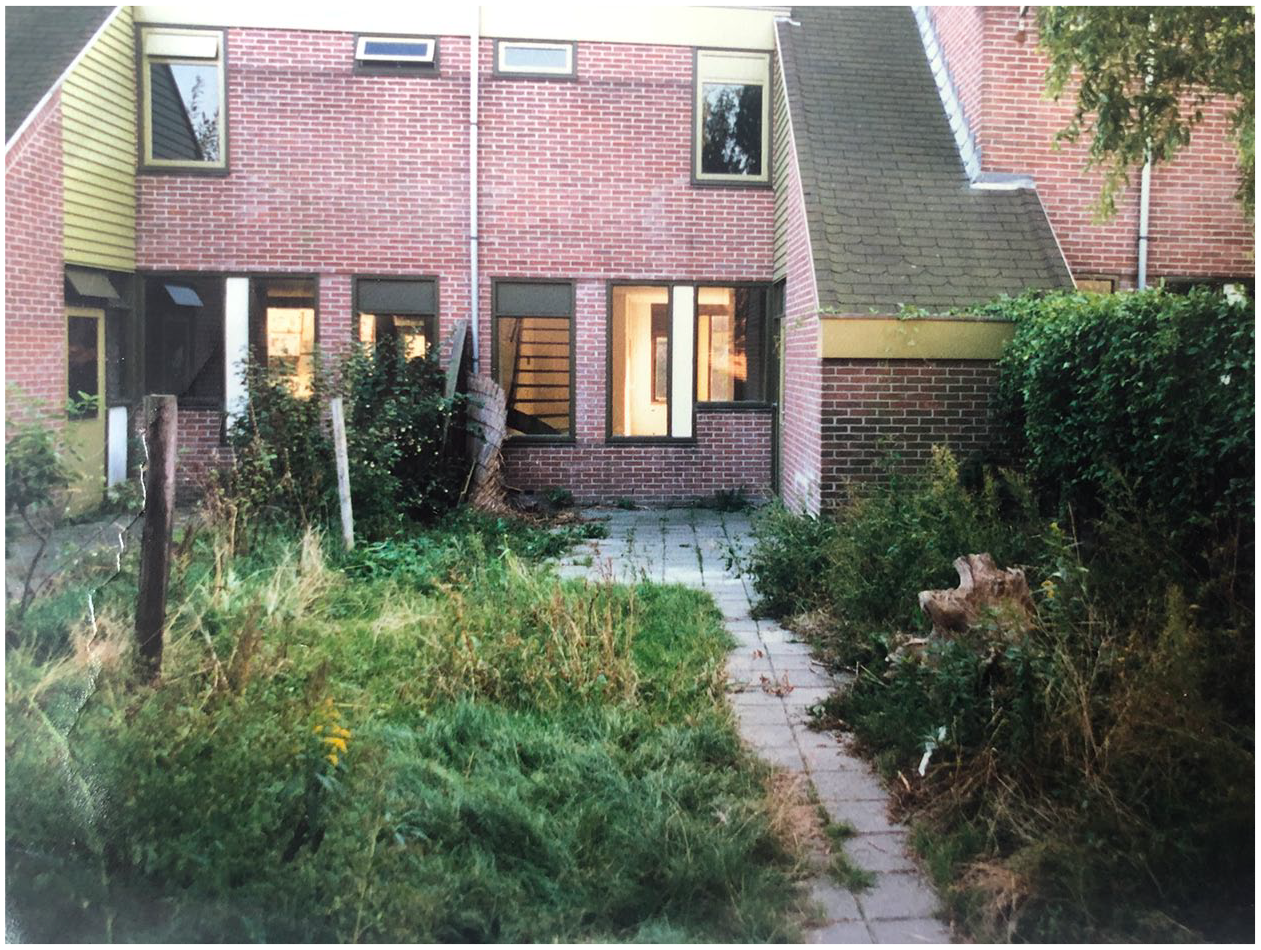
Unkept garden.
For these inhabitants, a street with many badly kept gardens, which in their perspective also included gardens with plain tiles and no flowers, would be a clear indication that this street was on its way to becoming a run-down area. A woman in her thirties living in Willow Road talking about her new neighbor.
Her garden is becoming a jungle. Because of these people with their messy appearance the neighbourhood is in decline.
The emotional experience was one of symbolic danger (Douglas 1966), as the badly kept garden threated their aspired self-definition as a respectable person, not belonging to lower working class living in a marginalized area (Elias and Scotson 1965, Yang et al. 2007). This cultural repertoire originates beyond the suburban context of Newhome. In the cities where most people came from, cleaning the public space in front of one’s house, the stoop, was seen as an indication that somebody led a proper life. The historian Simon Schama (1988, 379–99) traced this cultural repertoire back to the seventeenth century where cleaning one’s stoop was a clear indication of one’s moral status in Dutch cities.
The growing presence of badly kept gardens triggered a more in-depth stigma narrative, which was accelerated by the local housing cooperation. In order to deal with the vacancy, the housing cooperation became lenient with their policy. Where the first inhabitants had to go through a screening procedure, the cooperation decided to deal with vacancy by renting seventeen family units to students and by renting houses to families that were waiting for their new house in the newly built areas North of Newhome.
In our interviews, short-term residents created a counter narrative by explaining why they did not invest in their garden. They normalized their behavior by presenting themselves as people who do not want to waste money. The following citation is indicative of their perspective: “the money that you put in the ground, you cannot take it with you.” In our conversations with students, undoing stigma was related to a similar narrative as with the short-term residents. The short-term residents also indicated that for the time being living in Willow Road was a good temporary solution for them, that is, they were content with the comfortable modern house as were the students.
The state of the gardens was also related to a group of inhabitants with an immigrant background (mostly from Suriname and the Dutch Antilles) who moved into the neighborhood in the 1980s. Their shared narrative was that they had no experience with gardening. They were not used to it, or they didn’t have the financial resources. When they realized how much a gardener would ask or how much they had to invest in a garden they realized that this did not fit their budget. Instead, they would choose a pragmatic solution, such as tiles. Focusing on the perspectives of those targeted by stigma shows that the meanings they attach to their gardens contradict the stigmatizing narrative on disorder and weakness of character. Similar findings have been highlighted in other ethnographic studies on “urban disorder” (e.g., Duneier 1999; Ferrell 1993, 2006).
A fourth structural problem, created by the ongoing economic crisis in the early eighties was that the city of Alkmaar was facing severe financial problems. As a result, the management of the area became minimized, resulting in a reduction in cleaning services (garbage) and forestalling of repairs of, for instance, broken play areas and streetlights. This increased the overall sense of disorder and further stigmatized Willow Road. As a result of the increase of disorder, people who were thinking of living in Willow Road, were taken aback. It became difficult to attract new permanent inhabitants, which continued the high mobility and vacancy and thus the stigma narrative.
The high mobility and vacancy also changed the social character of Willow Road, which created another stigma claim: the waning of social contacts. Professionals, such as police officers and social workers, referred to “social disintegration” and “the absence of neighbourly interaction.” This was also voiced by inhabitants who had a strong local social orientation, a common theme in studies that focus on neighborhoods in transition (e.g., Blokland 2003; Dench, Gavron and Young 2006). In the first years Willow Road had a similar social life as in the other parts of Newhome. People knew each other by name and would visit each other regularly. A woman in her late seventies who said “she now feels like a stranger” in her neighborhood remembered this clearly.
It is not what it used to be. (. . .) There is a lot of mobility. Only a few (of the first, TM) neighbours are left. (. . .) There used to be a lively neighbourhood spirit. They said “granny do you want to come for coffee.” The men would get some beer from my shed, they mowed the lawn for me.
She added that only because of her activities as a volunteer for an organization that supports the elderly, she feels that she still is part of a social community. One family said they had three new neighbors in one year. They did not meet them and they said it felt as if they were strangers. For them the social quality of the neighborhood decreased and as a result they also thought of leaving Willow Road.
Not all inhabitants shared this claim within the stigma narrative and were involved in undoing stigma. Many of them indicated that they were happy with the social contacts they had within their neighborhood. A man in his eighties said that he is aware of the negative reputation but that he and his wife like living here:
The contact with our neighbours is good. Sometimes we visit our neighbours, others we have small talk with and greet them.
Inhabitants indicated that their social network went beyond the neighborhood and that they had significant relations with family, friends, and colleagues, who lived outside of Newhome. Their network also included persons they knew from the areas they came from. Still, most of them appreciated the fleeting friendly contacts they had and highlighted neighborly sociability and support, such as borrowing a tool and that people would help each other in case of emergency.
Another contributing element to the stigma springtide was that persons who were in financial and/or private trouble could easily get a house in Willow Road. Within the stigma narrative they were called “problem cases.” Research participants blamed the housing cooperation and the city for this social transformation. According to them they used this area to house “problem cases” who needed to have accommodation swiftly. A senior manager of the housing cooperation countered this stigma claim by explaining and normalizing the housing procedure:
We provide housing for everybody. Also, for your not so average family. We are a social housing cooperation.
He did not see any problem in housing those who suffered financial or private problems. He engaged in undoing stigma by referring to the social democratic principle of the right to have access to housing.
As a result, Willow Road had indeed more persons depending on social security, 14%, versus 6% in the other areas of Newhome. Though the numbers indicate that it was a minority of Willow Road inhabitants, its presence was used as a symbolic indication of the quality of the neighborhood. Inhabitants related the transitory character of the neighborhood, badly kept gardens, the decrease of contacts and disorder to “problem cases.”
Three categories were involved in doing stigma in relation to “problem cases.” One category consisted of former residents of Willow Road who were able to buy a house in Zone 2. They experienced the social changes as a threat to their aspired definition of self (see also Elias and Scotson 1965). One way of reestablishing their aspired middle-class status was moving out of the neighborhood and creating social and symbolic distance by stigmatizing Willow Road. They shared stories about how bad this area was, using the cultural repertoire of respectability and decency (see also Kusenbach 2009), even years after they left Zone 3. A man of around forty living in Zone 2 who used to live for five years in Willow Road explained why he and his wife moved in 1983. The couple expected that because of the high rent, they would have respectable neighbors but:
Willow Road turned out to be an anti-social neighbourhood with many broken families, problem cases: people with debt, people with stolen goods, people without a job. People were not taking each other into account. They were a different kind of people.
Former residents referred to atrocity tales to create categories of outsiders. With this stigmatizing narrative, they distanced themselves from “a different kind of people,” thus protecting and enhancing their aspired social status (see also Kusenbach 2009, 406). But what is significant here is that most of these research participants have an almost matter of fact way of talking about “different kind of people” and refrain from a demonizing narrative. Some even indicate that the city should be more outreaching in helping people in challenging situations.
Community activists also contributed to territorial stigma. They were all committed inhabitants who lived in or near Willow Road and tried to get support from the city in dealing with issues which they defined as highly problematic. A community activist living in Willow Road told us in an aggravated way about all the problems he shared with the city. For years he reacted immediately when things went wrong, but he says that the city has no clue and that it does not know what they are doing. Because community activists indicated the problems they encountered structurally and in an emotional way, sometimes referring to atrocity tales (Best 1987), they were actively involved in a process of constructing and reaffirming the negative reputation of Willow Road. Still, the target of these inhabitants were not so much new groups of residents, but the city that failed to help them in solving the problems, which I will discuss later in more detail.
A final category that was involved in doing stigma consisted of professionals who were involved in the neighborhood, such as social workers and police officers. They were troubled by what they encountered in Willow Road and feared a dystopian future. A social worker indicated that Willow Road had many households with a wide range of problems and that if the city would not intervene it could become a slum. A neighborhood police officer told us that he foresees “a bleak future.” He blames the city and says that there is hardly any affinity in Alkmaar with Newhome. With their narratives they confirmed and enhanced the territorial stigma narrative. Still, what is crucial here is that their narratives did not have a blaming or othering character directed at the inhabitants.
Inhabitants of both Willow Road and outside this area were involved in undoing stigma by normalizing the neighborhood. Research participants who live outside Willow Road embraced a critical stance toward the stigma narrative in different ways. Some would engage in undoing stigma by putting the stigma narrative in perspective by defining it as mere hearsay. A woman in her fifties from Zone 1 confirms that she has heard about Willow Road at the hairdresser.
It is all gossip. Drug use, but you do not know for sure. It is all exaggerated.
Research participants also refer to the fact that they cannot say whether it is true as they have no firsthand experience. A woman in her late thirties living in Zone 2 says that Willow Road has a bad reputation. She has heard it from others at the badminton club. She refers to fights and anti-social people, but she said she has never experienced it herself, indicating that she cannot be sure.
Others who live outside Willow Road, use their first-hand experience to undo stigma (see also Hastings 2004). A woman living in a homeowner house at the edge of Zone 3 says that Willow Road indeed has a bad reputation. She says that others refer to “drugs, Black people, divorced women, people without work and benefit recipients”. She confronts the stigma narrative by stating it is exaggerated and by constructing a positive normalizing image (see also Hastings 2004, 244; Kusenbach 2020, 70).
“But it is really not so bad”. When she bicycles through Willow Road, she sees a cosy neighbourhood where people sit in their garden and talk with each other: “It is not a big mess, and it does not make me think what anti-social riffraff.”
What was noticeable is that these inhabitants rejected defining themselves as better and did not place themselves above those living in Willow Road. They did not feel the need to position themselves as better off, with a higher status. This felt like a moral rule not highlighting the differences, but emphasizing the similarities, thus not creating a situation of us and against them.
Those who live in Willow Road also countered the stigma narrative.
A couple in their thirties who moved from the center of Alkmaar also disagree with the stigma narrative. He says that he was surprised by the stereotypical negative reactions when he said he was moving with his family to Willow Road. She said that it was all hearsay:
The tobacconist (in the centre, TM) who used to work for the housing cooperation said that it was a horrible neighbourhood, all the social cases are sent there.
Undoing stigma in their case is resisting the stigma narrative explicitly. They said that they always contradict people who talk bad about Willow Road.
A man in his early forties indicated that the local newspaper was crucial in the social construction of the territorial stigma. He said that people from outside of the neighborhood think criminals and foreigners live here and that it is a mess:
What was said in the newspapers was right, but the disadvantage was that these news items put the whole neighbourhood in a bad light.
This respondent is engaged in undoing stigma, by putting the newspaper coverage in a wider perspective, stating that the stigma narrative is based on incidents that do not cover the entire neighborhood, and thus he normalized Willow Road (see also Jensen and Christensen 2012, 87). Others put the stigma narrative in perspective by using a geographical lens. They stated that only some places were problematic, mainly because of high mobility. Another way of undoing stigma is referring to the historical context of the neighborhoods. Research participants indicated that five years ago there were more incidents (see also paragraph Youth Gangs and Vandalism).
A man in his mid-forties puts the stigma narrative in perspective by indicating that many people who live in this neighborhood do not fit the stigmatizing narrative.
They have put a label on it. They are talking about “benefit recipients” and “anybody is put there” and “incomplete families.” When walking through the neighbourhood I also see many complete families. (. . .) It is a suitable residential area.
Many inhabitants of Willow Road do see it as a nice residential area. They indicate that they are content with their house, especially the size and its modern comfort. They prefer not to move, because as they say they will not be able to get a better house outside Willow Road. Even the woman in her late seventies to whom I referred earlier and who said she feels like a stranger, indicates that she will never move as she has a “lovely house.”
We can see that a large category of inhabitants do not fit Becker’s definition of moral entrepreneurs smoothly. They would construct or counter the stigma narrative while participating in their social world. Because this activity is different from the “full-time” involvement of moral entrepreneurs as described by Becker, I have opted for a different concept: “moral narrators.” As moral narrators, inhabitants blamed certain groups for the negative social change in their neighborhood. Those who were especially threatened in their aspired self-definition were active in constructing territorial stigma. We have also seen that inhabitants acted as moral narrators rejecting stigma narratives as mere hearsay, giving positive examples and normalizing the behavior of the inhabitants of Willow Road.
Professionals and community activists do fit Becker’s concept of moral entrepreneurs. They highlighted the social problems in their goal to get funding for the neighborhood. While doing this some referred to atrocity tales and a dystopian future to gain attention from city hall, thus enhancing the stigma narrative. Still, most of them did not act as “crusading reformers” and did not engage in an othering and excluding language blaming the inhabitants for their problems. Their moral enterprise had an inclusive character. They blamed the city for not supporting Willow Road, as they saw it as the city’s task to intervene and solve the problems.
Thus far we have mostly discussed individual reactions to territorial stigma. In the following two paragraphs, I will discuss two stigma claims—“foreigners” and “youth gangs and vandalism”—that triggered collective actions countering territorial stigma.
“Foreigners”
“The decline was caused by the arrival of Surinamese, Antilleans (. . .) which caused a culture clash with the Dutch. (. . .) In each of the two houses next to my colleague families of three generations lived. In specific periods of the year, they had parties at night. The police had to come regularly because of the sound pollution. As a result of this my colleague moved out” (A man in his forties living in Willow Road).
An important claim within the stigmatizing narrative was related to “foreigners,” a common term in those days used to refer to Dutch citizens with an Antillean and Surinamese background. It was said that “foreigners” caused anti-social behavior, and that this was the reason for families to leave the neighborhood. It turned out that during our research 7% of inhabitants of Willow Road were of Antillean or Surinamese background, in total fifty eight persons. For Newhome in total this was 1.5%. Some research participants acted as moral narrators speaking of a concentration of foreigners causing problems. But in reality, sixteen households of the two hundred ninety seven had this background and these were living scattered in Willow Road. This stigma claim is in line with Sampson and Raudenbush’s findings (2004) that areas with a concentration of minorities and marginalization tend to be labeled with a negative reputation.
Research participants were aware of how racism shaped the negative reputation of Willow Road. They countered this in several ways. A community activist in her early fifties from the Dutch Antilles engages in undoing stigma by explaining that racism shapes the negative reputation of the neighborhood. She also normalized the neighborhood by stating that minor conflicts between neighbors are common:
“They think it is becoming impoverished, because they see all those black people”. She adds that she is content with the neighbours. “In this part of the neighbourhood I have never noticed it. Big problems no. Some small frictions, but that happens in every neighbourhood.”
Surinamese and Dutch Antillean inhabitants engaged in undoing stigma by referring to themselves as successful. They said that they were happy to live in Willow Road as their houses were large and comfortable. As many of the other inhabitants in Newhome, they had made a significant move upwards in their housing career. They were proud of their new dwelling and were not intimidated by the negative narratives. In some cases, they reacted by applying “stigma reversal” (Killian 1985) by laughing and saying that the people who complained were soreheads and whiners. One female research participant said that she did not care what these people would complain about because there will always be older people who love to complain.
Another counter claim which is related to the previous one, uses a social and historical angle. It states that racism was related to the first half of the 1980s. It moves the blame from “foreigners” to white Dutch people; they were not used to black people and had to get used to them. The community activist, whom I introduced earlier:
The children came to me and said: They are not greeting in return. Then I told them: keep doing it. Now they do greet us. Everybody used to be afraid. It needs time to get used to each other.
When we discussed the foreigners-claim with native Dutch inhabitants in Willow Road, many rejected the negative judgements. They engaged in undoing stigma by stating that they had positive experiences with their neighbors with an Antillean or Surinamese background.
A man in his fifties said that when people have the impression that many foreigners live in a neighbourhood, it will get a bad reputation. He explicitly says that foreigners cause the least trouble and that he is getting along fine with them. A man in his eighties said that he and his wife were hardly ever bothered by people with a “foreign background.” He normalised his relation with “foreigners,” referring to a situation which was solved in a civil way. In the past there were some “Surinamese neighbours” who would tinker with their cars but when he talked to them it stopped.
In 1983, doing stigma came from a group of inhabitants who lived at the edge of Zone 3 in homeowner houses. In a letter written to the city they warned of placing different “cultures” together in one area. They used Willow Road as an example of an area where it had gone wrong because different cultural groups did not get along. In addition, they indicated that this might have a negative effect on the value of their houses. The presence of inhabitants that they defined as morally different from them, endangered the definition of their respectable self, a common theme which is discussed in ethnographic studies on inter-ethnic relations in areas in transition (see Blokland 2003; Carr 2006; Dench, Gavron and Young 2006; Kefalas 2003).
In Newhome, this letter triggered a moral enterprise of undoing stigma. It was seen as racism and people were shocked by it. Undoing stigma was instigated by inhabitants, the media, and local politicians. It was discussed in the local newspaper and the dominant view was that it was an abject action. In addition to this, inhabitants of Newhome were appalled.
A man in his thirties (living in the same area of homeowner houses at the edge of Zone 3) refers to the letter, in which the decline of Willow Road was related to “foreigners,” fights and burned cars. He added that his family and many others thought that this was nonsense. They publicly distanced themselves from the letter in meetings and informal encounters.
The city council intervened by organizing a neighborhood meeting for professionals, representatives of the different “cultures” and those who had written the letter. It turned out that none of those present had an aversion directed at “foreigners.” In the meeting other topics of concern emerged such as litter, the decrease of social contacts, and the lack of service by the city. Supported by the city they formed a group to improve social cohesion and organize street parties, such as a neighborhood barbecue and a multicultural festival.
Youth Gangs and Vandalism
An important claim within the stigma narrative is related to the behavior of several youth groups. In the council they were defined as “destructive youth harassing passengers” and “youth gangs.” Some inhabitants had an overall negative attitude toward youth. They related them to anti-social behavior, vandalism, and graffiti. A woman in her early forties from Willow Road:
There used to be a group hanging around on a bridge. They terrorised the neighbourhood: loud music, roaring mopeds, making insults, lighting fireworks.
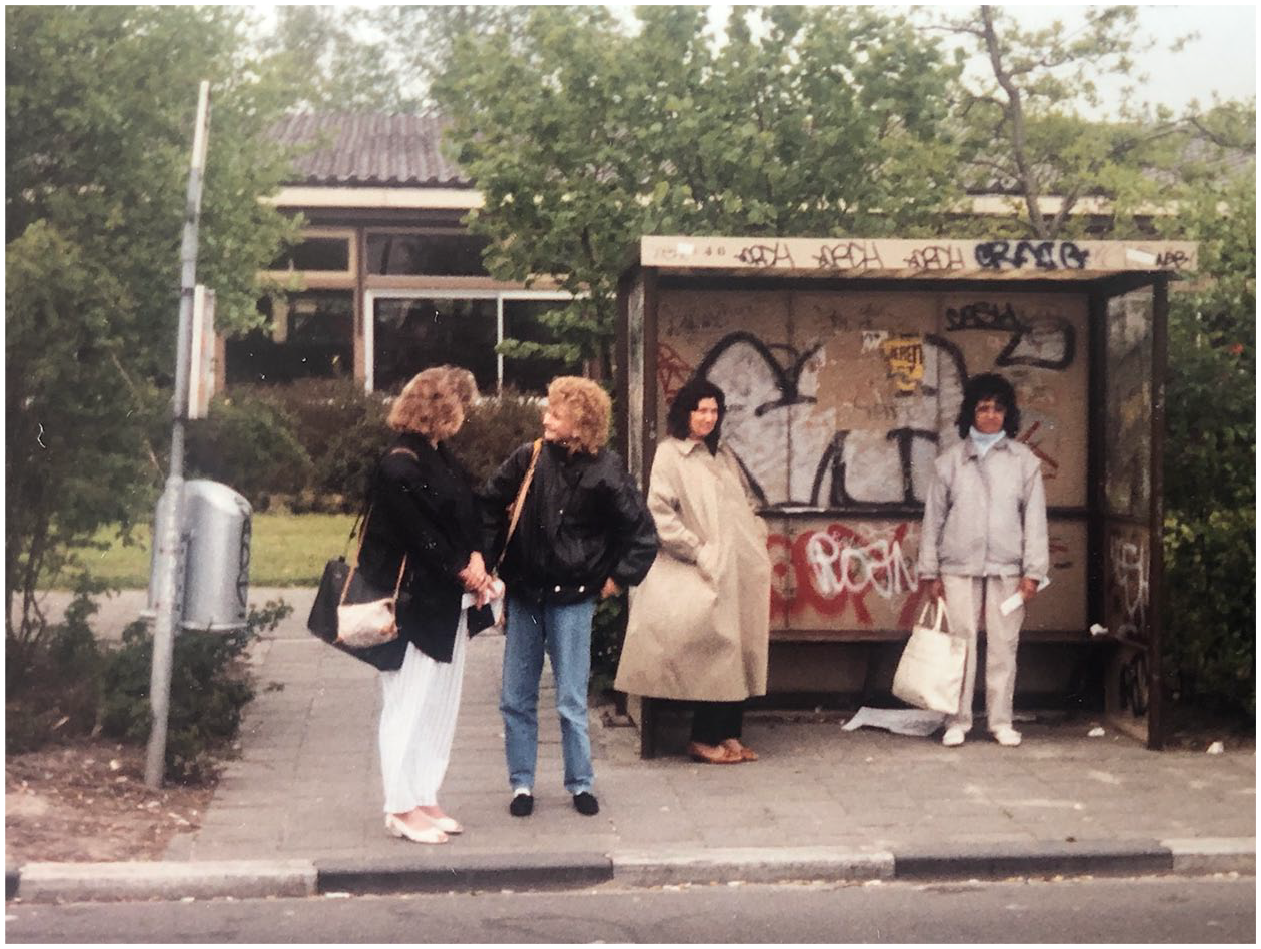
Bus stop graffiti and litter.
Research participants engaged in undoing stigma by stating that hanging around is normal for youth, including minor transgressions. They saw it as part of growing up. They added that youth cannot go anywhere as there are no facilities for them. A woman in her early fifties from Willow Road: “There is very little for youth. They will start wandering around and mess around because of boredom.”
In the mid-1980s, inhabitants of Willow Road engaged in undoing stigma as they organized themselves in a citizen group; they normalized the behavior of the teenagers with their counter narrative. They believed the lack of recreational youth services could be solved by creating a youth center and suggested that empty classrooms in a nearby school could be used. They developed a plan with a budget and presented it to the city council. They rejected the proposal because they did not want nor had the money to invest in a youth center, which was likely related to the financial troubles of the city. How the city dealt with local youth, and more specifically the plans for a youth center, enhanced the experienced “recognition-gap” (Lamont 2018): inhabitants felt treated like second class citizens.
Already in 1978, the neighborhood association asked the city for a space for youngsters from Zone 1 in Newhome. The city reacted negatively. In reaction to this, youth with the help of the pastor and some volunteers squatted at an old farm just outside the suburb. A community activist said that parents were actively involved and for instance had built the necessary sanitation:
It (the squat, TM) was related to two issues: 2) a protest against the municipality, that something had to be done for young people and 2) showing that indeed something could be done. (. . .) The youngsters were fuming. There was nothing to do in the neighbourhood. At very busy evenings there were around 60 to 70 youths.
After negotiations with civil servants, they left the farm for a construction cabin provided by the city. After three years another group of youths set fire to the cabin, because they were not allowed to use it. The city removed it and did not replace it with another facility.
In the same period, the youth of Willow Road would also visit the Friday night disco in Delta, a youth center run by a Christian organization. According to a volunteer, they were not used to the “unmanageable” behavior of Willow Road youth. In 1985 they called the police which removed them using police dogs. This created a great stir, gained media attention and became part of the stigma narrative of Willow Road. Even years later professionals used this incident as an atrocity tale.
Many inhabitants countered this stigma claim by putting it in a historical context. They stated that the groups had disappeared since many of the former troublemakers had grown up, moved out of the area or had settled for a family lifestyle. They indicated that until the mid-1980s vandalism had increased after which it decreased, which according to them coincided with the general decline of youngsters. An analysis of the demographic data indeed showed that the number of youths had gone down drastically since the mid-1980s. In the period 1983–1988 there was a decrease within the age group 10–19 years of 22% and a decrease of 37% within the age group 0–9 years.
Again, structural transformations, this time shaped by demography, the financial situation of the city, and urban planning, contributed to the process of doing stigma. Some inhabitants tried to make sense of the situation by doing stigma, that is, pointing their fingers at “outsiders” living in Willow Road. This was confirmed by our questionnaire; when we asked where vandalism would appear, many indicated Willow Road. The analysis of police data contradicted this; the area had no more incidents than the rest of Newhome. Still, as a result of the stigma claim of “youth gangs and vandalism” the city of Alkmaar started in 1988 the anti-vandalism projects which I will discuss in the next paragraph.
Territorial Stigma and the Anti-vandalism Projects
In theory, the anti-vandalism projects could diminish the social psychological effects of territorial stigma as for instance described by Jensen and Christensen (2012) for Aalborg East. But the project could also enhance the image that Newhome was a problematic area. Looking at the media representation it seemed that it did increase the stigma narrative. The local media published articles on the projects which could have confirmed that Newhome was a problematic area with social problems. But they had a matter-of-fact character and did not portray Newhome as a neighborhood in decline. Still, its inhabitants might have a different perspective, which I will discuss later.
In general, the projects were not successful. Here I will focus on the two youth meeting places, as they were the most public and most visible projects. Because there were hardly any youth causing problems in the neighborhood anymore, the manager of the project had a hard time finding teenagers who would like to use the meeting places. Still, the neighborhood police officer knew of a group of teenagers who might be interested and introduced them to the manager. At first the teenagers were disappointed by the open character of the meeting place, and as a result they only used it sporadically. Their interest waned as it became too cold and windy to be there. One of them:
We don’t need that shed now. Graffiti writers are there now. We are just going to hang around at the school. Maybe we will go to the shed in the summer.
After some time, some of the first group decided to use a coffeeshop in the center of Alkmaar as their meeting place and the other (younger) members could stay at one of their parents’ places. Other groups started to use the place regularly and over time it became itself an object of vandalism. It was used for tagging, the roof was demolished, tiles were removed and the wooden panels were broken off. In the end everything was stripped and only the metal frame was left.
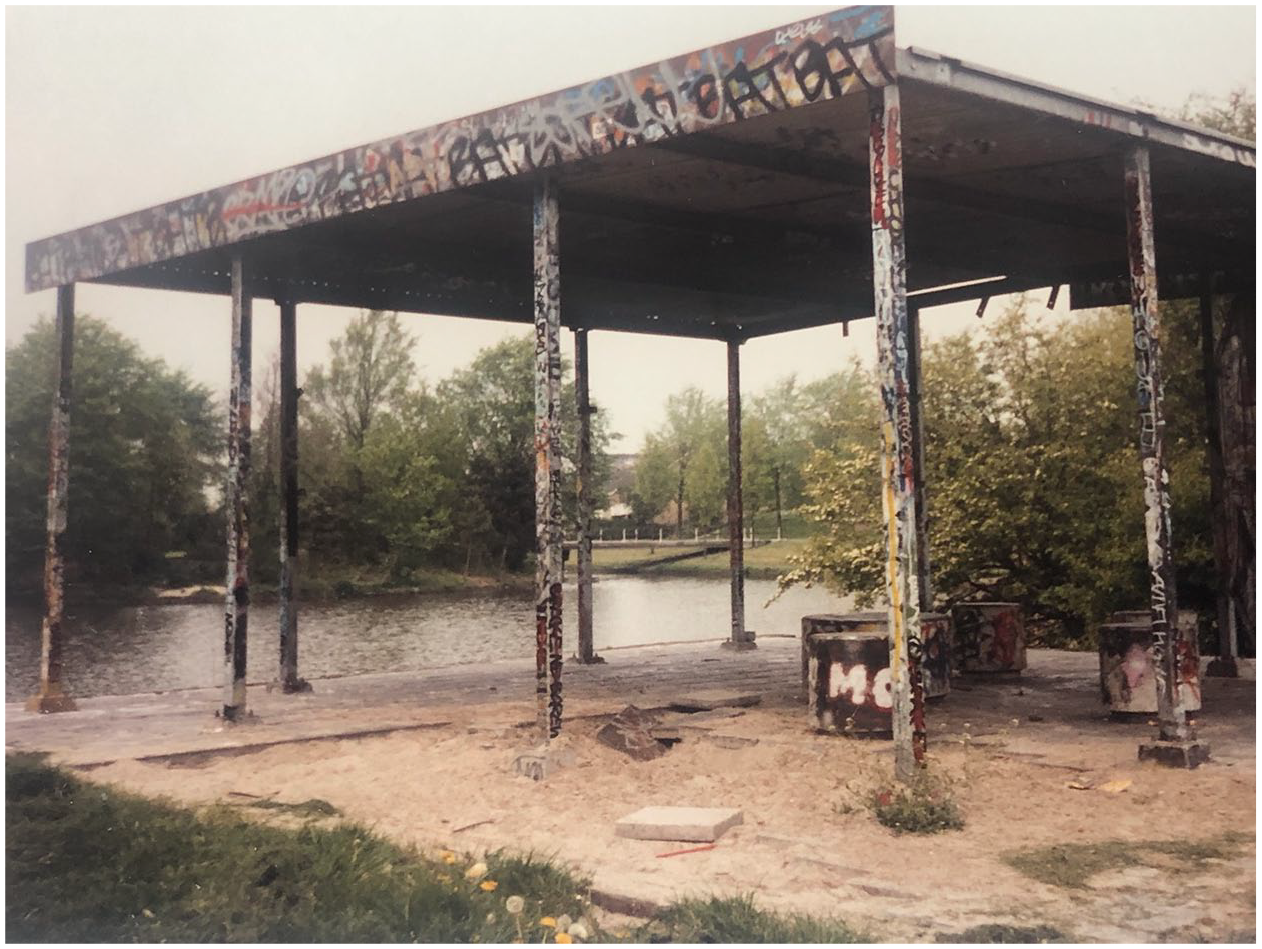
Demolished youth place.
At first the teenagers who were approached for the second meeting place were disappointed. They stated, “six years ago we wanted a youth centre and now they give us this.” Still the young men embraced the place and used it as a home adding a table, chairs and using old curtains to block off the cold wind. But inhabitants complained and the manager of the vandalism projects asked the municipal cleaning department to get rid of the mess. The young men were in shock when they saw that their homey place had turned into an “empty large bus stop” again. The place remained unused until the end of the project. A man who could see the meeting place from his house said that he objected to it because he felt the local population was not consulted and because it stimulates vandalism:
Garbage got into the gardens and cars can get damaged. People are trying to park their car as far as possible from that shed and visitors are advised to park somewhere else. Furthermore, it was a big mess in the beginning.
A man in his mid-fifties said that the shed typifies how the council sees Willow Road: “They will not place it anywhere else.” Inhabitants told us that the sight of the meeting places did not do the neighborhood good. Some wrote letters to the council in which they stated that they constituted an impoverishment of their living area.
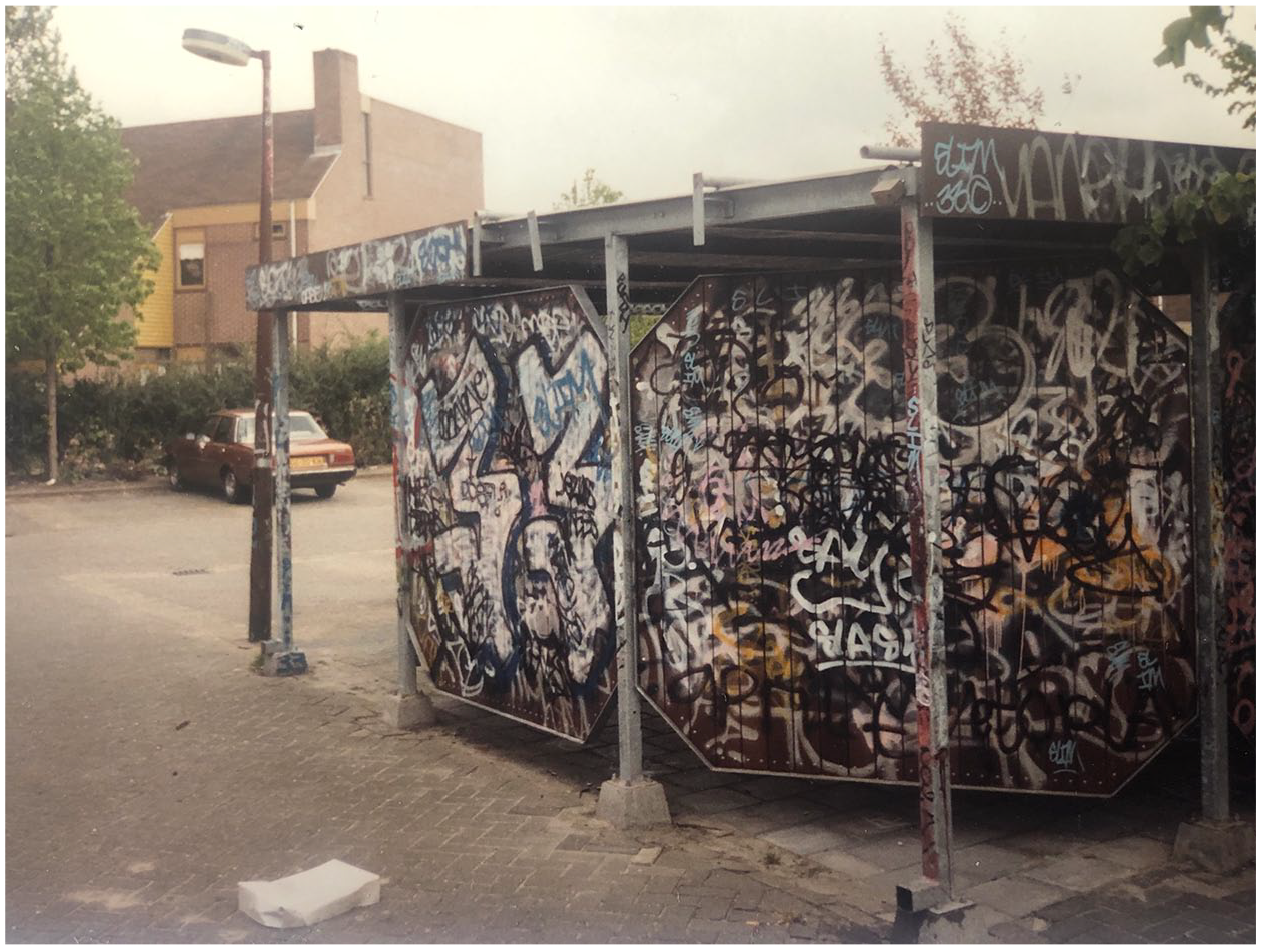
Second youth place on parking.
Overall, the development of the projects, the media coverage, and the letters of the city on the projects were not seen as positive. Some of our research participants feared it would put too much emphasis on the problematic depiction of the neighborhood. When we compare the results of the first (at the beginning of the project) with the last questionnaire (at the end of the project), the findings confirmed their fears. There was a significant increase of inhabitants who thought that Newhome was worse in regard to vandalism compared to the rest of Alkmaar. Also, more people stated that vandalism in their neighborhood damaged the reputation of their neighborhood. Finally, more people stated that there were streets in their neighborhood in which vandalism was especially a problem. In contrast to this, the systematic photo-reportage showed that an improvement had taken place. Police data also showed that at the end of our research period fewer objects in the neighborhood were damaged. To conclude, it seems that an unintended consequence of the projects was an increase in vandalism in the perception of the inhabitants, which confirmed and strengthened the stigma narrative.
The negative reaction to the anti-vandalism projects fitted the wider moral narrative shared by the inhabitants which stated that the city did not care about Newhome and specifically Willow Road. They felt that they were not treated fairly by the city of Alkmaar which created a recognition-gap (Lamont 2018). The following quote is representative of how inhabitants defined the general attitude of the council, a community activist from Willow Road:
Willow Road is forgotten in the Town Hall. They are doing nothing for us. On the map of Alkmaar there is one big blank spot. And that is where Willow Road is. (. . .) The civil servants do not know where it is. It does not matter.
Inhabitants shared this counter narrative, which did not blame the inhabitants of Willow Road but the municipality. A woman in her late seventies living in Willow Road:
Terrible, The upkeep by the city. Appalling. Willow Road is being neglected. When you call to report a broken streetlight, they never show up. They always wait till 2 or 3 are broken.
Some of the professionals we interviewed agreed with this narrative. They referred to two explanations: (1) the fact that most people in the council were indifferent to Newhome, as they did not live there and focused on their own neighborhoods and (2) since the financial crisis of the city in the mid-eighties, it spends less money on the management of the new suburb.
The city acted as an important participant in doing stigma, not only because of their minimal maintenance of public space and the unprofessional way the anti-vandalism projects were implemented, but also because of their choice of Newhome as a location for the projects, which itself contributed to the stigma narrative and the experienced recognition-gap. The municipal team responsible for the grant application for the anti-vandalism projects acted as moral entrepreneurs using the stigma narrative to gain governmental funding. Civil servants at the Town Hall took for granted that Newhome and especially Willow Road was an area of social problems without checking their assumptions. It seemed that the proposal was shaped by negligence or at least indifference toward the suburb, which in itself is an indication of a recognition-gap. The councilor for this project confirmed this and admitted that they should have checked their representation of the neighborhood and looked at what the neighborhood needed. He said in one of the observed meetings: “If you ask me were there good contacts with the field, I would say no.”
Conclusion
The analytic revisit of the data shows how we can learn from focusing with a multi-perspective on the moral enterprise of territorial stigma. We have gained insight in how the complex and dynamic relation between doing and undoing stigma developed over time within the cultural and social-economic context of Newhome and Willow Road. This has refined our understanding of the social construction of territorial stigma and how this is countered
How was it possible that Willow Road gained such a bad reputation in a couple of years? Structural changes in the financial and housing market played a crucial role in transforming a thriving community into one characterized by high mobility and vacancy. Many inhabitants moved out because it was economical to buy or rent a house somewhere else. I have described this vast transformation as a stigma springtide, a development with its own hard-to-control inner logic. Mobility and vacancy were followed by an influx of inhabitants labeled as “problem cases,” a decrease of social contacts and an increase of signs of disorder (unkept gardens, graffiti and litter). The latter was aggravated by cuts in the management of public space due to severe financial problems of the city. In addition, the neighborhood also changed because of an increase in vandalism and an increase of so called “foreigners”.
With doing stigma inhabitants tried to make sense of these changes. Territorial stigma was socially constructed in a complex and dynamic meaning-making process related to a wide range of stigma claims. Inhabitants that felt threatened by these rapid transformations acted as moral narrators labeling Willow Road as a run-down neighborhood with inhabitants that were less respectable. Those who felt that their aspired definition of a respectable self was compromised sought protection in the creation of symbolic boundaries between themselves and different others. Especially those who could afford to move out of the neighborhood, were a major source of territorial stigma. Their labeling should also be understood as a confirmation of their respectable identity. With these moral narratives they enhanced their moral career. They moved from a bad neighborhood to a good one.
Another category that felt threatened by the rapid transformation were the homeowners that lived in Zone 3. Willow Road was represented by them as a negative example, a deprived area characterized by anti-social behavior. Willow Road did not only constitute symbolic danger but also an economic risk. The homeowners were afraid that the value of their houses would decrease.
When we have a closer look at what these middle-class citizens said, it is clear that they did not show much affinity and care for Willow Road, but it is also important to point out that their perspective did not have a crusading character. It would be easy to depict them as the revanchist middle class, but that is not the case here. Those who felt threatened did not embrace an ostracizing or demonizing narrative. Most of them described their negative experiences in a credible way without any highly moralistic references. And some in fact said that the government should help those who were in financial or personal problems.
Two other categories played a key role in the social construction of territorial stigma: professionals and community activists. As moral entrepreneurs they were emotionally involved with the neighborhood and defined the changes as highly problematic. They believed that Willow Road was heading toward becoming a slum. Both groups voiced their concern in public meetings with inhabitants and civil servants, and thus confirmed and added to the stigma narrative. They would use atrocity tales and refer to a dystopian future to convince the local government to intervene. Their stance was different from the middle-class moral narrators, as they were worried and cared for Willow Road and its inhabitants. They created these moral narratives to push the local government to enhance the quality of life in Willow Road.
The intervention of the city of Alkmaar, the anti-vandalism projects, could have been used to counter territorial stigma, as in the case of Aalborg East described by Jensen and Christensen (2012), but the opposite took place. The civil servants that were responsible for the grant proposal and its implementation acted as moral entrepreneurs and contributed to the negative reputation of Willow Road. Though in 1988 many of the problems had faded away, among civil servants, territorial stigma remained part of the symbolic representation of Willow Road and Newhome. This resulted in a problematic implementation of the projects. The youth meeting places became an object of vandalism that according to inhabitants damaged the reputation of the neighborhood.
By applying the moral enterprise approach, we can see that most of those who contributed to doing stigma did not act as crusading moral narrators and entrepreneurs, nor were they highly moralistic. Most of them named the issues they faced, but did not engage in a degrading and demonizing narrative.
Because of the multi-perspective angle in this study, it shows that there was a wide range of social actors who embraced narratives and practices of undoing stigma. One category consists of research participants living outside of Willow Road. They redefined the stigma narrative as mere hearsay, or refused to confirm these narratives as they had no first-hand experience. Others who had first-hand experience, used this knowledge to counter the stigma narratives stating that these narratives focused on incidents and that this did not relate to the neighborhood as a whole. They normalized Willow Road by emphasizing the similarities between them and those who lived in Willow Road. They did not sense any symbolic danger and did not have the need to emphasize their respectability by distancing themselves from the inhabitants of Willow Road. In fact, they thought that putting themselves above others was not acceptable, which aligns with the social democratic culture repertoire emphasizing equality.
The inhabitants of Willow Road who were targeted by the stigma narrative also engaged in undoing stigma. They highlighted similarities between themselves and those living outside their neighborhood. They admitted that there were incidents but also added that this did not reflect the social character of the entire neighborhood. They also referred to a geographical contextualization—only some sections were problematic—and used a historical contextualization, indicating that in the past there were more problems.
In relation to race, inhabitants normalized relations between different groups by highlighting civility and sociability. Dutch citizens with a Surinamese and Antillean background applied stigma reversal by redefining stigma claims directed at them as racism and redefining complainers as soreheads and whiners. They also used a historical perspective, stating that over time relations improved as different groups became more familiar with each other.
Several narratives countered the claim of moral weakness specifically related to badly kept gardens. Inhabitants normalized not investing money in a garden due the temporary nature of living in Willow Road, lack of financial resources and lack of knowledge. Undoing stigma in relation to the decrease of social contacts involved inhabitants saying that the contacts that they do have are sociable and supportive. In addition they said that they are also part of a wider supportive social network of friends, colleagues, and family members that extends beyond Willow Road and Newhome.
Two stigma claims, “foreigners” and “youth gangs and vandalism,” were countered collectively. The letter of homeowners referring to clashing cultures in Willow Road met with a counter reaction rejecting its racist nature. Inhabitants inside and outside Willow Road, the media, and the city council became involved in a moral enterprise labeling the letter as immoral and racist. In a public meeting organized by the city the letter writers said they never intended to be racist. They were worried about growing disorder in the neighborhood and the decrease of social cohesion. As a reaction, inhabitants, supported by the city, organized meetings to improve social cohesion.
A last stigma claim refers to youth gangs terrorizing inhabitants and vandalizing private and public property. Inhabitants of Newhome countered this stigma claim by using a historical lens, stating that in the past it used to be a problem but that at the moment there is significantly less vandalism. Inhabitants also made it clear that youth groups causing trouble were not to be blamed. It was seen as normal that bored teenagers cause trouble for diversion. They criticized the city for not creating a space where local youth can meet and recreate. Inhabitants said that they were not treated fairly by the city and felt disrespected. They reacted with several collective activities to claim space for local youth.
Using the moral enterprise approach to analyze the social meanings of territorial stigma shows that it was widespread but that it was not a dominant and coherent narrative with a crusading character. A hegemonic demonizing and blaming moral enterprise of stigmatization as has been discussed by scholars such as Wacquant (1993, 2008), Schultz Larsen (2014) and Sisson (2022), did not develop in relation to Willow Road. As a result, a recognition-gap as discussed by Lamont (2018), did not play a significant role in the everyday interaction of those who were targeted by territorial stigma, nor did it define their self-identity.
But this concept can be used to describe the relation between the city and the inhabitants of Newhome and specifically Willow Road. They felt the city had failed them regarding a range of issues related to the upkeep of the neighborhood and recreational facilities for children and youth. They felt treated like second-class citizens. Indifference and negligence were also related to the anti-vandalism projects. The reason to choose Newhome was not validated by consulting stakeholders in the community. The projects were experienced by inhabitants as forced upon them. They became objects of the disregard of the city toward Newhome and especially Willow Road, or as one inhabitant put it, they would never do this somewhere else in Alkmaar.
Focusing on local narratives with a multi-perspective lens made it possible to highlight the agency of those targeted by stigma and go beyond coupling stigmatization with victimization. The inhabitants were aware of the negative reputation, but none of them were ashamed to live in Willow Road. Indeed, there was a stigma narrative, but they did not internalize it and it did not become their master status. How can we explain this limited impact on their self-identities?
Stigma can only become a master status when a stigma narrative is dominant in the social world of the targeted persons and has a structural impact on their lives. The stigma producers constituted a relatively small part of the social life of those targeted by territorial stigma, because most of the inhabitants had a social network that went beyond the neighborhood. Territorial stigma did not become a master status because the inhabitants did not rely on the stigma producers as their audience for a positive reaffirmation of their self-identity. Their selves were shaped by a range of social contacts at home, in the neighborhood, in work, recreation, education and the communities they came from. In sum, they did not identify with territorial stigma and the stigma producers as they were not of any major social significance in their social world.
In addition, stigma did not have structural consequences as in housing, education, income, and healthcare. In contrast, moving to Willow Road was seen by many as a positive development. They were proud of their house and saw it as an improvement compared to the situation they came from. They could distance themselves because of the normalizing qualities of these houses (see also Kusenbach 2009, 2020). Because of their houses they defined themselves as successful. It empowered them and shielded them from territorial stigma.
The limited impact of territorial stigma on the inhabitants of Willow Road can also be explained by looking at the cultural repertoires (Lamont 2018) used by the research participants. The narratives of the inhabitants of Newhome were shaped by a welfare state cultural repertoire. This social democratic repertoire embraced equality and focused on the role of the state as being responsible for solving social problems. This not only shaped undoing stigma, but also doing stigma, as it limited the harshness of the moral enterprise of doing stigma, which rarely included elements of blaming, degrading, and demonizing.
Newhome was still shaped by the Dutch welfare state, though its strength was diminishing in the 1980s. The welfare state and its ideology formed a political, financial, and cultural resource that inhabitants used to counter territorial stigma. Housing was seen as a right for all. Social security and other forms of state support prevented the creation of advanced marginalization, thus inhibiting the development of structural stigma and subsequently self-stigma. In fact, those living in Willow Road felt they had a right as members of Dutch society to being treated equally. Indeed, access to education, housing, and health care was seen as a common good. Therefore, inhabitants reacted with anger to the insufficient management of the neighborhood by the city. They challenged the recognition gap as they expected more, as they felt it was their right to be treated like anyone else.
This article has contributed to the field of territorial stigma in several ways. It highlighted the structural forces that created a stigma springtide. The moral enterprise approach went beyond a one-dimensional representation of territorial stigma and showed how a diverse range of actors created a wide variety of local narratives of doing/undoing stigma with different social meanings. This article also highlighted why the impact of territorial stigma was limited. Symbolic stigma was not dominant because (1) the stigma producers were marginal in the social world of the inhabitants of Willow Road and (2) it did not align with structural stigma. The findings show that the social democratic (welfare state) cultural repertoire shaped the social meanings of undoing stigma and of doing stigma. Future research should pay attention to how the moral enterprise of territorial stigma and its impact is shaped by a diverse range of moral narrators and moral entrepreneurs, producing narratives and practices of doing/undoing stigma while reacting to the cultural and social-economic context of their daily life.
Footnotes
Declaration of Conflicting Interests
The author declared no potential conflicts of interest with respect to the research, authorship, and/or publication of this article.
Funding
The author(s) disclosed receipt of the following financial support for the research, authorship, and/or publication of this article: This research received funding from the Dutch national government.
