






Abstract
This paper describes and critically assesses the use and development of a model of participatory theatre to reappropriate the ways in which a place in the deindustrialized south Wales valleys is represented. Neo-liberal policies which focus on individual responsibility, conditionality, sanctions and incentives frame the production of statistics on health inequality and deprivation in particular ways. While ‘place’ can be a resource for expressing positive identities this presents people living in economically under-resourced areas with a problem if that place-based identity is also subject to vilification. In this paper we focus on three objectives: to explore negative stereotypes of a post-industrial community; to describe the methods and process of working alongside local people to offer alternative ways of understanding place; and to discuss the implications of using community theatre for policy and practice. We argue that theatre-based forms of place-making and dialogue can create spaces where policy issues, such as health and well-being, can be discussed in the context of everyday local concerns. Meanings in common are generated in ways that create affective understandings of place and the impact of economic change and crisis (Jones et al., 2013). These co-productive processes are uncertain, emergent, and risky and need to be managed carefully in the context of trustful relations.
Introduction
The impact of large-scale social and economic developments on health and well-being has been documented since at least the middle of the 19th century, and with increasing precision. The garrets of Manchester and the wynds of Glasgow observed by Engels in 1844 (2009 [1845]) have their counterparts today in blasted housing estates in the centres and on the peripheries of large English and Scottish cities, in the former coal mining and steel producing communities in the ‘Heads of the Valleys’ of south Wales, in rural areas with ageing populations, and amongst migrant diasporas whose members have made Britain their home at different times under changing conditions (Hoggett, 1997; Power, 1999). All of these communities may find themselves disconnected, or indeed expelled (Sassen, 2014), from valued space, wider social networks and services, living with varying degrees of disruption and distress. The social and economic inequalities underlying these dislocations are creating cultural and experiential differences which are both vertiginously unjust and have multiple consequences for health and well-being (Dorling, 2013; Marmot, 2010; Wilkinson and Pickett, 2010).
At the same time neo-liberal policies which focus on individual responsibility, conditionality, sanctions and incentives frame the production of statistics on inequality and deprivation in particular ways (Popay, 2008). In the UK this is evident in popular news reporting and television documentaries where individual failure to sustain a livelihood is framed alongside places where so-called cultures of poverty and apathy have taken root. Marginality and poverty are framed in terms of failure, with ‘working-class’ identities no longer a resource for claiming a positive identity to challenge structural inequalities (Paton, 2013; Shildrick and MacDonald, 2013). These framings of poverty and inequality are circulated through images which themselves become part of the hurt that people living in particular places experience. The territorial stigma that people face is negotiated and resisted in different ways (Thomas, 2016) and in this context assertions of ‘communal beingness’ (Walkerdine, 2010) or ‘elective belonging’ (Paton, 2013) become strategies for finding support, comfort and well-being. Paton's research on housing sees place attachment as a potential signifier of class and demonstrates, through ethnographic research in Partick in Glasgow, how place was used as an alternative basis for expressing positive identities. However, this presents people living in economically under-resourced areas with a problem if that place-based identity is also subject to vilification.
In challenging representation it is also difficult for community-owned representations of place, such as through community-led journalism (Alevizou et al., 2016), to gain exposure on the same scale of production as the negative and often vilifying national media representations. The power of these representations threatens the protection of the affective relationships that constitute the lived experience and the place-making performances of community that could be a resource in times of trouble (Keene and Padilla, 2014). They also justify the exclusion of local forms of knowledge that might better inform a more nuanced understanding of inequalities in which people's everyday lives are shaped by, and act upon, wider social and economic structural forces.
This project is funded by the Arts and Humanities Research Council (AHRC) and includes five case study areas and six universities across the UK. In this paper we focus on one of the Welsh case study areas: an area of Merthyr Tydfil we have called Garthcoed. This area comprises a number of small communities that are distinct from each other, but whose inhabitants share an endurance of the territorial stigma of being ‘from Merthyr’. Garthcoed itself is an administrative label given to this group of smaller communities. Garthcoed is a place in Merthyr Tydfil in the South Wales Valleys which is itself ‘othered’ within a local authority that has the second highest proportion of Lower Level Super Output Areas (LSOA) in the most deprived 10 per cent in Wales, and the worst in the domains for employment and health (Statistics for Wales, 2014).
In all our case study areas we used arts-based methods, practices and products to illuminate local understandings of health and well-being and to create dialogical spaces in which local people, professionals and policy-makers could make sense of shared matters of concern. In making the data policy relevant we focused on new legislation in Wales that makes well-being a legal responsibility for all public bodies.
In this paper we focus on three objectives: to explore negative stereotypes of a post-industrial community; to describe the methods and process of working alongside local people to offer alternative ways of understanding place; and to discuss the implications of using community theatre for policy and practice. We argue that theatre-based forms of place-making and dialogue can create spaces where policy issues can be discussed in the context of local concerns. Meanings-in-common are generated in ways that create affective understandings of place and the impact of economic change and crisis (Jones et al., 2013). These co-productive processes are uncertain, emergent, and risky and need to be managed carefully in the context of trustful relations.
Precarious lives, stigmatized places
This paper starts with a story. A media story, and just one of many, that reports on population level health and well-being. In 2011, the
The term community is often treated as outdated and irrelevant, particularly in sociology where community is thought to be irrelevant to contemporary forms of social and economic life (Mulligan, 2015; Urry, 2000). However for the older Garthgoed resident in the news article, community is both real (expressing itself in this resident's affective relationships both real and imagined, to a peopled place) and a riposte to those who would demean her standing. She holds an active, social solidarity model of community (Brent, 2009). The news item, even though referring to male healthy life expectancy, is about her and her affective web of relationships — but she cannot remove the headline. And she is the lone voice in the newspaper article from the people who live there. Whether these structures of solidarity are real, for her they need to be so.
In the UK the dismantling of the welfare state as well as the demise of bottom-up structures of solidarity such as trades unions and workers' institutes have left an increasing number of people, and places, with no sense of their own contribution to economy and society. In theorizing this, Guy Standing refers to a rapidly growing ‘precariat’ class into which people are not born, but into which they fall or are dragged. He argues that in neo-liberal countries, the grip of advanced capitalism has commodified all aspects of life and fundamentally reoriented the way we talk about and address poverty (Standing, 2014). This is particularly manifest in the former mining towns of south Wales, often collectively referred to as ‘the Valleys’, where the dissolution of strong labour markets and working identities have left people jobless or struggling to survive on zero hours contracts in unstable and poor working conditions across the region. Standing argues that this ‘precariat’ class
… lives with anxiety — chronic insecurity associated not only with teetering on the edge, knowing that one mistake or one piece of bad luck could tip the balance between modest dignity and being a bag lady, but also with a fear of losing what they possess even while feeling cheated by not having more. (Standing, 2014: 34–35)
Standing argues that the precariat is alienated from positive working identities and is also at the mercy of intense individualization, a concept that has been propagated by neo-liberal values and compounded by the ‘class is dead’ argument put forward by several leading sociologists in the 1990s (Beck, 1992; Pakulski and Waters, 1996). Representational politicking whereby the poor are conceptualized as ‘revolting’ (Tyler, 2013), caught up in a ‘culture’ of worklessness and therefore a ‘drain’ on state accumulated resources, renders the causes of poverty and deprivation ‘as rooted in the characteristics of specific people and places’, rather than the structural conditions of a changing economy and the forms of available work (Fink, 2012; Fletcher 2007; Skeggs, 2011; Thomas, 2016; Tannock, 2013; Hills, 2015; Slater, 2014). This ripping away of a positive working-class identity and implanting of new rhetoric through which the poor and the communities in which they live are to be understood is experienced as alienating and shaming, and, in the absence of collective forms of support and identity, individualizes and privatizes despair (Chakrabortty, 2015; Shildrick and MacDonald, 2013). These social ‘realities’ are reflected in the data on economic and health inequalities and represented in the media stories which frequently reinforce a despairing ‘no hope’ narrative for people living in particular places.
Where media coverage focuses on this trope within a particular geographical location, these locations become tarnished with what Loïc Wacquant has called ‘territorial stigma’ (Wacquant, 2007). Negative representations in statistics and media, which often remain fixed long after the realities they purport to describe have changed, have a considerable impact on community identity and on the self-worth and self-efficacy of people living in those communities (Brent, 2009). So, for example, each of the devolved nations of the UK publishes and uses an ‘Index of Multiple Deprivation’ that ranks ‘places’ in terms of how poorly the people in communities are faring in relation to health, education, employment and other key indicators. Although such statistical representations are often designed to draw attention to areas of ‘need’ and guide policy development and government investment, they have the additional, unintended consequence of creating ‘geographies of lack’ (Rose, 2006), ‘non-places’ (Augé, 1995), places that are not ‘proper’ (Popay et al., 2003), and communities that are mythologized in ways that perpetuate negative imaginings of people as ‘passive, stuck and disconnected’ (Hanley, 2008: ix). Such ‘reputational geographies … defining an area as “good” or “bad”, safe or volatile, “no-go” or peaceful’ have the effect of drawing ‘symbolic and material boundaries … around places as indicators of social status, sites of memories and repositories of affect that can have profound socio-economic as well as emotional consequences for local residents’ (Parker and Karner, 2010: 1452). Talking about your own poverty, or its consequences in terms of ill health, violence, drugs and crime, reinforces a misplaced sense of social shame and stigma, rather than articulating potential bottom-up solutions and forms of social and economic transformation.
What is missing, in this context, are the shared representations and narratives of community, history; and the processes of representing them may take on a particular role, for example, within the creation of feelings of belonging, social capital and well-being (Chamlee-Wright and Storr, 2011). With this in mind, this paper presents research from a UK-wide project exploring how the particular arts-based methods and practices can enable people to express and communicate with policy and decision-makers about health, well-being and everyday life in particular places.
Methods: co-producing new knowledge through the arts
Developments emerging from dialogue between public health and more interpretive approaches from the humanities and social sciences emphasize the gains to be made from the qualitative exploration of lay forms of representation of health and health inequalities (Mallinson et al., 2013; Williams, 2004). These approaches illuminate ‘hidden injuries’ (Sennett and Cobb, 1972) and the resilience and resistance rooted in history and social conditions and in the cultural politics of marginalization and silence (Jordan and Weedon, 1994). Studies have attempted to develop forms of understanding through auto-ethnography, observation, interviewing and the analysis of documents (Hanley, 2008; Rogaly and Taylor, 2011). We have taken such approaches further through our use of participatory arts practice and arts-based research methods to generate forms of knowing that go beyond descriptive text. Furthermore, we developed these methods with ‘audience’ in mind. The dramatic performance of data at the end of the project was ‘emplaced’ and the dialogues that were generated became part of a collective form of place, sense and knowledge making. It was also an opportunity to reappropriate place from the deficit discourses that dominated both media and policy (Jones et al., 2013).
Over three years data were collected on peoples' responses to demographic, public health, policy and media representations of place as well as their own stories and experiences of local health and well-being. Alongside traditionally qualitative methods such as interviews, observation and focus groups, we explored some of the methods of arts-based research, defined as ‘the systematic use of the artistic process, the actual making of artistic expressions in all of the different forms of the arts, as a primary way of understanding and examining experience by both researchers and the people that they involve in their studies’ (Knowles and Cole, 2008: 29). We began by establishing a collaboration with a bilingual community arts project, POSSIB: Voices in Art, led by Theatr Soar in Merthyr. Through this collaboration we were able to co-produce a number of arts-based research activities which were of mutual benefit to the research and to POSSIB. These involved working with professional artists alongside participants in school and community settings, co-producing data and artistic outputs which challenge the negative portrayals of Merthyr and Garthcoed in particular.
We took a multi-generational approach to data collection and worked with participants ranging from primary school pupils to older adults, using a range of traditional and arts-based research methods, some of which have been reported elsewhere (Byrne et al., 2015). This paper will focus on The People's Platform, a piece of theatre devised from the data collected during the research to create a sensory form of what Paton refers to as ‘locational narratives’ (Paton, 2013), and with the additional aim of creating a space for dialogue and understanding between community members and decision makers. Paton describes locational narratives as
… people's residential biographical stories of how and where they live. They reveal the making of the social locations, hierarchies, boundaries and categories and people's actual physical location in relation to their material reality. (Paton, 2013: 85)
The data from which the performances were devised comprised a range of interviews, group discussions and creative outputs co-created by participants and artists. See Table 1 for an overview of the data.
Overview of data
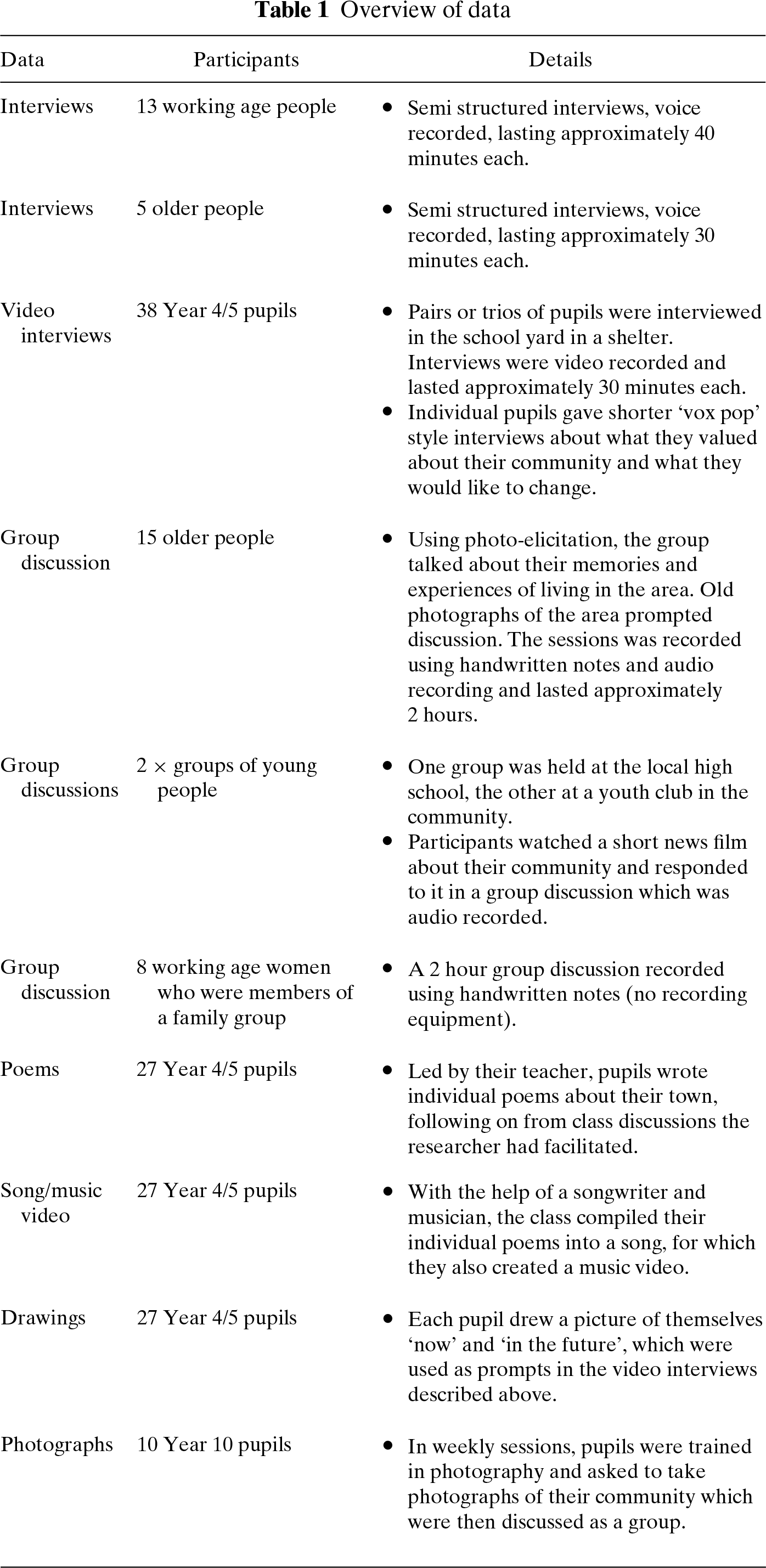
Our data provided a diverse range of perspectives on how people of different ages take part in the micro-sociality of everyday life. The findings (not reported here) related to the physical environment, housing, volunteering, the job centre, benefits sanctions, drug misuse, vandalism, social and informal support, networks, community spirit, future aspirations and pride. Our aim with The People's Platform was to distil these into a piece of theatre that would relate to current policy debates on well-being, co-creating a powerful piece of theatre whilst maintaining the integrity of the data. To make this connection between the micro-social and policy, we linked the event to the Well-being of Future Generations (Wales)Act 2015, a piece of legislation which calls upon all public bodies to embed well-being into their policies and practice. The seven goals of the Act would give the performance-based debate a structure upon which the performances could hang, to make the event meaningful and relevant for policy-makers and other stakeholders.
The People's Platform: a co-productive process
Working in partnership with National Theatre Wales TEAM, POSSIB: Voices in Art, 3Gs Development Trust and Common Wealth Theatre, we commissioned a writer/dramaturg and director to work with us, the data and community members to create the show. The director and writer worked with a group of working age people, some of whom had already taken part in interviews and others who were new to the project. Additionally, we commissioned another director to establish the ‘Young Company’ involving pupils in Years 9–11 at the local high school. The Young Company was established to explore young peoples' responses to the Act. Both groups met weekly in the lead up to the show, exploring ideas of community, health, well-being and the future. The purpose of the workshops was two-fold: to create material and to coach new actors into taking part in the performances.
The role of the writer was vital; she spent many hours reading anonymized transcripts and looking at, listening to, and watching creative outputs (videos, pictures, stories). She identified possible story lines, metaphors and characters from the multitude of sources. A number of monologues and exchanges were devised, each formed from more than one data source, so that no one participant could be identified. For example, one character was created by combining data from an interview with a working-age woman, working-age man and an older adult. All of the monologues were written to illuminate the micro-social aspects of community life, and ranged from a single mother's narration of her everyday struggles with depression, to an ex-offender's story of his difficulty to find work, to a young person's experience of judgement from others for being ‘from Merthyr’.
The role of the technical team was also important to ensure the sensory aspect of the theatre experience reflected the integrity and aims of the research. The setting for the event was a social club, a place in which the local people we spoke to felt comfortable as well as being a setting of the ‘everyday’ and in which displays of hospitality, friendship and community were etched. The redesign of the space was also created in discussion with the researchers and with local people, who worked with the set designer in the week leading up to the event and during a week of screen printing workshops. Tables were laid in ‘t’ shapes to encourage the development of social encounters between the audience and to facilitate discussion. The lighting designer created table lamps which were illuminated during two sections of discussion. With the dimming of the theatre lights used in the performance this intensified the discussion space. The sound engineer and composer created sounds which reflected both the pre-industrial history as well as the utopian ‘fires’ for change that also featured in a film called Dal Ati (‘keep at it’ in Welsh) that the Young Company created with a film production company. Images from the film were reflected on a washing line monologue providing a sense of possible futures within the everyday present.
The two discussion phases focused on a question illuminated as the theatre lights went down and the table lamps went up. The first question — ‘
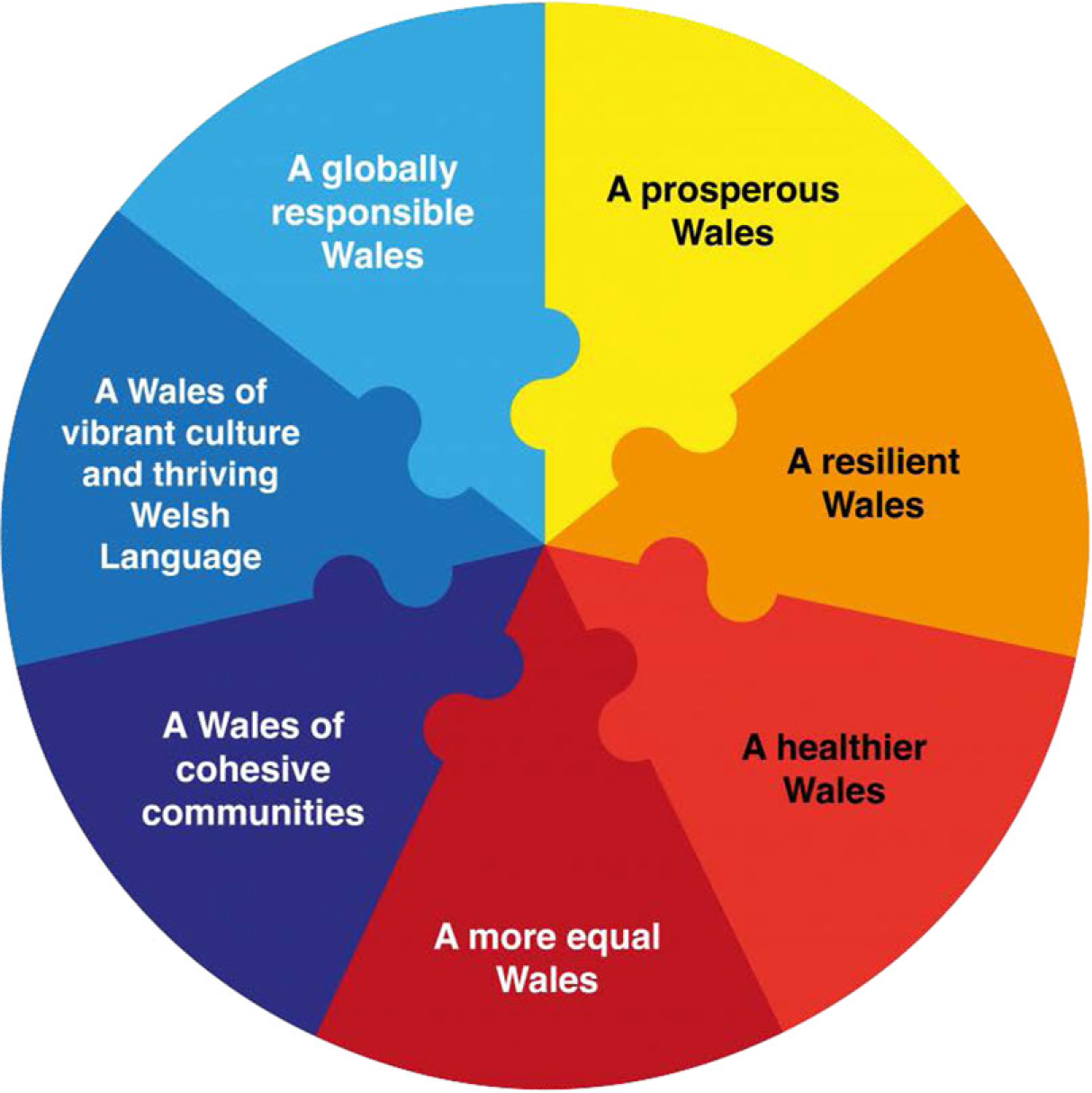
The seven well-being goals from the Well-being of Future Generations (Wales) Act 2015.
Throughout the process we discussed with arts partners the purposes of the research and the importance of community control of representation, the generation of knowledge and over decisions that affect their local area. As researchers concerned with the production of health inequalities we explained the importance of interventions that moved away from a focus on life-style and behaviour change to ones that take account of the social and economic determinants of health. The production was about the way in which some of these determinants play out of people's everyday lives — the monologues (at a pub bar; hanging out the washing) revealing how the epic nature of structural inequality reveals itself in the ‘ordinary’.
In terms of the performances these were largely through dramatics monologues by four professional actors all of whom had some connection to nearby localities. These actors worked, in the week prior to the event, with ‘new actors’ who were members of the local communities who wished to participate in the event but did not have the experience to ‘hold’ a monologue. Professional and new actors devised sections of the script such as a ‘roll call’ of famous and locally known residents from the past and present; a mime of a boxing match; highlighting Merthyr's famous boxing history; a dialogue between two girls texting their frustration at not be able to take action; and a group of working-age men describing their own contribution to the community. The interaction of professional and new actors in devising and performing place was key to maintaining the balance of keeping the performances relevant to the local context as well as creating a standard of aesthetic excellence that would convey the meanings intended by both community members and the researchers.
Performing community: the everyday and the epic
The following are fragments of the play which shows the way in which the performance of everyday lives reflected wider issues of social and economic neglect, the intergenerational transmission of social values, and collective action to maintain order in the face of uncertainty and precarity. Alun, a working-age man in his 30s is a volunteer, reflects on who he is, what he does and why he does it. He walks around the audience as he cleans up around them, chatting to them as he does so:
I started volunteer litter picking for something to do. I was on a zero hour contract that literally meant I didn't get any hours, so wanted to get out the house. Plus, it meant I got to see the boys. [The community centre] brought us together. Litter round here is a problem, people just presume its rough cos its not well kept. We do our best. It can be intimidating walking into a place that ain't clean. Makes it look like no one cares. There's been dust in the air recently, building new houses down by the roundabout. They won't be for us.
I said to one of the builders, ‘lot of mess you're making, what about the people who live here?’ He looked down at me from top of his ladder, dust falling like snow on the ground said ‘don't like it? Move out’. Move out? With what money? ‘Get a job then’ he said. Prick!
I can't stand mess, get it from my Dad; brought me up. My sister and me every Sunday would be up and down the stairs cleaning. Doing the beds, skirting, windows, the lot! House proud. We were only young but we loved it.
Alun is engaging and comic. He is telling a common story and yet he is revealing important concerns about the society in which he lives (whether this ‘composite’ man is aware of it or not). He is not defending his out-of-work status, he is just telling it how it is for him: zero hours contract, living in an environment that is degraded by neglect and from which he is unable to move even if he wanted to (which he doesn't). Local people in Merthyr have been framed as ‘bad workers’, feckless and scroungers but the conditions of work opportunities available are rarely reported in the same narratives be they media articles or reports (Tannock, 2013). Whilst not concluding that community efforts are a solution to problems of public spending cuts and worklessness, the narrative here was to dispel some of the talk that implies the moral shortcomings of people living in the area. In fact the monologue refers to one of a number of groups who regularly ‘clean up’ the area. A local men's group talked about picking up ‘nappies and needles’ where the environmental impact of the extensive drug problem in the area is managed by them. They pick up the needles in the absence of adequate safe needle disposal units.
Similar narratives were told by young people using photographs. Powerful images of beautiful and expansive landscapes (the area is on top of a hill surrounded by green fields and nearby mountains), ruined in the pathways by fly tipping. One image was of a bottle of what was suspected to be urine, on a beautiful woodland path. The images were powerful but Alun's cheerful performance connected with an audience, demanding their attention in a single space and time.
Later, Angharad, a woman who had had depression, talks about her connections to community. She hangs out the washing and tries to endear herself to the audience — as if she were talking over the garden fence. She remembers her mother:
My Mother? God she was lovely! Glamorous, legs up to here. A proper mother. Used to work in Hoovers before it closed. In the kitchen, she'd bring us left over treats. Our kitchen was kitted out with dishes and appliances that she'd ‘borrowed’ from there. We had enough Pyrex to rain shattered glass on [Garthcoed] for 30 days and 30 nights. My father, he was so quiet, a beautiful man with an even beautifuller [sic] singing voice.
The narrative is there to introduce herself as historically located — not just from anywhere. Hoover was the main employer in the area after the closure of the mines until it too closed in 2009. This is the context in which Angharad talks about bringing up her ‘boys’ and struggling with depression whilst responding to the resources that appear and disappear.
I started off going to [community name] forum; it's not there anymore. Typical! To meet people; get to know what was happening in the area. Was a community drop in centre, computer lessons and a cuppa — that sort of thing. Informal but supportive.
I was struggling with bad depression at the time. Well, sometimes life can just get a bit on top of you. I'd reached a point where I needed to get out of the house. I took a walk and there it was: [community name]. The Forum was my saviour really. They'd take us on day trips: Porthcawl, Cardiff. We'd sing on the back of the buses, rent-a-gob by here the loudest of course! At that time, I needed to be with people, like-minded people who got it.
Not necessarily to talk about my illness. Just talk about whatever really. When you walk around the streets here, you aren't alone, you hear funny conversations, see people smiling and you can sit beside a stranger on a bench … and they talk to you. I got counselling, we'd go for a cuppa and bacon sandwich. I started to get familiar with the best cafes in the area. I suppose a few would think a greasy spoon is a greasy spoon, but not to me. The grease is different, the bacon is different, the people are the same. A laugh! Every cafe she took me to was a step forward. I know it sounds stupid but I remembered I was human again. A woman, a mother, a singer.
She intersperses her narrative with singing whilst the shopping line shows film images of young people in the community who are ‘the future’. The monologue is not a ‘complaint’ — it is a story which incorporates hints at the organizational and interpersonal resources that have kept her going in times of trouble. These resources are fragile, depend on public funding and on kind community based staff, who understand the needs of the people they work for — at least in Angharad's experience. Again, this monologue is a challenge to discourses of resilience which focus on individual characteristics and qualities at the neglect of public and relational structures and resources.
Community as audience and participant
Whilst the fragments above were performed by professional actors, local community members were part of the ‘happening’ and experience of The People's Platform. Two young girls worked with the director of the Young Company to create their own dialogue, in response to the ‘othering’ of young people locally as ‘apathetic’. Whilst the young people who participated in the research and the creative projects (including The People's Platform) were already more likely to be ‘involved’ in civic and cultural organizations and activities, they saw themselves as correcting deficit narratives of ‘youth’ in the local area. Their dialogue was based on texting — an acknowledgement that community action can take the form of social media interactions as well as embodied:
Nothin much, chillin out. Mam's doin my head in.
She just doesn't stop.
She's constantly telling me how tired she is, but won't let me do anything, wont let me help her.
Driving me mad! I feel really guilty … I feel like-
It's time for them to let me do the dishes … Let me
Tidy MY room … Let me
Pay some of my own way … Let me
Start making a change … I feel like
I wanna start running … I feel like
I wanna take over … I feel like
I wanna get stuck in …
It's my time …
It's our fight now …
Reflecting an earlier ‘boxing’ performance (also a metaphor for ‘fighting’ or speaking back to power) the event moved immediately to the second discussion about the involvement of local people in the Act. Analysis of the discussions (accessed through interviews with facilitators, notes written on tablecloths, vox pops immediately after the performance and written messages on postcards) will be reported elsewhere. The point is that what this did was to blur the distinction between audience and participant. The monologues were a ‘conversation’ with the audience who were, in turn, invited to respond at the tables.
Occasionally community voices burst into the performances themselves. On one table a large group had chatted, texted and laughed throughout the event. Occasionally they seemed uninterested in the performances. They did not seem to respond in the quiet attentive way that audiences do at a play inside a traditional theatre. One interpretation could have been a lack of connection between this group of people and the dramatic spectacle around them. However, at the end of one monologue, about an ex-drug dealer and user trying to find a way of being a good father in the community, this assumption was refuted. In the monologue the actor, sitting at a bar, told ‘what do you call a …’ jokes throughout. At the end he said ‘I'll end with this last one — “what do you call a room full of people who can actually make a difference?” and after a moment of silence one of the group said, in a voice that appeared to be spontaneous, not forced and not mocking said ‘us’. After the event the group approached the research team to say how much they had enjoyed the evening.
Policy implications
The policy impacts are unfolding and it is not possible at the stage of writing this what these will be — if indeed there will be any. In terms of its uses in policy there has certainly been interest from public bodies to support similar ways of working in different areas. That is, bringing together community members, theatre artists and researchers to perform and engage with representatives from public bodies on issues of mutual concern and interest to policy and publics. Indeed the methods of working build on an established way in which National Theatre Wales has developed their engagement work across Wales as well as its Big Democracy Project which used theatre to re-engage different communities (of place and identity) in the democratic process. 1 However, the danger is that a ‘stripped down’ model would lose the aesthetic quality of the product and/or its attention to the participative and co-productive process. We would argue that productive meanings are held when neither is sacrificed.
However, it is worth considering the policy implications. The People's Platform at least showed that it is possible to bring policy audiences into a community setting to engage seriously in debates about possible futures. It also suggests that ‘art’ can be located in everyday spaces where people are more likely to define themselves as working class and does not need solely to reside in theatres, art galleries or the other spaces within the ‘sacred universe of legitimate culture’ (Bourdieu et al., 1991). Interest in the social and economic value of the arts might suggest that interventions like The People's Platform could be a vehicle for policy and public engagement in the future. The arts and cultural industries continue to receive funding but at the same time demands are for them to demonstrate their social value (Crossick and Kaszynska, 2016). If this is the case, whilst an opportunity, there is a real danger that its value will be tested by policy-driven metrics of value rather than a mechanism for publics to challenge ‘the way things are done’. The value of art is its potential to disrupt.
Another challenge, and possible criticism of The People's Platform, is the potential to silence dissent and difficult ideas. In reappropriating Garthcoed as a ‘proper place to live’ (Popay et al., 2003), talk about the impacts of poverty such as mental ill-health, fragmentation, drug use and violence can become silenced as a way of avoiding the forms of stigmatization that they seek to resist in the first place. In one workshop a community member asked how we should deal with the difficult stuff. In The People's Platform we did not avoid many of these issues and the actors were used as a way of creating characters who manage, often just, in the face of adversity. These people were real, and given personalities in the telling of private troubles as public issues (Mills, 1970). However, we also felt that policy-makers, as well as many members of the public, were only too aware of the negative sides of the area. What The People's Platform did was to give those discourses an alternative framing as well as providing a chance to show sides of the communities that are rarely presented. What is more, these representations came from and were sanctioned by community members themselves. Embedding facilitated discursive elements into the event also avoided the potential accusation that arts were a way of engaging people emotionally and not cognitively. The theatre space was intended as a creative dialectical space in which a form of public praxis was made possible. This also meant that sometimes the discussions were difficult. They did not always hide the ‘othering’ of others (not present perhaps) who were sometimes seen as the objects of ‘rightful’ condemnation. However the re-representation of some aspects of community life still acted as a challenge and indeed these views were also challenged.
Finally, The People's Platform was built on trust, and it took three years of conversation to build and secure that trust. One member of the research team has other research connections to the area and these have been sustained for over a decade. Conversations with National Theatre Wales have bubbled under the surface for the last three years and with POSSIB (the bilingual arts project) the joint working has been sustained over the same period. The choice and commissioning of creative directors, actors and other members of the creative team emerged through discussion and connections, and not through advertisement. The processes of trust and understanding were built slowly and carefully. Could a programme of work that burst into communities for a week at a time work? These kinds of relationship-building could happen at organizational and community levels and Wales has always, since devolution, prided itself on a focus on ‘voice’ rather than market based ‘choice’ as a driver for change (Beecham, 2006). Whether these could be achieved in Wales or other national contexts, may appear questionable and certainly aspirational, but perhaps possible. However, we would argue that without such a platform such interventions are likely to be seen as just as extractive, invasive and exclusive as many other forms of community-based intervention. The question also needs to be asked as to why arts based research needs to be policy driven (or engaged) at all?
Conclusion
One enduring challenge for us is that whilst we are finding that people engage enthusiastically and meaningfully with the arts, how do we talk about and present arts-based forms of knowledge into a political system dominated by narrow technical rationality? How do we bring, as Ruth Levitas (2013) argued, people's ‘expressions of the deepest desires of their hearts and mind’ into policy-making? Can we talk about a book of stories, or a novel, or performance as pieces of evidence or knowledge that policy-makers see as useable? Or are we simply asking too much?
Unlike being passively involved in research as research subjects, artistic engagement practices, with participants as producers, assist the development of ‘intangible’ assets as well as the ‘tangible’ assets that lend themselves well to empirical measurement — physical resources, financial assets and credit, human capitals of education and health, environmental and natural resources. Burnell (2013: 139) writes: ‘… dreams, hopes and ambitions can be defined as intangible asset s … [they] embody important human, cultural and social capital essential to building resilience … cultural action expressed through the arts can assist in unlocking these’.
Further, we are challenging and disrupting forms of narrative used by policy-makers that are framed by quantitative representations of communities and often deficit based. This can make new understandings of community contexts and futures possible, reinstating forms of utopian thinking, in which communities themselves are involved in the authorship. The forms of engagement in and of themselves build capacity for individuals and communities to achieve this. Through its rigorous analysis, its development of arts-based research methods, and its conviction that theatre, literature and the arts form a valid form of ‘evidence’ in policy discussions, the research offers different ways of thinking about, the study and development of ‘community health and well-being’ and the relationship between the experience of the everyday in particular places, and wider social and economic developments.
Footnotes
Acknowledgements
The work reported here is part of a multi-university, collaborative project. We are grateful to a large number of co-investigators, researchers and PhD students: Pete Seaman and Claire McKechnie (Glasgow Centre for Population Health); Qulsom Fazil and Joanna Skelt (University of Birmingham); Clare Barker and Jamie Anderson (University of Leeds); Roiyah Saltus and Adeola Dewis (University of South Wales); Madeleine Phillips (Cardiff University); Sarah-Anne Munoz and Issie McPhail (University of the Highlands and Islands). We are also grateful for the support and insights we have received from our members of the community and community partners. These are too numerous to list in full but we would want to mention in particular the creative artistry of Jěn Angharad, Rhiannon White, Kelly Jones, Charlotte Lewis, John McGrath, Phil George, Devinda de Silva and all the creatives that contributed to The People's Platform.
