




Abstract
Through an autoethnographic account that interweaves academic observations, my story of how I came to study Santa Muerte in Mexico and the entangled, emotive tale of Abby, a Santa Muerte devotee whom I grew very close to, I discuss the topic of belief in the ethnography of the occult and the “politics of integration”, derisively referred to “as going native”. I reveal how being an ethnographer of the Mexican female folk saint of death has taught me the necessity of dividuality and embracing belief in both the epistemological worlds of academia and the occult. I argue that slipping fluidly between the realm of science and the cosmos of magic has given me access not only to arcane knowledge and networks of practitioners but also through shared experiences of participatory consciousness with devotees of death during our rituals, proffered unique experiences, and new insights through intersubjectivity and interexperience, allowing me to understand the mystical power of Death Herself.
“Soy Mujer que sabe nadar en lo sagrado” I am a woman who knows how to swim in the sacred.
In this autoethnographic article, through the story of how I came to study the Folk Saint of Death, Santa Muerte, and was embraced by a Mexican family, I discuss the topic of belief in the ethnography of the occult and the “politics of integration”, in particular, the process commonly referred to “as going native” (Blomley 1994, 221), in this context when the anthropologist adopts their spiritual practices as their own. Interweaving my own family tale with Abby’s, a devotee of death, I highlight the necessity and naturalness as an ethnographer of the occult of residing as a dividual within two interlinked worlds, that of academia and that of spirituality, with a hand working in each. In one of them, my fingers light candles to Santa Muerte, and in the other, these same digits type papers, like the one my fingertips are tap-tapping now, analysing veneration to death herself. Although I slip fluidly between the realm of science and the cosmos of magic, in most of what I write, I do not refer to the role that has opened up to me in the second world of Santa Muerte, even though this is vital to my research.
*
Some anthropologists have recognised the value of practising the spirituality they are documenting. Favret-Saada, for example, states that to study witchcraft in the Bocage there was no other solution “but to practise it,” to become her “own informant” because in such work there is “no room for uninvolved observers” (1977, 22). One must experience rather than imagine witchcraft, she states in Être affecté (2018, 6). She also emphasises the importance of affect rather than observation during participation in rituals, that is to say, non-verbal embodied, sensual, and corporeal perceptions and involvement (2018). Nevertheless, the conclusions of her work often rest in positivistic analyses (see 1977, 192).
Timothy Landry has also pointed out, on his study of Vodun in Benin, that his most valuable research tool was apprenticeship into the spirituality (2018). This forced him “into a state of betweenness, being caught between two indeterminate worlds and between two ways of being” so as to blur this “professional. . .boundaries” (ibid, 172). Favret-Saada calls this “une schize”—a form of split experience (1990. 9).
Favret-Saada and Landry argue that research into magical traditions can only be successful and, above all, respectful and ethical when the anthropologist lets go of science, embracing the spirituality they are studying (ibid). Only then may they swim in new ontologies and discover alternative possibilities that are key to mystical experiences. The anthropological endeavor when undertaken this way becomes much more than “gathering and presentation of data” and causes the scholar to “confront the limitations” of their scientific training (Stoller 1987, 227).
If I have hidden my devotion to death, despite its value as a research tool; this is due to the judgment that has been cast upon those ethnographers who reveal their belief and participation in the mystical worlds of those under study. Some argue that it is somewhat passé, but the idea in anthropology that if an ethnographer goes native and adopts local practices (whether occult or otherwise) then she will be criticized, become “professionally doomed,” and will be “assumed to have lost some necessary distance and objectivity” still has currency, as numerous anthropologists have experienced and continue to document (Thompson 2019, 682; see also Behar 1996; Jacobs-Huey 2002). Favret-Saada describes how she was taught that of all the snares that imperil fieldwork, the worst is “agreeing to participate in the native discourse” and thereby losing objectivity (1977, 23). Stoller admits “I avoided the topic of sorcery for almost twenty-five years. It was too painful, too embarrassing. Having been stung by collegial ridicule in the past, I wanted to avoid it in the future. I desired disciplinary respect” (2009, 40).
This obsession with defining oneself as an individual who does not adhere to the beliefs of “others” is a hangover from the European colonial era, during which the colonisers feared “losing their cultivated identities” and becoming one of the “natives” (Burns 2017; cf. Ganter 2017). Yet when we return from the field, we can never “fully resume the lives we had previously led” (Stoller 2009, 4) nor do we totally disentangle ourselves from our respondents. Anthropologists, such as myself, Stoller, Landry, and Favret-Saada inter alia, who work through an apprenticeship are sojourners of “the between” (ibid).
While a number of anthropologists have made this argument about the benefits of apprenticeship, in this article, I additionally suggest that the experiences of betweenness that come from embracing new spiritual ontologies and realities occurred, for me, through shared deathly experiences and processes of dividuation. These accompanied participation in magico-religious rituals and rites were labours of love, linking me to devotees through sacred moments of mutual care in the face of death. By dividuation, I refer to “processes that extend the single person into new orders of space and time by interlinking and synchronising the single person with others and complicating the single person’s sense of coherence” (Ott 2018, 6).
As I detail, during my apprenticeship into Santa Muerte, I did not remain an individual with distinct boundaries that demarcated me from the “others” and their practices. During rituals with devotees involving death, my own porous boundaries as a dividual allowed for what Tambiah describes as emotional, sensory, and “sympathetic immediacy” moments of participation (1990, 108), connecting me to them in new ways as I entered into another epistemological order of reality. Eventually adopting their praxes as part of my daily life, I feared for my reputation in academia due to comments by colleagues that I had “gone native.”
Recently in anthropology, there have been concerted efforts to avoid using the idiom “going native”; instead the neologism “convert complete member researcher” has been suggested. Although seeking to remove negative connotations, the undertones of racism to the phraseology, and disrupting links to colonialism (Adler and Adler 1987), this neologism does not erase the fact that ethnographers “are still advised that to fully join the community in which one does research is to lose sight of one’s research objectives” (Thompson 2019, 682–3; see also Behar 1996), even to overlook that one is a researcher (Luhrmann 2012).
In my case, I have been warned by senior scholars based in the United States, the United Kingdom, Europe and Canada not to divulge my devotion to death. I have been advised that my scholarship will be questioned and that I will risk not advancing in my career if it is known I have “gone native”. Other scholars, who only unveiled their mystical beliefs once tenured, have advised me to follow suit and to keep quiet for now. But I find that I owe it to those “respondents” who have become part of my life, to the spiritual traditions they have taught me, to write honestly as a “vulnerable observer” (Behar 1996). I also seek to restore the deserved dignity to devotees of death, whose faith has been devalued in much of Western media as a deviant pseudo-religion (Kingsbury 2020, 50). Like Vodou, it has been portrayed in a manner “aimed to evoke terror. . .without openly entering into racist discourse,” disseminating and reinforcing centuries-old racist tropes “of the barbaric Other” (McGee 2012, 232).
My worst experience till date was when one night, after a conference, a colleague was supposed to drive me home. I had brought Santa Muerte statues and candles with me to do a bit of old-fashioned “show and tell” during my lecture. The colleague later refused to give me a ride. Somebody else had to step in. Apparently, the colleague was fearful of my involvement with the folk faith and had purportedly said “I do not want that satanic stuff in my car.”
Santa Muerte has been branded with a demonic reputation in mainstream media and even by certain Catholic clergy who misconstrue the folk faith and view devotion to death as something macabre. While such arguments are highly political in the case of the Church, whose flock is hemorrhaging, media views come from miscomprehension and fear of the unknown. |It does not help that no anthropological fieldwork has been done by scholars initiated into the folk faith, and that the corpus on Holy Death, as it stands, is firmly grounded in positivistic analyses, some of which seek to frame the folk faith as a “cult”.
My position as an initiated member within the fastest-growing new religious movement in the Americas is beneficial, therefore, as it not only gives me unique access to extensive networks of practitioners and secrets only imparted to those who have reached the highest levels of praxis but also most importantly opens avenues to multiple ways of knowing, informing my ethnography. It allows me to understand, through self-reflexive, embodied, and participatory experiences and affect, the power of death to devotees. But while disclosing some of the secrets learnt in the field has made my ethnographic work rich, I have not revealed my secret that allowed me to know the secrets of devotees of death (see Jones 2011, 79).
This straddling of the putatively opposed worlds of mythos and logos has arisen from my life’s trajectory. My childhood living in the United Kingdom, Belgium and later France immersed me in realms where I straddled multiple cultures, languages, and also mystical experiences, not only with my aunt, as I focus on in this article, but also with others, such as with an Italian “vedente” (clairvoyant) who resided in an apartment in Saint-Gilles, Brussels, next door to my Argentinian best friend. When he had no clients, Monsieur Pietro would invite us in to teach us how to read the tarot or tp show us some of the steps—not all, as these were secret—of how he made snakeskin-covered gris-gris (amulets). Experiences with Monsieur Pietro, and above all those with my aunt, taught me the value of interconnectivity, porosity, immediacy, and empathy through participatory consciousness, as I detail. They also taught me the value of being open to other ways of experiencing the world. This was juxtaposed with my later Oxford University education, which trained me to view magic, religion, and related arts as superstitions to be explained.
My belief and position in these two epistemological systems, mythos, and logos, is not mutually exclusive but is “complex, emergent, shifting and variable,” dependent upon context and, above all, the interrelations that such contexts comprise (Magliocco 2010, 15). “While anthropologists used to assume insider/outsider status was binary, more recently, it has been understood that the boundaries between the two positions are not demarcated; there is slippage and fluidity between them” (Kingsbury 2021b, 6). During fieldwork, identity as “fluid”, with different parts, may be “negotiated, highlighted in some points, or discarded all together in particular moments of research” (Ross and Razon 2012, 495). As I research and document Santa Muerte veneration, moving between the two different but related worlds of academe and magic, there is also slippage, fluidity, and variance in my beliefs.
I have concluded that I am a dividual, that is to say, fractal, socially embedded, and heteronomous. I am inextricably entangled within the relationships I have with particular people, in particular places, changing in accordance with “movements through places and relationships” and epistemological frameworks (Smith 2012, 54), whether in the occult or the academic world. “Belief is not a state of mind, but a result of the relationships among people” (Latour 1996, 2).
Scholars who do not know me assume from my rhetoric at conferences and from reading my research on Santa Muerte—known in English as Holy Death—that I am of entirely scientific bent, and I act as an “academic native” within the university context (Harris 1989,16). Afterall, my lectures and ethnographic writings are grounded in logic and reason, the hallmarks of academic rhetoric. And I hold fast to my functionalist assertions, among others, that female followers of the skeleton saint are empowered and fashion gynocentric spaces through devotion to death “in which to deal with the violence, precarity and poverty that riddles the Mexican post-colony” (Kingsbury 2020, 43). Nevertheless, I find that this work of mine is lacking since it reduces Santa Muerte to its social function.
As I have detailed, colleagues who know me personally and have heard of my deep ties within the community are concerned. They want to know which side of the fence I am sitting on. Some of them fear I have “gone native”. They tell me that the life of any anthropologist who believes—what they consider—the “realm of unreason” to be real (Kapferer 2002, 2) must be characterised by secondary elaboration and cognitive dissonance. Others ask me, with an amused tone, “so do you really think there is anything to all of this Santa Muerte stuff?” They warn me that as a younger academic I must make it clear that I am not a devotee, even if after numerous fieldtrips to Mexico and daily contact via apps, I am by now completely immersed in the world of devotees of Holy Death.
Paradoxically, during fieldwork, ethnographers are expected to get the native point of view without “por favor going native” (Behar 1996, 5). One should pick one’s side and, if one wants to be taken seriously in certain circles, this has to be the side of science. If you venture too far over the fence, then you become a native whose work therefore becomes questionable. As Sabina Magliocco has pointed out, all of this revolves around the question of belief in either science or magic. This is a “dividing practice”, and one of its aims is to differentiate “the scholar from the practitioner, to separate expert from lay knowledge, folklorist from folk” (Foucault 1983, 208; Magliocco 2010, 9). Bruno Latour, author of We Have Never Been Modern (1993), details in his critical discussion of the colonial project and the birth of modernity: as “Moderns. . .we had to believe in reason, the only force capable of seeing through” and allowing us to mock “the foolish beliefs of others in (a) scoffing tone” (Latour 1996, 2)
The traditional anthropological epistemic framework, built upon the colonial project and influenced by the Enlightenment period, privileges logos and rationality. Anthropology emerged as “ a product, of eighteenth- century rationalist philosophy, and… the stream of thought from Hobbes and Locke, through Hume and the Scottish moral philosophers, sceptics and Deists” (Evans- Pritchard 1960, 109). Within this framework, mythos and magic are mere “ pseudo- science”, a childish fantasy (Frazer [ 1913] 1960], 243). Magic “ stands outside of or is opposed to science, and the rule of reason” (Kapferer 2002, 2), and practitioners of it are “ gullible” (Greenwood 2009, 5) or “ manipulative” (Versnel 1991). Magic, in this discourse, is wrong- headed thinking, reserved for the primitive and illogical mind, in particular of non- Western “ others” or lower class Western people, whose mystical thought processes are implicitly deemed inferior to the rational workings of the logical brain.
Nevertheless, some anthropologists, have questioned these deprecatory arguments as I have already detailed in the introduction, and some have embraced what Stoller calls “the power of the between” (2009). Earlier on in the discipline, Malinowski refuted the idea that Westerners have science and “others” have magic (1954). He “credited the Trobrianders with the possession of scientific knowledge” (Tambiah 1990, 68). In “Magic, Science and Religion,” Malinowski recognised that Melanesians were both empirical and rational, pointing out that humans shift between two modes of reality: the scientific, which he saw as profane, and the sacred, the world of religion and magic.
Evans-Pritchard, in his study of the Azande, also documented the complementarity of logical reasoning and mystical thinking, stating that the “Zande belief in witchcraft in no way contradicts empirical knowledge” (1976, 25). Nevertheless, in his article, “Religion and the Anthropologists”, Evans-Pritchard acknowledged that atheist and agnostic anthropologists, citing Tylor, Frazer, Durkheim, and Malinowski, misconstrue the mystic because due to their own empiricism, they ignore believers’ relationship with deities and mystical experiences. Instead, he said they try to “explaining it away” in terms of other things (1960, 110). This is a complaint that has been reiterated by many scholars from Greenwood (2009) to Lurhmann (2020), inter alia, who underline how the actual experience of magic and spirituality has been lost in the explaining away, whether it be via intellectualist, functionalist, psychological, or other kinds of arguments.
Other scholars such as Stanley Jeyaraja Tambiah have analysed the history of, and criticized Western conceptualisations relating to, the categories of religion, magic, and science (1990). Tambiah maintains that these terms are heavily loaded, yet have fluid and dissimilar meanings across zeitgeists, classes, and societies. Tambiah questions the limits of Western scientific thought, rejecting evolutionary anthropologists’ theories that view magic and religion as precursors to science.
Instead of the rational/non-rational dichotomy, Tambiah recognises the “dual and perhaps multiple orderings of reality” (ibid, 101). He argues for “two orderings of reality” that all humans are capable of experiencing and that distinguish science from magic and religion (ibid, 105). Science, Tambiah argues, centers on causality governed by “categories, rules and methodology,” while magic and religion, he argues, building off Lévy-Bruhl’s notion of “participation mystique”, are based in participation which is about “immediacy, performative speech acts and ritual action” (ibid, 108). In this article, I explore the value of these and my experiences as a dividual within participatory spaces.
While, as I have detailed earlier, there are exceptions to the rule, nevertheless, to this day “many anthropological theories have implicit assumptions about the ultimate irrationality of magic or of the inferiority of magic when compared to science” or they distill it down “to its social or psychological effects” (Greenwood 2009, 2). Such approaches rest upon the logical positivism that underlies most Western European constructions of reality and that continue to “shape the nature of ethnographic enquiry” (Magliocco 2012, 7).
Logical positivism contrasted itself with “the pre-Enlightenment worldview, which accepts magic” (ibid). It entailed the presumptive “birth of science” from the death of magic (Josephson-Storm 2017, 43). Nevertheless, the enlightenment project was initially formulated not in terms of a battle between religion and science or faith and reason but “as a divine science” (ibid). Moreover, the scientific world view emerged in part from the “marriage of natural philosophy and the pragmatic and empirical tradition of sympathetic magic” (Greenwood 2009, 134). While according to this myth of modernity, magic is illogical and science entirely rational, Latour has demonstrated that scientific practices are riddled with contradictions, incoherencies, and illusions (Latour 1993, 1996).
Notwithstanding, the myth of modernity is reliant upon the disavowal of the occult and all superstition in a mutually exclusive formulation that does not allow for the fact that “not infrequently” mythos and logos, and magic and science “coexist in the same individual” (Magliocco, 2012). Indeed, for anthropologists who study the occult, this may be a necessary part of the job description, allowing for deeper understandings and intersubjectivity through the erosion of divisions between informants and ethnographer during rituals that allow them to understand through affect and sensory experiences.
Scholars involved in occult studies, such as myself, when not accused of “going native,” are presumed to be interested in voyeuristically observing “exotic” phenomena (see Clifford and Marcus 1986). Indeed, under the threat of being accused of “going native,” many ethnologists distance themselves by focusing on the differences between magic and science, seeking to reinforce how outré practices are. This is to the detriment of uncovering similarities between magic and science that might “break down social divisions. . .encourage communication,” thereby forging powerful “connections between phenomena” and even people from different traditions, backgrounds, and origins (Greenwood 2009, 4).
In my case, I could only conduct ethnographic work on Santa Muerte by living those connections between phenomena as a dividual within two spaces that are not separate, but overlap, by cohabitating “logics or categories that are supposedly otherwise incompatible and irreducible” (Bastide 1955, 495). Stoller counsels that “precious knowledge” can be accessed by inhabiting multiple realities, “unsettling places situated between things, places that challenge the foundation of our being-in-the-world” (Stoller 2009, 35).
Growing up in England, Belgium, and later France, among family and friends, some of whom believed in ghosts and swung the pendulum while others who chalked it all off as codswallop, I had a foot firmly in both worlds early on. During my studies at university, I experienced a hiatus, distancing myself from the world of mythos as I learned in anthropology classes on witchcraft and spirituality that such practices and beliefs were “the most pernicious delusions that ever vexed mankind” (Tylor [1871] 1958, 112). I learned that for many anthropologists it would be “more embarrassing to give a lecture naked in front of one’s peers than to be pegged with the view that magic could be anything other than a social and psychic fabrication” (Farias 2012,117). I did not understand at that time how racist and devaluing of other people’s worldviews these ideals were, until I began researching the skeleton saint.
When, for my doctoral thesis, I conducted fieldwork in Dakar on Mouride movements—a unique form of Senegalese Sufism that includes magical beliefs and praxis—I chose to apply everything I had learnt at Oxford, especially functionalist Durkheimian arguments to analyse these, but by doing so, I missed the mysticism that is fundamental to Mouridiyya.
During my fieldwork in Mexico, I have come back to inhabiting two worlds, to embracing “the power of the between” (Stoller 2009), and if I find myself learning new occult skills, it is not that I want to acquire secret powers (see Stoller 1987, 27). While my consanguineous family has drifted apart and the auntie who believed in ghosts has died—and for some become a ghost—I have been adopted by a new family in the field. For them, as it was during my childhood, the familial occult is a language and labour of love, just like my academic work, which encapsulates my passion for my subject area. So, these fingers type and light candles with the same motivations that flow into both areas of my life, conjoining them.
*
In February 2017, I was living in Northern Canada where –40 Celsius is normal. I grew up in far more temperate climes. That is not my normal. Depression sets in after so many dark days. Desperate to escape, my spouse suggested we find a cheap flight to somewhere hot. So, we did, flying off to Huatulco, Mexico. Upon my arrival, as an anthropologist, I could not just sit by the sea with other holidaymakers. I have never liked hotels, mired as they are with the inequalities of race and gender, especially in Mexico (see Kingsbury 2021b). Nevertheless, my conversations with staff led me to the study of Holy Death and to acquire the most unexpected family and friends, who, like the ones I grew up with, express themselves in occult languages and labors of love.
Most staff at the hotel, used to guests who took no interest in their culture or spoke no Spanish, were glad to converse with one who did. Many regaled me with their knowledge. And so it was that I began to hear about Santa Muerte, the female folk saint of death who, Andrew Chesnut details, has 10–12 million followers in the Americas (2017, 33). Praxes related to the folk saint are syncretic. Santa Muerte is a loosely organised folk faith that is characterised by heteropraxy and heterodoxy (Kingsbury 2021a, 46). It comprises a melange of Catholic-based prayers (Castañeda 2008), combined with curanderismo, as well as brujeria (witchcraft; Marrero 2019)–deriving in part from Indigenous praxes admixed with Medieval Spanish sorcery imported during the colonial era. It also melds in Neopagan magical influences from Euro-America, in addition to Afro-Cuban occult praxes from Santeria and Palo Mayombé (Kingsbury and Chesnut 2021).
Tales told by staff at the hotel depicted the folk saint of death as wrathful, but also as a generous mother. I was told that followers of the folk saint worked hechizos (spell work) to hex enemies but also lit magical candles during rites to bring miracles of love, money, health, wealth, and life. What most caught my ear was talk of a shrine dedicated to death. When my spouse suggested we go on a tourist turtle tour to release the just-hatched amphibians into the sea for their first dip, I acquiesced with an ulterior motive. I estimated the shrine spoken of to be about 40 minutes from the oceanic reserve, and thus a possible detour might be made before heading back to the hotel. Once my neonate had scuttled down the beach, and its teeny turtle flippers had touched the surf, I directed all my energies into finding the shrine, asking locals about its location.
*
I will never forget the first time I saw the shrine or met its owner. Like the new-born turtle reaching the sea for the first time, stepping into the shrine was a rite of passage for me, to a new world, but it also brought me back to my childhood self. Oaxaca, where the chapel is located, is at the southern tip of Mexico, just above Chiapas, and is hot and humid. The area where the shrine is situated is rural. Overgrown endless jungle swells out at the eye. The roads twist and turn, dangling from steep cliffs that slice through the jungle where they can. As lighting is limited, the red embers and yellow flames of the fires upon which trash is incinerated are the only signs of human life. The smoky fumes of burning debris blend with jungle petrichor.
That night, out of the darkness, the dance of candle flames whose light illuminated the blade of the skeleton saint’s scythe caught my eye (Figure 1). Many effigies of Santa Muerte are featured in this chapel, but no matter where you might come across the folk saint, she always has a skeletal form, like a feminine grim reaper dressed in a long gown. As I walked through the chapel, her bony skull, hands, and toes kept appearing and disappearing in the flickering flames, and from behind them emerged a small but sturdy woman of 70 years or so, with a long silver braid down her back. Despite being total strangers, we began conversing immediately.
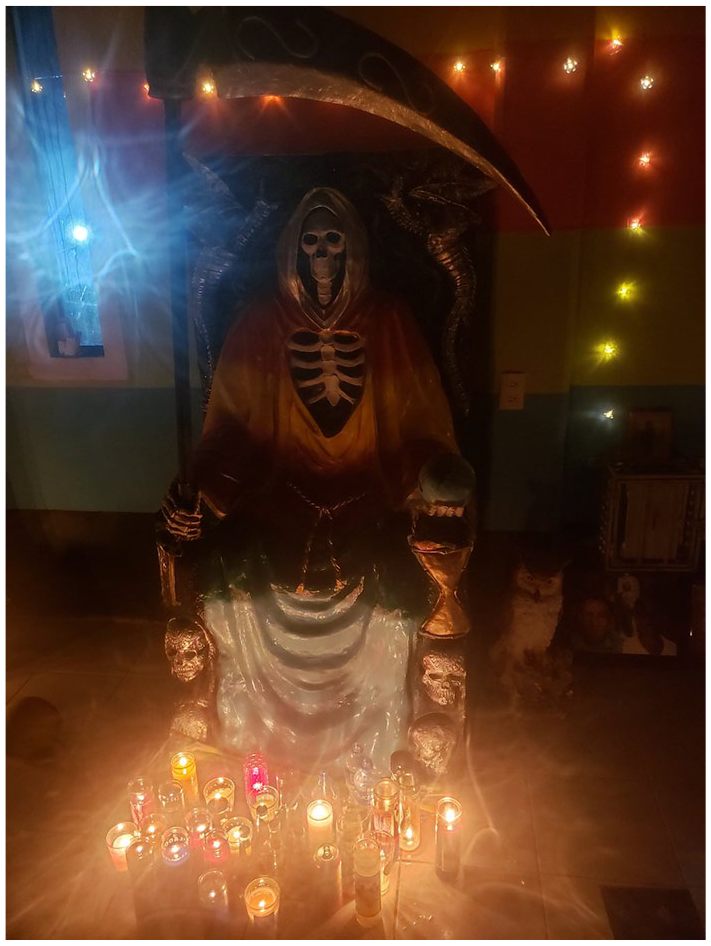
Statue of Santa Muerte at the shrine where I conducted fieldwork, illuminated by votives.
Doña Elena told me her story of devotion to death, not only of her own faith healing, but a story of a mother’s love for her son and her desire to heal him. Before I left, she gifted me a Santa Muerte statuette, dressed in red. This is the colour used for devotees for love spells. The folk saint in carmine gown left Mexico with me on the plane and now resides in my house in Canada—an occult gift that bridges two disparate worlds—and when my eyes alight upon it, I slip into another epistemic framework.
Doña Elena introduced me to her granddaughters the following year, all devotees of death. One happened to be in her thirties, like me, and we soon grew close. We had grown up in very different countries and cultures. A friend in the village commented that we looked like opposites as we walked along the village streets together—me, tall and pale with fine, shoulder-length gold hair; Abby small and dark with waist-length, lustrous dark locks—but early on we found similarities as we told each other our stories.
Abby related that as young woman, unlike her brothers, she had never been supported in her goals, such as to open her own business. Rather, in what she dubbed a machista culture, she had been expected by those on her mother’s side of the family to get pregnant before she hit eighteen and to marry the first man that came along. She did not. She worked tirelessly to open her own shop and, though she had a boyfriend, children were not a priority; they were something she had put on the back burner until her business took off. As a result of years of battling parental doubt and distrust, though Abby was incredibly intelligent and capable, she often lacked confidence and belief in herself.
I could relate, growing up in a strict British household with neo-Victorian patriarchal parental values that I found suffocating. My academic achievements, and the blood, sweat, and tears put into acquiring them, have never been taken seriously, to my frustration. My parents have, like Abby’s family, had other expectations for me—paramount of which is procreation. My mother to this day still believes that I will not be a proper woman until I have children. My father recently complained in a Christmas round-robin sent to far too many people that I remain “resolutely childless”. Although our lives differ dramatically—given our dissimilar cultural backgrounds, education, skin color, and more—conversations about the anxiety and self-doubt generated by growing up in patriarchal families that seemed to undermine everything we longed for created a strong bond between Abby and me.
After three years of friendship, quite out of the blue, without my request, Abby sent me her account of the chapel’s nascence. She knew I had heard the story many times, nevertheless, I had not been given all the details. Abby gave me the story as a gift of deep friendship. In it, she wrote a prefatory comment that three years ago, in the morning, she had prayed to Santa Muerte to send her someone to help her through a turbulent time of grief, and that very evening,I had appeared and thereafter become a pillar of support to her. The account was also a labor of love, written in a language of love for her grandfather who died on the date she sent it to me, and whose death had been a pathway for her veneration of the Saint of Death and, above all, for her boyfriend who is in jail in Acapulco these last three years still awaiting his final trial. Together, they cared for her grandfather during some of the last days of his life.
Above all, Abby told me that the words she sent me were an ex voto to Santa Muerte for protecting her boyfriend, Marc. In a region where most live far below the poverty line, he is a fisherman by day and a marine drug runner by night. The media rhetoric about narcos misinforms us. As does most of what has been written on Santa Muerte as a narcosaint. Marc is not a violent criminal like El Chapo, living it large, but before imprisonment, he eked out a living as best he could, often earning less than $10 a day. Marc might be in jail, but Abby affirms that Santa Muerte saved him from being killed by the marine police when they arrested him on the high seas. The words written and sent to me promised to Holy Death a gift of love in return that when Marc’s final trial comes, he might be freed and be allowed to live at her side once more, and then they will get married in the shrine—the first marriage ever in Oaxaca before Santa Muerte. That is her promise. The piece she sent is over 12 pages long, so I only cite this extract: My father for some time had lost touch with reality, he had gone mad due to witchcraft. My memories of that are scarce. I wasn’t there for part of those years. But I do know that was one of the reasons I was taken away as child from my father. My mother’s family didn’t want me to see that “loco” (crazy). So, as granny told you, she searched into her beliefs to heal her son. She had come from a long line of curanderos and knew what had to be done. She took him to a curandera, who was deeply devoted to la Santa Muerte and who cured him.
Soon after, the first effigy of la Santa Muerte was bought by the family to thank the skeleton saint for healing Doña Elena’s son. A gift out of love and the beginning of a tiny shrine that would grow into a large chapel, drawing in thousands. Every day during fieldwork, upon awakening, I would go straight to the chapel. There were always new gifts inside. If I left for a few hours and came back, more oblations filled it. And each year I returned, it grew and grew, ever more ornate, with ever more effigies and devotional decorations—gifts again in response to miracles that the folk saint had blessed the family and community with. The chapel was a labor of love. Whenever one looks at all the different pieces within it, one is reading a love letter.
Although some devotees work hexes and black magic, most, as I would come to discover, pray and conduct rituals to aid the ones they care for. It is when a miracle is granted to a loved one that items are left in the shrine; perhaps a statue of the folk saint, possibly an owl carved from wood (Santa Muerte’s animal companion in mythology), a bouquet of roses, or a bottle of mezcal. Miracles the folk saint is said to perform could be anything: preventing a boyfriend from being killed by the marine police (as we saw); healing a wife of cancer; getting a new job that allows one to care for children; or even exacting revenge upon someone who hurt one’s daughter.
Later, a bottle of tequila would be gifted to Santa Muerte by my spouse—this was their labour of love. My spouse learned the language of love without even a word of it to me. No belief had ever been expressed and no petitions ever murmured to Holy Death prior to this moment—nor since—but at Christmas 2019, the liquor was placed in the Chapel below Santa Muerte’s feet. This, I was told, was in return for a promise that I be kept safe. There had apparently been fears that I might die out in Oaxaca alone, possibly crashing off one of the hairpin bends into the cliffs below, or worse, after I related that I had moved cabañas to live in a safer area when told that a woman had been murdered and her body tossed off the crag near the previous one.
*
With each year of fieldwork, with every message exchanged when I was not in the field, I was learning this language of love without realising it and my spouse had evidently picked this up from me. I became more and more entangled in the lives of this new family. I cannot even recall how I became embraced fully by the family, only that I was constantly with the owner of the shrine, Doña Elena, the silver-haired lady with the long braid down her back, and her granddaughters, who all called her abuela (granny). Then one day, I was just one of them to her, because she was calling me m’hija (my daughter) and mi nieta (granddaughter), and I was calling her Abuela. She was also giving me the same lectures that she gave her other granddaughters, out of concern for my well-being, and all this converged into the occult because that was the language we used to discuss our worries, fears, and anxieties and to express our affection for one another.
While few researchers are ever completely outsiders (Mullings 1999), we should not ever delude ourselves to thinking we are same as those we research. It is easy for the “more privileged (the educated, the wealthier, the lighter-skinned) to imagine, to project social and emotional ties with the marginalized” (Lepowsky 2012, 72). Those we studymay refuse or reject the “strands of common identity or allegiance we proffer, whether of co-residence, nationality, gender, or political sympathy” (ibid). Although others not related to the family in the community would never see my relationship with Abuela in familial terms, her own behaviour toward me was marked by the intimacy of motherly and grandmotherly care.
* “De la muerte no te escapas, ni aunque te escondas”, Abby. (From death you cannot escape, not even if you hide).
Discussions arose one day of our problems. I told the women in the family of my frustrations with money, and work, in particular the fear of having no future secure job prospects. I had initially been led to believe when I first started teaching at a university in Alberta that one of the professors who had long taught religion would soon retire. I would have a fighting chance of obtaining that position. But funding was cut dramatically, and my dreams were shattered. The anxiety this situation caused was compounded when, only six months before coming to Mexico, I nearly died. Meeting death then, and now (in the form of a folk saint), felt like a second opportunity to live, to love, and to learn. This led to Abuela and the family members present telling me of problems they had and their rapport with Death herself.
Abuela had been bedridden for 12 years until one night, gasping for breath, Death came to her, but not as she expected. Astride a carriage drawn by owls, Holy Death came to her, flying through the thick dark night, and granted her the miracle of healing. The next day, Abuela woke up cured. That is how she knew when her son got sick to call upon the Saint of Death. It is also why Abuela took me, just as she had her son, to the local curandero (shaman) who worked with Santa Muerte, as well as other spirits, saints, and folk saints. Abby was keen to go to too in order to consult on her boyfriend’s situation. From then on I learnt that serious problems and worries always led to a visit of one of the many local curanderos to see what future they might divine and what ritual they might recommend.
For myself, my devastating brush with death “opened a new pathway to growth and development”, “enhanced my perception, and “deepened my sensitivities,” forcing me “to take a new path” (Stoller 2004, 1–2). Much as Stoller has described of his experience battling lymphoma as he recalled lessons from Songhay sorcerers, encounters with death lead us to liminal spaces; sorcerers, or brujo/as as they are known in Mexico, also reside in such spaces of the between (ibid, 187).
As I would come to learn, most devotees of the Lady of the Shadows have had deathly experiences–whether these are actual near-death experiences, such as for Abuela and me, or the metaphorical deathly experiences many of us have been through, when you hit rock bottom and, despite all the pain and anxiety, you have to brush yourself off and make yourself anew to be reborn.
Liminality whether in life/death states or in magical rites, is dangerous, draining as it was for Abby, as it had been for Abuela, and as it had been for me. When I first met her, Abby’s boyfriend had nearly died, drowning that fateful night of the arrest, and their dreams of a wedding had disappeared with the wreckage of his boat into the waters. Notwithstanding, as Abby told me: “once you have seen Death, stared in her eyes and believe in her, you are no longer afraid”. Santa Muerte, she said, accepts and listens to all devotees and sees them as equal; no matter their age, class, gender, skin colour, anyone’s prayers may be listened to and their spells may work, as long as devotion is deep because “de la Muerte nadie escapa”, from death no one escapes, because “para la Muerte, todos somos iguales”, before death we are all the same. We are all ultimately just bones.
The next day, we all went to the shaman’s hut together, with eggs and basil we had bought at the market. The curandero would require them, I was told, for his limpia (ritual cleansing). This was my first entry into a moment of total participation in a ritual that involved all of us, creating intimacy through its immediacy and trance-like qualities (Figure 2). Cleansed, and with instructions to return with occult supplies the following week, we returned to Abuela’s house. She was happy. It was Abuela’s language of love to take us there; her way of caring for us and making sure Santa Muerte was taking care of us too. Her way of asking Death to give us life. Abuela often suggested after such visits, and in particular every time before I would leave the field for Canada, that we pray together, with each other, and for each other before the skeleton saint. Again, this demanded participatory consciousness, openness, and vulnerability.
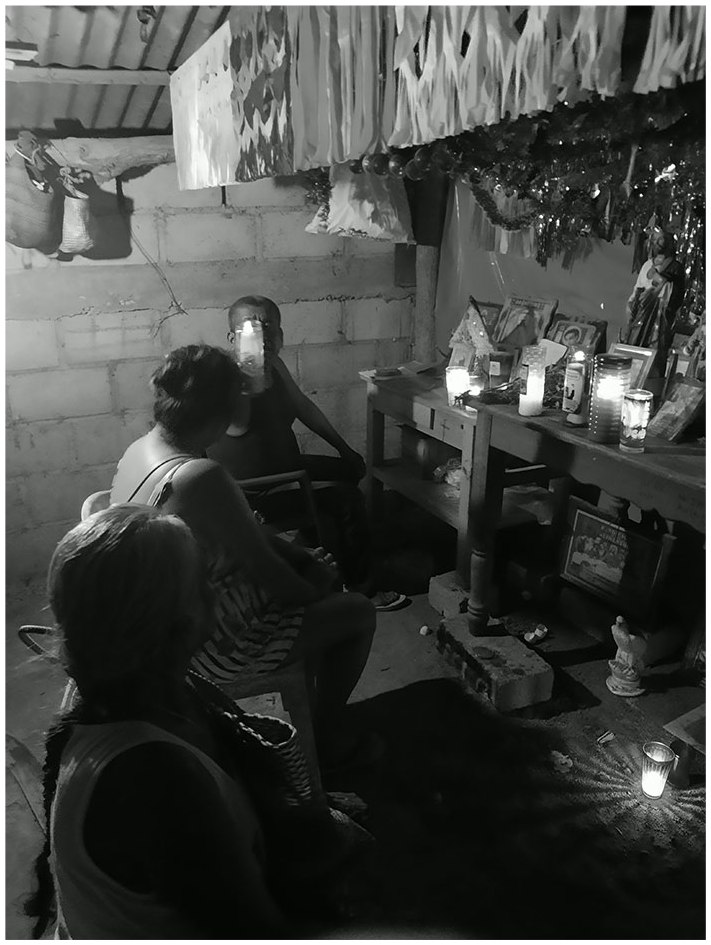
Ritual at the curandero’s house.
Slowly, without realising it, I was slipping through an epistemic portal into another way of understanding and another way of being in and seeing the world. As I entered deeper and spent more time with devotees, this altered the categories of my experience, shifting my awareness. Luhrmann might suggest that, over time, these experiences generated in me a “faith frame”—what she describes as “a special way of thinking, remembering and expecting” (2020, xii) that is distinct from “ordinary expectations about an everyday world” and that assumes there are “invisible beings involved in human lives” (ibid, 21). And that through each ritual action within the “faith frame,” my sense of Santa Muerte was being “kindled from the tinder of these small practices of attention” (ibid, xiii).
We would go shopping together to buy votive candles and other magical supplies. Often, candles were requested by the curandero who then infused them with his powers and lit them in further rituals. Abuela and Abby, with the help of other women in the family or their friends, usually took the lead in choosing the correct candle for me, as the shop carried a huge variety. They would examine, discuss, and then choose, explaining, in this occult idiom, that this particular candle was perfect to help me. I remember the last magical candle Abby picked out for me to take to the curandero for infusion with his powers: El Triunfador, The Winner. It featured the picture of a person celebrating a great victory with fists punching the air in ecstasy. The candle was said to bring abundance, bounty, and great success in all areas of life. Though she never said this to me, when she picked out that candle for me, the week before my departure from Mexico, I knew that Abby wanted me to have the world at my feet.
*
Through all these experiences, we built occult bridges between each other through devotional, participatory praxis to Santa Muerte, which created dividualistic porosity. To this day, even though I am in Canada, ensconced in the world of logos and academe, and have been unable to go to Oaxaca recently due to Covid travel restrictions, not a week goes by where I am not called upon to maintain an occult bridge to the family and to shift my epistemic frame.
I am requested to pray to Santa Muerte for members of the family in Oaxaca and their friends. I am asked to light Holy Death candles for them. I am requested to comment on the occult meanings of dreams or bade to look for a spell in my research books that might aid someone’s situation. I am consulted on which curandero might be best suited to help, and much more. In short, I am requested to care for my Mexican family through spiritual gestures. These are a language of love that require a “participatory orientation as involving the senses, creating emotional connections to the world” and each other “using holistic language. . .seeing the world as inspirited” (Magliocco 2010, 9; see Greenwood 2009, 31).
This occult bridge flows both ways. During difficulties, candles have been spontaneously lit for me by various members of the family in their chapel to the skeleton saint. During dangers, they have sent me instructions on how to perform rituals of protection. I have been messaged pictures of prayers they have written to Santa Muerte on my behalf, which have been placed at the chapel. As always, whenever a problem arises, they ask me if I want them to go to the curandero for me.
When I have recounted how people created difficulties for me, spells have even been done free of charge by brujas (witches) I have met through my Santa Muerte connections to ensure their ill will is returned to them seven-fold. Occasionally, as detailed, I am surprised by gifts of occult motivation, such as Abby’s textual ex voto. Written in a language of love, like my work, her script bridges two realms: the practical and the magical. Abby related that it will help me in this realm in my pragmatic understanding of the nascence of the Santa Muerte chapel, but also as a gift and labour of love to Santa Muerte and her dead grandfather, it will aid in the spiritual sphere, moving invisible forces so that Marc might be freed from jail.
*
Such participatory orientation, emotional and inspirited connections to others, as well as usage of alternate states of consciousness is familiar to me. My aunt was immersed in New Age and other mystic practices throughout my childhood. These were not to be discussed at the dinner table. My parents thought these to be nonsense, and thus I learn to keep what I saw at auntie’s house a secret. In fact, my own views changed as I slipped in and out of my parent’s world of atheism and my aunt’s inspirited cosmos.
Like with my “fieldwork family” in Mexico, my auntie was immersed in similar praxes out of care for her loved ones. She had many decks of tarot cards, some called forth the energy of archangels, others tree spirits. I remember one day: An anxious friend of my aunt’s appears at the doorstep, she is crying, worried. Auntie brings her in, they talk a while. Auntie gets out her tarot cards. I am sent to play in the room next door so that she might focus on her friend. The odor of incense wafts into my play space. Then I hear the instructions from my aunt’s soft, calm voice.“Let’s connect: breathe in deeply with me, now exhale. . .” Now there is a long silence. Then the sound of tarot cards being flicked onto a table. My aunt is murmuring words now inaudible, her friend seems to be agreeing. Later I am called back in, auntie’s friend seems calmer.
I recollect, that in the days before Skype or other videocall services, my aunt would receive long-distance phone calls from acquaintances in difficulty, would do tarot or pendulum readings for them and, if she had a photo of them, would glide incense plumes over it, with her eyes shut as she focused on them through what she called her “mind’s eye”. Her belief was that a spiritual connection, a bridge of sorts, can be built over any expanse, big or small, and that is a way of caring, seeking to help those we love when they most need it.
At age 14, my aunt gifted me a divinatory set that included tarot cards, runes, the pendulum, and more. She told me that when you are not sure how to help a friend or advise a sister, you should swing the pendulum, lay out the cards, or divine from the runes. It is a labour of love. You are kindling and growing y your relationship not onlto the divine but to the loved one, strengthening an occult bridge between you and them.
A few years later, after the tarot set was gifted and I was judged old enough to go, at auntie’s suggestion, I attended several occult workshops. Just like in fieldwork, I was taught that participating, not just observing, was essential. But I was tutored in other skills that no ethnographic field methods book has ever mentioned and that I believe have been vital to my scholarship. because what my teachers meant by participation was not just joining in whether you believe or not—it meant engaging fully through participatory consciousness, porosity, immediacy, and osmotic interconnectedness.
In various exercises, I was trained to become permeable with what was around me, to merge myself with both human and material, physical and spiritual. Sometimes it was just a sealed envelope that contained photos that my instructor handed to me, and advised me to meld myself with so that I might permeate it and then tell them what the photos featured: I remember one time I said it featured round, yellow, and red. My teacher opened the envelope; it contained a picture of red and yellow balloons. Other times, I was told to merge with someone before me,and the spirits around them to bring forth messages; I was building an occult bridge through me, between loved ones dead and alive.
While I did not discuss these workshops with my parents, and when at home I slipped easily back into their atheistic framework, it was at university that I truly distanced myself from them. I had to choose a side because all these practices were but “contemptible superstition” (Tylor [1871] 1958, 22) and, luckily for me a so-called “Modern” (Latour 1996,1), anthropology would help me learn the “science of unreason” so as to understand the Other who thought in these irrational terms (Kapferer 2002, 2). But even though I chose my side and shifted entirely to the world of logos, not wanting to be labelled as gullible, irrational, and of “childish mind” (Frazer [1813] 1990), I never entirely forgot my spiritual training.
*
One day during fieldwork, I was on my way to the market. I stopped by to see Abby at the shop. A customer was buying some hair grips from her. As soon as her client left, Abby’s face changed. I had never seen her that way. She never shows an ounce of vulnerability to anyone. Close to tears, her voice shaking, she told me that she had been to see the local curandero but he was not there, and the other one was too far away to venture to in the dark, after work was done. She was exhausted and broken, she wanted to do a limpia, buy some candles, pray, and work “reversible” magic. This kind of magic is used to return black magic that has been done to harm someone. Abby suspected that she and her boyfriend had been hexed by a jealous member of his family that objected to their relationship because she was a devotee of death.
It had been two years of incarceration at that point, and Marc had not even been granted a trial and was locked in a place containing shanks, murderers, and madmen, when “he is just a fisherman trying to make ends meet and besides which he castoff the evidence onto the seas so they really have no reason to hold him any longer”. I did not know what to advise. I have no experience in such matters. But I had been taught a long time ago by my auntie that to work the occult is a language of love. I tentatively agreed to help her conduct the ritual.
As Abby was busy at her shop, I offered to buy the requisite supplies, and to return at an appointed time and accompany her to the chapel. She requested I carry out the basil limpia. I had seen this done by curanderos and brujos (witches) many times before. While a limpia con huevo (egg cleanse) can be feasibly done by oneself, the basil limpia requires outside help. The person who wishes to be cleansed must sit, or stand, as another, the cleanser, brushes them with one or two very large bunches of fresh herbs. The cleanser should also pray for the person, imagining all negativity and impediments leaving the person and their path. Some curanderos even make a sucking sound while they perform it, effectively exsufflating all evil from the patient.
Directly prior to the ceremony, Abby told me details I had not known. Her mother, Marc, a young fisherman, reminded her of Abby’s father, also a fisherman, who had gone “loco” from witchcraft and whom Abby’s mother had fled from with the children. Even though Marc helped Abby pay for her university studies, her mother had since deemed all fishermen a danger to her daughter and, therefore, she had thrown Abby out. Meanwhile, her father’s family, which included Abuela, had welcomed them in. Prior to that time, Abby was deeply Catholic and was influenced by her mother’s view of Santa Muerte as dangerously occult, and that side of the family rejected the metaphysics of la Muerte. But as devotees of death with Indigenous Zapotec blood, Abuela and her father had taught her not only the secrets of la Santa but also the value of curanderismo, thereby, as I realised, opening her up to a new epistemic framework.
Nowadays, she told me, her mother had accepted her relationship, perhaps because Marc was locked up in gaol. Abby later moved in with her to save money for Marc’s lawyer, on her mother’s condition that Abby not refer to, nor practice, her beliefs. But Abby, like me, resided in two worldsa dividual who while with her mother’s family acted according to Catholic frameworks but with her father’s family, and when she went to pray at the chapel, believed fervently in Santa Muerte.
Abby also told me of Marc’s near death at the hands of the marine police, his incarceration without trial, their attempts to have a longed-for baby, the problems that had arisen in conception and many more intimate details. I felt her pain and sadness, and her need to remove all the burdens that weighed upon her. It was out of love for Marc, above all, that she requested the ritual, so that if she could liberate herself of hexes, which also affected him, he might one day be freed.
That night at the chapel recalled my very first visit. The shrine was shrouded in darkness, and only the light of the moon and innumerable dancing candles illuminated the bony forms of the various statues of la Señora de las Sombras (the Lady of the Shadows), as Santa Muerte is sometimes known. We invoked Saint Death in prayer before proceeding with the rituals: “Santisima Muerte de mi corazon, no me desampares de tu protección”.
1
During the limpia con huevo, after I cracked the shell open and let the contents glide into the glass of water, Abby asked me to read the yolk for her, a process deemed best done by someone else for the purposes of objectivity. Initially, I felt conflicted, I had been told to participate and observe but not to believe in my anthropology classes, as magic was but delusional irrationality. But how could I participate fully without believing? There is a big difference between participating and pretending to participate. “Willing suspension of disbelief for the purpose of an experience that creates a sense of participation is not the same thing as belief” (Magliocco 2010, 23).
Victor Turner observed that "to each level of sociality corresponds its own knowledge, and if one wishes to grasp a group’s deepest knowledge one must commune with its members, speak its Essential We-talk" (in Jules-Rosette 1975, 8). We-talk in this context required full participation, not acting “as if”. Mocking, play-acting or doubting the efficacy of the ritual and not fully investing myself in it was not only improper participation but to disrespect Santa Muerte traditions and betray Abby’s trust. In this context, belief and participatory consciousness formed not only a means of empathising with Abby but also a way of knowing her and Santa Muerte via another modus. Just as in the pagan rituals which Magliocco has described, rituals to the skeleton saint are not “performance events that can be observed from the margins, but demand active participation from everyone present” (2012, 12). Had I not fully participated, I would have missed the principal experiences central to devotion to death.
As I interpreted the cracked egg in the glass of water for Abby during the limpia, I recalled my aunt reading the tarot for her friends. As I passed the basil over Abby’s body focusing on expunging cosmic grime, I recalled my aunt drifting incense over photographs with her eyes closed. As we purged evil and prayed to Santa Muerte, I lost track of time, space, identity and merged myself with her as I had done with the spirits in the magical workshops of my childhood. I did not willingly suspend belief, I believed, and for a moment in time I sensed not only Abby, but Holy Death in a different way, through a sentient consciousness. The rite generated deep connections and understandings between Abby and me despite our different backgrounds and origins.
That night would not be the last time that I would engage in rituals. In fact, I would attend many more as a consequence. It dramatically improved my status, earned trust as well as respect, opening not only the family but members of the Santa Muerte community to me. Abby appraised my reading of her limpia a success, and told others. It was recognised that I was not just acting “as if” but respected and understood Santa Muerte and her traditions. I was judged qualified to record and preserve sacred skeleton saint knowledge for “gringos”. Before long others in the family were asking me to read their limpias.
What had started as a labour of love for Abby which led to slipping into belief or a “faith frame” as I participated fully, led me to learn not only of many devotee’s secrets, as well as being imparted arcane Santa Muerte knowledge, but ultimately allowed me to understand the concerns of devotees through sensory experiences. This gave me new insights into the power of Santa Muerte ritual to bring new life, hope and provide a space within which you are listened, loved and healed, not only by the other humans present, but by the spirit of Death herself (Kingsbury 2020, 59). I learnt how Santa Muerte spirituality views the cosmos as permeated by flows of different kinds of energetic forces which generate effects on events, people and places, and thus it is vital to be attuned to these. Ideally, one must osmose with these through the power of death, pulling in the bounteous, expurgating the bad and returning all evil to senders. Above all, I learnt what it is to accept death.
After I left the field, I felt guilty. Had I gone native? Had I done the very thing I had been advised by my anthropology instructors not to do? Should I tell anyone? I decided to reveal my experiences to a few select mentors. As Tedlock writes: “the public revelation of participatory details of the fieldwork experience is still considered embarrassingly unprofessional by some ethnographers. It is as though fieldwork were supposed to give us two totally independent things: reportable significant knowledge and unreportable mysticism” (Tedlock 1991, 71). One mentor told me to never write about what I had done if I wanted my ethnographic writings to be taken seriously, another brushed it off as me, a naïve young anthropologist, confusing fantasy for reality in the heat of the moment. They assumed that I would soon snap out of it. Another told me that I should not document any of this until I was tenured. But during and after the ritual with Abby I learnt more in a few weeks than I had in all previous field trips combined.
*
Greenwood (2009), Lévy-Bruhl (1952), Magliocco (2010, 2012), and Tambiah (1990) have written about the participatory bonds that magical moments foster, how the separateness of phenomena and people are broken down in transcendental experiences that disregard space and time. Lévy-Bruhl calls such moments of participatory consciousness “participation mystique”. While certain academics have criticised this idea, suggesting that Lévy-Bruhl associated this with “primitive” and “prelogical minds” (Moore and Sanders 2003, 6), other scholars have reclaimed participation mystique, advancing that it offers a way to understand “mystical mentality” (Greenwood 2009, 21; Tambiah 1990; Winborn 2014). Greenwood writes that during participation mystique, fusion of the self with what is around it is total: “bodily boundaries dissolve to such an extent that feelings of personal connectedness and empathy are intense” (Greenwood 2009, 29). Tambiah speaks of the “existential immediacy” that participation mystique allows for, and a “language of solidarity, unity, holism, and continuity in space and time” (1990, 109).
Scholars have detailed that the anthropologist and their respondents share moments where they are “experiencing together and, yet, not in the same way”. Holly Porter glossed this over as “interexperience” (2016, 23). If the ethnographer can leave logos for mythos and fully emerge themselves in liminal spaces with respondents, moments of the occult have the potential to create bridges between people and their worlds, thus not only fostering “interexperience” but also potentially effacing boundaries such as race, gender, class, and more.
We are born “in a sea of sameness,” writes Bryon (2014, 146). As infants, she says, we naturally participate fully in the world around us; as babies we are unable to different between ourselves and others, and we have no discriminations. The author details how it is only through ecognizedon as individuals that we lose this sense of cohesion, that we are encouraged, as I was at university, to create boundaries and define ourselves through distinctions to others. But magical moments, if we embrace them fully, can encourage “interpenetration, interweaving, and opening” between each other (Eigen 2014, 113).
Victor Turner recognized the homogeneity that rituals can create. Developing Arnold van Gennep’s second stage in the latter’s tripartite rite of passage, Turner coined the term communitas to describe the “moment in and out of time” where people become indistinguishable equals, and develop “intense comradeship” (1976). People are no longer individuals, but, I argue, become dividuals. It is precisely due to this that attendees are “fashioned anew” and acquire “new powers” (Schechner 2002, 58). This comes from participation mystique and the porosity between people that rituals and magic moments can create.
*
Anthropologists, impelled by the work of Louis Dumont (1980)—which has since been contested—once held that different societies and cultures had distinctive notions of personhood. The European person was imagined to be an autonomous individual, a static self who is bounded and monadic. The neologism “dividual”, coined by Marriott and Inden (1977), was taken up by anthropologists, such as Marilyn Strathern in her ethnography of Melanesia (1988), to propose a more fractal notion of the person in other cultures. In the latter, people are said to be partible, not static beings but processual, whose fluidity is sociocentric and correlates to their embeddedness. Kalpana Ram explains that they are “someone with permeable boundaries” (1994, 145).
More recently, while some anthropologists argue that with modernisation there is an increasing individualisation (Touraine 2002), it is recognised that in every society “all persons are both dividuals and individuals” (Englund and Leach 2002). Indeed, Martin Sökefeld has criticised the ethnocentric othering that such distinctions imply, namely, that Westerners are selves, and Others are not (1999, 429). Nevertheless, Charles Taylor’s work focuses on buffered/porous selves, once again referring to the passé individual/dividual binary. Using a Weberian idiom, he distinguishes between the modern world that is “disenchanted” and where people are buffered and have a “firmer sense of the boundary between self and other”, as compared to the “pre-modern” and “enchanted world” where there is “a perplexing absence of. . .boundaries” (2007, 33).
Contrary to Taylor, I believe that in all cultures there remain enchanted spaces where people embrace their porosity as dividuals. Whether it is in England where people, such as my auntie, seek to connect and merge with objects, people, and spirits, or in Mexico where in rituals people osmose with each other and Holy Death in spiritual spaces.
Such porosity in occult rituals appears across the world. Behrend has described the blurring of self and other in African rites. They state that in possession, for example “the self, the body and the person are not unitary concepts but open to a constant reformulation through mutable entanglements with others” in “practices that inscribe dividuality” (Behrend 1999, xviii). Ferrié’s work on the community of Apolo in the Bolivian piedmont also addresses this porosity, albeit this time it is viewed by locals as negative: the “human body riddled with openings and holes” may become infested with evil forces (2018, 143).
In Mexican curanderismo, porosity and making connections between the patient and the curandero, and linking the world and the psychic and mental domains is vital (Arias 2014, 226). In her work on the Mazatec curanderas of Oaxaca, Sylvia Marcos writes of this porosity between the spirit world and the women healers who transcend borders, becoming flooded during ritual with the divine: “they are not the ones who speak. . .They are not the ones who cure through massage. They are not the ones that heal. It is the sacred through them” (my translation, 1989, 381). The chants of Maria Sabina, the most famous Oaxacan curandero, also speak to her porosity with the world around her. During rituals, “Maria Sabina becomes what she names” (Krippner and Winkelman 1983, 227). She merges with the world both physical and metaphysical, becoming smoke, wind, and other elements, and receiving cures and poetry from the teonanacatl or los niños santos, the mushrooms she communed with. She sang “I can swim in the immense, Because I can swim in all forms” (Úzquiza 2011, 399)
In such rituals, there is a letting go of the sense of the self, of identity, and of independence. The dividual is interdependent, dynamic, mutable, and formed from their social, emotional, and physical connections, and constant exchanges with others. They embrace neither “the realm of objectivity nor to that of subjectivity, but rather human intersubjectivity” (Tedlock 1991, 72). If ethnographers of the occult are willing to embrace belief and dividuality, these offer rich research experiences, not only opening portals to new ways of knowing but conjoining us with our respondents through our shared humanity and the trials and tribulations we experience.
*
Ever since Malinowski proposed that fieldwork was the current method of study, the goal of ethnography has been to “grasp the native’s point of view, his relation to life, to realize his vision of his world” (1954, 25. At the same time, when fieldwork is done, we are told to “dust yourself off, go to your desk and write down what you saw or heard. Relate it to something you’ve read by Marx, Weber, Gramsci, Geertz” (Behar 1996, 5). Above all. do not tell anyone you went “native” if you want to be taken seriously.
While the discipline is changing, it is still the exception rather than the rule that prevails in anthropology, for scholars seldom detail their own mystical experiences or the consequences of these in traditional monographs. When anthropologists have reflected upon personal changes they underwent in any significant detail, this has most often been in the form of “confessional tales”, perhaps published as a separate volume or an afterthought at the end of their monograph (Van Maanen 2011) or they hide more than they reveal.
Autoethnographers, however, have pushed these boundaries. Their work fuelled by postmodern skepticism regarding generalization of knowledge claims gives us the opportunity to “focus on emotion in the social sciences” (Anderson 2006, 373) and to ponder unconventional ways of knowing. Autoethnographers situate their interpretations within personal reflexive views. “They themselves form part of the representational processes in which they are engaging and are part of the story they are telling” (Anderson 2006, 382).
Michael Schwalbe (1996, 58) observes how autoethnography can provide insights both as a doorway into other people’s experiences and as a mirror to look back at one’s own. Such mutual informativity and intersubjectivity make autoethnographic work rich. Notwithstanding, the focus on the author can lead to texts resembling an ethnographic selfie in what Geertz (1988, 15) has critically called “author saturated texts”. At worse, “autoethnographic elements can easily become “self-indulgent, narcissistic, introspective, and individualized” (Stahlke Wall 2016, 25). We may be left with too much intimate knowledge of the self-absorbed author and “lose sight altogether of the. . .Other” (Rosaldo 1993, 7).
*
It is reductionistic and risky to presume that “one’s own experience is the same as that of one’s subjects, especially when there are great differences in culture, age, gender, power, race, religion or sexual orientation” (Magliocco 2010, 16). As much as Landry has detailed how as a White academic male studying Vodún he could never fully experience the same as Beninois initiates (2018, 172), because I am a White woman who grew up in Europe, I cannot suggest that my experiences of Santa Muerte were akin to those of Abby. I lack Mexican ancestry. I have not experienced centuries of postcolonial oppression and I have been fortunate enough to pursue a doctorate. Nevertheless, having seen my life slip away before me; having experienced money struggles, sexism, family problems, and other difficulties that were not dissimilar to Abby’s; and having grown up with occult influences, this allowed me to connect deeply with Abby, and others, during rituals when our lives intersected and we permeated each other as dividuals through shared understandings of pain, distress, trauma, and near-death.
Liminal moments of participation mystique, often accessed through alternate states of consciousness and achieved by embracing porosity with others, empathy, and immediacy may erase the “buffered” boundaries that constitute self and Other, allowing the ethnographer of the occult—if they are willing to believe and respect traditions—unique experiences and new insights through intersubjectivity and interexperience. “If we find a way to draw strength from both sides of the between and breathe in the creative air of indeterminacy, we can find ourselves in a space of enormous growth, a space of power and creativity” (Stoller 2009, 4).
While autoethnography is sometimes narcissistic, if autoethnographers of the occult are able to recognise their interdependence with and connection to others in ritual moments of participatory consciousness, they may create accounts that are not merely mirror reflections but speak of the connections that human relationships are comprised of. They may thus bring new insights from the context of spiritual social embeddedness, based on knowing together through the senses.
Most people believe in superstitious ideas such as good or bad luck, ill omens, lucky charms, and perfect timing. Most of us also “ascribe to scientific thinking, aware that gravity, not God, makes an apple drop from a tree” (Kingsbury 2021b, 24). We tend to flip between the two modes. Greenwood terms this process of switching between magic thought and scientific analysis “not only but also” (2009, 111). There should be no shame in embracing other beliefs and slipping between science and academia, especially when one is an ethnographer of the occult whose fieldwork depends upon successful integration in spiritual spaces. Fortunately, my aunt long ago taught me the value of code-switching between occult and secular worlds. As humanist anthropologist Michael D. Jackson emphasized, the advice to ethnographers “not to lose sight of his or her academic objectives by going native” depends on “culturally and historically determined distinctions that cannot be sustained in reality” (2012, 16–17); hence it is only natural that ethnographers of the occult take on local beliefs as they immerse themselves in research.
I remember contemplating the ridiculousness of having to hide my statues of Santa Muerte when an anthropologist colleague last visited my house, for fear of the rumour becoming official that I had “gone native”. When Abby visited my cabaña in Oaxaca, I never needed to hide my anthropology books away. Given what this suggests about how beliefs are perceived by academics and respondents, and the dark history associated with these perceptions, perhaps it is high time I took my skeleton saints out of my closet for good and that ethnographers of the occult not be judged for embracing the occult.
Footnotes
Declaration of Conflicting Interests
The author declared no potential conflicts of interest with respect to the research, authorship, and/or publication of this article.
Funding
The author received no financial support for the research, authorship, and/or publication of this article.
