




Abstract
This article explores the world-building activities of players of the tabletop game Blood Bowl—a game that parodies American Football within a fantasy setting. It utilizes a ritual framework to focus on players’ activities relating to the considerable amount of luck inherent to the game. Based on fieldwork and survey data, it interprets players’ rituals and other actions as an effort to enact a particular social space, a “magic circle,” where enjoyable risk-taking and “edgework” take place. This social space is then analyzed within the Mary Douglas-derived theory of sociocultural viability (cultural theory). Using the theory’s typology, Blood Bowl tournaments can be characterized as individualist–hierarchy hybrid institutions. The article contributes by offering cultural theory as a tool for analyzing and comparing risk-taking behavior in diverse social contexts. The worlds built through Blood Bowl play are both analyzable and comparable with those integral to other social institutions, with cultural theory’s social solidarities ubiquitous. The article thus innovates by linking literatures on leisure and gaming with broader social theory.
Introduction
Unpredictability is part of many games, harnessed to varying degrees. Blood Bowl, a tabletop game where players utilize miniature figures and roll (mostly six-sided) dice to play a surreal version of American football (more further), is no exception. Indeed, to some, the inherent randomness of the game is part of the charm, where chainsaws may kick back and kill the wielder or the crowd may beat large chunks of one team senseless in a pitch invasion. Participant observation of Blood Bowl reveals that many players utilize a variety of rituals throughout their games. In this article, I examine these behaviors, seeking to understand them sociologically. I interpret Blood Bowl player behavior by applying the Mary Douglas-derived theory of sociocultural viability (cultural theory, for short). Cultural theorists argue that discursive narratives on the world, for example on the nature of reality and the role of chance, are coproduced with particular patterns of social relations, called social solidarities. Thus, a person articulates discourse concomitant with performing a particular pattern of social organization. This is discourse in the sense of a social text that is coproductive of common sense, legitimate knowledge, meanings, and relationships (Dryzek 2013, 9), generating distinctive narratives about the world. I argue that as social institutions, Blood Bowl tournaments reflect the discourses of the social solidarities and their distinctive attitudes to risk. I further contend that information challenging/reinforcing dominant institutional narratives is managed ritually, performing social spaces for particular forms of world-building, with concomitant framings of risk and risk-taking. Thus the rituals of Blood Bowl tournaments around risk and uncertainty will resonate in similar institutional contexts. I thus contribute to the literature on games and attitudes to uncertainty by outlining a path for research into discerning and predicting what contexts rituals will predominate, uniting the literature on games, ritual, and broader social theory.
This article is structured as follows. In the next section, I introduce the Blood Bowl tournament scene. I then present theoretical and methodological frames, notably cultural theory, and useful concepts drawn from games literature. I then present empirical material, discussing how Blood Bowl tournaments are performed ritually. I conclude with discussion of how these rituals may be interpreted using cultural theory as well as opportunities for future research. This broadens the focus, highlighting how cultural theory allows for innovative connections to be made between diverse practices and contexts, and briefly suggests a contribution for games studies to make to wider social issues.
The Game of Fantasy Football
Created and produced by the miniature gaming company, Games Workshop (GW), Blood Bowl thematically combines fantasy fiction and American Football. The fictional background of the game (the fluff) sets the game within an alternative version of GW’s Warhammer World—the setting for several other games (e.g. Warhammer, Mordheim, and Warhammer Fantasy Roleplay). In this setting, numerous fantasy races (elves, dwarfs, orcs, etc.) are locked in endless conflict, which players act out in games. The Blood Bowl world is dominated by the existence of the ancient god Nuffle (a pun on the real world’s NFL—the [US] National Football League) whose sacred game, Blood Bowl, enthralls all. Rather than endless war, the various races play Blood Bowl. A key part of the atmosphere is a vein of surreal and occasionally dark humor (see Figure 1). There are thus various rules to simulate pieces supposed to be of abnormally low intelligence or to have near-irrepressible desire for blood, which causes them to randomly bite teammates or the crowd.
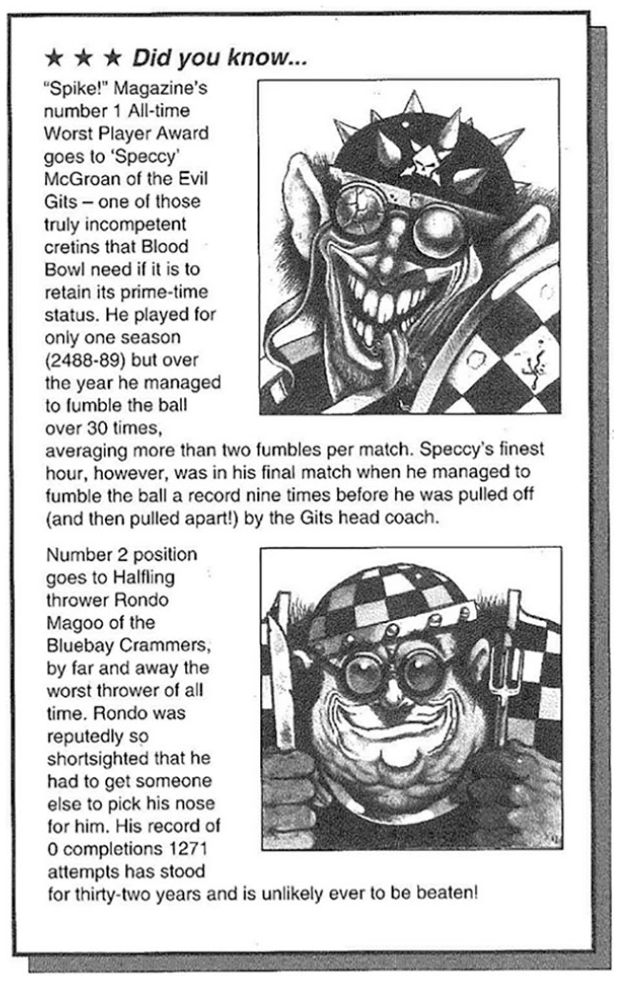
Surreal Blood Bowl lore from a rulebook.
Blood Bowl, like most GW games is a “collectable strategy game” (Williams 2006), combining buying and painting figures to use in the game (see Figure 2), which takes 2–3 hours. This paper focuses primarily on the gaming aspect of Blood Bowl, although other aspects of “miniaturing” overlap (Meriläinen, Stenros, and Heljakka 2020). In terms of game mechanics, the game’s originator describes it thus: Blood Bowl is what I would call a push-your-luck game. By that I mean you can stop taking actions at any time or. . .take a risk and carry on until you run out of actions or mess one up! The choice of what actions you take and how many you take lies with the player. . .you need to look at the state of play, weigh up the odds, figure out what you need on the dice and work out if the risk of it going wrong is outweighed by the reward of it going right. That dilemma sits at the heart of Blood Bowl—it keeps you on your toes because you’re measuring up a random risk (the dice are fickle, remember) for a known reward. (Johnson 2019, 64)
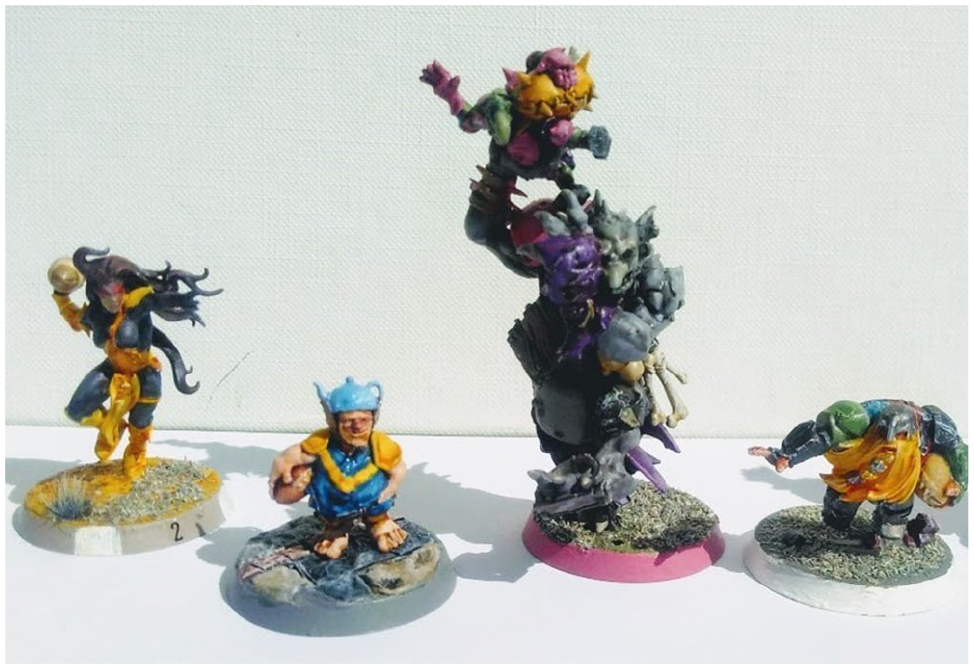
A selection of GW Blood Bowl playing pieces. Left to right: a wood elf, a halfling, a troll and a dwarf.
A key feature of Blood Bowl is the principle that if a dice roll fails, one’s go ends. Luck and uncertainty are thus integral elements of the game, and likewise. it is rare that one cannot take a chance for some reward.
Uncertainty in Blood Bowl comes in various guises: there is uncertainty around a player’s ability to pay attention and solve the puzzles their opponent creates. Likewise, there is uncertainty relating to the analytic complexity of the game—Blood Bowl is complicated by many rules interactions. Likewise, several teams have been designed to better or worse than others for thematic reasons. Thus elf teams are fast and agile, while halfling teams are terrible. There is also uncertainty around an opponent’s actions and, finally, as mentioned earlier, the considerable randomness built into the game itself.
Blood Bowl Tournaments
Despite the high levels of uncertainty involved, Blood Bowl is popular as a tournament game. The NAF (Nuffle Amorical Football, a humorous reference to the real-world’s NFL 1 ) exists as a tournament organization in both the game-background and the real world. The real world NAF “acts as a central resource for Blood Bowl coaches the world over—offering news, contacts, discussion, sanctioned tournaments and international player rankings” (NAF n.d.). It was established in 2003, apparently with the encouragement of GW employee and originator Jervis Johnson (King 2020). All the tournaments attended as part of this research were NAF-sanctioned. Those who wish can pay a €10 membership fee and are ranked within the NAF system. In 2019, NAF reportedly had 19,181 members 2 , and recorded within the NAF database listing 35,907 Blood Bowl matches played at NAF-affiliated tournaments during the year (Davies 2020a, 2020b). The existence of NAF points to an arguable difference between Blood Bowl and other collectible strategy games. For a long time, Blood Bowl was unsupported by GW. As such, until the most recent GW version, NAF disseminated the most up-to-date rules sets. With new GW rules appearing since 2016, NAF continue to produce recommendations about how to incorporate these into the existing tournament scene. Similarly, during the lull in GW support, other model manufacturers have produced fantasy football figures. As such, the Blood Bowl tournament scene is perhaps slightly separate from the game’s originators’ control in comparison to other collectible strategy games, and participation is less dependent upon purchasing official GW products (cf. Mizer 2015; Williams 2006).
While Blood Bowl tournaments vary in size, several elements are constant. First, each player must “build” a team in advance according to a resource system. Different tournaments have different rules around team-building, presenting differing challenges. For example, by mandating that each team take particular pieces. Efforts are made to balance the teams, typically by providing the worse teams with more resources.
Once at a tournament, proceedings usually began with some sort of ceremony. These ranged from elaborate events with bands, video and official welcomes from local politicians to the tournament organizer simply welcoming people and telling people to get started. A similar situation occurred at a tournament’s end, with elaborate prize-giving ceremonies contrasting with a low-key handover of a modest prize. Around the opening ceremonies, players would typically register in some form and would collect a welcome pack at larger events, which often included commemorative dice or figures. Usually, players would have sent in their “team roster” in advance. This listed their chosen race (e.g., orcs) and the different figures (e.g., “blitzer” or “thrower”, which have different in-game abilities) to be used.
In all cases, playing revolved around a number of tables with Blood Bowl boards on them, with seating laid out so that each player sat opposite their opponent at different ends of the board (Figures 3 and 4). At larger venues, there were bar facilities available, allowing players to consume alcohol during and around matches. Often there were also stalls selling Blood Bowl-related products such as teams, dice, or t-shirts. When not playing or finding opponents, people would usually chat with fellow players, either at the bar, in corridors or at tables watching others play.
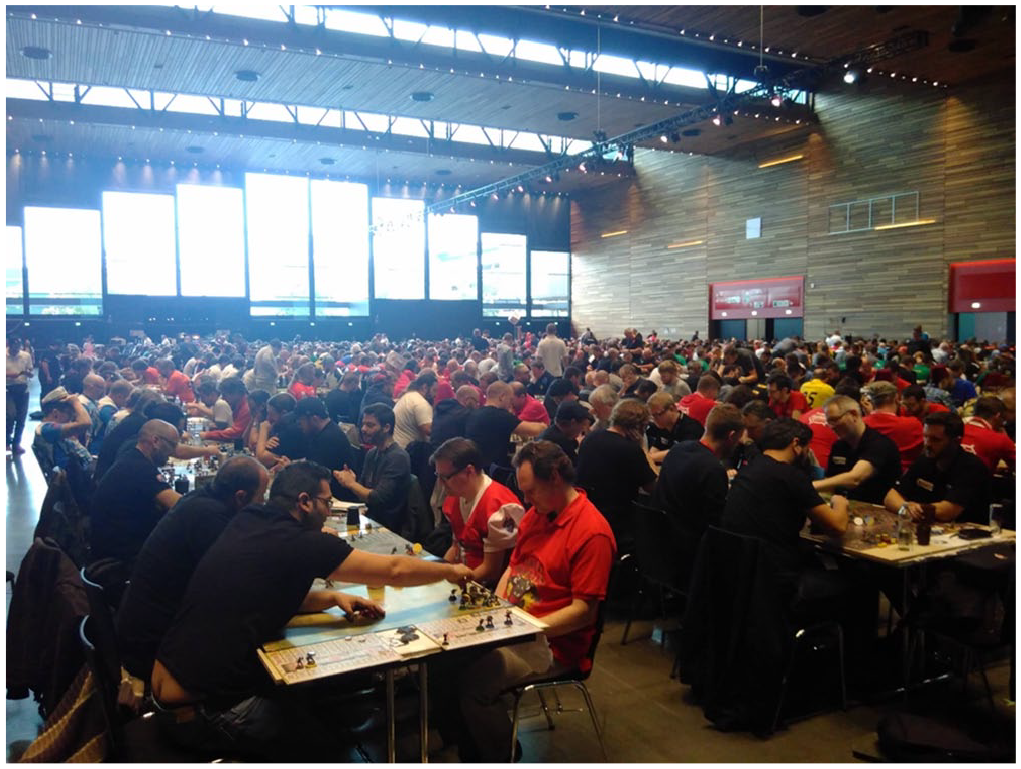
The main gaming hall at the 2019 world cup.
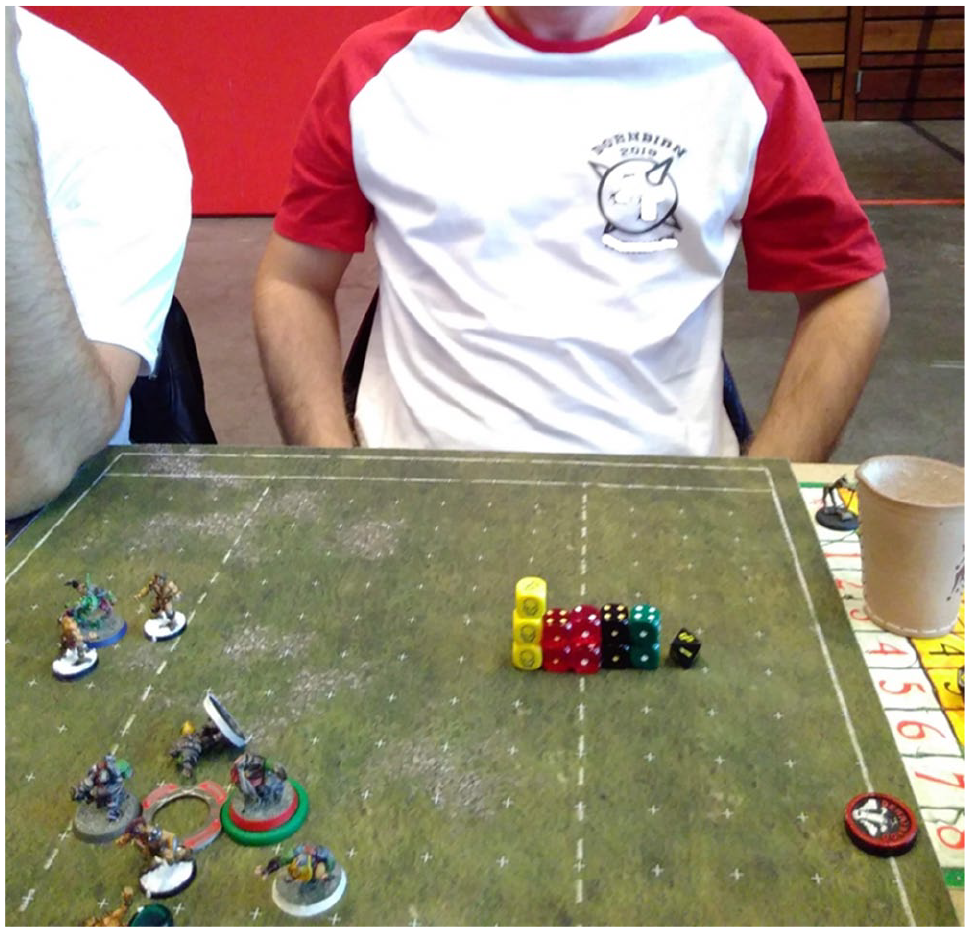
To jinx me, my opponent has placed all his dice to show the lowest possible result. He is also wearing a squad t-shirt.
Blood Bowl games begin with a series of rolls designed to determine the conditions under which the game takes place, for example, rolls are made to determine the weather. Typically, players then set up their pieces and ball marker. The players would then usually shake hands at this point and it was understood the game began in earnest. At the game’s conclusion, it was common to shake hands once more and fill in the result to be reported to the tournament organizer. The results would then affect the pairings in the next round of matches. Many of the tournaments visited were squad tournaments, with groups of 3–6 players playing for an aggregate result against another squad. Players were thus ranked individually, but the squad’s overall position was based on collective performance. Players were supported by other participants in non-playing roles, who typically took on a role as adjudicators of disputes and enforced the tournament schedule. At bigger tournaments, these other figures were identifiable by a uniform.
Cultural Theory and Games studies
This research focuses upon several things, Blood Bowl player’s ritual activity, their understandings of risk and their relationship to social contexts (Malaby 2002). A theoretical lens is required, which in the paper fulfilled is by the theory of sociocultural viability (cultural theory).
Cultural theory’s starting point was anthropologist Mary Douglas’ noting of certain patterns observed in how disparate peoples organized themselves and their world-view (Douglas 1970[2003]). Groups are assessed regarding the extent of incorporation into bounded units and the extent that an individual is bound by the scope of external prescriptions. From this a typology of four different social solidarities emerges (Thompson et al. 1990, 5): egalitarianism, hierarchy, individualism, and fatalism. Each social solidarity generates a discourse with a particular, distinctive narrative on nature, humanity, time, styles of learning, material and political distribution within society, with an associated “behavioural strategy” (Thompson et al. 1999, 1). Each social solidarity likewise demonstrates a different pattern of social and political relations. Social solidarities may exist at any level of social organization from dividual to the international level (Thompson 1998, 200; Thompson 2008b, 70). They are seldom hegemonic, with the solidarities (and concomitant discourses on the world) coexisting within institutions, often in a pairwise fashion (Verweij, Thompson, Engel 2011b; cf. 6 and Mars 2008, xviii–iv). 3
Several important points need to be made. First, no social solidarity is more or less correct than others. Each solidarity produces partial knowledge irreducible to that of the other social solidarities. The goal of cultural theory analysis is not to identify correct understandings of a situation. Second, cultural theory is not a theory of personality types. People move between different social solidarities as they go about their lives, even during a single day. Third, cultural theory is a dynamic theory. As situations change, either due to the action of people or otherwise, it may be increasingly difficult to continue to sustain a particular worldview. This is rooted in the imperfect framing that each solidarity generates—the knowledge of the other solidarities has a tendency to make itself heard (Verweij et al. 2011). The social solidarities are thus not simply deterministic; as discourses, they constrain and enable particular behavior (Tansey and Rayner 2009).
Operationalizing Cultural Theory
To aid in applying cultural theory, this article draws on several concepts from the literature on both games and sports studies. These concepts share a Durkheimian lineage with cultural theory and allow greater precision in discussion. These are in turn worldbuilding, the magic circle, keying, edgework, and rituals.
Creativity is often considered a key part of play (particularly adult play), even if it may also entail acceptance of certain rules (Heljaaka and Harviainen 2019; Sicart 2014, 20). Worldbuilding refers to this creative element—players of many games may be interpreted as seeking to enact orderings (Goffman 1961, 26–27). The assumption of this paper is that these orderings are interpretable within cultural theory’s typology.
Much discussion in games studies revolves around the magic circle (Huizinga 1949). Summarizing, in efforts to home in on what play is, scholars have focused upon the extent that play is separate from real life and the value of making such an analytical distinction (cf. Caillois 2001, Consalvo 2009, Stenros 2014). Similar arguments may also be observed around other leisure activities such as sport (Fletcher 2008). In this paper, magic circle is shorthand for efforts to enact a separate game-playing mode of being, which has psychological, social, and spatial elements (cf. Stenros 2014, 173–174). In cultural theory terms, what is relevant is how Blood Bowl players orient themselves towards the magic circle. If players act as if there is a magic circle—a separate institutional world—then that behavior may be examined with cultural theory’s typology (cf. Thompson, Grendstad, and Selle, 1999). In studying Blood Bowl, the magic circle can be understood as produced by worldbuilding activities.
From the work of Goffman, this paper takes the concept of keying (1974[1986]). This is a term used to describe the process that social actors move between different social modes. Games scholars have used this and similar concepts to discuss levels of immersion in games and in how action that is out of key may affect enjoyment (e.g. Williams 2016). Keying thus forms part of worldbuilding activity.
Finally, edgework relates to deliberately courting higher-than-usual risks or bad outcomes, testing one’s mastery and control, and cultivating feelings of skill and control (Shay 2016, 222–223). Originating in work on skydiving (Lyng 1990), it has subsequently been applied to roleplaying gamers (Shay 2016). The concept homes into actors’ efforts to manipulate the ideal amount of risk or feelings of risk in a given situation.
Finally, I found it productive examine empirical material in terms of rituals. A ritual is tricky to define, but it is also something that one tends to recognize, with different activities ritualized to varying degrees (cf. Grimes 2014, 193–194). Indeed, games themselves can be seen as rituals (Williams 2016, 116), and productive use of the lens has been applied to other aspects of popular culture (Chidester 1996). In this text, rituals are conceived in open, unessentialized terms as “embodied, condensed, and prescribed enactment” (Grimes 2014, 195). Ritualization is a bodily (emotional) process, with actions removed from everyday practice in a specific way. Rituals are thus intepellated with the four theoretical concepts listed earlier, and they have been associated with management of social group dynamics, mediating information, and expressing/transforming social values. A final point is rituals are not rote—they have integrally creative aspects. Indeed, performances may be scripted, but each is a unique act in time and space (Grimes 2014)
Methods
Playing Blood Bowl is an embodied, emotional experiences taking place within specific contexts. As such, I take an ethnographic approach to data collection (Agar, 2008). I collected data in situ, paying attention to the affective flow of situations (cf. Kusenbach 2003). As such, the starting point for this research was active participation in Blood Bowl tournaments, which I initially began for pleasure. However, such was the distinctive nature of many of the ritual activities going on during games that I found myself taking notes. Having kindled my interest, I looked to participate in other Blood Bowl tournaments as well as to engage with the Blood Bowl online community, joining several Facebook groups and following the Blood Bowl Reddit page. I also entered two different Blood Bowl leagues, which, at time of writing, has involved 10 further games. In total, I attended five tournaments, playing 32 Blood Bowl games in three countries—Finland, Sweden, and Austria. These varied dramatically in scale: the smallest, in Finland, was between six participants each playing five games. While the largest event, the NAF World Cup in Austria, was attended by 1,432 participants, who each played nine games. Venues naturally varied considerably ranging from large conference centers to a housing association’s party room. The language of data collection was variously in English or Swedish.
My general approach during data collection was to play as normal and then take the opportunity to discuss people’s habits, either as they occurred or shortly after depending on the flow of the game, not wishing to distract people deep in thought. I then noted down these conversations and subsequently wrote them up as soon as possible after the event. I also made use of photography as an aid to memory. I found that luck and dice-rolls were regular preoccupations of many Blood Bowl players and so I was able to have frequent conversations on the subject. It was hard to get an exact estimate of the demographic make-up of participants in these events, and indeed this varied somewhat with the larger, international tournaments attended showing considerably more diversity. However, if one was to describe the typical Blood Bowl player one would probably paint an image of a white, middle-aged, male individual with the disposable income to afford to own (likely several) sets of figures (£26+ for a team in 2020) and travel to tournaments. It is unclear how similar the Blood Bowl tournament community is to other gaming groups, but male-predominance in gaming has been noted elsewhere (McKinnon-Crowley 2019, Meriläinen, Stenros, and Heljakka 2020).
A feature of ethnographic fieldwork is that the researcher is in a web of social relationships, affecting and affected by the contexts within which data is collected. There is thus a need for reflexivity regarding the researcher’s impact upon the field in terms of affecting data presentation and respondents (Agar 2008, Ortbals and Rincker 2009). As a heterosexual, hirsute Englishman in my mid-thirties, I tried to act as any other participant. However, there are obviously diverse intersectional impacts and interactions around the different aspects of my identity (Crenshaw 1991) and readers must be conscious that a different person would have different experiences (cf. Henderson 2009; Ortbals and Rincker 2009). A woman or nonbinary researcher, for example, might have noticed different aspects of social life during competitive Blood Bowl play (cf. McKinnon-Crowley 2019). A lack of exploration of gender and Blood Bowl is an acknowledged weakness of this research. Whilst it is unlikely that any harm to respondents will result from this research, I have chosen to render all participants anonymous in the text.
To supplement this participant-observation and get a broader perspective on the prevalence of rituals at Blood Bowl tournaments, an online survey was constructed. Designed for speed and ease of use, it asked respondents about their rituals around Blood Bowl games. Following pilot testing, the English-language questionnaire was placed online for approximately six months. I posted links to the survey in several places online, notably the Blood Bowl Community Facebook page and the Blood Bowl Reddit page along with several other forums. I also produced paper fliers with a link to the questionnaire and distributed these around the tables at the NAF World Cup 2019. In total, 622 participants filled out the questionnaire, of whom 548 fully completed the form. This allowed me to better gauge the representative nature of observed ritual activity as well as providing insight into rituals that I was not able to observe 4 . I did not collect demographic information to allow respondents to easily and speedily complete the form. I did however collect information on the amount that respondents played Blood Bowl. This revealed that many respondents can be considered very active Blood Bowl players—38% (236) played 31+ games per year (the largest group), 20% (120) 21–30 games per year and 18% (111) 11–20 games, with the remainder played less often or did not say. In addition, a clear majority of respondents (78%) also played Blood Bowl on computer in some form.
Results: Raging Block Dice, the Experience of Blood Bowl Tournaments
Ritual is an ever-present at Blood Bowl tournaments. At each tournament the venue provided a ritual space, largely cut off from the outside world (Figure 3). Within this space, participants’ social roles were clearly demarcated between players and referees. Likewise, it was not uncommon for people to be dressed in ritual costume indicating either their membership of the Blood Bowl community or through the wearing of squad uniforms (Figure 4). Numerous ritual objects emerged into view. While some ritual objects, for example, registration forms, are largely practical, they also form part of keying into the magic circle. Others ritual objects such as playing pieces and dice seemed to generate considerable, diverse behavior. Indeed, dice and the iconic “block dice” in particular figured heavily in the symbolic landscape of Blood Bowl, appearing on t-shirts, for example, or, in one case, on a tattoo (Figure 5). Dice were the subject of large amounts of ritual behavior (see further). Likewise, players would sometimes give sets of dice to their opponents, usually with a special image replacing the six. Respondents informed me that dice collecting was fairly common among players and also gave examples of “dice rage” when frustration at poor luck or performance leads participants to throw away their dice.
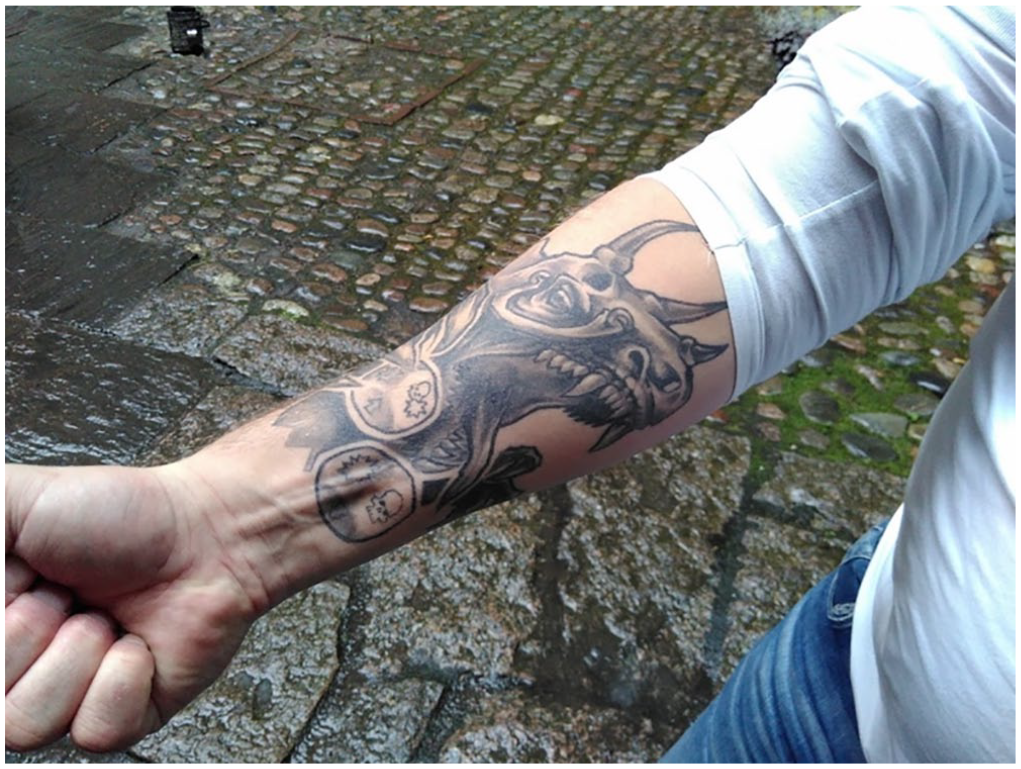
“Block dice” and Lizardmen team tattoo.
The online survey further reinforced the impression of the prominence of dice and dice rituals among Blood Bowl players. Only a minority of respondents (40%, 237/594) asserted that they did not have any rituals. By contrast, a majority of respondents (69%, 243/350) claimed not to perform other rituals. Players often had experience of witnessing other players perform dice-rolling rituals. Only 12% (69/578) of respondents said they hadn’t noticed dice rolling ritual behavior. A majority of respondents (74%, 370/497) had not witnessed any non-dice rolling ritual behavior.
Luck is thus a ubiquitous subject at Blood Bowl tournaments. Players regale one another with their feats of daring and/or (lack of) fortune. I once stopped by a tournament and a friend excitedly explained an unlikely but successful scoring play, dice roll by dice roll. At other times, luck can be embarrassing. Blood Bowl players periodically talk about “dicing” an opponent—when one player has all the luck and pulls off a victory so comfortable it’s almost worthless. During one game, an acquaintance of mine found himself repeatedly apologizing as he succeeded with everything.
With this preoccupation with fortune and the ubiquity of ritual behavior, there is a need to order material to make it understandable. In the following sections, I divide the rituals observed into two categories: thematic rituals and competitive rituals. These categories are not mutually exclusive; thematic action may also be competitive. Following on from this, I develop an argument that these both constitute worldbuilding practice.
Fun and “Fluffy” Play: Thematic Action Makes a Magic Circle
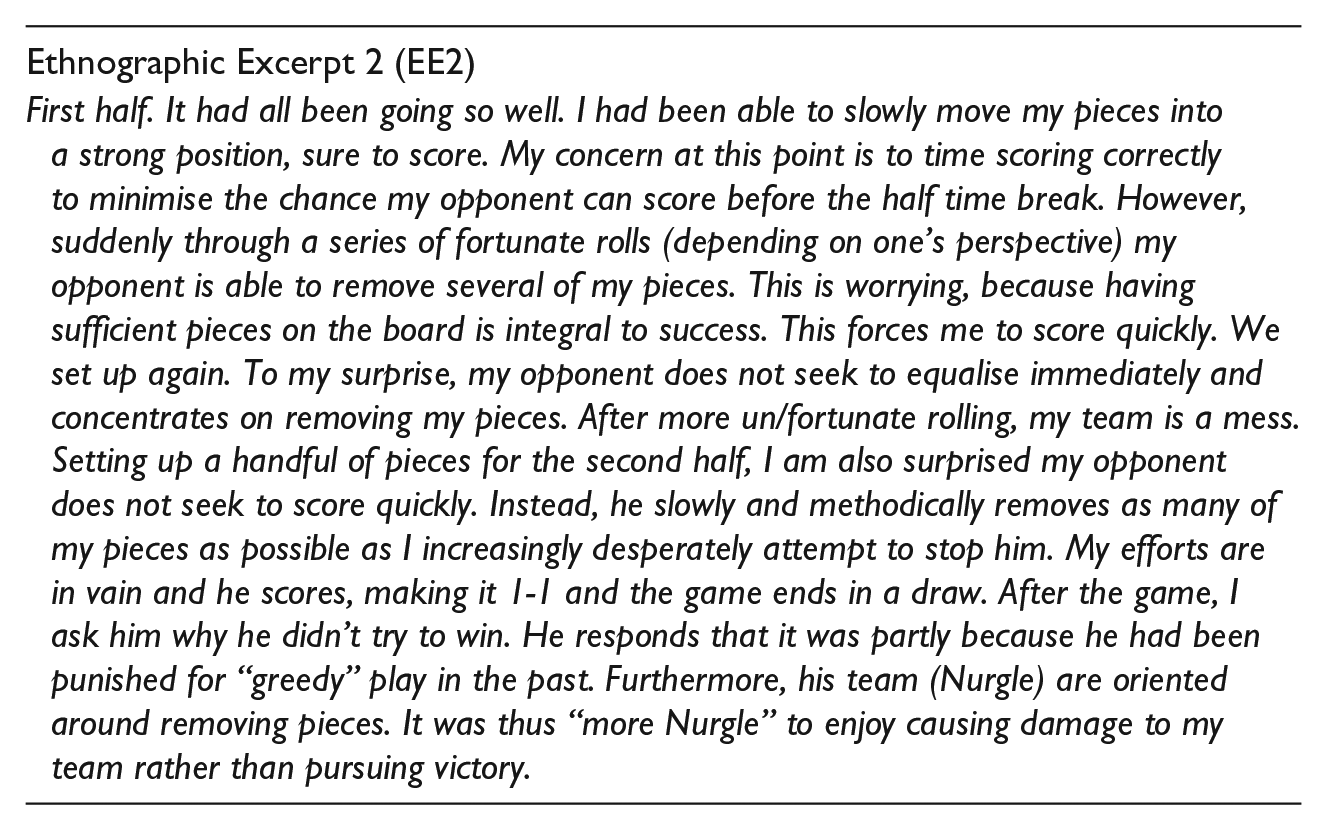
In broad terms, thematic rituals refer to actions that fit within the theme of Blood Bowl and the tournament setting. In Blood Bowl, the player is known as the “coach” and is envisaged as a trainer of a real sports team in the Blood Bowl world (mentioned earlier). Furthermore, there is an amount of background writing (“the fluff”) on Blood Bowl and the Warhammer world within which it takes place. This thus presents opportunities for players to be creative in their action (cf. Williams 2006). As such, some players would dress to match the theme, with special (occasionally “lucky”) clothing worn. Others would match their teams and dice. Some players embraced a certain amount of roleplaying in their games (EE2), with a few survey respondents talking of praising/calling on Nuffle, the god of Blood Bowl (the title quote is one example of this) while others liked to order their pieces in particular ways: I always sideline the same catcher every time as he has let me down too many times. (Survey respondent) All models not playing in the team must face the board to cheer on the team. (Survey respondent) Before the first kick-off and match start I do line up my team in a way that they seem to run to the pitch from the sidelines. (Survey respondent)
As such, some players clearly derived some aesthetic pleasure from thematic action. For some players, it appears that acting appropriately within the magic circle was part of the pleasure of playing (EE2). In such circumstance, rituals may be interpreted as keying actions maintaining the magic circle. For example, one of my opponents asked me if his friend could roll the dice whenever one of my players was pushed off the side of the board. In Blood Bowl, a piece pushed off is automatically “injured” – to represent being beaten to a pulp by the fans. By having a friend roll the dice to determine the extent of injury, my opponent was distinguishing between his (his team’s) actions and that of “the crowd”. A further element of such behavior is its use of in-group codes and knowledge. By acting in this way, the Blood Bowl playing group is enacted and communicated, intepelated with a shared set of material and semiotic resources, including information from the rules and fluff of the game (cf. Weninger 2006), as well as wider culture (cf. Fine 1979), which facilitate sociality (cf., Rapport 1999). Only an insider would automatically understand what was meant by “more Nurgle” (EE2) or why another person should represent the crowd. The opponent mentioned earlier in this paragraph also embraced the tournament key—he wore a colored wig showcasing his nationality (Belgian) and sat a bottle of liquor beside the board, from which he poured measures for both of us. Thus, whilst not specific to Blood Bowl, he symbolically marked the unusual nature of the tournament space.
For the Win! Seeking Victory
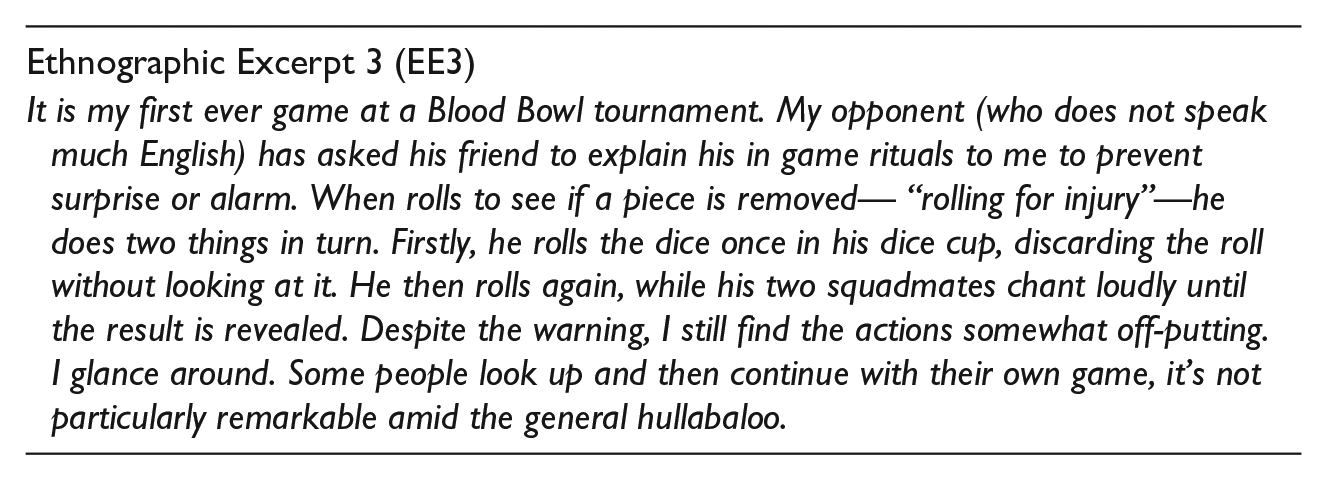
The second category of behaviors observed were those that seemed to be directly aimed at winning the game and by extension the tournament. Some of these took place before the match, in the form of practice and in discussions of particular team builds. Others involved in-game actions, often around dice rolls (EE3). So, for example, survey respondents would talk about “training” or even “threatening” and “punishing” dice that roll badly. One opponent had a huge collection of dice, which he cycled through, discarding a die when it rolled a one. Indeed, many respondents seemed to be tracking on some level how different dice are rolling.
Other competitive actions seek an advantage. For example, an opponent set up his dice to show the worst possible result in order to “jinx” me during a tense moment (Figure 3). One person I played against explained in a follow-up conversation that he would sometimes blow on the dice to “psych out” his opponent, hopefully disturbing them—presumably by suggesting he was gaining advantage. However, other competitive actions were intended to ensure that only “ordinary” luck and skill would determine a game’s outcome. About 33% (116/351) of survey respondents stated this was a reason for their rituals. These included using dice cups, trays, or towers (indeed 20% [120/594] of survey respondents claimed to use a dice cup/tray/tower for dice rolling), or insisting their opponent share dice. One player took this to an extreme. He had special dice made by a backgammon manufacturer to ensure as little bias in their rolling as possible and a dice tower. He requested that opponents utilize his dice and kept a close eye on my rolling technique, commenting if I was not shaking my dice cup enough. When questioned he talked about his experiences with skilled cheaters and that his desire to ensure everything was as fair as possible was in order “to help him sleep at night”. Concern for honest competition was thus prominent among many Blood Bowl players.
These competitive actions resonate with much research on sport or other situations of uncertainty and many may be interpreted as either belief in higher powers or as psychological techniques for staying in control of the situation (e.g. Gmelch 1971). It thus seems reasonable to, as with thematic action, ascribe it a certain keying function. It is part of how Blood Bowl players “get in the zone,” which may have psychological benefits, but also may be part of role-playing action, where it is part of entering a competitive gaming space—the magic circle.
Discussion: Building a Competitive World
The foregoing sections have categorized two forms of (often ritualized) worldbuilding action at Blood Bowl tournaments: thematic and competitive action. This section seeks to say something about the type of world that is produced; how this can be seen as ordering tournament institutions along a particular logic. Utilizing cultural theory (mentioned earlier), it describes how participants enact an individualism-hierarchy social institution. I interpret many of the rituals examined here as enacting individualist social solidarities, performing boundary work that manages information within the organization, particularly an organization that threatens the institutional worldview.
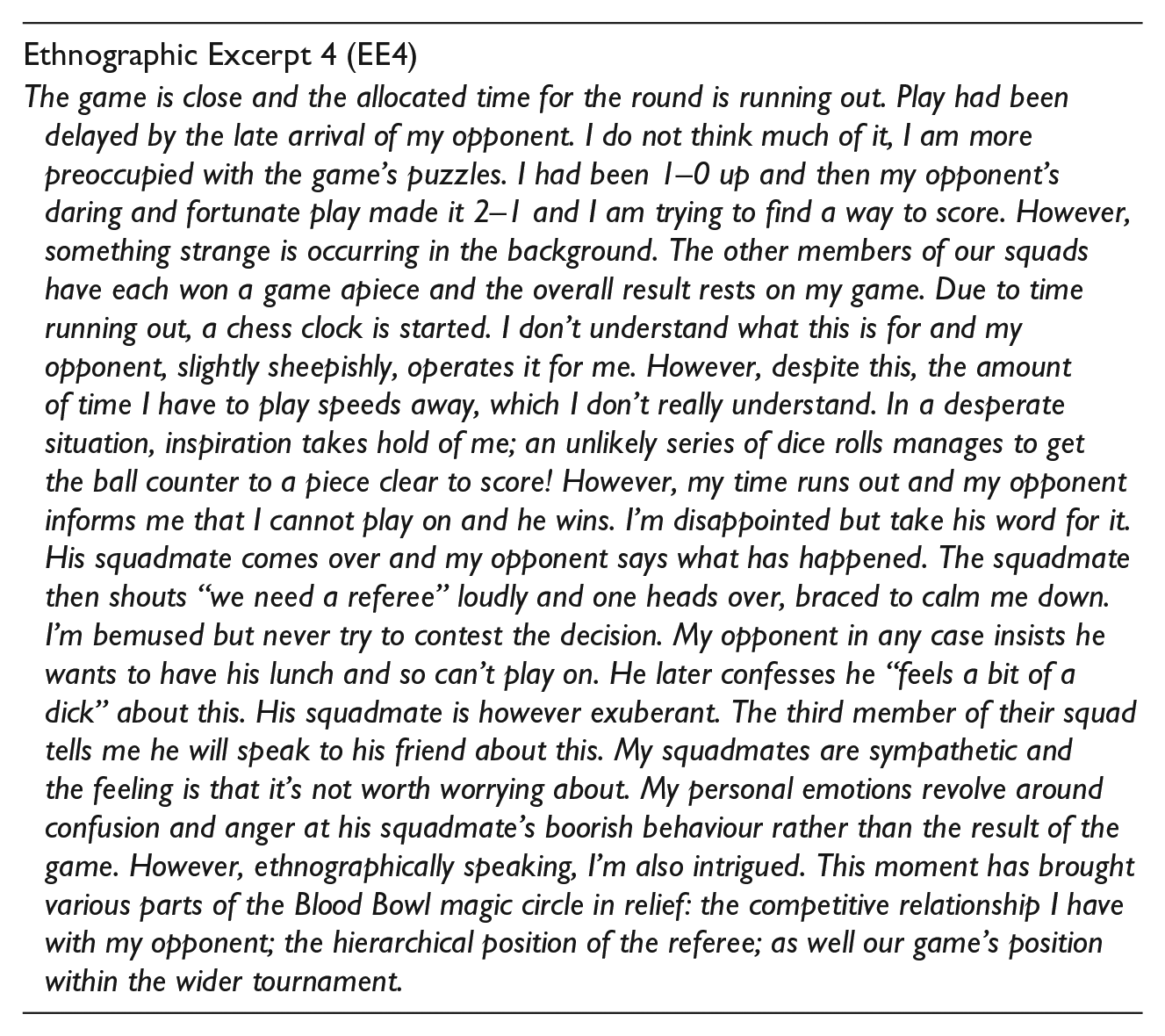
The concept of creativity is integral to many conceptualizations of play (e.g. Sicart 2014, 20). This is clear in the case of Blood Bowl, as players collect, build, and paint playing pieces for use in the game—playing Blood Bowl is immersive, tactile, and material (Wake 2019). Furthermore, players typically name their team and sometimes their playing pieces, creating a role-playing element. To varying extents, different players forge narratives about the highs and lows of their team’s journey towards success and/or disaster. In the two categories, we see two sets of values emerging around the pleasure of playing within the magic circle Blood Bowl—maintaining the anarchic, violent, humorous theme of Blood Bowl (cf. Figure 1) and in ensuring an even contest. These are integrated into dispositions of play within the magic circle. So, for example, exuberant public displays such as in EE3 are keyed with the setting, provided it doesn’t go into “dice-rage” territory. Similarly, whilst the atmosphere is often competitive (see further), thematic creativity is understood and even enjoyed (EE2). I interpret these two categories as indicative of two different identities that Blood Bowl players choose to embody: (a) the fun, fluffy, and characterful player, and (b) the cool and analytical but also daring skilled player. Although not mutually exclusive, the second identity is most prominent around Blood Bowl tournaments at least—while fun play is encouraged and appreciated, people engage seriously with the game, hence active concerns for fairness. Players will complement one another in post-game discussions on their ability to spot/solve the game’s puzzles. Risk-taking is also appreciated; for example, in one game, my opponent complemented me several times for making unexpected aggressive high-risk moves. However as EE4 highlights, there is however disunity among different players about what behavior is fun within the game (cf. Williams 2016).
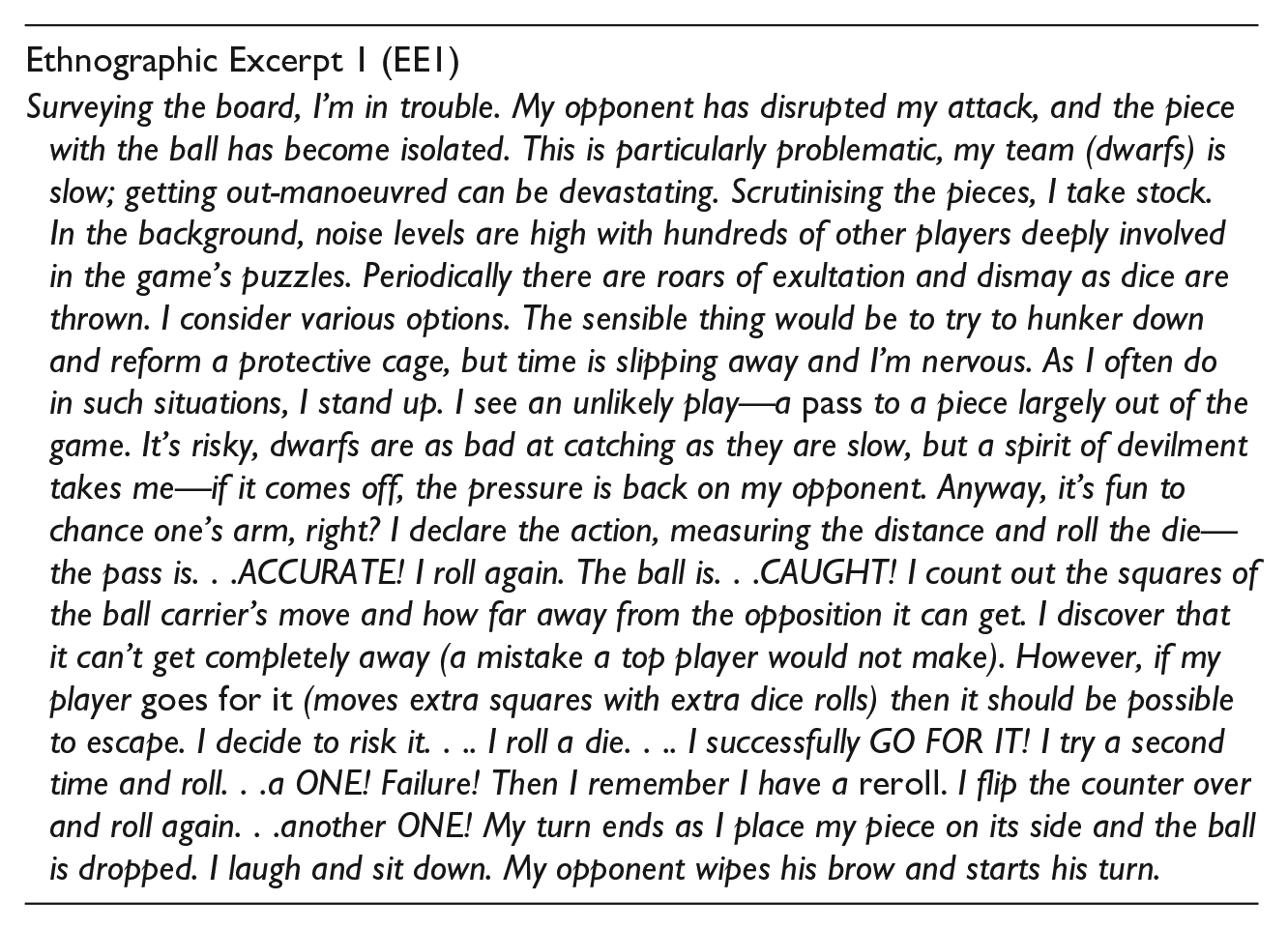
It is worth considering the character of the narratives and identities that participants create during Blood Bowl tournaments. The game lends itself to the imagining of outrageous sporting plays. However, outside of the game-world itself, part of the thrill of playing Blood Bowl is in the form of risk-taking. One thing that is difficult to convey is playing Blood Bowl is intense, tiring and often stressful. Speaking personally, I dislike starting a game late in the evening, because with adrenaline pumping it is hard to get to sleep. Maintaining the intensity for four games in row as is the case in some tournaments is challenging. A friend who once dropped by to watch me play stated that I looked totally shattered. Likewise, I know players who train to play repeated games, and who also avoid alcohol and seek to get rest during tournaments. As such, it seems fair to say that playing (and enjoying) Blood Bowl often involves edgework (see EE1). Definitive of edgework is that high stakes are on the line and that part of the fun is pushing one’s luck as far as one can (Shay 2016, 204, cf. the quote by Johnson, as given earlier). Part of the skill of playing Blood Bowl well is the acquisition of the skills required to allow one to see the opportunities and to evaluate the risk and rewards. This involves preparatory work (building teams and practicing), which allows Blood Bowl players to spot, analyze, and weigh the different options during game situations. To a certain extent, in common with psychological explanations of ritual behavior and endorsed by some of the players, some rituals (in-game, but also in the form of “lucky” clothing and the like) can be interpreted as part of reaching the appropriate mental space for performing edgework. On the other hand, rituals aimed at unnerving an opponent are similar; they are intended to actively interfere with an opponent’s judgment regarding risks.
Edgework, however, is not always about going as far to an extreme as possible. Classic edgeworkers, for example, skydivers, seek to remain in control—indeed the consequences of going too far are often catastrophic. Likewise, gamers of various sorts seek to take risks in a controlled manner. This thus explains some of the variability of rituals observed in Blood Bowl. Not everyone likes to take big risks all the time (EE2). Likewise unnecessary risk-taking is ruthlessly punished by skilled opponents. My “brave” play, mentioned earlier, for example, was notably unsuccessful and probably foolhardy. As such, players are concerned that things don’t go too far, going over the edge. Several of the observed ritual behaviors are interpretable in this light, as mechanisms for controlling uncertainty. Some of this is practical—players use various techniques to ensure that chance is the only factor. Another example is a player who strapped a hint sheet to his wrist, a combination of reminders and mantras (Figure 6). However, at other times, rituals are understandable as attempts to control what occurs, as magical rites to ensure good luck. This suggests the possibility that players interpret dice rolls as influenced by ritual. If this is the case, then it is inevitable that players will develop techniques for doing this as part of their edgework. Ritual control of the levels of uncertainty thus form part of players’ efforts to ensure that just the right amount of uncertainty is present for them to enjoy themselves.
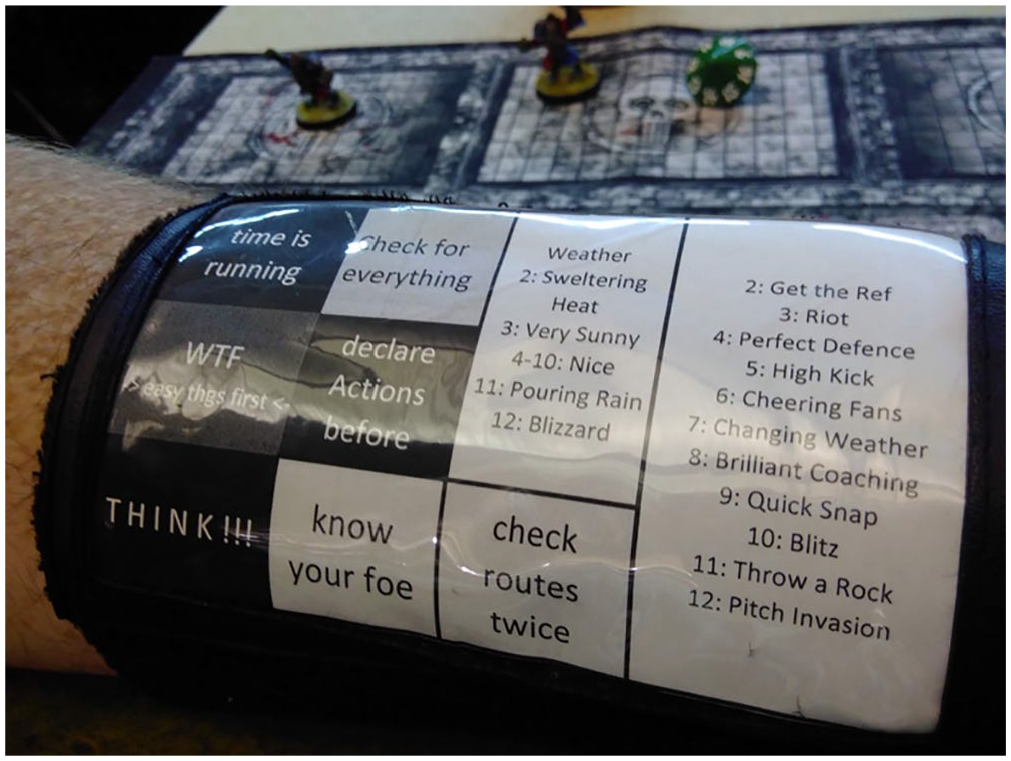
One player’s hint sheet.
In sum, Blood Bowl players build a world to play in, in part through ritual performance. These include roleplaying elements to allow for immersion. However, also within this world, there is a need to control the level of uncertainty to ensure that play remains on the edge of tolerance. Thus, players employ various behaviors to control this emersion in the magic circle, keying to ensure they ensure they maintain their own level of fun (cf. Williams 2016), exhibiting creativity and edgework.
Processing Information within an Individual-hierarchical Institution
There is a further element to all this, meriting elaboration. A crucial part of this worldbuilding is a need to deal with information that conflicts with the narrative of the world that players build (cf. Goffman 1961, 44–45). In the case of Blood Bowl, this is information that undermines the idea that playing Blood Bowl is competition between daring players challenging one another to (a) best solve the game’s puzzles and (b) to ride their luck to the limit where necessary. As such, I interpret many of actions observed as in part a way to mitigate the fact that the game is at times unfair. They form part of the illusion that the game is a fair contest, when in fact unevenness is integral to the rules, alongside randomness. If enjoyment of the game is in part dependent upon the game being competitive, then it is understandable that players make efforts to reconcile this contradiction. Similar behavior has been observed elsewhere in diverse circumstances. For example, players of the roleplaying game Dungeons and Dragons have been seen taking steps to ignore or avoid the randomness to their games. Players gain an illusion of control by emphasizing their personal responsibility for their character’s actions. (Shay 2016, 215).
Other actions, however, are more readily interpretable as supporting worldbuilding by forming the structure through which one is immersed in the Blood Bowl magic circle. Rituals such as the opening and closing ceremonies or the shaking of hands at the beginning and end of games can be interpreted as performing key changes within the magic circle separating in-game from pre- and post-game situations. There is a need both practically and ritually to outline the zone within which play and worldbuilding occurs. Within this zone, time is ordered (the event schedule) and various ritual roles are demarcated (between referees and players). Indeed, generally, Blood Bowl tournaments have a peculiar atmosphere of being in their own key—separate from the “real world”. 5 This is at times integral to the successful enactment of a competitive Blood Bowl tournament and is indeed part of the enjoyment. The various activities, rituals, and others can thus be interpreted as part of providing the field within which players are able to perform enjoyable play often in the form of edgework, further preventing the Blood Bowl tournament world from breaking down. Thus in EE4, I conformed to the magic circle’s enforced structure, rather than leaving in a huff.
In the language of cultural theory, what is being built at Blood Bowl tournaments is a hybrid institution, where the discourses of the individualist and hierarchical social solidarities predominate. During game playing, participants largely act according to the narratives of the individualist social solidarity; the context is seen as one of competition, with the spoils going to the winner, that is, the best player. The whole tournament is thus enacted to provide all players, to the greatest extent possible, with an equal chance of victory, and that it should be skill and acceptable levels of luck that determine the victor. Action is often breathless, with intense concentration on the game in hand, reflecting the temporal focus of the individual solidarity (Rayner 1982; Verweij et al. 2006). This has repercussions for interpreting the rituals observed. If enjoyment of the game requires the enactment of an individualist discourse, then players need ways to manage information that conflicts with this viewpoint. Players thus may use ritual to ensure that the twin facts that Blood Bowl is heavily dependent on luck and that the best player does not always win do not disrupt the individualist competition. Rituals thus become part of on-going boundary-work (mentioned earlier) that players perform to ensure focus remains on their skill and daring risk-taking.
By contrast, the hierarchical discourse is more prominent around games, tournaments require a clear structure once they become larger than small groups of players simply self-organizing pick-up games. As such, tournament organizers utilize a hierarchical logic to expedite play. The individualistic playing space is framed physically and temporally through hierarchical rituals and bureaucracy (the opening ceremonies, registration, and timetables) that demarcate the different roles of players and organizers. This allows Blood Bowl tournaments to avoid the pitfalls of individualistic institutions when those involved are unable to network and organize effectively, undermining the fair competition. Hierarchy would thus manifest when players, for example, could not solve disputes or ran over their allotted time to complete a match, effectively maintaining the tournament structure. Such a relationship is not uncommon, and it indeed underpins many individualistic social institutions, such as markets, which require a certain amount of hierarchical structuring to ensure that the playing field remains level (cf. Thompson 2008b). In the case of EE4, an individualistic approach would probably have involved each player harnessing their social networks to determine if play should continue. Within an egalitarian context, the most equitable solution would be sought.
Within cultural theory, the narratives of the other social solidarities are seldom completely absent. Many of the aforementioned thematic actions relate to individual enjoyment but also as enacting both squad identities and an identity within the wider Blood Bowl social group. At one tournament, an opposing squad called “the clowns” signaled their less than serious approach—they wore clown costumes, had comic props, and used pieces known to be weaker within the rules. Whilst they played to win, it was clear that their tournament would not be ruined by finishing in a low overall position. Such actions and the concomitant ritual can be interpreted as following the logic of the egalitarian solidarity—group membership and maintenance of the magic circle within which the group exists were the main concern. The fatalistic solidarity was generally less visible. This is unsurprising, characterized as it is with social withdrawal and acceptance of iniquitous context. Arguably, it however manifested around “whining” behavior. Whilst a certain amount of bad luck is integral to the Blood Bowl experience, complaining too much is considered bad form. Fatalism also could be seen when players chose to break the unwritten codes of sportsmanship. I witnessed one squadmate, normally extremely skilled, who was losing heavily, deciding that enough was enough and conceding—heading off to the bar. For those at the same table, this was an awkward moment going against the overall, dominant (individual-hierarchical) key of the competition.
Conclusion
This article has provided an ethnographic description of Blood Bowl tournaments. Scrutiny of social action has highlighted how a world is built. Actions, often ritual actions, allow players to key into and within the magic circle of the game—this may have competitive focus or be part of generating the ritual space within which the tournament takes place. As institutions, Blood Bowl tournaments are hybrids. The dominant atmosphere of these events is one of competition, with the ordering of proceedings primarily arranged according to the narrative of the individualist social solidarity – the game is conceived as a competitive space, where the best players will win. This is supported by a structure according to a hierarchical understanding of the world, which provides the frame within which the competition takes place. The narrative of the egalitarian solidarity is largely in the background, periodically emerging in the context of boundary work around membership of the group and demarcation of group space. With the individualistic solidarity dominant, it is unsurprising that many of the rituals described relate to luck, clustering around dice and dice-rolling. I argue this is part of the means by which the high level of chance involved is ignored. After all, Blood Bowl tournaments are an awful lot of time and effort if winning is simply a matter of luck!
This description echoes other investigations of gaming and sporting events, highlighting how identities and groups are performed through ritual action. The reader may legitimately enquire as to what value cultural theory brings to analysis. I consider cultural theory to have several advantages. First, it ties symbolic-interactionist dominated game studies to wider social theory, cementing the field’s place within the scientific canon. It thus assists further drives to demonstrate that games and leisure are relevant objects of scientific study (cf. Williams, Hendricks, and Winkler 2006). Second, the use of cultural theory’s typology of social solidarities situates gamers’ world-building within dynamic socio-material contexts. This makes it possible to compare different institutional arrangements and the contexts within which they are enacted. For example, individualist Blood Bowl tournaments may be compared with stockbroker behavior or classic accounts of Melanesian big men. Third, in making these comparisons, one is able to home in on the question of where and when uncertainty is considered positive or problematic (Malaby 2002). I argue that daring management of uncertainty (edgework) is part of the buzz of Blood Bowl for many players, and that ritual action occurs to prevent the inherent randomness of the game from killing the buzz. One could hypothesize, for example, that thematic actions will be better represented among casual players in comparison to competitive actions. Future work could look at other edgeworking contexts to see whether it is definitive of individualistic social solidarities. It could also explore how thematic action as a way of performing group membership may also support this. Research on extreme sports enthusiasts hints at this (e.g., Fletcher 2008) suggesting that particular combinations of solidarities may reoccur within different leisure pursuits. This could be contrasted with other contexts, where uncertainty is actively sought out (e.g. Whyte 1997). This could lead to the possibility of games studies making scientific contributions to studying how different institutions integrate or hide knowledge contradicting dominant worldviews, potentially of great relevance in contexts where accepted knowledge becomes increasingly tribal (cf. Klintman 2019). Finally, within cultural theory, solutions to so-called “wicked problems” are generally found in contexts where representatives of multiple social solidarities are present and where institutional arrangements are such that these representatives listen and respond to one another. This ideally leads to the identification of “clumsy solutions” (Thompson 2008a). As such, cultural theory arguably lays down a challenge for games theorists, designers, and communities: Is it possible to design “clumsier” gaming settings, where multiple solidarities are extant, which could serve as models for solutions outside of the magic circles of gaming?
Footnotes
Acknowledgements
I would like to thank all (anonymous) respondents and the NAF. I would also like to thank Kayue Poon, Anders Ekman and Nicola Singleton for their help at various stages of this research, may Nuffle bless your dice.
Declaration of Conflicting Interests
The author(s) declared no potential conflicts of interest with respect to the research, authorship, and/or publication of this article.
Funding
The author(s) received no financial support for the research, authorship, and/or publication of this article.
