




Abstract
Background:
Disparities in breastfeeding rates and exclusivity exist across regions and countries despite multifaceted breastfeeding promotion efforts in recent decades. Markets for artificial milk formula continue to grow as its substitution for breastfeeding is common. A new approach is needed for breastfeeding promotion strategies.
Research Aim:
This state-of-the-art review aimed to describe the implications of not-breastfeeding on the environment within the context of food system sustainability.
Method:
A total of 19 peer-reviewed articles within a 20-year timeframe were included in this review. Authors searched five databases for articles including Science Direct, GreenFILE, Springer Link, ProQuest, and PubMed.
Results:
The demand for artificial milk formula production as a replacement for breastfeeding results in increased greenhouse gas emissions, water pollution, and waste, thereby aggravating problems with freshwater scarcity. A short duration of breastfeeding and limited exclusivity have been associated with close birth spacing and contributing to global population growth. Breastfeeding is a healthy, sustainable diet, and a culturally acceptable first food. It advances health equity and food security. Exclusive breastfeeding for the first 6 months of life can be promoted with emphasis on total carbon footprint reduction, prevention of waterway degradation, and natural birth spacing, thereby sustaining food systems at large.
Conclusion:
It is important to reform food, nutrition, and environmental policies to protect exclusive breastfeeding while decarbonizing artificial milk formula production. More research is needed to provide directions for new breastfeeding promotion strategies connecting breastfeeding with environmental stewardship.
Keywords
Key Messages
Globally, substitution of artificial milk formula for breastfeeding continues to affect breastfeeding rates with disparities across regions.
Artificial milk formula production increases the total carbon footprint and waterway degradation. Short breastfeeding duration and limited exclusivity is associated with global population growth.
A policy-driven culture shift toward exclusive breastfeeding for the first 6 months will help to sustain the global food system.
Findings warrant more research toward educating lactation counselors and healthcare providers on the relationship between breastfeeding with environmental stewardship.
Background
Infant feeding practices have evolved over time to include breastfeeding with mother’s own milk, wet nursing, bottle feeding, and artificial milk formula use (Davidove & Dorsey, 2019). The advancement of formula manufacturing and the industry’s aggressive advertisement of artificial milk formula directly to the public negatively influences breastfeeding practices. A global decline in breastfeeding is thought to be attributable to aggressive marketing of artificial milk formula to developing countries (Lozada-Tequeanes et al., 2020). The marketing strategy used to promote artificial milk formula has driven its over-consumption, discouraged breastfeeding, and undermined confidence in breastfeeding (Davidove & Dorsey, 2019; Hernández-Cordero, et al., 2019; Lozada-Tequeanes et al., 2020). Environmental costs are not fully accounted for in the market price of formula, nor fully understood by consumers. This has aided the growth of artificial milk formula consumption (Smith, 2019). Despite the multifaceted efforts to improve breastfeeding rates over the past decades, exclusive breastfeeding rates for infants under 6 months increased only marginally while artificial milk formula sales have nearly doubled (Clark & Ghebreyesus, 2022). A new approach is needed to promote breastfeeding.
The replacement of breastfeeding with artificial milk formula is still not uncommon and disparities exist in breastfeeding rates across regions, within and between countries (Centers for Disease Control and Prevention [CDC], 2020). As one example, in the United States, while 84.1% of women have tried breastfeeding at some point, only 25.6% of them maintain exclusivity at the end of the first 6 months (CDC, 2020). Globally, 44% of newborns are put to the breast within the 1st hour after birth and 95% of infants have ever been breastfed, yet only 40% of children under 6 months are exclusively breastfed (Arts et al., 2018). The health benefits of breastfeeding are widely known, including protection against the risk of childhood infections and minimizing nutrition-related harm to cognitive development in early childhood (Holla-Bhar et al., 2015; Victora et al., 2016). Early termination of breastfeeding hinders natural birth spacing (Pimentel et al., 2020) and increases the fertility rate, which has contributed to growth in global population (Becker et al., 2003; Berens & Labbok, 2015; Stevens et al., 2009). Population growth is predicted to exceed 9 billion by the mid-21st century and is a threat to global food availability.
The costs of not-breastfeeding extend to environmental and economic loss. Although breastfeeding at the breast is not a zero-greenhouse gas emission activity due to emissions generated by the breastfeeding parent’s diet (Amonker et al., 2019), the replacement of breastfeeding with artificial milk formula generates a carbon footprint nearly twice that of breastfeeding. Exclusive formula feeding for 4 months has an environmental cost 35%–72% greater than exclusive breastfeeding for the same period (Andresen et al., 2022). Emissions from artificial milk formula production and waste generated by ancillary materials that are needed for formula use influence climate change. In addition, a large demand for formula feeding will divert energy and freshwater to livestock for formula production (Davidove & Dorsey, 2019). The global economic loss of not breastfeeding is estimated to be US$341.3 billion annually (Walters et al., 2019).
The promotion, protection, and support of breastfeeding are exceptionally cost-effective strategies for improving child survival and reducing the burden of childhood disease, as well as balancing global food systems. It is time to view breastfeeding as a healthy sustainable diet and to examine the impact of not breastfeeding on health, nutrition, and the environment in the context of food systems sustainability.
A state-of-the-art (SotA) review provides an opportunity to assess the literature using a time-based overview of the published evidence (Barry et al., 2022). SotA reviews are a new approach to literature reviews that address current topics and can offer a new perspective highlighting an area in need of further research. Using this design, we aim to explain how important it is to understand breastfeeding in the context of global food system sustainability, and suggest next steps. We examine the implications of using artificial milk formula to replace breastfeeding on the environment within the context of global food system sustainability.
Method
Design
This is a state-of-the art review that aimed for a comprehensive search of current literature to summarize the state of knowledge regarding the relationship between breastfeeding and the environment we live in (Barry et al., 2022; Grant & Booth, 2009).
Sample
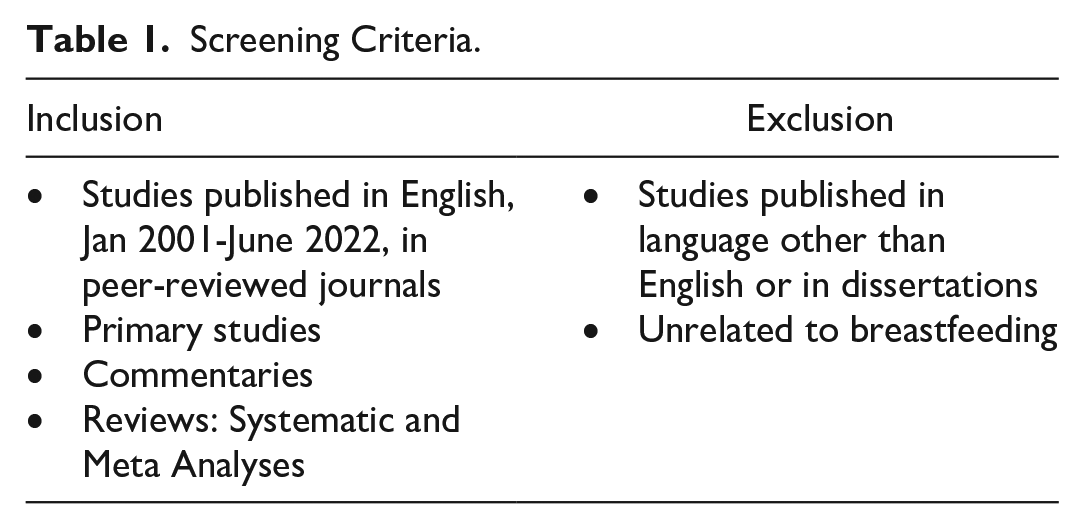
To investigate the harmful risk of not breastfeeding on the environment, studies that explored the link between artificial milk formula/breastmilk substitute feeding and water usage, carbon footprint, birth spacing, or environmental impact were searched. Inclusion and exclusion criteria of studies in this review are presented in Table 1. Part of the purpose of this type of review is to identify how and when studies were completed; therefore, papers including commentaries, research articles, and grey literature were encouraged (Barry et al., 2022). This review included commentaries, primary research, meta- and systematic-review articles, and grey literature for a total of 19 articles. (Figure 1)
Screening Criteria.
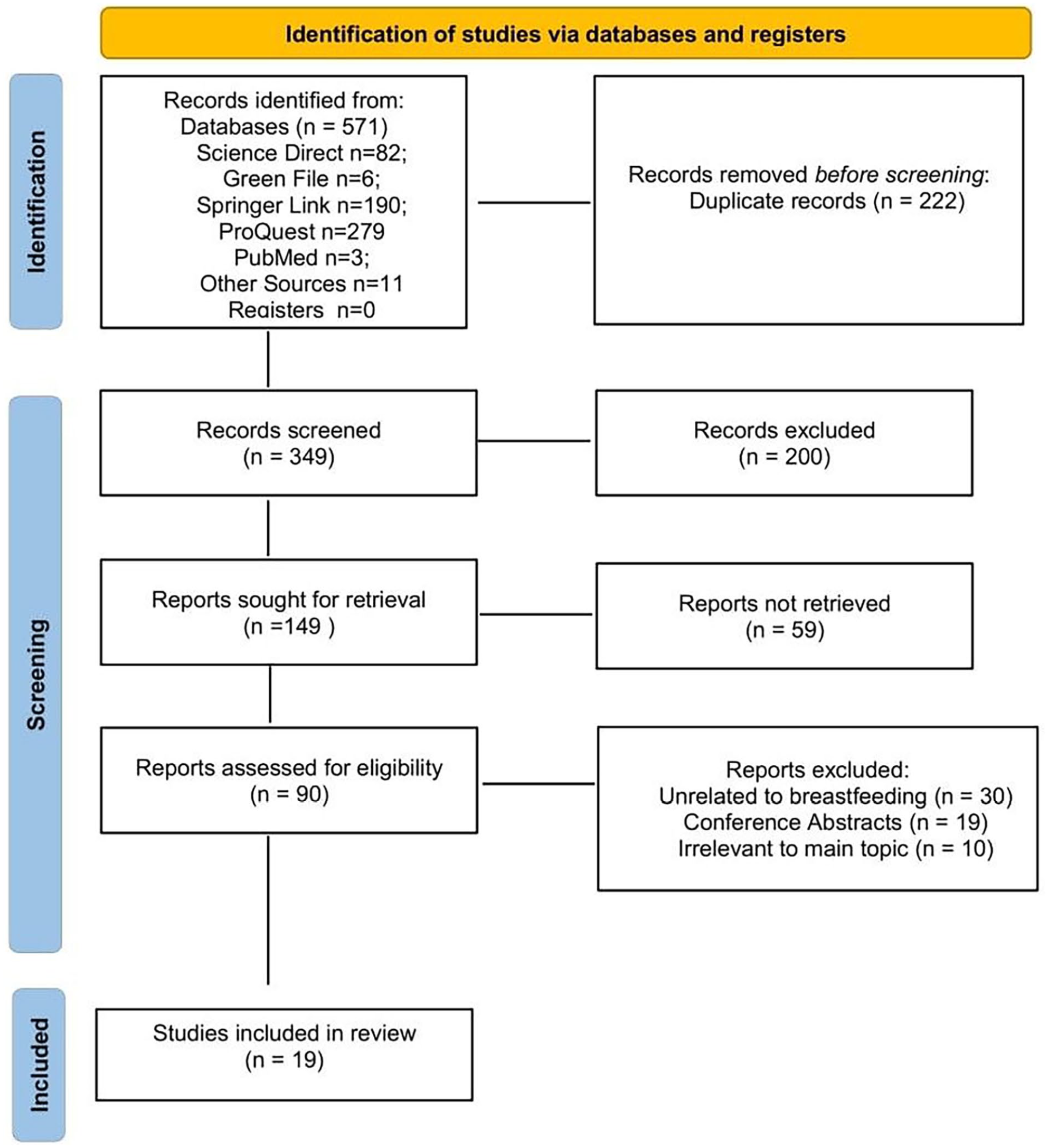
PRISMA Flow Chart of Study Selection (Page et al., 2021).
Data Collection
We searched the literature for peer-reviewed articles that were published within a 20-year timeframe (2001–2022). We additionally included commentaries and reviews in the search as well as primary research articles. We searched five databases: Science Direct, GreenFILE, Springer Link, ProQuest, and PubMed. No articles were identified from Cochrane Database of Systematic Reviews. Search statements were composed of a combination of keywords as follows: [Formula Feeding AND Carbon Footprint], [Breast Milk Substitutes AND Carbon Footprint], [Formula Feeding AND Water Usage], [Breast Milk Substitutes AND Water Usage], [Formula Feeding AND Environmental Impact], [Breast Milk Substitutes AND Environmental Impact], [Birth Spacing AND Environmental Impact], [Birth Spacing AND Carbon Footprint], [Inter-pregnancy interval AND Carbon Footprint], and [Inter-pregnancy interval AND Environmental Impact]. Additional articles were derived from a manual search of the cited references in the articles included in this review.
Two reviewers independently searched the database using the same search statements. Duplicate articles were removed from the initial collection of the search. Articles were screened by reviewing the title and abstract for relevance to this review topic. Then, the full text of the articles were screened. After full text screening, the two reviewers met to reach consensus on which articles should be included in the narratives. A total of 19 articles were analyzed.
Measurement and Data Analysis
Given the variations of the articles reviewed, the data were summarized by article themes and findings. Article themes ranged from article focus to study aims and methods. The findings of each article were synthesized and organized into three themes for this review: Breastfeeding and carbon footprint reduction; breastfeeding and water usage reduction; and breastfeeding and natural birth interval (see Table 2).
Summary of Studies Reviewed on Breastfeeding and Environmental Stewardship.
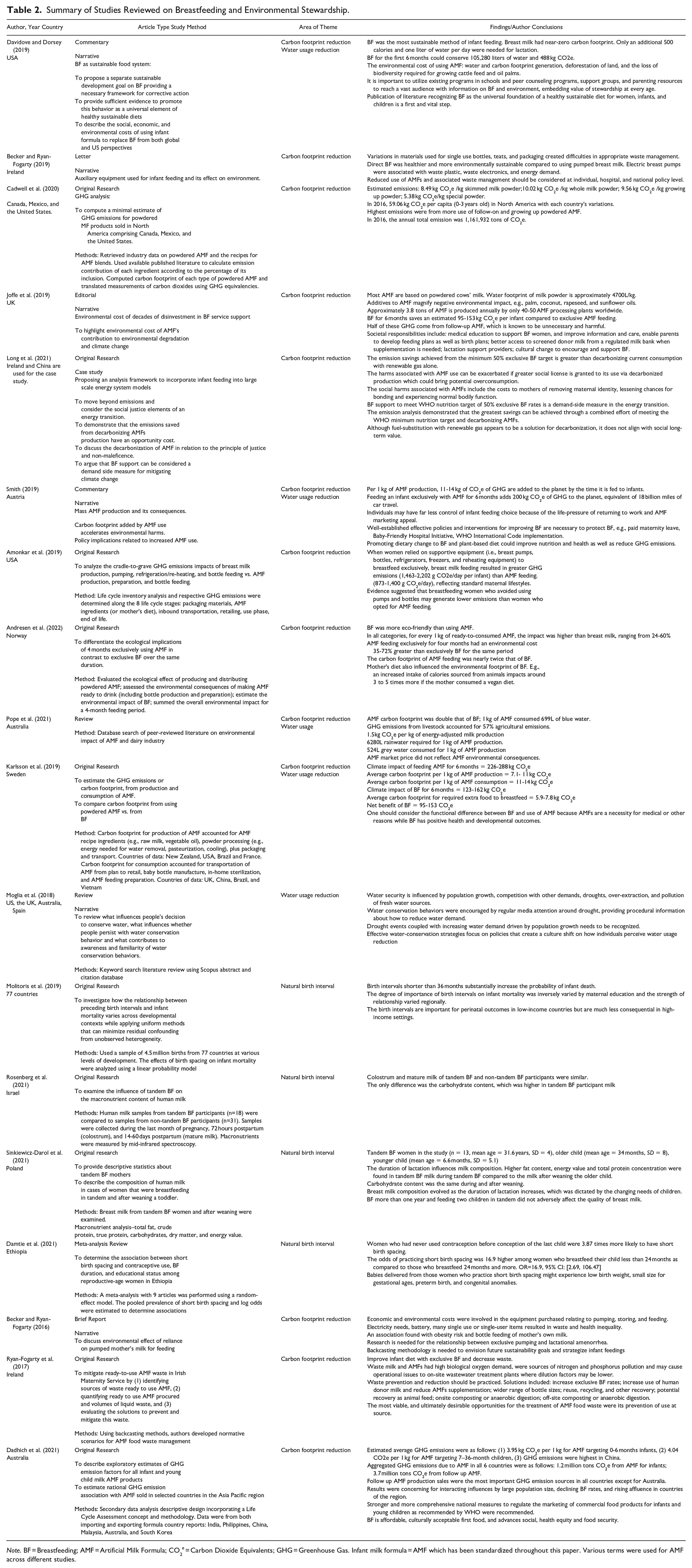
Note. BF = Breastfeeding; AMF = Artificial Milk Formula; CO2e = Carbon Dioxide Equivalents; GHG = Greenhouse Gas. Infant milk formula = AMF which has been standardized throughout this paper. Various terms were used for AMF across different studies.
Peer-reviewed journal articles in both online and paper publication formats were included. Findings of the review are presented in narratives with one summary table. Based on the type of current review, no formal quality assessment of the reviewed articles was conducted (Grant & Booth, 2009).
Results
Breastfeeding and Carbon Footprint Reduction
The Earth’s surface cools down at night by releasing the sun’s heat absorbed during the day into the air. This process is interrupted and slowed down if the heat is trapped in the Earth’s atmosphere by greenhouse gasses, leading to global warming (United States Environmental Protection Agency [U.S. EPA], 2015a). The greenhouse gasses are natural and man-made gasses that include carbon dioxide, methane, nitrous oxide, and fluorinated gasses (U.S. EPA, 2015b). Of the total greenhouse gas emissions, carbon dioxide is mostly emitted by human activities, for example, transportation (27%), electricity production (25%), industry (24%), commercial and residential (13%), agriculture (11%), and land use and forestry (13% of 2020 greenhouse gas emissions; U.S. EPA, 2015b). Food production and processing alone accounts for 25% of carbon dioxide emissions (Cadwell et al., 2020). The amount of carbon dioxide in the atmosphere has increased more than 20% in 40 years, from annual average 339 parts per million in 1980 to 412 parts per million in 2020, largely due to human activities. This amount represents well over 50% of the total increase in atmospheric carbon dioxide since the industrial revolution (Cadwell et al., 2020). Over the past decade, increases in carbon dioxide are responsible for about 82% of the increase in the heat-trapping capacity of the atmosphere.
The emissions of greenhouse gasses other than carbon dioxides are expressed as carbon dioxide equivalents, which are the product of the given gas mass multiplied by the gas’ global warming potential. The global warming potential allows comparisons of global warming impacts of different gasses. It is a measure of how much energy the emissions of 1 ton of a gas will absorb over a given period of time (i.e., 100 years), relative to the emission of carbon dioxide (U.S. EPA, 2015a, 2015b). For example, when the global warming potential of methane is 28, it means that the emission of methane is equivalent to emissions of 28 carbon dioxide. The total greenhouse gas emissions, both carbon dioxide and carbon dioxide equivalents, generated by human activities are described with carbon footprints (Durojaye et al., 2020). Carbon dioxide equivalents are the standard unit of a carbon footprint measure because a single number of carbon dioxide equivalents allows for easy comparisons between carbon footprints consisting of various amounts of greenhouse gasses.
Breastfeeding lowers the total carbon footprint through reduced land and water resource use compared to what is needed for the production and consumption of artificial milk formulas. Breastfeeding women require an additional 500 calories and 1 L of water per day to sustain breastfeeding for a day, whereas 21.8 kg carbon dioxide equivalents of greenhouse gasses and 4700 L of water are needed per 1 kg of artificial milk formula powder generated (Davidove & Dorsey, 2019). Breastfeeding for 6 months conserves approximately 488 kg carbon dioxide equivalents of greenhouse gasses and 105,280 L of water (Davidove & Dorsey, 2019). Breastfeeding can have 95–153 kg carbon dioxide equivalent reduction in carbon footprint per infant compared to exclusive artificial milk formula feeding, equal to the removal of 50–77.5 thousand cars off the roads per year (Joffe et al., 2019). Further reduction of the total carbon footprint can be made if breastfeeding women consume a plant-based diet following dietary guidelines, because greenhouse gas emissions from animal-based food production is nearly twice that of plant-based food production (Xu et al., 2021).
Long et al. (2021) suggested an innovative solution to reduce emissions in the production of artificial milk formula. Manufacturers that produce artificial milk formula could be targeted in efforts to change to renewable gas to decarbonize their process of formula production. However, the emission savings for achieving a minimum 50% exclusive breastfeeding target are greater than decarbonizing the current consumption with renewable gas alone (Long et al., 2021). Given that artificial milk formula serves a functional purpose for reasons including medical use, increasing exclusive breastfeeding for 6 months duration should be accompanied by this renewable gas solution to have a meaningful positive influence on the environment (Long et al., 2021).
Breastfeeding and Water Usage Reduction
The earth has plenty of water, but only a small percentage is usable by humans. Of the total water on earth, 96.5% is in oceans and only 2.5% constitutes the fresh water that we need for drinking and for irrigation of farm fields. Ice sheets and glaciers on Earth hold 68.5% of all fresh water, and over 30% of the fresh water is found in ground water (Stephens et al., 2020). As a result, less than 1% of all the fresh water on earth is accessible to humans for drinking, irrigation, and other use (Stephens et al., 2020). The World Health Organization (WHO, 2022) reports that over 2 billion people live in water-stressed countries, which is expected to be exacerbated in some regions as a result of climate change and population growth. In addition to the scarcity of fresh water on earth, human activities contaminate and waste the available fresh water through urbanization, population growth, agricultural activities, and more (Páll et al., 2013). In many urban areas, there is an increase in concentration and use of chemical products, which adversely affects ecological integrity (Brooks & Conkle, 2019). As aquatic ecosystems are threatened, human access to safe water diminishes.
Mass production of artificial milk formula contributes to the degradation of waterways, resulting in water pollution unable to support the healthy aquatic life (Smith, 2019). Water usage is present throughout the process of artificial milk formula production. Dairy cows, which produce the milk extracted for artificial milk formula, graze on pastures that require watering (Davidove & Dorsey, 2019). An estimated 800 L of water is required to produce 1 L of cow’s milk (Davidove & Dorsey, 2019). During manufacturing and distribution of artificial milk formula, water and energy are used. This includes the energy needed to heat water for sterilization, remove water for conversion to powder, and rehydrate the powder for feeding (Davidove & Dorsey, 2019; Karlsson et al., 2019). The water footprint of milk powder is approximately 4700 L/kg (Joffe et al., 2019). According to this estimate, breastfeeding an infant for 6 months can potentially save up to 105,280 L of water (Davidove & Dorsey, 2019). The water footprint accounted for to generate 1 kg of artificial milk formula powder would include water needed to grow a field adequate for grazing, feed cows, and support factory operation from farm to store. Although most of these processes use water, about 80% of it can return to the ecosystem in the form of wastewater; however, this returned water would not be the fresh water that humans need for drinking, further reducing the less than 1% fresh water reserve on earth (Upkeep Technologies, Inc., 2023). It is imperative that we focus on water conservation as scarce water resources are threatened with the rise in global drought risk (Moglia et al., 2018).
Breastfeeding and Natural Birth Interval
Inter-pregnancy interval or birth spacing is the time between a live birth and the conception of another child. Both short and long inter-pregnancy intervals are associated with adverse health outcomes (Sridhar & Salcedo, 2017). To reduce health risks to infants and postpartum women, the WHO recommends birth spacing between consecutive live births be 3–5 years (Molitoris et al., 2019; WHO, 2005). Researchers have shown the elevated risk of infant mortality in both shorter than 36 months and longer than 60 months birth intervals (Molitoris et al., 2019). The direct relationship between short birth intervals and mortality has been consistent. Shorter birth intervals interfere with women’s full recovery from the immediate past pregnancy. In low-income countries, breastfeeding-pregnancy overlap is not rare, which may influence the quality and quantity of breastmilk for the child born following the interval. In these cases of breastfeeding-pregnancy overlap, women often tandem breastfeed their infant and older child (Rosenberg et al., 2021). Although researchers of recent studies show the adaptive role of human milk and similar macronutrient composition of colostrum and mature milk between tandem and non-tandem breastfeeding, there is an undeniable sibling competition for the same resources, for example, parental attention and investment and breastmilk (Rosenberg et al., 2021; Sinkiewicz-Darol et al., 2021). Sibling competition, maternal physical depletion, and infectious transmission are thought to link infant mortality and short birth intervals (Molitoris et al., 2019).
Breastfeeding assists in fertility control by providing natural birth spacing. During breastfeeding, two hormones are in action: the prolactin hormone to stimulate milk production and the oxytocin hormone to eject milk from the breast. Nipple stimulation from breastfeeding releases a high amount of prolactin hormone. The prolactin inhibits ovulation and results in postpartum amenorrhea, therefore lengthening the interval between births (Labbok, 2008). For this reason, breastfeeding women may select lactational amenorrhea method which does not disrupt lactation and is satisfactory for the couple, as a contraceptive method to achieve optimal birth spacing (Berens & Labbok, 2015). On the other hand, a woman with a short duration of breastfeeding could experience short birth spacing as a result of low prolactin concentration (Labbok, 2008). In a meta-analysis conducted in Ethiopia with nine studies, the researchers reported a 46.95% prevalence of short birth spacing among reproductive-age women and odds for association between the duration of breastfeeding and short birth spacing of 16.9 (Damtie et al., 2021). Close birth spacing increases population growth, decreases women’s productivity, and increases the demand for natural resources, ultimately contributing to threats to global food system sustainability. Although breastfeeding alone is not enough to eliminate close birth spacing, breastfeeding exclusivity and duration do have a positive association with longer times between pregnancies.
Discussion
The current research reviewed in this study suggests that in recognition of the role of breastfeeding on the Earth’s resources, it is time to shift the focus of breastfeeding promotion efforts from only health, economic, and social benefits to also include environmental stewardship in breastfeeding and particularly exclusive breastfeeding. Infant feeding practices are also important. The use of bottles for feeding has a negative impact on the environment because discarding the equipment purchased for pumping, storing, and feeding has an environmental cost (Becker & Ryan-Fogarty, 2016). While environmentally meaningful, it is important to note that there are cases in which bottle feeding of mother’s own milk or human milk is necessary, including when the parent and child are not together, for example, working and breastfeeding, or conditions that require additional support, for example, some medical situations during feeding.
Food system sustainability is not typically considered in lactation education. Education and awareness campaigns relating to breastfeeding’s role in food system sustainability are needed for lactation counselors, midwives, and healthcare providers, as well as for the general public and policy makers. Creating an environment through policy conducive to direct nursing may support parents who desire to do so, including daycares near to the workplace for easy access, or infant visits allowed in the workplace for nursing, and kindness toward public nursing. Culturally-appropriate awareness and intervention campaigns are needed to create a nursing environment friendly to direct nursing at the breast.
Worldwide restrictions on traveling and economic activities during the pandemic resulted in drastic reduction in greenhouse gas emissions. However, this decline was temporary and the need for a return to a normal and stabilized economy rendered a rapid increase in emissions (Kumar et al., 2022). To reduce greenhouse gas emissions permanently, a redesign of vital policies toward greener economies is needed. Some suggestions made in the reviewed articles included using renewable energy sources to manufacture the artificial milk formula needed for specific purposes (Long et al., 2021), and reusing ready-to-use artificial milk formula waste from hospitals for animal feed and on-site and off-site composting (Ryan-Fogarty et al., 2017). However, the most direct solution for sustaining the environment is the promotion of breastfeeding exclusivity for the recommended duration and continued breastfeeding up to 2 years and beyond.
Breastfeeding promotion campaigns and policies have a role to play in environmental stewardship. Promotion campaigns could include messages discouraging non-specific artificial milk formula production altogether to reduce the total carbon footprint from unnecessary artificial infant formula production and feeding. Future research is needed to monitor the marketing of artificial milk formula and dietary guidelines in the light of climate and health changes. This would include the continued development of strategies to encourage the use of dietary guidelines as healthy plant-based eating reduces the total carbon footprint and positively contributes to food system sustainability (Binns et al., 2016).
To facilitate exclusive and continued breastfeeding for working parents, there is an urgent need for maternity leave policy modifications. Modifications could entail either full-paid maternity leave, or return-to-work policies that facilitate infants in the workplace with the mother at all times for the full duration of recommended breastfeeding. Until these provisions can be made for breastfeeding parents when they return to work, the negative impact on the environment of forced parent–infant separation, resulting in the need to provide expressed milk and/or artificial milk formula bottle feedings to the child, is inevitable.
Although the full impact of a global pause in the improvement of breastfeeding rates on food system sustainability still needs to be assessed, and there is little doubt that the consequence of not-breastfeeding extends to long-term negative associations with maternal and infant morbidity and mortality, environmental stewardship, and global food security. Increasing breastfeeding is also a WHO goal to solve the double burden of malnutrition and obesity. It is noteworthy that the increase in greenhouse gas emissions from artificial milk formula production intensifies the global synergistic epidemic, that is, syndemic, a situation in which two or more interrelated biological factors work together to make a disease or health crisis worse. A syndemic situation where health and nutrition problems caused by not breastfeeding interacting with climate change could worsen the mounting threat to global food system sustainability (Dadhich et al., 2021; Rosenberg et al., 2021).
Limitations
Given the recency of the concept of the cost to the environment of not breastfeeding, studies examining the connection between breastfeeding and environmental stewardship included in this review were limited and thus limited the review. The articles covering this specific intersection covered breastfeeding in relation to health, social, and economic benefits. The diversity of information about breastfeeding included in this review could have increased the complexity of the summary.
Conclusions
Breastfeeding provides powerful health benefits for nursing parents and infants and is an environmentally sustainable source of nutrition. The cost of not breastfeeding is monumental from the perspective of the food system sustainability and environmental stewardship. The cost is higher in areas facing challenges regarding available safe freshwater and rapid population growth. Given the amplified greenhouse gas emissions produced by the manufacture and use of artificial milk formula and ancillary material manufacturing, it is imperative that national food policy and dietary guidelines promote breastfeeding and its exclusivity as a sustainable diet. This will be most effective if it is coupled with decarbonizing artificial milk formula processing through advocating renewable resources in their manufacture.
Footnotes
Acknowledgements
The authors acknowledge the graduate associates who assisted with manuscript formatting.
Author Contributions
Disclosures and Conflicts of Interest
The authors declared the following potential conflicts of interest with respect to the research, authorship, and/or publication of this article: Yeon Bai is an associate editor for the Journal of Human Lactation.
Funding
The authors received no financial support for the research, authorship, and/or publication of this article.
