




Abstract
Why some people engage in criminal and other forms of deviant behavior, whereas others do not, has long been a question of interest in the social and behavioral sciences. In this study, we examine the role of personality differences in accounting for different forms of deviance. Using data from a large and demographically diverse German sample (N = 2,364), we investigated associations between 74 personality traits and five self-reported indicators of deviant behavior. We analyzed these relations at both the zero-order and multivariate level using regularized regression models to identify which personality traits predict deviant behavior most strongly and uniquely so, that is, above and beyond other traits. Personality explained a substantial proportion of variance in all forms of deviance considered, and these associations were not attributable to methodological artifacts or confounding influences of age or gender. Supporting our pre-registered hypothesis, traits related to dispositional morality or short-term mindsets were particularly powerful predictors. Taken together, our findings provide the most comprehensive overview to date of personality-deviance associations, offer a parsimonious account of individual differences in self-reported deviance, derive concrete guidelines for trait selection in future research, and introduce a ShinyApp that can guide theorizing and study design.
Plain language summary
Why do some people engage in crime and other forms of deviant behavior, whereas others do not? One possible explanation is differences in personality. In this study, we examined how 74 different personality traits relate to different forms of self-reported deviant behaviors, including crime, rule-breaking at work, vandalism, and violence. We analyzed data from over 2,300 adults in Germany who took part in a large research study. Using advanced statistical techniques, we identified which traits were most strongly and uniquely linked to deviant behaviors, even after accounting for other traits, age, and gender. Our results showed that personality plays a significant role: People who scored low on traits related to morality—such as honesty and concern for others—and those who tend to focus on short-term rewards rather than long-term consequences of their actions were more likely to engage in criminal or harmful acts. This study provides one of the most detailed examinations to date of how personality relates to deviance. We also offer guidance for researchers on which traits to focus on in future work and share a free online tool to support study design and theory development.
Understanding why some individuals engage in deviant behavior, ranging from minor rule-breaking to more serious criminal acts, whereas others do not, is a central question in the social and behavioral sciences. Indeed, offending trajectories vary both in terms of the seriousness of deviant acts committed and in terms of their length. For example, although many people commit minor offenses at some point in their lives, only a subset engages in more serious and/or repeated acts of crime (Hirschi & Gottfredson, 1994; Lemert, 1951). Furthermore, while most offending trajectories remain confined to adolescence and early adulthood, others show more persistence over the life-course (e.g., McGee et al., 2021; Moffitt, 2018). This heterogeneity highlights the importance of identifying the individual differences that help explain variation in deviant behavior. Prior research has addressed this issue from multiple angles, including examining demographic and socio-economic factors, such as sex, income, and age (Antenangeli & Durose, 2021; Hirschi & Gottfredson, 1983; Steffensmeier, 1980), social and developmental environments (Sampson & Laub, 1990, 2005), learning from criminal peers (Akers, 1998, 2001), and individuals’ levels of self-control (Gottfredson & Hirschi, 1990), and found consistent relations between these variables and deviance. The present contribution focuses on another crucial source of individual differences: personality.
A brief history of personality within criminology
Personality traits describe individuals’ relatively enduring patterns of thought, feeling, and behavior. As such, they guide individuals’ experiences and behavior in various ways, and affect many important life domains and outcomes (e.g., Ozer & Benet-Martínez, 2006; Soto, 2021; Zettler et al., 2020). Within criminological research, pioneers such as Eysenck (1977) and Wilson and Herrnstein (1985) have emphasized the ability of personality to account for criminal and other deviant behavior early on. For example, Wilson and Herrnstein summarized that “there is mounting evidence that, on the average, offenders differ from nonoffenders in … personality” (p. 27).
Nonetheless, early studies linking personality to deviance were criticized on a variety of grounds, including the use of ill-defined personality constructs and measurement instruments lacking validity (Miller & Lynam, 2001). For one, researchers considered various, supposedly different traits to account for individual differences in deviance, without any serious attempts to synthesize this diverse research. To illustrate, in 1977, Tennenbaum identified no less than 101 different personality measures—many of which assessed multiple traits—in studies investigating personality differences between criminal offenders and nonoffenders. This huge variety of measures and traits made a synthesis across studies extremely difficult, if not impossible.
Moreover, critics pointed to predictor-criterion overlap in the measurement of personality and (self-reported) deviance resulting from some personality items directly tapping into criminal behavior (e.g., Gottfredson & Hirschi, 1990; Tennenbaum, 1977; Waldo & Dinitz, 1967). For example, a long-established measure of psychoticism, 1 the Eysenck Personality Questionnaire-Revised (Eysenck et al., 1985), contains the item “People should always respect the law.” Even in newer personality scales, the problem persists. For instance, an established scale measuring psychopathy, the Short Dark Triad (SD3; Jones & Paulhus, 2014), contains a (reverse-keyed) item reading “I have never gotten into trouble with the law” and the well-known HEXACO Personality Inventory-Revised (Lee & Ashton, 2006) contains the item “If I knew that I could never get caught, I would be willing to steal a million dollars” to measure honesty-humility. Evidence on the personality-deviance link based on such trait measures may thus be interpreted as “the reporting of what are rightly considered ‘empirical tautologies’, the discovery that two measures of the same thing are correlated with each other” (Gottfredson & Hirschi, 1990, p. 109)—rather than necessarily hinting at a substantive link between certain personality traits and deviant behavior.
Since the early attempts, however, personality research has evolved significantly and produced some widely agreed dimensions of personality (i.e., the Five Factor Model [FFM], Goldberg, 1990; McCrae & Costa, 1987, and the HEXACO Model of Personality Structure, Ashton & Lee, 2007), together with validated instruments for measuring them. The recent empirical landscape is also rich in studies investigating the link between personality traits and deviant behavior (e.g., aggression, antisocial conduct), showing meaningful and robust relations between certain traits and these outcomes (e.g., Bader et al., 2025; Hyatt et al., 2019; S. E. Jones, 2017; S. E. Jones et al., 2011; Miller & Lynam, 2001; Pratt & Cullen, 2000; Van Gelder & De Vries, 2012, 2014).
Critically, however, we still lack an understanding of which personality traits are most strongly and uniquely associated with deviance in the multivariate case, that is, when multiple traits are considered at the same time. Certain trait-outcome relations may arise solely from the overlap of a trait with another, more relevant trait. Indeed, several of the personality traits that have been related to deviance show substantial conceptual overlap. Identifying those traits that show unique associations in multivariate models can thus contribute to theoretical parsimony and precision. Such research also has important practical implications: It can provide guidance regarding which traits to use in research or applied settings when the goal is to explain as much variance in deviance as possible based on just a few traits. With the current investigation, we aim to address exactly these issues.
An emerging synthesis
Calls for a stronger (re-)integration of personality in criminological theories and research have been voiced repeatedly (e.g., Caspi et al., 1994; Jones, 2017; S. E. Jones et al., 2011; Romero et al., 2003), yet with limited success. We leverage two unique circumstances, a theoretical and an empirical one, that allow us to provide a comprehensive, theory-guided synthesis of these two research fields. On the theoretical side, a recent review of the literature linking personality traits to criminal and other deviant behavior (Thielmann, 2023) suggests that the personality basis of deviance primarily revolves around two key underlying dispositional concepts: morality and short-term mindsets. 2 Based on this, we derived hypotheses about which of a variety of traits should relate to deviance. On the empirical side, we make use of data from a large-scale study including 74 personality traits—many of which are related to morality, short-term mindsets, or both—and five measures of (self-reported) criminal and other deviant behavior to pinpoint the personality basis of deviance in a much more comprehensive way than previous research.
Measured Personality Traits Along With Their Definitions, Operationalizations, Measurement Occasion in the Prosocial Personality Project, and Trait Category.

aThe two items from the short scale were collected at T3; the remaining items were collected at T4.
M = morality; S = short-term mindsets; (R) = reverse-keyed.
Moreover, criminal and other deviant behaviors often provide immediate, short-term benefits (e.g., monetary or material gain, sexual gratification, pleasure), whereas the potential costs of crime (e.g., legal sanctions, social disapproval) are delayed (Gottfredson & Hirschi, 1990). Refraining from such behaviors therefore requires considering long-term consequences and foregoing immediate rewards (Nagin & Pogarsky, 2004). Dispositional short-term mindsets refer to the extent to which individuals prioritize immediate outcomes over longer-term consequences, reflecting a present-focused orientation in thinking and decision-making. This umbrella construct encompasses a series of partially overlapping traits, including low self-control, low conscientiousness, impulsivity, and sensation-seeking, which share the same temporal core despite differing in their specific mechanism (e.g., reduced capacity to plan vs. deliberate preference for immediate rewards; Jaynes et al., 2022; Nagin & Pogarsky, 2004; Van Gelder & Frankenhuis, 2025). As such, individuals high on short-term mindsets should be more likely to engage in deviant behaviors. Empirical evidence supports this reasoning, showing consistent associations between traits reflecting short-term mindsets and deviance (e.g., Bader et al., 2025; Jones et al., 2011; Miller & Lynam, 2001; Pratt & Cullen, 2000; Shin et al., 2016; Vazsonyi et al., 2017; Zettler et al., 2020).
Taken together, based on this reasoning and empirical evidence, individual differences in deviance should be parsimoniously accounted for by personality traits from two trait classes capturing individual differences in dispositional morality and short-term mindsets. We test this proposition in the present study.
The present contribution
For the present study, we rely on a dataset containing a large and demographically diverse German sample (N = 2,346) and measures of 74 personality traits and five different indicators of self-reported deviant behavior (i.e., crime and analogous behavior, civic behavior, counterproductive work behavior, vandalism, and violence). This dataset provided us with a unique opportunity to examine how various traits related to morality, short-term mindsets, and other concepts are associated with deviance—both individually and above and beyond other traits in multivariate models. In doing so, we offer the first direct comparison of the relative contributions of a variety of broad and narrow personality traits to the explanation of deviance when considered simultaneously within the same sample.
Besides examining zero-order correlations between the traits and the indicators of deviance, we specifically investigated which set of traits accounts for the most unique variance in (each indicator of) deviance using tailored regression analyses. This simultaneous consideration of multiple traits is important because morality and short-term mindsets are related (Hofmann et al., 2018), as also reflected in Gottfredson and Hirschi’s (1990) conceptualization of self-control capturing self-centeredness and insensitivity to the suffering and needs of others, besides impulsivity and sensation seeking. Thus, certain (e.g., short-term mindset-related) traits may only exert their relation to deviance through their relation with other (e.g., morality-related) traits. By studying the unique contribution of a trait to explained variance above and beyond other, potentially related traits, we can overcome this issue and provide more conclusive evidence on the personality basis of deviance. In addition, whereas most prior research relied on a single measure of deviant behavior, our dataset contains five different measures of (self-reported) deviance, thereby allowing us to draw more general conclusions.
We preregistered that of all 74 personality traits included in the dataset, those conceptually linked to morality and/or short-term mindsets 3 will most strongly relate to deviance, in the sense of yielding meaningful zero-order correlations as well as being selected within the set of predictors that account for unique variance in deviance above and beyond all other traits (see https://osf.io/fc3bd). We also derived more specific hypotheses for the five deviance indicators based on their conceptual overlap with morality and short-term mindsets. Specifically, we predicted traits capturing individual differences in morality to particularly (negatively) relate to counterproductive work behavior, civic behavior, and criminal and analogous behavior, and traits capturing individual differences in short-term mindsets to particularly (positively) relate to vandalism and violence.
Besides testing these hypotheses, the dataset allowed us to investigate whether other traits beyond those associated with morality and/or short-term mindsets also show consistent links with deviance. For example, some research suggests that traits related to negative affectivity—the tendency to experience negative affective states, such as anger or anxiety—show associations with crime (see Thielmann, 2023). But do these traits add in meaningful ways to traits capturing dispositional morality and short-term mindsets in terms of the variance they explain in deviance? And are there still other traits that need to be taken into account? To tackle these questions, we refrained from narrowing down the number of traits in the dataset but, instead, used all data available to provide the most comprehensive test possible. Thereby, we can offer important insights for future theorizing and research on the dispositional roots of deviant behavior.
Finally, in an additional analysis, we accounted for potential item-criterion overlap in the measurement of personality traits and deviance by excluding items from the computation of trait scores that are most strongly correlated with the outcome (deviance) measures under scrutiny. Here again, we refrained from excluding scales from the dataset a priori based on our expectations regarding potential predictor-criterion overlap, but used a more objective, quantifiable criterion to preempt the criticism that the relations between personality traits and deviance are simply a methodological artifact. Taken together, we provide a comprehensive investigation of the personality basis underlying deviance.
Methods
The data for the current investigation stem from the Prosocial Personality Project (PPP; Thielmann et al., 2022), a large-scale, multi-wave online study conducted in Germany. We refer to data collected as part of the PPP base sample (waves T1–T5, collected between November 2019 and March 2020) and follow-up wave 2020-05b (collected in May 2020). A detailed documentation of the PPP including all measures and procedures, a priori specified exclusion criteria, sample sizes per wave, and prior publications using data from the PPP is available on the Open Science Framework (OSF; https://osf.io/m2abp). Note that none of the previous publications using data from the PPP has reported any analyses similar to the ones reported here or addressed a similar issue related to the dispositional basis of deviance.
The research materials, data, analysis scripts, and supplemental analyses are available on the OSF (see https://osf.io/pbymn). The hypotheses and analysis plan were preregistered prior to conducting any relevant analyses (https://osf.io/fc3bd). Data collection followed ethical standards for the treatment of human subjects, with fully informed consent, no deception, and full debriefing. The study included only protocols and procedures approved by the local university ethics board (LEK68-2016 and LEK154-2018).
Measures
Personality traits
The selection of traits included in the PPP was guided by two criteria: (1) To cover the personality space comprehensively and (2) to account for individual differences in ethical vs. unethical behavior. Table 1 provides a summary of all personality trait measures considered in the current investigation, alongside construct definitions, exemplary items from the respective questionnaires, and wave of data collection within the PPP.
To test our hypothesis that traits related to morality, short-term mindsets, or both are more effective in accounting for deviant behavior than others, prior to analyses all three authors independently rated for each of the 74 traits whether they capture individual differences in morality and/or short-term mindsets. This served to classify each trait with regard to whether it is related to morality, short-term mindsets, or both. Ratings were based on the construct definitions and items used to measure a construct. Morality was defined as the quality of behaving in ways that are commonly considered good or “right” (vs. unethical). Importantly, this definition emphasized a person’s own behavioral tendencies rather than beliefs about others’ unethical behavior or abstract (e.g., justice-related) views of the world. Short-term mindsets was defined as a focus on achieving current vs. future outcomes, a lack of consideration of future consequences of one’s actions, and the tendency to act on impulse. After independent coding, we determined interrater reliability by averaging Cohen’s κ across all pairs of coders. Agreement exceeded our preregistered reliability criterion of κ = .70 for ratings of both morality (
Deviant behavior
The PPP includes five measures of self-reported deviant behavior, which we used as outcomes in the current investigation. These are crime and analogous behavior (CAB), civic behavior, counterproductive work behavior (CWB), vandalism, and violence. For all measures, analyses were based on aggregate (mean) scores.
CAB was measured via the Crime and Analogous Behavior Scale (Miller & Lynam, 2003). This scale contains 10 items asking about whether or not a person has ever engaged in different criminal behaviors using a binary (yes/no) response format. To obtain a German version of the scale, we used a common forward-backward-translation approach (Brislin, 1980). Example items read “Did you ever drive drunk or high?” and “Have you ever stolen a car?”. Responses were coded 1 = yes and 0 = no. The mean score across items represents a variety score.
Civic behavior was measured via six items from the World Values Survey (Haerpfer et al., 2022) that were translated to German using forward-backward translation and rephrased so as to capture individuals’ behaviors rather that the perceived justifiability of the behaviors, as in the original survey. Items mostly refer to different types of economic/white-collar types of crime concerning societal issues, such as cheating on taxes (i.e., “I have cheated on taxes when I had the chance”) or fare dodging on public transport (i.e., “I have avoided a fare on public transport”). Participants were asked to report how frequently, if ever, they engaged in the described behaviors over their life course, using the response options 1 = never, 2 = rarely, 3 = occasionally, and 4 = frequently.
CWB was measured via a German version (Zettler & Hilbig, 2010) of the Deviant Workplace Behavior Scale (Bennett & Robinson, 2000). This scale includes 19 items measuring “voluntary behavior that violates significant organizational norms and, in so doing, threatens the well-being of the organization or its members, or both” (Bennett & Robinson, 2000, p. 349). Example items read “I have taken property from work without permission” and “I have used an illegal drug or consumed alcohol on the job.” Participants were instructed to specifically refer to the frequency with which they had engaged in the described behaviors at work in the past year. Responses were collected on a 7-point scale with the following anchors: 1 = never, 2 = once a year, 3 = twice a year, 4 = multiple times a year, 5 = every month, 6 = every week, 7 = every day.
Vandalism, “the intentional act to destruct or to deface a property not one’s own” (Pfattheicher et al., 2019, p. 52), was measured with five items as proposed by Pfattheicher and colleagues (2019). Exemplary items are “Sometimes I have to hold myself back not to destroy anything for fun” and “I feel satisfaction when I destroy something.” Participants indicated the extent to which they agreed with each statement on a 5-point Likert-type scale ranging from 1 = strongly disagree to 5 = strongly agree.
Finally, violence was measured via a German translation (again using forward-backward translation) of the McArthur Community Violence Screening Instrument, Revised (Pailing et al., 2014), an 11-item scale measuring “the explicit intent to do physical harm to a rival” (Pailing et al., 2014, p. 81). Example items read “Have you hit someone repeatedly or beaten them up?” and “Have you threatened anyone with a knife or other weapon?”. Participants reported the frequency with which they had shown the respective behaviors in the past year using a 4-point scale (1 = never, 2 = rarely, 3 = occasionally, 4 = frequently).
Procedure and participants
Data for the PPP was collected online via a professional panel provider in Germany. The baseline sample (wave 1) included N = 4,585 participants, with a roughly equal gender distribution (51.3% female) and a broad age range (18–78 years; M = 40.2, SD = 13.0). Educational backgrounds were diverse: 34.6% held a general certificate of secondary education (German: Realschule), 31.0% held a vocational diploma or university-entrance diploma (German: Fachabitur or Abitur), and 33.2% held a university/college degree. Participants were re-invited to take part in the subsequent waves of the PPP. Sample compositions and sizes as well as pre-specified exclusion criteria for all waves are available in the PPP online documentation (https://osf.io/m2abp). Data quality was ensured by embedding attention check items in all surveys (e.g., “Please select ‘strong agreement’ here (this is to check your attention).”). Participants received monetary compensation in each wave, in line with the panel provider’s regulations.
In the current investigation, we consider data from six waves of the PPP: wave 1, wave 2 (conducted 41 days after wave 1 on average), wave 3 (conducted 61 days after wave 1 on average), wave 4 (conducted 84 days after wave 1 on average), wave 5 (conducted 110 days after wave 1 on average), and follow-up wave 2020-05b (conducted 168 days after wave 1 on average). All these waves included multiple personality trait scales (see Table 1); follow-up wave 2020-05b additionally included the five deviance measures that serve as outcomes for the current investigation. Analyses are based on the subsample of participants completing at least one of the five measures, that is, N = 2,364 (46.5% female, aged between 18 and 78 years, M = 44.1, SD = 12.2; measured at wave 1). Compared to the baseline (wave 1) sample, this subsample did not differ in gender composition, χ2(df = 4) = 6.0, p = .199, Cohen’s ω = 0.71, but was slightly older (Mwave1 = 40.2, SDwave1 = 13.0; Mfollow-up = 44.1, SDfollow-up = 12.2), t(6,947) = 12.0, p < .001, Cohen’s d = 0.30. Importantly, the sample is not strictly representative of the general German population, nor does it specifically target at-risk populations. However, it is demographically diverse in terms of age, gender, and education, allowing for broad examination of the personality correlates of criminal and other deviant behaviors.
Results
Missing data
The dataset contained 11% missing data in total. The number of complete observations per trait predictor ranged from n = 2,364 (0% missingness) to n = 1,787 (24% missingness). The missingness was almost entirely due to drop-out between waves, and in small part due to exclusion of participants from a specific wave because they did not fulfill the inclusion criteria (see details in the PPP online documentation). To minimize loss of information, missing data were imputed via the MissForest algorithm (Stekhoven & Bühlmann, 2012), which implements a random forest model. Specifically, we relied on the default settings in the R package missRanger (Mayer, 2023). Data for the main analyses were imputed at the construct level, whereas data for the psychometric analyses were imputed at the item level (Newman, 2014). While the results reported here rely on a single imputed dataset (for consistency across analysis), we report multiply imputed correlations in the OSF supplement.
Dimensionality of deviance measures
Descriptive Statistics, Internal Consistencies, and Intercorrelations of the Five Deviance Measures.
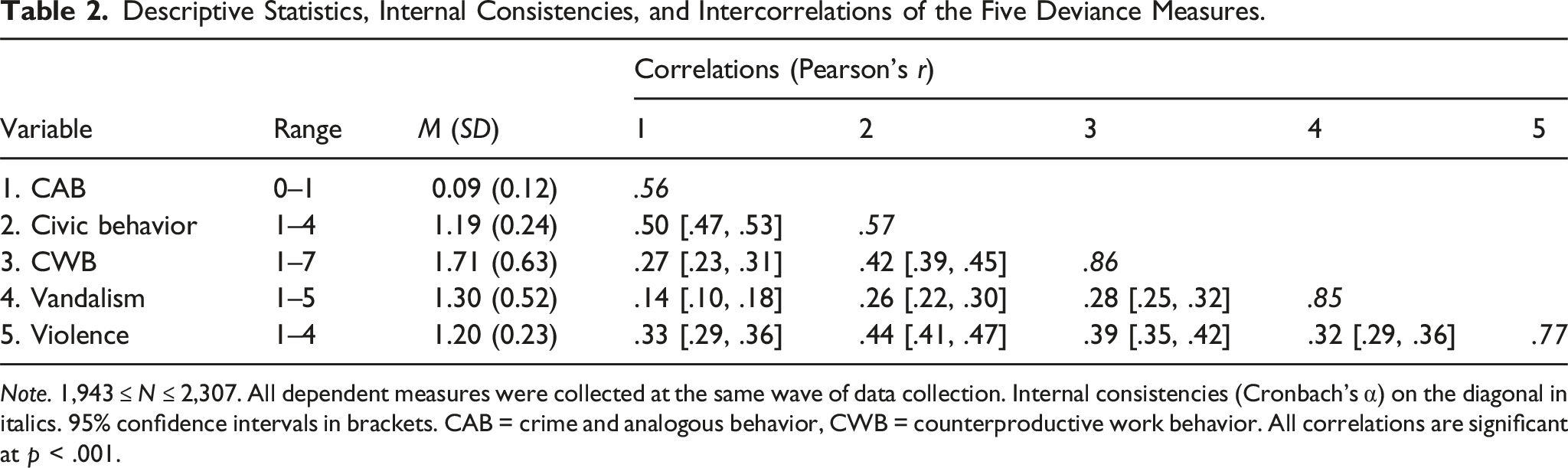
Note. 1,943 ≤ N ≤ 2,307. All dependent measures were collected at the same wave of data collection. Internal consistencies (Cronbach’s α) on the diagonal in italics. 95% confidence intervals in brackets. CAB = crime and analogous behavior, CWB = counterproductive work behavior. All correlations are significant at p < .001.
Trait–deviance relations
Figure 1 displays the Pearson’s correlations of the 74 personality traits with the five deviance measures, ordered by the average correlation of a trait across the five outcomes. Separate figures for each outcome measure, including exact effect sizes and 95% confidence intervals, are available in the R Markdown file in the OSF supplement along with descriptive statistics and intercorrelations of the personality trait scales. Moreover, we developed a ShinyApp (https://yngwie.shinyapps.io/dispositional_basis_of_deviance/) depicting the strength of the correlations of all traits with the five deviance measures (as well as correlations between traits and partial correlations with the different form of deviance when statistically controlling for other traits) to allow for a thorough inspection of correlational patterns by trait. Zero-order correlations (Pearson’s r) between personality traits and deviance measures. Note. The dots next to each trait indicate the category to which a trait was assigned. Specific effect size estimates are provided in the online supplement. ACT = Authoritarianism-Conservatism-Traditionalism Scales, BFAS = Big Five Aspects Scales, BFI-2 = Big Five Inventory-2, CAB = criminal and analogous behavior, CWB = counterproductive work behavior, FFM = Five Factor Model, GTS = General Trust Scale, IPIP-50 = International Personality Item Pool–50 item version, NARQ = Narcissistic Admiration and Rivalry Questionnaire, NEO-FFI = NEO Five-Factor Inventory, PID-5 = Personality Inventory for DSM-5; SD3 = Short Dark Triad, TPS = Trust Propensity Scale.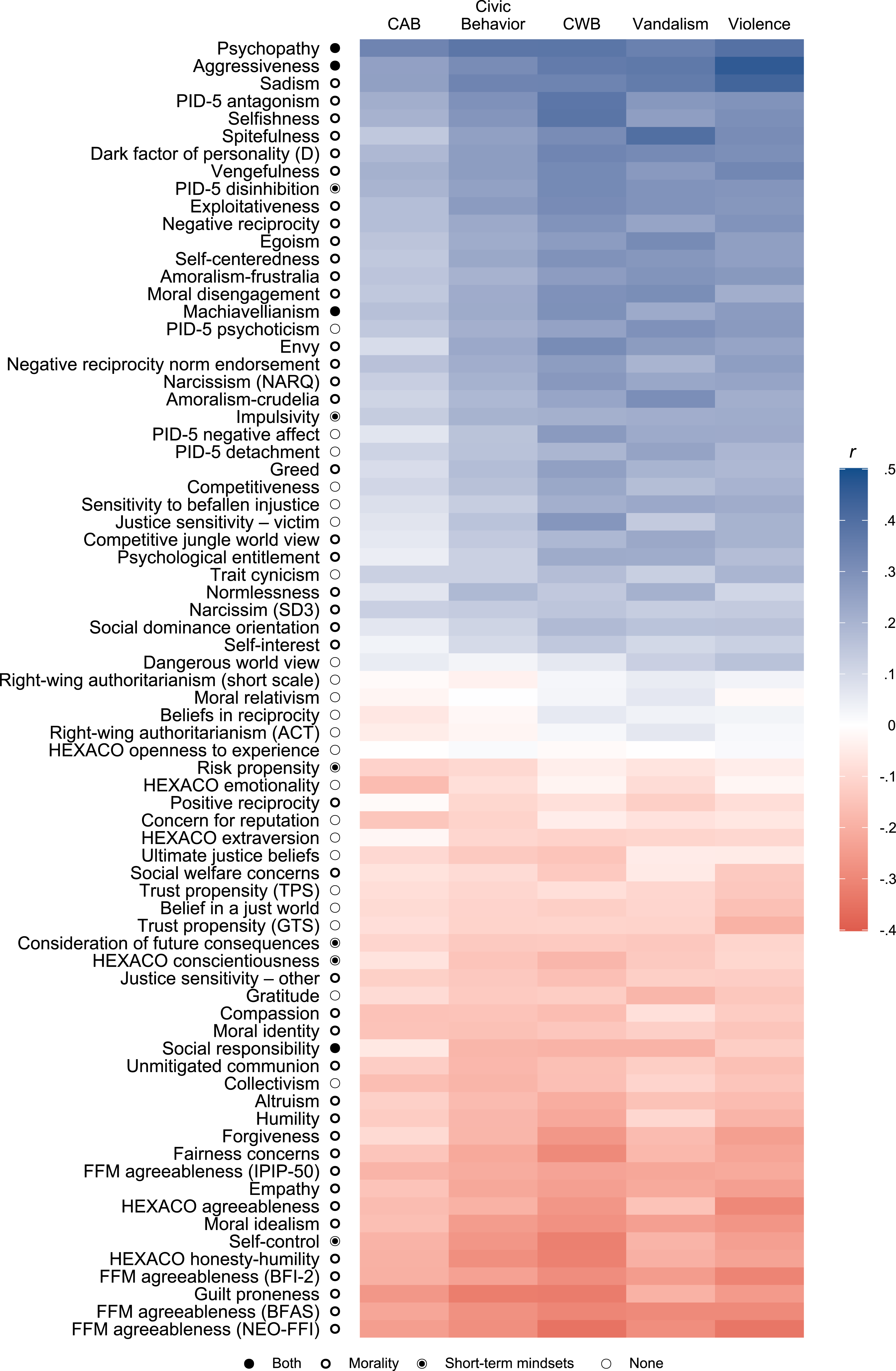
Average Absolute Correlations Between Personality Traits Belonging to the Same Trait Category and the Five Deviance Measures.
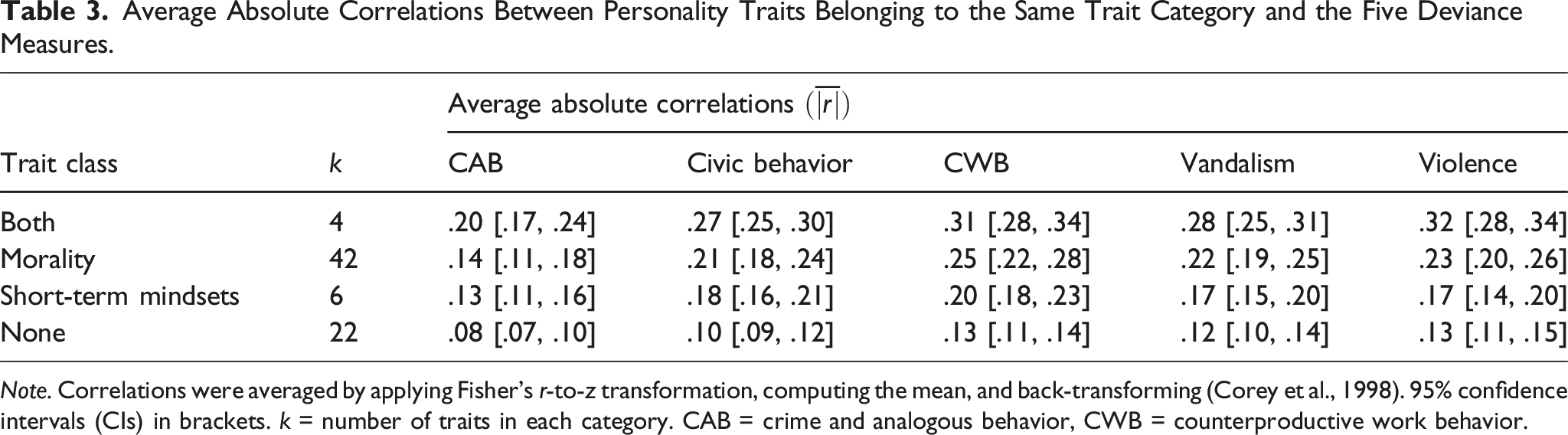
Note. Correlations were averaged by applying Fisher’s r-to-z transformation, computing the mean, and back-transforming (Corey et al., 1998). 95% confidence intervals (CIs) in brackets. k = number of traits in each category. CAB = crime and analogous behavior, CWB = counterproductive work behavior.
Taking a closer look at the specific trait-deviance relations (see Figure 1 and the R Markdown file on the OSF), we found that some traits yielded consistent relations with all five deviance measures (or none of them), whereas others showed a more nuanced pattern, revealing stronger links with some measures than with others. Illustrating the former, psychopathy and aggressiveness consistently ranked among the five strongest positive trait correlates across deviance measures, whereas FFM agreeableness (as measured via the NEO-Five Factor Inventory) ranked consistently among the five strongest negative correlates. Illustrating the latter, PID-5 antagonism (positively), HEXACO honesty-humility, and guilt proneness (both negatively) were relatively more strongly linked to CAB, civic behavior, and CWB than to vandalism and violence. Conversely, spitefulness and sadism showed relatively stronger (positive) relations with vandalism and violence than with the three remaining outcomes. This is interesting because all these traits are primarily linked to morality. Thus, the pattern of correlations does not align with our hypothesis that traits related to morality will be primarily linked to CAB, civic behavior, and CWB, whereas traits related to short-term mindsets will be primarily linked to vandalism and violence. Nonetheless, the results do hint at systematic differences in the dispositional basis of CAB, civic behavior, and CWB, on the one hand, as opposed to vandalism and violence, on the other.
Multivariate trait models of each form of deviance
Results From Predictor Selection Analyses.
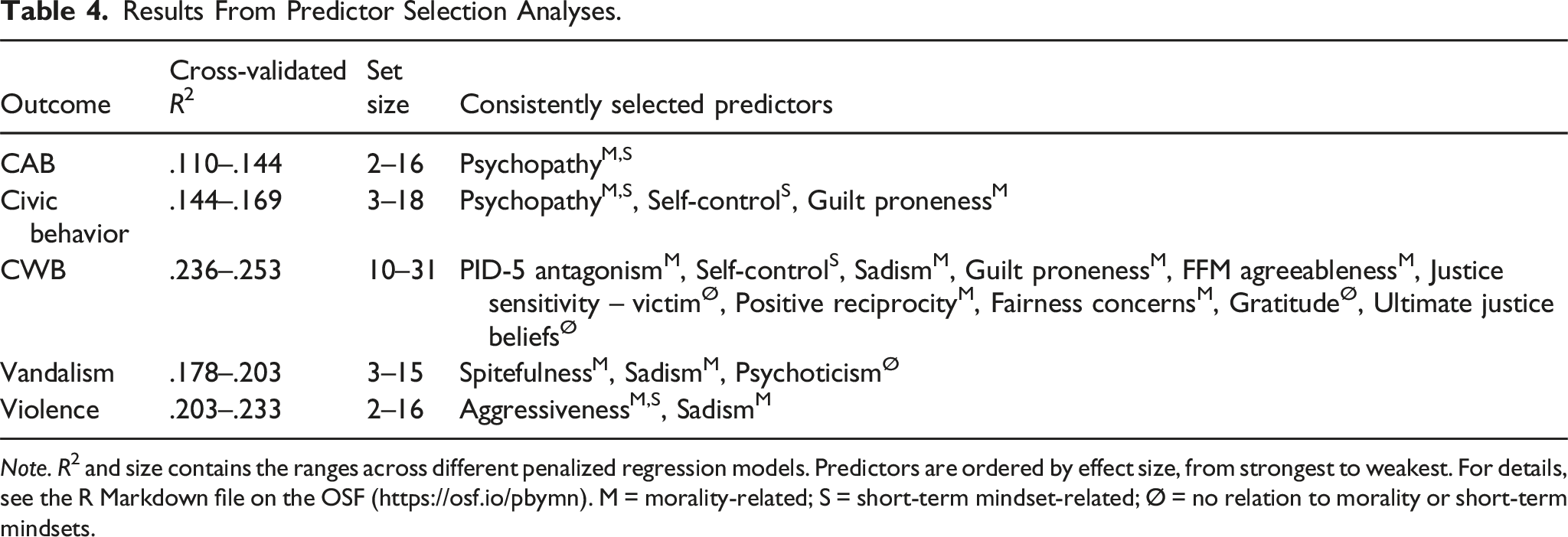
Note. R2 and size contains the ranges across different penalized regression models. Predictors are ordered by effect size, from strongest to weakest. For details, see the R Markdown file on the OSF (https://osf.io/pbymn). M = morality-related; S = short-term mindset-related; Ø = no relation to morality or short-term mindsets.
As shown in Table 4, personality accounted for more than 10% of the variance in all deviance measures. The least amount of variance was explained in CAB, reaching a maximum of 14% based on eight trait predictors in the adaptive lasso regression. The best prediction was apparent for CWB; here, personality accounted for 24–25% in all models, albeit drawing on a relatively large number of traits (≥10) throughout. The most parsimonious account was provided by the models for violence where two predictors alone accounted for up to 23% of the variance (again in the adaptive lasso regression).
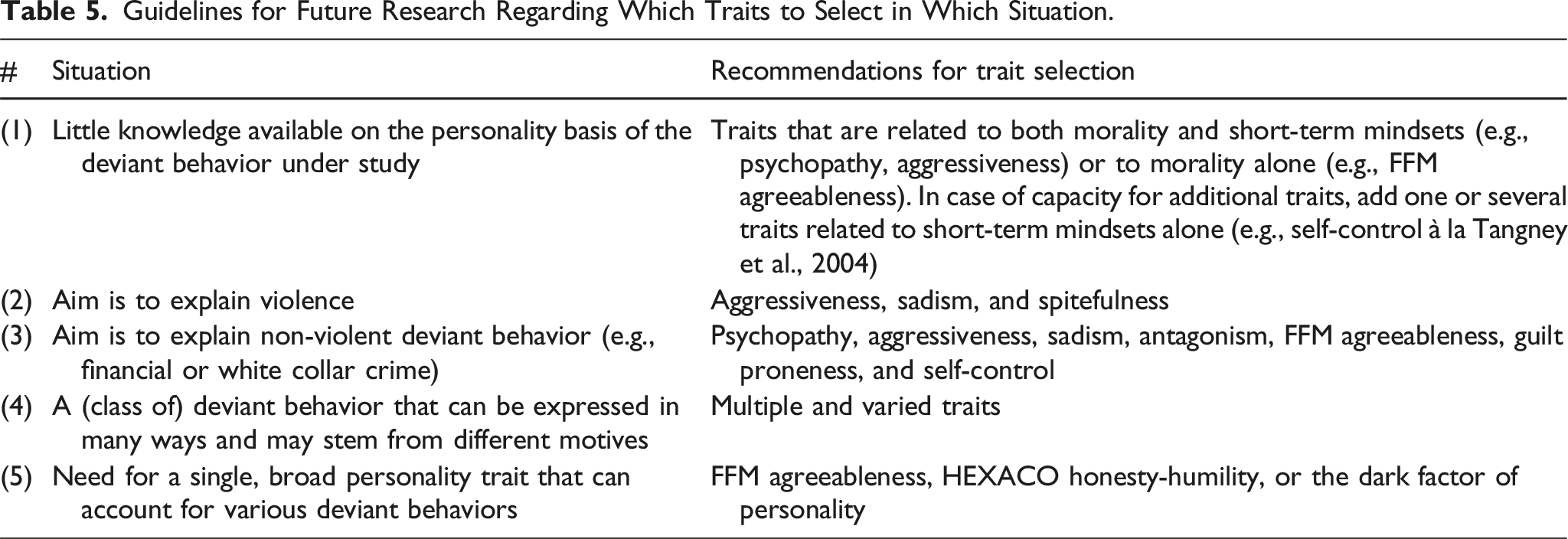
Guidelines for Future Research Regarding Which Traits to Select in Which Situation.
Sensitivity analyses
We ran multiple sensitivity analyses pertaining to the trait-deviance correlations to examine the robustness of the findings. Detailed results are provided in the R Markdown file on the OSF. First, we controlled for item-criterion overlap in the measurement of personality traits and deviance. As detailed above, some personality items explicitly refer to deviant behavior. As a consequence, the construct-level relations may be inflated by particularly strong correlations between items with overlapping content. To rule out this possibility, for each trait-outcome combination, we determined the pairwise correlations of all trait items with all items from the respective deviance measure and computed the trait scores again while excluding all trait items that exceeded a certain correlation. (Note that the deviance measures were unaffected by this procedure, meaning that we always retained all items of these measures). Since there is no agreed-upon cutoff criterion for how large an inter-item correlation has to be to constitute excessive item overlap, we used four different, increasingly conservative criteria for item exclusion (i.e., inter-item correlations of .25 ≤ r ≤ .40, in steps of .05; for information on which scales were affected of this procedure, we refer interested readers to our OSF supplement). We then correlated the resulting trait scores again with the respective deviance measure. Summarized briefly, the vast majority of trait-deviance correlations remained (largely) the same, reducing by Δr ≤ .05 only. The strongest differences were apparent for violence, where (only) 4 out of the 74 correlations decreased by more than Δr = .05 when the most conservative item exclusion criterion (i.e., excluding all trait items correlating at r ≥ .25 with a deviance item) was applied, reaching a maximum of Δr = .11 for aggressiveness.
Second, we repeated the analyses, controlling for age and gender. Criminal and other deviant behavior is more prevalent at a younger age (Hirschi & Gottfredson, 1983) and among males (Steffensmeier, 1980). Likewise, there are systematic personality differences as a function of both age (Ashton & Lee, 2016; Donnellan & Lucas, 2008) and gender (Feingold, 1994). Thus, it is conceivable that some trait-deviance associations are confounded by these demographic variables. However, all correlations were highly similar when partialling out age and gender, with only two correlations reducing by Δr ≥ .05 and most others changing by Δr ≤ .03, if at all.
Third and finally, we calculated the zero-order correlations using variety scores instead of frequency (or agreement) scores for CWB, civic behavior, vandalism, and violence (CAB is measured via a variety score by default). An issue with frequency scores is that frequent but relatively minor deviant acts (e.g., fare-dodging) can weigh more heavily on a mean or sum score than infrequent but more serious forms of deviance (e.g., grand theft)—simply because the former are more frequent than the latter. Variety scores, by contrast, are based on the variety of different acts of deviance a person has ever engaged in while neglecting how often a person has shown each form of deviance. As a consequence, variety scores may provide a more reliable and valid measure of deviance than frequency scores (Sweeten, 2012). We therefore computed variety scores for all outcome measures, but CAB, by coding all responses indicating that a person has ever engaged in a certain form of deviance (e.g., “rarely,” “occasionally,” “agree”) as “1” and responses indicating no prior engagement in this form of deviance (i.e., “never,” “strongly disagree”) as “0.” Almost all correlations were somewhat weaker (.01 ≤ |Δr| ≤ .08) when using variety instead of frequency scores. This is to be expected on statistical grounds alone because variety scores carry less information than frequency scores. However, the pattern of correlations remained largely the same, implying that our findings are not attributable to the type of scoring used to operationalize deviance.
Discussion
In spite of consistent relations between different personality traits and deviant behavior, evidence on which traits account for deviance most strongly when considered simultaneously is scarce. Inspired by recurring calls for a more systematic consideration of personality in the explanation of crime and deviance more broadly (e.g., Caspi et al., 1994; S. E. Jones et al., 2011; Romero et al., 2003; Thielmann, 2023), we examined associations between 74 different personality traits—individually and in the multivariate case—and five different measures of self-reported deviant behaviors, assessed in a large and demographically diverse sample. Based on theoretical considerations and prior evidence, we preregistered that traits capturing individual differences in morality and/or short-term mindsets should yield most consistent and unique relations with deviant behavior. We also expected differences in how these two trait classes are associated with the different forms of deviance under scrutiny.
A parsimonious account of individual differences in deviance
In line with our general prediction, of all traits included in the dataset, those capturing individual differences in morality, short-term mindsets, or both were most consistently related to deviance. Indeed, the results indicate that these traits in particular were likely to exhibit meaningful links with all measures of deviance at hand. For some traits (e.g., psychopathy, aggressiveness, dark factor of personality, FFM agreeableness, gratitude, moral idealism), the strength of correlations was highly similar across deviance measures. For other traits (e.g., PID-5 antagonism, spitefulness, justice sensitivity – victim, HEXACO honesty-humility, guilt proneness, self-control), the strength of correlations differed more strongly across deviance measures while being significant throughout.
Interestingly, results from the regression analyses showed that morality-related traits may be more relevant for the explanation of deviance than short-term mindsets-related traits. Whereas traits related to both morality and short-term mindsets, and traits related to morality alone, were picked up by most regression models as unique predictors, many models—including those explaining violence and vandalism—dispensed with traits related to short-term mindsets alone. As such, the findings were not fully compatible with our hypothesis that short-term mindsets should primarily account for violence. That said, the dominance of morality-related traits in accounting for all forms of deviance resonates with a recent review of research linking personality to crime (Thielmann, 2023). Moreover, it is in line with a key assumption of situational action theory (Wikström, 2004, 2006), which proposes that “an individual’s morality … is the most important individual characteristic influencing an individual’s engagement in acts of crime” (Wikström & Treiber, 2007, p. 258)—although morality is not conceptualized as a personality trait in situational action theory. Still, short-term mindsets seem to add to the explanation of deviance beyond dispositional morality: The best prediction across outcome measures occurred for traits related to both morality and short-term mindsets, and some traits related to short-term mindsets alone accounted for unique variance in certain deviane mesures beyond that explained by morality-related traits. Thus, we conclude that dispositional morality and short-term mindsets together can optimally—and parsimoniously—account for individual differences in deviant behavior.
That being said, it is important to note that we do not argue that these trait domains should be combined into a single construct in the future. Both domains differ conceptually and empirically and each provides unique information about a person’s tendency to engage in deviant behavior. At the same time, within each of these domains, traits are likely to share a common dispositional core. For instance, morality-related traits—such as altruism, empathy, low exploitativeness, and low selfishness—have been shown to overlap in capturing individual differences in regard for others (Popov & Thielmann, 2024). Likewise, traits reflecting short-term mindsets—such as low self-control, impulsivity, and psychopathy—share a common focus on immediate gratification and insensitivity to future consequences. Nonetheless, these common cores should not be taken to imply that all morality-related traits or all short-term mindsets-related traits are functionally equivalent. Each trait still represents a distinct manifestation of these broader dispositional tendencies. This reasoning aligns with the bandwidth-fidelity dilemma in personality prediction (Cronbach & Gleser, 1965; Ones & Viswesvaran, 1996): Broad dispositional dimensions (e.g., morality, short-term mindsets) capture shared susceptibility to deviance, whereas narrower traits provide greater fidelity for predicting specific deviant acts (Pletzer et al., 2020). Building on this reasoning, we next adopt a more fine-grained perspective to examine how specific traits relate to distinct forms of deviance.
A dispositional perspective of specific forms of deviance
Beyond the general finding that traits related to morality and short-term mindsets yielded the strongest associations with deviance throughout, examining specific forms of deviance reveals additional nuance in the personality-deviance nexus. Indeed, in the regression analyses, no single trait was consistently selected as a unique predictor for all deviance measures. That is, no single trait had incremental criterion-related validity above and beyond others for all forms of deviance under scrutiny. This means that different forms of deviance were best accounted for by different personality traits. For example, violence was primarily accounted for by trait aggressiveness and sadism. In contrast, civic behavior—which is more akin to economic/white-collar crime—was primarily accounted for by psychopathy, (low) guilt proneness, and (low) self-control. These results fly in the face of the assumption that the same dispositional mechanism can explain “all crime, at all times” (Gottfredson & Hirschi, 1990, p. 117). This was also backed by the observation that some forms of deviance (e.g., violence) were well explained by just two or three traits, whereas others (i.e., CWB) required more than 10 traits to reach satisfactory prediction. By implication, some forms of deviance have a more complex dispositional basis than others.
We speculate that these differences in the dispositional basis of different forms of deviance can be attributed to the opportunities, or affordances, that the respective situations provide for personality traits to manifest (De Vries et al., 2016). For example, violence is often triggered by provocation, thus happening “in the spur of the moment” (i.e., in emotionally-laden, “hot” states). By contrast, civic behavior—and white-collar crime more generally—may allow for more thorough contemplation and risk-benefit considerations, thus being more often committed in more emotionally-neutral, “cold” states (Van Gelder, 2013). As a consequence, different traits are likely to be activated in the respective situations (De Vries et al., 2016; Thielmann et al., 2020) and, thus, to guide the corresponding deviant act.
The behavior-specific hypotheses we derived were based on exactly this affordance-based logic, assuming that short-term mindsets-related traits are more strongly associated with impulsive or spontaneous forms of deviance (i.e., vandalism and violence), whereas morality-related traits are more strongly associated with more deliberate or calculated forms of deviance (i.e., CAB, civic behavior, CWB). Although our results failed to support this specific hypothesis, the lack of evidence can plausibly be explained by limitations resulting from the specific measures of deviance used. First, the different measures confounded distinct affordances. For example, our measures of impulsive or violent deviance (i.e., vandalism and violence scales) also captured behaviors that involve contemplation (e.g., “Sometimes I think about destroying objects just for fun” from the vandalism scale; emphasis added), thus likely triggering morality-related considerations. Conversely, our “non-violent” deviance measures also included some violent behaviors (e.g., “I have engaged in violence against other people” from the civic behavior scale), which could trigger short-term mindsets considerations. Second, survey-based measures of deviance often provide little information about the situational context in which the behaviors occurred, thus generally limiting the applicability of an affordance-based perspective. The measures of deviance employed in the present investigation may thus have provided an imperfect testbed for our behavior-specific hypotheses. This reasoning also applies more broadly to research on the personality-deviance link: Part of the variation in prior findings may stem from conceptualizing “deviance” too broadly. A psychological perspective suggests the need to disentangle different forms of deviance according to the affordances that corresponding situations provide, as these are likely to engage distinct psychological processes to influence behavior.
Besides providing information about which personality traits relate to deviance under which circumstances, our trait-specific results allow for drawing inferences about the motivational processes that may be involved in different forms of deviance. For example, spitefulness was strongly related to vandalism but to none of the other outcomes. Spitefulness captures the willingness to harm others even at a potential cost (harm or other losses) to oneself. By implication, vandalism in particular may be driven by a strong negative attitude towards a victim, and it may be difficult to prevent it through punishment because those individuals engaging in vandalism may simply not fear negative consequences. Indeed, a study among high school students provided support for both of these claims (Horowitz & Tobaly, 2003). Sadism, by contrast, which involves deriving pleasure from harming others, was strongly related to all forms of deviance studied, suggesting that any deviant behavior may be committed “just for fun.” In line with this reasoning, research shows that sadistic behavior, including crime, can be triggered by boredom (e.g., Newberry & Duncan, 2001; Pfattheicher et al., 2021; Pfattheicher et al., 2023). Finally, the finding that self-control was, surprisingly, only selected as a unique predictor of the more calculating forms of deviance suggests that engagement in these behaviors involves continuous deliberation and self-restraint. Taken together, these examples suggest that although different forms of deviance may share a certain psychological basis, they provide different opportunities for personality to manifest itself. We thus encourage future research to adopt an affordance-based perspective and employ situational (contextualized) measures of deviance to deepen our understanding of the psychological basis of different forms of deviant behavior.
Beyond morality and short-term mindsets
In several cases, traits that are largely unrelated to morality and short-term mindsets also made their way into the final regression models, meaning that they accounted for unique variance in deviance over and above all other (morality- and short-term mindsets-related) traits. The specific “other” traits that were selected differed between deviance measures. For example, psychoticism—which, as measured via the PID-5, “is characterized by a wide range of experiences and behaviors that are deemed ‘odd’, ‘eccentric’, or ‘unusual’ by common cultural standards” (Zimmermann et al., 2014, p. 520)—only emerged as a unique predictor of vandalism, although it also showed small to medium zero-order correlations with the other deviance measures. Ultimate justice beliefs—beliefs in the promise of higher justice—had incremental criterion-related validity for CWB while only showing small (negative) zero-order correlations with all other deviance measures at best. CWB was also uniquely accounted for by gratitude and justice sensitivity – victim, which capture how individuals react to good things that happen to them (gratitude) and to experiencing or anticipating unfair treatment by others (justice sensitivity – victim), respectively. Finally, concern for reputation and HEXACO emotionality were each included in all but one model predicting CAB. Whereas the former taps into how people want to be perceived by others, the latter captures individual differences in sentimentality, dependability, fearfulness, and anxiety.
On the one hand, these findings once again demonstrate systematic differences in the dispositional basis of different forms of deviance since each of these “other” traits only occurred as a unique predictor of a single deviance measure and not the others. On the other hand, they raise the question of what exactly it is that morality and short-term mindsets may lack for the explanation of deviance that these other traits capture. As mentioned above, negative affectivity—the tendency to experience negative affective states such as anger, contempt, fear, and disgust (Watson et al., 1988)—may be another trait class relevant for the explanation of deviant behavior (Thielmann, 2023). Indeed, some of the traits showing incremental criterion-related validity tap into negative affectivity. For example, justice sensitivity – victim entails anger about unfair treatment and fear of being exploited (Gollwitzer & Rothmund, 2011), and HEXACO emotionality entails being emotional, oversensitive, sentimental, fearful, anxious, and vulnerable versus being brave, tough, independent, self-assured, and stable (Ashton & Lee, 2007). Indeed, recent evidence on the trait correlates of official crime records likewise corroborates unique explanatory potential of HEXACO emotionality among basic personality traits (Bader et al., 2025). However, a link to negative affectivity cannot explain the criterion-related validity of PID-5 psychoticism, ultimate justice beliefs, and concern for reputation. Then again, the finding for PID-5 psychoticism aligns with evidence linking it to antisocial personality disorder (Maples et al., 2015) and negatively to HEXACO honesty-humility and conscientiousness (Pletzer et al., 2023), and the finding for ultimate justice beliefs corresponds to research linking it to aversive personality as reflected by the dark factor of personality (Hilbig et al., 2022). Nonetheless, future research is needed to determine whether these traits show consistent associations with (certain forms of) deviance and, if so, how to explain their effects. Until then, we maintain that considering morality and short-term mindsets as two key dispositional determinants of deviance strikes the right balance between parsimony and comprehensiveness.
Limitations and future directions
Even though our study was comprehensive, several limitations ought to be acknowledged. First, our findings are tied to the specific measures of deviance used. Although we applied five different outcome measures capturing different forms of deviance and replicated our results using variety scores for all measures implementing Likert-type (e.g., frequency) scales, the present design does not cover the full spectrum of possible deviant acts. Moreover, as also noted earlier, some of the measures aggregate distinct forms of deviance that may involve different psychological processes. For example, the CAB scale includes items referring to property offenses, violent crimes, and substance use. To more strictly test the idea that different situations provide different affordances for certain traits to be expressed in deviant behavior, future research should employ outcome measures that more clearly distinguish between specific forms of deviance, including distinct crime (sub)types. Relatedly, the vandalism scale in our study primarily assesses urges, temptations, or imagined enjoyment of destruction (e.g., “I would enjoy throwing a functioning TV out of the window”) rather than reports of actual acts of vandalism. Its comparability with measures focusing on self-reported past behaviors is therefore limited.
Another limitation with regard to the outcome measures concerns our reliance on self-reported indicators of deviant behavior. Self-reports are inherently susceptible to biases such as social desirability and inaccurate recall—tendencies that are likely amplified when individuals report on sensitive issues such as deviance (Tourangeau & Yan, 2007). Nevertheless, self-report data have long been a cornerstone of criminological research and offer several advantages over official crime records (e.g., police or court data; see Gomes et al., 2018 for a review). First, self-reports are not bound to the legal definition of crime, which varies across time and sociocultural context. Second, self-reports are better suited for assessing a broad range of offending behaviors, including acts without identifiable victims (e.g., drug use). By contrast, official records typically capture only a narrow and potentially unrepresentative subset of all relevant behaviors—namely those that are detected, reported, and legally prosecuted. Many forms of deviance go unreported, particularly minor, interpersonal, or socially stigmatized acts, resulting in substantial underestimation in official statistics (e.g., Farrington et al., 2013; Theobald et al., 2014). In light of this, criminologists have concluded that “the prevalence and mean frequency of self-reported offending is a better indicator of actual delinquent behavior than is being charged by the police or the frequency of police charges” (Loeber et al., 2015, p. 163). Self-reports thus remain an indispensable tool for capturing the full range of deviant behaviors, especially in large-scale studies like ours. Nonetheless, future research would benefit from integrating self-report data with official crime records to examine whether trait-behavior associations generalize across measurement methods.
Beyond the data source itself, the deviance measures differed in their psychometric quality. For example, the CWB scale showed a considerably higher alpha reliability (α = .86) than the civic behavior and CAB scales (α = .57 and .56, respectively), whose alpha reliabilities fell below common standards for acceptable internal consistency (Cortina, 1993). Whether these methodological reasons contributed to the herein observed differences in the amount of variance explained by personality for different forms of deviance should be addressed in future work.
Second, the trait classes differed in how well they were represented in the set of traits: 42 of the 74 traits had a conceptual link to morality alone, whereas only six had a conceptual link to short-term mindsets alone. Although this imbalance arguably mirrors the systematic differences in attention that these trait classes have received in research on (un)ethical behavior over the past decades, it may have placed traits capturing short-term mindsets at a disadvantage. That said, several well-established concepts and corresponding measures of short-term mindsets-related traits were included (e.g., self-control as measured via the Self-Control Scale by Tangney et al., 2004; impulsivity as measured via the Barratt Impulsiveness Scale; Patton et al., 1995; Spinella, 2007). Moreover, the regression analyses draw on the unique aspects of each trait, meaning that it should be irrelevant how many other traits capturing different content (in this case morality or something completely unrelated to both morality and short-term mindsets) are included in a model: As long as a trait explains unique variance in the outcome under scrutiny, it should be selected by the model. Thus, traits related to short-term mindsets had an equal chance to be selected as predictors as any other trait in the model. Nonetheless, future research may pay particular attention to including all conceivable traits capturing aspects of short-term mindsets to rule out that their relatively weaker associations were due to the specific traits included here. In a similar vein, future research may particularly focus on testing whether traits capturing individual differences in negative affectivity can systematically account for unique variance in (certain forms of) deviant behavior above and beyond traits capturing individual differences in morality and short-term mindsets.
Third, and relatedly, we classified traits as being related (or not) to morality and short-term mindsets in a categorical rather than continuous manner. This approach offered clear conceptual distinctions and facilitated hypothesis testing, yet inevitably entailed some loss of nuance. Traits may vary in the degree to which they reflect these domains rather than belonging exclusively to one or the other. Future research could address this limitation by rating the strength of each trait’s link to morality and short-term mindsets on a continuous scale or by applying data-driven methods (e.g., factor-analytic or network approaches) to identify the extent to which traits align with these overarching dispositional dimensions.
Fourth, many of the deviant behaviors arguably occurred prior to the personality assessment. As such, our findings do not reflect prospective prediction but rather the extent to which personality traits are associated with, and incrementally account for, variance in retrospectively reported behaviors. Consequently, the current data do not permit strong causal inferences about the direction or nature of these relations. This also applies to potential interrelations among predictors: although our regularized regression models identified subsets of strong predictors of deviance, they do not reveal the causal structure underlying the models nor whether some traits act as mediators, confounders, moderators, or suppressors. Future research using longitudinal or experimental designs is needed to test whether these traits prospectively predict subsequent engagement in deviant behavior and to disentangle potential causal mechanisms linking them.
Another limitation of the present study relates to our sample’s age. Although being substantial in size, covering a large part of the human life span (age range of 18–78 years), and being approximately representative of the (German) population, our sample did not cover early and late adolescence, a period during which both crime peaks and significant changes in short-term mindsets take place (see, e.g., Steinberg et al., 2009). Although controlling for age did not affect our results in any meaningful way—which strengthens our belief in the stability of our findings—we recommend future research to also systematically examine the relation between personality and deviance during early to late adolescence.
Finally, although the present findings highlight substantive links between personality and deviant behavior, a considerable proportion of variance remains unexplained. Some of this variance is likely attributable to contextual factors such as peer influences, socioeconomic status, or situational opportunities, which may shape or constrain the expression of individual dispositions (e.g., de Courson et al., 2023; Gerstner & Oberwittler, 2018). Future research should therefore examine the joint contributions of personality and environmental factors—as well as their potential interactions—to provide a more comprehensive understanding of when and how individual differences translate into deviant behavior.
Implications: Guidance for research and practice
Which personality traits should scholars interested in the explanation of deviance consider in their research? In Table 5, we provide several guidelines for trait selection in different situations based on our findings. Although oversimplifying our results, they are our best attempt to synthesize the complexity that comes with studying the associations of 74 personality traits with five measures of deviance. In this regard, we also wish to highlight again the ShinyApp developed in the context of the present study (https://yngwie.shinyapps.io/dispositional_basis_of_deviance/) that provides effect sizes for all specific traits included in our investigation in relation to the different outcome measures at hand. It further allows for exploring how multiple traits relate to each other and to deviance in a joint network.
Conclusion
Individuals’ personality is a consistent driver of deviant behaviors, including crime. Personality traits explain a considerable amount of variance in self-reported deviance, in some instances up to 25% according to our estimates. Importantly, the predictive power of personality traits cannot be traced back to “empirical tautologies” as suggested by early criticism (Gottfredson & Hirschi, 1990). Even when explicitly accounting for item overlap in the measurement of personality and the deviane measures, personality traits remained strong correlates of deviance. Similarly, the trait-deviance relations observed are not due to confounding influences of age or gender, or attributable to the scoring method used to operationalize deviance (i.e., frequency vs. variety scores). By implication, there is a substantive link between personality and different forms of deviant behavior.
Moreover, we have shown that considering a single trait—such as low self-control—as the sole predictor of deviance fails to fully capitalize on the potential that the personality space has to offer to the explanation of deviant behavior. Instead, we can only concur with the conclusion that “crime-proneness is defined … by multiple psychological components” (Caspi et al., 1994, p. 187), and we provide a parsimonious account of individual differences in deviance that draws on dispositional morality and short-term mindsets as key concepts accounting for the link of various traits to deviance.
Taken together, it is our hope that the current findings provide a unifying platform for future research to build on. To facilitate this venture, we (1) provide concrete guidelines for researchers about which traits to consider under which circumstance, (2) offer a ShinyApp that can serve as a reference to lean on when designing studies and deriving hypotheses about which traits will relate to which form of deviance and how strongly so, and (3) establish that personality is a major predictor of deviance per se. We are confident that targeted collaborative efforts between psychologists and criminologists will help overcome the remaining challenges in theorizing and measurement—ultimately allowing personality research to realize its full potential for advancing the study of deviance and the understanding of why people engage in deviant behavior.
Footnotes
Declaration of conflicting interests
The authors declared no potential conflicts of interest with respect to the research, authorship, and/or publication of this article.
Funding
The author(s) received no financial support for the research, authorship, and/or publication of this article.
Open science statement
All research materials, data, and analysis scripts as well as supplemental analyses are available on the Open Science Framework (https://osf.io/pbymn). The hypotheses and analysis plan were preregistered prior to conducting any relevant analyses ( ).
).
Notes
Appendix
Mathematical Description of Regularized Regression Models. Note. All regression parameters are estimated by minimizing a Gaussian likelihood 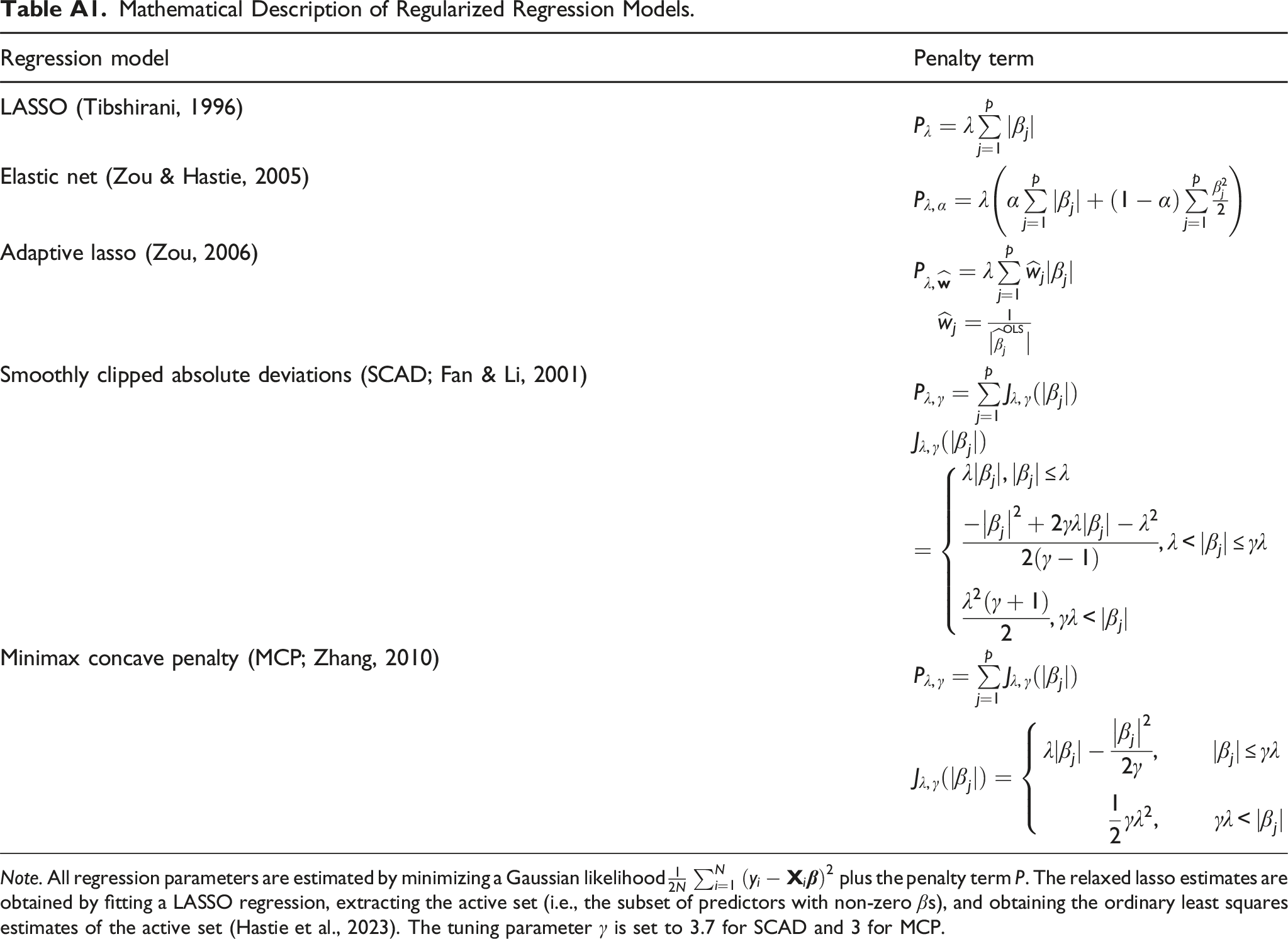
Regression model
Penalty term
LASSO (Tibshirani, 1996)
Elastic net (Zou & Hastie, 2005)
Adaptive lasso (Zou, 2006)
Smoothly clipped absolute deviations (SCAD; Fan & Li, 2001)
Minimax concave penalty (MCP; Zhang, 2010)