




Abstract
While socioeconomic status (SES) and personality have both been identified as relevant predictors of academic achievement, little is known about their possible interplay in predicting school performance. The present study used the latent moderated structural equations (LMS) method to investigate latent interactions between familial SES and parent-rated Big Five in a sample of German high school students (N = 3,043). Personality ratings administered in grade 7 were used to predict changes in school performance 2 years later under control for previous performance. Openness and Conscientiousness positively predicted German as well as mathematics grades over and above fluid intelligence, parental SES and competence measures. Openness and Conscientiousness also showed positive interactions with SES in line with the Matthew effect hypothesis. Their association with school performance was partly mediated by students’ competences. This evidence might be particularly relevant for planning school support programs and interventions targeting background disadvantages as well as teacher training.
Plain Language Summary
Understanding why students from wealthier families tend to receive better grades can be helped by considering students’ personality. This study used parental reports on their offspring’s personality as well as a measure of the socioeconomic status of the family to investigate whether they are relevant independently and if they have joint relevance for the grades that students receive in high school. Openness and Conscientiousness had both independent effects and also boosted the positive influence of familial socioeconomic status. Part of the association of Openness and Conscientiousness and school grades was based on students’ competences. More open and conscientious students might be rewarded more strongly for their competences and this could contribute to the benefit students with privileged socioeconomic status have in the classroom. These insights might be relevant for training new teachers and for the planning of support programs that aim at helping children from less privileged families.
Introduction
Persisting inequalities in academic achievement related to the socioeconomic status (SES) of the family (Liu et al., 2022; Sirin, 2005) raise the question of mechanisms underlying this association. Personality is another well-established predictor of achievement (Mammadov, 2022; Poropat, 2009) that has previously been considered as a modulator of background effects. Damian et al. (2015) outline possible patterns of this interplay. First, effects of both predictors might be independent of each other. Second, academically advantageous traits such as high Conscientiousness, Openness, and Agreeableness (Poropat, 2009) might compensate for familial disadvantages constituting the resource substitution hypothesis supported by some empirical evidence (Ayoub et al., 2018; Damian et al., 2015; Shanahan et al., 2014). Third, advantageous traits might be particularly beneficial for students with a privileged background, signifying the Matthew effect hypothesis. While previous research (e.g., Shanahan et al., 2014) focused on educational success in adulthood, effects might be stronger when variables are measured at the same time, that is, personality and achievement are both assessed in school. Until now, only a recent German study (Lechner et al., 2021) has implemented such a design and reported a positive interaction between parental SES and ninth graders’ self-reported Conscientiousness when predicting grade point average. In extension of the existing literature, we, first, investigated possible domain-specific interactions of SES and students’ Big Five separately for German grade and mathematics grade. Personality ratings from grade 7 were used to predict changes in school performance two years later in grade 9 with previous school performance being controlled for implementing a longitudinal design. We, additionally, tested whether the associations persisted over and above reading and mathematical competence thereby examining the extent to which they might be based on differences in students’ competences or rather reflect teachers’ assessments of classroom behavior. Lastly, we investigated the relevance of parental reports on students’ Big Five regarding the prediction of German and mathematics grades as well as interaction effects. Parents observe their children on a daily basis and in different contexts, so that their reports on students’ personality may be highly valid and less prone to possible biases of self-reports. Yet parental reports have, thus far, not been considered regarding interaction effects.
Socioeconomic status and academic achievement
First summarized by White (1982) and meta-analytically replicated decades later (Liu et al., 2022; Sirin, 2005), the relation between SES and academic achievement has been long recognized in educational research. The classical measurement of SES consists of parental education, income, as well as occupation (House, 2002). Bourdieu (1986) proposed that social inequality in education is based on differential access to three different forms of capital—economic capital of the family comprising income as well as wealth, cultural capital comprising educational degrees as well as cultural possessions and activities, and lastly social capital in terms of contacts and networks. These different aspects are assumed to be conducive to educational success in school, and children from households with lower SES are assumed to have less access to these different forms of capital, most notably economic capital and cultural capital. Wealthier parents can, for example, invest into books and other educational materials as well as tutoring for their offspring. Parents with higher cultural capital might provide a more stimulating environment for their offspring and also encourage their cultural participation. Additionally, there is evidence indicating that students with lower SES have additional disadvantages because teachers evaluate them more negatively due to negative implicit attitudes (Doyle et al., 2023; Glock & Kleen, 2020). The concrete mechanisms of the influence of socioeconomic status on achievement are subject of ongoing research.
International large-scale academic achievement assessments such as the Programme for International Student Assessment (PISA) detected associations between SES and students’ objective competence scores in most of the OECD countries, with effects in Germany being especially marked (OECD, 2023). Lower grades (Johnson et al., 2007), as well as outcomes in adulthood such as lower educational attainment (Duncan et al., 1998), lower occupational prestige, and lower income (Becker et al., 2019) have likewise been linked to low familial SES. In terms of mechanisms, Lurie et al. (2021) could show that in early childhood, cognitive stimulation as well as children’s language competence were interconnected with SES in predicting later academic achievement. All in all, the socioeconomic status of the family is an important predictor of academic achievement. Yet, the mechanisms behind this relation are not fully understood and merit further investigation. Interindividual differences among youth as well as their interplay with SES might be relevant in that regard.
Personality and academic achievement
Understanding the role of personality in learning processes can be supported by way of the Biggs (1993) 3P learning model comprising the aspects presage—process—product. While the product refers to learning outcomes such as competences and school performance, the process entails concrete behavior in the learning situation such as deep vs. surface learning. Personality can be categorized as part of the presage which encompasses student as well as context characteristics that precede the concrete learning process and that can modulate learning behavior but might also be directly related to learning outcomes. In the last decades, much attention has been given to the Big Five (Goldberg, 1990) personality dimensions—Openness, Conscientiousness, Extraversion, Agreeableness, and Neuroticism—as important predictors of academic achievement. De Raad and Schouwenburg (1996) provide a comprehensive review of theoretical mechanisms linking personality and successful learning. Conscientiousness is considered the most important dimension regarding achievement as it describes diligent and ambitious behaviors (Costa & McCrae, 1995). Openness shows the strongest correlations with fluid intelligence (Ashton et al., 2000) of all the Big Five dimensions and comprises facets as intellect as well as interest in new ideas (Costa & McCrae, 1995). It is also related to a deep-learning approach (Swanberg & Martinsen, 2010). Extraversion might be beneficial for younger students by fostering a positive learning attitude (De Raad & Schouwenburg, 1996) but it also has been linked to surface-learning (Zhang & Ziegler, 2016) which can be considered a maladaptive learning strategy (Donoghue & Hattie, 2021). Agreeableness might affect academic achievement through cooperative classroom behavior (De Raad & Schouwenburg, 1996). Neuroticism might be academically disadvantageous since it comprises a susceptibility to stress and is also linked to surface-learning (Swanberg & Martinsen, 2010).
Meta-analyses (Mammadov, 2022; Poropat, 2009, 2014) confirmed Conscientiousness, Openness, and to a lesser degree Agreeableness as predictors of academic achievement. A recent meta-analysis (Meyer et al., 2023) highlighted differences in associations between the Big Five and achievement depending on domain and type of outcome measure (grades vs. test scores). Conscientiousness was more strongly related to grades than to test scores irrespective of the domain. This indicates that teachers might take into account students’ diligent behavior when grading. Openness was more strongly associated with language-related achievement measures irrespective of their type. Agreeableness was more strongly related to language test scores but showed similar associations with grades in different domains. Students’ social classroom behavior might therefore also be relevant for teachers’ grading. The associations of personality with achievement also persist after control for intelligence, academic self-concepts, and academic interests (Spengler et al., 2016; Spengler et al., 2013). Regarding the German National Educational Panel Study (NEPS) data and the cohort used in the current study, all self-reported Big Five dimensions were related to academic achievement with Conscientiousness as well as Openness being the strongest predictors (Israel et al., 2019). Roemer et al. (2022) additionally showed that students’ self-reported Big Five in the NEPS predicted school grades largely independent of domain-specific as well as general cognitive competencies.
For self-reported Openness, however, the authors found that its associations with grades overlapped with competencies suggesting a partial mediation.
Previous studies on adolescents’ achievement focused predominantly on self-reports of personality apart from some exceptions (e.g., Fogarty et al., 2014; Israel et al., 2021). Much less is known about predictive validity of parental personality reports over and above fluid intelligence and sociodemographic control variables.
Parental reports on personality
As personality dimensions differ with regard to observability and evaluativeness (John & Robins, 1993), different raters might have unique information (Vazire, 2010) on an individual. Traits high in observability comprise easily observable behavioral cues. Trait evaluativeness implies that some traits can elicit particularly positive (or negative) associations. According to the Self-Other Knowledge Asymmetry (SOKA) Model (Vazire, 2010), others have better access to behavioral cues than the self. Additionally, others are assumed to be less afflicted by positivity bias when rating evaluative traits. Parents could be seen as the most important adult interaction partners of their offspring (Luan et al., 2017) as they know them from a wide range of situations over a long period of time typically resulting in a high familiarity with the offspring’s personality (Tackett et al., 2016). In terms of constituting “good judges” of personality (Funder, 1995), parents might exhibit some tendency to describe their offspring positively on evaluative traits since they can be assumed to be emotionally invested in the target (Vazire, 2010) but they are also considered motivated as well as capable of providing accurate descriptions (Tackett, 2011). Due to their high familiarity with the target, Conscientiousness as a behavior-centered trait might be possibly well assessed by parents, and parents might have the most trait information on traits low in observability such as Neuroticism of all adult raters. Openness and Agreeableness as highly evaluative traits might be assessed by parents in a less distorted manner than by the self. With regard to parental perceiver effects of the Big Five, parental reports on their offspring’s personality have been shown to be related to the parental socioeconomic background when contrasting parents reports against teacher-assessments on elementary school students (Meier-Faust & Watermann, 2024). In particular, parents with a higher SES described their offspring less positively than the children’s class teachers. This illustrates that personality ratings by adults can also be subject to certain distortions. Additionally, parents can only compare their offspring’s personality to that of siblings or other youth they know while teachers have a much broader frame of reference.
Agreement between parental and self-reports has been meta-analytically shown to be highest for Conscientiousness, followed by Openness and Extraversion, and lower for Neuroticism as well as Agreeableness (Connelly & Ones, 2010). With regard to the prediction of academic achievement, a meta-analysis on primary education (Poropat, 2014) found stronger associations of Conscientiousness and Openness with achievement when adult-ratings were used compared to self-reports. Similarly, peer-ratings of Conscientiousness and Autonomy were found to incrementally predict academic achievement over and above self-reports of high school students (Bratko et al., 2006). These empirical findings underscore the relevance of additional perspectives, especially of adults, when examining relations between personality and academic performance. Parental reports on personality might be particularly relevant predictors of academic achievement and consequently highly relevant for possible interaction effects.
Interaction of personality and socioeconomic background in predicting achievement
While most existing research considers independent effects of socioeconomic background and personality on academic achievement, analyzing incremental effects of both predictors over and above cognitive ability separately, Damian et al. (2015) have suggested that interactive effects of individual differences and socio-environmental factors might be detectable. Two mechanisms can be derived for the possible interplay of personality and socioeconomic background.
First, personality might help compensate for background disadvantages according to the resource substitution hypothesis. As intelligence has been shown to reduce negative background effects on achievement (Johnson et al., 2007), academically relevant personality dimensions, likewise, might be particularly beneficial for disadvantaged students. Highly conscientious, open, and agreeable students might be able to catch up on socioeconomic disadvantages because of their beneficial behavior. For example, being particularly disciplined and achievement-driven could provide agency and motivation facilitating the mitigation of disadvantages arising from fewer economic resources in the family. In disadvantaged families, the learning environment could also be more disruptive and unstable (see Bronfenbrenner (1979) for the discussion of the effectiveness of proximal processes in different environments), and Emotional Stability might help cope with consequences of economic stress within the family. Taken together, the resource substitution hypothesis would predict that the interaction between personality and socioeconomic background shows a negative coefficient so that background disadvantages are reduced when students have an academically beneficial personality.
Second, academically relevant traits might be particularly beneficial for students with a privileged background, signifying the Matthew effect hypothesis (Walberg & Tsai, 1983). It assumes that a resourceful familial background facilitates the benefits of advantageous traits (Damian et al., 2015). For example, children high in Openness might experience particular advantages regarding their academic achievement when they are provided with ample books and opportunities to pursue their interests without hindrance. A privileged familial environment characterized by high SES might overall be considered a more ideal environment for fostering academically beneficial traits compared to less privileged environments. This could in turn have consequences for students’ academic performance since privileged students might perform particularly well in school when their personality is academically advantageous as well. The Matthew effect applied to the interplay of socioeconomic background and personality would predict a positive interaction coefficient since students with an academically beneficial personality would benefit more from their privileged background.
Empirically, Damian et al. (2015) found a negative interaction between Conscientiousness and parental SES predicting income, after control for intelligence using a prospective longitudinal design—11 years after high school graduation participants benefited from high Conscientiousness in adolescence at lower levels of parental SES. However, for the other personality dimensions, the independent effects model was the most appropriate pattern as the other interaction effects failed to reach significance once intelligence was introduced into the models. The authors suggest that personality might be more relevant as a resource at earlier ages when it might be used by decision-makers to allocate educational opportunities. For example, in the German school system teachers evaluate students’ aptitude for different tracks at the transition from primary to secondary school. Shanahan et al. (2014) also report evidence for the resource substitution hypothesis in terms of greater returns on a beneficial adult personality regarding status attainment at lower levels of parental SES. Both studies focused on academic success in adulthood instead of school achievement in adolescence. Concurrent academic achievement might, however, be particularly subjected to influences of the family context and therefore constitute an important criterion variable.
Most recently, Lechner et al. (2021) examined interactions between self-reported Big Five and parental SES in the prediction of adolescents’ grade point average across six school subjects. Only the positive interaction between Conscientiousness and SES—measured by the Highest International Socio-Economic Index of Occupational Status (HISEI)—reached significance in their study, standing in contrast to the aforementioned empirical evidence. This might be due to differences in outcome measures as well as age of the respondents. In sum, empirical knowledge on the possible interplay between socioeconomic status and personality in the prediction of academic achievement is, as of yet, limited. For one, only Lechner et al. (2021) used school grades as outcome measures. Grades reflect teachers’ evaluations of students’ performance as well as classroom behavior and explicitly encompass classroom participation (Meyer et al., 2019; Westphal et al., 2016). Students’ personality, therefore, might be more relevant with regard to school grades compared to competence scores. Teachers, additionally, might be biased in their perceptions of students depending on the socioeconomic status of the family possibly favoring students who exhibit a highbrow habitus (Bourdieu & Passeron, 1977), such that interactions between personality and background measures might manifest most clearly using school grades as outcome.
Moreover, none of the previous studies have examined associations of personality and SES with school performance under control for competence scores. Controlling for the overlap of competences with the predictors might reveal their unique contribution to school performance freed of the influence of cognitive abilities. Lastly, parental ratings of adolescents’ personality have not been considered when investigating interaction effects albeit parents are frequently used as informants in large-scale assessments of youth.
The present investigation
The present paper pursues three objectives. First, we aimed at replicating findings of socioeconomic status differences in academic performance investigating the association of SES with school grades in two different subjects. Second, we assessed the predictive validity of adolescents’ parent-rated Big Five over and above fluid intelligence and SES as well as reading and mathematical competence. We implemented a longitudinal design by using personality ratings from grade 7 to predict school performance two years later and controlling for the previous school performance. We, accordingly, investigated whether the parent-rated Big Five predict change in school performance. Third, we examined the interplay of socioeconomic background and personality in predicting school performance.
We extended existing empirical knowledge in several regards. Our study used school performance and personality measures in adolescence while most existing literature has focused on achievement in adulthood unrepresentative of processes in the classroom.
Moreover, we aimed at methodological thoroughness by using large-scale data, a longitudinal design, and structural equation models to examine latent interactions (Klein & Moosbrugger, 2000). All in all, we investigated the following research questions: (1) Does familial socioeconomic status predict students’ German and mathematics grades? We expect positive associations of SES and both types of grades over and above fluid intelligence. (2) Does personality predict students’ German and mathematics grades? In line with previous research, we expect positive associations of Conscientiousness, Openness, and Agreeableness over and above fluid intelligence and SES. We expect Openness to be more strongly related to German grade than to mathematics grade but the other two dimensions to show similar associations with both grades. We expect that Extraversion and Neuroticism will not be significantly related to school performance. (3) Are effects of SES and personality on school performance independent or interacting? Based on previous findings, we expect a significant interaction between Conscientiousness and SES. Since previous findings were inconclusive concerning the direction of the interaction, we do not have specific expectations in that regard. We expect the interaction to persist even after control for competence measures.
Methods
Sample
We used data from Starting Cohort 3 of the German National Educational Panel Study (NEPS). The NEPS is a Germany-wide longitudinal study with a multi-cohort sequence design aimed at research on educational processes and developmental trajectories of competences (for details see Blossfeld & von Maurice, 2011). Data from the NEPS are not publicly accessible, but available after completion of a NEPS-data usage agreement. The NEPS study is conducted under the supervision of the German Federal Commissioner for Data Protection and Freedom of Information (BfDI) and in coordination with the German Standing Conference of the Ministers of Education and Cultural Affairs (KMK) and—in the case of surveys at schools—the Educational Ministries of the respective Federal States. All data collection procedures, instruments and documents were checked by the data protection unit of the Leibniz Institute for Educational Trajectories (LIfBi). The necessary steps are taken to protect participants’ confidentiality according to national and international regulations of data security. Participation in the NEPS study is voluntary and based on the informed consent of participants. This consent to participate in the NEPS study can be revoked at any time. Documentation of the procedures and measures used in Cohort 3 is openly available on the NEPS website: https://www.neps-data.de/Data-Center/Data-and-Documentation/Start-Cohort-grade-5/Documentation. NEPS data are collected every school year, for Starting Cohort 3 starting in grade 5. A total of N = 3,262 parents participated in 2015 (March to August) when students attended grade 9.
Our sample (N = 3,043) consists of cases for whom the parental personality as well as the dependent variable—grade in German or mathematics—were available. Descriptives of all study variables are presented in Table A2 of the appendix. The students were on average M = 14.43 (SD = 0.58) years old and 50.3% girls. They attended the following secondary school types in ascending order of academic demands (from vocational to highly academic): N = 228 attended a Hauptschule, N = 313 a mixed tracks school, N = 651 a Realschule, N = 173 the Integrierte Gesamtschule, and N = 1,678 a Gymnasium. This means that 55.1% of students attended a highly academic and competitive school type. 16.8% of the students had a migration background.
Measures
School performance
Grades in German and mathematics in grade 9 (school year 2014/2015, reported by students between November 2014 and March 2015) were used as the dependent variables. In the German grading system, 1.00 is the highest grade and 6.00 the lowest possible grade. To make results more interpretable, grades were recoded for further analyses such that higher values represent better performance. We used the previous school performance from two years ago (grade 7 in school year 2012/2013) as control variable on school performance in grade 9 and for the concurrent associations with personality assessed in grade 7.
Personality ratings
Parents filled out the short version of the Fünf-Faktoren-Fragebogen für Kinder [Five Factor Questionnaire for Children] (FFFK-K, Weinert et al., 2007) regarding their child’s personality in grade 7 (wave 3). The FFFK-K consists of 10 items (see Table A1 of the appendix), two per Big Five factor, and uses an 11-point scale (0–10). The items are constructed as semantic differentials (i.e., for Extraversion the child has to be rated: from 0 “is silent” to 10 “is talkative”). Reports were given by mothers in 55.3% of cases, by fathers in 10.4% of cases, by legal guardians in 0.01% of cases; the relationship was not reported in 33.8% of cases. We employed latent variable modeling to account for measurement error in the scales. A CFA of parent-rated Big Five fitted excellently: CFI = .98, TLI = .95, RMSEA = [.04, .05], SRMR = .03. The reliability of the Agreeableness scale in the sample was lowest (ω = .52), followed by Neuroticism (ω = .59), Openness (ω = .66), Conscientiousness (ω = .67), and Extraversion (ω = .71).
Socioeconomic status
Parental socioeconomic status (SES) was measured using the Highest International Socio-Economic Index of Occupational Status (HISEI). Information on parental occupation was available from three measurement occasions: wave 1 in 2011, wave 3 in 2013 and wave 5 in 2014. In 229 cases, data were missing at all three measurement points, and these parents were excluded from the sample. The HISEI variable used in the analyses represents the highest value from all available measurements per parent. A latent variable was modeled to represent SES using the HISEI as single indicator and fixing the variance to (1-ρ)*variance in the sample. We assumed a very good reliability of the HISEI of ρ = .90 since it is a relatively stable characteristic.
Fluid intelligence
Since higher socioeconomic status is associated with higher academic achievement (Sirin, 2005), it is possible that adolescents in households with higher socioeconomic status have higher cognitive abilities. Parental reports on adolescents’ personality were therefore controlled for the effects of intelligence to rule out the possibility that parental personality ratings in different SES households are influenced by adolescents’ intelligence. To control for fluid intelligence of adolescents, a latent variable was modeled with 12 dichotomous (solved/not solved) items from a figural reasoning matrices test, as well as two sum scores assessing processing speed in grade 9 (for details see Haberkorn & Pohl, 2013). The reliability was ω = .80.
Reading competence
Standardized achievement tests in the paper-pencil mode were administered to assess students’ reading competence in grade 9. They included 30 items (easy version) or 32 items (difficult version), and three types of tasks were applied: identifying information in the text, drawing text-based conclusions, and reflecting and evaluating. We used the WLE estimator provided in the NEPS dataset.
Mathematical competence
Students’ Mathematical competence was assessed with standardized achievement tests in the paper-pencil mode in grade 9. They comprised 34 items that were evenly distributed across four content areas: quantity, space and shape, change and relationships, and data and chance. We used the WLE estimator provided in the NEPS dataset.
Control variables
We used three dummy-coded control variables to account for possible differences in school performance: academic school track, the Gymnasium (55.1%) vs. the other school types; gender (50.3% girls); migration background irrespective of generation (16.8%) vs. no migration background. Models testing interaction effects also include additional interactions between the respective personality dimensions and the control variables (Tables A7 and A8 in the appendix) if a significant correlation between the two is present, as suggested in Yzerbyt et al. (2004).
Statistical analysis
Personality assessments conducted in grade 7 were used to predict changes in students’ school performance 2 years later in grade 9. Previous school performance from grade 7 was therefore used in all models a control variable. In order to address our research questions, we employed a six-step modeling procedure. Model I contained fluid intelligence and the control variables as well as SES as predictors of school performance. Models II a to II e additionally included one of the Big Five dimensions as predictors to depict their independent association with school performance—each dimension was analyzed separately and is therefore presented in separate columns. Additional models containing all Big Five dimensions at once are presented in Tables A3 and A4 of the appendix. Models III a to e included an interaction effect between SES and the respective personality dimension. Models IV a to e additionally included reading competence (for German grade) or math competence (for mathematics grade) as a control variable to evaluate whether associations persisted when competence is held constant. Finally, Models V a to e also included an interaction between the Big Five dimension and the competence measure as control for the interaction effects (Yzerbyt et al., 2004). We estimated the interaction effects using the Latent Moderated Structural Equations (LMS) method (Klein & Moosbrugger, 2000). It employs the Cholesky decomposition of the (p x 1) vector of the predictor and moderator producing maximum-likelihood estimates of latent variable interaction parameters. We estimated all models with Mplus 8.11 (Muthén & Muthén, 1998–2017) and our analysis code is provided in the appendix. Missing data was accounted for by Full Information Maximum Likelihood (FIML). As reported by Enders and Bandalos (2001), FIML yields unbiased results and is superior to response pattern imputation. Missing values on the moderator in Model Va were estimated employing a Bayesian estimator using the Mplus option integration = montecarlo. Students’ class ID was used as a cluster variable to obtain unbiased standard errors. Differences between the 548 classes are presented in Table A6 of the appendix—classes differed markedly regarding competences and decidedly less regarding grades and parental SES. The MLR estimator for maximum likelihood estimation with robust standard errors was employed in order to account for possible nonnormality of the measures. Model fit was assessed using the following criteria: comparative fit index (CFI) and Tucker-Lewis index (TLI) of at least .90, root mean square error of approximation (RMSEA) of no more than .06, and standardized root mean square residual (SRMR) of .08 or lower (Hu & Bentler, 1999; Marsh et al., 2004).
Fit statistics of SEMs for the prediction of high school students’ (N = 3,043) German grade by socioeconomic status (SES) and 2 years earlier parent-reported personality.
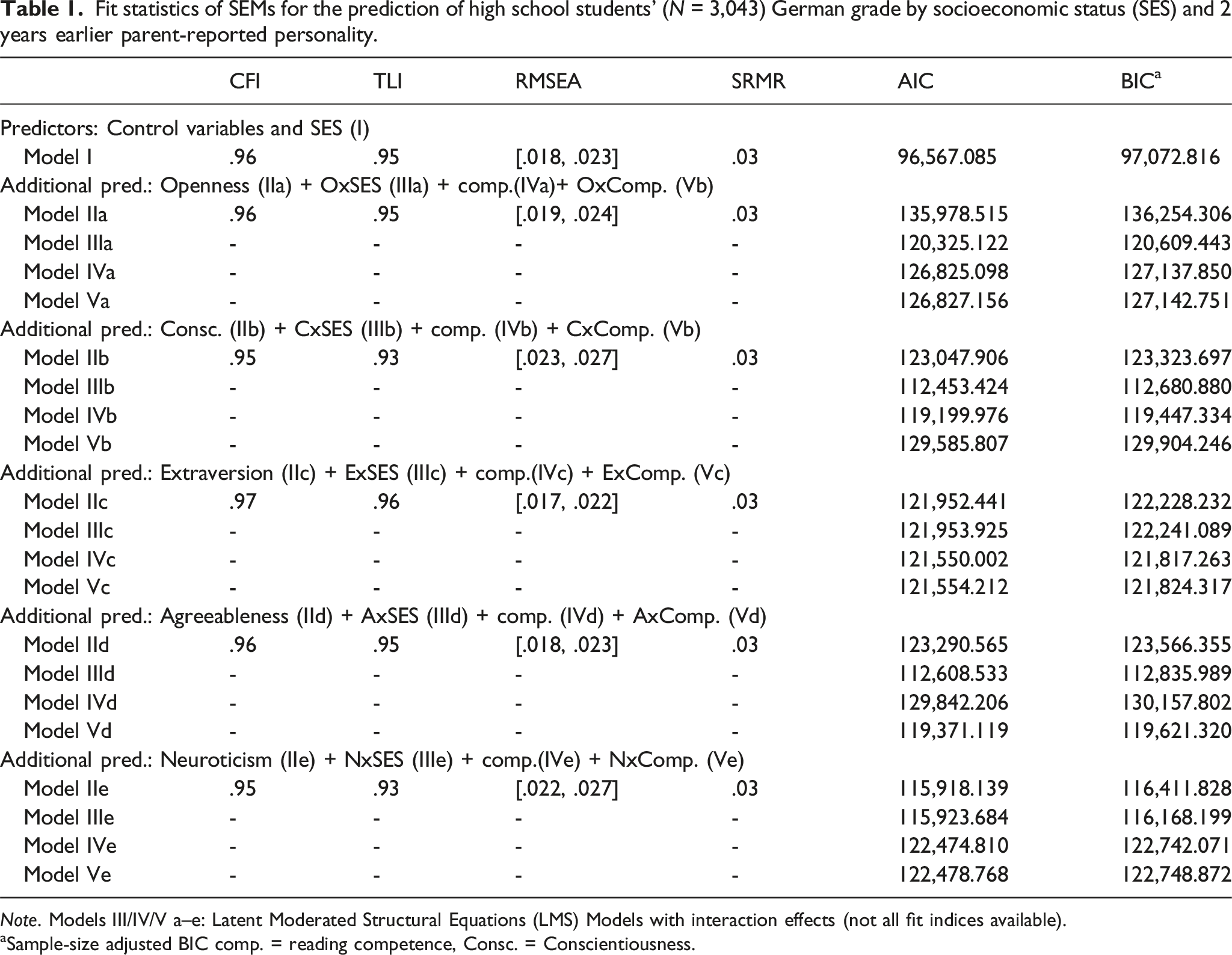
Note. Models III/IV/V a–e: Latent Moderated Structural Equations (LMS) Models with interaction effects (not all fit indices available).
aSample-size adjusted BIC comp. = reading competence, Consc. = Conscientiousness.
Fit statistics of SEMs for the prediction of high school students’ (N = 3,043) mathematics grade by socioeconomic status (SES) and 2 years earlier parent-reported personality.
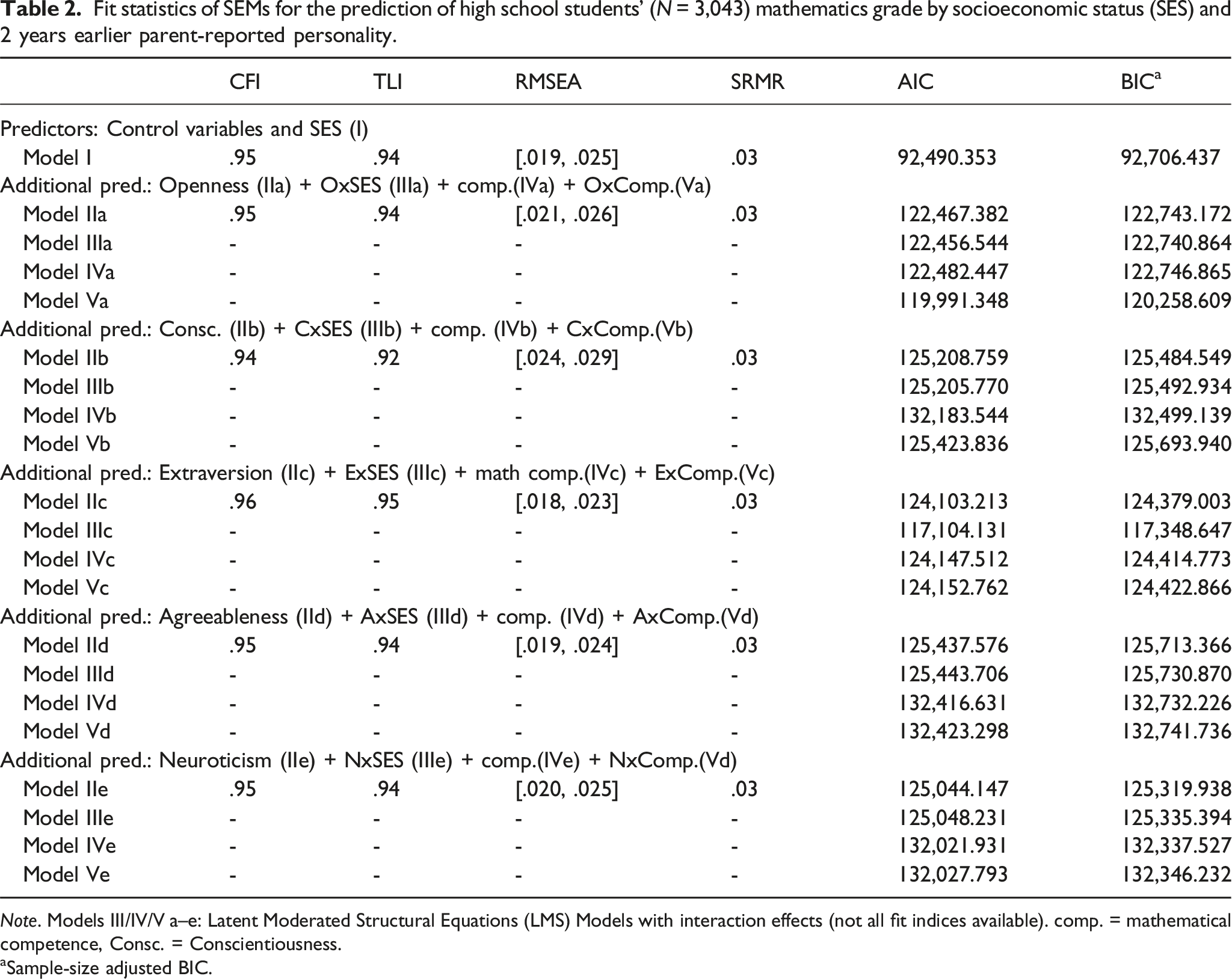
Note. Models III/IV/V a–e: Latent Moderated Structural Equations (LMS) Models with interaction effects (not all fit indices available). comp. = mathematical competence, Consc. = Conscientiousness.
aSample-size adjusted BIC.
Latent correlations between study variables in a sample of German high school students, N = 3,043.
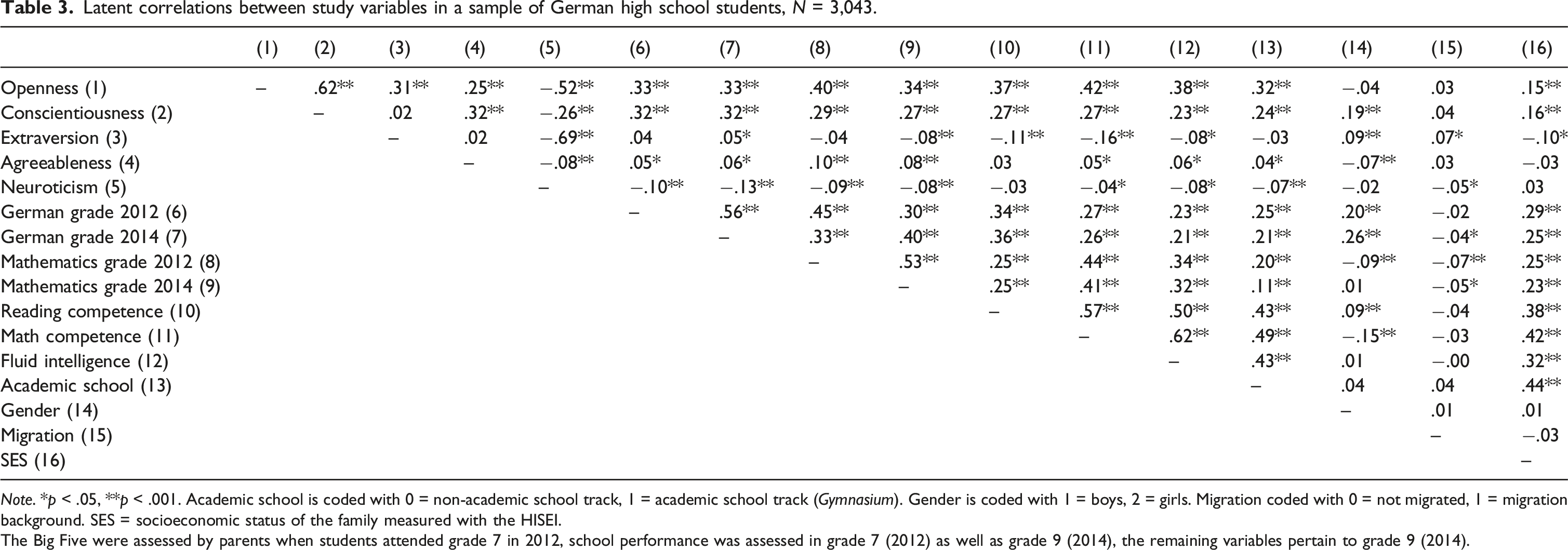
Note. *p < .05, **p < .001. Academic school is coded with 0 = non-academic school track, 1 = academic school track (Gymnasium). Gender is coded with 1 = boys, 2 = girls. Migration coded with 0 = not migrated, 1 = migration background. SES = socioeconomic status of the family measured with the HISEI.
The Big Five were assessed by parents when students attended grade 7 in 2012, school performance was assessed in grade 7 (2012) as well as grade 9 (2014), the remaining variables pertain to grade 9 (2014).
We corrected for multiple testing employing the Benjamini–Hochberg procedure (Benjamini & Hochberg, 1995; Benjamini & Yekutieli, 2001). Empirical evidence suggests that this correction method yields more statistical power than traditional approaches (Raykov et al., 2017; Raykov et al., 2012). The corrected p-values were computed for sets of tests. The first set consisted of the six tests in Model I containing the control variables as well as SES as predictors of grade. The second set consisted of all tests including Openness, that is, Models IIa, IIIa, IVa, Va resulting in 40 p-values. We did this separately for every Big Five dimension and for the two dependent variables. The correction was performed using the R-function p.adjust.
Measurement invariance of parent-rated Big Five was assessed to ensure comparable scale functioning across SES. Multi-group CFAs were conducted to assess configural, metric, and scalar invariance. Three groups were created using HISEI percentiles (25%/50%/75%): low SES was defined as HISEI values of 40 or lower (N = 766), middle SES as HISEI values between 41 and 60 (N = 1,541) and high SES as HISEI values of 61 and higher (N = 721). Invariance was assessed using the CFI—we considered a decrease in CFI of at least .010 substantial (Chen, 2007; Cheung & Rensvold, 2002). Table A5 in the appendix shows that the investigated levels of measurement invariance held meaning that loadings and intercepts can be assumed to be equal across groups with different SES.
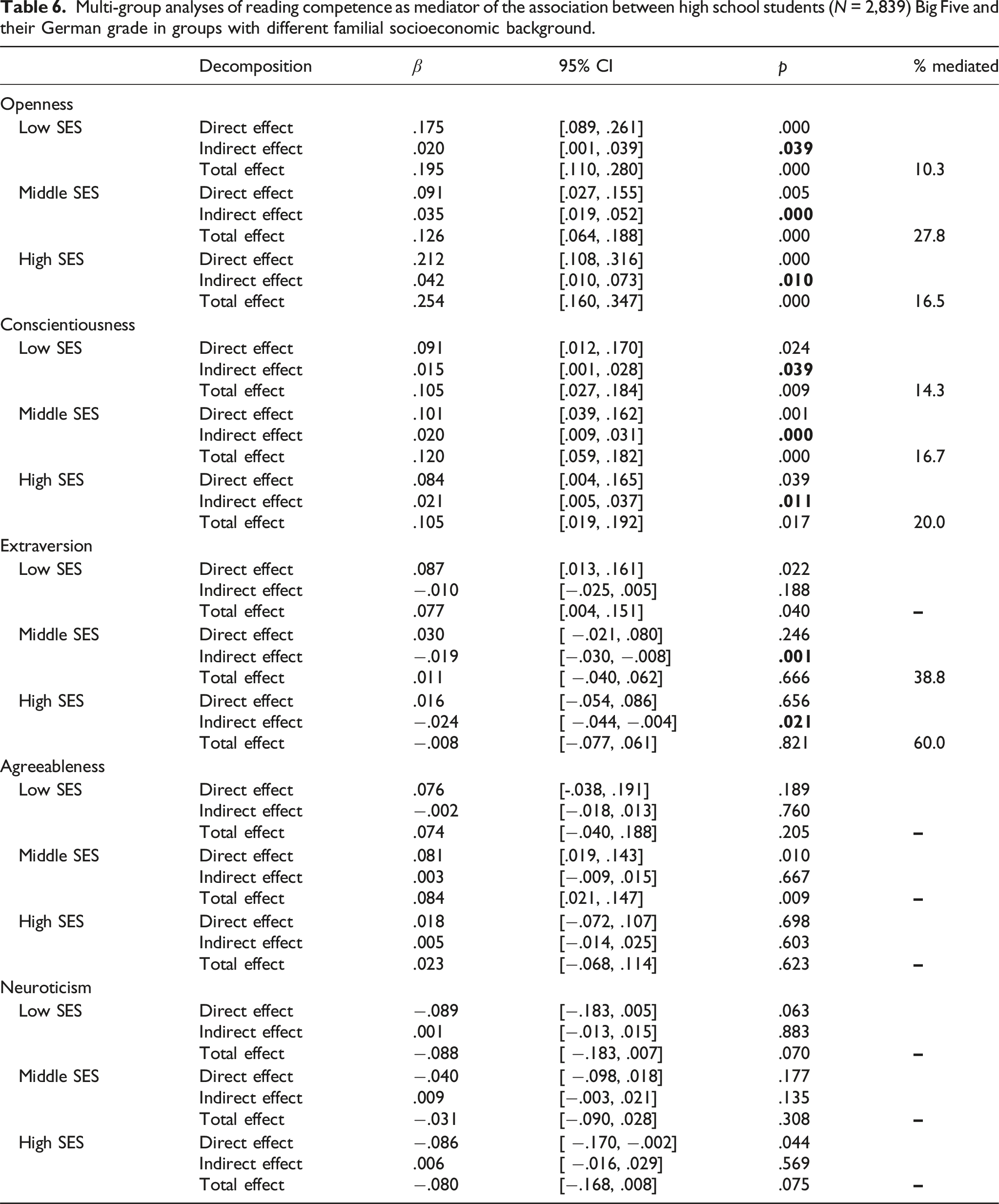
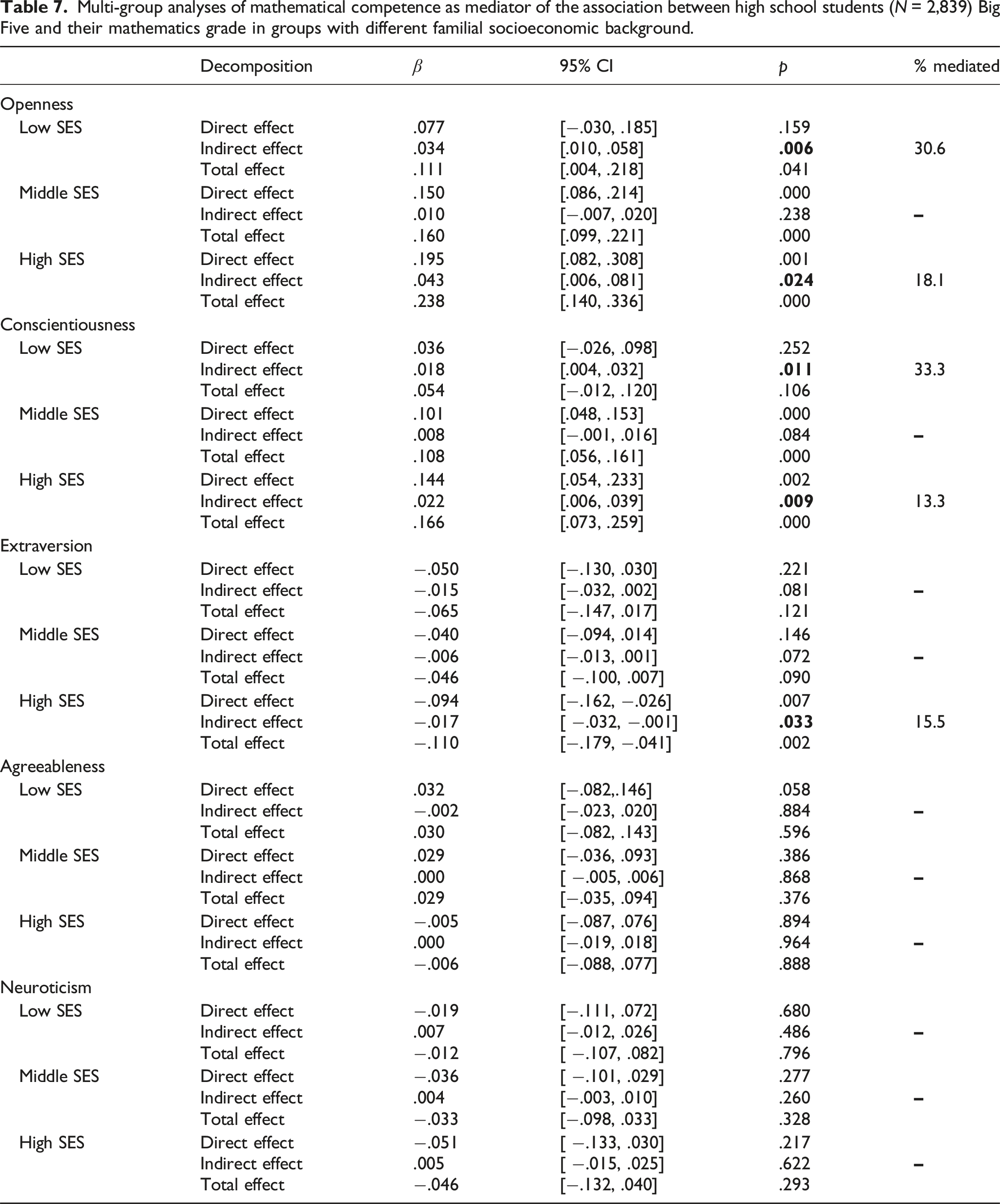
Multi-group mediation analyses were additionally conducted in order to investigate the percentage of the association between personality and school performance that is mediated by reading and mathematical competence. We compared the effects across groups of low SES (N = 720), middle SES (N = 1,435) and high SES (N = 684) grouped by the HISEI percentiles as for the MI testing.
Results
Latent moderated structural equations (LMS) models for the prediction of German high school students’ (N = 3,043) German grade by socioeconomic background and 2 years earlier parent-assessed Big Five.
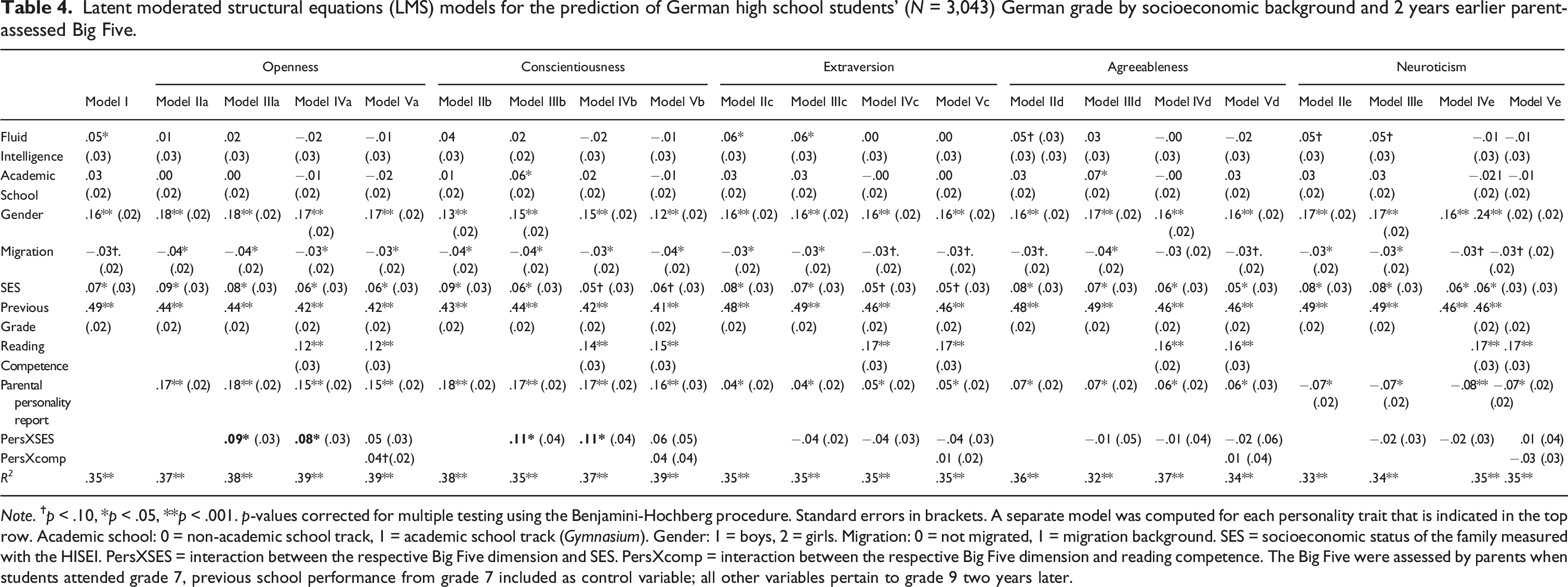
Note. ✝p < .10, *p < .05, **p < .001. p-values corrected for multiple testing using the Benjamini-Hochberg procedure. Standard errors in brackets. A separate model was computed for each personality trait that is indicated in the top row. Academic school: 0 = non-academic school track, 1 = academic school track (Gymnasium). Gender: 1 = boys, 2 = girls. Migration: 0 = not migrated, 1 = migration background. SES = socioeconomic status of the family measured with the HISEI. PersXSES = interaction between the respective Big Five dimension and SES. PersXcomp = interaction between the respective Big Five dimension and reading competence. The Big Five were assessed by parents when students attended grade 7, previous school performance from grade 7 included as control variable; all other variables pertain to grade 9 two years later.
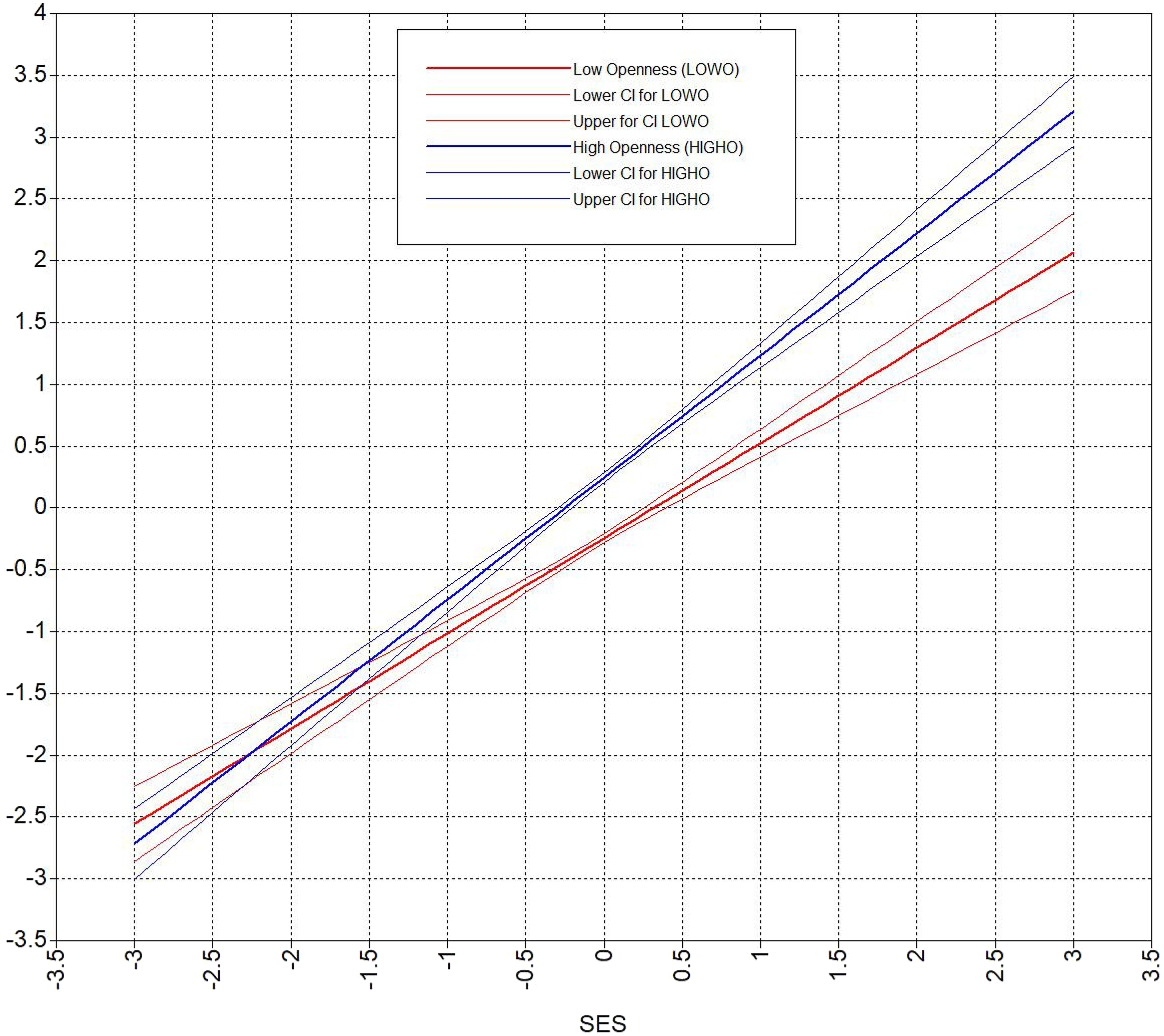
Latent interaction plot for the interplay between Openness and SES in the prediction of German grade. LOWO/HIGHO = low Openness/high Openness, Lower for LOWO/HIGHO = lower confidence interval, Upper for LOWO/HIGHO = upper confidence interval.
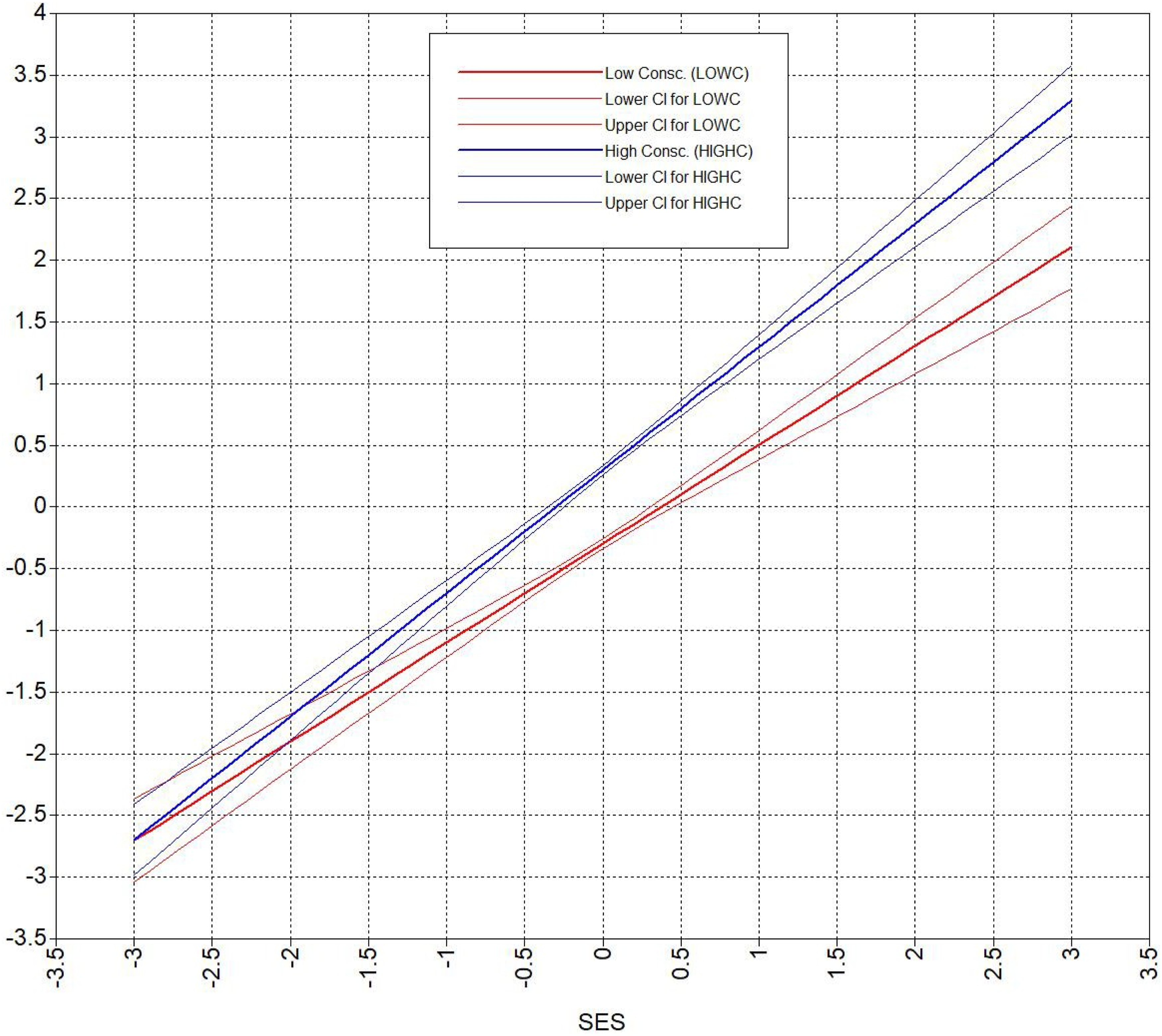
Latent interaction plot for the interplay between Conscientiousness and SES in the prediction of German grade. LOWC/HIGHC = low Conscientiousness/high Conscientiousness, Lower for LOWC/HIGHC = lower confidence interval, Upper for LOWC/HIGHC = upper confidence interval.
Multi-group analyses of reading competence as mediator of the association between high school students (N = 2,839) Big Five and their German grade in groups with different familial socioeconomic background.
Latent moderated structural equations (LMS) models for the prediction of German high school students’ (N = 3,043) mathematics grade by socioeconomic background and 2 years earlier parent-assessed Big Five.
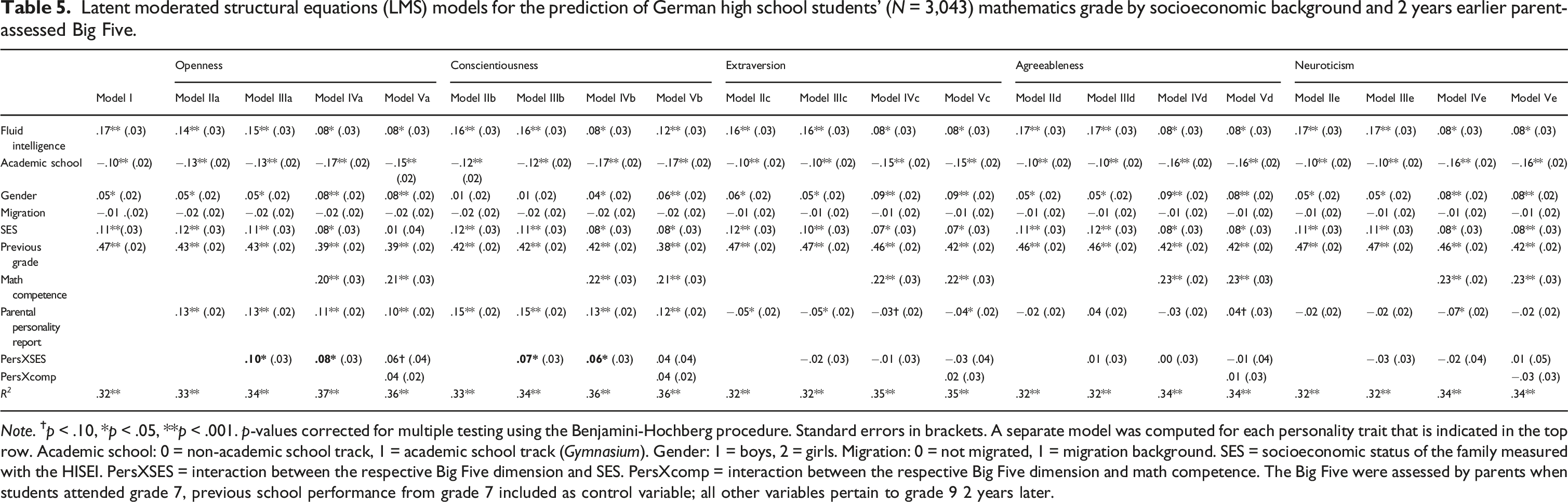
Note. ✝p < .10, *p < .05, **p < .001. p-values corrected for multiple testing using the Benjamini-Hochberg procedure. Standard errors in brackets. A separate model was computed for each personality trait that is indicated in the top row. Academic school: 0 = non-academic school track, 1 = academic school track (Gymnasium). Gender: 1 = boys, 2 = girls. Migration: 0 = not migrated, 1 = migration background. SES = socioeconomic status of the family measured with the HISEI. PersXSES = interaction between the respective Big Five dimension and SES. PersXcomp = interaction between the respective Big Five dimension and math competence. The Big Five were assessed by parents when students attended grade 7, previous school performance from grade 7 included as control variable; all other variables pertain to grade 9 2 years later.
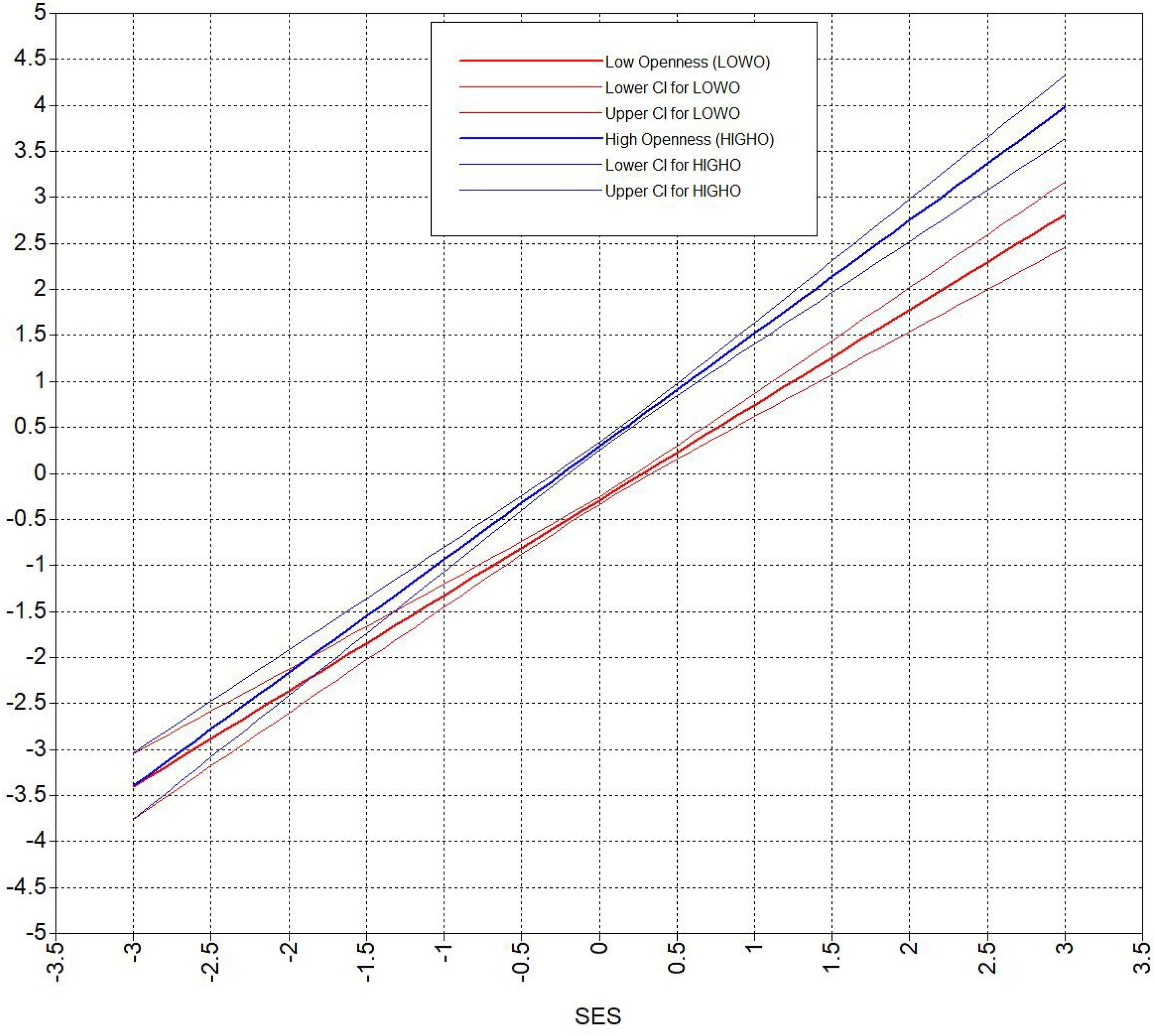
Latent interaction plot for the interplay between Openness and SES in the prediction of mathematics grade. LOWO/HIGHO = low Openness/high Openness, Lower for LOWO/HIGHO = lower confidence interval, Upper for LOWO/HIGHO = upper confidence interval.
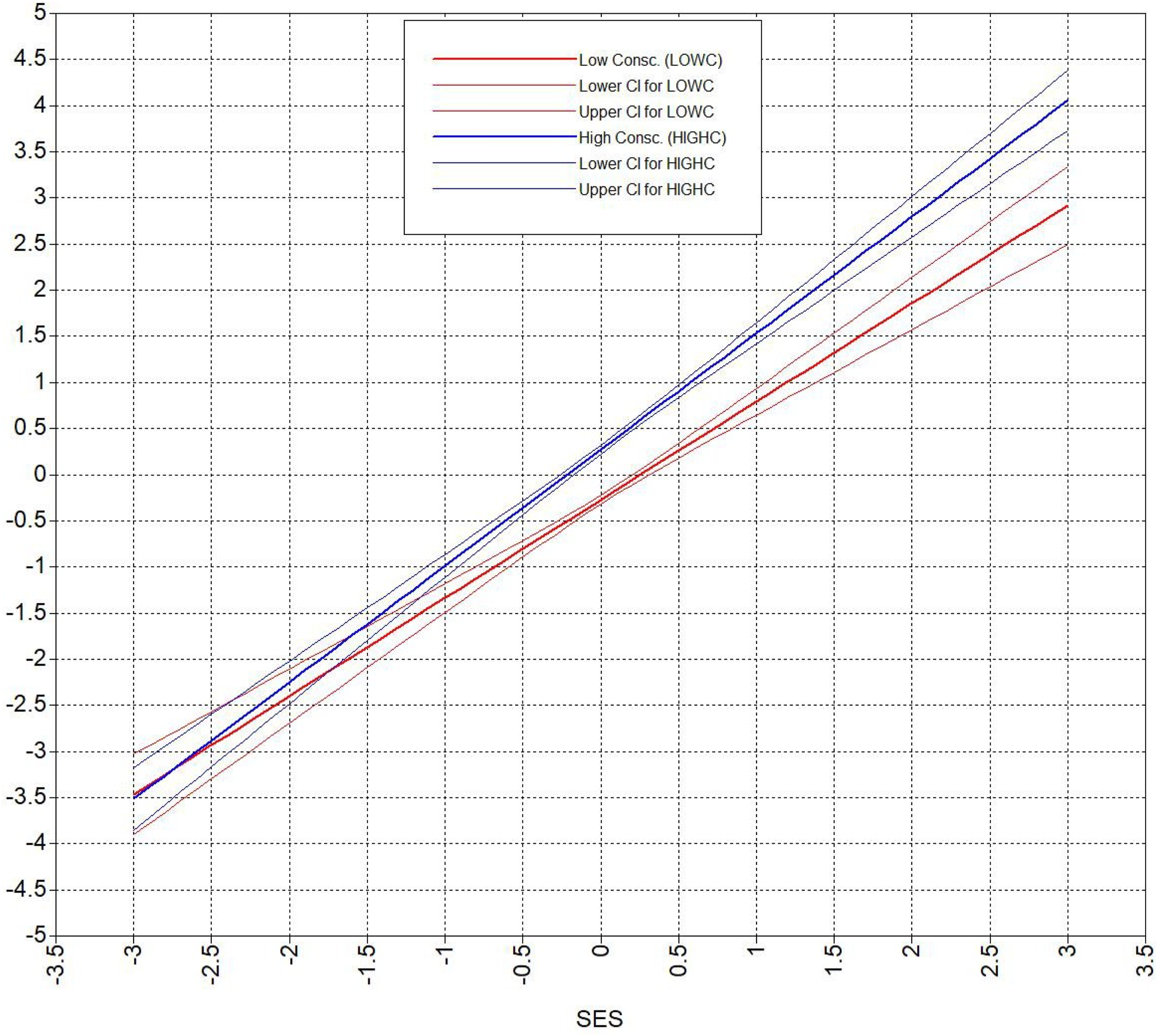
Latent interaction plot for the interplay between Conscientiousness and SES in the prediction of mathematics grade. LOWC/HIGHC = low Conscientiousness/high Conscientiousness, Lower for LOWC/HIGHC = lower confidence interval, Upper for LOWC/HIGHC = upper confidence interval.
Multi-group analyses of mathematical competence as mediator of the association between high school students (N = 2,839) Big Five and their mathematics grade in groups with different familial socioeconomic background.
As robustness check, and in order to examine the incremental validity of all Big Five traits, we ran latent hierarchical regression models with socioeconomic status and all Big Five dimensions simultaneously as predictors of German grade (Table A3 in the appendix) as well as mathematics grade (Table A4 in the appendix) under control for previous school performance. P-values were corrected for multiple testing employing the Benjamini-Hochberg procedure in R for each set of 29 tests per dependent variable. The significant positive association of Openness and German and mathematics grade persisted. Extraversion was a significant negative predictor of mathematics grade when the other Big Five dimensions were controlled for. SES was a significant predictor of German and mathematics grades over and above the Big Five and the controls and the associations persisted after including competence measures in the models.
Discussion
The current investigation examined the associations between SES as well as parent-rated Big Five and adolescents’ German and mathematics grades under control for previous school performance. The longitudinal association therefore represents the prediction of change in school performance. SES was a robust positive predictor over and above fluid intelligence and sociodemographic control variables. Regarding personality, Openness and Conscientiousness were the strongest positive predictors over and above SES. We, additionally, found a positive interaction effect between Openness as well as Conscientiousness and SES in the prediction of grades in both subjects. Students with a higher SES benefited more from being more open and more conscientious in terms of better grades compared to students with a lower SES which is in line with the Matthew effect. These interactions lost significance when interactions between competence and Openness as well as Conscientiousness were additionally included. Mediation analyses revealed that indeed a substantial part of the association between these two dimensions and school performance was mediated by competence measures. The results are discussed in the following.
Regarding our first research question, we could replicate socioeconomic differences in school performance that persisted even when controlling for fluid intelligence, sociodemographic variables, and previous performance. Higher SES was associated with better school performance. The association with SES remained mostly stable when students’ personality was added as predictor. When reading and mathematical competence were additionally included, a slight trend emerged indicating that the association of SES decreased or lost significance. With respect to the design of support programs, our results could indicate that social inequalities in academic achievement might be somewhat reducible by giving students from underprivileged families opportunities to increase their objective competencies. This is supported by our finding that part of the benefit of academically advantageous personality characteristics for school performance is mediated by students’ competences. Empirical findings indicate that teaching quality does not contribute to a reduction of socioeconomic inequalities in achievement (Atlay et al., 2019) but that the classroom environment might have a compensatory effect (Stienstra et al., 2023). Our results suggest that part of the benefit of higher SES might be related to how teachers assign grades to students depending on different student characteristics. Addressing these empirical insights during teacher training might help raise teachers’ awareness of how their evaluation of students’ school performance might be affected by different student characteristics including their personality.
With respect to our second research question, parent-rated personality did have significant associations with school performance over and above fluid intelligence and SES. As expected, Openness and Conscientiousness were significant positive predictors which dovetail well with previous empirical findings (Mammadov, 2022; Poropat, 2009, 2014). These associations persisted after inclusion of competence measures into the models. In other words—even when students were equally competent, they received better grades when they were more open and conscientious. This suggests that teachers also incorporate their impressions of students’ personality when evaluating school performance. Since we controlled for previous school performance, these associations represent developmental trends meaning that change in students’ school performance was predicted by their Openness and Conscientiousness. While Conscientiousness is generally assumed to be the most important predictor of achievement (De Raad & Schouwenburg, 1996), our results demonstrate that Openness can be highly relevant for the prediction of language-related as well as mathematical school grades. This is contrary to our expectation that Openness should be more strongly associated with German grade. The parent-questionnaire used in the NEPS includes Openness items on thirst for knowledge as well as quick comprehension which might be particularly relevant for academic achievement. The adolescents’ self-assessment in the NEPS used in the study of Lechner et al. (2021), on the other hand, covers artistic interests and an active imagination. The authors did not find substantial effects of self-assessed Openness on grade point average. All in all, the relevance of Openness for the prediction of academic achievement might depend on the specific content of the applied questionnaire.
Our findings also dovetail with meta-analytic findings on the predictive validity of other-ratings regarding academic achievement (Connelly & Ones, 2010). Parental assessments of their offspring’s personality demonstrated clear predictive validity with regard to school grades in two domains. Parents indeed seem to be comparatively accurate raters of their offspring’s personality despite being emotionally invested in the target (Tackett, 2011). The associations of Openness and Conscientiousness and school performance were of similar strength as the association of reading competence and German grade. In this sense, these two academically relevant traits might help overcome background differences. Since we used parental reports on personality, another possible interpretation would be that the reputation (McAbee & Connelly, 2016) adolescents have with their parents can somewhat influence their success at school, for example, by acting as a self-fulfilling prophecy (Pomerantz & Thompson, 2008) or if parents communicate their impressions of their offspring to the class teachers.
For our third research question on interactions between personality and SES in the prediction of school performance, we found a significant positive interaction between parent-rated Conscientiousness and SES with regard to both grades, as expected. This finding is in line with results reported by Lechner et al. (2021) using self-rated Conscientiousness of a different NEPS cohort of ninth graders. This indicates that the interaction between Conscientiousness and SES is not primarily driven by parental perceptions that might influence teachers’ evaluations but might be based on behavior related to this trait, such as orderliness. The interaction lost significance when interactions between Conscientiousness and competences were also added. These were not significant themselves and future studies are needed to better understand the underlying mechanisms, possibly also investigating different competence measures than administered in the current study. In the current study, for example, we only used one aspect of language competence, namely reading skills. Other aspect such as spelling competence might be more relevant with regard to German grades. Nonetheless, subsequent mediation analyses revealed that a significant percentage of the association between Conscientiousness and school performance was mediated by students’ competences. A part of the benefit conscientious students have with regard to their school performance seems to be based on their competences. More conscientious students might be better at utilizing their competences to achieve a better school performance. It is also possible that teachers reward students’ competences more strongly when the students also exhibit an academically advantageous personality.
In contrast to Lechner et al. (2021), we additionally found significant interactions of parent-rated Openness with SES for both school subjects. This is the first study to find significant interactions of Openness and SES with regard to school performance. As for self-reported Openness in the NEPS, Roemer et al. (2022) showed that its association with school grades was mediated by students’ competencies. In the current study, the interaction between Openness and SES lost significance when interactions between Openness and competences were added. Subsequent mediation analyses revealed that the association of parent-rated Openness and school performance indeed was partly mediated by students’ competences with indirect effects being most pronounced for high SES. This might signify that the different grading of students with different SES depending on their Openness might be based on how strongly teachers reward higher competences in highly open students. Our evidence fits well with the widely discussed Matthew effect in education (Walberg & Tsai, 1983) which generally implies that an initial advantage in educational measures is associated with stronger gains resulting in a widening of the initial gap. This pattern has previously been documented for reading development (Pfost et al., 2014), the benefit of intervention programs initially aimed at supporting disadvantaged students (Ceci & Papierno, 2005) or psychosocial factors and achievement (Kuo et al., 2021).
The mechanisms of an academically more advantageous personality amplifying the benefits of higher SES need to be investigated in future research. It is possible that parents provide more resources or learning opportunities when they consider their offspring highly conscientious and open. This might also be a bidirectional effect such that parents adjust their personality rating according to children’s learning behavior. Another potential pathway might be that parents with a high SES who have been shown to exhibit stronger parental involvement at school than parents with lower SES (Cheng Yong Tan & Peng, 2020; Pomerantz et al., 2012), and who consider their offspring highly open, communicate this to the teachers thereby influencing the teacher’s perspective on the students. Moreover, students with an academically beneficial personality might be particularly equipped to use the advantages that their familial background offers, for example, by seeking out more intellectually stimulating activities or using the resources provided by the parents and teachers very diligently. As shown in the current study, a part of the benefit of open and conscientious students with regard to school performance is based on their competences. Students from families with high SES might therefore benefit from their academically advantageous personality through this pathway, for example, by employing their competences more efficiently. This might also represent a mechanism underlying teacher evaluations during grading when teachers might reward students more strongly for their competence when they are more open and conscientious.
Implications
Background-related differences in academic achievement have been targeted using educational interventions for decades resulting in substantial short-term and smaller long-term effects on cognitive as well as noncognitive characteristics of children (Barnett, 2011). The results of the current study indicate that interventions might be most efficient when encompassing two aspects—disadvantages related to socioeconomic background as well as academically relevant personality dimensions. Students can benefit even more from economic resources when their personality exhibits academically advantageous characteristics such as high Conscientiousness and high Openness. These characteristics are additionally relevant for school grades on their own. Students therefore could achieve gains in their academic performance by showing behaviors related to these traits. Researchers have drawn attention to the relevance of personality traits as targets of policies and interventions highlighting the possibilities of personality development (Bleidorn et al., 2019). The review by Roberts et al. (2017) suggests that interventions can be effective with regard to personality trait change taking an average of 24 weeks and persisting in follow-ups. The majority of the reviewed studies referred to clinical interventions and Emotional Stability followed by Extraversion showed the strongest changes while the amount of change did not vary with the type of therapy. Moreover, Denissen et al. (2013) proposed that the main driving force of personality development might be self-regulatory mechanisms that can also be targeted by interventions, referring among others to one approach designed to increase Conscientiousness. This particular intervention by Magidson et al. (2014) involves identifying life goals and strategic planning of activities apt to reach them. This type of intervention seems highly applicable to the academic context and could help students excel in their academic endeavors.
The results of the current study furthermore suggest that teachers’ evaluations of students’ performance indeed depend to some extent on the personality students exhibit in class as assumed by Meyer et al. (2019). As reviewed by Jussim and Harber (2005), teachers’ expectations of students can act as self-fulfilling prophecies with effects typically being small. However, effects seem to be stronger for underprivileged students such that self-fulfilling prophecies show stronger effects among students from lower socioeconomic backgrounds, in particular when these students are also underachieving. Whether teachers’ perceptions of students’ personality act to some extent as self-fulfilling prophecies should be addressed by future research. The current results indicate that teachers incorporate their perceptions when grading. Since students’ grades were highest when they exhibited both a privileged background and an advantageous personality, future research might investigate to what extent teachers’ perceptions of personality are affected by students’ backgrounds. Our results might also be of relevance with regard to teacher training. When educating new teachers, some attention might be given to informing the preservice teachers about the aspects beyond students’ competences that have been shown to impact teachers’ evaluations. Our study in particular indicates that teachers might reward competences more strongly when students exhibit certain personality characteristics with the mechanism being more pronounced for students with high SES. Preservice teachers should ideally be encouraged to reflect upon how they form their own impressions of students, possibly with particular emphasis on trying to evaluate their students irrespective of aspects of students’ socioeconomic background.
Limitations and future directions
Several limitations have to be taken into consideration when interpreting our results. First, the questionnaire used for parental personality reports was originally constructed with regard to children. In our adolescent sample, however, students’ personality might be further developed. In the FFFK-K (Weinert et al., 2007), Agreeableness encompasses docility and obedience which might be less adequate to reflect individual differences of adolescents compared to children. Consequently, effects of students’ Agreeableness might be underestimated in our sample. Moreover, the FFFK-K (Weinert et al., 2007) contains only two items per Big Five dimensions. As a consequence, the coverage of the constructs is limited and the Big Five are not represented in their full extent. It might contribute to the unusually high correlation between the Openness and Conscientiousness factors in the current study. The constrained construct coverage limits the generalizability of our results since using longer questionnaires might lead to somewhat different results. In future studies, it would be preferable to assess the Big Five with all facets, but this poses difficulties in large-scale assessments where time is limited since a broad range of topics is covered.
The current study used parental personality reports without contrasting them against self- or other-ratings as the main focus of the investigation was on the interaction effects. However, multitrait–multimethod (MTMM) models are needed to represent the unique parental perspective under control for trait including a reference method such as self-reports. In the current cohort of the NEPS, self-reports were provided using a different personality questionnaire than administered to the parents and therefore the application of MTMM models poses challenges. Future studies should use the same items across all raters. Ideally, teacher-reports as well as parental reports could be contrasted against self-reports to represent these two unique perspectives and further investigate their effects on outcomes.
Future studies, furthermore, could examine the effects reported in our study in different age cohorts. It would be of particular interest to compare the effects in elementary school samples with high school samples across different school systems. The German secondary school system is highly selective in terms of grouping children into vocational and academic types of schools. Personality might also have differential consequences depending on the age of students since, for example, Extraversion is assumed to be beneficial for younger students because of positive learning attitudes but disadvantageous in high school due to a focus on social life instead of learning (De Raad & Schouwenburg, 1996).
Teachers’ perceptions of students might also differ depending on the age group since they might have higher expectations of adolescents thereby applying different reference values. Moreover, adolescence is characterized by moderate rank-order stability of personality (Roberts & DelVecchio, 2000) being related to stability as well as change in personality. It is assumed to be associated with dips in personality maturation (Herzhoff et al., 2017) albeit developmental patterns are inconsistent across studies. These developmental changes might also affect how personality is related to outcome variables as well as possibly having effects on how students are perceived and evaluated by teachers.
Lastly, the linear models employed here might not represent the full scope of the interplay between personality and socioeconomic background. Certain points of the SES distribution might be characterized by substantial differences in effects and identifying relevant transition points could give indications of the underlying mechanisms. Future studies might employ local structural equation modeling to investigate how model parameters change as a function of SES.
Conclusion
This study investigated latent interactions between socioeconomic background and the parental perspective on adolescents’ Big Five when predicting changes in school performance. Openness and Conscientiousness were positive predictors of school performance two years later, over and above fluid intelligence, SES, and previous performance. Those two traits also showed significant positive interaction with SES. Students whose Openness and Conscientiousness were rated higher by their parents later performed better in school, and these benefits were even more pronounced for students with a more privileged socioeconomic background. Students’ competences mediated a significant part of the associations between Openness and Conscientiousness and school performance. This could suggest that the benefit students with high SES have might partly be based on being rewarded more strongly for their competence in grading when also exhibiting higher Openness and Conscientiousness. This new evidence might be of relevance for teacher training and also informative for the planning of interventions aimed at reducing social inequality in school.
Supplemental Material
Supplemental Material - Personality in the classroom: Interactions of parental SES and students’ Big Five in predicting school performance
Supplemental Material for Personality in the classroom: Interactions of parental SES and students’ Big Five in predicting school performance by Emilija Meier-Faust, Annelie Schulze, Yannick Martin, Annabell Daniel, and Susanne Bergann in European Journal of Personality
Footnotes
Acknowledgments
The general idea for this study is based on the bachelor thesis by Yannick Martin entitled “Können Persönlichkeitseigenschaften den Einfluss der sozialen Herkunft auf die Leistung in der Schule kompensieren? [Can personality traits compensate for the influence of social background on school achievement?],” supervised by Emilija Meier-Faust and submitted at Freie Universität Berlin on February 17th, 2020.
Declaration of conflicting interests
The author(s) declared no potential conflicts of interest with respect to the research, authorship, and/or publication of this article.
Funding
The author(s) received no financial support for the research, authorship, and/or publication of this article.
Open science statement
We provide the Mplus code used for analysis in the appendix. Materials on the NEPS data can be accessed on the website (https://www.neps-data.de/Data-Center/Data-and-Documentation/Start-Cohort-Grade-5/Documentation). NEPS data is available upon completion of a user contract ( ).
).
Supplemental Material
Supplemental material for this article is available online.
References
Supplementary Material
Please find the following supplemental material available below.
For Open Access articles published under a Creative Commons License, all supplemental material carries the same license as the article it is associated with.
For non-Open Access articles published, all supplemental material carries a non-exclusive license, and permission requests for re-use of supplemental material or any part of supplemental material shall be sent directly to the copyright owner as specified in the copyright notice associated with the article.
