




Abstract
Intellectual curiosity and personal interest are both believed to spark information seeking and facilitate learning. In two preregistered studies (Study 1: exploratory lab study, N = 312; Study 2: online conceptual replication study, N = 960), we investigated effects of curiosity and interest on participants’ information seeking as they studied a hypertext on a historical topic. We captured their behavioral traces with log files. We also examined effects of curiosity, interest, and information-seeking behaviors on knowledge attainment. In both studies, latent profile analyses based on behavioral trace data revealed that some information-seeking profiles were more adaptive (e.g., broad and deep-diving information seeking, Study 1; broad information seeking, Study 2) and some were less adaptive (e.g., disengaged). More adaptive profiles were consistently related to better knowledge test performance. Curiosity and interest positively predicted more adaptive information seeking (Study 1) and knowledge test performance (Study 2); however, these effects were inconsistent across study contexts. Furthermore, curiosity and interest did not interact in predicting information seeking or knowledge attainment (Studies 1 and 2). Overall, our work extends the understanding of how intellectually curious and interested individuals learn and attain knowledge and underscores the promise of using behavioral trace data to study interindividual differences.
Plain language summary
Different personal characteristics are conducive to learning. Here, we asked whether it makes a difference if you are curious in general and want to learn about many things (i.e., intellectual curiosity) or if you are interested in the specific topic that you are studying (personal topic-specific interest). We conducted two studies to investigate how intellectual curiosity and personal interest manifest in how people search for information in a text on a historical topic (the Panama Canal) that they read online. The text included various hyperlinks that participants could click to access additional information on certain aspects of the text. In our first study, learners with high interest in the topic were more likely to look at many different pieces of information and click on different links in the text (“broad” information seekers), whereas intellectual curiosity was related to a “deep-diving information search” in that intellectually curious people revisited information by clicking on the links in the text again. In our second study, however, neither intellectual curiosity nor interest was related to specific information-seeking behaviors. Being a broad (Studies 1 and 2) or deep-diving information seeker (Study 1) was beneficial for learning. These findings suggest that intellectual curiosity and interest are reflected in different ways of searching for information and learning. Furthermore, in Study 2, people who were intellectually curious and interested did better on a knowledge test after reading the text. By contrast, in Study 1, we did not find that being intellectually curious or interested was beneficial for knowledge test performance. Our work contributes to the understanding of broad and specific personality characteristics. As the roles that intellectual curiosity and personal interest played in learning and knowledge attainment varied between the two studies, more research comparing effects across different study contexts is needed.
Introduction
People differ in how much they generally take pleasure in learning and like to seek out new information. This thirst for knowledge is captured by the personality trait of intellectual curiosity (Litman & Spielberger, 2003; Mussel, 2013; von Stumm, 2018). Intellectual curiosity is considered a basic element of human cognition and an important driver of successful learning (Grossnickle, 2016; Kidd & Hayden, 2015).
To date, there are different lines of research that have shed light on intellectual curiosity and learning. First, intellectual curiosity has been linked to “real life” learning outcomes (e.g., measures of academic achievement representing accumulated knowledge; Chamorro-Premuzic et al., 2006; Tang & Salmela-Aro, 2021). Scholars have also connected research on curiosity with research on other variables relevant to learning, for example, by examining unique and combined effects of curiosity and topic-specific interests (e.g., Shin et al., 2023; Ziegler et al., 2018). However, although highly informative, studies in this line of research may be missing an important piece, as they typically do not focus on specific learning behaviors. If they do, they rely on self-reported learning behaviors, which may be prone to response biases (e.g., Roth et al., 2016).
Second, a large body of laboratory studies have investigated whether being curious about the information an individual is processing makes them more likely to remember it (Fastrich et al., 2018; Kang et al., 2009). This assumption has been repeatedly tested with the trivia paradigm: Participants are given various trivia questions, asked to rate how curious they are to find out the answer, and then presented with the answer, which they are later asked to recall (e.g., Baranes et al., 2015; Jach et al., 2022). Even though this kind of research has significantly contributed to knowledge about curiosity and learning, it can be criticized for a lack of ecological validity, as acquiring random trivia does not represent how individuals seek information and acquire knowledge in everyday life.
Third, researchers have investigated more realistic, self-directed information seeking (e.g., participants freely exploring Wikipedia) and examined how intellectual curiosity is related to this type of information-seeking behavior (e.g., Lydon-Staley et al., 2021; Sher et al., 2019). In doing so, they have capitalized on actual behavioral traces instead of self-reports. However, such studies have usually not assessed how much knowledge was acquired during the information search, as they did not conceptualize information seeking as a way to learn, thus potentially leading to an incomplete understanding of how self-directed information seeking can act as a learning behavior in people’s everyday lives.
The present research aimed to overcome some of the limitations of previous studies on intellectual curiosity and learning while harnessing several of their key strengths. Specifically, we investigated how trait intellectual curiosity and personal interest manifest in people’s information-seeking behavior and information integration and whether intellectual curiosity, interest, and learning behaviors are related to knowledge acquisition. We zoomed in on more naturally occurring learning behavior in terms of information-seeking behavior by using behavioral process data in the form of log-file data from participants studying a hypertext on a historical topic. This task more closely resembles real-life learning and knowledge acquisition than, for example, trivia question tasks. Furthermore, our work adds to the understanding of how intellectually curious and interested individuals navigate learning experiences and to what extent they profit from doing so by focusing on both learning behaviors (log-file data) and learning outcomes (performance on knowledge tests of content covered in the hypertext). We conducted two preregistered studies. In Study 1, we examined links between intellectual curiosity, personal interest, distinct information-seeking profiles based on log-file data, and knowledge test performance in the lab. Study 2 provided a conceptual replication of Study 1, transferring the hypertext learning task to an online experimental environment. In both studies, we controlled for well-established predictors of learning in terms of fluid intelligence, verbal abilities, prior knowledge, and conscientiousness.
Intellectual curiosity
Curiosity is a very diverse construct space that can be organized along several dimensions (Grossnickle, 2016; Wagstaff et al., 2021). For instance, people can be curious about different things: Whereas perceptual curiosity is triggered by complex or ambiguous sights and sounds (Collins et al., 2004), social curiosity is characterized by the desire to obtain information about other people (Renner, 2006). Intellectual curiosity, also labeled epistemic curiosity (Litman & Spielberger, 2003) or intellect (e.g., Mussel, 2013), signifies an eagerness to learn about abstract concepts and motivates behaviors that are directed toward intellectual achievements (Mussel, 2013). Intellectually curious people “enjoy thinking” and like to engage in cognitively stimulating activities, such as solving riddles or puzzles (von Stumm & Ackerman, 2013). It has often been argued that a dispositional tendency to seek out knowledge and effortful cognitive activities should play a role in learning and long-term cognitive development (e.g., Ackerman’s Intelligence-as-Process, Personality, Interest, and Intelligence-as-Knowledge [PPIK] model, 1996; which built on Investment Theory by Cattell, 1943, 1963). Aligned with this idea, intellectual curiosity has been associated with measures of cognitive performance, such as fluid and crystallized intelligence and academic achievement (Anglim et al., 2022; Chamorro-Premuzic et al., 2006; DeYoung et al., 2005; Kaufman et al., 2016; Stanek & Ones, 2023; von Stumm & Ackerman, 2013).
Intellectual curiosity is considered a component of the openness to experience factor from the Five-Factor Model of Personality Traits (Digman, 1990; McCrae & Costa, 2008) and is often operationalized using the Ideas facet of openness to experience 1 (DeYoung et al., 2007; von Stumm & Ackerman, 2013). Prior findings underscore the value of focusing on intellectual curiosity instead of using a broad measure of openness to experience when studying effects on knowledge attainment (Gatzka, 2021; Gatzka & Hell, 2018; but see von Stumm, 2018). Specifically, meta-analyses have revealed significant positive, albeit weak, associations between openness to experience and academic performance (Mammadov, 2021; Poropat, 2009). As demonstrated by Gatzka and Hell (2018; see also Gatzka, 2021), a reason for such weak correlations may be that the intellectual component of openness to experience benefits knowledge attainment, whereas the senso-aesthetic components may actually be disadvantageous.
Intellectual curiosity and personal interest: Similarities, differences, and integrated perspectives
Intellectually curious people are generally more open to learning about a new topic compared with less curious people. But some topics will still capture their attention more than others because certain topics will match their preexisting interests better (Ziegler et al., 2018). Whereas both curiosity and interest are essential for learning, there is an ongoing debate on their similarities and differences (Ainley, 2019; Alexander, 2019; Donnellan et al., 2022; Grossnickle, 2016; Murayama, 2022; Murayama et al., 2019; Pekrun, 2019; Peterson & Hidi, 2019; Schmidt & Rotgans, 2021; Shin & Kim, 2019; Silvia & Kashdan, 2009; Tang et al., 2022). On a state level (i.e., momentary experiences of curiosity or interest), it is difficult to distinguish whether someone engages with a piece of information because it sparked their momentary interest or their curiosity. However, on a trait level, scholars agree that these constructs are distinguishable: Trait curiosity describes a diverse, undirected fascination with all kinds of topics, whereas personal interest is a stable motivational orientation toward a certain topic, characterized by positive feelings and increased knowledge about it (Hidi & Harackiewicz, 2000; Hidi & Renninger, 2006). However, the two constructs are often investigated separately from each other, thus potentially preventing the development of a better understanding of how each of them uniquely benefits learning, above and beyond the effects of the other trait.
In addition to the unique effects of trait curiosity and interest, scholars have theorized about their interplay. Specifically, Ziegler et al. (2018) suggested that learning should be especially fruitful when high interest and openness to experience (especially its intellectual component, intellectual curiosity) coincide. In their Openness-Fluid-Crystallized-Intelligence (OFCI) model (Ziegler et al., 2012), openness represents the overall propensity to seek out information, whereas interest directs this energy to a specific area. Importantly, when the information an intellectually curious person encounters during a search aligns with the person’s pre-existing interests, they should be more likely to engage with it more deeply and for a longer duration. This heightened engagement should then increase their likelihood of mastering the information, thus illustrating how openness and interest together can facilitate the accumulation of knowledge over time. Initial empirical tests of the model have been conducted on both state and trait levels and have demonstrated, for example, that the interaction between openness and subject-specific interest predicted school grades at the end of a semester or school year (J. Zhang & Ziegler, 2022; Ziegler et al., 2018). However, studies have yet to test whether the potential beneficial effect of concomitant intellectual curiosity and interest on learning outcomes can mainly be observed over extended periods of time or also in a single learning session (see Ziegler et al., 2012).
Intellectual curiosity, interest, and information seeking
Information seeking is considered a behavioral expression of curiosity (Kidd & Hayden, 2015). Many different behavioral tasks have been developed to assess participants’ curiosity through their decision to seek out information or not. For instance, different types of lottery games have been used to investigate whether people are willing to invest time or money to see information about a reward outcome in advance, even if the information does not change the outcome itself (Bennett et al., 2016; Jach et al., 2022; van Lieshout et al., 2018). To specifically quantify intellectual curiosity, researchers commonly use the trivia paradigm in which participants can decide to seek out semantic information (Baranes et al., 2015; Bennett et al., 2016; Fastrich et al., 2018; Gruber et al., 2014; Kang et al., 2009; Ligneul et al., 2018; Marvin & Shohamy, 2016). In these studies, participants are presented with a trivia question and are usually asked to rate how curious they are to find out the answer. Higher self-reported state curiosity has been associated with better recollection of the information, even at follow-up assessments (Gruber et al., 2014; Kang et al., 2009; Ligneul et al., 2018; Marvin & Shohamy, 2016), and increased activity in reward systems in the brain (Gruber et al., 2014; Kang et al., 2009), indicating that curiosity benefits learning and makes it a rewarding experience.
However, in our everyday lives, we rarely acquire knowledge from trivia facts being presented to us. If we want to learn something new, we must often seek out meaningful information ourselves. For instance, someone may be intrigued by something they heard on the news and then decide to read up on the topic later. In other cases, information seeking can be a required learning behavior in formal education settings, for example, when students are instructed to prepare for the next lesson as homework and independently do research on a new topic. Thus, curiosity research may benefit from using tasks that allow for more natural occurrences of information seeking, thereby increasing ecological validity (Murayama et al., 2019). Studying information seeking in a more natural manner yields another benefit: Not only can we investigate the effects of intellectual curiosity (and interest) on the decision to unveil one piece of information, but we can also study the information-seeking process itself (e.g., how thorough or widespread the information search is) and whether that process is related to the amount of knowledge that is acquired (i.e., we can view information seeking as a learning behavior). Information seeking as a means to attain knowledge has been extensively studied in the information science literature (Marchionini, 2019). Given that many people nowadays obtain knowledge via online searches, digital information seeking has become a critical skill for modern learners (Anthonysamy et al., 2020; Eickhoff et al., 2014; Kammerer et al., 2018; Marchionini, 2019). In this context, it is common to differentiate between whether the goal of information seeking is to locate a specific piece of information (e.g., Gao et al., 2022) or to gain a broader understanding of a topic that involves open-ended, exploratory searches (Collins-Thompson et al., 2016; Eickhoff et al., 2014; Marchionini, 2006). Whereas much of the research in information science has focused on the mechanics of information seeking, less emphasis has been placed on the roles played by learners’ dispositions, such as curiosity or interest (Marchionini, 2019). Because curiosity and interest should be intrinsic drivers of information seeking, they are likely to be especially evident in more open-ended information-seeking tasks.
This kind of research question calls for the use of behavioral data. However, most studies examining the relationships between personal dispositions and learning behavior have tended to rely on self-report measures (e.g., Bidjerano & Dai, 2007; Chamorro-Premuzic & Furnham, 2009; Heinström, 2005; Lavrijsen et al., 2021). Self-reports can be problematic in the sense that they are prone to social desirability, and they can be influenced by learners’ incomplete memories of their experiences (Roth et al., 2016; van Halem et al., 2020). Expanding research by using objective behavioral measures is important because they are unobtrusive and can provide a more fine-grained understanding of learning processes.
Beyond self-reports: Behavioral traces of information seeking
A naturalistic, noninvasive, and implicit assessment of individuals’ information-seeking behavior can be achieved by tracing how they search for information digitally. Sources on the Internet are usually organized in so-called hypertexts, which are nonlinear digital texts that include hyperlinks through which the reader can access other web pages containing additional, related information (Naumann et al., 2008). The reader must constantly decide which page or link is relevant and interesting for their learning goal, in which order to read them, and the extent to which they want to go into detail. Using automatically collected log-file data, researchers can re-create a reader’s behavioral traces and try to draw conclusions about the reader’s characteristics. For instance, when participants are presented with texts on different subjects to choose from, the order in which they choose to read the texts can be seen as a sign of topic interest, whereas time spent reading can be interpreted as persistence or engagement (Ainley et al., 2002; Brandmo & Bråten, 2021). Lydon-Staley et al. (2021) investigated whether participants’ deprivation-type curiosity is reflected in the way they browse Wikipedia. Deprivation-type curiosity describes the disposition to seek out information because one is driven by the unpleasant feeling of a perceived knowledge gap that sparks a need to know (Litman & Mussel, 2013). They found that those high in deprivation-type curiosity were more likely to create tighter knowledge networks by visiting conceptually similar concepts, whereas participants low in deprivation-type curiosity were broader in their information seeking. This observation indicates that different facets of trait curiosity may manifest in different types of information-seeking behavior (Lydon-Staley et al., 2021). There is a range of conceptually relevant behavioral indicators of information seeking that can be extracted from log-file data, such as information on when the participants clicked on specific hyperlinks, how long they spent on the linked website, and when they returned to the main body of text (Richter et al., 2003). Thereby, it seems particularly promising to consider multiple behavioral indicators simultaneously instead of separately. For instance, two participants might spend the same total amount of time on a text, but one might skim through several links, whereas the other might read a select few carefully. These differences in individuals’ configurations of information-seeking behavior may, for example, have consequences for how much they learn from the task and may therefore be important to consider. Person-centered approaches can reveal these qualitative differences in behavioral patterns (Loken & Molenaar, 2007) and have been identified as auspicious approaches in previous research on digital reading and information-seeking tasks (Antonenko et al., 2012; Gao et al., 2022; Hahnel, Ramalingam, et al., 2023; He et al., 2023).
The current research
The current work integrates different lines of research to gain a comprehensive understanding of the interplay between curiosity, interest, information seeking, and knowledge attainment. We sought to overcome some of the limitations of previous studies, such as by increasing ecological validity by using a more naturalistic information-seeking task, testing effects of information seeking on participants’ knowledge acquisition, and considering interest as another relevant person characteristic in addition to trait intellectual curiosity. Specifically, we aimed to investigate how intellectual curiosity and personal interest manifest in information-seeking behavior and are related to knowledge attainment and whether information seeking predicts knowledge attainment. We additionally explored the extent to which the interaction between intellectual curiosity and interest benefits both information seeking and knowledge attainment. We focused on actual information-seeking behavior by analyzing log files from a hypertext learning task. We used different behavioral indicators of information seeking extracted from the log-file data to identify distinct information-seeking profiles. As learning material, we chose a hypertext on the history of the Panama Canal, as most people have limited prior knowledge on the topic, and it includes various thematic fields (e.g., history, politics, and geography), making it likely to spark information seeking. We present two studies: first, an exploratory study set in an experimental laboratory setting, and second, a confirmatory online study as a conceptual replication of Study 1. In both studies, we controlled for the effects of other well-established predictors of learning behaviors and knowledge attainment (e.g., intelligence and conscientiousness).
Study 1: Exploratory study
Research questions and hypotheses
Research Question 1: Using behavioral information-seeking indicators derived from the log-file data of the hypertext (number of unique clicks on links, number of links revisited, overall time spent on links, average time spent on different links, time spent reading the main text), can participants be clustered into different meaningful information-seeking patterns? Due to the exploratory person-oriented approach we used, the exact number and configurations of information-seeking profiles were not known a priori; therefore, it was not possible to derive hypotheses for specific profiles.
Research Question 2a: Do intellectual curiosity and interest predict information-seeking behavior? On the basis of conceptual considerations and prior research focusing on other (learning) behaviors (e.g., Han et al., 2018; Van Alten et al., 2021), we tentatively proposed that individuals with higher levels of intellectual curiosity and higher levels of personal interest would be more likely to belong to more adaptive information-seeking behavior profiles (i.e., they should engage more with the text and seek more information).
Research Question 2b: Does the interaction between intellectual curiosity and interest predict information seeking? We expected to find a significant interaction such that the combination of higher levels of intellectual curiosity and personal interest would predict membership in more adaptive information-seeking profiles (Ziegler et al., 2018).
Research Question 3: Do information-seeking profiles predict knowledge test performance (i.e., questions about the content of the hypertext)? We hypothesized that belonging to a more (vs. less) adaptive information-seeking profile would positively predict knowledge test performance (Lawless et al., 2002; List & Alexander, 2017).
Research Question 4a: Do intellectual curiosity and interest predict performance on the knowledge test? We hypothesized that both higher levels of intellectual curiosity and higher levels of personal interest would significantly and positively predict better knowledge test performance (e.g., Grossnickle, 2016).
Research Question 4b: Does the interaction between intellectual curiosity and interest predict knowledge attainment? We expected to find that the combination of higher levels of intellectual curiosity and personal interest would predict better knowledge test performance (Ziegler et al., 2018).
Method
Participants and procedure
We conducted a secondary data analysis of data from a larger project conducted at the University of Tübingen in Germany. The project examined self-regulation in a variety of different learning tasks across three testing sessions. All questionnaires and tests were administered on laptops. Ethical approval was provided by the university’s ethics committee.
In our Study 1, we used data from the learning task “Learning from hypertexts” (see Figure 1), as well as participants’ questionnaire data and performance on cognitive tasks. Three hundred twenty-one participants were recruited for the project. They were 18–30 years old, and most were university students. Participants were paid 8€ per hour and an additional 15€ when they had completed all three testing sessions. Four participants were excluded for not participating in all testing sessions. For the current study, another five participants were excluded due to technical issues during the assessment, because data from different measures could not be unambiguously matched, or because both their behavioral data (log-file data) and knowledge test scores were missing. Thus, the final sample we analyzed consisted of 312 participants (Mage = 23.33, SDage = 3.04; 70.5% women). For the analyses including the behavioral data, an additional nine participants had to be excluded because they did not follow instructions and used multiple browser tabs to access hyperlinks, resulting in log files that were not comparable to other participants’ log files. Table S1 presents descriptive statistics and bivariate correlations for all measures. Example from the hypertext learning task. Note. The main text (only a part shown here) on the history of the Panama Canal contained 18 hyperlinks that were underlined and colored blue. Once a link was clicked, it turned purple. At the end of each hyperlink page, a “Back” button allowed participants to return to the main text.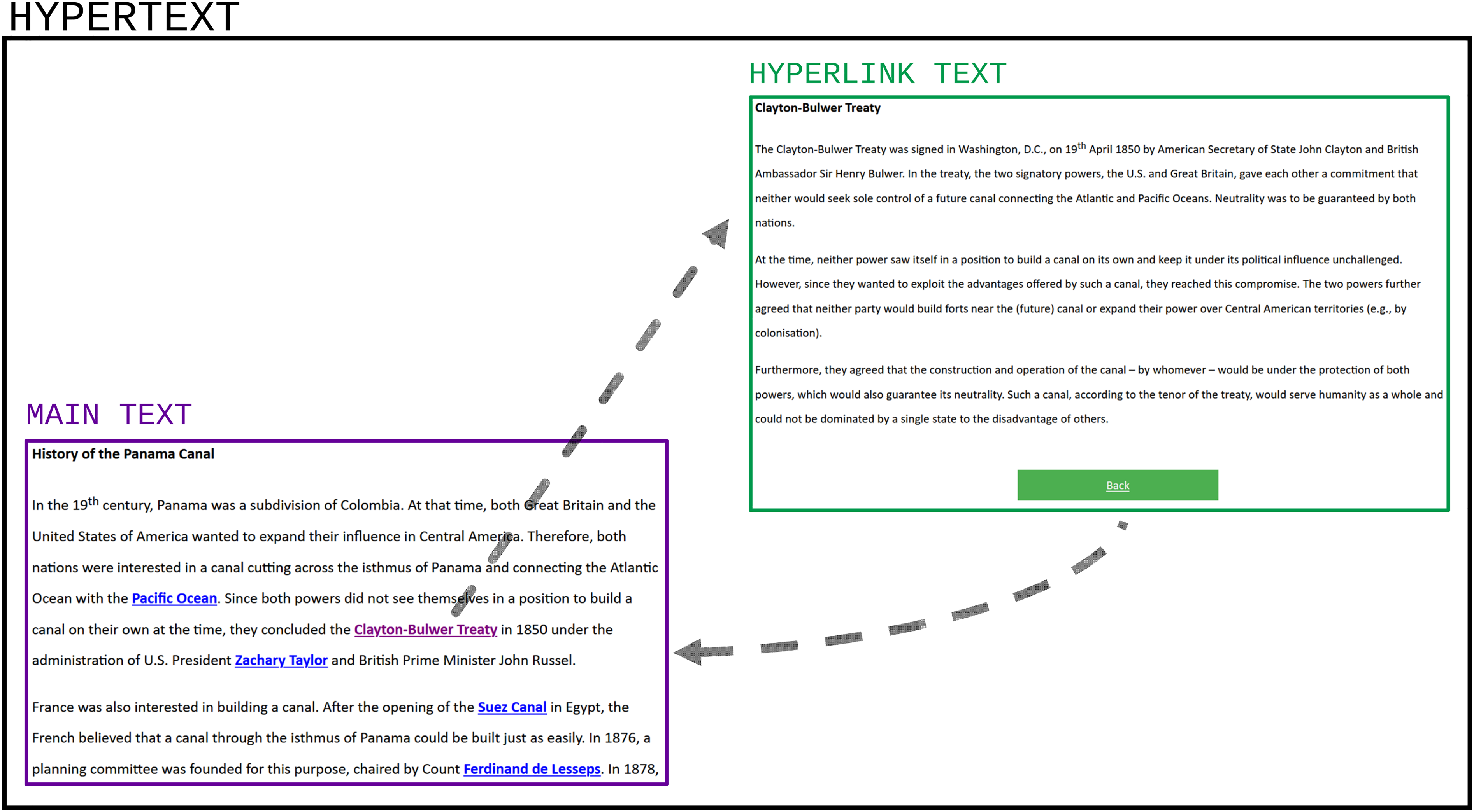
All measures considered in this study were assessed in one testing session. Participants completed the intelligence test and filled out the personality questionnaire before the learning task. In the learning task, participants first rated their previous knowledge of the history of the Panama Canal and their interest in American history and Central America (personal interest). They were then presented with a hypertext on the political history of the Panama Canal and instructed to educate themselves on the topic, as they would be asked questions about the content afterward (knowledge test). They were informed that they could read the text for 15 min; however, they could prematurely end the information search whenever they felt ready for the test or study the text for longer if they wished. There were 18 hyperlinks embedded in the hypertext, six of which provided more information about political facts (e.g., treaties and conflicts), geographical facts (e.g., countries and cities), or people (e.g., ambassadors and presidents). All texts were derived from the respective Wikipedia articles and modified in length and readability to fit the purpose of the study (main text comprised 464 words, hyperlink texts comprised between 139 and 190 words). Participants were instructed to freely navigate the hypertext, while their log-file data was recorded. After reading the text, participants completed the knowledge test. A general reading ability test was administered after the knowledge test.
When data were first collected for the larger project from which the data for our study stemmed, researchers planned to address different research questions about the effects of an experimental manipulation that was unrelated to the research questions addressed here. Specifically, before studying the hypertext, participants were given six multiple-choice questions on topics related to the topic of the Panama Canal (Group A: geographical questions [n = 80]; Group B: person-related questions [n = 71]; Group C: political questions [n = 72]; or questions that were unrelated to the topic [Group D, n = 96]). These questions were also part of the knowledge test administered after the task. Before conducting the main analyses in Study 1, we tested for differences between the experimental groups on all variables, which are reported in Tables S2 and S3. Additional robustness checks for the different experimental conditions are reported in Tables S4 and S5 in the Online Supplement. Importantly, we included experimental condition as a control variable in all our main analyses.
Measures
Intellectual curiosity
Intellectual curiosity was measured with the Ideas facet of the openness to experience scale from the German version of the NEO-PI-R questionnaire (Ostendorf & Angleitner, 2004). Seven items were used (sample item: “I like to solve complex problems”; the internal consistency, computed as Cronbach’s alpha, was α = .77). Participants responded to the items on a scale ranging from 1 (strongly disagree) to 5 (strongly agree).
Personal interest
To measure personal interest, we used three items that were developed for the purpose of the study, drawing on conceptualizations of interest from the literature and prior interest assessments (e.g., Renninger & Hidi, 2011; items: “I am interested in the history of Central America”; “I am interested in the countries of Central America”; “I am interested in the history of the United States”). The same response options as for intellectual curiosity were used (ranging from 1 = strongly disagree to 5 = strongly agree). The scale had good internal consistency (α = .81).
Knowledge test performance
After reading the text, participants worked on a knowledge test constructed for the purpose of the study. They were presented with nine inference questions (true-false questions) that could be answered by reading only the main body of the hypertext and without accessing any hyperlinks (sample item: “The Clayton-Bulwer Treaty allowed France to build the Panama Canal”). Then, participants were given 18 multiple-choice questions, one on each of the hyperlinks (sample item: “Which party did U.S. President Zachary Taylor belong to?”) and six multiple-choice questions on unrelated topics (information not included in the hypertext; e.g., “What are the inhabitants of Guatemala called?”). For the outcome measure of knowledge test performance, we excluded the unrelated questions. For each correct answer, participants received 1 point, resulting in a total maximum score of 27 points. The reliability of the knowledge test, based on item response theory (IRT) analyses using a two-parameter logistic model (Birnbaum, 1968; De Ayala, 2009) was acceptable (WLE [weighted likelihood estimate] reliability = .65).
Behavioral indicators of information seeking
The following indicators of information-seeking behavior were extracted from the log files: Number of unique clicks on links (indicating whether the participant attempted to explore a wide range of information), number of links revisited (indicating the reconceptualization or reevaluation of information in light of other information presented in the text), overall time spent on links, average time spent on links (time on links/number of links clicked), and time spent reading the main text (overall time minus time spent on links; see Jeske et al., 2014, for similar indicators).
Control variables
As participants knew that they would be tested on the content of the hypertext before they read the text, information seeking could have been motivated by the desire to perform well on the test rather than curiosity. Thus, we controlled for trait conscientiousness, which was assessed with the respective scale of the German version of the NEO-PI-R questionnaire (Ostendorf & Angleitner, 2004; 48 items, sample item: “I work hard to achieve my goals”; α = .92). Furthermore, we controlled for the effects of self-rated previous knowledge on the history of the Panama Canal with one self-developed item (“How do you rate your previous knowledge about the Panama Canal?”) with a response scale ranging from 1 (no knowledge at all) to 10 (expert), as prior knowledge may affect reading strategies and comprehension in hypertext reading (Salmerón et al., 2006). As our task was text-based, we controlled for reading ability by relying on the comprehension score on the German Reading speed and comprehension test (“Lesegeschwindigkeits- und Verständnis-Test,” LGVT; Schneider et al., 2007; KR-20 = .87). Additionally, we controlled for fluid intelligence, assessed with the CFT-R (internal consistency estimate: KR-20 = .78), due to its associations with reading skills and its importance for learning and knowledge acquisition in general (Peng et al., 2019). We added experimental condition as a covariate to account for potential influences of the experimental manipulation on our analyses (four experimental groups: geographical vs. person-related vs. political vs. unrelated questions).
Analyses
Data processing and the computation of descriptive statistics were conducted in R Version 4.1.2 (R Core Team, 2023). All other analyses were performed in Mplus 8.6 (Muthén & Muthén, 1998) using maximum likelihood estimation with robust standard errors (MLR). The amount of missing data ranged from 0.00% to 6.09% on the item level. Full information likelihood estimation (FIML) was used to deal with missing data (Enders, 2010). In preliminary analyses and as preregistered, we tested the factor structure of the personal interest measure, which was developed for the purpose of the research project, by running a confirmatory factor analysis (CFA). On the basis of the CFA results, we retained three out of the five items (see Online Supplement S1 for all items and the CFA results).
In the preregistered analyses that were designed to address our research questions, we modeled intellectual curiosity, personal interest, and the control variable conscientiousness as manifest variables (i.e., mean scores on the respective scales) and used sum scores for performance indicators (reading performance, fluid intelligence, knowledge test). For the control variable previous knowledge, we used the score from the single-item measure. The control variable experimental group was dummy coded using the group primed with unrelated questions as the reference category.
A latent profile analysis (LPA) was conducted to identify different profiles on the basis of the information-seeking indicators. The primary strength of LPA in this context lies in its ability to simultaneously consider multiple behavioral indicators, an aspect that is critical for capturing the qualitative differences in information-seeking behaviors across participants (Loken & Molenaar, 2007). We employed the three-step latent profile approach described by Asparouhov and Muthén (2014b) and as implemented in Mplus to investigate the latent profiles’ associations with auxiliary variables. This approach allowed us to investigate the relationships of the latent profiles with auxiliary variables without this estimation influencing the measurement model of the latent profiles (Asparouhov & Muthén, 2014b; Vermunt, 2010). Five hundred random sets of starting values with 50 initial stage iterations and 50 final stage optimizations were requested. We first estimated LPAs with k = 2 to k = 6 profiles to identify the optimal number of latent profiles. Statistical indicators and theoretical considerations were combined to select the optimal latent profile model. As statistical indicators, we relied on the Akaike information criterion (AIC), the Bayesian information criterion (BIC), and the sample-size-adjusted BIC (SABIC) to compare different models. Lower relative values on these indices indicate a better model fit while considering model complexity (i.e., number of estimated parameters). Additionally, we used the Vuong-Lo-Mendell-Rubin likelihood ratio test (VLMR) and the Lo-Mendell-Rubin adjusted likelihood ratio test (LMR) for model comparisons (Lo et al., 2001). A significant p-value obtained with these two tests means that a particular model fits better than a model with one fewer profile (Nylund et al., 2007). Furthermore, we checked the entropy value as a measure of classification accuracy, which ranges from 0 to 1 and should preferably be at least .80 (Clark & Muthén, 2009). With respect to content-related indicators, we relied on the principle of parsimony, along with theoretical considerations (e.g., whether a profile was theoretically relevant and unique), as well as the interpretability and meaningfulness of the profiles. We then employed Asparouhov and Muthén’s (2014b) three-step approach to examine whether intellectual curiosity and interest predicted the information-seeking profiles using multinomial logistic regressions. Two models were set up, one without and one with the interaction between curiosity and interest. Next, the three-step approach was used to test whether profile membership predicted knowledge test performance. Specifically, we relied on equality tests of means across profiles to investigate relationships between the profiles and knowledge test scores, treating the knowledge test score as a distal variable with unequal means and variances (Asparouhov & Muthén, 2014b). Finally, to examine the effects of intellectual curiosity and interest on knowledge attainment, we set up two multiple regressions (the first model without and the second model with the interaction term). All hypotheses were tested against a significance level of α = .05, and we relied on two-tailed tests.
All research questions, hypotheses, and their respective analysis plans were preregistered on the Open Science Framework (OSF, https://osf.io/mkwfg/) before any data were analyzed. Some deviations from the preregistration were applied to improve the analyses (see Online Supplement S2). The preregistration and all analysis scripts can be found on the OSF. Study 1 was based on a secondary data analysis, and the data are currently not publicly available due to data privacy/ethical restrictions.
Results
Latent profile analysis
Overview of the different latent profile solutions in Study 1.
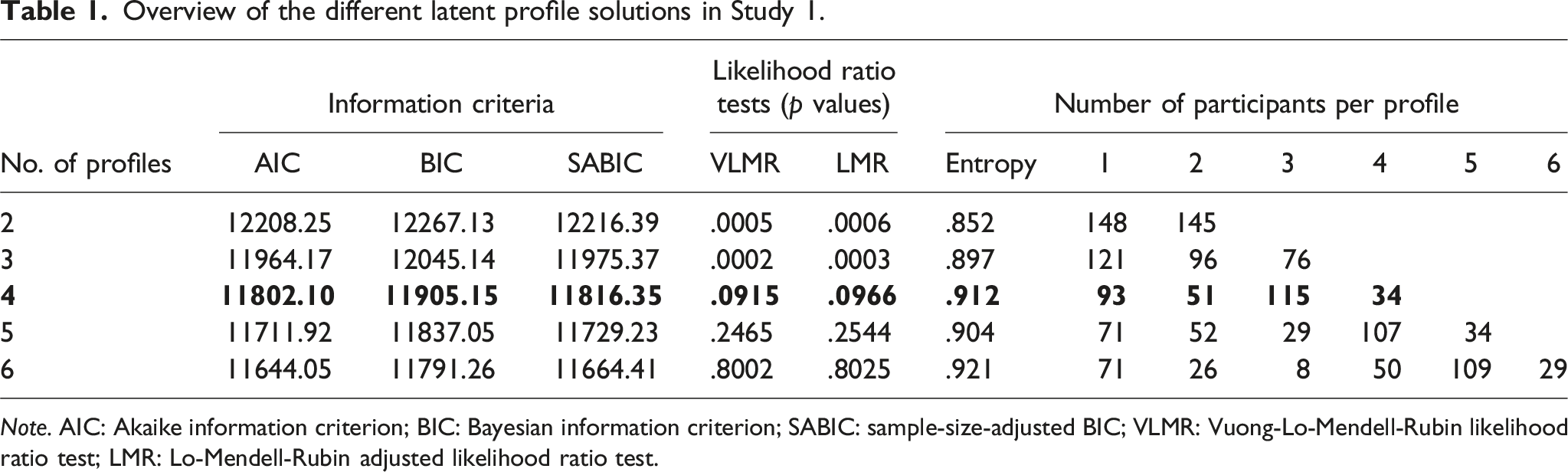
Note. AIC: Akaike information criterion; BIC: Bayesian information criterion; SABIC: sample-size-adjusted BIC; VLMR: Vuong-Lo-Mendell-Rubin likelihood ratio test; LMR: Lo-Mendell-Rubin adjusted likelihood ratio test.
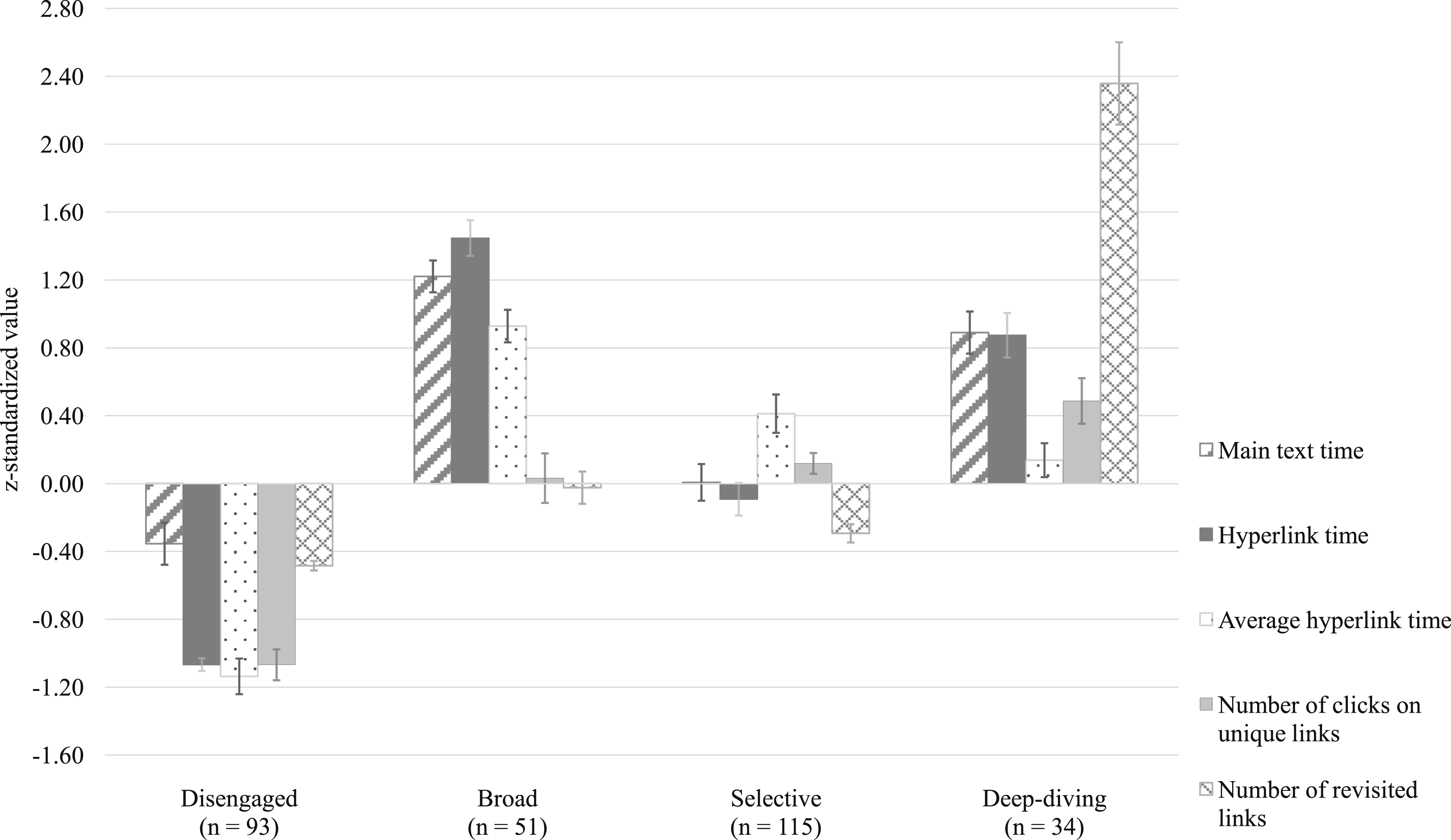
Configuration of the four latent profiles. Note. Error bars represent standard errors.
Descriptive information for each latent profile in Study 1.
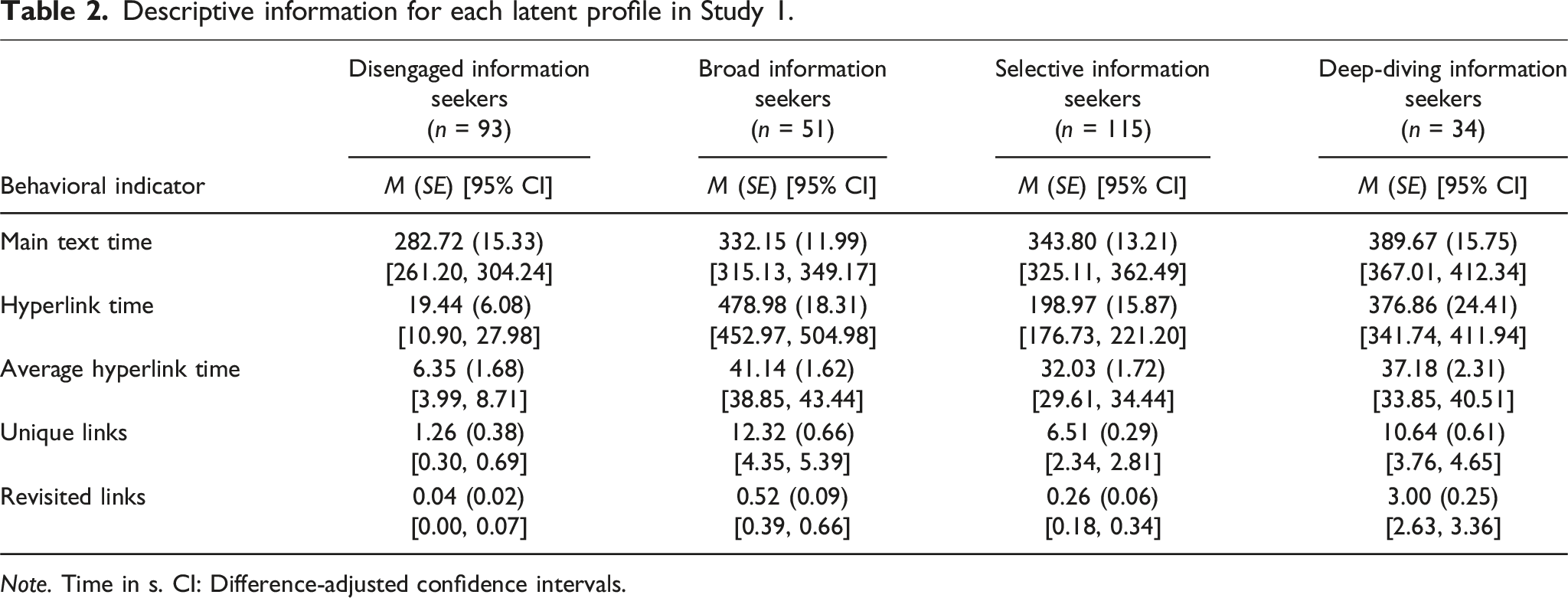
Note. Time in s. CI: Difference-adjusted confidence intervals.
Of the final four information-seeking profiles, one group of participants (n = 93) displayed little commitment to the task and spent less than 5 min on the hypertext on average while hardly accessing any hyperlinks. We thus named this group “disengaged information seekers.” The largest group of participants (n = 115) seemed moderately engaged with the hypertext. They chose to read only a few hyperlinks (on average 6.5 links out of 18 with an average reading time of 32.03 s), but the overall time they spent on the hypertext was relatively low; therefore, we labeled them “selective information seekers.” Fifty-one participants were characterized by a widespread search for information and sought out many different additional pieces of information (i.e., accessing many different hyperlinks), making them “broad information seekers.” They spent even more time on hyperlinks than on the main text. The last group of participants (n = 34) spent nearly as much time on the main text as on the hyperlinks and clicked on many different hyperlinks, though not as many as the broad information seekers. Their most notable feature was the large number of links they revisited (three on average) compared with the other profiles. Revisiting pages allows learners to reevaluate and reconceptualize information in light of other information (e.g., Kammerer et al., 2021); therefore, we interpreted this information-seeking behavior as a desire for a deeper understanding of certain concepts and labeled this group “deep-diving information seekers.” All in all, the deep-diving and broad information-seeking patterns are characterized by higher engagement with the hypertext and are presumably more adaptive for knowledge acquisition compared with the disengaged and selective information-seeking patterns (see Table 2 for descriptive information for all four latent profiles).
Intellectual curiosity, interest, and information seeking
Results of the multinomial logistic regressions (unstandardized coefficients and odds ratios [OR]) computed to investigate effects of intellectual curiosity, interest, and all control variables on information-seeking profiles in Study 1.
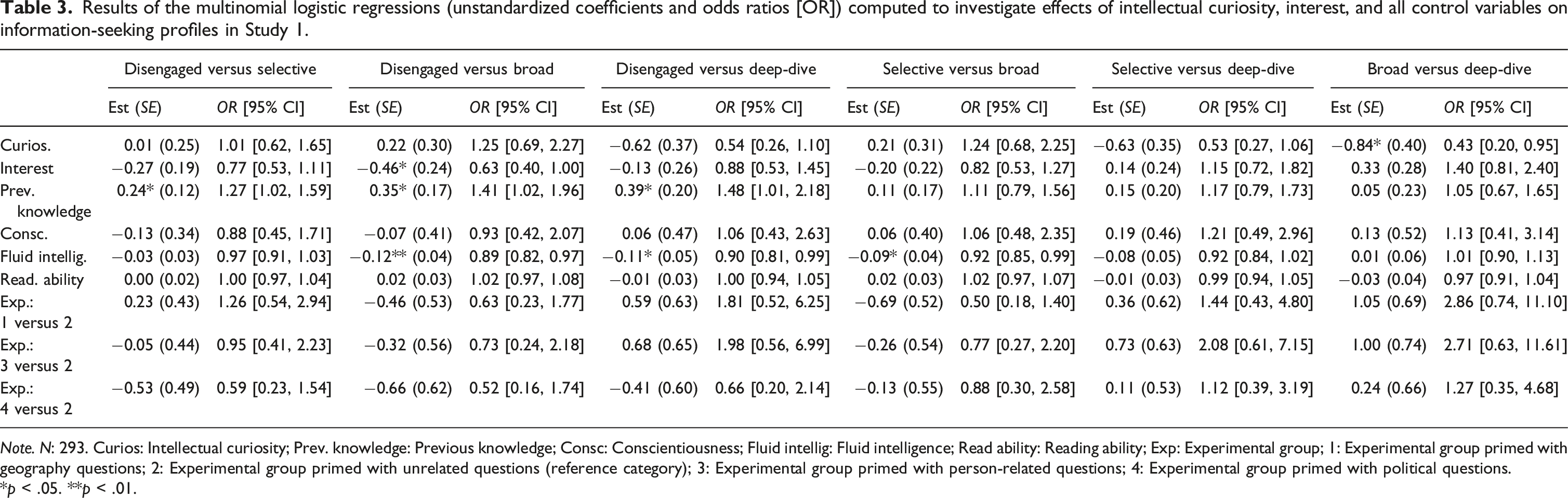
Note. N: 293. Curios: Intellectual curiosity; Prev. knowledge: Previous knowledge; Consc: Conscientiousness; Fluid intellig: Fluid intelligence; Read ability: Reading ability; Exp: Experimental group; 1: Experimental group primed with geography questions; 2: Experimental group primed with unrelated questions (reference category); 3: Experimental group primed with person-related questions; 4: Experimental group primed with political questions.
*p < .05. **p < .01.
Next, we included the interaction between intellectual curiosity and interest in the model. The interaction between intellectual curiosity and interest was not a statistically significantly predictor of membership in any information-seeking profile, with bs ranging from 0.02 to 0.43 and ps ranging from .239 to .949 (see Table S6 for all effects from the model with this interaction).
Information seeking and knowledge test performance
Equality tests of means across profiles revealed that the different information-seeking profiles had significantly different performances on the knowledge test (χ2 = 108.23, p < .001). Participants belonging to the broad information-seeking profile performed better (M = 18.32, SD = 3.32) than participants from the deep-diving profile (M = 16.47, SD = 2.85; χ2 = 7.80, p = .005), the selective profile (M = 15.22, SD = 2.83; χ2 = 32.12, p < .001), and the disengaged profile (M = 13.08, SD = 2.73; χ2 = 94.33, p < .001). Furthermore, the deep-diving profile performed better than the selective profile (χ2 = 4.35, p = .037), and the selective profile performed better than the disengaged profile (χ2 = 29.14, p < .001).
Intellectual curiosity, interest, and knowledge test performance
Multiple regression results showed that neither intellectual curiosity (b = 0.38, p = .177) nor interest (b = 0.30, p = .135) statistically significantly predicted knowledge test performance. Knowledge test performance was significantly and positively predicted by fluid intelligence (b = 0.12, p = .001) and reading ability (b = 0.06, p = .011). Furthermore, effects of experimental condition were significant, with the groups that were primed with geography questions and person-related questions performing significantly better than the group primed with unrelated questions (geography: b = 1.17, p = .021; person: b = 1.17, p = .025). In additional robustness checks, we ran analyses for separate knowledge test performance domains (i.e., geography, person-related, political). We found that each experimental group performed better than the other groups on the knowledge test questions they were primed with. However, the nonsignificant effects of intellectual curiosity and interest on performance were consistently found across the models, underlining the robustness of our main findings (see Tables S4 and S5).
Adding the interaction between intellectual curiosity and interest revealed that the interaction did not significantly predict knowledge test performance (b = −0.01, p = .982). Table S7 in the Online Supplement shows all effects from the model without the interaction, and Table S8 shows all effects from the model with the interaction (unstandardized and standardized estimates).
Discussion
Using behavioral indicators of information seeking extracted from log-file data, we identified four different information-seeking profiles of participants who read and learned from a hypertext. The number of identified profiles was consistent with previous research that has used cluster analyses to identify navigational patterns in information-seeking tasks (Gao et al., 2022; Hahnel, Ramalingam, et al., 2023; He et al., 2023). Two information-seeking patterns (disengaged and selective) could be classified as less adaptive, characterized by little information seeking and low knowledge test performance. Among the more adaptive information-seeking patterns, broad information seekers sought out many different forms of additional information, whereas deep-diving information seekers were more likely to revisit certain links. Broad information seekers performed best on the knowledge test, followed by deep-diving, selective, and disengaged information seekers. The information-seeking profiles we identified were in line with previous research. Groups of disengaged or minimally engaged participants have often been observed in reading tasks or other interactive tasks (Gao et al., 2022; Hahnel, Ramalingam, et al., 2023; He et al., 2023; Ulitzsch et al., 2022). The broad information-seekers in our study resembled Hahnel, Ramalingam, et al.’s (2023) exploring cluster, who exhibited the highest hypertext coverage and performed best on the questions about the text. Observing participants with a navigational pattern that includes revisiting pages also seems common, and this behavior was often interpreted as a sign of either effort (Gao et al., 2022) or disorientation (Gwizdka & Spence, 2007). However, because our participants were not tasked with retrieving specific pieces of information but were free to explore the hypertext, the concept of “disorientation” might not apply in the same way as it does in other studies. Furthermore, trait intellectual curiosity was related to a higher likelihood of being a deep-diving information seeker compared with the other information-seeking profiles, whereas higher personal interest in the topic was linked to a greater likelihood of being a broad information seeker compared with being a disengaged information seeker. In line with theoretical accounts that regard curiosity as the desire to address specific knowledge gaps (Loewenstein, 1994), adopting a deep-diving information-seeking pattern could be most effective for accomplishing this goal (e.g., revisiting crucial concepts that are particularly important for closing the identified gap). Conversely, personal interest has been argued to lead to more sustained engagement with a topic (Hidi & Renninger, 2006, 2019), which might have manifested in exploring as many topic-related aspects as possible. In contrast to the large body of research documenting how curiosity and interest are related to learning outcomes (Renninger & Hidi, 2019; von Stumm et al., 2011), in our study, intellectual curiosity and personal interest were not significantly related to knowledge test performance.
Furthermore, the results did not reveal beneficial effects of the interaction between intellectual curiosity and interest on information-seeking behavior or knowledge attainment. We hypothesized that we would find a synergistic interaction effect (high levels of both openness and interest should be most beneficial for learning), originally suggested by the OFCI model (Ziegler et al., 2018). However, recent studies have found mixed results on whether the interaction is synergistic or compensatory (a high level of either Openness or interest can compensate for a low level on the other variable; see J. Zhang & Ziegler, 2022). Therefore, more research is needed to determine whether the interaction between curiosity and interest can be obtained in different contexts and to investigate the exact interplay of openness and interest. Nonetheless, to the best of our knowledge, the present study is the first to test the OFCI model in a single learning session and the first to expand the outcomes to include learning (information seeking) behaviors. In doing so, our work contributes to current research on the OFCI model (Lechner et al., 2019; J. Zhang & Ziegler, 2022) and research combining curiosity and interest more generally (Tang et al., 2022).
Study 2: Conceptual replication
Although Study 1 provided relevant insights into the interplay between intellectual curiosity, interest, information seeking, and knowledge attainment and had considerable strengths (e.g., the use of behavioral information-seeking indicators), it was also limited in several regards. For instance, the sample size was relatively small, which did not allow for latent variable modeling and may have led to insufficient power; the data set included experimental conditions that we controlled for but that were nevertheless unrelated to our research questions; and the instructions that participants were given before the experiment did not fit the purpose of our study perfectly, as participants were aware of the upcoming knowledge test, which may have potentially superseded their intrinsic curiosity. We therefore conducted a second confirmatory study as a conceptual replication and extension of Study 1 to overcome the limitations of Study 1 and to build a more robust evidence base (Plucker & Makel, 2021).
Research questions and hypotheses
In Study 2, we tested whether we could replicate the results from the exploratory study, and we retested the hypotheses that had previously not been empirically supported. Using the same behavioral indicators of information seeking, we first asked whether we could identify the same profiles as in Study 1 (Research Question 1). Then we asked: Do participants’ intellectual curiosity and interest (Research Question 2a) and the interaction of these two variables (Research Question 2b) predict participants’ information-seeking behavior? We hypothesized that individuals with higher levels of intellectual curiosity and individuals with higher levels of personal interest would be more likely to belong to more adaptive information-seeking profiles than to less adaptive information-seeking profiles. 2 In line with the OFCI model, we expected that the interaction would also predict profile membership in more adaptive profiles. Next, we asked: Does information-seeking profile membership predict knowledge test performance (Research Question 3)? We hypothesized that belonging to a more (vs. less) adaptive information-seeking profile would positively predict knowledge test performance. Finally, we asked: Do intellectual curiosity and interest (Research Question 4a) and their interaction (Research Question 4b) predict performance on the knowledge test? We expected that higher levels of intellectual curiosity, higher levels of personal interest, and their interaction would significantly and positively predict knowledge test performance. For both research questions addressing the interaction effect, we expected to find a significant interaction on the basis of theory; however, we left open how exactly curiosity and interest would interact in predicting the outcomes (e.g., compensatory vs. synergistic effects), as prior research has not only been based on different research settings than our study but has also yielded mixed results (J. Zhang & Ziegler, 2022).
All hypotheses and methods were preregistered on the OSF before the data were collected (see https://osf.io/mkwfg/).
Method
Participants and procedure
To ensure that we recruited a sufficiently large sample, Study 2 was conducted as an online experiment. It was approved by the ethics committee of the University of Tübingen. We translated the materials into English to leverage the significantly larger number of English-speaking participants who were recruited on the online research participation platform Prolific (www.prolific.co). To match the sample from Study 1 as closely as possible, we used filters on Prolific so that the study was displayed only to potential participants who fit our inclusion criteria. Participants were eligible to participate if they were between 18 and 30 years old, had acquired a high-school diploma/completed A-levels, and had not been medically diagnosed with dyslexia. We decided to exclude potential participants from the US, Colombia, Panama, and other Central American countries, as they might have more extensive prior knowledge about the Panama Canal than the original German sample. To test the operability of the experimental setting, we conducted a pilot study with N = 31 participants prior to the preregistration.
We used G*Power (Faul et al., 2009) to conduct a power analysis to determine our target sample size. To be maximally conservative, our power analysis was based on the analyses for Research Question 2 (effects of intellectual curiosity and interest on information-seeking profiles) because we expected to find the smallest effects here and because multiple tests were conducted (comparing each of the latent profiles against one another). We aimed to obtain 90% power to detect small effect sizes (f2) of .02 with a conservative alpha error probability of .008 to correct for the use of multiple tests (Bonferroni). The power analysis yielded a required sample size of 1,002.
We collected data from N = 1,102 participants. As preregistered, participants (55 participants, 4.99%) were excluded if their questionnaire and behavioral data could not be unambiguously matched, data could not be clearly assigned to one participant, or if it became apparent from the log-file data that participants did not follow instructions (e.g., used tabs to access hyperlinks). Next, as Study 2 was conducted in an unsupervised online testing setting, we performed outlier analyses for the behavioral data aimed at identifying unrealistically long reading times (e.g., spending more than 1 hour on one link), which indicate off-task behavior. We thus calculated the estimated reading time for each page of the hypertext, based on the word count and an average silent reading rate for adults in English of 238 words per min (Brysbaert, 2019). As participants generally differ in their reading speed and were free to reread texts, we defined unusual reading behavior as four times the expected reading time for the main text and three times the expected reading time for each hyperlink. If participants exceeded any of these thresholds, they were excluded, which led to the exclusion of 87 participants (resulting in a total exclusion rate of 12.89% 3 ). Thus, our final sample consisted of 960 participants. The final sample was slightly smaller than the sample size determined by the power analysis. However, our power analysis was very conservative and was based on comparing effects across four different latent profiles, whereas our main analyses reported below were based on a two-profile solution. The 960 participants were 25.54 years old (SDage = 3.19) on average. A total of 51.25% identified as female, 47.08% as male, 1.67% as a gender variant/nonconforming). The vast majority of participants were British (71.35%), followed by South African (9.06%) and Australian (3.85%).
We used the German survey software SoSci Survey (Leiner, 2023) to implement the online questionnaire, whereas the hypertext was hosted on a local webserver at the Leibniz-Institut für Wissensmedien in Tübingen, Germany, to ensure high data privacy standards for the collection of log-file data. After giving consent, participants completed a short (figural) fluid and a short verbal intelligence test. Next, they filled out questionnaires on sociodemographic data, personal interest in and previous knowledge about the topic, and personality (intellectual curiosity, conscientiousness). For the hypertext learning task, participants were instructed to freely explore the given text on the history of the Panama Canal and familiarize themselves with the topic. Participants were told that they could browse the text for as long as they wanted and that they could click on as many links as they wanted. In contrast to Study 1, there was no experimental manipulation, and they did not know that they would be tested on the content of the text afterward. After reading the text, participants took the knowledge test. They were then redirected to Prolific and reimbursed (£5.40). The median time spent completing the study was 33 min. Table S9 presents descriptive statistics and bivariate correlations for all measures.
Measures
We used English versions of the measures used in Study 1 by either translating the items (proofread by professional translators) or using the respective English versions of the scales. All items were pilot tested by Native English speakers. To analyze the information-seeking behavior, we used the same five behavioral indicators extracted from the log-file data as in Study 1. For intellectual curiosity, we used the Ideas facet from the openness to experience scale from the original English version of the NEO-PI-R (Costa & McCrae, 1992) with the same response scale ranging from 1 (strongly disagree) to 5 (strongly agree). Internal consistency was good (α = .80). To assess personal interest, we translated the three items used in Study 1 and kept the same response format (1 = strongly disagree to 5 = strongly agree). Internal consistency was also good (α = .88). We translated the knowledge test but excluded the six questions unrelated to the text, resulting in a 27-item measure. We conducted IRT analyses using a two-parameter logistic model (Birnbaum, 1968; De Ayala, 2009) and derived WLEs (Warm, 1989) of participants’ test scores (WLE reliability = .70).
We aimed to include the same control variables as in Study 1; however, we needed to adapt several measures, as the original measures were either not workable or were too long for an online study. Fluid intelligence was assessed with the 11-item Matrix Reasoning Task from the International Cognitive Ability Resource (ICAR; Condon & Revelle, 2014; The International Cognitive Ability Resource Team, 2014), which demonstrated acceptable internal consistency (KR-20 = .70). To account for differences in verbal abilities, we included a measure of verbal intelligence using 11 items from the ICAR Verbal Reasoning Task (Condon & Revelle, 2014; The International Cognitive Ability Resource Team, 2014; KR-20 = .63). To measure conscientiousness, we used the respective scale from the NEO-FFI, which is a short 12-item form of the original NEO-PI-R scale (Costa & McCrae, 1992). The internal consistency estimate was high (α = .87). Prior knowledge was measured with the same item as in Study 1 (“How do you rate your previous knowledge about the Panama Canal?”) with a response scale ranging from 1 (no knowledge at all) to 10 (expert).
Analyses
For data processing and the computation of sample descriptives, we used R Version 4.1.2 (R Core Team, 2023). We also used R (and the TAM package; Robitzsch et al., 2022) to derive WLE scores for our central outcome, the knowledge test, for the main analyses in which we used a measurement-error-corrected single indicator approach for knowledge test performance (see below for details). All further analyses (CFAs to test the factor structure of all multiple-item scales, main analyses addressing our research questions) were performed in Mplus 8.6 (Muthén & Muthén, 1998) using maximum likelihood estimation with robust standard errors (MLR). There were no missing values in this study.
For our main analyses, we modeled intellectual curiosity, personal interest, and the control variable conscientiousness as latent variables (for details on the measurement models, see Online Supplement S3). For the main analyses involving knowledge test performance, we used a single-indicator (SI) approach to account for measurement error (e.g., Hoyle, 2012), fixing the residual variance of the respective WLE knowledge test scores to (1-WLE reliability)*sample variance. The control variables prior knowledge (single item) and fluid and verbal intelligence test scores were included as manifest variables. We followed the same statistical analysis protocol as in Study 1. We again utilized the three-step latent profile approach outlined by Asparouhov and Muthén (2014b); however, we could not rely on the automatic functions offered by Mplus but had to implement it manually, as we used more advanced secondary models involving latent variables (see Asparouhov & Muthén, 2014b, and Appendix D and E in Asparouhov & Muthén, 2014a).
First, we identified latent profile models with k = 2 to k = 6 profiles on the basis of the five behavioral indicators (number of unique clicks on links, number of links revisited at least once, overall time spent on links, average time spent on different links, time spent reading the main text). Five hundred random sets of starting values with 50 initial stage iterations and 50 final stage optimizations were requested. We relied on the same statistical indicators as in Study 1 (AIC, BIC, SABIC, VLMR, LMR) and additionally considered the Bootstrap Likelihood Ratio Test (BLRT) alongside theoretical considerations (parsimony, interpretability, meaningfulness) to choose the best model. We then conducted multinomial logistic regressions to investigate whether intellectual curiosity and interest predicted information-seeking profile membership (Asparouhov & Muthén, 2014b) and estimated two models (one without and one with the curiosity–interest interaction). In Step 2, we determined the measurement error for the most likely class variable N, which was used in the subsequent and final step of the estimation. In Step 3, the desired auxiliary model was estimated, where the latent class variable was measured by the most likely class variable N, and the measurement error was fixed and prespecified to the values computed in Step 2. The model without the interaction included the latent predictor variables intellectual curiosity and interest and the control variables. In the model with the interaction, a latent interaction between intellectual curiosity and interest was added (see Maslowsky et al., 2015). Next, we examined whether information-seeking profile membership predicted knowledge test performance, which again required manual implementation due to the (latent) SI approach specifications for knowledge test performance. Finally, we explored the relationship between intellectual curiosity and interest with knowledge test performance by setting up two structural equation models (one with and one without a latent interaction; Maslowsky et al., 2015).
All hypotheses were tested against a significance level of α = .05. We relied on one-tailed tests for effects for which we had specified directed hypotheses, and two-tailed tests for the remaining effects (including control variables). We used Benjamini–Hochberg corrections (Benjamini & Hochberg, 1995) to adjust for multiple tests (corrections were applied for each research question separately and for all variables for which we had specified hypotheses). The preregistered analysis plan, data, and analysis scripts are publicly available (https://osf.io/mkwfg/).
Results
Latent profile analysis
Overview of the different latent profile solutions in Study 2.
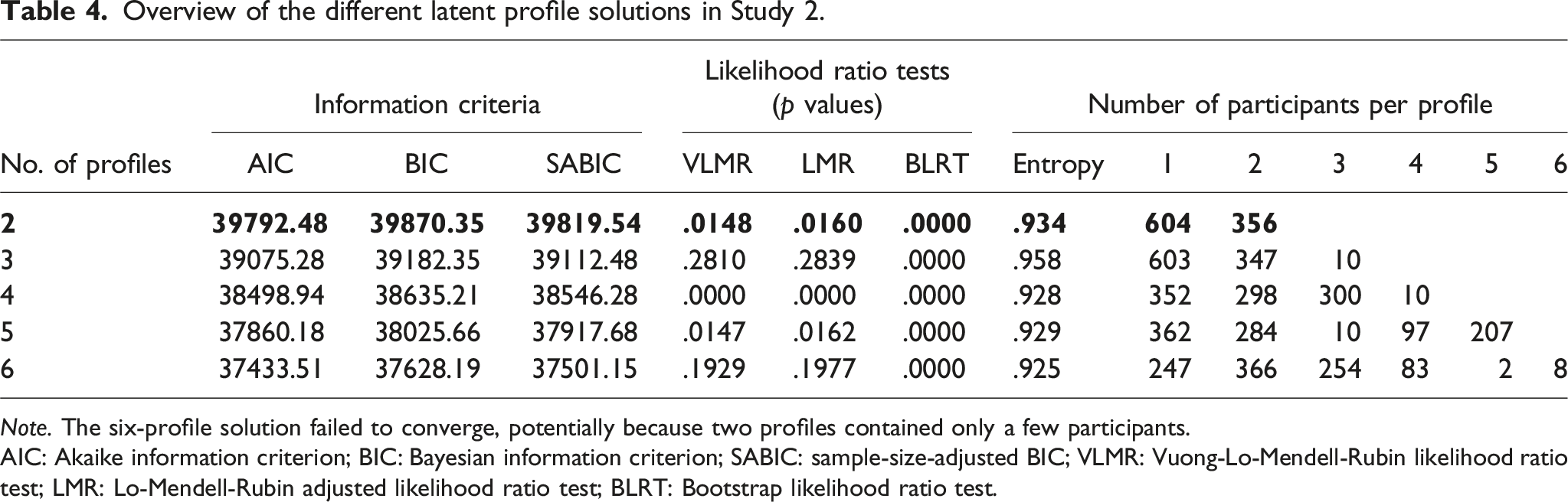
Note. The six-profile solution failed to converge, potentially because two profiles contained only a few participants.
AIC: Akaike information criterion; BIC: Bayesian information criterion; SABIC: sample-size-adjusted BIC; VLMR: Vuong-Lo-Mendell-Rubin likelihood ratio test; LMR: Lo-Mendell-Rubin adjusted likelihood ratio test; BLRT: Bootstrap likelihood ratio test.
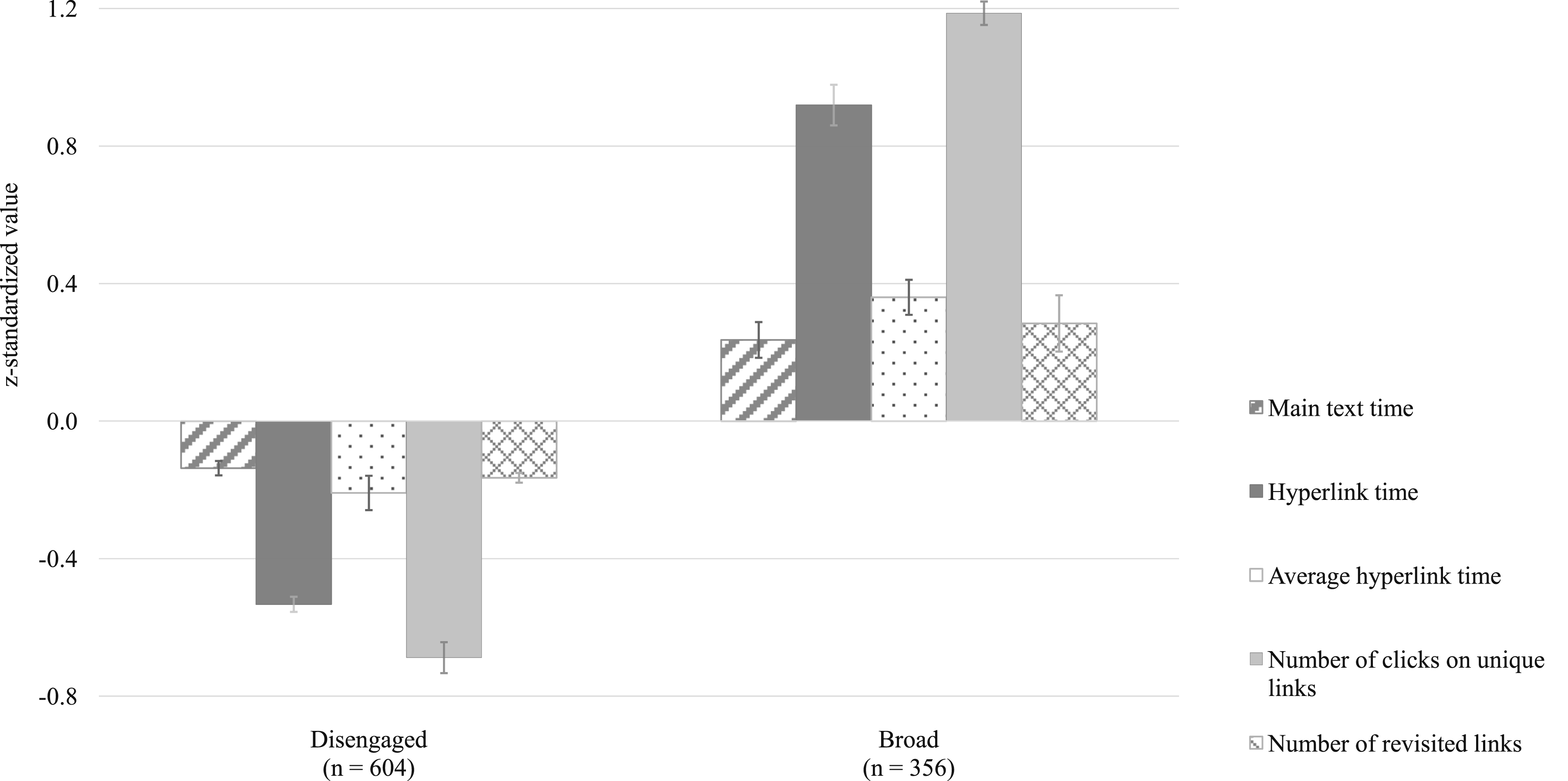
Configuration of the two latent profiles. Note. Error bars represent standard errors.
Descriptive information for each latent profile in Study 2.
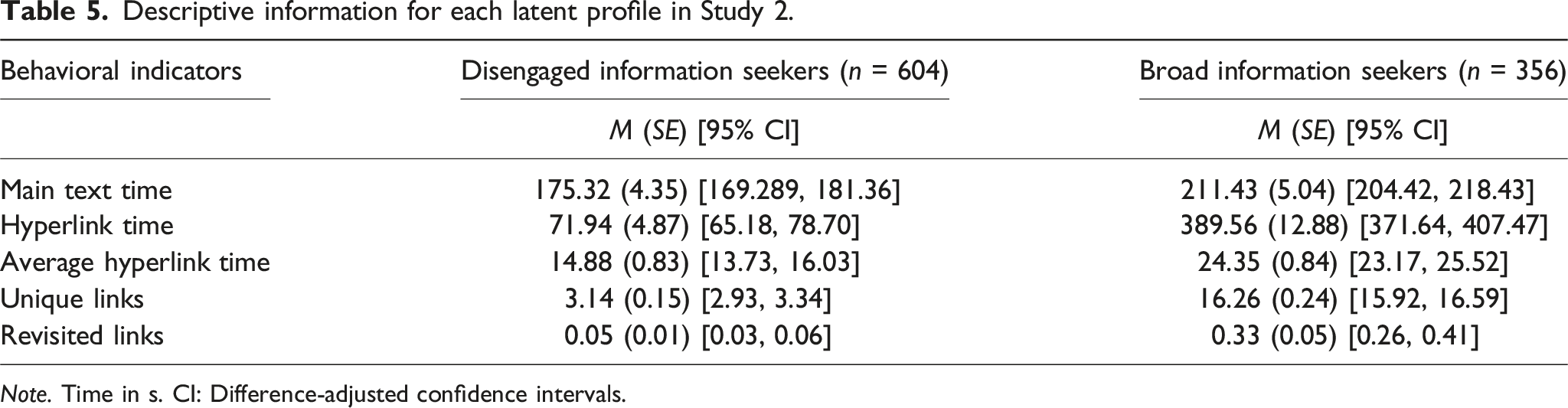
Note. Time in s. CI: Difference-adjusted confidence intervals.
Intellectual curiosity, interest, and information seeking
Results of the multinomial logistic regressions (unstandardized coefficients and odds ratios [OR]) computed to investigate effects of intellectual curiosity, interest, and all control variables on information-seeking profiles in Study 2.
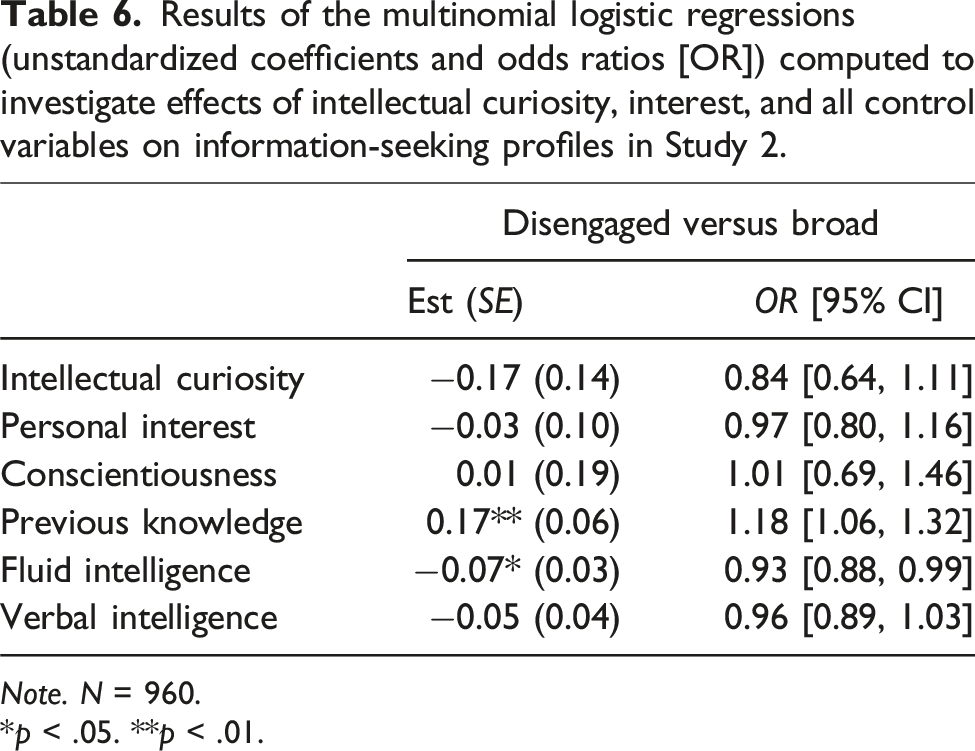
Note. N = 960.
*p < .05. **p < .01.
Information seeking and knowledge test performance
The difference in knowledge test performance between the two profiles was significant (test for latent mean differences = 1.08, p < .001). Broad information seekers performed better (M = 15.63, SD = 4.06) on the knowledge test than disengaged information seekers (M = 12.53, SD = 3.68).
Intellectual curiosity, interest, and knowledge test performance
Structural equation modeling results revealed that both intellectual curiosity (b = 0.12, p = .045) and personal interest (b = 0.19, p < .001) significantly predicted knowledge test performance. Furthermore, knowledge test performance was significantly and positively predicted by verbal intelligence (b = 0.11, p < .001), previous knowledge (b = 0.06, p = .023), and fluid intelligence (b = 0.04, p = .024). We fit another structural equation model that included the interaction between intellectual curiosity and interest; the interaction did not predict knowledge test performance (b = 0.05, p = .457). Tables S11 and S12 in the Online Supplement show all effects from the models without and with the interaction, respectively (unstandardized and standardized estimates).
Robustness checks (Studies 1 and 2)
We included (preregistered) theoretically relevant control variables in our analyses for Studies 1 and 2. However, we also report the results of our analyses without control variables on the OSF. For Study 2, for which we had relied on latent variable modeling, we reran all analyses using manifest variables (following the analysis protocol of Study 1). The results, which we uploaded onto the OSF, were very similar, with one exception: In the manifest variable analyses, intellectual curiosity was a statistically significant predictor of the likelihood of being a broad information seeker, as compared with being a disengaged information seeker. In the Discussion sections below, we focus on the (preregistered) latent results.
Discussion
Study 2 provided a conceptual replication of Study 1 with several notable strengths, including the larger sample, which also made it possible to conduct latent variable modeling. Relying on the same behavioral indicators as in Study 1, we identified two information-seeking profiles (broad vs. disengaged). Broad information seekers spent more than twice as much time on the hypertext and sought out many different hyperlinks. Disengaged information seekers, on the other hand, spent most of their reading time on the main text and hardly sought out any additional information. Likely due to their more comprehensive information seeking in the hypertext, broad information seekers performed better on the subsequent knowledge test. Thus, the two profiles resembled the disengaged and broad information-seeking profiles identified in Study 1 and in previous research (Gao et al., 2022; Hahnel, Ramalingam, et al., 2023; He et al., 2023). Surprisingly, intellectual curiosity and personal interest did not predict information-seeking profile membership, which contrasts with prior research that relied on self-reported adaptive learning behavior (e.g., Dan & Todd, 2014; Evans et al., 2003) and the results of Study 1. However, in line with previous research, which employed different markers of knowledge attainment (e.g., Anglim et al., 2022; Hyland et al., 2022), individuals scoring high on intellectual curiosity and interest performed better on the knowledge test. Again, no empirical support for the OFCI model’s predictions on the combined effects of curiosity and interest could be established, as we did not obtain significant interaction effects on adaptive information-seeking behavior or knowledge attainment.
General discussion
The present two-study paper integrated different lines of research on curiosity, interest, information seeking, and learning to gain a comprehensive understanding of how people differ in how they search for information to acquire knowledge. We leveraged behavioral data from a hypertext learning task to identify distinct information-seeking profiles. Furthermore, we examined the effects of information-seeking profiles on knowledge attainment and investigated the unique and combined effects of participants’ intellectual curiosity and personal interest on their information-seeking behavior and knowledge attainment.
In both studies, we identified behavioral information-seeking profiles that can be characterized as either more or less adaptive. However, in Study 1, these profiles were more differentiated, as two profiles (broad and deep-diving information seekers) exhibited adaptive characteristics, and two profiles (disengaged and selective information seekers) exhibited more maladaptive characteristics. Disengaged and selective information seekers sought out hardly any additional information. Broad information seekers extensively explored additional information across different topics, whereas deep-diving information seekers tended to visit fewer unique links but instead revisited the same links. We interpreted the revisiting as a desire for a deeper understanding of certain concepts and as reconceptualizing and reevaluating information in light of new information (Goldman et al., 2012; Kammerer et al., 2021; Leroy et al., 2023; List & Alexander, 2018). In the online study (Study 2), we did not replicate the four-profile solution but identified only a broad information-seeking profile and a disengaged information-seeking profile, similar to those in Study 1. The granularity of different information-seeking types may depend on the specific context of the information-seeking task. Even though we used the same material (hypertext on the history of the Panama Canal) and extracted the same behavioral indicators, there were several differences between the two studies. For instance, in the lab study, participants were told beforehand that they would be tested on the content of the hypertext, whereas participants in the online study did not know about the subsequent knowledge test when reading the text, which may have influenced their information-seeking behavior. Furthermore, the sample in the online study was more heterogeneous than the university student sample in Study 1. When inspecting the behavioral data, we noticed that the online sample exhibited more extreme behaviors, such that there were many participants who either hardly read the text or read the text very thoroughly, with fewer participants who were moderately engaged. Such behavior may account for why only two profiles—disengaged and highly engaged—emerged in Study 2, whereas we were able to detect more subtle qualitative differences in the information-seeking behavior of the participants in the lab study. Another possible explanation is related to differences between the two samples. Compared with a sample drawn from a wider population (Study 2), currently enrolled university students (Study 1) might exhibit different levels of trait curiosity, personal interest in the topic, or information-seeking styles and combinations of these, as these characteristics could be advantageous for pursuing university studies. To conclude, in both studies, we were able to show that participants differed in their more versus less beneficial information-seeking behavior in line with previous research (Hahnel, Jung, et al., 2023; Lydon-Staley et al., 2021), which seems to be a robust finding. The qualitative differences in terms of more differentiated profiles from Study 1 appear to be less robust and may be more context- or sample-specific.
Next, we addressed the question of how participants’ trait curiosity and personal interest in the topic were related to their information-seeking behavior. In Study 1, we found that higher intellectual curiosity made a participant more likely to be a deep-diving information seeker than a broad information seeker. This result is consistent with Lydon-Staley et al. (2021), who identified an information-seeking style that was characterized by visiting conceptually similar pages and creating tighter knowledge networks when reading Wikipedia (naming this a “hunter”-like information-seeking style), a style that was related to higher levels of deprivation-type curiosity. Highly intellectually curious readers may be more likely to identify their own knowledge gaps and then direct their search to close such gaps rather than engaging in widespread, possibly undirected information seeking. Such directed actions may include rereading the most important texts to ensure that a specific knowledge gap is closed (Loewenstein, 1994). Notably, in contrast to Lydon-Staley et al. (2021), we did not use a specific deprivation-type curiosity measure but rather a broader scale that leans toward interest-type curiosity. Thus, in our study, one could also have expected that our measure of intellectual curiosity would be more strongly related to the broad information-seeking profile. Nonetheless, whereas deprivation-type and interest-type curiosity are distinct constructs, they are both subtypes of epistemic curiosity and are typically substantially correlated (Kashdan et al., 2018; Litman, 2008; Litman et al., 2010; Whitecross & Smithson, 2023). Consequently, even high levels of trait interest-type curiosity should increase the likelihood of experiencing the urge to close a knowledge gap when placed in a curiosity-evoking situation. Instead, we found that higher personal interest was related to the likelihood of being a broad versus a disengaged information seeker in Study 1. This finding fits with interest theory, which argues that established interests should lead to continued engagement with the topic (Hidi & Renninger, 2006, 2019). However, unexpectedly, we did not replicate these findings. In Study 2, no deep-diving profile emerged. We also did not obtain significant relationships between intellectual curiosity or personal interest and membership in the two profiles identified in Study 2, even though theory and prior empirical evidence (Ainley et al., 2002; Jach et al., 2022) have suggested that both constructs should predict being a more adaptive (broad) compared with a less adaptive (disengaged) information seeker. Furthermore, as the online study represented an even less structured learning situation, we would have expected curiosity and interest—as they tap into intrinsic motivational processes—to be even more relevant for prompting information seeking. Nonetheless, the findings in Study 1 indicate that curiosity and interest may manifest in distinct information-seeking behaviors, thus adding to the extensive literature on the similarities and differences between curiosity and interest (e.g., Grossnickle, 2016). To our knowledge, no study has yet tried to disentangle the effects of the two constructs by using behavioral process data (e.g., log-file data). Hence, tasks such as the hypertext learning task employed in our study could be a promising study paradigm to investigate further in future studies, leveraging behavioral data to study interindividual differences (Boyd et al., 2020).
In both studies, we found that the participants with the more adaptive information-seeking profiles performed better on the knowledge test than those with the less adaptive profiles. In Study 1, broad information seekers performed best, followed by deep-diving, selective, and disengaged information seekers. Correspondingly, in Study 2, broad information seekers outperformed disengaged information seekers. These findings support the validity of the behavioral indicators that we selected to measure information seeking as a means to learn from a hypertext across two studies with different contextual conditions (lab vs. online). However, it is important to bear in mind that we administered the knowledge test right after participants read the text. Even though we were able to show that information seeking plays a role in knowledge attainment, it would be insightful to test the effects of different information-seeking styles on long-term learning using delayed knowledge tests in future research. For instance, whereas broad information seekers may perform better on an immediate knowledge test because they visited more pages, deep-diving information seekers may have grasped some concepts more deeply and may thus remember the content for a longer period of time (Fayn et al., 2015; Smillie et al., 2016). Thus, the evaluation of whether an information-seeking style is more or less relevant to learning should be extended by adopting a longer term perspective on knowledge attainment.
Both trait curiosity and interest are important for learning (Renninger & Hidi, 2019; Tucker-Drob & Briley, 2012; von Stumm et al., 2011), and in our studies, we tested whether they would predict knowledge attainment in a single learning session. In Study 1, trait intellectual curiosity and personal interest were not significantly related to knowledge test performance. In Study 2, we found the expected statistically significant positive effect, but the effect sizes were small, especially for curiosity. However, we also controlled for a range of other highly relevant variables (e.g., intelligence), and in Study 2, curiosity and interest still significantly contributed to the prediction of knowledge test performance above and beyond the effects of these other variables. Taken together, we propose that the hypothesized positive (small) effects of curiosity and interest on knowledge attainment exist but require a rather large sample (i.e., higher statistical power) to detect it. The trait-level assessments of curiosity and interest employed in our study could be another reason for the small effect sizes we obtained. Stronger effect sizes may be expected for immediate, state-level assessments of curiosity and interest (i.e., asking participants how curious they felt before reading the text; Nuutila et al., 2020; Roemer et al., 2023; Rotgans & Schmidt, 2018). However, it can be challenging to distinguish between state curiosity and situational interest (Ainley, 2019). Conversely, trait curiosity (general openness toward various topics) and personal interest (directed toward a specific topic) are more clearly distinguishable. As it was an important goal of this study to consider and compare the effects of both curiosity and interest on information-seeking behavior and knowledge attainment through an intertheoretical integration, we found the trait-level assessment to be both informative and valuable. In the future, combinations of trait- and state-level assessments may be considered.
Additionally, we investigated whether the combination of interest and curiosity played a role in information seeking and knowledge attainment by testing the OFCI model’s predictions (Ziegler et al., 2018) in a different context (single session including a hypertext learning task) and expanding the model to consider a novel learning-relevant outcome (information-seeking behavior). According to the OFCI model, a curious person might be even keener to seek out information if the topic of the text matches their pre-existing interests. However, we did not find statistically significant interaction effects in either study. Previous research on the interplay between openness and interest has found beneficial interaction effects, when using either trait (J. Zhang & Ziegler, 2022) or state (Ziegler et al., 2018) measures of openness and interest. However, such studies mostly conducted longitudinal tests of the effects on scholastic performance over the span of a semester or school year. It might be the case that the co-occurrence of openness (or intellectual curiosity) and interest specifically fosters learning behaviors that are beneficial for long-term learning that cannot be observed in a single learning session. Furthermore, it is also important to consider that personal interest is inherently domain-specific, whereas intellectual curiosity is domain-general (Grossnickle, 2016). Consequently, the lack of support for the OFCI model in our studies might be related to the specific topic we used. Based on research on the RIASEC model of vocational interests (Holland, 1997), Ziegler et al. (2018) suggested that openness should be particularly likely to covary with investigative interests that involve abstract and theoretical thinking. The topic of the hypertext in the present study (the history of the Panama Canal), although it touched on complex political events, did not involve abstract theories. Therefore, it might not have been the most suitable topic for testing the claims of the OFCI model. To follow up on our two studies, additional research in different contexts and across various topics is warranted to further determine under which conditions the predictions made by the OFCI model will hold.
Finally, we included established control variables related to learning behaviors and outcomes and found largely consistent effects. Higher previous knowledge was consistently associated with being a disengaged information seeker, in line with previous research on hypertext reading in which prior knowledge was associated with shorter reading times (Madrid & Canas, 2009; Sullivan & Puntambekar, 2015). Fluid intelligence increased the likelihood of being a broad information seeker, potentially because higher intelligence levels may reduce the cognitive load associated with hypertext reading. Moreover, knowledge test performance in both studies was directly predicted by participants’ fluid intelligence and verbal abilities, likely due to their higher complex reasoning abilities, general knowledge (Furnham & Chamorro-Premuzic, 2006), or enhanced reading comprehension and speed (Johann et al., 2020).
Limitations and directions for future research
Several limitations should be acknowledged. The lower degree of experimental control might have influenced participants' task compliance but may have potentially also affected information-seeking behavior itself. Jach et al. (2022) demonstrated that the decision to seek out information depends not only on the person but also on situational factors, especially how intellectually engaging, positive, and negative they perceive the situation to be. Applied to our studies, it is possible that participating in an online study from the comfort of one’s home may be a less intellectually stimulating situation than being invited to a lab and tested by a researcher. This might have made participants less inclined to seek out information to learn something new. Future research should carefully test how varying degrees of situational constraints influence information-seeking behavior. For instance, participants in this study were not allowed to open multiple tabs while reading the hypertext, a constraint that might not accurately reflect their real-life information-seeking behavior and could impact ecological validity. We also had only a two-layered hypertext environment, so potentially more differentiated information-seeking patterns could be identified if we had a more complex hypertext (Hahnel et al., 2016). Curiosity research will benefit from further comparisons of lab studies, online studies, and even field studies that investigate people’s natural information-seeking behavior on the Internet (see, e.g., Zhou et al., 2024). Additional insights into situational effects could also be obtained by incorporating participants’ explicit perception ratings of the situational characteristics of the information-seeking task (Jach et al., 2022; Rauthmann et al., 2014). Another limitation involves the selection of our measures. Although the focus on intellectual curiosity and domain-specific interest add to current knowledge, it would have been desirable to compare their effects with other conceptually similar (e.g., need for cognition; Cacioppo & Petty, 1982; or typical intellectual engagement, Goff & Ackerman, 1992) and conceptually distinct constructs (e.g., neuroticism; Z. Zhang et al., 2021) to gain an even more comprehensive understanding of how different individual difference variables manifest in behavioral traces of information seeking (see also Rauthmann, 2023). Particularly the distinctions between deprivation-type curiosity, interest-type curiosity (Litman, 2008), and personal interest may be valuable to consider for the hypertext learning task, leading to more differentiated and potentially stronger effects. Also, an even more fine-grained understanding may be gained by looking at item-level effects in the future (e.g., Achaa-Amankwaa et al., 2021). Lastly, log-file data capture rich, time-sensitive information of overt information-seeking behavior but cannot make mental processes visible. For instance, a long reading time can mean various things—a participant might be thoroughly reading a text, pausing and contemplating what they just read, they might be engaged in mind-wandering and in need of more time because they are unfocused, or they might simply be a slow reader. Thus, caution must always be taken when psychological processes are inferred from trace data (Goldhammer et al., 2021). Future research could enrich the log-file data by adding multimodal data (e.g., eye-tracking, think-aloud protocols, mouse movements) to both enhance the validity of interpretation (e.g., Kammerer & Gerjets, 2013) and capture information-seeking behavior more comprehensively (Berkovsky et al., 2019; Meidenbauer et al., 2023; Umemoto et al., 2012; Youngmann & Yom-Tov, 2018).
Conclusion
In two studies, we used behavioral data from a hypertext learning task and linked participants’ information-seeking behavior with their trait curiosity and personal interest in the topic. There were indications that curiosity and interest are related to more adaptive information-seeking profiles (Study 1) and knowledge attainment (Study 2); however, these effects were not robust across study contexts, thus also underlining the importance of (conceptual) replications to gain insights into the generalizability and boundary conditions of research findings (Plucker & Makel, 2021). More adaptive information-seeking behavior consistently predicted knowledge test performance (Studies 1 and 2). Furthermore, curiosity and interest did not interact in predicting information-seeking behavior or knowledge attainment (Studies 1 and 2). The hypertext learning task mirrors more natural information seeking, thereby enhancing ecological validity (Murayama et al., 2019), while maintaining high experimental control over the material that was used. We conceptualized information seeking as a way to learn by assessing the knowledge participants gained through information seeking, which could be a promising way to extend curiosity research across various research fields, such as personality psychology, information science, and educational research (Grossnickle, 2016; Jach et al., 2023; Wilson, 2024).
Supplemental Material
Supplemental Material - How do intellectually curious and interested people learn and attain knowledge? A focus on behavioral traces of information seeking
Supplemental Material for How do intellectually curious and interested people learn and attain knowledge? A focus on behavioral traces of information seeking by Aki Schumacher, Yvonne Kammerer, Christian Scharinger, Steffen Gottschling, Nicolas Hübner, Maike Tibus, Enkelejda Kasneci, Tobias Appel, Peter Gerjets, and Lisa Bardach in European Journal of Personality
Footnotes
Acknowledgments
We thank André Klemke for his support with data collection for Study 2.
Declaration of conflicting interests
The author(s) declared no potential conflicts of interest with respect to the research, authorship, and/or publication of this article.
Funding
The author(s) disclosed receipt of the following financial support for the research, authorship, and/or publication of this article: We acknowledge that the data used in Study 1 stemmed from a research project supported by the LEAD Graduate School & Research Network [GSC1028], which was funded within the framework of the Excellence Initiative of the German federal and state governments. We acknowledge financial support for Study 2 from the intramural funding program of the LEAD Graduate School & Research Network (awarded to Aki Schumacher). Aki Schumacher is a doctoral student at the LEAD Graduate School & Research Network, which is funded by the Ministry of Science, Research and the Arts of the state of Baden-Württemberg within the framework of the sustainability funding for the projects of the Excellence Initiative II. Lisa Bardach is supported by a Jacobs Foundation Research Fellowship and an Elite Program for Postdocs Fellowship from the Baden-Württemberg Foundation.
Open Science Statements
For Study 1 (secondary data analysis), the preregistration, code, and materials are openly accessible. The Study 1 data are not publicly available due to data privacy/ethical restrictions. For Study 2, the preregistration, data, code, and material are openly accessible. Everything is publicly available at  .
.
Supplemental Material
Supplemental material for this article is available online.
Notes
References
Supplementary Material
Please find the following supplemental material available below.
For Open Access articles published under a Creative Commons License, all supplemental material carries the same license as the article it is associated with.
For non-Open Access articles published, all supplemental material carries a non-exclusive license, and permission requests for re-use of supplemental material or any part of supplemental material shall be sent directly to the copyright owner as specified in the copyright notice associated with the article.
