




Abstract
Although some people procrastinate more than others, most of us occasionally postpone tasks until tomorrow that we could or should have done today. The present study proposes a volitional-task attractiveness framework including both personality and task-related predictors of actual procrastinatory behavior. Data were collected in a three-wave design around the Christmas break. Using a representative sample of the Dutch population, qualitative data were collected on tasks/situations that induce procrastination (N = 1835) and the validity of the volitional-task attractiveness framework was explored regarding procrastination on a Christmas break task (n = 712). Most respondents (95.6%) reported to at least occasionally procrastinate (e.g., on housekeeping, social, and administrative tasks; when busy/stressed, tasks conflict, and being tired). While personality (i.e., trait procrastination) positively predicted procrastinatory behavior, task-related factors (i.e., task importance and task motivation) explained 12% unique additional variance. Whereas intrinsic task motivation negatively and amotivation positively predicted procrastinatory behavior, extrinsic task motivation showed a more complex pattern. Lastly, low intrinsic motivation was less harmful for those higher on trait self-control. The findings align with the proposed volitional-task attractiveness framework, suggesting that both personality and task-related factors as well as their interaction explain actual procrastinatory behavior.
Plain Language Summary
Although some people procrastinate more than others, most of us occasionally postpone tasks until tomorrow that we could or should have done today. The present study examines when and why people engage in procrastination. Data were collected in at three points in time around the Christmas break. Using a representative sample of the Dutch population, qualitative data were collected on tasks/situations that induce procrastination and the predictors of procrastination on a Christmas break task were explored. Most respondents (95.6%) reported to at least occasionally procrastinate. People reported to procrastinate mostly on housekeeping tasks, jobs in and around the house, social tasks, and administrative tasks. Situations in which people typically procrastinate are when they are busy/stressed, when there are multiple/other tasks, when they are tired/in the evening, and when there is time pressure, deadlines, and things pile up. Results further show that not only personality factors (i.e., people's general tendency to procrastinate) but also task-related factors (i.e., task importance and task motivation) predict task procrastination. Tasks with low importance, low intrinsic motivation, and high amotivation induce procrastinatory behavior. In addition, tasks high on extrinsic motivation induce procrastinatory behavior, except when these have contingent consequences (e.g., rewards) imposed by others (i.e., external regulation). Lastly, high self-control abilities may somewhat overcome procrastination on tasks with low intrinsic motivation. In summary, the findings show that both personality and task-related factors as well as their interaction explain actual procrastinatory behavior.
Procrastination is usually considered as a problematic habit that some people suffer from. Procrastination is widespread among students, but it is also common among adults at work and in everyday life (Ferrari et al., 1995; Klingsieck, 2013; Steel, 2007). Prevalence estimations of chronic or problematic procrastination in the general population range from about 10 to 20% (Ferrari et al., 2007; Harriott & Ferrari, 1996). Numerous self-help books (e.g., Ferrari, 2010; Knaus, 1998; Steel, 2011) and various interventions and counseling programs are available to break the procrastination habit (Van Eerde & Klingsieck, 2018). Although procrastination may have some immediate positive effects (e.g., less stress; Tice & Baumeister, 1997), it also induces guilt (Pychyl et al., 2000) and has negative effects on longer-term outcomes such as timeliness of task completion, mental health, (academic) performance, and educational and career success (e.g., Kim & Seo, 2015; Nguyen et al., 2013; Sirois, 2014; Sirois et al., 2003; Steel, 2007; Steel & Ferrari, 2013; Van Eerde, 2003).
Previous research mostly studied procrastination as a personality trait (Klingsieck, 2013), defined as the tendency to postpone that what is necessary to reach some goal (Lay, 1986). Such a trait perspective assumes that procrastination entails a habitual pattern of behavior that is relatively stable over time and across tasks and situations. Supporting this perspective, meta-analyses showed that procrastination is linked to personality characteristics such as low conscientiousness, self-efficacy, and self-esteem, and high impulsiveness and boredom proneness (Steel, 2007; Van Eerde, 2003). Furthermore, procrastination has a genetic component (46%; Gustavson et al., 2014) and is relatively stable over time (rtest-retest of .73–.77; Steel, 2007) and across situations (e.g., r = .65 between procrastination of academic and daily tasks; Milgram et al., 1998).
Notwithstanding the validity of the trait perspective and findings illustrating that individuals differ in their levels of procrastination, it can be argued that most people every now and then put off tasks until tomorrow that they could and should have done today. Therefore, the present study takes a different perspective by focusing on procrastination as a behavior. Studying actual procrastinatory behavior is important because it is a more proximal antecedent of task performance than trait procrastination. Furthermore, taking procrastinatory behavior as outcome allows for examining the role of task-related characteristics in predicting procrastination. Although previous research shows that actual procrastinatory behavior is linked to individual differences in trait procrastination, correlations between measures of trait procrastination and indicators of procrastinatory behavior typically vary between .20 and .45 (e.g., Ferrari, 1992, 1993; Ferrari & Tice, 2000; Lay, 1986, 1990; Lay & Brokenshire, 1997; Schouwenburg, 1992; Solomon & Rothblum, 1984; Tice & Baumeister, 1997; Van Hooft, 2014). This suggests that only 4–20% of the variance in actual procrastinatory behavior is explained by stable individual differences in trait procrastination. Also, multi-wave studies showed fluctuations in procrastinatory behavior within individuals over time (Krause & Freund, 2014; Wieland et al., 2021). Thus, actual task procrastination seems to be only partly habitual and stable over time and across situations, and consequently likely depends not only on individual differences in trait procrastination but also on other factors such as task characteristics.
Building on theory and previous research, the present study combines an individual differences perspective with a task-related perspective to understand procrastinatory behavior and its predictors. Specifically, using a representative sample of the general population in the Netherlands, this study empirically tests the assumption that most people every now and then engage in procrastination. Furthermore, taking a relatively understudied task-related perspective (Klingsieck, 2013), this study explores what type of tasks people typically procrastinate on, and whether task characteristics (e.g., task difficulty, task size, task importance, task self-efficacy, and task motivation) can enhance our understanding of the predictors of actual procrastinatory behavior over and beyond general individual differences (i.e., trait procrastination and self-control ability). Lastly, combining an individual difference and task-related perspective, this study explores if the role of task motivation in predicting procrastinatory behavior depends on individual differences in self-control ability.
The present study aims to contribute to the literature by providing an integrated account of procrastination. Synthesizing previous theoretical models (e.g., Harris & Sutton, 1983; Klinsieck, 2013; Paden & Stell, 1997; Schraw et al., 2007; Steel, 2007; Van Eerde, 2000), we propose and test a volitional-task attractiveness framework of task procrastination delineating personality and task-related factors and their interaction in explaining procrastinatory behavior on a Christmas break task. Further, previous research has mostly examined procrastination on academic tasks in student samples, while procrastination in other samples and situations is understudied (Klingsieck, 2013). Because procrastination is also harmful among adults (e.g., Lay & Brokenshire, 1997; Nguyen et al., 2013; Sirois, 2007), a thorough understanding of its occurrence and antecedents is warranted. Therefore, the present study aims to contribute to the literature by focusing on task procrastination in the general population. In addition, the study findings have important practical implications for providing recommendations and designing interventions to reduce procrastination in everyday life.
Procrastination in the general population
Procrastinatory behavior or task procrastination is defined as voluntarily and unnecessarily delaying the initiation or completion of intended task behavior despite the potential negative consequences of the delay (Klingsieck, 2013; Steel, 2007). Thus, while task procrastination implies task delay, not all types of task delay refer to procrastination. For example, when task delay is purposely planned and functional or strategic, and when it is rational and has potential positive consequences, it is not procrastination (Klinsieck, 2013; Van Eerde, 2003). Whether task delay is procrastination therefore is an intra-individual appraisal, relating to interpreting the delay as unnecessary and irrational and accompanied by an awareness of its potential negative consequences.
Studies using adult samples from various countries showed that procrastination occurs across the globe (Ferrari et al., 2007; Steel & Ferrari, 2013). Previous research on the type of tasks that people procrastinate and the type of situations in which they procrastinate, mostly involved students. Regarding tasks, Klassen et al. (2008) found that students mainly procrastinate writing, studying, research, and reading tasks. Ferrari and Scher (2000) reported that students not only procrastinate such academic tasks, but also non-academic tasks such as household chores, exercising, and making/returning calls. Regarding situations, various studies suggest that situations prone to induce procrastination are, for example, being in a negative mood, having slept poorly, or experiencing conflicting tasks (e.g., Kühnel et al., 2016; Pollack & Herres, 2020; Senécal et al., 2003). Extending these findings to the general population, the present study explores the type of tasks in daily life that people typically procrastinate, and the situations in daily life that typically induce procrastination.
A volitional-task attractiveness framework of procrastinatory behavior
In addition to exploring what tasks and in what situations in daily life people procrastinate, the present study proposes a volitional-task attractiveness framework to predict task procrastination and tests this framework for procrastinatory behavior on a Christmas break task. Extant theorizing distinguishes between personality and task-related determinants of procrastination (e.g., Klinsieck, 2013; Schraw et al., 2007; Steel, 2007; Van Eerde, 2000). For example, Van Eerde (2000) theorized procrastination as a function of person factors such as impulsiveness and avoidance and situation factors such as task attractiveness. Similarly, in their grounded theory study, Schraw et al. (2007) distinguished between person antecedents such as organizational skills and task antecedents such as task difficulty of academic procrastination. Also temporal motivation theory (TMT; Steel, 2007; Steel & König, 2006) explains procrastination as a consequence of the interplay between person factors related to sensitivity to delay (e.g., low self-control and impulsiveness) and task factors related to task motivation (e.g., task value and task efficacy).
Guided by these theoretical models, Figure 1 proposes an integrated volitional-task attractiveness framework, suggesting that in the core procrastination is a function of (a) people’s volition in terms of their disposition toward postponement and (b) the task attractiveness (vs. aversiveness) as indicated by perceptions of the task. Based on such integrated account, three general propositions can be derived to explain procrastinatory behavior. First, individuals with a stronger disposition toward postponement (e.g., as indicated by trait procrastination or low self-control abilities), more likely engage in procrastinatory behavior because they are more easily distracted, have lower impulse control, and therefore less capable to initiate and maintain task-directed behavior. Second, tasks that are aversive or unattractive (e.g., low intrinsic enjoyment, unimportant, and too difficult or too easy given one’s skills) less likely satisfy people’s needs and thus have lower motivational power and are more likely to be procrastinated. Third, dispositional and task-related factors may interact in predicting procrastinatory behavior. For example, strong self-control abilities may reduce procrastination on unattractive tasks, because it allows for more volitional strength to overcome the immediate unattractiveness of engaging in the task in order to attain longer-term valued outcomes of performing the task. This overarching volitional-task attractiveness account guided the specific rationales for the present study described below. Volitional-task attractiveness framework of procrastinatory behavior.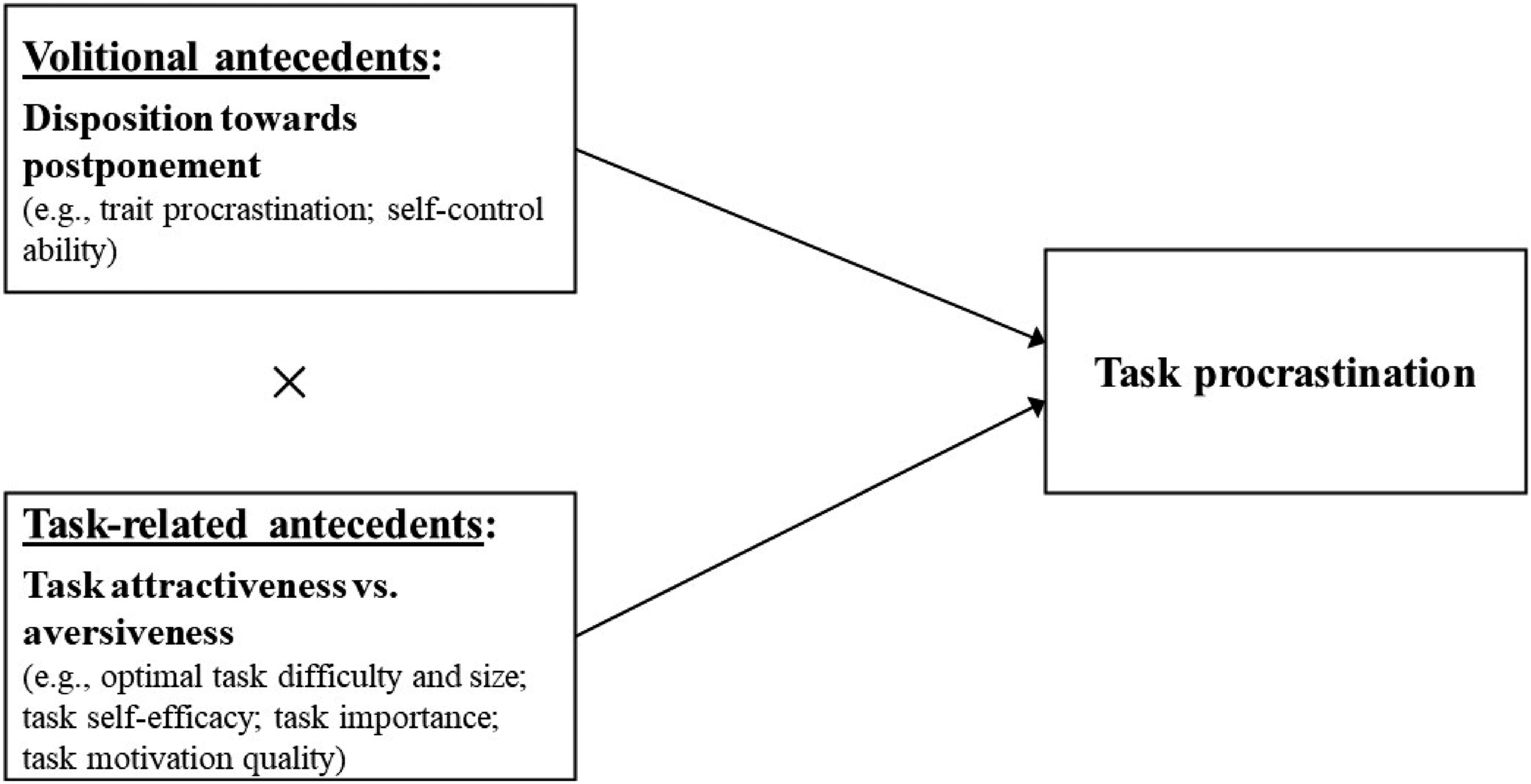
Volitional antecedents
Procrastination can be understood as a self-regulation failure (Ferrari, 2001; Steel, 2007). Self-regulation refers to intra-individual processes that enable initiation and maintenance of goal-directed activities and guide goal attainment, which includes control by the self to modulate thoughts, attention, affect, and behavior toward reaching the goal (Karoly, 1993). Self-regulation is needed when a discrepancy arises between the current and desired state or when immediate urges conflict with long-term valued goals. Procrastination as failing self-regulation thus indicates a lack of adequate modulation of the current state (i.e., thoughts, attention, affect, and behavior) for the purpose of attaining longer-term goals. Self-regulation is needed in two types of situations (Van Hooft, 2018): (a) delayed-cost dilemmas where self-regulation is needed to refrain from an activity that has short-term benefits (e.g., it feels good and it gratifies an immediate need) but long-term costs and (b) delayed-benefit dilemmas where self-regulation is needed to initiate and maintain an activity that has short-term costs (e.g., it is aversive) but long-term benefits. Procrastination usually combines failing self-regulation on both dilemma situations, that is, failing to initiate an aversive activity with valued outcomes (e.g., studying for an exam) and giving in to an immediate gratifying temptation with long-term costs (e.g., binge watching series instead).
Some people are inherently better in self-regulation than others, because they have a larger capacity to regulate their impulses, emotions, thoughts, attention, and behavior (Tangney et al., 2004) or are better in avoiding temptations altogether (Grund & Carstens, 2019; Hofmann et al., 2012). Two specific personality facets indicating such individual differences are trait self-control and trait procrastination. Individuals low on trait self-control have less abilities to override or change their inner responses, avoid temptations, and refrain from and interrupt undesired behavioral tendencies (Hofmann et al., 2012; Tangney et al., 2004), and therefore more likely engage in procrastinatory behavior. Individuals high on trait procrastination have the tendency to postpone goal-direct activities (Lay, 1986), because they are more easily distracted and have low impulse control, suggesting difficulties to refrain from short-term pleasures to attain long-term goals (Steel, 2007; Van Eerde, 2003), and therefore more likely engage in procrastinatory behavior. Thus, trait self-control should negatively and trait procrastination positively predict task procrastination.
Task-related antecedents
Various characteristics of tasks may contribute to whether tasks are perceived as attractive versus aversive. Prior theoretical models (Harris & Sutton, 1983; Paden & Stell, 1997) and empirical studies (Grunschel et al., 2013; Klingsieck et al., 2013; Lonergan & Maher, 2000; Patzrek et al., 2012; Schraw et al., 2007) on task-related antecedents of procrastination in academic and work settings identified a wide array of task characteristics that may induce procrastination. Integrating insights from these frameworks and findings, we conceptualize task attractiveness versus aversiveness by examining task difficulty, task size, task self-efficacy, task importance, and task motivation.
Regarding task difficulty and task size, the extant literature offers different predictions. Paden and Stell (1997) posed that difficult tasks are procrastinated more because difficult and large tasks may be perceived as overwhelming, suggesting a positive relationship between task difficulty and task procrastination. While some support has been found for this idea in student samples (Grunschel et al., 2013; Klinsieck et al., 2013; Pychyl et al., 2000), Schraw et al. (2007) in contrast reported that difficult tasks decrease student procrastination, suggesting a negative relationship. Other authors posed that the relationship between task difficulty and task procrastination may be U-shaped (e.g., Harris & Sutton, 1983; Van Eerde, 2000). Too difficult or large tasks are aversive as these may be perceived as a threat that induces feelings of anxiety, leading to task procrastination. Too easy or small tasks are aversive as these may be perceived as lacking challenge and stimulation, which induces feelings of boredom and passivity, leading to task procrastination. Instead, moderately difficult and sized tasks likely are highest in attractiveness and therefore less likely procrastinated. Thus, we explore if task difficulty and task size have a U-shaped relation with task procrastination.
Task self-efficacy refers to people’s task beliefs that they have the capability to successfully complete the specific task (Steel, 2007). Motivational theories suggest that tasks for which people feel more confident in having the necessary skills, are perceived as more attractive, generate more motivational power, and improve self-regulation (Bandura, 1991). Applied to procrastination, TMT (Steel, 2007) suggests that when a task has a high expectancy (i.e., as a result of high efficacy on the task), it is more desirable to engage in that task (i.e., higher utility) and therefore less likely to be procrastinated. Thus, tasks higher on self-efficacy are more attractive and therefore lower on task procrastination. TMT further identifies task value as an important predictor of procrastination. Task importance is an indicator of task value, referring to the subjective value in terms of importance and commitment attached to the task. Important tasks are less likely to be procrastinated (Paden & Stell, 1997), as these have higher value because of higher urgency, priority, and rewards. Lonergan and Maher (2000) theorized that work tasks low on importance induce feelings of purposelessness. Consistently, they found that task significance related negatively to decisional procrastination. Altogether, task self-efficacy and task importance should negatively predict task procrastination.
Lastly, the present study focuses on task motivation as an indicator of task attractiveness in predicting task procrastination. Prior research on the relationship between motivation-related factors and procrastination showed some conflicting findings. Specifically, based on eight studies, Steel (2007) found a meta-analytic correlation of .40 between task aversiveness and task procrastination, suggesting that interesting and enjoyable tasks are procrastinated less than aversive and boring tasks. In contrast, Conti (2000) found that among adults, “want to” (i.e., autonomously motivated) projects are procrastinated more as compared to “had to” (i.e., extrinsically motivated) projects. We propose two explanations for these divergent findings regarding the role of task motivation in predicting task procrastination, relating to (a) different types of extrinsic motivation as described by self-determination theory (SDT; Deci & Ryan, 2000) and (b) individual differences in self-control.
SDT stresses the importance of motivation quality, distinguishing between several types of motivation that vary in the degree of self-determination or autonomy (Deci & Ryan, 2000; Ryan & Deci, 2000). First, referring to high motivation quality, intrinsically motivated activities are those that are inherently enjoyable or interesting. These are tasks people find interesting or pleasant by itself, and they would do these in absence of separate consequences. Second, extrinsically motivated activities are not inherently enjoyable or interesting. Motivation for such tasks depends on external outcomes of performing the task. Depending on the degree that these consequences are internalized, SDT describes several forms of extrinsic motivation. Identified regulation refers to an autonomously determined form of extrinsic motivation, in that people themselves value the outcomes generated by performing the task. Introjected regulation refers to motivation that is controlled by contingent, internalized consequences (e.g., activities that are performed to avoid shame or guilt). External regulation refers to motivation that is controlled by contingent, externally imposed consequences such as attaining desired or avoiding undesired outcomes (e.g., activities that are performed because others require so). Third, SDT describes amotivation as the lowest motivation quality, indicating a lack of motivation. People are neither intrinsically nor extrinsically motivated to perform amotivated activities because they do not see any reason why it would be useful to perform such activities.
SDT poses that the more self-determined people’s motivation, the more positive its effects on behavioral persistence, performance, emotions, and well-being (Ryan & Deci, 2000). Extending this reasoning to procrastination suggests that amotivated activities are procrastinated most, because these tasks lack both immediate pleasure and a longer-term purpose, and intrinsically motivated activities are procrastinated least, because these tasks are inherently pleasurable and attractive. Thus, intrinsic motivation should negatively and amotivation positively predict task procrastination.
Regarding extrinsic motivation, we propose a divergent pattern, integrating SDT and Conti’s (2000) reasoning and findings. Extrinsically motivated tasks represent a delayed-benefit dilemma requiring self-regulation to engage in these not inherently interesting or pleasurable tasks toward the longer-term valued outcome (Van Hooft & Kreemers, 2022). Given that procrastination is a self-regulatory failure, extrinsically motivated tasks are likely procrastinated. In contrast, Conti (2000) suggested that extrinsic motivation relates negatively to task procrastination, because extrinsic motivators have informational value in terms of an appropriate time frame for completing the task and an indication of the importance of the outcomes to others, and extrinsic motivators enable and facilitate task pursuit by providing resources, opportunities, and structure. However, taking SDT’s different types of extrinsic motivation into account, such enabling mechanisms likely occur for external regulation only. That is, in contrast to identified and introjected regulation, external regulation is the only type of extrinsic motivation that refers to behaviors performed because of contingent rewards administered by others. Therefore, of the extrinsic motivation types only external regulation should negatively predict task procrastination, while introjected regulation and identified regulation should positively predict task procrastination.
Interaction between self-control abilities and task motivation
A second explanation for previous diverging findings on task motivation and procrastination relates to individual differences in self-control. Self-control is especially needed for tasks low on intrinsic motivation and high on extrinsic motivation (Sansone & Thoman, 2006; Van Hooft, 2018; Van Hooft & Kreemers, 2022): When tasks are unpleasurable, uninteresting, or otherwise aversive to perform but serve valued outcomes, people need to apply self-control (e.g., regulation of effort, reminding oneself of the valued outcome, and maintenance actions directed at increasing interest) to facilitate task persistence and performance. This reasoning suggests that trait self-control and task motivation interact in predicting task procrastination. Specifically, low intrinsic motivation likely induces task procrastination, but strong self-control may help to overcome the harmful effects of low intrinsic motivation, as trait self-control can direct people toward regulating effort and performing the behavior despite it being aversive. For extrinsic motivation, SDT’s different motivation types are relevant. First, because external regulated behavior is largely controlled by others, trait self-control should not interact with this motivation type. Second, high introjected and identified regulation likely induce task procrastination, but strong self-control may help to overcome the harmful effects of these extrinsic motivation types, as trait self-control can direct people toward initiating and maintaining their behavior (e.g., by reminding the importance of the outcomes of the task). Thus, we explore if trait self-control moderates the negative relationship of intrinsic motivation with task procrastination and the positive relationships of introjected regulation and identified regulation with task procrastination, such that these are less strong when trait self-control is high rather than low.
Method
Participants and procedures
Data were collected in a three-wave design in the Netherlands (Figure 2), using an online panel of 2000 households (CentERpanel; https://www.centerdata.nl/), selected to be a good representation of the Dutch population. Panel members regularly receive online questionnaires about a variety of topics and their expenses (e.g., internet costs) are covered. Every weekend panel members log in on a special website to check if they are selected to complete a questionnaire. For the present study, all panel members of ≥16 years were selected (N = 2387). Because the study involved no invasive or potentially harmful elements, it was declared exempt from further review by the ethical committee. Overview of the study design, participants, and measures.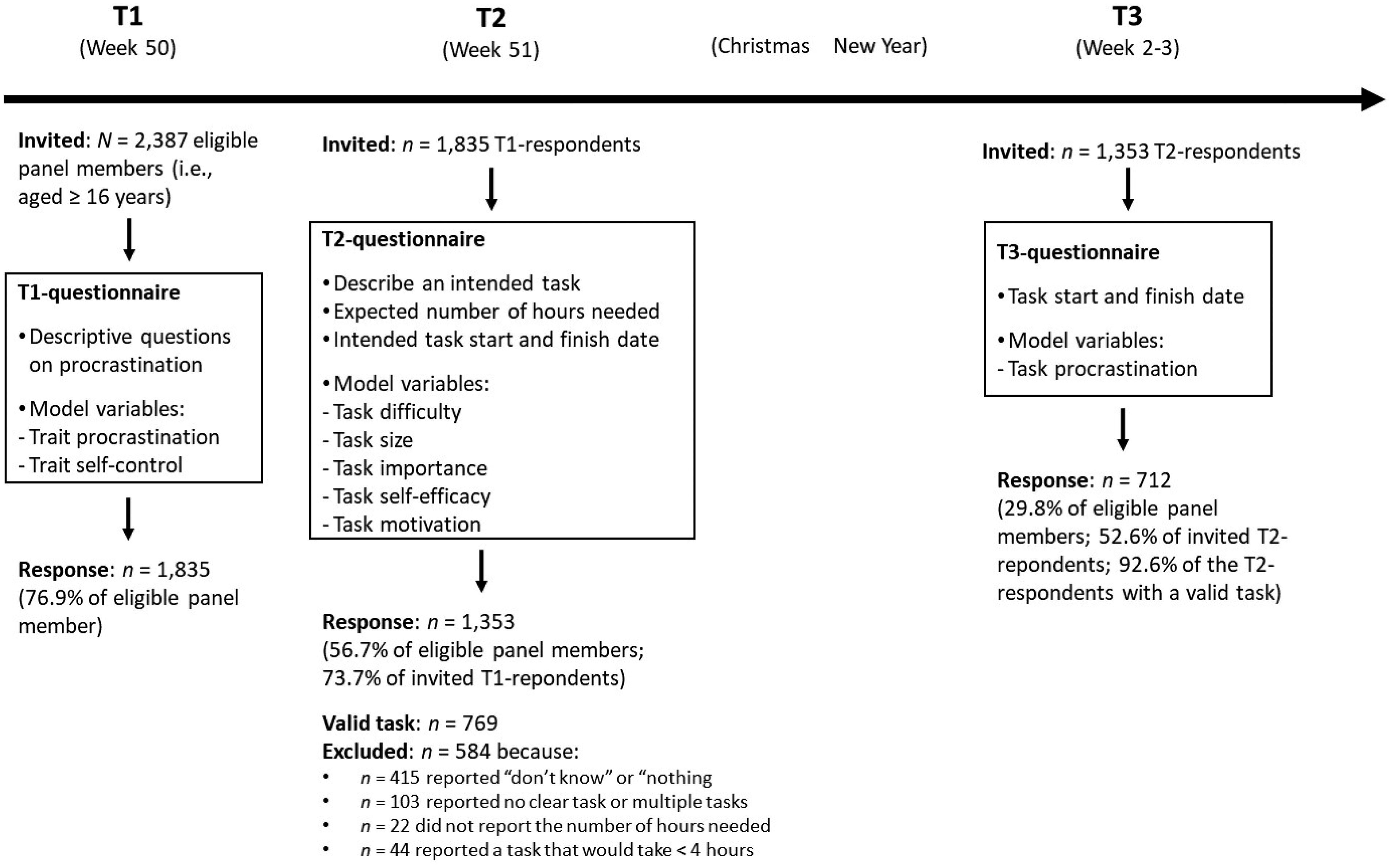
The study was conducted around the Christmas holidays as this is a period in which people typically intend to do certain tasks or projects. The T1 questionnaire was administered mid-December and completed by 1835 respondents. It included a brief description of the study purpose (i.e., to examine how people behave in daily life), a statement that responses were treated anonymously and used for research purposes only, descriptive questions on general procrastination, the measures of trait self-control and trait procrastination, and several other personality measures 1 . The T2 questionnaire was administered in the weekend before Christmas and completed by 1353 respondents. In this questionnaire, respondents were asked to describe a personal task/project that they thought about or planned to carry out in the next three weeks. Based on procedures of Little (1983) and Koestner et al. (2008), we instructed participants as follows: “In the present study, we are interested in tasks, activities, or projects that people are planning to perform in the period around Christmas and New Year. Most people have a number of personal tasks/projects that they think about or plan to do in the Christmas/New Year period, and that they sometimes (though not always) complete in that period. These tasks/projects can be related to daily life, work, education, home, sport, and leisure, among others.” Next we asked participants to name a personal task/project that they were thinking about or planning to perform in the next three weeks and that would take at least 4 hours of their time. Participants were further asked to describe the content of this task/project and what they need to do for it and the number of hours they expected to need for the task. A valid task was filled in by 769 respondents (see Figure 2 for exclusion reasons). In addition, the T2 questionnaire included measures for task characteristics and task motivation (and some other items on attitudes). The T3 questionnaire (measuring task procrastination and some filler items) was administered in January. Of the 769 valid T2 respondents, 712 participants responded at T3.
The 712 participants were from 603 households (M = 1.35 members per household, ranging between 508 households with 1 participant and 4 households with 4 participants), 314 were women (44.1%), age varied between 16 and 93 (Mage = 51.5, SD = 15.5), and 55.9% were employed. Education level varied between primary school or lower vocational training (27.2%), secondary/high school or intermediate vocational training (28.1%), and college/university (44.2%). Examples of the T2 tasks are tidying up (13.2%), redecorating/painting (6.7%), major repairs/alterations (5.8%), administrative tasks (4.9%), and sorting/editing/processing (holiday) pictures/movies (4.2%). Median expected task duration was 10.5 hours (M = 21.9, SD = 35.5).
To check for selective non-response, respondents in the final sample (n = 712) were compared to T1 respondents not in the final sample (e.g., because of not completing the T2 or T3 questionnaire or not filling in a valid task at T2; n = 1123) on the T1 variables sex, age, education level, employment status, trait procrastination, and trait self-control. Logistic regression analysis (cf. Goodman & Blum, 1996) showed some signs of non-random attrition, χ2(6) = 35.28, p < .001, with the odds ratio of education level being significant, Exp(B) = 1.32, p < .001. A subsequent test showed that higher educated individuals more likely remained in the sample, χ2(2) = 29.84, p < .001.
Measures
To collect descriptive information about procrastination in the general Dutch population, the T1 questionnaire started with asking if participants ever procrastinate something (response options: 1 = no, never, 2 = yes, very occasionally, 3 = yes, sometimes, 4 = yes, regularly, 5 = yes, often, and 6 = yes, very often) and whether procrastination is a problem for them (response options: 1 = totally no problem, 2 = hardly a problem, 3 = a small problem, 4 = a fairly big problem, 5 = a big problem, and 6 = a very big problem). Further, we asked what type of tasks participants procrastinated on most often, and in what situations/circumstances they procrastinated most. Participants were allowed to list up to five tasks and up to five situations. Next, the T1 questionnaire contained items on the trait variables, using 5-point Likert scales ranging from 1 = completely disagree to 5 = completely agree.
Personality traits
Trait procrastination was measured at T1 with nine items from Van Hooft et al. (2005) based on Lay’s (1986) General Procrastination Scale (α = .85; e.g., “I generally delay before starting on work I have to do”). Trait self-control was assessed with the Dutch version (Finkenauer et al., 2005) of Tangney et al.’s (2004) Brief Self-Control Scale. The scale consists of 13 items (α = .81), such as “I am good at resisting temptation.”
In the T2 questionnaire, after naming and describing a task that participants were thinking about or planning to perform, participants were asked to indicate the date on which they intended to start with the task (response options restricted to the next three weeks), the amount of time they expected to need for the task (in hours), and the date on which they wanted to finish the task. Then they were asked to rate the items on task characteristics and task motivation.
Task characteristics
Items for task difficulty, size, and importance were based on measures employed in previous studies (Blunt & Pychyl, 2000; Emmons, 1986; Harris & Sutton, 1983; Little, 1983; Paden & Stell, 1997; Schraw et al., 2007; Solomon & Rothblum, 1984; Steel, 2007), using 7-point semantic differentials. Task difficulty was measured with four items (i.e., easy-difficult, existing of one step/phase-existing of multiple steps/phases, simple-complex, and demanding little skills-demanding many skills; α = .80). Task size was measured with three items (i.e., little-large, taking little time-take much time, and small-big; α = .88) 2 . Task importance was measured with two items (i.e., unimportant-important and something you do not care about-something you are very committed to; α = .75). Task self-efficacy was assessed with three items based on Little (1983) and Riggs and Knight (1994) (e.g., “I have confidence in my abilities to perform this task well”; α = .94), with response options from 1 = completely disagree to 7 = completely agree.
To assess task motivation, we presented participants the task they mentioned, followed by: “Why do you plan to engage in this task in the next three weeks?” The Situational Motivation Scale (SIMS; Guay et al., 2000) was used to measure intrinsic task motivation (4 items, e.g., “Because I think this task is interesting”; α = .88), identified regulation (3 items, e.g., “I am doing this task for my own good”; α = .69) 3 , and amotivation (4 items, e.g., “There may be good reasons to do this task, but personally I don’t see any”; α = .80). Because the SIMS does not distinguish between introjected and external regulation, items for these were based on Koestner et al. (2008) and Pelletier et al. (2004). Introjected regulation was measured with four (e.g., “Because I would feel ashamed if I did not do this task”; α = .79) and external regulation with three items (e.g., “Because I will get something from somebody if I do this task”; α = .68) 4 . Items were translated in Dutch and slightly adapted to fit the study context (response options 1 = completely disagree to 5 = completely agree).
The T3 questionnaire started with an introductory text reminding the participants that three weeks ago before Christmas they had described a personal task/project that they thought about carrying out during the Christmas/New Year period. Then we displayed the task they filled in at T2 and asked participants to indicate the date on which they started with the task (response options restricted to the last three weeks) or to tick a box if they had not started (yet), and if they had not started the reason(s) for not having started (participants were allowed to list up to five reasons). Subsequently, we asked participants to indicate the date on which they finished the task (response options restricted to the last three weeks) or to tick a box if they had not finished (yet), and if they had not finished the reason(s) for not having finished (participants were allowed to list up to five reasons). Lastly, participants got items on task procrastination (alternated with some filler items).
Task procrastination
Task procrastination was measured with a 6-item scale based on the behavioral definition of procrastination and items used in previous research (Milgram & Toubiana, 1999; Solomon & Rothblum, 1984; Wolters, 2003). Items were phrased to explicitly refer to the task at hand (rather than a general tendency) and written in Dutch. The English translations read: “I postponed the preparations for this task until the last minute,” “Despite my intentions to start timely with this task, I had to do a lot still at the last moment,” “I postponed this task till the last moment,” with response options from 1 = completely disagree to 7 = completely agree, and “How often have you postponed working on this task?”, “How often did it happen that you started doing other things on times that you committed yourself to working on this task?”, and “To what extent was procrastination on this task a problem for you?”, with response options from 1 = never to 7 = always (α = .85). Although there are other reasons for task delay than procrastination (Klinsieck, 2013), task procrastination should relate to task delay. To measure task delay, we calculated the number of days participants started the task later than intended and the number of days participants finished the task later than intended. Both variables were recoded in classes (−1 = started/finished earlier than intended, 0 = started/finished on the same day as intended, 1 = started/finished 1−3 days later, 2 = started/finished 4−7 days later, 3 = started/finished 8−21 later, and 4 = not yet started/finished). Supporting its validity, the task procrastination measure related positively to starting later than intended (r = .45, p < .001, 95% CI [.38; .50]) and finishing later than intended (r = .35, p < .001, 95% CI [.29; .42]).
Control variables
Previous research indicates that men tend to procrastinate more than women that procrastination relates negatively to age and education level, and that procrastination occurs less frequently among employed rather than unemployed individuals (Nguyen et al., 2013; Steel, 2007; Steel & Ferrari, 2013). Sex (0 = male and 1 = female), age, education level (1 = primary school or lower vocational training, 2 = secondary/high school or intermediate vocational training, and 3 = college or university), and employment status (0 = not employed and 1 = employed) as available in the panel database were therefore included as potential control variables.
Analyses
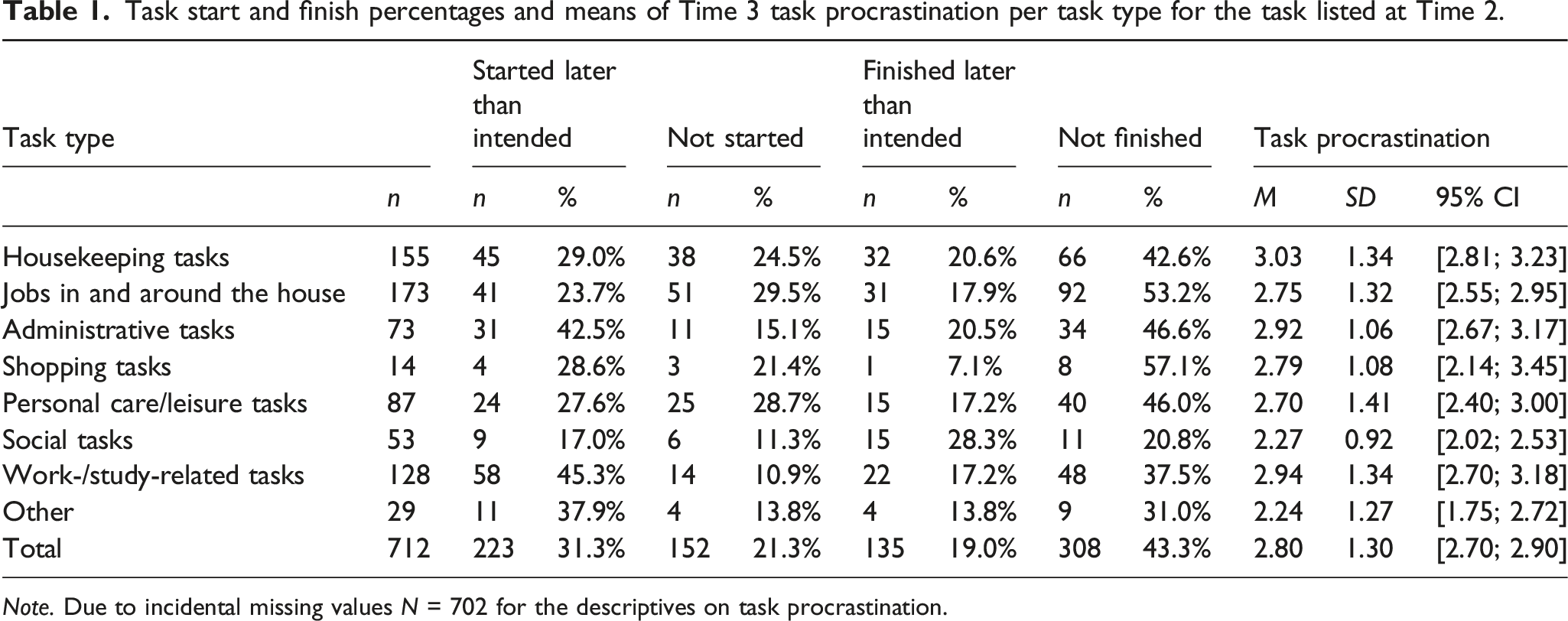
Task start and finish percentages and means of Time 3 task procrastination per task type for the task listed at Time 2.
Note. Due to incidental missing values N = 702 for the descriptives on task procrastination.
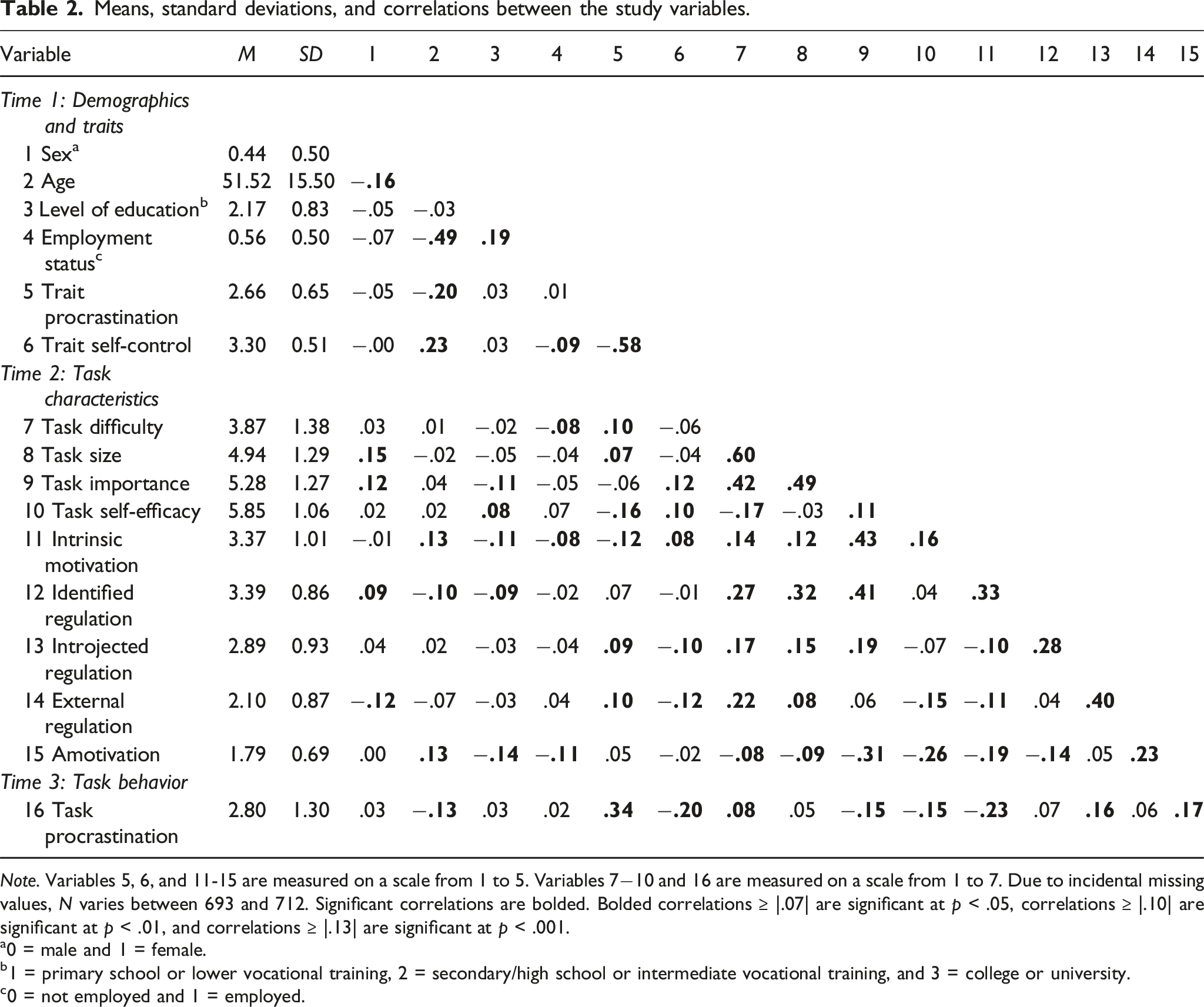
Means, standard deviations, and correlations between the study variables.
Note. Variables 5, 6, and 11-15 are measured on a scale from 1 to 5. Variables 7−10 and 16 are measured on a scale from 1 to 7. Due to incidental missing values, N varies between 693 and 712. Significant correlations are bolded. Bolded correlations ≥ |.07| are significant at p < .05, correlations ≥ |.10| are significant at p < .01, and correlations ≥ |.13| are significant at p < .001.
a0 = male and 1 = female.
b1 = primary school or lower vocational training, 2 = secondary/high school or intermediate vocational training, and 3 = college or university.
c0 = not employed and 1 = employed.
Third, as post-hoc analyses, we analyzed if trait procrastination and trait self-control have shared variance at the household level. To examine household effects, we ran a multilevel regression analysis in Mplus 8.8, with Level 1 intercept set random, and modeling age, trait procrastination, and trait self-control as predictors of T3 task procrastination at both Level 1 and Level 2.
Results
Prevalence of procrastination and type of tasks and situations that evoke procrastination
The mean score on the T1 item asking respondents if they ever procrastinate something (response options from 1 = no, never to 6 = yes, very often) was 3.18 (SD = 1.04; N = 1835), with 4.4% reporting that they never procrastinated. Thus, as 95.6% reported that they procrastinate, with 35.2% reporting to procrastinate on a regular basis to very often, it seems valid to conclude that almost everyone now and then procrastinates. The mean score on the T1 item asking respondents if procrastination is a problem for them (response options from 1 = totally no problem to 6 = a very big problem) was 2.49 (SD = 0.94; N = 1835). While 11.8%, respectively, 43.1% reported that procrastination was totally not or hardly a problem for them, 32.8% indicated that procrastination was a small problem, and 12.4% experienced it as a fairly large, large, or very large problem.
People reported to procrastinate mostly on housekeeping tasks (29.5%; e.g., tidying up, cleaning, and ironing), jobs in and around the house (15.0%; e.g., gardening, cleaning the car, and repairs), social tasks (13.9%; e.g., phone calls, paying visits, and making appointments), administrative tasks (12.8%; e.g., financial tasks, paying bills, and correspondence), work-/study-related tasks (6.9%; e.g., homework and making minutes/reports), personal care/leisure tasks (5.2%; doctor/dentist appointments and exercising), and shopping tasks (5.11%; groceries and large purchases). Also, 9.2% of task descriptions represented a more general task characteristic (i.e., aversive tasks, difficult tasks, and unimportant tasks). People reported to most often procrastinate when they are busy/stressed (21.8%), there are multiple/other tasks (8.3%), they are tired/in the evening (8.2%), there is time pressure, deadlines, things pile up (7.5%), they do not feel like it (7.4%), they do not feel well physically/mentally (4.2%), there is a lack of time (3.6%), or there is time enough and no urgency (2.8%).
Regarding the personal task that participants were thinking about or planning to perform in the Christmas break as reported at T2 (n = 712), 24.3% referred to jobs in and around the house, 21.8% to housekeeping tasks, 18.0% to work-/study-related tasks, 12.2% to personal care/leisure tasks, 10.3% to administrative tasks, 7.4% to social tasks, and 2.0% to shopping tasks. As shown in Table 1, 31.3% of the participants started later than intended, and 21.3% had not started at all (n = 152). These participants reported in total 217 codable reasons for having not started. Most often mentioned reasons were being busy/having no time (23.5%), health issues (13.8%), no priority/having other more important tasks to do (11.1%), hindering external circumstances (10.1%), and lack of motivation/concentration (8.8%). Table 1 further shows that 19.0% finished later than intended, and 43.3% had not finished yet (n = 308). These participants reported in total 221 codable reasons for not having finished. Most often mentioned reasons were that the task was too big/larger than expected (16.7%), being busy/having no time (11.3%), no priority/having other more important tasks to do (10.4%), and social activities/having visitors (9.1%). Lastly, Table 1 displays means of T3 task procrastination per task type. A one-way ANOVA showed that task type significantly related to T3 task procrastination, F(7, 694) = 3.12, p = .003, η2 = .03. Exploratory post-hoc multiple comparisons (Tukey HSD) indicated that social tasks are procrastinated less than housekeeping tasks (Mdiff = 0.75, p < .01) and work-/study-related tasks (Mdiff = 0.67, p < .05).
Volitional and task-related predictors of task procrastination
Multilevel regression analyses predicting task procrastination.
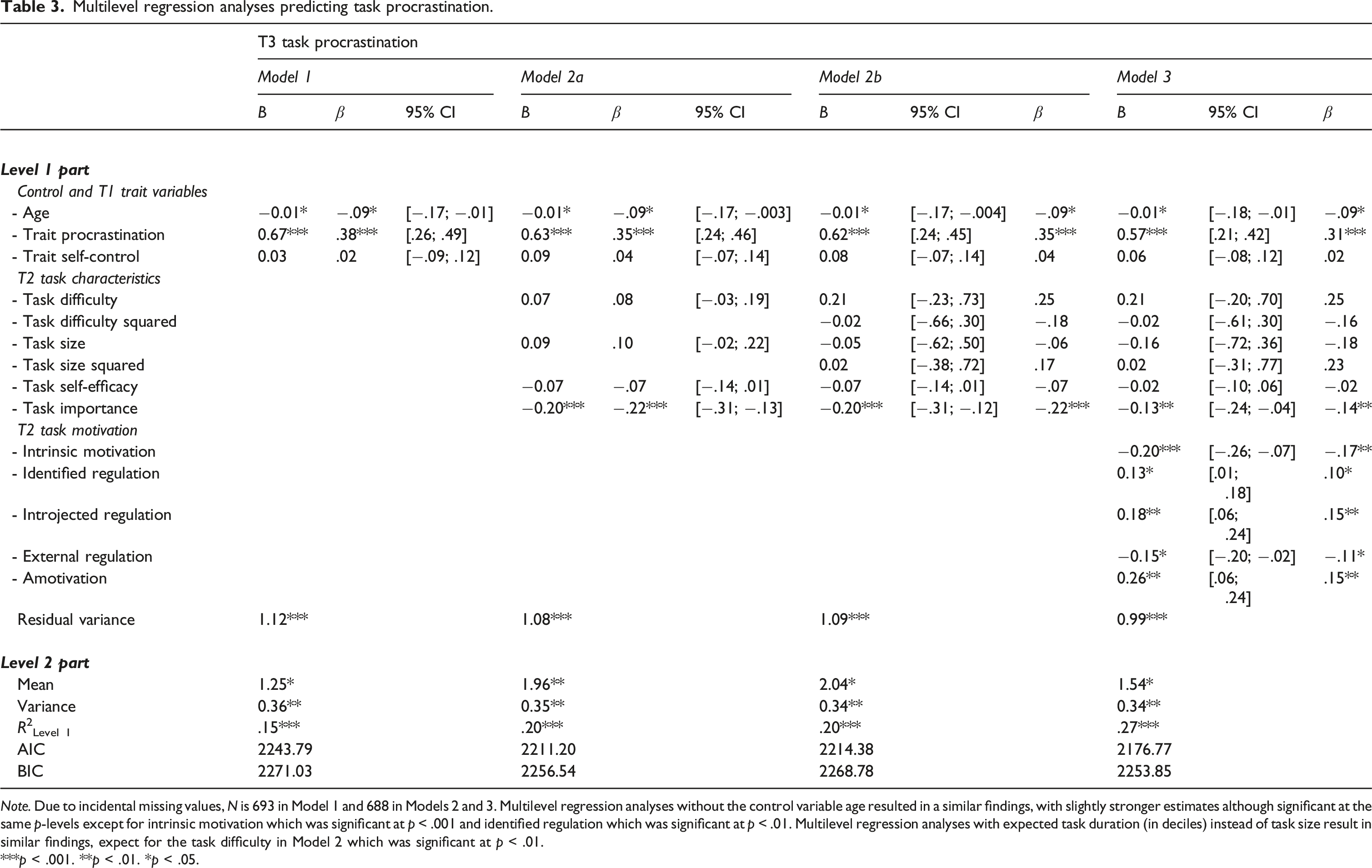
Note. Due to incidental missing values, N is 693 in Model 1 and 688 in Models 2 and 3. Multilevel regression analyses without the control variable age resulted in a similar findings, with slightly stronger estimates although significant at the same p-levels except for intrinsic motivation which was significant at p < .001 and identified regulation which was significant at p < .01. Multilevel regression analyses with expected task duration (in deciles) instead of task size result in similar findings, expect for the task difficulty in Model 2 which was significant at p < .01.
***p < .001. **p < .01. *p < .05.
Regarding the task-related predictors, Model 2a-b in Table 3 present the findings on whether task difficulty, task size, task importance, and task self-efficacy add to the prediction of T3 task procrastination, over and beyond age, trait procrastination, and trait self-control. We reasoned that task difficulty and task size may have a curvilinear relationship with task procrastination. As shown in Model 2b, neither of the quadratic terms were significant. We further reasoned that task self-efficacy and task importance should negatively predict task procrastination. Although the zero-order correlations supported this pattern (i.e., negative correlations for both task self-efficacy, r = −.15, p < .001, 95% CI [−.22; −.07], and task importance, r = −.15, p < .001, 95% CI [−.22; −.08]; Table 2), the multilevel regression (Model 2b) showed that only task importance explained unique variance in task procrastination. Level 1 standardized coefficient (β) for task importance was −.22 (p < .001; 95% CI [−.31; −.12]), indicating that more important tasks are less likely to be procrastinated.
Table 3 further shows that the task motivation variables explained additional variance in T3 task procrastination beyond age, trait procrastination, trait self-control, and the other task characteristics (Model 3). Intrinsic motivation negatively (β = −.17, p = .001; 95% CI [−.26; −.07]) and amotivation positively (β = .15, p = .002; 95% CI [.06; .24]) predicted task procrastination. The three extrinsic motivation types showed a diverging pattern. While external regulation negatively (β = −.11, p = .014; 95% CI [−.20; −.02]), identified regulation (β = .10, p = .033; 95% CI [.01; .18]) and introjected regulation (β = .15, p = .002; 95% CI [.06; .24]) positively predicted task procrastination.
Lastly, adding the interactions of trait self-control with the task motivation variables intrinsic motivation, identified regulation, and introjected regulation showed that only the trait self-control x intrinsic motivation interaction predicted significant additional variance in T3 task procrastination, ΔR2 = .01, Level 1 unstandardized estimate = 0.20, p = .016
5
, 95% CI (0.04; 0.36). Simple slopes analysis (see Figure 3) showed that intrinsic motivation was significantly negatively related to task procrastination for people low (i.e., M−1SD) on trait self-control (unstandardized estimate = −0.29, 95% CI [−0.42; −0.16]), but not significantly related for people high (i.e., M+1SD) on trait self-control (unstandardized estimate = −0.09, 95% CI [−0.22; 0.05]).
6
Interaction between trait self-control and intrinsic task motivation in predicting task procrastination.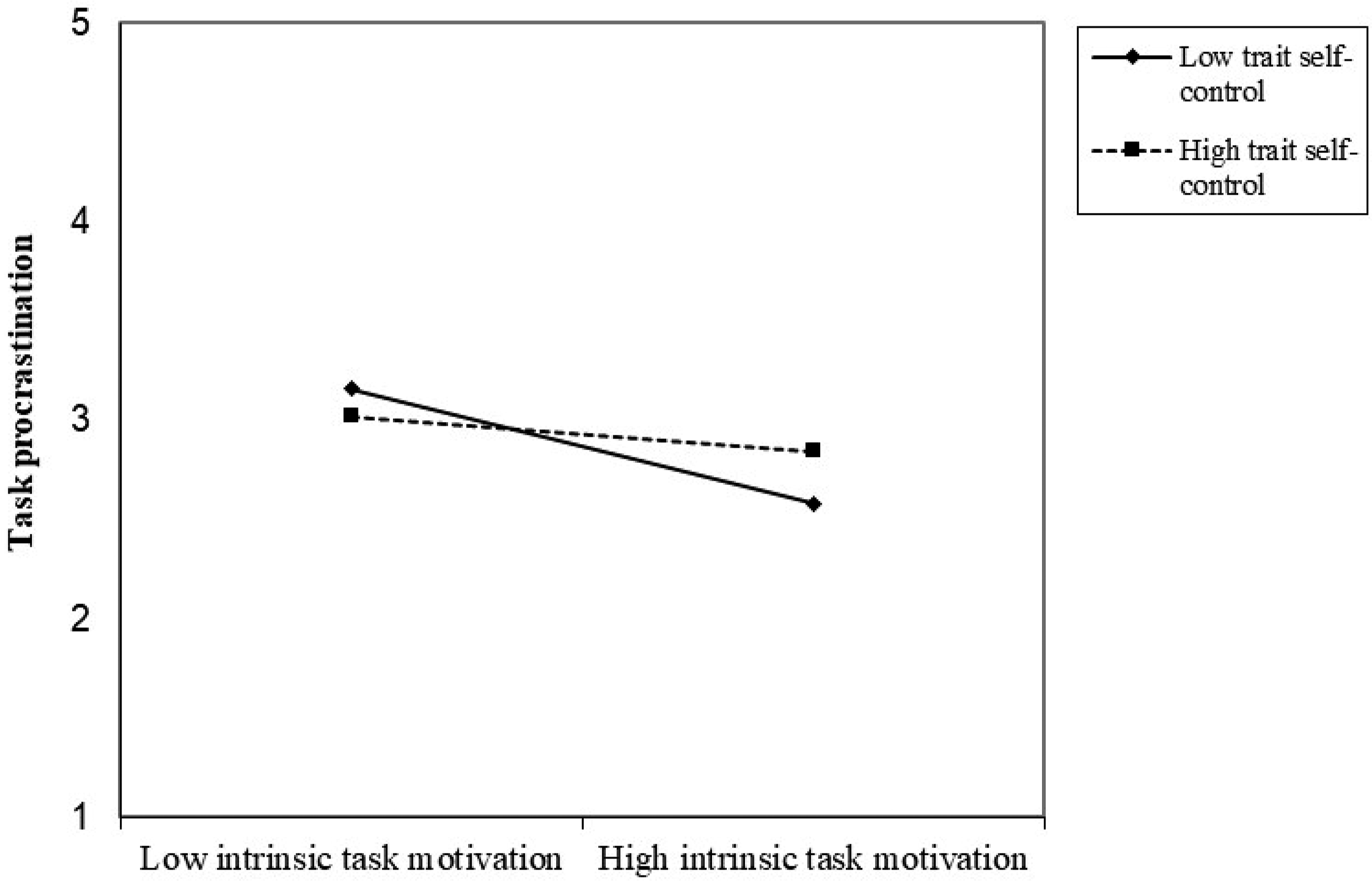
Post-hoc analyses
In addition to T3 task procrastination, we examined if T1 trait procrastination and T1 trait self-control also have shared variance at the household level. Using Mixed Model Analysis in SPSS, we compared two-level intercept-only models with a fixed versus random intercept. For trait procrastination, the random intercept model fitted significantly better, Δχ2(1) = 7.21, p = .007, suggesting that household membership explained significant variance in trait procrastination. The variance in trait procrastination was 0.087 at Level 2 and 0.329 at Level 1, indicating that 20.92% of the variance in trait procrastination is explained by the household level and 79.08% by the individual level. For trait self-control, the random intercept model did not fit better, Δχ2(1) = 2.42, p = .12. Thus, household membership did not explain significant variance in trait self-control.
Next, a multilevel regression with age, trait procrastination, and trait self-control modeled at both Level 1 and 2 as predictors of T3 task procrastination replicated Level 1 findings of Model 1 in Table 3: Age (β = −.15, p = .04) and trait procrastination (β = .32, p < .001) were significant predictors, but trait self-control not (β = .05, p = .58). At Level 2, none of the three predictors was significant (βs of .25, −.02, and −.56, all ps > .41), suggesting that household-level variance in the predictors did not significantly relate to household-level variance in task procrastination.
Discussion
Procrastination is a commonly acknowledged and widely studied phenomenon among students (Klingsieck, 2013; Steel, 2007). The present study demonstrated that procrastination also regularly occurs in the general population, finding that in a representative sample of the Dutch population, most people (i.e., 95.6%) reported to procrastinate tasks every now and then. To explain why people engage in procrastination, we proposed and tested a volitional-task attractiveness framework of personality and task-related antecedents of procrastinatory behavior. Supporting a task-specific, behavioral account of procrastination, findings show that task-related factors (i.e., task importance and task motivation) explained 12% additional variance in procrastinatory behavior, beyond more stable factors such as age and trait procrastination (which explained 15% of the variance). Thus, although some people procrastinate more than others (i.e., those higher on trait procrastination and younger individuals), the present findings indicate that almost everyone occasionally procrastinates, and that task importance and task motivation predict such procrastinatory behavior.
Theoretical implications
Specifying previous research acknowledging that procrastination not only occurs among students but also among adults in everyday life (e.g., Ferrari et al., 2007; Harriott & Ferrari, 1996; Sirois, 2007; Steel & Ferrari, 2013), the present study found that 35.2% of the Dutch population indicated to procrastinate tasks regularly, often, or very often. Furthermore, 12.4% reported to experience procrastination at least as a fairly large problem. These findings suggest that about a third of the general population engages in regular procrastination and over a tenth of the general population suffers from problematic procrastination, illustrating the importance of examining procrastination among adults. The present study further provides insight in the type of tasks that are typically procrastinated in daily life. Extending findings among students (Ferrari & Scher, 2000; Klassen et al., 2008), our qualitative data indicate that people procrastinate mostly on housekeeping tasks, jobs in and around the house, social tasks, and administrative tasks.
The present study contributes to the procrastination literature by proposing and testing a volitional-task attractiveness framework to outline the personal and task-related factors that explain procrastinatory behavior in everyday life. Supporting the role of personality, the findings show that trait procrastination is an important predictor of actual task procrastination. Consistent with previous research among students (e.g., Ferrari, 1992; Ferrari & Tice, 2000; Lay, 1986, 1990; Schouwenburg, 1992; Tice & Baumeister, 1997) and (unemployed) adults (Ferrari, 1993; Lay & Brokenshire, 1997; Van Hooft, 2014), trait procrastination explained 9.6%–14.4% of unique variance in task procrastination. Although trait self-control was significantly negatively correlated with task procrastination, it did not explain unique variance, probably because of its strong relation with trait procrastination. Nevertheless, these findings corroborate the idea that procrastination is partly attributable to relatively stable individual differences (cf. Steel, 2007). Interestingly, we found that 24.69% of the variance in task procrastination resided at the household level. This may be indicative of a genetic component (cf. Gustavson et al., 2014) or household factors that induce procrastination similarly among household members. Post-hoc analyses, however, suggested that household-level variance in trait procrastination and self-control did not predict household-level variance in task procrastination. Therefore, an interesting avenue for future research is to identify and disentangle genetic and situational household factors that predict procrastinatory behavior.
Notwithstanding the validity of the trait perspective of procrastination, the present findings indicate that task-related factors explain 12% additional variance in procrastinatory behavior beyond personal factors. These findings support our volitional-task attractiveness framework and extend previous theoretical and qualitative work on task factors that induce procrastination in work (Harris & Sutton, 1983) and academic settings (Grunschel et al., 2013; Klingsieck et al., 2013; Paden & Stell, 1997; Patzrek et al., 2012; Schraw et al., 2007). The present study examined various indicators of task attractiveness in predicting task procrastination. Specifically, in contrast to qualitative research among students (Grunschel et al., 2013; Klingsieck et al., 2013; Schraw et al., 2007), task difficulty and task size did not explain unique variance in task procrastination, neither in a linear nor in a curvilinear fashion. Our null-findings suggest either that task difficulty and size are unimportant in explaining task procrastination in everyday life or that the role of task difficulty and size may depend on other person-related (e.g., conscientiousness and self-efficacy) or task-related factors (e.g., availability of subgoals), which future research could explore. For task self-efficacy, consistent with TMT (Steel, 2007), our findings show a negative correlation with task procrastination. However, task self-efficacy failed to predict unique variance in task procrastination. Potentially, task self-efficacy emerged as a less important predictor of everyday procrastination in our study because most respondents identified tasks relatively high on self-efficacy (i.e., M = 5.85 on a 7-point scale). Our findings support the role of task importance in predicting task procrastination, such that tasks rated as more important were less likely procrastinated. Future research needs to establish which aspects underlie the evaluation of task importance (e.g., urgency and rewards) in predicting task procrastination.
Further, the present study contributes to the literature by uncovering the nuanced role of task motivation in predicting task procrastination, with intrinsic motivation and external regulation being negative predictors, and identified regulation, introjected regulation, and amotivation being positive predictors. These findings have implications for SDT (Deci & Ryan, 2000), which poses that more self-determined motivation leads to higher persistence and quality of behavioral engagement. Prior research on procrastination among students supported SDT by showing negative relations between a composite measure of self-determined motivation and procrastination (Katz et al., 2014; Senécal et al., 2003; Senécal & Guay, 2000). Our findings suggest that a more fine-grained operationalization of task motivation is needed (rather than using a composite measure) to understand the role of the various motivation types distinguished in SDT for task procrastination. That is, not only inherently enjoyable tasks (i.e., intrinsic motivation) but also tasks with contingent consequences (e.g., rewards) imposed by others (i.e., external regulation) are less likely procrastinated. This finding can be explained by considering that procrastination is a self-regulatory failure (Steel, 2007), and that both such tasks rely less on self-regulation, although in different ways. Intrinsically motivated tasks with a valued outcome do not rely on self-regulation because these are inherently enjoyable and do not impose a conflict between short-term benefits and long-term costs or vice versa (Sansone & Thoman, 2006; Van Hooft & Kreemers, 2022). External regulation tasks do represent a delayed-benefit dilemma, but our findings imply that self-regulation is less needed because task engagement is regulated by others. In contrast, for tasks high on identified/introjected regulation, such regulation by others is absent, making these tasks vulnerable for procrastination because these involve a delayed-benefit dilemma. Importantly, our findings extend procrastination research by showing the importance of distinguishing between several types of task motivation.
Lastly, our volitional-task attractiveness framework posed that self-control ability and task motivation may interact in predicting task procrastination. Some support was found as intrinsic motivation related less strongly to task procrastination for people high rather than low on trait self-control. This suggests that trait self-control may buffer the harmful role of low intrinsic motivation for task procrastination, such that it provides volitional ability to counter task unattractiveness and engage in the task to attain the valued task outcomes. However, no support was found for the proposed moderating role of self-control ability in the relationships of identified and introjected regulation with task procrastination. Future research could explore the moderating role of state self-control, because the ability for self-control fluctuates over time (e.g., Millar, 2017). Also, future research may explore whether more specific self-control skills (e.g., reminding oneself of the valued outcome; maintenance actions to increase interest; and forming implementation intentions) may attenuate the positive role of identified and introjected regulation in predicting task procrastination.
Limitations
The present study explored the predictors of task procrastination in a representative sample of the general population in the Netherlands. The current sample contributes to the procrastination literature, which has mostly focused on student procrastination (Klingsieck, 2013), by providing representative prevalence rates of procrastination in everyday life as well as its personal and task-related predictors. However, as previous research showed country differences in procrastination levels (Ferrari et al., 2007; Steel & Ferrari, 2013), future (confirmatory) research needs to examine the generalizability to other countries and cultures. A further limitation is sample attrition, which is common in multi-wave studies. Attrition was unrelated to T1 model variables (trait procrastination, trait self-control) or demographics, except education level. Because higher educated individuals were slightly overrepresented and the possibility that other, unobserved attributes may have differed between participants and non-participants, some caution is warranted in generalizing our findings.
To operationalize task procrastination, participants were asked to describe a task that they were thinking about or planning to perform in the weeks of Christmas and New Year. While this design using a self-chosen task in actual life (rather than an assigned task in a lab setting) increases the ecological validity, it implied reliance on self-reports. Such self-reports may be vulnerable to social desirability responding and common method variance. To minimize such biases, we stressed to participants that their answers would be treated anonymously and used for research purposes only, used different response scales, and temporally separated measurements of personality factors, task-related factors, and task procrastination. Furthermore, procrastination inherently is an intra-individual appraisal (Klingsieck, 2013; Van Eerde, 2000), implying that in field studies the use of self-reports is needed to accurately assess task procrastination (rather than task delay). Some validity evidence was found for our measures of task size and task procrastination, as these related to more objective measures. Also the finding that not all variables were (strongly) correlated suggests that common method variance did not play a large role in explaining our findings. In addition, because of our correlational design, causal conclusions can only be drawn on based theoretical grounds rather than on our empirical findings. To address these issues, future studies experimentally manipulating task characteristics and assessing task procrastination in a controlled setting (e.g., Ferrari & Tice, 2000) may be a fruitful avenue to examine the causal influence of task factors.
Finally, our findings are based on one task that people plan to perform around Christmas/New Year. Although this allowed for a controlled task period and standardized spacing of the measures, these tasks might not be representative of tasks that people conduct throughout the year. For example, people may have selected tasks they did not had time for in other periods. Also, this design did not allow for examining multiple tasks per person or tracking task behavior over time. Future research using other periods in the year and research designs with multiple tasks and/or repeated measures are useful to test the generalizability of our findings and further examine the unique contribution of person-level and task-level components in predicting task procrastination.
Practical implications and conclusion
As previous research demonstrated that procrastination has negative effects for well-being and performance, it is important to reduce task procrastination. Based on the present findings, a first recommendation would be to boost intrinsic task motivation, for example, by using interest-enhancing strategies (cf. Sansone & Thoman, 2006). Depending on people’s preferences and the specifics of the task, one can make a task more interesting or fun, for example, by cognitively focusing on the interesting aspects of the task, creating a pleasant task environment (e.g., music), or incorporating a social element in the task (e.g., doing it with friends). Second, because in its core procrastination is a self-regulatory failure (Steel, 2007) and given that the ability and motivation to exercise self-regulation fluctuates during the day (e.g., Millar, 2017), it is advisable to schedule tasks that are low on intrinsic motivation but need to be done at times when self-control is high (e.g., not when being tired in the evening or not when it conflicts with other tasks). A third strategy could be to circumvent the need for self-regulation, for example, by building the task into a routine (e.g., Dietz et al., 2007), forming implementation intentions (e.g., Owens et al., 2008), or involve others to increase external regulation (e.g., make commitments and set deadlines with an important other).
In conclusion, procrastination is a common phenomenon not only for students but also in the general population. Supporting the proposed volitional-task attractiveness framework, task procrastination depends on a combination of personality factors and task characteristics, such as task importance and task motivation. By focusing on actual task procrastination in daily life, this study unraveled the complex role of task motivation, showing that not only intrinsic motivation but also external regulation reduces procrastination. These findings contribute to theory on motivation, self-regulation, and procrastination and offer practical directions to reduce procrastination.
Footnotes
Declaration of conflicting interests
The author(s) declared no potential conflicts of interest with respect to the research, authorship, and/or publication of this article.
Funding
The author(s) disclosed receipt of the following financial support for the research, authorship, and/or publication of this article: This study was supported by a grant (Nr. 451.06.003) from the Netherlands Organization for Scientific Research (NWO).
