




Abstract
Personality development from emerging adulthood onwards is marked by traits becoming more socially desirable. However, little research exists on developmental trends of so-called dark personality traits. Moreover, the current understanding of longitudinal trends and associations with mental health remains unclear. Addressing this gap, the present study analyzed average (mean-level) changes of the dark triad traits (Machiavellianism, psychopathy, and narcissism) in three birth cohorts over a 4-year period spanning emerging adulthood to midlife, as well as their concurrent and longitudinal associations with depressiveness. We used three data waves, each 2 years apart, from the German Family Panel (pairfam) to perform growth curve models. The final sample included N = 5,127 participants ranging from 22 to 46 years (Mage at T1 = 34.59). Results indicated a significant linear downward trend for Machiavellianism and for psychopathy but no linear change in narcissism. All dark triad traits had moderate positive correlations with depressiveness, and changes in these traits showed moderate to strong correlations with changes in depressiveness. Overall, the findings suggest that from emerging adulthood into midlife, individuals high in Machiavellianism and psychopathy develop towards greater social desirability.
Plain language summary
The present study investigated how certain negative personality traits, known as the “dark triad” — Machiavellianism, psychopathy, and narcissism — change as people grow older. While it is well-known that people generally become more socially desirable in their traits as they move from young adulthood to middle age, less is known about how these dark traits change over time. We analyzed data from over 5,000 people aged 22 to 46, collected over four years. It was observed that both Machiavellianism and psychopathy decreased as people aged, but narcissism stayed about the same. The study also found that people with higher levels of these dark traits tended to experience more depressiveness. As their dark traits decreased, their depressiveness often improved too. Overall, the findings suggest that people with these traits tend to become more socially desirable as they age.
Personality development is a key topic in personality psychology (Roberts et al., 2006). However, research so far has often focused on the development of major trait models such as the Big Five thereby neglecting stability and change of malicious traits such as the dark triad traits: Machiavellianism, psychopathy, and narcissism (Paulhus & Williams, 2002). Individuals high in Machiavellianism tend to manipulate and exploit others (Christie & Geis, 1970; Jakobwitz & Egan, 2006), while individuals high in psychopathy are impulsive and show limited empathy or remorse (Hare & Neumann, 2008). Narcissism in turn is characterized by a sense of superiority and grandiosity (Raskin & Hall, 1979). Despite the significant research interest in age differences in these traits, it is important to note that most studies to date have relied on cross-sectional data (e.g., Kawamoto et al., 2020). In addition, previous research has strongly focused on studying interpersonal effects of the dark triad traits. For example, there is ample evidence showing the detrimental impacts of the dark triad traits on the well-being of others (e.g., Rauthmann & Kolar, 2012), whereas the impact of dark triad traits on one’s own well-being has received relatively few attention.
The current study analyzed the development of the dark triad traits using longitudinal data from three birth cohorts covering the period from emerging adulthood to midlife. Furthermore, we examined the codevelopment of the dark triad traits with depressiveness. Here, we show that stability and change of the dark triad traits and depressiveness are consistently related, reflecting possible pathways of socially desirable personality development.
Development of the dark triad traits
In line with Gordon Allport’s (1961) conception, personality development in young adulthood tends to proceed according to the maturity principle (Roberts & Nickel, 2017). This means that as a person gets older, their personality traits change to become more reliable and responsible, both for themselves and for others (Hogan & Roberts, 2004; Specht et al., 2014). This developmental trend is consistent with the social investment theory (Roberts et al., 2005), which posits that transitions into new age-graded social roles, such as starting a family or entering the workforce, can promote increasing personality maturation in adulthood (Roberts & Nickel, 2017).
The maturity principle, however, has been subject to criticism (Klimstra & McLean, 2024). First, it has a strongly evaluative connotation and defines maturity in terms of socially desirable trait expressions, ignoring the fact that socially undesirable traits can also be adaptive in specific niches or contexts, as it has been discussed for the so-called dark personality traits (Jonason et al., 2016). Second, the maturity principle implies a quasi-healthy and irreversible endpoint of personality development, which cannot be empirically verified. For example, research shows that emotional stability, conscientiousness, and agreeableness significantly increase during young adulthood. However, in middle and later adulthood, opposing trends can sometimes emerge that do not align with the maturity principle (Bleidorn et al., 2022; Kandler et al., 2015; Seifert et al., 2024). For these reasons, we avoid describing personality development in young adulthood strictly according to the so-called maturity principle or evaluating personality profiles by categorizing them as inherently “good” or “bad” (see Klimstra & McLean, 2024). Instead, we view these processes as socially desirable developments and use the terms “maturation” or “maturity principle” in a descriptive rather than prescriptive manner, similar to the term “dark.”
The trajectories described within the context of maturation represent normative patterns, but individuals can deviate from them. Nevertheless, studies have consistently shown that on average, personality traits such as conscientiousness, agreeableness, and emotional stability increase from emerging adulthood into middle age (e.g., Damian et al., 2019; Schwaba et al., 2022; for meta-analyses, see Bleidorn et al., 2022; Roberts et al., 2006).
Applying the aforementioned developmental processes to change in dark personality traits, it is reasonable to expect a general decrease in the dark triad traits from emerging adulthood onwards. For example, the dark triad traits are mainly negatively correlated with socially desirable traits like agreeableness and, with the exception of narcissism, also with conscientiousness. However, they are uncorrelated with emotional stability (e.g., Muris et al., 2017; O'Boyle et al., 2015; Vize et al., 2018). As socially desirable traits increase, socially aversive traits, characterized by tendencies such as prioritizing personal interests at the expense of others (Jonason et al., 2009), should decrease. Most studies so far have analyzed age differences in the dark triad traits using cross-sectional data or have focused on more specific malicious traits like callous affect, manipulation, or egocentricity. Those studies in general found higher levels in these traits in younger compared to older people (e.g., Götz et al., 2020; Klimstra et al., 2020). For instance, mean-levels in Machiavellianism were shown to peak during the transition from late childhood to adolescence and steadily decreased throughout adulthood, reaching its lowest point at age 65. This pattern was observed to closely parallel the inverse trends found in agreeableness and to a lower degree those found in conscientiousness (Götz et al., 2020). To date, there are only few longitudinal studies showing developmental trajectories of the dark triad traits towards greater social desirability (e.g., Grosz et al., 2019; Wetzel et al., 2020; Zettler et al., 2021). However, these studies mainly relied on selective samples assessed over short time intervals with only two measurement points. The present study addresses these limitations by comparing the development of dark triad traits in three birth cohorts within a large and representative sample over three measurement occasions, spanning from emerging adulthood to midlife.
Age and gender differences in dark triad development
The development of dark triad traits may vary significantly based on age and gender. Evidence suggests that personality traits like the Big Five show a greater degree of change during young adulthood compared to middle adulthood (Bleidorn et al., 2022; Roberts et al., 2006). A comparable effect on the dark triad traits is likely, as suggested by the study conducted by Zettler et al. (2021), revealing a less pronounced decline in some dark traits with increasing age in individuals aged 18 to approximately 45 years.
Findings from a meta-analysis indicate that men on average report higher levels on all dark triad traits compared to women (Muris et al., 2017). Research on gender differences in personality development mostly exists for major trait models such as the Big Five and suggests that men and women exhibit similar patterns of mean-level change (e.g., Roberts et al., 2006). However, only few studies investigated gender differences in the development of the dark triad traits. For instance, in a study by Zettler et al. (2021) that spanned 4 years including individuals aged 18–65 years, men exhibited a more pronounced decrease in narcissism compared to women, but no differences were found for Machiavellianism and psychopathy. Another study examining the development of narcissism over a 23-year period from emerging adulthood to midlife indicated that gender did not moderate change over time (Wetzel et al., 2020). In sum, the overall pattern of gender differences in the development of dark triad traits remains inconsistent, calling for more longitudinal research based on non-selective population samples.
Codevelopment of the dark triad traits with depressiveness
Heightened levels of dark personality traits are often associated with interpersonal difficulties (e.g., Muris et al., 2017). Not surprisingly, previous research has focused on the effects that the dark triad traits have on other people. However, it is important to note that the dark triad traits can also have negative consequences for individuals themselves, such as experiencing increased negative affect (e.g., Jonason & Jackson, 2016; Pilch, 2020), even though evidence remains less clear to date. In the present study, we focused on depressiveness as a disposition towards experiencing negative affect. Theoretical considerations suggest either negative or positive relationships between depressiveness and each of the dark triad traits, but empirical studies have yielded inconsistent results.
On the one hand, Lovelace and Gannon (1999), for example, postulated a negative relationship between psychopathy and depressiveness based on differential activation of the behavioral inhibition system. Psychopathy is characterized by reduced behavioral inhibition (i.e., low sensitivity to potential aversive stimuli), while depressiveness is associated with increased behavioral inhibition (i.e., heightened sensitivity to potential aversive stimuli), making them mutually exclusive. In line with these considerations, a study involving male inmates revealed, for instance, that individuals scoring high on the affective and lifestyle facets of psychopathy utilized fewer sadness words when describing a depressive episode. The authors concluded that individuals vary in how they experience depressive episodes based on their level of psychopathy (Willemsen et al., 2011). Moreover, the dark triad traits, particularly psychopathy, might serve as a protective factor against emotional distress (e.g., Međedović et al., 2018). Stress immunity and fearlessness are indeed core features of psychopathy and are negatively related to depressive symptoms (Yildirim & Derksen, 2015).
On the other hand, some recent studies have reported evidence in the opposite direction, indicating positive relationships between Machiavellianism or psychopathy and depressiveness (Gogola et al., 2021; Gómez-Leal et al., 2019; Love & Holder, 2014; Lyons et al., 2019; Shih et al., 2021; Šram, 2017). These findings raise several possible explanations for why such positive relationships may exist. First, the dark triad traits have been linked with emotion regulation difficulties (e.g., Shen, 2022; Zeigler-Hill & Vonk, 2015). The use of maladaptive emotion regulation strategies, for example, was shown to predict higher levels of depressiveness (Mojsa-Kaja et al., 2021; Shen, 2022). Second, individuals with high dark triad traits scores often face more interpersonal difficulties (Muris et al., 2017). This could stem from tendencies such as manipulation, deception, or exploitation, common in Machiavellianism (Jakobwitz & Egan, 2006), or from low empathy and antisocial behavior, typical of psychopathy (Ali et al., 2009; Hare & Neumann, 2008). Such behaviors may elicit negative responses from others, resulting in increased negative affect and depressiveness in individuals with high levels in these traits (Shih et al., 2021).
With regard to narcissism, the relationship with depressiveness could be even more complex. On the one hand, narcissism is characterized by a grandiose self, which may be adaptive against negative emotions (Shih et al., 2021), and previous research has indeed demonstrated that narcissism is associated with increased psychological well-being (Aghababaei & Błachnio, 2015) and lower levels of depressiveness (Bonfá-Araujo et al., 2021; Lyons et al., 2019; Shih et al., 2021). It also fits well that people with higher narcissism tend to exhibit greater mental toughness and rarely show depressive symptoms (Papageorgiou et al., 2019; Truhan et al., 2022). On the other hand, a more differentiated perspective on narcissism shows that adaptive and maladaptive aspects can be discerned. For example, Back et al. (2013) distinguished between narcissistic admiration and narcissistic rivalry. These two forms may exert distinct effects on depressiveness. In particular, when narcissists devalue others in a rivalrous manner, they may face social rejection in the long-term (Back et al., 2013), which is often linked to negative affect (e.g., Chester et al., 2017). Admiration, conversely, leads to positive impressions on other people in the short-term (Back et al., 2013). Considering stressful relationships as a risk for mental health outcomes (e.g., Umberson et al., 2010), admiration might serve as a protective factor against depressiveness, whereas rivalry might contribute to depressiveness. A few studies have indeed found negative associations between narcissistic admiration and depressiveness, while showing positive associations between narcissistic rivalry and depressiveness (Fang et al., 2021; Mota et al., 2019; Richter et al., 2023); nonetheless, evidence is limited.
Overall, previous research suggests that Machiavellianism and psychopathy tend to be positively associated with depressiveness, while general narcissism is predominantly negatively associated with depressiveness. However, the inconsistent links between the dark triad traits and depressiveness in past studies highlight the need for replicating these results with a large and representative sample.
To the best of our knowledge, no prior study has examined longitudinal associations between the dark triad traits and depressiveness. It is plausible that both characteristics codevelop in accordance with a trend of increasing social desirability. For example, Schwaba et al. (2022) found a decrease in depressiveness from emerging adulthood to midlife, and it is reasonable to expect that this developmental trend goes hand in hand with decreases in the dark triad traits. We posit that the development towards greater social desirability during emerging adulthood and beyond could serve as a shared factor affecting the codevelopment of dark triad traits and depressiveness. However, as for cross-sectional correlations, codevelopment of narcissism with depressiveness might differ from the other dark triad traits. Specifically, a decrease in narcissism diminishes the protective effect that a grandiose self provides against negative emotions (Shih et al., 2021), potentially mitigating the decrease in depressiveness. Therefore, we assume that a decrease in narcissism is associated with a weaker or no decrease in depressiveness.
The present study
The goal of this preregistered study was to delineate the developmental trajectories of the dark triad traits and their concurrent and longitudinal associations with depressiveness. We used longitudinal data from a large and nationally representative study from three birth cohorts covering the period from emerging adulthood to midlife.
First, we examined age and gender differences. Based on previous studies, we expected lower levels in the dark triad traits with increasing age (H1.1) and among women (H1.2).
Second, we examined the average (i.e., mean-level) change of the dark triad traits over a period of 4 years, with data collected at three measurement occasions. Consistent with past findings demonstrating a development towards greater social desirability (Grosz et al., 2019; Klimstra et al., 2020; Zettler et al., 2021), we expected that all dark triad traits would show a decline from emerging adulthood onwards (H2.1). Moreover, we assumed a weaker decrease in the dark triad traits with increasing age (H2.2). We also explored possible gender differences in the development of the dark triad traits. With regard to ceiling effects (e.g., Hoff et al., 2020; Zhu & Shek, 2021), we assumed that individuals with higher initial levels of the dark triad traits would have less room for an increase and would therefore exhibit a decrease in these traits over time (negative correlations; H2.3).
Third, we investigated both cross-sectional and longitudinal correlations between the dark triad traits and depressiveness. With regard to cross-sectional correlations, we expected positive associations between Machiavellianism or psychopathy and depressiveness and a negative association between narcissism and depressiveness (H3).
In terms of longitudinal correlations, we expected stronger decreases in Machiavellianism or psychopathy to be accompanied with stronger decreases in depressiveness (positive correlations) and stronger decreases in narcissism to be accompanied with weaker or no decreases in depressiveness (negative correlations; H4.1). Based on the logic of ceiling and floor effects (e.g., Hoff et al., 2020; Zhu & Shek, 2021), we expected that higher initial levels of Machiavellianism and psychopathy would correspond to a greater potential for a reduction in depressiveness, thus showing a more pronounced decrease over time (negative correlations). Conversely, individuals with higher initial levels of narcissism would have less potential for a decrease in depressiveness, resulting in a weaker or no decrease in depressiveness over time (positive correlations; H4.2).
Finally, drawing from evidence highlighting the unique interpersonal dynamics of narcissism (e.g., Back et al., 2013), we conducted a nuanced examination of this trait. Specifically, we separately explored the facets of narcissistic admiration and narcissistic rivalry (Back et al., 2013) in relation to depressiveness. This involved examining cross-sectional and longitudinal correlations of narcissistic admiration and narcissistic rivalry with depressiveness. However, given the restricted nature of existing literature, we carried out these supplemental (i.e., not preregistered) analyses with an exploratory approach.
Method
Data and procedure
Analyses are based on data of the German Family Panel (pairfam), release 13.0 (Brüderl et al., 2022), a nationally representative study including over 12,000 people. Individuals were randomly drawn from population registers, evenly representing three birth cohorts: 1971–73, 1981–83, and 1991–93. This panel offers extensive long-term data to address research questions related to partnership and family dynamics in Germany. Data collection began in 2008 and up until the present study, encompassed 13 waves of data. Annual surveys were conducted through computer-assisted personal interviews (CAPI) and self-administered computer-based assessments (CASI). Participants provided informed consent prior to participation and were compensated with 10 euros for each annual interview. A detailed description of the pairfam study can be found in Huinink et al. (2011) and on the website https://www.pairfam.de.
Sample
For the purpose of the present analyses, all survey waves that captured the dark triad traits, namely, wave 9 (N = 5,127), wave 11 (N = 9,435), and wave 13 (N = 2,351), each 2 years apart, were used. Participants who did not provide data in wave 9 were excluded. The overall sample included N = 5,127 participants with a mean age of 34.59 years (SD = 8.28), comprising 54% women at wave 9. Of those who participated in wave 9, approximately 84% (n = 4,305 participants) also took part in wave 11 and approximately 29% (n = 1,479 participants) took part in both wave 11 and wave 13. Due to possible attrition effects, we compared the 1,479 participants who took part in all three waves with those who did not participate in all waves. Analyses indicated that participants did not significantly differ in Machiavellianism (t(5086) = 0.39, p = .698, d = 0.01), psychopathy (t(5084) = −0.71, p = .475, d = −0.02), or narcissism (t(5081) = 0.78, p = .438, d = 0.02) at wave 9. Participants who missed at least one study wave reported significantly higher depressiveness than those who participated in all waves (t(5110) = 3.17, p = .002, d = 0.10), though the effect size was negligible. Compliance with ethical standards for German social research and data protection laws was followed throughout data collection and preparation of pairfam (German Research Foundation, Register Number NE633/10-3).
Measures
Dark triad traits
Machiavellianism and psychopathy were assessed using three items from the German version of the Dirty Dozen (DD; Jonason & Webster, 2010; Küfner et al., 2015). The original version of the DD comprises three scales with four items each to measure the dark triad traits. In the current study, however, the scales consisted of three items: “I tend to manipulate others to get my way.”, “I have used deceit or lied to get my way.” and “I have used flattery to get my way.” for Machiavellianism and “I tend to lack remorse.”, “I tend to not be too concerned with the morality of my actions.” and “I tend to be callous or insensitive.” for psychopathy. These 3-item scales were validated and are referred to as the “Naughty Nine” (Küfner et al., 2015). This version demonstrates adequate convergent validity concerning standard instruments assessing the dark triad traits. Correlations with external outcomes in the nomological network align with previous findings and are similar to those of the 4-item version, such as with aggressiveness, deception of others, and the Big Five (Küfner et al., 2015). Participants provided their responses using a 5-point Likert-type scale (1 = not at all to 5 = absolutely). Internal consistencies across the three study waves ranged from α = .72–.73 for Machiavellianism and α = .64–.65 for psychopathy in the current sample.
Means and standard deviations of the dark triad traits and depressiveness.
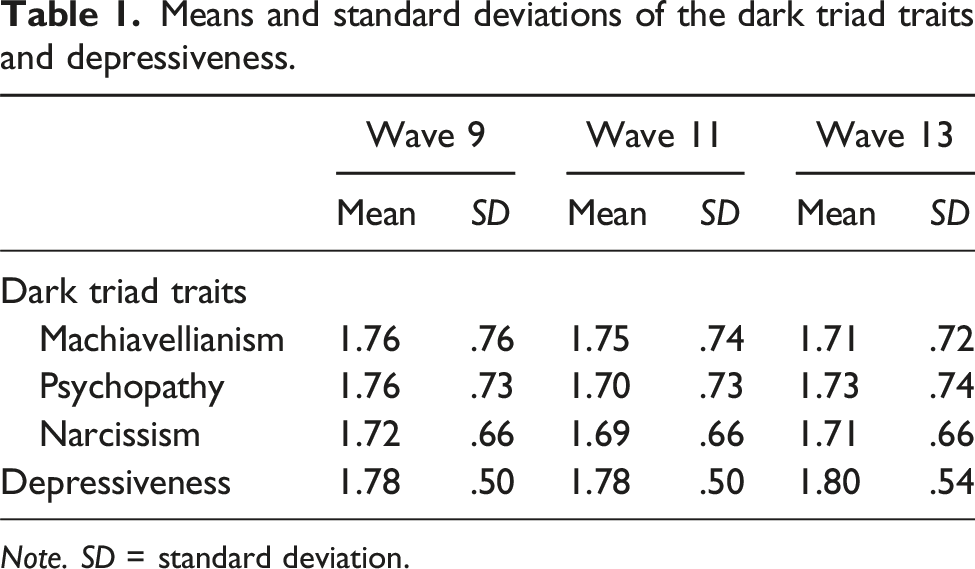
Note. SD = standard deviation.
Depressiveness
Depressiveness was measured with ten items of the State-Trait Depression Scales (STDS; Spaderna et al., 2002). These items assessed trait depressiveness and were divided into two 5-item subscales capturing the presence of negative affect (dysthymia, e.g., “I am depressed.”) and the absence of positive affect (euthymia, e.g., “I am happy.”, reversed). For the present analyses, the total scale for trait depressiveness was used. Internal consistencies in the current sample were high across all study waves ranging from α = .90–.91. Responses to the items were given on a 4-point Likert-type scale ranging from 1 (almost never) to 4 (almost always). Reversed items were recoded so that higher scores indicated less positive affect. Table 1 reports the means and standard deviations of depressiveness at each study wave.
Demographic variables
Age at the first study wave and gender were used as covariates in our analyses. Given the cohort approach underlying the pairfam data, age was treated categorically for our analyses covering the age groups 22–26 years, 32–36 years, and 42–46 years. We referred to these groups as emerging adulthood (commonly defined from 18 to 25 years; Arnett, 2000), established adulthood (commonly defined from 30 to 45 years; Mehta et al., 2020), and middle adulthood (commonly defined from 40 to 60 years; e.g., Infurna et al., 2020). In the original dataset, male gender was coded with 1 and female gender was coded with 2.
Preliminary analyses
Although the “Naughty Nine” represents a validated measure of the dark triad traits (Küfner et al., 2015), the short scales that were used to assess Machiavellianism and psychopathy were additionally validated. For this purpose, we reanalyzed a dataset from Vize et al. (2019), as this dataset captured the dark triad traits through a wide range of items. To this end, we conducted two confirmatory factor analyses (CFAs) with the items of the current sample, one with the three items for Machiavellianism and the other with the three items for psychopathy. Additionally, we conducted two CFA models using the items from the dataset by Vize et al. (2019). One model included items measuring Machiavellianism, comprising all items from the Machiavellianism Inventory-Version IV (MACH-IV; 20 items; Christie & Geis, 1970) and the Short DT (SD3; 9 items; Jones & Paulhus, 2014). The other model encompassed items measuring psychopathy, including all items from the Self-Report Psychopathy Scale (SRP-III; 64 items; Williams & Paulhus, 2004), and the SD3 (Jones & Paulhus, 2014). We extracted the factor scores from these models and examined the correlations between the factor scores for Machiavellianism and psychopathy. In addition, akin to Küfner et al.’s (2015) study, we examined correlations of the two short scales measuring Machiavellianism and psychopathy with the Big Five traits within their nomological network. Using the pairfam data, we conducted CFA models for each of the Big Five traits (short version of the Big Five Inventory, BFI-K; Rammstedt & John, 2005), along with CFA models for the short scales and subsequently correlated the factor scores. Since waves 9, 11, and 13 do not include the Big Five traits, we used data from the refreshment sample from wave 11, which encompasses the Big Five traits and the dark triad traits at the same time (N = 5021, Mage = 24.03, SD = 8.47, 52% women). This sample is representative of the original cohorts and was obtained using the same recruitment methods as the main samples of pairfam.
To ensure that the items maintain consistent meaning and scaling across the different study waves, we examined longitudinal measurement invariance for the dark triad traits and for depressiveness. This was achieved by testing configural, metric, and scalar invariance across the three measurement occasions. Specifically, unconstrained confirmatory factor models were compared against a series of nested models that imposed equality constraints on the factor loadings and on the intercepts. In the scalar invariance model, identification of latent mean structure was employed using effects coding. We also investigated measurement invariance across age groups and across gender using the same procedures as for longitudinal measurement invariance. For the comparison of invariance models, we evaluated changes in fit statistics (with ∆RMSEA of
Statistical analyses
Assuming that longitudinal scalar measurement invariance was established, we proceeded to fit bivariate second-order latent growth curve models (Meredith & Tisak, 1990; Preacher et al., 2008) to examine the relationships between Machiavellianism, psychopathy, narcissism, and depressiveness over time. Figure 1 illustrates the model, employing Machiavellianism and depressiveness as an example. First, we tested for age and gender differences in the baseline levels of the dark triad traits by regressing age at baseline and gender on the intercept variables. Regarding age, we created three contrast variables expressing the comparisons between emerging adulthood and established adulthood, established adulthood and middle adulthood, and emerging adulthood and middle adulthood. Positive coefficients would indicate higher baseline levels of the dark triad traits in the respective younger group. Gender was dummy coded with male coded as 0 and female coded as 1. Positive coefficients would indicate higher levels of the dark triad traits in women compared to men. Bivariate Second-Order Latent Growth Curve Model for Machiavellianism and Depressiveness. Note. The illustrated model was used for estimating linear mean-level change, age and gender differences in baseline level and in mean-level change, cross-sectional (correlation InterceptMach ↔ InterceptDepr), intercept–slope (correlation InterceptMach ↔ SlopeDepr and correlation InterceptDepr ↔ SlopeMach), and longitudinal (correlation SlopeMach ↔ SlopeDepr) correlations. For brevity, only three out of ten items are plotted for depressiveness. Equivalent models were estimated for psychopathy and narcissism, respectively, in relation to depressiveness.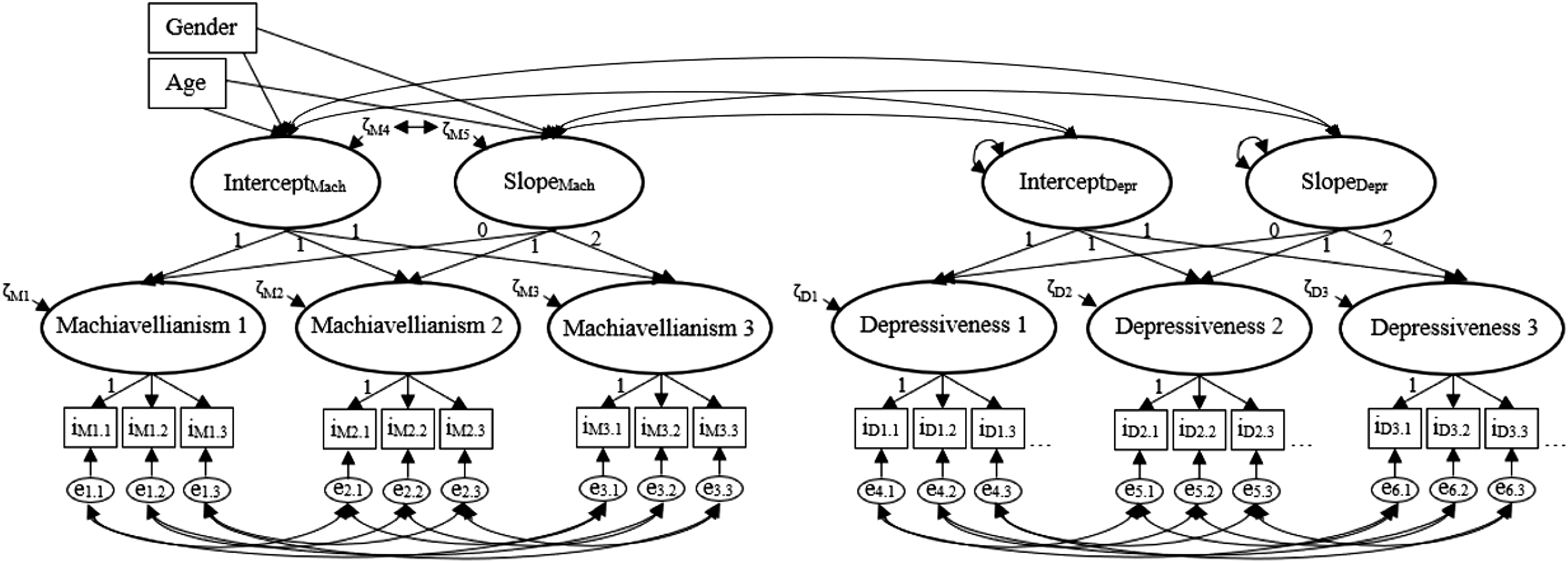
To analyze linear mean-level change, we examined the average slope variables. A negative value would indicate an average linear decrease over time. To examine moderation effects in the linear change of the dark triad traits, we regressed age at baseline and gender on the slope variables. For instance, negative coefficients would indicate a stronger decrease in the respective younger age group or in women compared to men. Given the statistical limitations of incorporating all three contrast variables for age into a single model, we employed all three models with the first two contrast variables on the intercept and on the slope in an initial step and replicated this process in the same way but with the third contrast variable, excluding the other contrast variables, in a second step.
Cross-sectional correlations refer to correlations between intercept variables, and longitudinal correlations to correlations between slope variables. It is important to note that the estimated effects from the bivariate second-order latent growth curve models (e.g., cross-sectional correlations, intercept–slope correlations, and longitudinal correlations of the dark triad traits with depressiveness) were controlled for age and gender.
We employed full information maximum likelihood (FIML) estimation in our analyses, as it is unbiased when data is missing completely at random (MCAR) or missing at random (MAR) (Newman, 2003, 2014). FIML estimation also demonstrates reliable performance, even when confronted with high rates of missing data (Johnson & Young, 2011). Similar to Zettler et al. (2021), we conducted a robustness check using listwise deletion. As noted by Zettler et al. (2021), listwise deletion is unbiased when data is MCAR. Results of the robustness analyses can be found in the Supplemental Material (Table S1–Table S3 and Table S10). Overall, the results were largely consistent between the two methods, with few exceptions as reported in the Supplement (Tables S2, S3).
Models were estimated in R (version 3.6.1; R Core Team, 2019), using the lavaan package (version 0.6-5; Rosseel, 2012). R scripts for all conducted analyses are accessible at https://osf.io/43y9r/. To account for nonnormality in the data, we employed maximum likelihood estimation with Huber–White adjusted standard errors and Yuan–Bentler corrected test statistics (Yuan & Bentler, 2000). Given the chi-square test is very sensitive to large sample sizes (Nye & Drasgow, 2011), we considered the root mean square error of approximation (RMSEA) and the standardized root mean square residual (SRMR) as descriptive indices of model fit. Values <. 06 for the RMSEA and values <. 08 for the SRMR were interpreted as good model fit (Hu & Bentler, 1999). Based on suggestions on sample size requirements (Wolf et al., 2013), our sample size is large enough to ensure sufficient power for the conducted analyses.
The analyses plan and our hypotheses of the current study were preregistered. The preregistration for this study is available at https://osf.io/emk7f. The data of the study is available in the form of a scientific use file provided by the pairfam administration at https://www.pairfam.de/en/data/data-access/. Detailed information on the analyzed data is given in the data manual (Brüderl, Garrett, et al., 2022) and the scales and instruments manual (Reim et al., 2022).
Results
Preliminary analyses
Manifest correlations of the dark triad traits with depressiveness.
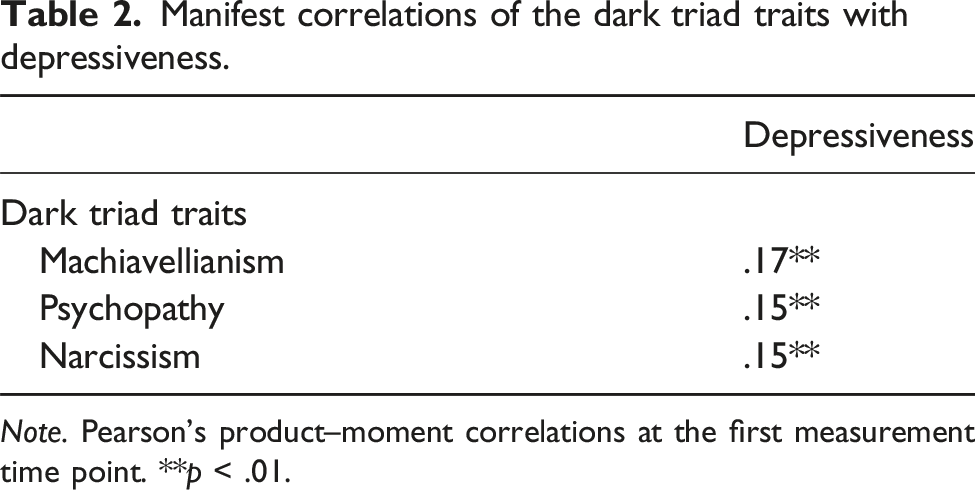
Note. Pearson’s product–moment correlations at the first measurement time point. **p < .01.
Results concerning scale validation indicated a sufficient level of agreement between the short scales and the established scales for both Machiavellianism and psychopathy (rMachiavellianism = .63, rpsychopathy = .64). Correlations of the short scales with the Big Five traits were as expected and comparable to those found in the article by Küfner et al. (2015). Coefficients are depicted in Table S5 in the Supplemental Material.
As a prerequisite for the bivariate second-order latent growth curve models, we tested longitudinal measurement invariance for the dark triad traits and for depressiveness. Table S6 in the Supplemental Material summarizes the results of all invariance models and model comparisons. The configural invariance models for the dark triad traits and depressiveness showed good model fit, supporting configural invariance. Chi-square difference tests comparing the configural invariance model with the metric invariance model for both the dark triad traits and depressiveness did not yield significant results. In addition, there were improvements in fit statistics, or changes in model fit were negligible, supporting metric invariance (equivalent factor loadings). However, when comparing the metric invariance models with the scalar invariance models, chi-square difference tests were significant in each case. Nevertheless, there were improvements in fit statistics, or the changes in model fit were negligible, supporting scalar invariance (equivalent factor loadings and intercepts).
We also investigated measurement invariance across age groups and across gender for the dark triad traits and for depressiveness. The results can be found in Table S7 and Table S8, respectively, in the Supplemental Material. We found evidence for configural invariance for the dark triad traits and for depressiveness both across age groups and across gender. Chi-square difference tests comparing the configural invariance models with the metric invariance models were significant for the dark triad traits and for depressiveness, for both the invariance test across age groups and across gender. Nevertheless, when considering changes in model fit, metric invariance can still be assumed. Similarly, chi-square difference tests comparing the metric invariance models with the scalar invariance models were significant for the dark triad traits and for depressiveness, for both the invariance test across age groups and across gender. However, changes in model fit were negligible, thus supporting scalar invariance. One exception concerns invariance across gender for depressiveness, where the change in CFI was small (−.010), but not negligible. Therefore, we adjusted an invariance constraint for one item, resulting in a negligible change in CFI, thus supporting partial scalar invariance.
Age and gender differences in the dark triad traits baseline levels
The following results are based on the bivariate second-order latent growth curve models. Fit statistics of all estimated models are given in the Supplemental Material (Table S9). Model fit was good for all models (average fit statistics across estimated models RMSEA = .045, SRMR = .067). We hypothesized that older age is associated with lower levels of the dark triad traits (H1.1). Results showed that emerging adults exhibited higher levels on all dark triad traits compared to established adults (β = .19 averaged across all dark triad traits, p < .001). In addition, established adults demonstrated higher levels on all dark triad traits compared to middle adults (β = .15 averaged across all dark triad traits, p < .001), suggesting that emerging adults also exhibited higher levels on all dark triad traits compared to middle adults. Thus, results are in accordance with H1.1.
Age and gender differences in the dark triad traits.
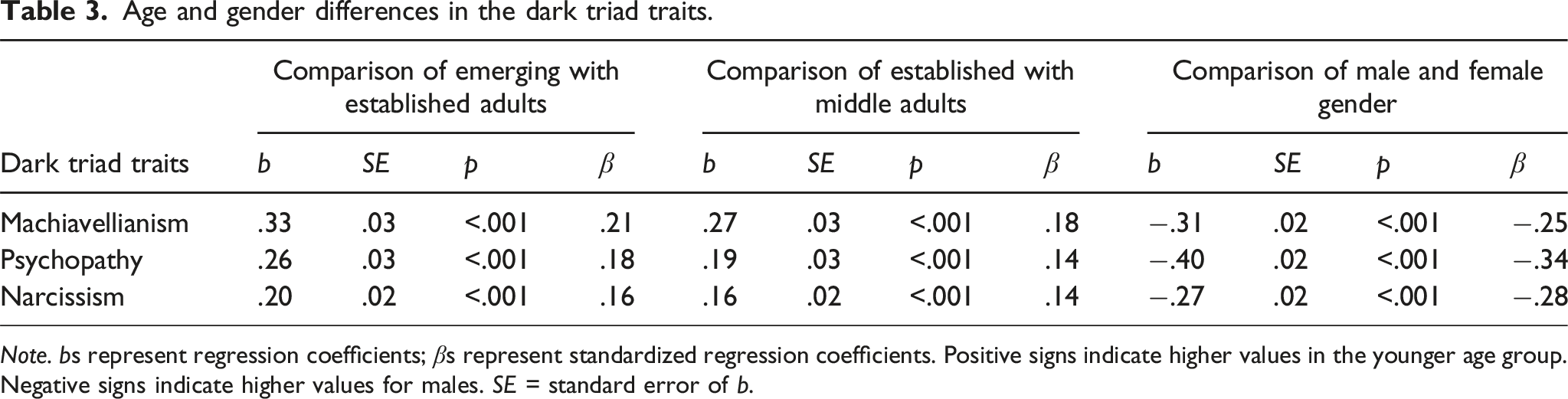
Note. bs represent regression coefficients; βs represent standardized regression coefficients. Positive signs indicate higher values in the younger age group. Negative signs indicate higher values for males. SE = standard error of b.
Mean-level change of the dark triad traits
Model parameters of all latent growth curve models.
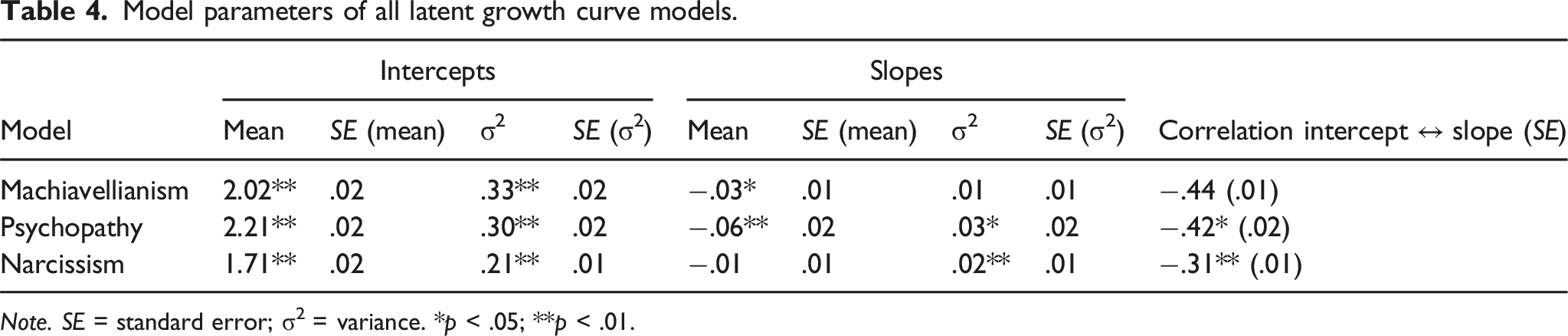
Note. SE = standard error; σ2 = variance. *p < .05; **p < .01.
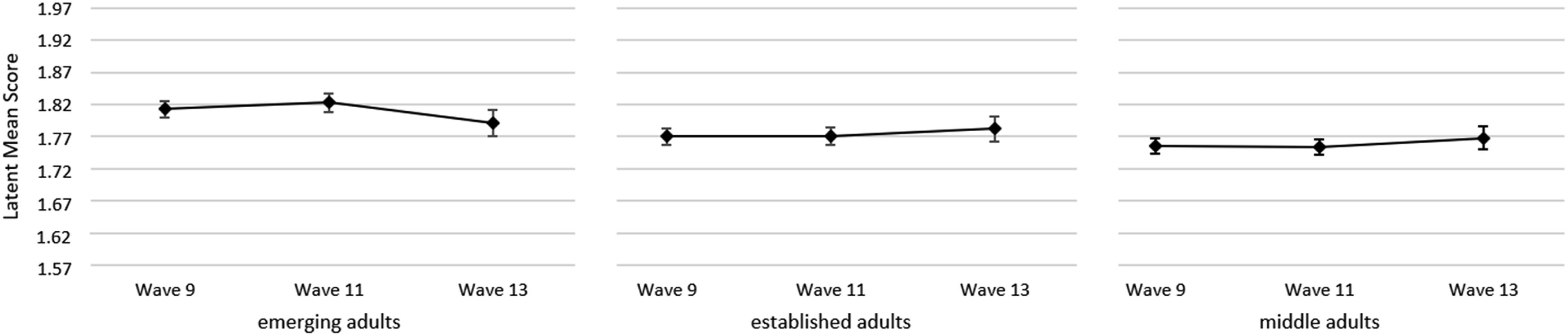
We analyzed age differences in the trajectories of the dark triad traits. In particular, we expected a weaker decrease with increasing age (H2.2). Effects of age on the slope variable were nonsignificant for all dark triad traits, which is contrary to H2.2. However, descriptive trends show stronger declines in emerging adults compared to older age groups. This also aligns with the results from listwise deletion showing significant stronger decreases in emerging adults compared to established adults for psychopathy and narcissism and significant stronger decreases in emerging adults compared to middle adults for narcissism. Figure 2 presents descriptive trajectories of the dark triad traits for the three age groups, while Figure 3 illustrates depressiveness trajectories in the same age groups. In addition, we explored whether there are gender differences in the development of the dark triad traits. However, results showed no significant moderating effect of gender on the mean-level change of the dark triad traits. Table S10 in the Supplemental Material shows the coefficients, standard errors, and p-values for all age and gender effects. Development of the Dark Triad Traits Across Three Measurement Time Points for Separate Age Groups. Note. Line charts represent the latent mean-level change with standard errors in the dark triad traits. The dark triad traits were measured on a 5-point Likert-type scale (1 = not at all to 5 = absolutely). Development of Depressiveness Across Three Measurement Time Points for Separate Age Groups. Note. Line charts represent the latent mean-level change with standard errors in depressiveness. Depressiveness was measured on a 4-point Likert-type scale (1 = almost never to 4 = almost always).
Finally, we considered intercept–slope correlations for the dark triad traits. In particular, we assumed negative intercept–slope correlations for all dark triad traits (H2.3). Table 4 shows the correlation coefficients. There was no significant intercept–slope correlation for Machiavellianism (p = .084). Intercept–slope correlations for psychopathy and narcissism were each negative and significant (p = .015 for psychopathy; p = .009 for narcissism), supporting H2.3 for these traits, but not for Machiavellianism.
Codevelopment of the dark triad traits and depressiveness
Cross-sectional, longitudinal, and intercept–slope correlations of the dark triad traits with depressiveness.

Note. M = Machiavellianism; P = psychopathy; N = narcissism; D = depressiveness; ∆ denotes a change effect; SE = standard error. *p < .05; **p < .01.
Regarding longitudinal correlations, we hypothesized positive correlations between Machiavellianism and psychopathy with depressiveness, and negative correlations between narcissism and depressiveness (H4.1). The slope for depressiveness was not significant, indicating no average linear change in this trait (β = .05, SE = .01, p = .399). Slope variance for depressiveness was significant (p < .001). Similar to the cross-sectional correlations, the longitudinal correlations for all dark triad traits were positive and significant (p < .001 for Machiavellianism and psychopathy; p = .003 for narcissism), supporting H4.1 for Machiavellianism and psychopathy, but not for narcissism. Note that the longitudinal correlation for Machiavellianism was r = .69 in our main analyses. We believe that this value is inflated due to the nonsignificant slope variance, which, as mentioned earlier, we attribute to estimation issues. The robustness analyses with listwise deletion revealed a lower value of r = .35 (see Table S3 in the Supplemental Material), additionally strengthening the conclusion that the longitudinal correlation for Machiavellianism in the main analyses is overestimated.
Finally, regarding intercept–slope correlations, we expected negative correlations between Machiavellianism and psychopathy with depressiveness, and positive correlations between narcissism and depressiveness (H4.2). Baseline levels of the dark triad traits were not significantly correlated with changes in depressiveness (p = .455 for Machiavellianism; p = .453 for psychopathy; p = .743 for narcissism). However, the baseline levels of depressiveness were significantly negatively correlated with changes in psychopathy (p = .006). There was no significant correlation between baseline levels of depressiveness and changes in narcissism (p = .246). Following the same rationale as with the longitudinal correlation for Machiavellianism, we believe that the correlation between baseline levels of depressiveness and changes in Machiavellianism is also inflated. This is again supported by analyses with listwise deletion, indicating a lower nonsignificant value (see Table S3 in the Supplemental Material; p = .078). Therefore, we conclude that the correlation between baseline levels of depressiveness and changes in Machiavellianism is not significant. Thus, H4.2 was partially supported for psychopathy, but not for Machiavellianism and narcissism.
Supplemental analyses
Cross-sectional and longitudinal correlations of narcissistic admiration and narcissistic rivalry with depressiveness.

Note. NA = narcissistic admiration; NR = narcissistic rivalry; ∆ denotes a change effect; SE = standard error. **p < .01.
Discussion
Recent studies on the development of dark personality traits showed trajectories towards greater social desirability, indicating a general decrease in Machiavellianism, psychopathy, and narcissism as people age (e.g., Grosz et al., 2019; Wetzel et al., 2020; Zettler et al., 2021). The current study extends previous research by investigating mean-level changes in the dark triad traits across three birth cohorts from emerging adulthood to midlife using a large and representative sample with three measurement points, each 2 years apart. Moreover, we offered new insights into the intrapersonal effects of the dark triad traits by analyzing their codevelopment with depressiveness.
Stability and change of dark triad traits
In line with our hypothesis, results revealed significant linear downward trends for Machiavellianism and for psychopathy. These findings align with the maturity principle (Roberts & Nickel, 2017), reflecting that people become more emotionally stable, agreeable, and conscientious from emerging adulthood onwards (e.g., Roberts et al., 2008). As mentioned earlier, we use the word “maturity” in a descriptive manner and not in evaluative terms. Maturation is therefore seen as a socially desirable developmental process which is also accompanied by a decrease in traits that are commonly associated with “immaturity.” In this context, intercept–slope correlations are also noteworthy: they suggest stronger maturation processes for individuals with higher initial levels in the dark triad traits.
Although emerging adults reported higher narcissism compared to established and middle adults, there was no consistent linear change in narcissism over the examined 4-year time span. However, descriptive trends showed a decline in emerging adults, suggesting potential changes within this age group, while no such trends were observed among established and middle adults. One possible explanation for this current pattern of results could be that narcissism, among the dark triad traits, is often seen as less harmful, exhibiting comparatively fewer self-benefits and drawbacks for others (Rauthmann & Kolar, 2012). For example, narcissism shows the lowest negative correlations with agreeableness and is even partly positively related to conscientiousness, suggesting that narcissism might be relatively less “immature” (O'Boyle et al., 2015; Vize et al., 2018). This consideration aligns with previous longitudinal studies which found no significant changes (Carlson & Gjerde, 2009; Grosz et al., 2019) or descriptive mean-level differences (Orth & Luciano, 2015) in narcissism. Narcissism might even encompass beneficial characteristics when it comes to taking on responsibilities. For example, Grosz et al. (2019) proposed that assertiveness, found within narcissistic admiration, might be functional for managing developmental tasks and thus may even increase in emerging adults. Our data suggests that such an increase becomes evident only from established adulthood onwards. Future studies should explicitly focus on the development of assertiveness as a facet of narcissism.
We also examined moderating effects of age on changes of the dark triad traits. Figure 2 illustrates the descriptive trends for all dark triad traits. Our study enhances the understanding of long-term developmental processes in these traits, highlighting differences between emerging, established, and middle adulthood based on a large and representative sample. Mean-level decreases in the dark triad traits were descriptively more pronounced in the youngest age group compared to the older age groups. This finding reinforces the idea that developmental processes tend to be more active in emerging adulthood than in middle adulthood (Roberts et al., 2006). Especially young adults find themselves in the position of adapting a variety of new roles which have significant developmental implications (Roberts et al., 2005). Moreover, research has shown that individuals view conformity to social norms (i.e., not engaging in criminal offenses, consuming illegal drugs) as a pivotal marker of the transition to adulthood (Arnett, 2001; Sirsch et al., 2009). This underscores the importance of a decline in norm violating behaviors among emerging adults, which may account for a more pronounced decline in the dark triad traits during that period.
Taken together, our results provide clear evidence that the so-called maturity principle applies to the development of Machiavellianism and psychopathy, with stronger declines in emerging adulthood than in older age groups. These mean-level changes in the dark traits generalized across gender, paralleling changes in commonly investigated traits like the Big Five (Roberts et al., 2006).
Codevelopment of dark triad and depressiveness
In line with prior research and existing theories (e.g., Gómez-Leal et al., 2019; Shih et al., 2021), Machiavellianism and psychopathy were positively related to depressiveness at first assessment. Contrary to our expectation, narcissism also showed positive associations with depressiveness. Thus, individuals with higher levels on all of the dark triad traits also reported higher depressiveness. Due to the heterogeneous nature of existing research on the link between narcissism and depressiveness, we separately examined two forms of narcissism: admiration and rivalry. Results showed positive links between narcissistic rivalry and depressiveness, as well as between narcissistic admiration and depressiveness, although the latter effect was negligible. This pattern of findings aligns quite well with prior studies. For example, narcissistic rivalry tends to elicit negative reactions, which should inevitably lead to negative affect (Back et al., 2013; Ivanova et al., 2015). Prior findings regarding narcissistic admiration were more mixed with two studies showing negative associations with depressiveness in clinical samples (Mota et al., 2019; Richter et al., 2023), while one larger representative German study found no significant association (Mota et al., 2019).
Regarding intercept–slope correlations, we found that higher initial levels of all dark triad traits were not significantly associated with stronger decreases in depressiveness. However, higher initial levels of depressiveness were significantly associated with subsequent stronger decreases in psychopathy, but not with changes in Machiavellianism and in narcissism. In fact, this pattern of results is difficult to interpret. It is possible that there are no essential associations between the level of one variable and the changes in the other variable. This conclusion would be consistent with the idea that there are no reciprocal transactions between the dark triad traits and depressiveness, which, of course, would need to be more thoroughly investigated through additional research. Nevertheless, we found significant longitudinal correlations between dark triad traits and depressiveness. Consistent with our hypothesis, stronger decreases in Machiavellianism and in psychopathy were associated with stronger decreases in depressiveness. Analogous to cross-sectional correlations, codevelopment may be due to the influence of one variable on the other, a mutual influence, or a common cause of both variables (Allemand & Martin, 2016). Considering previous research (Grosz et al., 2019; Klimstra et al., 2020; Schwaba et al., 2022), it is reasonable to assume that the development towards greater social desirability from emerging adulthood onwards might serve as a common cause for the codevelopment of Machiavellianism and psychopathy with depressiveness.
Based on evidence that a grandiose self, as prevalent in narcissism, might serve as a protective factor against depressiveness (Shih et al., 2021), we assumed that a decrease in narcissism and thus a reduction of the associated buffer effect would mitigate the decrease in depressiveness. Nevertheless, cross-sectional correlation of narcissism with depressiveness was positive, indicating that there was no apparent buffer effect in our data. It was therefore not surprising that stronger decreases in narcissism were also associated with stronger rather than with lower decreases or increases in depressiveness. Upon closer investigation of the facets of narcissistic admiration and narcissistic rivalry, the results suggested that stronger decreases in narcissistic rivalry were linked to more substantial decreases in depressiveness. However, there was no significant effect for narcissistic admiration. This finding is consistent with cross-sectional correlations, implying once more that narcissistic rivalry might result in more adverse outcomes than narcissistic admiration. For example, recent research has shown that narcissistic rivalry was linked to malicious envy (i.e., characterized by the intent to undermine others; Lange et al., 2016), which is connected to higher levels of depressiveness (e.g., Li et al., 2022).
Taken together, all dark triad traits codevelop with depressiveness. In line with previous literature, our longitudinal findings indicate that narcissistic admiration represents the benign facet, while narcissistic rivalry embodies the malicious facet of grandiose narcissism. The current study is the first to examine longitudinal associations between narcissistic admiration and narcissistic rivalry with depressiveness, emphasizing the importance of differentiating these facets when considering their associations with individual well-being.
Limitations and future directions
The current study has a number of strengths, including a large and nationally representative sample, the use of multiple measurement occasions, and the comparison of three birth cohorts covering the age range from emerging adulthood to midlife. Nevertheless, some limitations have to be considered.
First, although measurement instruments used in the present study reflect standard tools, we had no information on important aspects beyond the dark triad traits like vulnerable narcissism or sadism. Moreover, apart from the dimensions of narcissistic admiration and narcissistic rivalry, the dark triad traits were assessed unidimensional. This does not account for potential unique developmental trajectories of subdimensions. For instance, assertiveness, as a facet of narcissistic admiration, may even increase during emerging adulthood (Grosz et al., 2019). Moreover, there are studies pointing out differential associations between facets of psychopathy and depressiveness (e.g., Blonigen et al., 2010; Hicks & Patrick, 2006; Latzman et al., 2019).
Second, Machiavellianism and psychopathy were assessed by the “Naughty Nine” (Küfner et al., 2015), which measures each dark triad trait with three items drawn from the original 4-item scales of the Dirty Dozen (DD; Jonason & Webster, 2010). The DD, like other conventional measures of Machiavellianism, is criticized for not capturing the construct in its entire bandwidth but rather measuring aspects of psychopathy (e.g., Miller et al., 2017). Additionally, shorts scales like the DD fall short of encompassing the whole variance of the constructs. For instance, Miller et al. (2012) revealed that interpersonal antagonism and disinhibition as facets of psychopathy are not fully captured by the DD.
Third, although we relied on a large and nationally representative sample, participants were living in a Western, educated, industrialized, rich, and democratic country (WEIRD; Henrich et al., 2010). For example, research reveals differences in the average levels of the dark triad traits and variations in their associations with age and gender across cultures (Aluja et al., 2022; Jonason et al., 2020). In particular, the gender gap in the dark triad traits was shown to be most pronounced in European countries (Aluja et al., 2022). Future studies may investigate non-WEIRD samples to test generalizability of the findings.
Fourth, although our sample allowed for a comprehensive understanding of the long-term development of the dark triad traits across the age spectrum from emerging adulthood to midlife, mean-level changes were computed separately within each age group, with a 4-year time interval. A more extended time span could have unveiled greater change or different trajectories. Moreover, our analyses do not include the age range from 46 years onwards. Through the loss of social roles and relationships in older age, personality development may proceed in reverse to the so-called maturity principle (Bleidorn & Hopwood, 2019). Indeed, prior studies found decreases in socially desirable traits, such as agreeableness and consciousness in older adults (e.g., Götz et al., 2020; Kandler et al., 2015) and increases in Machiavellianism after the age of 65 years (Götz et al., 2020). Future research may benefit from further examining mean-level trends in dark personality traits in this age range.
Conclusion
The present study examined the mean-level change of Machiavellianism, psychopathy, and narcissism from emerging adulthood to midlife and the codevelopment of these traits with depressiveness. We found that people on average became less Machiavellian and less psychopathic over time, which is in line with the so-called maturity principle. Moreover, stronger decreases in all dark triad traits were associated with stronger decreases in depressiveness, suggesting that the development towards greater social desirability may serve as a common cause for the codevelopment of the dark triad traits and depressiveness, in particular concerning Machiavellianism and psychopathy. Together, these findings provide a comprehensive picture about dark personality development in conjunction with changes in depressiveness.
Supplemental Material
Supplemental Material - Codevelopment of the dark triad and depressiveness from emerging adulthood to midlife
Supplemental Material for Codevelopment of the dark triad and depressiveness from emerging adulthood to midlife by Anna Braig, Tita Gonzalez Avilés and Franz J Neyer in European Journal of Personality.
Footnotes
Declaration of conflicting interests
The author(s) declared no potential conflicts of interest with respect to the research, authorship, and/or publication of this article.
Funding
The author(s) disclosed receipt of the following financial support for the research, authorship, and/or publication of this article: The present work was supported by the German Research Foundation, Register Number NE633/10-3.
Open science statement
The preregistration for this study is available at https://osf.io/emk7f. R scripts for all conducted analyses are accessible at https://osf.io/43y9r/. The data of the study is available in the form of a scientific use file provided by the pairfam administration at https://www.pairfam.de/en/data/data-access/. Detailed information on the analyzed data is given in the data manual (Brüderl, Garrett, et al., 2022) and the scales and instruments manual (Reim et al., 2022).

Supplemental Material
Supplemental material for this article is available online.
References
Supplementary Material
Please find the following supplemental material available below.
For Open Access articles published under a Creative Commons License, all supplemental material carries the same license as the article it is associated with.
For non-Open Access articles published, all supplemental material carries a non-exclusive license, and permission requests for re-use of supplemental material or any part of supplemental material shall be sent directly to the copyright owner as specified in the copyright notice associated with the article.
