




Abstract
In the past two decades, research on the motivational underpinnings of the Dark Triad has burgeoned. However, it is unclear how each Dark Triad trait may map onto the values circumplex, and whether the research conducted thus far indicates consistent effects. In this multi-level meta-analysis, we examined the relationship between Dark Triad personality traits and personal values. Across 34 studies conducted between 2000 and 2020, Dark Triad traits were positively associated with self-enhancement and openness-to-change value dimensions, and negatively associated with self-transcendence and conservation value dimensions. Shape consistency for the Dark Triad associations was stronger for the self-enhancement versus self-transcendence values tension than for the openness-to-change versus conservation values tension. We concluded that Dark Triad traits showed meaningful patterns of associations with personal values with some differences between the traits. Materials, data, and code are available on: https://doi.org/10.17605/OSF.IO/4Z27F
Introduction
In personality research, the introduction of the Dark Triad personality traits (Paulhus & Williams, 2002) led to a substantial body of work attempting to map the origins of antisocial behaviors (Jonason et al., 2017; O’Boyle et al., 2012; Wisse & Sleebos, 2016). Initially defined as a constellation of personality traits that influence antisocial behaviors, in recent years research has sought to question how these aversive traits may have positive outcomes, such as helping individuals to be effective leaders (Mathieu et al., 2014; Rosenthal & Pittinsky, 2006), or to persist with their entrepreneurial passion (Schmidt et al., 2025). Despite the substantial body of work showing the Dark Triad’s associations with a wide range of behavioral outcomes, personality researchers remain divided over the extent to which the Dark Triad traits are theoretically distinct or overlapping, and how each trait is related to social behavior (Muris et al., 2017).
Research on personality and personal values may help to address the puzzles of theoretical distinctiveness, similarities, and the tension behind maintaining conflicting social behaviors. Over the last two decades, an emerging stream of studies (e.g., Jonason et al., 2015; Kajonius et al., 2015) has sought to identify how dark personality traits are associated with personal values—defined as long-term motivational goals that people deem important in their lives (Schwartz, 1992). The present research offers a new perspective by identifying how the Dark Triad traits share similar motivational patterns, and where these traits differ, mainly in the magnitude to which they emphasize specific motivations.
We conducted a systematic mapping of the associations between Dark Triad traits and personal values in the literature. We aimed to develop a unified framework to deepen our understanding of the long-term motivations of those identified as higher on what are considered to be the “darker” aspects of personality, and to help clarify conceptual ambiguities and the findings so far on the Dark Triad traits (Muris et al., 2017).
We begin with a theoretical account of the Dark Triad traits, the personal values framework, and their possible links, and then proceed to report a meta-analysis of the literature on the relationships between Dark Triad traits and personal values.
Dark Triad
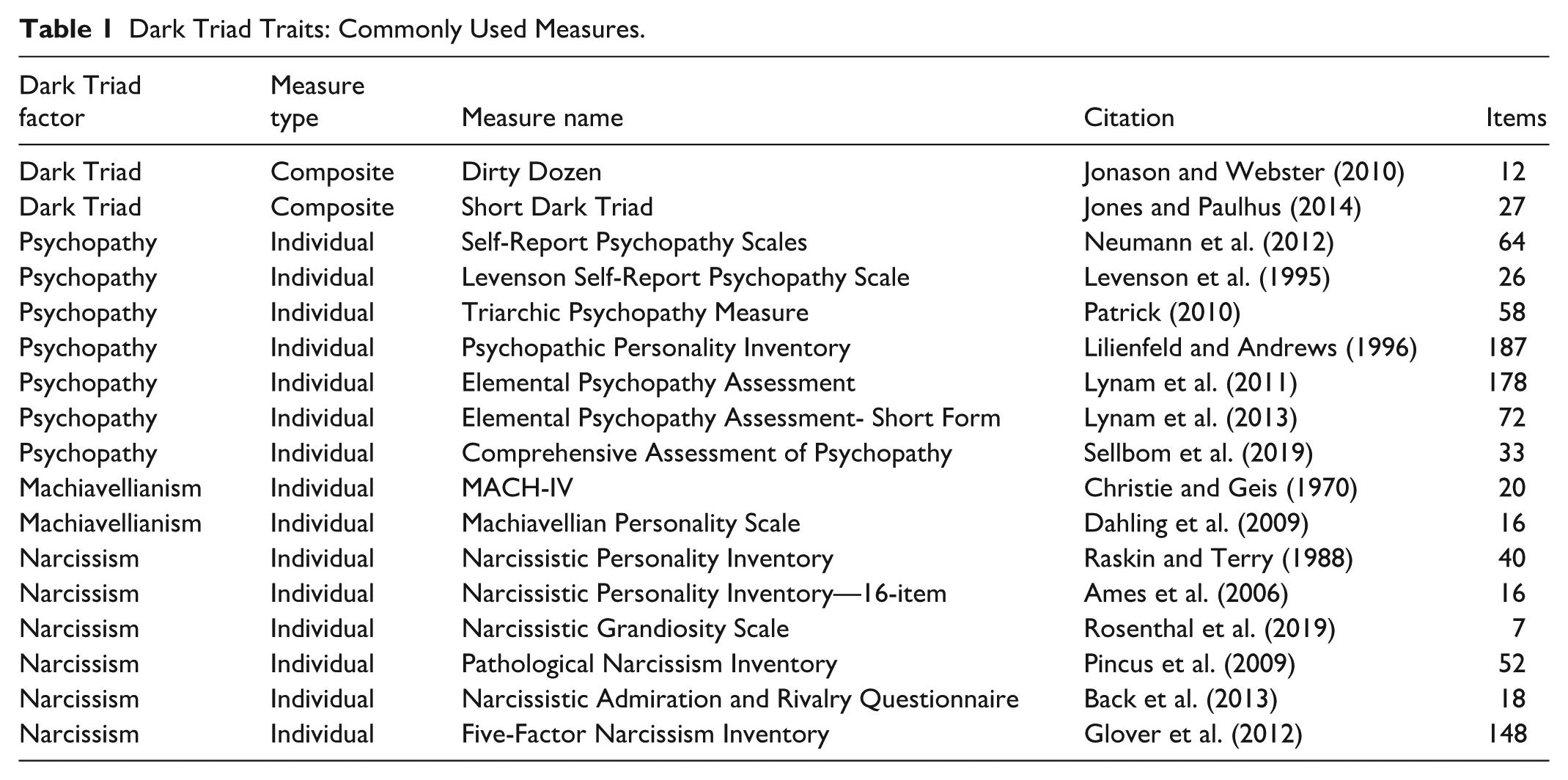
The Dark Triad is a cluster of three personality traits, commonly considered as malevolent and characterized by their anti-social and self-oriented attributes (Paulhus & Williams, 2002). Briefly, psychopathy is characterized by having an impulsive, thrill-seeking, and callous nature; Machiavellianism by a manipulative, glib, and cynical nature; and narcissism by a self-loving, grandiose, and entitled nature. The Dark Triad traits were identified as the most prominent dark personality traits that were covered by a large body of literature as being highly aversive yet still not entirely outside accepted norms (Furnham et al., 2013). We summarized a list of common measures used for the Dark Triad in Table 1.
Dark Triad Traits: Commonly Used Measures.
Over a wide range of contexts, empirical literature examining these traits mostly associated them with undesirable outcomes such as exploitative mating strategies (Jonason et al., 2017), counterproductive work behavior (O’Boyle et al., 2012), abusive supervision at work (Wisse & Sleebos, 2016), and differentiated cheating strategies (Baughman et al., 2014). However, these traits have also been associated with positive outcomes that enable the individual to “get ahead of” but not “get along with” others in the workplace (Furnham et al., 2013, p. 206; Hogan, 2007). This is particularly seen in the corporate world, where trait psychopathy and narcissism are positively related to leadership (Mathieu et al., 2014; Rosenthal & Pittinsky, 2006).
Structurally, there has been increasing concern about the Dark Triad traits’ high intercorrelations (Muris et al., 2017). Whilst this supports the original conceptualization that these traits are “evil allies of personality” (Muris et al., 2017, p. 189), from a factor perspective, it remains contentious whether these traits are sufficiently distinct. Multiple meta-analytic examinations posit that the Dark Triad should be reduced to the Dark Dyad, with Machiavellianism collapsed under psychopathy as they share substantial overlap in variance, and narcissism remaining a distinct factor of its own (Muris et al., 2017; O’Boyle et al., 2014; Vize et al., 2018). This proposal is reasonable, given that both psychopathy and Machiavellianism are more oriented toward affecting others with their actions, such as engaging in political behavior at work (Liu & Liu, 2018), or showing cruelty to others (Dadds et al., 2006), whereas narcissism is more self-oriented and predicts more behaviors that affect self-presentation, such as the selection of Facebook profile pictures to enhance likeability (Kapidzic, 2013). Further, when the shared variance between the Dark Triad traits has been accounted for, psychopathy appears to be the single factor that subsumes narcissism as well (Glenn & Sellbom, 2015; Muris et al., 2017). This has led to recent meta-analytic examinations proposing that the Dark Triad share a core D-factor (Schreiber & Marcus, 2020). While these empirical findings point to the Dark Triad traits sharing common variance, it remains an open question as to how this similarity may explain an individual’s behavior.
Additionally, even with these empirical findings showing substantial overlap between the Dark Triad traits, recent reviews and meta-analyses still assume that each trait remains conceptually distinct, resulting in dissonance about the validity of the Dark Triad being seen as a constellation of traits (Furnham et al., 2013; Muris et al., 2017; O’Boyle et al., 2014; Vize et al., 2018). Thus, this meta-analysis has the potential of offering a unified perspective in understanding where both similarity and variance can co-exist between the Dark Triad traits—by examining associations with personal values.
Personal Values
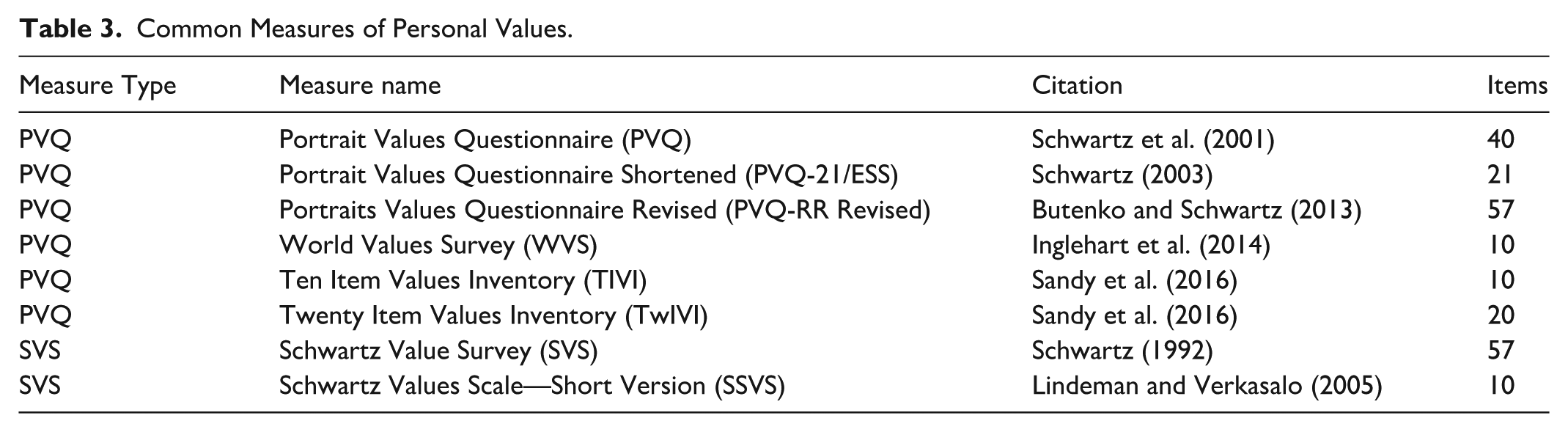
Personal values are long-term motivational goals that people deem important in their lives (Schwartz, 1992). Values are generally stable, yet they can also be reordered depending on one’s social experiences and normative expectations (Bilsky & Schwartz, 1994; Rokeach, 1973). Currently, the dominant model in the values literature is Schwartz’s (1992) personal values theory. Traditionally, this model postulated ten universal values (power, achievement, hedonism, stimulation, self-direction, universalism, benevolence, conformity, security, and tradition). The values follow a consistent circular structure such that values sharing a similar universal motivation are positioned closer to each other. Within the personal values circumplex model, values that are positioned opposite to each other can be considered as values reflecting opposing motivations. The 10 values are nested under four higher-order dimensions that are listed on two orthogonal axes and are considered as two sets of underlying general motivations that oppose each other: self-transcendence versus self-enhancement and openness-to-change versus conservation. This value model has received universal support (Schwartz, 2011), and is considered a system of related values, rather than independently distinct values (Schwartz, 1996). The values circumplex structure is outlined in Figure 1 and sample items from the 10 value categories are provided in Table 2. In Table 3, we summarized a list of commonly used measures for the personal values model.
Description of the 10 Personal Values Categories.
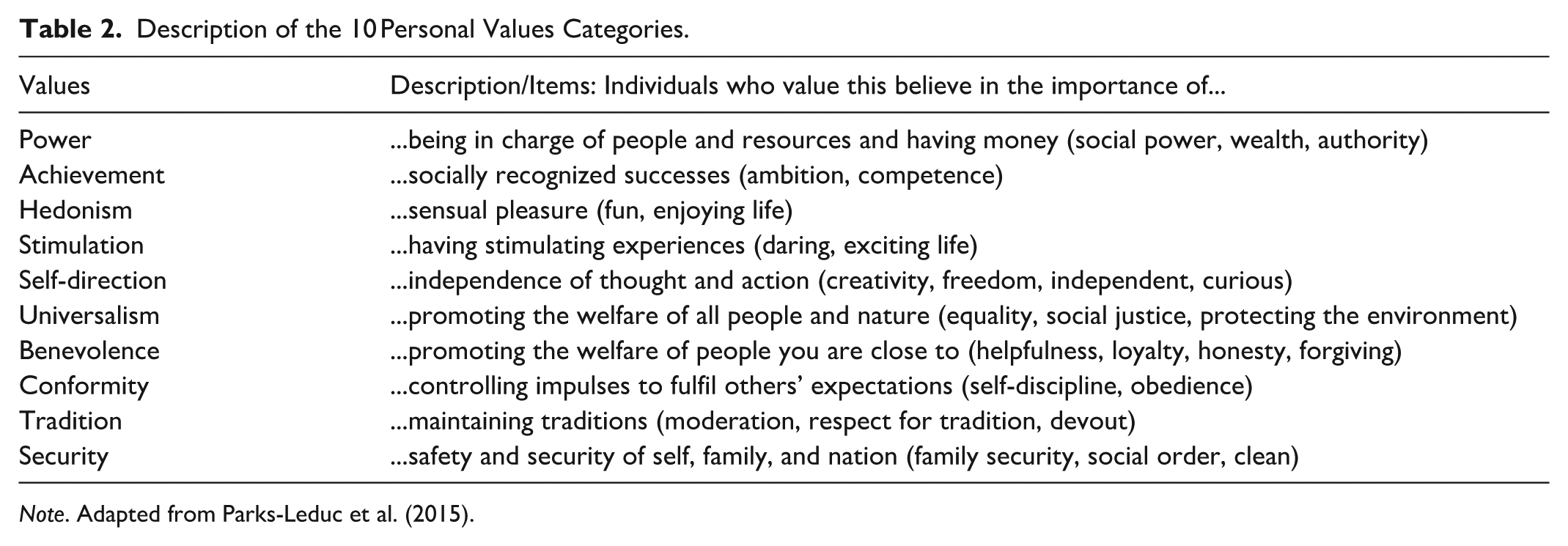
Note. Adapted from Parks-Leduc et al. (2015).
Common Measures of Personal Values.
The stable motivational quality of values distinguishes them from other goal-specific constructs (Maio, 2010). Though considered abstract, values have been shown to predict a range of value-serving attitudes and behaviors (Bardi & Schwartz, 2003; Grunert & Juhl, 1995; Hitlin & Piliavin, 2004; Lipponen et al., 2010; Roccas & Sagiv, 2010). Of specific interest to this meta-analysis, values predict unethical decision-making and behaviors (Feldman et al., 2015; Fritzsche & Oz, 2007; Menesini et al., 2013; Ring et al., 2020), which have previously been associated with those higher on the Dark Triad.
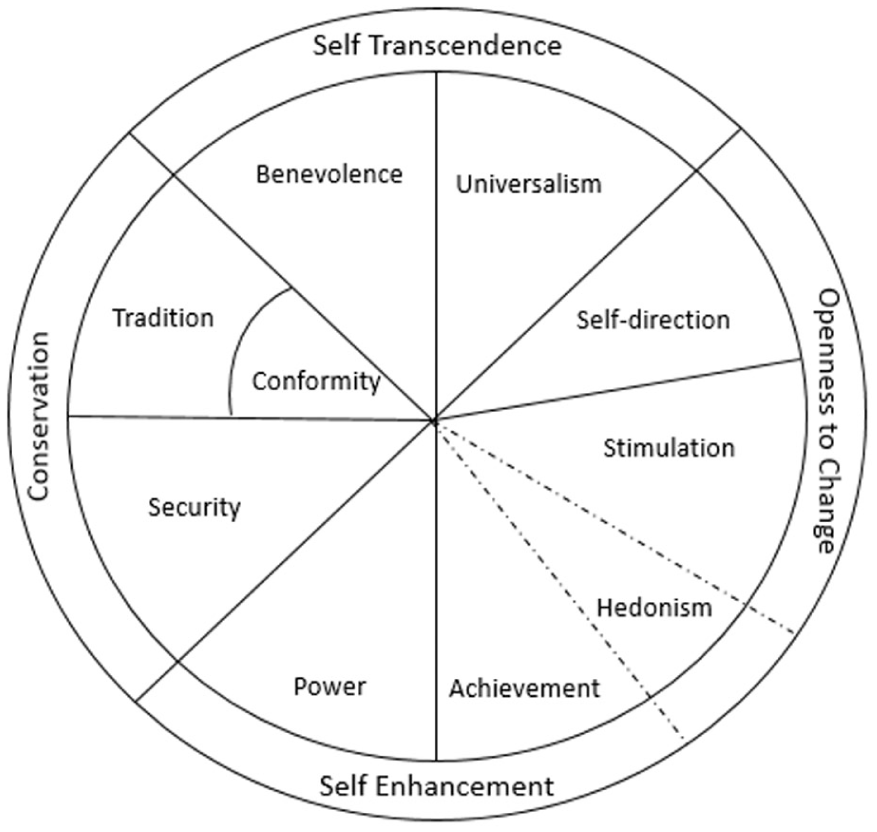
Personal values circumplex structure and shape consistency equation and correlations vector.
Values Circumplex: Sinusoidal Pattern of Expected Correlations and Shape-Consistency
One of the strengths of the values theory (Schwartz, 1992) is its circumplex model mapping consistent relationships among those values. Therefore, when theorizing about associations between values and other constructs, we believe it is important to not only examine the effect size for each value link, but also to analyze the overall pattern of associations of the circumplex as a whole (Schwartz, 1996). Boer and Fischer (2013) introduced a methodology that quantifies the overall fit of a relationship pattern with the expected sinusoidal patterns of the values circumplex structure along the two bipolar dimensions of self-enhancement versus self-transcendence and conservation versus openness-to-change. To date, however, only a few studies have used this methodology to examine associations, mostly in meta-analyses (i.e., Boer & Fischer, 2013; Feldman et al., 2015; Fischer & Boer, 2015) and large-scale studies (Feldman, 2021). In Boer and Fischer (2013) and Feldman (2021), shape consistencies were an important methodological approach in assessing a theorized pattern of relationships between personal values and morality to provide a high-level abstract overview of a large number of complex relationships (50 overall, 10 personal values by five moral foundations/dimensions). We believe that the shape-consistency approach and focusing on high-order value dimensions are especially useful in simplifying complex patterns of value associations to concise, clear, and meaningful conclusions, especially in systematic reviews and meta-analyses.
According to Feldman (2021), shape-consistency is defined as “the extent to which an observed value correlations pattern maps onto a sinusoidal shape emphasizing either the self-enhancement versus self-transcendence dimensions (SET-shape) or the conservation versus openness-to-change dimensions (CO-shape).” A larger shape consistency value indicates a stronger contrast between the correlations of opposing high-order dimensions on the values circumplex, self-enhancement versus self-transcendence (SET) or conservation versus openness-to-change (CO), with the shape consistency effect sizes categorized as .40 for weak fit, .60 for moderate fit, and .80 and above for strong fit. We outlined the shape-consistency equation and correlations vectors in Figure 2.
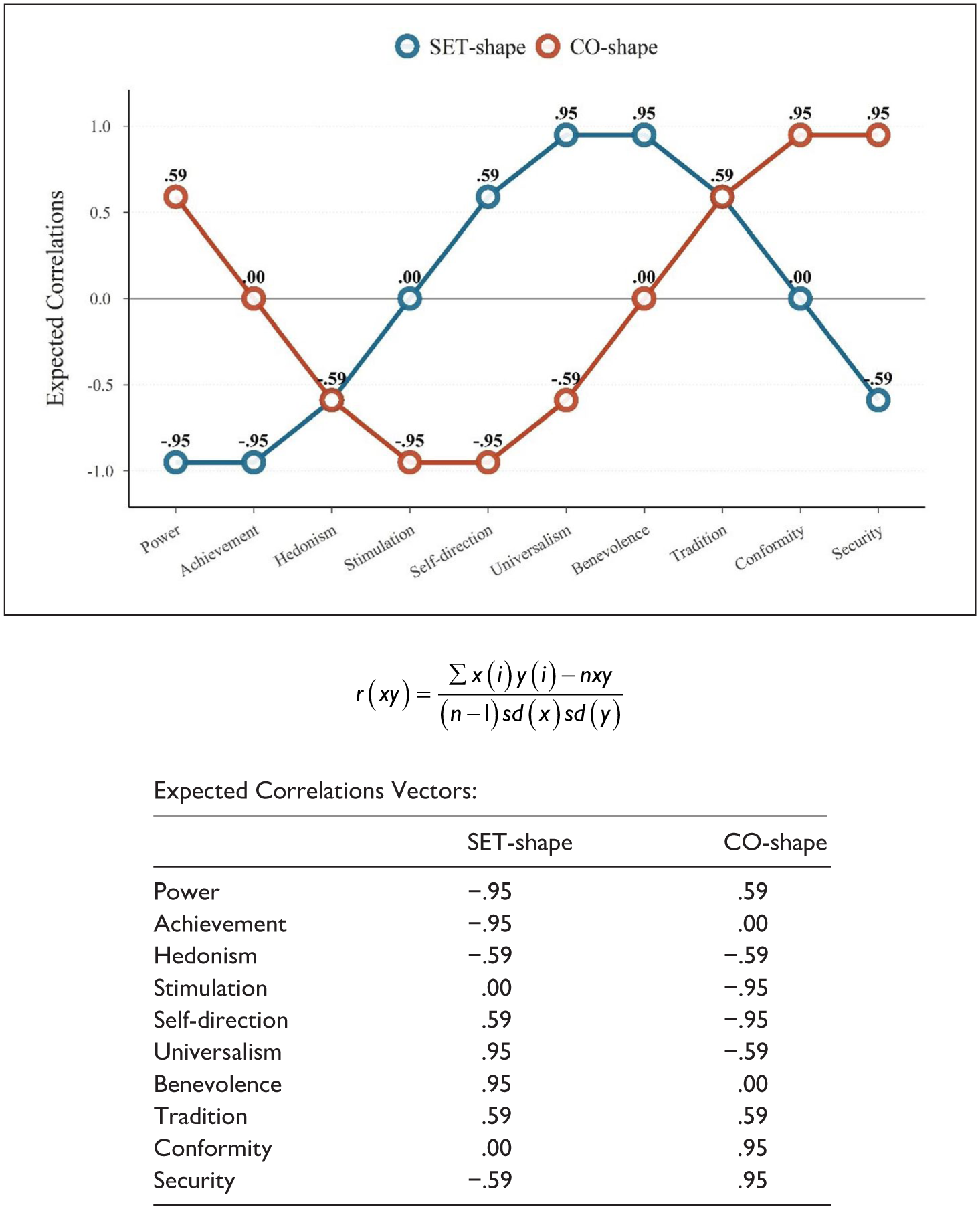
Shape consistency fit: Expected sinusoidal patterns across the values circumplex.
Relationship Between Traits and Values
There is a growing body of literature that has argued, and empirically demonstrated, that traits and values are conceptually and empirically distinct (Kajonius et al., 2015; Roccas et al., 2002). Parks-Leduc et al. (2015) discussed the differences between the two, defining traits as “descriptions of people in terms of relatively stable patterns of behavior, thoughts, and emotions,” and personal values as “stable broad life goals that are important to people in their lives and guide their perception, judgments, and behavior,” and summarizing the main difference as being that “traits are descriptive variables whereas values are motivation(al) variables” (pp. 3–4).
Trait-values meta-analyses further elaborated on the similarities and differences between the two constructs and presented theoretically meaningful associations between the Big Five personality traits and the Schwartz personal values circumplex. Personal values were shown to be more strongly related to cognitive-based traits than to emotionally-based traits (Parks-Leduc et al., 2015), and contextual factors were shown to affect the association between these two constructs (Fischer & Boer, 2015).
Relationship Between the Dark Triad Traits and Personal Values
There has been growing interest in the link between the Dark Triad and personal values (Balakrishnan et al., 2017; Güngör et al., 2012; Jonason et al., 2015; Kajonius et al., 2015; Persson, 2014). Existing studies have so far shown that Dark Triad traits are positively related to self-enhancement and openness-to-change values, and negatively related to self-transcendence values and conservation values (Kaufman et al., 2019). These findings fit with the characterization of the Dark Triad as being self-centered, antisocial, sensation-seeking (Crysel et al., 2013), and callous about the well-being or interests of others (Jonason et al., 2015). While these studies individually suggest that the Dark Triad share similar value orientations, there has not yet been a collective effort to synthesize whether and how these motivational patterns consistently map out onto each of the Dark Triad traits. Further, research in this area has yet to evaluate how each trait is unique via their differences in how strongly they are motivated by a specific value. This has the potential to reconcile how the Dark Triad can both share overlapping variance yet remain distinct by their difference in the values they prioritize, such that they may share the same directional associations toward the same values, yet the extent to which they are associated with a specific value may vary. This thus leads to different motivational profiles for each Dark Triad trait.
We outlined an initial simplified mapping of the Dark Triad traits on the values circumplex structure (see Figure 3), and hypothesize below on the finer-grained associations further differentiating between the Dark Triad traits based on their expected values associations.
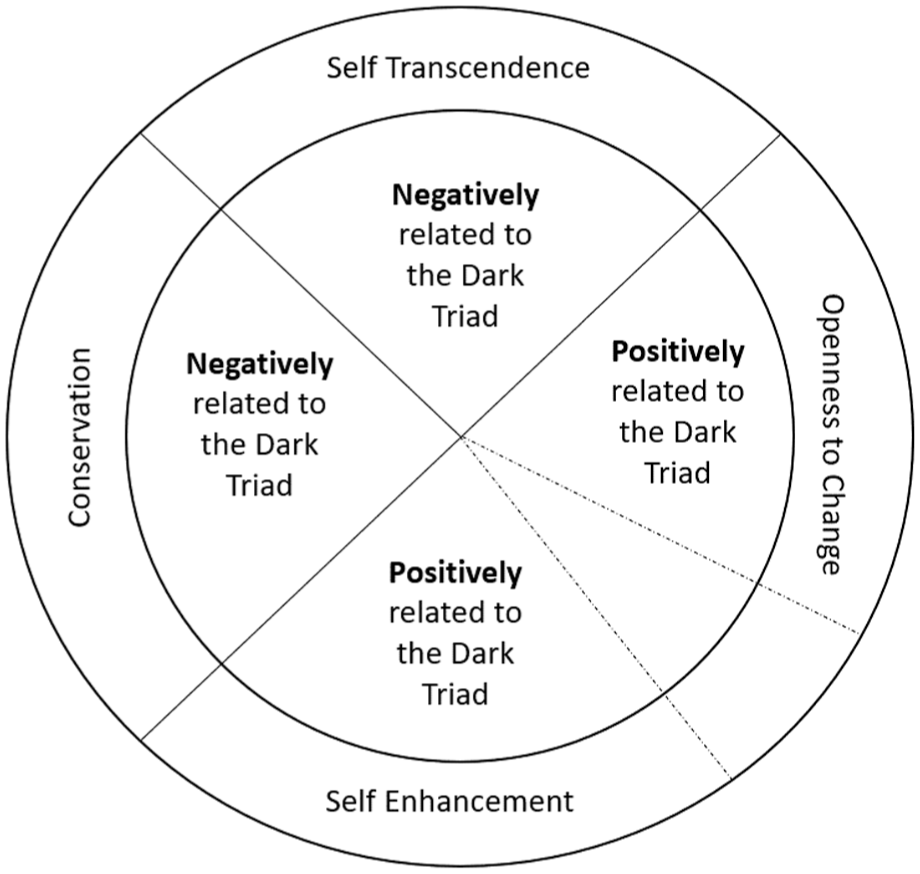
Mapping of the high-order Dark Triad onto the personal values circumplex.
Research Aims and Hypotheses
We examined the pattern of relationships between each of the Dark Triad traits and personal values, and hypothesized on potential factors that may moderate the associations.
At its core, the Dark Triad is strongly representative of, or associated with, low agreeableness (Jonason et al., 2013; Vize et al., 2020). Meta-analyses found negative associations between agreeableness and self-enhancement value dimensions, positive associations between agreeableness and self-transcendence, and positive associations between agreeableness and conservation value dimensions (Fischer & Boer, 2015; Parks-Leduc et al., 2015). Overall, we expected that the Dark Triad traits are positively related to self-enhancement, and negatively related to self-transcendence and conservation. However, below we theorized on the relation between each trait and the value dimensions, and expected variations between our overall expectations and individual hypotheses relating to each trait with each value dimension. 1
Psychopathy
Psychopathy is characterized by callousness, impulsivity, and a lack of remorse (Paulhus & Williams, 2002). The lack of inhibition to engage in immoral acts for gains (Schouten & Silver, 2012) can result in parasitic efforts to gain benefits at the expense of others at work (Babiak & Hare, 2006; Boddy, 2006). This suggests that psychopathy is a highly self-oriented trait, motivated by self-gains. This is supported by recent studies that consistently showed positive associations between psychopathy and values that are more oriented toward enhancing oneself, such as power and achievement (Glenn et al., 2017; Jonason et al., 2015; Persson, 2014). Further, the need for stimulation and hedonism values are highly characteristic of individuals high in trait psychopathy, as exhibited by higher tendencies to engage in substance abuse (Benning et al., 2003). This finding is also supported by positive correlations found consistently between psychopathy and openness-to-change (Balakrishnan et al., 2017; Jonason et al., 2015; Kajonius et al., 2015; Ljubin-Golub & Sokić, 2016).
Individuals high in trait psychopathy also tend to value the welfare of others to a much lesser degree than their own. Jonason and Zeigler-Hill (2018) found negative associations between psychopathy and the motivation to develop and maintain good relationships with others. Psychopathy was also associated with being less motivated to focus on the partner’s needs during sex (Smith et al., 2019). This supports existing findings that psychopathy is negatively related to self-transcendence and conservation values (Jonason et al., 2015; Kajonius et al., 2015; Ljubin-Golub & Sokić, 2016).
We hypothesized the following relationships between psychopathy and personal values:
Hypothesis 1: Psychopathy is associated with self-enhancement (+), openness-to-change, (+), self-transcendence (−), and conservation (−) values.
Based on our predicted orthogonal hypotheses for psychopathy with the value dimensions, we also expected a sinusoidal pattern displayed when these observed value associations are mapped on the circumplex structure of the value model. Following Boer and Fischer’s (2013) shape consistency method, and based on past literature finding the strongest associations with the self-enhancement and self-transcendence values dimensions (Kajonius et al., 2015; Persson, 2014), we expected that psychopathy has a sinusoidal-shaped pattern with values where the peaks and valleys are observed in the self-enhancement versus self-transcendence dimensions (SET shaped). In other words, we expected that high levels of psychopathy would be more strongly associated with prioritizing the enhancement of oneself and displaying a high aversion to the well-being of others, with weaker associations with indulging in hedonic pleasure and maintaining what others think of them.
Hypothesis 2: There is a sinusoidal correlational pattern between psychopathy and the values in order of the circumplex structure: The self-enhancement versus self-transcendence tension has stronger associations compared to the conservation versus openness-to-change tension (i.e., stronger negative SET consistency shape than CO consistency shape).
Machiavellianism
Given the evidence that Machiavellianism highly overlaps with psychopathy in variance and that it might even be a subset of the latter trait (Muris et al., 2017; O’Boyle et al., 2014), we predicted that Machiavellianism would be similar to psychopathy in terms of the relationships held with personal values.
Machiavellianism is a trait characterized by having a calculative and strategic tendency in order to achieve self-oriented goals, often at the expense of considerations for others’ well-being (Machiavelli, 1513). Machiavellianism and psychopathy share a weakened empathy for others in the pursuit of prioritizing their self-interests. For example, in the workplace individuals high in Machiavellianism are more likely to be abusive (Feng et al., 2022) and to engage in counterproductive work behaviors (Burns et al., 2024). Individuals with high Machiavellianism tend to be motivated by power and achievement self-enhancement values and less motivated by benevolence and universalism self-transcendence values.
Furthermore, Machiavellianism promotes an individualistic sense of self and less concerned with following social norms or fulfilling others’ expectations and is more likely to result in violations of social norms in order to benefit oneself. For instance, taxpayers high in Machiavellianism may be more likely to report less ethical norms, which in turn predicts high tax evasion intentions (Shafer & Wang, 2017). Yet, Machiavellianism is likely to promote less flagrant violation of social rules than psychopathy, as those higher on Machiavellianism are capable of hiding their true intentions and managing impressions if there is benefit in doing so (Ankit & Uppal, 2021; Curtis et al., 2022; Hogue et al., 2012). Therefore, those high on Machiavellianism seem to be less concerned with conservation values and likely higher on openness-to-change if it benefits their self-enhancement goals.
We hypothesized the following relationships between Machiavellianism and personal values:
Hypothesis 3: Machiavellianism is associated with self-enhancement (+), openness-to-change (+), self-transcendence (−), and conservation (−) values.
We expected a sinusoidal pattern for Machiavellianism to be similar to that of psychopathy. Therefore:
Hypothesis 4: There is a sinusoid correlational pattern between Machiavellianism and the values in order of the circumplex structure: The self-enhancement and self-transcendence tension has stronger associations with Machiavellianism compared to the conservation versus openness-to-change tension (i.e., stronger negative SET consistency shape than CO consistency shape).
Narcissism
The motivations of those with high narcissism are less clear compared to psychopathy and Machiavellianism, because individuals high on this trait are often characterized as “disagreeable extraverts” (Rogoza et al., 2016, p. 88) and are higher on both antisocial and prosocial behaviors (Kauten & Barry, 2016; Konrath et al., 2016; Grijalva et al., 2015). Narcissism can be more complex, as it includes facets that tend to be associated with different value dimensions (Güngör et al., 2012; Rogoza et al., 2016).
Individuals with high narcissism tend to be self-focused, achievement-oriented (Papageorgiou et al., 2018; Soyer et al., 1999), and high on pursuing hedonic enjoyment, such as indulgent consumption of luxury goods (Cisek et al., 2014; Kang & Park, 2016; Sedikides et al., 2018). Narcissism also tends to be positively associated with extraversion (Muris et al., 2017), which, in turn, tends to be associated with self-enhancement and openness-to-change (Fischer & Boer, 2015; Parks-Leduc et al., 2015). We therefore hypothesized the following relationships between narcissism and personal values:
Hypothesis 5: Narcissism is associated with self-enhancement (+) and openness-to-change (+) values.
However, there are mixed findings regarding the associations between narcissism and conservation or self-transcendence value dimensions (Balakrishnan et al., 2017; Güngör et al., 2012; Jonason et al., 2015; Kajonius et al., 2015; Rogoza et al., 2016). Narcissism can be decomposed into two facets: vulnerable narcissism and grandiose narcissism (Miller et al., 2011). The vulnerable narcissism facet relates to “a defensive and insecure grandiosity that obscures feelings of inadequacy, incompetence, and negative affect” (Miller et al., 2011, pp. 1013–1014). Individuals high on vulnerable narcissism are more likely to be passive when dealing with others, and more focused on the preservation of their self-image. This may extend to a lesser concern for the well-being of others, for fulfilling others’ expectations, or for following social norms. This may imply a weak negative to no association with conservation or self-transcendence values dimensions.
On the other hand, the grandiose narcissism facet is the more typical and popular characterization of narcissism, associated with more grandiose, aggressive, and dominant characteristics (Miller et al., 2011). Grandiose narcissism may be further separated into two dimensions, a rivalry dimension (“I want my rivals to fail”) to preserve their self-worth, and an admiration dimension (“Being a very special person gives me a lot of strength”) about self-drive (Back et al., 2013). These dimensions suggest opposing effects in terms of how an individual with high grandiose narcissism approaches others. A high narcissism-rivalry may have an aversion to others’ well-being because others’ well-being may come at costs to oneself. However, narcissism-admiration may mean that individuals high on this facet want to build and maintain others’ positive impressions of them—which may include the need to ensure others’ well-being, and to follow social norms in order to be accepted and appreciated. Thus, narcissism appears to invoke contradictory motivational states depending on the different facets on multiple levels (e.g., grandiose versus vulnerable narcissism, and grandiose-rivalry versus grandiose-admiration). We therefore made no specific predictions about the associations for narcissism with conservation and self-transcendence values.
Comparison: Machiavellianism Versus Psychopathy in Their Associations with Personal Values
We were interested in whether the strength of the relationships between Dark Triad and personal values varies for the different Dark Triad traits.
We hypothesized that Machiavellianism and psychopathy are both motivated by the pursuit of power and success, yet focusing on different aspects. Psychopathy is more focused on the outcome of having power and success, whereas Machiavellianism is more focused on the process and the means of gaining power and achieving success. The strategic nature of Machiavellianism suggests more caution in balancing one’s own goals with the expectations of others, compared to psychopathy, in which the drive for the outcome tends to actively ignore and disregard others’ expectations, Machiavellianism is therefore more likely to use deception to at least appear to fulfill others’ expectations and obtain a win-win situation. If so, then we would expect Machiavellianism to have stronger associations with values than psychopathy.
We hypothesized the following competing exploratory hypotheses:
Hypothesis 6a: The associations between Machiavellianism and personal values are weaker than the associations between psychopathy and personal values (as indicated by a comparison of shape consistency and the strongest correlations).
Hypothesis 6b: The associations between Machiavellianism and personal values are stronger than the associations between psychopathy and personal values (as indicated by comparison of shape consistency and the strongest correlations).
Moderator: Dark Triad Measurement Scales
Past research demonstrated that there may be meaningful differences in traits-values associations based on factors such as measurement variations in studies, publication status, and sample differences (Parks-Leduc et al., 2015). We coded a host of moderators and pre-registered predictions, yet to keep things concise below we focus our on the moderator of measurement scales, with the rest provided in the Supplemental Materials.
Across empirical studies, different instruments were used to measure the Dark Triad and personal values (see Tables 1 and 2). This may limit generalizability as different instruments may tap into varying facets and capture different variance of the same construct (Parks-Leduc et al., 2015; Watts et al., 2017). In a study by Balakrishnan et al. (2017), the use of a 27-item composite Dark Triad measure (Jones & Paulhus, 2014) and individual measures of psychopathy (Forth et al., 1996), Machiavellianism (Christie & Geis, 1970), and narcissism (Raskin & Hall, 1979), yielded different correlational strengths for the same construct with personal values. For example, Machiavellianism and benevolence were found to be negatively correlated using the individual measure (r = −.26), but with weaker effects when using the composite measure (r = −.13). A question thus emerges: are composite measures of Dark Triad traits only capturing the abstract representation of a trait and not its unique variance, which would explain the weaker effects observed? This raised the possibility that the nature of personality measures (individual or composite) measuring the Dark Triad may have a moderating effect on the correlational strength of the relationships found between traits and values. We therefore set the following exploratory hypothesis:
Hypothesis 7: Relationships between Dark Triad traits and personal values are different (stronger or weaker) for studies when measured using individual Dark Triad measures compared to studies using composite Dark Triad measures (exploratory).
Moderator: Personal Values Measurement Scales
The type of value instruments used may also impact effects found for relationships between values and traits. Parks-Leduc et al. (2015) found that more than half of the relationships examined between values and the Big Five traits were different between studies that utilized the Schwartz Values Survey (SVS; Schwartz, 1992), versus studies that utilized the Portrait Values Questionnaire (PVQ; Schwartz et al., 2001). Further, Boer and Fischer (2013) also found differences between studies that used either of these two instruments on the association between attitudes and values. Thus, we examined studies using these two specific types of instruments to examine how the use of different instruments impacts the associations between traits and values.
Parks-Leduc et al. (2015) indicated that “in general [. . .] PVQ had stronger relationships with traits than the SVS” (p. 19). They explained that SVS measures abstract values directly whereas the PVQ was developed from the SVS with more concrete examples asking participants to compare themselves to people’s profiles and is therefore less cognitively complex. They summarized that “as the PVQ has trait-like elements, it is likely to result in inflated trait–value correlations compared with the SVS” (p. 19). We therefore expected that:
Hypothesis 8: Relationships between Dark Triad traits and personal values are stronger for studies that measure values using the PVQ compared to studies using the SVS.
Moderator: Statistical Adjustments for Values Scale Use
Parks-Leduc et al. (2015) suggested that analyzing values requires a different approach compared to traits. As values are perceived in relation to other values, controlling for the mean importance of these values is encouraged (Schwartz, 1992). However, studies measuring associations between Dark Triad and personal values do not consistently use mean centering. This may result in varying trait-value associations, but we made no predictions regarding the directional effect of this difference:
Hypothesis 9: Relationships between Dark Triad traits and personal values are different (stronger or weaker) for studies that test values associations using mean centering compared to studies that do not.
Method
Transparency and Openness
This project was initially conducted as a Registered Report submitted to the Journal of Research in Personality. Stage 1 underwent expert peer review in two rounds, with two reviewers and finally received an in-principle acceptance on May 7, 2020. We then pre-registered the meta-analysis and proceeded to conduct the search and coding. Given the challenges of the COVID-19 pandemic, we missed several deadlines and finally had to withdraw from the Stage 2 submission.
We note this for the following reasons. First, the Stage 1 submission with the planned theory and methods went through expert peer review and were agreed upon before data collection. Second, as is common in Registered Reports, we tried to keep the introduction close to the Stage 1 submission and with only minor deviations. We documented all deviations from the Stage 1 submission and pre-registration in the Supplemental Materials, and discussed all developments in our understanding of the findings in the discussion section. Third, the search was conducted for the literature up until the point of the stage 1 in-principle acceptance, the year 2020. Fourth, we made our reply to the anonymized peer review of the Stage 1 available for evaluation on the OSF: https://doi.org/10.17605/OSF.IO/4Z27F under the “Files” folder “JRP Stage 1 peer review and in-principle acceptance.” Fifth, we made revisions to the introduction based on the feedback received from PSPB, deviating from the Stage 1, in that we moved some moderators to the Supplemental Materials, elaborated on the theory regarding psychopathy and narcissism, and moved and expanded on a section moved to the introduction from discussion explaining shape consistency.
We followed the PRISMA reporting guidelines (Moher et al., 2009). We further relied on open-source meta-analysis registered report template as a starting point in preparing this manuscript (Fillon & Feldman, 2023). All procedures, materials, datasets, and code are available to access on the Open Science Framework (https://doi.org/10.17605/OSF.IO/4Z27F). Deviations made from our preregistration are reported in Supplemental Materials. The systematic article search and coding only began after the pre-registration (https://doi.org/10.17605/OSF.IO/VQZEK). There are no other unreported/unlinked pre-registrations for this meta-analysis project.
Eligibility Criteria
Studies including measures of Dark Triad traits and the Schwartz personal values were included in our study (see Tables 1 and 2 for a list of measures).
Literature Search Strategy
Multiple strategies were used for gathering all studies that included measures of the Dark Triad and personal values (see Figure 4 for an overview of the meta-analysis search and coding strategy). First, we carried out a literature search on Google Scholar, which is suitable for gathering articles for meta-analyses (Gehanno et al., 2013), and further searched PsycINFO, Proquest, and Web of Science. Combinations of keywords focusing on the Dark Triad and personal values were used to conduct systematic searches of the specified database. These search patterns were pre-tested, and each finalized pattern to be used was pre-run to check for suitability of search results.
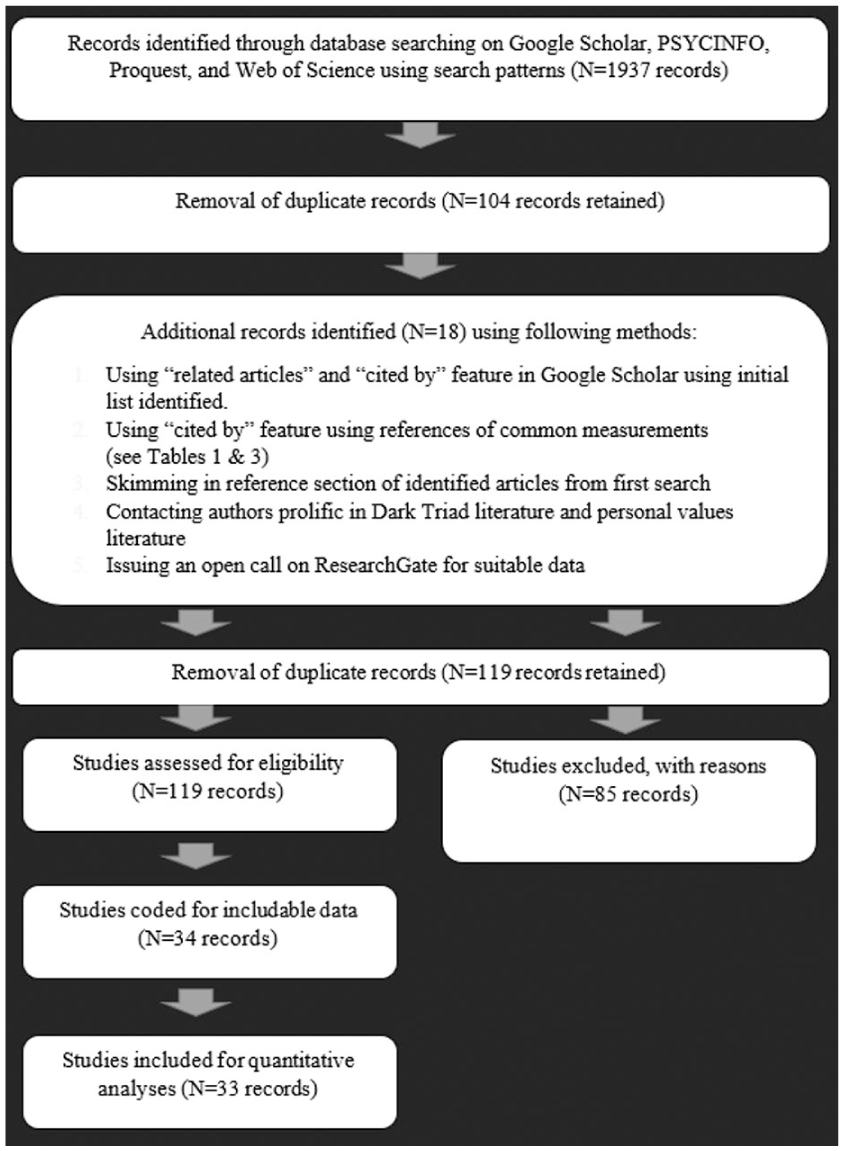
Overview of the meta-analysis search and coding strategy.
The following were the specific keyword stems that were used in the search: (a) Trait-related keywords, (b) Value-related keywords. Boolean Logic operators such as “OR,” and “AND” were used in the search pattern to connect the trait and value-related keywords. An asterisk was appended to keywords to allow for searches of truncated variations of keywords that may be spelled differently (e.g., “psychopathy” vs. “psychopaths”; Robinson & Dickersin, 2002). The asterisk together with variations of keywords were included in the search, along with the original keywords specified, to ensure that all studies examining the specific constructs are captured in the search. An example of the general format for our search pattern was as follows: (“psychopathy” OR “psychopath*”) AND (“values” OR “value*”). Once all search patterns had been exhausted and an initial list was specified, duplicate records input by the researcher in the article list were identified and removed. Database searches for each search pattern were terminated after combing through 30 records consecutively without potentially relevant papers that fit the inclusion criteria.
Next, a search for relevant papers not listed in the first search was conducted, by searching for papers listed under the “related articles” and “cited by” features where available in the database using the identified list of articles. Another search for relevant papers was also conducted by searching for papers listed under the “cited by” feature where available in the database using the common measurements identified based on a pre-review of existing empirical studies conducted by researchers (see Tables 1 and 2). Additionally, one more search for relevant papers was also conducted by skimming the reference sections of identified articles from our primary search.
Further, we identified authors in the fields of the Dark Triad and personal values literature, searched through their available papers and contacted them, along with authors of other identified articles to ensure full coverage and maximize access to unpublished data and/or manuscripts that are also relevant.
Lastly, we issued a call for unpublished findings on online forums and research platforms (e.g., ResearchGate, listservs). We set up a project on ResearchGate, and all identified articles were added as references, where possible, to notify authors about this project, and to provide an open-access list of available studies.
Inclusion and Exclusion Criteria
We included studies that reported correlations between at least one of the Dark Triad traits and one of the personal values/dimensions.
Studies were excluded if they (a) experimentally manipulated value orientations, (b) failed to report the crucial statistics necessary for a meta-analysis (i.e., correlation coefficients and sample size), and the results were not obtainable from the authors, or (c) not written in English (unless all necessary data and information for coding is provided in English or can be obtained from the authors).
Recording Studies During Searches
We summarized the process in Figure 4. We first recorded a list of studies that initially met our criteria. Articles were scanned to determine whether they should be included in the main coding sheet or not. If excluded, a reason was documented along with the article. Studies that required contacting the author for the dataset/further clarifications were first included in the main coding sheet, but documented as to be excluded potentially, should the author not respond by a given date. Authors of studies with missing statistics were contacted for relevant datasets/information. If the dataset was provided, the researchers conducted the needed analyses for coding. All final studies included in the total search are listed in Table 4.
List of Studies Included in Meta-Analysis of Dark Triad and Personal Values.
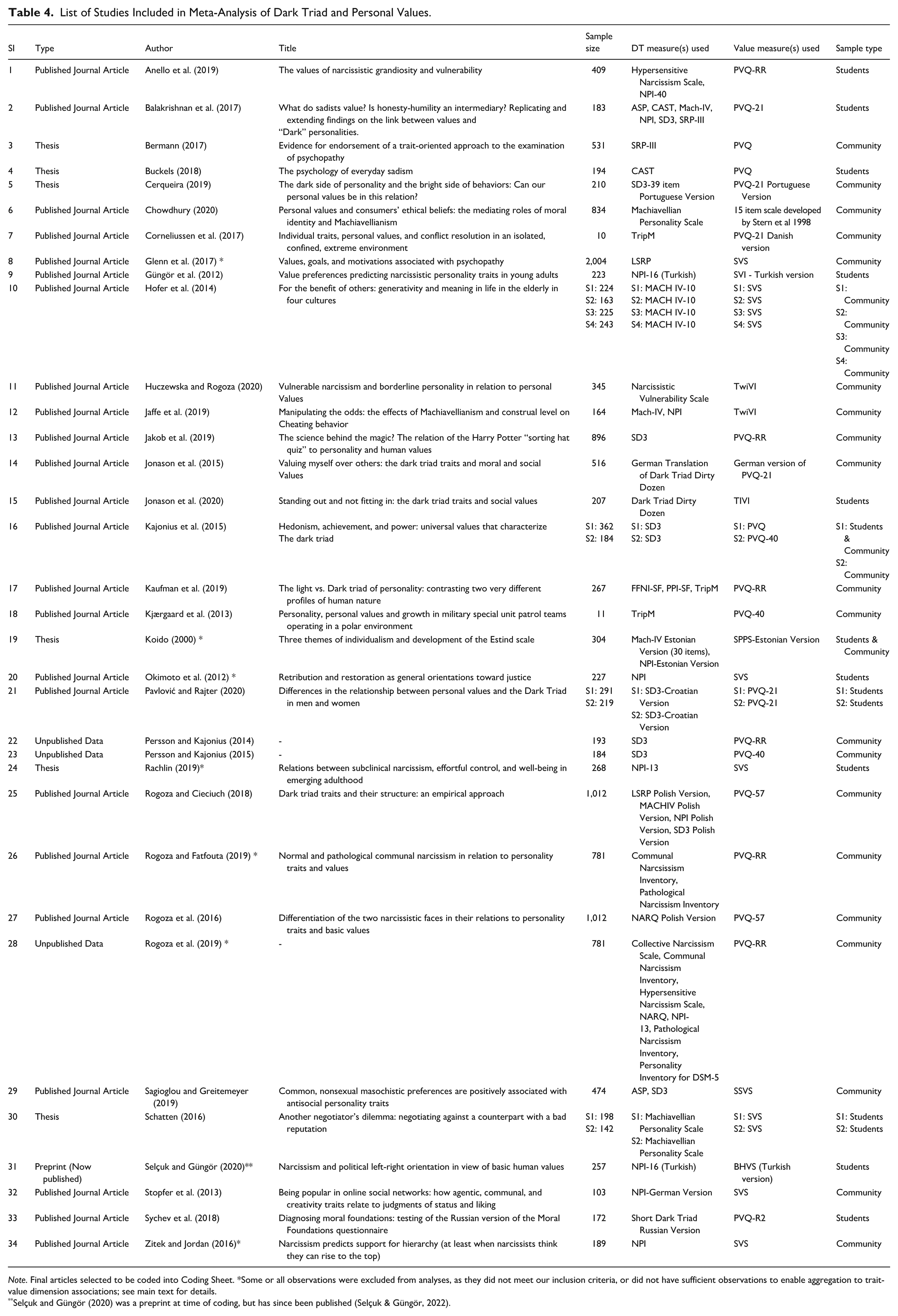
Note. Final articles selected to be coded into Coding Sheet. *Some or all observations were excluded from analyses, as they did not meet our inclusion criteria, or did not have sufficient observations to enable aggregation to trait-value dimension associations; see main text for details.
Selçuk and Güngör (2020) was a preprint at time of coding, but has since been published (Selçuk & Güngör, 2022).
Selection Procedure
During the database search, the title and abstract of the study were scanned to assess eligibility and recorded onto the list of records in the coding sheet if eligible. A total of 104 published articles, unpublished articles, and datasets were initially identified and downloaded from the primary search.
In subsequent search strategies, the title and abstract of potential articles were also scanned to assess eligibility and added to the list, with indication as a secondary source. These searches yielded another 15 published articles, unpublished articles, and datasets.
The remaining 119 studies were then assessed by author VL to determine their suitability for the meta-analysis, and author AF verified the results. All decisions on inclusion and exclusion are documented with reasons in the coding sheet. After all studies were assessed, a final list of 34 studies using 38 samples was derived.
Coding
Data extraction from the identified studies were recorded on a master coding sheet under the “Main Coding Sheet” tab, on OSF. Where available, the following key variables were recorded into the coding sheet: correlations between each Dark Triad and values, the type of scales used, sample demographics, and publication information. In a separate tab titled “DT interrelations coding sheet,” the intercorrelations among the Dark Triad traits were also coded.
During the coding process, if the correlation between a trait variable and a value variable (e.g., psychopathy and self-transcendence) was reported both on its own, and also as a result when split by specified moderators (e.g., relationship when participants are male, and the correlation when participants are female), these results were listed as separate rows. If correlations at the trait-value level and at the trait-value dimension were provided, we coded for both levels of correlations. In the analyses, we chose to retain the trait-dimension correlations, and only if these were not present, we used the trait-values correlations to aggregate and form trait-dimension correlations (see below for detailed explanation). Moderator variables were coded for each study if identified as present.
To ensure similarity in coding perception, author VL pre-tested and conducted coding rounds of three random articles and reached at least 80% agreement before the main coding began. Author VL coded all articles listed, with verification conducted by author AF.
Analysis Plan
We used R/R Markdown (Allaire et al., 2023). We used the R package metafor (Viechtbauer, 2010) to conduct meta-analytic analyses. We meta-analyzed the relationship between Dark Triad traits and personal values, as measured by Pearson’s r. Our primary method of obtaining correlation coefficients and sample sizes was directly from the papers or the authors. If correlations and regression coefficients from multiple regression analyses were both provided in the paper, only the correlations were used, as we are only interested in the associations between traits and values. If a correlation coefficient between a Dark Triad trait and one of the 10 values was not reported, but instead there were reported correlations between a Dark Triad trait and sub-facets of one of the 10 values, then the sub-facet correlations were aggregated to the value level. For instance, Balakrishnan et al. (2017) reported correlations between each Dark Triad trait and Self-Direction Thought and Self-Direction Action—in this case, the two sub-facets were aggregated to form a correlation between each Dark Triad trait and the Self-Direction value). The aggregation was also applied for sub-facets of Dark Triad traits and was broken up by Dark Triad trait and value measurements. For instance, Balakrishnan et al. (2017) measured Narcissism in two different ways which resulted in four different correlation coefficients with Self-Direction Thought and Self-Direction Action. Aggregation here resulted in two correlation coefficients between Narcissism and Self-Direction for each way Narcissism was measured. The aggregation of correlation coefficients was done by converting the reported rs to Fisher’s z, averaging the Fisher’s zs, and converting back to r. Further details of the aggregation procedure can be found in the R Markdown script on OSF.
We also meta-analyzed the relationship between Dark Triad traits and higher-value dimensions. The same basic procedure was followed: if the correlation coefficients between the Dark Triad trait and the higher-value dimension were reported, we used those; otherwise, we aggregated sub-facets of Dark Triad traits and values to higher-value dimension. We also excluded cases where studies did not report correlations between a Dark Triad trait and all of the values under a value dimension that would allow us to aggregate. 2 This resulted in a sample of 765 effects in 33 studies being analyzed.
Before proceeding to modelling, we first corrected our estimates for unreliability by using the Hunter and Schmidt method (Schmidt & Hunter, 2015). 3 For each recorded correlation, we also recorded the reliability of both variables (Cronbach’s alpha) as reported in the article. When we performed the aggregations outlined above, we averaged the reliabilities. We imputed missing reliabilities separately for traits, values and value dimensions by using a sample size weighted average of available reliabilities. For values and value dimensions, we also split the imputation by measurement type (SVS vs. PVQ).
We first fit a multi-level random effects model to meta-analyze the interrelations between the Dark Triad traits. We then fit a multi-level meta-regression model (controlling for the unreliability in estimates that was applied using the Hunter and Schmidt adjustment) separately for each of the 12 relationships between Dark Triad traits and value dimensions. For specificity, we also fitted the model at the value level, the results of which can be found in the Supplemental Materials. We chose a multi-level model as some studies included more than one effect size of the same relationship (e.g., Balakrishnan et al., 2017, measures each Dark Triad trait in two different ways so each correlation between a Dark Triad trait and a value appears twice) and thus effect sizes were not independent; in our models, the individual effect sizes were nested inside studies. 4 For each model, we report the meta-analytical estimate, its standard error, the confidence and prediction intervals, p value, Q p value, as well as the per-level I2, which represents the percentage of total variation due to heterogeneity in that level (Higgins et al., 2003). Forest plots presenting the effect size of each study are produced; where multiple studies contribute more than one effect size estimate, these were averaged within studies based on the marginal variance-covariance matrix of the observed estimates from the multi-level models. Equivalence tests were conducted to examine whether the effect size indicates a meaningful association (Lakens, 2017), where an absolute correlation of at least r = .10 was expected.
Given the expected level of heterogeneity, we also run the Dark Triad traits by value dimension multi-level meta-regression model for each hypothesized moderator. Moderators included trait scale type (individual, e.g., NPI, vs. composite, e.g., SD3), value scale type (SVS vs. PVQ), statistical adjustment used (mean-centered vs. no adjustment), publication status (published vs. unpublished), sample type 5 (community vs. student), age, and gender (captured as % males in a sample). Categorical moderators are coded as treatment contrasts so that the resultant statistics represent the difference between the two levels. For those models, we report the statistics (estimate, standard error, p value and confidence interval) for the moderator to assess its impact. To further validate our moderator analysis, given that our sample sizes tended to be on the lower side, we used metaforest (Van Lissa, 2020) as an additional screening of all moderators. This approach applies a machine learning algorithm, namely random forests, in a meta-analytical framework to prevent overfitting and assess variable importance. The results from that analysis converged with what is presented here; further details are available in Supplemental Materials.
We also examined whether a sinusoidal correlation pattern emerges between the Dark Triad traits and the values. To do this, we used the meta-analytic estimates from the analyses at the trait-values level and applied them to the shape consistency table to derive the sinusoidal values (Boer & Fischer, 2013).
We further tested differences in correlational patterns between Machiavellianism and psychopathy by testing differences between the correlations of the two traits with each value and values dimensions. We used R’s cocor package (Diedenhofen & Musch, 2015) to test these dependent correlations by plugging in the correlation between Machiavellianism and each value/value dimension, between psychopathy and each value/value dimension, and between Machiavellianism and psychopathy. The different correlations had different sample sizes, so, to be conservative, we used the smallest one.
Finally, we tested for the presence of publication bias. Given that we are running multi-level meta-analytic models, most existing techniques (e.g., Trim & Fill, three-parameter selection models) fail to accurately test for this and are not recommended (Rodgers & Pustejovsky, 2021; Shi & Lin, 2019). It has been shown that only a modified version of Egger’s regression test performs reasonably well (Rodgers & Pustejovsky, 2021). We included contour-enhanced funnel plots (Peters et al., 2008) for completeness in the Supplemental Materials. While we find no evidence of publication bias on the basis of the funnel plots, we note that the interpretation of those plots in the context of multi-level models with dependent effect sizes is unclear.
Results
Dark Triad Interrelations
We found moderate-high intercorrelations between the dark triad traits: psychopathy was positively correlated with narcissism (ρ = .39 [.28, .50]), and with Machiavellianism (ρ = .53 [.47, .60]), and Machiavellianism was also positively correlated with narcissism (ρ = .42 [.34, .49]) (see Figure 5).
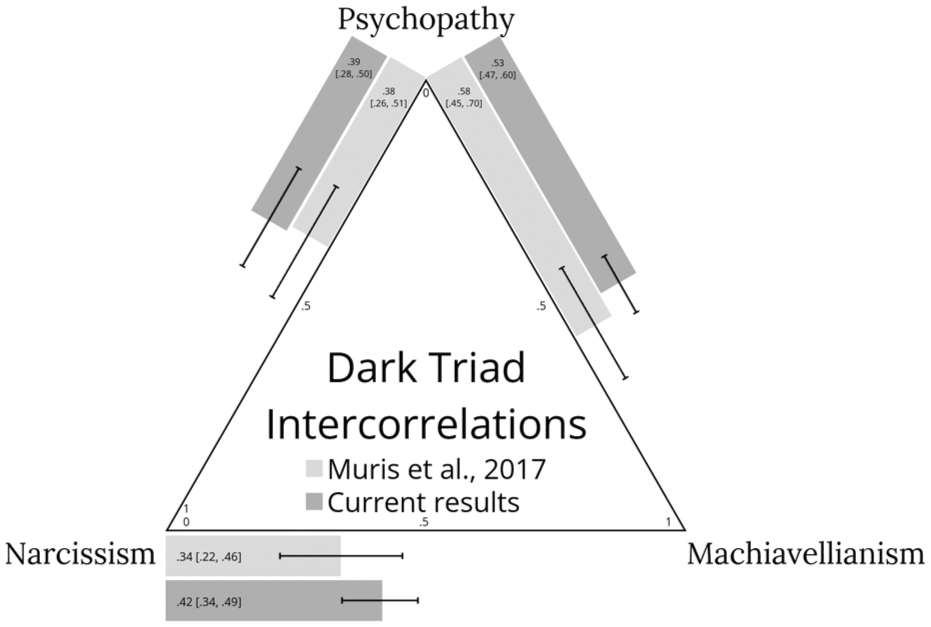
Dark Triad meta-analytic intercorrelations and comparison with Muris et al. (2017).
Dark Triad Traits and Personal Values High-Order Dimensions
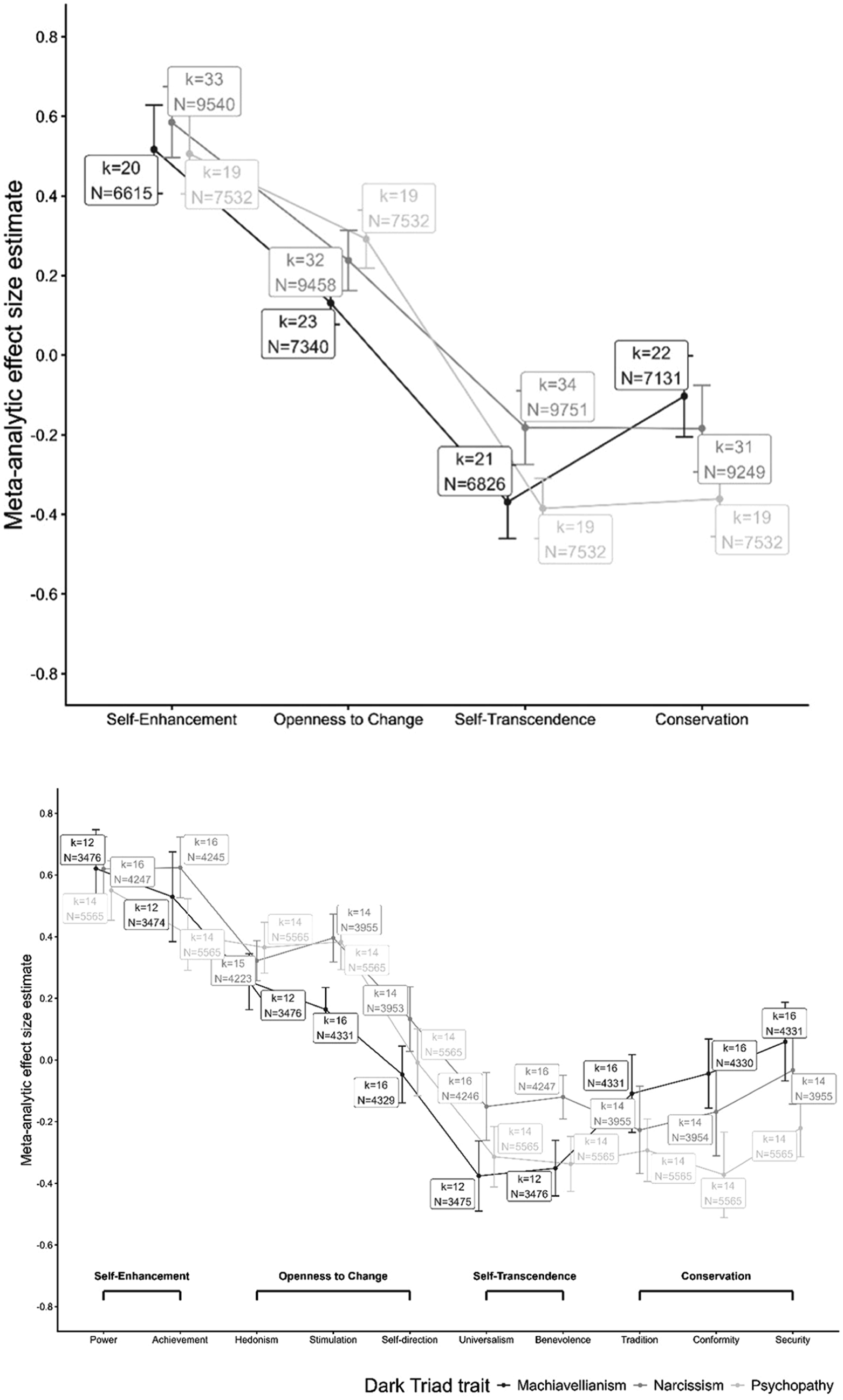
We summarized the meta-analytic associations for values categories and high-order value dimensions against Dark Triad traits and in Figure 6 and Table 5. We produced forest plots presenting the effect size of each study; where multiple studies contribute more than one effect size estimate, these were averaged within studies based on the marginal variance-covariance matrix of the observed estimates from the multilevel models, and the plots are available in our analysis outputs on the OSF.
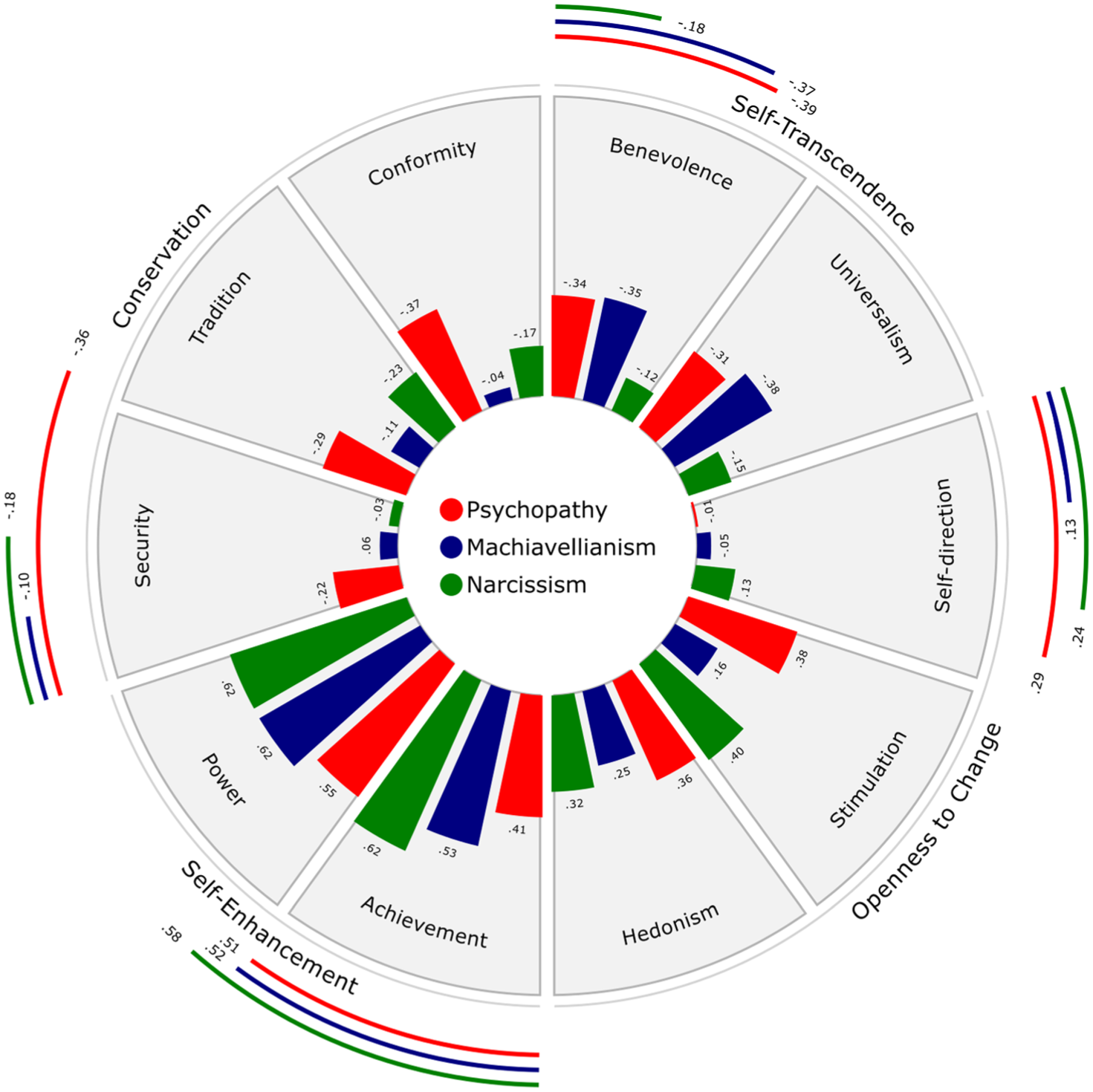
Summary of the meta-analytic estimates across values and value-dimensions.
Meta-Analytic Results for Associations Between the Dark Triad Traits and Personal Values High-Order Dimensions.
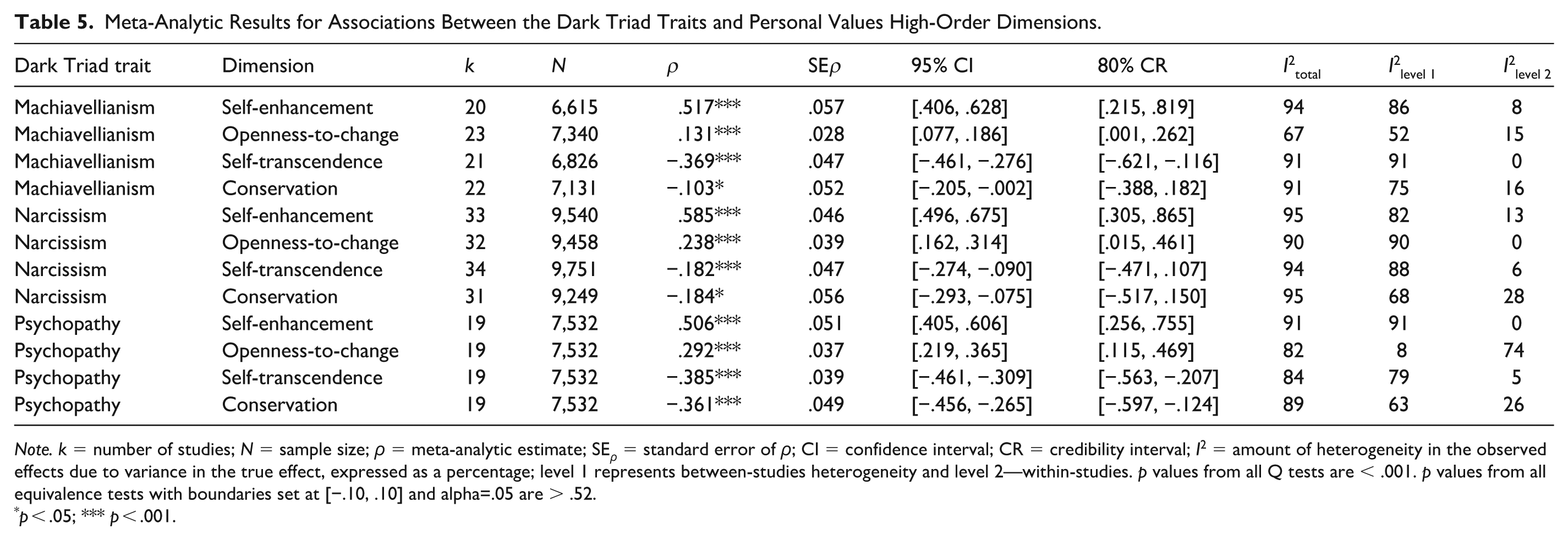
Note. k = number of studies; N = sample size; ρ = meta-analytic estimate; SE ρ = standard error of ρ; CI = confidence interval; CR = credibility interval; I2 = amount of heterogeneity in the observed effects due to variance in the true effect, expressed as a percentage; level 1 represents between-studies heterogeneity and level 2—within-studies. p values from all Q tests are < .001. p values from all equivalence tests with boundaries set at [−.10, .10] and alpha=.05 are > .52.
p < .05; *** p < .001.
Overall, the Dark Triad traits followed a similar pattern in their relationship with each of the personal value dimensions. 6 We found support for Hypothesis 1: psychopathy was positively associated with self-enhancement (ρ = .51 [.40, .61]), and openness-to-change (ρ = .29 [.22, .36]), and negatively associated with self-transcendence (ρ = −.38 [−.46, −.31]), and conservation (ρ = −.36 [−.46, −.26]). We found support for Hypothesis 3: Machiavellianism was positively associated with self-enhancement (ρ = .52 [.41, .63]), and openness-to-change (ρ = .13 [.08, .19]), and negatively associated with self-transcendence (ρ = −.37 [−.46, −.28]), and conservation (ρ = −.10 [−.20, −.00]). We found support for Hypothesis 5: narcissism is positively associated with self-enhancement (ρ = .58 [.50, .68]), and openness-to-change (ρ = .24 [.16, .31]). We also observed negative associations between narcissism and self-transcendence (ρ = −.18 [−.27, −.09]), and conservation (ρ = −.18 [−.29, −.07]).
Circumplex Fit Analysis: Shape Consistency
We examined the sinusoidal pattern for the different traits across the 10 personal values, plotted in Figure 7. We found support for Hypothesis 2 with psychopathy having a SET-shape of −.71 and a CO-shape value of −.32. We found support for Hypothesis 4 with Machiavellianism having a SET-shape of −.89 and a CO-shape of .09.
Circumplex structure associations between Dark Triad traits and personal values.
We also observed a sinusoid correlational pattern for Narcissism emphasizing the self-enhancement versus self-transcendence tension over openness-to-change versus conservation tension (i.e., SET shape consistency: −.82; CO shape consistency: −.13).
A Comparison of Machiavellianism and Psychopathy in Associations with Personal Values
We had competing hypotheses for whether the effects would be stronger for Machiavellianism or Psychopathy (6a and 6b; Table 6). We ran a test for differences in meta-correlations. For openness-to-change and conservation value dimensions, we found support for differences in these correlations comparing Machiavellianism and psychopathy. The correlations between these value dimensions and psychopathy (openness-to-change: r = 0.29; conservation: r = −.36) were stronger than with Machiavellianism (openness-to-change: r = .13; conservation: r = −.10). However, we found no support for differences in the correlations associated with self-enhancement (p = .338) and self-transcendence (p = .207).
Meta-Regression Moderation and Comparisons of Associations Between the Dark Triad Traits and Personal Values.
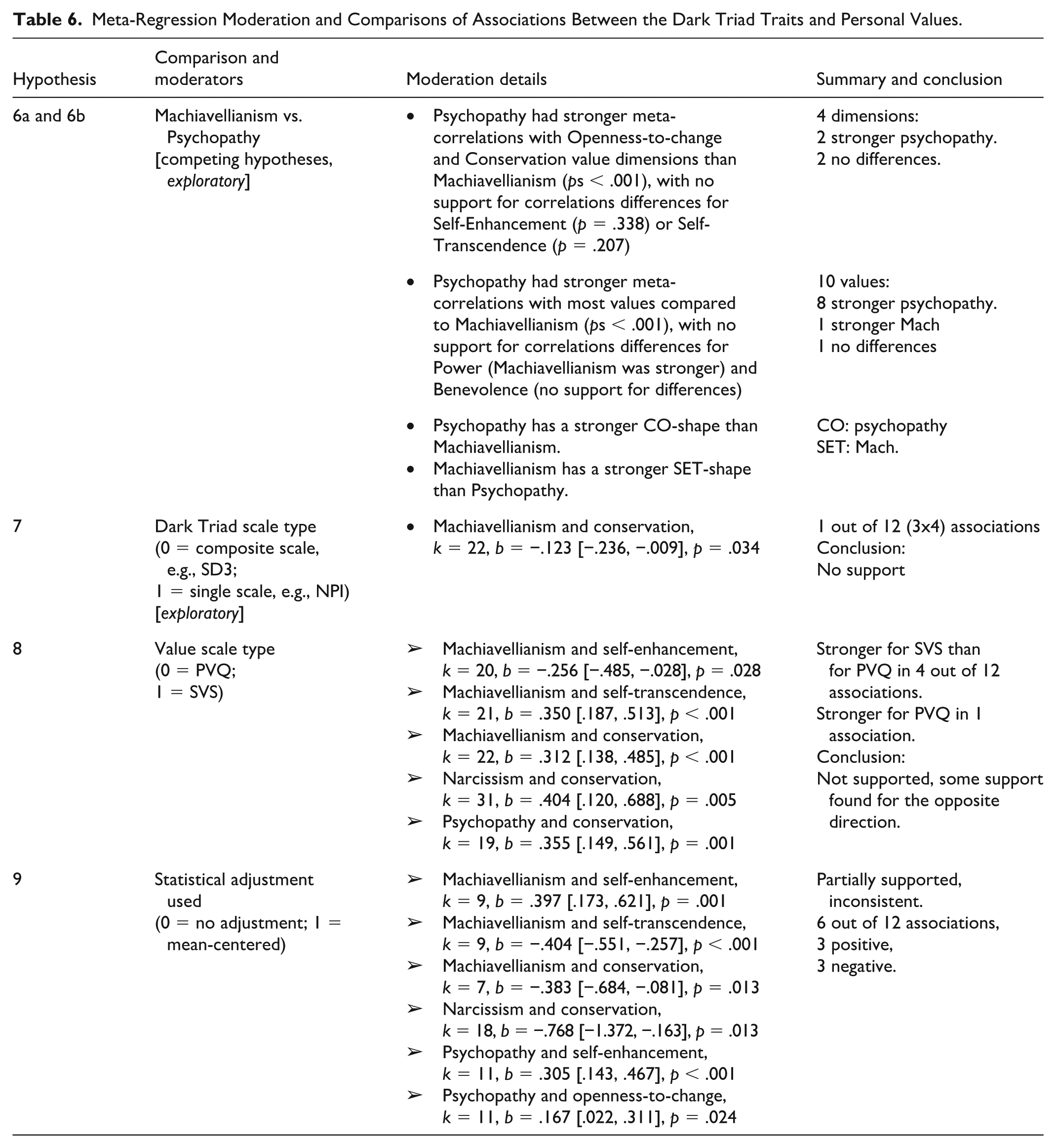
We also conducted analyses at the values level, and found support for Machiavellianism-psychopathy correlations differences for all values (ps < .01), except for benevolence (p = .355), with correlations between values and psychopathy consistently stronger than between the same value and Machiavellianism (except for the correlations with power)—see “Moderator Analysis Results” section in the Supplemental Materials for details.
Machiavellianism was associated with a stronger SET-shape (−.89) value than psychopathy (−.71), whereas psychopathy was associated with a stronger CO-shape value (−.32) than Machiavellianism (.09). These results suggest that Machiavellianism is more aligned with self-enhancement values, reflected in its strong SET-shape alignment, whereas psychopathy shows a clearer, though weaker overall, orientation along the CO axis, characterized by lower conservation and greater openness-to-change. Machiavellianism, by contrast, appears largely indifferent to CO values.
Moderators
We summarized the moderator analyses for the associations between the Dark Triad traits and personal values in Table 6 (hypotheses 7, 8, and 9). We were unable to find any consistent moderation patterns for scale use, with mixed findings. We found no support for composite versus individual trait scale type (1 out of 12), mixed support for value scale type (out of 12: 4 stronger for SVS, opposite to our predictions, 1 stronger for PVQ), and mixed support for the use of statistical adjustments (out of 12: 3 positive, 3 negative).
Single Dark Triad Measures Versus Composite Dark Triad Measures
We explored whether correlations are different for studies that used a single Dark Triad measure (e.g., MACH-IV) compared to studies which used composite Dark Triad measures (e.g., SD3-Mach) (Hypothesis 7; Table 6). We found some support for only one of twelve possible moderations: the relationship between Machiavellianism and Conservation (b = −.123 [−.236, −.009], p = .034). We concluded this as overall lack of support for Hypothesis 7.
PVQ Values Measure Versus SVS Values Measure
In Hypothesis 8, we hypothesized that the correlations are stronger for studies using the PVQ, than for studies using the SVS. Contrary to our hypothesis, we found that four associations were stronger using SVS: Machiavellianism with self-transcendence, Machiavellianism with conservation, Narcissism with conservation, and psychopathy with conservation. Only the moderation for the association between Machiavellianism and self-enhancement was reported to be stronger for SVS than for PVQ (b = −.26 [−.49, −.03], p = .028). Thus, we concluded no support for Hypothesis 8, with partial support for an opposite effect.
Statistical Adjustment for Values Scales (Mean Centering)
In Hypothesis 9, we expected that correlations differ between studies that use mean centering compared to studies that do not. We found support for moderation in the following relationships: Machiavellianism with self-enhancement, Machiavellianism with self-transcendence, psychopathy with self-enhancement, and psychopathy with openness-to-change. In these relationships, studies that used a mean-centering statistical adjustment reported stronger correlations than studies that did not. We take this as inconsistent mixed support for Hypothesis 9.
Discussion
We examined meta-analytic associations between the Dark Triad traits—psychopathy, Machiavellianism, and narcissism - and personal values. Using a multi-level meta-analysis to synthesize the effects from studies conducted from 2000 to 2020, we hypothesized and found empirical support for meaningful and unique personal values patterns of the Dark Triad. We found that the Dark Triad traits tended to be positively associated with self-enhancement and openness-to-change value dimensions, and negatively associated with self-transcendence and conservation value dimensions. Sinusoidal analyses further revealed that the Dark Triad traits had stronger associations with the SET shape than the CO shape, indicating greater tension between self-enhancement and self-transcendence value dimensions than with the openness-to-change and conservation value dimensions. Despite the broad overlap in how the Dark Triad traits are associated with values, we observed subtle differences between the three traits toward specific values. Moderators of interest did not indicate any consistent meaningful differences, which suggests that the traits-value relationships are fairly stable.
Theoretical Implications
Distinguishing the Dark Triad Facets
This meta-analysis serves as a timely summary of the literature on Dark Triad traits and personal values to offer a new perspective on how we may consider where the Dark Triad traits may overlap in conceptualization, and where they uniquely differ. Despite extensive research seeking to address the theoretical distinctiveness of the dark triad personality traits, researchers remain in contention with current explanations as to how these personality traits may differ. Methodologically, such work sought to consider the bivariate correlations between each Dark Triad trait (Muris et al., 2017), differentially mapped onto other personality models (Lee & Ashton, 2014; Kaufman et al., 2019), or via multilevel analysis to identify latent constructs (Schreiber & Marcus, 2020). We went beyond this work to show that individual’s personalities may differ on the basis of their long-term motivations as reflected in their pattern of associations with personal values structures.
Our findings illustrate that the dark personality traits have similar value orientations: positive associations with self-enhancement and openness-to-change value dimensions and negative associations with self-transcendence and conservation values. However, their differences lie in how strongly they relate to each value dimension, which suggests that those having the different traits vary in their priorities of the long-term motivational goals. While they share a common motivation with strong positive associations with self-enhancement, the Dark Triad traits have associations with openness-to-change value dimension (which includes the desire for enjoyment, adventurous experience, and the agency to act) that differ in strength. Individuals high in psychopathy and narcissism seem more driven by the nature and quality of the experiences they have, yet those high in Machiavellianism seem less motivated by experiences and instead focus more exclusively on self-enhancement. Our findings confirm past findings on these traits’ focus on gaining power and self-benefit, and further reveal differences in their need for hedonic and novel experiences. Our findings may be interpreted as challenging previous assumptions that the Dark Triad traits are uniformly driven by self-indulgence and pleasure (James et al., 2014; Kajonius et al., 2015). This may serve as a potential first step in disentangling and distinguished between the Dark Triad traits.
An intriguing question that arises here is whether individuals who report having high levels in all three traits may face a tempering in their extreme desire for change, as compared to people who are high in narcissism and or psychopathy but are low in Machiavellianism. This points to a worthwhile examination of how motivational underpinnings may vary when the Dark Triad is considered from a combinatorial perspective (Garcia & Moraga, 2017; Jonason & Webster, 2010; Jones & Paulhus, 2014; Miller et al., 2019).
We observed another key difference in the associations between Dark Triad traits and values. Among the three traits observed, psychopathy accounted for having the strongest relationship with openness-to-change, self-transcendence, and conservation. Self-enhancement was the exception, in being most strongly related to narcissism. These findings suggest that high levels of trait psychopathy might promote stronger motivations overall, which might in turn lead to a greater tendency to act on those motivations. In comparison, Machiavellianism and narcissism seem to hold lower motivations, which might result in a lower tendency to act on those motivations.
Additionally, we found that the negative relationship between psychopathy and self-transcendence and between Machiavellianism and self-transcendence was approximately twice as strong as that between narcissism and self-transcendence. This distinction suggests that whereas those higher on narcissism may show less concern for the impact of their actions on others, individuals higher on psychopathy and Machiavellianism traits may exhibit a stronger aversion to considering others’ welfare. These findings on the specific motivations associated with the Dark Triad suggest the importance of recognizing the subtle differences in their motivations.
Exploring the Social Value of Personal Values
This study contributes to a deeper understanding of the relationship between personal values and personality traits, building on previous meta-analyses that highlight the consistent relationships between personality structures and the personal values framework (Fischer & Boer, 2015; Parks-Leduc et al., 2015). By exploring how personal values can outline unique motivational profiles, our research contributes to added understanding of personality distinctions. Previous studies have primarily focused on the Big Five personality traits to illustrate the brighter side of motivational goals (Fischer & Boer, 2015; Parks-Leduc et al., 2015). In contrast, our work sheds light on the dark side of motivation, examining the Dark Triad traits over two decades.
This raises an intriguing question: can we steer the motivations of individuals with high levels of Dark Triad traits toward more prosocial behavior? Our findings indicate that individuals with Dark Triad traits exhibit tension with self-transcendence values but less so with conservation values, suggesting they might be more receptive to shifts toward conservation-oriented values. This opens up promising research avenues on whether individuals high in Dark Triad traits can be supported to follow prosocial directions by emphasizing values that they are more open to. Additionally, there is interest in how these individuals might engage in ambiguous prosocial behaviors, such as unethical prosocial actions (Mo et al., 2022; Umphress et al., 2010) or telling white lies (Erat & Gneezy, 2012) for a perceived greater good.
Moreover, our research points to the complex relationship between the Dark Triad traits and personal values in various contexts, including potential benefits in extreme situations. For example, our dataset included studies on the personality and values of military and expedition professionals (Corneliussen et al., 2017; Kjaergaard et al., 2013), suggesting that individuals who differ from typical trait-value associations may be inclined toward certain professions. For instance, in medicine, despite the profession’s ethos of “Do no harm,” these individuals may navigate ethical dilemmas where causing harm is necessary for the greater good (Andiappan, 2023; Goranson et al., 2020; Margolis & Molinsky, 2008), highlighting the nuanced interplay between Dark Triad traits, personal values, and professional roles.
Interplay of Dark Triad Traits and Personal Values
In delineating different combinatorial relationships between traits and values, we hope that scholars would take this as a starting point to consider how traits and values interplay in predicting outcomes. While research in these separate domains have focused on the contributions toward common outcomes such as ethical behaviors that traits and values have individually (Feldman et al., 2015; Feldman et al., 2017), we still know very little about how they would compare against each other or interact with one another to amplify the likelihood an individual is to act in certain ways.
In our study, we theorized the existence of potential moderators that could affect the relationship between Dark Triad traits and values. Based on suggestions that different instruments may tap into varying facets and capture different variance of the same construct (Parks-Leduc et al., 2015; Watts et al., 2017), we considered how composite vs. individual scales used to measure the Dark Triad, and the use of SVS vs. PVQ would affect the strength of relationships observed. We did not find support for meaningful differences in the use of Dark Triad measurements, despite the ongoing debate on the value in using composite vs. individual scales to capture each of the Dark Triad traits. The lack of influence on the types of measurements used across the Dark Triad is suggestive that these relationships are a) stable enough to resist potential distortion due to measurement error, and or b) that the different types of measurements used in capturing Dark Triad traits seem to adequately capture the essence of each construct.
Further, contrary to our Hypothesis 8, where we expected the use of PVQ to lead to stronger trait-value relationships because the use of more concrete examples in this measurement than the SVS should mean that the PVQ is capturing more variance in each construct, and therefore a stronger relationship accordingly. Instead, we found more support for the use of SVS leading to some trait-value relationships being stronger. We take this finding to potentially mean that in measuring motivational values, what may matter is the broad intention underlying what an individual may consciously be aspiring toward, because motivations are considered best on an abstract level. But when attempts are made to measure such values on a concrete level, complexities come into play which fail to adequately tap into the essence of what motivational values represent. Lastly, our and other meta-analyses on trait-values relationships are a promising start, but what remains uncertain is how these trait-values relationships lead individuals to behave and act. Rather than focusing on purely correlational research designs examining the relationship between trait and values, it may be worthwhile to consider how traits and values interplay to promote specific types of social behaviors.
Limitations and Future Directions
Our study offers an updated examination of the interplay between the Dark Triad personality traits and personal values, yet it is important to acknowledge certain limitations.
In our coverage of the literature and through the peer review process, we recognized that there are still gaps in the conceptual clarity and the measurement of traits and values. This results not only in the conflation of values and traits, but also in measurements that blur the conceptual distinction between the two. Parks-Leduc et al. (2015) noted that there are still “some researchers (who) do not make the distinction between personality traits and personal values, using the terms largely interchangeably” (p. 3) and that “some researchers do not clearly distinguish between traits and values, some view them as distinct and separate constructs, and some view them as loosely related components at different levels of personality” (p. 4). Regardless of where one stands in this debate, it is important to systematically assess the associations between the constructs, yet the conceptual debate also impacts the methodology. We noticed that some of the scales aiming to measure traits sometimes form questions that conflate them with values. For instance, the Levenson Self-Report Psychopathy Scale (Levenson et al., 1995) has items that ask about long term motivational goals (e.g., “. . . is my important goal”; “my main purpose in life is. . .”) more conceptually aligned with the definition of values than of traits. Future research may aim to distinguish, conceptually and empirically, between traits and values by systematically reviewing traits and values definitions and measures to address possible conflation and overlap to ensure that measurement is aligned with definition and theory.
Our research focused solely on the correlational links between these traits and values without delving into causality. Thus, we cannot ascertain whether Dark Triad traits lead to the formation of certain values or if motivational goals drive individuals to behave in ways that align with their inherent traits. This leaves the causal relationship between personality traits and values unexplored, inviting future research to investigate how values might trigger darker behaviors or how these traits might influence the prioritization of values such as openness-to-change and self-enhancement over time.
We were unable to examine the relationship between personal values and Sadism, often considered a fourth dimension of the Dark Triad/Tetrad (Buckels et al., 2013; Johnson et al., 2019; Meere & Egan, 2017). Despite recent studies incorporating Sadism into the Dark Triad/Tetrad framework (Bonfá-Araujo et al., 2022; Book et al., 2016; Moshagen et al., 2018; Tran et al., 2018), our analysis did not include enough data to meaningfully explore how Sadism interacts with personal values. This gap highlights a research opportunity to further examine how Sadism, which occupies a unique position within the dark personality spectrum, is associated with how individuals relate to others, seek pleasure, view themselves, and conform to societal norms. Given our current understanding of Sadism, it is plausible that individuals high in Sadism share the Dark Triad’s strong association with self-enhancement values. However, they may show a different pattern of association with values, potentially having a stronger link to both conservation and openness-to-change values. This suggests a distinct inclination among those high in Sadism to eschew societal expectations and pursue pleasure more freely, which could uniquely distinguish Sadism from the other traits of the Dark Triad.
Our study aimed at assessing the associations between the Dark Triad traits and personal values. We examined traits in the aggregate and yet due to insufficient number of samples for the sub-facets we were unable to examine the possible complex nuances where unique facets of a Dark Triad trait may differ in their associations with values. With time, we expect there will be more studies that would allow for such an analysis and then future research may attempt to uncover lower-level associations and potentially contribute to expanded theory of the conceptualization of narcissism as a complex personality trait. Further studies would also allow for clearer theory and hypotheses to address unclear findings regarding the different trait facets.
Our meta-analysis covered a sample of studies that used cross-sectional designs to assess the relationship between Dark Triad trait and values. However, with ongoing work suggesting the dynamics and potential for change for personality (and values) over time (Bardi et al., 2009; Daniel et al., 2021; Sagiv et al., 2017), a question is whether and when these relationships may be stable or change over time. It would be worth testing for such relationships using longitudinal designs, or how certain life trajectories may be influential in accelerating change in specific trait-value relationships over others. For instance, it may be interesting to consider whether weaker trait-value relationships are more susceptible to distortion based on situational factors over time. In the case of individuals who experience high levels of narcissism, it may be the case that their value profiles may change depending on how well they fit with the values that people in their social environment have. If they are seeking to gain approval from others who value self-transcendence values, then perhaps narcissistic individuals may be more goal directed toward these types of values, thus strengthening the relationship between narcissism and self-transcendence.
Conclusion
This meta-analysis mapped the relationship between Dark Triad personality traits and personal values, revealing the diverse motivational orientations of individuals with these traits. To further our understanding of the motivations behind the Dark Triad, researchers are encouraged to explore the unexpected interplay of personalities and values. Additionally, consideration should be given to the specific contexts in which individuals with high levels of Dark Triad traits and prosocial motivations are most likely to emerge.
Supplemental Material
sj-docx-1-psp-10.1177_01461672261426619 – Supplemental material for Values and the Dark Side: Meta-Analysis of Links Between Dark Triad Traits and Personal Values
Supplemental material, sj-docx-1-psp-10.1177_01461672261426619 for Values and the Dark Side: Meta-Analysis of Links Between Dark Triad Traits and Personal Values by Nikolay B. Petrov, Velvetina Lim, Adrien Fillon and Gilad Feldman in Personality and Social Psychology Bulletin
Footnotes
Acknowledgements
We thank all the authors who sent us information, data, and code, to help make this meta-analysis possible. We would also like to thank Dougal Wright for his invaluable research assistance.

Author Contributions
Funding
The authors disclosed receipt of the following financial support for the research, authorship, and/or publication of this article: Adrien Fillon has received funding from the European Union’s Horizon 2020 Research and Innovation Programme under Grant Agreement number 857636—SInnoPSis—H2020-WIDESPREAD-2018-2020/H2020-WIDESPREAD-2018-04, and the European Union’s Horizon Europe Research and Innovation Programme under grant agreement No. 101079196 (Twinning for Excellence in Management and Economics of Research and Innovation [TWIN4MERIT]). These funded his postdoctoral position during the time he contributed to this project.
Declaration of Conflicting Interests
The authors declared no potential conflicts of interest with respect to the research, authorship, and/or publication of this article.
Rights
CC BY or equivalent license is applied to the AAM arising from this submission. (clarification)
Supplemental Material
Supplemental material is available online with this article.
Notes
References
Supplementary Material
Please find the following supplemental material available below.
For Open Access articles published under a Creative Commons License, all supplemental material carries the same license as the article it is associated with.
For non-Open Access articles published, all supplemental material carries a non-exclusive license, and permission requests for re-use of supplemental material or any part of supplemental material shall be sent directly to the copyright owner as specified in the copyright notice associated with the article.
