




Abstract
The self-insight motive (SIM; also known under the label self-assessment motive) describes the dispositional tendency to strive for accurate self-knowledge. The current research includes five multimethodological studies (total N = 3667) that comprehensively investigated the SIM’s nomological network, its antecedents, and cognitive-behavioral consequences, comprising longitudinal, round-robin, and population-representative data. Among the personality correlates of the SIM were curiosity, the intimacy and self-improvement motives, private self-consciousness, narcissistic admiration, and openness to experience. Further, the SIM was more pronounced among younger and highly educated people. A key environmental antecedent of the SIM was the instability of life circumstances, in the sense that the motive became stronger after life circumstances had changed. Concerning the cognitive-behavioral consequences, the results suggest that the SIM fosters feedback-seeking behavior. Nevertheless, the motive was not linked to more accurate self-perception across three studies. We discuss several reasons for this unexpected finding.
Plain language summary
The focus of this research was the self-insight motive (SIM), which is all about wanting to know oneself better. The research involved five studies and a large number of participants (3667 in total). The researchers looked at how the SIM is connected to demography and different personality traits, at whether the SIM gets stronger when significant changes happen in a person’s life, and at the behaviors that people with a strong SIM tend to do. It turns out that younger and more educated people tend to have a stronger SIM. Concerning associated personality traits, people tend to have a stronger SIM, when they are generally more curious, want to improve themselves, reflect a lot about themselves, want to be admired, and when they are open to new experiences. Interestingly, when life situations of a person change, the SIM is likely to become stronger. One thing the SIM does is make people seek feedback about themselves. However, surprisingly, it doesn't necessarily make them any better at knowing themselves accurately.
Keywords
An investigation into individual differences in the self-insight motive
People engage in various activities to find out about their personality, abilities, internal states, or—quite generally—about themselves. For example, they use smartphone apps to track their mood, take personality or intelligence tests online, ask friends how they come across, seek feedback on their strengths and weaknesses from professional coaches, and so forth. Not only is the striving for accurate self-knowledge omnipresent in everyday life, but it is also a major theme in prominent psychological theories. For example, Festinger’s (1954) social comparison theory posits that the main reason people engage in social comparisons is to obtain accurate self-knowledge. According to Kelly’s (1955) personal construct theory, people act like naïve scientists who are eager to make correct inferences about the world—including themselves. Bem’s (1972) self-perception theory is built on an innate drive to continuously seek and update self-knowledge, and Rogers’ (1951, 1967) self-actualization theory stresses the importance of self-exploration for becoming a fully functioning person.
In theories on motivated self-perception, the striving for accurate self-knowledge is typically referred to as the self-assessment motive (e.g., Baumeister, 1997; Leary, 2007; Robins & John, 1997; Sedikides & Strube, 1997) and plays a prominent role as one of four major self-evaluation motives. The others are the self-enhancement motive, which describes the desire to see oneself positively; the self-verification motive, which aims at confirming one’s current self-image; and the self-improvement motive, which denotes the desire to improve one’s traits, abilities, health, or well-being. Together, these four motives shape how people select self-relevant information, draw inferences about themselves and create their self-views and self-concept (see, e.g., Sedikides & Strube, 1997). A problem with the term self-assessment motive, however, is that it is not the assessment process itself but insight into oneself that is the main incentive behind the motive. Accordingly, we suggest to rename the self-assessment motive into the self-insight motive (SIM) and define it as the desire to have true and accurate knowledge about oneself. Most of the social psychological research was experimental and investigated the conditions under which the SIM becomes relevant (Gregg, Sedikides, & Gebauer, 2011; Trope, 1979, 1980). Yet in this literature, investigations of individual differences are rare.
There is one exception. Gregg, Hepper, and Sedikides (2011) developed two-item self-report measures for each of the four self-evaluation motives and found that their SIM scale was positively related to the self-improvement motive, self-esteem, life satisfaction, and emotional stability. Besides this initial study, there are further largely unconnected lines of research on introspection that measure the core aspect of the SIM (i.e., the desire to find out the truth about oneself) but used different labels for the construct (need for self-reflection, Grant et al., 2002; Intrapersonal Curiosity, Litman et al., 2017; Self-Curiosity Attitude and Interest, Aschieri & Durosini, 2015).
Thus, research from different traditions using different labels for their constructs agree that the SIM is a relevant motive and that individuals differ in the strength of the SIM. Yet, which personality dispositions and demographic background characterize individuals with a strong SIM? What are the antecedents of a strong SIM? And what are the behaviors that result from it? Does a strong SIM go along with better self-knowledge? We addressed these questions in the current research.
A conceptual model on the antecedents and consequences of the SIM
A conceptual model in Figure 1 summarizes all substantive research questions. The model makes assumptions about the demographic and personality correlates, antecedents, and consequences of the SIM. It suggests that the SIM is related to personality aspects from five broad domains (for details see below) and includes demographic characteristics in an exploratory fashion. In terms of antecedents, it suggests that a strong SIM resides from the experience of instability in one’s life circumstances. Finally, the model suggests that the SIM has specific cognitive-behavioral consequences: People with a strong SIM should be more inclined to seek accurate feedback about themselves, and, as the SIMs’ main incentive, should have more accurate perceptions of themselves. We will describe each of the model’s components in the following. Conceptual Model on the Assumed Antecedents and Consequences of the Self-Insight Motive. Note. Exploratory describes the constructs for which the literature indicated contradictory expectations and the constructs that were included for comprehensiveness without explicit assumptions; For constructs that are written in bold and black, a relationship with the SIM was consistently found in the five studies of the present research, constructs that are written in gray were not, or only weakly, related to the SIM in the present research.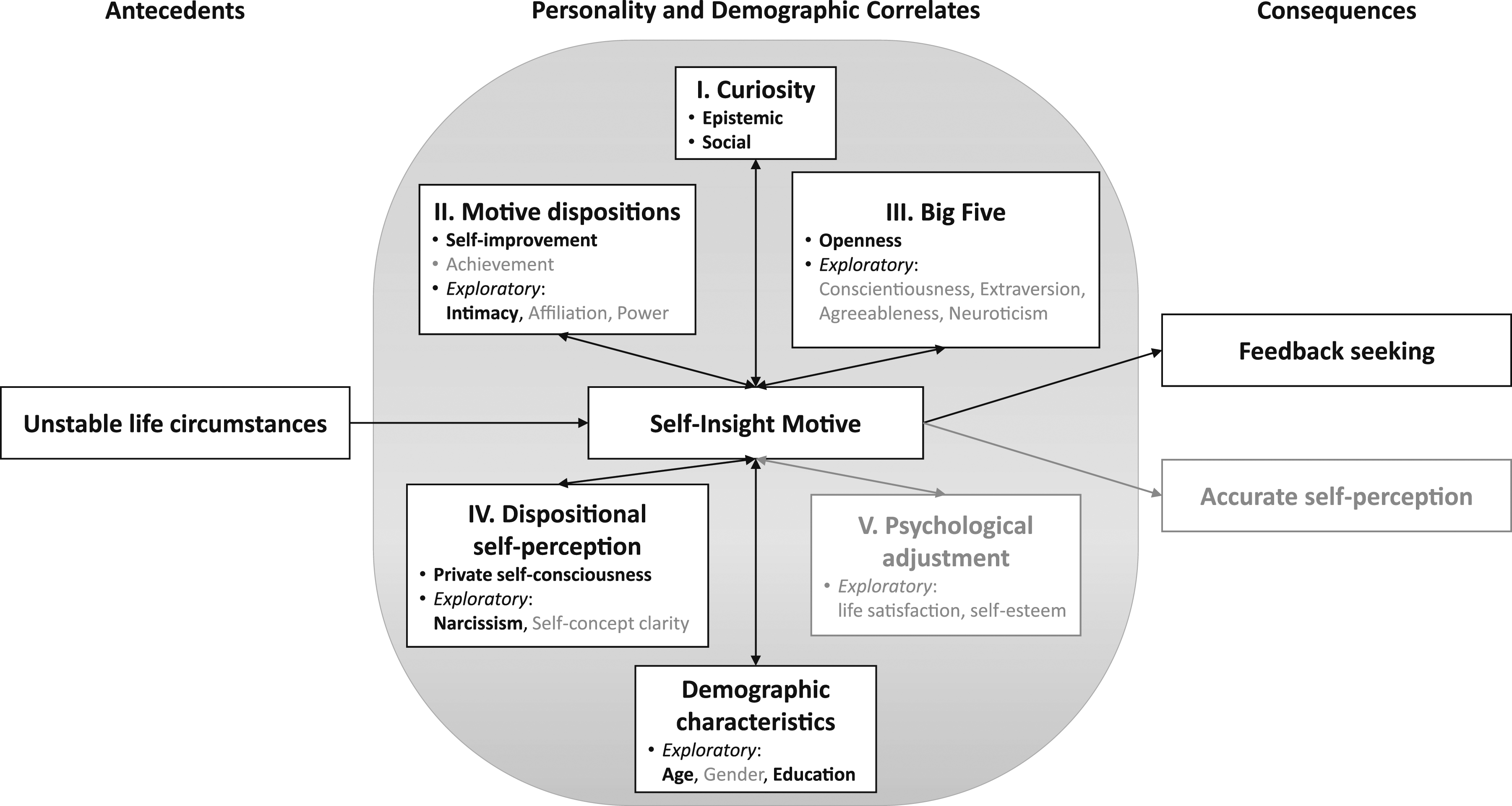
Personality and demographic correlates of the SIM
We focused on constructs from five different domains (see Figure 1), which we subsumed under the umbrella term of personality correlates. Conceptually, the SIM represents a motive that can be considered a form of curiosity directed toward the self. We thus considered correlates from the domains of motive dispositions, curiosity, and dispositional self-perception. To locate the SIM in the coordinate system of basic personality traits, we also investigated correlations with the Big Five. Finally, because self-insight if often considered highly important for mental health and well-being, we considered psychological adjustment.
Concerning curiosity, we expected the SIM to be positively linked to epistemic curiosity, which is the desire to obtain new knowledge about the world (Litman & Spielberger, 2003) and to social curiosity, which describes the desire to acquire information and knowledge about other people (Renner, 2006). If one has a particular interest in how people think, feel, or behave, then one is probably also interested in one’s own thoughts, feelings, and behaviors. Such positive links would be in line with initial research (Durosini et al., 2018; Litman et al., 2017).
Concerning motive dispositions, the SIM should be positively linked to the self-improvement motive. If one wants to improve aspects of the self, it is necessary to first take stock and realistically appraise one’s strengths and shortcomings (Sedikides & Skowronski, 2000). In line with this reasoning, Gregg, Hepper, and Sedikides (2011) indeed reported a positive correlation between their SIM scale and a self-developed measure of the self-improvement motive. Furthermore, we considered the achievement, affiliation, intimacy, and power motives, which are among the most basic human motive dispositions (McClelland, 1987). As the desire for self-improvement is a key aspect of the achievement motive (Pang, 2010), a positive relationship can also be expected between the SIM and the achievement motive. Finally, because the SIM is a motive and motive dispositions are often partly overlapping (i.e., they all share the core of “wanting” or “preventing” particular experiences), correlations with other motive dispositions (e.g., power, affiliation, and intimacy) seemed likely.
A first potential correlate from the domain of dispositional self-perception is private self-consciousness, which consists of the two subfacets self-reflection (the tendency to intensely reflect on the self) and subjectively perceived self-insight (Grant et al., 2002). Self-reflection can be considered a cognitive-behavioral consequence of the SIM, in the sense that it can offer a very straightforward way to find out about oneself (Grant et al., 2002). The SIM should therefore be positively linked to self-reflection. The relationship between the SIM and subjective perceptions of self-insight is less clear, and thus, we investigated it in an exploratory manner.
A further potential correlate from the domain of dispositional self-perception is self-concept clarity (Campbell et al., 1996). It could be argued that people with a strong SIM seek information about themselves and are thereby able to attain a clear self-concept. This would imply a positive link between the SIM and self-concept clarity. Yet, alternatively one could argue that given the genuine complexity of human beings, the better people understand themselves, the more confusing, contradictory, and nuanced the picture might become. Moreover, one could argue that individuals with an unclear self-concept may have a pronounced tendency to seek information about themselves to clarify their identity. In both cases, a negative link between the SIM and self-concept clarity would result. Therefore, we chose to investigate this link in an exploratory fashion.
A final correlate from the domain of dispositional self-perception is grandiose narcissism. Two competing hypotheses can be derived from the literature. First, one could argue that because narcissists strongly favor positive feedback about themselves (Morf et al., 2011), they are not particularly interested in realistic feedback, which is often less flattering. In this case, the overblown self-enhancement motive would override the desire to find out the truth about the self, and a negative relationship between narcissism and the SIM would result. Alternatively, one could argue that due to their egocentrism (Emmons, 1987), narcissists strongly value any novel information about themselves and that, due to their unrealistically positive self-views (Dufner et al., 2019), they expect most information to be positive anyway. In this case, the correlation between narcissism and the SIM would be positive.
Concerning the Big Five, openness is defined by high levels of curiosity and related to intellectual curiosity, including curiosity into oneself (John & Srivastava, 1999). Accordingly, the SIM should be positively linked to openness. Initial research supported this possibility (Aschieri et al., 2020; Gregg, Hepper, & Sedikides, 2011; Litman et al., 2017).
A final question in this context was whether the SIM would be related to psychological adjustment. Because the SIM is an approach-oriented motive, positive relationships with psychological adjustment could be expected, as such relationships have been shown for other approach-oriented motive dispositions (e.g., Schönbrodt & Gerstenberg, 2012). Furthermore, if the SIM goes along with high levels of either actual or perceived self-insight, there could be a positive effect on adjustment, as self-insight is often considered adaptive (see, e.g., Jahoda, 1953), although the empirical support for this claim has not been conclusive (see, e.g., Humberg et al., 2019). On the other hand, it could also be argued that an intense focus on the self might distract people from the external world and lead to maladaptive spirals of rumination. Initial findings on links with the SIM have been inconsistent (Durosini et al., 2018; Grant et al., 2002; Gregg, Hepper, & Sedikides, 2011; Litman et al., 2017), which can most likely be explained by the different scales that have been used to assess the SIM (i.e., they varied in evaluativeness).
In addition, we aimed to find out whether there are certain demographic characteristics of people with a strong SIM. Since we had not made any explicit assumptions about such relationships a-priori, we investigated the correlations of the SIM with gender, age, and education in an exploratory fashion.
Unstable life circumstances as an environmental antecedent of the SIM
Major life events (e.g., marriage, unemployment, or the death of a close relative) often destabilize people’s everyday lives (Turner & Wheaton, 1997). This reflects a “discontinuity in a person’s life space of which he is aware, and which requires new behavioral responses” (Hopson & Adams, 1976, p. 24). The readjustment process (Brandtstädter & Lerner, 1999; see also Rogers, 1951) involves a critical re-evaluation of one’s life situation that often goes along with changes in the self-concept. For example, research has shown that life events, such as changing schools (Cairns et al., 1990), starting a job (Reitz et al., 2020; van der Velde et al., 1995), or moving abroad (Huttemann et al., 2015) go along with changes in self-esteem and that a variety of life events can affect people’s possible selves (Barreto & Frazier, 2012). Unstable life circumstances should therefore be an environmental antecedent of the SIM and positively predict its strength.
Feedback-seeking behavior as a consequence of the SIM
Generally, an approach-oriented motive results in behavior that is instrumental for attaining the incentive that satisfies it (Toates, 1994). The SIM is satisfied by novel accurate information about the self, and a very direct way of attaining such information is by actively seeking feedback (e.g., Gallrein et al., 2019). Feedback can be obtained by asking one’s peers how they see oneself or by taking personality or performance tests. Characteristic for the SIM is that the sought feedback is expected to be highly accurate and diagnostic (Brown & Dutton, 1995; Sedikides, 1999). In organizational contexts, for example, seeking feedback is a widespread strategy among employees who want to find out about their strengths and weaknesses (Ashford, 1986; Tuckey et al., 2002). The more a source of feedback is perceived as accurate here, the more it is valued and the more useful the feedback appears to be (Fedor et al., 2006; Vancouver & Morrison, 1995). Accordingly, the SIM should be positively linked to the seeking of accurate feedback about one’s personality or abilities.
Accurate self-perceptions as a consequence of the SIM
The final question that is relevant in this context is whether a strong SIM ultimately leads to the incentive it is aimed at—accurate self-perception. We have argued that a strong SIM should go along with the seeking of self-relevant information and with increased self-reflection. In principle, these tendencies should be helpful for drawing accurate inferences about oneself. Thus, it seems likely that individuals with a strong SIM have more accurate self-views than individuals with a weaker SIM.
To comprehensively test whether a strong SIM is linked to more accurate self-perceptions, we applied different types of accuracy criteria in three different domains, namely, personality, social perception, and intelligence, with which self-ratings could be compared. We suggested that the stronger the SIM is, the higher the convergence should be between self-estimates and the accuracy criteria.
The present research
The present research represents the most comprehensive investigation of the SIM to date. First, we developed a self-report scale that is reliable, evaluatively neutral, and focuses on the core aspect of the motive, namely, the desire to know the truth about oneself. With the new scale in hand, we investigated the personality correlates of the SIM. We expected the SIM to be positively correlated with epistemic curiosity, social curiosity, the self-improvement motive, the achievement motive, the self-reflection facet of private self-consciousness, and openness. In an exploratory fashion, we examined its relationships with subjectively perceived self-insight, self-concept clarity, narcissism, and psychological adjustment. Also in an explorative fashion, we examined relationships with the demographic variables gender, age and education.
Concerning the antecedents of the SIM, we expected unstable life circumstances to induce a psychological readjustment process, which includes a strengthening of the SIM. Concerning the behavioral consequences of the SIM, we expected the SIM to be a positive predictor of seeking feedback about oneself and tested whether a strong SIM would go along with more accurate self-perceptions in the domains of personality, social perception, and intelligence.
Study overview
Overview of the design and addressed research questions in the five studies.
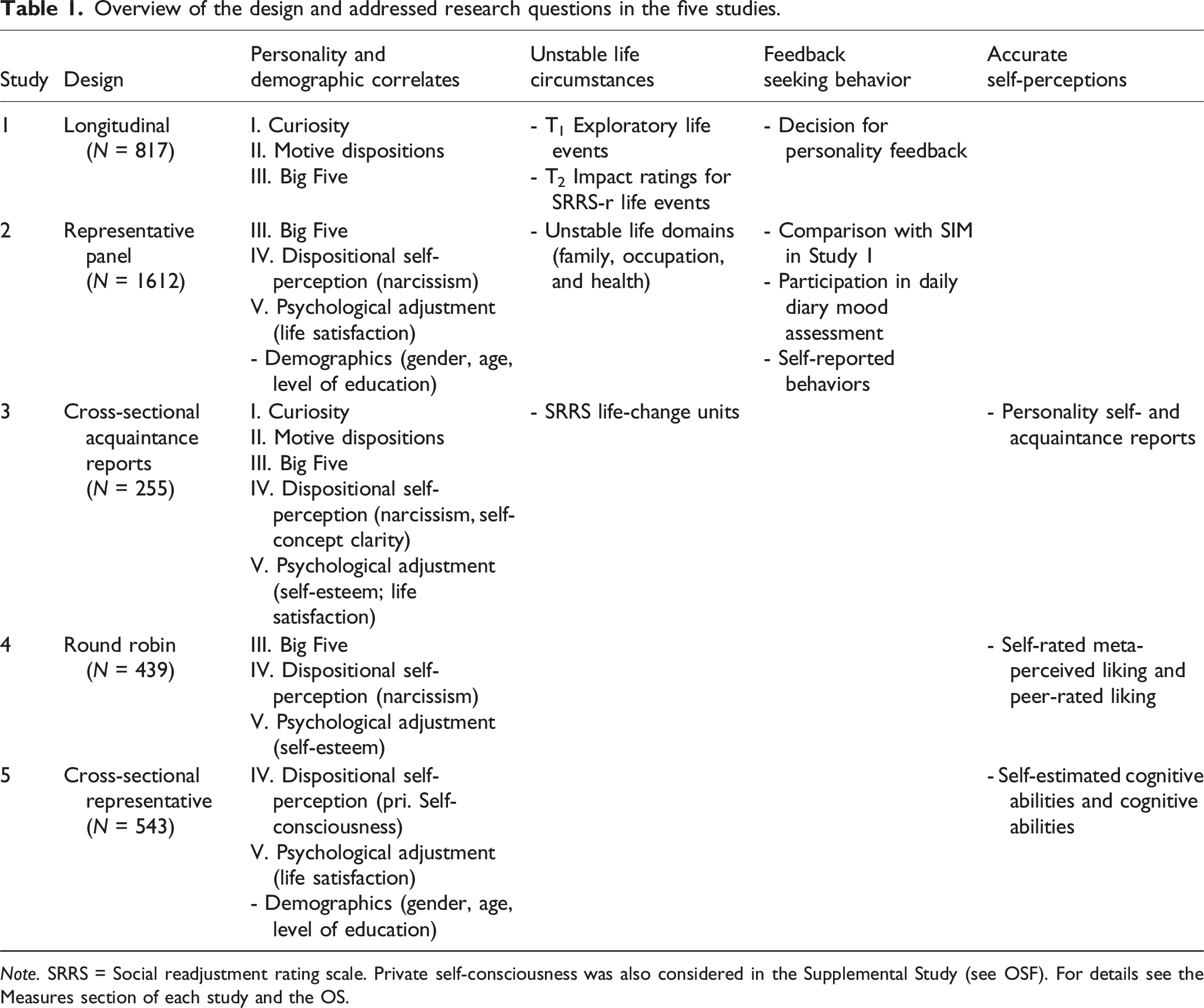
Note. SRRS = Social readjustment rating scale. Private self-consciousness was also considered in the Supplemental Study (see OSF). For details see the Measures section of each study and the OS.
The analyses concerning the personality correlates of the SIM and for the effects of unstable life circumstances consisted primarily of bivariate Pearson correlations. Assuming a medium effect size of r = .20 (Funder & Ozer, 2019) and an alpha level of .05, we determined that a minimum sample size of N = 191 was necessary for detecting such effects with 80% power. The analyses of feedback-seeking behavior partly consisted of group comparisons, and the analyses pertaining to accurate self-perception consisted of moderated regressions. We discuss the statistical power of these analyses within the relevant studies.
Study 1
In the first study, we developed a novel measure for individual differences in the SIM, the SIM scale. We did this, because existing SIM scales were either not comprehensive enough (i.e., too short), too broad in content for our purposes (i.e., assessing also other aspects of introspection than the SIM), strongly evaluative, or had psychometric issues. We then examined the psychometric properties of this newly developed scale. Finally, we used the scale to investigate the expected personality correlates of the SIM, unstable life circumstances as a hypothesized environmental antecedent, and feedback seeking as a behavioral consequence.
Method
Sample and procedure
We tested participants from the German online panel PsyWeb (https://psyweb.uni-muenster.de). The longitudinal self-report online study had three measurement occasions (time intervals: T1–T2: 2 months; T1–T3: 12 months). The sample consisted of N = 817 participants (477 female, 336 male, 4 diverse) at T1 with a mean age of 48 years (SD = 14 years). It was reduced to 367 participants at T2 and 346 participants at T3.
At T1, participants first answered demographic questions and completed an initial item pool for the SIM scale, consisting of 19 items. Then, motive dispositions and the instability of life circumstances during the previous 12 months were assessed. Finally, we assessed feedback-seeking behavior by offering participants the opportunity to receive individualized feedback on their intimacy motive.
The main reason for the T2 assessments was to compute the test–retest reliability of the SIM scale. Participants therefore completed the initial set of 19 items again. We also assessed feedback-seeking behavior by offering participants the opportunity to receive individualized feedback on their affiliation motive (which was also assessed at T2).
The main reason for the T3 assessments was to investigate whether instability in life circumstances was related to relative increases in the strength of the SIM. Accordingly, participants completed the final five items of the SIM scale and also indicated how unstable their life circumstances had been during the previous 12 months. Furthermore, we assessed a number of personality correlates, namely, epistemic curiosity, social curiosity, and the self-improvement motive. Finally, we assessed feedback-seeking behavior by offering participants the opportunity to receive individualized feedback on their SIM.
Measures
Self-insight motive
Participants completed the initial pool of 19 items (see the SOM Section 1 for these items and a more detailed description of scale construction process). All items were designed to capture the central aspect of the SIM, the desire to gain accurate knowledge about oneself. The items asked about a general desire for self-relevant information, which is considered a key aspect of the SIM, regardless of whether this information is expected to be positive or negative (Gregg, Sedikides, & Gebauer, 2011). The items further included two general aspects. As the first general aspect, items asked about the desire for self-knowledge with regard to personality and with regard to skills or abilities, which are the two overarching domains of psychologically relevant individual differences (Cattell, 1946). As the second general aspect, because motives can be described as individual differences in showing relatively consistent patterns of thoughts, feelings, and behaviors (Frankenbach et al., 2022), items were created to cover these with regard to the SIM.
Crossing these two general aspects, some items assessed cognitive-affective manifestations of the SIM either referring to the desire to know one’s traits (e.g., “Having accurate knowledge about my character traits is very important to me”), or referring to the desire to know one’s abilities (e.g., “I want to know exactly what my strengths and weaknesses are.”). Other items asked about behavioral manifestations of the SIM, again with regard to traits (e.g., “I seek both positive and negative feedback about my personality.”), or abilities (e.g., “I often try to find out what I am good at and what I am bad at”).
Personality
Correlations of the self-insight motive scale with personality and demographics across the five studies.
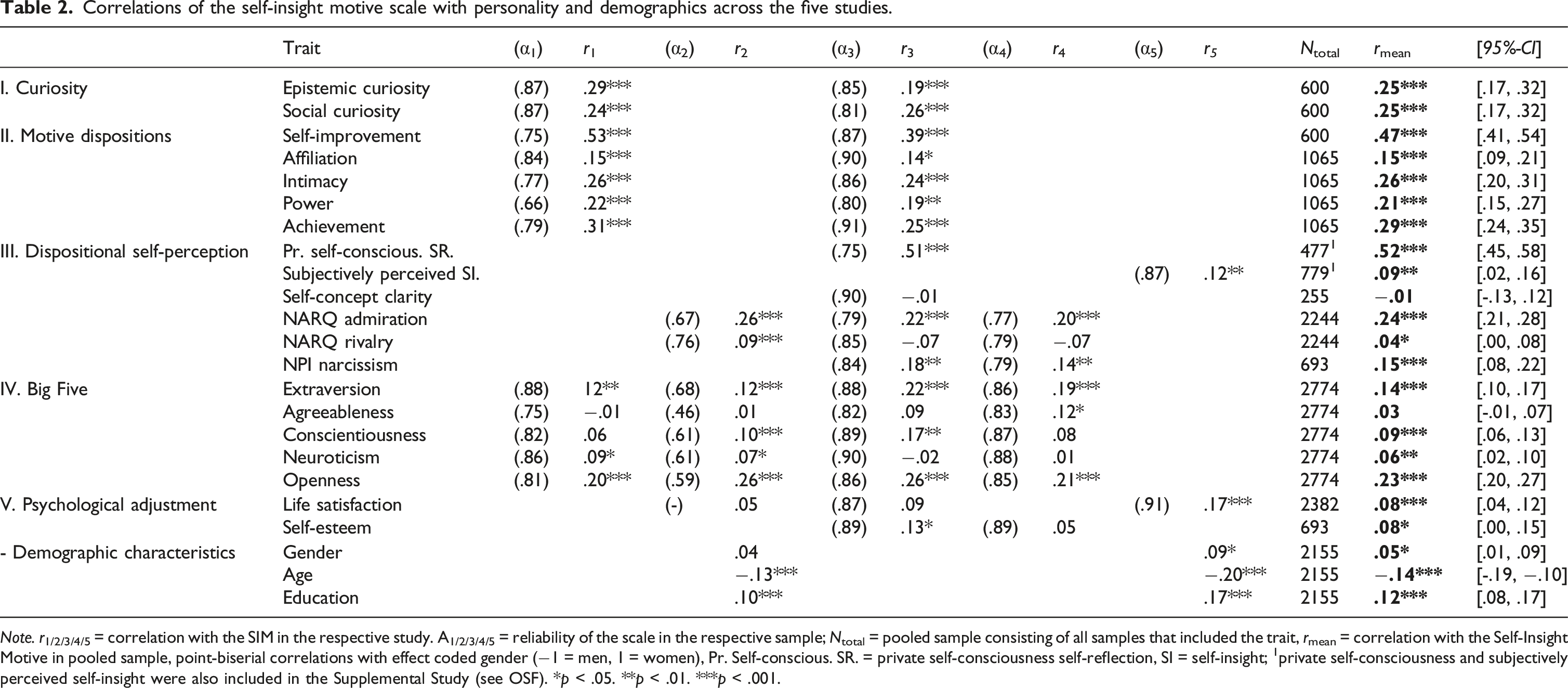
Note. r1/2/3/4/5 = correlation with the SIM in the respective study. Α1/2/3/4/5 = reliability of the scale in the respective sample; Ntotal = pooled sample consisting of all samples that included the trait, rmean = correlation with the Self-Insight Motive in pooled sample, point-biserial correlations with effect coded gender (−1 = men, 1 = women), Pr. Self-conscious. SR. = private self-consciousness self-reflection, SI = self-insight; 1private self-consciousness and subjectively perceived self-insight were also included in the Supplemental Study (see OSF). *p < .05. **p < .01. ***p < .001.
Unstable life circumstances
At T1, we assessed the instability of life circumstances with six self-developed items. These items asked whether the following life changes had occurred during the past 12 months (0 = had not occurred; 1 = had occurred): (a) moved to another city; (b) ended a long-term relationship; (c) completed school, college, or vocational training; (d) change or left a job; (f) became a parent; and (g) lost a close relative or friend.
At T3, the instability of life circumstances was measured with the Social Readjustment Rating Scale-Revised (SRRS; Hobson et al., 1998; our own translation), which is commonly used to assess the impact of different life events. Six of these life events were divided into two separate events, as they comprised two distinct events (e.g., trying to change one’s own addictive behavior or that of a close relative), which resulted in a final set of 57 events. We reasoned that events that were perceived as more impactful should evoke greater instability in life circumstances. Accordingly, we asked participants to indicate the impact of each reported event on a 10-point Likert scale, ranging from 1 (not at all) to 10 (very strong). The score for unstable life circumstances was calculated by summing the impact ratings of life events reported by each participant.
Feedback-seeking behavior
At the end of each wave’s assessment, participants were given the opportunity to receive individualized feedback. Feedback could be obtained on their intimacy (T1), affiliation (T2), and self-insight (T3) motives. Alternatively, they could end the study without receiving personality feedback. Participants’ choices were used as indicators of feedback-seeking behavior (0 = chose not to receive the feedback; 1 = chose to receive the feedback).
Results and discussion
Measurement of the SIM
Final five items of the self-insight motive scale.
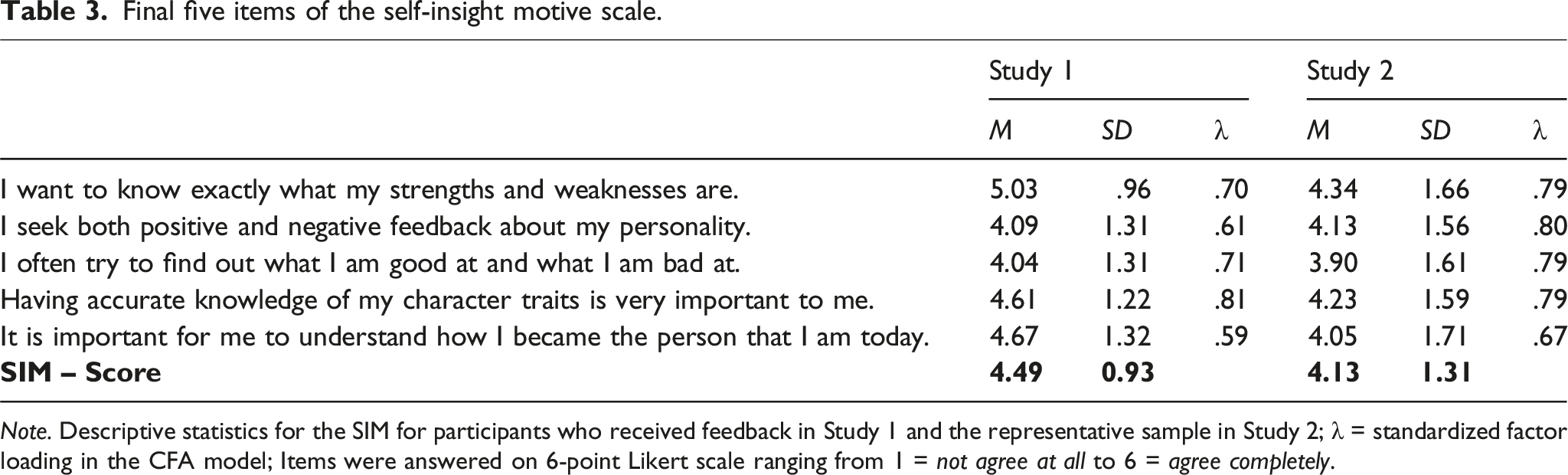
Note. Descriptive statistics for the SIM for participants who received feedback in Study 1 and the representative sample in Study 2; λ = standardized factor loading in the CFA model; Items were answered on 6-point Likert scale ranging from 1 = not agree at all to 6 = agree completely.
Measurement invariance of a scale over time is another important indicator of psychometric quality (Putnick & Bornstein, 2016). Thus, we used a CFA model and tested for strict measurement invariance across all three assessments by constraining the factor loadings, item intercepts, and item residuals to equality over time. Residual correlations for the same items were freely estimated across time. The time-invariant model fit well, χ2 (98) = 266.57, p < .001, CFI = .940, RMSEA = .050, SRMR = .063, thus indicating that the same construct was measured with the same factor structure after 8 weeks and, still, after 1 year (For a consecutive test of invariance levels over time see SOM Section 3). The correlation of the latent factors between T1 and T2 (r = .77) supported a good retest reliability of the short scale. The correlation of latent factors between T1 and T3 (r = .63) indicated a moderate stability of the SIM within the typical range of stability estimates for personality constructs (e.g., Bazana & Stelmack, 2004), especially in the domains of dispositional self-perception (e.g., Trzesniewski et al., 2003) and motive dispositions (Tuominen-Soini et al., 2011).
Personality correlates
Table 2 presents a summary of the bivariate correlations between the SIM and all personality measures we employed in the five studies. The results largely met our expectations. As hypothesized, epistemic curiosity and social curiosity were positively related to the SIM.
Also as hypothesized, the self-improvement motive was positively correlated with the SIM. Furthermore, the achievement motive, and also the intimacy, affiliation, and power motives were positively correlated with the SIM. To explore whether the different motive dispositions were uniquely related to the SIM, we ran a multiple regression analysis in which all motive dispositions simultaneously predicted the SIM. Whereas the relationships of the achievement (β = .06, p = .233), power (β = .09, p = .083), and affiliation (β = −.028, p = .552) motives vanished, the self-improvement (β = .42, p < .001) and intimacy (β = .23, p < .001) motives remained significant positive predictors of the SIM. This unique relationship might indicate that one reason people seek self-insight is that they consider it beneficial for their close interpersonal relationships. It has been argued repeatedly that knowing oneself might lead to good interpersonal functioning (Anderson et al., 2008; Paulhus, 1998; Robins & Beer, 2001; Ward & Brenner, 2006), and accordingly, the SIM might stand in the service of not only the self-improvement motive but also the intimacy motive.
For the Big Five, openness was positively correlated with the SIM and the correlations with the remaining Big Five factors were weak (see Table 2).
Unstable life circumstances
We tested the hypothesis that unstable life circumstances are positive predictors of the SIM. To do so, we first investigated the T1 assessments of life events that had occurred during the previous year and predicted the SIM at T1. Indeed, the more life events participants had experienced in the previous year, the higher their SIM was (β = .17, p < .001). We then looked at the T3 assessments of unstable life circumstances one year later and tested whether the aggregated impact of life events predicted T3 assessments of the SIM. This was the case (β = .20, p < .001).
Finally, we tested whether this prediction of the SIM at T3 held if we controlled for the T1 assessments of the SIM in a multiple regression. Controlling for the SIM at T1 would rule out the alternative explanation that the relationship between the SIM and experienced life events is exclusively driven by a reverse causal effect, in the sense that a strong SIM causes instability in life circumstances. The impact of life events assessed at T3 still predicted the T3 SIM scores when we controlled for the T1 SIM scores (β = .11, p = .016). We also investigated this effect in a latent regression when predicting the SIM at T3 from the SIM at T1 with strict measurement invariance across both assessments. The aggregated impact of life events had an overall comparable effect in the latent regression (β = .09, p = .039).
In sum, the rough estimate of unstable life circumstances at T1 and the more systematic assessment at T3 both supported the notion that unstable life circumstances are related to the SIM. The finding that the instability of life circumstances predicted SIM scores, when SIM levels of the previous years were controlled for, further buttresses the claim that unstable life circumstances might be a developmental antecedent of the SIM.
Feedback-seeking behavior
The majority of the sample decided to receive their personality feedback, and only 54 participants at T1 (6.7% of the sample), 18 participants at T2 (4.9% of the sample), and 5 participants at T3 (1.5% of the sample) did not. A likely explanation for the low rate of feedback denial is that the only incentive for participation in the PsyWeb panel is the opportunity to receive individualized feedback from psychological research.
We estimated Welch’s t-tests to investigate whether participants who chose to receive feedback scored significantly higher on the SIM than participants who did not. To do so, we estimated the power for finding a medium-sized effect (d = 0.50) at each time point, given the number of feedback receivers and non-receivers. As their number differed largely, this can strongly impact the statistical power of the t test. The power was .97 at T1, .66 at T2, and .30 at T3. We therefore focused on T1 for our hypothesis test. As expected, participants at T1 who decided to receive the feedback scored significantly higher on the SIM than participants who did not, t (59.59) = 3.22, p = .002, d = 0.49.
As an alternative approach, we ran a multilevel logistic regression and predicted the feedback decision by the SIM and the time of assessment. This approach has the advantage that it is more in line with the theoretic reasoning (i.e., feedback seeking as the dependent variable) and that it simultaneously considers the feedback decisions at all measurement occasions. The SIM significantly predicted the feedback decision, β = .73, eβ = 2.07, p < .001. That is, the odds to choose to receive the personality feedback increased by 107% when the SIM increased by 1 SD. Taken together, the findings supported our hypothesis that a strong SIM goes along with a strong feedback seeking tendency.
Study 2
Study 1 indicated that the newly developed SIM scale is reliable and valid (the Supplemental Study also reports associations with existing measures, see OSF) and shed first light on the correlates, antecedents and consequences of the SIM. In Study 2, we administered the SIM scale in one wave of a large panel study that was representative of private households in Germany, the Innovation Sample of the Socio-economic Panel (SOEP-IS; Richter & Schupp, 2015). Doing so allowed us to address four research questions (and to obtain representative descriptive statistics on the SIM).
First, we conducted measurement invariance tests to explore whether the SIM varied across gender groups, levels of educational attainment, and the age range. Measurement invariance is important for comparability of the SIM across different levels of these demographic variables and for the SIM scales’ psychometric quality (Van De Schoot et al., 2015).
Second, we further examined the associations between the SIM and potential personality correlates. Specifically, we investigated its associations with narcissism, life satisfaction, and the Big Five. Because Study 2 was representative, it was also ideally suited for exploring the demographic correlates of the SIM.
Third, we re-examined whether unstable life circumstances went along with a strong SIM. The SOEP-IS includes a broad set of questions in periodic time intervals referring to participants’ current family status, occupation, and health. Accordingly, we were able to reinvestigate the relationship of the SIM with unstable life circumstances with a different measure of life circumstances than in Study 1 and, due to the large sample, with high statistical power.
Fourth, the SOEP-IS data allowed us to conduct a comprehensive and high-powered test of the hypothesis that a strong SIM goes along with more feedback-seeking behavior. We tested this hypothesis in three ways. First, we compared the mean SIM score in the SOEP-IS with the mean score from Study 1. In the SOEP-IS, the panel provider randomly selects households in Germany which should result in a representative distribution of the SIM. In Study 1, only people interested in the study participated and the major incentive for participation had been individualized psychological feedback. If feedback-seeking behavior is indeed a consequence of the SIM, then especially persons with a high SIM should have participated in Study 1. Thus, the Study 1 participants should have higher SIM scores than the representative sample from the SOEP-IS. Second, 3 years before the application of the SIM scale, participants from the SOEP-IS had been asked to voluntarily participate in a 1-week daily diary happiness tracking study. The only incentive for participation was feedback on their habitual mood. We expected individuals who were willing to participate in the daily diary study to have higher SIM scores than those who were not. Third, we added a set of questions to the SOEP-IS to ask directly about the occurrence of specific feedback-seeking behaviors.
Method
Sample and procedure
Richter and Schupp (2015) provide detailed information on the SOEP-IS data collection. The SIM scale was administered to N = 1612 participants (848 female, 764 male) with a mean age of 54 years (SD = 18 years). Six participants did not provide SIM ratings but were retained in the sample because they provided data on other relevant variables.
Measures
Self-insight motive
The SIM was measured with the SIM scale (α = .88).
Personality measures
The short form of the Narcissistic Admiration and Rivalry Questionnaire (NARQ; Back et al., 2013) served as a measure of grandiose narcissism that captures two distinct core dimensions: admiration, which describes the tendency to engage in agentic self-enhancement; and rivalry, which describes the tendency to engage in antagonistic self-protection. The BFI-S (Schupp & Gerlitz, 2008) is a brief Big Five measure that is based on the Big Five Inventory (John & Srivastava, 1999) and includes three items for each Big Five trait. Life satisfaction was measured with the single item “Finally, we would like to ask you about your satisfaction with your life in general. How satisfied are you with your life, all things considered?” Single item life satisfaction measures can have comparable validity to the commonly applied satisfaction with life scale (SWLS; Cheung & Lucas, 2014).
Unstable life circumstances
We separately considered life events from the domains of family, occupation, and health. Some of the items were direct indicators of a life event (e.g., “marriage” or “child born”), whereas others had to be compared with the previous year’s value in order to find out whether a novel event had occurred (e.g., “currently registered unemployed”; for all items and the scoring, see the OSF). If a life event was recorded in one domain (family status, occupation, or health), we coded the domain as unstable; if no event occurred, we coded the domain as stable (0 = stable, 1 = unstable). We then summed across the three domains to obtain an indicator of unstable life circumstances.
Feedback-seeking behavior
As described above, we tested differences in the average SIM between Studies 1 and 2 (0 = Study 2, 1 = Study 1) and investigated the decision to voluntarily participate in a 1-week daily diary happiness tracking study (0 = chose not to participate; 1 = chose to participate). In order to assess specific behaviors, participants indicated how often (a) they had completed a personality questionnaire out of curiosity, (b) had completed an intelligence test out of curiosity, (c) had participated in a self-awareness seminar, and (d) had bought psychological guidebooks for themselves (0 = never to 3 = three times or more).
Results and discussion
Measurement of the SIM
In Study 2, the SIM scale was administered for the first time to a large sample representative of the German population. It thus provided normative data that might be useful in different practical and research settings (see above Table 3).
We conducted a multigroup confirmatory factor analysis to test for measurement invariance across levels of gender and education. For gender, we compared men and women. Concerning levels of education, we compared three groups. The first had attained no formal degree or the lowest level of school education (Hauptschulabschluss), the second had attained a medium-level degree (Realschulabschluss), and the third had attained the highest degree (Abitur). To test for age differences in the SIM, we applied a local weighted structural equation model (LSEM; Olaru et al., 2019) that allows to estimate the measurement model at each level of a continuous moderator variable. For different levels of each demographic variable, we stepwise included equality constraints on factor loadings, item intercepts, and item residuals. According to the commonly used cutoff criteria (Chen, 2007), strict measurement invariance held for different levels of all three demographic variables (detailed results presented in the SOM Sections 4–6). This underlined the comparability of SIM scores across demographic groups and again confirmed the psychometric quality of the SIM scale.
Personality and demographic correlates
The correlation of the SIM with admiration was comparable in strength to the correlations for curiosity and openness from the first study, yet there was only a weak association between the SIM and narcissistic rivalry. This finding provided preliminary evidence that individuals high in narcissism, and particularly those with a higher tendency to engage in agentic self-enhancement, tend to show a pronounced interest in finding out about themselves.
The relationships with the Big Five were comparable to the findings from Study 1, with the only substantial correlation occurring for openness (see Table 2). Life satisfaction was not significantly related to the SIM, which provided initial evidence that the SIM might not be substantially linked to psychological adjustment.
We then explored the relationships between the SIM and the demographic variables. The average SIM was unrelated to gender (see Table 2), that is, mean SIM scores were comparable for women (M = 4.18, SD = 1.32) and men (M = 4.07, SD = 1.3). However, the SIM was related to educational attainment, with the lowest SIM score for the lowest level of school education (M = 3.93, SD = 1.43), followed by a medium level of education (M = 4.13, SD = 1.31), and the highest SIM for the highest level of education (M = 4.27, SD = 1.15). The SIM was also negatively related to age. Figure S7 in the SOM Section 6 depicts a stable decline in the SIM across the considered age range from M = 4.49 (SD = 0.88) at the age of 20 to M = 3.72 (SD = 1.36) at the age of 85.
Because the overall educational level in Germany has increased in recent decades (Stecher & Maschke, 2020), age and education are substantially related variables (r = −.26 in the current data, p < .001). We therefore tested the combined relationships of age and education with the SIM in a multiple regression. Significant effects of both variables (β = .08, p = .003 for education and β = −.11, p < .001 for age) implied that age and education were uniquely related to the SIM.
Concluding from these relationships, we included the demographic variables as potentially relevant covariates in the other analyses concerning personality correlates, unstable life circumstances, and feedback seeking behavior. When controlling for them, however, results did not change (see SOM Section 7).
Unstable life circumstances
Even though the approach to the quantification of unstable life circumstances was very different in the current study, they were again significantly positively related to the SIM (β = .10, p < .001).
Feedback-seeking behavior
To address the feedback-seeking hypothesis, we first compared mean SIM scores between Studies 1 and 2. In line with the hypothesis, the mean SIM score in Study 1 (M = 4.49, SD = 0.93) was significantly higher than in Study 2 (M = 4.13, SD = 1.31), t (2421) = 7.07, p < .001, d = 0.30.
As a second test of the feedback-seeking hypothesis, we compared the mean SIM scores for individuals who chose to participate in the daily diary study with those who chose not to. The average SIM score was higher (M = 4.38, SD = 1.16) for the N = 140 individuals who voluntarily participated than for the N = 1472 who did not (M = 4.10, SD = 1.32), t (175) = 2.69, p = .007, d = 0.21.
As a third test of the feedback-seeking hypothesis, we investigated the relationships between the SIM and the four feedback-seeking behaviors. The average reported frequencies, aggregated across the four behaviors, were 72% never, 10% once, 7% twice, and 11% three times or more often. All behaviors were positively interrelated with an average correlation of r = .34. Regressing each of them on the SIM, the motive significantly predicted all behaviors (personality questionnaire: β = .17, p < .001; intelligence test: β = .14, p < .001; self-awareness seminar: β = .13, p < .001; psychological guidebooks: β = .17, p < .001).
The SIM scale includes the item “I seek both positive and negative feedback about my personality.” To ensure that the observed relationships between the SIM and feedback-seeking behavior were not driven solely by this particular item, we repeated the analyses without this item included in the SIM score. However, removing this item had no meaningful impact on the results (see the SOM Section 8 for details).
Results from the analyses pertaining to the SIM and feedback-seeking behavior.
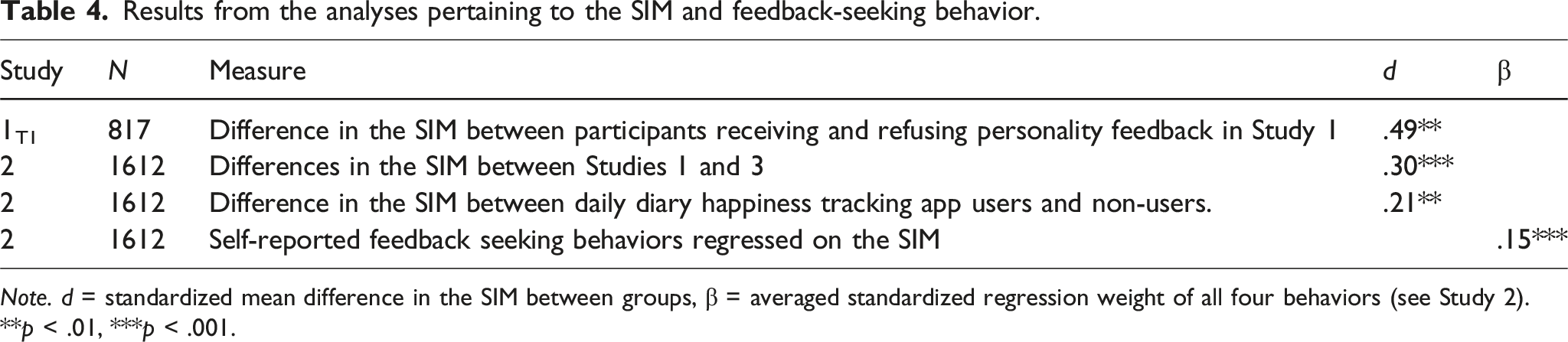
Note. d = standardized mean difference in the SIM between groups, β = averaged standardized regression weight of all four behaviors (see Study 2).
**p < .01, ***p < .001.
Study 3
The first goal of Study 3 was to further explore the personality correlates of the SIM. We reinvestigated its relationships with curiosity, motive dispositions, narcissism, the Big Five, and life satisfaction and added private self-consciousness, and self-concept clarity from the dispositional self-perception domain and self-esteem as another central indicator of psychological adjustment.
The second goal of Study 3 was to replicate the association that unstable life circumstances go along with high SIM levels. We did so by using a classic approach to assess the instability of life circumstances.
The third goal of Study 3 was to provide an initial test of the hypothesis that a strong SIM is related to more accurate self-perceptions. When the self-perception accuracy of personality traits is concerned, acquaintance ratings often serve as accuracy criteria (Letzring et al., 2021). After all, acquaintance ratings of personality often possess high validity, especially when they are made by long-term acquaintances (Donnelly et al., 2022; Kenny, 2020) and when ratings of several acquaintances are aggregated (e.g., Kenny, 2004).
In the previous studies we found clear evidence that the SIM goes along with increased feedback seeking. As we have argued above, this tendency should, in principle, help people with a strong SIM to make more accurate self-judgements. Therefore, we expected the agreement between a self-rated personality trait and acquaintance reports of the same trait to increase with the SIM scores.
Method
Sample and procedure
We analyzed data from the Leipzig Context Study, a comprehensive study on personality and social behavior. The sample consisted of N = 255 participants (198 female, 53 male, 4 diverse) with a mean age of 25 years (SD = 4 years). A detailed description of the study and a comprehensive list of all measures can be found in the study codebook (https://osf.io/u4trj/). Here, we will only describe the study parts and measures that are relevant for the current research question. So far, four articles addressing different research questions have analyzed data from the same study (Dufner et al., 2022; Grosz et al., 2020; Rau et al., 2022; Schliebener et al., 2022).
The SIM and self-rated personality were assessed with an online questionnaire. Participants were asked to invite at least three people (M = 3.23, SD = 1.13) who knew them well and would be willing to provide acquaintance ratings. Most of these acquaintances were friends (59%), followed by romantic partners (14%), and siblings (10%). The remaining informant-raters (15%) classified themselves as “other” or did not provide any information. Acquaintances were not allowed to participate in the study themselves.
Measures
Self-insight motive
The SIM was measured with the SIM scale (α = .88).
Personality measures
As before, epistemic curiosity and social curiosity were assessed with the German versions of the ECS and the SCS (Renner, 2006). Again, the same 11 items from the Scale of Readiness for Self-Improvement (Zawadzka, 2014) served as a measure of the self-improvement motive. Motive dispositions were assessed with the UMS (UMS-10; Schönbrodt & Gerstenberg, 2012). Private self-consciousness was measured with the German version (Heinemann, 1979) of the revised unidimensional private self-consciousness scale (Scheier & Carver, 1985), which captures the self-reflection facet of private self-consciousness (Harrington & Loffredo, 2010). Self-concept clarity was assessed with the German version (Stucke, 2002) of the self-concept clarity scale (Campbell et al., 1996). Narcissism was measured with two different questionnaires, the long form of the NARQ (Back et al., 2013) and the German version (Schütz et al., 2004) of the Narcissistic Personality Inventory (NPI; Raskin & Hall, 1979), the most popular unidimensional measure of grandiose narcissism. The Big Five were assessed with the German version (Danner et al., 2016) of the BFI-2 (Soto & John, 2017). Self-esteem was assessed with the German version (von Collani & Herzberg, 2003) of the Rosenberg Self-Esteem Scale (Rosenberg, 1965) and life satisfaction with the German version (Janke & Glöckner-Rist, 2012) of the SWLS (Diener et al., 1985).
Unstable life circumstances
We assessed unstable life circumstances with the original version of the SRRS (Holmes & Rahe, 1967, translated into German by Becker, 2006). For each life event, there are predefined life-change units. Summing up these units for the reported life events produces an index of the instability of an individual’s current situation.
Accurate self-perceptions
To investigate the accuracy of self-perceptions, self- and acquaintance ratings were gathered for motive dispositions, the perceived capacity to attain power and likability, agentic and communal attributes, and the Dark Triad. Motive dispositions were assessed with the UMS (Schönbrodt & Gerstenberg, 2012; self: UMS-10; acquaintance: UMS-6). The perceived capacity to attain power was assessed with the personal sense of power scale, which captures the perception that a person has the ability to attain power in different social situations (Anderson et al., 2012; own translation; for details, see the OSF). The perceived capacity to attain likability was assessed with the personal sense of likability scale, which captures the perception that a person is generally liked by others (as used in Schliebener et al., 2022; for details, see the OSF). Agentic (ambitious, dominant) and communal (compassionate, honest) attributes were assessed with the measure developed by Gebauer et al. (2013). Narcissism was measured with the NARQ (Back et al., 2013; self: long form; acquaintance: short form). Machiavellianism and psychopathy were assessed with the scales by Grosz et al. (2020).
Results
Personality correlates
Concerning the personality correlates of the SIM, the results from Study 3 lined up well with all previous findings (see Table 2). That is, curiosity and motive dispositions were positively related to the SIM. Comparable to results from Study 1, only self-improvement (β = .34, p < .001) and intimacy (β = .20, p = .002) remained significant predictors when regressing the SIM on all motive dispositions in a multiple regression, whereas the other relationships vanished (achievement: β = −.01, p = .882; power: β = .10, p = .129; affiliation: β = .01, p = .893).
For dispositional self-perception, the SIM was related to private self-consciousness as the overall strongest correlate, which is in line with the idea that private self-consciousness is a cognitive-behavioral consequence of the SIM. By contrast, self-concept clarity was essentially unrelated to the SIM. The finding implies that even though people scoring high on the SIM scale have a desire for knowing themselves well, this does not necessarily mean that they have a very clear self-concept. As in Study 2, the SIM was related to grandiose narcissism. The SIM was positively correlated with the NPI—the unidimensional measure of narcissism—and with narcissistic admiration, but not with rivalry.
Relationships with the Big Five were also comparable to previous studies, with the largest correlation for openness (see Table 2, for correlations with BFI-2 subfacets, see SOM Section 9).
For psychological adjustment, the SIM was not significantly related to life satisfaction, which replicated previous findings. A small correlation with self-esteem was in line with the reasoning that the SIM is not or only weakly related to psychological adjustment.
Unstable life circumstances
Results from the regressions predicting the SIM from the instability of life circumstances.
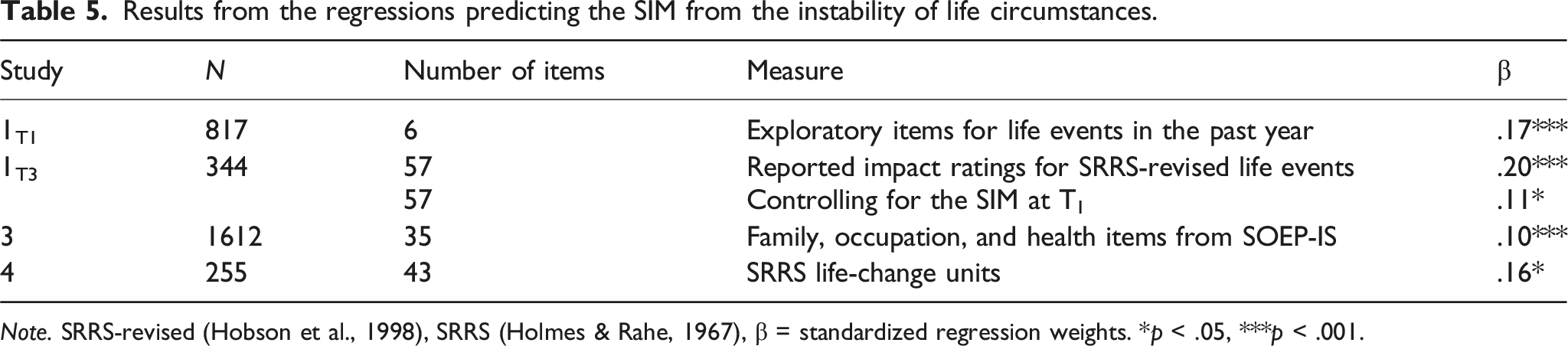
Note. SRRS-revised (Hobson et al., 1998), SRRS (Holmes & Rahe, 1967), β = standardized regression weights. *p < .05, ***p < .001.
Accurate self-perceptions: Self- and acquaintance-rated personality
Results pertaining to the accuracy of self-perceptions. descriptive statistics, and reliabilities for self-ratings, and accuracy criteria, and respective regression coefficients for predicting self-ratings.
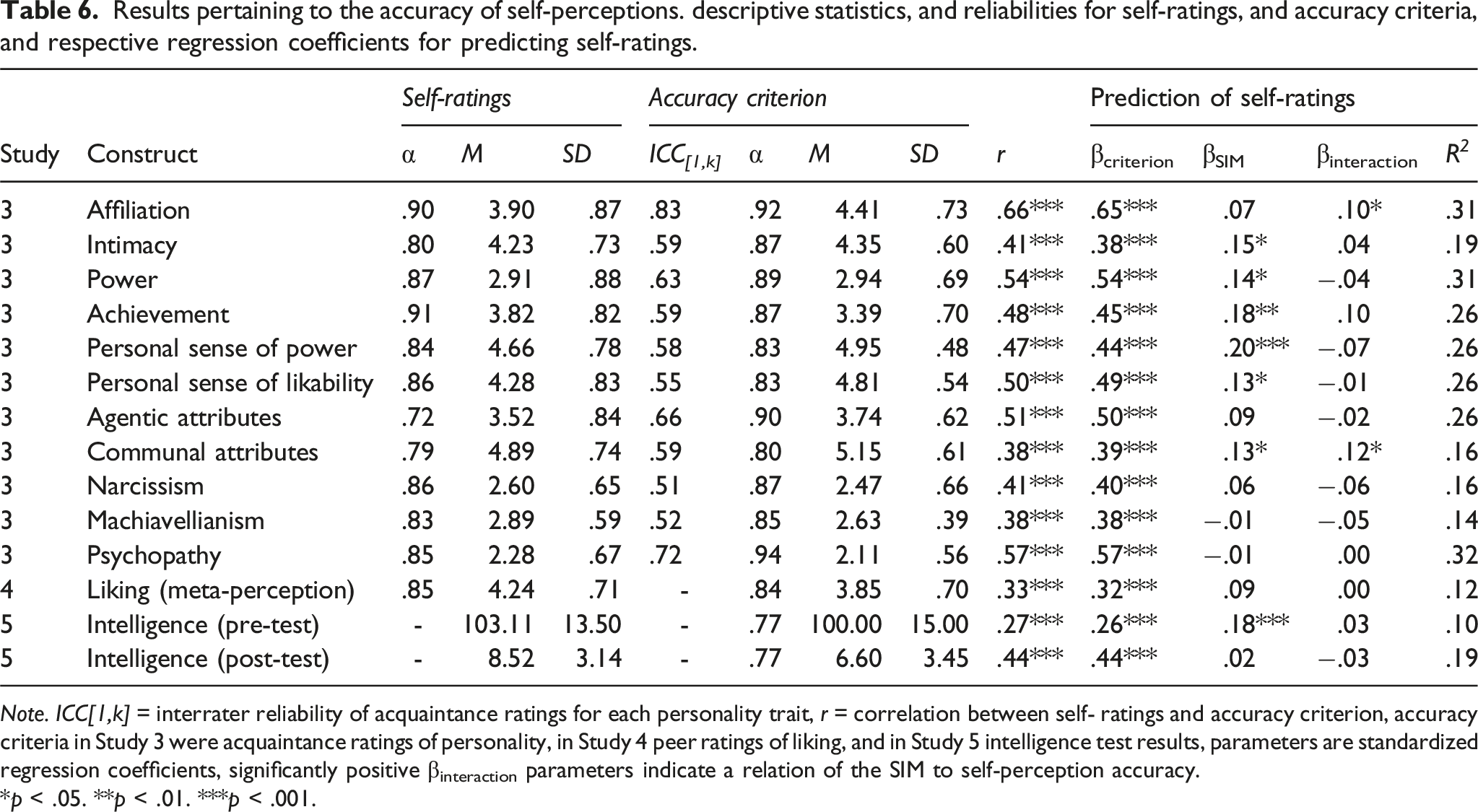
Note. ICC[1,k] = interrater reliability of acquaintance ratings for each personality trait, r = correlation between self- ratings and accuracy criterion, accuracy criteria in Study 3 were acquaintance ratings of personality, in Study 4 peer ratings of liking, and in Study 5 intelligence test results, parameters are standardized regression coefficients, significantly positive βinteraction parameters indicate a relation of the SIM to self-perception accuracy.
*p < .05. **p < .01. ***p < .001.
The accuracy of self-perceptions is reflected in the strength of the relationship between self- and acquaintance ratings: If self- and acquaintance ratings agree, this results in a strong positive relationship. As we expected the SIM to lead to more accurate self-judgments, the positive relationships between self- and acquaintance ratings should be stronger for people with higher SIM scores. Thus, the SIM should moderate the strength of the relationship between the self- and acquaintance ratings. Statistically, this corresponds with a positive interaction between the SIM and the acquaintance ratings when predicting the self-ratings. The interaction was significant (and in the expected direction) in two out of the 11 cases (i.e., for the affiliation motive and communal attributes; see Table 6). However, no effect remained significant when we applied the false discovery rate p-value correction recommended by Benjamini and Hochberg (1995). Accordingly, the findings were a first hint that even though the SIM is characterized by a strong desire for self-knowledge, it might not actually go along with more accurate self-perceptions.
However, could it be that the statistical power in Study 3 might have been too small to reliably detect the hypothesized moderating effect? To find out, we conducted a simulation study and estimated the sample size that would be needed to detect an effect size in a scenario where the correlation between self-perception and the outcome is rdiff = .30 larger for individuals scoring above average on the SIM than for individuals scoring below average (details are provided in SOM Section 10). The results showed that the sample size of N = 255 in Study 3 was associated with a likelihood of 86% for detecting the expected interaction. Thus, power was sufficient. Nevertheless, to avoid drawing a premature conclusion based on a false-negative result, we again addressed the hypothesis in two additional studies that each had a statistical power above 90% and that focused on different content domains, namely, meta-accuracy (Study 4) and intelligence self-perception (Study 5).
Study 4
We next investigated whether the SIM is linked to the accuracy of liking meta-perceptions. In research on meta-accuracy (Carlson & Kenny, 2012), people’s estimations of how they are perceived by others are compared with the actual perceptions of these others. We compared individuals’ meta-perceptions of liking (i.e., their estimates of how much others like them) with actual liking ratings made by their peers. The liking ratings represent an objective accuracy criterion, as they reflect a groups’ social reality.
We analyzed a large set of round robin data, where participants were assigned to groups and all group members provided liking ratings on each other. According to the social relations model (SRM; Kenny & La Voie, 1984), liking ratings in a round robin setting can be decomposed into three different sources of variance (in addition to measurement error). The first source represents a perceiver’s tendency to generally like others (perceiver effect). The second one represents a target’s tendency to be generally liked by others (target effect), which is also referred to the popularity of an individual. The third one represents the extent to which a perceiver likes a specific target, beyond the perceiver and target effects (relationship effect).
We examined how good people were at estimating their popularity in the group. In technical terms, we studied generalized meta-accuracy, which describes a match between individuals’ meta-liking perceiver effects (i.e., their aggregated perceptions of how much they are liked by their group members) and their liking target effects (i.e., the aggregated actual liking scores they received). Generalized meta-accuracy thus describes knowing how popular oneself is in the group and can be considered in terms of self-insight (Carlson & Kenny, 2012). As the SIM is related to increased feedback seeking and self-reflection, persons with a strong SIM should have spent more effort into identifying how popular they are in the group. Thus, in terms of generalized meta-accuracy, a strong SIM should go along with more accurate meta-perceptions.
Next to this overarching goal, we again analyzed personality correlates of the SIM. That is, we re-examined the SIM’s associations with narcissism, the Big Five, and self-esteem.
Method
Sample and procedure
This study was conducted in the context of a larger research project in Leipzig, Germany. As before, we will only describe the study parts that are relevant for the current research question. A total of N = 439 students (224 female 215 male) with a mean age of 27 years (SD = 6 years) participated in the study. They were assigned to 110 groups, each with four unacquainted members of the same sex. The study consisted of an online questionnaire and three laboratory group sessions (N = 427 completed the third session, dropout <3%). In each session, which took approximately 1 hr, group members had to solve different tasks as a team, such as a survival on the moon exercise or building a bridge from Lego bricks. Before and after each session, group members rated each other in terms of liking and meta-liking. We analyzed the ratings after the third session, when participants had had the opportunity to familiarize themselves with each other. To address a different research question, the same data were also analyzed by Rau et al. (2020).
According to our simulations, with a sample size of N = 439 the likelihood of detecting the hypothesized moderator effect was 99% (see SOM Section 9 for details).
Measures
Self-insight motive
The SIM was measured with the SIM scale (α = .88).
Personality correlates
Grandiose narcissism was measured with the long form of the NARQ (Back et al., 2013) and the German NPI (Schütz et al., 2004). The Big Five were measured with the BFI-2 (Danner et al., 2016) and self-esteem with the German Rosenberg Self-Esteem Scale (von Collani & Herzberg, 2003).
Accurate self-perceptions
Meta-perceptions of liking were assessed on a 6-point Likert scale with two items that asked “How much do you think this person likes you?” and “How well could this person imagine being friends with you?” (α = .85). Liking ratings were assessed with comparable items that asked “How much do you like this person?” and “How well could you imagine being friends with this person?” (α = .84), also answered on a 6-point Likert scale. The average liking rating across all individuals was M = 3.99 (SD = 1.06), whereas the average meta-perception of liking was slightly lower (M = 3.86, SD = 0.86).
Results and discussion
Personality correlates
As in the previous studies, the SIM was positively correlated with grandiose narcissism, particularly the admiration facet; openness was the strongest correlate from the Big Five; and the SIM had no substantial relationship with self-esteem (see Table 2).
Accurate self-perceptions: liking and meta-perceived liking
We subjected the meta-liking and liking ratings to the SRM analyses as implemented in the TripleR package (Schönbrodt et al., 2012). All three sources of variance (the perceiver, target, and relationship effects) were found to be significant and above the benchmark of .10 that is worthy of further investigation (Kenny, 1994).
To test whether the SIM was linked to generalized meta-accuracy, we predicted the meta-liking perceiver effect from the liking target effect, the SIM, and their interaction (see Table 6). A nonexistent interaction (β = .00, p = .979) indicated that the SIM was not linked to generalized meta-accuracy and thus again suggested that the SIM might not be substantially linked to the accuracy of self-perceptions.
Study 5
Studies 3 and 4 both used benchmark criteria that were based on social consensus and found no support for the hypothesis that a strong SIM is associated with more accurate self-perceptions. In Study 5, we relied on intelligence, which is a criterion that is performance-based, can be measured with high reliability and validity, and is relevant for multiple life outcomes (e.g., Freund & Kasten, 2012). We administered an online intelligence test to a sample that was representative of the German population so that we could determine participants’ actual IQ scores in relation to their respective age groups. We then examined the association between the self-rated and actual IQ scores and tested for whether it got more positive as individuals’ SIM scores increased.
Because the data were representative, we also tested whether the SIM’s relationship with the demographic variables age and education that were found in Study 2 could be replicated. Finally, we examined the associations between the SIM and two personality correlates: subjectively perceived self-insight and life satisfaction.
Method
Sample and procedure
We relied on a professional panel provider to recruit a sufficiently large population-representative sample. After exclusions, the final sample consisted of N = 543 participants (278 female, 264 male, 1 diverse) with a mean of M = 44 years (SD = 15 years). A total of N = 151 participants (28%) had attained no formal degree or the lowest level of school education (Hauptschulabschluss), N = 184 participants (34%) had attained a medium-level degree (Realschulabschluss), and N = 208 participants (38%) had attained the highest degree (Abitur). The demographic composition of the sample matched the population well as reported by the federal statistical office (Statistisches Bundesamt, 2018).
As we required the sample to be representative of the German population for age (up to the age of 69 years), gender, and educational level, N = 1586 participants first answered a screening questionnaire. Of these, a representative subset of 868 participants was invited to take part in the study. At the beginning, participants received basic information about the meaning and structure of the intelligence quotient (IQ) and then provided a self-estimate of their IQ. Afterward, participants answered three personality questionnaires (including the SIM scale). The third questionnaire included an attention check item. Subsequently, participants completed the IQ test and were then asked to guess the number of items they had solved. At the end, they were asked whether they had worked through the entire study carefully.
Of the 868 invited participants, 94 dropped out during the study, 173 were excluded because they speeded through the test, 13 were excluded because they answered less than 13 of the 16 IQ test items (more than 20% missing), and 45 reported low data quality at the end of the study or failed the attention check, which led to the final sample of 543 participants. Based on the results of the simulation study, a sample size of N = 543 would provide a power of 97% to find the hypothesized interaction effect.
Measures
Self-insight motive
The SIM was measured with the SIM scale (α = .89).
Personality measures
We used the eight insight subscale items from the SRIS (Grant et al., 2002, own translation) to measure subjectively perceived self-insight. Life satisfaction was measured with the SWLS (Diener et al., 1985).
Accurate self-perceptions
We used two measures of self-estimated intelligence. Before the IQ test, participants were asked: “Compared with people of the same age in the German population, how high would you estimate your intelligence quotient to be?” Based on a distribution of the IQ in the population, they used a range slider to choose a value between 50 and 150 (pretest IQ estimate). After the IQ test, they estimated how many of the 16 items they had solved correctly (posttest performance estimate).
Intelligence was measured with the 16-item short form of the International Cognitive Ability Resource (ICAR16; Condon & Revelle, 2014). The ICAR16 is a brief measure of cognitive abilities comprising letter and number series items, matrix reasoning items, verbal reasoning items, and three-dimensional rotation items. There are 16 items in total (four from each type). Each item offers seven answer options, including the possibility that none of the displayed options is correct. The internal consistency was acceptable (α = .77), and the confirmatory factor model that was used in the test validation (Condon & Revelle, 2014) fit the data well, χ2 (100) = 148.22, p < .01, CFI = .952, RMSEA = .030, SRMR = .036. We used latent factor scores from this model, and, according to common practice, IQ scores were calculated by standardizing the test score separately for different age groups from 20 to 60 years in 10-year increments and then transforming these values into IQ scores with M = 100 and SD = 15.
Results and discussion
Personality and demographic correlates
The SIM was weakly positively related to subjectively perceived self-insight. The same result was mirrored in a nonsignificant relation in the Supplemental Study. The finding corresponded with the finding from Study 2 where the SIM was unrelated to self-concept clarity. Overall, individuals with a strong SIM did not have the feeling that they knew themselves particularly well, nor did they have a very clear self-concept.
The correlation with life satisfaction was also only weak and corresponded to results from previous studies.
Regarding the demographic correlates, this time the SIM was weakly related to gender, with women (M = 4.72, SD = .98) scoring slightly higher on the SIM than men (M = 4.54, SD = 1.05). Further, the SIM was positively related to educational attainment and negatively related to age (see Table 2). Thus, the findings from Study 2 were largely replicated and in sum, both representative studies indicated that especially young and highly educated people have a relatively strong SIM.
Accurate self-perceptions: cognitive abilities
The correlation between the pretest IQ estimates and actual IQ scores was r = .27 (p < .001), and the correlation between the posttest performance estimates and the actual number of items that were solved was descriptively stronger r = .44 (p < .001). These findings match meta-analytic results on the average correlation between self-estimated and objectively assessed intelligence very well (Freund & Kasten, 2012).
We then tested our hypothesis that individuals with a strong SIM know their intelligence better than those with a weak SIM. Contrary to this hypothesis, however, the SIM did not moderate the associations between actual intelligence and the self-rated intelligence estimates, neither for the pretest IQ estimates (β = .03, p = .483) nor for posttest performance estimates (β = −.03, p = .504). This means that also with regard to the content domain of intelligence, there was no support for the hypothesis that a strong SIM goes along with particularly accurate self-perceptions.
General discussion
In five studies, containing a total sample size of N = 3667 participants and including longitudinal, informant-report, round robin, and representative data, we shed unique light on the demographic and personality correlates of the SIM as well as on its developmental antecedents, and consequences for social cognition and behavior.
Personality and demographic correlates of the SIM
Concerning curiosity, the hypothesis that the SIM would be positively related to epistemic and social curiosity was supported in Studies 1 and 3. Thus, individuals who are curious about the world in general (Litman & Spielberger, 2003) and individuals who are curious about other people in particular (Renner, 2006) also tend to have a strong SIM.
Concerning motive dispositions, the SIM was significantly related to all considered motives. However, only the self-improvement and intimacy motives were uniquely related to the SIM. The former result corroborated our proposal that the SIM stands in the service of the self-improvement motive: If one wants to improve aspects of the self, it helps to first appraise one’s strengths and shortcomings realistically (Sedikides & Skowronski, 2000). The unique relationship with the intimacy motive was not hypothesized a priori but robust across both relevant studies (Studies 1 and 3). As self-insight is thought to lead to good interpersonal functioning (e.g., Paulhus, 1998; Ward & Brenner, 2006), laypersons potentially internalize this belief and seek self-insight if they are highly motivated to maintain functioning close personal relationships (i.e., if they have a strong intimacy motive).
From the domain of dispositional self-perception, private self-consciousness was the strongest correlate. A likely explanation for this finding is that private self-consciousness, which describes the tendency to intensely reflect on the self (Scheier & Carver, 1985), is a direct cognitive-behavioral consequence of the SIM. That is, people with a strong SIM might reflect on themselves often so that they can find out more about themselves. This interpretation is supported by the finding that only the self-reflection facet was substantially related to the SIM, whereas the other (subjectively perceived self-insight) was not.
This weak association between the SIM and subjectively perceived self-insight was paralleled by the null association between the SIM and self-concept clarity, which also entails subjective perceptions of knowing who one is. Taken together, these results indicate that people who want to know themselves well (i.e., who have a strong SIM) are not necessarily those who also have the feeling that they know themselves particularly well, or who have a particularly clear self-concept. We will return to this point below when we discuss the results on the accuracy of self-perceptions.
Another construct from the domain of dispositional self-perception, narcissistic admiration, was positively related to the SIM in all relevant studies. Potentially, narcissists have a strong SIM because they are highly self-focused and convinced that most information about oneself will turn out to be positive anyway. This finding portrays people with a strong SIM in a novel light. In the literature, they have been compared to scientists who are highly objective, analytical, and unbiased in their search for the truth (Robins & John, 1997). This picture needs to be adjusted, as the desire to find out about oneself might be grounded not only in epistemic strivings but also in narcissistic needs. The fact that narcissistic people want to find out more about themselves could be relevant in the clinical context, as it indicates giving narcissists the opportunity for that self-exploration might be a means for keeping them engaged in therapy.
The strongest Big Five correlate of the SIM was openness to experience. This result fits with the view that open individuals are high in intellectual curiosity, which includes curiosity about oneself (John & Srivastava, 1999). The overall correlations with the other Big Five traits were negligible.
The final question concerning the personality correlates was whether the SIM would be related to psychological adjustment. The overall correlations with life satisfaction and self-esteem were small (rmean = .08 for both constructs), suggesting that individuals with a strong SIM differ in adjustment only to a very small degree from individuals with a weaker SIM.
In terms of demographic characteristics, neither men nor women had an overall substantially stronger desire to attain accurate self-knowledge (i.e., a stronger SIM). However, in both representative studies, more educated individuals had a stronger SIM. It has been argued that education is an important foundation of personal growth (Huitt, 2009), and it seems likely that dealing with complex scientific and societal issues during the course of higher education could lead not only to increased enjoyment of intellectual exploration in general but also to increased interest in self-exploration.
The SIM was also negatively related to age. Assuming that this relationship was a true age effect, rather than a cohort effect, it could be explained by the decreasing relevance of personal identity across adulthood (Erikson, 1959). The exploration of identity (Who am I?) is highly relevant in adolescence and becomes less important in later adulthood after a relatively stable identity has been formed (Topolewska-Siedzik & Jan Cieciuch, 2019).
Even though the links of the SIM with education and age were robust across studies, these relationships were not hypothesized a priori and the explanations we provided were developed post hoc. It is a task for future research to clarify why more educated and younger individuals have a stronger SIM.
Unstable life circumstances
In all relevant studies, unstable life circumstances were significantly related to the SIM, and results from the longitudinal analyses in Study 1 favored the interpretation that the SIM gets stronger after a person’s life circumstances have been disrupted. Sedikides’ (1993) notion that the people seek accurate self-views in order to reduce uncertainty fits into this picture well.
These findings might be helpful for understanding personality development. According to the TESSERA framework, life events translate into changes in daily experiences, behavioral patterns, and consequently the personality self-concept (Wrzus & Roberts, 2017). If life circumstances change, individuals repeatedly find themselves in personality-incongruent situations that require new behavioral responses. However, these experiences are aversive because individuals generally seek to experience personality-congruent situations (Buss, 1987; Roberts & Robins, 2004; Wrzus & Roberts, 2017). A typical reaction to prevent such aversive states is to alter one’s personality self-concept through reflective processes so that it fits with the experienced situations. Considering that self-reflection is likely a direct consequence of the SIM, a temporary increase in the SIM might be adaptive in this context. Accordingly, the increase in the SIM may be an important puzzle piece when explaining personality changes that result from altered life circumstances (Specht et al., 2011).
Feedback-seeking behavior
Research from social psychology has accumulated compelling evidence that people, on average, are often motivated to seek realistic feedback about themselves—a finding that is typically regarded as evidence for the existence of the SIM (e.g., Strube et al., 1986; Trope, 1979, 1980; Trope & Brickman, 1975). In line with this reasoning, we have argued that the SIM should be linked to the seeking of accurate and diagnostic feedback about oneself. Using four different operationalizations of feedback-seeking behavior, we found consistent evidence for this claim.
The fact that individuals with a strong SIM can be incentivized with individualized feedback about themselves might have practical implications. For example, mental or physical health apps have great potential and are increasingly used, but user dropout is a large issue (Kao & Liebovitz, 2017). The apps are thus not made for everyone, and predicting who will use them and stick with them would be very useful. The present findings suggest that, for apps that provide individualized feedback, knowing the strength of a person’s SIM might be helpful for making such predictions.
The SIM is also potentially relevant for therapeutic settings. Psychotherapy generally offers the opportunity to find out more about the self, and one explanation for why therapy works is that it helps patients clarify the sources of their issues for themselves (Grawe, 2004). Because such a gain in self-insight is intrinsically rewarding for people with a strong SIM, it is conceivable that these individuals hesitate less to seek therapeutic aid, are more compliant in the therapeutic process, and ultimately profit more from it than people with a weaker SIM. The latter should be particularly the case for therapeutic approaches that provide explicit and comprehensive feedback about the self, such as collaborative assessment (Aschieri et al., 2023; Durosini & Aschieri, 2021). Future research should address these possibilities.
Furthermore, the SIM plays a role in the sample-selection process as evident in the SIM’s mean difference between the Studies 1 and 2. Individuals with a strong SIM should be more willing to participate in psychological studies, especially if the studies provide individualized feedback. Given that researchers will often admit any interested people into their studies, many samples are likely biased in the sense that individuals with a strong SIM are overrepresented. In this case, the samples would also likely be biased with respect to the correlates of the SIM. Therefore, the effect of the SIM on the willingness to participate in psychological research should lead to systematic differences in the SIM and its correlates between studies using representative samples and those using convenience samples and provide individualized feedback. In technical terms, the SIM is a potential source of between-study heterogeneity as typically found in meta-analyses (Thompson & Sharp, 1999).
Accurate self-perceptions
The weak-to-zero correlation with subjectively perceived self-insight indicated that individuals with a strong SIM did not feel like they knew themselves particularly well. The same picture emerged with regard to actual self-insight. Individuals with a strong SIM did not have particularly accurate views of their personality (Study 3), how much they are liked by others (Study 4), or how intelligent they are (Study 5). Considering these results together, and given that statistical power was high, we can safely conclude that when it comes to the accuracy of self-perceptions, no meaningful differences exist between people with a strong SIM and those with a weak SIM. Unlike previously believed, a strong SIM does not go along with more accurate self-perceptions.
But why don’t individuals with a strong SIM know themselves any better, despite all their efforts to find out about themselves? A potential explanation is that much of the information people typically receive about themselves is invalid. The internet is full of questionable self-assessment tools with low validity. Therefore, gathering valid information might be difficult. Likewise, in the social context, valid feedback is often absent (Kenny & DePaulo, 1993). To gain self-insight, just receiving more (subjectively perceived as valid but in fact invalid) feedback about oneself therefore does not necessarily help. Instead, higher levels of self-insight should result only if people are also better at distinguishing valid from invalid feedback. If this ability is not pronounced among individuals with a strong SIM, higher levels of self-insight cannot be expected.
Even when valid feedback is available, it does not automatically mean that the feedback will be integrated into people’s self-concepts due to self-enhancement and self-protection processes. For example, people are more likely to forget unfavorable than favorable behavioral predictions that are made about them when the predictions refer to central aspects of oneself (Sedikides & Green, 2000), and they are more likely to double-check self-threatening than nonthreatening information (Ditto & Lopez, 1992). It is possible that self-enhancement and self-protection are so powerful that they often undermine the integration of realistic feedback (Alicke & Sedikides, 2009), even among people with a strong SIM.
Each of these explanations could be experimentally tested in future research. To investigate the processing of valid versus invalid feedback, researchers could systematically vary the validity of feedback and then assess the extent to which it is integrated into the self-concept. If individuals with a strong SIM generally integrate more feedback but do not outperform those with a weak SIM in identifying the valid feedback, it would explain why they do not have more self-insight overall. To investigate the roles of self-enhancement and self-protection mechanisms, participants could be provided with (random) positive or negative feedback on an ability test and then their defensive self-protection reactions could be assessed by giving them the opportunity to criticize the test. If people with a strong SIM and those with a weak SIM are equally likely to criticize the test after negative feedback, it would indicate that a strong SIM does not immunize people from self-protective reactions.
An alternative explanation for the nonexistent effect could be that the SIM actually results in more accurate self-perceptions but that the effect is masked in cross-sectional data by an antagonistic underlying process. That is, it might be the case that people with highly inaccurate self-perceptions have experiences in their daily lives that do not match how they view themselves, thus shaking their self-images. As a consequence, their willingness to find out about themselves would increase. In this case, having inaccurate self-perceptions would lead to increases in the SIM over time. If such antagonistic processes are equally strong, they would result in a lack of relationship between the SIM and the accuracy of self-perceptions in cross-sectional data. The same explanation for antagonistic processes applies to subjectively perceived self-insight and self-concept clarity, which were also cross-sectionally uncorrelated with the SIM. In the future, researchers should thus collect longitudinal and experimental data on the relationship between the SIM and the accuracy of self-knowledge.
Further avenues for future research
With the SIM scale, researchers now have a tool that is economical and psychometrically sound for the assessment of the SIM. Despite its brevity, the scale is highly internally consistent and has a clear one-dimensional structure that was cross-validated across five samples (and in a Supplemental Study). It showed good test-retest reliability over 8 weeks, scores were moderately stable over 1 year, and it was invariant in measurement across age, gender, and education. The fact that most of our hypotheses concerning the personality correlates of the SIM could be confirmed using the SIM scale speaks for the construct validity of the scale (Cronbach & Meehl, 1955). Still, in the Supplemental Study relationships between the different measures of the SIM were only moderately high indicating inconsistencies in their measurement. In an integrative psychometric study, different aspects of introspective tendencies could be studied together while taking into account the nomological network of these tendencies. This will help to understand the empirically shared features and specific peculiarities of the different existing scales, many of which should theoretically assess the same construct.
In terms of the SIM’s nomological network, there are still constructs that remain unaddressed by the current research. An example would be need for cognition, which is defined as a need to structure relevant situations in meaningful, integrated ways (Cacioppo & Petty, 1982). People with a strong need for cognition might also be interested in structuring and integrating accurate knowledge about themselves. Thus, the SIM might be positively related to need for cognition. Another construct is intellectual humility, which is defined as the tendency to recognize that one’s beliefs are fallible and to remain open to new evidence (Krumrei-Mancuso & Rouse, 2016). It is likely that people with the desire to find out about themselves are, or become, more aware of the fallibility of their thoughts. Thus, the SIM might also be positively related to intellectual humility. Finally, there are measures for some of the considered constructs that capture more nuanced subfacets, such as interest and deprivation subtypes of epistemic curiosity (Litman, 2008). It could be viewed a limitation of the current research that we did not distinguish between these two facets as research indicates that they might be differentially linked to the SIM (Litman et al., 2017). Examining these relationships will most likely lead to a deeper understanding of the SIM and its correlated constructs.
Future research could also test whether further antecedents or consequences should be included in the model. For example, the SIM could depend on the cultural background of an individual, namely, the level of individualism in a society (Hofstede, 2001). People in individualistic societies tend to construe the self in a rather private and idiosyncratic way, whereas people in collectivistic societies tend to have a view of the self that is shaped more by their social groups and that varies across social contexts (Markus & Kitayama, 1991). The SIM refers to the individual or independent self, and if the individual self is more relevant and valued in individualistic societies, then the SIM should be higher in individualistic societies. On the other hand, it could be particularly helpful for people to know themselves well when they understand their identity as being connected to a relational network because knowing one’s own behavioral tendencies, strengths, and weaknesses might be beneficial when interacting with other people (Aschieri et al., 2023). In this case, the SIM should be higher in collectivistic societies. Future research could investigate differences in the strength of the SIM between individualistic and collectivistic cultures and whether reasons for a strong SIM (i.e., the antecedents and personality correlates) differ between cultures.
Conclusion
The striving for self-knowledge is a major theme in prominent psychological theories, valued by religious and philosophical traditions and is present in everyday life. Despite the undisputed relevance of the motive, the research has just begun to comprehensively investigate it from an individual differences perspective. The present studies showed that people indeed systematically differ in the extent to which they strive for accurate self-knowledge, provided an instrument for assessing such individual differences, and revealed likely developmental antecedents and cognitive-behavioral consequences. It is our hope that this contribution will lay the foundation for future work so that the human need to know oneself will receive the scholarly attention it deserves.
Supplemental Material
Supplemental Material - The quest for genuine self-knowledge: An investigation into individual differences in the self-insight motive
Supplemental Material for The quest for genuine self-knowledge: An investigation into individual differences in the self-insight motive by Christoph Heine, Stefan C Schmukle, and Michael Dufner in European Journal of Personality
Supplemental Material
Supplemental Material - The quest for genuine self-knowledge: An investigation into individual differences in the self-insight motive
Supplemental Material for The quest for genuine self-knowledge: An investigation into individual differences in the self-insight motive by Christoph Heine, Stefan C Schmukle, and Michael Dufner in European Journal of Personality
Footnotes
Acknowledgments
We wish to thank Benjamin Ahlmeyer and Anna Bernitzke for collecting the data for Study 1, Livia Kraft and Franziska Wieg for collecting the data for Study 3, Sascha Krause and Lucie Nikoleizig for collecting the data for Study 4, and Joanne Chung for her help translating the scale.
Declaration of conflicting interests
The author(s) declared no potential conflicts of interest with respect to the research, authorship, and/or publication of this article.
Funding
The author(s) disclosed receipt of the following financial support for the research, authorship, and/or publication of this article: The Studies 1, 3, and 5 were funded by the German Research Foundation (DFG) via Grants DU 1641/5-1 and SCHM 1646/4-1. Study 3 was funded by the DFG via Grant DU 1641/3-1 awarded to Michael Dufner. Study 4 was funded by the DFG via Grant KR4702/2-1 awarded to Sascha Krause.
Open Science Statement
The studies were not preregistered. Parts of the data have been analyzed in previous publications (for details, see the Method section of each study) but none of them included any data or analyses pertaining to the SIM. The data (except Study 2, for which access to the data must be requested from the panel provider), analysis code, and the Supplemental Online Materials and analyses (SOM) are provided on the OSF ( ). Most of the scales we used in the current research have been published and the respective references are provided. In all other cases (i.e., when we used self-developed scales or our own translations), we provide those materials on the OSF.
Supplemental Material
Supplemental material for this article is available online.
References
Supplementary Material
Please find the following supplemental material available below.
For Open Access articles published under a Creative Commons License, all supplemental material carries the same license as the article it is associated with.
For non-Open Access articles published, all supplemental material carries a non-exclusive license, and permission requests for re-use of supplemental material or any part of supplemental material shall be sent directly to the copyright owner as specified in the copyright notice associated with the article.
