




Abstract
Past research has linked individual differences in loneliness to Big Five personality traits. However, experience sampling studies also show intrapersonal fluctuations in loneliness. These may reflect situational factors as well as stable individual differences. Here, for the first time, we study the relationship between personality traits and within-person variation in loneliness. In a one-week experience sampling study, n = 285 Nepali participants reported feelings of loneliness three times a day (3597 observations). We use Bayesian mixed-effects location scale models to simultaneously estimate the relationship between Big Five personality traits and (a) mean levels and (b) within-person variability in loneliness. We also test whether these relationships vary depending on whether participants were alone or in the company of others. More neurotic individuals felt lonelier, especially (but not only) when they were alone. These individuals also experienced greater intrapersonal fluctuations in loneliness. These findings extend the differential reactivity hypothesis, according to which individuals vary in loneliness due to differential reactivity to social situations, and accord with the conceptual view of neuroticism as hyperreactivity to social stressors. In addition, we document the role of personality and social context in people’s everyday experience of loneliness in a non-WEIRD population.
Plain language summary
People differ in how much loneliness they experience. When asked how lonely they feel on average, some people report that they feel very lonely; others, that they do not feel lonely at all. However, people also differ in how much their feelings of loneliness vary from situation to situation. Two people who report the same average level of loneliness may have very different experiences if one of them persistently feels somewhat lonely, whereas the other sometimes feel very lonely and sometimes not at all. In this study, we investigated how such ups and downs in loneliness relate to the individual’s personality. 285 Nepali participants first reported their personality in terms of five major dimensions (the Big Five). Then, three times a day for one week, we asked them how lonely they felt, collecting a total of 3,597 reports. We found that participants with higher levels of neuroticism – one of the Big Five dimensions – on average felt lonelier, and especially so when they were alone. Moreover, these individuals also experienced greater ups and downs in loneliness. In addition, we also found that participants higher in agreeableness felt less lonely on average. These results support the view that people high in neuroticism are more sensitive to social stressors and experience more frequent emotional ups and downs.
Introduction
Loneliness is the feeling that one’s social relations are lacking in quantity and/or quality (Hawkley & Cacioppo, 2010; Perlman & Peplau, 1981; Rotenberg, 1994). Experiencing persistent loneliness is associated with lower levels of physical, mental, and subjective well-being (Hawkley & Cacioppo, 2007; Holt-Lunstad et al., 2015; VanderWeele et al., 2012; van Winkel et al., 2017; Wei et al., 2005; but see Rohrer & Lucas, 2020, for a cautionary note on interpreting similar links between subjective well-being and health as causal). On the one hand, trait loneliness is linked to individual differences in personality. A recent meta-analysis found that all Big Five traits were associated with individual differences in (trait) loneliness (Buecker et al., 2020). The strongest and most robust associations were a negative link between extraversion and loneliness and a positive link between neuroticism and loneliness. On the other hand, people’s experiences of loneliness are also influenced by their social context and fluctuate from situation to situation. For example, adolescents experience more loneliness when they are alone than when they are with somebody (van Roekel et al., 2018). This indicates that the experience of loneliness varies both between people as well as within individuals across time.
The focus on associations between personality traits and trait loneliness on the one hand and between situational factors and state loneliness on the other hand may hide context-dependent effects of personality traits on (state) loneliness (Funder, 2008). The expression of personality traits may, for example, depend on the affordances of the situation (Thielmann et al., 2020). One prominent example in the context of loneliness is the differential reactivity hypothesis. In its original formulation, this hypothesis states that high trait loneliness is associated with greater state loneliness specifically when individuals are on their own (Cacioppo et al., 2003; van Roekel et al., 2018). Interpreted more broadly, depending on their personality traits, individuals may vary in their reactivity to situational factors. Neuroticism, in particular, may be associated with greater reactivity to being alone. Consequently, the link between personality traits and state loneliness may be context-dependent. However, past studies on links between personality and loneliness have largely overlooked such situation-specific factors.
Crucially, individuals may also differ in the extent to which they experience fluctuations in loneliness, independent of their trait level. Yet, there has been little attention to what makes some people experience frequent fluctuations in loneliness while others have a more stable trait level. Among broad Big Five personality traits, neuroticism has been defined as hyperreactivity to social stressors (Bolger & Schilling, 1991; Costa & McCrae, 1992; Eysenck & Eysenck, 1985; Hills & Argyle, 2001; Hisler et al., 2020), resulting in heightened situation-to-situation or day-to-day variability in affect (Ching et al., 2014; Geukes et al., 2017; Kuppens et al., 2007; Mader et al., 2023). Similarly, neuroticism – as well as other personality traits – may be associated with the degree to which a person’s experiences of loneliness fluctuate throughout the day. One person may have a consistently low (or high) level of loneliness, whereas another may cycle through frequent ups and downs, experiencing both low and high levels of loneliness within the span of a day or week. Estimating the degree to which such individual differences in within-person variability occur, and identifying personality traits that are predictive of greater or lesser variability, provides a richer picture of individual differences in the experience of loneliness.
Loneliness as a trait and state
The degree to which people experience loneliness differs both between individuals and within individuals across time. Research on loneliness, however, has largely treated trait and state loneliness as distinct constructs (e.g. van Roekel et al., 2018). A trait approach views loneliness as a relatively stable property of the person (Fung et al., 2017; van Roekel et al., 2018). A recent meta-analysis of longitudinal studies found high rank-order stability for trait loneliness during adulthood (Mund et al., 2020). One-year stability exceeded r = .60 for much of adulthood before declining in very old age. Across the lifespan, loneliness exhibits a U-shaped trajectory (Mund et al., 2020). These findings suggest that loneliness is trait-like to a similar degree as broad-factor personality traits such as the Big Five.
In contrast, the state approach views loneliness as a state fluctuating from one moment to another. From this perspective, an individual can oscillate between feeling more or less lonely from situation to situation or day to day. Experience sampling and daily diary studies have reported significant within-person variability in loneliness (Buecker et al., 2023; Harper et al., 2020; Rinderknecht, 2020; Tam & Chan, 2019). For example, Tam and Chan (2019) reported an intraclass correlation (ICC) for state loneliness of ICC = 0.43; suggesting that loneliness varied more within persons (i.e. from situation to situation; 57%) than between persons (43%). Similarly, Harper et al. (2020) and Rinderknecht (2020) found that around 50% of the variance in loneliness occurred within persons. These findings evidence significant within-person variability in loneliness from occasion to occasion beyond a more stable trait level.
Here, we take the view that loneliness has both trait and state components. This is consistent with contemporary personality theories, which posit that traits are manifested in fluctuating states (e.g. Baumert et al., 2017; Horstmann & Ziegler, 2020). Whole trait theory, in particular, holds that traits are reflections of the density distributions of states; that is, that individuals experience varying (personality) states, but differ between each other in the distribution of these states (Fleeson, 2001; Fleeson & Jayawickreme, 2015). Individual differences can thus refer to measures of central tendency (or level, e.g. the arithmetic mean) and to measures of dispersion (or variability, e.g. the variance). We expect that individuals experience varying levels of loneliness across situations, and that they differ from each other in both the level (i.e. location) and variability (i.e. scale) of their experienced states. Moreover, we explore whether these associations between personality and state loneliness depend on the social context.
Individual and contextual differences in loneliness
Personality predictors of loneliness
Past research has shown that personality traits are robust correlates of trait loneliness. A recent meta-analysis found that extraversion, agreeableness, conscientiousness and openness were negatively related to loneliness, whereas neuroticism was positively related to loneliness (Buecker et al., 2020). When controlling for other Big Five personality traits, the small association between openness and loneliness was not significant. For other personality traits the association was significant, albeit reduced in magnitude when compared to the bivariate associations. The strongest associations existed for extraversion (r = –.37) and neuroticism (r = .36). With the exception of one unpublished experience sampling dataset, these correlations were, however, based on one-time measures of trait loneliness. Importantly, these sizable associations with multiple personality traits suggest that loneliness is not merely a nuance of one broad personality dimension (Mõttus et al., 2017), but may be multiply determined.
Contextual predictors of loneliness
Prima facie, the most plausible predictor of loneliness is contact with other people. Indeed, individuals experience more (state) loneliness when they are alone than when they are with somebody else (Larson, 1990; van Roekel et al., 2018). However, social isolation – the objective lack of relationships and social interaction – is only weakly correlated with trait loneliness (Cacioppo et al., 2009; Hawkley et al., 2003; Tiwari, 2013). In a large sample of older Americans, several indicators of social isolation only correlated with loneliness at r = .20 (Coyle & Dugan, 2012). This correlation may even reflect social withdrawal following experiences of loneliness (van Winkel et al., 2017). Loneliness and social isolation also have distinct associations with physical and mental well-being (Beller & Wagner, 2018; Holt-Lunstad et al., 2015). Thus, there exists a clear discrepancy between objective social isolation and subjective feelings of loneliness.
Relationships and social interactions can also vary in quality. It has been suggested that it is the quality and closeness of relationships rather than their quantity which matters for well-being (Perlman & Peplau, 1981; Russell et al., 2012). While some studies have found that contact with close others is more strongly associated with (lower) loneliness (van Roekel et al., 2015; Sandstrom & Dunn, 2014, Study 1), others found that even contacts with ‘weak ties’ – acquaintances or even strangers – may alleviate loneliness (Epley & Schroeder, 2014; Rinderknecht et al., 2021; Sandstrom & Dunn, 2014, Study 2). The highest-quality studies suggest that positively valenced contact may buffer against loneliness, whereas negatively valenced contact may even increase them (Tam & Chan, 2019; van Roekel et al., 2014, 2015). Unfortunately, causal evidence on the effects of the quality and closeness of contact is lacking.
Person X situation interactions
Crucially, personality and contextual causes of loneliness may also interact with each other. The differential reactivity hypothesis posits that individual differences in trait loneliness are driven by differential reactivity to situational stressors (Cacioppo et al., 2003; van Roekel et al., 2018). In several studies of adolescents, individuals with high (measured) trait loneliness reported feeling lonelier when they were alone, compared to individuals with low trait loneliness; this difference was smaller when the participants had company (van Roekel et al., 2018). This suggests that differential reactivity to being alone is one of the social-cognitive mechanisms which produce individual differences in trait loneliness. However, individuals with high trait loneliness still experienced more state loneliness even when they had intimate company, indicating that differential reactivity to being alone cannot fully account for individual differences in trait loneliness.
Differential reactivity to context factors may also explain why broad personality traits (such as the Big Five) are associated with individual differences in trait loneliness. In particular, neuroticism has been associated with heightened reactivity to situational stressors, which is thought to result both in heightened negative affect and in greater emotional volatility (Bolger & Schilling, 1991; Costa & McCrae, 1992; Eysenck & Eysenck, 1985; Hisler et al., 2020; Mader et al., 2023). Thus, the well-documented association between neuroticism and trait loneliness may be driven by differential reactivity to situational stressors, in particular, being alone. Consequently, we would expect this association to be stronger when individuals are alone (rather than in company). Importantly, more neurotic individuals should experience not only heightened levels of loneliness but also greater fluctuations in state loneliness across situations.
Few studies have directly examined person × situation interactions in loneliness (Reissmann et al., 2021). However, several recent studies on loneliness during the COVID-19 pandemic have found that measures which restricted social contact were associated with changes in the associations between personality and loneliness. In Germany, social contact restrictions were associated with greater increases in loneliness among more extraverted, neurotic and conscientious individuals (Alt et al., 2021; Entringer & Gosling, 2022). More extraverted individuals, in particular, may suffer from such restrictions because they experience a greater need for social contact. The otherwise negative association between extraversion and loneliness may thus be driven by selection into social situations, and may be diminished when individuals are alone. Correlations between personality traits and trait loneliness, which make up the bulk of the literature, may obscure such context-dependent links between personality and loneliness. In contrast, experience sampling studies make it possible to test whether the associations between personality traits and loneliness differ depending on whether the participant is alone or in the company of others.
Personality and within-person variability in loneliness
As whole trait theory suggests, individual differences encompass the entire shape of the distribution of states (Fleeson, 2001; Fleeson & Jayawickreme, 2015). Thus, individuals may differ not only in the level of loneliness they experience across situations but also in the extent of fluctuations from situation to situation. Some individuals may feel chronically high (or low) levels of loneliness; others, however, may experience more frequent ups and downs. Such individual differences in within-person variability may arise from differential reactivity to the social context (Cacioppo et al., 2003; Danneel et al., 2018; Lay et al., 2019; van Roekel et al., 2018). This is consistent with the prominent definition of neuroticism as hyperreactivity to social stressors (Bolger & Schilling, 1991; Costa & McCrae, 1992; Eysenck & Eysenck, 1985; Hills & Argyle, 2001; Hisler et al., 2020): if both the more and the less neurotic individual experience similar kinds of situations, but only the more neurotic individual is affected in their loneliness by being alone, the more neurotic individual will experience greater fluctuations in loneliness from situation to situation than the less neurotic individual. Thus, differential reactivity to social stressor can explain why personality traits may be associated with both the mean level (i.e. location) and cross-situational variability (i.e. scale) of loneliness.
Intriguingly, the link between personality traits and within-person variability may itself differ across social contexts. This may occur when classes of situations contain different subsets of stressors. For example, social situations may vary in the quality of social contact (e.g. van Roekel et al., 2014). Some studies in adolescents suggest that highly (trait) lonely individuals experience the greatest benefits from social contact, but that this is specific to positive interactions with close others (van Roekel et al., 2014, 2018). Extending this finding to neuroticism, highly neurotic individuals might experience stable (high) levels of loneliness when alone, but varying levels of loneliness when in the company of others, depending on the quality of the social contact; less neurotic individuals would experience largely stable low levels of loneliness independent of their social context. In this scenario, unless one accounts for the quality of social contact, within-person variability in loneliness would not only differ depending on the individual’s personality, but also depending on the particular combination of personality and situation.
Research on loneliness has, so far, largely focused on personality and social contexts as predictors of trait and state levels of loneliness. However, theory suggests that these factors should also be associated with differences in intrapersonal variability. Moreover, previous studies have shown that broad personality traits predict such within-person variability in affect more generally. For example, previous studies have linked neuroticism to greater and extraversion to lower within-person variability in affect (Ching et al., 2014; Eid & Diener, 1999; Geukes et al., 2017; Kuppens et al., 2007; Mader et al., 2023). These personality traits may also be associated with intrapersonal variability in loneliness. Such associations may be further moderated by the social context, in particular, the presence of others. This is a hitherto overlooked dimension of individual difference in loneliness, which may open up new opportunities for interventions.
The present study
In the present study, we pursued several interlinked goals. First, we assessed the associations between Big Five personality traits and mean levels of state loneliness. Second, we tested whether these associations varied across situations in which individuals were alone versus in the company of others. Third, we tested whether Big Five personality traits were also linked to within-person variability in loneliness. Fourth, we examined whether these links between personality and within-person variability differed across situations in which individuals were alone versus in the company of others. In sum, we provide a comprehensive test of the associations between Big Five personality traits and the level and intrapersonal variability of loneliness, as well as differences in these associations across varying social contexts.
Methods
Ethics and open scientific practices
This paper uses data from a broader study on personality, loneliness and affect. The study was approved by the national ethical review board of Nepal, the Nepal Health Research Council (NHRC), with the ERB Protocol Registration no. 413/2020 P. Data, analysis code and a list of all measures are available on the OSF (https://osf.io/u2gbe/).
Sample
The sample size was determined in the context of the broader study and before the present analyses were planned. The initial sample consisted of N = 315 participants. Of these, n = 11 did not provide any experience sampling responses and a further n = 19 did not complete the intake survey and are not included in the analyses reported here. In addition, we dropped two duplicate responses from the experience sampling survey. The final sample thus consisted of n = 285 individuals (age: M = 22.50, SD = 5.14, range 17–55; gender: 87% female, 13% male) who provided a total of k = 3597 responses. This constitutes a response rate of 60%. Additionally, for some models we dropped k = 74 responses from our analyses because we could not determine whether the participant was alone or in the company of others, which also lowered the sample size by n = 1. This subsample thus consisted of n = 284 individuals who provided a total of k = 3523 responses.
Participants were recruited through snowball sampling by contacting students through social media sites and email lists. As the participants were either enrolled in or had completed undergraduate or postgraduate education in English, the survey was administered in English. Most participants were students (67%); the remainder were employed or self-employed (26%) or unemployed (6%). 95% of the participants lived in multi-person households (M = 4.39; range 2–14, excluding two participants who indicated households of 24 and 80). Most participants indicated being unmarried (89%) and living with their nuclear family (75%; remainder joint or communal living arrangements).
Historical and local setting
The data was collected during the first wave of the COVID-19 pandemic in Nepal, over the course of twelve days from April 20, 2020 to May 1, 2020. Participants could enrol themselves in the study between April 20 and April 25, 2021. The government of Nepal announced the first lockdown effective from March 24, 2020 till July 21, 2020 (Sharma et al., 2021). During this time, all businesses, schools, colleges and government offices were closed down except for a few hours a day. Mobility was restricted as public transportation was shut down and private vehicles were only allowed to move with a governmental pass. The general population was required to stay home except to obtain essential goods or in case of emergencies. Thus, participants were largely confined to their homes during the study period.
Much attention has been paid in recent years to psychology’s reliance on samples from Western, educated, industrialised, rich and democratic (WEIRD) populations (Henrich et al., 2010). We use this framework to contextualise our sample. Nepal is a South Asian country of about 29 million people. The net primary school enrolment rate has only reached 80% in recent years World Bank, (n.d.); however, our sample consisted mostly of students in tertiary education, which makes up a small part of the population. The economy is largely agricultural, and the per-capita gross national income was only US$1190 in 2020 (World Bank, (n.d.). Nepal is a relatively new democracy, having experienced a democratic revolution in 2006. Within the WEIRD framework, our sample is thus non-Western, relatively educated, less industrialised, less rich and (newly) democratic.
Measures
Descriptive statistics for the BFI subscales. Means and standard deviations are shown for the final dataset (‘Included’) and for participants who did not provide ESM responses (‘Excluded’), With 95% credible intervals and Cohen’s d for differences between both subgroups. The correlation matrix shows 95% credible intervals with reliabilities
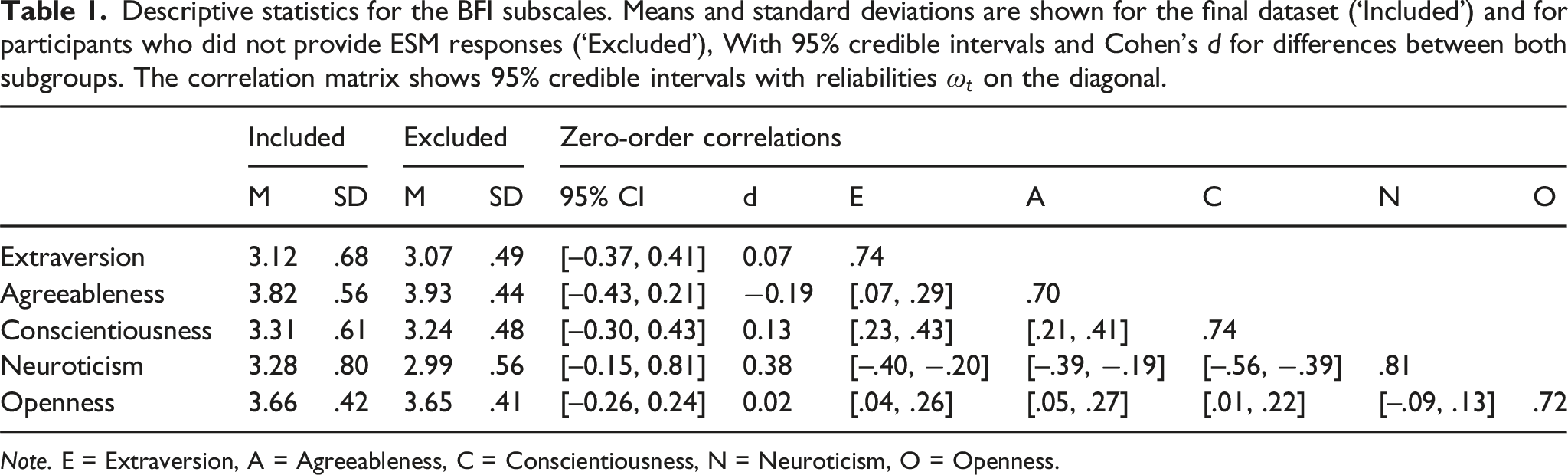
Note. E = Extraversion, A = Agreeableness, C = Conscientiousness, N = Neuroticism, O = Openness.
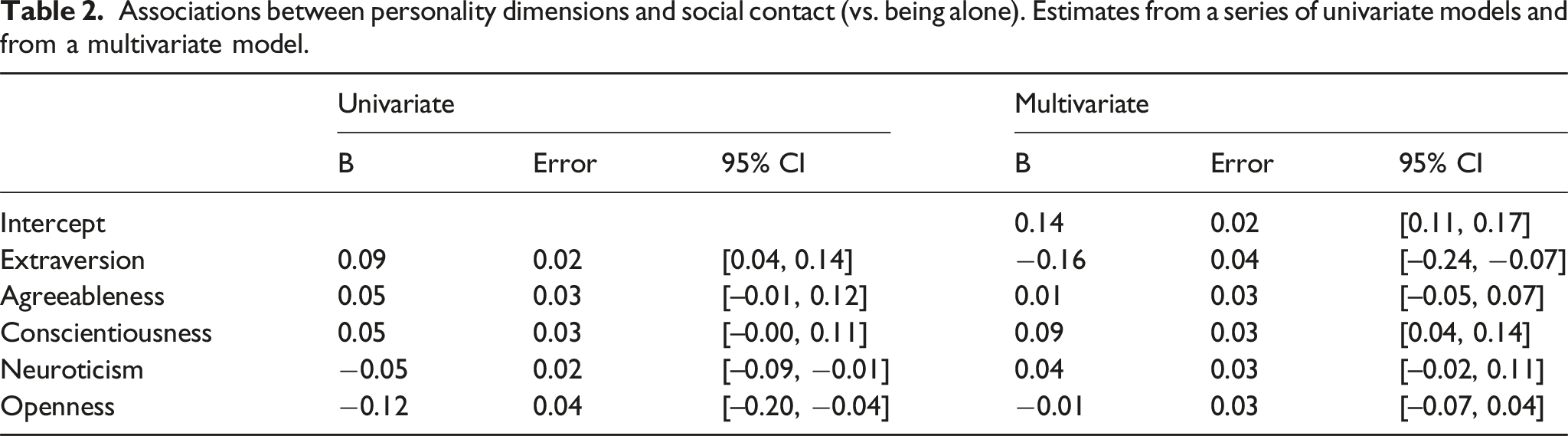
Associations between personality dimensions and social contact (vs. being alone). Estimates from a series of univariate models and from a multivariate model.
State loneliness was assessed using a single item, ‘How lonely are you feeling right now?’ Responses were recorded on 0-100 rating scale (0 = not lonely at all, 100 = very lonely). The mean reported loneliness was 28.12 (estimated marginal mean = 28.31). Participants whose responses were excluded because they did not complete the personality measure reported only marginally more loneliness, M = 29.93, EMM = 34.25, B = 5.94, 95% CI = [-6.20, 17.65].
Participants were also asked to describe who they were with at the time, where they were at the time and what they were doing at the time. We manually coded these open text responses based on whether they indicated the presence of another person (e.g. ‘family’, ‘brother’, ‘sister’; k = 2394) or being alone (e.g. ‘alone’, ‘no one’; k = 1253); k = 79 uncategorisable. Most contacts were close family members (family, parents, siblings, children and partners; k = 2273), other family members (k = 64), work contacts (k = 22) and undefined others (k = 43). Responses whose social context could not be classified based on the description were rated higher in loneliness (M = 48.1) than both situations in which participants had company (M = 24.8) and in which they were alone (M = 33.2). To ensure that our classification did not skew the results, we ran two additional specifications of the model containing this variable, assigning all unclassifiable responses either to ‘alone’ or to ‘in company’. Neither specification changed the substantive interpretation of our results (Tables S1, S2).
Procedures
Data were collected using the Expiwell mobile app (https://app.expiwell.com/). Participants were contacted through email and Facebook. They were asked to download the mobile app. Usage of the app was explained through a tutorial video. Each participant was given a unique code which would lead them to the survey. At this point, participants provided consent to participate in the study. Subsequently, the participants completed the intake survey, which included the BFI as well as a number of other measures not relevant to the present study (a full list of measures is available on the OSF).
The experience sampling phase started from the day the participants enrolled in the study and lasted for seven days. Each day, participants were asked to complete three surveys in the morning, afternoon and evening. The morning survey was made available from 6:30 AM to 11:59 AM. The afternoon survey was made available from 12 PM to 4:59 PM and the evening survey was made available from 5 PM to 9 PM. Participants were alerted through a notification in the app. Each survey included the loneliness measure as well as questions about the context (e.g. where were they, who were they with, what were they doing?), and a measure of affect not analysed here. The evening surveys also included a day reconstruction measure for daily activities. The data were securely stored on an online server.
Analytic approach
Mixed-effects location scale models
To simultaneously estimate the relationship between individual differences in personality and (a) between-person variation in loneliness and (b) within-person variance in loneliness, we employed Bayesian mixed-effects location scale models (MELSM; Bürkner, 2017a; Hedeker et al., 2008; Rast et al., 2012). MELSMs are an extension of the more familiar linear mixed-effects models. Linear mixed-effects models assume that the (between-subjects) variance of random effects and the (within-subjects) error variance are homogeneous across subjects. MELSMs relax these assumptions by including (sub-)models for the between-subjects and the within-subjects variance (Hedeker et al., 2008). This allows predictors to influence these sources of variation.
Consider first a basic mixed-effects model for repeated observations j = 1, 2, …, k (level 1) nested within subjects i (level 2),
The MELSM relaxes the homogeneity assumptions of linear mixed-effects models by allowing the within-person variance 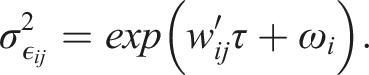
Introducing this scale submodel allows the value of the variance to change with the predictors
Zero inflation
A particular challenge arises because the outcome variable, loneliness, exhibits significant inflation at both ends. This is commonly observed in slider scale data (Vuorre, 2019). We therefore modelled the outcome as both left- and right-censored. Censoring assumes a continuous underlying (latent) variable. Other treatments for inflated data instead assume distinct data generation processes, for example, zero-or-one-inflated beta regression (Liu & Kong, 2015). In the case of loneliness measured using a slider scale, a continuous latent variable appears (more) plausible. This also facilitates the interpretation of the estimates. 1
Model specification
We implement a Bayesian MELSM using brms (Bürkner, 2017b), an R package for implementing Bayesian mixed-effects models using the probabilistic programming language Stan (Stan Development Team, 2022). We use weakly informative default priors (see supplementary materials) and model loneliness on a Student’s t distribution.
2
We include random intercepts and random slopes for the variable coding for the presence of others in both submodels and allow the random effects to be correlated across submodels. We centred the continuous predictors and contrast-coded the variable coding for the presence of others (−0.5 = ‘alone’, 0.5 = ‘in company’). All models were run with four chains and 10,000 iterations and converged without issue (no divergent transitions after warm-up; all
Inference criteria
We report point estimates and 95% credible intervals (CIs) based on quantiles. Credible intervals are based on the posterior distribution and describe a range which contains 95% of the values in the posterior distribution. Therefore, a 95% credible interval can be interpreted as ‘given the observed data, the effect has 95% probability of falling within this range’ (Makowski et al., 2019). In line with recommendations for Bayesian mixed-effects models, we do not adjust for multiple comparisons (Gelman et al., 2012).
Software
Mixed-effects location scale models were fitted using brms (Bürkner, 2017b). Data wrangling was done using R and tidyverse (R Core Team, 2022; Wickham et al., 2019). Factor analyses were conducted using the R packages psych (Revelle, 2022) and lavaan (Rosseel, 2012).
Results
Descriptive results
Zero-order and partial correlations
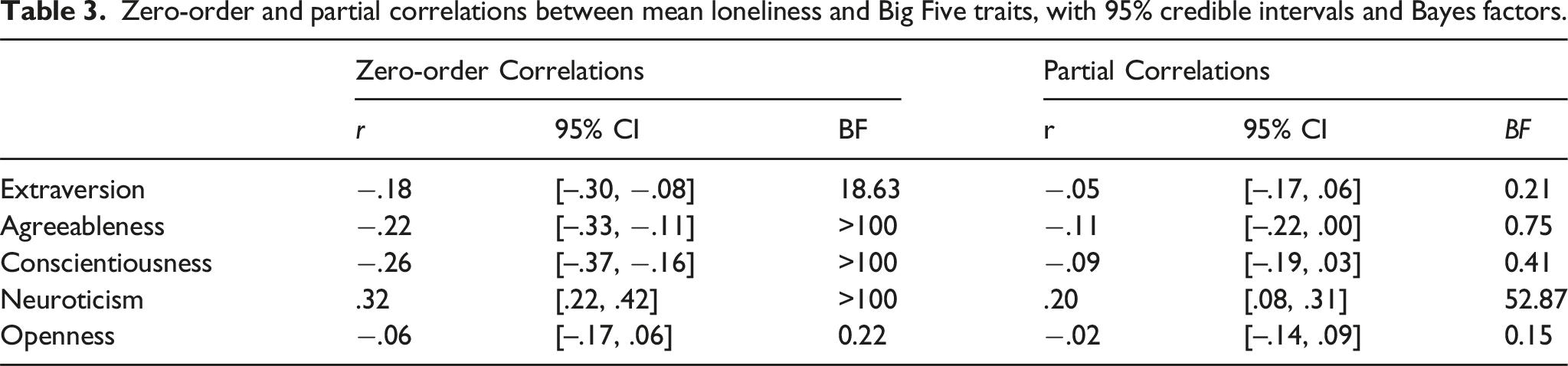
Zero-order and partial correlations between mean loneliness and Big Five traits, with 95% credible intervals and Bayes factors.
Distribution and within-person variability of loneliness
The average reported loneliness was 28.12 (out of 100). To estimate the within-person variability of loneliness, we fitted an intercept-only mixed-effects model without scale parameters to the raw data. This yielded an ICC = .53 (i.e. about half of the variance in loneliness occurred within persons). Loneliness ratings exhibited significant inflation at both extremes of the scale, with 26.7% of responses reporting ‘0’ (i.e. no loneliness) and 4.6% reporting ‘100’ (i.e. maximum loneliness). We therefore apply models accounting for censoring at both extremes.
To further examine within-person variability, we added a null submodel for the scale (i.e. a model including only a scale-related random effect). This revealed variance due to the random intercept of the location,
Inferential results
Location effects. Fixed effects parameter estimates for the effects of personality and social context on the level of loneliness. Social context was contrast-coded (alone: −0.5 vs. in company: 0.5). 95% credible intervals not containing zero are shown in bold.
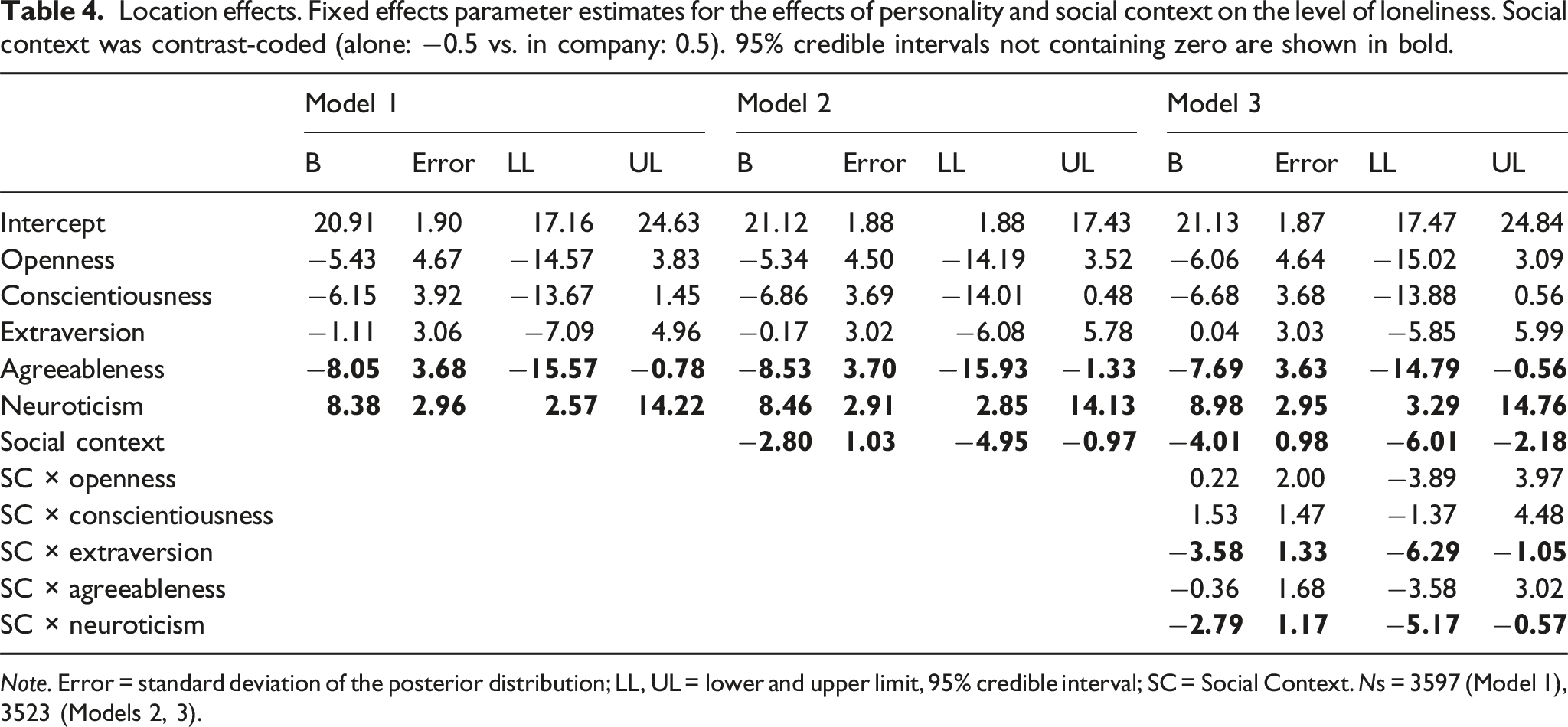
Note. Error = standard deviation of the posterior distribution; LL, UL = lower and upper limit, 95% credible interval; SC = Social Context. Ns = 3597 (Model 1), 3523 (Models 2, 3).
Scale effects. Fixed effects parameter estimates for the effects of personality and social context on the within-person variance of loneliness. Social context was contrast-coded (alone: −0.5 vs. in company: 0.5). 95% credible intervals not containing 1 are shown in bold.
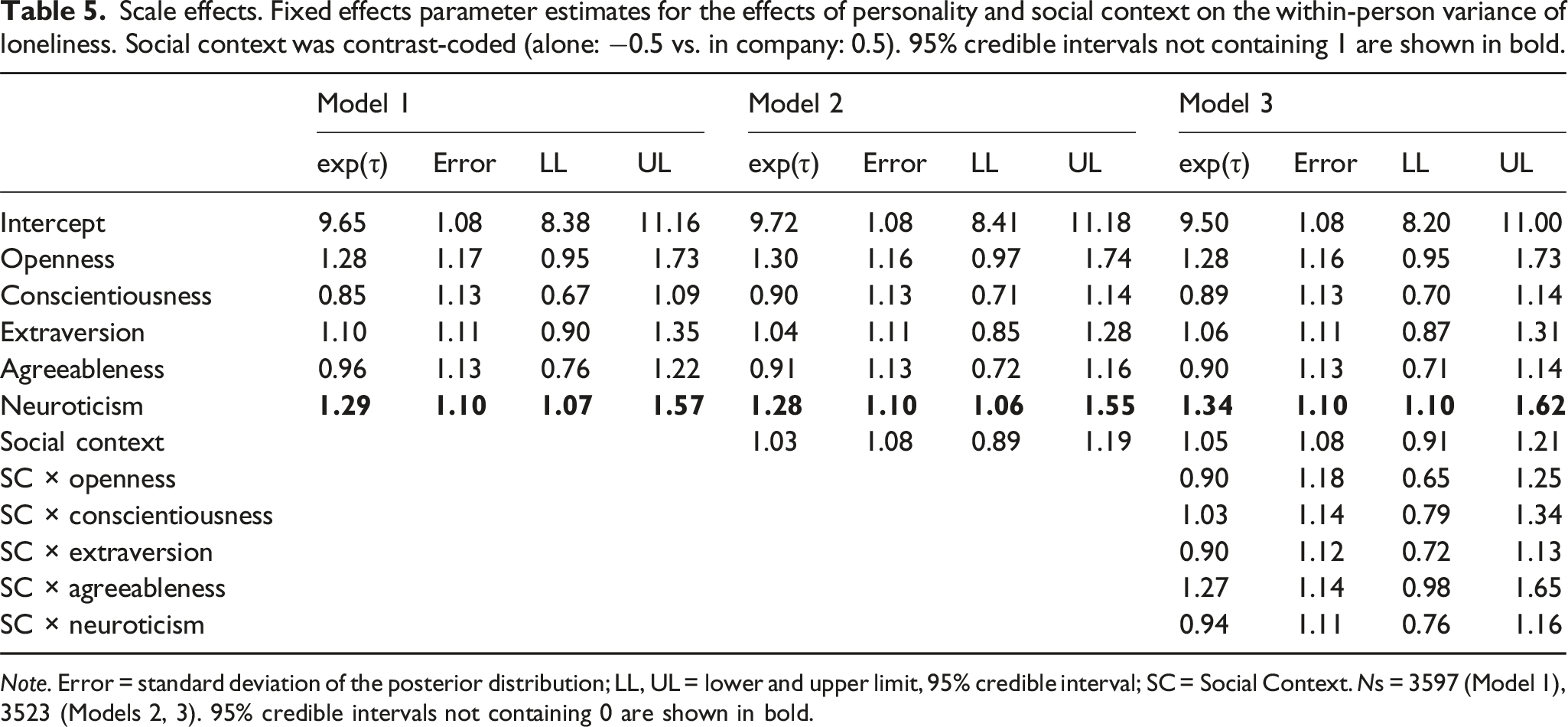
Note. Error = standard deviation of the posterior distribution; LL, UL = lower and upper limit, 95% credible interval; SC = Social Context. Ns = 3597 (Model 1), 3523 (Models 2, 3). 95% credible intervals not containing 0 are shown in bold.
Standard deviations of random effects parameters for location and scale.
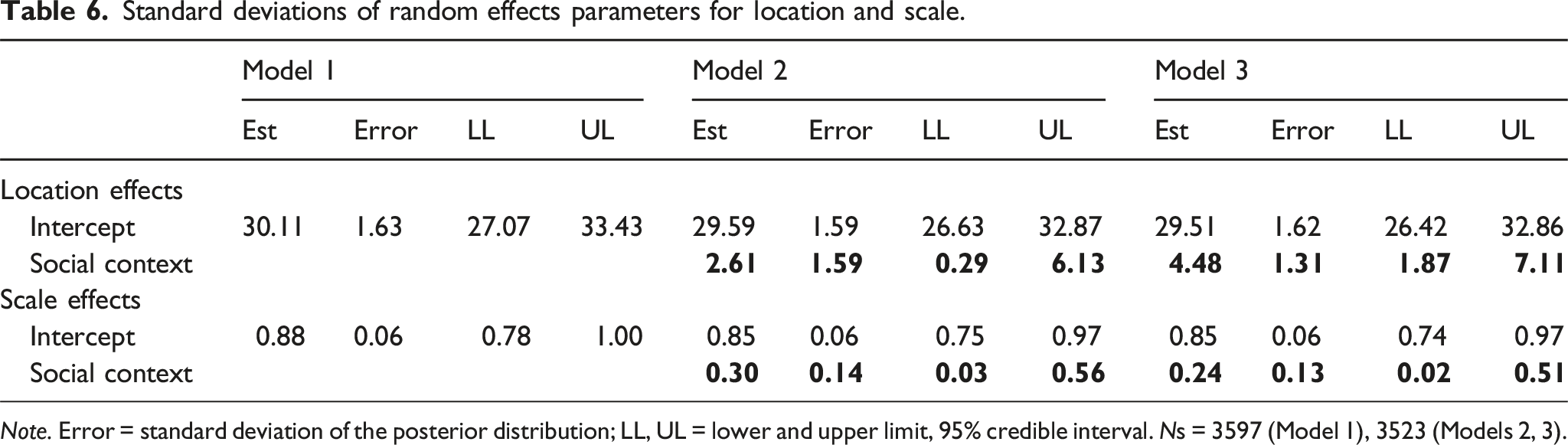
Note. Error = standard deviation of the posterior distribution; LL, UL = lower and upper limit, 95% credible interval. Ns = 3597 (Model 1), 3523 (Models 2, 3).
Random effects correlations. 95% credible intervals not containing zero are shown in bold.
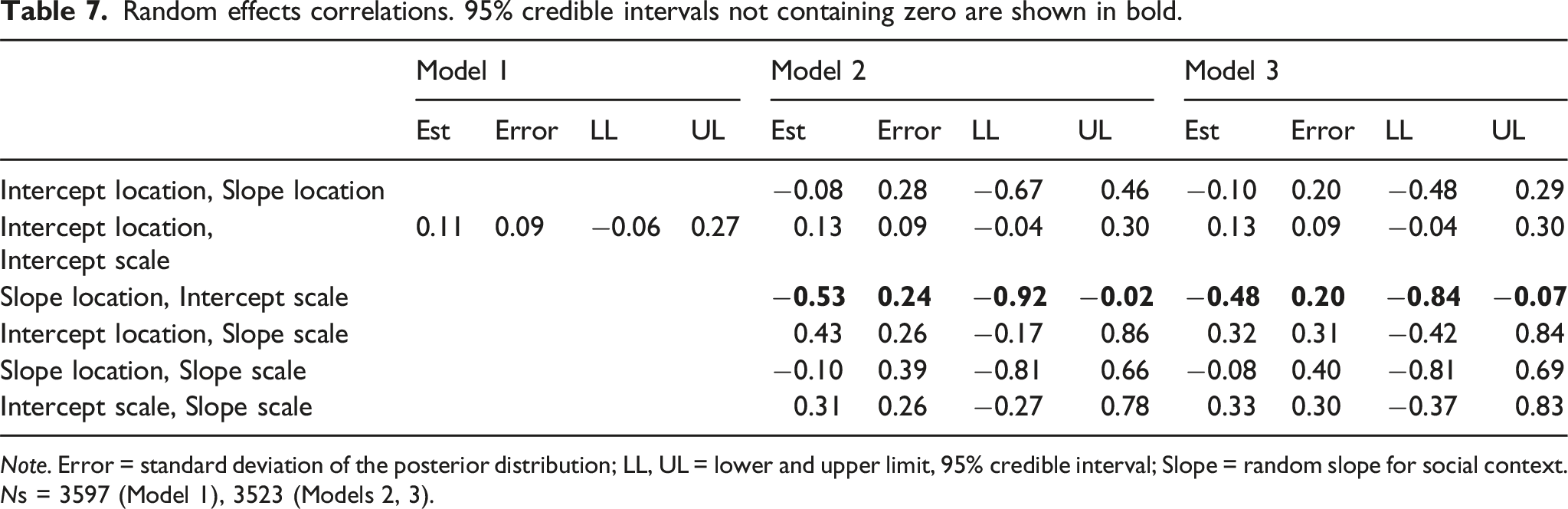
Note. Error = standard deviation of the posterior distribution; LL, UL = lower and upper limit, 95% credible interval; Slope = random slope for social context. Ns = 3597 (Model 1), 3523 (Models 2, 3).
Personality and social context predict the level of loneliness
We first consider individual differences in the mean level of loneliness across time points (Model 1, Table 4). Overall, more neurotic individuals felt lonelier, B = 8.38, 95% CI = [2.57, 14.22], whereas more agreeable individuals felt less lonely, B = −8.05, 95% CI = [−15.57, −0.78]. For all other traits, the 95% credible interval contains zero, which is consistent with the partial correlations reported in Table 3. These effects were robust to the inclusion of the social context (Model 2, Table 4). Unsurprisingly, participants felt less lonely when they were in company than when they were alone, B = −2.80, 95% CI = [−4.95, −0.97].
The multiplicative model identifies two person × situation interactions on the level of loneliness (Model 3, Table 4). Whether participants were alone or in company moderated the effect of extraversion, B = −3.58, 95% CI = [−6.29, −1.05], as well as the effect of neuroticism, β = −2.79, 95% CI = [−5.17, −0.57]. Figure 1 illustrates these interactions. To further probe the shape of the significant interactions, we computed estimated marginal effects of extraversion and neuroticism in both social contexts. For extraversion, Figure 1 shows a crossover interaction: more extraverted individuals felt lonelier when alone, but less lonely when in company. However, 95% credible intervals for marginal effects of extraversion included zero when participants were alone, B = 1.83, 95% CI = [−4.35, 7.98], and when they had company, B = −1.75, 95% CI = [−7.84, 4.16]. For neuroticism, Figure 1 shows that less neurotic individuals experienced little loneliness regardless of social context, whereas highly neurotic individuals experienced loneliness, especially when they were alone. This was borne out by the marginal effects, which showed that the effect of neuroticism was stronger when participants were alone, B = 10.37, 95% CI = [4.36, 16.30], than when they were in company, B = 7.59, 95% CI = [1.86, 13.30]. Conditional effects of Big Five personality traits on average loneliness when participants were alone (blue) and when they were in company (red). 95% credible intervals for the interaction terms involving extraversion and neuroticism did not contain zero; the other intervals did.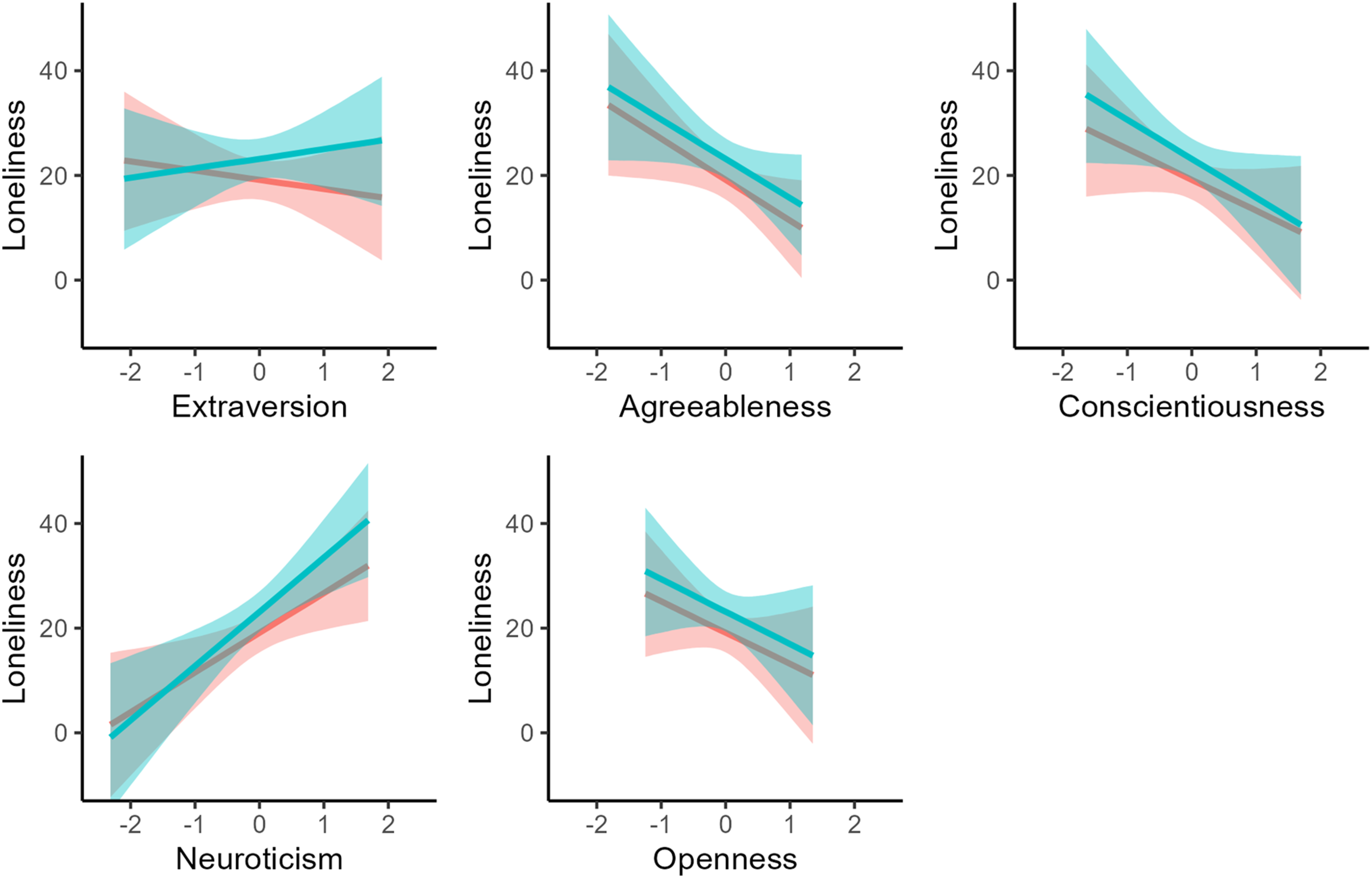
Neuroticism predicts within-person variability in loneliness
Big Five traits also predicted how much an individual’s feelings of loneliness varied from time point to time point (Model 1, Table 5). More neurotic individuals experienced greater ups and downs in their loneliness, exp(τ) = 1.29, 95% CI = [1.07, 1.57]. No other personality traits predicted within-person variability. In addition, participants did not fluctuate more (or less) when they were alone than when they were in the company of others, exp(τ) = 1.03, 95% CI = [0.89, 1.19] (Model 2, Table 5). Finally, neither the effect of neuroticism on within-person variability nor that of any other personality trait differed across social contexts (Model 3, Table 5).
Account for personality reduces the association between level and variability of loneliness
The models also yield some insights through the random effects. In particular, once we control for the (fixed) effects of personality traits, the location and scale of loneliness are no longer correlated, r = .11, 95% CI = [−.06, 27] (Model 1, Table 7). This suggests that the correlation between mean levels and within-person variability in loneliness is due to shared underlying personality traits. However, even after accounting for personality traits and social context, there remains unexplained variation in the location and scale of loneliness (Model 3, Table 6).
Discussion
Some people feel lonelier than others, an individual difference which is robustly associated with Big Five personality traits (Buecker et al., 2020). However, most people also vary in their experience from situation to situation; in particular, they feel lonelier when alone and less lonely when they are in the company of close others (van Roekel et al., 2015). Yet, following the differential reactivity hypothesis, individuals may also differ in how they respond to contextual factors. Partly as a consequence, some individuals may experience persistently low or high levels of loneliness, whereas others may experience greater fluctuations. Here, we use experience sampling data to examine whether Big Five personality traits and social context can explain differences in the level and intrapersonal variability of loneliness. We find that more neurotic individuals both experienced higher levels of loneliness and fluctuated more from situation to situation. The link between neuroticism and the level of loneliness was context-dependent: more neurotic individuals consistently felt lonelier, but especially so when they were alone rather than in company. However, this interaction did not extend to the degree of intrapersonal fluctuation: more neurotic individuals experienced greater ups and downs in loneliness across situations in which they were alone and across situations in which they had company.
Neuroticism and differential reactivity
The differential reactivity hypothesis posits that individuals vary in trait loneliness because they differ in their reactivity to being alone: highly lonely people feel lonelier when they are alone, but not necessarily when they have company (Cacioppo et al., 2003; van Roekel et al., 2018). Past research on Dutch adolescents had shown that the presence of close others moderates the link between trait loneliness and state loneliness, although highly (trait) lonely individuals still felt lonelier when they were in company, compared to less lonely individuals (van Roekel et al., 2018). In contrast to this approach, we did not assess trait loneliness directly. Rather, in line with whole trait theory (Fleeson, 2001; Fleeson & Jayawickreme, 2015), we take the trait of loneliness to be represented by the distribution of state loneliness. However, consistent with the differential reactivity hypothesis, we found that the random location intercept and the random slope intercept of loneliness were correlated, meaning that individuals who reported greater loneliness also experienced greater variability in loneliness across situations.
More broadly, differential reactivity means that individuals differ in their responses to situational cues. In particular, neuroticism has been conceptualised as hyperreactivity to social stressors (Bolger & Schilling, 1991; Costa & McCrae, 1992; Eysenck & Eysenck, 1985; Hills & Argyle, 2001; Hisler et al., 2020). Indeed, we found that highly neurotic individuals experienced greater loneliness when they were alone rather than in company. Yet, contrary to suggestions that social contacts could serve as a buffer against loneliness (Wieczorek et al., 2021), more neurotic individuals felt lonelier than less neurotic individuals even when they had company. Thus, though neurotic individuals do benefit from social contact, an alternative reading of our data could be that low neuroticism serves as a buffer against the negative effects of being alone, in particular, feeling lonely. Recent studies have shown that some people experience solitude (i.e. being alone) mostly negatively, whereas others experience it mostly positively (Danneel et al., 2018; Lay et al., 2019). Such differential reactivity to being alone may form part of the social-cognitive mechanism which links individual differences in neuroticism to individual differences in the level and intrapersonal variability of state loneliness.
One consequence of hyperreactivity to social stressors is increased emotional volatility (Bolger & Schilling, 1991; Costa & McCrae, 1992; Eysenck & Eysenck, 1985; Hills & Argyle, 2001; Hisler et al., 2020). Past empirical findings have linked neuroticism to within-person variability in affect more generally (Eid & Diener, 1999; Hisler et al., 2020; Mader et al., 2023).Consistently, our study shows that more neurotic individuals also experienced greater within-person variability in loneliness. A recent study suggested that such associations between personality traits and within-person variability in affect may be due to confounding of variability with the mean level of (negative) affect (Kalokerinos et al., 2020). Our analytic approach avoids this issue by concurrently modelling influences on mean level and within-person variance. Incidentally, Mader et al. (2023) used simulations to show that the data of Kalokerinos et al. (2020) are best explained by a model which is nearly identical to ours. In particular, like us, Mader et al. (2023) use censoring to account for the possibility of emotional states outside the range of the response scale. After re-analysing the original data, they conclude that ‘more neurotic individuals indeed experience more variability in negative emotion in everyday life’. Our results provide initial evidence that this is also true for loneliness, although further replications, including in other populations, would be welcome.
Extraversion and restrictions on social contact
Next to neuroticism, a recent meta-analysis found that, among the Big Five traits, extraversion was most strongly associated with loneliness (Buecker et al., 2020). In contrast, we found no such association when controlling for the other Big Five traits. However, several recent studies found that highly extraverted individuals experienced the greatest increase in loneliness when restrictions on social contact were put in place (Alt et al., 2021; Entringer & Gosling, 2022). Highly extraverted individuals may have responded more negatively to such restrictions because they have a greater need for social contact. Since our data were collected under similar lockdown conditions, which may have increased the overall level of loneliness (Ernst et al., 2022), these may have diminished the link between extraversion and loneliness.
Intriguingly, we found that the link between extraversion and loneliness was moderated by social context. Plotting this interaction shows that when they were alone, participants felt lonelier the more extraverted they were; conversely, when they had company, participants felt less lonely the more extraverted they were (Figure 1(a)). This pattern is consistent with the suggestion that extraversion may be positively associated with loneliness when individuals are restricted in their opportunities for social contact. However, marginal effects in each social context showed that neither of these associations was statistically significant. Future research may use more reliable measures of loneliness and more detailed measures of social context to further investigate whether there indeed exists a context-dependent link between extraversion and loneliness, and in particular, whether more extraverted individuals indeed experience greater loneliness than less extraverted individuals when they are alone.
Despite the restrictions put on social contact, it is still possible that individuals differed in the frequency of social interactions. We therefore tested whether personality predicted the proportion of situations individuals experienced alone versus in company. For this purpose, we regressed the social context on the five personality traits in a generalised linear mixed model. Indeed, individuals who were more extraverted, B = .09, 95% CI = [.04, .14], and less open, B = −.16, 95% CI = [−.24, −.07], reported being in the company of others more often (for full results, see Table 2). Thus, even under restrictions on social contact, more extraverted individuals appear to have been able to seek out, or otherwise experienced, more frequent social interactions. This provides some evidence that person–situation transactions may partially explain associations between personality traits and loneliness.
Generalisability
While most prior literature on personality and loneliness focuses on American and European samples, we collected a large experience sampling dataset in Nepal. Yet, our results generally replicate prior findings about the association between Big Five traits and mean levels of loneliness. The zero-order correlations in our study are within the prediction intervals obtained from a recent meta-analysis (Buecker et al., 2020). Like Buecker et al. (2020), we find partial correlations to be somewhat weaker. However, our results only diverge from their meta-analytic estimates in the case of extraversion, for which we find a non-significant negative partial correlation. This may be partly due to restrictions on social contact (Entringer & Gosling, 2022). Overall, we thus find quite similar associations between personality and mean levels of loneliness among Nepali participants as those previously reported in WEIRD samples. Even beyond these mean-level associations, our findings concord with the differential reactivity hypothesis and the conceptualisation of neuroticism as hyperreactivity to social stressors. Our study thus provides a sanguine perspective on the generalisability of the nomological net of broad personality models such as the Big Five beyond the usual WEIRD samples.
Limitations
We used experience sampling methods to ask participants several times a day about their feelings of loneliness. This allowed us to study intrapersonal fluctuations in loneliness. A downside of experience sampling is the need for brief measures. In this case, we used a face-valid single-item measure of loneliness. When analysed ‘as is’ (i.e. without censoring), this item has an ICC = .53, which is in line with other experience sampling studies of loneliness (Harper et al., 2020; Rinderknecht, 2020; Tam & Chan, 2019). Unfortunately, with a single-item measure, it is not feasible to establish the specificity, that is, how reliably the measure captures occasion-specific effects. If anything, however, an unreliable measure would work against our models and, in particular, should not be expected to yield the theoretically plausible associations we identify. Still, future research may replicate our analyses using more reliable multi-item measures of loneliness.
Collecting intensive longitudinal data also allowed us to explore whether associations between personality and loneliness were context-dependent. Using a simple indicator of whether participants were alone or in the company of others, we find that social context moderated the links between Big Five traits and both the level of loneliness and the degree to which individuals experienced ups and downs of loneliness. We must acknowledge, however, that our measure of social context was rather crude. Past research based on correlations between trait loneliness and measures of the quantity and quality of social connections has suggested that what matters is less the number of one’s contacts than the depths of one’s relationships with them (Perlman & Peplau, 1981; Russell et al., 2012; van Roekel et al., 2015). Most social contacts reported by our participants involved close family members. It may be that these contacts were overall positively valenced, and that this accounts for the relationship between social context and loneliness. However, further research may use more sophisticated measures of social context, including measures not only of the relationship with the other person(s), but also of the situation itself (e.g. DIAMONDS, Rauthmann et al., 2014; SIS, Gerpott et al., 2018).
A related limitation is that we only accounted for whether others were physically present. However, participants may also have been in contact with others via phone or internet. Correlational studies have consistently linked the use of (computer-)mediated communication to more, rather than less, loneliness, including during the COVID-19 pandemic (Bonsaksen et al., 2021; Kashian, 2022; Sarmiento et al., 2020). However, these broad associations may reflect that lonelier individuals turn to mediated communication in the absence of alternative means of contact (Boursier et al., 2020; Cauberghe et al., 2021). Indeed, some studies suggest that social uses of mediated communication during the COVID-19 pandemic were associated with lower loneliness (Choi & Choung, 2021; Meier et al., 2021). Future experience sampling studies or within-person experiments may explore whether communicating by phone or internet may buffer against loneliness by comparing such instances against situations in which individuals did not communicate at all.
Outlook: the importance of intrapersonal variability
A large body of research has documented links between trait loneliness and mental and physical well-being (Holt-Lunstad et al., 2015). A key finding from our study is that the individuals vary not only in average levels of loneliness but also in the extent to which they experience ups and downs of loneliness. This raises the question whether individual differences in intrapersonal variability in loneliness have independent associations with well-being. A recent study found that social contact alleviated the negative effects of loneliness on mental well-being (Stavrova & Ren, 2023). This suggests that occasional meaningful social connections, even if they are interspersed with periods of intense loneliness, could buffer against the harmful effects of loneliness and mitigate the negative association between neuroticism and mental well-being.
Our findings may also inspire new interventions. Drawing on the distinction between objective social isolation and subjective feelings of loneliness, researchers and practitioners have recognised that encouraging social contact alone is insufficient to alleviate loneliness (Hickin et al., 2021; Käll et al., 2020). Interventions based on cognitive behavioural therapy target perceptual and cognitive biases that result in hypervigilance to negative social information (Cacioppo & Hawkley, 2009; Hickin et al., 2021). This hypervigilance and hyperreactivity is seen as central to neuroticism (Bolger & Schilling, 1991; Costa & McCrae, 1992; Eysenck & Eysenck, 1985; Hills & Argyle, 2001; Hisler et al., 2020), and may underlie the greater intrapersonal variability in loneliness associated with heightened neuroticism. However, our results also show that merely being in the company of others was associated with lower loneliness among even the most neurotic part of our sample. Future research may inform interventions by further elucidating the personality-dependent triggers within situations spent alone or with others which give rise to feelings of loneliness.
Conclusion
Most people feel lonely from time to time, though some people feel lonelier on average than others. Beyond such differences in average loneliness, however, people also differ in the degree to which they experience ups and downs of loneliness. Using experience sampling data, we show that more neurotic individuals experience a greater level of loneliness. This link was strongest when participants were alone rather than in company. Moreover, in line with the differential reactivity hypothesis, more neurotic individuals also experienced greater fluctuations in loneliness from situation to situation. We also find some evidence for a context-specific association between extraversion and loneliness. Thus, the link between personality and loneliness is not merely a matter of averages but also of context-dependent intrapersonal dynamics.
Supplemental Material
Supplemental Material - Big five traits predict between- and within-person variation in loneliness
Supplemental Material for Big five traits predict between- and within-person variation in loneliness by Sujan Shrestha, Kripa Sigdel, Madhusudan Pokharel and Simon Columbus in European Journal of Personality
Footnotes
Acknowledgements

Author’s note
Sujan Shrestha. Part of the work was completed when Mr. Shrestha was at St. Xavier’s College, Maitighar.
Declaration of conflicting interests
The author(s) declared no potential conflicts of interest with respect to the research, authorship, and/or publication of this article.
Funding
The author(s) received no financial support for the research, authorship, and/or publication of this article.
Open science statement
Supplemental Material
Supplemental material for this article is available online.
Notes
References
Supplementary Material
Please find the following supplemental material available below.
For Open Access articles published under a Creative Commons License, all supplemental material carries the same license as the article it is associated with.
For non-Open Access articles published, all supplemental material carries a non-exclusive license, and permission requests for re-use of supplemental material or any part of supplemental material shall be sent directly to the copyright owner as specified in the copyright notice associated with the article.
