




Abstract
People often attribute success to themselves and failure to others. Past research indicates that this tendency toward self-serving attributions is pronounced among individuals high in trait narcissism. The aim of this registered report was to re-visit the link between narcissism and self-serving attributions by studying attributions in a group context and by distinguishing between two major dimensions of grandiose narcissism, admiration, and rivalry. We conducted a group study, (N = 422 participants nested in 54 groups), in which participants of each group were randomly assigned to one of two teams which then engaged in an intergroup competition. In line with our hypotheses, admiration predicted the tendency to take personal credit for success. Contrary to our hypotheses, rivalry did not uniquely predict the tendency to blame others for failure. Instead, admiration uniquely predicted the tendency to attribute negative team outcomes to unfairness of the competing outgroup. Explorative analyses further revealed that both admiration and rivalry were associated with the tendency to attribute negative, rather than positive, team outcomes to chance. Taken together, the findings indicate that narcissism goes along with an increased propensity for self-serving attributions in competitive intergroup settings and that this tendency is mainly driven by the admiration dimension.
People are not always fully honest to themselves. Quite often, they bolster their egos by explaining events in a self-serving manner (Sedikides & Strube, 1997). That is, they take personal credit in the case of success and blame others in the case of failure. Biased interpretations of reality can be beneficial for psychological health (Dufner et al., 2019; Taylor & Brown, 1988), but may be problematic in situations that call for a realistic appraisal of one’s own limits (Dunning et al., 2004). Understanding the personality traits that may promote such biases is thus an important task for social-personality science. The current research aims to tackle this task. It investigates people’s attributional patterns in a competitive intergroup context and analyzes how they cope with group successes and failures. In doing so, it focuses on a personality trait that has particular relevance for self-serving cognitions (Morf & Rhodewalt, 2001), namely, grandiose narcissism.
Self-Serving Attributions in a Competitive Intergroup Context
Be it at work, in academia, or in leisure contexts, people often interact in groups. And quite frequently, outgroups are present that compete over scarce resources. Previous research has primarily focused on the consequences of narcissism for group dynamics and functioning (e.g., Czarna et al., 2014; Lynch et al., 2021). In the current research, we take the reverse approach and focus on the socio-cognitive functioning of narcissists (i.e., persons scoring high in trait grandiose narcissism), when put in an intergroup context. Even though narcissists have a strong self-focus, their self-enhancing socio-cognitive mechanisms do not only involve evaluations of the self, but also of the social surrounding (Morf & Rhodewalt, 2001). As we will point out in the following, this should be consequential in an intergroup context.
People routinely try to find causes for the events they experience in their daily lives (Weiner, 1985). A well-established phenomenon in this context is the tendency toward so-called self-serving attributions (Mezulis et al., 2004; Miller & Ross, 1975; Weiner, 1985). In order to enhance or protect their self-esteem, people tend to ascribe success, but not failure, to factors within oneself (Campbell & Sedikides, 1999; Miller & Ross, 1975; Sedikides & Alicke, 2012; Sedikides & Gregg, 2008). That is, when people are asked about the causes of a task success, they explain it to a higher degree than their failures with their ability and with the effort they put into the task. In the case of failure, conversely, an efficient way of protecting the self is by attributing the outcome to factors outside the self. These external factors can include chance, task difficulty (Mezulis et al., 2004; Weiner, 1985), and other persons (Schlenker et al., 1976).
In the context of a competitive intergroup situation, a self-serving reaction would be to attribute a group success to one’s own personal contribution. In the case of a group failure, a self-serving, or ego-protecting, reaction would include a tendency to attribute the outcome to factors beyond one’s personal control. This reaction can come in different forms. We will describe three of them that are particularly relevant in the current context. First, as in all other situations, a self-serving reaction to a group failure can be to attribute the negative outcome to chance (Mezulis et al., 2004). Second, it is possible to attribute the negative outcome to lacking ability or effort of one’s own group members (Bird et al., 1980; Iso-Ahola, 1975; Wingrove & Bond, 1998). Third, it is possible to attribute the negative outcome to the behavior of the outgroup. However, the attribution would not be self-serving if the outcome was explained by the outgroup members’ high ability or effort, because this would imply that the failure is well deserved and that one’s own team is inferior. Instead, a self-serving reaction could be believing that the outgroup has succeeded solely due to unfair means (Knowles et al., 2015).
Narcissism and Attributions
A personality trait that might be particularly relevant for facilitating self-serving and ego-protecting attributions is grandiose narcissism. Grandiose narcissism is characterized by self-centeredness, feelings of grandiosity, entitlement and arrogance (Krizan & Herlache, 2018; Miller et al., 2017). Importantly, narcissists have a strong need for maintaining and protecting a positive self-view (Back et al., 2013; Campbell & Campbell, 2009; Campbell & Foster, 2007; Morf & Rhodewalt, 2001). Given that engaging in self-serving attributions is a powerful means toward this goal, one would expect grandiose narcissists to show a stronger self-serving attributional bias than people lower in grandiose narcissism. In line with this assumption, several studies indeed reported a positive relation between narcissism and self-serving attributions (Campbell et al., 2000; Farwell & Wohlwend-Lloyd, 1998Farwell & Wohlwend‐Lloyd, 1998; Rhodewalt & Morf, 1995, 1998; Selle et al., 2019; Stucke, 2003).
There is a reason to believe that distinct dimensions of narcissism are uniquely linked to the tendency to engage in biased attributions. According to the Narcissistic Admiration and Rivalry Concept (NARC, Back et al., 2013) there are two core dimensions of grandiose narcissism. The first dimension is called narcissistic admiration and describes narcissists’ tendency to actively enhance the positivity of the self. Narcissistic admiration goes along with high self-esteem (Geukes et al., 2017), the belief that one is better than the average other person (Back et al., 2013), and self-confident behavior (Leckelt et al., 2015). The second dimension is called narcissistic rivalry and describes narcissists’ propensity to protect the self against external threats by derogating other people. Narcissistic rivalry goes along with defensiveness and hostility (Grove et al., 2019), arrogance (Leckelt et al., 2015), disagreeableness (Rogoza et al., 2016), and untrustworthiness (Leckelt et al., 2015).
Because narcissistic admiration represents the self-enhancement dimension of narcissism (Back et al., 2013), it should account for narcissists’ tendency to take personal credit for successes. This means that after a success in a competitive intergroup task—but not after a failure—admiration should go along with the tendency to make internal personal attributions for the outcome. It thus seems likely that the link between grandiose narcissism and the tendency to attribute positive outcomes to one’s own abilities and effort that has been reported in past research is due to the admiration dimension.
For narcissistic rivalry, the expected links with attributional patterns are very different. Because rivalry represents the self-protection dimension of narcissism (Back et al., 2013), it should be associated with narcissists’ reactions to defeats. As described by the NARC, one way to protect the self in the face of an ego threat is by derogating others. Out of the three self-serving reactions to group failure that were described above (i.e., attributing the negative outcome to chance, lacking ability or effort of one’s own group members, or to unfair behavior of the outgroup) two are inherently other-derogatory. The tendency to attribute the negative group outcome to chance can be self-serving, but does not imply other-derogation. Thus, there is no reason to believe that this tendency is typical for people high in rivalry. When people attribute the negative outcome to lacking ability or effort of one’s ingroup members, this clearly implies a negative view of them. Thus, this tendency should be pronounced among people high in rivalry. In line with this possibility, recent evidence indicates that in the case of a negative group outcome people who are high in rivalry tend to distance themselves from their group (Benson et al., 2019). Hence, in case of an ego threat, people high in rivalry defend their individual egos by distancing themselves from their ingroup. Finally, attributing the negative group outcome to unfair behavior of the outgroup also clearly involves a negative view of others. Accordingly, we also expect this tendency to go along with high rivalry.
The Current Research
In the current research, we investigate people’s attributions in a competitive intergroup situation, involving actual teams in a laboratory setting with direct, intergroup contact. We zero in on the role that narcissistic admiration and narcissistic rivalry play in this context.
First, we expect that narcissistic admiration goes along with self-serving attributions. Specifically, we hypothesize that admiration positively predicts attributions of ability and effort for the self after a team win (Hypothesis 1). We also formulate two ancillary hypotheses that will test the specificity of the effect. The first ancillary hypothesis pertains to the partial effect of admiration when controlling for rivalry. Some past studies have compared the zero-order effects of the two dimensions with their partial effects (e.g., Back et al., 2013; Wurst et al., 2017). If a zero-order effect is significant, but the partial effect is not, this indicates that the effect was driven by the general need for a grandiose self-view that is shared by both dimensions rather than by the specific socio-cognitive characteristics of the respective dimension (e.g., a striving toward agentic self-enhancement for admiration). If the partial effect remains significant, the specific socio-cognitive characteristics of the respective dimension actually have a unique effect. As our argumentation rests upon the specific characteristics of admiration and rivalry (self-enhancement and self-protection processes, respectively), we propose that the hypothesized effect is present when the other dimension is controlled. Accordingly, we hypothesize that after a win, the positive relation between admiration and attributions of ability and effort for the self persists when the rivalry dimension is controlled (Hypothesis 1a). As the second ancillary hypothesis, we predict that the relation between admiration and attributions of ability and effort for the self is more positive after a win than after a defeat (Hypothesis 1b), which would indicate that a specific self-serving mechanism is at work.
We investigate also the relation between rivalry and defensive reactions to negative team outcomes. We hypothesize that in the case of a team defeat, narcissistic rivalry is positively related to the tendency to make attributions of (lacking) ability and effort for one’s team members (Hypothesis 2). This would mean that in terms of a negative outcome, people high in rivalry would claim their team members responsible. We further hypothesize that after a team defeat, narcissistic rivalry is positively related to attributions of unfairness for the members of the opposing team (Hypothesis 3). For each of the two hypotheses, we formulated two ancillary hypotheses that are analogous to the ones above. We hypothesize, first, for both outcomes that the effects are specific for the rivalry dimension, and persist when the admiration dimension is controlled (Hypotheses 2a and 3a, respectively). This pattern would indicate that the effect is indeed specific for the rivalry dimension. We hypothesize, second, that both suggested relations are more positive after a team defeat than after a team win (Hypotheses 2b and 3b, respectively). Such a pattern would indicate a specific ego-protecting reaction to negative outcomes.
Our line of argumentation indicates that narcissists’ increased needs for self-enhancement and self-protection are responsible for the predicted pattern of results. Yet, an important alternative explanation must be taken into account. It is conceivable that due to their charm, extraversion, and self-confidence (Back et al., 2010; Dufner et al., 2013), narcissists actually perform better than people lower in narcissism in the intergroup competition. In this case, effects such as a positive link between admiration and internal personal attributions after a success could be due to actual differences in performance, rather than to biased interpretations of reality. To rule out this possibility, we will control for impartial assessments of individual performance when we test our hypotheses.
Yet, another alternative explanation would be that the effects are driven by gender differences. Past research indicates that gender differences exist for both grandiose narcissism (Grijalva et al., 2015) and self-serving attributions (Campbell & Sedikides, 1999). Hence, gender qualifies as a potential confounder and we will control it in our hypothesis tests.
We will also investigate the specificity of the hypothesized effects in additional analyses. Instead of the specific attributional processes suggested by us, it is conceivable that a success might generally trigger pronounced positive perceptions among people high in admiration and that a failure might generally trigger pronounced negative perceptions among people high in rivalry. In this case, one would expect additional effects to the ones hypothesized by us. For example, in the case of a win, admiration should not only show pronounced links to attributions of ability and effort for the self (see Hypothesis 1), but also to a general tendency to view other persons more positively. Reversely, in the case of a failure, people high in rivalry should not only show a pronounced tendency to attribute the outcome to the ability and effort or their team members (Hypothesis 2) and to the unfair behavior of the opposing team (Hypothesis 3), but also a general tendency to view other persons more negatively. We will thus test if admiration is linked with pronounced positive generalized other-perceptions after a success and whether rivalry is linked to pronounced negative generalized other-perceptions after a failure. If this should be the case, we will re-run our hypothesis tests controlling for generalized other-perceptions. If the specific attributional processes proposed by us are at work, effects should persist. If the effects do not persist, more generic processes are apparently at work.
Finally, we will also explore the pattern of results for the Narcissistic Personality Inventory (NPI, Raskin & Hall, 1979; German: Schütz et al., 2004), which is the most popular unidimensional measure of grandiose narcissism, and the Hypersensitive Narcissism Scale (HSNS, Hendin & Cheek, 1997; German: Morf et al., 2017), which is a measure of vulnerable narcissism. Because the two instruments are not direct operationalizations of admiration or rivalry, we do not formulate firm hypotheses. Instead, we outline expectations, which seem plausible in light of past research on the overlaps between different narcissism measures. The NPI overlaps positively with both admiration and rivalry, albeit somewhat more with admiration (Back et al., 2013). Accordingly, we expected similar, albeit presumably weaker, effects to the ones described above (i.e., a positive relation with attributions of ability and effort for the self after a team win, a positive relation with attributions of ability and effort for one’s team members after a defeat, and a positive relation with attributions of unfairness for members of the opposing team after a defeat).
Because vulnerable narcissism has a positive overlap with rivalry, but only a negligible one with admiration (Krizan & Herlache, 2018), we expected the HSNS to show positive links to attributions of ability and effort for one’s team members after a defeat and to attributions of unfairness for members of the opposing team after a defeat.
Method
Following in-principle acceptance (IPA) as Registered Report, we conducted the group study. The stage 1 registered report, analysis script, a draft for the Supplemental Material and study codebook were uploaded before data collection to the OSF: https://osf.io/sm2ep/[Folder “Stage 1 Registered Report (in-principle acceptance)]. After completion of the study, some additional exploratory analyses turned out to be necessary. We will explicitly clarify when this was the case in the results section. Next to adding these exploratory analyses, we also made other minor changes in the text in order to increase its clarity and stylistic quality. A detailed description of these changes, the data, final versions of the analysis script, study codebook, and Supplemental Material are provided on the OSF: https://osf.io/sm2ep/[Folder: Stage 2 Registered Report]. Parts of the following description are identical to another registered report that is based on the same dataset [Dufner et al., 2023].
Sample and Design
Data were collected as a part of a larger study 1 on intra- and intergroup processes (N = 422, 2 54 groups [12 groups of 6, 11 groups of 7, 12 groups of 8, 13 groups 9, and 6 groups of 10], see study codebook on the OSF page). The study design was approved by the ethics board of the German Psychological Society. Participants (Mage = 22.81, SD = 3.84; 73.68% female, 26.32% male, 0.96% other), who were mostly university students (91.29% students), were recruited via social networks, notice-boards and flyers. Participants were required to be between 18 and 35 years old and fluent in German (94.31% native speaker). The group sessions took place at a university lab in eastern Germany.
Prior to the laboratory sessions, participants completed an online questionnaire involving assessments of demographic and personality variables (including narcissism). Participants registered online for the group sessions. When they did so, names of the other members were visible to them. Participants were explicitly requested to only join for a group in which they do not know any person. Participants signed in for a group consisting of up to 10 persons of the same gender (group sessions did not take place if less than six persons appeared). We checked the acquaintance afterwards (“I know this person.” 1 = do not agree to 6 = agree completely) and the result suggests that the procedure was successful (95.76% used the scale points 1–2; 3.53% used the scale points 3–4 and 0.71% used the scale points 5–6). During the group session, participants were randomly placed into two teams.
Next, participants encountered the opposing team and competed with it in a debate game. The game consisted of three rounds (see Supplemental Material), in which three controversial topics were discussed. These parts were video-recorded. For the first topic, participants read a description of a moral dilemma task in which a person has cheated on his or her partner. The question was whether he or she should confess the misdeed to the partner. The second topic was whether people should be obliged, rather than permitted, to participate in political elections. The third topic was whether marijuana should get the same legal status as alcohol. In every round, each team was instructed to defend a randomly assigned viewpoint on the topic (e.g., “in favor of the proposal” vs. “against the proposal”). Before each round the two teams got the chance to develop arguments for their viewpoint with their ingroup members for 10 minutes. After that, the two teams were instructed to express their own arguments, to criticize the arguments made by the other team, and to defend their own arguments if they are criticized. They learned that at the end of the third round, the experimenter would declare the team that provided the better arguments as the winning team and that members of the winning team would receive 35 Euros each, whereas the members of the losing team would only receive 25 Euros each. The criteria that we used to determine the winner (see below) were made transparent to the participants before the debate. Furthermore, participants learned that each team member had to make at least one active contribution in each round. The experimenter told participants that when one or more person(s) remained silent during an entire round, the round was automatically lost. (This never happened). The discussion topics and the coding scheme were piloted (see Supplemental Material).
Participants completed measures at three time points during the lab session. The first and second assessment took place at the very beginning of the lab session and during the debate game (i.e., between the second and the third round of the game). Both assessments included measures that were not analyzed for the current research question. The third assessment took place after participants have learned which team has won the debate game, and it included the assessments of attributions that we use as dependent measures in the present study.
Measures
Only the measures that were analyzed for the current research question are described here. (For a list of all study variables, see the study codebook: https://osf.io/98jfp)
Narcissism
We assessed narcissistic admiration and rivalry with the Narcissistic Admiration and Rivalry Questionnaire (NARQ, Back et al., 2013). The NARQ includes nine items assessing admiration and nine items assessing rivalry. Participants indicated their agreement with each statement for both questionnaires on a rating scale from 1 (not agree at all) to 6 (agree completely). Grandiose narcissism was also measured with the Narcissistic Personality Inventory (NPI; Raskin & Hall, 1979; German: Schütz et al., 2004). The NPI consists of 40 item pairs that are presented in a forced-choice format. Participants responded by choosing one of the two with which they most agree. Vulnerable narcissism was assessed using the 10-item Hypersensitive Narcissism Scale (HSNS; Hendin & Cheek, 1997; German: Morf et al., 2017). Participants’ responses were measured on a 5-point rating scale (1 = strongly disagree to 5 = strongly agree).
Attributions
Traditional measures of attributions typically assess only an internal-external dimension (e.g., Peterson et al., 1982). Yet, for our purpose such an assessment would not be ideal. After all, our hypotheses did not pertain to a broad internal-external dimension, but predicted a nuanced pattern of effects. That is, we predicted that admiration would mainly be linked to the tendency to make internal attributions and that rivalry would be linked to specific types of external attributions. Thus, as some other researchers before us (e.g., González-Boto et al., 2006; Rhodewalt & Morf, 1998; Riess & Taylor, 1984), we assessed different dimensions of attributions separately, namely, attributions to ability and effort, attributions to unfairness and attributions to chance. We assessed the attributions of ability/effort separately for the self (e.g., “Without my abilities it would not have come to this result.”), one’s own team members (e.g., “Without my team members´ abilities it would not have come to this result.”), and the members of the opposing team (e.g., “Without the other team´ abilities it would not have come to this result.”) with four items each that were adapted from González-Boto et al. (2006). We also assessed attributions of unfairness separately for the self, one’s own team members, and the members of the opposing team (sample item: “I/My team members/The members of the other team behaved unfairly.”) with four items. These items were adapted from Kaufmann and Stern (1988). Furthermore, we assessed attributions of lacking ability of the experimenter with two items (“The experimenter was not able to judge competently”) and attributions of unfairness of the experimenter with two items (“The experimenter was biased.”). Finally, we assessed attributions of chance with four items adapted from Norcross et al. (1985; sample item: “The outcome is due to just luck/bad luck”). For all attribution measures, participants indicated how strongly they agree with each statement on a rating scale from 1 (not agree at all) to 6 (agree completely). We had conducted an online vignette study (N = 95) to choose items of attribution measures and back-up their psychometric quality and validity (see Tables S1 and S2 in the Supplemental Materials).
Team Win/Defeat
The experimenter determined the winner of the debate by relying on an adapted version of the official coding scheme that is used by “Jugend debattiert,” a prominent debate club that is under the patronage of the German Federal President (https://www.jugend-debattiert.de/). This coding scheme consists of four criteria that are being used to evaluate the performance of each team for each of the three topics of the debate. The first criterion is the number of valid arguments made by the team. (How many valid arguments are being made?). The second criterion is the extent and quality of the support for the arguments provided by the team. (Does the team manage to make a convincing case for their arguments, e.g., by providing illustrative examples or supportive data?). The third criterion is conversation skills. (How well does the team perform at criticizing the arguments of the other team and how well it defends its own position against criticism?). The fourth criterion is the style of presentation of one’s arguments (How eloquent and expressive was the team?). After each round of the debate game, the experimenter rated the team as a whole on each criterion using a scale ranging from 1 = very low rating; to 5 = very high rating and then computed a sum score. These sum scores were then again summed at the end of the game to obtain a final composite score for each team. The team with the higher composite score was declared the winning team. If the teams achieved the same total score, the winner was the one who has achieved the higher score in the criterion conversation skills.
Individual Performance
The impartial assessment of performance of each participant was made via four observers who had watched the video recordings of the debate (each observer rated all participants). They rated the performance for each of the three topics of the debate based on the same four criteria as described in team win/defeat. Again, they could assign one to five points per criterion. We computed a composite score for each rater per target by summation across all four criteria and all three discussions. Inter-rater agreement of composite scores across the four observers was ICC (2, 4) = .82.
Additional Assessments
The debate game was meant to trigger a lively discussion in which all participants partook to some degree. Accordingly, participants were asked to what extent each topic provided an opportunity for discussion (“The discussion topic provided an opportunity to discuss in general”), and to what extent they contributed to the discussion (“I contributed to the discussion of the topic”). Participants indicated their agreement with each statement on a rating scale from 1 (strongly disagree) to 7 (strongly agree).
Furthermore, our reasoning builds upon the assumption that winning/losing at the debate game is of psychological relevance in that it is perceived as an actual success/failure. To test whether this assumption is true, participants responded to the items “The outcome of the game feels like a success to me” and “The outcome of the game feels like a failure to me” (1 = strongly disagree – 7 = strongly agree). We also assessed emotional experience after winning/losing by providing participants the 10-Item Positive and Negative Affect Schedule (Ebesutani et al., 2012). This scale includes five items assessing positive affect (sample item: “At the moment I feel joyful”) and five items assessing negative affect (sample item: “At the moment I feel miserable.”). Participants indicated their agreement with each statement using a Likert scale ranging from 1 (not at all) to 5 (extremely).
Finally, in order to be able to investigate the specificity of the observed effects, we also assessed participants’ general tendency to view others positively/negatively. For this purpose, they rated each person from their own and the opposing team in terms of liking with three items (“I like this person,” “I could imagine being friends with this person,” “I find this person likeable”) on a scale 1 (do not agree at all) to 6 (agree completely). These ratings were gathered at the end of the laboratory session, when participants know the game outcome. To gain a proxy of generalized other-perceptions, we computed each participant’s perceiver effect (Kenny, 1994, 2019) using the R package TripleR (Schönbrodt et al., 2012).
Analytic Procedure
We first controlled the quality of the data. That is, we checked if there were any signs of stereotypic responding (rigid response pattern) during participation of the study and excluded the respective participants. We did so by computing an index named LongString, which indicates the maximum number of items to which the respondent consecutively used the same response option and compute the proportion of such responses on a given survey page (Meade & Craig, 2012). We computed this index for the Big Five Inventory-2 (BFI-2; Soto & John, 2017), which is also included in the larger study (see codebook) and has the advantages that it assesses multiple traits and includes negatively keyed items. (Therefore, a rigid response pattern is most likely due to careless responding.) Participants were excluded if they provided the same consecutive responses for at least 90% of the items on a page containing a short version of the BFI-2 items. The items were presented on three pages containing 10 items each. One participant was therefore excluded because he or she provided the same consecutive responses for at least nine items on at least one of the three pages. We also conducted a winsorization for extreme outlier values on all relevant scales (|z| > 3). 3
Because participants were nested within groups, we used multilevel modeling. All models include a random intercept for group at Level II and all remaining effects are at Level I. We apply z-standardization to all continuous variables and dummy- or effect-coding to the dichotomous variables (e.g., outcome is coded as defeat = 0 and win = 1; gender is coded as female = 0 and male = 1).
In a preliminary step, we explored to what extent participants thought that the game generally provided an opportunity for debate and to what extent they have personally contributed to the debate (for details, see below). Furthermore, we investigated effects of the game outcome on participants’ perceptions of the outcome as an actual success/failure and their emotional experience. Furthermore, we investigated effects of the game outcome on each of the attribution measures. In each case, we computed a random intercept model with the game outcome (win vs. defeat) as a predictor. We also inspected the intercorrelations between all study variables and the ones between narcissism and attributions separately for winners and losers. To account for the nested structure, we used partial correlations using dummy-coded groups as a covariate.
Hypotheses 1, 2, and 3 as well as Hypotheses 1a, 2a, and 3a concerned the effects among the subsample of winners (Hypothesis 1) or losers (Hypotheses 2 and 3). Hypothesis 1 was tested by predicting attributions of ability and effort for the self by individual performance, 4 team size, gender, and admiration, and the test of Hypothesis 1a included rivalry as an additional predictor. Hypothesis 2 was tested by predicting attributions of ability and effort for one’s group members by individual performance, team size, gender, and rivalry, and the test of Hypothesis 2a included admiration as an additional predictor. Hypothesis 3 was tested by predicting attributions of unfairness for the members of the other team by individual performance, team size, gender, and rivalry, and the test of Hypothesis 3a included admiration as an additional predictor.
Hypotheses 1b, 2b, and 3b posited differences in effect sizes between winners and losers, and therefore they were tested based on the whole sample. For each hypothesis, we predicted the respective outcome by a) individual performance, b) team size, c) the respective narcissism dimension (H1b: admiration; H2b and H3b: rivalry), d) game outcome (win/defeat), e) gender, f) the interaction between individual performance and the game outcome, g) interaction between gender and the game outcome, and h) the interaction between the respective narcissism dimension and the game outcome. 5
We used two-sided tests and Satterthwaite’s approximations to derive p-values for fixed effects. Furthermore, we used restricted maximum likelihood estimation (REML), assuming that residuals and random intercepts are independent random variables following a normal distribution. Estimation of fixed effect parameters is relatively robust against the violation of assumptions (Maas & Hox, 2004). The R scripts are provided on the OSF (https://osf.io/sm2ep/)
Calculation of Required Sample Size
Calculation of required sample size was based on a simulation study as recommended for multilevel models (Gelman & Hill, 2007). The code can be found on the OSF project page [https://osf.io/ecbhs].
Due to a lack of previous research studying the effects of admiration and rivalry on self-serving attributions, it was not easy to specify the expected effect sizes for our hypotheses. An exception was Hypothesis 1 (including ancillary Hypotheses 1a and 1b), as previous research investigated the relation between narcissism (unidimensional NPI score) and internal attributions after success versus failure. Across the past studies we are aware of that report correlations between narcissism and internal attributions after success (Farwell & Wohlwend‐Lloyd, 1998; Rhodewalt & Morf, 1998; Selle et al., 2019), the weighted average effect size is r = .305. Moreover, across studies reporting correlations between narcissism and internal attributions after failure (Rhodewalt & Morf, 1998, Studies 1 and 2), the weighted average effect size is r = −.071. Yet, even in this case, it is unclear how large the effect should be for admiration, rather than the unidimensional NPI score. However, we feel safe to assume that the effects for the more specific admiration subscale on internal attribution should be at least as large as the effect for a more general narcissism scale. For the effects of rivalry on external attributions, there is no previous research we are aware of that we can refer to at all, so we assumed that the effects for rivalry were of similar size as those for admiration. We thus based our power analysis on the assumption that the standardized effect of admiration on internal attributions of ability and effort is β = .30 after a win (Hypothesis 1) and β = 0 after defeat. The latter value results in an interaction effect of β = .30 (Hypothesis 1b). Note that this effect is only partially standardized because the SD of the dummy-coded independent variable is 0.50 (and not 1). In fully standardized metrics, this interaction effect corresponds to an effect size of b = .15.
To conduct the simulation study, it was also necessary to specify the effects of covariates and the associations between all predictor variables. Based on findings from Mezulis et al. (2004), we set the effects of game outcome on attributions to β = .30, and the interaction effect between gender and game outcome on attributions to β = .30. The effects of further covariates (including gender, performance, team size, and rivalry) were set to zero. With regard to associations between predictors, we assumed a correlation of r = .50 between admiration and rivalry (Back et al., 2013), a correlation of r = .30 between admiration and performance, a standardized difference between win and defeat in performance of d = .50, and a standardized difference between male and female in narcissism (i.e., admiration and rivalry) of d = .26 (Grijalva et al., 2015). The correlation between narcissism and individual performance is unknown, as there is no previous research using a similar design. However, it is highly unlikely that the correlation will be larger than r = .30, as this value is considered to be the typically found in correlational personality research for observed behavior (Mischel et al., 1968). The remaining associations were set to zero.
In addition, we assumed that 5% of the variance in attributions can be explained by group differences (i.e., relative random intercept variance). The group size was set to 10 participants. Furthermore, we included a buffer by adding a dropout of 10% into the power analyses. Our final power analysis was conducted by varying the number of groups from 30 to 60, each time using 1000 simulated data sets to estimate the power for detecting the three effects (assuming alpha = .05, two tailed).
The resulting sample size was determined by ensuring that each of the three hypotheses could be tested with a power of at least 80%. Our simulation suggested that 41 groups with 10 participants (total N = 410, including 10% dropout) would be necessary to detect the interaction effect (Hypothesis 1b) with a probability of 80%. Note that the power increased to 83% when the correlation between narcissism and individual performance was set to r = 0. Being conservative, we will aim for the sample size of N = 410. For Hypotheses 1 and 1a, an effect of β = .30 would be detected with a probability of 97.5% and 92.0%, respectively.
Results
Descriptive Statistics and Preliminary Analyses
Cognitive-Emotional Reactions, as a Function of the Game Outcome.
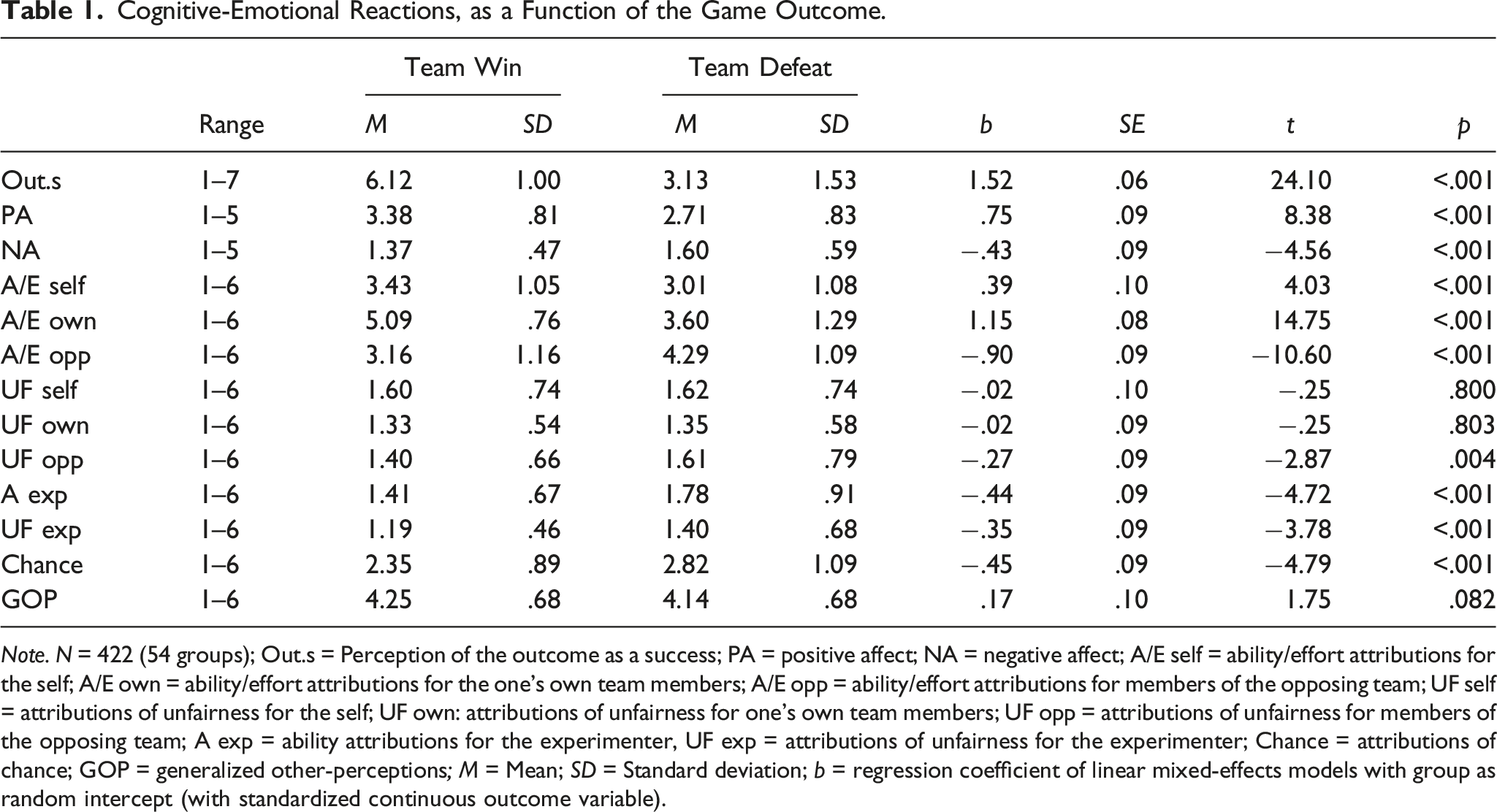
Note. N = 422 (54 groups); Out.s = Perception of the outcome as a success; PA = positive affect; NA = negative affect; A/E self = ability/effort attributions for the self; A/E own = ability/effort attributions for the one’s own team members; A/E opp = ability/effort attributions for members of the opposing team; UF self = attributions of unfairness for the self; UF own: attributions of unfairness for one’s own team members; UF opp = attributions of unfairness for members of the opposing team; A exp = ability attributions for the experimenter, UF exp = attributions of unfairness for the experimenter; Chance = attributions of chance; GOP = generalized other-perceptions; M = Mean; SD = Standard deviation; b = regression coefficient of linear mixed-effects models with group as random intercept (with standardized continuous outcome variable).
We first investigated participants’ general reactions to the game outcome. The winners considered the outcome as an actual success to a greater extent than the losers. The winners had higher positive affect scores than the losers and the losers had higher negative affect scores than the winners. The winners did not have more positive generalized other-perceptions than the losers. This pattern of the result was expected and is in line with our expectations. This means that the experience of winning or losing in the game was sufficient to have a psychological impact on the participants and that the experimental setting worked well.
We also examined the effects of winning versus losing on attributions. The winners had higher values in their attributions of ability and effort for the self than the losers. In contrast, losers had higher values than winners with regard to attributions of unfairness for the members of the other team and with regard to attributions of chance. These results clearly indicated the presence of self-serving attributional patterns.
Attributions of ability and effort for the team members were also higher among the winners than among the losers, whereas attributions of ability and effort for the members of the other team were lower among the winners than among the losers. Thus, participants also had a tendency to attribute positive outcomes to internal factors of their ingroup.
When we examined the two forms of attributions that were neither self- nor group-serving—attributions of unfairness for the self and for the own team members—we found no significant differences between winners and losers. In combination, these results indicate that our experimental design was suited for finding self-serving attributional biases, as they are well-documented in the literature.
Descriptive Statistics and Intercorrelations.
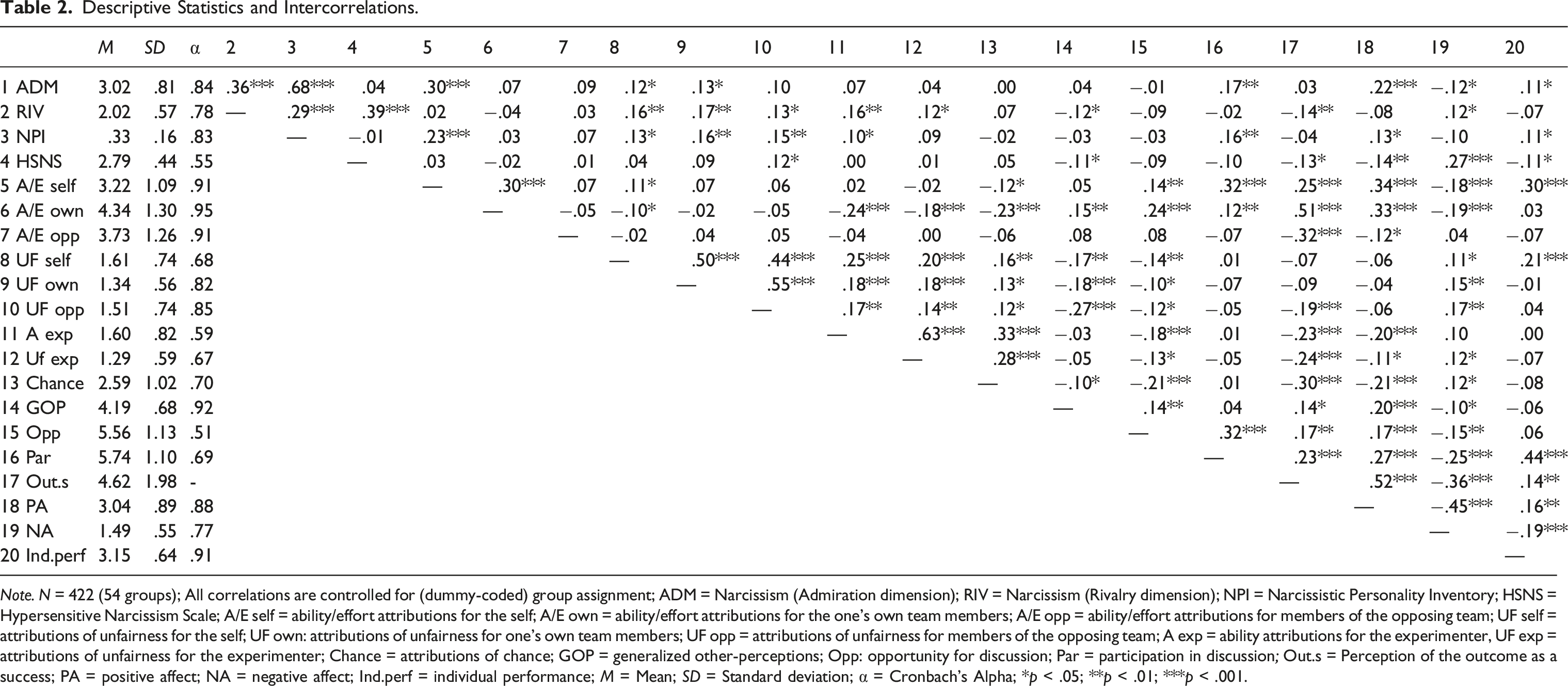
Note. N = 422 (54 groups); All correlations are controlled for (dummy-coded) group assignment; ADM = Narcissism (Admiration dimension); RIV = Narcissism (Rivalry dimension); NPI = Narcissistic Personality Inventory; HSNS = Hypersensitive Narcissism Scale; A/E self = ability/effort attributions for the self; A/E own = ability/effort attributions for the one’s own team members; A/E opp = ability/effort attributions for members of the opposing team; UF self = attributions of unfairness for the self; UF own: attributions of unfairness for one’s own team members; UF opp = attributions of unfairness for members of the opposing team; A exp = ability attributions for the experimenter, UF exp = attributions of unfairness for the experimenter; Chance = attributions of chance; GOP = generalized other-perceptions; Opp: opportunity for discussion; Par = participation in discussion; Out.s = Perception of the outcome as a success; PA = positive affect; NA = negative affect; Ind.perf = individual performance; M = Mean; SD = Standard deviation; α = Cronbach’s Alpha; *p < .05; **p < .01; ***p < .001.
Correlations between different Narcissism Dimensions and Attributions.
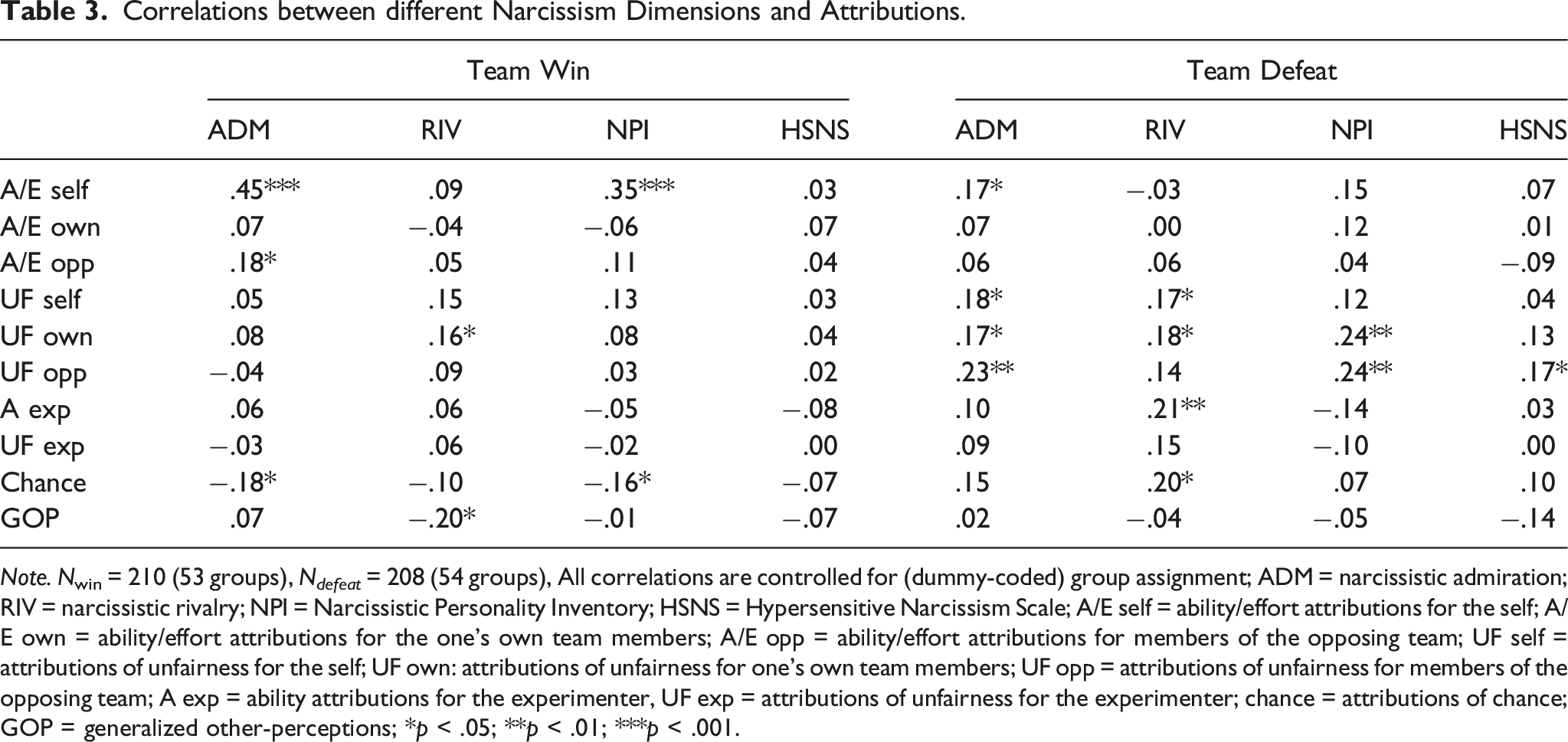
Note. Nwin = 210 (53 groups), N defeat = 208 (54 groups), All correlations are controlled for (dummy-coded) group assignment; ADM = narcissistic admiration; RIV = narcissistic rivalry; NPI = Narcissistic Personality Inventory; HSNS = Hypersensitive Narcissism Scale; A/E self = ability/effort attributions for the self; A/E own = ability/effort attributions for the one’s own team members; A/E opp = ability/effort attributions for members of the opposing team; UF self = attributions of unfairness for the self; UF own: attributions of unfairness for one’s own team members; UF opp = attributions of unfairness for members of the opposing team; A exp = ability attributions for the experimenter, UF exp = attributions of unfairness for the experimenter; chance = attributions of chance; GOP = generalized other-perceptions; *p < .05; **p < .01; ***p < .001.
Hypothesis Testing
Admiration and Attributions
Fixed Effects of Admiration on Attributions of Ability and Effort for the Self.
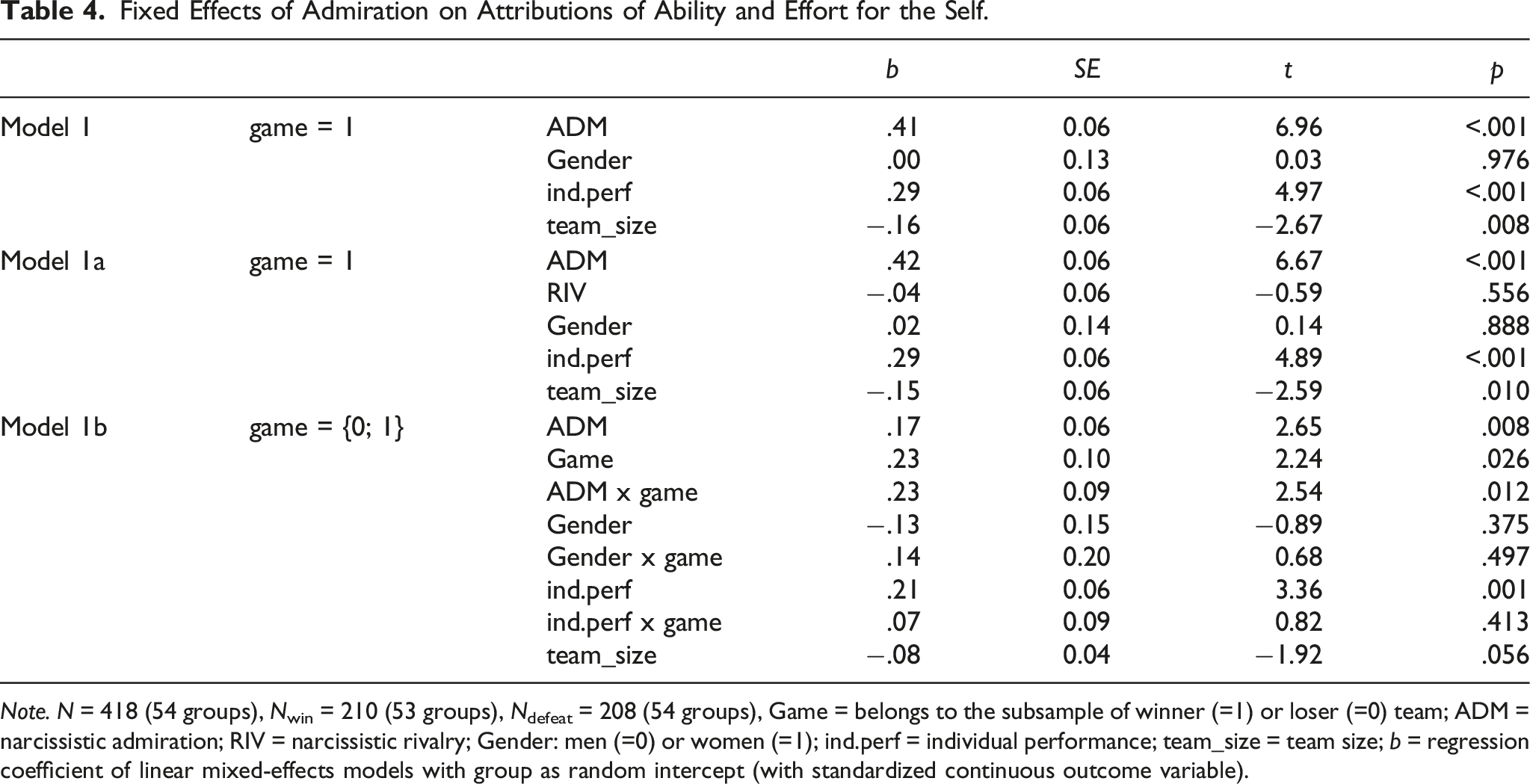
Note. N = 418 (54 groups), Nwin = 210 (53 groups), Ndefeat = 208 (54 groups), Game = belongs to the subsample of winner (=1) or loser (=0) team; ADM = narcissistic admiration; RIV = narcissistic rivalry; Gender: men (=0) or women (=1); ind.perf = individual performance; team_size = team size; b = regression coefficient of linear mixed-effects models with group as random intercept (with standardized continuous outcome variable).
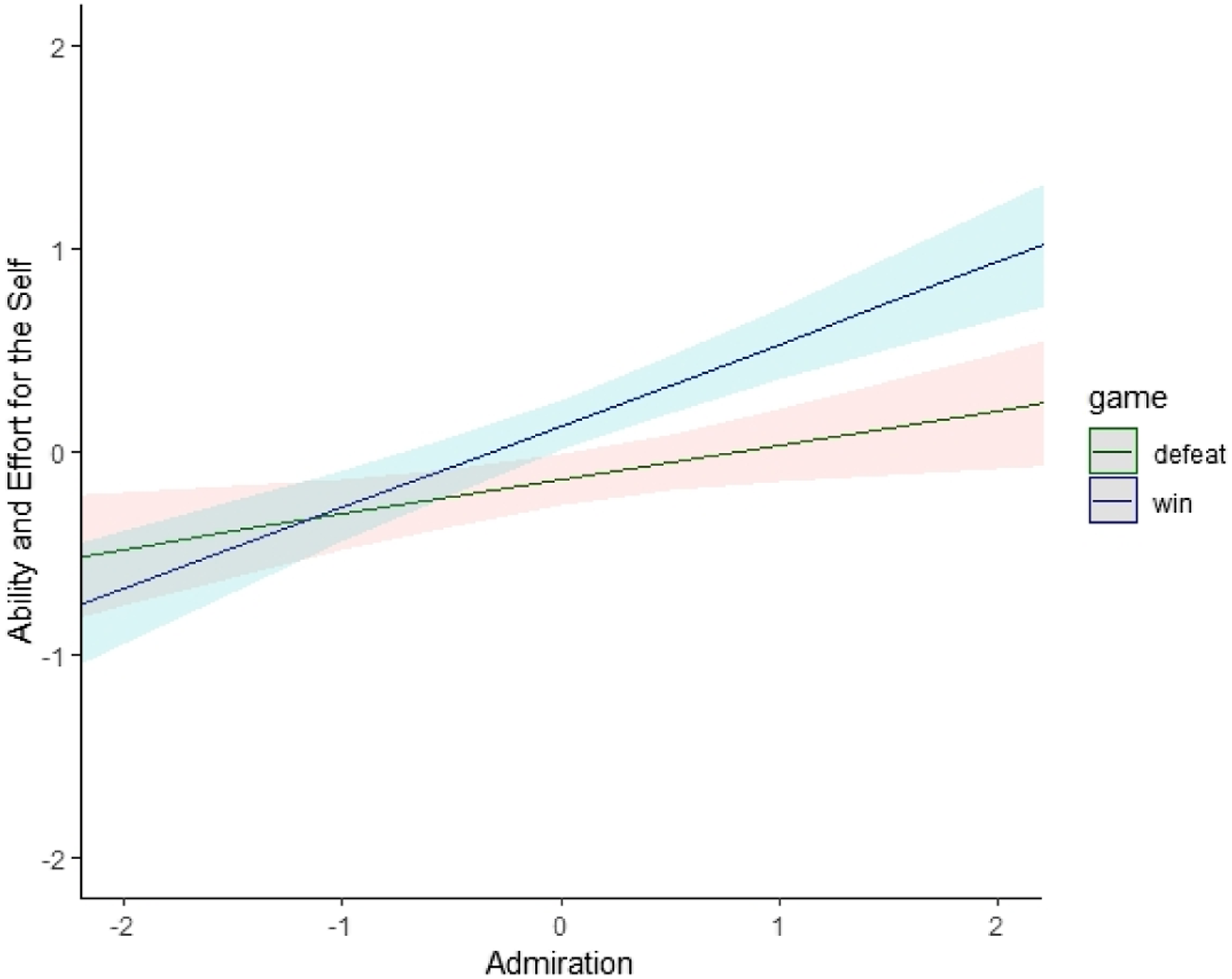
Interaction Effect between Admiration and Game on Attribution of Ability and Effort for the Self (all Variables were Z-standardized).
Rivalry and Attributions
Fixed Effects of Rivalry on Attributions of Ability and Effort for one’s Team Members.
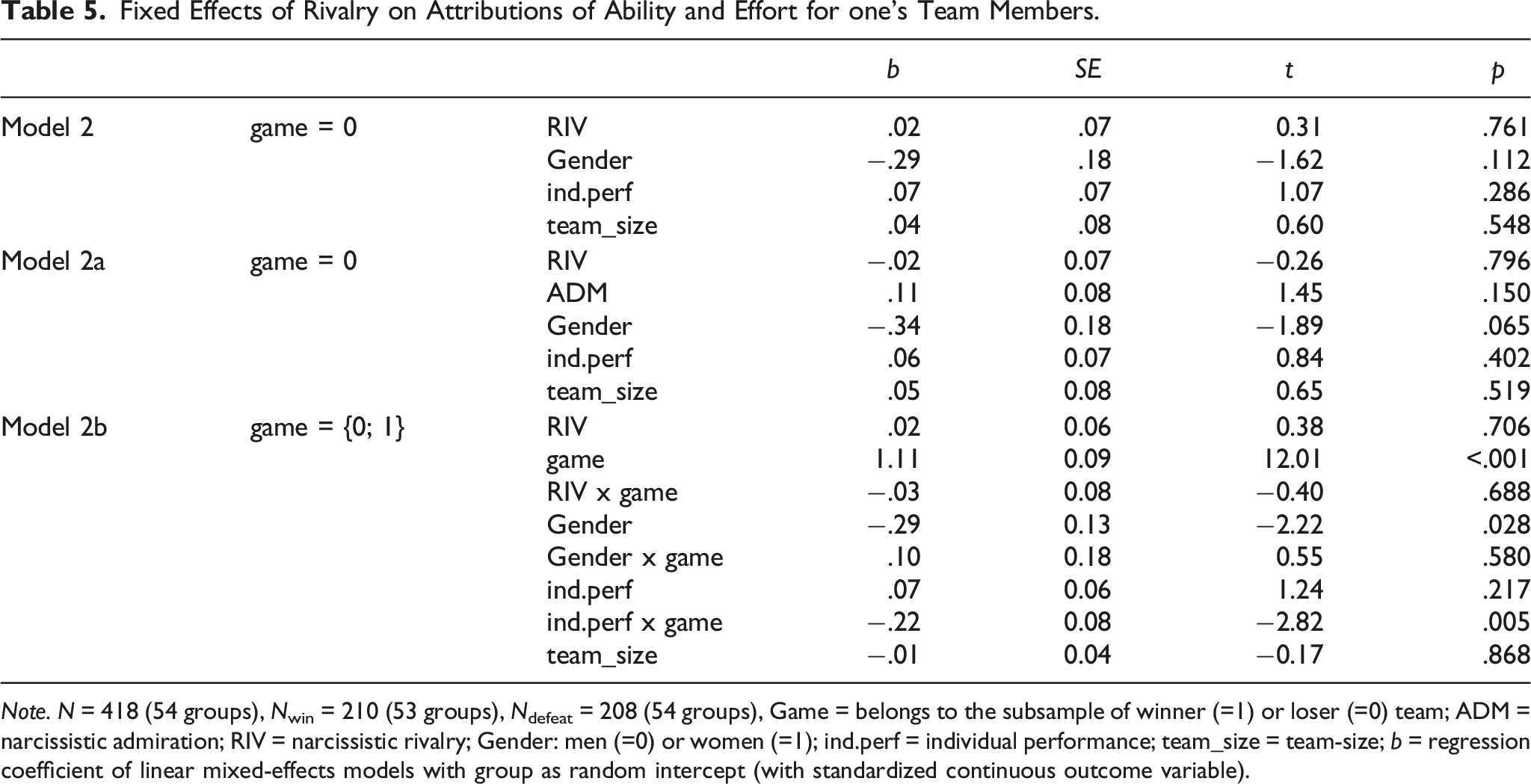
Note. N = 418 (54 groups), Nwin = 210 (53 groups), Ndefeat = 208 (54 groups), Game = belongs to the subsample of winner (=1) or loser (=0) team; ADM = narcissistic admiration; RIV = narcissistic rivalry; Gender: men (=0) or women (=1); ind.perf = individual performance; team_size = team-size; b = regression coefficient of linear mixed-effects models with group as random intercept (with standardized continuous outcome variable).
Fixed Effects of Rivalry on Attributions of Unfairness for the Members of the Other Team.
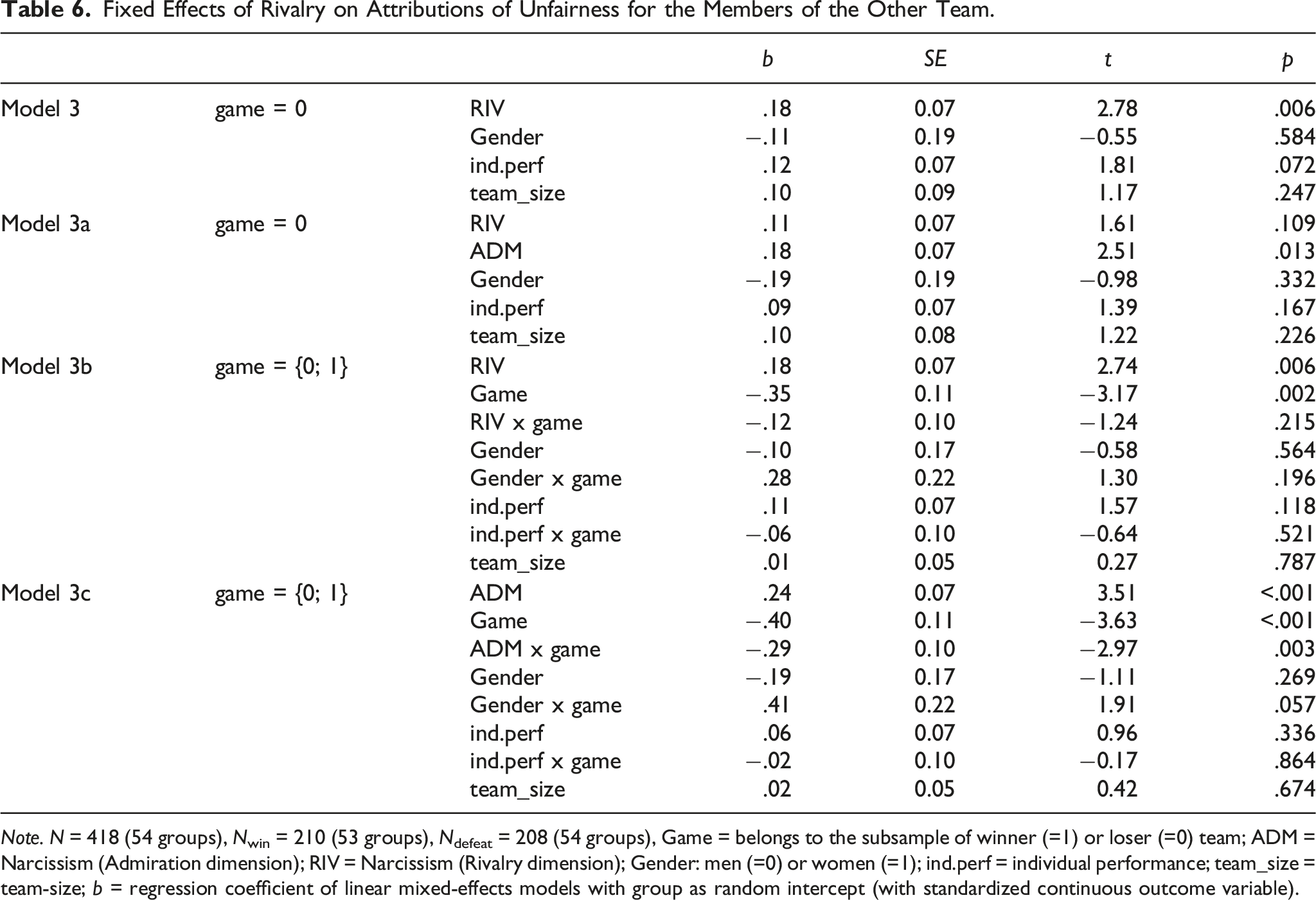
Note. N = 418 (54 groups), Nwin = 210 (53 groups), Ndefeat = 208 (54 groups), Game = belongs to the subsample of winner (=1) or loser (=0) team; ADM = Narcissism (Admiration dimension); RIV = Narcissism (Rivalry dimension); Gender: men (=0) or women (=1); ind.perf = individual performance; team_size = team-size; b = regression coefficient of linear mixed-effects models with group as random intercept (with standardized continuous outcome variable).
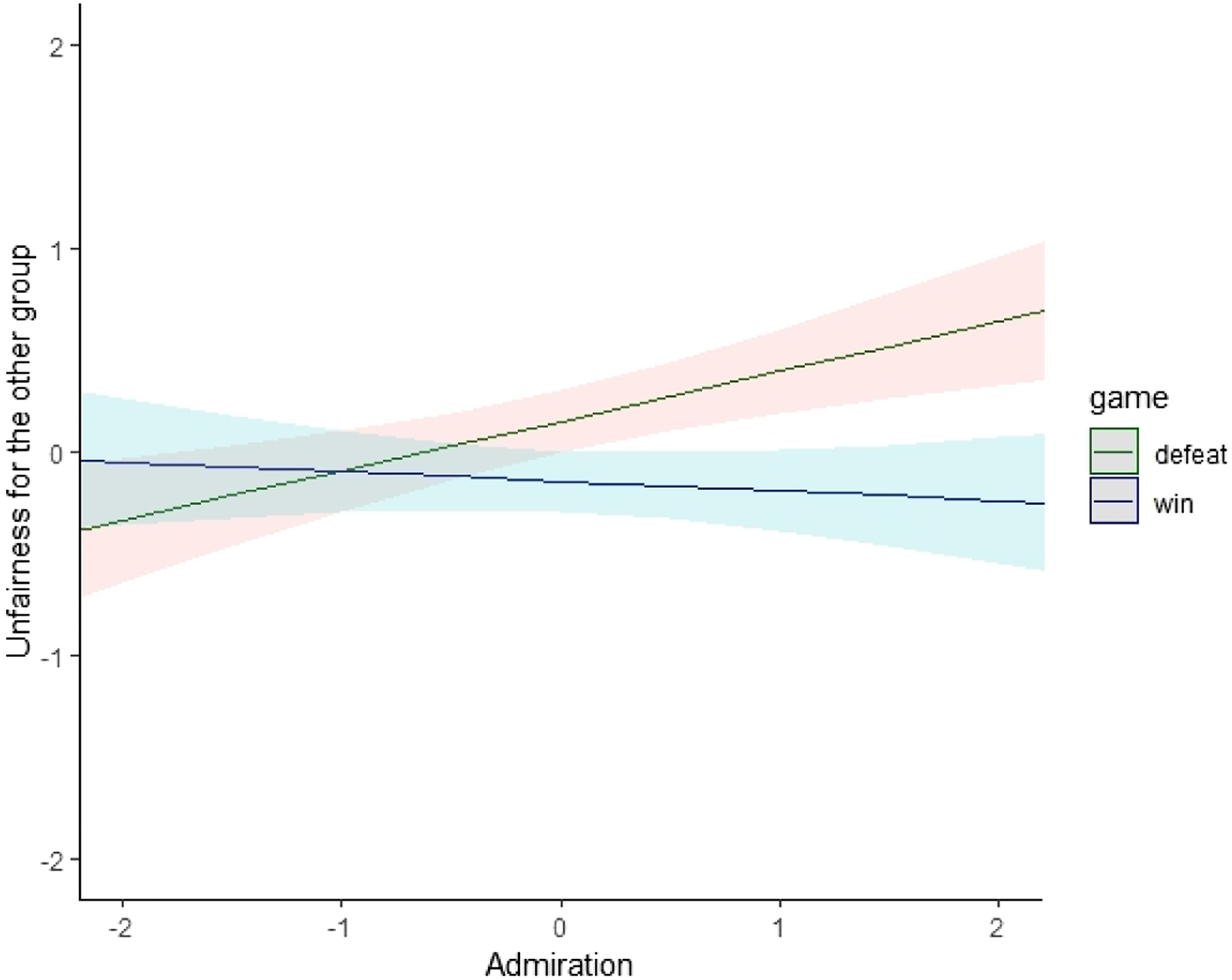
Interaction Effect between Admiration and Game on Attribution of Unfairness of the other Team Members (all Variables were Z-standardized).
Further Exploratory Analyses
Experimenter-Related Attributions
Fixed Effects of Admiration and Rivalry on Attributions of Lacking Ability of the Experimenter.
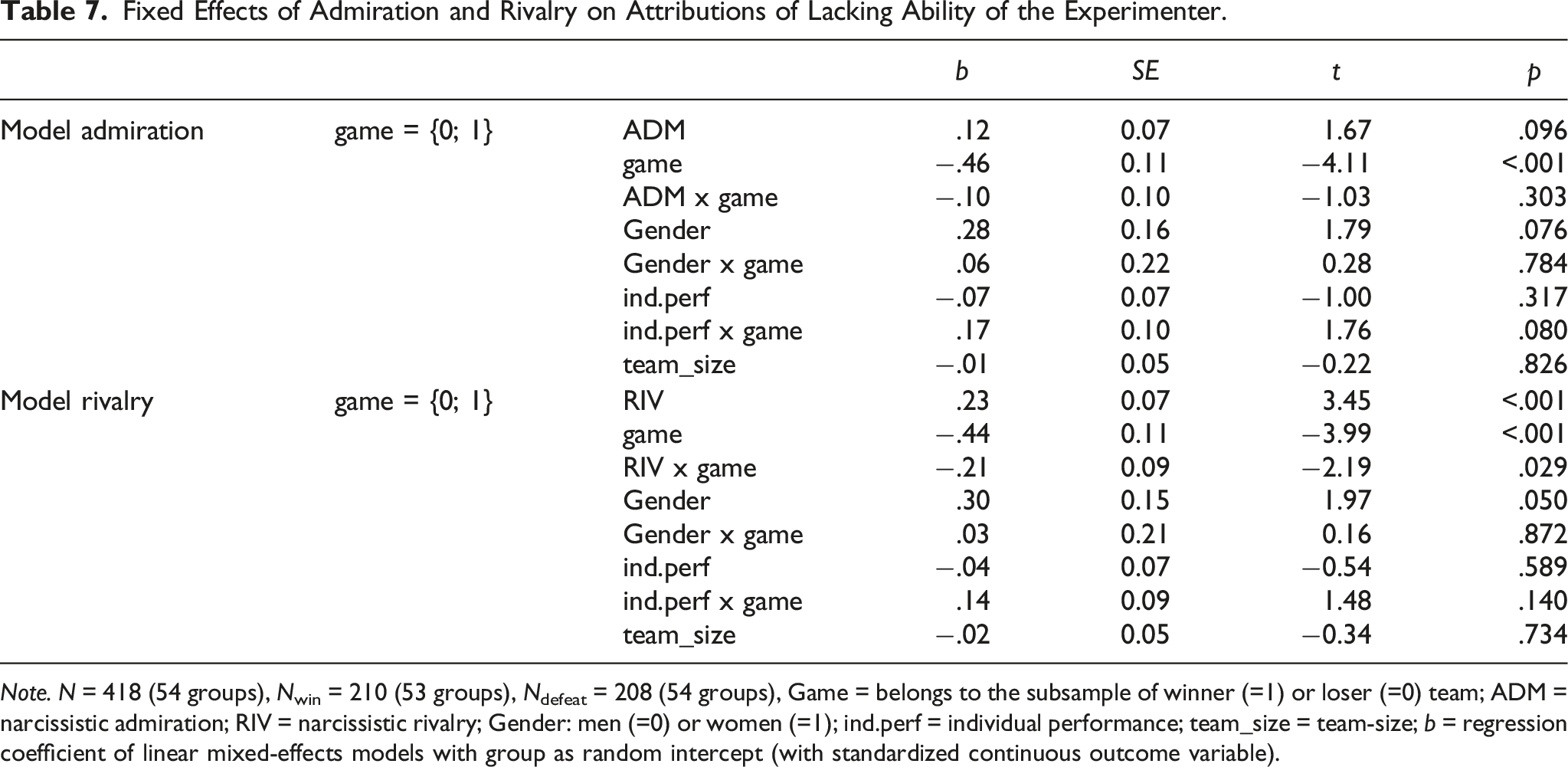
Note. N = 418 (54 groups), Nwin = 210 (53 groups), Ndefeat = 208 (54 groups), Game = belongs to the subsample of winner (=1) or loser (=0) team; ADM = narcissistic admiration; RIV = narcissistic rivalry; Gender: men (=0) or women (=1); ind.perf = individual performance; team_size = team-size; b = regression coefficient of linear mixed-effects models with group as random intercept (with standardized continuous outcome variable).
Fixed Effects of Admiration and Rivalry on Attributions of Unfairness of the Experimenter.
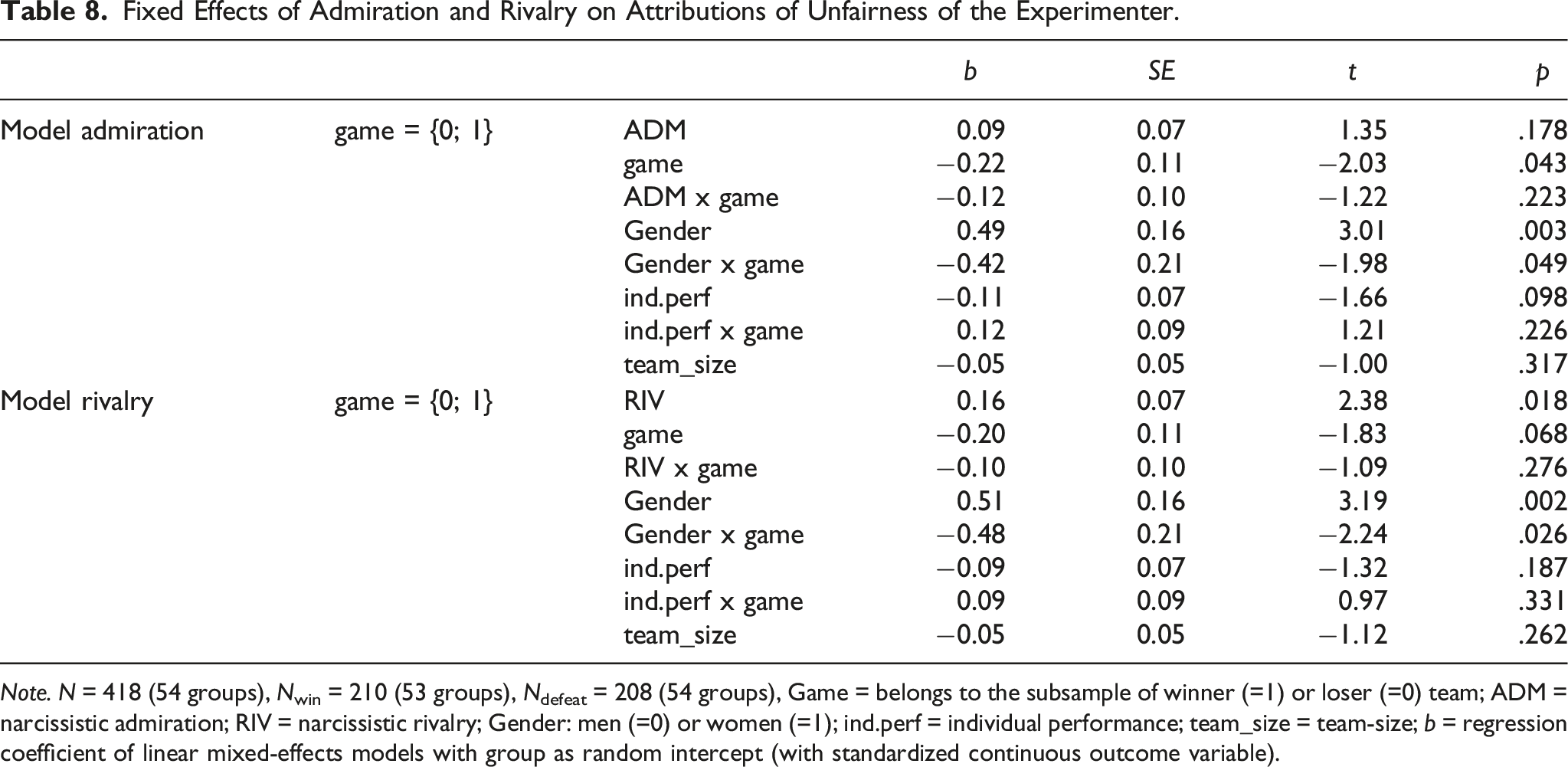
Note. N = 418 (54 groups), Nwin = 210 (53 groups), Ndefeat = 208 (54 groups), Game = belongs to the subsample of winner (=1) or loser (=0) team; ADM = narcissistic admiration; RIV = narcissistic rivalry; Gender: men (=0) or women (=1); ind.perf = individual performance; team_size = team-size; b = regression coefficient of linear mixed-effects models with group as random intercept (with standardized continuous outcome variable).
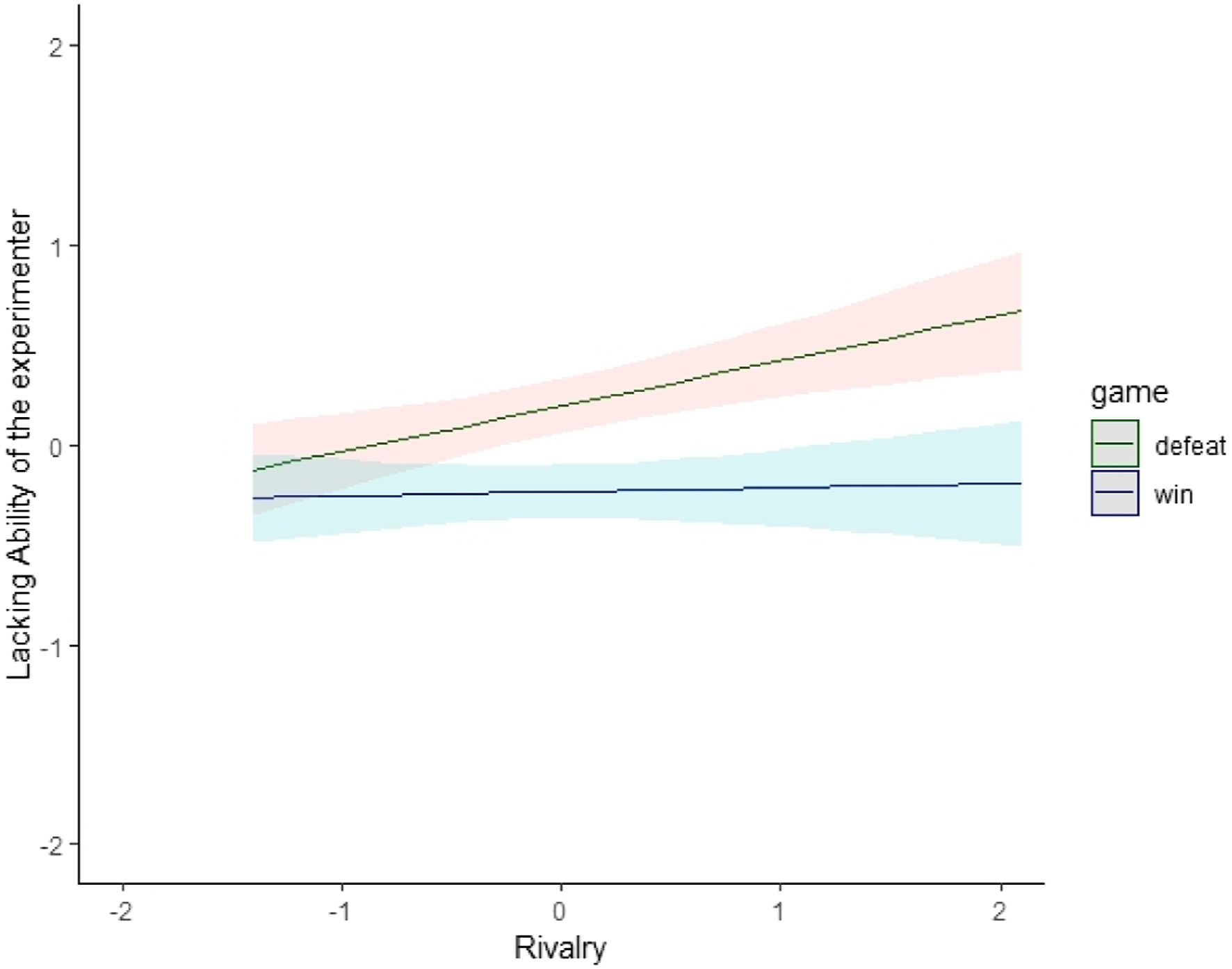
Interaction Effect between Rivalry and Game on Lacking Ability of the Experimenter (all Variables were Z-standardized).
Only the interaction effect between narcissistic rivalry and the game outcome on attribution of lacking ability of the experimenter was significant. This effect indicated that the relation between narcissistic rivalry and attributions of lacking ability of the experimenter was positive among the losers and close to zero after a win (see also Figure 4). The p value was just slightly below the .05 threshold, which means that the effect should be interpreted with caution. Yet, it would indicate that people high in rivalry tended to attribute negative outcomes to lacking ability of the experimenter. Left panel: Interaction Effect between Admiration and Game on Chance (all Variables were Z-standardized); right panel: Interaction Effect between Rivalry and Game on Chance (all Variables were Z-standardized).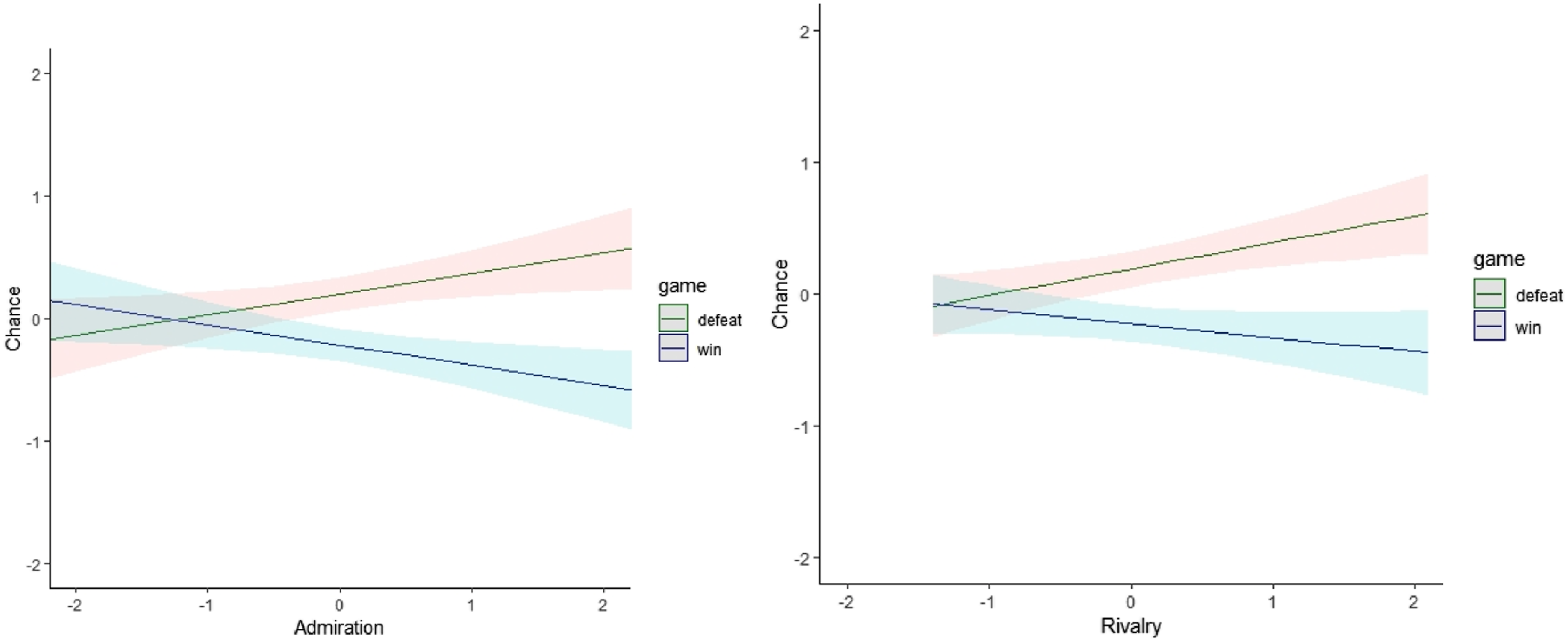
Attributions of Chance
Fixed Effects of Admiration and Rivalry on Attributions of Chance.
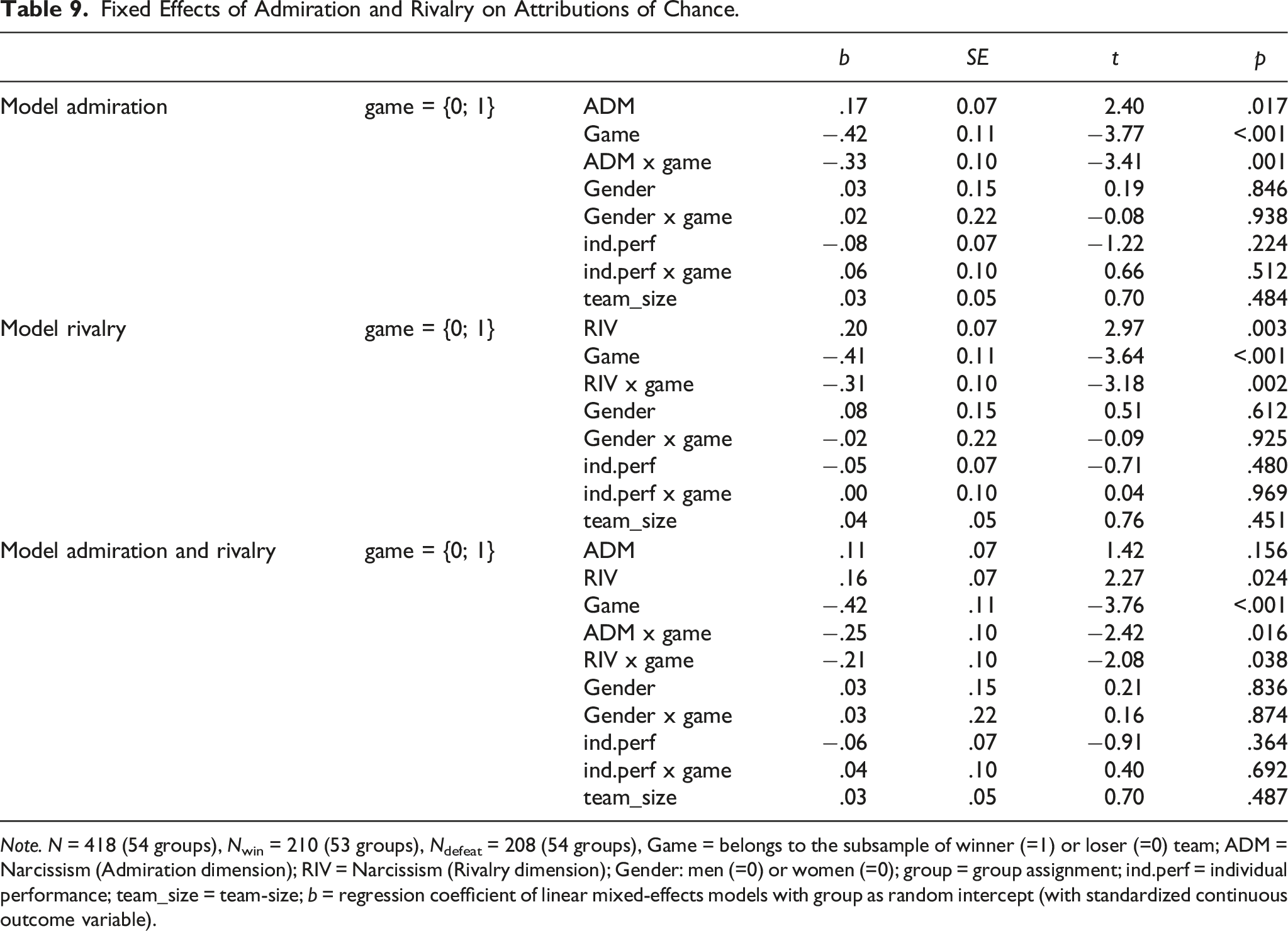
Note. N = 418 (54 groups), Nwin = 210 (53 groups), Ndefeat = 208 (54 groups), Game = belongs to the subsample of winner (=1) or loser (=0) team; ADM = Narcissism (Admiration dimension); RIV = Narcissism (Rivalry dimension); Gender: men (=0) or women (=0); group = group assignment; ind.perf = individual performance; team_size = team-size; b = regression coefficient of linear mixed-effects models with group as random intercept (with standardized continuous outcome variable).
Surprisingly, both interaction effects between the respective narcissism dimension and the game outcome were significant. These interaction terms indicated that the relation between admiration and attributions of chance and the one between rivalry and attribution of chance were both more positive among the losers than among the winners (see Figure 4). To investigate whether these effects of the two narcissism dimensions are incremental, we also ran a model including admiration and rivalry as predictors, including their interactions with game outcomes and the relevant covariates. As shown in Table 9, both the admiration x game outcome and the rivalry x game outcome interactions were significant, which indicates that both narcissism dimensions uniquely predicted the tendency to attribute positive team outcomes less to chance than negative team outcomes.
Generalized Other-Perceptions
Finally, we addressed the alternative explanation that a success might trigger pronounced positive generalized other-perceptions among people high in admiration and that a defeat triggers pronounced negative other-perceptions among people high in rivalry. As Table 3 shows, the correlation between admiration and generalized other-perception was descriptively more positive among winners than among losers and the correlation between rivalry and generalized other-perception was contrary to prediction descriptively more positive among losers than among winners. To test whether the relations between the two narcissism dimensions and generalized other-perceptions are statistically stronger among the winners, we used the same analytic strategy as above and regressed generalized other-perception on all relevant interaction effects and covariates. The results are shown in Table 5. For none of the narcissism dimensions, the interaction with game outcome was significant, indicating that admiration and rivalry were not more strongly linked to generalized other-perception among winners than among losers. Thus, the alternative explanation did not hold.
Alternative Narcissism Measures
In an explorative fashion, we re-ran all hypotheses tests using the NPI and HSNS scores. The results are shown in Tables S3 to S4 of the Supplemental Material. The NPI total score predicted attributions of ability and effort for the self among the winners. However, the relation between NPI score and attributions of ability and effort for the self was not more positive after a win than after a defeat. The NPI score also predicted attributions of unfairness for the members of the other team after a defeat, and this time the relation was stronger among the losers than among the winners. The results pattern therefore resembled the one we found for admiration, which is unsurprising, given their high correlation (Table 2). The HSNS score did not predict attributions of ability and effort for one’s own team members after a defeat. It showed a positive link to attributions of unfairness for the members of the other team after a defeat, but the non-significant interaction term revealed that the relation was not significantly stronger among the losers than among the winners. The results pattern therefore resembled the one we found for rivalry, which was also as expected.
Discussion
The current study was the first to comprehensively investigate narcissists’ attributional patterns in a competitive intergroup context. The preliminary analyses indicated that we were successful in creating a naturalistic, competitive intergroup situation that provided ample opportunity for personal engagement and that had a psychological impact. Replicating previous findings, internal personal and group attributions were stronger among winners and external attributions were stronger among losers (Mezulis et al., 2004; Miller & Ross, 1975; Weiner, 1985). Precisely, winners had a pronounced tendency to attribute the success to their own and their team members’ ability and effort, whereas losers attributed the failure to a higher degree to unfairness of the members of the other team, to chance and to lacking ability and fairness of the experimenter. These results indicate that participants engaged in various forms of self-serving attributions.
Going beyond such main effects of game outcome, which role did narcissistic admiration and narcissistic rivalry play? Narcissistic admiration went along with a pronounced propensity for self-serving attributions. As predicted by Hypothesis 1, persons high in narcissistic admiration tended to attribute a team win to a higher degree to their own ability and effort than persons lower in admiration. The finding that the effect also held when we controlled for rivalry supported Hypothesis 1b and indicated that it was likely driven by the specific socio-cognitive characteristics of admiration (i.e., a striving toward agentic self-enhancement), rather by the general need for a grandiose self-view that is common to both admiration and rivalry. The finding that the relation between admiration and attributions of ability and effort for the self was more positive after a win than after a defeat supported Hypothesis 1c and indicated that a specific self-serving mechanism was at work, rather than a general tendency among persons high in admiration to attribute all outcomes to the self. In combination, the results indicate that in group settings, persons high in narcissistic admiration bolster their egos by taking more personal credit for positive outcomes than for negative outcomes.
From a broader perspective, the findings match well with previous research reporting a positive association between narcissism and self-serving attributions (Campbell et al., 2000; Farwell & Wohlwend-Lloyd, 1998; Rhodewalt & Morf, 1995, 1998; Selle et al., 2019; Stucke, 2003). The current study had higher statistical power than previous ones and the hypotheses were pre-registered, which means that trustworthiness of the current results is high. There is thus robust evidence now that highly narcissistic individuals take more personal credit for positive outcomes than for negative outcomes.
The current study goes beyond earlier research, however, by demonstrating that this pattern can also be found in group settings. Persons high in admiration take much personal credit for what their ingroup as a whole has accomplished, a tendency that bolsters the narcissistic ego, but might at the same time evoke conflicts among group members and impair group functioning (Martin & Carron, 2012; Taylor & Doria, 1981). Furthermore, the present research was the first to demonstrate that narcissists’ tendency to take more personal credit for positive outcomes than for negative ones goes back to a specific narcissism dimension, namely, narcissistic admiration. According to the NARC, persons high in narcissistic admiration engage in various forms of cognitive, affective and behavioral self-enhancement processes that maintain and increase the positivity of the self-concept (Back et al., 2013). The current research shows that among these processes is the tendency to take personal credit for successes.
We also investigated the relation between rivalry and defensive reactions to negative team outcomes. Contrary to Hypothesis 2, narcissistic rivalry was not related to the tendency to make attributions of (lacking) ability and effort for one’s team members in the case of a defeat. Hence, we found no support for the hypothesis that persons high in rivalry blamed their team members in case of a negative outcome. Furthermore, even though rivalry negatively predicted attributions of unfairness for the members of the opposing team after a team defeat (as predicted by Hypothesis 3), this effect did not hold when admiration was controlled (contradicting Hypothesis 3a) and the relation between rivalry and attributions of unfairness for the members of the opposing team was also not stronger after a defeat than after a win (contradicting Hypothesis 3b). Surprisingly, however, our exploratory analyses revealed that narcissistic admiration uniquely predicted such attributions and that after a defeat, the relation between admiration and unfairness for the members of the opposing team was more positive than after a team win. These results seem to indicate that narcissists indeed protected their egos against negative outcomes by derogating others, but that in the case of competitive intergroup situations, this tendency went back to the admiration, rather than the rivalry dimension. Only for attributions of lacking ability of the experimenter, we found a pattern that would be in line with our general proposal concerning rivalry. That is, when faced with a negative group outcome, people high in rivalry coped with it by derogating a specific other, namely, the experimenter. However, because the analysis was exploratory, the effect was not present for attributions of fairness of the experimenter, and because the p value was just slightly below the .05 threshold, the evidence was still rather weak for the general proposal. In combination, the results do not provide consistent evidence for the claim that individuals high on rivalry cope with negative outcomes via an increased tendency to blame others.
The relation between admiration and perceptions of unfairness may question some conclusions from earlier research, including the notion that grandiose narcissism might be essentially unrelated to perceptions of being treated unfairly by others (Freis & Hansen-Brown, 2021). The current findings indicate that this conclusion might have been too broad. Instead, narcissistic admiration seems to go along with an increased tendency toward perceiving one’s opponents as unfair after a defeat. An increased justice sensitivity from the victim perspective in this particular context might thus be a way for people high in admiration to protect their egos. Future research could investigate the relation between different narcissism dimensions and justice sensitivity in different contexts more comprehensively.
We also explored the associations between narcissism and attributions of chance. Contrary to our expectations, both narcissistic admiration and narcissistic rivalry were more positively linked to attributions of chance after negative group outcomes and negative after positive group outcomes. These results seem to indicate that narcissists are characterized by the tendency to make random factors more accountable for negative events than for positive events. Such a tendency seems to stem from both admiration and rivalry, as both dimensions had incremental effects. From a broader perspective, these results indicate that narcissists’ self-enhancement repertoire is not limited to the social domain, but also pertains to non-social factors, such as bad luck or randomness.
To cover a broad range of narcissism measures, we re-run all major analyses using the NPI and HSNS scores. For the NPI score, which correlated strongly with admiration, we found a similar pattern as for admiration (i.e., positive relation with attributions of ability and effort for the self after a positive outcome, positive relation with attributions of unfairness for the members of the other team after a negative outcome), yet effect sizes were slightly smaller. These results match well with the view that admiration and the NPI both tap into agentic grandiose narcissism, but that admiration is the purer measure. The HSNS score also showed a similar effect pattern like rivalry (i.e., no significant relation with attributions of ability and effort for one’s group members but positive relation with attributions of unfairness for the members of the other team after a negative outcome). Interestingly, the tendency to attribute negative group outcomes to unfair behavior of the opposing group seems to be characteristic for both grandiose and vulnerable narcissism.
Due to our design and analytic choices, we were able to rule out a number of alternative explanations about the processes underlying the present results. Our selection of covariates safeguarded that effects were driven by gender or by narcissists actually performing better than people lower in narcissism in the discussion game. Furthermore, the results showed that narcissists’ generalized view of other persons did not differ depending on the game outcome, which ruled out the alternative explanation that effects might have been driven by narcissists’ general pronounced reactivity to positive versus negative outcomes. Thus, our findings indicate that the results we reported likely represented actual effect of narcissism on specific attributional outcomes.
Nevertheless, the current research is not without limitations and several questions need to be tackled by future studies. We exclusively focused on grandiose narcissism, as measured via self-reports, and specific aspects of attributions. Future research should investigate different forms of narcissism, non-self-report assessments of narcissism (e.g., informant assessments, Oltmanns et al., 2018) and different types of attributions more comprehensively. For example, collective narcissism (de Zavala, 2011) and its links to types of attributions could be studied. With regard to attributions, one could investigate additional dimensions of attributions, such as, for example, attributions of general unfairness of the experimental procedure. Potentially moderating aspects, such as, for example, the subjective importance of the task could also be studied.
As mentioned above, we also assessed round-robin ratings, in which participants rated each other, and some of these ratings were assessed before the attribution measures were administered. It is conceivable that this procedure might have affected the outcome variables in some way and it is not fully clear whether the results generalize to other study designs (e.g., without such round-robin ratings). Future research would therefore do well to use an alternative study design.
Furthermore, the goal of the current research was to investigate how narcissism is linked to attributions of success and failure in newly formed groups. Such situations emerge, for example, in work or university contexts, when formerly unacquainted employees or students have to work on a project together. In such zero-acquaintance contexts, group identification is typically low, meaning that people feel little connection to the other group members. Research on attribution processes in dyads indicates that attributions for shared outcomes can differ, depending on whether or not they feel closely connected to the partner (Sedikides & Campbell, 1997). An interesting task for future research might therefore be to test if the current results replicate in groups with high group identification.
Another critical point is that it cannot be ruled out completely that the success/failure conditions might have been influenced by other uncontrolled behavior that might be correlated with narcissism. We tried to minimize such effects by assessing performance as objectively as possible by using an official coding scheme that is used by “Jugend debattiert,” a prominent debate club that is under the patronage of the German Federal President (https://www.jugenddebattiert.de/). Future research might circumvent this problem by randomly assigning winning or losing groups. However, such an approach also has downsides that need to be pointed out, for example, it might undermine the credibility of the feedback and, as a consequence, participants’ motivation and cooperativeness. Finally, yet importantly, whereas the current research focused on narcissists’ reactions to one specific type of event, namely, a positive or negative group outcome, future research should take a more comprehensive approach and study narcissists’ attributional reactions to a variety of events.
Conclusion
The current research backs up the proposal that the tendency to engage in self-serving attributions is among narcissists’ standard repertoire of self-enhancing cognitive strategies (Morf & Rhodewalt, 2001) and indicates that this tendency is also relevant in competitive intergroup settings. The findings have implications for all contexts where individual and team efforts and performance are being evaluated. They indicate that team members‘ personalities with their characteristic motivations carry importance and interact with situational factors to influence social perception and cognition. We hope that these insights will contribute to a more complete understanding of both the interpersonal functioning of narcissism and attributional processes that occur in social groups.
Footnotes
Declaration of Conflicting Interests
The author(s) declared no potential conflicts of interest with respect to the research, authorship, and/or publication of this article.
Funding
The author(s) disclosed receipt of the following financial support for the research, authorship, and/or publication of this article: The work was supported by grand no. DU1641/13-1 from the German Research Foundation (DFG) awarded to Michael Dufner and grand no. 2016/23/G/HS6/01397 from the National Science centre, Poland, awarded to Anna Z. Czama.
