




Abstract
Sense of purpose is seen as a catalyst for successful ageing, predicting a wide range of health outcomes and mortality. However, its role in fostering subjective well-being during old age has received less attention, especially the bidirectional nature of this relationship. The present study examined how sense of purpose predicts and is predicted by subjective well-being in this life stage. Panel data from the Health and Retirement Study (N = 8980) were used, spanning three measurement occasions across eight years. Four subjective well-being indicators (life satisfaction, depression, positive- and negative affect) were modelled with purpose using (random-intercept) cross-lagged panel models to disentangle within-from between-person associations. We found moderate to strong correlated change and some evidence for directional associations between the constructs. Purpose predicted changes in all four subjective well-being markers, and these associations were generally stronger than the effects of subjective well-being on purpose. Within-person changes in sense of purpose predicted subsequent changes in life satisfaction and positive affect, but not in negative affect and depression. In sum, sense of purpose is associated with higher subjective well-being in old age, but efforts to maintain or increase older adults' sense of purpose may only improve positive components of subjective well-being.
Keywords
Introduction
Sense of purpose, a component of eudaemonic well-being, refers to the perception that one has a direction in life that aligns with one’s subjective perception of a life well-lived (Ryff & Keyes, 1995; McKnight & Kashdan, 2009). As such, it is related to both future goals as well as daily decisions and serves as a source of engagement and personal meaning to the individual. 1 This construct has become a focal point in the study of adaptive development, and accumulated evidence shows that it relates to a wide range of desirable outcomes across the lifespan, both focused on physical and subjective well-being (for recent reviews, see Irving et al., 2017; Ribeiro et al., 2020). While it is a robust predictor of successful ageing, sense of purpose is vulnerable to declines during older adulthood, following life transitions such as retirement and health decline (Pfund & Lewis, 2020). Meanwhile, subjective well-being, a correlate of sense of purpose, often peaks in older adulthood (Blanchflower & Oswald, 2008). While these constructs are consistently connected cross-sectionally in older adults (Ribeiro et al., 2020), it remains unknown whether changes in one construct precede changes in the other or if they generally change together.
Although both comprise aspects of well-being and are each associated with positive health outcomes and longevity (Diener & Chan, 2011; Ribeiro et al., 2020), sense of purpose and subjective well-being are empirically distinct constructs that can exist without the other (Baumeister et al., 2013; Vanhoutte, 2014). Subjective well-being (SWB) is generally defined as a combination of cognitive and affective evaluations of one’s life, involving both a global sense of life satisfaction (the cognitive component) as well as positive and negative emotional experiences in daily life (the affective component; Diener et al., 1999; Vanhoutte, 2014). These two parts of SWB are positively related but still empirically separable (Diener et al., 1999; Vanhoutte, 2014). Furthermore, positive and negative affect across longer time spans are negatively related to each other but not directly opposing (Diener & Emmons, 1984), emphasizing the need to distinguish between cognitive, positive, and negative affective components of SWB. Related to, but not synonymous to SWB, sense of purpose reflects a general orientation to life which promotes adaptive development and may, as such, ultimately lead to higher SWB. While SWB is generally seen as a marker or an outcome of successful ageing (Cho et al., 2015), sense of purpose can be seen as a catalyst of it (Pfund & Lewis, 2020).
Developmental trends of purpose and subjective well-being in old age
Past cross-sectional work suggests that young-to-middle adulthood may be a peak for age-graded trends in sense of purpose, with a vulnerability for a decline in older adulthood (Pfund & Lewis, 2020; Ryff, 1989; Ryff & Keyes, 1995). These trends counter some of the research on SWB (Blanchflower & Oswald, 2008; Scheibe & Carstensen, 2010) insofar that those variables sometimes evidence increases or stability into older adulthood. This differentiation of lifespan trajectories is supported in longitudinal work within the same individuals across the lifespan, wherein there is greater instability amongst older adults and mean-level declines in sense of purpose relative to the SWB components (Mann et al., 2021).
This apparent paradox of stable or even increased mean levels of SWB despite the various losses of old age may be partly explained by general shifts in motivations people have as they get older. As maintained by socioemotional selectivity theory (Carstensen et al., 2003), older adults tend to focus more on emotionally rewarding goals and relationships and away from negative stimuli, prioritizing their time in ways that minimize negative affect. Thus, with qualitative work highlighting that some older adults no longer perceive purpose to be a relevant pursuit later in their lifespan (Lewis et al., 2022), the divergence of these trajectories may, in part, be explained by focusing on feeling positive emotions rather than more goal-directed aims.
In terms of purpose declines in old age, the two reasons often suggested are retirement and health issues. On the first front, research has suggested that retirees report slightly lower levels of sense of purpose compared to working adults (Pinquart, 2002), and that retirees may be more susceptible to longitudinal declines in sense of purpose (Hill & Weston, 2019). Although financial status may play a role in explaining these retirement effects (Yemiscigil et al., 2021), it is often argued that these retirement-related declines may reflect the fact that individuals have lost a prominent arena for goal-directed engagements, namely the workplace. This fact may help explain why sense of purpose is susceptible to decline, even during a time when SWB may be maintained. On the second front, research has been equivocal regarding whether health concerns lead to reduced sense of purpose. One study found that self-reported health modestly predicted changes in sense of purpose among retirees in the expected direction (Hill & Weston, 2019). However, researchers also show that the onset of health conditions does not systematically impact sense of purpose (Hill, Beck, et al., 2021a). As such, it appears more likely that developmental tasks and transitions could be more central to understanding sense of purpose during older adulthood compared to health functioning per se (see Pfund & Lewis, 2020), which can be considered both in terms of transition to retirement as well as how one manages becoming a caregiver (see Hill, Wynn, et al., 2020b).
Sense of purpose as an antecedent and outcome of subjective well-being
Empirical findings show that sense of purpose and SWB are positively associated, wherein individuals with a higher sense of purpose report greater life satisfaction and positive affect, as well as lower negative affect (Ardelt, 2003; Hill, Sin, et al., 2018a). Furthermore, higher sense of purpose has also been connected to lower levels of ill-being, such as depressive symptomatology (Pinquart, 2002; Worrall et al., 2020). However, due to the cross-sectional nature of these studies, they cannot answer the question of whether purpose predicts better SWB, if purpose itself is predicted by SWB, or if the associations are primarily driven by other factors that could account for this relationship. In the current work, we thus examined whether sense of purpose predicts or is predicted by these four components of SWB over time.
Sense of purpose has been theorized to act as a buffer against stress, anxiety, and depression, ultimately protecting against the detrimental impact of adversity (Frankl, 1963; McKnight & Kashdan, 2009). In line with this account, sense of purpose might play a role in maintaining higher SWB during the challenging life transitions often unique to older adulthood. Conversely, higher SWB itself may facilitate the search for and maintenance of purpose. For example, the cognitive load associated with negative affect (Paulus, 2015) might compromise the search for and pursuit of purpose, so people with lower SWB may be less able to pursue activities and long-term goals that bolster their sense of purpose. Meanwhile, positive emotions appear to affect cognition and behavior in ways that facilitate the building of personal resources—such as purpose—in the long run, as postulated by the broaden-and-build theory (Fredrickson, 2001). In line with this account, more frequent experiences of positive emotions might motivate the development of skills, relationships, and activities that foster an individual’s sense of purpose by way of broadened mindset (e.g., more holistic perception and attentional flexibility; see Fredrickson, 2001, 2013).
Findings from prospective studies on the antecedents of purpose align with the notion that one’s capacity or motivation to develop and maintain a sense of purpose depends somewhat on previous emotional well-being (Hedberg et al., 2011) and fulfilment of psychological needs (Teas et al., 2022). In one study, depression in old adulthood was associated with larger declines in sense of purpose after five years (Hedberg et al., 2010), and another study found that higher scores on depression and anxiety and lower scores on positive affect predicted lower sense of purpose eight years later (Chen et al., 2020). SWB thus appears to predict sense of purpose at later time points, although the mechanism explaining this association remains unknown.
Having a stronger sense of purpose could benefit older adults in dealing with age-related losses and challenges by protecting against worsened affect, depressive symptoms, and declines in life satisfaction. Indeed, individuals with higher reported purpose exhibit better emotional recovery from negative stimuli in the lab (Schaefer et al., 2013). Furthermore, they are also able to maintain lower negative affect in the face of daily stressors (Hill, Sin, et al., 2018a). However, prospective studies on the value of purpose for subsequent SWB in older adulthood have yielded conflicting results (Kim et al., 2022; Windsor et al., 2015).
A recent study found that a higher sense of purpose among older adults predicted reduced depression and loneliness four years later (Kim et al., 2022). This is in line with results from Wood and Joseph’s (2010) study, where a lower initial sense of purpose predicted higher odds of being clinically depressed after ten years. However, Hedberg et al. (2011) found that among older adults without a diagnosis of depression, sense of purpose did not predict the odds of a depression diagnosis five years later. Another longitudinal study with a broader age range of older adults found similar results (Windsor et al., 2015). Specifically, the results showed that purpose did not predict the rate of change in depression scores. This implies that a lack of purpose may be an early marker of depression but that higher levels of purpose may not protect against the odds of developing depression in old age. However, as noted by Windsor et al. (2015), an inherent assumption in this interpretation is that sense of purpose remains relatively stable. If, however, there is significant within-person variability in sense of purpose across time and between-person differences in these changes, time-invariant measures might not capture an existing dynamic and reciprocal relationship. In light of findings showing individual differences in purpose trajectories (Hill et al., 2015; Hill & Weston, 2019; Willroth et al., 2021), these failures to detect associations between purpose and subsequent depressive symptoms may be due to hidden decreases in purpose among those with increased levels of depression, highlighting the need to study change in these variables at the individual level.
Examining within-person associations
Most previous studies on purpose–SWB associations have taken a between-person approach, studying whether people who score higher on purpose also score higher (or increase more strongly) on SWB compared to people with lower scores on purpose. Although these between-person associations are highly informative, they do not necessarily translate to associations at the within-person level (see Hamaker et al., 2020). For example, although individuals high in sense of purpose may be less likely to develop depression, it is unclear whether increases in an individual’s sense of purpose would lead to decreases in intra-individual depression levels. Purposeful individuals may generally have certain qualities in common that make them less susceptible to developing depression, and these qualities may not automatically follow individual purpose trajectories. Thus, investigating the within-person change associations between the constructs can provide a clearer view of whether fostering a sense of purpose promotes SWB and successful ageing, which could make it a promising target for public health intervention. Similarly, this approach can be used to evaluate the theoretical notion that people build more psychological resources (i.e., sense of purpose) following within-person increases in positive affect or decreases in negative affect (Frederickson, 2001).
The present study
The primary aim of this study was to explore whether the associations between sense of purpose and various indicators of SWB in old age are bidirectional and whether they hold at the within-person level, controlling for stable between-person differences. To this aim, we used data from the Health and Retirement Study (HRS), spanning three measurement occasions across a period of eight years. Since most longitudinal research on sense of purpose and psychosocial outcomes has focused on depression, we wanted to study additional aspects of SWB. Cross-sectional studies have shown associations between purpose and various psychosocial outcomes (Ardelt, 2003; Hill, Sin, et al., 2018a; Pinquart, 2002; Worrall et al., 2020) and there are indications that purpose may predict life satisfaction (Dezutter et al., 2015) and positive affect (Miao et al., 2017; Park et al., 2020) longitudinally. To examine whether the reciprocal effects would be similar across the different components of SWB (i.e., cognitive, positive affective, negative affective; Diener et al., 1999; Vanhoutte, 2012), we compared findings across the following four indicators of SWB: life satisfaction, positive affect, negative affect, and depressive symptoms.
Specifically, we had four primary aims. First, we sought to replicate this past work by showing that purpose and SWB levels are cross-sectionally correlated (aim 1). Second, we tested whether changes in purpose are correlated with changes in SWB (aim 2). Based on previous findings (Chen et al., 2020; Hill et al., 2018b; Kim et al., 2022; Worrall et al., 2020), we expected sense of purpose to be positively associated with positive affect and life satisfaction and negatively associated with negative affect and depression, both with respect to the stable level (hypothesis 1) and change (hypothesis 2). To test these hypotheses, we used bivariate latent growth curve models.
As mentioned above, most previous studies focused on concurrent associations, with few longitudinal studies focusing on purpose as either an antecedent or an outcome—but not explicitly on whether the associations may be bidirectional. Therefore, third, we sought to address this gap in the literature, testing whether initial purpose predicts later SWB above and beyond initial SWB levels, and vice versa (aim 3). Based on previous longitudinal findings (Chen et al., 2020; Hedberg et al., 2010; Kim et al., 2022), we expected to see bidirectional associations between purpose and the SWB indicators, such that higher (vs. lower) scores on purpose predict higher subsequent life satisfaction and positive affect and lower negative affect and depression, and vice versa (hypothesis 3).
Importantly, studies to date have not controlled for stable between-person differences in these constructs, leading to results that may conflate between- and within-person effects. Therefore, we fitted variations of cross-lagged panel models, both with and without random intercepts, to account for stable between-person differences (Hamaker et al., 2015; Mund & Nestler, 2019). Using this analytic strategy, fourth, we examined whether the cross-construct associations are mainly a function of between-person associations or if they are also observed at the within-person level (aim 4; see Statistical Models section for more details). In line with the notion that having a sense of purpose buffers against negative emotions (Frankl, 1963; McKnight & Kashdan, 2009) while positive emotions may facilitate the search for and pursuit of purpose (Fredrickson, 2001), we expected to also observe the same bidirectional associations at the within-person level (hypothesis 4). In other words, we expected that within-person changes in purpose would predict subsequent changes in the SWB indicators and vice versa.
Finally, for all time-lagged associations, we also compared the strength of the effect of purpose on later SWB to that of SWB on subsequent purpose (i.e., given a bidirectional relationship, which is more predictive of the other: purpose or the SWB indicators?). Given the lack of theory and study of the directionality of effects, we did not have specific predictions regarding these analyses.
Method
Participants and procedure
The data come from a total of three waves from two cohorts of the HRS, an open, ongoing panel study of older adults in the US that started in 1992 (Sonnega et al., 2014). It is sponsored by the National Institute on Aging and approved by the Institutional Review Board at the University of Michigan. The sample is based on a multi-stage area probability sampling, making it nationally representative. After an initial interview in each household unit, survey data are gathered from all participants every two years (Sonnega et al., 2014).
The Psychosocial and Lifestyle Questionnaire is administered to HRS participants on every second measurement occasion (i.e., every four years), with half of the study’s participants answering the survey from 2006 onwards and the other half in 2008 onwards, creating two cohorts (Smith et al., 2017). For this study, data from waves 2008–2018 were used (due to changes made to relevant questionnaire items and response scales in 2008 2 ), thus spanning a period of eight years and three measurement occasions for each cohort. To maximize the available sample size and power, we combined data from the two cohorts (2008/2012/2016 and 2010/2014/2018) and controlled for cohort differences in our analytic models.
Only participants with at least two waves of data on the purpose and SWB variables 3 were included in the analytic sample. This resulted in a total sample size of 8,980 (60.5% [n = 5,434] female), out of which 70.2% (n = 6,306) provided responses to the measures at all three time points. The age of participants ranged from 50 to 95, with a mean age of 65.81 (SD = 9.01) at the first measurement occasion (T1). Participants were all community-dwelling self-respondents, of whom 49.6% were retired by the first wave, and 61.7% were retired eight years later.
Based on data from T1, participants with two or three complete assessments were, on average, more educated (d = .19; p < .001), more likely to be retired (d = .06; p = .004), and perceived themselves to be healthier (d = .22; p < .001) than those not included in the analytic sample. They also scored on average higher on purpose (d = .12; p < .001), life satisfaction (d = .15; p < .001) and positive affect (d = .13; p < .001), and lower on negative affect (d = −.15; p < .001) and depression (d = −.17; p < .001). Within the analytic sample, similar differences appeared between participants with all three assessments compared to those with only two. Additionally, participants with full assessments were, on average, younger (d = −.10; p < .001) compared to those with only two assessments. We controlled for these differences. Detailed results from this attrition analysis can be found in OSF Table S1 (https://osf.io/vyjqu/).
Measures
Purpose in life
Purpose in life was assessed using a subscale from the Psychological Well-being Scale (Ryff, 1989; Ryff & Keyes, 1995). This measure consisted of seven statements (e.g., “I don’t have a good sense of what it is I’m trying to accomplish in life,” reversed) to which participants indicated their level of agreement on a scale from 1 (strongly disagree) to 6 (strongly agree). Responses across the seven items were averaged, yielding an index range of 1–6, with higher scores representing higher sense of purpose. The 7-item version has been psychometrically validated (Abbott et al., 2006). Cronbach’s alpha coefficients were .76 at all three waves.
Life satisfaction
Life satisfaction was measured using the Satisfaction with Life Scale (Diener et al., 1985). This measure consisted of five statements (e.g., “The conditions of my life are excellent”) to which participants indicated their level of agreement on a scale from 1 (strongly disagree) to 7 (strongly agree). Responses across the seven items were averaged, yielding an index range of 1–7, with higher scores representing greater satisfaction with life. The scale has been shown to be a valid and reliable measure of life satisfaction (Pavot & Diener, 2009). Cronbach’s alphas ranged from .88 to .89 across time points.
Positive and negative affect
Positive and negative affect were assessed with an adjective checklist (e.g., enthusiastic for positive affect and upset for negative affect) adapted from the Positive and Negative Affect Schedule—Expanded Form (PANAS-X; Watson & Clark, 1994), with five additional items added based on the work of other researchers (Carstensen et al., 2000; Ong et al., 2006). This measure included 13 positive affect and 12 negative affect items, each consisting of a single emotion adjective to which participants responded how much they felt that emotion in the past 30 days on a scale from 1 (very much) to 5 (not at all). Final scores were calculated for positive and negative affect separately, as the two reflect distinct dimensions of affect rather than opposite ends on a single scale (Wedderhoff et al., 2021). All responses were reverse scored such that higher values represented a higher emotion rating. Averages for the positive affect and negative affect indices were then calculated, yielding a score range of 1–5 for each, with higher scores representing more frequent experiences of positive or negative affect, respectively. There is support for the reliability and validity of PANAS and its fit for use with older adults (Humboldt et al., 2017). The Cronbach’s alphas were .92 across all waves for positive affect and ranged from .88 to .90 for negative affect.
Depressive symptoms
Depressive symptoms were measured using a shortened version of the Center for Epidemiologic Studies-Depression Scale (CES-D; Radloff, 1977). This measure consisted of eight statements (e.g., “I felt depressed”; “I felt everything I did was an effort”) to which respondents indicated whether (“yes”/“no”) they experienced each of the symptoms in the previous week. A total score was calculated by summing the number of endorsed symptoms (with positive symptoms reverse-scored), yielding a score range of 0–8, with higher scores representing greater depressive symptomatology. The CES-D scale has been extensively used in research on late-life depression and has good psychometric qualities for older populations (Karim et al., 2015). This modified version of the CES-D scale used in the HRS has also been analyzed and is deemed to have good measurement qualities (Steffick, 2000). Cronbach’s alphas ranged from .79 to .80 across waves.
Analyses
The analyses were exploratory and not pre-registered. Supplementary materials and analysis scripts used in this study are available in the OSF repository (https://osf.io/2dbfg/). Data analysis was conducted in R 4.1.2 (R Core Team, 2022) using the Rstudio interface (RStudio Team, 2022), and models were fitted using the package lavaan for structural equation modelling (version 0.6–11; Rosseel, 2012). Model fit was assessed using three approximate fit indices in line with previous guidelines (Bentler & Bonett, 1980; Kenny, 2020): the comparative fit index (CFI; >.90 acceptable, >.95 good), root mean square error approximation, and standardized root mean square residual (RMSEA, SRMR; <.08 acceptable, <.05 good). Effect sizes were reported in line with recommendations by Orth et al. (2022), based on previously published (RI-)CLPM effects in subfields of psychology. They proposed the benchmark values of .03 (small effect), .07 (medium effect), and .12 (large effect) when interpreting standardized cross-lagged coefficients in both models. We ran a sensitivity power analysis using Monte Carlo simulations with the powRICLPM package (Mulder, 2022) to assess the minimum effect size we could detect with 80% power in the RI-CLPM. 4 Based on these simulations, our sample size allowed 80% power to detect standardized cross-lagged effects of .05 (α = .05). For medium effect sizes of .07 and above, the estimated power was above 95%.
All models controlled for age (in years), gender (binary), level of education (no degree, general education diploma, high school diploma, 2-year college degree, 4-year college degree, master’s degree, or professional degree), self-reported health (range: 1–5; reversed such that higher numbers reflect better health), and retirement status (not retired, partly retired, or fully retired). To control for potential effects of changes in retirement status and health, we included them as time-varying control variables. All variables have been found to be associated with sense of purpose and SWB (e.g., Cheng & Yan, 2021; Hill & Weston, 2019) and were associated with missingness in the data (see OSF Table S1). We also controlled for cohort differences.
The model estimation method was full information maximum likelihood (FIML), which, in combination with including the covariates, mitigates the risk of bias due to non-random missingness (Enders, 2001). To account for the non-normal distribution of the data, standard errors were estimated using bootstrapping (1000 samples). We also tested for measurement invariance across time for all constructs used. The procedure and findings are described in detail in OSF Table S2. All constructs achieved acceptable measurement invariance levels.
Statistical models
The data were fitted to three types of models to assess the dynamic associations between purpose and each of the SWB variables (life satisfaction, positive affect, negative affect, and depressive symptoms) separately. The first model was a bivariate latent growth curve model (LGCM; see Figure 1(a)), which we used to examine between-person associations of the stable levels and linear change across the eight years covered in this study. The second model was a cross-lagged panel model (CLPM; see Figure 1(b)), which has been the standard for assessing time-lagged associations between two variables and investigating bidirectional effects (Mund & Nestler, 2019). The third model was an extension of the former, the random-intercept cross-lagged panel model (RI-CLPM; see Figure 1(c)), developed to separate the within-person dynamics from the overall associations observed in the CLPM through the inclusion of correlated random intercepts (Hamaker et al., 2015). Model fit was acceptable for all models, but comparisons favored the LGCM and RI-CLPM over the CLPM (LGCM: CFI = .966–.976; RMSEA = .045–.053; SRMR = .039–.047; CLPM: CFI = .967–.973; RMSEA = .073–.077; SRMR = .045–.053; RI-CLPM: CFI = .987–.990; RMSEA = .044–.052; SRMR = .039–.048). Path Diagrams of the Latent Growth Curve- and Cross-Lagged Panel Models.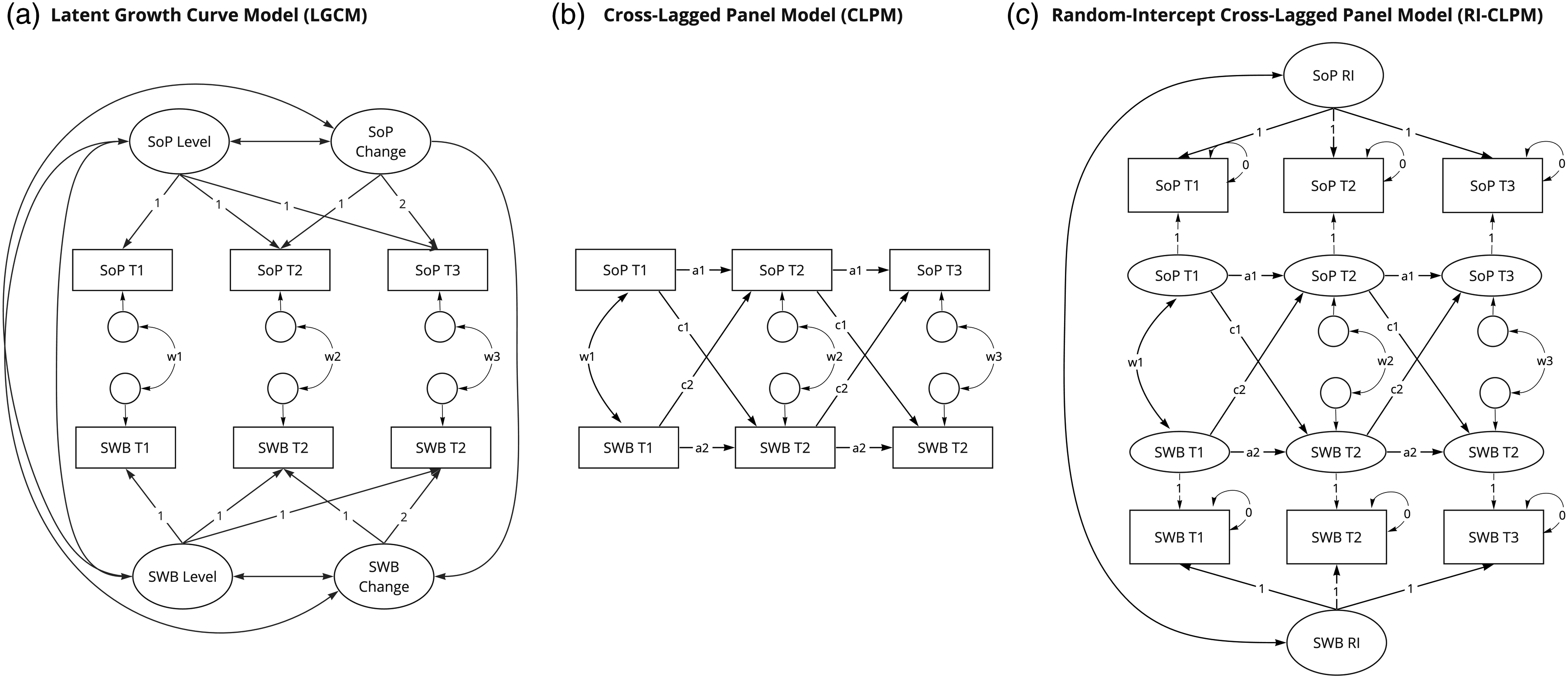
In the present analysis, the covariance of the LGCM (or RI-CLPM) level (or intercept) factors captures the overall between-person association between purpose and the SWB indicators (i.e., irrespective of measurement occasion; aim 1). We also examined whether changes in sense of purpose were associated with changes in SWB (aim 2). We did so by examining the correlation between the LGCM change factors, as well as the correlations of the measurement occasion specific residuals (i.e., within-time correlations; paths w in Figure 1(a)). Whereas the former reflects associations between linear change across the eight years of this study, the latter is indicative of the associations of within-person fluctuations around the stable level or linear change (e.g., whether SWB was lower/higher in years in which sense of purpose was also lower/higher than usual).
The main focus in this study, however, was on the cross-lagged paths (paths c in Figure 1(b) and 1(c)), which can be used to study reciprocal effects of purpose and SWB across time. In the CLPM, these represent whether previous purpose or SWB levels (or changes from the second measurement occasion onwards) predict subsequent changes in SWB or purpose, respectively (aim 3). Because the stable trait-like mean is partialled out in the RI-CLPM, cross-lags, auto-regressive paths, and within-time correlations represent the associations between intra-individual deviations from the stable levels of sense of purpose and SWB. As such, the RI-CLPM cross-lags reflect how much within-person changes in purpose predict subsequent changes in SWB and vice versa (aim 4). Comparing results from both models can provide insight into whether the associations are better explained by between- or within-person effects. For instance, if associations that were present in the CLPM vanish in the RI-CLPM, this would suggest that between-person differences primarily explain the associations. If the associations are of similar strength between the models, this would suggest that within-person effects are primarily responsible for the associations. The RI-CLPM can thus be seen as purely reflecting within-person associations, while the CLPM estimates are a mix of between- and within-person effects (see Hamaker et al., 2015; Lüdtke & Robitzsch, 2022). For both the CLPM and RI-CLPM, we also estimated a difference parameter between the cross-lagged effects (i.e., the difference in effect size) to assess the causal dominance of the predictors. Bootstrapping was used to test the significance of these parameters.
Results
Descriptive results
Descriptive Statistics and Correlations for Purpose and Subjective Well-being Scores.
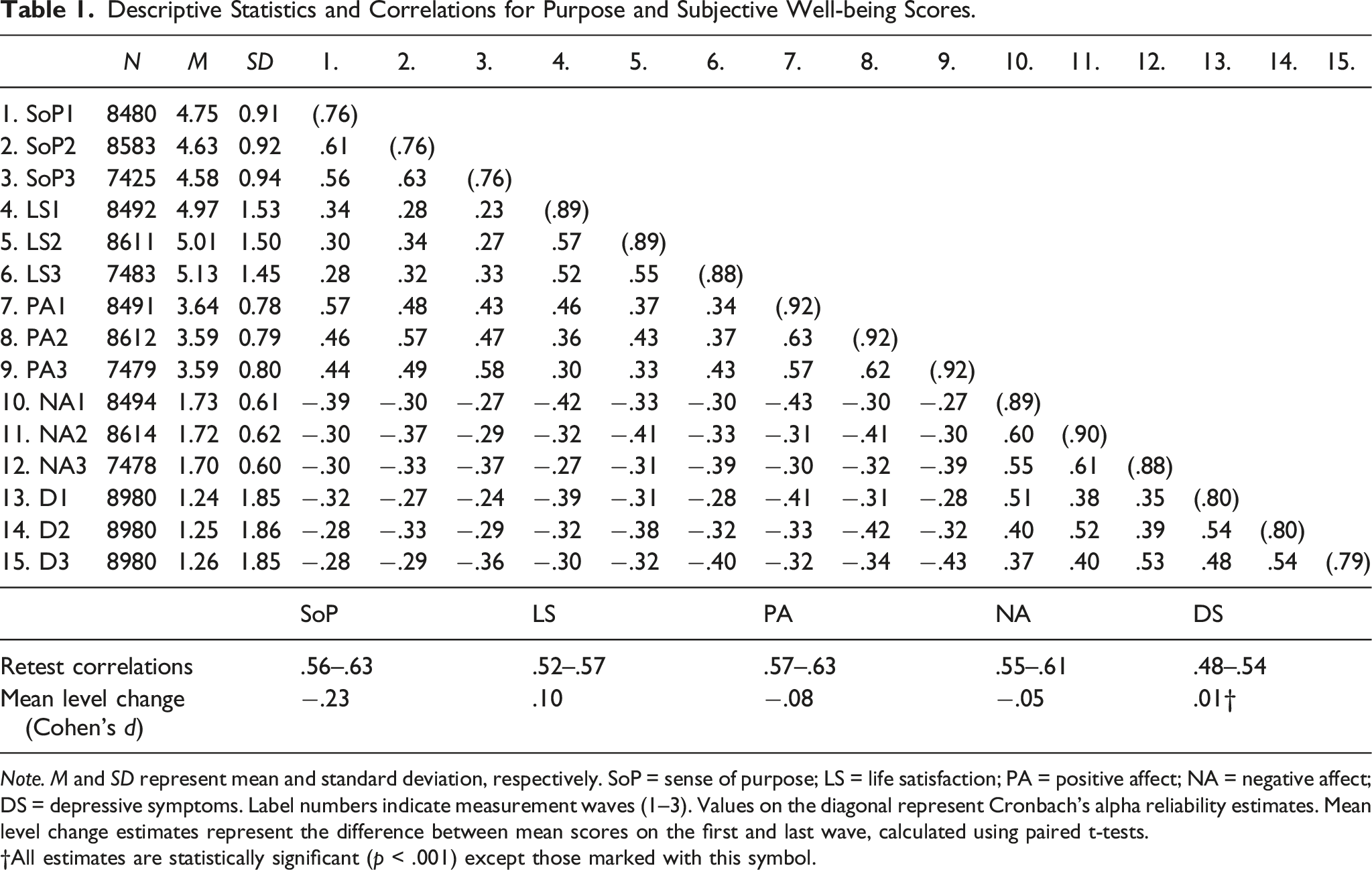
Note. M and SD represent mean and standard deviation, respectively. SoP = sense of purpose; LS = life satisfaction; PA = positive affect; NA = negative affect; DS = depressive symptoms. Label numbers indicate measurement waves (1–3). Values on the diagonal represent Cronbach’s alpha reliability estimates. Mean level change estimates represent the difference between mean scores on the first and last wave, calculated using paired t-tests.
†All estimates are statistically significant (p < .001) except those marked with this symbol.
CLPM and RI-CLPM equality constraints across time
CLPM and RI-CLPM Model Fit with and without Time Equality Constraints.
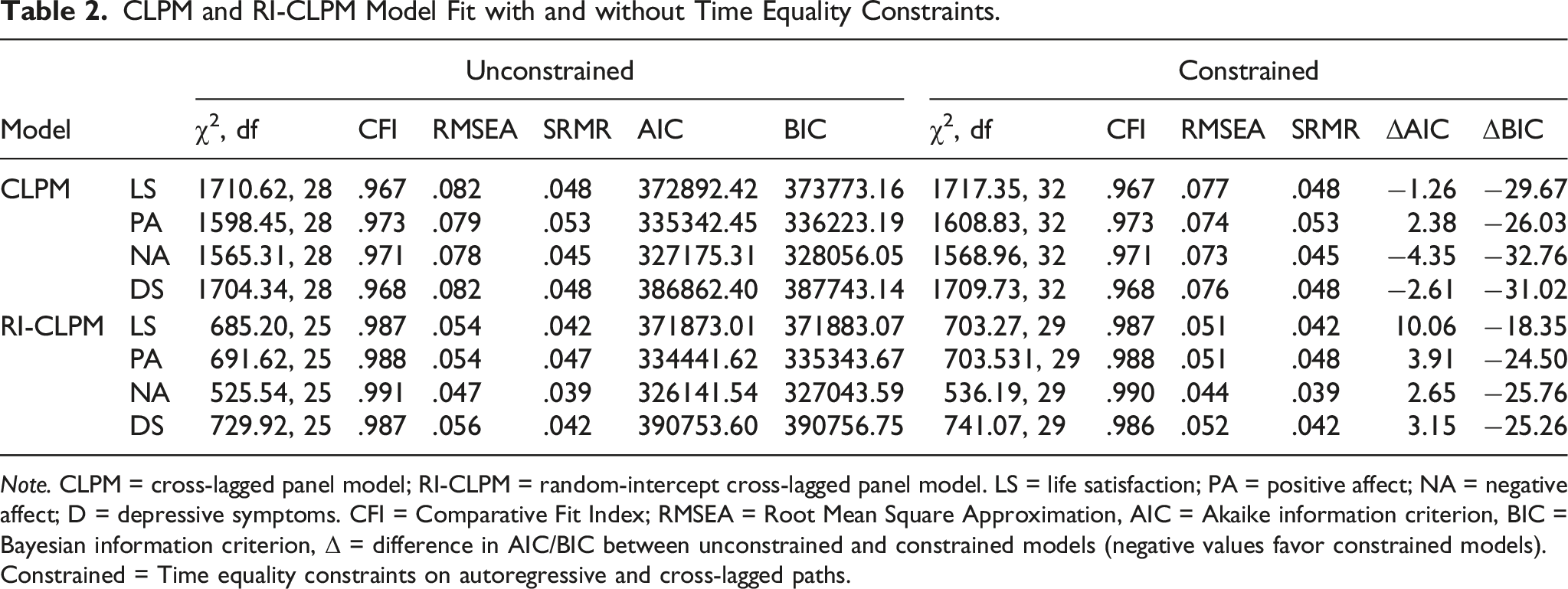
Note. CLPM = cross-lagged panel model; RI-CLPM = random-intercept cross-lagged panel model. LS = life satisfaction; PA = positive affect; NA = negative affect; D = depressive symptoms. CFI = Comparative Fit Index; RMSEA = Root Mean Square Approximation, AIC = Akaike information criterion, BIC = Bayesian information criterion, Δ = difference in AIC/BIC between unconstrained and constrained models (negative values favor constrained models).
Constrained = Time equality constraints on autoregressive and cross-lagged paths.
Level and change correlations (aims 1 and 2)
All relevant standardized parameter estimates from the LGCM and (RI-)CLPM analyses are presented in Figure 2 (for exact values, see OSF Table S3 and S4). To address the first question of whether sense of purpose and SWB are associated, we examined the associations between the stable levels of purpose and SWB using the level correlations in the LGCM. The results showed clear between-person associations for purpose and the SWB variables in the predicted directions: r = .42 for life satisfaction, r = .70 for positive affect, r = −.47 for negative affect, and r = −.36 for depression (all p < .001). In other words, people who reported higher levels of purpose across the eight years also reported greater satisfaction with their lives, more positive affect, less negative affect, and fewer depressive symptoms. Standardized Associations Between Sense of Purpose and Subjective Well-being.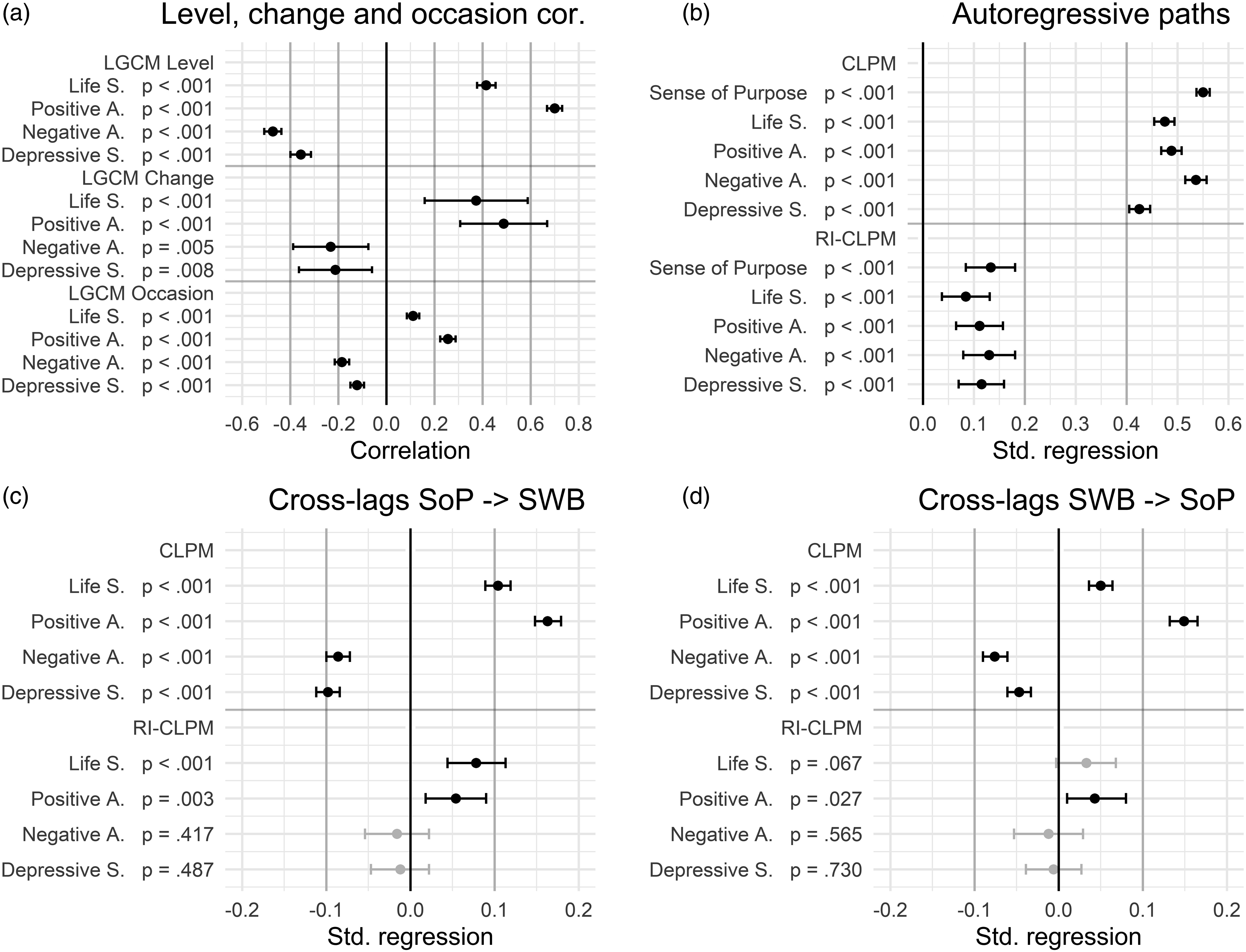
Next, to address the second question, we examined correlated change in purpose and SWB using the change factor- and within-time correlations in the LGCMs. Similar to the level associations, linear changes in sense of purpose were associated with changes in SWB in the expected directions: r = .37 (p < .001) for life satisfaction, r = .49 (p < .001) for positive affect, r = −.23 (p = .005) for negative affect, and r = −.21 (p = .008) for depression. The (intra-individual) within-time fluctuations in purpose were also significantly correlated with the respective fluctuations in all SWB indicators in the predicted directions, although to a smaller degree than the between-person differences in linear change: r = .11 for life satisfaction, r = .26 for positive affect, r = −.18 for negative affect, and r = −.12 for depression (all p < .001). These associations were similar to the residual correlations in the CLPM and RI-CLPM (see OSF Table S4). Taken together, this shows that people who increased in their sense of purpose across time or at a specific time point also increased in SWB across time or the corresponding time point, respectively.
Time-lagged associations based on CLPM (Aim 3)
Turning to the lagged relationships addressing the third research question, the CLPM estimates revealed significant cross-lagged associations between purpose and all the SWB indicators in both directions. Purpose predicted subsequent life satisfaction (β = .10), positive affect (β = .16), negative affect (β = −.09), and depression (β = −.10) (all p < .001). Purpose was also predicted by previous life satisfaction (β = .05), positive affect (β = .15), negative affect (β = −.08), and depression (β = −.05) (all p < .001). In all four cases, the effect of purpose on SWB was stronger than the effect of SWB on purpose (life satisfaction: Δβ = .05; p < .001; positive affect: Δβ = .01; p = .001; negative affect: Δβ = −.01; p < .001; depression: Δβ = −.05; p < .001), although the effect size differences were negligible for positive and negative affect.
Time-lagged associations based on RI-CLPM (Aim 4)
For the fourth question, when accounting for between-person differences using the RI-CLPM, the cross-lagged associations were inconsistent across models. Purpose changes predicted later life satisfaction changes (β = .08; p < .001; compared to β = .10 in CLPM), and positive affect changes (β = .05; p = .003; compared to β = .16 in CLPM). Of the SWB variables, only positive affect changes predicted later purpose changes (β = .04; p = .027; compared to β = .15 in CLPM). In contrast to the CLPM results, none of the cross-lagged paths for the negative affect and depression models were significant.
Discussion
The primary aim of this study was to extend current insights into the link between sense of purpose and SWB in older adulthood. In line with previous studies (Ardelt, 2003; Hill, Sin, et al., 2018a; Ribeiro et al., 2020; Worrall et al., 2020), we found strong associations (|r| ≥ .30) between the levels of purpose and SWB, as well as correlated change across the eight years covered in this study. Moreover, the findings suggest that sense of purpose both predicts and is predicted longitudinally by all four SWB indicators, even when accounting for age, perceived health, retirement status, and other covariates. In other words, older adults with a higher sense of purpose were more likely to have higher levels of SWB at the same and subsequent time points, as well as the other way around (i.e., higher levels of SWB were associated with higher levels of purpose at the same and at later time points). At the within-person level, these bidirectional associations only held for life satisfaction and positive affect, but not negative affect and depression. We discuss the findings and implications in more detail below.
Correlated change between purpose and subjective well-being
One of the main findings was that changes in purpose across the eight years covered in this study were associated with changes in SWB—even after controlling for health and retirement status. Similar to previous studies, we found a mean-level decline in purpose across age (Hill & Weston, 2019; Springer et al., 2011) but an overall stability in SWB (Blanchflower & Oswald, 2008; Scheibe & Carstensen, 2010). Importantly, even though sense of purpose declined for many, for individuals whose sense of purpose levels were maintained or even increased, more positive trajectories of SWB were also found. Thus, while some older adults may not perceive purpose as being relevant later in their lives (Lewis et al., 2022), this perception may have more pervasive implications. The current work adds to the vast literature on the value of sense of purpose for physical and cognitive health (e.g., Pfund & Lewis, 2020), and highlights that declines in sense of purpose are tied to declines in a wide range of well-being aspects as well. Most notably, we found the strongest correlated change with positive affect, followed by life satisfaction, and weaker associations with negative affect and depressive symptoms. This might suggest that declines in purpose may be primarily linked to decreases in positive emotions but less so to increases in negative affect. However, it is unclear whether these correlations reflect changes due to unobserved third variables or (bi-)directional effects, a question we addressed using the cross-lagged panel models.
Reciprocal associations between purpose and subjective well-being
As hypothesized and extending earlier findings, the CLPM estimates—which capture both between- and within-person components—revealed reciprocal associations between the constructs. In other words, people with a stronger sense of purpose had higher SWB at subsequent time points and vice versa, accounting for initial levels of SWB and purpose, respectively, as well as wave-to-wave carryover effects.
Looking at SWB as an antecedent of purpose, the results showed that all four SWB indicators were predictive of subsequent purpose, in line with earlier findings (e.g., Chen et al., 2020; Hedberg et al., 2010). Individuals with higher SWB thus seem more likely to increase or at least maintain their sense of purpose as they age. Sense of purpose also predicted SWB at subsequent time points, in line with some earlier findings (e.g., Kim et al., 2022; Wood & Joseph, 2010). A noteworthy result was that sense of purpose predicted subsequent SWB more strongly than SWB predicted later sense of purpose, most notably for life satisfaction and depression (for positive affect and negative affect, the difference was negligible). For decades, researchers have discussed whether sense of purpose is a component of well-being versus a promoter of well-being (e.g., Disabato et al., 2019; McKnight & Kashdan, 2009; Ryff, 1989). These findings highlight that, while there is a degree of reciprocity in these constructs, sense of purpose, in particular, may help bolster SWB rather than the other way around.
The finding that purposeful individuals seem more likely to improve or at least maintain their SWB compared to their less purposeful counterparts suggests that they have certain resources or tendencies that protect them from the adverse effects of age-related challenges. Purpose aids in the organization of day-to-day activities, helps individuals prioritize short- and long-term goals, and is connected to more effective resource allocation (McKnight & Kashdan, 2009). Moreover, sense of purpose has been connected to less reactivity to stressors (Hill, Sin, et al., 2018a) and more reliance on emotion regulation strategies that involve problem-solving rather than rumination or avoidance (Lohani et al., 2022). Thus, these relationships may be partly explained by purposeful older adults being better at choosing activities and coping in ways that promote well-being. It is also likely that social support plays an integral role in this relationship, being a correlate of both sense of purpose (Weston et al., 2021) and SWB (Siedlecki et al., 2014) in old age. Indeed, previous work shows correlated changes in purpose and perceived social support across years (Pfund & Hill, 2022; Weston et al., 2021) and higher daily purpose on days with more positive social interactions (Pfund, Hofer, et al., 2022a).
Future research would benefit from exploring potential moderating variables in the current relationships, such as whether sense of purpose may be more strongly tied to SWB amongst retirees or people making large life transitions in older adulthood. Moreover, when considering potential causal relationships, it is important to identify why sense of purpose may promote SWB. On this front, it would be valuable for research to evaluate whether purposeful people are more effective at engaging in beneficial emotion regulation techniques (Lohani et al., 2022) or choosing better social networks in a time where loneliness is more pervasive (e.g., Pfund, Hofer, et al., 2022a; Weston et al., 2021).
Within-person dynamics in purpose and subjective well-being
A defining feature of this study was the use of a RI-CLPM analysis, providing a novel insight into the person-level associations between sense of purpose and SWB by controlling for stable individual differences. Once these differences were accounted for, changes in negative affect and depression neither predicted nor were predicted by within-person changes in sense of purpose, in contrast to our CLPM findings and some previous research using alternative analytic strategies (e.g., Kim et al., 2022; Wood & Joseph, 2010). They were, however, in line with findings from another study which also separated between- and within-person components, wherein sense of purpose did not predict the rate of change (i.e., slopes) in depression across 20 years (six waves; Windsor et al., 2015). It can thus be induced that the respective associations observed in the CLPM analysis are mostly a function of between-person differences. What this implies is that older adults with higher levels of purpose may be less likely to have higher negative affect and depression at later time points, compared to those lower in purpose, due to differences in some mediating factors (e.g., personality traits or social support). This would mean that an increase in a person’s sense of purpose may not—in and of itself—lead to marked reductions in later negative mood.
In contrast, our findings showed that within-person changes in sense of purpose significantly predicted subsequent changes in life satisfaction and positive affect. This is a notable finding, suggesting that on the one hand, changes in sense of purpose do not lead to subsequent changes in negative aspects of well-being (i.e., negative affect and depression), while on the other hand, purpose changes lead to apparent changes in positive aspects of well-being (i.e., positive affect and life satisfaction). The differences in effect magnitudes underline the importance of separately analyzing positive and negative aspects of well-being (Vanhoutte, 2014). Moreover, this comparison may prove critical for implementing the current findings in intervention studies, notifying researchers which aspects of well-being may and may not improve when targeting purpose. Our findings corroborate results from intervention studies suggesting that engagement in purposeful activities improves life satisfaction but not depression among older adults (Owen et al., 2022). This implies that purpose interventions may have more limited benefits for reducing negative emotionality in old age despite gains in positive aspects of well-being.
Various explanations, both analytical and theoretical, could underlie the lack of support for lagged associations between purpose and negative aspects of SWB. One explanation is that negative affect and depressive symptoms could be markedly intact and stable in later years of life, requiring more substantive clinical intervention for meaningful improvement. However, it is also possible that the present findings underrepresent the true associations due to floor effects and the large time lag between measurements (i.e., four years). Considering that the correlated change captured by the models was moderate—which suggests that sense of purpose and SWB change in tandem—shorter intervals between measurements are warranted to establish whether this association is indeed directional. Alternatively, purpose and negative aspects of SWB might both be jointly affected by the same mechanisms, changing simultaneously instead of sequentially.
More research is needed to establish the differential effects of purpose on distinct components of SWB. However, if the present finding holds true, this will have interesting theoretical implications for understanding the mechanisms by which having a sense of purpose facilitates SWB. Rather than downregulating negative affect, sense of purpose may facilitate SWB by upregulating positive affect. One possible pathway through which sense of purpose might promote positive affect is through increased activity and life engagement (Scheier et al., 2006) and more frequent positive events in daily life (Hill et al., 2018b), in turn increasing life satisfaction (Cohn et al., 2009). That said, research also shows that purposeful individuals may react with smaller increases in positive affect to positive events (Hill, Sin, et al., 2020a;Hill, Sin, et al., 2020). This adds context to the activity pathway prediction by suggesting that sense of purpose could lead to more positive affect through greater engagement with positive events rather than through getting more out of them, a hypothesis that merits attention in future research.
The finding that preceding changes in positive affect predict within-person changes in purpose aligns well with functional accounts of positive emotions, such as Fredrickson’s (2001) broaden-and-build theory. According to this theory, the more frequent experience of positive emotions facilitates the building of personal resources through various mechanisms, including broadened perception and motivation to pursue meaningful activities. Further, the theory proposes reciprocal relations between positive emotionality and personal resources, forming an upward spiral dynamic and increasing resilience in the long run (for a review of the evidence, see Fredrickson, 2013). Fostering a sense of purpose may then increase the experience of positive emotions, in turn helping to further build and retain purpose itself, as well as other aspects of well-being. One can view this as akin to a positive feedback loop, which has been alluded to in other theoretical work on purpose (Hill, Best, et al., 2021b; Moran, 2020). Namely, when people engage in purpose-relevant activities, they garner a sense of meaning and positivity that may, in turn, fuel future purpose development. As such, the within-person findings herein may provide valuable insights into the potential mechanisms by which people broaden and build their sense of purpose, which should be considered in future purpose intervention work.
Limitations and future research
Some limitations of this study should be considered when interpreting the current findings. Firstly, the cross-lagged relations should neither be taken to suggest causal effects nor a lack thereof. Although separately assessing the within-person change associations provides a more accurate picture of causality than cross-sectional or between-person estimates, potential confounders at both levels may bias or mediate the effects (Hamaker et al., 2015; Lüdtke & Robitzsch, 2022). This risk was partly mitigated by controlling for various (time-varying) confounders previously shown to be related to sense of purpose and SWB, including age, retirement, and self-reported health (Cheng & Yan, 2021; Hill & Weston, 2019), but the observed associations may be partly explained by person characteristics not accounted for in this study, and aspects of the design and analysis may have impacted the results. For example, some of the shared variance between purpose and SWB may be attributable to both being captured using self-report measures. It would be advantageous to supplement self-report measures with observer- or clinical ratings for improved validity of the constructs and to prevent bias due to common method variance. Another potential confounder is the time interval between measurements. The lagged associations between the constructs examined in this study may be stronger across shorter time intervals, which would have been captured as correlated change in our latent growth curve- and cross-lagged models. Future studies should examine these associations with more frequent assessments of purpose and SWB. Employing intensive longitudinal methodology (e.g., daily diary studies) would allow for greater elucidation of whether people’s sense of purpose and SWB change together or predict each other in their everyday lives rather than across several years.
Secondly, sense of purpose is here defined and measured as a future-oriented concept determined by goals and plans, which may not be the most suitable conceptualization when studying change among older adults. The scale items may take on different meanings and relevance with increasing age and retirement status (Anderson et al., 2022; Hill & Weston, 2019), and, as pointed out by Anderson et al. (2022), a future-oriented sense of purpose may become less important for SWB as people get older, especially as they approach the end of life. In line with this, earlier findings have shown sense of purpose to predict well-being differently based on people’s estimation of how much time they have left to live (Pfund, Ratner, et al., 2022b). Future studies with a broad age range could include an age moderation to examine if the associations between sense of purpose and SWB change over the lifespan.
Finally, the present work was restricted to community-dwelling older adults who were able to report their perceptions unaided. Thus, the sample does not fully represent the general population of older adults, especially the oldest-old, of whom a large proportion of individuals reside in retirement homes or are unable to provide self-reports. More research is needed to generalize findings to people in retirement homes and those suffering more functional and cognitive decline, not the least because they may be the most vulnerable to declines in purpose and SWB.
Summary and conclusion
Caveats aside, the present findings offer valuable insights into the intricate relationship between purpose and SWB in old age. They extend previous work by showing that purpose and SWB are related bidirectionally, that purpose appears to predict SWB more robustly than the other way around, and that between-person differences largely—yet not entirely—explain the associations. In other words, individuals with a high or a low sense of purpose likely share certain characteristics beyond basic demographic factors, self-rated health, and retirement status that contribute to higher SWB in the face of increasing age and associated challenges. Likewise, individuals with higher SWB likely share characteristics that allow them to better maintain or bolster their sense of purpose as they age.
Although stable individual differences seem to contribute largely to the effects, the findings also suggest that within-person increases and decreases in purpose predict respective changes in some aspects of SWB, namely positive affect and life satisfaction. This points to the benefit of maintaining and fostering a sense of purpose in old adulthood to protect against declines in SWB and to promote successful ageing. However, the lack of support for the respective effects of purpose on negative affect and depressive symptoms indicates that purpose interventions alone may not suffice to reduce distress and depression unless they are combined with more direct efforts targeting negative emotions and emotion regulation. However, replication of these findings and intervention studies is needed before such conclusions are drawn.
In sum, the findings underscore the importance of considering the role of purpose in successful ageing from a dynamic and holistic perspective, exploring how purpose not only affects but is itself affected by SWB and the mechanisms through which this occurs. Such insights are essential for developing viable personal and societal interventions to promote successful ageing.
Footnotes
Declaration of conflicting interests
The author(s) declared no potential conflicts of interest with respect to the research, authorship, and/or publication of this article.
Funding
The author(s) received no financial support for the research, authorship, and/or publication of this article.
Open Science Statement
The datasets used in this study are publicly available upon registration, free of charge, at https://hrs.isr.umich.edu/data-products. Analysis scripts and supplementary materials can be accessed in the OSF repository  .
.