




Abstract
This study examines the hypothesis that temperamental (dis)similarity is associated with twin relationship quality. In a longitudinal study that followed 322 monozygotic twins (who share close to 100% of their genes) and 1199 dizygotic twins (who on average, share 50% of their segregating genes) throughout childhood, mothers (N = 1547) and fathers (N = 536) reported on their twins’ relationships on at least one of four measurement points when the twins were between 3 and 8–9 years of age. Mothers also reported on the twins’ temperament. Negative associations were found between reports by both parents on the twins’ closeness and their temperament difference throughout childhood, while positive associations were found between twins’ conflict and their temperament difference in late childhood. Latent growth modeling indicated that the association between temperament differences and the twins’ mother-reported closeness was evident beyond the effect of zygosity. A different pattern was found for twin conflict: the more the twins differed in their temperament (specifically negative emotionality) with age, the more the conflict between them increased. Our findings support the hypothesis that personality similarities can contribute to positive relationships from early childhood, and vice versa, beyond the effect of genetic similarity.
Keywords
Introduction
The stability and change of personality traits across the life-course is one of the most intriguing topics in the field of developmental psychology. Using twin samples, behavioral genetics researchers have demonstrated both genetic and environmental influences on personality, as genetics contribute to the formation of traits and may also indirectly affect the environment children are nurtured in (Boomsma et al., 2002; Caspi et al., 2005; Kandler & Papendick, 2017). Previous studies have shown that genetics exert an important influence on personality characteristics, and thereby on long-term personality stability, while environmental experiences tend to affect individual differences and contribute to long-term personality changes (Bouchard & Loehlin, 2001; Kandler et al., 2010; Plomin & Colledge, 2001). In light of this research, the biological essentialist perspective (reviewed by Caspi et al., 2005) asserts that personality traits show high rank-order stability over time. This claim is supported by meta-analyses indicating that personality is moderately stable during childhood, and becomes highly stable across adulthood (Ferguson, 2010; Roberts & DelVecchio, 2000).
Behavioral genetic studies that examine personality development have focused on the stability of specific personality characteristics of individuals, and used twin samples to investigate the genetic and environmental effects on personality development. For example, Briley and Tucker-Drob (2014) conducted a meta-analysis of 24 longitudinal twin studies, and found that the magnitude of genetic and environmental effects on personality stability varies across the lifespan. The researchers found that while the contribution of heredity to personality stability is moderate and relatively constant with age, the contribution of environmental effects to personality stability increases from near zero in early childhood to moderate in adulthood. The current study investigated the developmental path of personality from a different perspective. We used a longitudinal twin sample to examine personality (dis)similarity within twin dyads, and its associations with the quality of the dyadic relationship. Our sample consisted of a large number of monozygotic twins (MZ: sharing virtually 100% of their genes, N = 322) and dizygotic twins (DZ: on average, sharing 50% of the segregating genes that can vary across humans, N = 1199), participating at least once in four measurement points from early to middle childhood. The large sample size of MZ and DZ twins, in a longitudinal design, allowed us to study the associations between genetic relatedness, personality (dis)similarity, and close relationships, and the stability and change of these associations, across childhood.
Twins' Relationships in Early to Middle Childhood
Sibling relationships, and particularly twinships, are among the longest-lasting human relationships (Whiteman et al., 2011). Twins’ shared contexts (e.g., school, friends) provide many opportunities for intimacy, disclosure, warmth, and support, as well as for conflict. The dimensions of closeness and conflict have been found to be central components of twin relationships from early childhood to old age (Bekkhus et al., 2011; Fortuna et al., 2010; Neyer, 2002b; Penninkilampi-Kerola et al., 2005; H. Segal & Knafo-Noam, 2019; Tancredy & Fraley, 2006). While some twin pairs show high levels of closeness, others are characterized by high levels of conflict. Nevertheless, there is variability across twin pairs in both relationship dimensions (Fraley & Tancredy, 2012; Neyer, 2002a; Penninkilampi-Kerola et al., 2005). Closeness and conflict can coexist, especially in childhood, as the twin relationship generally continues even if it is characterized by frequent conflict (Campione-Barr & Killoren, 2019). These two relationship dimensions are thus not polar opposites (Furman & Buhrmester, 1985; McGuire et al., 1996; Stoneman & Brody, 1993), and are barely correlated throughout childhood (H. Segal & Knafo-Noam, 2021). However, as they represent the positive and negative aspects of the twin relationship (H. Segal & Knafo-Noam, 2019), we focus on both of them in this study.
Personality (Dis)Similarity, Zygosity, and Twins' Relationships
Child psychologists have focused on temperament traits as representing personality, studying the taxonomies and structure of temperament even in the first years of life (Caspi et al., 2005). Broadly, temperament refers to the basic dispositions that underlie and modulate an individual’s expression of activity, emotionality, and reactivity to social situations (Buss & Plomin, 1984; Goldsmith et al., 1987; Shiner et al., 2012; Zentner, & Bates, 2008). Temperament is generally considered to develop early in life; to persist, with some modification, across the lifespan; and to be largely rooted in an individual’s genetic makeup (Kandler & Papendick, 2017).
Only a handful of studies have examined the associations between differences in temperament and sibling relationships. Using pairs of singleton siblings, these studies found that greater similarity is associated with better relationships. In one such study, Munn and Dunn (1989) found significant positive associations between differences in several temperament dimensions and the amount of conflict in sibling pairs at 24 and 36 months of age. Stoneman and Brody (1993) found that school-aged siblings who differed in activity levels experienced high levels of conflict and negativity and less warmth in their relationship. Saudino et al. (2004) found mixed evidence for these associations, as differences in activity level were associated with less positive relationships but showed no association with overall negativity in the siblings' relationships. Kavčič and Zupančič (2011) studied preschool and elementary school siblings at two measurement points. They found that a match in particular personality traits of siblings contributed to their relationship quality. Thus, warmth between siblings was found to be associated with the siblings’ similarly high levels of conscientiousness, extraversion, and agreeableness. However, a more recent study (Binnoon-Erez et al., 2018) found no associations between personality similarity in any of the Big Five personality traits (neuroticism, extraversion, openness, conscientiousness, and agreeableness) and siblings’ agonism or rivalry/competition, when the younger siblings were preschoolers and the older ones were 3 years older on average.
One possible mechanism to explain the associations between personality (dis)similarity and close relationships stems from the reinforcement model (Byrne & Clore, 1970). According to this model, individuals favor interactions that reinforce their own logic and perspectives. Similar people reinforce each other’s attitudes and behaviors and, thereby, make their interactions increasingly associated with positive feelings, which leads to closer relationships. While the reinforcement model takes a cognitive perspective, Gonzaga et al. (2007) offered a complementary, affective explanation. These researchers suggested that couples with more similar personalities share more similar emotional experiences during interactions. This similarity in emotional experience may lead to more successful interactions, possibly explaining the better relationships between dyads with similar personalities. However, the association between personality (dis)similarity and relationship quality can be bi-directional. That is, closer relationships in dyads members appear to encourage convergence of the two members’ emotional reactions and personality, a process that is referred to as emotional convergence (Anderson et al., 2003). By spending time together, partners observe each other’s reactions and match their emotions and behaviors to those of their partner (Anderson & Keltner, 2004). A longitudinal design is needed to elucidate the directionality of the association between twins’ personality similarity and their relationships, addressing the questions: does personality similarity between dyads predict the emergence of closer relationships, as suggested by the reinforcement model, or do close relationships predict an increasingly similar personality, as the emotional convergence process suggests?
Using a twin sample also allowed us to test another explanation for the association between personality (dis)similarity and the quality of sibling relationships, as MZ twins were repeatedly found to be not only closer to each other than DZ twins but also more similar to one another in many ways, including physically and in terms of personality (Jang et al., 1996; Korbøl Torgersen, 2016; Olson et al., 2001; N. L. Segal, 2012; Tellegen et al., 1988). The greater resemblance in MZ twins’ personality was found as early as 9 months, an effect that lasted until the age of 6, and even became stronger at the age of 15 (Korbøl Torgersen, 2016).
In addition, zygosity was also found to have an effect on the twins' relationship (Bekkhus et al., 2011; Neyer, 2002b; Penninkilampi-Kerola et al., 2005; N. L. Segal, 2002). For instance, in a previous report from our sample (H. Segal & Knafo-Noam, 2021), we found that throughout childhood MZ twins were rated as closer and more co-dependent compared to DZ twins. The special closeness between MZ twins is not limited to childhood but continues throughout the twins' lifespan (Fraley & Tancredy, 2012; Neyer, 2002b; Penninkilampi-Kerola et al., 2005). Nevertheless, the effect of zygosity on the negative aspects of their relationships is less conclusive, as previous studies (including our previous report on the current sample) indicated that zygosity had no effect on the negative aspects of the twins’ relationships (Nozaki et al., 2012; H. Segal & Knafo-Noam, 2021)
An evolutionary perspective provides one potential explanation for the special closeness between MZ twins. According to this perspective, evolutionary success depends on promoting the inheritance of an organism’s genes through the survival of one’s offspring and kin. Therefore, MZ twins, who share almost 100% of their genes with each other, are expected to show more positive behaviors toward each other, compared to DZ twins, because of the potential for promoting the survival of one’s genes in the MZ co-twin. Moreover, the extreme same-look that MZ twins share makes their kinship indisputable. The kin recognition mechanism between MZ twins may yield more collaborations with one another and more altruistic behaviors toward one another, further promoting the survival of their shared genes (Fraley & Tancredy, 2012; N. L. Segal, 1984; N. L. Segal et al., 2003). However, both MZ twins and DZ twins compete for their parents' resources to preserve their genes, especially during childhood, when reliance on parents' resources is vital for survival (H. Segal & Knafo-Noam, 2018). This may account for the lack of difference between MZ and DZ twins’ levels of conflict.
The complex associations between personality (dis)similarity, genetic relatedness, and siblings’ relationships were the focus of our current study. Using a large twin sample, consisting of MZ and DZ twins, could add to our understanding of the association between temperamental (dis)similarity and relationship quality in the context of varying levels of genetic similarity.
The current research
The current study longitudinally addressed the associations between differences in twins’ personality and their relationships. To the best of our knowledge, this is the first study to examine these associations in twin pairs. Moreover, while previous studies focused on differences in specific temperamental dimensions, we were also interested in temperament differences as a whole, covering Buss and Plomin’s (1984, 2014) model of temperament traits, which includes negative emotionality, activity, sociability, and shyness. These four temperament dimensions in childhood may be an early manifestation of neuroticism and extraversion traits in adulthood (Shiner et al., 2012). Negative emotionality and neuroticism reflect the tendency to experience the world as distressing and threatening. Activity and sociability can be seen as early aspects of extraversion. Shyness includes both emotional and behavioral aspects, and is related to neuroticism and introversion (Buss & Plomin, 1984; Caspi et al., 2005; Kandler & Papendick, 2017). The longitudinal design of our study allowed us to investigate the development of the temperament differences between the twins throughout childhood, examining whether the twins became more or less different from one another with time and how the baseline level of their temperament differences in early childhood was related to the developmental paths of their temperaments.
We sought to establish the paths between twins' relationships and their temperament differences across four time points, from age 3 to 8–9 years. As most previous research found that temperament differences between siblings were associated with their relationship quality (Kavčič & Zupančič, 2011; Lemery & Goldsmith, 2003; Munn & Dunn, 1989; Saudino et al., 2004), we hypothesized that temperament differences would be positively associated with twin conflict and negatively associated with twin closeness (the hypotheses were not preregistered). Moreover, the longitudinal design across the twins’ childhood enabled us to investigate whether the baseline level of the twins' average temperament differences, indexing personality (dis)similarity, predicted change in their relationship quality across time, and whether the baseline level of the twins' relationship quality predicted change in their temperament differences.
Finally, while certain proposed processes linking personality similarity to relationship quality do not require genetic relatedness (such as spending more time together and engaging in joint activities), it can be argued that the greater closeness and personality similarity observed in MZ twin pairs is due to their higher degree of genetic resemblance (Bekkhus et al., 2011; Gamble et al., 2010; Gonzaga et al., 2007; Korbøl Torgersen, 2016; N. L. Segal, 2012; Tellegen et al., 1988). We were therefore interested in investigating whether relationship quality is associated with personality similarity above and beyond genetic similarity. If this is the case, the association between temperament differences and relationship quality would be found regardless of genetic similarity. MZ twins provide a unique perspective on the topic, as they invariably share close to 100% of their genes. Finding that variation in temperament differences is linked to relationship quality even among monozygotic (MZ) twins, would suggest that the association between temperament differences and relationship quality cannot be attributed solely to genetic resemblance between siblings.
Method
Participants
Families participated as part of the ongoing Longitudinal Israeli Study of Twins (LIST), a study focusing on genetic and environmental contributions to individual differences in children’s and adolescents' social behavior (Vertsberger et al., 2019). The protocol for the study was approved for the project titled “Parenting, gene-environment correlation, genetic and epigenetic factors in early social development” by the ethics committee of Sarah Herzog Hospital, Jerusalem, Israel (IRB protocol no. HMO-0587–11), and by the Hebrew University of Jerusalem Committee for the Use of Human Subjects in Research. Informed consent was obtained from all participating parents. Based on a list of twin births in 2004–2005 received from the Israeli Ministry of the Interior, the researchers contacted the families of Hebrew-speaking twins by mail. Mothers of the twins were contacted approximately every 2 years, with questionnaires concerning twins’ development (e.g., temperament, social behavior, behavior problems). Twin relationship data were collected when the twins reached the ages of 3, 5, 6.5, and 8–9 years. A minority of mothers (N = 186) participated in all study waves, which enabled investigation of the developmental path of the twins’ relationships. Since only 19 fathers participated in all measurement points, we studied fathers’ reports when analyzing each measurement point separately, but relied only on mothers’ reports in the longitudinal analysis (H. Segal & Knafo-Noam, 2021; see also Supplementary Table S1 for longitudinal sample sizes across the measurement points).
Sample Descriptive Statistics.
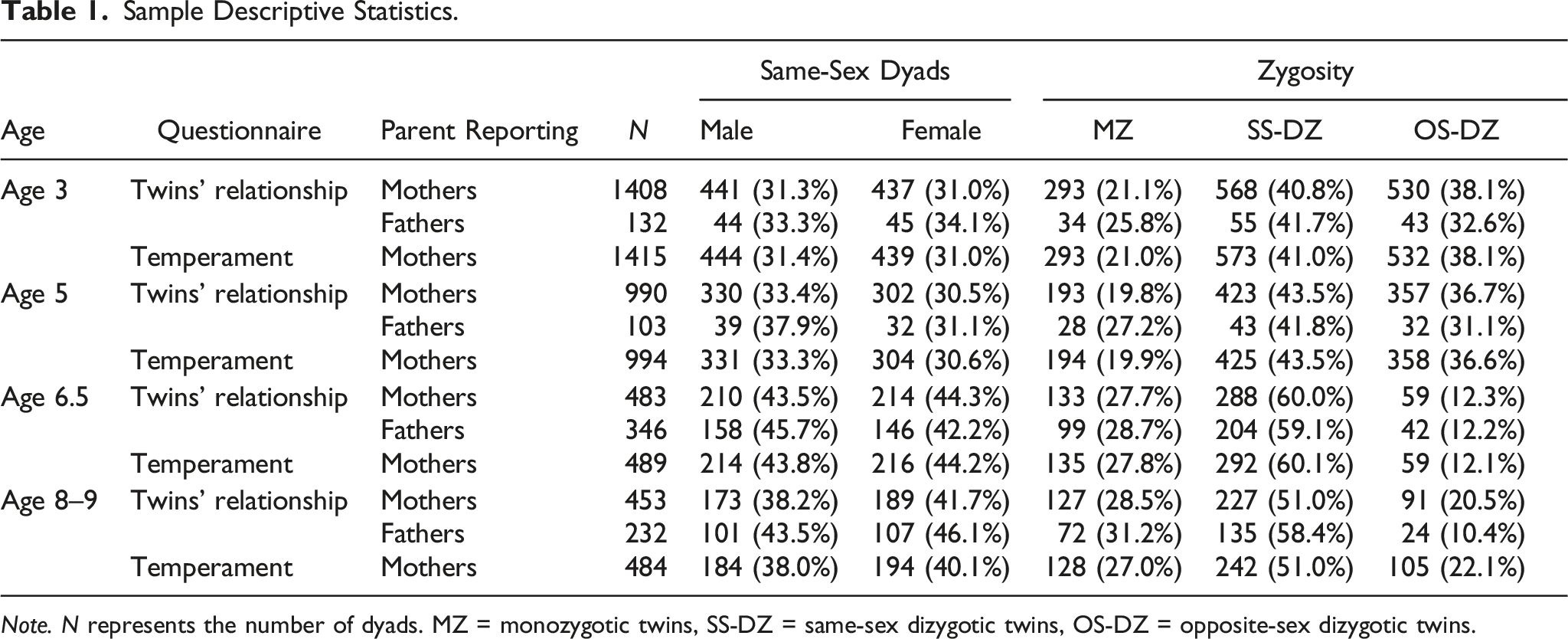
Note. N represents the number of dyads. MZ = monozygotic twins, SS-DZ = same-sex dizygotic twins, OS-DZ = opposite-sex dizygotic twins.
Our previous report from this sample (H. Segal & Knafo-Noam, 2021) showed that age-related changes in sample composition due to the larger longitudinal study’s age-specific goals and funding had little effect on twins’ relationship means and variances, except for a small (Cohens’ d = 0.19) difference in closeness scores between twins who dropped out after age 5 and those who still participated at 6.5 years (Supplementary Table S2). In addition, a small (Cohens’ d = 0.14) attrition effect was found for temperament difference scores from age 3 to age 5.
Measures
Twins' Closeness and Conflict
The extent of closeness and conflict between the twins was assessed using the parent-reported Twin Relationship Questionnaire (TRQ; H. Segal & Knafo-Noam, 2019). Mothers and fathers reported separately on each twin. The TRQ includes five subscales: closeness, conflict, rivalry, dependence, and dominance. In the current study, we focused on closeness and conflict as representing the positive and negative aspects of the twins' relationships. Parents rated the degree to which each statement characterized each of the twins, using a scale ranging from 1 = not characteristic at all to 5 = very characteristic. Five items represented the closeness scale (e.g., “Likes to be with other twin”) and six items represented the conflict scale (e.g., “Fusses and argues with other twin”). Previous reports from this sample confirmed the structure and the reliability of the TRQ. The internal consistencies (Cronbach’s alpha) of the scales ranged from .72 to .82 for conflict and .84 to .90 for closeness across ages, indicating adequate internal consistencies (H. Segal & Knafo-Noam, 2019). The construct validity of the TRQ was supported by exploratory and confirmatory factor analyses presenting similar loadings across all measurement points, and the external validity was tested against experimentally assessed pro-social behaviors between the twins at age 6.5, and against the twins' own reports on their closeness at age 11 (H. Segal & Knafo-Noam, 2019). The scalar measurement invariance across the four measurement points was tested and the model yielded satisfactory results, indicating that the same latent constructs were measured across all measurement points (Mothers: χ2(734) = 2099.73, p < .001, CFI = .97, TLI = .96, RMSEA = .05, SRMR = .05, Fathers: χ2(734) = 938.25, p < .001, CFI = .98 TLI = .98, RMSEA = .04, SRMR = .07). In our previous report from this sample, mothers’ and fathers’ reports on the twins’ relationships were moderately and positively correlated (rs = .30–.53, p < .001; H. Segal & Knafo-Noam, 2019). These moderate inter-rater correlations could indicate differences in the parents’ perceptions of the relationships, as was found in singletons (Kramer & Baron, 1995; H. Segal & Knafo-Noam, 2019). Both closeness and conflict were found to be dyadic variables, showing high cross-dyad correlations (.73–.85 for closeness and .71 – .83 for conflict, p < .001; see Supplementary Table S3). Because we were interested in the dyadic relationship rather than the specific closeness and conflict exhibited by each twin, we calculated a dyadic closeness score and a dyadic conflict score as the mean of the two twins’ scores. Items and their respective scales appear in Supplementary Table S4.
Temperament Differences
Mothers reported on the Emotionality, Activity, and Sociability (EAS) temperament survey (Buss & Plomin, 1984) at all measurement points, for each twin. The survey yielded scores on four subscales: Negative Emotionality (e.g., “Gets upset easily”), Sociability (e.g., “Likes to be with other people”), Shyness (e.g., “Takes a long time to warm up to strangers”), and Activity (e.g., “Very energetic”). Each scale comprised five individual items. Mothers rated each twin using a scale ranging from 1 = not characteristic or typical of your child to 5 = very characteristic or typical of your child. Previous studies confirmed the four-scale structure and stability of the EAS: the internal consistencies of the various scales were adequate, ranging from .71 to .88 at the age of 4–12 (Boer & Westenberg, 1994; Mathiesen & Tambs, 1999). As we were interested in the dyadic level, we calculated absolute difference scores between the twins for each temperament scale and then calculated a mean score of the differences across all four scales. The composite score represented the overall differences between the twins' temperaments. The internal consistencies of the composite scores ranged from .64 to .70 at all measurement points.
Zygosity
The zygosity for 44.6% of the same-sex twin pairs was assessed by DNA, using 10 genetic markers. Twins’ DNA was isolated from buccal epithelial cells using buccal swab brushes that were kept after collection in a sterile tube containing 15 mL of Aquafresh mouthwash. DNA was extracted using the Master Pure kit (Epicentre, Madison, WI). Since DNA was not available for all twins, the zygosity of 54.7% of the same-sex twin pairs was assigned by parental questionnaires describing twins’ physical similarity (Goldsmith, 1991). This questionnaire was reported to have 97% correct classification (Lenau et al., 2017). In addition, 0.7% of the twins were assigned as DZ because they were conceived via in-vitro fertilization, and one family’s zygosity was assigned as DZ using estimates of physical similarity from videos (Vertsberger et al., 2019).
Analytic Strategy
First, we analyzed whether mothers’ and fathers’ reports on the twins’ relationships correlated with mothers’ reports on the twins’ temperament differences at each measurement point. We also performed Mixed Model ANOVA with maximum likelihood estimation (ML), for both parents’ reports, to study the zygosity effect on the twins’ closeness, conflict, and temperament differences, relating to the twins’ age as a repeated variable. Studying both parents’ reports separately enabled replicating our findings for both parents and using different raters for temperament similarity (mothers) and relationship quality (fathers).
Second, a Latent Growth Model (LGM) was employed to reflect twins' mother-rated relationship quality change using latent variables of intercept and slopes within a structural equation modeling framework (Ram & Grimm, 2007). The LGM involves identifying an appropriate growth curve form that can accurately and parsimoniously describe individual development and allow for the study of individual differences in the parameters that control the pattern of growth over time (Duncan & Duncan, 2004). In LGM, data points from the different study waves were used as indicators of two factors—the intercept and the slope, for each longitudinal variable. Regression weights for the intercept were all set to 1.0, allowing the intercept to be interpreted as the initial (baseline) level of the twins' closeness, conflict, and temperament differences. For the slope factor, the four regression weights were set to 0.0, 2.0, 3.5, and 5.5, reflecting the actual time gaps (in years) between measurement points (i.e., ages 3, 5, 6.5, and 8–9). The twins’ closeness, conflict, and temperament differences were allowed to covary. Zygosity was represented in the model as the percentage of shared genetic variance (MZ = 100%, DZ = 50%), and was introduced as a predictor of temperamental differences and the twin relationship. Missing values were treated using full information maximum likelihood estimation (FIML).
As an alternative approach to studying the longitudinal associations between temperament differences and twin relationships, we also conducted a random intercept cross-lagged panel model (RI-CLPM). This allowed us to decompose our longitudinal data into stable variations between the twin dyads’ closeness, conflict, and temperament differences, versus temporal, within-dyads fluctuations in these variables. To fit the RI-CLPM we decomposed the reported closeness, conflict, and temperament differences into three components. The first components were grand means that were allowed to be time-varying for each measurement point. The second components were random intercepts (between components) that represented the stable variations between dyads. The random intercepts were latent variables, with the repeated measures as their indicators, while fixing all the factor loadings to 1.0. The third components were within-dyads components, which were the differences between a dyad’s observed measurements and the dyad’s expected scores based on the grand means and the random intercepts (Mulder & Hamaker, 2021).
In addition, following the results of the aforementioned LGM, we also calculated a follow-up LGM, adding multigroup analysis to study the association between temperament differences and the twins’ closeness beyond genetic similarity effects. In this analysis, we aimed to study whether there were differences in the models between MZ and DZ twins, in the associations among temperament differences and relationship quality indices of intercept and change across the four measurement points. Therefore, we first conducted a metric invariance analysis to verify that the constructs of the measurement models (e.g., the twins’ closeness and conflict and the composite temperament difference score) were applicable to both MZ and DZ twins. Next, we carried out three separate multigroup LGM analyses. In the first analysis, all path coefficients were allowed to vary freely. In the second analysis, we constrained all the insignificant path coefficients to be equal across MZ and DZ twins. In the third analysis, all path coefficients were constrained to be equal between the two groups. Finally, we evaluated the change in the models’ fit after constraining the paths to equality.
Several model fit indices were used to evaluate models' fit: Chi-square, Comparative Fit Index (CFI), Tucker–Lewis Index (TLI), Root Mean Square Error of Approximation (RMSEA), and Standardized Root Mean Square Residual (SRMR). The LGMs were calculated only for mother reports, since only 19 fathers participated in all the measurement points, limiting the convergence of the model (Hamilton et al., 2003). The LGMs were performed in R, version 4.2.2, using the “lavaan” package (Beaujean, 2014). Scripts and outcomes of the statistical analyses can be accessed at https://osf.io/scz5q/files/osfstorage.
Results
Scale Descriptives
Twins' Dyadic Closeness, Conflict, and Temperament Differences: Means, Standard Deviations, and Longitudinal Correlations, by Zygosity.
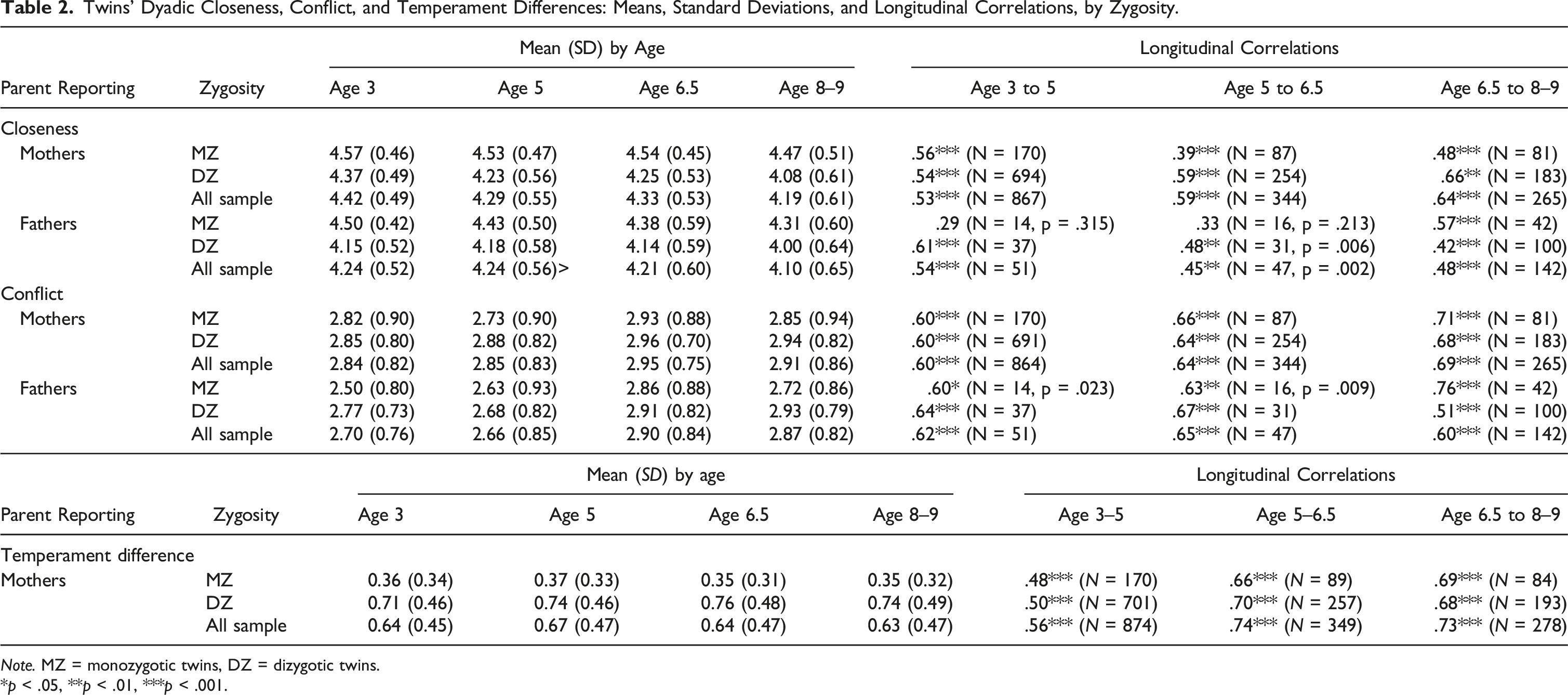
Note. MZ = monozygotic twins, DZ = dizygotic twins.
*p < .05, **p < .01, ***p < .001.
Twins’ Relationships, Temperament Differences, and Zygosity in Each Measurement Point
Correlations Between Closeness and Conflict (Mothers’ and Fathers’ Reports) and Temperament Differences at Each Measurement Point.
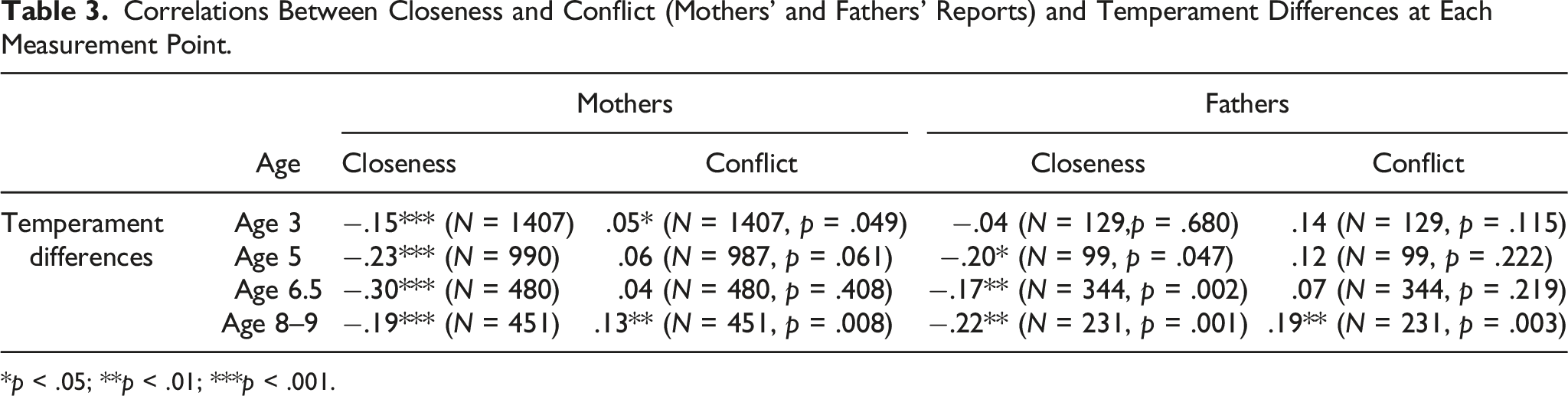
*p < .05; **p < .01; ***p < .001.
The zygosity effects on the twins’ relationships and on their temperament differences were tested by Mixed Model ANOVAs with maximum likelihood estimation (ML), and treating the twins’ age as a repeated variable. We also tested the effect of the interaction between zygosity and age on the twins’ relationships. Zygosity was found to have a significant main effect on the twins’ closeness, indicating that MZ twins were closer to each other than SS-DZ and OS-DZ twins (mothers’ reports: F(2,1845.41) = 54.27; fathers’ reports: F(2,571.97) = 11.63, p < .001), while the differences between SS-DZ and OS-DZ in closeness were significant only according to mothers’ reports, and very small (the mean difference between SS-DZ and OS-DZ was 0.09, SE = 0.04, p = .006, 95% CI [ 0.03–0.15 ], See Supplementary Table S6 for post hoc tests based on estimated marginal means). Zygosity’s main effect on conflict was not significant (mothers’ reports: F(2,1831.54) = 2.57, p = .077; fathers’ reports: F(2,605.32) = 2.60, p = .075). Zygosity was found to have a significant main effect on the temperament differences, presenting significant differences between all zygosity groups (F(2,1856.94) = 116.01, p < .001, see Supplementary Table S6 for post hoc tests based on estimated marginal means). However, the gap between SS-DZ and OS-DZ twins’ temperament differences was very small (mean difference was .07, SE = .03, p = .004, 95% CI [ .02–.12 ]).
The interaction between zygosity and age was significant for the twins’ closeness and conflict only according to mothers’ reports (F(9,2155.87) = 16.06, p < .001, F(9,2072.39) = 3.05, p = .001, respectively). To study these interactions, we calculated Tamhane’s T2 post-hoc tests, which indicated that while MZ twins were closer to each other than SS-DZ and OS-DZ at all ages, effect sizes of these differences increased throughout childhood (age 3: F(2,1388) = 18.45, η2 = .03; age 5: F(2,970) = 25.69, η2 = .05; age 6.5: F(2,477) = 16.05, η2 = .06; age 8–9: F(2,442) = 22.72, η2 = .09, p < .001). In contrast, the differences between SS-DZ and OS-DZ twins’ closeness were insignificant at all ages. In addition, Tamhane’s T2 post-hoc tests indicated that zygosity had a small significant effect on the twins’ conflict only at the age of 5, an age at which SS-DZ twins demonstrated higher levels of conflict than the two other zygosity groups (F(2,967) = 6.07, η2 = .01, p = .002). Since the differences between SS-DZ and OS-DZ twins were insignificant or very small, we combined the SS-DZ twins and the OS-DZ twins into one group (DZ twins) in the following analyses.
Latent Growth Model (LGM) Analyses
Estimations of LGM on Closeness, Conflict, and Temperament Differences, Mothers’ Reports.

***p < .001.
LGM for Temperament Differences and Twins' Relationships, Mothers’ Reports.
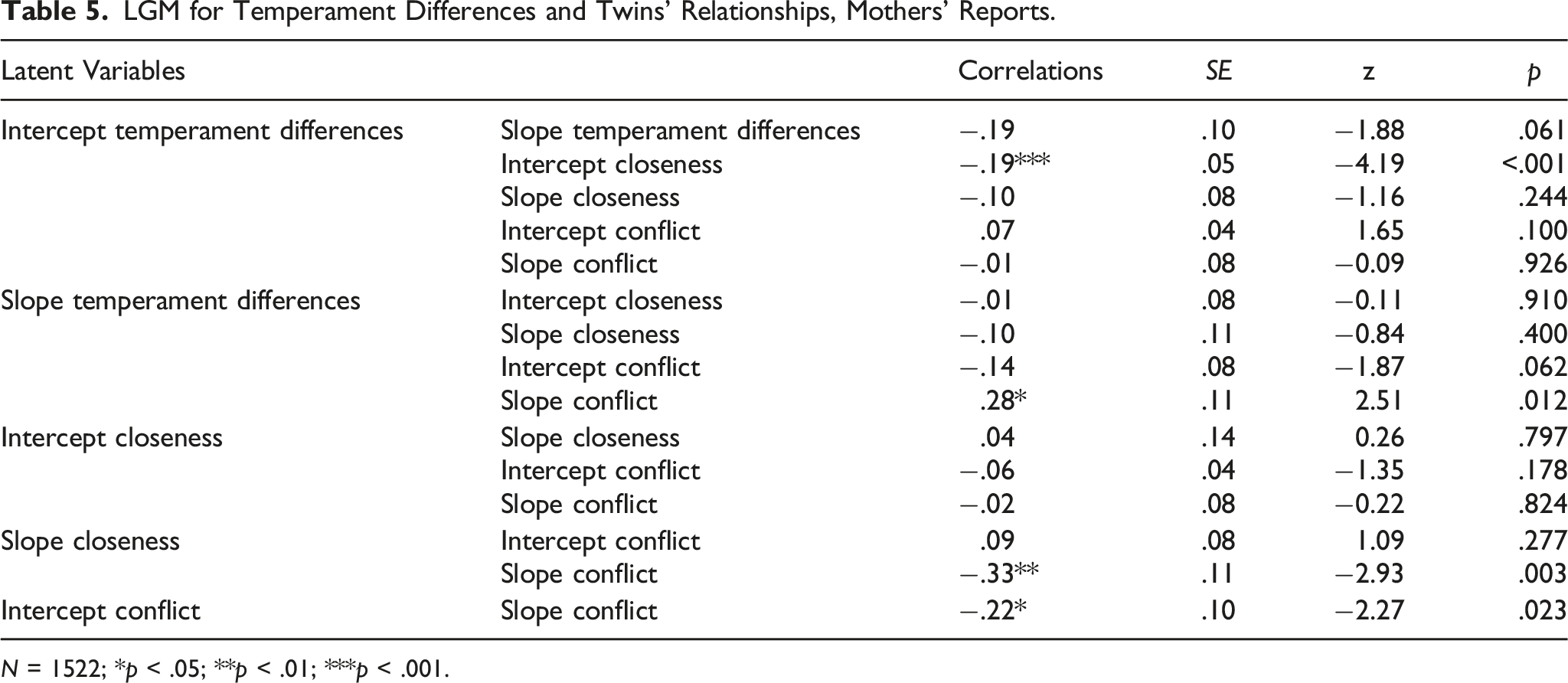
N = 1522; *p < .05; **p < .01; ***p < .001.
LGM for Zygosity Predicting the Twins' Relationships and Temperament Differences: Standardized Regression Coefficients, Mothers’ Reports.
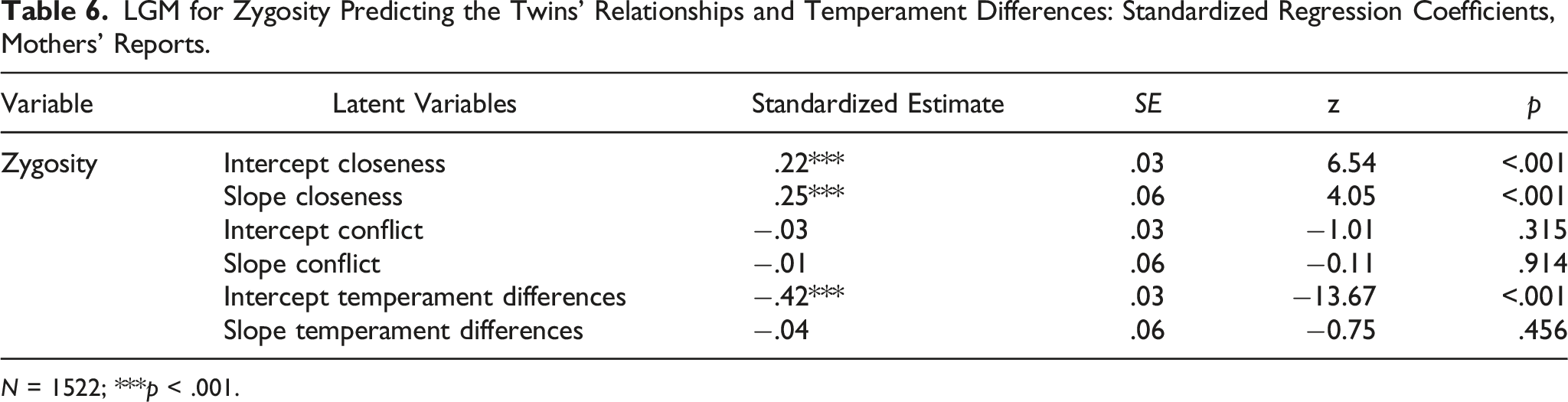
N = 1522; ***p < .001.
Closeness and Conflict
Before we describe the results for personality similarity, we will repeat the results about closeness and conflict presented in a previous report from this sample (H. Segal & Knafo-Noam, 2021, Table 4). The twins' average level of closeness decreased gradually over time, while the conflict slope was insignificant, indicating that the twins' average level of conflict did not change through childhood. Moreover, as was previously found, variance estimates for the intercept and slopes of the twins' closeness and conflict were significant. This indicated that there was significant variability in the dyads’ levels of closeness and conflict, and that the growth of the twins' relationships was significantly differentiated between dyads. The intercept and slope of closeness were not related, while the association between the conflict’s intercept and slope was significant. This association could be attributed to the statistical phenomenon of regression to the mean, whereby the conflict level of twins with initially high levels of conflict decreased, while the conflict level of twins with initially low levels of conflict increased.
As was found in our previous report from this sample (H. Segal & Knafo-Noam, 2021), zygosity predicted the closeness intercept, and the closeness slope. That is, MZ twins were found to be closer to each other than were DZ twins, and the DZ twins' closeness decreased at a higher rate than did the closeness between MZ twins. In contrast, zygosity did not significantly predict the intercept nor the slope of the twins' conflict (Table 6, Figure 1). Dyadic closeness (top row) and conflict (lower row) – by zygosity, mothers’ reports (left) and fathers’ reports (right).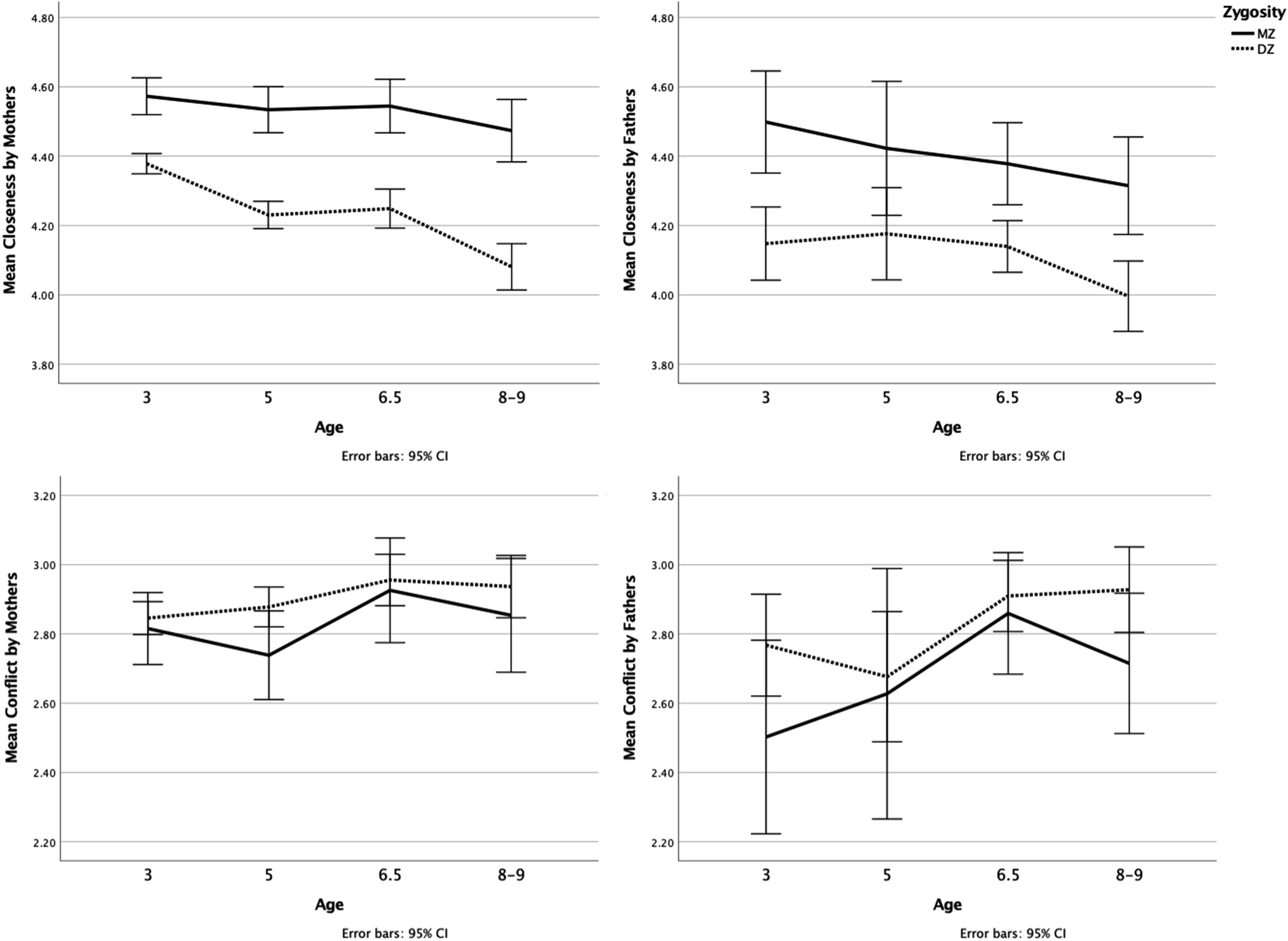
Temperament Differences
On average, twins' average level of temperament differences did not change throughout childhood, as suggested by the insignificant slope for temperament differences (See Table 4 for LGM results). Variance estimates for the intercept and slopes of the twins' temperament differences were significant. This indicated that there was significant variability in twin pairs' temperament differences, and that the growth of the temperament differences was significantly differentiated between dyads. Furthermore, the initial level of temperament differences and their development throughout childhood were not significantly associated with one another (Table 5).
Studying the effect of zygosity on the twins’ temperament differences showed that zygosity predicted the twins’ temperament differences intercept, but not the slope (Table 6, Figure 2). This finding indicated that MZ twins were more similar to one another in their temperament than were DZ twins, a difference that remained stable throughout childhood. Temperament differences – by zygosity.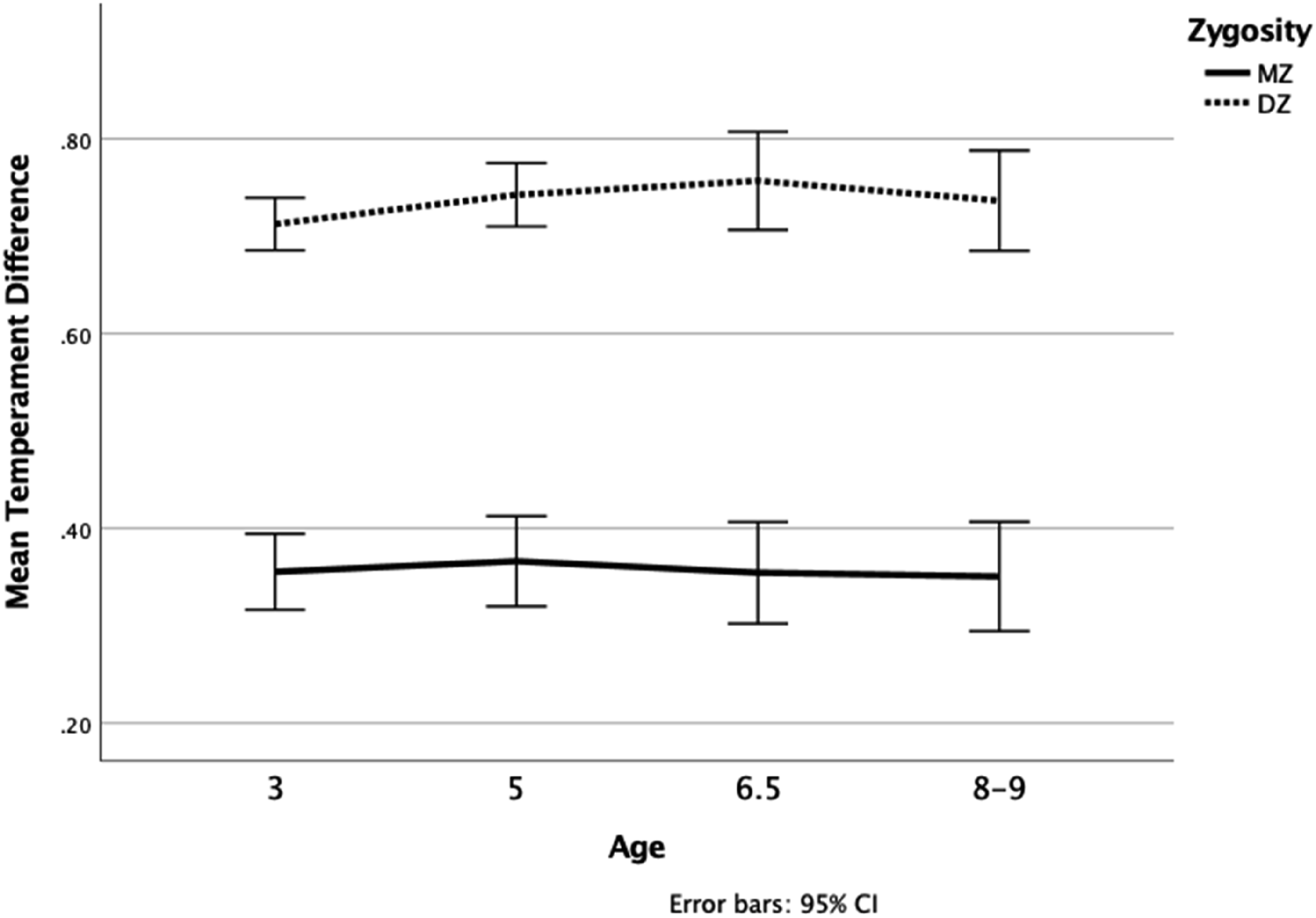
Associations Between the Twins’ Relationships and Temperament Differences
As hypothesized, temperament differences were associated with twins’ relationship quality (Table 5). First, there was a significant negative association between the intercepts of the twins' closeness and the temperament differences, indicating that the greater the difference between the twins' temperament, the less close they were to each other, across childhood. Because the association was only found for the intercepts, it was not indicative of the direction of effect between temperament differences and closeness.
A different pattern was found for conflict. Temperament differences were not significantly associated with the intercept of the twin's conflict. However, the slope of the twins' temperament differences was associated with the slope of the twins' conflict, indicating co-development of conflict and temperament differences.
An alternative approach to the LGM was to run random intercept cross-lagged panel models (RI-CLPM). The RI-CLPM enabled us to decompose the twin dyads’ closeness, conflict, and temperament differences into stable variations between the twin dyads as opposed to temporal within-dyads fluctuations. Focusing on the temporal within-dyad fluctuations, the RI-CLPM also allowed us to test the associations of the twins’ relationships with their temperament differences within each study wave, and between each pair of consecutive waves. Results largely supported those of the LGM, and specifically the tripartite association between zygosity, the twins’ closeness, and their temperament differences and the insignificant association between the twins’ conflict and their temperament differences. Nevertheless, the RI-CLPM results presented a lack of significant association between temperament difference and conflict in the earlier ages, and the appearance of an association among the older, 8 to 9 year-old twins. This finding clarifies that the LGM finding of the association between the slopes of temperament difference and conflict reflects change in both variables toward age 8–9 (see Supplementary Tables S8–S14 and Supplementary Figure S2 for the closeness RI-CLPM results and Supplementary Tables S15–S21 and Supplementary Figure S3 for the conflict RI-CLPM results). Since the LGM and the RI-CLPM yielded similar results, we decided to focus on the LGM as it is a more parsimonious model, which integrates the results of closeness and conflict.
Following our findings regarding the association between temperament differences and the twins’ relationships, we decided to run post-hoc LGMs for each temperament dimension separately, to further refine our understanding of this association (Figure 3, estimates of intercepts and slopes appear in Supplementary Table S22). The fit of all the models can be considered very good (Table 7, detailed LGMs results for the various temperament dimensions appear in Supplementary Tables S23–S34). For each temperament trait, except for negative emotionality, there were negative associations between the intercept of the twins' closeness and that of the temperament differences (sociability: β = −.23, p < .001; shyness: β = −.12, p = .012; activity: β = −.18, p < .001). The negative associations indicated that lower initial levels of the twins’ closeness were associated with higher differences in their sociability, shyness, and activity. Moreover, it seems that the association between the slope of the twins' temperament differences and the slope of the twins' conflict was mainly induced from the positive association between the slope of the twins’ conflict and the negative emotionality differences slope (β = .26, p = .037). That is, the more different the twins became in their negative emotionality with age, the more the conflict between them increased. Finally, although the model combining the four temperament traits showed no significant association between the overall temperament differences and the intercept of conflict, positive and significant associations were found between the intercepts of twins' conflict and the intercepts of twin differences in both negative emotionality and sociability (β = .11, p = .027; β = .09, p = .048; respectively). This finding indicated that twins with greater differences in their negative emotionality and sociability were also characterized by higher initial levels of conflict. Finally, there was a negative association between the conflict intercept and the sociability differences’ slope (β = −.15, p = .039), indicating that the intra-twin difference in sociability increased at a slower rate for dyads that had higher initial conflict levels. Latent growth models: Zygosity predicting the intra-twin differences in negative emotionality (top left), sociability (top right), shyness (lower left), and activity (lower right) differences and their closeness and conflict, mothers’ reports. Goodness of Fit Indices of the LGMs, Specific Temperament Dimensions, Mothers’ Reports. *Recommendations for cutoff points for a good fit (Hu & Bentler, 1999); N = 1522.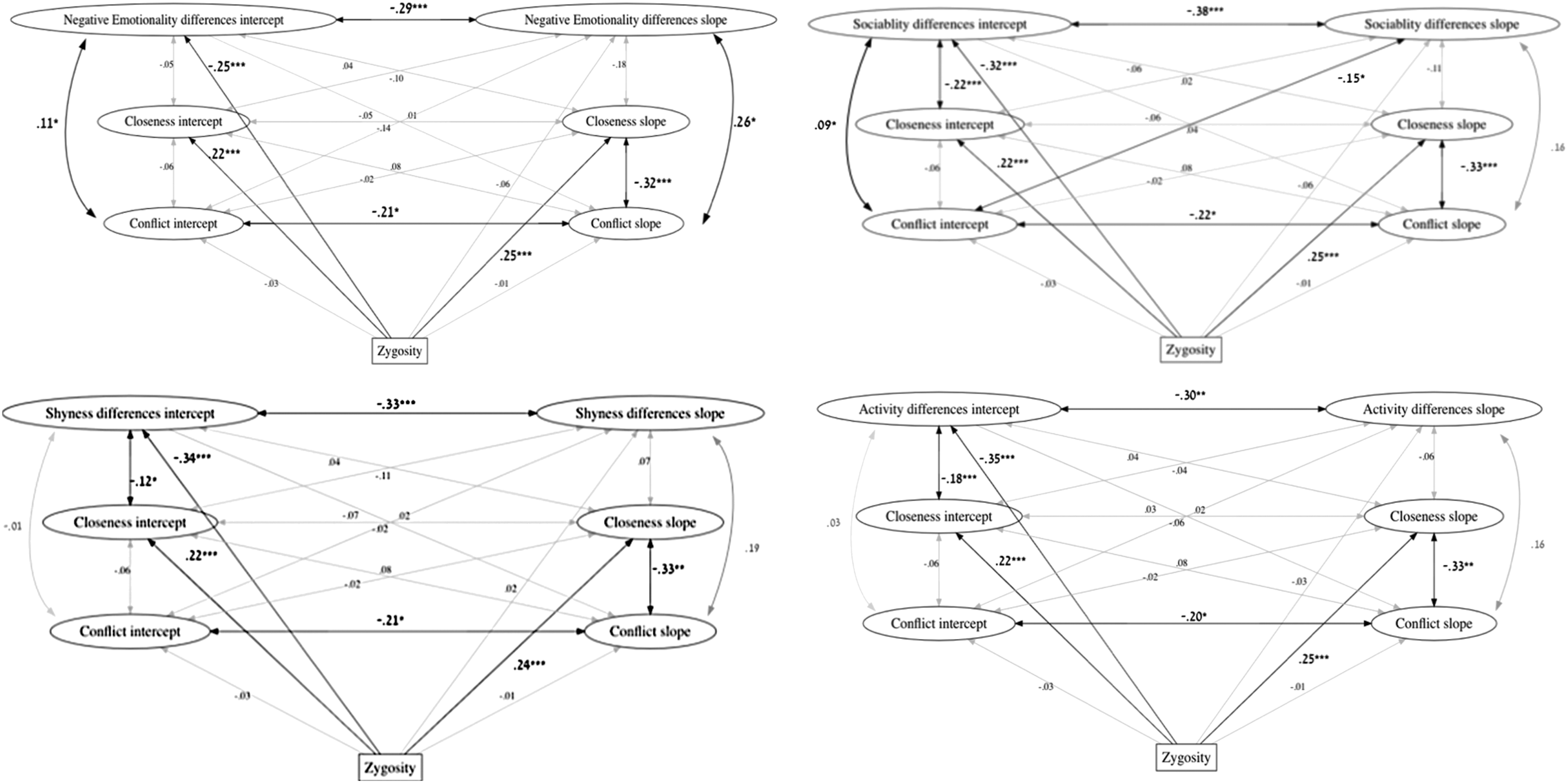

The Twins' Relationships, Temperament Differences, and Genetic Effects
Because zygosity was associated with both temperament differences and twin relationships, we sought to disentangle the associations among these three variables. Specifically, we were interested in ruling out the possibility that higher genetic similarity in MZ twins was simply expressed in both lower temperament differences and better relationship quality. As a first step, we tested the metric invariance for the twins’ closeness and conflict as well as for the composite temperament differences score across MZ and DZ twins. Constraining the loadings in the models to be equal for MZ and DZ twins resulted in satisfactory model fit (closeness and conflict: χ2(45) = 135.06, p < .001, CFI = .99, TLI = .98, RMSEA = .04, SRMR = .02; composite temperament differences score: χ2(7) = 30.56, p < .001, CFI = .98, TLI = .97, RMSEA = .04, SRMR = .02). Comparing these constrained models to models without constrained loadings indicated that the decline in the models’ fits was insignificant (closeness and conflict: χ2(9) = 3.43, p = .94; composite temperament differences score: χ2(3) = 5.79, p = .122). This metric invariance enabled us to further compare MZ and DZ twin results in a multigroup LGM analysis.
Goodness of Fit Indices of the Multigroup LGMs, Zygosity Groups.

*Recommendations for cutoff points for a good fit (Hu & Bentler, 1999); MZ twins N = 322, DZ twins N = 1199.
In all multigroup LGMs, the associations between the twins’ temperament differences and the twins’ relationship variables were in the same direction for MZ and DZ twins. The associations between the intercepts of twin temperament differences and closeness showed that twins who were more similar in their temperament were closer to one another (unconstrained LGM: MZ: β = −.20, p = .059; DZ: β = −.20, p < .001; insignificant paths constrained LGM: MZ: β = −.15, p = .132; DZ: β = −.22, p < .001; all paths constrained LGM: MZ: β = −.27; DZ: β = −.17, p < .001). Similarly, the association between the slopes of the twins’ conflict and the temperament differences was evident for MZ and DZ twins separately (unconstrained LGM: MZ: β = .70, p = .173; DZ: β = .24, p = .065; insignificant paths constrained LGM: MZ: β = .44, p = .057; DZ: β = .30, p = .020; all paths constrained LGM: MZ: β = .42, p = .025; DZ: β = .31, p = .006).
Comparing the goodness of fit of the first model (free of constraints) with the insignificant paths constrained model (χ2(11) = 17.62, p = .091) and with the all paths constrained model (χ2(15) = 22.22, p = .102) showed no significant decline in model fit. This indicated no significant differences between MZ and DZ twins in the co-development of conflict and temperament differences.
Discussion
Twin relationships remain understudied despite the increased rate of twin births, and the significant influence twinship has on twins' individual development and families’ lives. With the longitudinal twin design of the current study, we were able to examine the effect of temperament differences between twins on their relationships from early to middle childhood, while deepening our understanding of the complex associations between genetic similarity, temperament differences and dyadic relationships. Our large sample of MZ and DZ twins that participated in four measurement points makes this study the largest and most comprehensive treatment of the topic.
In accordance with our hypotheses, we found that the twins’ temperament differences were negatively associated with the twins’ closeness at all measurement points across childhood, based on reports from both parents. The LGM’s findings for mothers’ reports showed that the initial levels of the twins’ temperament differences were moderately and negatively associated with the initial levels of their closeness. This finding was repeatedly found for three of the temperament dimensions: sociability, shyness, and activity differences between the twins. In addition, supporting previous findings, zygosity was found to be related both to temperament differences and to the twins’ closeness (Fraley & Tancredy, 2012; Korbøl Torgersen, 2016; Neyer & Lang, 2003; Tellegen et al., 1988). Furthermore, the results showed that the association between temperament differences and twins’ closeness started from a young age and was similar for MZ and DZ twins.
The significant association between temperament differences and twins’ closeness may reflect social mechanisms in which individuals who share similar characteristics tend to feel closer to one another, and vice versa. However, while temperamental differences and the twins’ closeness were found to be associated from an early age, our findings were inconclusive regarding the directionality of this association. We could not support the reinforcement model, claiming that personality similarity between dyads contributes to closer relationships (Byrne & Clore, 1970; Gonzaga et al., 2007). Our findings also do not provide support for the emotional convergence process, claiming that close relationships contribute to greater personality similarity (Anderson et al., 2003). Both temperament (dis)similarity and relationship quality tend to be associated, but no evidence was found that one dyadic characteristic directionally predicts the other or vice versa. It may be that both reinforcement mechanism and emotional convergence processes contribute to the association between temperamental difference and the twins’ closeness. That is, the closeness between the twins encourages them to reinforce each other’s opinions, display more agreeableness in their interactions, and experience similar emotions in shared situations. At the same time, these similar perspectives and personality characteristics reinforce the twins’ closeness in a feedback cycle.
The association between temperament differences and the twins’ closeness can also offer an explanation for other close relationships, suggesting that from a very early age, closer relationships inside the family system are related to personality similarity above and beyond shared genes. Becoming aware of the association between temperamental similarities and close relationship can help parents better understand why some of their children exhibit closer relationships than others, and why one parent–child dyad may feel closer than another. While genetic similarity between dyads is constant, and cannot be altered, our findings suggest that closeness between dyads may be achieved by joint activities and shared interests, potentially increasing the similarity between the dyads’ characteristics. For example, striving for better relationships with their children, parents could also adapt their own behaviors to match their child’s temperament, starting from early childhood.
Focusing on the twins’ conflict, our findings suggested that although the overall differences in the twins’ temperament weren’t related to the twin conflict, there were positive associations between differences in specific temperament dimensions and the twins’ conflict. That is, twins that presented higher initial differences in their sociability and negative emotionality also exhibited more conflict at an early age. Moreover, twins whose negative emotionality deviated from one another (across childhood) also displayed relationships that started and evolved as more conflictual, and vice versa. This finding suggests that from early childhood, negative emotionality differences between dyad members and their conflict reinforce and intensify one another. The lack of significant effect of zygosity on twins' conflict suggests that the association between sociability and negative emotionality differences and conflict, as well as the co-development of negative emotionality differences and conflict during childhood, cannot be solely attributed to genetic similarity. In future studies, it would be interesting to investigate environmental factors (such as the family’s conflictual environment, or the parents’ attitudes toward competitiveness and achievement) as mediating the associations between the evolving differences in the twins’ negative emotionality and their conflict.
These unique findings regarding the association of twin differences in the specific temperament dimensions with closeness and conflict provide further support to the conclusion of our previous paper (H. Segal & Knafo-Noam, 2019) that twins’ closeness and conflict were not polar opposites. Although closeness and conflict showed comparable associations with sociability (whose intercept showed a negative association with the intercept of closeness and a positive association with the intercept of conflict), the current findings indicated that conflict and closeness related differently to different aspects of temperament. Thus, the initial levels of shyness and activity differences were related only to the initial levels of the twins’ closeness, while the initial levels of negative emotionality differences were only related to their initial levels of conflict. Despite these variations in the associations between differences in the specific temperament dimensions and the twins’ closeness and conflict, the overall picture seems quite clear, and supports previous findings (Kavčič & Zupančič, 2011; Munn & Dunn, 1989; Stoneman & Brody, 1993). These findings indicate that less difference in the twins’ personalities is associated with more warmth and less conflict in their relationships.
Strengths and Limitations
Among the strengths of the study was the longitudinal design of our study, which allowed us to investigate the associations between zygosity, twin relationship, and temperament differences from early childhood; to study the stability and change in twins' relationships and their temperament differences across childhood; and to follow their mutual developmental trajectories. Another strength of our research can be seen in using both parents’ reports, with the similar results we found for fathers and mothers, further validating our findings. The use of a twin sample, which included a large representation of MZ twins, is another strong point. Finding similar results regarding the associations between temperament differences and twin relationships, for MZ and DZ twins separately, enabled us to demonstrate that these associations are present above and beyond genetic similarity.
Nonetheless, our study had several limitations that should be considered when interpreting the present results. In assessing the twins' relationships and the temperament differences, we relied on parents’ reports. The use of such reports allowed us to reach the large number of twin pairs needed for our analysis and gave us access to a rich source of information about the children, which represents parents’ accumulated knowledge of the twins’ relationships. In addition, parents’ reports on twins’ relationships correlated with the twins’ self-reported relationships, and experimentally assessed inter-twin prosocial behavior (H. Segal & Knafo-Noam, 2019) supporting the use of parents’ reports. However, parents' reports on their twins might be biased (Pike et al., 1996; Saudino et al., 2000). Nevertheless, demonstrating the basic associations between temperament differences as measured by mothers and relationship quality as reported by fathers does strengthen our conclusions. Future research might aim to replicate the current findings with additional measures, such as teachers' reports and observational measures.
Future Directions for Research
The current research elucidates the role of zygosity in twins’ closeness and indicates the potential importance of temperament differences. In addition, we found evidence for associations between the twins’ conflict and the developmental course of their negative emotionality differences. Understanding the complexity of twins' relationships can shed light on the development of human relationships in general (Mark et al., 2017; Yirmiya et al., 2018). In addition, the findings regarding temperament differences and twins' relationships can open a window to these effects on singleton siblings’ evolving relationships. The results of the current study support the hypothesis that genetic similarity is related to close relationships. However, we also ruled out the possibility that close relationships between siblings occur merely due to shared genetics, as MZ twins did vary in their relationship quality. Instead, personality similarity was shown to relate to relationship quality beyond genetic effects. A promising avenue of future research would examine the associations of temperament differences with singleton-sibling relationships, and address the similarities and differences between twins' evolving relationships and singleton-sibling relationships. Future research might also seek to take into account the level of separation twins experience throughout childhood (e.g., whether or not they have a shared room, toys, and friends, and are in the same classroom). The subject of twins’ separation has been a longstanding issue for parents, clinicians, and educators (N. L. Segal & Russell, 1992), but its impact on the differences in their personality and their relationship has yet to be studied empirically.
The current study has several practical implications. First, it may contribute to informed decisions by caregivers and educators about separating twins at school while taking into account the twins' zygosity and temperament differences, beyond the general advantages and disadvantages of separating them (Gordon, 2015; N. L. Segal & Russell, 1992). A second implication is related to relationships in the family system in general. Following the study’s findings, parents may choose to reward situations in which their children engage in joint activities, toward the goal of enhancing the positive aspects of their relationships and supporting their children in developing close relationships from an early age.
Supplemental Material
Supplemental Material - Two peas in a pod? Development of twin relationships in light of twins’ temperament differences
Supplemental Material for Two peas in a pod? Development of twin relationships in light of twins’ temperament differences by Hila Segal, Shifra Gutermann and Ariel Knafo-Noam in European Journal of Personality.
Footnotes
Acknowledgements
We would like to thank the parents and children in our study for their continued support and participation.
Declaration of Conflicting Interests
The author(s) declared no potential conflicts of interest with respect to the research, authorship, and/or publication of this article.
Funding
The author(s) disclosed receipt of the following financial support for the research, authorship, and/or publication of this article: This work was supported by the John Templeton Foundation (The Science of Generosity Initiative), Israel Science Foundation (31\06) and European Research Council (240994).
Data Accessibility Statement
The data used in the research is not available online. The data can be obtained by contacting Ariel Knafo-Noam at The Hebrew University of Jerusalem. The materials used in the research are available. The scripts and statistical output can be obtained at  . Other materials can be obtained by emailing:
Supplemental Material
Supplemental material for this article is available online.
References
Supplementary Material
Please find the following supplemental material available below.
For Open Access articles published under a Creative Commons License, all supplemental material carries the same license as the article it is associated with.
For non-Open Access articles published, all supplemental material carries a non-exclusive license, and permission requests for re-use of supplemental material or any part of supplemental material shall be sent directly to the copyright owner as specified in the copyright notice associated with the article.
