




Abstract
The conceptual and empirical overlap of grandiose narcissism and self-esteem is part of ongoing debate. Whereas cross-sectional findings suggest a moderate correlation between both constructs, evidence on the longitudinal relationship of narcissism and self-esteem is still lacking. Using data of two longitudinal studies consisting of more than 10,000 participants in adulthood, the aim of the present study was to investigate whether narcissism and self-esteem follow similar developmental patterns and whether longitudinal change in narcissism is related to longitudinal change in self-esteem. Participants provided self-ratings of global, agentic, and antagonistic narcissism as well as their general perception of self-esteem. The results of True Intraindividual Change Models showed that although narcissism and self-esteem were associated cross-sectionally, intraindividual change in narcissism was largely unrelated to intraindividual change in self-esteem, suggesting a predominantly independent development of both constructs. The findings contribute to a more profound understanding of the developmental similarities and idiosyncrasies of narcissism and self-esteem in adulthood.
Narcissism is one of the most intriguing and paradoxical personality characteristics in the field of psychology. A long-standing issue in research on narcissism is its relationship with self-esteem (Miller et al., 2021). Typically conceptualized as a global evaluative judgment of the self, self-esteem has been considered as an integral aspect in theoretical accounts of narcissism (Miller et al., 2017; Morf & Rhodewalt, 2001). Empirical evidence, too, indicates that narcissism is at least moderately associated with self-esteem, suggesting that, although conceptually distinguishable, both constructs share some significant commonalities (Ackerman et al., 2011; Back et al., 2013).
The relationship between narcissism and self-esteem has been most commonly investigated from a cross-sectional perspective (Bosson et al., 2008; Brummelman et al., 2016). Far less is known about the development of narcissism and its longitudinal association with self-esteem. Therefore, it is largely unclear whether narcissism and self-esteem follow similar developmental trends and whether and to what degree change in narcissism is related to change in self-esteem. Hence, the aim of the present multi-sample longitudinal study was to investigate the normative development of narcissism and its correlated change with self-esteem in adulthood.
Narcissism and its facets
Narcissism is a multifaceted construct that, at minimum, is composed of two meaningful dimensions: grandiose and vulnerable narcissism (Miller et al., 2021). In the present paper, we exclusively focus on grandiose narcissism, which refers to a dimensional personality construct in the general population (i.e., normal narcissism). Accordingly, throughout this article, the term narcissism refers to grandiose narcissism.
In personality and social psychology, narcissism is defined by a strong sense of grandiosity, uniqueness, and entitlement (Ackerman et al., 2011; Bosson et al., 2008). Narcissists 1 tend to consider themselves superior to other persons, to overestimate their agentic traits and skills, and to give less importance to more communal qualities such as interpersonal warmth or trust (Brummelman et al., 2016). In peer-ratings, narcissists are found to be characterized as extraverted and outgoing but also as hostile and less agreeable, leading to the conclusion that narcissism may be both a source of social potency and social conflict (Back et al., 2013; Leckelt et al., 2018).
For a long time, the vast majority of studies conceptualized grandiose narcissism as a unitary construct, most commonly measured by the total score of the Narcissistic Personality Inventory (NPI; Raskin & Terry, 1988). More recently, however, more efforts were made to explicitly take account of the agentic and antagonistic qualities of narcissism (Ackerman et al., 2018). According to the Narcissistic Admiration Rivalry Concept (NARC; Back et al., 2013), agentic narcissism and antagonistic narcissism include different sets of intra- and interpersonal strategies with which narcissists aim to maintain their grandiose self-perception. Agentic narcissism includes self-enhancing strategies aimed at acquiring social adulation by outgoing, charming, and assertive behaviors. Agentic narcissism has been shown to be more adaptive and to be associated with extraversion, leadership, and a behavioral orientation toward activation and approach (Back et al., 2013; Miller et al., 2021; Rogoza et al., 2019). By contrast, antagonistic narcissism describes strategies primarily focused on preventing violations to the self by aggressive and derogative behaviors. Individuals high in antagonistic narcissism tend to be distrustful, deceitful, and less empathetic (Leckelt et al., 2018; Miller et al., 2021).
It is important to note that global narcissism, as measured by the overall score of the NPI, has been shown to hold higher associations with agentic narcissism than with antagonistic narcissism suggesting that global narcissism does not capture the agentic and antagonistic qualities of narcissism in equal proportions (Back et al., 2013). To allow a more stringent integration in existing research, in the present study, we operationalize narcissism both at the level of a global construct and at the level of its agentic and antagonistic facets.
Self-esteem and narcissism: similarities and divergences
A central commonality of narcissism and self-esteem may be found in a positive self-evaluation, implying that narcissists and individuals high in self-esteem alike have a good opinion about themselves (Brummelman et al., 2016). These positive self-views, however, tend to be qualitatively different. Whereas the narcissistic self-view tends to be unrealistically inflated, the positive self-view inherent in self-esteem is argued to be more grounded in an objective reality and to be characterized by feelings of self-acceptance, self-respect, and self-compassion (Kernberg, 1975; Kernis, 2003; Orth & Robins, 2014). In contrast to narcissists, individuals high in self-esteem do not necessarily feel better or superior; they equally value agentic and communal traits, and recognize the intrinsic value of significant others (Brummelman et al., 2016).
Importantly, the conceptual overlap of narcissism and self-esteem depends on whether the agentic or antagonistic facet of narcissism is emphasized. According to the NARC, the behavioral dynamics underlying agentic narcissism’s self-enhancing strategies (e.g., charming behavior) are likely to evoke positive social reactions and, in turn, promote positive self-perceptions. The behavioral dynamics underlying antagonistic narcissism’s self-protection strategies (e.g., aggressive behavior), by contrast, tend to evoke negative social reactions and, in turn, may foster negative self-perceptions.
Consistent with their conceptual commonalities and idiosyncrasies, global narcissism and self-esteem are found to be moderately correlated in cross-sectional studies (Brown & Zeigler-Hill, 2004). Furthermore, research taking account of the multidimensionality of narcissism suggests that agentic and antagonistic narcissism are diametrically related to self-esteem, with agentic narcissism generally showing positive correlations and antagonistic narcissism yielding negative associations (Back et al., 2013; Leckelt et al., 2018).
Potential sources of correlated change of narcissism and self-esteem
It is important to note that a cross-sectional correlation does not necessarily imply correlated change. The effect of causal mechanisms that once evoked an initial correlation may fluctuate and diminish over time (Klimstra et al., 2013). Accordingly, to derive hypotheses about how change in narcissism is related to change in self-esteem, it is necessary to understand the driving mechanisms underlying both constructs’ development. Correlated change, thereby, may be primarily expected when the development of narcissism and self-esteem is affected simultaneously by broad and general acting causal mechanisms.
Several broadly and generally acting mechanisms have been shown to be relevant in personality development in adulthood. The maturity principle, for example, suggests that personality traits associated with social maturity, such as agreeableness, conscientiousness, and emotional stability tend to simultaneously increase, particularly between emerging and middle adulthood (Donnellan et al., 2015). Adulthood, thereby, is argued to be associated with a variety of normative and societally prescribed roles, such as entering into working life, building a family, or participating in community activities, that afford higher levels of social maturity (Roberts et al., 2008).
With its tendency for self-centered, exploitative, and entitled behavior, narcissism may be argued to be the antithesis of social maturity (Wetzel et al., 2019). Furthermore, narcissism has been shown to be most strongly linked to high extraversion and low agreeableness, with the former being more closely associated with agentic and the latter more closely being related to antagonistic narcissism (Miller et al., 2009). Low agreeableness, thereby, is consistent with low maturity. Self-esteem, by contrast, has been shown to be associated with higher extraversion and higher emotional stability, with the latter being consistent with higher maturity (Robins et al., 2001). Accordingly, the maturity principle might also generalize to the development of narcissism and self-esteem and, by affecting both constructs’ development simultaneously, be a potential source of correlated change.
Research on the normative development of narcissism and self-esteem suggests that both constructs’ development might indeed follow the maturity principle. A growing body of cross-sectional evidence suggests an inverse relation between age and narcissism, indicating that individuals are less narcissistic as they become older (Twenge et al., 2008). Furthermore, although evidence on mean-level change is still rare, research taking account of the multidimensionality of narcissism indicates that particularly antagonistic narcissism tends to decrease in adulthood (Carlson & Gjerde, 2009; Chopik & Grimm, 2019; Wetzel et al., 2019). Evidence on mean-level change in agentic and global narcissism, however, is less consistent. Whereas some findings suggest a substantial decline, some studies observed no significant mean-level changes, or even increases in adulthood (Carlson & Gjerde, 2009; Grosz et al., 2019; Orth & Luciano, 2015). Research on the development of self-esteem is more conclusive and indicates that self-esteem follows a normative trajectory over the life span similarly to other maturity personality characteristics. Cross-sectional studies suggest a positive association between self-esteem and age in that individuals’ level of self-esteem increases as they become older (Orth & Robins, 2014). Congruently, longitudinal studies investigating mean-level change report increases in self-esteem of participants in early and middle adulthood (Huang, 2010; Rentzsch & Schröder-Abé, 2022; Wagner et al., 2013). These findings are corroborated by recent meta-analytical evidence indicating that the development of self-esteem tends to follow an inverted U-shape curve with increases from adolescence to middle adulthood, a stagnation around the age of 50 or 60, and a decline in old age (Orth et al., 2018).
Previous findings on the correlated change of narcissism and self-esteem
Empirical studies that investigated the correlated change of narcissism and self-esteem are still lacking. However, evidence on the correlated change of related personality characteristics, such as the Big Five, provides further evidence that change in narcissism might be related to change in self-esteem. In longitudinal studies, small to moderately positive coefficients are commonly reported for correlations between change in agreeableness and change in both emotional stability and extraversion (Allemand et al., 2007; Klimstra et al., 2013). Accordingly, change in self-esteem (correlate of emotional stability) might be negatively related to change in antagonistic narcissism (negatively correlated with agreeableness) (Back et al., 2013). By contrast, for agentic and global narcissism, which has been shown to be more closely and positively associated with extraversion (Ackerman et al., 2011; Miller et al., 2009), longitudinal change might be positively associated with change in self-esteem.
The current study
The evidence reviewed so far indicates that narcissism and self-esteem might follow the maturity principle of personality development and, hence, are affected by overlapping sets of causal mechanisms – however not necessarily in the same directions. Particularly antagonistic narcissism and self-esteem might develop diametrically in adulthood with increases in antagonistic narcissism being associated with decreases in self-esteem and vice versa. By contrast, a positive correlated change might be expected for agentic and global narcissism, with the latter measuring proportionally more agentic aspects than antagonistic aspects of narcissism.
This study is the first longitudinal study that simultaneously investigated the normative development of narcissism and its correlated change with self-esteem in adulthood. We used data of two longitudinal studies to replicate and generalize our findings across different samples from the general population and distinct measures of narcissism and self-esteem. In Study 1, individuals were followed across three measurement waves, spanning a total time period of six years. Narcissism was operationalized as a unitary construct using an adapted version of the NPI. In Study 2, a large nationwide clustered sample including three age cohorts in Germany was followed across two measurement waves two years apart. Furthermore, we took a more elaborate view on the correlated change of narcissism and self-esteem by taking account of the agentic and antagonistic aspects of narcissism. More specifically, we investigated the differential links between change in agentic narcissism, antagonistic narcissism, and change in self-esteem.
Study 1
Method
Pre-registration
The study was pre-registered and, unless otherwise stated, the study design, all methods, and analyses were specified in advance. Regarding correlated change, the original research question focused on the longitudinal effect of narcissism on self-esteem, and vice versa, and not on both constructs’ correlated change (see https://osf.io/acpwz). 2
Participants and procedure
We used three waves of data from the Self-Evaluations Across Life study (SELF; Rentzsch, 2021), which focuses on the longitudinal development and stability of self-evaluations across adulthood. Data relevant to the present research question were collected in 2013, 2017, and 2019, to which in the following we refer to T1, T2, and T3, respectively. At each wave, individuals of the general German population were recruited using a pool of potential candidates for psychological research. As an incentive, participants received personal feedback on their self-esteem profile. At T1, 636 participants (68.0% female) completed the questionnaire. We excluded two participants from the present analyses because they reported that they were underage. At T2, 523 participants (63.7% female) attended and 633 (65.6% female) attended at T3. Of those participating at T1, 208 also participated at T2 and 209 at T3. Of those individuals that attended at T2, 258 also took part at T3. All participants who had data on at least one measurement wave were included in the analyses, resulting in a total sample size of 1254 females and males.
Participants' mean age at T1 was 47.0 years (SD = 12.4; range = 18.0–88.0), 48.8 years (SD = 13.7; range = 19.0–78.0) at T2, and 48.8 years (SD = 14.5; range = 18.0–81.0) at T3. In regard to educational attainment, 54.1% of the total sample had a college or university degree (∼17–19 years of education), 11.4% a college of applied sciences entrance qualification (∼13 years of education), 20.2% had a high school degree (∼12–13 years of education), 19.8% a middle school degree (∼10 years of education), and 3.3% a main school degree (∼9 years of education). Only a small subset was without an academic degree (0.2%).
Approval for instruments and procedure was obtained by the Ethics Committee of the University of Bamberg, Germany.
Measures
Narcissism
Narcissism was measured using a 12-item short form of the German adaptation of the Narcissistic Personality Inventory (NPI; Klavina & Schröder-Abé, 2020; Raskin & Terry, 1988; Schütz et al., 2004). Using a forced-choice response format, participants were asked to choose one out of two statements (one narcissistic and one non-narcissistic statement) that describes them better (e.g., “I really like to be the center of attention.” vs. “I am not comfortable being the center of attention.”). The scales’ reliability
3
was
Self-esteem
Global self-esteem was measured using the 7-item self-regard subscale of the Multidimensional Self-Esteem Scale (Schütz et al., 2016), which is the German adaptation of the self-esteem scale created by Fleming and Courtney (1984). The self-regard subscale measures individuals’ general perception of self-worth that is independent of a particular domain, with high scores indicating high levels of self-acceptance, self-evaluation, and self-confidence. Individuals responded on 7-point rating scales ranging from 1 (not at all) to 7 (very much) for items measuring intensity (e.g., “Do you have a positive attitude towards yourself?”) and from 1 (never) to 7 (very much) for items measuring frequency (e.g., “How often are you satisfied with yourself?”). Reliability of the scale was high at each measurement wave,
Analytic strategy
All analyses were run using longitudinal latent structural equation modeling. The latent modeling approach has the advantage that it explicitly accounts for measurement error and thereby provides more precise and hence more valid parameter estimates than analyses based on manifest variables.
For each latent construct, three item parcels 4 were generated according to the balancing technique recommended by Little et al. (2002). To account for the use of the same indicators across time, correlations between the indicators’ residual variances were specified.
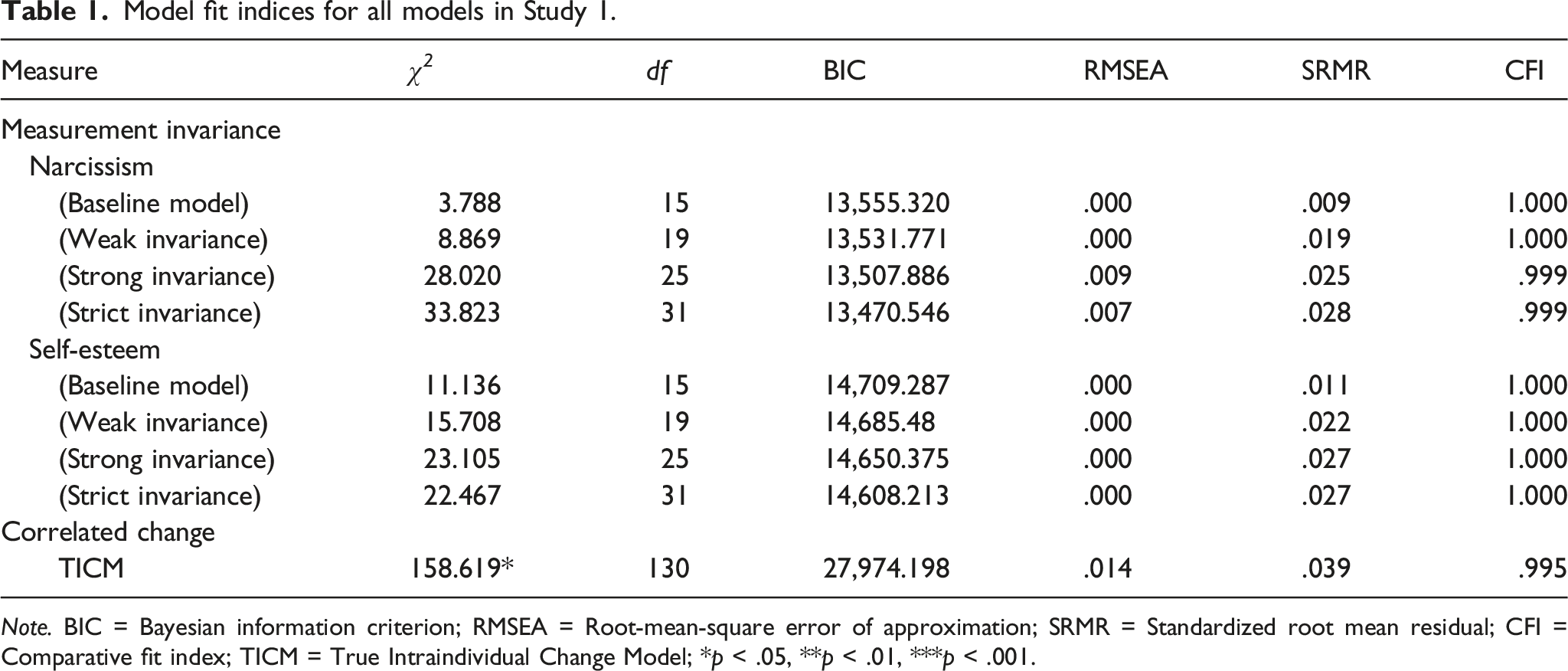
Models were estimated using the lavaan package (Rosseel, 2012) of the R environment (R Core Team, 2020), employing the robust maximum likelihood estimator (MLR). The MLR estimator has been shown to provide standard errors and test statistics robust against non-normality of the data. Evaluation of model fit was based on the comparative fit index (CFI), the root-mean-square error of approximation (RMSEA), the Bayesian Information Criterion (BIC), and the standardized root mean residual (SRMR). As pre-registered, good model fit is indicated by a CFI above .90, a RMSEA coefficient of less than .08, and a SRMR of equal or less than .11. Test of measurement invariance across time was based on the CFI index, for which a decrement of equal or less than .01 indicates a non-significant difference (Cheung & Rensvold, 2002).
Attrition was handled using the full information maximum likelihood procedure (FIML), which is a model based statistical approach for dealing with missing data (Enders, 2010; Schafer & Graham, 2002).
All analysis scripts and output files are provided online in an OSF repository (at https://osf.io/c8bjy/).
Results and discussion
Descriptive statistics including the manifest indicators’ means, standard deviations, and intercorrelations as well as exact p values for all findings are provided online on the OSF repository.
Measurement invariance and rank-order consistency
To ensure the validity of the relations between the latent constructs and their manifest indicators as well as to ensure that these relationships are stable across time, we tested multiple measurement models separately for narcissism and self-esteem.
Model fit indices for all models in Study 1.
Note. BIC = Bayesian information criterion; RMSEA = Root-mean-square error of approximation; SRMR = Standardized root mean residual; CFI = Comparative fit index; TICM = True Intraindividual Change Model; *p < .05, **p < .01, ***p < .001.
Based on the respective measurement models for narcissism and self-esteem, latent correlations between the factors were used to estimate both constructs’ rank-order stability. 5 Both narcissism and self-esteem yielded a substantial stability across the approximately 4-year measurement period between T1 and T2 (narcissism: r = .911, p = .000, 95% CI [.832, .990]; self-esteem: r = .811, p = .000, 95% CI [.736, .886]) as well as across the approximately 2-year period between T2 and T3 (narcissism: r = .942, p = .000, 95% CI [.890, .994]; self-esteem: r = .856, p = .000, 95% CI [.789, .923]). 6 Even taking into account of the approximately 6-year period between T1 and T3, the rank-order stability of both constructs decreased only marginally (narcissism: r = .849, p = .000, 95% CI [.766, .931]; self-esteem: r = .766, p = .000, 95% CI [.683, .848]).
Mean-level and correlated change of narcissism and self-esteem
True Intraindividual Change Models (TICM; Steyer et al., 1997) were used to investigate the mean-level change and correlated change of narcissism and self-esteem. TICMs are a class of structural equation models which allow to estimate a variable’s change between two measurement occasions controlled for measurement error. In the present study, latent change was specified in relation to the construct’s score at the initial measurement occasion (T3–T1, T2–T1; baseline change model).7 Accordingly, a first question a TICM can answer is whether there is a reliable change in narcissism (self-esteem) between T1 and T2 and between T1 and T3, respectively. Moreover, TICMs not only provide estimates of the mean of the latent change between two measurement occasions but also its variance, which indicates the degree to which individuals differ in their intraindividual change.
We simultaneously estimated two baseline change TICMs, one for narcissism and one for self-esteem, respectively. This approach provides estimates about the extent to which change in narcissism is proportional to change in self-esteem between the three measurement occasions. More specifically, it allows to answer whether change in narcissism between T1 and T2 (T1 and T3) corresponds to change in self-esteem between T1 and T2 (T1 and T3). Narcissism and self-esteem at T2 and T3 loaded on their respective initial levels, the respective simultaneous, and previous change scores, with all loadings being fixed to one. Correlations between the initial levels of narcissism and self-esteem as well as all latent change scores were freely estimated both within and across measurement waves.
8
The structural model is depicted in Figure 1. True Intraindividual Change Model to estimate the development and correlated change of narcissism and self-esteem in Study 1. Note. NAR = Narcissism; SE = Self-esteem; T1 = Time 1; T2 = Time 2; T3 = Time 3.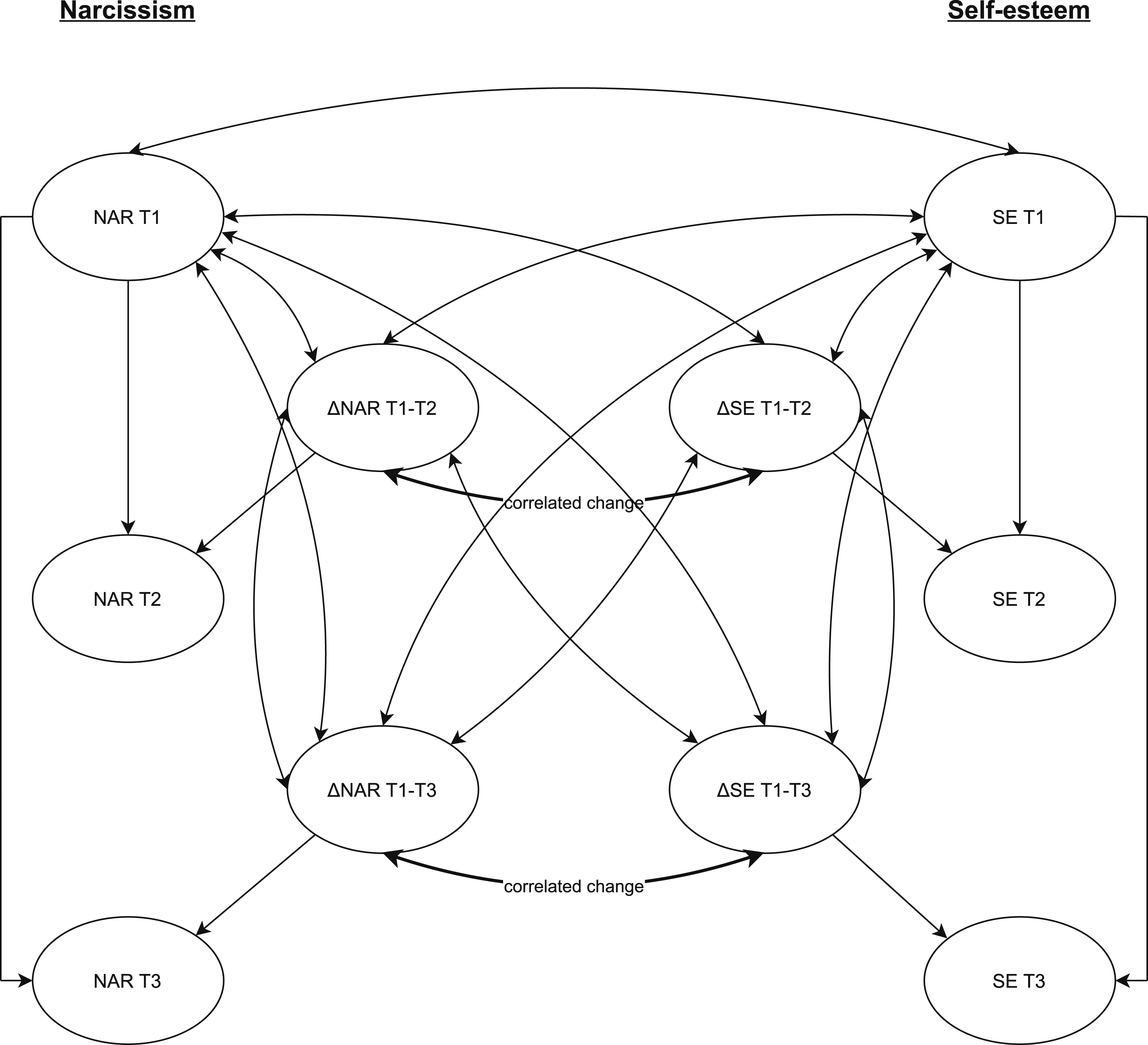
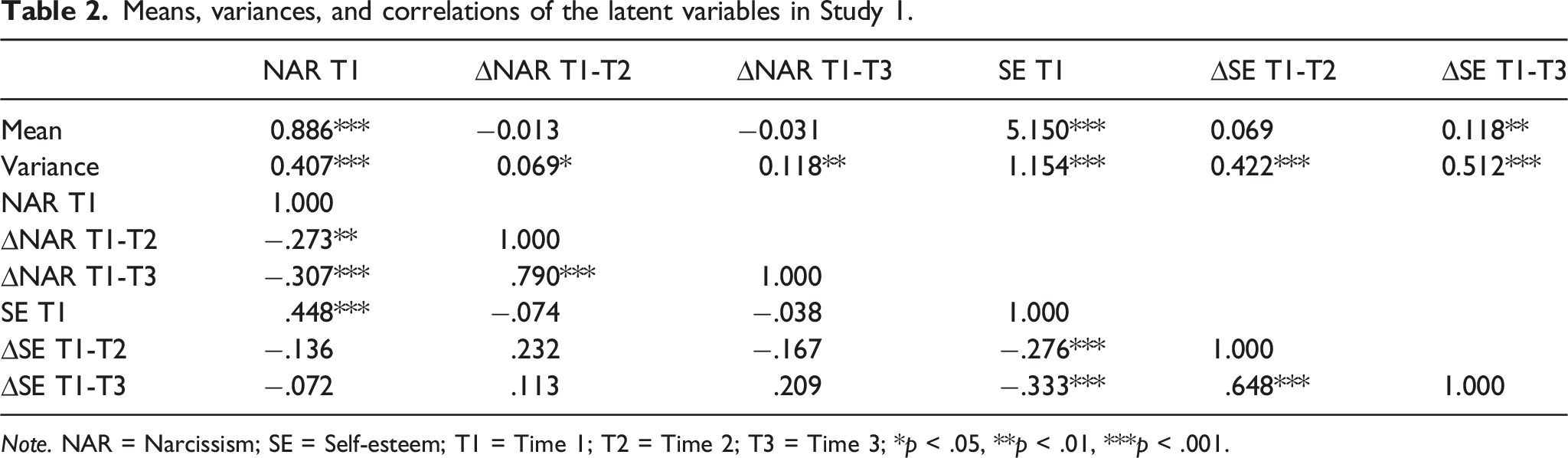
Means, variances, and correlations of the latent variables in Study 1.
Note. NAR = Narcissism; SE = Self-esteem; T1 = Time 1; T2 = Time 2; T3 = Time 3; *p < .05, **p < .01, ***p < .001.
Mean-level change
The mean-level in narcissism neither significantly increased or decreased neither across the 4-year period between T1 and T2 (M = −0.013, p = .635, 95% CI [−0.067, 0.041]) nor across the 6-year period between T1 and T3 (M = −0.031, p = .291, 95% CI [−0.089, 0.027]). Similarly, self-esteem did not show a significant mean-level change between T1 and T2 (M = 0.069, p = .117, 95% CI [−0.017, 0.156]). Only when taking account of the total study period of 6 years between T1 and T3, self-esteem showed a small but significant increase in mean-level across time (M = 0.118, p = .008, 95% CI [0.031, 0.205]). Both narcissism and self-esteem exhibited significant variances of the latent change scores, suggesting that some individuals changed more than others with respect to narcissism and self-esteem.
Cross-sectional correlation and correlated change
As depicted in Table 2, we observed a significant correlation between both constructs’ initial levels (r = .448, p = .000, 95% CI [.374, .522]). Accordingly, in line with previous cross-sectional evidence, individuals with higher levels of narcissism also scored higher on measures of self-esteem. The initial level of narcissism, however, was not significantly related to change in self-esteem between T1 and T2 (r = −.136, p = .163, 95% CI [−.327, .055] as well as between T1 and T3 (r = −.072, p = .399, 95% CI [−.238, .095]). Similarly, the initial level of self-esteem was unrelated to change in narcissism, again, both between T1 and T2 (r = −.074, p = .528, 95% CI [−.302, .155] and T1 and T3 (r = −.038, p = .687, 95% CI [−.223, .147]). Unexpectedly, change in narcissism between T1 and T2 was not significantly related to change in self-esteem between T1 and T2 (r = .232, p = .421, 95% CI [−.333, .797]) and T1 and T3 (r = .113, p = .582, 95% CI [−.290, .516]). Similarly, change in narcissism between T1 and T3 was not significantly related to change in self-esteem, again, both between T1 and T2 (r = .167, p = .370, 95% CI [−.198, .532]) and T1 and T3 (r = .209, p = .188, 95% CI [−.102, .502]). 9
In summary, in the present study we did not find evidence for significant mean-level change in narcissism or self-esteem in adulthood. However, all latent change variables showed significant variances, indicating that individuals did change in narcissism and self-esteem within the study period but not in a unitary direction. Importantly and in contrast to our hypotheses, the present findings suggest that narcissism and self-esteem, at least when operationalized globally, seem to develop independently in adulthood, with increases or decreases in narcissism being unrelated to increases or decreases in self-esteem.
Study 2
In the previous study, narcissism was conceptualized as a unitary construct. However, as outlined above, narcissism includes both agentic and antagonistic facets. Evidence suggests that both facets tend to follow distinct developmental trajectories and to show characteristic associations with self-esteem. Hence, the aim of Study 2 was to provide a deeper understanding of the correlated change of narcissism and self-esteem by taking account of agentic and antagonistic facets of narcissism. 10
Method
Participants and procedure
Data came from the German Panel Analysis of Intimate Relationships and Family Dynamics (pairfam), release 11.0 (Brüderl et al., 2020). Pairfam started in 2008/2009 with a nationwide random sample of participants from three age cohorts (aged 15–17, 25–27, and 35–37 years). All participants of previous waves who did not explicitly refuse were contacted again at 1-year intervals. Participants with missing data on two consecutive waves were excluded from the study design. Due to attrition, a refreshment sample was drawn at T11. At each wave, data were obtained using Computer Assisted Personal Interviewing (CAPI) by trained staff. Further details on the study design are found in Huinink et al. (2011).
As agentic and antagonistic narcissism was first measured in 2016/17 and then again in 2018/19, we included only two waves of data to which in the following we refer to T1 and T2. Individuals from the original sample as well as from the refreshment sample were included in our analyses resulting in a total sample size of 10,235 participants, with 5109 individuals (53.6% female) with a mean age of 34.6 years (SD = 8.3; range = 22.0–46.0) participating at T1, and 9409 individuals (53.2% female) with a mean age of 30.0 years (SD = 10.5; range = 14.0–48.0) participating at T2. Regarding educational attainment, 14.8% of the participants had a college or university degree (∼17–19 years of education), 41.4% had a high school degree (∼12–13 years of education), 10.8% a college of applied sciences entrance qualification (∼13 years of education), 32.3% a middle school degree (∼10 years of education), and 12.5% a main school degree (∼9 years of education). Only a small subset was without an academic degree (2.3%).
Measures
Narcissism
Narcissism was measured using a short form of the Narcissistic Admiration Rivalry Questionnaire (NARQ-S; Back et al., 2013; Leckelt et al., 2018). The NARQ-S is a 6-item self-report instrument that distinguishes between agentic (admiration) and antagonistic (rivalry) aspects of grandiose narcissism, with three items for each subscale (e.g., agentic narcissism: “I deserve to be seen as a great personality”; antagonistic narcissism: “I react annoyed if another person steals the show from me.”). For reasons of consistency with other scales of pairfam, the original 6-point response format was reduced to a 5-point response format, ranging from 1 (not at all) to 5 (absolutely). Internal consistency for the admiration subscale was
Self-esteem
Participants’ self-esteem was measured using a 3-item scale (e.g., “I like myself just the way I am.”) derived from the Rosenberg Self-Esteem Scale (Rosenberg, 1965). Again, for reasons of consistency, the response format was modified, and all items were answered using a 5-point scale ranging from 1 (not at all) to 5 (absolutely) instead of the questionnaire’s original 4-point scale. Reliability was,
Analytic strategy
To investigate correlated change of narcissistic admiration, rivalry, and self-esteem we adopted a similar analytic strategy as in Study 1. This time, however, instead of two, we simultaneously estimated three TICMs encompassing two instead of three measurement occasions: one for agentic narcissism, one for antagonistic narcissism, and one for self-esteem. As outlined before, this approach allows to answer whether there is a reliable mean-level change in agentic/antagonistic narcissism and self-esteem as well as whether change in agentic/antagonistic narcissism corresponds to change in self-esteem Single items were used as indicators for the latent factors and, to account for the shared variance of repeatedly measured indicators, we specified correlated residuals.
Results and discussion
Descriptive statistics including the manifest indicators’ means, standard deviations, and intercorrelations as well as the exact p values for all findings are provided online on the OSF repository.
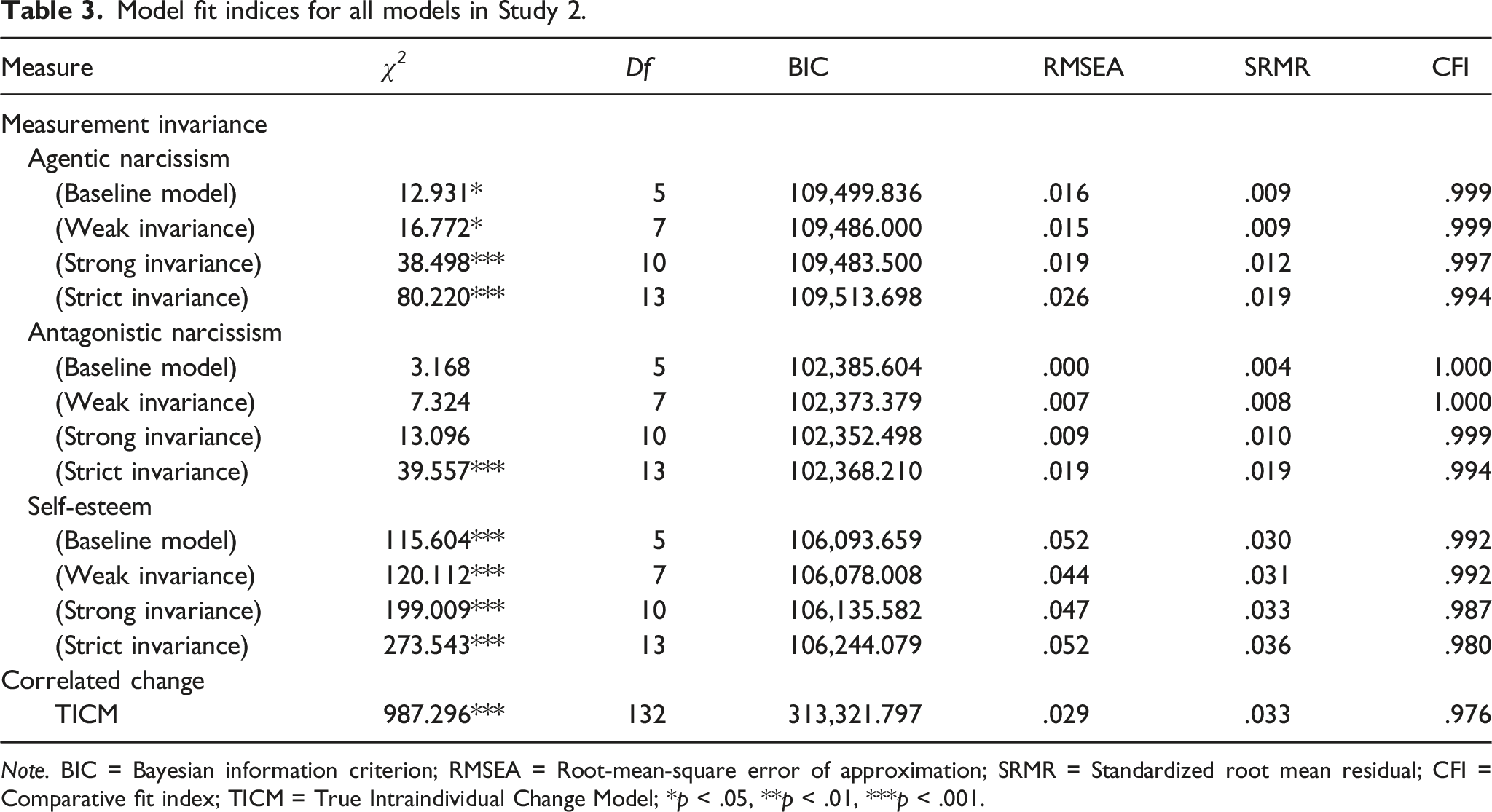
Measurement invariance and rank-order consistency
Model fit indices for all models in Study 2.
Note. BIC = Bayesian information criterion; RMSEA = Root-mean-square error of approximation; SRMR = Standardized root mean residual; CFI = Comparative fit index; TICM = True Intraindividual Change Model; *p < .05, **p < .01, ***p < .001.
Based on the respective measurement models, the estimated correlations between the latent factors yielded a high temporal stability for both dimensions of narcissism as well as self-esteem across the approximately 2-year period (agentic narcissism: r = .718, p = .000, 95% CI [.691, .745]; antagonistic narcissism: r = .729, p = .000, 95% CI [.692, .765]; self-esteem: r = .719, p = .000, 95% CI [.690, .748]).
Mean-level and correlated change of agentic and antagonistic narcissism and self-esteem
We simultaneously estimated three TICMs, one for admiration, one for rivalry, and one for self-esteem. Agentic narcissism, antagonistic narcissism, and self-esteem at T2 loaded on their respective initial levels and the respective simultaneous change scores, with all loadings being fixed to one. Correlations between the initial levels of agentic narcissism, antagonistic narcissism, and self-esteem as well as all latent change scores were freely estimated.
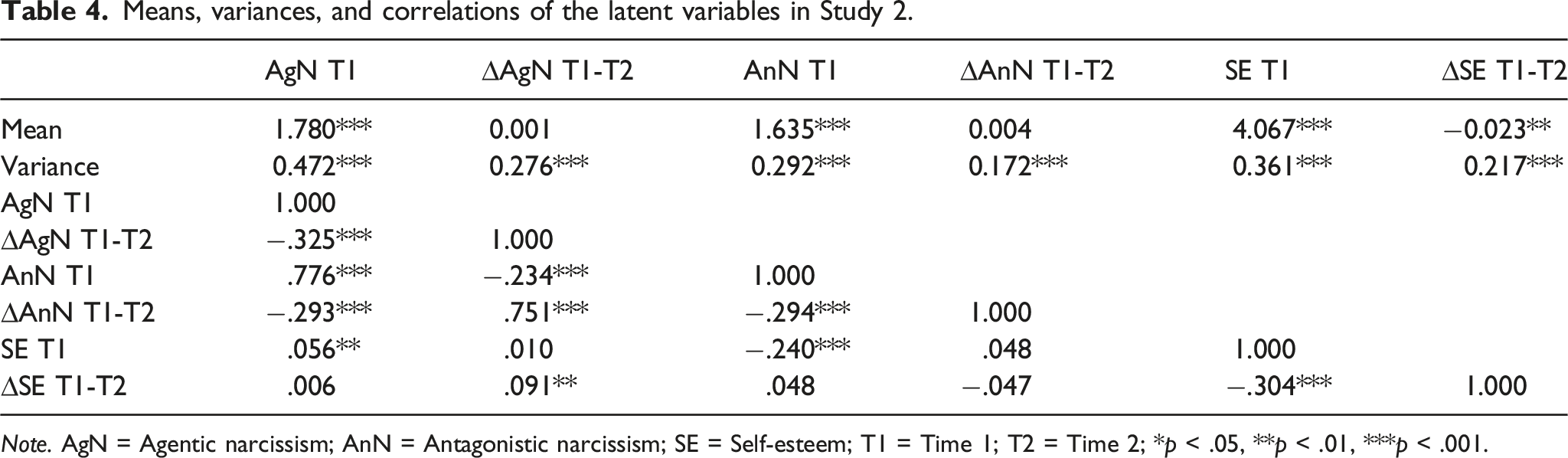
Means, variances, and correlations of the latent variables in Study 2.
Note. AgN = Agentic narcissism; AnN = Antagonistic narcissism; SE = Self-esteem; T1 = Time 1; T2 = Time 2; *p < .05, **p < .01, ***p < .001.
Mean-level change
Neither agentic narcissism nor antagonistic narcissism exhibited a significant mean-level change across the 2-year period between the T1 and T2 (agentic narcissism: M = 0.001, p = .893, 95% CI [−0.018, 0.021]; antagonistic narcissism: M = 0.004, p = .683, 95% CI [−0.014, 0.021]). Self-esteem showed a rather small but significant mean-level decrease between the two measurement times (M = −0.023, p = .005, 95% CI [−0.040, −0.007]). Moreover, and as in Study 1, all latent change factors showed a significant variance, indicating meaningful interpersonal differences in intraindividual change.
Cross-sectional correlation and correlated change
For agentic narcissism and self-esteem, we observed a small positive correlation between both constructs’ initial levels (r = .056, p = .001, 95% CI [.022, .090]), indicating that individuals with higher levels in agentic narcissism also had higher levels in self-esteem. Both initial levels, however, were unrelated to the respective other latent change factor (agentic narcissism T1 with ∆self-esteem: r = .006, p = .772, 95% CI [−.037, .050]; self-esteem T1 with ∆agentic narcissism: r = .010, p = .640, 95% CI [−.033, .054]). Regarding correlated change and in line with our hypotheses, both latent change factors were positively correlated (r = .091, p = .001, 95% CI [.036, .145]), suggesting that an increase (decrease) in agentic narcissism was associated with an increase (decrease) in self-esteem. It is important to note however, that the association between the latent change scores was rather small and far from being considered as meaningful.
For antagonistic narcissism and self-esteem, we found a moderate negative correlation between their initial levels (r = −.240, p = .000, 95% CI [−.278, −.202]), indicating that individuals high in antagonistic narcissism tend to have lower levels of self-esteem. Antagonistic narcissism at T1, however, was not significantly associated with latent change in self-esteem (r = .048, p = .055, 95% CI [−.001, .096]). Similarly, self-esteem at T1 was unrelated to latent change in antagonistic narcissism (r = .048, p = .063, 95% CI [−.003, .098]). Most importantly, latent change in antagonistic narcissism was not significantly associated with change in self-esteem (r = −.047, p = .142, 95% CI [−.110, .016]), suggesting that both constructs changed independently. 11
To summarize, the analyses in Study 2 yielded that neither agentic narcissism nor antagonistic narcissism showed significant mean-level changes across the 2-year study period. A significant but very small mean-level decrease, however, could be observed for self-esteem. As in Study 1, all constructs showed significant variances, indicating substantial interindividual differences in intraindividual change and, hence, that some individuals increased (decreased) more than other individuals. Furthermore, whereas change in antagonistic narcissism was unexpectedly found to be unrelated to change in self-esteem, change in agentic narcissism showed a weak but significant association with change in self-esteem in the expected positive direction. Hence, individuals with higher increases or decreases in agentic narcissism also tended to show higher increases or decreases in self-esteem.
General Discussion
The aim of the present research was to investigate the development of narcissism and its correlated change with self-esteem. Drawing on data of two longitudinal studies, with more than 10,000 adult participants and taking account of the agentic and antagonistic facets of narcissism, latent True Intraindividual Change Models were used to investigate whether narcissism significantly increased or decreased in adulthood and whether change in narcissism was related to change in self-esteem.
Mean-level change in narcissism
Previous studies on mean-level change of narcissism in adulthood were rare and partially inconsistent. In the present studies, we found no evidence for a substantial mean-level increase or decrease in narcissism in adulthood. In Study 1, the mean-level of global narcissism neither significantly changed within the 4-year period between T1 and T2, nor within the 6-year period between T1 and T3. As global narcissism measures both agentic and antagonistic aspects of narcissism (Ackerman et al., 2011), an explanation for the absence of mean-level change might have been that both facets develop in opposite directions. Particularly antagonistic narcissism has been argued to decrease from the emerging of adulthood, whereas evidence for agentic narcissism suggest a higher mean-level stability or even increases (Carlson & Gjerde, 2009; Chopik & Grimm, 2019; Grosz et al., 2019). However, in Study 2, neither agentic nor antagonistic narcissism was found to significantly change across the 2-year period. Furthermore, change in agentic narcissism was found to positively correlate with change in antagonistic narcissism, which argues against opposite developmental trends and instead suggests that increases or decreases in agentic narcissism are associated with increases or decreases in antagonistic narcissism.
It might be argued that the study period was too short for significant mean-level changes in narcissism to appear. Evidence for mean-level changes in narcissism was primarily found in studies with substantially longer intervals between the measurement times (Chopik & Grimm, 2019; Wetzel et al., 2019). However, despite the absence of mean-level change, all latent change variables, both in Study 1 and in Study 2, yielded significant variances, indicating substantial interindividual differences in intraindividual change. Accordingly, individuals had changed in their levels of narcissism, but not in a unitary direction. These findings suggest that for the present samples the development of narcissism in adulthood was less triggered by normative mechanisms that affect all persons similarly, such as the maturity principle. Instead, individual increases or decreases in narcissism tended to be the subject of idiosyncratic factors for which the probabilities of occurrence vary between individuals (Allemand & Martin, 2016; Klimstra et al., 2013).
Cross-sectional correlation and correlated change of narcissism and self-esteem
In line with the assumption that narcissism and self-esteem share a positive self-evaluation, global narcissism was found to be positively correlated with self-esteem cross-sectionally in Study 1. Importantly, the association between narcissism and self-esteem became more differentiated, when taking account of the agentic and antagonistic facets of narcissism. In Study 2, only agentic narcissism was found to positively correlate with self-esteem. Notably however, this correlation was rather weak. By contrast, a negative correlation was observed for the association between antagonistic narcissism and self-esteem. These findings show that the positive self-view applies primarily to individuals high in global narcissism and is reversed for individuals high in antagonistic narcissism.
Longitudinal evidence on the correlated change of narcissism and self-esteem still had been lacking. Based on evidence of the normative development of narcissism and self-esteem and on findings of the correlated change of correlates of narcissism and self-esteem (Chopik & Grimm, 2019; Grosz et al., 2019; Klimstra et al., 2013; Wetzel et al., 2019), we argued that particularly antagonistic narcissism and self-esteem develop diametrically in adulthood, with decreases in antagonistic narcissism being associated with increases in self-esteem. Furthermore, we expected the correlation between change in narcissism and change in self-esteem to be positive for agentic and global narcissism.
Despite narcissism and self-esteem being cross-sectionally associated, change in narcissism was unexpectedly found to be largely unrelated to change in self-esteem. In Study 1, all four cross-domain correlations between global narcissism and self-esteem turned out to be insignificant, suggesting that individuals increased or decreased in global narcissism independently from their increases or decreases in self-esteem. Additionally, and unexpectedly, change in antagonistic narcissism was unrelated to change in self-esteem in Study 2. Only change in agentic narcissism showed a significant association with change in self-esteem in the expected positive direction in Study 2. Accordingly, individuals who increased or decreased in their level of agentic narcissism also increased or decreased in their level of self-esteem. It is important to note, however, that the correlation between change in agentic narcissism and change in self-esteem was weak and may not be considered as substantial.
The relative absence of correlated change allows important insights into the causal mechanisms underlying the development of narcissism and self-esteem. Correlated change may be primarily expected when the development of two or more personality characteristics is affected simultaneously by broad and general acting causal mechanisms (Allemand & Martin, 2016). In this respect, our findings suggest that the development of narcissism and self-esteem in adulthood is unlikely to be influenced by the same causal mechanism, such as the maturity principle. These findings are in line with exploratory research on life events suggesting that narcissism and self-esteem are predicted at least partially by distinct sets of socializing factors. Orth and Luciano (2015) investigated the effect of stressful life events on self-esteem and overall narcissism in adulthood and found negative associations only for self-esteem but not for narcissism. Similarly, Wetzel et al. (2019) reported positive associations between change in overall narcissism and life events almost exclusively for work related experiences. In contrast, relationship-related experiences and events related to health and subjective well-being, which have been shown to be related to change in self-esteem in other studies (Mahadevan et al., 2019; Orth & Luciano, 2015), turned out to be unrelated to change in overall narcissism. In childhood, too, some evidence indicates that the development of narcissism and self-esteem is affected by different socializing experiences, such as distinct parenting behaviors (parental overevaluation vs. parental warmth; Brummelman & Sedikides, 2020) or types of social comparisons (interpersonal vs. intrapersonal; Gürel et al., 2020). Taken together, our findings suggest that it is such specifically and narrowly operating mechanisms that affect change in narcissism and self-esteem in unique ways.
In summary, our findings provide further evidence for the distinctiveness of narcissism and self-esteem. Whereas there is still a widespread belief that narcissism is merely a form of inflated and exaggerated self-esteem, more recently efforts have been increased to conceptually and empirically distinguish both constructs (Brummelman et al., 2016; Orth & Luciano, 2015). As such, our findings suggest that narcissism and self-esteem differ not only regarding their phenotype and outcomes, but also regarding their underlying developmental processes.
Limitations and perspectives for future research
The findings in this study must be evaluated in the context of some limitations. First, in the present paper, we exclusively focused on grandiose narcissism, which refers to a dimensional personality construct in the general population and its agentic and antagonistic qualities. We explicitly did not address vulnerable narcissism, which may be considered as a more pathological form of narcissism (Miller et al., 2021). Although vulnerable narcissism conceptually overlaps with antagonistic narcissism (Wink et al., 1991) and negatively correlates with self-esteem cross-sectionally (Crowe et al., 2019), it remains to future studies to clarify the correlated change of vulnerable narcissism and self-esteem.
Second, in Study 1, narcissism was operationalized as a unitary construct, using the total score of the NPI. Although the total score of the NPI has been one of the most common operationalizations of narcissism in the field of personality and social psychology, the NPI has been shown to comprise multiple dimensions including agentic and antagonistic facets (Ackerman et al., 2011). The multidimensionality of narcissism was taken into account in Study 2, where the implementation of the NARQ-S allowed to explicitly distinguish between agentic and antagonistic narcissism. We believe that the combination of both methodological approaches allows our findings to be well integrated into the existing body of knowledge.
Third, in Study 2 narcissism and self-esteem were measured using ultra-short forms of original scales. Although both instruments have been shown to provide a reliable and valid assessment of narcissism and self-esteem in a reasonable amount of time, short scales in general have been criticized for their inferiority to longer scales in terms of their reliability, validity, and explained personality variance (Sleep et al., 2021). We encourage future studies to investigate the correlated change of agentic narcissism, antagonistic narcissism, and self-esteem using longer measures.
Fourth, although the sample’s mean age in Study 1 was comparable to the mean age of the general German population (Statistische Ämter des Bundes und der Länder, 2022) and although it included individuals of a large age range from young to late adulthood, the sample might still be considered as WEIRD (Henrich et al., 2010) as female participants and individuals of a higher educational background were overrepresented. Although we partially addressed this issue in Study 2, which included a nationwide random sample of individuals from three birth cohorts, future studies might want to investigate the correlated change of narcissism and self-esteem in even more representative samples to further investigate the generalizability of our findings. 12
Fifth, although our data provided no evidence for a substantial correlated change of narcissism and self-esteem, change in narcissism might still be associated with change in self-esteem in certain age groups. Correlated change in the Big Five, for example, has been shown to be particularly evident for individuals in young and late adulthood (Klimstra et al., 2013). Both developmental phases are associated with substantial transitions in and out of roles of adult life. Hence, we encourage future studies to investigate the correlated change of narcissism and self-esteem in distinct developmental phases and to examine whether critical transitional periods exist, where a correlated change of narcissism and self-esteem is more likely.
Sixth, with multiple-year intervals between the measurement times, our study design allowed investigating only the long-term correlated change of narcissism and self-esteem, which most commonly results from shared developmental processes (Allemand & Martin, 2016). However, correlated change may also appear in the short term due to more transient and dynamic processes. Hence, investigating the case of a short term correlated change of narcissism and self-esteem using shorter retest-intervals, experience sampling designs, and more state-like measures of narcissism and self-esteem might be a promising area for future research. Relatedly, observing correlated change may be more likely with increasing interindividual differences in intraindividual change in narcissism and self-esteem. Both constructs may become less stable with increasing time intervals between the measurement points. Hence, even though all latent change scores both in Study 1 and Study 2 showed significant variances and although our findings were rather consistent across the 2-year, 4-year, and 6-year measurement intervals, future studies might want to consider investigating the correlated change of narcissism and self-esteem across even longer periods of time.
Finally, although our findings suggest that the development of narcissism and self-esteem is triggered by distinct developmental mechanisms, it remains unclear which mechanisms exactly these are. Similarly, it is still unclear why narcissism and self-esteem correlated in the first place. The cross-sectional correlation between narcissism and self-esteem suggests that there must have been mechanisms that influenced both constructs in similar ways at least at some time in an individual’s course of development. These mechanisms, however, seem to fade across the life course and to be replaced by more narrowly and specifically acting processes. Hence, we encourage future research to investigate correlated change of narcissism and self-esteem across the life span including individuals in childhood or adolescence. Despite these limitations we believe that the present longitudinal study contributes to an improved understanding of the developmental similarities and idiosyncrasies of narcissism and self-esteem and adulthood.
Footnotes
Authors’ Note
This paper uses data from the German Family Panel pairfam, coordinated by Josef Brüderl, Sonja Drobnič, Karsten Hank, Franz Neyer, and Sabine Walper.
Declaration of Conflicting Interests
The author(s) declared no potential conflicts of interest with respect to the research, authorship, and/or publication of this article.
Funding
The author(s) disclosed receipt of the following financial support for the research, authorship, and/or publication of this article: This work was supported by the German Research Foundation (DFG) as long-term project for pairfam.
Data Accessibility Statement
This article earned Open Data, and Open Materials badges through the R code and output files for all specified models, as well as data for Study 1, are provided online at https://osf.io/c8bjy/. We do not have permission to share the data from Study 2 publicly. However, data access can be applied at  .
.