




Abstract
Dispositional envy has been conceptualized as an emotional trait that varies across comparison domains (e.g., attraction, competence, wealth). Despite its prevalence and potentially detrimental effects, little is known about stability and change in dispositional envy across time due to a lack of longitudinal data. The goal of the present research was to close this gap by investigating stability and developmental change in dispositional envy over time. In a preregistered longitudinal study across 6 years, we analyzed data from N = 1229 German participants (n = 510–634 per wave) with a mean age of 47.0 years at intake (SD = 12.4, range 18–88). Results from latent factor models revealed that both global and domain-specific dispositional envy were stable across 6 years in terms of their rank order and mean levels, with stability coefficients similar to those of other trait measures reported in literature. Moreover, a substantial amount of variance in global and domain-specific dispositional envy was accounted for by a stable trait factor. Results thus provide evidence for a stable disposition toward the experience of envy both at the global level and within specific envy domains. The present findings have important theoretical and practical implications for the stability and development of dispositional envy in adulthood and advance the understanding of emotional traits in general.
People differ in their disposition toward envy, with some being more prone to the experience of envy than others (Smith et al., 1999). The increasing interest in dispositional envy mirrors the uptick of interest in dispositional social emotions in general (e.g., dispositional gratitude, dispositional contempt, and dispositional greed; see McCullough et al., 2002; Schriber et al., 2017; Seuntjens et al., 2015). With dispositional envy being increasingly in the focus of research over the last decades (Crusius et al., 2020; Smith & Kim, 2007), it is quite surprising that no study has yet systematically investigated whether it is appropriate to conceptualize dispositional envy as a trait that remains stable over time. One reason for this gap might be the lack of longitudinal data in research on social emotional traits.
The goal of the present study is to enhance the understanding of envy as a trait by systematically investigating long-term stability and change in dispositional envy across several years. We believe that a more detailed knowledge about stability and change in dispositional envy will allow us to derive implications for the conceptualization of dispositional envy as a stable trait and thereby advance research on emotional traits in general.
Conceptualizations of envy as an emotional trait
Envy is an unpleasant, comparison-based emotion that arises when a person realizes that someone else has something that the person longs for, strives for, or desires (Parrott & Smith, 1993; Smith & Kim, 2007). As shown by previous research, envy includes cognitive, physiological, motivational, and behavioral aspects in addition to the subjective experience of an unpleasant or even painful emotional state (for a review on component approaches in emotion research, see Scherer & Moors, 2019). For instance, envy is connected to a vast range of positive and negative behavioral outcomes, such as antisocial behavior (Behler et al., 2020), hostility (Rentzsch et al., 2015), and social undermining (Duffy et al., 2012), but also increased persistence and performance (see Lange & Crusius, 2015; van de Ven et al., 2011). Moreover, envy includes upward social comparisons (Alicke & Zell, 2008; Smith & Kim, 2007) and the cognitive appraisal of the other person’s advantage as unjust or undeserved (Smith et al., 1994; van de Ven et al., 2012). The subjective experience of envy is often described as painful (Cohen-Charash & Mueller, 2007; Tai et al., 2012), which is reflected in neural activation in brain areas responsible for the processing of social pain (Takahashi et al., 2009).
Envy has been studied as a state and as a trait (e.g., Belk, 1985; Gold, 1996; Rentzsch & Gross, 2015; Smith et al., 1999). The theoretical differentiation between states and traits has a long tradition in psychological research. According to classical state-trait theories of emotions (Endler & Hunt, 1966; Spielberger, 1972), affective states are defined as complex emotional reactions that vary in intensity and fluctuate over time as a function of situational influences, while affective traits are defined as an individual’s proneness toward a certain emotion, which determines how often and intensely this emotion is experienced (Spielberger & Reheiser, 2009). The hierarchical model of affective organization (Rosenberg, 1998) draws on Spielberger’s ideas and provides a useful framework for the organization of affect in different levels of analysis. According to this model, an affective trait can be understood as a person’s threshold for the experience of a certain emotion. For instance, people high in dispositional envy should have a low threshold for the experience of state envy and thus experience envy in situations where people with low dispositional envy remain indifferent. This means that while distinct emotional experiences might be futile and highly susceptible to situational changes, they also have a dispositional core that remains stable over time (Izard et al., 1993).
State-trait theories of emotions have stimulated the development of various instruments designed to empirically investigate temporarily stable components of emotions. Among the first questionnaires that were specifically developed to measure emotional traits are the Spielberger scales that assess trait (and state) aspects of anxiety and anger (Spielberger, 1972, 1983, 1988). Similarly, several questionnaires have been developed in order to assess dispositional social emotions such as dispositional gratitude (McCullough et al., 2002), dispositional greed (Seuntjens et al., 2015), and dispositional envy (Rentzsch & Gross, 2015). The growing body of research investigating emotions from a personality perspective has met with approval amongst those arguing that the emotion system is a central subsystem of personality (Reisenzein et al., 2020).
Dispositional envy as a domain-specific construct
Envy has been conceptualized as a domain-specific construct that varies within individuals and across comparison domains (e.g., attraction, competence, and wealth; DelPriore et al., 2012; Salovey & Rodin, 1991). Research on state envy has shown that people tend to experience envy when they fail to meet their own expectations in a domain, provided that the specific domain of comparison is important to them (Salovey & Rodin, 1984, 1991). Comparison domains that are particularly likely to elicit envy have been identified from an evolutionary psychological point of view, with the domains of status/prestige, attraction, and romantic success being most prominent (DelPriore et al., 2012).
Based on this, it has been shown that a person’s disposition toward envy varies across comparison domains (e.g., Rentzsch & Gross, 2015). For instance, a person that tends to feel envious when others are more competent might nevertheless be indifferent to others having more financial success. Some of the instruments measuring dispositional envy refer to specific comparison domains, such as the Materialism Scale (Belk, 1985), which assesses dispositional envy with regard to wealth and romantic attraction. Moreover, the Domain-Specific Envy Scale (DSES; Rentzsch & Gross, 2015) has been developed to measure global dispositional envy and domain-specific dispositional envy in three broad domains of social comparison: attraction, competence, and wealth.
The idea that psychological traits can vary across life domains has a long research tradition. Other examples of domain-specific constructs include self-esteem (Gentile et al., 2009; Shavelson et al., 1976), perfectionism (Haase et al., 2013), risk-taking (Liu et al., 2021), and narcissism (Grosz et al., 2021). A domain-specific perspective entails specific advantages when compared to a purely global perspective, as underpinned by several theoretical accounts that stress the importance of symmetry between predictor and criterion (i.e., the symmetry principle, see Wittmann, 1988; specificity-matching, see McWilliams et al., 2013; Swann Jr. et al., 2007; the frame-of-reference approach, Lievens et al., 2008). All of these theoretical principles would agree that in situations where a specific domain is especially salient, domain-specific dispositional envy is more useful for the prediction of state envy than global dispositional envy. This was demonstrated by a previous study which showed that competence envy triggered by an upward comparison with a competent-seeming person was predicted by domain-specific dispositional envy regarding competence, over and above global dispositional envy (Rentzsch & Gross, 2015). The same study found unique associations between the domains of dispositional envy and other domain-specific constructs, such as domain-specific self-esteem and contingencies of self-worth, further underpinning the importance of a domain-specific approach.
Theoretical and empirical perspectives on the stability of dispositional envy
When investigating the stability of trait characteristics, it is important to differentiate between different indicators of longitudinal stability, such as rank-order stability, mean-level change, and the proportion of variance that can be accounted for by a stable trait factor. Rank-order stability describes the consistency of individuals’ relative ordering on a certain variable over time, while mean-level change refers to increases or decreases of the mean level of an attribute at the population level over time (Roberts et al., 2008). Trait-like constructs can be expected to be stable across time with regard to rank-order stability and mean-level change (i.e., high rank-order stability and low mean-level change), even though most dispositions including personality traits such as the Big Five show a certain degree of change across life (Roberts et al., 2008; Roberts & Mroczek, 2008). In the case of well-established trait characteristics such as self-esteem and the Big Five, there is extensive research on both indicators of stability (e.g., Anusic & Schimmack, 2016; Rentzsch & Schröder-Abé, 2018; Specht et al., 2011).
With regard to dispositional envy and other dispositional social emotions, research on rank-order stability and mean-level change remains scarce. The only conclusions about the rank-order stability of dispositional envy can be drawn from test-retest reliability coefficients reported in the context of questionnaire validation studies. For dispositional envy, a 2-week retest reliability of r = .80 (Smith et al., 1999) and a 3-month retest reliability of r = .77 (Rentzsch & Gross, 2015) were reported. However, because time intervals were short, these findings only allow very limited conclusions on the long-term stability of dispositional envy. Research on mean-level change in dispositional envy is equally insufficient. To our knowledge, a study assessing mean-level change in dispositional envy does not yet exist.
In recent years, researchers have increasingly used the statistical framework of latent state-trait modeling in order to disentangle stable and variable components of different constructs, with “trait-like” constructs such as intelligence containing large proportions of trait-specific variance and “state-like” constructs such as mood containing rather small proportions of trait-specific variance (Geiser et al., 2017; see also Hertzog & Nesselroade, 1987). Latent state-trait theories thus closely resemble state-trait theories of emotions, where affective states are defined as fluctuating, while emotional traits are defined as remaining relatively stable across time (i.e., containing high amounts of trait variance). Latent state-trait models such as the Trait-State-Occasion (TSO) model (Cole et al., 2005) can be used to decompose measures into a stable trait component and an occasion-specific component that accounts for variance that is specific for measurement occasions (see also Steyer et al., 1999, 2015). For instance, in an application of TSO modeling, Lance and colleagues (2021) found that, in a three-wave study across 2 years with 1-year intervals between waves, 84% of interindividual differences in trait anxiety and 81% of interindividual differences in trait anger could be explained by a stable trait factor (for similar investigations with regard to disgust proneness and positive emotionality, see Olatunji et al., 2020; Kendall et al., 2015). However, no previous study has used latent state-trait modeling in research on dispositional envy and other social emotional traits.
A domain-specific perspective raises additional research questions concerning the stability of global versus domain-specific constructs. So far, there are no specific theoretical or empirical accounts on the stability of domain-specific dispositional envy. As a comparison-based emotion (Alicke & Zell, 2008; Smith & Kim, 2007; White et al., 2006), domain-specific dispositional envy may be less stable than global dispositional envy because it may be more sensitive to recent outcomes of social comparisons in that domain. Another perspective suggests that domain-specific constructs are equally stable as their corresponding global constructs (e.g., Fleming & Courtney, 1984; Rentzsch & Schröder-Abé, 2018; regarding domain-specific self-esteem). According to this perspective, domain-specific dispositional envy can be expected to reflect a person’s stable disposition toward envy in a specific domain, which would not be influenced by recent social comparison outcomes.
The present study
The question of trait stability and change has been the subject of a major debate in personality psychology for several decades. Stability and change in the Big Five has been extensively researched (Bleidorn et al., 2021; Borghuis et al., 2017; Specht et al., 2011), and there has been a recent surge of interest in the stability of other trait characteristics such as loneliness (Mund et al., 2020) and materialism (Jiang et al., 2021). Research on the stability and change of dispositional envy and other social emotional traits, however, is still lagging behind due to a lack of longitudinal data. The present work aims to investigate whether the conceptualization of dispositional envy as a stable trait as proposed by state-trait theories of emotions is justified and to thereby place research on dispositional envy and social emotions in general on a more solid, empirically underpinned ground.
The present study is the first to systematically examine three indicators of stability in dispositional envy (i.e., rank-order stability, mean-level change, and the proportion of variance accounted for by a stable trait factor). All hypotheses were preregistered on the Open Science Framework (https://osf.io/8aewb/). In line with previous conceptualizations of dispositional envy as a trait-like construct (e.g., Rentzsch & Gross, 2015; Smith et al., 1999), we hypothesized that global dispositional envy would be stable across a time span of 2 to 6 years (Hypothesis 1), which should be reflected by high rank-order stability, minimal mean-level change, and a substantial proportion of trait-specific variance. Moreover, we aimed to investigate possible differences regarding the stability of global and domain-specific dispositional envy. Following the idea that domain-specific dispositional envy may be more sensitive to recent outcomes of social comparisons in that domain, domain-specific envy should be less stable than global envy (Hypothesis 2), as indicated by a greater stability in terms of rank-order stability and mean-level change as well as a greater proportion of trait-specific variance. Note, however, that other perspectives suggested that domain-specific constructs should be as stable as the corresponding global construct.
In the present study, we used a longitudinal design, where dispositional envy was measured on three occasions over the course of 6 years. At intake, participants’ age ranged between 18 and 88 with a mean age of 47 years (SD = 12.4). In total, N = 1229 participants completed the 15-item Domain-Specific Envy Scale (DSES; Rentzsch & Gross, 2015), which is a valid instrument measuring global and domain-specific dispositional envy. We then carried out longitudinal analyses using a latent variable approach in order to investigate rank-order stability and mean-level change and to disentangle stable and variable variance components of dispositional envy. Moreover, we exploratively tested for gender and age effects on the initial level, rank-order stability, and mean-level change of global and domain-specific dispositional envy.
Methods
Preregistration
All methods, hypotheses, and analyses in the present study were preregistered on the OSF (see https://osf.io/8aewb/). 1 The preregistration document also includes a detailed overview of all measures at each time point. Analyses that deviate from the preregistered protocol are identified as such in the following.
Participants and procedure
Participants were recruited from the German population using a pool of volunteers for participation in lab research. The link for signing up was announced in regional and national media outlets. As an incentive, participants received personal feedback on their self-esteem profile after participating in the study. Assessments were conducted as part of the SELF (Self-Evaluations Across Life) study (Rentzsch, 2021), which was approved by the ethics committee of the University of Bamberg.
Sample size and demographics across waves.
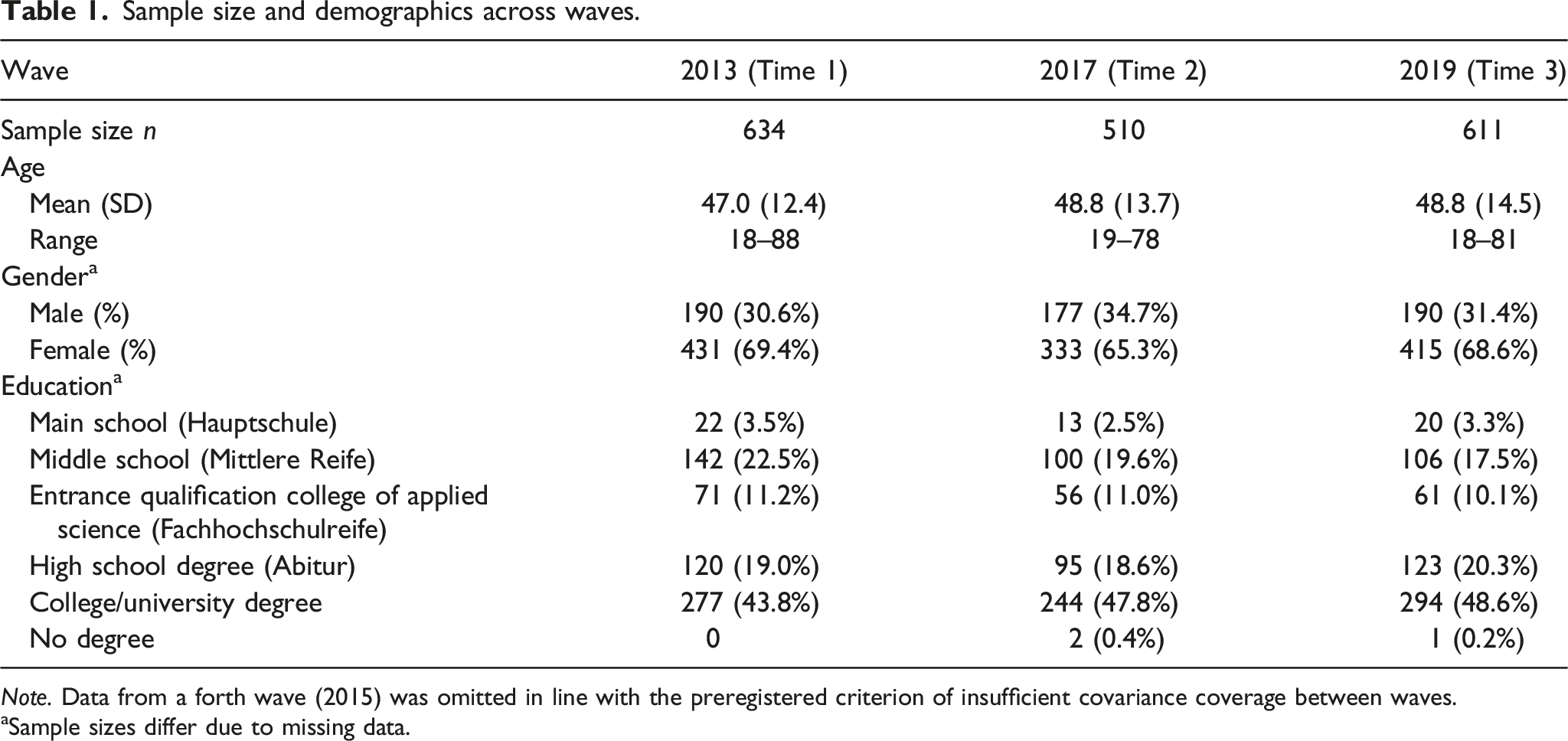
Note. Data from a forth wave (2015) was omitted in line with the preregistered criterion of insufficient covariance coverage between waves.
aSample sizes differ due to missing data.
Measure
Global and domain-specific dispositional envy was assessed with the Domain-Specific Envy Scale (DSES; Rentzsch & Gross, 2015). The DSES exhibits good reliability and validity in adolescents and adults (Crusius et al., 2021; Rentzsch et al., 2015; Rentzsch & Gross, 2015). Highlighting the validity of its emotional content, previous research showed that the DSES predicted actual experiences of (state) envy in upward-comparison situations (Rentzsch & Gross, 2015). The 15-item scale can be divided into three 5-item subscales measuring dispositional envy with regard to attraction, competence, and wealth as broad domains of social comparison. The items were formulated in a way that they emphasize the subjective experience of an unpleasant feeling as a reaction to an upward comparison with another person. • Attraction envy (e.g., “It annoys me when others are more popular than I am”) refers to interpersonal and romantic attraction (being popular as a friend and relation partner) as well as physical attraction (being good-looking). • Competence envy (e.g., “It is hard to take when other people are more intelligent than I am”) refers to envy elicited by the perception of others as being more intelligent or creative. • Wealth envy (e.g., “It bothers me when others own things that I cannot have”) refers to envy that is triggered by the financial well-being of others (being able to buy better products or living in better neighborhoods).
Responses were rated on 7-point rating scales ranging from 1 (not at all) to 7 (very much). Reliability coefficients for the subscales as measured with Cronbach’s alpha (α) ranged from .80 to .90 across time points, and the global scale exhibited an α = .93 at every time point.
Analytic strategy
The stability of dispositional envy was investigated with the help of latent longitudinal analyses based on confirmatory factor models. In order to investigate global dispositional envy, a first-order measurement model representing the latent factor of dispositional envy and three manifest parcels as indicators (Little et al., 2002) was used. As preregistered, the internal-consistency approach was applied to create parcels (for a concise description of that approach, see Little et al., 2002, p. 167). In order to investigate specific domains of dispositional envy, first-order measurement models for each of the domain-specific subscales of the DSES (i.e., attraction, competence, wealth) were established. Each factor model included three item parcels based on the balancing technique as recommended by Little et al. (2002, p. 166). The use of item parcels has been controversial (e.g., Marsh et al., 2013; Meade & Kroustalis, 2006), and we adopted the parceling strategy due to the widely acknowledged advantages that parcels have compared to item-level indicators, such as an increased reliability, a lower likelihood of distributional violations, and less sampling error (Little et al., 2002, 2013).
All models were estimated with Mplus Version 8.5 (Muthén & Muthén, 1998-2019) based on full information maximum-likelihood estimation (Enders, 2010). According to our preregistration, model fit was assessed with the χ2-test statistic, Comparative Fit Index (CFI), Root Mean Square Error of Approximation (RMSEA), and Standardized Root-Mean-Square Residual (SRMR), a CFI > .90, RMSEA < .08, and SRMR < .11 reflecting an acceptable fit to the data. The Bayesian Information Criterion (BIC) and Tucker–Lewis Index (TLI) are also reported. In accordance with the preregistration, we used p < .05 and 95% confidence intervals for non-directional hypotheses. Additionally, we corrected p values for the exploratory analyses of gender and age effects with the Benjamini–Hochberg procedure (Benjamini & Hochberg, 1995) in order to adjust for multiple comparisons (see Table S2 in the Supplement).
The anonymized data and all scripts used for the analyses are available on the OSF (https://osf.io/5fvhc/).
Measurement invariance
First of all, we tested for measurement invariance across time. Establishing invariance is important to ensure that the relationship between the indicators and the latent factors did not change across time, which is a prerequisite for a meaningful comparison of latent factors at different times of measurement.
Every measurement model for each of the measures of global and domain-specific dispositional envy was tested for invariance across the three time points. For each model, the three latent factors representing envy at the different measurement waves (2013, 2017, and 2019) were allowed to correlate. All models were tested in terms of configural, metric, scalar, and strict factorial invariance by comparing a series of increasingly restrictive models against each other (Meredith, 1993). As preregistered and in accordance with Cheung and Rensvold (2002), a value of ΔCFI smaller than or equal to .01 between nested models was regarded as indicating a nonsignificant decrement in fit between the models. The measurement models of the following analyses regarding rank-order stability, mean-level change, and latent state-trait modeling were based on the level of invariance found in these tests.
In the metric invariance model, all factor loadings were constrained to be equal across time. In addition to that, the intercepts of all indicators were constrained to be equal in the scalar invariance model. In the strict invariance model, the residual variances were constrained to be equal in addition to factor loadings and intercepts. In all models, we allowed the residuals of identical indicators to be correlated in order to account for the use of the same indicators across time (Bollen & Curran, 2006).
Rank-order stability
In order to investigate rank-order stability, we examined the intercorrelations between the latent envy factors at different times of measurement (i.e., Time 1–Time 2, Time 2–Time 3, and Time 1–Time 3). 4 Each analysis was based on the respective measurement model. In order to facilitate the interpretation of the stability of global dispositional envy (Hypothesis 1), rank-order stability coefficients were then compared to stability coefficients of other trait measures reported in previous literature. As preregistered, differences in rank-order stability between measures of dispositional envy were considered relevant, when the confidence intervals of the respective rank-order stability parameters did not overlap (Hypothesis 2).
To exploratively analyze gender and age effects on the rank-order stability of global and domain-specific dispositional envy, we used latent moderated structural equation modeling (Klein & Moosbrugger, 2000). Specifically, gender and age were used as moderators in latent regression analyses, in which the latent factor of dispositional envy at Time 1 predicted the latent envy factor at Time 3. Each model was estimated using a maximum-likelihood estimator with robust standard errors. In addition to regressing the envy factors at Time 3 on the respective initial factor at Time 1, the moderator and an interaction term between the moderator and the initial factor at Time 1 were included as predictors. A significant interaction effect indicates that individual differences in the moderator correspond with individual differences in rank-order stability across time.
Prior to analyses, age was recoded in 10-year units (i.e., divided by 10) and mean-centered in order to avoid very small values, using participants’ age at Time 3. If information on age was missing, we used age data from other times of measurement in order to extrapolate participants’ age at Time 3. Positive effects of age thus reflect an increase in the dependent variable when age increases by 10 years. Sex was coded as −1 for men and 1 for women. With respect to age, linear, quadratic, and cubic effects between age and rank-order stability were investigated.
Mean-level change
In order to examine mean-level change, True Intraindividual Change Models (TICM; Steyer et al., 1997) were run for each measure of dispositional envy separately. In these models, change is measured directly via latent difference variables. Latent difference variables represent individual differences in true intraindividual change over time corrected for random measurement error (Steyer et al., 1997). All TICM were based on the respective measurement model of each measure of dispositional envy. One set of analyses included latent difference variables between the latent envy factors and the first time point (Time 2–Time 1, Time 3–Time 1; i.e., baseline change models). Another set of analyses included latent difference variables between the latent envy factors of neighboring time points (Time 2–Time 1, Time 3–Time 2; i.e., neighbor change models). Baseline change models were used to analyze mean-level change during the 6-year (Time 1–Time 3) and the 4-year (Time 1–Time 2) interval. Neighbor change models were used to analyze mean-level change during the 2-year interval (Time 2–Time 3).
All latent envy factors loaded on an initial latent factor at Time 1. Every envy factor at later time points loaded on a latent difference factor indicating latent change between Time 1 and that measurement occasion (or in the case of neighbor change models: several latent difference factors indicating latent change between consecutive measurement occasions). All loadings were fixed to one. The intercepts of the reference indicators were set to zero to identify the latent means. The latent difference factors were allowed to correlate. The intercepts and variances of the latent envy factors were set to zero for purposes of identification. Latent mean-level change was assessed as the mean of the latent difference factor. A significant latent difference factor mean indicates that the mean change between time points is significantly different from zero; a positive sign on the latent difference factor mean indicates that the latent scores of dispositional envy have increased between the respective time points. The variance of the latent difference factor reflects individual differences in the latent change scores, indicating interindividual differences in intraindividual change.
In order to evaluate the size of the mean-level change in global dispositional envy (Hypothesis 1), we used the recommendations by Cohen (1992), with a latent Cohen’s d of .20 representing a small effect. 5 Again, differences in mean-level change between measures of dispositional envy were considered relevant, when the confidence intervals of the respective mean-level change parameters did not overlap (Hypothesis 2).
In a set of exploratory analyses, we investigated whether age and gender as time-invariant covariates predicted the initial levels and mean-level change of the respective measures of global and domain-specific dispositional envy. With respect to age, we again investigated linear, quadratic, and cubic effects on change in dispositional envy.
Latent state-trait modeling
To analyze trait and occasion-specific variance in the respective measures of dispositional envy, we used latent TSO models (Cole et al., 2005). The TSO model decomposes latent variables into a trait factor representing stable individual differences across time and an occasion factor representing effects of changing occasion-specific circumstances such as specific events or momentary interpersonal and intrapersonal conditions (Cole, 2006). Trait-State-Occasion models have successfully been used for longitudinal data with three measurement occasions (Lance et al., 2021; Wagner et al., 2019).
The same measurement models as in the analyses described above were used. Trait-State-Occasion models for each measure of global and domain-specific dispositional envy were run separately (see Figure 1 for the structural model). The intercepts of the reference indicators were set to zero to identify the latent means. All latent envy factors loaded on a trait factor indicating stable trait variance. Additionally, every envy factor loaded on an occasion-specific factor indicating the proportion of state variance in envy at a specific measurement occasion that cannot be explained by the trait factor. All loadings were fixed to one. The intercepts of the latent envy factors were set to zero. Since the latent envy factors were defined to be completely determined by the trait factor and the respective occasion-specific factor, the residual variances of the latent envy factors were set to zero. The occasion-specific factor at Time 1 was not allowed to correlate with the trait factor. Following suggestions by Prenoveau (2016), the factor variances of the occasion-specific factors were constrained to be equal, since constraining did not lead to a significant decrement of model fit (global envy: Δχ2 (2) = .39, p = .821; attraction envy: Δχ2 (2) = .10, p = .951; competence envy: Δχ2 (2) = 1.01, p = .604; wealth envy: Δχ2 (2) = 5.29, p = .071). As preregistered, the TSO model originally included autoregressive effects between the occasion-specific factors of neighboring time points. Following suggestions by Prenoveau (2016), we tested whether these autoregressive effects were necessary in order to explain the stability of dispositional envy across time. Since constraining the autoregressive pathways to zero did not lead to a significant decrement in model fit (global envy: Δχ2 (2) = 1.56, p = .458; attraction envy: Δχ2 (2) = .84, p = .658; competence envy: Δχ2 (2) = 4.34, p = .114; wealth envy: Δχ2 (2) = .79, p = .673), we used the more parsimonious model without autoregressive effects in the present study. In this special case, the TSO model is equivalent to a single-trait/multistate model (Prenoveau, 2016; Steyer et al., 2012). Latent TSO model without autoregressive effects for three measurement occasions (Time 1, Time 2, and Time 3). Note. Y = manifest parcels; E = latent envy factor; T = trait factor; O = occasion-specific factor. The error variances of the manifest parcels were omitted for the sake of clarity.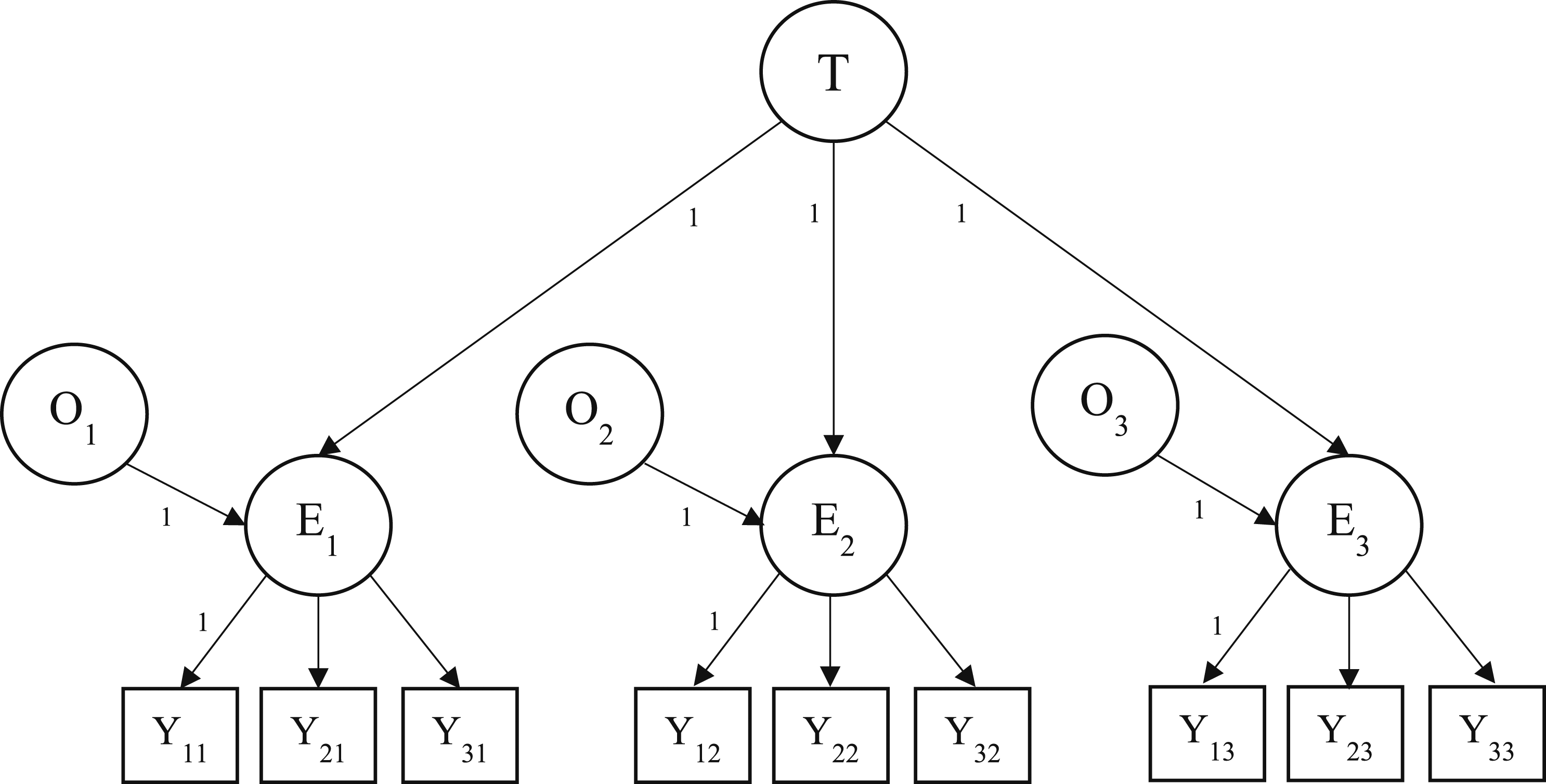
As preregistered, we hypothesized that a substantial proportion of variance in global dispositional envy would be accounted for by a stable trait factor, which again was underpinned by comparisons with previous literature (Hypothesis 1). Extending the preregistered protocol, differences in trait-specific variance between global and domain-specific dispositional envy were considered relevant if the confidence intervals of the proportion of variance accounted for by a stable trait factor did not overlap (Hypothesis 2).
Results
Estimated means, standard deviations, and intercorrelations between latent envy factors.
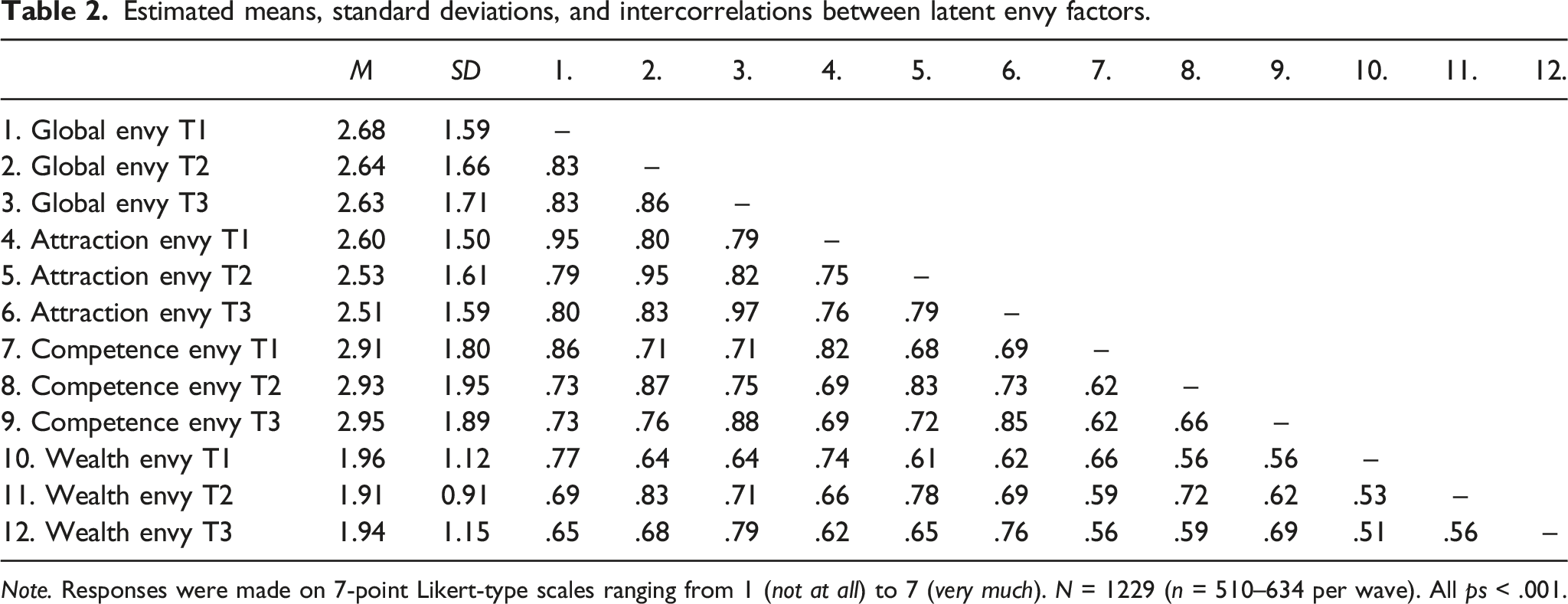
Note. Responses were made on 7-point Likert-type scales ranging from 1 (not at all) to 7 (very much). N = 1229 (n = 510–634 per wave). All ps < .001.
Measurement invariance
Model fit indices from invariance testing across time.
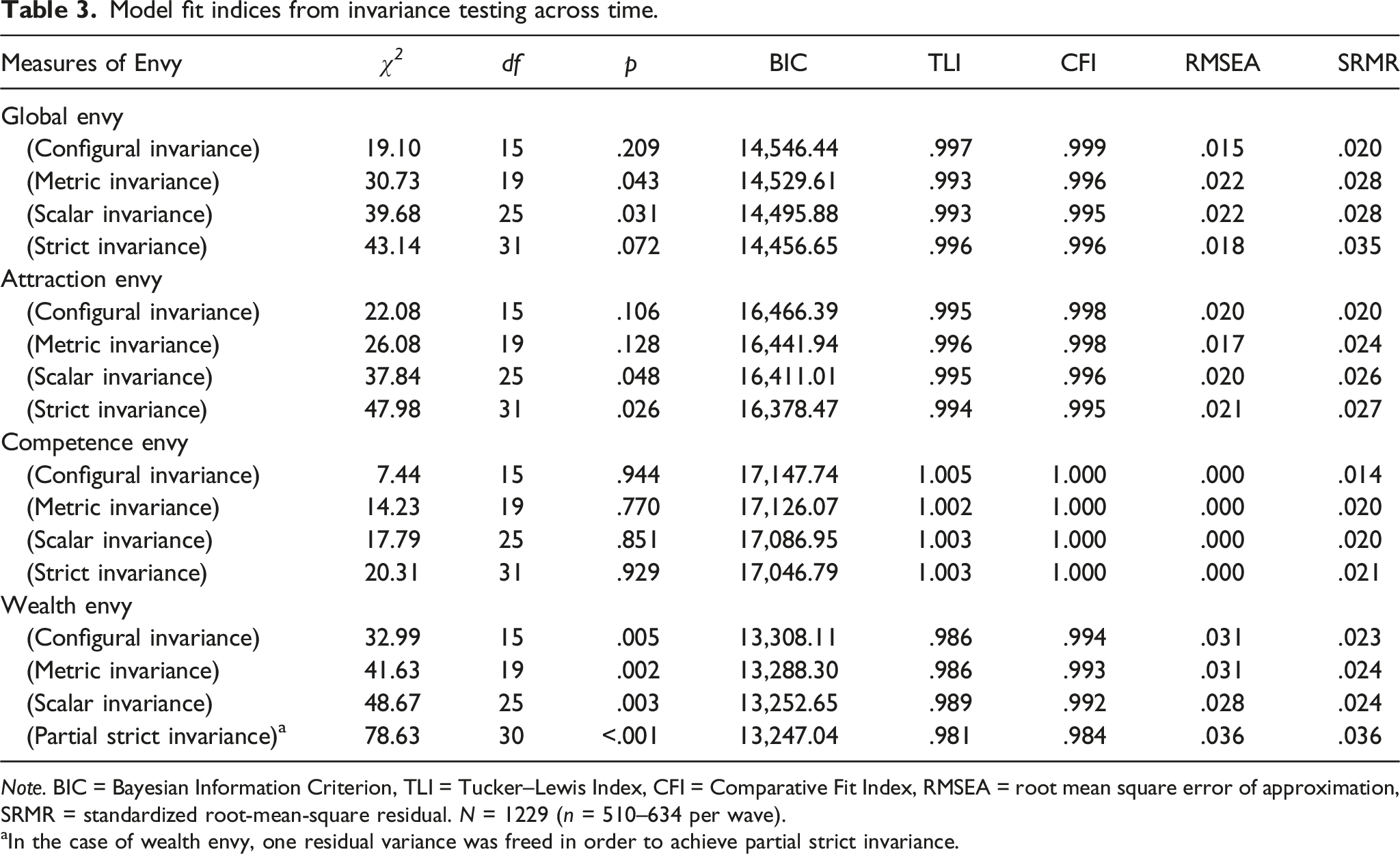
Note. BIC = Bayesian Information Criterion, TLI = Tucker–Lewis Index, CFI = Comparative Fit Index, RMSEA = root mean square error of approximation, SRMR = standardized root-mean-square residual. N = 1229 (n = 510–634 per wave).
aIn the case of wealth envy, one residual variance was freed in order to achieve partial strict invariance.
Rank-order stability
Rank-order stability, mean-level change, and variance of change across time.
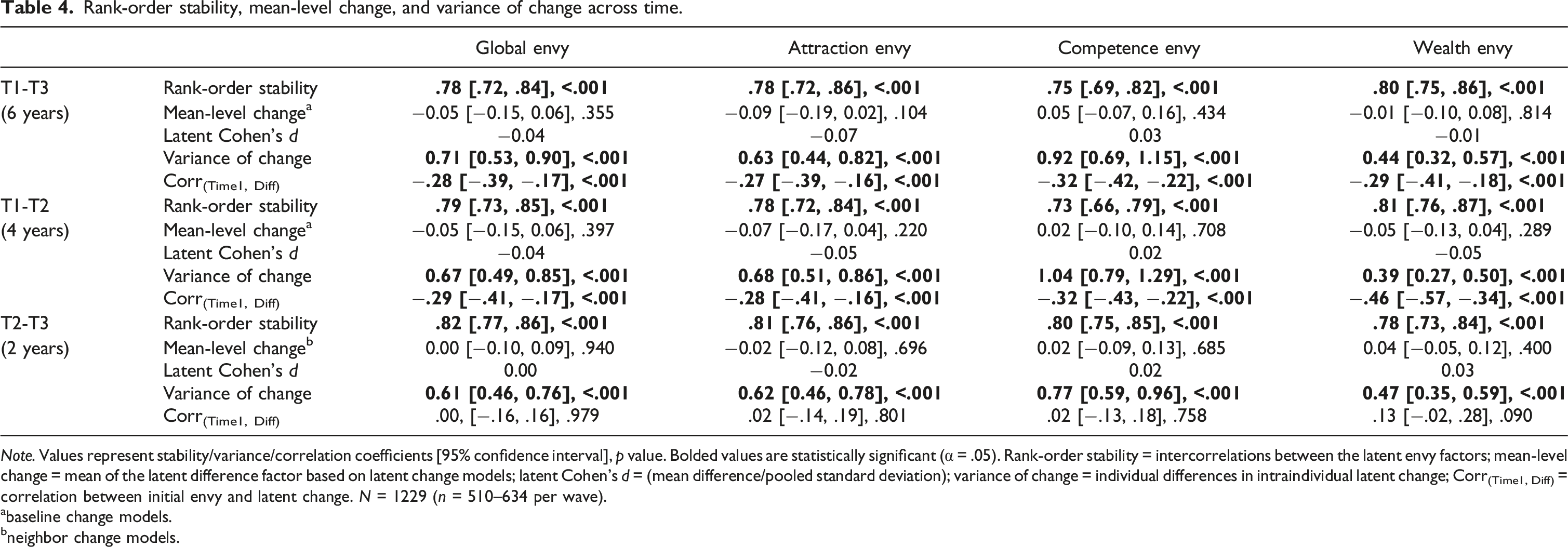
Note. Values represent stability/variance/correlation coefficients [95% confidence interval], p value. Bolded values are statistically significant (α = .05). Rank-order stability = intercorrelations between the latent envy factors; mean-level change = mean of the latent difference factor based on latent change models; latent Cohen’s d = (mean difference/pooled standard deviation); variance of change = individual differences in intraindividual latent change; Corr(Time1, Diff) = correlation between initial envy and latent change. N = 1229 (n = 510–634 per wave).
abaseline change models.
bneighbor change models.
Mean-level change
The TICM revealed an excellent model fit for global (CFI = .996, RMSEA = .019) and domain-specific dispositional envy (attraction: CFI = .995, RMSEA = .021; competence: CFI = 1.000, RMSEA = .000; wealth: CFI = .984, RMSEA = .038). Results from the TICM as displayed in Table 4 revealed that both global and domain-specific dispositional envy were stable with respect to mean levels. All measures of dispositional envy showed a nonsignificant mean-level change across the 6 years of assessment. Effect sizes across all envy measures and time intervals were close to zero with latent Cohen’s d ranging from −.07 to .03, providing further support for Hypothesis 1. Moreover, we found overlapping confidence intervals for mean-level change in global and domain-specific dispositional envy, which again supports the perspective of domain-specific envy being equally stable as global dispositional envy (see Hypothesis 2).
As indicated by the variance of the change scores (Table 4), participants differed significantly from each other in how much their global and domain-specific envy scores changed across the 6 years of assessment (with variances ranging from .44 to .92). Correlations between the initial level of dispositional envy and the 6-year change score ranged from r = −.27 to r = −.32 across the envy measures.
Trait and occasion-specific components of dispositional envy
Trait variance and occasion-specific variance from latent trait-state occasion models.
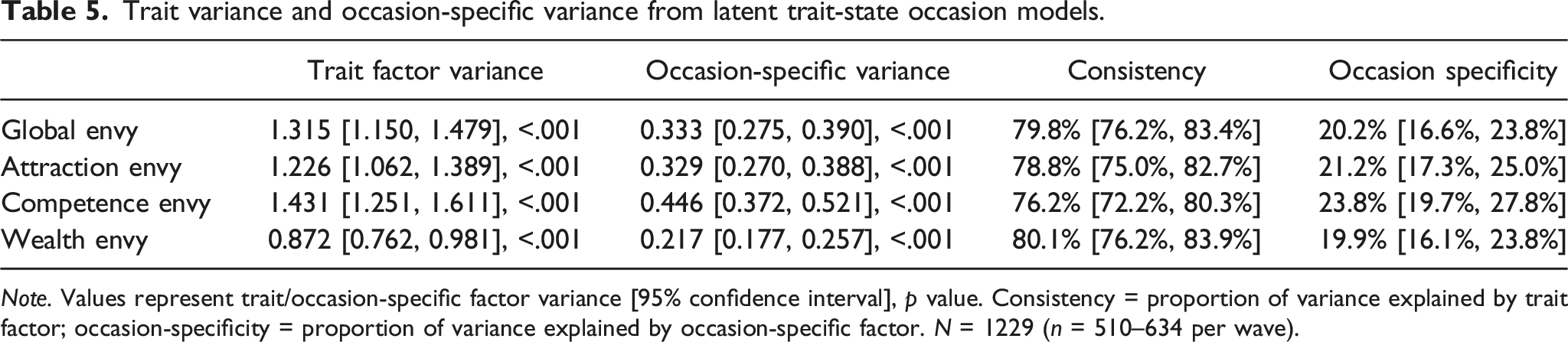
Note. Values represent trait/occasion-specific factor variance [95% confidence interval], p value. Consistency = proportion of variance explained by trait factor; occasion-specificity = proportion of variance explained by occasion-specific factor. N = 1229 (n = 510–634 per wave).
For both global and domain-specific dispositional envy, the trait and occasion-specific variances were significantly different from zero, highlighting the utility of the TSO model for the present data. For global dispositional envy, the variance of the latent trait factor was σ2T = 1.32 and the variance of the occasion-specific factor at T1 was σ2O = 0.33. The trait-specific variance of domain-specific dispositional envy ranged between 0.87 for wealth envy and 1.43 for competence envy. For all measures of dispositional envy, the trait variance was significantly larger than the occasion-specific variance.
Gender and age effects
Gender and age effects on rank-order stability, initial levels, and latent change.
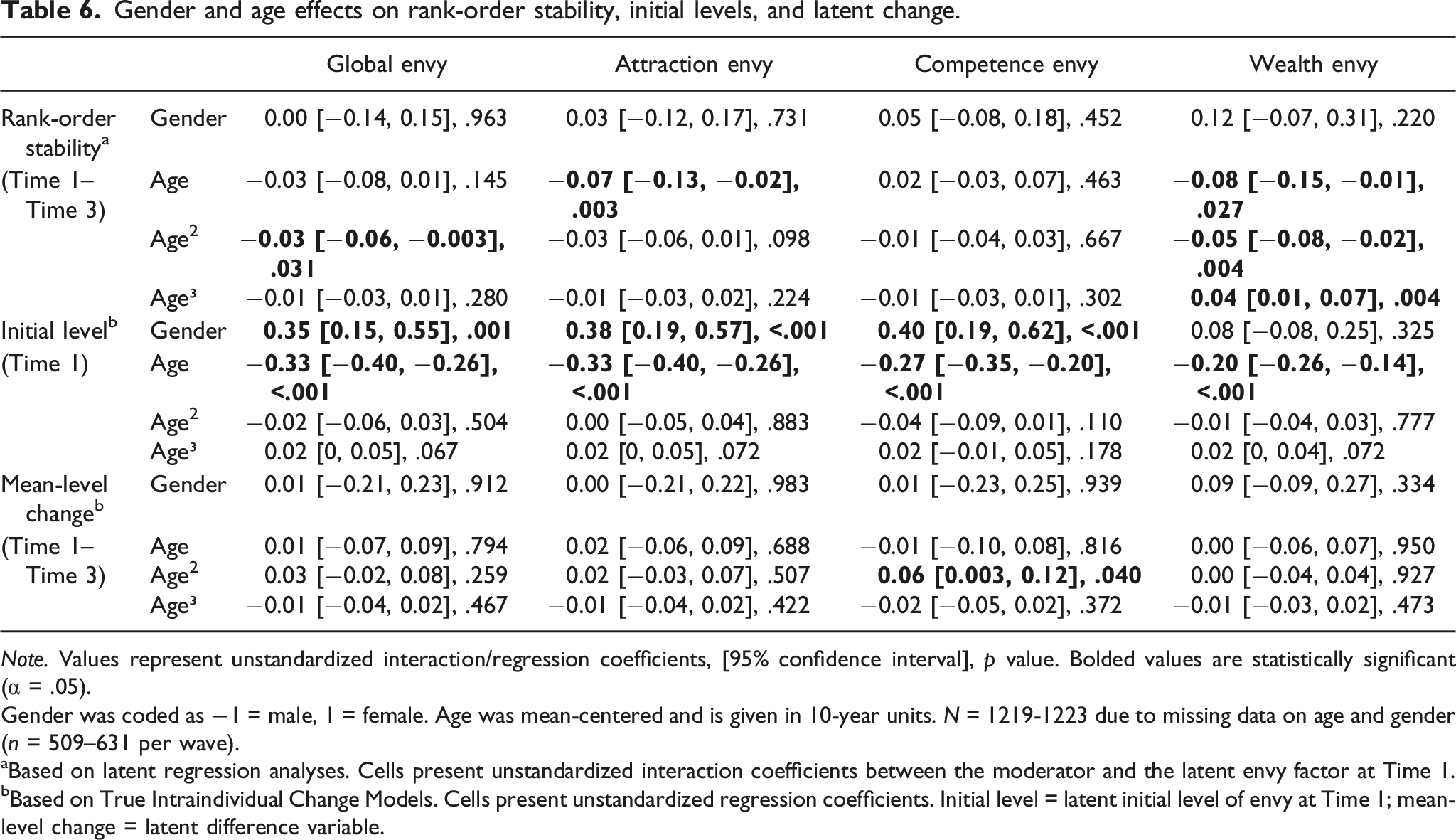
Note. Values represent unstandardized interaction/regression coefficients, [95% confidence interval], p value. Bolded values are statistically significant (α = .05).
Gender was coded as −1 = male, 1 = female. Age was mean-centered and is given in 10-year units. N = 1219-1223 due to missing data on age and gender (n = 509–631 per wave).
aBased on latent regression analyses. Cells present unstandardized interaction coefficients between the moderator and the latent envy factor at Time 1.
bBased on True Intraindividual Change Models. Cells present unstandardized regression coefficients. Initial level = latent initial level of envy at Time 1; mean-level change = latent difference variable.
Moderation of rank-order stability
Gender did not influence the rank-order stability of global or domain-specific dispositional envy. Age revealed a significant quadratic effect on the rank-order stability of global dispositional envy (b = −0.03, p = .031), indicating that the stability of global dispositional envy was particularly large in middle adulthood, whereas global dispositional envy was less stable in younger and older adults. Moreover, age revealed a significant linear effect on the rank-order stability of dispositional envy with regard to attraction (b = −0.07, p = .003), indicating that attraction envy was more stable in younger participants than in older participants. In the case of wealth envy, we found a significant cubic effect (b = 0.04, p = .004) of age on rank-order stability. This means that the rank-order stability of wealth envy showed an overall decrease over the course of life, with largest coefficients in middle adulthood. Significant effects of age on rank-order stability are shown in Figure S1 in the Supplement.
Predicting initial levels and mean-level change
Overall, only few effects of covariates were found. Women revealed higher initial levels of global dispositional envy (b = 0.35, p = .001) as well as attraction (b = 0.38, p < .001) and competence envy (b = 0.40, p < .001). We found no evidence for gender differences in wealth envy (b = 0.08, p = .325). With respect to gender effects on change, there was no significant effect of gender on change in any measure of dispositional envy (ps > .05).
With regard to age, results revealed evidence for a significant linear relationship between age and initial levels of global and domain-specific dispositional envy (bs ranging from −0.20 for wealth envy to −0.33 for global dispositional envy, all ps < .001). Older participants thus exhibited lower initial dispositional envy than younger participants. However, there was no evidence for linear, quadratic, or cubic effects of age on change in dispositional envy (ps > .05), with the exception of dispositional envy with regard to competence, where we found a quadratic relationship with age (b = 0.06, p = .038). The predicted decline in competence envy across 6 years was strongest in middle adulthood around the age of 50 years, whereas a smaller decline or even a slight increase in competence envy was predicted for younger and older adults.
Discussion
The goal of the present research was to investigate the long-term stability of global and domain-specific dispositional envy. In a preregistered longitudinal study of adults, dispositional envy was examined across three waves and a period of 6 years. We used three different indicators of stability, that is, rank-order stability, mean-level change, and latent state-trait modeling, in order to examine if dispositional envy remains stable across time and thereby underpin its conceptualization as a stable trait.
Global and domain-specific dispositional envy are stable and trait-like
In line with Hypothesis 1, the rank-order stabilities of global and domain-specific dispositional envy were relatively high, with global dispositional envy exhibiting a 6-years stability of r = .78 and stability coefficients of domain-specific dispositional envy ranging between r = .75 for competence envy and r = .80 for wealth envy. Stability coefficients were comparable to those of other trait measures that have been reported in the literature, such as trait anger (r = .70/.81 for women/men across 6 years; Hakulinen et al., 2014), multidimensional self-esteem (r = .76-.87 across 2 years; Rentzsch & Schröder-Abé, 2018), and the Big Five personality traits (r = 64-.73 across 4 years; Specht et al., 2011). Mean-level change across 6 years in all measures of dispositional envy was small and nonsignificant, which again supports the notion of dispositional envy as a stable trait.
Results from TSO models (Cole et al., 2005) indicated that, in accordance with Hypothesis 1, 80% of variance in global dispositional envy was accounted for by a stable trait factor. This is in line with previous research on trait components of emotional traits, which found that 84% of variance in trait anxiety and 81% of variance in trait anger as well as 75% of variance in disgust proneness were accounted for by a stable trait factor (Lance et al., 2021; Olatunji et al., 2020). Taken together, our findings clearly support the conceptualization of dispositional envy as a trait which remains stable across time.
Beside a large trait component, we found significant occasion-specific variance in global and domain-specific dispositional envy, highlighting the usefulness of the TSO model. Factors that cause deviations from a person’s habitual level of domain-specific envy might include specific events or momentary intrapersonal conditions. For instance, a salient upward comparison around the time of testing might lead to deviations from the average level of dispositional envy in a person. Similarly, intrapersonal conditions such as mood might cause intraindividual variability in dispositional envy.
When comparing global and domain-specific dispositional envy with respect to the different indicators of stability, a clear pattern emerged: We found that domain-specific dispositional envy was equally stable as global dispositional envy. Rank-order stability coefficients were comparable for global and domain-specific dispositional envy; and both forms of dispositional envy exhibited no significant mean-level change across time. Moreover, domain-specific dispositional envy exhibited a proportion of trait-specific variance which was comparable to that of global dispositional envy. We did not find any evidence supporting the perspective of domain-specific constructs being less stable than global constructs (Hypothesis 2). If domain-specific dispositional envy were more dependent on recent events or social comparison outcomes than global dispositional envy, as some might expect, this should be reflected in a greater proportion of occasion-specific variance in domain-specific dispositional envy. However, our data showed that the proportion of occasion-specific variance did not vary significantly between measures of dispositional envy and was generally quite small compared to the proportion of trait-specific variance. Our findings thus support the notion of domain-specific dispositional envy as a stable trait, which mirrors results from related research on domain-specific constructs (e.g., on self-esteem; Rentzsch & Schröder-Abé., 2022). We believe that this highlights the importance of a domain-specific perspective in personality psychology.
Age and gender effects on levels, stability, and change of dispositional envy
In our study, we found that participants differed from each other in their initial levels of dispositional envy as well as in change in dispositional envy across time. In order to explain these individual differences, we exploratively investigated the influence of age and gender on levels, stability, and change of dispositional envy. Taken together, our results suggest that interindividual differences in rank-order stability and mean-level change in dispositional envy cannot, for the most part, be explained by age and gender. We found only few and rather weak effects of age on rank-order stability and mean-level change and no evidence for any gender effects. However, there were age and gender effects on the initial levels of dispositional envy, with younger participants and women reporting more dispositional envy.
Our finding of age effects on the initial envy levels is in line with several cross-sectional studies that found a negative relationship between dispositional envy and age (Henniger & Harris, 2015; Lange & Crusius, 2015; Rentzsch & Gross, 2015) as well as previous research demonstrating that general negative affect decreases with age (Carstensen et al., 2000; Charles et al., 2001; Gross et al., 1997; Windsor & Anstey, 2010). Specific mechanisms that account for these positive aspects of aging might include the fact that growing old is often associated with a decrease in social comparison orientation (Callan et al., 2015) and an enhanced emotion regulation (Urry & Gross, 2010). The age effect found in the present study is thus in line with a growing body of research highlighting positive aspects of aging. This provides support for the idea that aging does not have to be a painful process filled with sadness and resentment due to the loss of attraction, skills, and assets, and should be investigated more closely by future research.
Women on average reported significantly higher initial levels of dispositional envy (except for domain-specific dispositional envy with regard to wealth). However, this result should be interpreted with caution, as the effects were quite small and previous studies generally only found small or nonsignificant gender effects on dispositional envy (Briki, 2019; Henniger & Harris, 2015). If the finding that women report more dispositional envy than men can be replicated, future research should investigate the mechanisms underlying this gender effect. For instance, gender differences in global dispositional envy might, at least in part, be accounted for by the fact that women tend to experience more negative affect (Fujita et al., 1991) and lower self-esteem (Bleidorn et al., 2016; Kling et al., 1999), variables that are closely intertwined with envy (Rentzsch & Gross, 2015). Similarly, gender differences in domain-specific dispositional envy might be explained by gender differences in domain-specific self-esteem. For instance, women report lower physical appearance self-esteem (Gentile et al., 2009) and tend to base their self-esteem more strongly on academics and appearance than men do (Crocker et al., 2003), which is in line with our finding of women reporting more attraction and competence envy than men. Future research should take a closer look at gender differences regarding domain-specific dispositional envy.
With regard to rank-order stability, we did not find any gender effects, indicating that global and domain-specific dispositional envy are equally stable in women as in men. However, we found some evidence for age effects on rank-order stability. For example, global dispositional envy was particularly stable in middle adulthood with a significant quadratic effect of age, mirroring previous research on rank-order stability that found similar inverted U-shaped patterns (Lucas & Donnellan, 2011; Seifert et al., 2022). This peak of rank-order stabilities of dispositional envy in middle adulthood might be due to the relative stability of social roles and biological and cognitive factors during midlife when compared to young or older adulthood (see Wortman et al., 2012).
The investigation of age and gender effects on mean-level change yielded no significant effects, except for a quadratic relationship between age and dispositional envy with regard to competence, indicating that the predicted decline in competence envy across 6 years was strongest in middle adulthood. An explanation might be that social comparison in the competence domain plays a bigger role in young and old adult life when compared to midlife, with young adults facing many challenges in the field of academics (for instance during college and in the early stages of their career), and old adults increasingly having to cope with cognitive impairments (Deary et al., 2009).
Implications for research on emotional traits
With our study, we wanted to contribute to the growing body of research on emotional traits. As postulated by classical state-trait models of emotions (Endler & Hunt, 1966; Rosenberg, 1998; Spielberger, 1972), emotional experiences have a dispositional core that remains stable across time and determines how often and intensely a certain emotion is experienced. Building on these models, a growing number of empirical studies have investigated antecedents, correlates, and consequences of dispositional envy (e.g., Rentzsch & Gross, 2015; Vrabel et al., 2018). The emotional core of dispositional envy has been demonstrated in previous research (Rentzsch & Gross, 2015; Smith et al., 1999). However, as is the case for many other dispositional social emotions, there has been no empirical evidence regarding its dispositional core, showing that dispositional envy actually meets the postulated criterium of temporal stability. Our results fill this gap in research by showing that the disposition toward the experience of envy is temporarily stable and thus complete the picture of dispositional envy as an emotional trait.
Recently, there have been calls for the integration of emotional traits into general models of personality structure, emphasizing the centrality of the emotion system and arguing that differences in emotional traits are important for describing individuals (Reisenzein et al., 2020). We believe that our research underpins this idea by providing evidence that individual differences in dispositional envy remain fairly stable across longer time intervals. Importantly, while some might expect dispositional emotions to be less “trait-like” than core personality traits, we found no evidence that dispositional envy is less stable than traditional personality traits such as the Big Five.
However, it is not self-evident that the existing research on stability and change in emotional traits can be replicated for other emotional traits, as they may have distinct properties depending, for example, on the valence of the emotion (positive and negative). For instance, according to the broaden-and-build theory (Fredrickson, 2001), positive emotions such as gratitude and admiration can initiate an upward spiral by building personal resources and promoting well-being, which in turn increases the likelihood for positive emotional experiences, suggesting that individuals high in dispositional positive emotions should be likely to experience an increase in their mean levels across life. Such mutually reinforcing processes might not play a role for dispositional envy. Another characteristic of envy is that its expression is often suppressed (see Lange et al., 2020) because it violates social norms (Foster, 1972) and is painful to the person experiencing it (Takahashi et al., 2009). Emotions that are expressed more openly than envy such as anger and pride might be more likely to elicit positive or negative feedback from others, which might lead to changes in a person’s emotional disposition in the long term. On the other hand, even though some differences with regard to stability and change might emerge, state-trait theories of emotions suggest that all emotions have a strong dispositional core that remains stable across time (Rosenberg, 1998; Spielberger, 1972). Future research should thus investigate the generalizability of our findings on other (social) emotional traits. Possible discrepancies might prove informative in order to understand the mechanisms underlying stability and change in emotional dispositions.
Another important question concerns the mechanisms behind the stability of global and domain-specific dispositional envy and emotional traits in general. Explanations might include genetic, environmental, and psychological factors (Allemand et al., 2013). For instance, stable genetic factors may contribute to the stability of dispositional envy, either by directly influencing a person’s trait level of envy, or by having on impact on trait characteristics related to dispositional envy (e.g., social comparison orientation). At the same time, stable environmental influences as well as transactions between genetic and environmental factors might play an important role. For instance, a person with a pronounced disposition toward wealth envy might decide to pursue a career in the finance sector, where their tendency for social comparison with regard to wealth is consistently encouraged, further consolidating their trait envy at a high level. Psychological explanations that have been put forward include set-point theory and stable appraisal biases. According to classical set-point models (see Ormel et al., 2017), a person’s trait level fluctuates around an individual set-point. While temporary changes as a reaction to experiences and life events are possible, the trait level will eventually return to this characteristic set-point. Even though newer approaches to set-point theory emphasize that set-points can change under certain conditions, set-point models might thus explain why mean-levels of dispositional envy do not change across time, while at the same time allowing temporary changes (i.e., occasion-specific deviations from an individual’s dispositional envy). Moreover, recent research emphasized the importance of appraisal biases underlying emotional traits (Scherer, 2021). Stable biases in the appraisal of situations and events (e.g., a tendency to interpret upward comparisons as threatening) might thus contribute to the stability of dispositional envy across time. Future research should investigate the mechanisms behind the stability of dispositional envy and other emotional traits, for example, by examining the appraisal biases underlying them.
Strengths, limitations, and directions for future research
The present study has several strengths worth noticing. Most importantly, the longitudinal design is novel in the field of research on dispositional envy. To our knowledge, no previous study has systematically examined stability and change in dispositional envy, nor is there any previous research attempting to disentangle trait and state variance in envy. We approached the question of stability and change in dispositional envy with different methods, encompassing the more traditional analyses of rank-order stability and mean-level change as well as the more modern approach of latent state-trait modeling. Moreover, we used an established instrument measuring global and domain-specific dispositional envy with five items per subscale, which demonstrated excellent psychometric properties with regard to reliability and validity. We thus believe that our data and methodology make an important contribution to research on dispositional envy and emotional traits in general. Moreover, we would like to highlight that the study was preregistered before data of Time 2 were analyzed and before data of Time 3 were collected. Even though the need for preregistration is frequently emphasized in psychological research, it remains far from being self-evident.
We would also like to draw attention to the sample of the current study, which had a large age range from young to old adulthood, with a mean age closely resembling that of the German general population (44.5 years; DESTATIS, 2020). Future research should nonetheless use larger, age-balanced samples that allow for comparisons between age groups and for conclusions on the development of global and domain-specific dispositional envy across life. Moreover, women were overrepresented in our sample, and participants had relatively high levels of education. Future studies should replicate our findings in representative samples to test the generalizability of the results, especially our findings on gender and age effects on stability and change. Research on the early development of dispositional envy in childhood and adolescence could also provide important insights into when in life a person’s disposition toward the experience on envy becomes manifest.
Our data suggested large individual differences in change in dispositional envy, which could only in part be explained by gender or age. Future research should identify further predictors of change in dispositional envy. For instance, dispositional envy might change as a reaction to life events connected to social comparison. As envy is a consequence of upward comparisons (Alicke & Zell, 2008), positive events which increase an individual’s status (e.g., a promotion) might lead to a decrease in envy, while events connected to a decrease of a person’s status (e.g., losing one’s job) might lead to an increase in dispositional envy. In this regard, it is also important to determine the reasons for change in domain-specific dispositional envy when compared to global dispositional envy. For instance, as people are particularly prone to envy in life domains that are important to them (Salovey & Rodin, 1991), changes in the subjective importance of a specific domain might lead to changes in dispositional envy with regard to that domain, but not in other domains or at the global level. Moreover, life events that influence social status in a specific comparison domain might lead to changes in domain-specific envy: For example, a promotion that involves a pay raise might lead to a decrease in dispositional envy with regard to wealth, but not in other domains of dispositional envy. Future research should also examine if individual differences in the direction or magnitude of change in domain-specific dispositional envy across time are connected to changes in related psychological constructs such as domain-specific self-esteem (Rentzsch et al., 2022; Rentzsch & Gross, 2015), social comparison orientation (Alicke & Zell, 2008), and domain-specific narcissism (Grosz et al., 2021; Krizan & Johar, 2012), or changes in more objective indicators and life events (e.g., income, unemployment).
Moreover, even though variance in dispositional envy was largely accounted for by a stable trait factor, we found significant occasion-specific variance in all measures of dispositional envy. Future research might not only want to investigate predictors and correlates of the trait component of dispositional envy, but also look into factors associated with occasion-specific variation in dispositional envy, such as specific life events or psychological variables.
In the present study, we covered a timespan of 6 years, which can be considered quite broad with regard to the investigation of rank-order stabilities, since previous studies investigating retest reliabilities at best used time intervals of several months. However, longer time intervals seem to be especially important for the investigation of mean-level change. In the present study, we found a negative relationship of dispositional envy with age at the cross-sectional level, but only small mean-level change over 6 years. Thus, future researchers may be able to detect some mean-level change in dispositional envy when investigating longer time intervals.
The present study assessed global dispositional envy by aggregating the domain-specific subscales. Even though previous research showed that the global factor of the DSES is a reliable and valid measure that shows convergent validity with other measures of global dispositional envy (Crusius et al., 2021; Rentzsch & Gross, 2015), the comparison between global and domain-specific dispositional envy may be improved by using a separate measure for the assessment of global dispositional envy. Future research might thus want to use a measure specifically designed for the assessment of global dispositional envy in addition to the DSES.
The present study focused on the trait-based assessment of dispositional envy. In future studies, researchers may want to simultaneously use trait and state measures of envy, in order to investigate how the stable trait translates into state envy experienced in everyday life as suggested by classical state-trait theories (e.g., Rosenberg, 1998; Spielberger, 1972) and modern trait approaches (e.g., Fleeson & Jayawickreme, 2015).
By providing empirical evidence for the conceptualization of envy as stable trait, the present study makes an important contribution to research on dispositional envy and emotional traits in general. We hope that the present study stimulates research on emotional traits by emphasizing the importance of longitudinal data and the investigation of different indicators of stability.
Supplemental Material
Supplemental Material - Stability and change in dispositional envy: Longitudinal evidence on envy as a stable trait
Supplemental Material for Stability and Change in Dispositional Envy: Longitudinal Evidence on Envy as a Stable Trait by Elina Erz and Katrin Rentzsch in European Journal of Personality
Footnotes
Acknowledgments
We thank Janis Jung, Thomas Lösch, and Mareike Müller for help with data management.
Declaration of conflicting interests
The author(s) declared no potential conflicts of interest with respect to the research, authorship, and/or publication of this article.
Funding
The author(s) received no financial support for the research, authorship, and/or publication of this article.
Data accessibility statement

Supplemental Material
Supplemental material for this article is available online.
Notes
References
Supplementary Material
Please find the following supplemental material available below.
For Open Access articles published under a Creative Commons License, all supplemental material carries the same license as the article it is associated with.
For non-Open Access articles published, all supplemental material carries a non-exclusive license, and permission requests for re-use of supplemental material or any part of supplemental material shall be sent directly to the copyright owner as specified in the copyright notice associated with the article.
