




Abstract
This study examined gender and immigrant status differences in stability and change in the Big Five traits in a sample of early adolescents in Greece from economically disadvantaged schools with a high immigrant composition (65% first- or second-generation immigrants). Youth in the sample (N = 1252, 46% female, ages 12–13 at time 1) self-reported Big Five traits annually for 3 years. Mean-level and rank-order stability were examined separately by gender and immigration history. Growth modeling of mean-level scores showed declines in all five personality traits for both genders between ages 12 and 14, followed by increases in conscientiousness for girls and boys, and increases in agreeableness and openness to experience for boys only. In sensitivity analyses, boys showed disruption at all levels of perceived economic stress, but only girls with high levels of perceived economic stress showed disruption. Trajectories were similar for immigrant and non-immigrant youth, suggesting that immigrant youth did not show greater mean-level disruption. However, immigrant youth reported lower means on all traits except emotional stability. Rank-order stability was moderately strong over 3 years and comparable across both genders and immigration histories. Results in this high-risk sample supported the disruption hypothesis and suggest that immigration experiences are associated with personality development.
Personality differences have been linked to a host of important outcomes in life (Roberts et al., 2007; Soto, 2019), spurring interest into how and when personality traits change and stabilize. In particular, the Big Five traits of extraversion, agreeableness, conscientiousness, emotional stability (i.e., the positive pole of neuroticism), and openness to experience have been robustly linked with socially desirable life outcomes across cultures and developmental periods (Soto, 2021). However, less is known about adolescent personality development in stressful conditions and among ethnic minority and immigrant youth (Costa et al., 2019; Benet-Martinez et al., 2015). To address these gaps, this study examined mean-level and rank-order stability and change over 3 years in self-reported personality traits in a sample of immigrant and non-immigrant secondary school students in Greece. Data collection occurred in low-resourced neighborhoods during 2013–2015, a period of societal stress in Greece, when a severe and prolonged economic crisis was triggered by the Global Recession (beginning circa 2008–2009). Immigrant youth faced compounding stressors of social and economic marginalization and acculturative stressors. We investigated whether boys and girls with varied immigrant statuses (first-generation immigrant, second-generation immigrant, and non-immigrant) displayed different patterns of personality trait development across early adolescence. Thus, we were able to test whether previously observed patterns of personality development generalized to youth experiencing significant socio-economic stressors (e.g., economic crisis, family’s low socio-economic status) and stressors associated with immigration status (e.g., discrimination, social marginalization, acculturation).
Mean-level and rank-order stability in personality development
Early studies of lifespan personality development described a steady increase in the mean-level of Big Five traits from childhood to adulthood, a trend described as the “maturity principle” (Caspi et al., 2005; Roberts et al., 2006). However, it may be misguided to apply the maturity principle to change during adolescence without careful attention to measurement and to the time period over which traits are assessed. An alternative “disruption hypothesis” has been proposed, in which mean levels of positive traits temporarily decline during adolescence (Soto et al., 2011, Soto and John, 2014).
Denissen et al. (2013) has proposed an integrative developmental framework for personality encompassing neurodevelopmental, social, experiential, and contextual changes during adolescence. This framework builds on social investment theory (Roberts et al., 2006), in which practice-related improvements in self-regulation underlie personality maturation. Self-regulation enables individuals to meet goals that they have set for themselves; through practice, these self-regulatory behaviors strengthen and form the basis of stable, personality traits. At the same time, however, this model also predicts a period of disruption during the early- and mid-adolescent period based on what is known about adolescents’ neural development and self-regulatory capacities (Casey et al., 2019; Casey & Jones, 2010). Specifically, in early adolescence, the more rapid neurodevelopment of motivation/approach and emotion/avoidance systems relative to regulation systems is associated with increased sensitivity to reward and risk-taking, and lower self-regulatory capacity (see Ernst, 2014). By the end of adolescence, self-regulatory systems are back in balance with the motivation and emotion systems. In addition, young adolescents are met with increasing social, behavioral, and academic expectations. The interaction between these neurodevelopmental changes and the increasing demands on adolescents may result in an actual or perceived period of disruption on the path to maturity (Denissen et al., 2013).
In addition to mean-level change over time, personality development can be described with respect to changes in an individual’s rank on each trait relative to his or her peers (Roberts & Mroczek, 2008). Across the life course, meta-analyses generally observe moderate rank-order trait stability that increases over time (Roberts & DelVecchio, 2000), including during adolescence (Klimstra et al., 2009). Genetically-informed studies of personality development find evidence for both genetic and environmental influences on personality stability (Briley & Tucker-Drob, 2014). Therefore, it is useful to understand how contextual stressors relate to rank-order stability. Adversity may alter personality development, resulting in lower rank-order stability for youth exposed to greater environmental instability and stress.
Disruption hypothesis versus maturity principle: Conflicting findings across studies
The findings on mean-level change in personality traits during adolescence remain mixed along several important dimensions, necessitating further work to discern between the maturity principle and the disruption hypothesis. First, the timing of disruption—at what age traits begin to decline, and how long they decline before beginning to increase—varies across studies. Second, within and across studies, some traits are observed to follow a maturity trajectory, increasing at each assessment point, while others follow a disruption trajectory. These conflicting findings may result from methodological differences across studies (e.g., cross-sectional vs. longitudinal data, timing of assessments, different informants). As elaborated below, firm conclusions in support of either theory cannot yet be drawn from the extant literature.
First, there is significant variation in the age at which the inflection point between decreasing and increasing traits is observed. Some studies have found that the low-point for traits occurs between the ages of 10 and 12 (Soto et al., 2011), while others have found that disruption occurs later, with the lowest mean-level of traits observed after age 15 (Borghuis et al., 2017). Since the timing of disruption is not settled in the empirical literature, studies may miss a potential disruption if the assessments occur only before and after the critical period for potential disruption. For example, in a first study by Luan et al., (2017), participants were assessed only at ages 12 and 17, and the results over this 5-year observation period were consistent with the maturation hypothesis; in contrast, participants in a second study were followed up annually after age 12, and the disruption hypothesis was supported in this more densely sampled data.
Currently, most evidence for the disruption hypothesis draws on self-reports of Big Five traits derived from studies with only two timepoints (Filipiak & Łubianka, 2019) or cross-sectional studies (Rohrer et al., 2018), such as the landmark studies by Soto et al. (2011); Soto and John (2014). In a two-timepoint study covering the transition to middle school (ages 11–13 at time 1 and 12–14 at time 2), evidence supported disruption in conscientiousness for both sexes and for openness to experience among girls, but maturity for all other traits (Filipiak & Łubianka, 2019). Similarly, a two-timepoint study with assessments at ages 12 and 15 found declines in conscientiousness and agreeableness across this period (Ibáñez et al., 2016). There are notable exceptions, including a longitudinal study with annual assessments from age 12 to 25, which showed evidence for a curvilinear pattern of change in conscientiousness, but found no change or mean-level increases for the other Big Five traits (Van Dijk et al., 2020) and a longitudinal study from age 7 to 20, which found evidence for disruption in agreeableness, conscientiousness, and openness to experience, which varied slightly in timing or degree by parent or self-report (Van den Akker et al., 2014). One longitudinal study of caregiver-reported personality traits from age 9 to 14 found variability in mean-level increases or decreases at the facet level of each trait, and the authors concluded that there was overall more support for maturity than disruption (Brandes et al., 2020). With some exceptions, the strongest evidence for the disruption hypothesis for personality traits during adolescence derives from cross-sectional studies, necessitating efforts to replicate these findings in longitudinal studies. Moreover, there is a notable gap in our understanding of personality development in high-risk contexts.
Gender differences in personality development
The evidence for gender differences regarding the disruption hypothesis also is mixed. As described above, some studies suggest that disruption in conscientiousness and agreeableness occurs for both genders (Van den Akker et al., 2014; Van Dijk et al., 2020), even in studies that observe maturity in other traits (Filipiak & Łubianka, 2019). A notable exception, however, is a study that found mean-level increases in agreeableness for both genders, as well as a decrease in conscientiousness for boys only (Klimstra et al., 2009). One study examining particular facets of conscientiousness found disruption for both genders in achievement striving, orderliness, and concentration, but decreases in perseverance for boys only (de Haan et al., 2017). It is important to investigate gender differences in the development of conscientiousness, because it is possible that gender differences in the trajectories of these traits account for meta-analytic findings that adolescent girls show higher self-discipline in school (Spinath et al., 2014).
Likewise, gender differences in neuroticism/emotional stability may be particularly relevant for understanding the well-documented emergence of gender differences in internalizing symptomatology at this developmental stage (Hilt & Nolen-Hoeksema, 2009). Some studies find that girls show disruption in emotional stability, while boys do not (Filipiak & Łubianka, 2019; Ibáñez et al., 2016; Van Dijk et al., 2020). De Haan et al. (2017) observed temporary disruption (a decrease followed by an increase) in facets of emotional stability for both genders between ages 6 and 12, but consistent decreases in emotional stability for girls from age 12 to 17. There is some evidence that gender differences in neuroticism may be more pronounced in self-reported data than parent-reported data (Van den Akker et al., 2014).
Given the mixed findings across studies for gender differences in mean-level trait change, additional work is needed to understand development during this period as it relates to gender. The theory and empirical evidence for gender differences in internalizing and externalizing psychopathology and academic behavior, as well as studies that directly measure personality development during this period, suggest that particular attention should be paid to gender differences in the traits of emotional stability, conscientiousness, and agreeableness. The present study models personality development separately by self-reported gender to address these gaps.
Immigration status and personality development
Recent reviews call for integrating individual differences, including personality, into models of immigrant acculturation and, conversely, for integrating knowledge of the immigrant experience into models of personality (Benet-Martínez et al., 2015). Additionally, there have been calls to better integrate structural and societal considerations into the study of individual personality differences (Arshad & Chung, 2022). Research on mean-level and rank-order stability and change in personality traits in youth has tended to focus on majority populations; thus, it remains unclear whether immigrant youth show the same patterns of personality development (Costa et al., 2019).
Some preliminary evidence suggests links between immigration and biculturalism and personality trait development. Immigrant teenagers in London reported higher mean-levels of open-mindedness and cultural empathy (facets of a trait similar to openness to experience), but lower mean-levels of emotional stability than non-immigrant teenagers (Dewaele & van Oudenhoven, 2009). For both immigrant and non-immigrant youth in this study, multilingualism also demonstrated the same patterns, suggesting that the experience of code-switching between multiple cultural contexts or languages may shape personality development. The experience of code-switching is relevant to both first-generation immigrants and second-generation immigrants who are being raised by immigrant parents and may use different languages at home and in public. Aspects of the immigration experience may promote positive personality development.
On the other hand, immigration may expose youth to chronic social stressors in the form of individual and institutional discrimination and acculturative challenges as young people navigate their heritage and receiving cultures (Motti-Stefanidi et al., 2020). Meta-analytic research has linked discrimination to lower self-esteem and higher psychological distress, with stronger links for children compared to adults (Schmitt et al., 2014). Among a multiethnic/multiracial sample of middle-aged and older adults in the United States, both chronic and new instances of discrimination predicted increases in neuroticism and declines in agreeableness and conscientiousness between two waves of data collection (Sutin et al., 2016). One study with migrant children in China found that perceived discrimination was associated with higher neuroticism, but did not find associations with other Big Five traits (Xiang et al., 2018). Despite the potential for immigration to act as an important life transition for 1st generation immigrants and to shape youths’ social environment in the 1st generation and beyond, there is a notable lack of research investigating personality development among 1st and 2nd generation immigrant adolescents.
Greece offers a particularly useful case study of the associations between immigration and personality development. Greece, previously quite homogenous in ethnicity with fairly high emigration rates, had rapidly become a receiving country for Central and Eastern European immigrants by the 1990s. More recently, Greece has experienced high rates of immigration by asylum seekers and refugees. Estimates suggest that by 2012, 10% of the population of Greece was foreign-born (Kasimis, 2012). Although the immigrant community in Greece is highly heterogeneous, immigration status is a salient social positioning variable for both first- and second-generation immigrant families. Immigrants of all ethnicities in Greece face social, political, and economic marginalization which are compounded in times of economic crises (Pavlopoulos & Motti-Stefanidi, 2017). Overall, immigrants in Greece, relative to those in all other European nations, report the highest levels of perceived discrimination and face a long process to receive citizenship, even if they were born in Greece (OECD, 2016). Immigrant adolescents’ experiences of biculturalism and discrimination may shape mean-level and rank-order change in personality development.
The current study
Longitudinal data for the present study were drawn from a larger study spanning the three middle-school years beginning in 2013 in Greece. Participants were recruited from schools located in highly disadvantaged neighborhoods in the context of two salient societal risk factors: the Great Economic Recession and high immigrant composition of the schools (see Motti-Stefanidi & Asendorpf, 2012). While all youth in the participating schools and neighborhoods were impacted by the prolonged economic crisis, we expected that additional stressors experienced by immigrant youth would influence patterns of mean-level and rank-order differences in Big Five personality traits delineated below (Sutin et al., 2016; Xiang et al., 2018). Longitudinal, self-report studies of personality trait development are few and even fewer focus on personality development in higher risk samples. To fill this gap, we examined personality development using longitudinal, self-reported data in an economically disadvantaged, ethnically diverse sample of immigrant and non-immigrant students. Youth reported on their Big Five traits at three time points spanning three school years.
The first aim of the study was to model mean-level change in personality traits based on gender in order to observe growth trajectories in personality traits. We hypothesized that disruption would be observed for agreeableness and conscientiousness in both girls and boys (Filipiak & Łubianka, 2019; Ibáñez et al., 2016; Van Dijk et al., 2020) and for neuroticism/emotional stability in girls (Borghuis et al., 2017), since these patterns had been most consistently observed in low-risk samples.
The second aim was to examine whether immigrant status was associated with mean-level change in personality traits. Limited research has explored personality development among immigrant youth, but several experiences may be relevant: conditions of discrimination and economic stress may increase risks for personality trait disruption (Sutin et al., 2016; Xiang et al., 2018), while, conversely, the experience of growing up in bilingual and bicultural settings may promote self-regulation and positive personality development (Dewaele & van Oudenhoven, 2009). From these conflicting findings, it was challenging to draw directional hypotheses about the trajectory of personality development during adolescence; discrimination would predict lower levels of traits and potentially greater disruption, while increased self-regulation would predict higher levels of traits and less disruption according to the Denissen et al. (2013) model. While we do not directly measure discrimination or self-regulation, these relevant experiences informed our exploratory hypotheses that immigration status would predict trajectories of personality development.
The third and final aim of the study was to examine the rank-order stability of traits, according to gender and immigration status. We hypothesized that rank-order stability would be moderate in strength, given the short period between assessments. Some studies have observed that girls’ personality traits tend to mature earlier than boys’ across cultures (see De Bolle et al., 2015) and that girls show higher or equal rank-order stability than boys (Klimstra et al., 2009), thus we expected lower levels of rank-order stability among boys. We further hypothesized that stability would be lower for immigrant students than non-immigrant Greek due to compounding experiences of stress (Shiner et al., 2017). Immigrant youth also experience higher variability in levels of acceptance and support within the school setting (Reitz et al., 2016), which could in turn create more variability in their developmental trajectories and reduce rank-order stability.
Methods
Procedure and participants
The Athena Studies of Resilient Adaptation (AStRA) Project study was approved by the Greek Ministry of Education, by school principals, and by parents. Recruitment occurred through 14 public schools in Athens, Greece, with more than 95% of parents providing written consent for their child to take part in the study. Beginning in early 2013, 1252 students (46% female) drawn from 57 classrooms completed in-class surveys following their first trimester of secondary school (age 12–13 at the first assessment). At the time, Greece was in the midst of an ongoing economic crisis (UNICEF, 2014). Over a quarter of participants reported that their fathers (26.9%) or mothers (25.7%) were unemployed, which is consistent with the national unemployment rate of 26.8% in March of 2013 (Wearden & Allen, 2013), and 80–84% reported “some” to “severe” financial problems across three waves of data collection. Of the 1252 participants, 65% were immigrants (22% first generation, 78% second generation); first-generation immigrants had spent 60% (range = 10%–99%; mean = 7.75, SD = 3.47 years) of their lifetime in Greece. Immigrant students were given the option of completing the survey in Albanian or Russian, but more than 95% of these students chose to complete the study in Greek. Participants completed two follow-ups each 12 months apart, for a total of three assessments over three school years.
Ethnicity and immigration
Ethnicity was described in terms of the place of birth of students’ mother and father. Students were defined as “Greek” when both parents were born in Greece. All other students were classified as immigrants. Among immigrants, those born outside of Greece were classified as 1st generation, and those born in Greece were classified as 2nd generation. Greek students comprised 36.2% of the sample (N = 453). Immigrant students (N = 799; 14.2% 1st generation; 49.6% 2nd generation) comprised students from diverse ethnic backgrounds, including 30.6% Albanian students, 10.9% former USSR, and 13.5% from other immigrant backgrounds from other Eastern European countries such as Bulgaria, Romania, or former states of the Soviet Union such as Russia or Moldavia. Additionally, 8% of the sample were 2nd generation immigrants with one Greek and one immigrant parent (N = 100), and 0.9% (N = 11) of the sample had parents from two different immigrant backgrounds.
Missing data
At each follow up, the attrition rate was 8% of the sample from the previous timepoint. The final sample included 1060 individuals, reflecting an overall retention rate of 84.7%. Analyses of dropout effects described in [Masked for Review] indicated that immigrants had higher attrition rates than non-immigrants; t (1,116) = 4.17, p < .001, d = 0.25, but that there were no significant differences according to gender. Additional t-tests were used to analyze missingness based on personality traits at the first assessment, using a p-value of <.01 to correct for multiple comparisons. Participants who dropped out of the study reported small to moderately lower values of emotional stability (d = 0.24, p = .006), agreeableness (d = 0.32, p < .001), conscientiousness (d = 0.40, p < .001), and openness to experience (d = 0.32, p < .001) at time 1. Data missing for reasons other than attrition was rare. All missing data was handled using Full Information Maximum Likelihood estimation in the lavaan package (Rosseel, 2012), which is suitable for data missing at random and due to selective attrition (Asendorpf et al., 2014).
Measures
Perceived financial problems
Adolescents self-reported on their families’ financial problems on a four-point Likert scale (“1 = no problem” to “4 = really serious problems.”)
Big five personality traits
A Greek version of the Five Factor Questionnaire for Children (FFFK) was used to measure the Big Five personality traits of Conscientiousness, Emotional Stability, Extraversion, Agreeableness, and Openness to Experience at each wave. The scale, originally designed for 12-year-olds, has been validated with adolescents aged 12–17 (Asendorpf & Van Aken, 2003). This measure was selected for its developmental appropriateness in this sample and ease of understanding by immigrant students who learned Greek as a second language. The FFFK consists of a series of bipolar adjective pairs, balanced for positive and negative stems in the first position (Asendorpf & Van Aken, 1999). Participants rate themselves on a five-point Likert scale anchored by each of these adjectives. The FFFK was originally developed in Germany by constraining an exploratory factor analysis (EFA) of 80 candidate items to a five-factor model. Items that cross-loaded onto two or more factors, or loaded weakly were discarded, resulting in a final 40-item measure with eight adjective pairs for each trait. In a different sample of Greek adolescents, the subscales showed moderate internal consistency (α = .52 – .65; Motti-Stefanidi & Asendorpf, 2012).
Factor loading parameters (Standardized) for a Confirmatory factor analysis with strong factorial invariance.
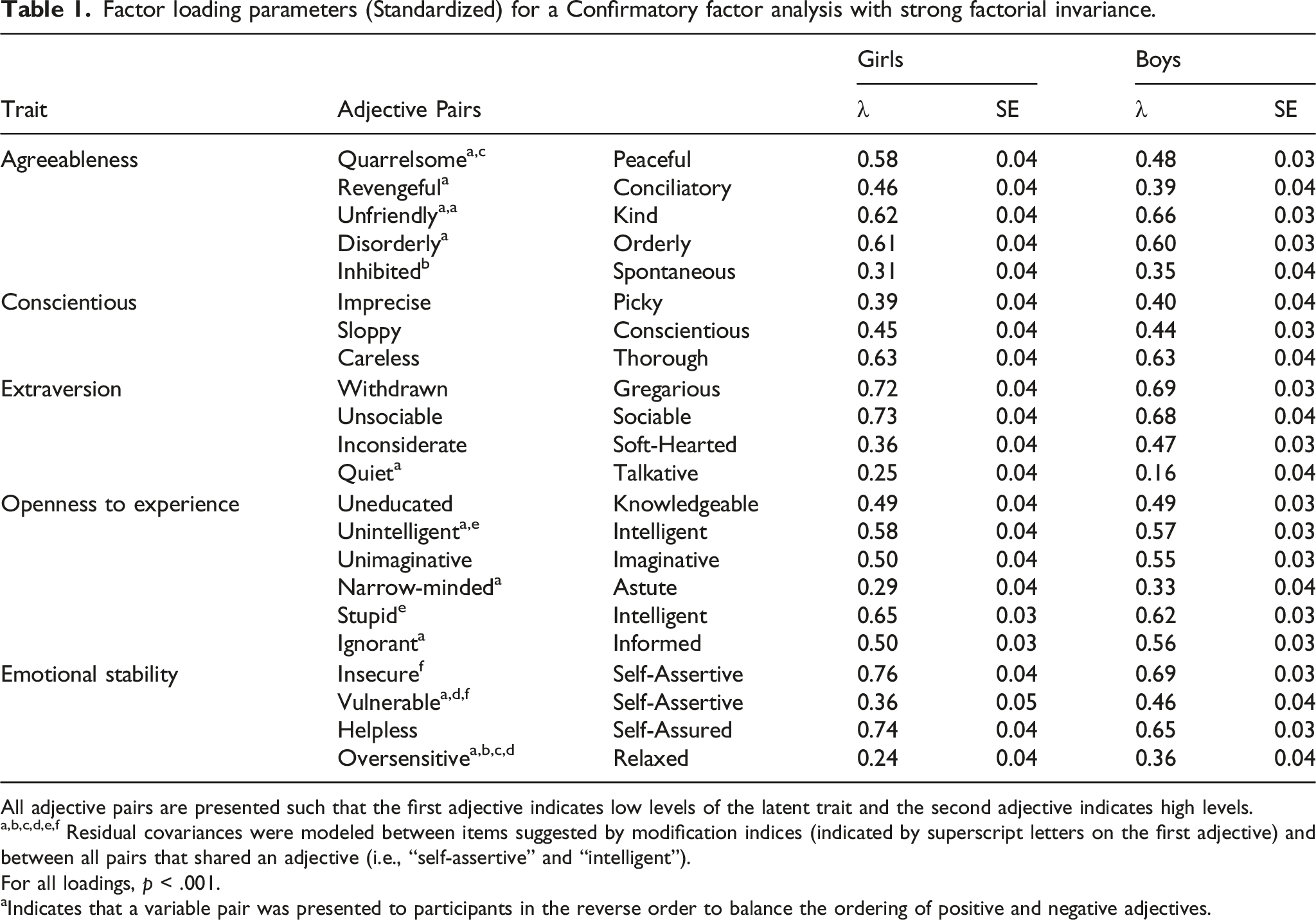
All adjective pairs are presented such that the first adjective indicates low levels of the latent trait and the second adjective indicates high levels.
a,b,c,d,e,f Residual covariances were modeled between items suggested by modification indices (indicated by superscript letters on the first adjective) and between all pairs that shared an adjective (i.e., “self-assertive” and “intelligent”).
For all loadings, p < .001.
aIndicates that a variable pair was presented to participants in the reverse order to balance the ordering of positive and negative adjectives.
Analytic plan
Intraclass correlations revealed that classroom clustering explained a negligible level of variation in personality traits (range of 0.004–0.04) and, therefore, the nesting was not modeled in subsequent analyses. To address the first and second aims, latent curve analysis was used to estimate a latent intercept and slope for each personality trait over the three timepoints for each gender, with the first wave of assessment as the reference point. The latent slope was estimated by constraining the loading of the first timepoint to be 0 and the loading of subsequent timepoints to be 1 and 2, respectively. For piecewise models, separate slopes were estimated for the change between time 1 and time 2 (loadings fixed to 0, 1, and 1 across the three timepoints) and time 2 and time 3 (loadings fixed to 0, 0, and 1). Non-linear growth models can be fit by constraining parameters so that the structural equation model is just-identified or over-identified (Kamata et al., 2013). Piecewise growth models were fit by constraining the covariance between the Time 1–2 and Time 2–3 slopes to be 0, and by constraining the variance in both slopes to the same value. Linear and piecewise growth models were compared according to overall model fit and AIC values in order to determine the functional form of the data, with a change in AIC of 2 considered evidence of significant differences between models. Acceptable model fit was defined as CFI ≥0.90, RMSEA ≤.06, and SRMS ≤0.08 (Hu & Bentler, 1999).
To test whether the developmental trajectory of traits varied by immigration experiences (Aim 2), the latent intercept and latent slopes in the final adopted models were regressed on dummy-coded immigrant generation (1st, 2nd, or Greek), with Greeks used as the reference group. Model comparisons were made on the basis of AIC comparisons, with Δ AIC ≤ −2 considered significantly different. Full fit statistics are provided in Supplemental Table S5.
To address Aim 3, rank-order stability was tested by fitting a regression model in which the mean-level of a trait was predicted by its value at the previous timepoint and the interaction of that value with dummy coded immigrant generation status (1st or 2nd generation with non-immigrant Greeks as the reference group). Significant interaction terms indicated that stability varied among groups. Power analyses indicate that a sample size of 387 would be needed to detect a small interaction effect (partial η2 = 0.02) with 80% power and error probability of 5%. This is exceeded for each gender (males = 676; females = 576). Standardized regression coefficients of <0.20 are considered small, <0.5 medium, and >0.8 large, respectively.
Transparency and openness
Data and analysis code are available at https://github.com/gille597/pers_dev. The methods supplement contains all research materials. All analyses were conducted in R version 4.0.0. EFA models were fit using the psych package in R (Revelle, 2020). Confirmatory factor analyses were fit using the sem function of the lavaan package (Rosseel, 2012). The present study design and analyses were not pre-registered.
Results
Financial problems
Most participants reported some financial problems (83.4%), with 21.3% describing their problems as moderately severe and 3.6% describing them as severe. Girls reported significantly higher financial problems than boys (t (994) = 2.84, d = 0.18, p = .005). No differences were observed by immigration status.
Measurement invariance
The Methods Supplement and Supplemental table S4 describe the procedure and results of all tests of measurement invariance. Table 1 includes the factor loadings of a longitudinally invariant measurement model. Strong/scalar invariance was attained longitudinally. Metric/weak invariance was attained between genders at all timepoints. Latent growth models were fit separately to account for this and due to specific hypotheses about gender differences in trajectories of growth. For immigrant generation, metric invariance was attained at the first timepoint, but not the second; by the third timepoint, partial strong/scalar invariance was attained.
Baseline differences in mean levels by gender and immigration status
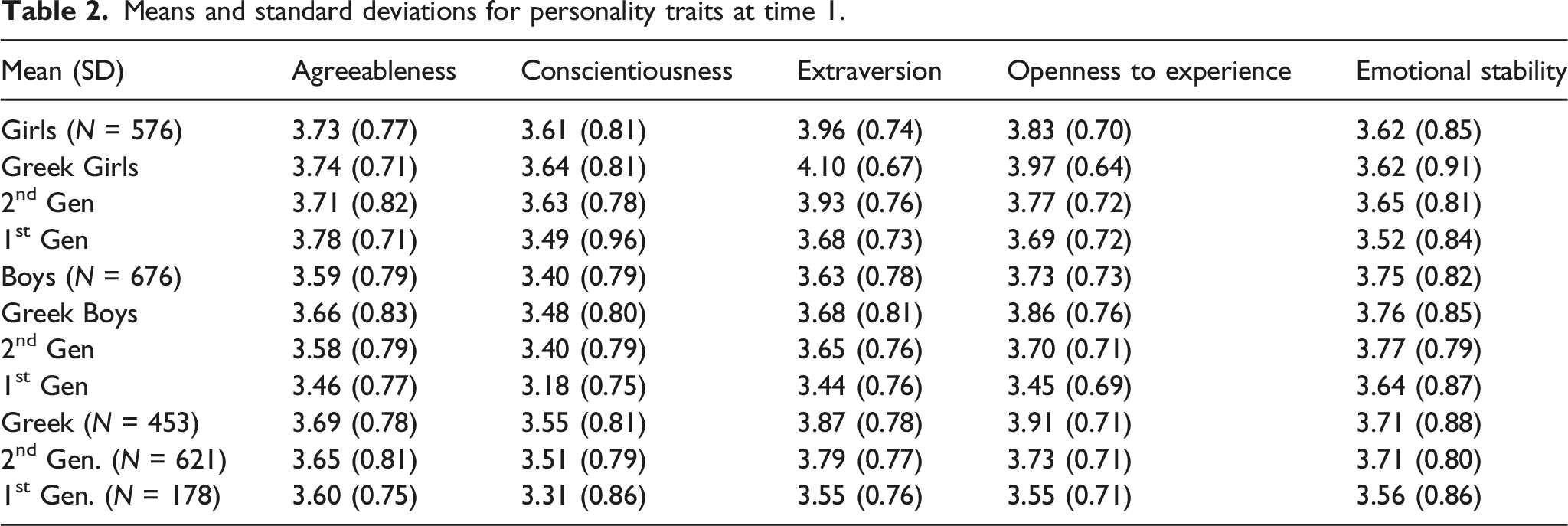
Means and standard deviations for personality traits at time 1.
Mean-level change in big five traits for boys and girls (Aim 1)
Fit statistics for linear and piecewise latent curve models testing mean-level change in the big five traits for girls and boys.
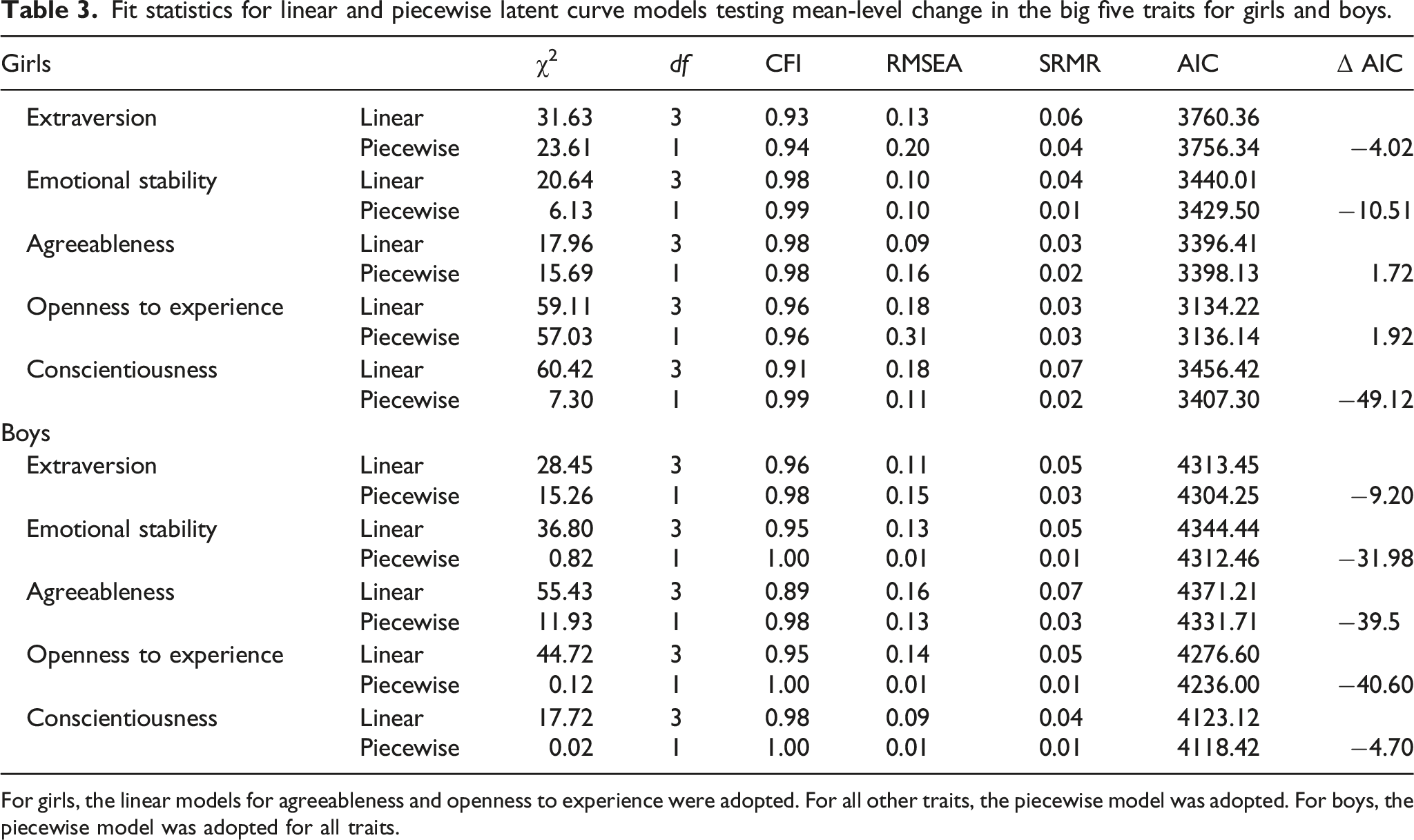
For girls, the linear models for agreeableness and openness to experience were adopted. For all other traits, the piecewise model was adopted. For boys, the piecewise model was adopted for all traits.
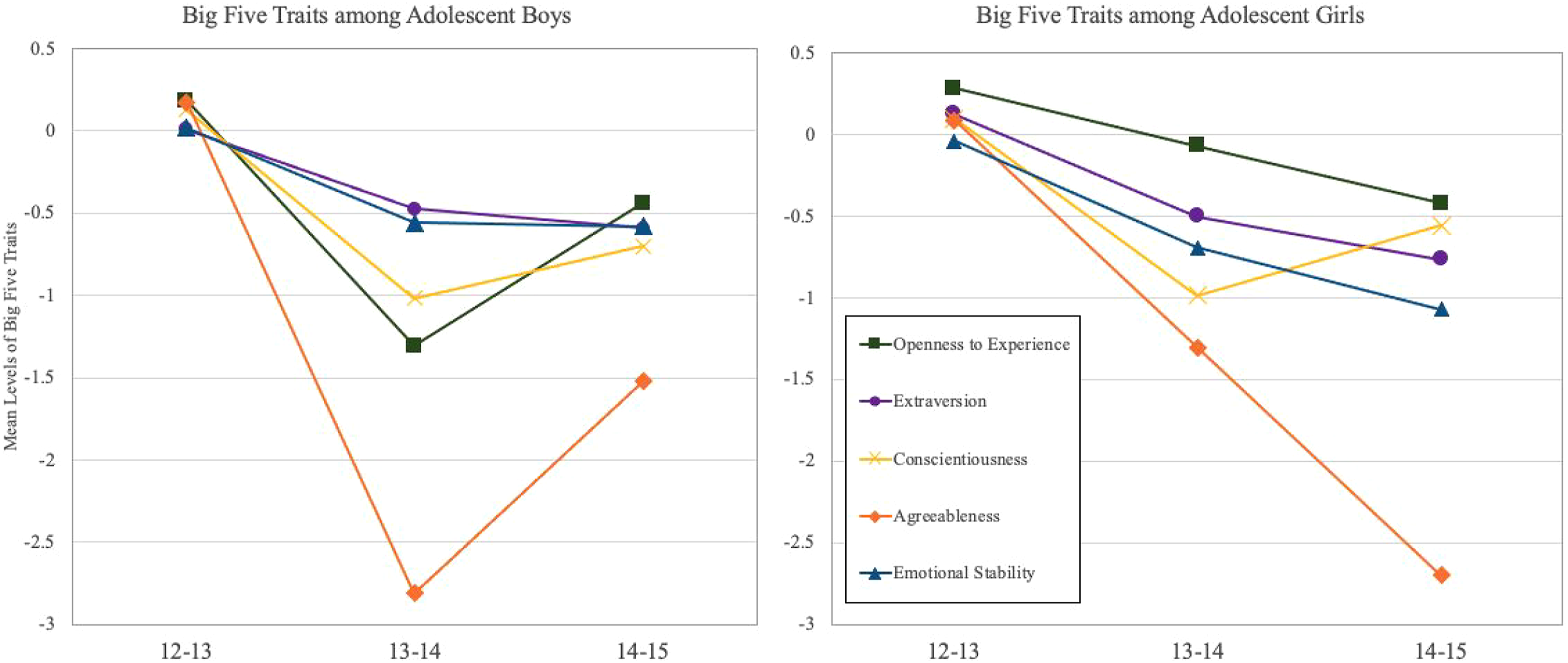
Model predicted growth in the big five traits for boys and girls between ages 12 and 15.
Extraversion
For girls, both the linear and piecewise models indicated that extraversion declined, but the piecewise function suggested that the decline was more than twice as steep from Time 1 to Time 2 (β12 = −0.63, b = −.22, CI [−.29, −.15], p < .001) as from Time 2 to Time 3 (β23 = −0.27, b = −.22, CI [−.16, −.03], p = .005). AIC and overall fit statistics indicated that the piecewise model significantly improved the model. The unstandardized variance of both slopes was significant (σ2 = .125, p < .001).
For boys, the piecewise model had the lowest AIC and best overall fit statistics. As with girls, both models indicated a decrease in extraversion over time; in the piecewise function, however, the decrease from Time 2 to Time 3 was not significant for males (β12 = −0.49, b = −.20, CI [−.25, −.14], p < .001; β23 = −0.12, b = −.05, CI [−.10, .01], p = 0.10). The unstandardized variance of both slopes was significant (σ2 = .166, p < .001).
Emotional stability
The piecewise model had superior fit and indicated that girls decreased across time (β12 = −0.65, b = −.28, CI [−.33, −.22], p < .001; β23 = −0.38, b = −.16, CI [−.21, −.11], p < .001), while boys’ emotional stability only decreased significantly at the first follow up (β12 = −0.58, b = −.26, CI [−.31, −.21], p < .001; β23 = 0.02, b = .01, CI [−.04, .06], p = .75). The unstandardized variance of both slopes was significant for girls (σ2 = .182, p < .001) and for boys (σ2 = .199, p < .001).
Agreeableness
For girls, the linear model had superior fit to the data and indicated negative growth (β = −1.39, b = −.12, CI [−.14, −.09], p < .001). The variance of the slope was not significant (σ2 = .007, p = .316). For boys, the piecewise model was adopted. For boys, a significant decrease from Time 1 to Time 2 was followed by a significant increase to Time 3 (β12 = −2.99, b = −.23, CI [−0.29, −.17], p < .001, β23 = 1.29, b = .10, CI [.04, .16], p = .001). The variance of the slopes was not significant (σ2 = 0.006, p = .351).
Openness to experience
For girls, the linear model had superior fit to the data and indicated negative growth (β = −0.35, b = −.06, CI [−.08, −.04], p < .001). The variance of the slope was significant (σ2 = .031, p < .001). For boys, a significant decrease to Time 2 was followed by a significant increase to Time 3 (β12 = −1.49, b = −.20, CI [−.25, −.14], p < .001; β23 = 0.87, b = .12, CI [.06, .17], p < .001). The variance of the slope was not significant (σ2 = .017, p = .309)
Conscientiousness
The piecewise model indicated that girls had a decrease in conscientiousness, followed by a significant increase (β12 = −1.08, b = −.29, CI [−.35, −.24], p < .001; β23 = 0.43, b = .09, CI [.03, .15], p = .001). The variance of the slopes was significant (σ2 = .045, p = .01). For boys, the model indicated a significant decrease and then increase in conscientiousness (β12 = −1.15, b = −.15, CI [−.20, −.09], p < .001; β23 = 0.31, b = .04, CI [−.01, −.10], p = .14). The variance of the slopes was not significant (σ2 = .017, p = .290).
Mean-level change by immigrant generation (Aim 2)
Immigrant generation was a significant predictor of growth in conscientiousness for girls between Time 1 and Time 2, with both first and second generation immigrants showing steeper declines in conscientiousness (β 1st gen = −0.62, b = −.21, CI [−.38, −.04], p = 0.02; β 2nd gen = −0.53, b = −.18, CI [−.30, −.06], p = 0.004). There was no association with growth between Time 2 and Time 3. Immigrant generation did not predict the slopes of any other traits for either gender.
Immigrant generation also was associated with the intercept of certain traits, depending on the adolescents’ gender. Among girls, being a 1st generation immigrant was associated with a significantly lower mean-level of extraversion (β = −0.56, b = −.29, CI [−.45, −.13], p < .001); both 1st (β = −0.66, b = −.50, CI [−.70, −.30], p < .001) and 2nd (β = −0.38, b = −.29, CI [−.43, −.15], p < .001) generation immigrant girls also had lower intercepts for openness to experience. For boys, being a 1st or 2nd generation immigrant was associated with lower mean-levels of agreeableness (1st: β = −.48, b = −.27, CI [−.42, −.12], p < .001; 2nd: β = −0.20, b = −.11, CI [−.22, −.01], p = 0.04) and openness to experience (1st: β = −0.52, b = −.36, CI [−.53, −.18], p < .001; 2nd: β = −0.21, b = −.14, CI [−.26, −.02], p = 0.02); while 1st generation immigrant boys reported lower mean-levels of conscientiousness (β = −0.45, b = −.26, CI [−.41, −.11], p < .001). Immigration experiences were not associated with emotional stability for either gender. In summary, immigrant generation was associated with mean-levels of most traits, but was only associated with the developmental trajectory of conscientiousness for girls over the course of the study.
Rank-order stability of the big five traits (Aim 3)
Descriptive statistics and rank-order stability correlations among self-reported big five traits across three waves of assessment using CFA model-predicted data.
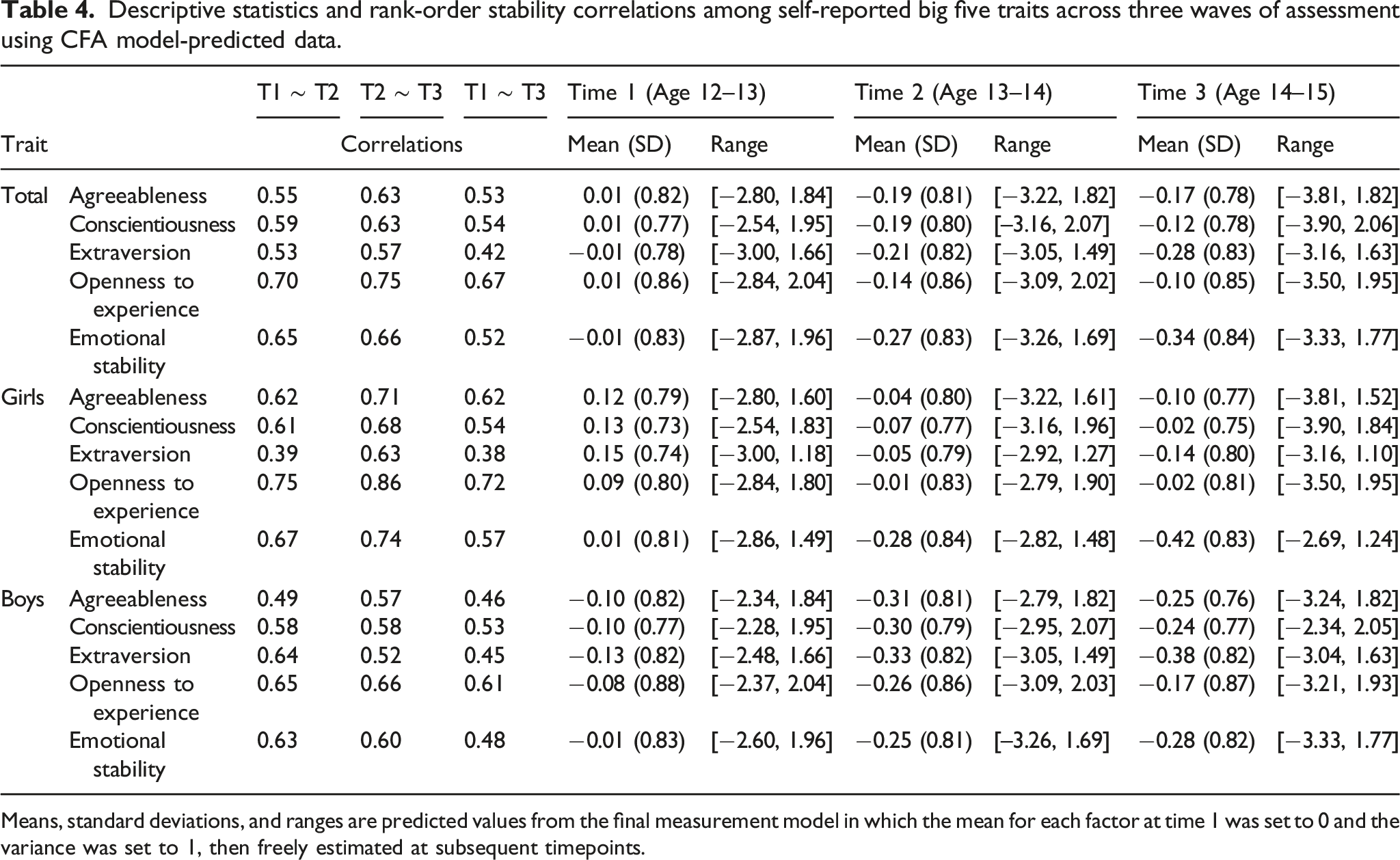
Means, standard deviations, and ranges are predicted values from the final measurement model in which the mean for each factor at time 1 was set to 0 and the variance was set to 1, then freely estimated at subsequent timepoints.
Gender differences in stability
To test whether stability was moderated by gender, a series of moderated regression models were fit where the value of the trait at the preceding timepoint was multiplied by dummy coded gender (female = 1, male = 0). To account for multiple comparisons, a Bonferroni correction for multiple comparisons was applied (p = .05/5 tests per timepoint). Gender differences in stability emerged for some traits between time 1 and 2, with boys showing higher stability in extraversion [F (3, 1234) = 166.7, p < .001; b = −0.21, SE = .05, p < .001)] and girls showing higher stability in agreeableness [F (3, 1234) = 183.8, p < .001; b = 0.14, SE = .05, p = .003)]. Gender differences were also found for four of five traits between time 2 and 3 [(agreeableness F (3, 1234) = 288.6, p < .001; b = 0.15, SE = .04, p < .001); (openness F (3, 1234) = 569.5, p < .001; b = 0.21, SE = .04, p < .001); (extraversion F (3, 1234) = 207.8, p < .001; b = 0.12, SE = .05, p = .009); (emotional stability F (3, 1234) = 347.6, p < .001;b = 0.14, SE = .04, p = .001], with girls showing higher stability overall. Subsequent tests were analyzed separately by gender.
Immigrant generation differences in stability
To test whether stability was moderated by immigrant generation, a series of moderated regression models were fit separately for boys and girls. Immigrant generation (Greek, 1st generation, or 2nd generation) was dummy coded and multiplied by the trait, and non-immigrant Greeks were used as the reference group. For boys, the interaction term was significant for extraversion [F (5, 662) = 93.11, p < .001; b = −0.24, SE = .09, p < .01)] and conscientiousness [F (5, 662) = 70.00, p < .001; b = −0.24, SE = .09, p = .01)] between time 1 and 2, with 1st generation immigrants showing lower stability. For girls, 1st generation immigrants had a trend towards lower stability for emotional stability [F (5, 564) = 95.23, p < .001; b = −0.17, SE = .09, p = .07)]. Applying a Bonferroni correction for multiple comparisons (p = .05/5 tests per gender at each timepoint), extraversion for boys remained statistically significant.
Sensitivity analyses of mean level change
Since notable changes were made to the original measure, sensitivity analyses were also conducted to examine mean-level change in the original 40-item measure using mean scores for each trait on the 8-item subscales. The results of these analyses are presented in Supplemental Table S6 and Figure S1. Disruption was consistently observed for both genders and across traits, with the exception of openness to experience for which girls showed non-significant growth over the three waves of assessment. Furthermore, disruption in agreeableness—while still significant—was less pronounced when using the original measure.
Given the economic context of our data collection, we ran sensitivity analyses using self-reported financial problems as a predictor of the intercept and slope of personality growth over the 4 years. The pattern of results remained consistent for boys, such that disruption was observed for all traits between Time 1 and Time 2. Economic stress predicted a lower intercept of extraversion, emotional stability, and agreeableness, but did not predict the slope of any traits. For girls, the main effect of disruption was only observed for the slope of emotional stability between Time 2 and 3. For all other traits, the main effect was nonsignificant. However, having more perceived economic stress predicted a negative slope between Time 1 and Time 2 for extraversion, emotional stability, and conscientiousness. Results suggest that the disruption occurred for boys independent of perceived financial problems, while only girls with higher levels of perceived financial problems showed disruption in traits.
Discussion
In a diverse, longitudinal sample of adolescents (age 12–15), all Big Five personality traits declined at least temporarily over a 3-year period for both genders, a pattern consistent with the disruption hypothesis. Despite hypotheses about the association of immigration experiences with personality development, differences in trajectories were more pronounced by gender than by immigrant status. Girls reported higher mean scores at baseline for extraversion, conscientiousness, and openness to experience, while boys reported higher emotional stability. Both genders showed declines in mean-levels of all traits between age 12 and 13, indicating the potential for similar developmental processes, but there were some gender differences in mean-level change from 13 to 14. We observed moderate to strong rank-order stability in traits. We further analyzed trajectories of mean-level change and patterns of rank-order stability within self-reported gender according to immigrant generation. We found evidence for moderate to strong rank-order stability in traits during this period, with boys and 1st generation immigrant youth showing greater rank-order change for certain traits. Collectively, our findings suggest that social positioning variables (i.e., gender, immigration status) as well as contextual differences (i.e., perceived financial stress of the family) are associated with personality development.
Gender differences in personality development
We observed mean-level differences at baseline, as well as different growth trajectories. Girls reported significantly higher levels of extraversion, conscientiousness, and openness to experience, while boys reported significantly higher emotional stability. For both genders, we found evidence consistent with the disruption hypothesis across all Big Five personality traits. Agreeableness showed the steepest decline for both genders, and, while it rebounded for boys at the last timepoint, it declined consistently for girls over the course of the study. Effect sizes of these overall decreases from the first to final timepoint ranged from small (openness to experience in girls) to large (agreeableness and conscientiousness in boys, and emotional stability in girls) standardized coefficients, with other traits showing medium effect sizes. These findings are consistent with the integrative theory of personality development, which synthesizes psychosocial, biological, and cognitive development trends to predict a temporary disruption in personality during adolescence (Denissen et al., 2013).
The consistency of the disruption trajectories across all Big Five traits and across both genders is notable among the extant literature on adolescent personality development, in which some studies find disruption only for some traits or genders. The participants in this study were developing in the context of family and societal-level economic stressors, and we have some preliminary indication that this could explain the more robust evidence for disruption in our sample relative to lower risk samples. While our sensitivity analyses suggest that disruption occurred for boys regardless of their perception of their families’ financial problems, girls only showed disruption in the context of higher levels of perceived financial distress. These preliminary results highlight the importance of future research on personality development in stressful or adverse contexts. Follow up studies would benefit from objective or parent-reported measures of family financial stress, since our measure only captures adolescents’ perceptions of their family’s situation.
While the overarching developmental trend is one of disruption for both genders, some gender differences emerged that are consistent with what is known about gender differences in academic, behavioral, and emotional challenges during this developmental stage (Hicks et al., 2007; Hilt & Nolen-Hoeksema, 2009; Spinath et al., 2014). In our study, girls showed consistent decreases in all traits except conscientiousness, which increased from time 2 to time 3. Boys also showed an initial decrease in all traits, which was particularly pronounced for agreeableness. This decrease was followed by a significant increase in agreeableness, conscientiousness, and openness to experience from time 2 to time 3, although none returned to their Time 1 levels. This pattern of findings is consistent with observations of gender differences in internalizing psychopathology (lower in boys) that are linked to emotional stability, externalizing psychopathology (higher in boys) that is linked to low agreeableness, and school performance (higher in girls) that is linked to conscientiousness.
Studies that sample only twice over this period of development or over longer intervals between childhood and adulthood may fail to detect the trajectory of mean-level change in traits, particularly in boys for whom decreases were largely followed by rapid corrections (for example, see Filipiak & Łubianka, 2019; Luan et al., 2017). That noted, our study was not long enough to detect the lowest mean-level and subsequent rise of most traits in girls, raising the possibility that disruption occurs at different ages and on different timescales for each gender. Our results are most consistent with the findings of Borghuis et al. (2017) and Rohrer et al. (2018), who found that the low-point for traits may occur around age 15 or later.
Regarding rank-order stability, we observed that girls had significantly higher rank-order stability than boys in the latter time windows for nearly all traits; between the earlier timepoints, gender differences in rank-order stability were mixed or non-significant. Differences in the timing of personality trait development have been observed in other studies, with girls tending to mature earlier than boys (see De Bolle et al., 2015) and showing higher rank-order stability (Klimstra et al., 2009). Our results indicate that rank-order stability may also emerge earlier for girls than boys, though our data only shed light on the period from age 12 to 15.
While mean level change and rank-order stability are independent of each other in theory, their pattern of relations may reveal the drivers of change (Klimstra et al., 2009; Specht et al., 2011). Considering both sets of findings together, the traits with the lowest rank-order stability in our sample tended to have more pronounced mean level change. For example, between the first two assessments, boys showed the lowest rank-order stability and the most pronounced mean level change in agreeableness. Additionally, stability was generally observed to be inversely related to group level increases. Between the second two assessments, girls showed higher stability than boys and a more consistent pattern of mean level decreases (except for conscientiousness). Taken together, this pattern of findings raises the possibility that there may be important individual differences in whether individuals rebound to mean level growth following any disruption. This is consistent with emerging research on inter-individual differences in intra-individual personality change (Graham et al., 2020).
Immigration and personality development
The diverse migration experiences of the adolescents in this study enabled us to investigate whether rank-order stability and growth trajectories in personality traits were associated with first- or second-generation immigrant status. Immigrant youth in this sample faced, in addition to their immigrant status, challenges associated with the Great Economic Recession and low socio-economic status, which could confer additional risk for personality development. However, immigrant youth (both 1st and 2nd generation) showed similar patterns of disruption and maturation in personality traits as Greeks. In other words, being an immigrant was not associated with the latent slope of the growth in most personality traits. The only exception was observed for conscientiousness, where immigrant girls showed more pronounced decreases between the first two assessments. Despite similar patterns of growth, immigrant generation was generally associated with lower mean-levels of self-reported traits. The only trait without any significant mean differences between immigrant and Greek youth was emotional stability. This result is consistent with findings that immigrant youth do not differ significantly in emotional symptoms from non-immigrant youth (Motti-Stefanidi et al., 2012).
These mean-level differences should be interpreted with caution and further investigated in future studies. Differences could be attributed to different self-reporting styles across cultural groups, with 2nd generation immigrants showing a response style in between those of non-immigrant Greeks and 1st generation immigrants (Shiner et al., 2021). Having additional informants from each cultural group could address concerns about mean-level differences in self-reported traits. Alternatively, these mean-level differences could reflect additional adversity faced by immigrant youth in Greece. For example, experiences of discrimination have been linked to higher neuroticism and lower agreeableness among adults (Sutin et al., 2016) and migrant youth in China (Xiang et al., 2018). That noted, our study only observed lower agreeableness for immigrant boys and did not observe lower emotional stability among immigrants; disentangling the specific risk and protective factors for personality trait development requires further research.
The finding that both 1st and 2nd generation immigrants reported lower openness to experience contrasts with a study that compared trait levels between immigrant and non-immigrant adolescents in London (Dewaele & van Oudenhoven, 2009). However, differences may be due to the specific facets of openness to experience that were measured: that study measured cultural empathy and open-mindedness among immigrant and multilingual youth, while our measure mainly captured intellectual curiosity and perceived intelligence and had a high correlation with overall GPA (see Supplemental Table S1). Our measure may have failed to capture any potential strengths related to cultural empathy and open-mindedness. Importantly, these results do not imply lower intellectual abilities, but rather that stressors and barriers within the school context, combined with a lack of institutionalized support, may overwhelm youths’ coping mechanisms and result in lower self-perception of abilities (Motti-Stefanidi et al., 2015). Future research at the facet-level of analysis may be better suited to measuring personality strengths among immigrant youth.
Rank-order stability was comparable across immigration groups for most traits in boys and for all traits in girls. Results indicate that 1st generation immigrant boys had lower rank-order stability for extraversion and conscientiousness compared to Greek and 2nd generation boys. The transition to secondary school may be particularly volatile for first generation immigrant youth, who are adjusting to new academic and social demands and who may go through a period of rejection, particularly if there are few other immigrant youths in the classroom (Asendorpf & Motti-Stefanidi, 2017). Gender differences in stability were more notable, indicating that immigration status may play a smaller role in determining rank-order stability than hypothesized.
Limitations
The findings of this study should be interpreted in light of several limitations. First, important recent work has shown that different facets of the Big Five traits may develop in different ways, with some more likely to show evidence of the maturity principle or the disruption hypothesis (Brandes et al., 2020). Indeed, some of the heterogeneity of findings in this literature may be attributable to the specific facets measured across different studies. Our study was unable to disaggregate different facets of these broader traits, and the reduced subscales with some repeated anchors (e.g., Intelligent∼Stupid; Intelligent∼Unintelligent) that we ultimately used to measure each trait may have limited the breadth of the trait that we captured. Future work would also benefit from comparing self-report to informant report, since findings about the timing and degree of disruption have also differed based on informant (Luan et al., 2017; Van den Akker et al., 2014).
Additionally, this study focused on experiences related to immigrant status as potentially important factors in personality development. Model fit was best for 2nd generation and Greek participants and improved for all groups over the three waves of the assessment, indicating a potential effect of time spent in Greece. Consequently, mean differences should be interpreted cautiously. Furthermore, data were aggregated across all ethnic groups in the sample. Immigrants with a Pontic-Greek ethnic background, for example, are viewed more favorably by Greeks and under the law. These factors may cause their experiences to be different than those of Albanian immigrants, the largest group in the study sample, or of other immigrant groups with lower ethnic density in the neighborhoods from which the sample was drawn. Additionally, immigrant generation was used as a proxy for different factors that were hypothesized to relate to personality development, such as acculturation or exposure to discrimination. Direct measurement of these factors in future work would better account for individual differences in the immigration experience.
Finally, our study found different growth trajectories for boys and girls, based on self-reported gender with a binary option (the standard assessment approach at the time in this and other studies in Greek schools). Over the course of the three timepoints, boys demonstrated both decreases and subsequent increases in socially desirable traits, while girls demonstrated monotonic decreases for all traits except conscientiousness. A broader window of observation would have been needed to observe when girls began to show mean-level increases, and future research could benefit from non-binary measures of self-reported gender. Sensitivity analyses indicated that perceived financial stress may predict whether girls show disruption; however, results should be interpreted cautiously given that adolescent-reported financial stress may be inaccurate or influenced by individual differences in anxiety or sensitivity to stress.
Conclusions
Our findings shed light on an understudied period of personality development (Costa et al., 2019) in a high risk sample, providing support for the disruption hypothesis: a temporary decline in socially desirable traits. Our sample, comprised of both immigrant and non-immigrant adolescents in Greece, also afforded preliminary evidence of differences in personality development that could be driven by social and economic marginalization. Adolescence is a dynamic period during which developmental trajectories can be altered rapidly in both positive and negative ways by individual, familial, and societal experiences, including immigration to a new country (Dahl et al., 2018). Indeed, the particularly pronounced disruption observed in our sample highlights the need for future research into the development and impact of personality traits in the face of adversity.
Supplemental Material
Supplemental Material - Personality development in immigrant and non-immigrant adolescents: Disruption or maturation?
Supplemental Material for Personality development in immigrant and non-immigrant adolescents: Disruption or maturation? by Sarah Gillespie, Rebecca Shiner, Ann S. Masten and Frosso Motti-Stefanidi in European Journal of Personality
Footnotes
Declaration of conflicting interests
The author(s) declared no potential conflicts of interest with respect to the research, authorship, and/or publication of this article.
Funding
The author(s) disclosed receipt of the following financial support for the research, authorship, and/or publication of this article: The present study is part of the Athena Studies of Resilient Adaptation (AStRA, Motti-Stefanidi PI), a collaborative project focusing on the quality of adaptation of immigrant youth living in Greece. Work on the present paper was supported by a research grant awarded to the last author (Frosso Motti-Stefanidi) by the Hellenic Foundation for Research and Innovation (HFRI-FM17-1188). The grant supports research projects of faculty members and researchers working in Greek Universities and Research Centers. Preparation of this manuscript also was supported by a Provost Fellowship from the University of Minnesota (Gillespie), a National Science Foundation Graduate Research Fellowship (Gillespie), and the Irving B. Harris Professorship (Masten).
Data accessibility statement

Supplemental Material
Supplemental material for this article is available online.
References
Supplementary Material
Please find the following supplemental material available below.
For Open Access articles published under a Creative Commons License, all supplemental material carries the same license as the article it is associated with.
For non-Open Access articles published, all supplemental material carries a non-exclusive license, and permission requests for re-use of supplemental material or any part of supplemental material shall be sent directly to the copyright owner as specified in the copyright notice associated with the article.
