




Abstract
The period between childhood and adulthood is a turbulent time of life (Hollenstein & Lougheed, 2013). While there is a solid body of research on youth social, biological, and psychological development (Sawyer et al., 2018; Steinberg & Morris, 2001), surprisingly little is known about personality processes and individual differences in them during these years. The papers in this Special Issue make important contributions to the current literature in three ways: first, by mapping developmental patterns to broader conceptualizations of personality, including personality pathology, second, by examining predictors and mechanisms in youth personality development, and third, by linking youth personality development to later life outcomes. We hope that the results of these papers will contribute to a more nuanced understanding of adolescent personality development in diverse cultural contexts and stimulate new integrative research.
Keywords
The period between childhood and adulthood is a turbulent time of life (Hollenstein & Lougheed, 2013). While there is a solid body of research on youth social, biological, and psychological development (Sawyer et al., 2018; Steinberg & Morris, 2001), surprisingly little is known about personality processes and individual differences in them during these years. Although the structure of personality as conceptualized with normative personality frameworks such as the Big Five has been found to be similar to that in adults, developmental patterns tend to deviate from those in later life periods (e.g., Mõttus et al., 2019; Soto & Tackett, 2015). Even less is known about how patterns of youth personality and their development apply to broader conceptualizations of personality, including personality pathology. Along these lines, many questions about stability and change in youth personality—broadly conceptualized—as well as potential underlying processes remain open. And finally, we are still at the very beginning of understanding whether and how youth personality sets the stage for further development and life outcomes in adulthood. Advancing our understanding of personality processes in youth and individual differences in these processes requires robust research that combines strong conceptual foundations with sophisticated methodological approaches.
Overview of Articles, Personality Domains, Countries, and Topics Included in the Special Issue.
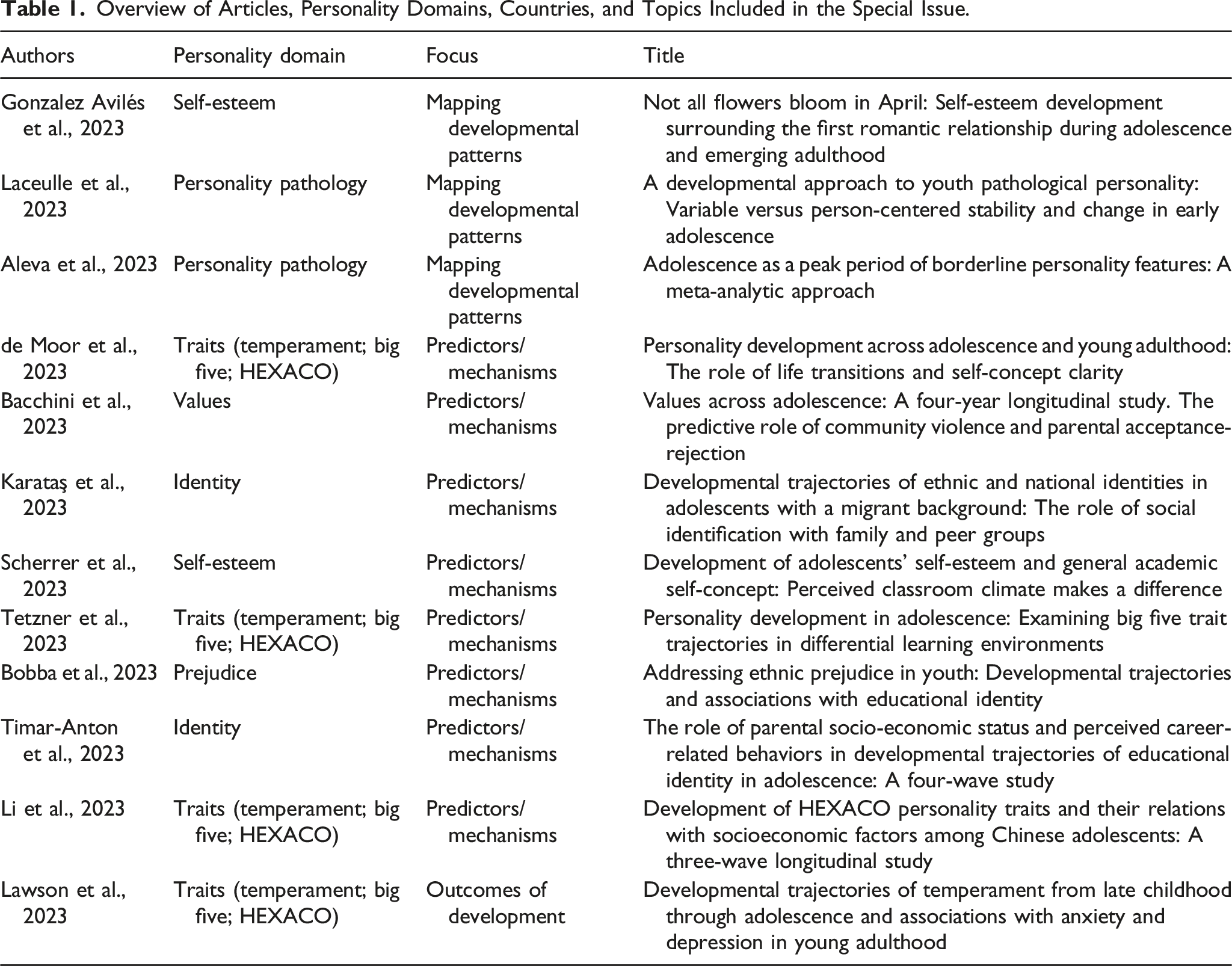
Overview of the Special Issue
Mapping Developmental Patterns in Youth Personality
By definition, personality is understood to be relatively stable across contexts and time (Costa Jr & McCrae, 1994). However, over the last 20 years, longitudinal studies of personality change in adolescence and adulthood have suggested a refinement of this stability assumption (e.g., Bleidorn et al., 2022; Orth et al., 2018; Roberts et al., 2006). Although personality is relatively stable, substantial changes have been found in both mean levels and rank order. This pattern appears to be true for most (if not all) personality characteristics and across all ages. Importantly, developmental patterns in youth tend to deviate from those in adulthood in terms of both mean-level changes, where we see a temporary reversal of the general maturation trend, and rank-order changes, where we see more instability and increasing variance (e.g., Mõttus et al., 2019; Soto & Tackett, 2015).
The studies in the current special issue replicate and build on these earlier findings by mapping developmental patterns of temperament (Lawson et al., 2023), personality traits (de Moor et al., 2023; Li et al., 2023; Tetzner et al., 2023), and other conceptualizations of personality (self-esteem: Gonzalez Avilés et al., 2023; Scherrer et al., 2023; identity: Karataş et al., 2023; Timar-Anton et al., 2023; values: Bacchini et al., 2023; and prejudice: Bobba et al., 2023) across various cultural contexts. For example, the study by Avilés and colleagues examines average trends of self-esteem development among romantic late bloomers over a period of 10 years from adolescence till emerging adulthood (ages 16–26). Findings indicate that average self-esteem did not change before beginning the first relationship, but slightly decreased thereafter. Another important extension of this special issues pertains to developmental trends in youth personality pathology. There is growing consensus that a developmental perspective on personality pathology is critical for both understanding and targeting personality pathology in youth (Sharp & Wall, 2018). The studies by Aleva et al. (2023) and Laceulle et al. (2023) focus on these developmental patterns in youth, but do not provide support for youth being a particularly sensitive period for personality pathology. Instead, findings largely align with results from adult normative personality research: Both studies point towards mean-level personality maturation in population samples (i.e., decreases in pathological traits: Laceulle et al., 2023 and decreases in borderline features: Aleva et al., 2023). However, differential age effects across 131 clinical samples suggested stability or even increases in average levels of borderline features (Aleva et al., 2023). Thus, together the papers provide a more nuanced understanding of typical developmental patterns in youth.
Predictors and Mechanisms in Youth Personality Development
Moving beyond developmental patterns, eight of the articles included in this special issue aim to also increase our understanding of individual differences in, and mechanisms of, youth personality development. At first glance, these articles primarily demonstrate diversity in factors predicting changes and developmental trajectories of personality and underlying mechanisms. At second glance, however, the pattern of findings aligns well with one of the core theoretical frameworks in developmental psychology: Bronfenbrenner’s Bioecological Systems Model (1994). In this model, child and youth development is understood as a complex system of relationships affected by the interplay between individual characteristics and multiple layers of the surrounding environment ranging from the immediate contexts (microsystems), to the interaction between them (mesosystem), up to more distant layers including the broader neighborhood (exosystem) and national or cultural customs and values (macrosystem). The articles in the current special issue show how all of these layers need to be considered when aiming to understand youth personality development.
Starting from individual characteristics, de Moor and colleagues (2023) examine the moderating role of self-concept clarity on the relationship between life transitions and Big Five personality development from middle adolescence into young adulthood. Results showed limited support for moderation effects of self-concept clarity, yet a clearer self-view was related to somewhat more adaptive average personality traits levels later in youth.
Moving to the role of youth’s immediate environments and their relationships (microsystems and mesosystems), the studies by Bacchini et al. (2023) and Karataş et al. (2023) focus on family and peers. Findings indicated that they are influential socializing agents in the development of identity (social identification with family and peers; Karataş et al., 2023) and openness to change (but none of the other values assessed was predicted by paternal rejection; Bacchini et al., 2023). The subsequent three articles all demonstrate the role of the school context. The study by Scherrer et al. (2023) documents that changes in self-esteem and academic self-concept (but not in social self-concept) were predicted by dimensions of classroom climate, underscoring the impact of the school context on adolescents’ self-perceptions. Bobba and colleagues (2023) examine antecedents of ethnic prejudice by considering educational identity, with results illustrating the importance of in-depth exploration for reducing ethnic prejudice and thus, for the adolescents’ way of feeling and thinking about a multicultural world. Results of this study might be one first important step to identify particularly vulnerable segments of the adolescent community for potential interventions. The study by Tezner et al. (2023) demonstrates typical changes in personality during early adolescence and the role of schooling and differential learning environments. Findings suggest a combination of social selection, reflected by students selecting themselves into educational environments that mostly match their skills and characteristics, and (to a lesser extent) social influence, reflected by students’ self-evaluations of their personality varying in response to the educational environments.
The final two studies on predictors and mechanisms in youth personality development look at more distal contexts related to parental workplace and socio-economic status. Timar-Anton et al. (2023) highlight that parental socio-economic status and career-related behaviors, such as support, interference, and lack of engagement, play an important role in adolescents’ developmental trajectories of educational identity. Li et al. (2023) demonstrate that personality trait levels in middle to late adolescence, but not their changes, are associated with both childhood and current family socio-economic status as well as perceived economic inequality, indicating further support for resource-related accounts when it comes to the role of parental support. Interestingly, this study was one of the first to look at development in HEXACO personality during adolescence, illustrating results supporting (Honesty-Humility, Agreeableness, Emotionality) and contradicting (Extraversion) the disruption hypotheses. Together, these articles nicely cover most of Bronfenbrenner’s Bioecological Model and demonstrate that the various layers of youth’s environment play a differential role in personality development.
Youth Personality Development and Life Outcomes
The special issue ends with a paper mapping typical development of early adolescent temperament in Mexican origin youth, and examining associations with anxiety/depression several years later (Lawson et al., 2023). Findings indicate that temperament development can serve as both a protective factor (Effortful Control, Positive Emotionality) and a risk factor (Negative Emotionality) for later anxiety/depression. Moreover, temperament’s developmental patterns across adolescence (i.e., individual differences in change) predicted experiences of psychopathology over and above initial temperament levels. This indicates that applying an individual differences approach may be a good first step, but not sufficient for understanding why some youth may struggle more with mental health problems than others. Instead, integrating a developmental perspective into personality science is key when it comes to understanding diverging trajectories in youth (mal)adjustment.
Conclusive Remarks
Overall, this special issue offers novel insights on youth personality development. The results on developmental patterns, predictors and mechanisms, and life outcomes provide a nuanced understanding on how youth from diverse European (Gonzalez Avilés et al., 2023; Bacchini et al., 2023; Bobba et al., 2023; De Moor et al., 2023; Karataş et al., 2023; Laceulle et al., 2023; Scherrer et al., 2023; Tetzner et al., 2023; Timar-Anton et al., 2023), American (Lawson et al., 2023), and Asian (Li et al., 2023) cultural contexts, develop in adolescence and in the transition to emerging adulthood. Importantly, this set of articles pave the way for more research that adopts integrative perspectives to further enrich a developmental understanding of youth personality.
Footnotes
Declaration of conflicting interests
The author(s) declared no potential conflicts of interest with respect to the research, authorship, and/or publication of this article.
Funding
The author(s) received no financial support for the research, authorship, and/or publication of this article.