




Abstract
Personality develops across the lifespan, but most development occurs in adolescence and young adulthood. Life transitions to new social roles may be important drivers of mean-level personality development. The present study examined mean-level personality development in adolescence and young adulthood, and the role of the transition to tertiary education and working life therein in a sample of Dutch young people that were followed across 14 years (N = 497, AgeW1 = 13.03 years). We explored whether young people’s self-concept clarity moderated these associations. Our hypotheses and analytical plan were pre-registered. Findings from Latent Growth Models showed support for maturation in personality across adolescence and young adulthood, but not a maturity dip. Having the role of employee was associated with higher conscientiousness, but no associations were found of the transition to tertiary education and the transition to work with mean-level development of any of the personality traits. Self-concept clarity did not moderate the role of transitions in mean-level personality development. Our findings suggest that socialization effects may not explain associations between life transitions and personality development in adolescence and young adulthood.
Although there is considerable rank-order stability in personality across time (e.g., Damian et al., 2019), it is now well-recognized that there is also considerable mean-level change in personality across the lifespan (e.g., Bleidorn & Hopwood, 2019; Ferguson, 2010; Roberts et al., 2006). This change is thought to happen most rapidly during the second and third decade of individuals’ lives (e.g., Bleidorn et al., 2022). During this period, young people have to adapt to many personal and environmental transitions, which may bring about change in their personality. Personality is related to diverse life outcomes, such as relationships with peers (Van Aken & Asendorpf, 2018) and psychological adjustment (Tackett & Mullins-Sweatt, 2021), and developing a well-adapted personality is therefore important for well-being not just during this life period but also in later life (e.g., Atkins et al., 2020). Changes in individuals’ personality may depend on the specific transition young people experience (Specht et al., 2014). Moreover, the impact of transitions on personality change may depend on the extent to which individuals have a clear sense of who they are at that point. In this study, we therefore examined (a) mean-level personality development across adolescence and young adulthood, (b) the impact of the transition to tertiary education and working life on personality development across adolescence and young adulthood, and (c) the extent to which self-concept clarity moderates the impact of these transitions on personality development. The present study extends previous work on adolescents’ and young adults’ personality change by following youth from early adolescence into their mid-twenties. As youth’s developmental tasks such as finishing one’s education and entering the job market increasingly extend into and are even postponed until young adulthood (Schoon, 2015), such a longer age range is vital to capture development around developmental tasks such as choosing an education and a career, and the influences of these tasks on personality development. The study’s research questions and corresponding hypotheses, as well as the analytical plan were pre-registered prior to conducting the study (https://osf.io/nhs5t).
Big Five Personality Development
Across the lifespan, people’s personalities continue to develop (Ferguson, 2010). Personality can be defined very broadly as the typical way in which an individual thinks, feels, and behaves (Roberts et al., 2008), and inter-individual differences in personality may be captured in traits reflecting five broad domains. Overall, individuals develop higher levels of conscientiousness, agreeableness, and openness to experience, and lower levels of neuroticism as they get older (Bleidorn & Hopwood, 2019; Bleidorn et al., 2022; Roberts et al., 2006). For extraversion, social dominance tends to increase towards mid-adulthood before leveling off, whereas social vitality tends to decrease after individuals reach adulthood. This positive personality growth reflects the maturity principle, which states that individuals grow towards a personality profile that facilitates functioning and adjustment in society (Bleidorn et al., 2013; Hogan & Roberts, 2004; Roberts et al., 2008; Roberts & Mroczek, 2008).
Most of this mean-level personality growth happens in the second and third decade of life (Bleidorn et al., 2018). Whereas individuals were traditionally expected to have figured out who one is and to have taken on mature roles that fit with one’s personality by the end of adolescence, these major developmental tasks now increasingly extend to and are even postponed until young adulthood (Schoon, 2015). In line with this, most young people may increase in openness to experience, conscientiousness, extraversion, and agreeableness, and/or decrease in neuroticism across adolescence and young adulthood (e.g., Klimstra et al., 2009; Van Dijk et al., 2020). For instance, using a combination of longitudinal (i.e., following the same youth across time) and cohort sequential (i.e., following groups of youth of different age cohorts across a shorter time period) data, Luan et al. (2017) found an increase in openness to experience, conscientiousness, and agreeableness across adolescence and young adulthood, with extraversion and neuroticism remaining stable across the same period. Moreover, Borghuis et al. (2017), using data from the first seven waves of the same longitudinal study that was used in the present work, tracked personality development across adolescence until the start of young adulthood (i.e., from age 13 to 22). They reported small but significant increases for agreeableness in boys and girls and conscientiousness in girls. This study as well as previous work also found evidence for a temporary “maturity dip” in several personality traits around the middle of the adolescent years. Specifically, young people may experience a temporary increase in neuroticism and a decrease in openness to experience (Denissen et al., 2013; Soto et al., 2011), conscientiousness (Borghuis et al., 2017; Van den Akker et al., 2014; Van den Akker et al., 2021), and agreeableness (Van den Akker et al., 2021). Exactly for which personality traits this dip (or peak) occurs and at what age remains unclear. Moreover, as key developmental tasks traditionally confined to adolescence are now extended into adulthood (e.g., prolonged education), it is important to also extend our examination of personality development until such tasks are finished. Therefore, the present study builds on the study by Borghuis et al. (2017) with four additional years of data, by examining personality development across a period of 14 years from early adolescence into young adulthood (i.e., from age 13 to 26), and by focusing on the role of transitions in personality development.
Big Five Personality Development and the Role of Transitions
Across the lifespan, personality development is thought to be partially driven by environmental factors that impact how individuals tend to behave. This may be especially true in adolescence and young adulthood, where young people have to adapt to many transitions in their personal and professional lives. These transitions may impact personality through transactional processes between the person and their environment. Following the social investment principle (Roberts et al., 2005; Roberts & Wood, 2006), investing in the social roles they take up (e.g., student, employee) drives young people to gradually adapt their personalities to better fit that role. For instance, investing in tertiary education, youth in late adolescence may be expected to become more punctual and less emotionally volatile, which will ultimately help them to perform better in their studies. Similarly, entering the job market youth may also be expected to become more punctual, disciplined, and committed, and emotionally stable, in addition to becoming less agreeable and more assertive to get ahead in their job. Thus, individuals’ adaption to social roles may affect their personality (McAdams, 2013).
Different life transitions may affect personality differently (Bleidorn et al., 2018; Specht et al., 2014). In the present study, we focused on the transition to tertiary education and the transition to working life because they are highly universal experiences in Western societies (Bleidorn et al., 2018), and are thought to be linked to clear expectations of how one “should” change in terms of one’s personality. Previous studies have shown that adolescents who made the transition to tertiary education experience a greater mean-level increase in openness to experience, conscientiousness, and extraversion than peers who did not experience this transition (Klimstra et al., 2018; Leikas & Salmela-Aro, 2015; Lüdtke et al., 2011). Adolescents who make the transition also experience a greater decrease in neuroticism. Similarly, adolescents and young adults transitioning to working life tend to experience a greater increase in conscientiousness and a greater decrease in neuroticism than peers who do not transition to working life (Leikas & Salmela-Aro, 2015; Specht et al., 2011). Moreover, they also experience a smaller increase in agreeableness (Lüdtke et al., 2011). However, several studies found no evidence for an effect of either the transition to tertiary education or to working life on personality change (Den Boer et al., 2019; Neyer & Asendorpf, 2001; Van Dijk et al., 2020). It should be noted that, these studies often only examined the association between having a particular role and personality, or linked having a social role to personality across a much longer time interval. It is possible that personality development would be visible when tracking it more closely across the transition to tertiary education and to working life. The current study examined whether having a particular role, that is, being a tertiary education student or being an employee, is related to personality. Moreover, based on the social investment principle, the current study examined whether entering a particular social role was related to mean-level personality change.
The Impact of Life Transitions on Personality Development: Self-Concept Clarity as a Moderator
Given the mixed evidence for an impact of the transition to tertiary education and working life, it is especially important to keep in mind that the extent to which life transitions impact young people’s personality may not be the same for everyone. Some individuals may be more strongly impacted by transitioning to tertiary education or to working life than others. In particular, the extent to which young people’s personality changes after adopting the social role of student or employee may depend on the extent to which they already experience identity synthesis or self-concept clarity. Self-concept clarity refers to how certain individuals are of who they are (Schwartz et al., 2011) and how much their beliefs about themselves are clearly defined, and internally and temporally stable (Campbell, 1990). Although positively related to self-esteem, self-concept clarity concerns the clarity of the self-beliefs rather than the positivity versus negativity of those beliefs. Low self-concept clarity has been linked to poorer psychological well-being (Campbell et al., 2003) and diverse forms of psychopathology (Cicero, 2017), and is considered a key component of identity (Campbell, 1990; Schwartz et al., 2011; Van Dijk et al., 2014).
Having lower self-concept clarity, and a less clear identity in general, has been hypothesized to be associated with a greater susceptibility to external influences (Brechwald & Prinstein, 2011; Campbell, 1990). Individuals who have a less clear idea of who they are or whose self-beliefs are not consistent may be more likely to be affected by external, and particularly interpersonal, influences. In part, this may be the case because individuals with low self-concept clarity also have poorer self-regulation and goal-directedness (Light, 2017), which results in greater susceptibility to external influences. In contrast, individuals who have a clearer sense of self rely more on self-information when determining behavior and may be more goal-focused and therefore less susceptible to external influences. Consistent with this suggestion, individuals with low self-concept clarity were more susceptible to interpersonal influence (Mittal, 2015), positive feedback (Bharti et al., 2022), false feedback (Guadagno & Burger, 2007), and friends’ delinquency (Levey et al., 2019) than individuals with higher self-concept clarity. Thus, it is possible that when faced with the transition to tertiary education or working life, young people with a less clear view of who they are will be more susceptible to external influences, thus increasing their likelihood of mean-level personality change. Alternatively, having a clear and consistent self-concept may make young people more open to changing in a maturing pattern. That is, having clear and consistent views of who they are, these individuals may be more likely to change in ways that help them function well in their new role (e.g., by becoming more conscientious when starting a new education or job). In contrast, peers with a less clear selfview may change in ways that are not consistent with a certain purpose such as a new social role. In sum, young people’s self-concept clarity may both weaken and strengthen the association between the transition to tertiary education and working life on personality development.
Moreover, self-concept clarity is likely not an equally efficient moderator of the association between life transitions and all personality traits. Specifically, it is likely a stronger moderator for personality traits that young people are more aware of. People’s reports of their own personality reflect their internal view of who they are, and these perceptions are generally in line with more objective measures of their personality (Vazire & Carlson, 2010). However, some traits are easier to perceive accurately in oneself than other traits, for instance due to introspective limits, self-enhancement, and social desirable responding (Back & Vazire, 2012). People are better at evaluating highly internal or highly observable traits (i.e., neuroticism and extraversion) and less well at evaluating highly evaluative traits (i.e., openness to experience and conscientiousness; Vazire, 2010). Therefore, we may expect stronger moderating effects of self-concept clarity for extraversion and neuroticism, moderately strong effects for agreeableness, and less strong effects for openness to experience and conscientiousness.
The Current Study
Great leaps in mean-level personality development are thought to occur in the second and third decade of life (Bleidorn & Hopwood, 2019; Roberts et al., 2006) due to major personal and environmental transitions that young people have to adapt to. The present study had three aims. First, we wanted to extend knowledge on mean-level personality development in adolescence and young adulthood, by extending the examined period to approximately 26 years of age. Given that major transitions like choosing an education and a career are increasingly postponed until young adulthood (Schoon, 2015), it is vital to extend the investigation of personality accordingly. We expected that the Big Five personality traits would develop during the period from early adolescence to young adulthood following the principle of overall maturation and the maturity dip in adolescence (Borghuis et al., 2017; Denissen et al., 2013; Klimstra et al., 2009; Soto et al., 2011). Specifically, for openness to experience, conscientiousness, extraversion, and agreeableness (Hypotheses 1a, 1b, 1c, and 1d, respectively), we expected a decrease in early adolescence and an increase in late adolescence and young adulthood. For neuroticism (Hypothesis 1e), we hypothesized an increase in early adolescence and a decrease in late adolescence and young adulthood.
Second, we studied the role of the transition to tertiary education and of the transition to working life in this mean-level development. Given the mixed evidence for the effects of transitions in previous work, we examined this role in two different ways. First, we examined the concurrent association between having a role and personality, comparing individuals who made the transition to those who had not (yet). Then, we examined whether the transition to a role was preceded or followed by personality change, to see whether the transition to a role predicts personality change relative to the pre-transition level. We hypothesized several changes in personality based on previous research on the transition to tertiary education (Klimstra et al., 2018; Leikas & Salmela-Aro, 2015; Lüdtke et al., 2011) and working life (Leikas & Salmela-Aro, 2015; Lüdtke et al., 2011; Specht et al., 2011) 1 . For openness to experience and extraversion (Hypotheses 2a and 2c), we expected a relatively higher level for individuals who made the transition to tertiary education than for those who did not make the transition. Moreover, we expected an increase in openness and extraversion after making the transition relative to one’s own previous level. For conscientiousness and neuroticism (Hypotheses 2b and 2e), we hypothesized that individuals making the transition to tertiary education or to working life would report relatively higher and lower levels than youth not making these transitions, respectively. Furthermore, we hypothesized an increase for conscientiousness and a decrease for neuroticism after both life transitions relative to one’s own previous levels. For agreeableness (Hypothesis 2d), we hypothesized lower levels in individuals who made the transition to working life than in those who did not make the transition. We further expected an increase in individuals’ levels of agreeableness after the transition to working life.
Our third aim was to examine whether self-concept clarity moderated the impact of these transition moments on mean-level development of personality. We hypothesized that young people with higher self-concept clarity would experience smaller changes in their personality traits around a transition than young people with lower self-concept clarity (Hypothesis 3a). Alternative to this hypothesis, we also considered that instead of making young people more resistant to change, having high self-concept clarity may make them more likely to change towards maturity (Hypothesis 3b). We expected these moderation effects to be especially strong for extraversion and neuroticism, which are more (accurately) perceivable in oneself than agreeableness, openness to experience, and conscientiousness.
Method
Participants and Procedure
The present study used data from the Research on Adolescent Development and Relationships-younger cohort (RADAR-Y; Van Lier et al., 2008; Branje & Meeus, 2018). RADAR is an ongoing longitudinal research project focused on the development of youth across adolescence and young adulthood. A sample size of about 500 was determined for RADAR, to facilitate different types of analyses including multigroup models. For this project, data were collected from adolescents, their parents, a sibling, and a friend, who were followed longitudinally. Data collection started in 2005 and new annual (i.e., Wave 1–6) or biannual (i.e., Wave 7 and onwards) waves have been added ever since, with Wave 10 data collected in 2018–2019. Initial ethical approval for the project was gained from the medical ethical committee of the University Medical Center in Utrecht (the Netherlands, project number: #05/159-K). In the present study, we included data from all 497 main participants who participated in the first wave, with a mean age of 13.01 (SD = 0.46) and of which 214 were girls (43.06%). The large majority had either a medium or high socioeconomic status (n = 436, 89.16%). We included data from Wave 1–10. At Wave 1, there was data on personality from 493 (99.2%) adolescents. There was some attrition across waves, with personality data at the following 9 waves of 465 (93.6% of the total 497 adolescents), 451 (90.7%), 437 (87.9%), 420 (84.5%), 424 (85.3%), 383 (77.1%), 365 (73.4%), 367 (73.8%), and 341 (68.6%) adolescents, for Waves 2–10, respectively. The data used to answer our research questions is made available on the project OSF page: https://osf.io/tuch5/. A codebook of all included measurement instruments is available at https://easy.dans.knaw.nl/ui/datasets/id/easy-dataset:113721/tab/2 for Wave 1–7; the included instruments for later waves were highly comparable.
Participants were recruited via 230 randomly selected elementary schools from several medium-sized cities in the center of the Netherlands. From these schools, 497 adolescents, their families, and their friends consented to participate (with a maximum of three participants per school). Both parents and adolescents provided written consent (or assent in the waves where adolescents were <16 years-old).
Measurement Instruments
Big Five Personality Traits
Participants reported on their Big Five personality traits using an adjusted version of the Big Five questionnaire (Goldberg, 1992), called the Quick Big Five personality test (in Dutch: Vermulst & Gerris, 2005). Each wave, participants rated to what extent they possessed each characteristic of a list of 30 adjectives (e.g., “withdrawn,” “nervous,” and “sympathetic”), on a scale from 1 (not at all) to 7 (completely). Each Big Five trait was assessed with six items, some of which were reverse-scored (e.g., “quiet” as a reverse-scored indicator of extraversion). Reverse-coded items were recoded such that high scores reflected high openness to experience, conscientiousness, extraversion, agreeableness, and neuroticism. Across the 10 waves of data, reliability for each of the subscales was good, with ω total ranging between .72 and .92 (see Supplemental Table S1 for the reliability per subscale per wave).
Transition to Tertiary Education and Working Life
Life transitions were not measured directly but were deduced using background data provided in Wave 4–10. Specifically, we used answers to the question: “Which educational program are/were you following in the school year 20xx-20xx? If you were not at school anymore, or did not follow an educational program, please answer ‘otherwise’ or ’I work/worked’”. Responses to this item were used to identify the point at which participants transitioned to tertiary education (as indicated by an educational program of this type) and to working life (as indicated by the “I work/worked” response). Identification was done based on work by Christiaens et al. (2021) on the transition from secondary to tertiary education in the same dataset.
Self-Concept Clarity
Self-concept clarity was assessed at each wave using the Dutch version of the Self-Concept Clarity Scale (Campbell et al., 1996). The scale consists of 12 items related to the extent to which participants have an idea of themselves as an individual that is clearly defined, internally consistent, and stable over time. Most items were originally coded such that high scores on the items reflect low self-concept clarity (e.g., “My ideas about myself are often in conflict with each other”). Participants rated the items on a scale from 1 (totally disagree) to 5 (totally agree). As for the Big Five personality traits, the items for self-concept clarity were reverse-scored such that high scores reflected high self-concept clarity. Across waves, the scale demonstrated good internal consistency, with ω total ranging between .87 and .93 (see Supplemental Table S1 for a breakdown per wave).
Analytical Plan
Before starting our analyses, we tested the normality of the Big Five personality traits and self-concept clarity data using the Shapiro-Wilk’s test for normality in combination with a visual inspection of the histograms of the variables. Because nearly all variables showed signs of non-normality (with the exception of conscientiousness at Wave 1–8 and self-concept clarity at Wave 1; see Supplemental Table S2), a robust variant of the Maximum Likelihood (ML) estimator was used for the main analyses (i.e., MLR, see Rosseel, 2012).
To check whether we could meaningfully track personality across adolescence and young adulthood, we next tested for measurement invariance across time. Specifically, we examined whether the structure (configural invariance), loadings onto the personality factors (weak invariance), and item intercepts (strong invariance) were equal across time. Per personality trait, we combined the six items randomly into parcels with two items each, keeping the same items per parcel across time, in line with the item-to-construct balance technique (Little et al., 2002). As shown in more detail in Supplemental Table S3 of the Supplementary Material, we found evidence of strong invariance for all traits, indicating that we could examine personality development across all 10 waves of data.
We computed power estimates at the model level for all Latent Growth Models (LGMs; e.g., Duncan et al., 1999) described below. Based on the RMSEA fit indicator, this method indicates whether potential model misspecification could be detected based on the model complexity (df) and the sample size (Preacher & Coffman, 2006). To test for sensitivity to misspecification, we tested a close-fit hypothesis, with an RMSEA of ≤.05 as the null RMSEA and ≤.08 as the alternative RMSEA. All analyses had enough power to detect poor-fitting models (see Supplemental Table S4 in the Supplementary Material).
Main Analyses
All LGMs below were estimated using a second-order framework, with item parcels serving as indicators for latent personality factors at each timepoint which in turn served as indicators of latent intercept and slope factors 2 . Following the findings from our measurement invariance tests, we constrained all parcel intercepts and parcel loadings to be equal across time. To examine our first research question regarding the mean-level development of personality, we first (Step 1) ran three models for each personality trait: one with an intercept and a linear slope, one with an additional quadratic slope, and one with an additional cubic slope. As previous work has evidenced meaningful differences in the timing of personality development in adolescence between boys and girls (Borghuis et al., 2017; Klimstra et al., 2009; Van den Akker et al., 2021), sex was included as a time-invariant covariate of the latent growth factors (i.e., intercepts and slopes).
In a second step (Step 2a; first test of research question #2), we investigated the association between having a social role and personality at each timepoint. To do this, we included both life transitions in the best-fitting LGMs from Step 1 as time-varying covariates that were associated with the latent manifest personality variables at each time point. These dichotomous scores were 0 for all waves before the transition took place and one for the wave at which the transition occurred and all succeeding waves (e.g., if a participant transitioned to tertiary education in Wave 5, they would have 0s on Wave 1–4 and 1s for Wave 5–10 for that dichotomous variable). When youth did not experience a transition in the period of the study, they had 0s on all time points for this transition.
Next (Step 2b), we tested research question #2 by examining personality change around the transitions. We did this by centering the waves of personality data around the occurrence of the life transition and then modeling mean-level personality development across the transition including three waves of personality data before the transition and three waves of data after the transition using piecewise LGMs separately per life transition. These models each had an intercept and two slope factors: one for the first piece on which only the first three waves of data loaded and one for the second piece on which only the second three waves of data loaded. Thus, each model had two pieces: one before the life transition (consisting of Waves −3, −2, and 1) and one after (consisting of Wave 1, 2, and 3). As the transition moments themselves were not a separate data wave but rather happened between waves, they were represented in the models as the break between the two pieces of the model. Due to the centering of data, in Step 2b we controlled for age in all models in addition to sex by including both as covariates of the latent growth factors. Importantly, centering the data around the life transitions meant that the number of individuals also slightly differed between the analyses for each of the transitions, as some participants may have experienced one transition but not the other.
Finally (Step 3), we examined the third research question regarding the role of self-concept clarity as a potential moderator in the previously described piecewise LGMs of personality. To do so, we first performed a Latent Class Growth Analysis (LCGA; Jung & Wickrama, 2008) for self-concept clarity on all 10 waves of data 3 . Based on previous work estimating such trajectories (Crocetti et al., 2016), we expected at least two trajectories of consistently low and consistently high self-concept clarity across time. Therefore, we estimated models with 2–4 classes. The optimal number of classes was selected based on a combination of the Bayesian Information Criterium (BIC; Schwartz, 1978), the Lo-Mendell-Rubin Likelihood Ration Test (LMR-LRT; Lo et al., 2001), entropy, and the size of the classes. Specifically, the best-fitting LCGA was selected based on the lowest BIC and with the number of classes after which adding more classes did not significantly improve the model according to the LMR-LRT. Furthermore, entropy was examined for classification accuracy; values of entropy above .75 were considered to represent good classification (Reinecke, 2006). Finally, with regard to class size, each class had to contain at least 10% of the sample (Van de Schoot et al., 2017), such that it also covered a meaningful portion of the sample population. From the best-fitting LCGA we got estimates of class membership for each of the participants in our dataset. This class membership was then used as a grouping variable in a subsequent multigroup piecewise LGM. We fitted a constrained model in which the slopes were set to be equal between groups, as well as two unconstrained models in which either the pre- or post-transition slope was allowed to vary between groups.
For all LGMs, model fit was examined and compared with the CFI, RMSEA, and SRMR indices. Specifically, model fit of CFA ≥.90, RMSEA of ≤.08, and SRMR ≤.10 was seen as indicative of acceptable model fit (Hooper et al., 2008; Hu & Bentler, 1999). Change of ΔCFI ≥ −.01, supplemented by ΔRMSEA ≥.015 and by ≥ .030 ΔSRMR was indicative of significant change in model fit (Chen, 2007). As the effects of the transitions on personality were tested for each of the five personality traits separately, we applied a Bonferroni correction of α = .05 divided by 5, which resulted in a more conservative alpha level of <.01 as a criterium of significance for the covariate effects. Full information likelihood estimation (FIML) was used to deal with missing data. Effect size was evaluated using the proposed rules of thumb by Funder and Ozer (2019). All LGMs were performed using the “lavaan” R package (Rosseel, 2012). The “lcmm” package was used to estimate the LCGA (Proust-Lima et al., 2017).
Results
Descriptive Statistics
Young people in our sample tended to report above the average point of the scale on all study variables, indicating that they generally reported favorable levels of personality traits and self-concept clarity (e.g., high agreeableness, conscientiousness, and self-concept clarity; see Supplemental Table S5). The exception was neuroticism, where participants tended to score around the midpoint of the scale. Correlations within waves were in the expected direction, with effect sizes ranging from small to large (see Supplemental Table S6). Across waves, there was medium to very high rank-order stability of the variables from one wave to the next (as represented by the correlation of the same variable across waves).
We compared individuals who still participated in the study at Wave 10 with participants who dropped out across waves, using an independent sample t-test on each of the key study variables (i.e., Wave 1 Big Five personality traits and self-concept clarity) as well as age, and using a χ2 test for sex. In total, we identified 156 individuals who dropped out across waves; 341 were still participating in Wave 10. These two groups did not differ at Wave 1 on self-concept clarity (t(318.64) = −1.80, p = .073, Cohen’s d = .17) or openness to experience, conscientiousness, agreeableness, and neuroticism (t(274.02) = −.10, p = .917, Cohen’s d = .01, t(296.12) = −1.16, p = .246, Cohen’s d = .11, t(260.03) = −1.54, p = .125, Cohen’s d = .16, and t(282.22) = −.26, p = .795, Cohen’s d = .03, respectively). However, the group with missing data on average scored lower on extraversion (t(295.86) = −2.71, p = .007, mean difference = .27, Cohen’s d = .26) and was somewhat older (t(230.63) = 4.16, p < .001, mean difference = .21, Cohen’s d = .45). They were also more likely to be boys (χ2(1) = 7.12, p = .008, Cramer’s V = .12). All participants were included in the main analyses 4 . Selectivity in attrition should be considered in the interpretation of the results.
Mean-Level Personality Development
Fit Statistics of the Linear Growth Models for Each of the Big Five traits.
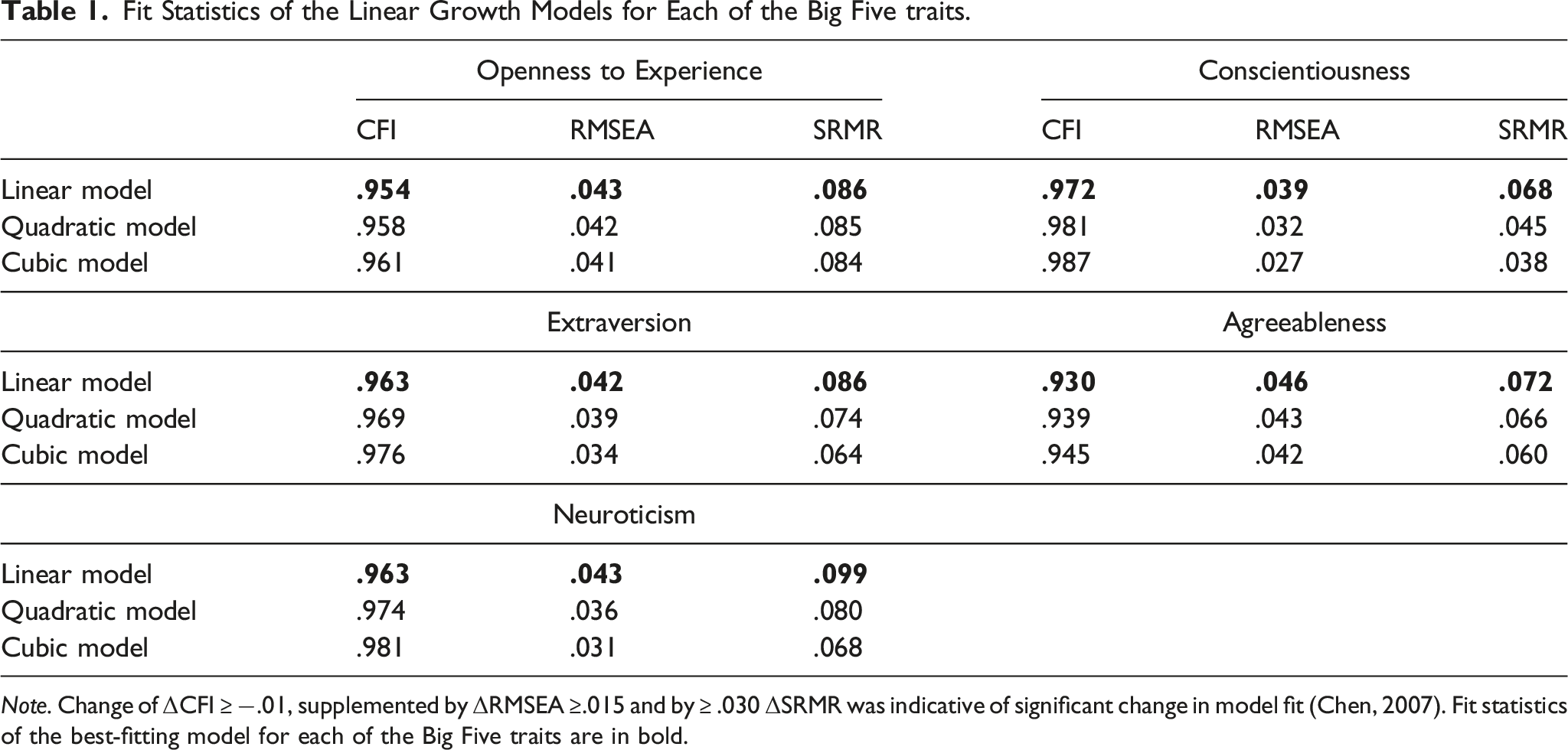
Note. Change of ΔCFI ≥ −.01, supplemented by ΔRMSEA ≥.015 and by ≥ .030 ΔSRMR was indicative of significant change in model fit (Chen, 2007). Fit statistics of the best-fitting model for each of the Big Five traits are in bold.
Parameter Estimates of the Best-Fitting Linear Growth Models for Each of the Big Five traits.
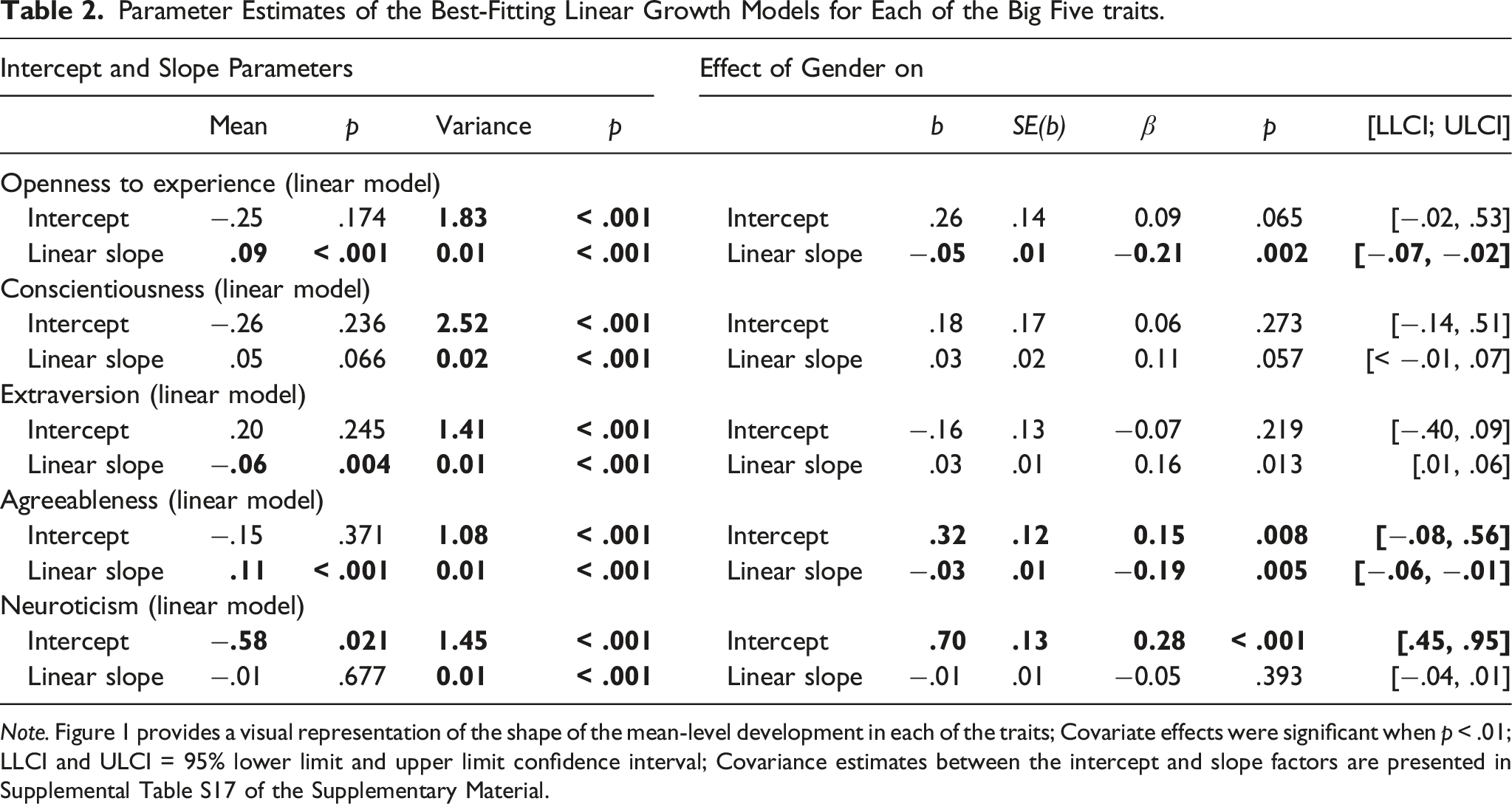
Note. Figure 1 provides a visual representation of the shape of the mean-level development in each of the traits; Covariate effects were significant when p < .01; LLCI and ULCI = 95% lower limit and upper limit confidence interval; Covariance estimates between the intercept and slope factors are presented in Supplemental Table S17 of the Supplementary Material.
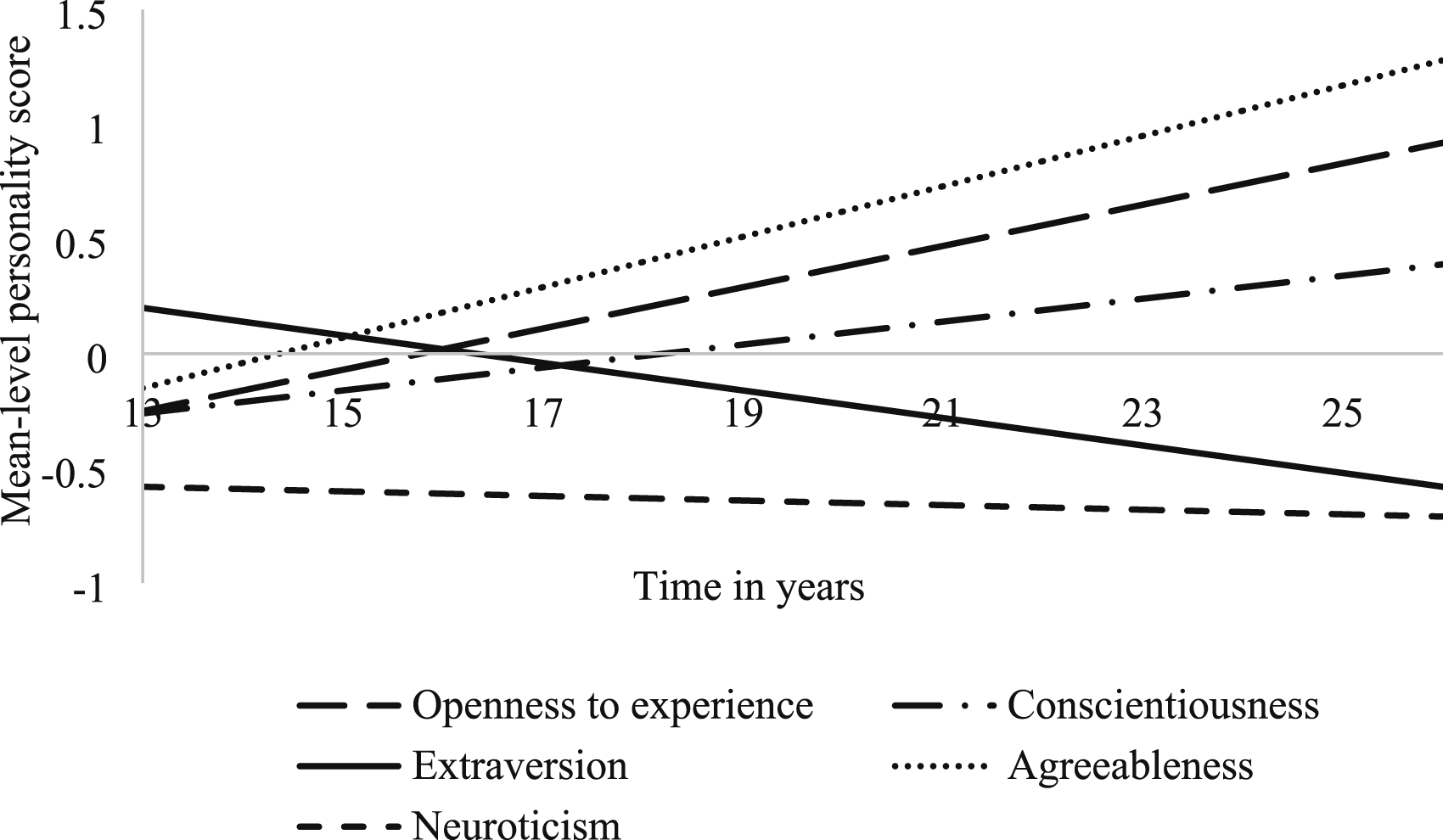
Graphical illustration of the mean-level development of each of the Big Five traits.
Impact of Life Transitions on Personality at Each Wave
Parameter Estimates of the Effects of Educational and Work Role Status as Time-Varying Covariates in the Latent Growth Models for Each of the Big Five traits.
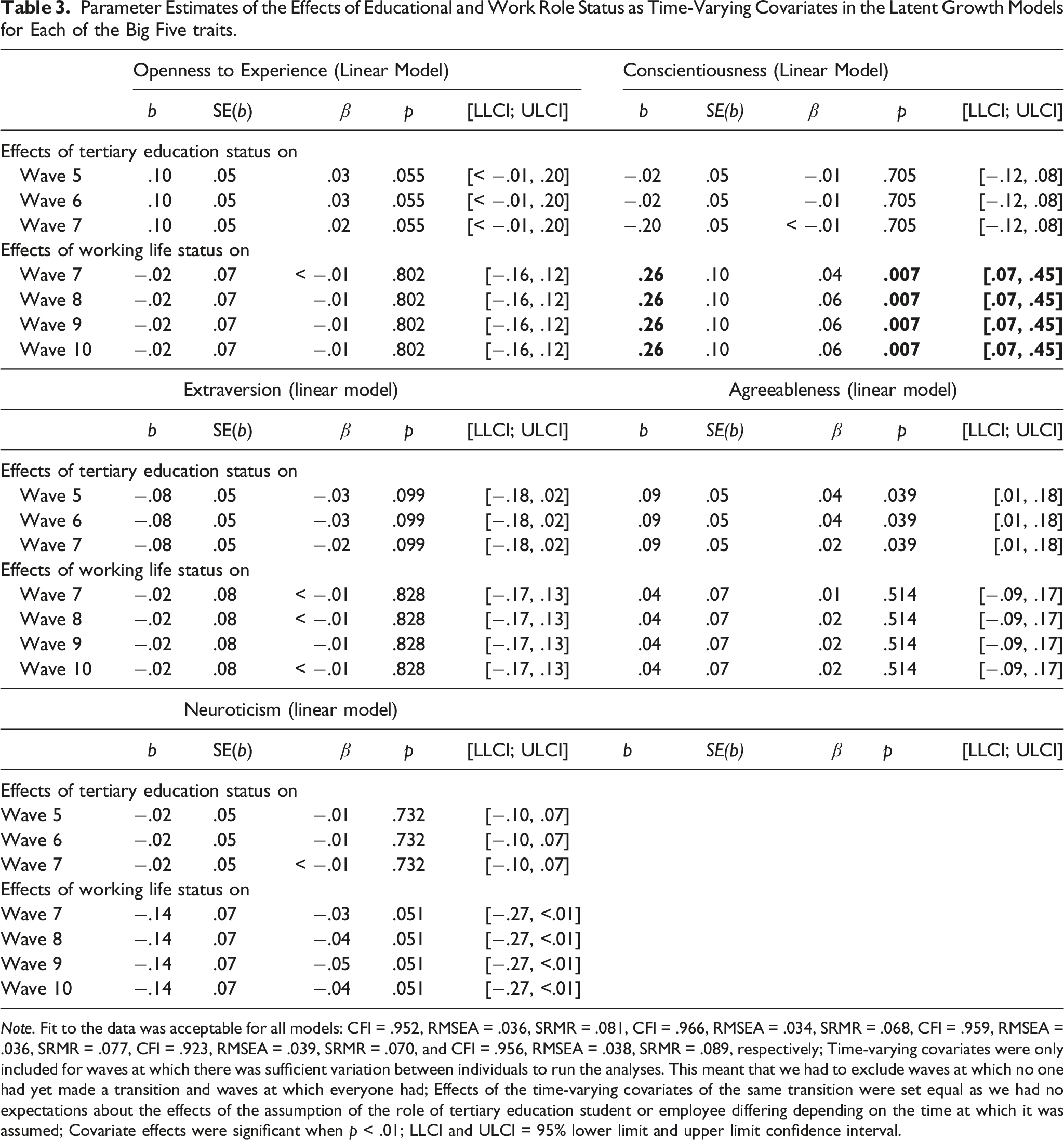
Note. Fit to the data was acceptable for all models: CFI = .952, RMSEA = .036, SRMR = .081, CFI = .966, RMSEA = .034, SRMR = .068, CFI = .959, RMSEA = .036, SRMR = .077, CFI = .923, RMSEA = .039, SRMR = .070, and CFI = .956, RMSEA = .038, SRMR = .089, respectively; Time-varying covariates were only included for waves at which there was sufficient variation between individuals to run the analyses. This meant that we had to exclude waves at which no one had yet made a transition and waves at which everyone had; Effects of the time-varying covariates of the same transition were set equal as we had no expectations about the effects of the assumption of the role of tertiary education student or employee differing depending on the time at which it was assumed; Covariate effects were significant when p < .01; LLCI and ULCI = 95% lower limit and upper limit confidence interval.
Impact of Life Transitions on Mean-Level Personality Development Around the Life Transitions
Parameter Estimates of the Piecewise Linear Growth Models for Each of the Big Five Traits for the Centered Data Around the Transition to Tertiary Education.
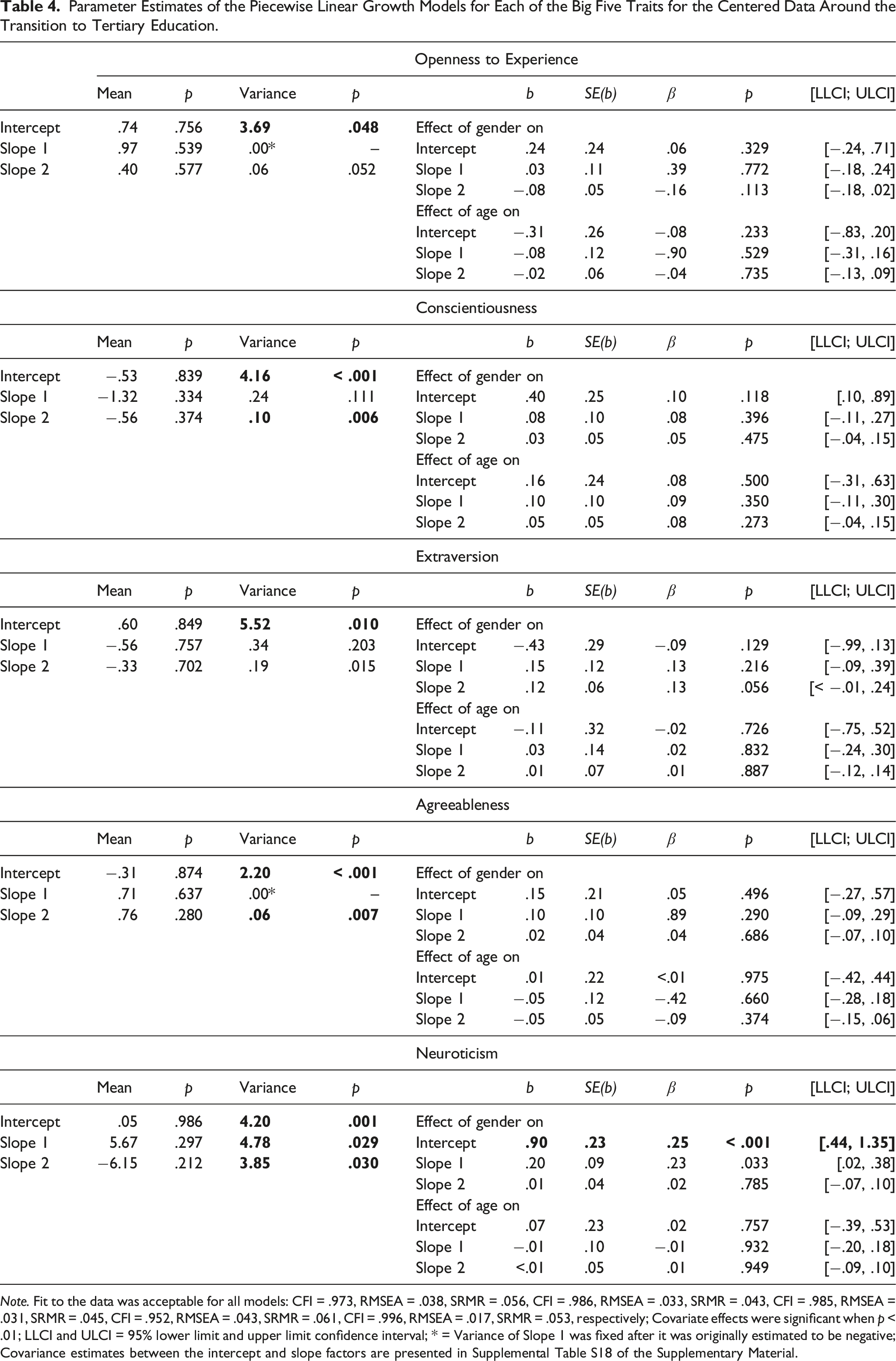
Note. Fit to the data was acceptable for all models: CFI = .973, RMSEA = .038, SRMR = .056, CFI = .986, RMSEA = .033, SRMR = .043, CFI = .985, RMSEA = .031, SRMR = .045, CFI = .952, RMSEA = .043, SRMR = .061, CFI = .996, RMSEA = .017, SRMR = .053, respectively; Covariate effects were significant when p < .01; LLCI and ULCI = 95% lower limit and upper limit confidence interval; * = Variance of Slope 1 was fixed after it was originally estimated to be negative; Covariance estimates between the intercept and slope factors are presented in Supplemental Table S18 of the Supplementary Material.
Parameter Estimates of the Piecewise Linear Growth Models for Each of the Big Five Traits for the Centered Data Around the Transition to Working Life.
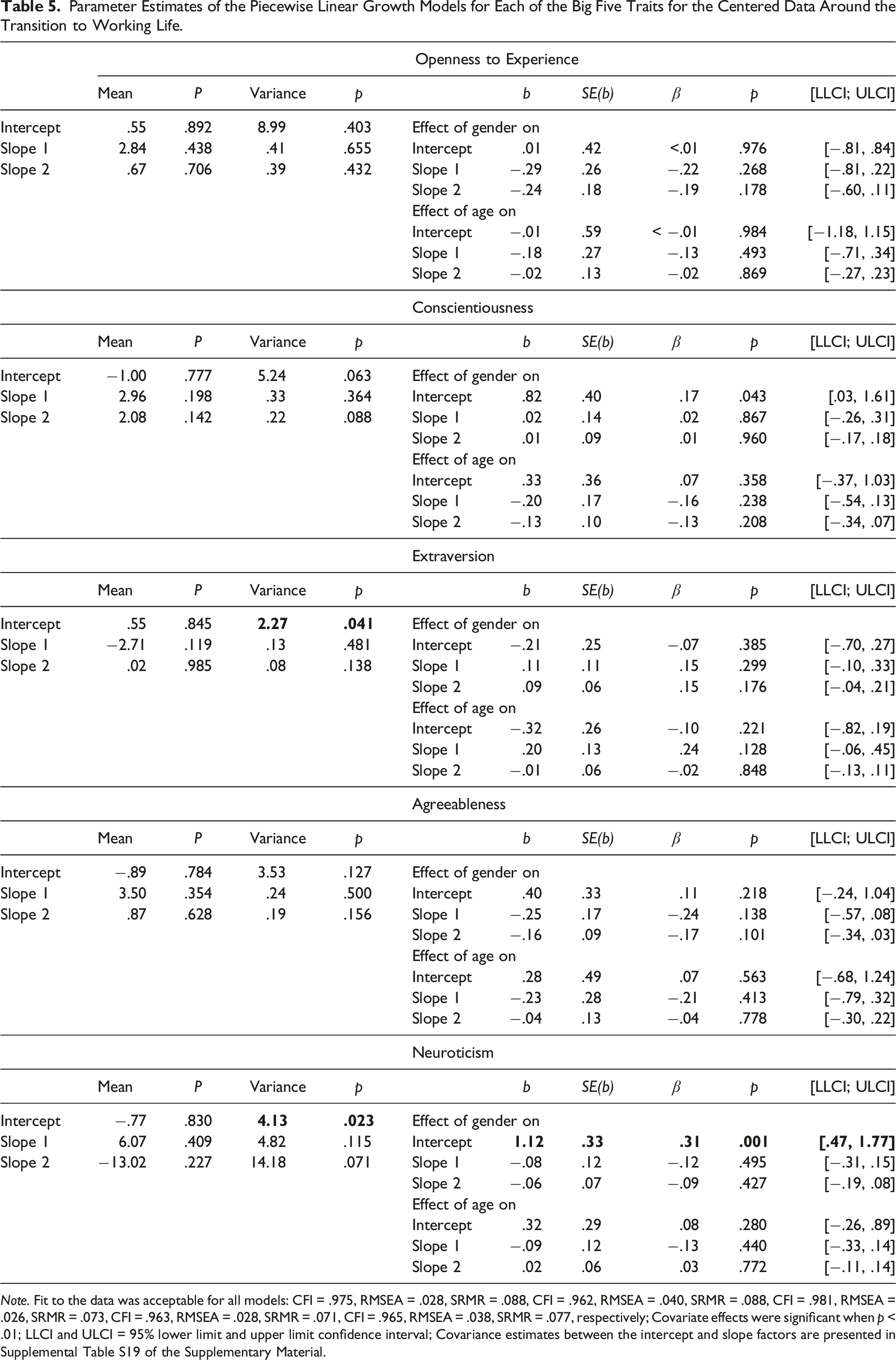
Note. Fit to the data was acceptable for all models: CFI = .975, RMSEA = .028, SRMR = .088, CFI = .962, RMSEA = .040, SRMR = .088, CFI = .981, RMSEA = .026, SRMR = .073, CFI = .963, RMSEA = .028, SRMR = .071, CFI = .965, RMSEA = .038, SRMR = .077, respectively; Covariate effects were significant when p < .01; LLCI and ULCI = 95% lower limit and upper limit confidence interval; Covariance estimates between the intercept and slope factors are presented in Supplemental Table S19 of the Supplementary Material.
Moderating Role of Self-Concept Clarity in Mean-Level Personality Development
Fit Statistics of the Latent Class Analysis Solutions With Two to Four Classes of Self-concept Clarity.
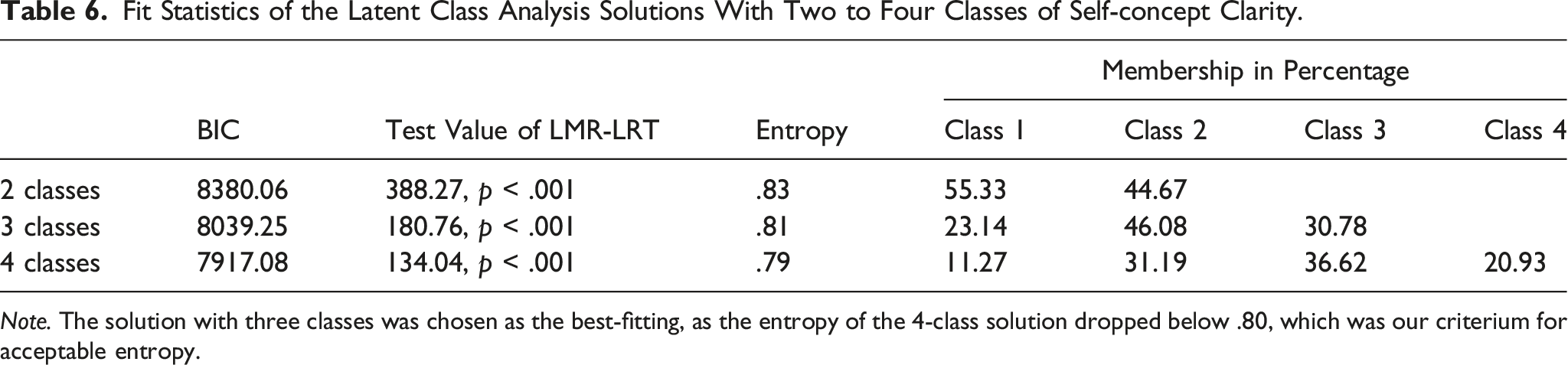
Note. The solution with three classes was chosen as the best-fitting, as the entropy of the 4-class solution dropped below .80, which was our criterium for acceptable entropy.
Summary of Model Fit Statistics of the Constrained and Unconstrained Multigroup Piecewise LGMs Around the Transition to Tertiary Education for Each of the Big Five Traits.
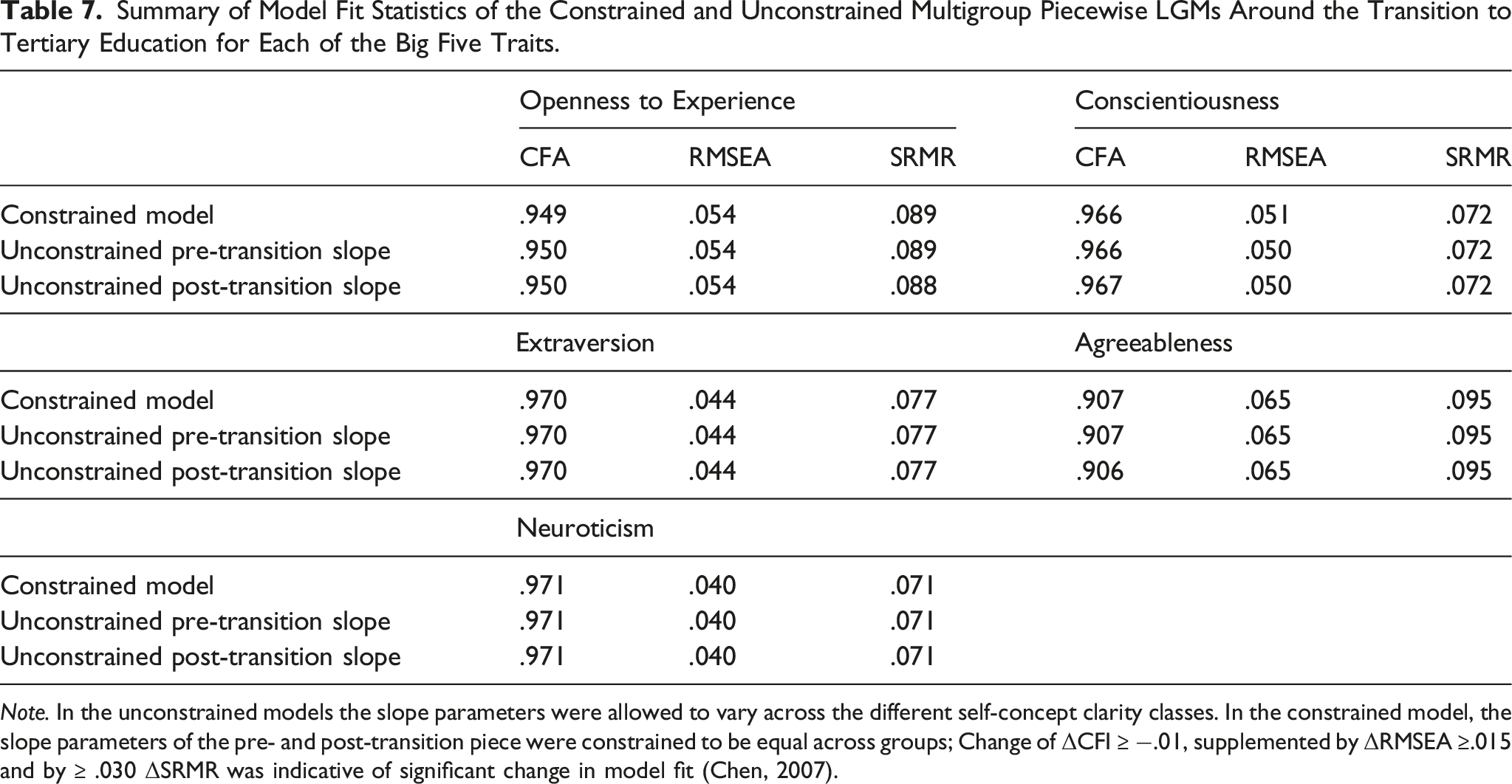
Note. In the unconstrained models the slope parameters were allowed to vary across the different self-concept clarity classes. In the constrained model, the slope parameters of the pre- and post-transition piece were constrained to be equal across groups; Change of ΔCFI ≥ −.01, supplemented by ΔRMSEA ≥.015 and by ≥ .030 ΔSRMR was indicative of significant change in model fit (Chen, 2007).
Post-Hoc Analyses with Self-Concept Clarity
Using Continuous Scores of Self-Concept Clarity
In addition to the above pre-registered analyses, we conducted two sets of additional analyses to further explore the role of self-concept clarity. First, to test whether self-concept clarity would predict differences in how youth’s personality changes around the school transition, we additionally examined whether continuous scores of self-concept clarity pre-transition were associated with post-transition personality change. To test this, self-concept clarity at timepoint −1 was included in the centered piecewise LGMs of Step 2b as predictor of the post-transition slope. All of these models fitted acceptably, with the exception of the models for neuroticism around the transition to tertiary education (below cutoff for the SRMR criterium: SRMR = .102) and to working life (SRMR = .103). Consistent with our main analyses, these analyses did not point to any effects of self-concept clarity on personality change (Supplemental Table S21).
Using Self-Concept Clarity as a Time-Varying Predictor of Personality
Second, we investigated whether self-concept clarity was a time-varying predictor of personality. We again extended the models from Step 2b, this time by including self-concept clarity scores at each timepoint (i.e., −3, −2, −1, 1, 2, 3) as predictors of the latent personality factors at the same point. Model fit was acceptable for all models for the transition to tertiary education, but for the models for the transition to working life four out of five models had less-than-acceptable fit in one of three indicators. The findings indicated several significant associations. For the transition to tertiary education, there were significant associations between self-concept clarity and scores on all personality traits except openness to experience (Supplemental Table S22). Youth with higher scores on self-concept clarity reported more extraversion and lower neuroticism than their peers with lower self-concept clarity across all timepoints, and more agreeableness on all but the first timepoint. Moreover, providing some support for moderation by self-concept clarity of the effects of the transition, youth with a clearer sense of self were more conscientious than their peers after the transition to tertiary education. For the transition to working life, having higher self-concept clarity was similarly related to more extraversion and less neuroticism across all timepoints (Supplemental Table S23). In addition, youth high on self-concept clarity reported being more conscientious and agreeable on some timepoints. Effects were very small to small (conscientiousness), small to medium (agreeableness), and large (extraversion and neuroticism).
Discussion
The present study examined the associations of personality development with two transitions that may be considered nearly universal: the transition to tertiary education and the transition to working life. Our findings indicated that there was some mean-level personality development across adolescence and young adulthood and that having the role of employee was related to level of conscientiousness at each timepoint. However, making the transition to tertiary education or working life was not accompanied by mean-level personality change. Moreover, personality change across these transitions was not moderated by young people’s self-concept clarity.
Big Five Personality Development
Across life, individuals generally develop in the direction of a personality profile that allows them to function well in the society that they are a part of (Hogan & Roberts, 2004; Roberts et al., 2008; Roberts & Mroczek, 2008). Supporting this maturity principle and in line with previous research by Van Dijk et al. (2020), we found a linear increase for openness to experience and agreeableness across adolescence and young adulthood, and a decrease for extraversion. In contrast to the maturity principle and our expectations, we found no overall change in conscientiousness and neuroticism, which adds to previous inconsistent findings regarding change in these traits (Klimstra et al., 2009; Luan et al., 2017). However, it should be noted that our study tracked adolescents annually or biannually across 14 years, whereas the study by Klimstra et al. (2009) used five annual waves and Luan et al. (2017) tracked youth across relatively large gaps between measurements (i.e., 5 years and 12 years) in addition to using data with a cohort sequential design (where youth between 11.5 years and 15.5 years were followed for three timepoints across 2 years). As a result of these differences in the period of measurement and the lags between measurements compared to Klimstra et al. (2009) and Luan et al. (2017), respectively, our analyses may not have picked up on relatively temporary trends in change that were found across shorter time spans or greater measurement intervals.
In contrast to previous research, we did not find support for a temporary maturity dip in personality (e.g., Denissen et al., 2013; Soto et al., 2011; Van den Akker et al., 2014; Van den Akker et al., 2021). That is, our findings suggested that a linear change best characterized the pattern of development in the Big Five personality traits, with no change occurring for conscientiousness and neuroticism. Again, it is possible that by tracking youth across longer time periods, subtler, relatively temporary changes in personality are not captured. Interestingly, the absence of a maturity dip not just contradicts previous studies using cross-sectional cohort data (Denissen et al., 2013; Soto et al., 2011; Van den Akker et al., 2021) and longitudinal data (Klimstra et al., 2009; Luan et al., 2017; Van den Akker et al., 2014; Van Dijk et al., 2020), but is also in contrast to a previous study using part of the same data and sample as the present study (Borghuis et al., 2017). In this previous study, youth were followed from adolescence into their early twenties (i.e., from age 13 to 22), whereas the present study extended this period to age 26. Therefore, although tracking youth until their early twenties suggests a temporary dip in conscientiousness, following them for an additional 4 years indicates that a stable pattern best characterizes their overall development. It may thus be the case that temporary fluctuations are less noticeable when we examine personality across a longer period, because they represent only small bumps in overall development.
When we are interested in the development of personality across the life span, such temporary dips or fluctuations may even be less meaningful. Focusing on life transitions, it is possible that certain traits and behaviors become temporarily accentuated, but will mostly bounce back after the transition. However, these fluctuations during and around transition periods might also reflect that transitions are moments of larger potential for change, and research interested in differential trajectories could focus on transition periods to better understand which youth continue on adaptive trajectories and which youth diverge into less adaptive trajectories. When the focus is on such relatively short-term personality fluctuations in relation to longer-term outcomes, more complex statistical analyses may be needed to capture developmental dips across longer time periods (e.g., Ram & Grimm, 2007). Visually inspecting the raw mean scores of conscientiousness at each timepoint (Supplemental Table S5), we do see somewhat lower conscientiousness in adolescence, after which the mean score becomes somewhat higher again.
In sum, there are multiple avenues to consider in the future when studying personality development, depending on the research question that we wish to answer. Although statistical methods to appropriately consider time in our models are becoming more and more available (e.g., Wagner et al., 2019), the theoretical question of what an appropriate timescale is remains and should be considered in light of what we want to learn as different timescales may offer different insights into (youth) personality development. Therefore, important future work concerns the extension of theories of development with an explicit reference to the timescale at which it plays out. In addition, more research with a similar data collection design as the present study is needed to replicate the current findings.
Big Five Personality Development and the Role of Transitions
In addition to mean-level development across adolescence and young adulthood, the present study aimed to shed more light on the role of transition moments in the development of personality. Despite having a clear theoretical expectation of the role of transition moments as well as some empirical support for this association (Klimstra et al., 2018; Leikas & Salmela-Aro, 2015; Lüdtke et al., 2011; Specht et al., 2011), we found only limited support for the association between role assumption and personality change. Specifically, young people who were employed were more conscientious than their peers who did not assume this role. Moreover, examining mean-level personality development across the transition to tertiary education and working life, we found no evidence of a role of the transition in this development. The finding with regard to conscientiousness is in line with our hypothesis as well as previous research, and provides some support for the social investment principle (Roberts et al., 2005; Roberts & Wood, 2006).
On the whole, however, our research is in line with a growing body of work reporting null findings regarding the role of transitions in personality (e.g., Den Boer et al., 2019; Neyer & Asendorpf, 2001; Van Dijk et al., 2020). It is possible that in contrast to socialization effects of the transition to new roles on personality, certain personality traits predispose young people to select into certain situations (e.g., being less agreeable may make people more likely to successfully hold a job). Several studies have found support of such selection effects for life transitions such as the first romantic relationship (Van Dijk et al., 2020) and even the transition to working life (Roberts et al., 2003; Specht et al., 2011). Thus, it is possible that selection effects may be useful to explain the associations between role status and personality found in this study.
Another potential explanation for the absence of transition effects on personality is that transitions affect personality in non-uniform ways. In this case, future work on life transitions may need to move beyond looking at whether or not a transition occurred. As has been suggested for the association between major life events and personality, the role of such impactful moments on personality may depend on characteristics of the transition (Haehner et al., in press; Luhmann et al., 2021) and of the person (Denissen et al., 2019). For example, in the field of identity it has been recognized that the interpretation of an event may be more important for individual outcomes than the simple occurrence of the event (Pasupathi et al., 2007; Skaggs & Barron, 2006). To further improve our understanding of how life transitions impact personality, we need to examine individuals’ interpretation or perceptions of those events and individual differences therein. Moreover, different life events and transitions should also be considered together within the context of the broader life (Bleidorn et al., 2021). As an example, the transition to working life may be experienced quite differently after already moving out of the house and taking care of one’s own finances when going to tertiary education, as compared to when one starts working immediately after secondary school. Taken together, a more holistic approach is needed to examine how life events and transitions combine within individuals and to understand their multiple and potentially contrasting effects on personality.
Alternatively, and simultaneously, here too the timescale may be important to consider. Taking a long-term perspective, the impact of life events and transitions may be negligible and result in the inconsistent findings that have been reported in the literature. However, examining the periods immediately before and after these moments, we may see more evidence of effects on personality. For instance, a recent study on motherhood reported temporary effects on neuroticism from early pregnancy to 6 months after birth (Leikas et al., 2022), whereas other studies with a more long-term perspective did not report any lasting effects (e.g., Specht et al., 2011; Van Scheppingen et al., 2016). Similarly, we may need to track youth more closely as they make the transition to tertiary education and to working life, to capture effects of these transitions on their personality.
The Impact of Life Transitions on Personality Development: Self-Concept Clarity as a Moderator
Finally, we considered that personality change following transition moments may not be uniform across all young people. In particular, we examined whether having a clear view of who they are may make young people less susceptible to external influences (Brechwald & Prinstein, 2011; Campbell, 1990; Levey et al., 2019) and thus adjust less in their personality following a life transition. To examine the role of self-concept clarity in the mean-level development of personality traits across transition moments, we first investigated whether young people differed in their development of self-concept clarity. In line with Crocetti et al., (2016), we found evidence of a low and a high self-concept clarity group. In addition to that we also found an in-between group, with moderate levels of self-concept clarity.
Examining the mean-level development of young people in these three classes across the transition to tertiary education and to working life, we found no evidence of differences in their personality development in the years before and after the transition to tertiary education. That is, young adolescents making these transitions did not have different personality trajectories depending on whether they had low, medium, or high self-concept clarity. For the transition to working life, our models did not converge, possibly because the added complexity of the multigroup model did not weigh up to the limited increase in explanatory power. One possible explanation for the absence of moderation effects is that differences between the groups were rather limited; even the lowest self-concept clarity group reported around the midpoint of the scale. Thus, even this “low” group was probably fairly well-adjusted. However, our post-hoc analyses with a continuous score of pre-transition self-concept clarity also did not suggest a role in post-transition personality change. Possibly, and as is mentioned above, a more in-depth focus on characteristics of the transition to tertiary education and working life and on how these transitions fit into the broader life (Bleidorn et al., 2021) may explain individual differences in the impact of these transitions on personality.
Although youth with different self-concept clarity levels did not report different mean-level change before or after the transition to tertiary education or to working life, self-concept clarity was associated with personality before and after the transition (Supplemental Tables S22 and S23). Our second set of exploratory analyses suggested that youth who reported higher self-concept clarity than their peers also reported being more conscientious, agreeable, and extraverted, and less neurotic around both life transitions. The finding that higher self-concept clarity was related to higher conscientiousness only after the transition to tertiary education provides some tentative evidence for moderation. That is, it seems to suggest that especially after making the transition to tertiary education do high self-concept clarity individuals show more adaptive personality levels. Thus, although self-concept clarity did not seem to predict personality change, it was associated with individual differences in personality around the transition to tertiary education and working life. In particular, youth who had a clearer view of who they are reported more adaptive personality levels than youth with lower levels of self-concept clarity.
Strengths and Limitations
The present study had several strengths. The study made use of longitudinal data spanning one-and-a-half decade with only limited attrition. This design allowed us to examine personality across a long time span, with minimal bias entering the sample over time. Furthermore, we performed a rigorous test of not only whether transition moments impact mean-level personality development, but also if they do so the same for everyone.
However, some limitations need also to be acknowledged. Most notably, the sample used in the present study was somewhat homogenous in terms of socioeconomic status and biased due to selective missingness. Specifically, participants with missing data were more likely to be older, boys, and less extraverted. Although the robustness checks we conducted on the sub sample with complete data did not indicate meaningful differences in the findings, it is important to keep these limitations to the data in mind because they may affect the generalizability of our findings.
Moreover, there were several limitations to the data structure. First, the data were self-reported, meaning that our results may only have captured the parts of personality traits that were observed by the youth themselves and, conversely, may have captured parts of personality traits that would not be observed by others. Previous work has shown that each perspective on personality, such as the perspective of the parents, teachers, co-workers, peers, or youth themselves, contains unique information (e.g., Self-Other Knowledge Asymmetry model; Vazire, 2010). For example, in several studies examining parent-reports in addition to self-reports, parents reported a decrease in neuroticism in later adolescence, whereas the youth themselves reported no such decrease or even an increase (Luan et al., 2017; Göllner et al., 2017; Van den Akker et al., 2014). In the future, it is important to include multiple, age-appropriate observers when studying the impact of life transitions on personality development. Second, our data were gathered annually, which may have resulted in missing potentially short-term mean-level changes in personality before or after the occurrence of life transitions.
Finally, although we have attempted to capture the transition to working life as accurately as possible, it is likely that this transition reflects a gradual transition period rather than one single moment in time. For instance, some individuals may have held a temporary job that increased in hours, may have then started an internship next to their education, and may have transitioned into what we labeled as “working life” from there. This example also showcases the overlap and potential dependency of both transitions. That is, for some young people the transition to tertiary education and to working life may occur in the same period. Moreover, we may expect that the impact of the transition to working life is dependent on whether they make this transition immediately after secondary school or after finishing a tertiary education (e.g., Lüdtke et al., 2011). Thus, the dividing line of what is and what is not “a real job” and at what point in their life someone started one may in practice have been less clear than the classification used in this study and may need to be further disentangled to increase our understanding of the impact of these transitions on youth personality.
Conclusion
The present study found evidence for personality maturation across adolescence and young adulthood. Conscientiousness appeared important for the transition to working life, with employees reporting higher levels than their non-working peers. However, the transition to tertiary education and working life did not appear important for further mean-level personality development, nor did individuals with higher or lower levels of self-concept clarity differ in their adaption to these transitions. Our exploratory analyses did provide some evidence that self-concept clarity is linked to more adaptive personality levels in the years before and after the transition, and may moderate the association between the transition to tertiary education and conscientiousness, but more research is needed to examine these associations further. On the whole, our findings provide only limited support for the social investment principle. Possibly, the transition to tertiary education and working life may be more strongly tied to personality development through selection rather than socialization effects, and needs to be studied further with a focus on the subjective experience of the transition. However, replication of the present findings with a more heterogeneous sample is needed.
Supplemental Material
Supplemental Material—Personality Development Across Adolescence and Young Adulthood: The Role of Life Transitions and Self-Concept Clarity
Supplemental Material for Personality Development Across Adolescence and Young Adulthood: The Role of Life Transitions and Self-Concept Clarity by Elisabeth L. de Moor, Stefanie A. Nelemans, Andrik I. Becht, Wim Meeus, and Susan Branje in European Journal of Personality
Footnotes
Acknowledgments
The authors want to thank the participating children, parents, and schools, as well as all the students and student assistants involved in the RADAR study for making this research possible.
Declaration of Conflicting Interests
The author(s) declared no potential conflicts of interest with respect to the research, authorship, and/or publication of this article.
Funding
The author(s) disclosed receipt of the following financial support for the research, authorship, and/or publication of this article: Elisabeth L. de Moor and Susan Branje were supported by a grant from the European Research Council (ERC-CoG INTRANSITION-773023). Data of the RADAR (Research on Adolescent Development And Relationships) study were used ( ). RADAR has been financially supported by main grants from the Netherlands Organisation for Scientific Research (GB-MAGW 480-03-005, GB-MAGW 480-08-006), Stichting Achmea Slachtoffer en Samenleving (SASS), the Netherlands Organisation for Scientific Research to the Consortium Individual Development (CID; 024.001.003), a grant of the European Research Council (ERC-2017-CoG—773023 INTRANSITION), and various other grants from the Netherlands Organisation for Scientific Research, VU University Amsterdam, and Utrecht University. The funders had no role in the study design, data collection and analysis, decision to publish, or preparation of the manuscript. Initial ethical approval for the project was gained from the medical ethical committee of the University Medical Center in Utrecht (the Netherlands, project number: #05/159-K).
Data Accessibility Statement
The study materials can be accessed at https://easy.dans.knaw.nl/ui/datasets/id/easy-dataset:113721/tab/2. The anonymized data and analysis scripts used for this article can be accessed at .
Supplemental Material
Supplemental material for this article is available online.
Notes
References
Supplementary Material
Please find the following supplemental material available below.
For Open Access articles published under a Creative Commons License, all supplemental material carries the same license as the article it is associated with.
For non-Open Access articles published, all supplemental material carries a non-exclusive license, and permission requests for re-use of supplemental material or any part of supplemental material shall be sent directly to the copyright owner as specified in the copyright notice associated with the article.
