




Abstract
Nearly 25 years ago, four studies examined the development of social value orientation (SVO) and uncovered that SVO was related to specific and general adult attachment, the number of siblings, and age. However, some of these findings have been challenged by two recent replication studies. The present (pre-registered) research extends these replication studies and the original research by using multiple measurements of both SVO and adult attachment on two large samples that allowed us to detect small effect sizes. With online samples (N = 1446 and 2644) from MTurk and Prolific, we replicated earlier findings that prosociality was associated with a greater level of secure attachment and a lower level of avoidant attachment. Moreover, prosociality was positively related to the number of siblings, especially sisters, as discovered by Study 3 of the original study. However, we failed to replicate the significant relation between SVO and age. Generally, we conclude that prosocial orientation is associated—even if modestly—with secure and avoidant attachment and the number of siblings, but the link with age is a question open to future investigation.
Classic theory and research uncovered the importance of social value orientation (SVO)—weights that people assign to their own and others’ outcomes in situations of interdependence—that help people navigate social situations (Messick & McClintock, 1968; Van Lange, 1999). At the time, many experimental studies focused on the well-known prisoner’s dilemma and other game situations, characterized by a conflict between self-interest and collective interest. They found that across a number of games and social settings, some people were more prone to cooperate, to respond differently to cooperative others, as well as to expect cooperation from others (Kelley & Stahelski, 1970; Kuhlman & Marshello, 1975; Kuhlman & Wimberley, 1976; for a recent meta-analysis, see Thielmann et al., 2020).
Extending this earlier research, later conceptualizations focused on differences in three categories of SVO: (a) the tendency to enhance joint outcomes and equality for self and others (prosocial orientation), (b) the tendency to enhance outcomes for self in an absolute sense (individualistic orientation), and (c) the tendency to enhance outcomes for self, relative to the outcomes for others (competitive orientation, see Murphy & Ackermann, 2014; Van Lange, 1999). Subsequent research found that, when facing interaction with others, prosocials act as conditional cooperators (to approach others cooperatively, and continue to do so if the other cooperators do the same, see Ackermann & Murphy, 2019), individualists act as instrumental cooperators (to cooperate only if this promotes their own outcomes in the short or long run), and competitors act as consistent noncooperators (because cooperation can never yield greater relative advantage over other’s outcomes, see McClintock & Liebrand, 1988; Van Lange et al., 2013; Van Lange, Klapwijk, et al., 2011).
Research in more recent years has extended this line of research, demonstrating the importance of SVO in contexts other than economic games. Relative to individualists and competitors, prosocials have a preference for contributing to environmental concerns (Fleiß et al., 2020), are more likely to donate to noble causes (Van Lange et al., 2007), including to help needed to alleviate the suffering from an acute disaster (e.g., Typhoon; Manesi et al., 2019), to provide costly help to refugees (Böhm et al., 2018), and report more energy conservation behaviors (Sütterlin et al., 2013). Moreover, SVO has been shown to be associated with political orientations, with prosocials being more likely to be left-wing oriented than individualists (Chirumbolo et al., 2016; Van Lange et al., 2012). And finally, some previous research has examined the associations of SVO with other personality traits. Prosociality is found to be positively related to HEXACO Honesty-Humility and Big Five Agreeableness (although the link between SVO and Agreeableness is less stable, Hilbig et al., 2014), and negatively associated with dark traits (Jonason et al., 2010).
This brief review provides an overview of past research on SVO. While not exhaustive, it shows that SVO has a long history of research with noteworthy extensions over the past two decades. At the same time, past research on SVO has paid relatively little attention to its social developmental roots. In recognition of this gap in the literature, Van Lange et al. (1997) examined whether SVO is associated with attachment styles—a variable central in research on social development—and the number of siblings and birth order, as well as development throughout the life span. This research used the Triple Dominance Measure of SVO—a widely used measure of SVO that will be elaborated later, as well as the Adult Attachment Scale, and found that relative to individualists and competitors, prosocials revealed higher levels of secure attachment in general (Study 1) and in their ongoing close relationships (Study 2); they also found that relative to individualists and competitors, prosocials reported having a greater number of siblings, in particular, sisters (Study 3); and a cross-sectional study revealed an association between prosocial orientation and age: people are prone to be more prosocial and less individualistic with increasing age (Study 4).
The social development of SVO was approached from an interdependence perspective that emphasizes how individuals’ behavior affects both themselves and others’ outcomes. And as the subtitle of the paper indicates, the data provided only tentative evidence: “Theory and preliminary evidence” (Van Lange et al., 1997, p. 733). More recently, two studies have sought to replicate the Original Studies 1 and 3, respectively. One failed to replicate Original Study 1—the association between SVO and secure attachment (IJzerman & Denissen, 2019). And another article failed to replicate the Original Study 3 in that they did not find a significant association between SVO and the total number of siblings (Klein et al., 2018). While these replication studies are informative, they still have some limitations. For instance, researchers adopted different measures of SVO that might be one of the possible reasons for replication failure (details see the corresponding sections below).
Thus, the goals for the present research are fourfold. First, we sought to examine the correspondence between methodologically related but distinct measures of SVO. Hence, we included the two most used measures of SVO—the Triple Dominance Measure and the Slider Measure, which allow us to examine whether the discrepant features of the measures may explain the replication failures. Second, we sought to examine the associations between SVO and adult attachment—the internal representations of an infant and the primary caregiver that persists through the life span (Carnelley & Janoff-Bulman, 1992)—through two well-established attachment scales. This allows for a more rigorously conceptual replication of the Original Study 1 and can directly compare the results with IJzerman and Denissen (2019). Third, we sought to replicate the Original Study 3 by examining the association between SVO and the number of siblings (especially sisters) and birth order (whether individuals with fewer older siblings are more likely to be individualists or competitors rather than prosocials). And finally, we sought to replicate the Original Study 4 by examining the (cross-sectional) association between SVO and age to figure out whether prosocial orientation is more prevalent with increasing age.
Goal 1: Correspondence between Triple Dominance and Slider Measures
Overview of the SVO measures.
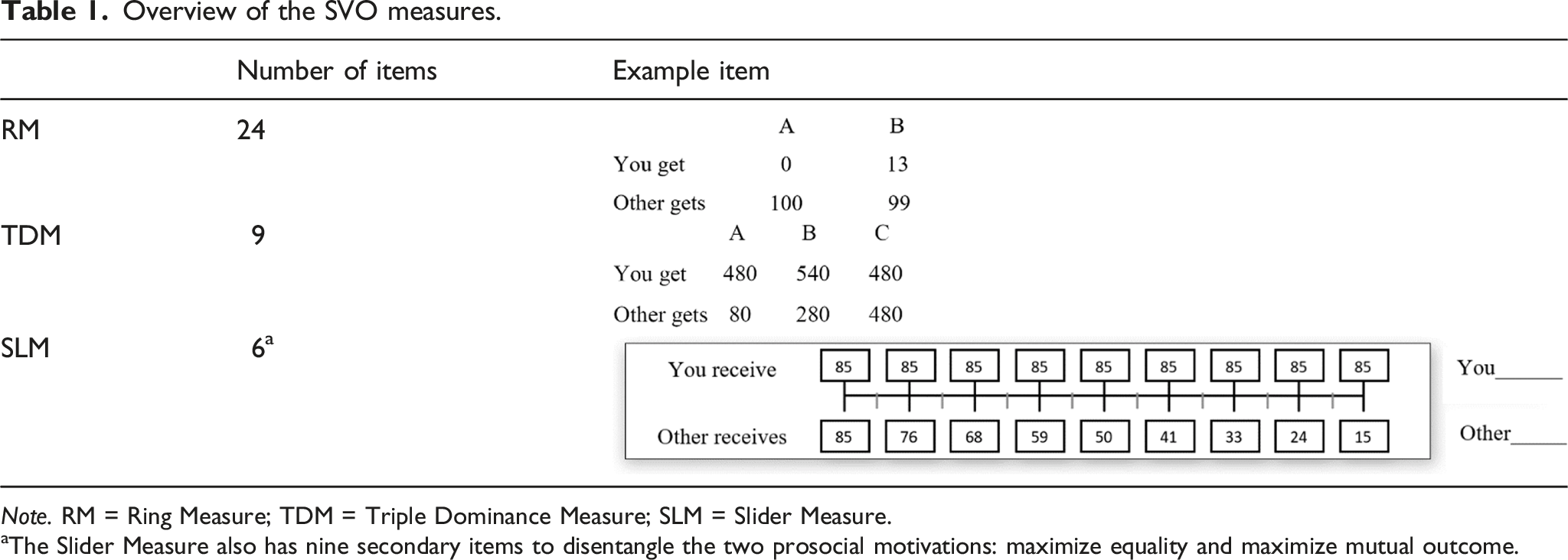
Note. RM = Ring Measure; TDM = Triple Dominance Measure; SLM = Slider Measure.
aThe Slider Measure also has nine secondary items to disentangle the two prosocial motivations: maximize equality and maximize mutual outcome.
The TDM contains nine decomposed games (Van Lange et al., 1997, 2012). In each game, participants decide on three forced choices, which indicate a prosocial (e.g., 480 points for self and 480 points for other), an individualistic (e.g., 540 points for self and 280 points for other), or a competitive preference (e.g., 480 points for self and 80 points for other). Participants are classified as prosocials, individualists, or competitors when they make six or more consistent choices out of the nine items. There is good evidence for this three-category typology. Even when people were forced to make pairwise decisions between two alternatives in a two-dimensional space (involving outcomes for self and outcomes for other), they tended to cluster into three groups: prosocials, individualists, and competitors, even though competitors constituted a relatively small group (Liebrand & McClintock, 1988).
The outcome distributions of the RM and SLM can be represented on a Cartesian coordinate system where the x-axis represents the payoffs for participants themselves, and the y-axis illustrates the outcomes for the unknown other. In the RM, the allocation decisions are defined by 24 equidistant points on a circle center at (0, 0) with a radius of 100. Participants need to make decisions between the two adjacent allocations, resulting in 24 dichotomous decisions in this measure. The SLM contains six primary and nine secondary items,
1
which can be represented on the circle center at (50, 50) with a radius of 50 (see Figure 1). From top to bottom, the four black dots on the circle represent purely altruistic, prosocial, individualistic, competitive self-other outcome distributions. The nine self-other outcome distributions of each six primary items of the SLM are derived from the six lines that each links two points at one time. The distribution of the averaged resource toward self and other could be transformed into a continuous SVO angle.
2
A higher angle means a higher level of prosociality. Illustration of TDM and SLM items in the Cartesian Coordinate System. Note. The green dots represent the nine items of the TDM. We divided the original points in the TDM by 5.8 to fit the options in the Cartesian coordinate system. The blue lines represent the six primary items of the SLM. The nine joint payoffs are selected evenly on them. The figure was adapted from Murphy and Ackermann (2014).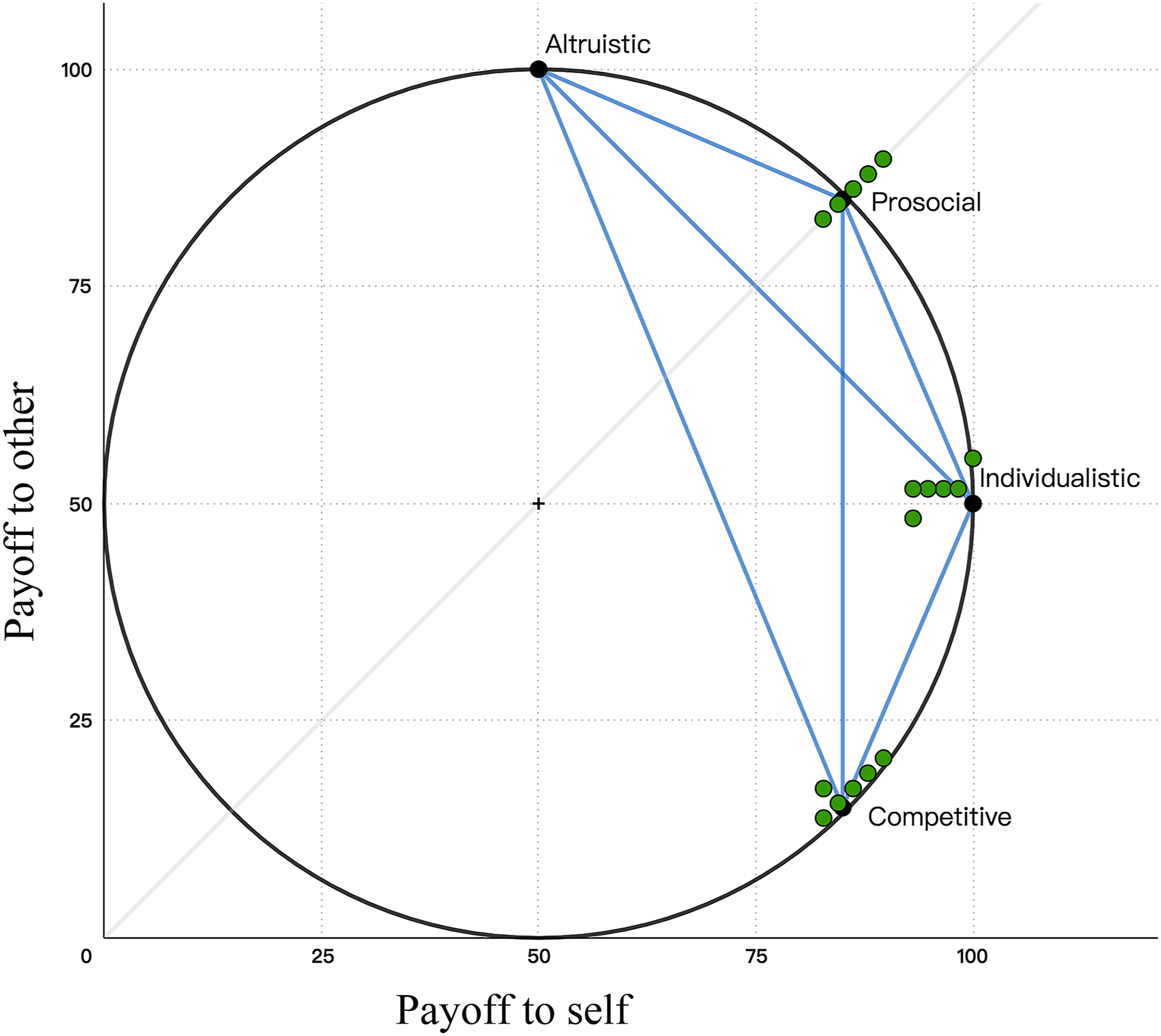
Therefore, rather than simultaneously representing three discrete options, the SLM yields a continuum that reflects the degree to which people have positive or negative regard for others by using nine discrete options (see also Balliet et al., 2009; Murphy & Ackermann, 2014; Murphy et al., 2011). In this case, the SLM assesses gradual choices on a spectrum, each time ranging from, for example, maximization of joint outcomes (cooperation) to maximizing relative advantage over another’s outcomes (competition). In the example item in Table 1, prosociality guides one to the right, whereas both individualism and competition may guide a participant to navigate to the left, and individualism and competition can be inferred from different pairwise “slidings.”
While the RM and TDM have been used for decades, the RM has been less used in recent years because, relative to the TDM and SLM, it is time-consuming to administer, and it tends to show weaker convergent validity and test–retest reliability (Murphy & Ackermann, 2014). The TDM and SLM are both used a lot in recent research, but the more recently developed SLM has become increasingly popular among researchers because of its exemption of the risk of unclassifiable individuals, and especially its broad use in research as an individual difference or continuous dependent variable (i.e., providing both categorical and continuous outputs, e.g., see Van Doesum et al., 2021).
Overall, the present research examines the correspondence between the TDM and SLM. This serves two replication purposes. It serves as a replication of earlier research (i.e., Murphy et al., 2011) that, with a somewhat small sample size, it showed a fair but no strong correspondence between these two measures; and it helps us to explore whether the associations with attachment, number of siblings, and age are similar for the two measures.
Goal 2: Social value orientation and adult attachment style
One of the key constructs relevant to social development is attachment style. Attachment style is a reflection of differences in beliefs and emotions with which people approach relationships, and these differences are partially rooted in a history of relationships. Attachment security reflects a positive interaction experience with others, a basic trust or security to approach people, including strangers (Mikulincer et al., 2003; Van Lange et al., 1997). In contrast, attachment avoidance relates to a less benign view of others—the intentions of other people are believed to be not that kind, gentle or harmless—and makes people prefer less closeness with and less dependence on others, while attachment anxiety reflects a less benign view of self that results in anxiety or worries of being abandoned (Mikulincer et al., 2003). The latter two attachment styles together refer to as the insecure attachment, which indicates lower levels of trust in other people, albeit they differ in the desire to be close and interdependent.
In the Original Study 1, Van Lange et al. (1997) used the TDM of SVO and Adult Attachment Scale validated by Carnelley and Janoff-Bulman (1992). They found a significant association, albeit modest in effect size, between SVO and attachment style, with prosocials exhibiting higher levels of secure attachment style than individualists and competitors. At the time, this was an extension of earlier research showing that relative to individualists and especially competitors, prosocials exhibited greater trust in others (e.g., Kuhlman et al., 1986).
Recently, IJzerman and Denissen (2019) provided a replication of the Original Study 1 in a relatively large sample size (N = 879, the sample size of the Original Study 1 was N = 573) and with multiple attachment scales. However, they did not find a significant association between SVO categories and adult attachment styles. This was a conceptual replication with several changes. Different from the Original Study 1, which used a variety of students, IJzerman and Denissen used only psychology students; there is evidence that psychology students are on average more prosocial than students that select other majors (e.g., economics, see Van Lange, Schippers, et al., 2011; Van Andel et al., 2016; there were 65% prosocials in the study of IJzerman & Denissen, 2019, while the number was 54% in the Original Study 1.) Further, the replication study included the Adult Attachment Scale (AAS; Collins & Read, 1990) as well as the Revised Experience in Close Relationship Scale (ECR-R; Fraley et al., 2000), rather than the original scale validated by Carnelley and Janoff-Bulman (1992). We should note that the reliability of the attachment scale, especially the five-item secure attachment subscale, included in the Original Study 1, was very low, which might be in line with the development of the construct of attachment: there is a shift in the field of adult attachment from three types of attachment (i.e., security, avoidance, and anxiety) to two dimensions (i.e., avoidance and anxiety; Fraley, 2019). The attachment scales based on the typological model provide less precision for secure people, especially those high in secure dimension (Fraley et al., 2000). And in this case, the ECR-R, which is based on a two-dimensional construct, might be a more reliable measure of adult attachment (Fraley et al., 2015). Overall, the current study aims to comprehensively examine the association between SVO and adult attachment by including all measures mentioned above.
Goal 3: Social value orientation and siblings
Social development may also be shaped by key differences in the social environment where a young child faces interdependence. In the original article, it was theoretically argued that a large family size could either facilitate or inhibit the development of prosocial orientation. From one perspective, the number of siblings promotes the development of prosocial orientation because children enhance social skills, including sharing and collaborating, helping and caring, during the interaction with siblings (see Hughes et al., 2018). From another perspective, the development of prosocial orientation may be tempered because cooperation tends to decline with increasing group size, as shown in some research on social dilemmas (e.g., Hamburger et al., 1975; Messick & McClelland, 1983).
In the Original Study 3, what they found was a significant association between SVO and the number of siblings, even though this was completely accounted for by prosocials having a greater number of sisters (rather than brothers) than individualists and competitors (Van Lange et al., 1997). A replication by Klein et al. (2018), which included many countries with a large sample size (N = 6234), intended to conceptually replicate the association between SVO and the total number of siblings. However, they did not replicate the original results, even though they showed large differences in the associations between SVO and the number of siblings across the countries involved in the study. Again, it was a conceptual replication in that it used the SLM rather than the TDM, 3 and also, it did not include the sex of the siblings and birth order but only the total number of siblings. Moreover, after using the scoring scheme of the SLM (Murphy et al., 2011), we categorized the participants in Klein’s study into three categories and found that 74.1% of them were prosocials, and only 25.4% were individualists. The skewed sample renders a significant relationship between SVO and the number of siblings (or sisters) less likely. In general, the current study aims to replicate the association between SVO and the number of siblings using both measures of SVO.
Goal 4: Social value orientation and age
Social development also changes throughout the life span. Although the avenues of how age might be associated with prosociality are complex (Matsumoto et al., 2016; Mayr & Freund, 2020; Romano et al., 2021), Van Lange et al. (1997; Study 4) showed that prosocial orientation, as measured by the TDM, was more prevalent with increasing age. This finding is in line with the prosocial-growth hypothesis and could be understood by three complementary explanations. The first explanation is individual learning which suggests that individuals learn the functional value of prosociality through various interactions with people. For example, a conditionally cooperative strategy is associated with greater long-term outcomes for self and the dyad. This idea is supported by the other study, which suggests that people shift from immediate to long-term gains with aging (Matsumoto et al., 2016). The second explanation is that interdependent situations change with age. From younger adults to older adults, the situation changes from being independent of others or competing with others to being counted on by others because of their accumulated capital or dependent on others for care reasons. The third explanation focuses on cohort differences. For example, older people are more likely to be raised in rural environments than in urban environments, which may (or may not) promote the development of prosocial orientation (see a meta-analysis by Steblay, 1987).
Besides the possible explanations advanced in the original research, the age-related trends in prosociality might also be explained by the number of material resources people have. Compared to younger adults, older people usually accumulate greater wealth, and therefore, the same cost to benefit others is less weighted or valued for them (see Mayr & Freund, 2020). Another indirect evidence for the possible relation between SVO and age is that personality traits related to SVO are shown to vary across the life span. For example, Honesty-Humility increases (Ashton & Lee, 2016), and Machiavellianism, one of the typical dark traits, decreases (Götz et al., 2020) from emerging adulthood until age 60. Above all, the current study uses a larger sample size to replicate the association between SVO and age. Additionally, with the continuous score of SVO provided by the SLM, we can also detect the linear relation between these two variables.
The present research: Pre-registered hypotheses
Because one of the two earlier replication studies used different measurements of SVO, the first goal of the present research is to examine the correspondence between two commonly used measures of SVO: the TDM and the SLM.
The other three goals of the present research are to replicate the original research by examining the associations between SVO and adult attachment styles, the number of siblings (especially sisters), and age. This research sought to make the replication as precise as possible by including exactly the same measures, as well as extending them in four respects: (1) a large sample size; (2) a broader group of participants instead of only students, as in the Original Study 1 and Study 3; (3) the nationality of the participants was American instead of Dutch; 4 and perhaps most importantly, (4) we used multiple measurements of adult attachment, including the one used in the original study as well as the two scales used in the replication study of IJzerman and Denissen (2019). And we expected to find similar results as the original studies with the following pre-registered hypotheses:
We predicted an association between SVO and attachment, as found in the Original Study 1. For SVO categories measured by the TDM, relative to individualists and competitors, prosocials were predicted to report a higher level of secure attachment and lower levels of avoidant and anxious attachments than individualists and competitors. We did not advance formal predictions regarding differences between individualists and competitors. SVO angle measured by SLM was predicted to be positively associated with secure attachment but negatively associated with avoidant and anxious attachments.
We predicted an association between SVO and the number of siblings: the total numbers of siblings, older siblings, and sisters, respectively, were predicted to be higher among prosocials than individualists or competitors. Also, the SVO angle was assumed to be positively related to those numbers of siblings.
We predicted an association between SVO and age. Compared with younger participants, prosocial orientation measured by the TDM is more prevalent, and individualistic and competitive orientations are less prevalent, with increasing age. Moreover, we predicted a positive relation between the SVO angle and participants’ age.
Method
We conducted a priori power analyses and recruited two samples, which were independently pre-registered on OSF before data collection (https://osf.io/g9b7c/). With the consideration of the insightful comments provided by the editor and reviewers, we decided to combine the two samples when analyzing the data. Also, we used regression analysis instead of (M)ANOVA (see the Results section). We specified the deviations from the pre-registration in detail in the Supplementary Material, and the results of the pre-registered analyses are reported there as well. Finally, all measures, datasets, and the analysis script can be found in the OSF folder (https://osf.io/g9b7c/).
Sample
For Sample 1, a priori power analysis by G*power indicated that to reach a small effect f 2 = .0056 (the association between SVO and attachment security in the study of IJzerman & Denissen, 2019, which is the smallest effect size among all effects of our primary interests), alpha = .05, power = .80, a study with 3 groups (SVO: prosocial vs. individualists vs. competitors) and 3 response variables (Attachment: security, avoidance, anxiety) using MANOVA needed to include 1215 participants. We finally recruited 1502 American adults from the online platform MTurk, with the aim to include a sufficient number of participants with a competitive orientation. 5
To provide a comprehensive test of the association between age and SVO, as well as explore whether the sequence of measures might affect the results or not, we collected the second sample, which is representative regarding age and sex, through another crowdsourcing platform—Prolific Academic. We used a higher power value (1-β = 95%) to estimate the sample size for a stronger replication. The estimated sample size was 2588 to detect the smallest effect size of interest found in Sample 1 (the effect of SVO measured by the TDM on the number of sisters, ηp2 = .005) with a power of 95% when using ANOVA with a 3-level predictor. We finally recruited 2714 participants. 6
After checking the data, fifty-six participants in Sample 1 (3.7%) and seventy participants in Sample 2 (2.6%) were excluded because (1) they failed to pass at least one of the two attention check questions and/or (2) they choose “other” as their sex identification. We excluded those with “other” sex identification because only men and women were included and examined in the original paper, although we treated sex as a control variable in our analyses. Among those 1446 participants in Sample 1, there were 823 men and 623 women, with an average age of 35.29 years old (SD = 10.46). And for Sample 2, there were 1320 men and 1324 women (Mage = 39.61, SD = 12.05). The questionnaire lasted for around 10 minutes, and each participant got $1.3 US dollars or £ 0.9 pounds for compensation. The study has been approved by the Scientific and Ethical Review Board of the university (VCWE-2019-093; VCWE-2021-109).
Measures
We used the same measures in the two samples, except that in Sample 2, we also measured participants’ income and education level. The scales used to measure SVO and adult attachment are listed below.
The Triple Dominance Measure of social value orientation
As described before, the TDM contains nine decomposed games (Van Lange et al., 1997, 2012). Categorical SVOs (prosocials, individualists, and competitors) were calculated when participants made six or more consistent choices out of the nine items; otherwise, they would be recorded as unclassified. The test–retest reliability of this scale in Murphy et al. (2011) was 70% in a small sample size (N = 46).
The Slider Measure of social value orientation
We only used the six primary items in the current study and calculated the continuous SVO angles. To investigate the correspondence between the two SVO measures, we also classified participants into three SVO categories based on the angle-scores: prosocial (>22.45°), 7 individualist (−12.04° to 22.45°), and competitor (<−12.04°). The test–retest reliability in a previous study showed that 89% of the participants (N = 46) were classified into the same SVO category between two sessions (1 week; Murphy et al., 2011). And when considering the score as a continuous variable, the correlation between the two sessions in Murphy et al. (2011) was r = .92.
Adult Attachment Scale
This is one of the scales used in the replication study conducted by IJzerman and Denissen (2019) to measure adult attachment. It consists of 18 items and has three subscales: Close, Depend, and Anxiety (referred to as CDA in the current study; Collins & Read, 1990). Participants chose whether the statements (e.g., “I find it difficult to allow myself to depend on others.”) were not at all characteristic of themselves (“1”) to very characteristic of themselves (“5”). The test–retest reliability for the Close, Depend, and Anxiety subscales in a previous study were .68, .71, and .52, respectively (Collins & Read, 1990).
Because the 18 Adult Attachment Scale items were adapted from statements originally representing attachment Security, Avoidance, and Anxiety, we also used these original item groupings to calculate the subscale scores of attachment Security, Avoidance, and Anxiety (referred to as AAS) as IJzerman and Denissen (2019) did for comparison purpose (see Supplemental Material Table S3).
Adult Attachment Style Questionnaire in Original Study 1
All the items used in the Original Study 1 can be found in the 18-item Adult Attachment Scale except for one question, “I find it easy to trust others.” 8 Thus, we added this question to the Adult Attachment Scale to contain all questions used in Van Lange et al.’s (1997) studies (referred to as Original in the following sections). Five items measure attachment Security. The attachment Avoidance and Anxiety subscales contain three items, respectively (see Supplemental Material Table S3). The Cronbach α was .46, .66, and .67 for the Security, Avoidance, and Anxiety styles in Original Study 1.
Revised Experiences in Close Relationships Scale
This scale was developed to measure the attachment in a close relationship (Fraley et al., 2000). However, to fit in our study, we changed the target in each item from “partners” to “other people” (specific items can be found on OSF) to measure the attachment in a general relationship. In this scale, only attachment Avoidance and attachment Anxiety are directly measured through 36 items (Fraley et al., 2000). Participants were asked to indicate their opinions on statements about their general relationships (e.g., “It’s not difficult for me to get close to other people.”) from 1 (strongly disagree) to 7 (strongly agree). Although attachment Security is not directly measured, we can calculate the score of Security by reversing the average score of Anxiety and Avoidance (Fraley, 2012). The Cronbach α reported in a previous study was .93 and .95 for the Avoidance and Anxiety subscales, respectively (Sibley & Liu, 2004).
Procedure
We created the questionnaire on the platform Qualtrics. After consenting, participants first answered two SVO scales and two Adult Attachment Scales. In Sample 1, SVO scales were always displayed before the Adult Attachment Scales because we assumed SVO was related to people’s preferences and could be affected by questions reminding social interactions and connotations of the language of earlier measures that decomposed games seek to minimize (e.g., wordings of “closeness” in attachment scales). However, in Sample 2, we randomized the sequence of SVO and adult attachment to see whether the sequence affected the findings. 9 Further, in both samples, the sequences within the SVO scales and attachment scales were counterbalanced, and two attention check questions were inserted into the attachment scales. Finally, demographic information and the number of younger siblings, older siblings, sisters, as well as brothers 10 were gathered. As mentioned before, we also measured participants’ income level and education level in Sample 2.
Results
In all analyses mentioned below, we used SVO categories as the dependent variable when SVO was defined by the TDM. Moreover, we combined the individualists and competitors into one category—proselfs, because the percentage of competitors was unexpectedly low. We used the continuous SVO angle as the dependent variable for SVO defined by the SLM. The SVO categories defined by the SLM were only used to examine the correspondence between the two SVO measures. We centralized the continuous variables and treated the categorical predictors by the effect coding method. We used the binormal family for generalized linear regression. Furthermore, we adjusted the p-values using Benjamini–Yekutieli (BY) adjustment (Benjamini & Yekutieli, 2001). 11 To make the effect sizes comparable across different analyses, we reported r2 in all analyses. 12
Correspondence between TDM and SLM
Numbers and percentages of prosocials, individualists, and competitors for SVO measures and different studies (current samples and three replicated studies in Van Lange et al., 1997).
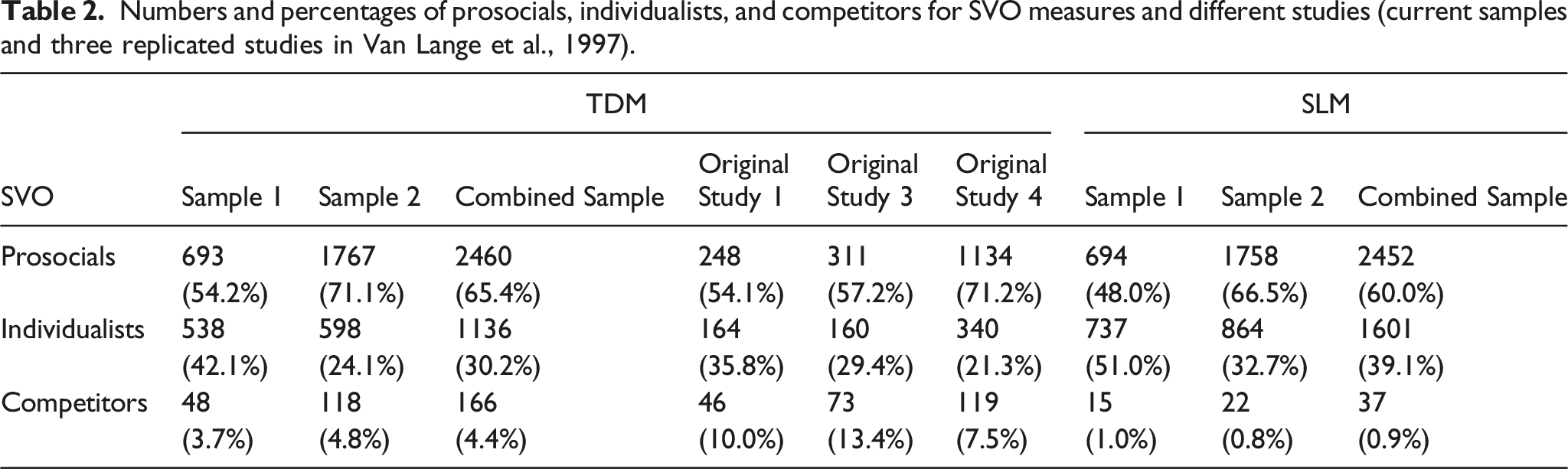
Also, we compared the distribution of SVO categories among different samples in the current study and Van Lange et al. (1997). Firstly, the results indicated that participants from Prolific (i.e., Sample 2) are more prosocial and less individualistic than those from MTurk (i.e., Sample 1) for both TDM, χ2(2) = 129.51, p < .001, and SLM, χ2(2) = 133.66, p < .001. Further, we compared the distribution of SVO measured by the TDM in the current study and those in the original studies. We found that the distribution of SVO in the combined sample was different from the distributions in the original studies, χ2(2) > 37.98, ps < .001. Specifically, in the combined sample, there were fewer competitors compared to all original studies, ps < .001, and there were more individualists compared to the Original Study 4, p < .001. Besides, the percentage of prosocials in the current sample was larger than that in the Original Studies 1 and 3, ps ≤ .001, but smaller than that in the Original Study 4, p < .001.
Correlations among continuous variables
Descriptive statistics and correlations among continuous variables in the combined sample.
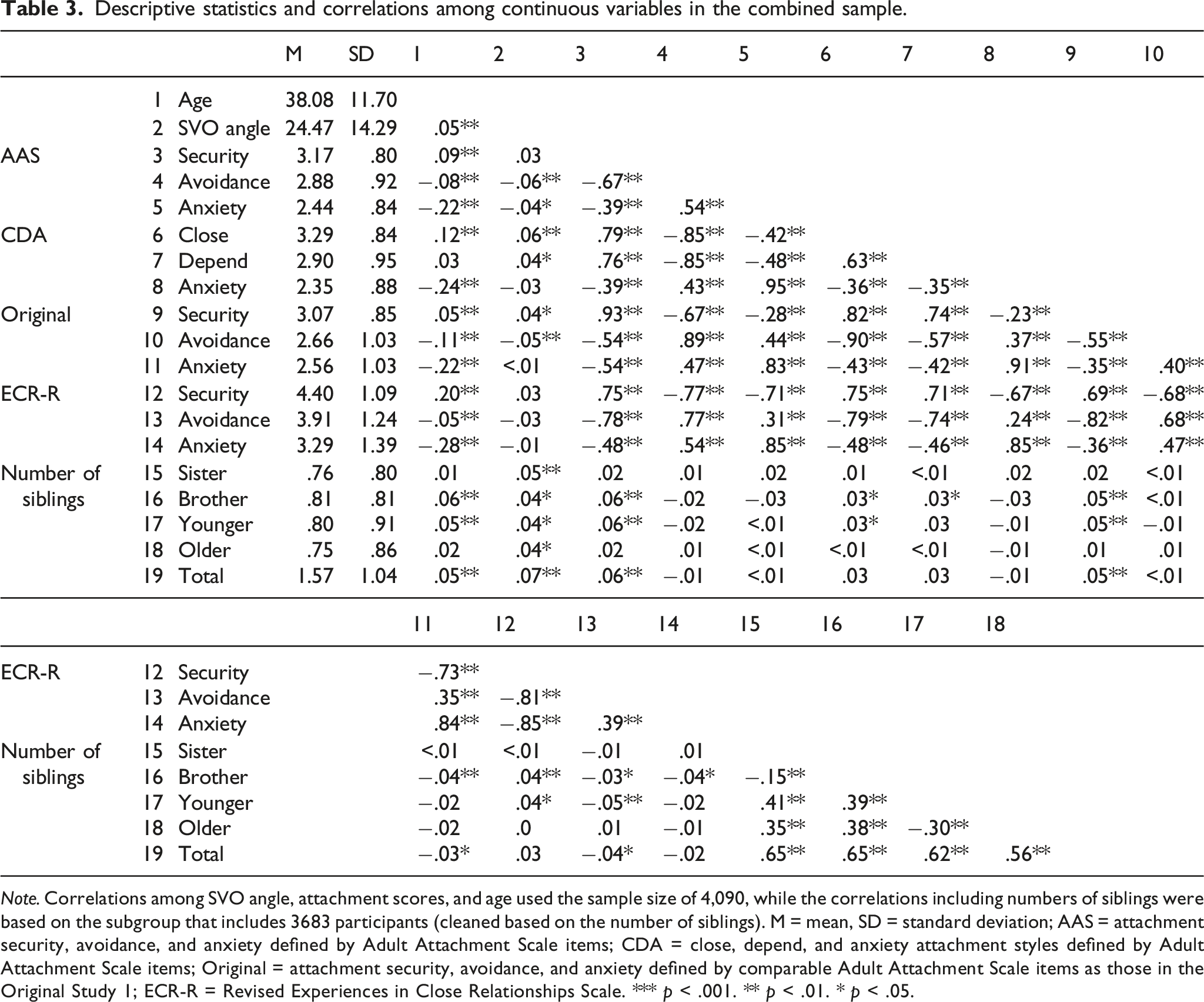
Note. Correlations among SVO angle, attachment scores, and age used the sample size of 4,090, while the correlations including numbers of siblings were based on the subgroup that includes 3683 participants (cleaned based on the number of siblings). M = mean, SD = standard deviation; AAS = attachment security, avoidance, and anxiety defined by Adult Attachment Scale items; CDA = close, depend, and anxiety attachment styles defined by Adult Attachment Scale items; Original = attachment security, avoidance, and anxiety defined by comparable Adult Attachment Scale items as those in the Original Study 1; ECR-R = Revised Experiences in Close Relationships Scale. *** p < .001. ** p < .01. * p < .05.
Relation between social value orientation and adult attachment
To test the association between SVO and adult attachment (Hypothesis 1), we conducted (generalized) linear regression models that included one attachment style or dimension at a time, 13 controlling for sex and study sample (Sample 1 vs. 2). The outcome variables were the (TDM) SVO category (i.e., prosocials vs. proselfs) and the (SLM) SVO angle, 14 respectively. The attachment styles or dimensions included security, avoidance, and anxiety that were derived from (1) AAS, (2) Original, and (3) ECR-R; close, depend, and anxiety dimensions that were scored from (4) CDA.
Results for (generalized) linear regression of the SVO categories and SVO angle on the adult attachment scores.
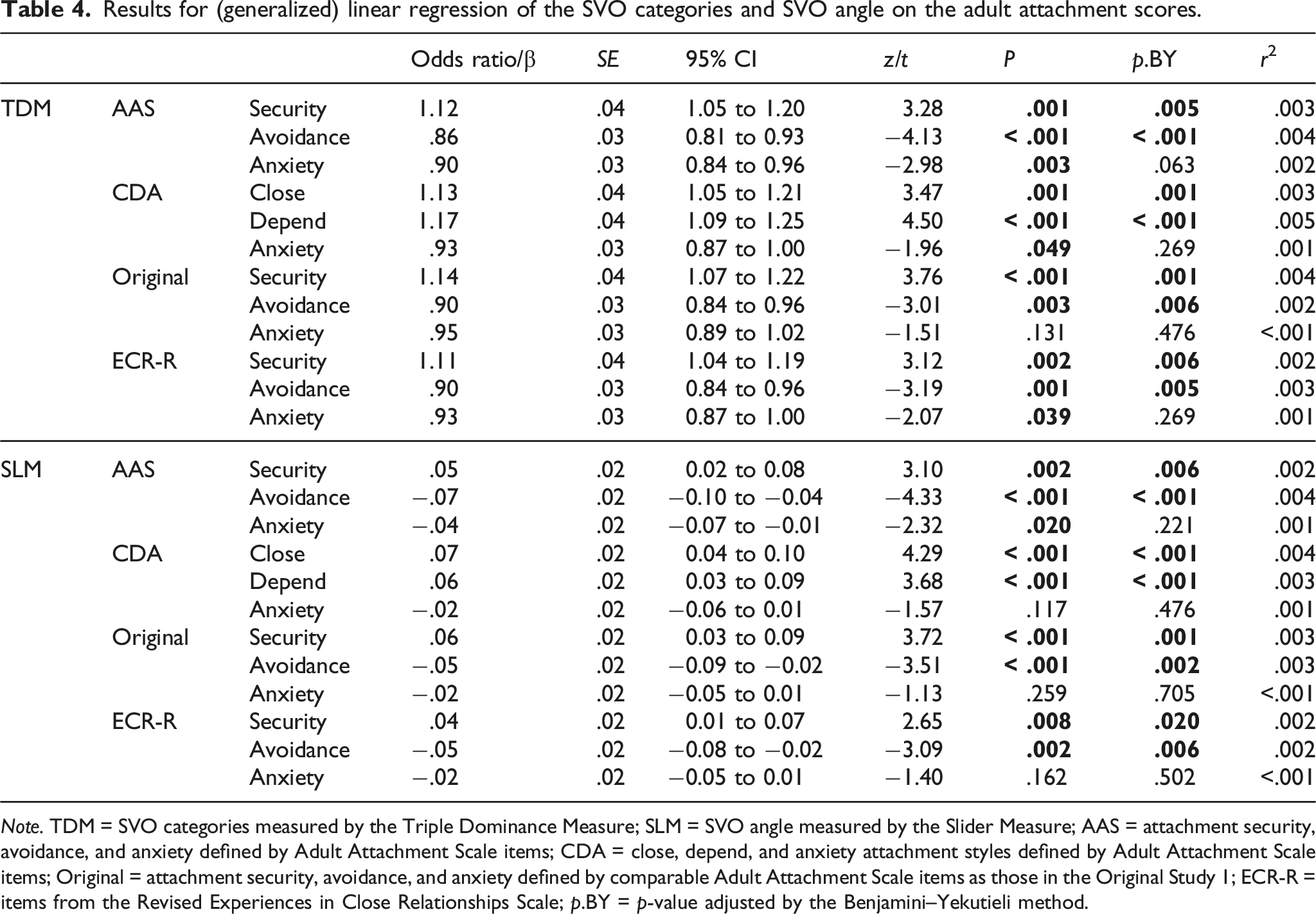
Note. TDM = SVO categories measured by the Triple Dominance Measure; SLM = SVO angle measured by the Slider Measure; AAS = attachment security, avoidance, and anxiety defined by Adult Attachment Scale items; CDA = close, depend, and anxiety attachment styles defined by Adult Attachment Scale items; Original = attachment security, avoidance, and anxiety defined by comparable Adult Attachment Scale items as those in the Original Study 1; ECR-R = items from the Revised Experiences in Close Relationships Scale; p.BY = p-value adjusted by the Benjamini–Yekutieli method.
Overall, as hypothesized, the association between SVO and attachment security, when measured by the original items used by Van Lange et al. (1997), as well as all other attachment scales, was successfully replicated in the current study. At the same time, we also noticed that the effect sizes were small, as in the Original Study 1. Moreover, the associations between SVO and attachment security, as well as attachment avoidance, were more stable than the association between SVO and attachment anxiety across different attachment scales.
Relation between social value orientation and number of siblings
To test the association between SVO and the number of siblings (Hypothesis 2), we first detected outliers of the number of siblings by using the Hoaglin and Iglewicz (1987) outlier labeling rule. Specifically, we calculated the lower fourth
Results for (generalized) linear regression of SVO categories and SVO angle on the number of siblings.
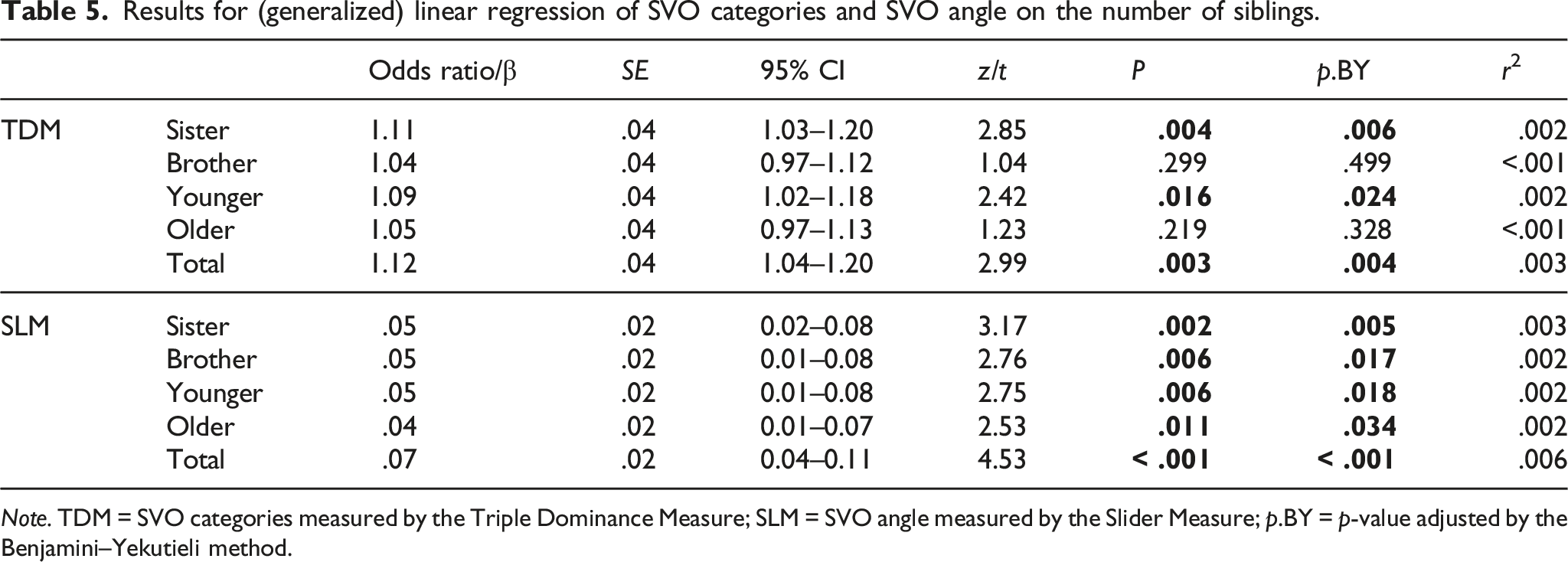
Note. TDM = SVO categories measured by the Triple Dominance Measure; SLM = SVO angle measured by the Slider Measure; p.BY = p-value adjusted by the Benjamini–Yekutieli method.
For an exploratory purpose, an additional analysis was conducted to test whether the presence of a sibling would be associated with SVO. To do so, we re-coded the total number of siblings into 0 (participants reported no siblings) and 1 (participants reported at least one sibling). We conducted (generalized) linear regression models. The predictor was whether participants had a sibling or not. The outcome variables were the (TDM) SVO categories and the (SLM) SVO angle, separately.
Results revealed that the odds of participants that categorized as prosocials were 1.33 times higher if they had at least one sibling than if they had no sibling at all when the SVO was measured by the TDM, odds ratio = 1.33, SE = .14, z = 2.73, p = .006, 95% CI [1.08, 1.63]. Moreover, having at least one sibling was associated with increased participants’ prosociality that measured by the SLM, β = .23, SE = .05, t = 4.77, p < .001, 95% CI [0.13, 0.32].
In general, we found stable relations between SVO and the number of sisters, younger siblings, as well as the total number of siblings across different measures of SVO. These results are partially consistent with Hypothesis 2 and in accordance with the findings in the original paper, except that we did not find the association between SVO and older siblings but younger siblings. Moreover, having at least one sibling, irrespective of the age and sex of the siblings, can increase the possibility that a person is classified as prosocial or the level of prosociality.
Relation between social value orientation and age
For Hypothesis 3, which is the association between SVO and age, we conducted (generalized) linear regression models where age was entered as the predictor, and (TDM) SVO categories and (SLM) SVO angle were entered as the outcome variables, separately.
After controlling for sex and study sample, we did not find any significant relation between SVO and age in the combined dataset (TDM: odds ratio = 1.04, SE = .04, z = 1.17, p = .241, 95% CI [0.97, 1.12]; SLM: β = .02, SE = .02, t = 1.34, p = .179, 95% CI [−0.01, 0.05]). Thus, contrary to our Hypothesis 3, we failed to replicate the association between SVO and age that discovered by the Original Study 4.
Discussion
The first goal of the current study was to assess the correspondence between the two widely used measurements of SVO: the TDM and the SLM. The results revealed a medium-sized association between the two measures. The second goal was to test the relation between SVO and adult attachment. Most of the observed relations between SVO and adult attachment were similar across measures. Specifically, prosocials reported a higher level of secure attachment and a lower level of avoidant attachment than proselfs, which (partially) replicated the Original Study 1. The third goal of the study was to examine the association between SVO and sib-ship size. We successfully replicated the previous result that prosocials were more likely to have a larger number of total siblings and sisters. The fourth goal was to replicate the finding that prosocial orientation increases with age. However, we did not replicate this earlier finding. In the next paragraphs, we discuss each of the findings in turn.
Association between TDM and SLM
The current research used both the TDM and SLM. We found only a medium-sized correspondence between the two measurements, accounting for a shared variance of about 50%, and around 75% percent of participants were classified into the same SVO category. This is consistent with earlier findings (e.g., Bakker & Dijkstra, 2021; Matsumoto et al., 2016; Murphy et al., 2011), and so it is fair to conclude that the two measures are both similar and distinct.
We proposed that the different categorizations, especially the larger number of competitors identified by the TDM than by the SLM, could be explained by the joint payoff design discrepancy. The TDM simultaneously presents competitive (relative advantage) joint payoffs with prosocial and individualistic joint payoffs in each item. In contrast, only three out of the six items of the SLM include competitive choices. In this case, one might speculate that increasing the salience of competition as an independent option might trigger some people to navigate toward competition. That is, the absence of a distinct competitive option might attenuate the expression of competitive orientation because the corresponding situational affordances are less strong (cf. Columbus et al., 2019; Thielmann et al., 2020; Van Lange & Columbus, 2021). This is an interesting topic for future investigation because detecting competitors is as valuable as disentangling prosocials and proselfs—numerous studies have empirically supported the differences between competitors and individualists (and prosocials) in how they respond to other’s strategies in economic games (e.g., McClintock & Liebrand, 1988; Van Lange & Visser, 1999), in judgments of them by friends and roommates (Bem & Lord, 1979), and in donations and political preferences (e.g., Van Lange et al., 2012). Overall, we suggest that the robustness and meaning of the non-correspondence between the TDM and SLM, and especially the frequency of competitors, awaits future research.
We should also highlight that the TDM can only be sensibly used as a categorical measure, whereas the SLM can also be used as a continuous measure. This is important because it means that the SLM is often suitable for a greater variety of research purposes—for example, in research in which one seeks to predict an outcome variable on the basis of a degree of prosociality. And although we have emphasized differences, together with the results in the Supplementary Material, it is also fair to say that if the measures are used as categorical variables, they by and large show similar (albeit weak) associations with other variables—such as attachment styles, the number of siblings, and age in the present research.
Another interesting finding is that participants from the Prolific platform were more prosocial than those from MTurk. Although the sample may well be similar in a number of qualities (e.g., education, see Peer et al., 2017), there is some evidence that MTurk workers are more socially isolated and withdrawn than those involved in Prolific (McCredie & Morey, 2019), which may help explain the lower levels of prosociality in MTurkers. The distribution of SVO from MTurk was similar to the Original Studies 1 and 3, where prosocials and proselfs were equally distributed. In contrast, the distribution of SVO from Prolific and that in the combined sample was similar to that of Klein et al. (2018) and IJzerman and Denissen (2019), where there was a larger proportion of prosocials compared to proselfs. These differences in the distribution of SVO might also partially explain why the association between SVO and attachment style, as well as the number of siblings, were not completely stable across the two samples. 16 More generally, we suggest that, given the centrality of prosociality as a construct in a network of traits (Hilbig et al., 2014; Thielmann et al., 2020), some differences in findings across the literature might be explained by differences in the prevalence of prosocial orientation in the platforms used.
Relation between social value orientation and attachment
In the original research, researchers assumed an association between prosocial orientation and secure attachment (Van Lange et al., 1997). The reasons may be that, relative to individualistic or competitive behavior, prosocial behavior is more likely to elicit cooperative responses from others, which should reinforce trust—and hence give rise to the development of secure attachment with “relative strangers” (cf. Kelley & Stahelski, 1970). Such experiences may be accumulated early on in life and help provide a basis for approaching interaction situations with strangers later in life (e.g., Fraley, 2019; Jones et al., 2018).
The present findings complement previous findings. In addition to replicating the relation between SVO and secure attachment, there may also be a small but rather robust relation between SVO and one of the two attachment styles that are often conceptualized as insecure: the avoidant attachment. Indeed, for both measures of SVO, we found that the level of avoidant attachment was negatively associated with prosociality. Why is avoidant attachment more strongly associated with SVO compared to anxious attachment? One possible explanation is that although both avoidant and anxious attachments are related to negative interactions with others, the motivations behind them are distinct. The avoidant attachment is associated with depending less on others, and this low level of dependence is associated with less cooperation (Gerpott et al., 2018). In contrast, people high in anxious attachment tend to experience approach-avoidance conflict with closeness and interdependence. Thus, given some insecure attachment, we suggest that proselfs tend to adapt by decreasing closeness and interdependence. One might speculate that this may help them to reduce the risk of negativity in social interactions so long that they have such “degrees of freedom” to decrease levels of interdependence (which is not always easy in social life—for example, with neighbors or colleagues; Van Lange & Visser, 1999).
The findings from the current study are inconsistent with the replication study of IJzerman and Denissen (2019). However, as the authors pointed out in their article, the post hoc sensitivity analysis showed that the sample they used could detect an effect size as small as d = .19. As can be seen in the current study, the effect size of the relation between SVO and attachment might be even smaller than that.
Together, the present findings provide support for the predicted association between SVO and secure attachment, as well as for the association of SVO and avoidant attachment. While it seems fair to conclude that SVO and attachment are interrelated, we should add that the effects sizes were generally small. It is possible that measures that rely strongly on language, such as self-reports of attachment, are methodologically distinct from measures that rely less on language but more on actual choices—methodological differences might elicit different psychological processes and, therefore, attenuate the association. For example, self-evaluation may play a greater role in self-judgment involving value-laden language than in assessments focusing on (forced) choices and outcomes (for a more elaborate discussion, see Van Lange et al., 2012).
Relation between social value orientation and siblings
Consistent with Hypothesis 2, we replicated the positive association between SVO and the number of siblings and sisters in both measurements of SVO. 17 Findings also nuanced the pattern predicted by Hypothesis 2 in that this association may be due to whether one has a sibling or not, rather than the number of siblings or whether they are younger or older than oneself. It is possible that some readers regard these findings as intuitively compelling, perhaps even common sense. And perhaps some may have anticipated more “impressive” effect sizes. For those readers, we wish to outline that number of siblings, composition in terms of brothers and sisters, is only one of the many causes of the development of prosociality. For example, even independent of genetic influences, there is strong evidence in support of peer influences on adolescents’ outcomes rather than parental influences, or even more subtle: influences of the specifics of family composition (Padilla-Walker et al., 2010).
From this perspective, it is surprising that the gist of these findings is now observed twice in different samples coming from distinct countries (the Netherlands for the original studies, and a large proportion of Americans and a minor proportion of British for the current study). Retrospectively, it might also lead us to re-think the findings of the ambitious replication project (Klein et al., 2018). While there is no general association between SVO and siblings in Klein et al.’s study, it is interesting to note that they observed large differences among the nations involved. Indeed, it is possible that cultural differences might help explain the findings. For example, masculine and feminine cultures (Hofstede, 2001) may differ in terms of the ways in which, or how strongly, female (male) siblings may encourage (discourage) the development of prosocial orientation (Hine, 2017). Either way, the present findings underline the relatively unique role of female siblings in the development of prosocial orientation. As uncovered by Padilla-Walker et al. (2010), having a sister led to a lower level of internalizing behaviors (i.e., depression/anxiety) after controlling the effect of the parent–child relationship. That may be because sisters provide higher levels of communication and/or caregiving (Zukow-Goldring, 2002).
Relation between social value orientation and age
It was surprising that we did not find evidence in support of Hypothesis 3—the prediction that prosocial orientation would be more prevalent among individuals with increasing age. Although it is possible that there is no relation between SVO and age, we do want to share some nuances regarding this possibility. First, this association involving SVO and age was among the strongest findings observed in the original article (Van Lange et al., 1997; see also Matsumoto et al., 2016). Also, there is research that found a significant correlation between age and SVO measured by the SLM (Matsumoto et al., 2016), and there is an association of another choice-related measure of social preference, although capturing low-cost cooperation, with age (Van Doesum et al., 2013). Second, beyond economic games, there is a fair amount of evidence showing that with increasing age, people are more likely to donate time or money to help others (Bekkers & Wiepking, 2011; Hubbard et al., 2016; Midlarsky & Hannah, 1989), especially those in need (Freund & Blanchard-Fields, 2014). Such evidence is only partially explained by the notion that prosociality changes with age because resources, be it money or time, change across the life span (e.g., Mayr & Freund, 2020). And third, as stated earlier, from emerging adulthood until age 60, personality traits, such as Honesty-Humility (Ashton & Lee, 2016), which is positively related to SVO, and Machiavellianism (Götz et al., 2020), which is negatively associated with SVO, tend to vary with age.
So, what is the broader picture? Given that the evidence in support of the association comes from numerous studies, which are quite distinct in measures and operationalizations of prosocial orientation and behavior, we believe our nonsignificant association may perhaps be explained by some restriction of the range in the variation in age. While samples of MTurk and Prolific nicely extend student samples, it is also true that people older than 60 are somewhat underrepresented (Difallah et al., 2018; Ross et al., 2010). The same also held for the present sample (only 2% and 5% of the current Samples 1 and 2, respectively, older than 60). In contrast, Van Lange et al. (1997) used an online service that actively sought to optimize representativeness in terms of age, sex, education, and social-economic status, with 17% of the participants older than 60 years old.
But if this is true, why would people older than 60 years old be more prosocial in orientation than those in the less senior categories? One reason might be that they face a short time horizon and become more concerned about the next generation (e.g., Van Lange et al., 2018; see also Mayr & Freund, 2020). As a second interpretation, we cannot exclude a generation effect such that people whose childhood took place around the time of World War II were socialized with stronger “prosocial” norms such as those prescribing support for one another and perhaps egalitarianism (Bauer et al., 2016). Thus, the relation between SVO and age is still an open question in terms of both specific patterns and explanations. We recommend future studies to focus on a larger variance of age groups (including more people older than 60 years old), and samples from diverse countries are needed to test the relation between SVO and age. Clearly, these are timely topics, not only because life expectancy increases but also because the group of old age has become relatively more active and prevalent in society.
Limitations
The current study has some limitations. First, as can be found in the Supplementary Material, the attachment scales exhibited a relatively modest-size internal consistency. Also, the measures of attachment style have been subjected to some changes over the past decades. We agree with Hussey and Hughes (2020), who noted that the low reliability and validation of the scales might well yield a lower a priori chance of successful replication. But the scales we currently included, especially the ECR-R, are the best alternatives for now.
Second, the measures of SVO were not incentivized but hypothetical in the current study. As suggested by Ackermann et al. (2016), making hypothetical choices regardless of real consequences might not reflect people’s real behavior. Using incentives can reduce noise when measuring distributional preferences (Greiff et al., 2018) and might reduce the effect of social desirability (Balliet et al., 2009). Thus, further studies are needed to examine whether and how the associations between SVO and adult attachment, number of siblings, or age are modified by incentivization of the measure of SVO.
Third, we did not use the secondary items in the SLM, which are used to distinguish people’s motives of prosociality (joint maximization vs. inequality aversion). It shows that the motive to be prosocial of half of the prosocials classified by the primary items of SLM is inequality aversion, while the other prosocials are motived by the maximum joint gain (Murphy & Ackermann, 2011). It is still unclear whether the different motives among prosocials are associated with adult attachment, siblings, and age, which gives an avenue for future studies.
As a replication, the current study is different from the original research in at least three respects: (1) the sample of the study is from the US and UK instead of the Netherlands; (2) we combined individualists and competitors into one category because of the low proportion of competitors; and (3) the original Studies 1 and 3 were conducted in paper-and-pencil, while the current studies were conducted online. The current finding might be influenced by the nationalities or cultures. However, we do not know any empirical study that suggests strong differences among these three countries. Further studies can test whether the associations between SVO and adult attachment, siblings, as well as age are consistent across different countries or cultures. And since there are very few competitors in the current study, it is still unknown whether there is a difference between individualists and competitors in adult attachment, number of siblings, or age. Moreover, we believe that the validity of assessing psychological construct online is equivalent to that of using paper-and-pencil as suggested by many researchers (e.g., Fouladi et al., 2002; Pettit, 2002).
Concluding remarks
The present research has uncovered several findings that contribute to the extant literature. First, we suggest that the distinctive features of the design might result in a moderate correspondence between the two measures of SVO. The psychology underlying these differences may point at framing effects, such that the presence of a third option may affect how people evaluate the other two options. More empirically, the less-than-perfect correspondence indicates that discrepant findings in the literature may be to some degree accounted for by different measurement properties.
Second, the current study provides support for the association of SVO with attachment (Hypothesis 1) and the number of siblings, sisters in particular (Hypothesis 2). We should note that the effect sizes are small in both cases, but the evidence, even if small, is consistent with the broader claim that the development of SVO may partially derive from interaction patterns with close others in the past. Based on the present findings, we recommend new avenues of research focusing on how “packages” of trust, secure attachment, and prosocial orientations may be rooted in early life experiences. We do not expect large effect sizes, as one may generate numerous influences on the development of SVO. Looking at the nonsignificant findings between age and SVO, we cannot exclude the possibility that there may be a fair amount of continuity rather than systematic change during adult life before old age. Neither can we exclude the possibility that over the past several decades, more senior people increasingly maintain a “young” psychological mindset, with a relatively strong emphasis on values such as autonomy and independence rather than a rapid change from a proself to a prosocial orientation to their social environments.
Supplemental Material
Supplemental Material - The development of social value orientation: Attachment styles, number of siblings, age, and a comparison of measures
Supplemental Material for The development of social value orientation: Attachment styles, number of siblings, age, and a comparison of measures by Yi Liu, Bo Wang and Paul A. M. Van Lange in European Journal of Personality
Footnotes
Acknowledgments
Grateful acknowledgement is provided to Jellie Sierksma for comments on the construction of the earlier version of the manuscript.
Declaration of conflicting interests
The author(s) declared no potential conflicts of interest with respect to the research, authorship, and/or publication of this article.
Funding
The authors disclosed receipt of the following financial support for the research, authorship, and/or publication of this article: This article is funded by China Scholarship Council (20180636274)
Data Accessibility Statement

Supplemental Material
Supplemental material for this article is available online.
Notes
References
Supplementary Material
Please find the following supplemental material available below.
For Open Access articles published under a Creative Commons License, all supplemental material carries the same license as the article it is associated with.
For non-Open Access articles published, all supplemental material carries a non-exclusive license, and permission requests for re-use of supplemental material or any part of supplemental material shall be sent directly to the copyright owner as specified in the copyright notice associated with the article.
