



Abstract
Research on consequences of adversity appears inconclusive. Adversity can be detriment to mental health, promoting maladaptive patterns of thoughts. At the same time, posttraumatic growth studies suggest that overcoming major adversity facilitates growth in wisdom-related patterns of thoughts. We address this puzzle by examining how distinct types of adversity impact wisdom over time and how individual differences in self-distanced (rather than self-immersed) reflection on adversity relate to different wisdom trajectories. In a four-wave prospective year-long study, participants (N = 499) recalled and reflected every three months on the most significant recent adverse event in their life. They reported how much they engaged in wise reasoning—intellectual humility, open-mindedness to diverse perspectives and change, search for compromises and resolution—as well as self-distancing during reflections. Independent raters identified seven distinct adversity types (e.g. social conflict, economic hardship, major trauma) in open-ended descriptions. Growth curve analyses revealed little evidence of positive change in wise-reasoning over the course of a year, and some evidence of negative change for health-related adversity. Although self-distancing was associated with stability in wisdom, self-immersing was associated with negative change in wisdom in reflections on social conflicts over time. We discuss implications these results have for adversity, change vs. resilience in character strengths, and self-distancing.
In the classic Aristotelian and Thomasian perspectives in philosophy, virtues such as courage, justice, or temperance define a person’s character. Governing these strengths is the cardinal virtue of wisdom—a meta-cognitive ability to discern the best path of action or virtuous behavior for a given situation (Aquinas, 2012, p. 1702; Ostwald, 1964; Schwartz & Sharpe, 2010). In recent years, the study of wisdom has moved beyond philosophy as cognitive and behavioral researchers begun systematically studying the psychological characteristics representing this meta-cognitive ability (Jayawickreme & Blackie, 2016; Swartwood & Tiberius, 2019). Though wisdom can be conceptualized in many ways (Grossmann, 2017; Staudinger & Glück, 2011, for reviews), the growing interest from empirical sciences contributed to the recent development of the new Common Wisdom Model (CWM). This model presents a common denominator across a vast number of scientific approaches to measure the wisdom construct (Grossmann, Weststrate, et al., 2020).
In the CWM, central tenets of wisdom concern “morally-grounded excellence in social-cognitive processing,” emphasizing perspectival meta-cognition and moral aspirations as essential psychological characteristics of wisdom. By perspectival meta-cognition, researchers refer to patterns of thought that afford a better understanding of the self and the situation at hand. They include such features as awareness of one’s limited knowledge, open-mindedness to change, consideration of different perspectives and long-term consequences, and balancing and integrating viewpoints. By moral aspirations, researchers refer to intentions and ideals guided by the principles of shared humanity, cooperation, and search for a compromise. Psychometric research shows that these meta-cognitive and moral features of wisdom often go hand-in-hand and converge on one latent factor that is distinct from Big Five personality and other established individual difference constructs (Brienza et al., 2018; Grossmann, 2017).
One common proposition is that wisdom is gained through adversity (Jayawickreme & Blackie, 2016; Jayawickreme et al., 2021; Staudinger & Glück, 2011; Weststrate & Glück, 2017). The current paper examines this proposition empirically and prospectively. Specifically, we examined whether trajectories of common psychological features of wisdom outlined above and operationalized via a combination of moral aspirations and meta-cognitions (Brienza et al., 2018; Grossmann, Weststrate et al., 2020) depend on the viewpoint people adopt as they reflect on their adverse experiences. We also explored how wisdom varies over time for different adversities people experience in their lives.
The puzzle of adversity
There is a common belief that facing adversity helps to pave the path to character growth, and specifically to growth in wisdom (be it meta-cognition such as intellectual humility, open-mindedness to change, or perspective-taking, or moral aspirations such as seeking a compromise or conflict resolution). Wisdom is presumed to flourish in response to navigating difficult life experiences (Ferrari et al., 2019; Park, 2020). However, existing research on the consequences of adversity for change in character strengths, including wisdom, appears inconclusive.
On the one hand, research on posttraumatic growth (Tedeschi & Calhoun, 2004) asserts that working through major adversity through a process of rumination and meaning-making facilitates growth in character strengths involving open-mindedness, spirituality, appreciation of life, and wisdom (Linley, 2003; Staudinger & Glück, 2011; Tedeschi & Calhoun, 1996). A few cross-sectional studies that examined wisdom found correlational evidence of a positive association between self-reported experience of adversity and wisdom. Specifically, participants who reported post-traumatic growth also reported gains in wisdom following adversity (Plews-Ogan et al., 2013; Webster & Deng, 2015).
On the other hand, self-reflection on adversity can backfire, exacerbating negative emotions and thoughts, undermining health and well-being over time (e.g. Hankin et al., 2010; Lyubomirsky & Nolen-Hoeksema, 1995; Nolen-Hoeksema & Morrow, 1991). Focusing on adverse experiences is often associated with negative mental health outcomes, including anxiety, dysphoria, social and interpersonal stagnation, and avoidance of similar situations in the present and future, leading to increased life interference and distress (e.g. Chiupka et al., 2012; Gavric et al., 2017). Such negative consequences may interfere with positive changes in character strengths. Indeed, despite some evidence for character growth after life-threatening experiences, many recent studies have failed to find substantial and stable growth over time following major traumatic events (Affleck, Tennen, Croog, et al., 1987; Ardelt & Bruya, 2020; Chopik et al., 2020; Davis et al., 2019; Dekel et al., 2012; Frazier et al., 2001). For example, a study that assessed a student sample at two time points—before and after adversity—found a reliable increase across several characters strengths (relating to others, personal strength, new possibilities, appreciation of life, and spiritual change) for only 5–25% of the sample (Frazier et al., 2009). In short, existing evidence that confronting negative life events is likely to promote positive change in character strengths is mixed and inconclusive (Jayawickreme et al., 2021).
Self-distanced vs. self-immersed reflection
One way to address the puzzle of adversity concerns examining individual differences in psychological resources people use when approaching adverse experiences (Glück et al., 2019). One such psychological resource concerns how people mentally reflect on adverse experiences in their lives. When spontaneously reflecting on adverse experiences, people, especially in North America, typically self-immerse in the experience. In other words, they visualize the event through their own eyes and focus on specific details and emotions they experienced as the event unfolded (e.g. Grossmann & Kross, 2010; McIsaac & Eich, 2004; Nigro & Neisser, 1983; Wu & Keysar, 2007). In the context of positive events, such self-focus can help people savor their experiences. However, in the context of adverse events, self-immersed reflection can be maladaptive. Focus on the self is associated with narrower thinking (e.g. Grossmann & Jowhari, 2018), and self-immersing cues and promotes negative emotionality, distress, and depressive symptomatology (Tackman et al., 2019).
Even though most people habitually self-immerse in the face of adversity, it is also possible to reflect on adverse experiences from a self-distanced perspective. Engaging in self-distancing involves “taking a step back” from the current experience (Kross & Ayduk, 2017). Prior research has shown that people who spontaneously engage in self-distancing report lower distress, less negative emotional reactivity, and more adaptive reasoning about challenging experiences (Ayduk & Kross, 2010; Grossmann & Kross, 2010; Romano et al., 2020; White et al., 2015).
Previous research has also shown that self-distancing can promote a broader, “bigger picture” view of situations than self-immersing (Grossmann & Kross, 2010; Huynh et al., 2016; Pronin & Ross, 2006; Robinson & Swanson, 1993; Vasquez & Buehler, 2007). Indirect evidence supporting the notion that a broader view of a situation can boost wisdom comes from experimental studies showing that participants who reflected on interpersonal challenges that involve them personally reported lower wisdom compared to identical scenarios in which they were third-party observers (Grossmann & Kross, 2014). Other experiments provided direct evidence for the role of self-distancing for wisdom, demonstrating that engaging in self-distancing (vs. self-immersing) promotes intellectual humility, open mindedness, and perspectivism (Grossmann, Dorfman, Oakes et al., 2021; Huynh et al., 2017; Kross & Grossmann, 2012; Staudinger & Baltes, 1996; Sternberg & Jordan, 2005; see Grossmann, 2017, for a review). This prior scholarship raises a question for the posttraumatic growth research: Does self-distancing moderate the trajectories of change in wisdom after people reflect on adverse events they encounter? The question is best addressed through a prospective and longitudinal design that allows to examine prospective change in wisdom over a relatively long period (i.e. a year rather than several days or weeks).
Heterogeneity of adverse experiences
One further way to address the puzzle of adversity is by exploring the ecology of adversity in its many expressions. Many types of adversity can be highly stressful and such stress can accumulate over time. Nevertheless, the characteristics of different types of adversity (cf. economic hardship vs. assault vs. major health problem) can be distinct (e.g. McLaughlin & Sheridan, 2016), as can be their negative consequences (e.g. Denissen et al., 2019). Even within the same broader category of adversity (e.g. intimate partner abuse), some types of adversity can have a much greater impact on mental health outcomes than others (e.g. Mechanic et al., 2008). Thus, the type of adversity one experiences matters at least as much as its cumulative level over time. Though this body of work has been focused on maladaptive consequences of adversity for health and psychopathology, it is plausible that the type of adversity would similarly have differing effects on potential trajectories of wisdom-related meta-cognitions. Indeed, theoretical accounts of adversity- and stress-related growth suggest different growth trajectories for wisdom-related meta-cognitions for different types of negative and stressful events (Joseph & Linley, 2006; Park et al., 1996).
These theoretical accounts highlight a potential benefit in considering different types of adversities (e.g. social conflicts, professional setbacks, health problems), beyond major traumatic events, when examining change in wisdom following adversity. Looking at a broader range of adverse events allows addressing the possibility that certain types of adverse events promote gains in wisdom more than others. Specifically, because wisdom is more prominent in solving social vs. personal challenges (Grossmann & Kross, 2014; Grossmann, Dorfman et al., 2020), growth in wisdom might be more pronounced in adverse events that directly involve other people than in events that do not.
Prior methodological limitations
To address the questions about the role of self-distancing (vs. self-immersing) and heterogeneity of adversity for wisdom trajectories in the face of adversity, it is also necessary to consider prior methodological limitations in the study of growth from adversity (Jayawickreme et al., 2021). First, existing research has relied primarily on retrospective self-reports to assess changes in character strengths (Blackie et al., 2017): participants reported on causes and consequences of growth at the same time (e.g. Calhoun et al., 2000). This cross-sectional approach is problematic (Jayawickreme & Zachry, 2018). People who report experiencing adversity may also report more open-mindedness than those who did not report experiencing adversity. But due to a cross-sectional nature of the design, the causal direction of this association could go either way.
Second, equating inter-individual differences (as assessed within the context of cross-sectional designs) with intra-individual differences/changes would erroneously equate inferences observed on different levels of analyses (i.e. between and within people; Borsboom et al., 2003). Just because inter-individual differences in the experience of adversity may be associated with certain psychological characteristics, it does not necessarily mean that change in the experience of adversity would be associated with change in the same psychological characteristics.
Finally, the retrospective nature of self-assessments in posttraumatic growth research makes it impossible to differentiate between actual psychological change and perceptions of change. Perceived change may be biased by memory distortions and (conscious and unconscious) social desirability in reports of positive characteristics such as humility, open-mindedness, or courage (Eibach et al., 2003; Ross & Wilson, 2003; Tennen & Affleck, 2009). Such self-assessments require a complex cognitive process: a person must assess their current level of the characteristic, recall their past level of this characteristic before the adverse event has occurred, compare between the two assessments, as well as conclude how much of the change is due to the adverse event (e.g. Bostock et al., 2009). This mentally taxing process can be unreliable due to its complexity, memory biases, or self-serving positive illusions (Coyne & Tennen, 2010; Tennen & Affleck, 2009). In fact, studies have found modest associations between observed change measured with a pre–post design and participants’ retrospective assessments of perceived change (r = .20; Frazier et al., 2012; Joseph et al., 2012; Yanez et al., 2011). This modest association (according to recommendations in personality psychology; Funder & Ozer, 2019) suggests that retrospective assessments of change and observed change do not measure the same intra-individual changes.
To circumvent the challenges associated with retrospective assessments, measuring changes in character strengths calls for prospective longitudinal designs (e.g. Jayawickreme & Blackie, 2014). Prospective designs assess variables of interest at multiple time points and estimate change from one time point to the next, rather than assessing perceived character change retrospectively following a single past event. Methodologists recommend that such studies look beyond single major traumas and examine multiple events across the lifespan (Seery et al., 2010). Prospective designs exploring change over time following multiple events from people’s daily lives can also shed light on the types of adversities people encounter and the psychological processes that promote growth or buffer declines in wisdom.
Whole-trait theory: Inter-individual vs. intra-individual differences
To explore how self-distancing and heterogeneity in adversity inform wisdom-related changes over time, we draw on the Whole Trait Theory (Fleeson, 2001; Fleeson & Jayawickreme, 2015). Whole Trait Theory suggests that one’s general level of a characteristic (i.e. a “trait”) can be derived from the distribution of ways this trait manifests itself across situations people experience in their lives. Notably, individuals’ behavior in each situation (i.e. a “state”) can deviate from this general level (Eid & Diener, 1999). Thus, intra-individual differences reflect within-person deviations from one situation to the next, above and beyond the average inter-individual differences between people (Bolger & Laurenceau, 2013; Molenaar & Campbell, 2009).
Distinguishing inter- and intra-individual differences can provide unique insights for understanding the effects of self-distancing on changes in wisdom. Inter-individual differences in self-distancing concern general dispositions in self-distancing. They address the question of whether people who are more likely than others to self-distance when reflecting are also more likely to change in wisdom over time. Intra-individual variability in self-distancing address the question of how reflecting on a specific adverse experience (relative to their general disposition) contributes to wisdom trajectories.
Overview of present study
Does self-distancing moderate the effects of adversity on change in wisdom? Is wisdom equally stable vs. variable over time across different forms of adversity? To address the first question, we test a pre-registered hypothesis that inter-individual and intra-individual tendencies for distanced self-reflection are positively associated with wisdom (https://osf.io/2hpbv). 1 To address the second question, we explore how different appraisals of adversity (e.g. negative, challenging, predictable) and types of adversity (e.g. social conflicts, economic setbacks, and health concerns) people experience in their lives inform changes in wisdom-related meta-cognitions.
The data for this study come from a year-long longitudinal study, with four waves set approximately 2.5 months apart. At the onset of each wave, participants described the most significant adverse event they experienced during the previous two months. Participants reconstructed the event, reflected on it, and provided their stream-of-thoughts about this event. Then, they reported how much they engaged in wisdom-related thoughts and behaviors and the extent to which they self-distanced (vs. self-immersed) from the adverse experience.
Method
The study was reviewed and received ethics clearance through a University of Waterloo Research Ethics Committee (ORE # 23053). Full project documentation, including a structural and timeline summary, anonymized data, and analyses is available on Open Science Framework (
Participants and recruitment
First, we recruited 461 North American residents from Canada and the U.S. An additional sample of 127 U.S. participants for three study waves (chronologically corresponding to waves 2–4) supplemented this sample to increase sample size in case attrition rates would be higher than expected. The community sample was diverse in terms of age and socio-economic background and captured a wider range of adverse events compared to college student samples. The initial sample consisted of 68% women; Mage = 37.89; SDage = 12.95; range = 18–82; median annual household income $35,001–50,000, range: $10,000–100,000; 78% White, 6% Black, 5% Asian, 4% South/Southeast Asian, 4% Latinx, 2% mixed race or other; 90% had high-school education, 22% had completed some college; 33% had a Bachelors degree, and 24% had a professional or graduate degree. Participants reported the demographics in the first wave.
To recruit participants for the study, we placed ads on Facebook as well as a short survey on Amazon’s Mechanical Turk (mTurk), inviting participants interested in the year-long study to contact the laboratory via email. The additional three-wave sample was recruited via mTurk. Participants received survey-links directly to their emails and phones via the online application SurveySignal (Hofmann & Patel, 2015).
We offered participants an Amazon gift card worth up to 100 CAD (four-wave sample)/75 CAD (three-wave sample), depending on the number of completed waves. To motivate retention, the remuneration increased for follow-up waves (amounts are presented in Table 1). Participants who completed all waves also entered a raffle offering an additional 100 CAD prize. Participants were remunerated after all data collection was completed, according to the number of completed surveys.
Participants, attrition rates, and compensation across study waves.

Note: To minimize attrition, for waves 2–4, we emailed survey-links to participants even if they missed the survey in the previous wave. Wave 4 attrition is based on the four-wave sample only.
Upon removing respondents who reported inconsistent age or gender across waves (n = 13) and incomplete responses that did not report an adverse event (n = 85 across waves), the final sample included 499 participants that completed the first wave survey. See Table 1 for demographics and attrition by wave.
Attrition
Table 1 presents attrition rates for each study wave. Attrition between waves was compatible with typical attrition in clinical studies (Geraghty et al., 2010) and longitudinal surveys (Roberts et al., 2006).
Procedure
We aimed to overcome a central limitation of retrospective growth assessment in previous posttraumatic growth research by using state-of-the-art methods for reconstructing past events with minimal biases (Schwarz et al., 2009). Participants were instructed to recall a relatively recent adverse experience from a defined period (i.e. the two months before the study) and reflect on it during the survey. Assessments of wisdom were done in the moment of reflection. This allowed prospective estimation of change in wisdom, from one time point to the next. This method replaced the effortful and biased method of asking participants to retrospectively estimate how much they changed from before the adverse event occurred. Using assessments of participants’ in-the-moment reflections and collecting data at several time points removes the need for retrospective recollection of wisdom-related meta-cognitions. Additionally, by examining the trajectories of wisdom for the same individuals over time, this longitudinal design allowed a differentiation between inter- and intra-individual differences in self-distancing.
The 12-month longitudinal study consisted of four waves set approximately 2.5 months apart. Participants received links to an on-line survey to complete on a computer (rather than a tablet or a smartphone). The survey took approximately 25 minutes on average to complete. The present paper pertains to measures completed on the first day of each wave (which included additional nine consecutive daily-diary surveys).
Participants responded to a wide range of demographic questions (age, biological sex, ethnic background, religious group, political beliefs, education) in the first wave. In subsequent waves, participants reported only age and sex. We used these demographics to exclude responses that may have been completed by different individuals using the same email. All surveys were otherwise identical.
Adverse events
Participants began the survey by recalling an adverse event. To ensure that in each study wave participants reported a distinct event, we asked for the most recent adverse event from the last two months. To ensure participants clearly understood the meaning of “adverse events”, we first defined “adversity” (Merriam-Webster, n.d.) and gave examples of adverse events: By adversity we refer to a state or instance of difficulty or misfortune. Such adversity can include economic setbacks (e.g., loss of a job), health-related challenges (e.g., illness, pregnancy), marital conflict (e.g., separation), a loss of a loved one (e.g., ending a relationship or death), a serious scare (e.g., being a victim of a crime/accident, a distress over future events, loved one’s health), a serious conflict with another person or any other serious difficulty or challenge you may have encountered in your life.
To facilitate recall and minimize biases, participants reconstructed the adverse event using the Event Reconstruction Method (Schwarz et al., 2009). We instructed participants to “visualize this event in your mind’s eye. Consider who was involved and what happened, what you thought and how you felt.” Next, they reported the first name of the other person(s) involved, the time of day and location, how long it went on, and whether it was an isolated episode or an ongoing issue. Participants rated the event’s intensity on a seven-point scale (0 = Not at all intense; 6 = Extremely intense). Next, participants reflected on the event and described their stream of thoughts. Three writing prompts guided participants to write several sentences describing the event and reflecting on their feelings, thoughts, and behaviors (for verbatim instructions, see
Event characteristics
Following the reflection, participants rated nine characteristics of the event using the Event Characteristics Questionnaire (Luhmann et al., 2020): valance (negativity), challenge, emotional significance, external control, extraordinariness (i.e. uncommon event), impact, social status changes, change in world view, and predictability—on a five-point scale (0 = not at all, 4 = very much).
Situated wise reasoning scale
To assess wisdom, participants complete the Situated Wise Reasoning Scale (SWiS; Brienza et al., 2018), reporting the extent to which they engaged in different thoughts and behaviors in response to the event. Operationalizing the theoretical concept of wisdom via the SWiS allowed us to assess the central meta-cognitive and moral aspirational tenets of the CWM (Grossmann, Weststrate et al., 2020): (1) intellectual humility (four items, e.g. “Double-checked whether my opinion on the situation might be incorrect”, α = .82); (2) open-mindedness to change/multiple ways a situation may unfold (four items, e.g. “Believed the situation could lead to a number of different outcomes”, α = .82); (3) perspectivism (four items, e.g. “Considered the perspective of the other person(s) involved in the situation”, α = .87); (4) search for compromise/resolution (five items, e.g. “Though it may not have been possible, I searched for a solution that could result in most people being satisfied”, α = .84). All items were rated on a five-point scale (1 = Not at all, 5 = Very much). Because the overall scale showed excellent reliability (Wave 1: α = .93; Wave 2: α = .94; Wave 3: α = .93; Wave 4: α = .94; total across all waves: α = .94), we averaged responses across the four sub-dimensions to represent a wisdom score for each wave.
Self-distancing
Participants reported self-distancing during the event (four items: “Wondered what I would think if I was somebody else watching the situation;” “Tried to see the conflict from the point of view of an uninvolved person;” “Asked myself what other people might think or feel if they were watching the conflict;” “Thought about whether an outside person might have a different opinion from mine about the situation”). Within-wave reliabilities were very good (Wave 1: α = .91; Wave 2: α = .94; Wave 3: α = .93; Wave 4: α = .94). We computed each participant’s self-distancing score per wave by averaging the four distancing items. The correlations of mean self-distancing scores between waves showed a typical degree of stability across situation-specific events (Fleeson & Gallagher, 2009), .20 < r ≤ .47, Mr = .32. Each participant’s general self-distancing score was the average of this participant’s self-distancing score across waves (α = .90). The intra-individual self-distancing score was the difference score between that participant’s self-distancing score within each wave and that same participant’s general self-distancing score (see Bolger & Laurenceau, 2013).
Additional measures
After responding to the SWiS and the self-distancing items, participants completed additional measures. A full list of additional measures is included in the Supplemental Materials and on OSF (https://osf.io/vkrpu).
Identifying types of adverse events
To explore the adverse events that occur in people’s lives over one year, two coders classified the events in terms of common underlying themes. First, each coder independently classified adversity types based on descriptions provided in a random subset of 200 open-ended reports of adverse events from the total 1237 reports of adversity in the study. The coders identified seven distinct types: i) social conflict, ii) personal health (including mental health), iii) economic hardship, iv) daily hassles, v) others’ health, vi) academic/work setback, and vii) major traumas (per Diagnostic and Statistical Manual of Mental Disorders, fifth edition [DSM-5] definition). Coders sorted narrative adversity descriptions into one of the types. If an event concerned multiple types (e.g. social conflict and economic setback), the coders sorted into the type they identified as the dominant/central in the description. The inter-rater reliability was very good (Cohen’s κ = .897), with disagreements resolved by discussion between coders regarding the dominant type.
As Table 2 indicates, the most common adversities were social conflicts and the least common were major traumas. To ensure that participants were as likely to recall the different types in each of the waves, we tested a multinomial model with time as a predictor and event proportion as a dependent variable. There were no significant differences in the proportion of adverse event type reported over time, χ2(18) = 27.19, p = .076.
Different types of adversity reported in the study.
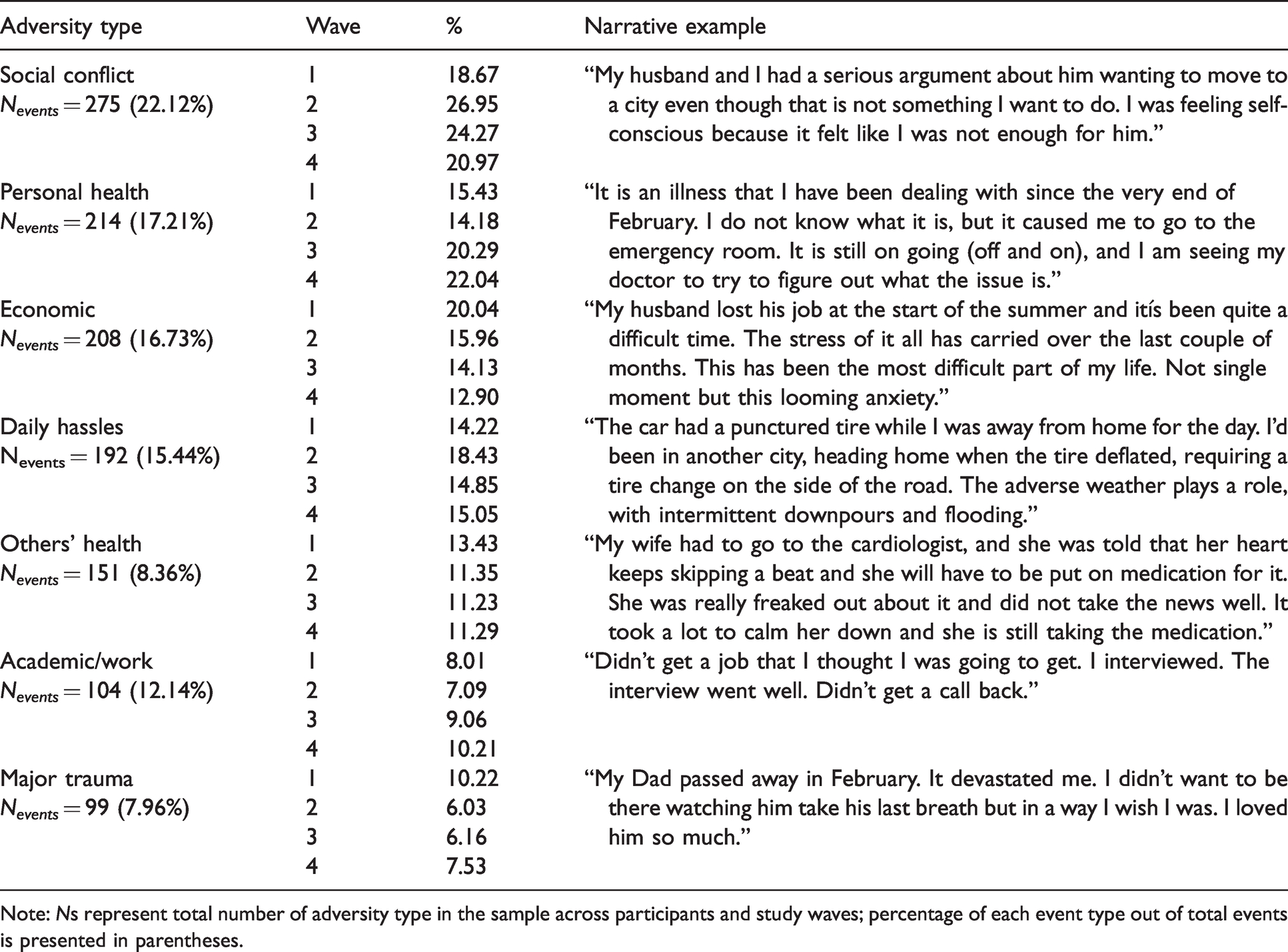
Note: Ns represent total number of adversity type in the sample across participants and study waves; percentage of each event type out of total events is presented in parentheses.
Analytical approach
Following our pre-registered plan (osf.io/ankw9), we performed growth curve modeling of our longitudinal data. To this end, we used a linear mixed effects framework with multi-wave responses clustered in participants via the lme4 package (Bates et al., 2015) in R. The linear mixed modeling approach allowed us to enhance power and account for the nested structure of the four-wave data. Fitting the manifest growth curve model (Mehta & Neale, 2005) within the mixed modeling framework allowed us to include types of adversities as a covariate in a more parsimonious fashion compared to latent growth curve models. Importantly, results from latent growth curve model showed identical effects as the manifest growth curve model analysis within the linear mixed-effects framework (see Supplemental Analysis 2.a. for the latent growth curve model).
To estimate change over time, the first wave was set at zero, with consecutive numbers for subsequent waves in chronological order. All analyses included grand-mean centered inter-individual self-distancing score along with the group-mean centered intra-individual self-distancing score (Enders & Tofighi, 2007). Tukey’s method for family-wise correction controlled for multiple testing in post-hoc simple effect analyses.
Results
Pre-registered analyses: How does self-distancing relate to change in wisdom over time?
The primary pre-registered question (https://osf.io/ankw9/) concerned the role of self-distancing 2 in wisdom trajectories over time. We hypothesized that 1) inter- and intra-individual differences in self-distancing will positively relate to wisdom and 2) greater self-distancing will predict more wisdom over time.
First, we examined how individual differences in self-distancing are associated with the wisdom trajectory over a year. Following the pre-registration and best practices for longitudinal analyses (Bolger & Laurenceau, 2013), the growth-curve model included both participants’ overall aggregated means to estimate inter-individual differences and person-centered self-distancing scores to simultaneously estimate intra-individual differences. Next, given differences in wisdom across adversity types and deviating from the pre-registered analysis, a second growth-curve model included adversity type as a covariate.
As predicted, self-distancing on both inter-individual and intra-individual levels were significantly associated with greater wisdom. In the pre-registered growth curve model, the intra-individual self-distancing ? time interaction was not significant, t(1160.99) = 0.798, p = .425 (see Table 3). However, subsequent exploratory analysis performed just on social conflicts ? the main form of adversity participants reported ? yielded a significant intra-individual self-distancing ? time interaction, t(263.91) = 2.03, p = .043. The inter-individual self-distancing ? time interaction was not significant, t(244.02) = 1.49, p = .138. (see Table 3). As Figure 1 shows, exploratory probing of the interaction via Johnson--Neyman technique to estimate the regions of significance showed that the effect of time on wisdom was significant for intra-individual self-distancing values below −0.376 (observed range of intra-individual self-distancing scores = −2.44 to 3.00). For higher self-distancing values, the effect of time on wisdom was not significant. (see Supplemental Analysis 2.b for analogous linear mixed models for each adversity type.).
Effects of time, inter- and intra-individual differences in self-distancing on wisdom for social conflicts.

Note: The analyzed sample included participants who did not complete first wave but completed later study waves. The comparison group for adversity type factor is daily hassles. ICC is the interclass correlation coefficient; AIC is the Akaike information criterion (AIC) that estimats prediction error. The significant predictors are in bold.

Johnson–Neyman regions of significance (left panel) and simple slopes of time for lowest and highest intra-individual self-distancing over a year (right panel) for social conflicts. Vertical line represents that point along which the effect of self-distancing changes in significance.
Exploratory analyses: How do different adverse events relate to wisdom?
Event characteristics and wisdom
Examining effects of subjective ratings of event characteristics on wisdom revealed greater wisdom in reflection on adversities that participants viewed as challenging, emotional, impactful, uncommon, externally controlled, led to status loss, and more likely to instigate change in worldviews (see Table 4 for all coefficients). However, none of the event characteristics significantly moderated the trajectory of wisdom over time: time × event characteristic interactions: 0.75 < χ2 (df =3) ≤ 4.47, ps > .215.
The effects ofsubjective event characteristics ratingson wisdom

Adversity types and wisdom
As Figure 2 shows, participants reported significantly more wisdom when reflecting on adverse events concerning another person’s health (e.g. partner, parent, child) compared to all other types of adversity, 3.47 < ts ≤ 6.89, ps < .001, except for social conflicts, t = 2.35, p = 0.220 and work/academic, t = 2.35, p = .153. People also reported more wisdom for social conflicts compared to major trauma t = 5.477, p < .0001, daily hassles, t = 3.429, p = 0.011, and personal health, t = 4.201, p < .0001. All other post-hoc pairwise comparisons were not significant, ts < 2.61, ps > .123. Results were comparable for most sub-dimensions of wisdom, except for intellectual humility, which did not differ between adversity types (see Supplemental Analysis 2.c.).

Estimated marginal means for different types of adverse events. Percentage in parentheses indicates proportion of adversity type out of total adverse events reported. The vertical lines represent 95% confidence intervals around the mean.
Adversity types and change in wisdom over time
Spaghetti plots in Figure 3 depict wisdom trajectories for each adversity type, suggesting a great deal of variability in individual trajectories both within and between adversity types. Indeed, although the full model of time and adversity type accounted for 27% of the variance in participants’ responses, most of it (23% of the variance) could be attributed to intra-individual variability in participants’ responses over time. Though wisdom significantly varied between adversity types (with higher wisdom scores when reflecting on another person’s health and on social conflicts vs. other adversity types, as outlined above), F(6, 1174.82) = 12.03, p < .001, adversity type did not significantly qualify changes in wisdom over time: adversity type × time interaction: F(18, 1027) = 1.39, p = .129. 5 These results suggest a great degree of stability in wisdom in the face of different types of adverse events, but also emphasize some nuanced divergence in pathways (see Supplemental Analysis 2.c.).

Plots of individual trajectories for wisdom for different types of adversity. Line of best fit across participants (fixed effect) is presented in bold red, with 95% confidence bands in gray. Fit is estimated via a locally estimated scatterplot smoothing (loess) function—a non-parametric regression method that combines multiple regression models with k-nearest-neighbor meta-models.
Discussion
In the present research, we used a year-long longitudinal study to examine how different ways people reflect on their adversity—self-distancing vs. self-immersing—prospectively inform changes in wisdom. In addition, we explored the relationship between different forms of adversity and prospective changes in wisdom.
Self-distanced vs. self-immersed reflection on adversity
To address the first question, we examined how inter- and intra-individual differences in self-distancing are associated with wisdom trajectories following adversity. We suggested that greater self-distancing in reflection an adverse experience may facilitate resilience and possibly even growth in wisdom over time. Overall, we found that inter-individual differences in self-distancing did not significantly qualify the trajectory of wisdom. In other words, people who on average self-distance more than others do not show different wisdom for adversities involving social conflicts trajectories. In contrast, intra-individual differences in self-distancing did qualify the trajectory of wisdom. Specifically, participants who reported self-distancing less from social conflicts than their general level subsequently showed a negative trajectory of wisdom. Participants who reported self-distancing more from adversity than their general level sustained wisdom over the same period. Together, these findings suggest that maintaining or developing a self-distanced perspective on social conflicts is associated with sustaining wisdom over time. Self-distancing may be related to mechanisms such as meaning-making and deliberative rumination. This idea is in line with recent research on memory updating during clinical interventions. A recent study found that shifting perspectives from self-immersion to self-distancing when working through stressful past experiences helped to create new meaning for these experiences (Romano et al., 2020).
Our results extend recent evidence from a pre–post experimental field study that examined effects of self-distanced reflection training for wisdom (Grossmann, Dorfman, Oakes, et al., 2021). When examining responses on the same scale as used in the present longitudinal study (Grossmann, Dorfman, Oakes, et al., 2021, Study 1 supplement), participants who trained in self-distancing sustained a comparable degree of self-reported wisdom from before-to-after the self-distancing intervention. In contrast, control participants who did not train in self-distanced reflection showed a decline in wisdom. These findings further qualify a set of theoretical models about wisdom development, which suggest that individual differences competences similar to self-distancing can promote growth in wisdom over time (e.g. Glück et al., 2019). Although these models so far have chiefly focused on inter-individual competences, it is possible that intra-individual change in competences is the driving force behind wisdom maintenance and development.
It is noteworthy that the effects of self-distancing on wisdom trajectory were particularly pronounced for social conflicts. Social conflicts often involve disagreements of parties pursuing different interests. Consequently, it is possible that social conflicts are both more likely to call for wisdom (Grossmann, 2017; Grossmann, Dorfman, et al., 2020). They are also more frequent compared to more singular events such as a major health scare. Thus, social conflicts may produce enough variance in responses to detect growth/decline trajectories. At the same time, the current operationalization of wisdom builds on measures designed specifically for the context of social disagreements and conflicts (Brienza et al., 2018). Consequently, future work may benefit from metrics specifically designed for contexts capturing nuances of medical or economic adversities.
These longitudinal findings also extend the existing literature of self-distancing (Kross & Ayduk, 2017), highlighting the distinction between inter-individual, “trait-like” differences in self-distancing and intra-individual variability from this trait-like level. Further understanding of self-distancing effects will benefit from additional longitudinal studies over longer time frames and across a broader range of psychological processes such as emotion regulation and relational maintenance strategies.
Another insight regarding self-distancing relates to the trajectory of self-distancing for different types of adversity. We found a similar self-distancing trajectory across many different types of adversity, suggesting that the way people engage in self-distancing was largely robust across adversity type (but see minor exceptions in the supplement).
Are all types of adversities alike?
In our exploratory analyses, we classified different types of adversity participants reported experiencing during the year. While some participants reported experiencing the same type of events several times, we observed considerable inter- and intra-individual variability in the types of adversity participants reported. Ratings of subjective event characteristics (i.e. construal of the event) shed further light on differences between adversity types. In particular, social conflicts, economic hardships, and health issues were perceived as more challenging than daily hassles, academic/work setbacks, and even traumas. Also, social conflicts, others’ health problems, and major traumas elicited more negative affect than other types of adversity. Finally, others’ health problems were perceived as less predictable than all other adversity types reported in the study.
Though construal of an event as less predictable may signal uncertainty and low locus of control (Affleck, Tennen, Pfeiffer, et al., 1987), it may also signal greater recognition flexibility that is needed in the situation, which is central to the wisdom construct (Grossmann, 2017). Indeed, participants reported greater wisdom in reflection on adversity involving others’ health problems as compared to other types of adversity. More wisdom in reflections about other-focused adversity than self-focused adversities also corresponded with existing experimental evidence in the wisdom literature, which suggests that people exhibit greater wisdom when reflecting on others’ (vs. their own) problems (Grossmann & Kross, 2014). The insight that different types of adverse events may be associated with different outcomes depending on people’s subjective appraisals of the event (Beck, 2002; Folkman & Lazarus, 1985; Yih et al., 2019) may be especially critical for posttraumatic growth research. We note this because the posttraumatic growth research so far has either chiefly focused on one type of adversity (major trauma) or has not differentiated between adversity types in the first place (e.g. Engels et al., 2019; cf. Infurna & Luthar, 2016; Jayawickreme et al., 2021; Luhmann & Eid, 2009).
Focusing on wisdom, we observed no evidence for posttraumatic growth for any type of adversity participants reported. For major trauma, economic and work-related challenges, and daily hassles, participants reported a high degree of rank-order stability in wisdom, with no change in trajectories over a period of a year. In contrast, for adversity involving health issues, we observed a negative linear trajectory in wisdom over time. It is possible that people who are dealing with personal health problems are more self-focused. As a result, they may report wisdom-related meta-cognitions such as perspectivism less than people who reflect on other types of adversity. Together, these longitudinal observations of the ways people work through different types of adversity suggest potentially distinct trajectories of wisdom over time, casting doubt on the idea of general growth in wisdom after experiencing adversity.
The overall trajectory of wisdom in the face of adversity may be best characterized as reflecting resilience—i.e. the maintenance of stable levels of psychological (and physical) functioning in the face of adversity (Luthar et al., 2000). The assumption that wisdom stability is a sign of resilience dovetails with other emerging longitudinal studies on trajectories of character strengths following adversity. Like the present results, these studies document resilience rather than positive changes (e.g. Chopik et al., 2020; Davis et al., 2019).
Change in character over time: Nuances matter
This research contributes to the emerging study of change and resilience in specific character strengths and virtues (Lamade et al., 2020), responding to calls to integrate prospective research on specific character strengths into the resilience and growth research (Infurna & Jayawickreme, 2019; Letzring et al., 2005). Enriching previous research on resilience and growth, which has primarily examined general changes in well-being (Jayawickreme & Blackie, 2016), the current investigation provides a detailed and nuanced picture of wisdom trajectories. Specifically, sustained wisdom-related resilience in response to adversity may depend on type of adversity and how individuals reflect on this adversity. Such fine-grained studies have been largely missing from the literature (Denissen et al., 2019; Infurna & Jayawickreme, 2019; Jayawickreme & Blackie, 2014). The resilience in wisdom observed in the current study is also noteworthy given that resilience may not be as commonplace as previously believed (Bonanno et al., 2002; Infurna & Luthar, 2018; Infurna et al., 2017). Recent studies show that for a significant number of people, adverse life events bring negative change in character strengths and self-esteem (Bleidorn et al., 2021; Chopik et al., 2020). For example, examining U.S. soldiers pre- and post-deployment, Chopik et al. (2020) found that 40% of soldiers experienced negative changes in character strengths post-deployment. The rest of the sample remained stable post-deployment. If resilience in general is not commonplace, and change is often negative, maintaining wisdom—a unique strength—in the face of adversity may be at least as important as experiencing “growth” in wisdom, because a likely alternative is a decrease in this character strength.
Why did we fail to observe positive changes in wisdom over time in response to adverse events? First, one year may not be enough time to observe meaningful changes in character, especially changes in wisdom, as most changes may happen more gradually over longer periods (e.g. McAdams & Olson, 2010). Second, significant changes in wisdom may be driven by non-normative life events (Chopik et al., 2019). In our sample, participants considered the events they reported as relatively common and not particularly likely to transform their worldview (the event characteristics of different adversity types are presented in supplemental analysis 2.d. and Figure S1 in the Supplemental Materials). Future longitudinal research that tracks people for more than one year can help answer some of these questions. Such studies can help to determine whether wisdom trajectories and the effects of self-distancing differ for lower base-rate adverse events (e.g. a life-threatening assault) or unexpected circumstances (e.g. prolonged social isolation during a pandemic).
Focusing on wisdom expands the discussion of posttraumatic growth and character change beyond personality traits. The narrative identity approach to posttraumatic change examines changes in how people construe and “narrate” their lives following traumatic life events (McAdams, 1996; Pals & McAdams, 2004). Likewise, wisdom can be understood through the ways people approach and reflect on adverse experiences (Weststrate & Glück, 2017; Weststrate et al., 2018; also see Staudinger & Glück, 2011, for a review). In contrast to the changes that people report when describing their “life stories” after a major adverse event (Pals, 2006), our findings suggest that growth in wisdom—reflected in specific meta-cognitions and moral aspirations of the CWM—does not typically change much at all. These findings challenge the folk belief that people can grow stronger and become “wiser” following adverse events they experience in their lives. Rather, the findings emphasize the importance of self-distanced reflection on adverse events in helping to prevent stagnation and decline in wisdom.
While our study focused on wisdom-related responses to concrete events using items concerning moral aspirations and meta-cognition, other conceptualizations and measures may show different trajectories following adversity. In particular, it is possible that more abstract characterizations of wisdom, using context-free metrics, or self-reports of one’s narrative identity may produce results more in line with common lay theories about growth from adversity (e.g. Glück et al., 2019). It is also possible that more nuanced measures, which build on common ways people of different socio-economic and sub-cultural groups express their intellectual humility, open-mindedness, or perspective-taking, could show greater variability in wisdom-related meta-cognitions over time. Future research could examine prospective changes in wisdom as an autobiographical narrative (e.g. Glück et al., 2005), personality characteristic (Staudinger et al., 2005), and personality resource (Glück et al., 2019), as well as consider employing a multi-method approach relying on simultaneous assessment of wisdom across different operationalizations (e.g. Baltes & Staudinger, 2000; Jeste et al., 2010; Webster, 2003).
Despite the substantial diversity of our study sample in age and socio-economic background, most participants were White, with less than a quarter of participants from other ethnic groups, limiting the generalizability of the insights to other populations. Moreover, the study was solely based on participants from English-speaking North America, raising questions about whether these effects would generalize to other cultures. Future research must focus on exploring and understanding the types and appraisals of adverse events that are experienced by culturally diverse groups. Indeed, wisdom trajectories could be different for different cultural and ethnic groups, who may also differ in their propensity to engage in self-distanced reflections (Grossmann & Kross, 2010).
Conclusions
Working through different types of adversities does not offer a direct path to gain wisdom. Though wisdom may not “grow” over time in the face of adversity, it matters how one reflects on an adverse experience. Although reflecting on adverse social conflicts in a self-immersed way is associated with negative trajectories in wisdom, taking a self-distanced perspective can help preserve wisdom in the face of adversity. And though not all adversities are alike, no specific type of adversity appear especially beneficial for the development of wisdom.
Supplemental Material
sj-pdf-1-erp-10.1177_08902070211014057 - Supplemental material for None the wiser: Year-long longitudinal study on effects of adversity on wisdom
Supplemental material, sj-pdf-1-erp-10.1177_08902070211014057 for None the wiser: Year-long longitudinal study on effects of adversity on wisdom by Anna Dorfman, David A Moscovitch, William J Chopik and Igor Grossmann in European Journal of Personality
Footnotes
Acknowledgments
Takuya Shibayuma and Nadine Bolineu provided valuable assistance with executing the longitudinal study, Konstantyn Sharpinsky provided assistance with data-integrity cross-validation, and the participants of the Pathways to Character Capstone Conference 2019 provided valuable insights.
Declaration of conflicting interests
The author(s) declared no potential conflicts of interest with respect to the research, authorship, and/or publication of this article.
Funding
The author(s) disclosed receipt of the following financial support for the research, authorship, and/or publication of this article: The present research was funded by the Social Sciences and Humanities Research Council of Canada Insight Grants (435-2014-0685, to IG), Early Researcher Award from the Ontario Ministry of Research and Innovation (ER16-12-169, to IG), and Templeton Pathways to Character Award (to IG and DAM).
Data accessibility statement
The study materials, data, and analysis scripts used for this article can be accessed at osf.io/vkrpu.
Notes
References
Supplementary Material
Please find the following supplemental material available below.
For Open Access articles published under a Creative Commons License, all supplemental material carries the same license as the article it is associated with.
For non-Open Access articles published, all supplemental material carries a non-exclusive license, and permission requests for re-use of supplemental material or any part of supplemental material shall be sent directly to the copyright owner as specified in the copyright notice associated with the article.
