




Abstract
Researchers have questioned whether self-report questionnaires adequately assess post-traumatic growth as it was theorized (positive personality change after trauma), versus assessing a broader coping mechanism. Across four studies, we examine whether individuals report post-traumatic growth as a coping mechanism to restore a sense of justice. In Studies 1 and 2, participants predicted greater post-traumatic growth for a hypothetical victim after a severe accident that caused grave suffering (and disrupted one’s belief in a just world), compared to an accident that caused minimal suffering (and did not disrupt one’s belief in a just world). Both perceptions of deservingness of post-traumatic growth for the victim (a belief in a just world mechanism) and engagement in deliberative rumination (a post-traumatic growth mechanism) mediated the effect of suffering on the prediction of post-traumatic growth in Study 2. The same pattern of results held when participants considered their own imagined suffering (Study 3), and when participants reported post-traumatic growth from distressing events in their own lives (Study 4). As such, we conclude that following an episode of suffering, either occurring to another or to oneself, self-reports of post-traumatic growth on questionnaires can reflect two distinct motivations: (1) an attempt to cope with perceived injustices and (2) the will to search for meaning in one’s suffering.
Keywords
Post-traumatic growth (PTG) is defined as positive personality change that individuals may experience after they have endured distressing and traumatic life events (Jayawickreme & Blackie, 2014). PTG was born out of Janoff-Bulman’s (1992) theory of shattered assumptions, which argues that traumatic experiences can severely threaten the assumptions that individuals implicitly hold about the benevolence, predictability, and meaningfulness of the world they live in. To recover from trauma, individuals need to rebuild their shattered assumptions to incorporate their traumatic experience and manage feelings of fear and acute victimization. Tedeschi and Calhoun (2004) observed that through this rebuilding process, some individuals described how the experience had shaped their identity, relationships and worldviews in unexpected positive ways. For example, an individual may rely more on the support of loved ones when coming to terms with a serious health diagnosis, and as such may feel closer to and more able to confide in their loved ones about their fears and worries. In other words, some people report positive psychological changes following trauma.
While researchers do not doubt that some individuals experience PTG, they have questioned the suitability and accuracy of assessment tools used to measure it (Frazier et al., 2009; Jayawickreme & Blackie, 2014; Tennen & Affleck, 2002). Researchers have argued that the self-report questionnaires typically used to measure PTG cannot determine whether participants’ responses reflect positive changes from pre-trauma characteristics, versus a broader coping mechanism to manage the negative emotion triggered by the trauma. The aim of this paper is to examine the extent to which perceptions of PTG, following episodes of suffering, capture one specific coping mechanism—the motivation to restore belief in a just world (BJW; Lerner 1980).
The accuracy of measurement of post-traumatic growth
The vast majority of PTG research has relied on cross-sectional and retrospective study designs. Typically, in these studies, researchers recruit a sample of participants who have experienced a traumatic life event within a set timeframe, usually three to five years prior to the study. PTG is then assessed retrospectively, in reference to that trauma, by asking participants to complete a self-report questionnaire, such as the post-traumatic growth inventory (PTGI; Tedeschi & Calhoun, 1996). The PTGI is a 21-item questionnaire, where participants rate the degree to which they have experienced each positive change on the inventory on a 6-point scale from “0” (“did not experience”) to “5” (“experienced to a very great degree”). The PTGI measures positive changes in five domains: Improved relationships (e.g. “I learned a great deal about how wonderful people are”), increased feelings of personal strength (e.g. “I discovered that I’m stronger than I thought I was”), deepened spirituality (e.g. “I have a stronger religious faith”), identification of new possibilities (e.g. “I have developed new interests”), and appreciation of life (e.g. “An appreciation for the value of my own life”). The PTGI is not the only retrospective self-report questionnaire available to measure PTG (cf. Joseph et al., 2012; Park et al., 1996), yet it is the most frequently used. Jayawickreme et al. (2018) reviewed the published research on PTG between 2016 and 2017 and reported that the PTGI was used in 94% of publications.
However, despite its frequent use, the PTGI is not without its problems. For every single item, individuals have the error-prone and taxing task of determining their current standing, recalling their past standing prior to the trauma, calculating the degree of change, and determining how much of the change was uniquely due to the trauma (Coyne & Tennen, 2010; Ford et al., 2008). The few prospective longitudinal studies considering PTG have shown that individuals are not able to undertake these steps accurately, thereby calling into question the suitability of the PTGI, and other similarly designed retrospective self-report questionnaires, for assessing PTG as positive personality change over time. Specifically, Frazier et al. (2009) found only a small positive correlation between participants’ responses on the PTGI (measured once post-trauma) and actual change in the five domains of PTG. Frazier et al. (2009) measured actual PTG as the change in scores on the adapted current-standing PTGI (PTGI-CS) pre- and post-trauma. This measure of actual change removes the taxing task of participants calculating the personality change themselves, by producing a difference score on how people’s stance on the five domains of PTG has changed between time 1 (pre-trauma) and time 2 (post-trauma).
Similarly, more recent prospective longitudinal studies, which also use current-standing measures of PTG to assess change over time, have found no relationship between participants’ retrospective perceptions of how they had changed and the degree to which they had actually changed over time (Boals et al., 2019; Owenz & Fowers, 2018; Yanez et al., 2011). In other words, research suggests that the PTGI may not portray an accurate representation of how much an individual has experienced positive personality growth following trauma. Although, of note, Boals et al. (2019) did find that the PTGI-CS can be adapted to refer to longer time frames (i.e. the length of an academic semester) and maintain a strong and positive correlation with the actual growth.
Post-traumatic growth as a coping mechanism
As highlighted above, the methodological challenges associated with using a retrospective and cross-sectional questionnaire to assess PTG makes it difficult to disentangle whether participants’ responses are capturing actual positive changes occurring over time, as theorized, or other plausible alternatives, such as coping strategies. This has led some researchers to propose a two-component model of PTG (Zoellner & Maercker, 2006), where self-reported PTG may reflect either an illusory belief (i.e. mere perceptions of PTG) or a constructive and functional belief (i.e. actual pre- to-post-trauma change) that predicts greater adjustment over time. The two components are proposed to have distinct predictors, outcomes and, importantly, time courses, and research has offered support for this distinction between illusory and constructive PTG. Illusory PTG (assessed as higher scores on the retrospective PTGI), is associated with increases in distress and avoidance coping over time, whereas constructive PTG (assessed as actual pre- to post-trauma change in PTG-related domains) is associated with decreases in distress over time (Boals et al., 2019; Frazier et al., 2009). These findings suggest that the PTGI is not best suited to measure constructive growth, yet if the PTGI is measuring illusory growth instead, then questions remain about the function that self-reports of illusory growth serve. That is, what motivates individuals to perceive illusory growth following trauma?
Several researchers have proposed that illusory growth may enable individuals to cope with difficult and challenging life circumstances. Indeed, there is conceptual overlap between the content of the PTGI and self-report questionnaires that assess individual differences in coping styles and strategies. For example, echoing the PTGI, the Brief COPE questionnaire (Carver, 1997) has a positive reframing sub-domain, which measures the extent to which individuals are motivated to search for something positive in their crisis. Although, PTG and positive reappraisal are not necessarily the same construct (and the latter might be a cognitive mechanism facilitating constructive PTG), the aforementioned issues with the PTGI make it impossible to fully determine whether people’s positive perceptions of their trauma (i.e. illusory growth) are a coping mechanism, driven in part or wholly by individual differences in positive reappraisal.
Another explanation for why individuals may report illusory PTG is the motivation for self-enhancement. Specifically, Taylor and colleagues noted that women undergoing breast cancer treatment would engage in downward social comparisons and inflate their chances of recovery to feel good about themselves and optimistic about their future (Taylor & Armor, 1996; Taylor et al., 2000). McFarland and Alvaro (2002) found participants rated themselves significantly lower on growth-related PTG attributes, when compared to an acquaintance, prior to the occurrence of the stressful event. There was no difference in self-ratings and acquaintance-ratings after the event. These findings suggest that people may self-enhance to perceive illusory PTG by derogating or misremembering their past selves. Thus, in self-enhancement explanations of PTG, these so-called positive illusions are cognitive distortions, not accurate representations of reality, which function to protect an individual’s emotional and psychological health.
In sum, there are separate bodies of work that could explain retrospective PTGI responses as perceptions of illusory growth and as a coping mechanism, rather than an accurate measure of actual growth.
Post-traumatic growth as a form of ultimate justice reasoning
Perceiving positivity in trauma and suffering can also be recognized as ultimate justice reasoning (UJR; Lerner, 1980). UJR is the perception and prediction of future positivity and compensation following undeserved suffering, motivated by the desire to maintain a belief in a just and fair world. That is, people perceive an individual who has suffered greatly, versus minimally, as more likely to experience a more fulfilling and meaningful life in the future (Harvey et al., 2014). UJR offers a potential alternate motivation and coping mechanism to account for people’s responses to the PTGI. Yet, despite the theoretical parallels between UJR and PTG, to our knowledge, no research has formally examined the extent to which explanations for PTG can be situated within just world theory (Lerner, 1980). Therefore, we specifically set out to examine whether people’s predictions of PTG (Studies 1–3) and people’s self-reported levels of PTG after distressing events (Study 4), via the PTGI, are simply one of the mechanisms that people may adopt when motivated to maintain their implicit belief that the world is a just and fair place.
To understand UJR, one must first understand the theoretical construct of the “BJW”. BJW was first proposed by Lerner (1980), who suggested that people have a fundamental desire to perceive the world as a fair and just place, aligned with principles of deservingness. Adhering to this “fundamental delusion” allows individuals to pursue long-term goals and investments with the confidence that just and deserved rewards will be bestowed. If the world did not behold such principles, effortful endeavors, such as working in paid employment, would be considered fruitless, as there would be no guarantee that one would receive their deserved outcomes (i.e. pay). As such, individuals are inherently motivated to perceive all events and outcomes as deserved to pursue everyday activities, endeavors, and long-term pursuits.
Although the BJW is fundamental for an individual to function in modern society, it is ultimately a delusion. Unfortunately, the reality is that the world we all live in does not guarantee deserved outcomes. One does not have to look far to see instances of injustice, where good, innocent people suffer undeserved misfortunes. A prominent and recent example is the great suffering and loss of life of individuals, including NHS workers, from the deadly Covid-19 Coronavirus. When an individual is faced with such undeserved suffering, their BJW, and therefore their faith in the return of their long-term investments, is threatened (see Callan et al., 2009).
As adhering to principles of deservingness is integral to daily life and serves important adaptive functions (i.e. investment in long-term goals), individuals are therefore motivated to restore a sense of justice when exposed to instances of injustice. Lerner (1980) argued that people often engage in various cognitive and behavioral “strategies” or “tactics” to maintain a perception of justice in the face of instances that pose a threat to the BJW. Of relevance to the current paper, Lerner (1980) proposed several “nonrational” strategies for preserving a commitment to justice that can involve, among other things, denying, avoiding, reinterpreting, or misremembering episodes of injustice. Nonrational strategies are typically cognitive distortions an observer can personally entertain to maintain their BJW, without seeking any actual relief or justice for a victim. Thus, such nonrational strategies to maintain a BJW echo the work on coping strategies to maintain a positive illusion of PTG, as both are cognitive distortions to appraise a negative and irreversible situation in more favorable terms.
UJR is one nonrational strategy people may utilize as a defence against threats to one’s BJW (Lerner, 1980). To endure and accept the undeserved suffering of another, one can simply extend the time frame of an injustice, so that any wrongdoing will be rectified in the long run and a balance of justice will eventually be restored. Research has supported theorizing on UJR and has identified that individuals sometimes perceive future benefits and positivity for a victim as a direct result of their suffering and misfortune (Anderson et al., 2010; Hafer & Gosse, 2011; Harvey et al., 2014; Ong et al., 2002; Warner et al., 2012). For example, Anderson et al. (2010) found that participants envisioned a teenager’s later life as more fulfilling and meaningful if he had been badly injured and placed in a wheelchair (i.e. high BJW threat) than if he had suffered only a mild injury (i.e. low BJW threat). This effect was enhanced in their second experiment, when participants’ just-world beliefs were first threatened within an unrelated context (i.e. a prior justice threat “spilled over” to heighten UJR in another context, Anderson et al., 2010). Most recently, Ong et al. (2020) found that participants exposed to individuals who have suffered, versus not suffered, to be more deserving and therefore perceived them as more likely to receive specific tangible rewards (i.e. being chosen to receive a green card in the US “lottery”).
In a similar vein, Harvey and Callan (2014a) found that participants engage in more UJR when a victim is portrayed as good and, therefore, undeserving of misfortune, (versus bad and deserving of misfortune). Interestingly, UJR appears to work comparatively for the self as it does for others. Harvey and Callan (2014a) found that when participants thought about their own bad breaks, those with higher self-esteem perceived themselves as more deserving and more likely to have a fulfilling and meaningful future life (i.e. UJR) compared to those with lower self-esteem. More generally, Mata and Simão (2019) found people make positive and optimistic forecasts for themselves, regardless of their previous moral conduct.
Therefore, people can engage in the cognitive distortion of UJR to perceive positive outcomes, in the form of future compensation, for either an observed victim or themselves to absolve current suffering and BJW threat. As such, if people were to respond to the PTGI following a trauma to predict future positive psychological growth, their responses could be driven by the motivation to restore a sense of justice, rather than the accurate prediction of growth following shattered and then rebuilt core assumptions (Janoff-Bulman, 1992). Furthermore, this alternative account of why individuals perceive PTG is broadly consistent with Park’s (2010) integrative account of meaning making in the aftermath of adversity, which posits that people engage in situational meaning making processes to reappraise the event and reduce the discrepancy between the occurrence of the adverse event and their global belief system (i.e. BJW).
The current experiments
In this paper, we aim to test the extent to which a coping mechanism—the motivation to maintain a BJW via UJR—accounts for people’s responses to the PTGI. Despite the theoretical parallels between UJR and PTG, to our knowledge, no research has formally examined the extent to which explanations for PTG can be situated within just world theory (Lerner, 1980). Combining research on PTG and BJW, we will examine whether individuals will predict future psychological growth (i.e. PTG via a predictive PTGI; Studies 1-3B) and report experiencing PTG after distressing events in their own lives (Study 4) as a coping mechanism to restore a sense of justice. We are interested to see if the effect is mediated by perceptions of deservingness (Studies 1–4) and/or processes aligned to PTG (i.e. deliberative rumination, Cann et al., 2011; Studies 2–4). We are also interested to examine whether predicting PTG, and the associated mediational relationships, are constant across perceptions of others and the self and whether an individual difference, such as dispositional UJR (Maes, 1998), moderates the effect (Study 3).
Study 1
Previous research has demonstrated that participants engage in UJR to a greater extent, and therefore perceive a victim as more likely to have a fulfilling life in the future, when considering a victim who suffers greatly (versus minimally; Harvey et al., 2014). Similarly, we would anticipate that individuals’ predictions of psychological growth, via the PTGI, would show the same pattern of results as UJR. In line with PTG theory, predictions of growth would only be warranted when an individual’s assumptions of the world have been shattered through trauma and suffering (i.e. high BJW threat), rather than mild inconvenience (i.e. low BJW threat; Janoff-Bulman, 1992). Therefore, we would expect people to predict greater PTG following instances of observed high suffering than low suffering.
The effect of BJW threat on UJR is mediated and driven by perceptions of deservingness (Harvey & Callan, 2014a; Ong et al., 2020). When participants are confronted with a victim who poses a threat to their BJW, compared to a victim who poses little to no threat, participants perceive the victim as more deserving of future fulfilment in life, which at least partially accounts for greater engagement with UJR (Harvey & Callan, 2014a). Therefore, in our first study we sought to examine if the deservingness mechanism, which explains UJR in response to suffering, also accounts for predictions of PTG on the PTGI.
In our first study, we asked participants to read a hypothetical scenario that outlined a soccer accident that occurred to someone else. The severity of the accident was manipulated to either threaten the notion of a fair and just world (high suffering) or pose little threat (low suffering). Afterwards, participants responded to questions that measured UJR and an adapted version of the PTGI to predict future PTG. Firstly, we wanted to conceptually replicate Harvey and Callan’s (2014a) UJR findings. We expected to see greater UJR reasoning for participants in the high suffering condition compared to the low suffering condition, and for deservingness of UJR to mediate this effect. Secondly, we wanted to investigate whether our suffering manipulation led to greater predictions of PTG in the high versus low suffering condition and whether this effect was mediated by perceived deservingness of PTG. We predicted that participants in the high suffering condition (versus the low suffering condition) would perceive the victim as more deserving of PTG and therefore predict greater growth via the PTGI. Our hypotheses and data analysis plan were preregistered prior to data collection and are available from the Open Science Framework (Blackie & Harvey, 2020a).
Methods
All the materials and questionnaires used in each study are clearly specified in their respective method section. Furthermore, the data 1 and syntax are available from Open Science Framework: https://osf.io/dwa3s/
Participants
A total of 303 participants from the UK were recruited online via Prolific, an online participant recruitment system, in return for payment of £2. Our sample size was determined from previous studies on UJR that had examined similar mediation hypotheses and the amount of available funds for the project. A total of 13 participants were excluded from further data analysis because three participants did not complete the study, one participant listed their age as under 18 years, and nine participants failed the attention check. A final sample consisted of 290 participants (65% female, 35% male; Mage = 33.81 years; SDage = 12.39). This study was approved by the School Research Ethics Panel at the first author’s university.
Materials
One item was included as an attention check item. Participants were asked “What injuries, if any, did James suffer in his soccer accident?” and given the following options: “Broken leg and damage to his spine” (correct for the high suffering condition), “Mild sprain to his ankle” (correct for the low suffering condition), “No injuries” and “I can’t remember”. A total of nine participants failed this attention check, as mentioned in the participant subsection above.
Procedure
Participants were recruited to participate in an online survey on perceptions of people and personal experiences. The survey was conducted via Qualtrics. Participants were presented with a participant information sheet and provided informed consent before participating in the study.
Participants first read a vignette formatted as an online blog entry describing a soccer accident involving a character named James. Participants were randomly allocated to either the high suffering condition, where James spent time in a wheelchair, or the low suffering condition, where James suffered a mild sprain. Next, participants answered a series of questions about the vignette. Participants answered the UJR items and the adapted PTGI to measure PPTG. These scales were counterbalanced so half of the participants responded to the UJR items first and the other half of participants responded to the adapted PTGI first. Participants then answered the deservingness of ultimate justice items, followed by the deservingness of PTG items, followed by the manipulation check items, the attention check item and demographic questions. Finally, participants were debriefed and paid £2, via the recruiting platform Prolific, for their participation.
Results
The reported data analyses follow our preregistered data analytic plan. The data, correlation matrices, and syntax files are available from the project page on the Open Science Framework.
Manipulation check: Perceived unfairness
As specified in our pre-registration, outliers were determined as extreme values that were more than ±3 SD from the mean in each condition. Two outliers for perceived unfairness were therefore removed from the high suffering condition for being more than 3 SD below the condition mean. The distribution of the data was skewed in both conditions (low suffering = W(144) = 0.98, p = 0.046 and high suffering = W(144) = 0.90, p < 0.001), therefore a nonparametric test was conducted. A Mann–Whitney test validated our manipulation by demonstrating that participants in the high suffering condition (Mdn = 6.00, SD = 0.83, Mean ranks = 212.77) perceived the accident as significantly more unfair than participants in the low suffering condition (Mdn = 3.33, SD = 0.99, Mean ranks = 78.23), U = 537.00, Z = −13.95, p < 0.001, ƞ2 = 0.68.
Ultimate justice reasoning
Three outliers for UJR were removed from the high suffering condition for being more than 3 SD below the condition mean. The UJR measure violated assumptions of normality in both the low suffering (W(144) = 0.96, p < 0.001) and high suffering (W(143) = 0.96, p < 0.001) conditions and the assumption of equal variances was violated (F(1, 285) = 26.274, p < 0.001), therefore a nonparametric test was conducted. A Mann–Whitney test demonstrated that participants in the high suffering condition (Mdn = 5.33, SD = 1.01, Mean ranks = 190.03) perceived greater UJR for the victim of the accident than participants in the low suffering condition (Mdn = 4.00, SD = 1.62, Mean ranks = 98.29), U = 3714.00, Z = −9.39, p < 0.001, ƞ2 = 0.31.
We conducted mediation analyses using the PROCESS macro via SPSS (Hayes, 2017; Model 4, 10,000 resamples). 2 The indirect pathway between suffering condition and UJR, via perceived deservingness of UJ, was significant (indirect effect, b = 0.19, 95% BCa CI [0.09, 0.33]; see Figure 1). That is, perceived deservingness of ultimate justice at least partly explains why participants perceive greater UJR for a victim who suffers greatly versus minimally.
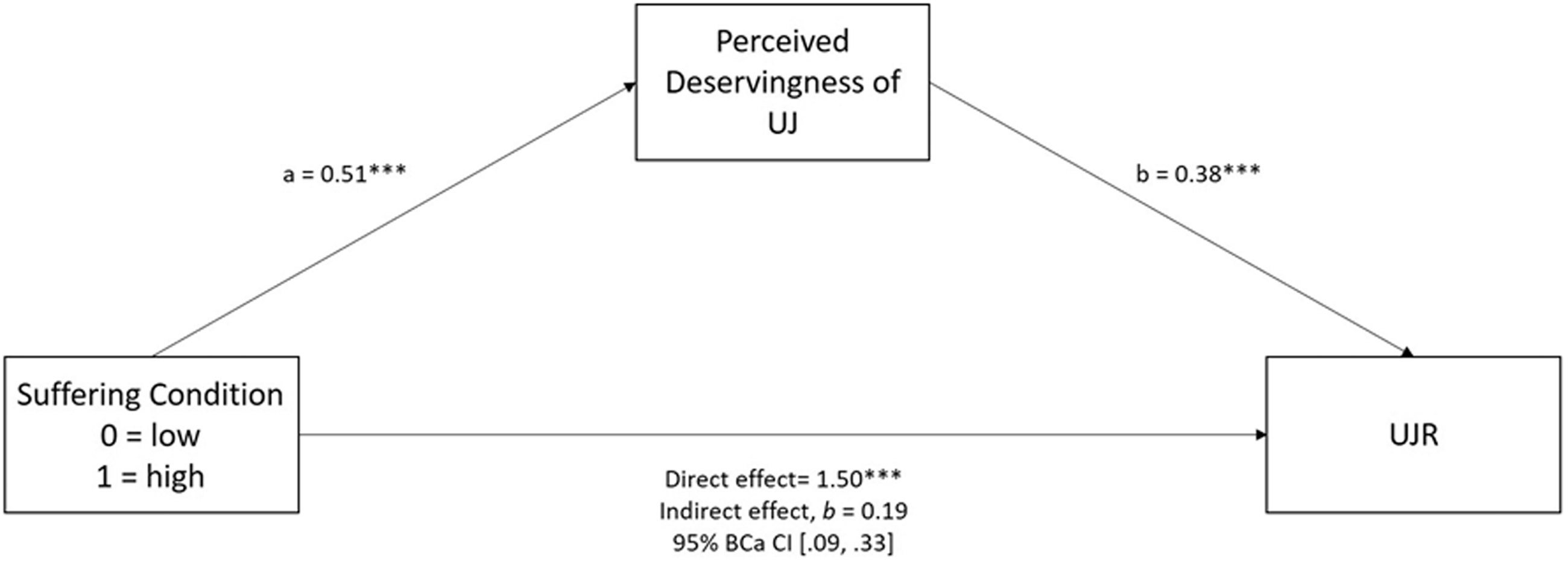
Mediational model from Study 1, predicting ultimate justice reasoning from suffering condition and perceived deservingness of ultimate justice.
Predicted post-traumatic growth
One outlier from the low suffering condition was removed for being more than 3 SDs above the condition mean. The measure of PPTG violated assumptions of normality, with positively skewed data in the low suffering condition, W(143) = 0.91, p < 0.001. In addition, Levene’s test for equality of variances was significant, F(1, 287) = 10.96, p < 0.001, so a nonparametric test was conducted. A Mann–Whitney test demonstrated that participants in the high suffering condition (Mdn = 4.07, SD = 0.78, Mean ranks = 204.58) predicted greater PTG for the victim of the accident than participants in the low suffering condition (Mdn = 1.86, SD = 0.98, Mean ranks = 84.17), U = 1740.00, Z = −12.25, p < .001, ƞ2 = 0.52.
Before examining whether perceived deservingness of PTG mediated the relationship between suffering condition and PPTG, we examined whether the data met the assumptions required for regression. No issues with normality (as assessed by examining the plot of residuals), heteroscedasticity or multicollinearity were identified (Tolerance < 1, IVF < 2). No outliers were identified as exceeding the cut-off threshold for two or more of the outlier statistics for Mahalanobis distance, cooks distance, and leverage outlier statistics.
We conducted mediation analyses using the PROCESS macro via SPSS (Hayes, 2017; Model 4, 10,000 resamples). The indirect pathway between suffering condition and PPTG, via perceived deservingness of PTG, was not significant (indirect effect , b = 0.06, 95% BCa CI [−0.001, 0.13]; see Figure 2). Therefore, perceived deservingness of PTG did not mediate the relationship between suffering condition and PPTG.
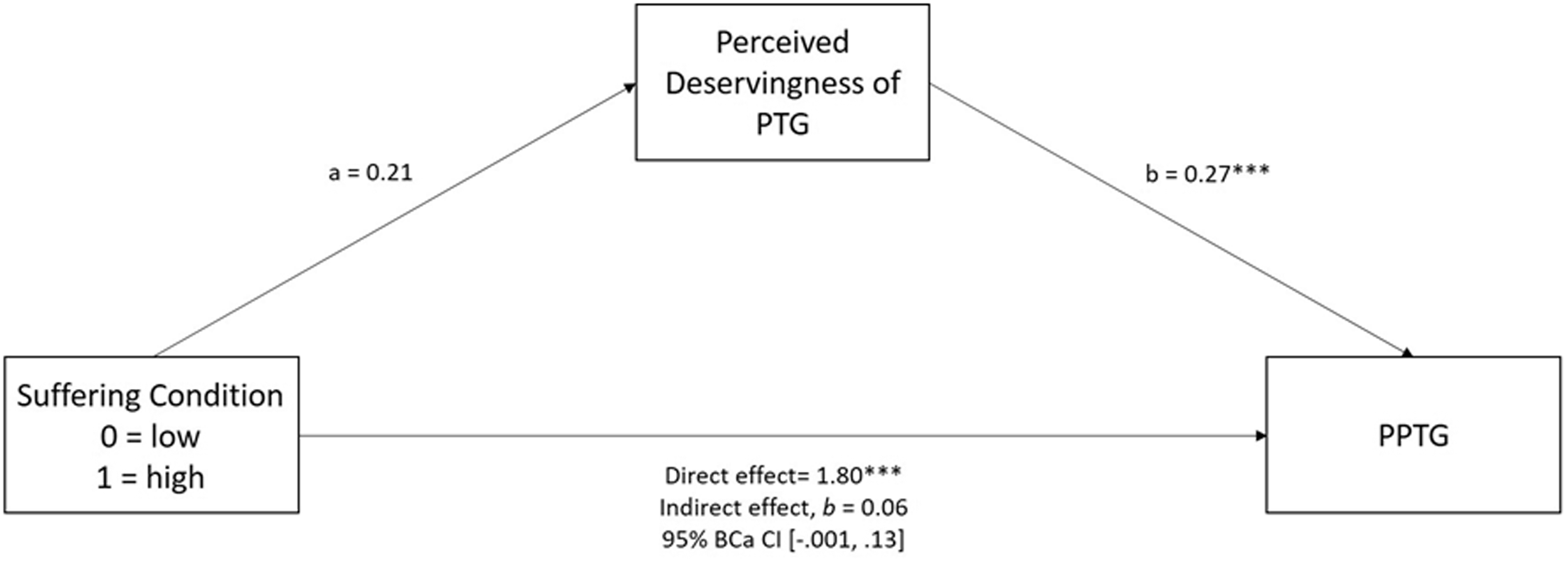
Mediational model from Study 1, predicting predicted post-traumatic growth (from the adapted PTGI) from suffering condition and perceived deservingness of post-traumatic growth.
Discussion
Our findings from Study 1 conceptually replicated previous UJR research (e.g. Harvey & Callan, 2014a) in that participants engaged with greater UJR when exposed to a victim who had suffered greatly, versus minimally, and perceptions of deserving ultimate justice mediated this relationship. In other words, a high suffering victim poses a greater threat to participants’ BJW than a victim who is not suffering, presumably due to such suffering being unfair and undeserved. In an attempt to annul this threat, participants perceived the high threat victim as deserving of and therefore likely to receive future compensation and positivity in the form of a future fulfilling and meaningful life.
As expected, the suffering manipulation impacted participants perceived PTG for the victim. Participants expected the high suffering victim to have greater positive psychological growth than the low suffering victim. This effect would be expected from the PTG literature, because for growth to occur, one’s assumptions of the world must first be shattered through trauma and suffering (Janoff-Bulman, 1992), which we would expect to occur for an individual placed in a wheelchair (i.e. high suffering condition) compared to an individual experiencing a mild inconvenience (i.e. low suffering condition). We were particularly interested here however, to see if principles of deservingness mediated the relationship between suffering condition and PPTG, as they do for UJR. However, the indirect pathway was not significant, suggesting participants did not predict future PTG following suffering because positive psychological growth was perceived as deserved. This finding suggests that PPTG is not driven by principles of deservingness and is not a coping mechanism to overcome a threat to one’s BJW.
Study 2
Although Study 1 identified that participants expect someone who has experienced grave suffering to grow positively in the future, this expectation of growth was not explained by BJW principles of perceived victim deservingness. In our second study, we sought to further explore the mechanism that accounts for the effect of suffering on PPTG and determine if the mechanism underlying PPTG was one aligned with PTG theory, rather than one aligned with BJW.
PTG is theorized to occur through two fundamental cognitive mechanisms: (1) the initial trauma must shatter an individual’s assumptions of the world and (2) meaning-making processes are initiated to consider the trauma and its implications (Cann et al., 2011; Janoff-Bulman, 1992). Once someone’s world assumptions are shattered, they need to rebuild their framework and core beliefs about the world, which gives individuals the space and opportunity to positively change and grow (Cann et al., 2011). To rebuild their world, Cann et al. (2011) proposes that survivors of trauma may engage in deliberative ruminative thought, which is defined as intentional and voluntary thinking, “focused purposefully on trying to understand events and their implications” (p. 138).
Thus, in Study 2, we replicated Study 1, but removed measurement of UJR and included Cann et al.’s (2011) measure of deliberative rumination as a second and alternative mediator. The aim of Study 2 was therefore to test two competing mechanisms (i.e. deservingness and deliberative rumination) from alternative theories in an effort to account for the effect of suffering on PPTG. Our method and data analysis plan was preregistered prior to data collection and is available from the Open Science Framework (Blackie & Harvey, 2020b).
Methods
Participants
A total of 310 participants from the UK were recruited online via Prolific, in return for payment of £2. Our sample size was determined from previous studies on UJR that had examined similar mediation hypotheses and available funds for the project. Participants who had participated in Study 1 were prevented from participating in this study to ensure participants were blind to hypotheses. A total of 26 participants were excluded from data analysis based on criteria in our preregistered data analytic plan; 8 participants did not answer any questions, 2 participants listed their age as under 18 years, and 16 participants failed the attention check question. A final sample consisted of 284 participants (70% female, 29% male, 1% nonbinary; aged 18–68 years Mage = 33.64 years; SDage = 11.82). The School Research Ethics Committee at the second author’s university approved the study.
Materials
Procedure
Participants responded to an advertisement posted on Prolific to participate in an online survey about perceptions of people and personal experiences. The survey was conducted via Qualtrics. Participants were presented with a participant information sheet and provided informed consent before participating in the study.
Participants first read a vignette formatted as a blog entry describing a soccer accident and were randomly allocated to either the high suffering or the low suffering condition. Next, participants responded to the adapted PTGI (Tedeschi & Calhoun, 1996) followed by the adapted deliberative rumination scale (Cann et al., 2011) and deservingness of PTG scale. The presentation order of the two latter scales was counterbalanced, such that half of the participants responded to the deservingness of PTG items first and the other half of participants responded to the deliberative rumination items first. Participants then answered the manipulation check and attention check questions, followed by demographic questions about their age and gender. Participants were debriefed and paid £2 for their participation.
Results
The reported data analyses follow our preregistered data analytic plan. The data, correlation matrices, and syntax files are available from the project page on the Open Science Framework.
Manipulation check: Perceived unfairness
No outliers (extreme values ±3 SD from the mean in each condition) were detected for the variable of perceived unfairness. However, this variable was negatively skewed in the high suffering condition W(143) = 0.93, p < 0.001 and Levene’s test for equality of variances was significant, F(1, 282) = 6.69, p = 0.01. For these reasons, a nonparametric test was conducted. A Mann–Whitney test validated our manipulation by demonstrating that participants in the high suffering condition (Mdn = 6.00, SD = 0.89, Mean ranks =205.05) perceived the accident as significantly more unfair than participants in the low suffering condition (Mdn = 3.33, SD = 1.14, Mean ranks = 79.06), U = 1137.00, Z = −12.96, p < 0.001, ƞ2 = 0.60.
Predicted post-traumatic growth
One outlier in the low suffering condition was excluded for being more than 3 SD above the condition mean. The PPTG variable was positively skewed in the low suffering condition W(140) = 0.90, p < 0.001 and Levene’s test for equality of variances was significant, F(1, 281) = 11.15, p = .001. Therefore, a nonparametric test was conducted. A Mann–Whitney test demonstrated that participants in the high suffering condition (Mdn = 4.05, SD = 0.79, Mean ranks = 195.28) predicted greater PTG for the victim of the accident than participants in the low suffering condition (Mdn = 2.00, SD = 1.08, Mean ranks = 87.58), U = 2390.50, Z = −11.07, p < 0.001, ƞ2 = 0.43.
Mediation analysis
Based on hypotheses derived from PTG and BJW theory (Tedeschi & Calhoun, 2004; Lerner, 1980), the assumed temporal sequence of the mediation model tested in this study is that highly threatening negative events (i.e. event severity: the manipulated X variable) encourage people to reflect on their deservingness of compensation and the meaning/impact of the event (i.e. two mediators of perceptions of deservingness and deliberative rumination), which in turn facilitates perceptions of PTG (i.e. Y). This temporal sequence is assumed in all further studies where mediation is tested with these variables (i.e. Studies 3B and 4).
Before examining whether perceived deservingness of PTG and the likelihood of engaging in intentional meaning making (i.e. deliberative rumination) mediated the relationship between suffering condition and PPTG, we examined whether the data met the assumptions required for regression. No issues with normality (as assessed by examining the plot of residuals), heteroscedasticity or multicollinearity were identified (Tolerance < 1, IVF < 2). We examined the data for outliers using Mahalanobis distance, cooks distance and leverage statistics and utilized a conservative strategy where participants were excluded only if they exceeded the cut-off score for two of the outlier statistics. Based on this criteria, six participants were excluded prior to subsequent data analysis for exceeding cut-off scores for cooks distance and leverage statistics.
We conducted mediation analyses using the PROCESS macro via SPSS (Hayes, 2017; Model 4, 10,000 resamples). We regressed condition (X), deservingness of PTG (M1) and deliberative rumination (M2) onto PPTG (Y). The indirect pathway between suffering condition and PTG, via perceived deservingness of PTG, was significant (indirect effect, b = 0.37, 95% BCa CI [0.23, 0.52]) and the indirect pathway between suffering condition and PTG, via deliberative rumination, was significant (indirect effect, b = 0.52, 95% BCa CI [0.33, 0.73]; see Figure 3). A pairwise contrast between the two mediators did not differ from 0 (indirect effect, b = −0.15, 95% BCa CI [−0.43, 0.13]), suggesting that the indirect pathways for each mediator are not significantly different from one another. In other words, both perceived deservingness and deliberative rumination equally contribute to mediating the effect of suffering condition on PPTG.
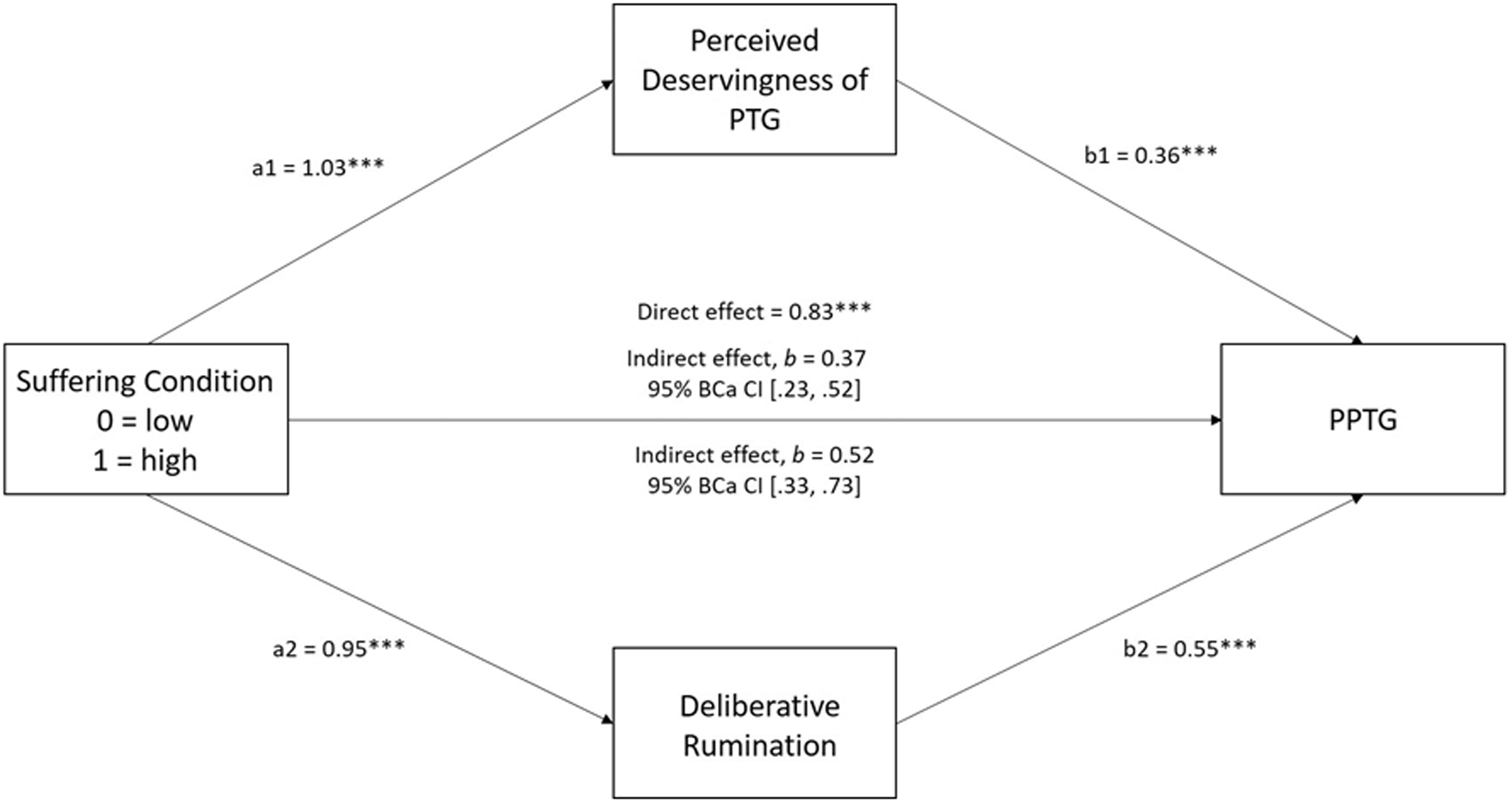
Mediational model from Study 2, predicting perceived predicted post-traumatic growth from suffering condition, perceived deservingness of post-traumatic growth and intentional meaning-making (from deliberative rumination).
Discussion
The direct effect of suffering condition on PPTG found in Study 1 was replicated in Study 2. Participants who were exposed to a high suffering victim predicted greater future PTG for the victim compared to participants presented with an individual who suffered minimally. In Study 2 we sought to better understand the mechanism accounting for this effect, by considering both a coping mechanism explanation from the BJW literature (i.e. deservingness) and a PTG mechanism of deliberative rumination (see Cann et al., 2011). The findings from Study 2 suggest both mechanisms equally account for the effect of suffering condition on PPTG. That is, participants predict future PTG partially because future positivity is what someone who has suffered deserves, and partially because participants expect a sufferer to intentionally ruminate on their suffering to find meaning and grow from the experience.
However, despite the similar design, we did not find evidence of deservingness of PTG mediating the relationship between suffering condition and PPTG in Study 1. The only notable difference in the design of these two studies is that Study 1 included two measures of UJR (UJR items from previous research and PPTG via the adapted PTGI) and measured both deservingness of UJR and deservingness of PTG. Although the presentation order of UJR and PTG was counterbalanced in Study 1, all participants completed the deservingness of UJR items before the deservingness of PTG items. It is therefore possible that because participants had responded to the PPTG items, the UJR items and the deservingness of UJR items, the threat posed to their BJW after reading about the high suffering victim was annulled, and further engagement in the deservingness of PTG items was redundant. We discuss this possibility further in the general discussion. Given this inconsistent finding, we measured these two mechanisms again in Study 3B to determine if we could conceptually replicate the parallel mediation when, as in Study 2, UJR was conceptualized and measured only as PPTG.
Study 3A
Studies 1 and 2 required participants to predict the extent to which another person was likely to experience PTG after an accident via a hypothetical vignette. This methodology is commonly used in just world research (e.g. Harvey et al., 2014), but in PTG research, participants report their own experiences of PTG after a distressing life event. Thus, we aimed to investigate whether perceived deservingness and deliberative rumination continue to explain the effect of suffering on PPTG when participants predict their own PTG from minor versus life-altering accidents.
We created new vignettes for Study 3A, which we intended to be more inclusive and easier for participants to imagine happening in their own lives than the vignettes used in Studies 1 and 2. The aim of this pilot study was therefore to determine whether the newly created vignettes had the desired condition effects. We examined whether we had successfully manipulated suffering by determining whether participants in the high suffering condition rated their imagined accident as more unfair and more likely to result in PPTG than participants in the low suffering condition. Our hypotheses and data analysis plan were preregistered prior to data collection and are available from the Open Science Framework (Blackie & Harvey, 2020c).
Methods
Participants
A total of 112 participants from the UK were recruited online via Prolific in return for payment of £0.50. Our sample size was determined by an a priori power calculation that determined we would need a minimum of 82 participants based on an effect size derived from Studies 1 and 2 of d = 1.7 and power at 95%. Participants who had participated in Study 1 or Study 2 were prevented from participating. A total of seven participants were excluded from data analysis because one participant listed their age as under 18 years and six participants did not answer any questions. A final sample consisted of 105 participants (51% female, 46% male, 3% did not provide demographic information; aged 18–21 years Mage = 18.04 years; SDage = 0.31). The School Research Ethics Committee at the second author’s university approved the study.
Materials
Procedure
Participants responded to an advertisement posted on Prolific to participate in an online survey about perceptions of people and personal experiences. The survey was conducted via Qualtrics. Participants were presented with a participant information sheet and provided informed consent before participating in the study.
Participants were first randomly assigned to read one of the vignettes, which asked them to imagine they had sustained a minor or severe injury while running outside for exercise. Afterwards, participants answered questions about the unfairness of the accident and the likelihood of experiencing PTG as a result of the accident, assuming that the accident had happened in their own lives. Finally, participants answered one question on how easy they found it to imagine the accident had happened in their life and provided their age and gender. Participants were debriefed and paid £0.50 for their participation.
Results
The reported data analyses follow our preregistered data analytic plan. The data, correlation matrices, and syntax files are available from the project page on the Open Science Framework.
Unfairness
We first examined whether participants’ perceptions of unfairness differed between the conditions. No outliers were detected for the variable of perceived unfairness. However, this variable was positively skewed in the high suffering condition, W(52) = 0.95, p = 0.019. We therefore conducted a nonparametric test. A Mann–Whitney test validated our manipulation by demonstrating that participants in the high suffering condition (Mdn = 5.00, SD = 0.93, Mean ranks = 70.94) perceived the accident as significantly more unfair than participants in the low suffering condition (Mdn = 3.67, SD = 1.17, Mean ranks = 35.40), U = 445.00, Z = −6.00, p < 0.001, ƞ2 = 0.35.
Predicted post-traumatic growth
We next examined whether participants’ predictions of PTG as a result of the accident differed between conditions. Although there were no outliers identified, this variable was positively skewed in the low suffering condition, W(52) = 0.89, p < 0.001. We therefore conducted a nonparametric test. A Mann–Whitney test validated our manipulation by demonstrating that participants in the high suffering condition (Mdn = 3.57, SD = 0.83, Mean ranks = 66.64) predicted they would experience greater PTG than participants in the low suffering condition (Mdn = 2.10, SD = 1.00, Mean ranks = 36.94), U = 543.00, Z = −5.07, p < 0.001, ƞ2 = 0.25.
Ease of imagining
Finally, we examined the frequencies of participants’ responses to the question about how easy they found it to imagine that the accident had happened in their own lives. Most participants found the accidents described in the hypothetical scenarios fairly easy to imagine happening to them with 72% of the sample endorsing a “4” or “5” on the scale (Mean = 3.90, SD = 1.00, Mode = 4.00). We undertook some further analyses (not specified in our preregistration) to determine if ease of imagination was equivalent across conditions. For each condition, we ran a one-sample t-test against a test score of 3 (i.e. scale mid-point). In both conditions, the mean of ease of imagination was significantly greater than 3, indicating that both conditions found the hypothetical scenarios easy to imagining happening to them (i.e. low suffering; Mease = 4.250, SDease = 0.789, t(51) = 11.424, p < 0.001 and high suffering; Mease = 3.540, SDease = 1.073, t(49) = 3.558, p = 0.001).
Discussion
Based on these results, we can conclude that we successfully manipulated just world threat in regard to one’s own suffering across the two conditions. Participants found the accidents described in the vignettes easy to imagine happening to them and, we observed parallel findings to those in Study 1 and Study 2, with participants in the high just world threat condition (high suffering) perceiving their accident to be more unfair and predicting greater PTG than participants in the low just world threat condition (low suffering).
Study 3B
Previous research within the BJW literature demonstrates that participants engage in UJR comparably if they are responding to the injustice of another or contemplating their own injustices (Harvey & Callan, 2014a). However, research within the PTG literature is focused largely on the examination of self-ratings of PTG. Individuals are usually only asked to rate the PTG of a close friend or family member in an effort to corroborate and validate the veracity of self-reports of PTG (Blackie et al., 2015). Therefore, Study 3B considered if the findings from Study 2 could be conceptually replicated when participants made predictions of PTG about their own misfortune, rather than that of another.
In addition, we wanted to explore if some individuals were more likely to perceive themselves as deserving of PTG if they held dispositional views about ultimate justice. Lerner (1980) first proposed “ultimate justice” as a belief system that can account for temporary setbacks in life due to the assumption that things will work out in the long run. Maes (1998) developed a 4-item “belief in ultimate justice” (BUJ) scale to measure a dispositional belief in ultimate justice (e.g. “Even persons who suffer from severe misfortune can expect that, in the end, something good will happen to balance everything out”). Maes (1998) found the BUJ scale to correlate significantly and positively with the ability to find meaning and the expectation of a cure of cancer being found in the near future. Maes (1998) also identified a positive correlation between BUJ and people’s confidence in coping with cancer (should they be diagnosed). Therefore, BUJ appears to be an individual difference trait associated with adaptive processes when confronted with suffering and injustice. Someone with a high endorsement of BUJ assumes that a state of equilibrium and justice is obtained in the long run, and therefore reinterprets instances of suffering and misfortune with optimism. As such, we predict that this individual difference may moderate the extent to which participants believe they are deserving of future growth following suffering.
In sum, we predicted that Study 3B would conceptually replicate the findings from Study 2, in that participants in the high suffering condition would perceive greater PPTG for themselves compared to participants in the low suffering condition. Due to this prediction of PTG being motivated by both a coping mechanism to restore a sense of justice and a product of making sense of and rebuilding shattered assumptions, as found in Study 2, both perceived deservingness of PTG and deliberative rumination should mediate this relationship. Finally, we seek to explore if individual differences in the BUJ moderate the mediation of condition on PPTG via perceived deservingness. Our hypotheses and data analysis plan were preregistered prior to data collection and are available from the Open Science Framework (Blackie & Harvey, 2020c).
Methods
Participants
A total of 301 participants from the UK were recruited online via Prolific, in return for payment of £2. Our sample size was determined from previous studies on UJR that had examined similar mediation hypotheses and available funds for the project. Participants who had participated in Study 1, 2, or 3A were prevented from participating in this study to ensure participants were blind to hypotheses. A total of 19 participants were excluded from data analysis based on criteria in our preregistered data analytic plan for failing the attention check question. A final sample consisted of 282 participants (65% female, 34% male, 0.4% nonbinary, 0.4% preferred not to state; aged 18–74 years Mage = 35.05 years; SDage = 12.47). The study received ethical approval from the School Research Ethics Committee at the first author’s university.
Materials
We used the same attention check question from Studies 1 and 2, in which participants had to identify the injuries they previously imagined they had suffered in the scenario they read (i.e. broken leg and spinal damage/mild sprain to the ankle/no injuries/can’t remember). As outlined in the participant section, 19 participants failed this attention check question and were excluded from data analysis. Finally, as in Study 3A, participants answered one question on how easy they found it to imagine the accident had happened in their life on a scale from 1 (“not at all easy”) to 5 (“very easy”) and provided their age and gender.
Procedure
Participants responded to an advertisement posted on Prolific to participate in an online survey about perceptions of people and personal experiences. The survey was conducted via Qualtrics. Participants were presented with a participant information sheet and provided informed consent before participating in the study.
Participants first responded to the BUJ scale (Maes, 1998) before reading a vignette. The vignette asked participants to imagine the scenario they read had happened to themselves and participants were randomly allocated to either the high suffering or the low suffering condition. Next, participants responded to the adapted PTGI (Tedeschi & Calhoun, 1996) to measure PPTG, followed by the adapted deliberative rumination scale (Cann et al., 2011) and deservingness of PTG measure. The presentation order of the rumination and deservingness measures were counterbalanced, such that half of the participants responded to the deservingness of PTG items first and the other half of participants responded to the deliberative rumination items first. Participants then answered the manipulation check and attention check questions, followed by demographic questions about their age and gender. Participants were debriefed and paid £2 for their participation.
Results
Manipulation check: Perceived unfairness
No outliers (extreme values ±3 SD from the mean in each condition) were detected for the variable of perceived unfairness. The data were skewed in both the low suffering condition (W(144) = 0.97, p = 0.003) and the high suffering condition (W(138) = 0.97, p = 0.002), therefore a nonparametric test was conducted. A Mann–Whitney test validated our manipulation by demonstrating that participants in the high suffering condition (Mdn = 5.00, SD = 1.04, Mean ranks = 200.58) perceived their imagined accident as significantly more unfair than participants in the low suffering condition (Mdn = 3.33, SD = 1.07, Mean ranks = 84.89), U = 1783.50, Z = −11.944, p < 0.001, ƞ2 = 0.51.
Predicted post-traumatic growth
No outliers (extreme values ±3 SD from the mean in each condition) were detected for the variable of PPTG. However, this variable was positively skewed in the low suffering condition (W(144) = 0.91, p < 0.001) and Levene’s test for equality of variances was significant, F(1, 280) = 3.948, p = 0.048. For these reasons, a nonparametric test was conducted. A Mann–Whitney test demonstrated that participants in the high suffering condition (Mdn = 3.76, SD = 0.98, Mean ranks = 186.58) predicted greater PTG for themselves after reading the imagined accident than participants in the low suffering condition (Mdn = 2.00, SD = 1.09, Mean ranks = 98.30), U = 3715, Z = −9.088, p < 0.001, ƞ2 = 0.29.
Before examining whether perceived deservingness of PTG and the likelihood of engaging in intentional meaning making (i.e. deliberative rumination) mediated the relationship between condition and PPTG, we examined whether the data met the assumptions required for regression. No issues with normality (as assessed by examining the plot of residuals), heteroscedasticity or multicollinearity were identified (Tolerance < 1, IVF < 2). We examined the data for outliers using Mahalanobis distance, cooks distance and leverage statistics and utilized a conservative strategy where participants were excluded only if they exceeded the cut-off score for two of the outlier statistics, which was the case for five participants.
We conducted mediation analyses using the PROCESS macro via SPSS (Hayes, 2017; Model 4, 10,000 resamples). We regressed condition (X), deservingness of PTG (M1), and rumination (M2) onto PPTG (Y). The indirect pathway between suffering condition and PPTG, via perceived deservingness of PTG, was significant (indirect effect, b = 0.19, 95% BCa CI [0.10, 0.29]) and the indirect pathway between suffering condition and PPTG, via deliberative rumination, was also significant (indirect effect, b = 0.60, 95% BCa CI [0.42, 0.79]; see Figure 4).
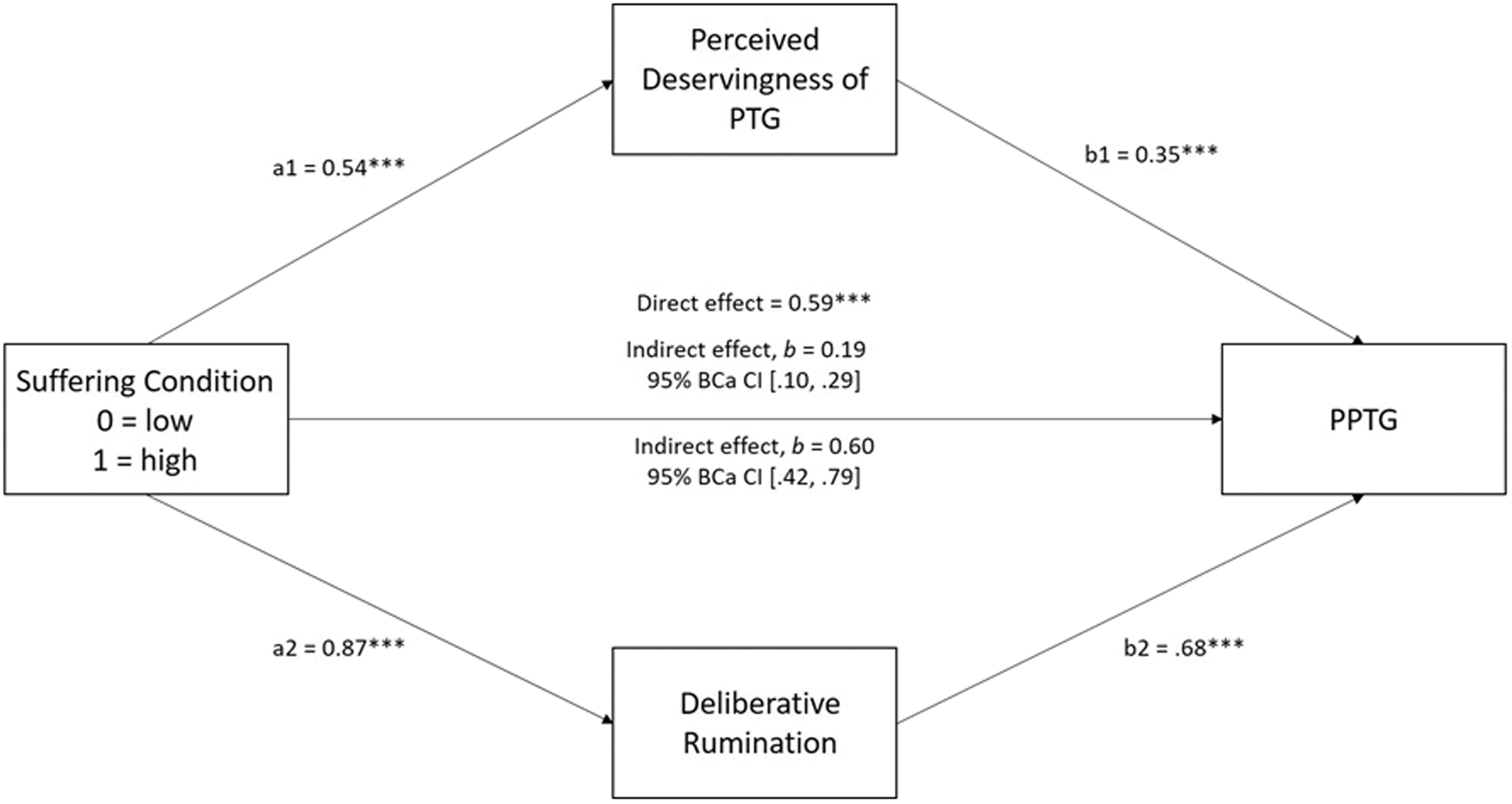
Mediational model from Study 3B, predicting perceived post-traumatic growth from suffering condition, perceived deservingness of post-traumatic growth and deliberative rumination, when participants imagined their own suffering.
A pairwise contrast between the two mediators significantly differed from 0 (indirect effect, b = −0.41, 95% BCa CI [−0.62, −0.20]), suggesting the indirect pathways for each mediator differed in strength from one another. In other words, deliberative rumination was a stronger mediator than perceived deservingness of PTG when mediating the effect of suffering condition on the predictive PPTG.
Discussion
The results from Study 3B conceptually replicate those from Study 2 and demonstrate that participants predict PTG comparably for another as they do for themselves. When participants imagine themselves suffering trauma, compared to a mild inconvenience, they predict themselves experiencing greater future positive psychological growth. Participants responded to imagined trauma partly as a way to cope with the trauma and consider themselves deserving of PTG, and partly because they expected that they would contemplate and deliberate their trauma to grow from it. We found no support for individual differences in BUJ moderating this effect.
The analyses in Study 3B also illustrated that the expectation of deliberative rumination accounted for more variance than perceived deservingness of PTG in the relationship between suffering condition and PPTG. In other words, people who imagined great suffering predicted that they would grow from the experience, primarily because they would find meaning from the experience, and, to a lesser extent, because they feel deserving of such growth. Interestingly, this differentiation between mediators was not observed in Study 2 and therefore the weighting and contribution of these two mechanisms in accounting for expectations of PTG may differ depending on whether one is predicting PTG for themselves or an other.
The combined findings of Studies 2 and 3B provide support for expectations of growth, measured via an adapted version of the PTGI, reflecting both a coping mechanism and a cognitive mechanism outlined in PTG theory.
Study 4
Study 3B had two limitations: (1) participants were imagining hypothetical events happening to themselves and (2) participants were predicting how much they expected to ruminate on the event and experience PTG from it. These limitations are problematic because we cannot be confident that perceptions of deservingness and deliberative rumination mediate the relationship between suffering and PTG when participants reflect on their own real and past events. As such, in Study 4, we propose to ask participants to reflect on a recent episode of suffering (high threat) or mild frustration (low threat) to mirror high and low suffering conditions from Studies 1–3. Afterwards, participants will respond to questions that measure their perceptions of their deservingness of PTG, engagement in meaning making and PTG.
If participants’ hypothetical predictions of PTG from Study 3B are accurate forecasts, we expect to conceptually replicate these prior findings in Study 4. That is, participants who reflect on a recent highly distressing event (i.e. the high suffering condition) will perceive greater PTG for themselves compared to participants who recalled a mildly distressing event (i.e. low suffering condition), with both perceived deservingness of PTG and deliberative rumination mediating this relationship. Our hypotheses and data analysis plan were preregistered prior to data collection and are available from the Open Science Framework project page https://osf.io/dwa3s/ (Blackie & Harvey, 2020d).
Methods
Participants
A total of 317 participants from the UK were recruited online via Prolific, in return for payment of £1.60. Our sample size was determined from power calculations for parallel mediation using the power estimator tool from Schoemann et al. (2017), utilizing correlations between variables from Study 3B. These estimates returned a sample size of 200 participants to detect effects with 80% power. We increased our proposed sample size to 300 participants to try and ensure we maintain 200 participants after our planned data exclusions. Full details of our power calculation can be found on our project page on the Open Science Framework.
Participants who had participated in Study 1, 2, 3A, or 3B were prevented from participating in this study to ensure participants were blind to hypotheses. A total of 40 participants were excluded from data analysis based on criteria in our preregistered data analytic plan for (1) not consenting to the study (n = 4), (2) failing the attention check question (n = 21), (3) consenting to the survey, but then not answering a single item (n = 14) or (4) not typing something related to the instructions for the recalled event manipulation (n = 1). A final sample consisted of 277 participants (69.3% female, 30% male, 0.7% nonbinary; aged 18–70 years Mage = 34.96 years; SDage = 12.39). The study received ethical approval from the School Research Ethics Committee at the second author’s university.
Materials
As an attention check measure, we asked participants whether the negative event they recalled had occurred between 3 June 2020 and 5 November 2020. Participants answered “No”, “Yes” or “I can’t remember”. As outlined in the participant section, 21 participants failed this attention check question (i.e. answered “No” or “I can’t remember”) and were excluded from data analysis.
Procedure
Participants responded to an advertisement posted on Prolific to participate in an online survey about perceptions of people and personal experiences. The survey was conducted via Qualtrics. Participants were presented with a participant information sheet and provided informed consent before participating in the study.
Participants were randomly allocated to either the high suffering or the low suffering condition and asked to recall either a highly distressing and upsetting or mildly unpleasant/stressful/frustrating event respectively. Next, participants responded to the PTGI (Tedeschi & Calhoun, 1996) to measure PTG, followed by the deliberative rumination scale (Cann et al., 2011) and deservingness of PTG measure. The presentation order of the rumination and deservingness measures were counterbalanced, such that half of the participants responded to the deservingness of PTG items first and the other half of participants responded to the deliberative rumination items first. Participants then answered the manipulation check and attention check questions, followed by demographic questions about their age and gender. Participants were debriefed and paid £1.60 for their participation.
Results
The data, correlation matrices, and syntax files are available from the project page on the Open Science Framework.
Manipulation check: Perceived unfairness
No outliers (extreme values ±3 SD from the mean in each condition) were detected for the variable of perceived unfairness. The data was skewed in both the low suffering condition (W(140) = 0.98, p = 0.045) and the high suffering condition (W(137) = 0.97, p = 0.001), therefore a nonparametric test was conducted. A Mann–Whitney test validated our manipulation by demonstrating that participants in the high suffering condition (Mdn = 5.00, SD = 1.38, Mean ranks = 158.61) perceived their recalled event as significantly more unfair than participants in the low suffering condition (Mdn = 4, SD = 1.41, Mean ranks = 116.81), U = 6903.50, Z = −4.04, p < 0.001, ƞ2 = 0.06.
Post-traumatic growth
No outliers (extreme values ±3 SD from the mean in each condition) were detected for the variable of PTG. However, the data were skewed in both the low suffering condition (W(140) = 0.95, p < 0.001) and the high suffering condition (W(137) = 0.98, p = 0.019), therefore a nonparametric test was conducted. A Mann–Whitney demonstrated that participants in the high suffering condition (Mdn = 3.00, SD = 1.11, Mean ranks = 154.69) perceived greater PTG than participants in the low suffering condition (Mdn = 2.48, SD = 1.22, Mean ranks = 123.65), U = 7440.50, Z = −3.23, p = 0.001, ƞ2 = 0.04.
We conducted mediation analyses using the PROCESS macro via SPSS (Hayes, 2017; Model 4, 10,000 resamples). We regressed condition (X), deservingness of PTG (M1), and rumination (M2) onto PTG (Y). The indirect pathway between suffering condition and PTG, via perceived deservingness of PTG, was significant (indirect effect, b = 0.09, 95% BCa CI [0.01, 0.17]) and the indirect pathway between suffering condition and PTG, via deliberative rumination, was also significant (indirect effect, b = 0.26, 95% BCa CI [0.12, 0.41]; see Figure 5).
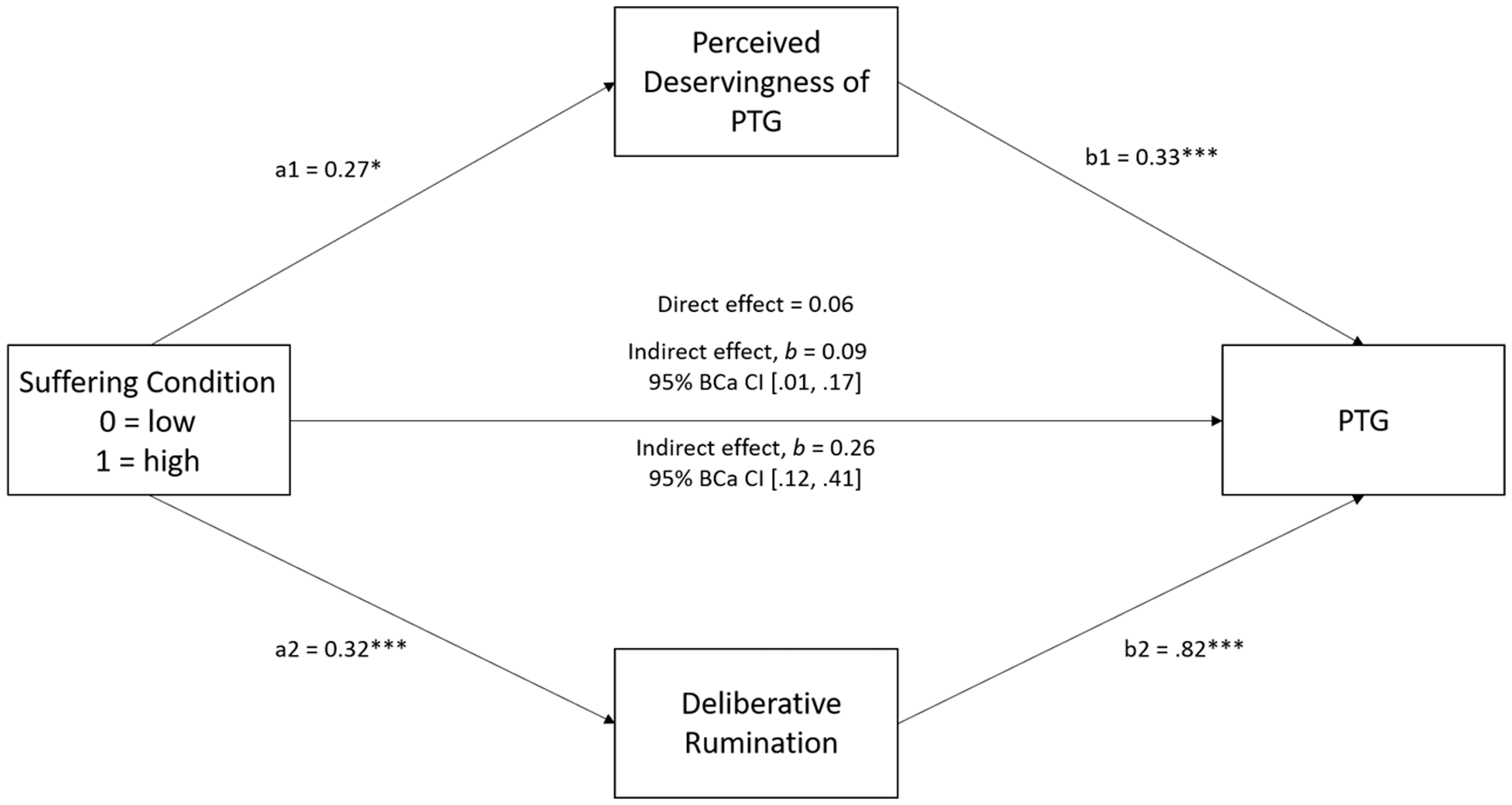
Mediational model from Study 4, predicting perceived post-traumatic growth from suffering condition, perceived deservingness of post-traumatic growth and deliberative rumination, when participants considered their own suffering.
A pairwise contrast between the two mediators significantly differed from 0 (indirect effect, b = −0.17, 95% BCa CI [−0.32, −0.04]), suggesting the indirect pathways for each mediator differed in strength from one another. In other words, deliberative rumination was a stronger mediator than perceived deservingness of PTG when mediating the effect of suffering condition on PTG.
Discussion
The results from Study 4 conceptually replicate those from Study 3B and demonstrate that participants’ motivations for reporting PTG are comparable to when they make hypothetical predictions about how much PTG they are likely to experience. When participants consider their recent distressing negative events, compared to a mild inconvenience, they report greater positive psychological growth. Participants report growing from a recent distressing negative event partly as a way to cope with the trauma by considering themselves deserving of PTG, and partly because they have contemplated and deliberated their trauma and how to grow from it. As in Study 3B, we found that deliberative rumination accounted for more variance than perceived deservingness of PTG in the relationship between suffering condition and PTG. That is, people who recalled an event of great suffering reported they grew from the experience, primarily because they found meaning from such an experience, and, to a lesser extent, because they felt deserving of growth.
General discussion
The aim of this paper was to investigate whether perceptions of PTG, via the PTGI (Tedeschi & Calhoun, 1996), were motivated by an attempt to cope with instances of injustice that threaten one’s BJW (Lerner, 1980). We examined this hypothesis utilizing both hypothetical scenarios and predictions of future positive psychological growth (i.e. PPTG) on an adapted version of the PTGI (Studies 1–3B), and as self-reported PTG on the original PTGI in reference to a distressing event that had occurred in participants’ lives (Study 4). This research was based on findings from prospective longitudinal studies that have observed small to no correlations between participants’ perceptions of PTG on the PTGI and pre- to post-trauma change in PTG (Boals et al., 2019; Frazier et al., 2009; Owenz & Fowers, 2018; Yanez et al., 2011), which have called into question the suitability of the cross-sectional and retrospective PTGI for measuring PTG in terms of positive personality change. If the PTGI is not reliably measuring the construct of PTG, as it was originally theorized, then questions remain about what is measured by the PTGI.
Overview of methodological approach and results
In four studies, we examined the extent to which responses on the PTGI were motivated by the coping mechanism of UJR, which is the belief that instances of undeserved suffering are ultimately compensated in the long run with positivity to restore one's BJW (Harvey & Callan, 2014a; Lerner, 1980). We conceptualized UJR here by measuring how deserving participants felt of PTG as a result of their suffering. In Studies 2–4, we also considered whether deliberative rumination, a PTG mechanism, accounts for responses on the PTGI. That is, once someone’s assumptions about the world are shattered, they need to rebuild their framework and core beliefs about the world by engaging in deliberative ruminative thought (Cann et al., 2011).
There are notable differences in the methodologies used by researchers examining just world theory and researchers examining PTG. The two research areas originate from different traditions, with research into BJW derived from experimental social psychology (see Hafer & Bègue, 2005, for a review) and research into PTG derived from clinical psychology (see Infurna & Jayawickreme, 2019, for a review). In this paper we utilized methodologies from both research traditions. Specifically, Studies 1 to 3B employed experimental designs that utilized hypothetical scenarios, which required participants to predict the likelihood of experiencing PTG as an outcome in the future, both for others (Studies 1 and 2) and themselves (Study 3). However, Study 4 employed a design similar to traditional PTG studies, insofar as participants recalled a distressing event from their own lives and self-reported the extent to which they had experienced PTG. Study 4 was an important addition to this paper, because it extended our findings from hypothetical responses to examine if perceptions of deservingness and deliberative rumination also mediated the relationship between suffering and PTG when participants reflect on their own experiences. Yet, Study 4 also had a comparable control condition (i.e. recall of a mildly unpleasant/stressful/frustrating event), which is often lacking in PTG studies (Jayawickreme & Blackie, 2014).
In Studies 1 through 3B, where perceptions of PTG were predicted after participants imagined hypothetical scenarios, we observed that participants predicted greater PTG in response to a severe accident that caused grave suffering (versus a minor incident), both for another individual and for themselves. We further found that perceptions of deservingness of PTG and predictions of engagement in deliberative meaning making mediated the relationship between suffering and predictions of PTG in Studies 2, 3A, and 3B. In Study 4, we replicated these results when participants recalled a distressing (versus a mildly unpleasant event) from the last six months within their own lives and reported the PTG they had experienced, the extent to which they had engaged in deliberative meaning making and felt deserving of PTG. Thus, across four studies, we found that participants both predicted and reported experiencing PTG as a function of both UJR (i.e. deservingness) and PTG (i.e. deliberative meaning-making) mechanisms, with the latter observed as the strongest mechanism when participants considered their own PTG.
What motivates individuals’ self-reports of PTG (via the PTGI)?
Our results provide support for the hypothesis that perceptions of PTG, via the PTGI, are motivated by efforts to restore BJW, but importantly, Studies 2, 3B, and 4 also found support for the role of a PTG-related mechanism of deliberative rumination (Cann et al., 2011). These two mechanisms operated in parallel, yet in Studies 3B and 4 where participants considered their own suffering, deliberative rumination was the stronger of the two mechanisms for predicting PTG. Thus, overall, our results cannot be entirely explained within the context of just world theory (Lerner, 1980). Instead, our findings demonstrate that participants’ responses to the PTGI do not measure one consistent psychological construct. Participants’ perceptions were motivated by a coping response to restore a sense of justice, but also through the level of engagement in self-reflection on the impact and meaning of the tragedy.
Although our results do not conclusively demonstrate that the PTGI tool (Tedeschi & Calhoun, 1996) is solely capturing a coping strategy utilized by individuals to manage the impact of perceived injustices, our findings speak to the challenges surrounding the study of PTG. Specifically, our results confirm some researchers’ concerns about the ambiguity of what perceptions of PTG actually measure (Coyne & Tennen, 2010), as our findings illustrate that perceptions of PTG can reflect distinct and often competing motivational mechanisms. Taken together with research showing that perceptions of PTG are weakly correlated with actual changes in PTG over time (Boals et al., 2019; Frazier et al., 2009; Owenz & Fowers, 2018; Yanez et al., 2011), our findings suggest that the PTGI is not a pure measure of PTG, in terms of positive personality change.
Constraints on when PTG is perceived as deserved
It is important to note that we did not observe deservingness of PTG as mediating the relationship between condition and predictions of PTG in Study 1 (although it was found in Studies 2, 3B, and 4). The main difference between the design of Study 1 and the other experiments was that our first study assessed UJR through two methods—via UJR items used in previous just world research and via the adapted PTGI (i.e. PPTG). Our measure of PPTG and our UJR items were similar in that they asked participants to predict the likelihood of future positivity in life for a target character. The UJR items reflected predictions of a future meaningful and fulfilling life, and the PPTG measured future positive changes in five domains (relationships, spirituality, personal strength, possibilities for life, and appreciation of life). It is possible that because participants had responded to the PPTG items, the UJR items and the deservingness of UJR items, the threat posed to their BJW after reading about the high suffering victim was annulled, and further engagement in the deservingness of PTG items was redundant. That is, participants perceived that the high suffering victim was deserving of a fulfilling and meaningful life, and engaging in this form of UJR was in itself sufficient to compensate for the trauma endured. This logic follows research from motivated social cognition that reaching an end state, in this case annulling the threat to one’s BJW, leads to a reduction in processes that serve to achieve this end-state (i.e. further restorative reactions to injustice; see Kruglanski et al., 2002).
Indeed, related research considering a different reaction to injustice, immanent justice reasoning (IJR), provides support for this explanation (Callan et al., 2014). IJR is the belief that actions result in deserved outcomes, even when there is no physically plausible or causal mechanism between action and outcome (Callan et al., 2014; Piaget, 1965). Callan et al. (2014) found that participants engage in IJR to a lesser extent when a victim has already received their “just deserts” and justice had been restored via a form of IJR (i.e. a thief that is then a victim of theft) compared to when they have not received such a fate. The contrast in findings from Study 1 and our following studies, therefore, suggests that our measure of PPTG reflects a form of UJR, which is only perceived as deserved when a threat to one’s BJW is still present.
Limitations and future directions
Although our findings offer potentially promising new avenues for researchers to explore when examining what motivates (or underlies) people’s reports of PTG, there are some limitations that future research would need to address. First, our hypothesized temporal order of the psychological processes as tested in our mediation models was derived from relevant theory on BJW (Lerner, 1980) and PTG (Tedeschi & Calhoun, 2004), yet measurement of the outcome (i.e. PTG) preceded measurement of the mediators (i.e. deservingness of future PTG and deliberative rumination). Although inconsistent with theory on PTG and BJW, people may perceive PTG and then engage in intentional meaning making and post-event rationalizations about their deservingness of PTG. The reverse causality of this alternative hypothesis cannot be ruled out in these studies, not only due to the temporal order in which we collected the variables, but also because in experimental study designs where the mediator and outcome are measured at the same one point in time, the temporal precedence of the hypothesized mediator is not sufficient to conclude causality (Gelfand et al., 2009).
In measurement-mediation models, such as the ones in the current paper, Pirlott and MacKinnon (2016) have argued that temporal precedent of the mediator cannot be established, and nor can confounding variables that account for the relationship between the mediator and outcome be ruled out. Following Pirlott and MacKinnon’s (2016) recommendations, researchers could employ a manipulation-of-mediator design in future studies. In this design, an enhancement manipulation could be used to encourage people to engage in greater meaning making processes or perceptions of deservingness and then examine whether this manipulation strengthens the relationship between the occurrence of a highly threatening event and perceptions of PTG. The designs of Studies 1, 2, and 3B could be adapted to apply this design as they utilized hypothetical events, but researchers would need to carefully consider the ethical issues of utilizing this design in response to people’s own negative experiences. There are at least two main ethical issues to consider in this case: (1) the manipulation or enhancement of the mediator could directly or indirectly encourage people to not find meaning or feel less deserving of PTG, and (2) it could be harmful to encourage people to actively engage in greater meaning making or perceptions of deservingness when researchers do not know the value of such processes over time. If such processes are associated with increases in distress over time, as some researchers have found with perceptions of PTG (Frazier et al., 2009), then this design should not be implemented. As we note in due course, the temporal dynamics of these two processes—perceptions of deservingness and deliberative rumination—need further investigation, and therefore longitudinal measurement-mediator designs in which auto-regressive effects can be modeled might be the better solution for these methodological concerns when examining individuals’ own negative experiences until the utility of these processes on well-being is known.
A second limitation is that we restricted investigation of negative experiences in Study 4 to those that occurred within individuals’ lives in the past six months. We did this because BJW strategies, such as UJR, are typically theorized as defence reactions to emotionally involving events and reactions are measured in experiments shortly after exposure to stimuli (see Hafer & Bègue, 2005). However, by asking participants to recall recent experiences, we may have limited the range and type of events relevant for PTG and it is unlikely that participants in the high threat condition had all experienced a form of clinical trauma in this short time frame. Although Tedeschi and Calhoun (2004) use the term trauma more broadly than the clinical diagnosis of trauma, they argue that the negative experiences that facilitate PTG should be seismic enough to challenge individuals’ worldviews. The wording used in Study 4 to manipulate event severity was designed with this in mind, but future research should strive to examine how the two processes of perceptions of deservingness and deliberative rumination relate to perceptions of PTG in response to a broader range of challenging and traumatic experiences. We note however, that our analyses confirmed that, on average, individuals in the high threat condition recalled events that they perceived as more severe and unfair when compared to participants in the low threat group (i.e. consistent with our manipulation instructions).
Finally, future research should involve the identification of individual differences that may make engagement in UJR more likely to occur. Assuming that UJR is a coping mechanism that individuals use, at least in part, when responding to the PTGI about their own traumatic experiences, then it is important to investigate who is most likely to use this mechanism to cope with adversity. People who score highly on the BUJ individual difference measure subscribe to believing that justice will ultimately be obtained in the long run (Maes, 1998). Maes (1998) found that people who score highly on the BUJ scale, are also more likely to find meaning in unfortunate events and react to suffering with optimism. We were therefore expecting this individual difference to moderate the relationship between suffering condition and perceptions of deserving PTG. However, in Study 3B we found no evidence for BUJ moderating the effect of suffering condition on participants’ PPTG following the exposure of participants to an imagined accident.
Alternatively, research within the BJW literature provides evidence for other individual difference measures that influence the extent of UJR, such as religiosity (Harvey & Callan, 2014b) and self-esteem (Harvey & Callan, 2014a). Firstly, Harvey and Callan (2014b) found that people who self-report as highly religious, are more likely to believe a victim will have a later fulfilling and meaningful life, regardless of whether the victim was a bad (i.e. underserving) or good (i.e. deserving) individual. Indeed, religious participation is positively correlated with BUJ (Bègue, 2002) and Maes and Schmitt (1999) claim UJR is derived from religious doctrines that allude to injustices being met by a higher form of justice. Secondly, Harvey and Callan (2014a) found that the higher one’s self-esteem, the more individuals perceive themselves as deserving and therefore likely to receive UJ. Therefore, how positively individuals perceive themselves may influence how deserving one considers themselves of PTG. Exploring multiple individual difference moderators was beyond the scope of this study, but offers possible fruitful avenues for future exploration.
Conclusion
In conclusion, our results suggest that self-reported PTG after trauma (measured via both an adapted version of the PTGI and the original PTGI) may be underpinned by a motivated coping mechanism (i.e. perceptions of deservingness), as well as engagement in deliberative rumination. These mechanisms appear to operate in parallel and explain perceptions of PTG for both others and for the self, following trauma and suffering. These findings echo concerns raised by researchers previously about the ambiguity of what perceptions of PTG via the PTGI actually measure (Coyne & Tennen, 2010). Thus, as others have previously argued (Blackie & Jayawickreme, 2014), we urge researchers to be clear and precise in their definitions and measurement of PTG, and further recommend that researchers include measurement of motivational mechanisms, where possible, especially in studies where PTG is measured as perceptions of, rather than actual, positive personality change.
Footnotes
Data accessibility statement
The study Materials, data and analysis scripts used for this article can be accessed from the Open Science Framework. https://osf.io/dwa3s/vkrpu.
Declaration of conflicting interests
The author(s) declared no potential conflicts of interest with respect to the research, authorship, and/or publication of this article.
Funding
The author(s) disclosed receipt of the following financial support for the research, authorship, and/or publication of this article: This research was funded via internal funds from the authors’ institutions.
