




Abstract
Although psychosocial functioning and personality are indisputably interrelated in adulthood, much less is known about these associations in early adolescence. Accordingly, the goal of the current study was twofold. First, we investigated associations between adolescents’ personality and three broad indicators of psychosocial functioning: academic achievement, social relationships, and psychosocial adjustment. Second, we tested differential effects by comparing these associations across three different cohorts (Grades 5, 7, and 9) and across two raters of adolescents’ personality: self- and parent reports. Our sample consisted of N = 2667 students and their parents. According to latent regression models, adolescents’ personality traits showed significant associations with all psychosocial functioning variables: Achievement was most consistently associated with emotional stability, openness, and conscientiousness; social relationships were most consistently associated with agreeableness and conscientiousness; and psychosocial adjustment was related to all of the Big Five traits. Most associations did not vary across grades, whereas self-reported extraversion showed lower associations in later grades. Looking at rater-specific effects, we found fewer and usually smaller associations with parent- than with self-rated personality, again with the most significant differences with extraversion. We discuss the consistent interrelatedness between adolescents’ personality and psychosocial functioning but also highlight important exceptions in grade- and rater-specificities.
Both conceptual and empirical research emphasize the importance of personality as an adaptive capacity for positive life outcomes across the entire adult lifespan (Caspi et al., 2005; Ozer & Benet-Martínez, 2006; Roberts et al., 2007; Soto, 2019). But what about earlier phases in life? Much less is known about how personality is related to key aspects of psychosocial functioning during adolescence. Once labeled a phase of “storm and stress” (Arnett, 1999), adolescence is characterized by the need to face diverse tasks such as striving for academic success, establishing positive relationships, and generally developing social-emotional skills to adjust to these demands (Caspi et al., 2005; Eccles & Roeser, 2011; Hogan & Roberts, 2004; Weissberg et al., 2015). It is still unknown whether adaptive capacities such as personality traits promote the mastery of developmental tasks and how these accomplishments loop back to personality in adolescence (for a review, see De Fruyt et al., 2017). This lack of empirical research is even more pronounced when looking for age-sensitive associations of personality and psychosocial functioning across the disruptive phase of early to middle adolescence and when comparing different raters’ perspectives.
Previous research has suggested that assessments of the Big Five personality traits (i.e. emotional stability, extraversion, openness, agreeableness, and conscientiousness; McCrae & Costa, 1987) are comparable from adolescence through adulthood (Brandt, Becker, et al., 2020; Soto et al., 2008). This finding provides a starting point for identifying age-differential associations between personality and diverse indicators of psychosocial functioning. Indeed, initial evidence obtained from a moderator analysis of a meta-analysis indicated that personality–achievement associations can differ across adolescence (Poropat, 2009) and also appear to differ across raters (e.g. Poropat, 2014a, 2014b; Vazire & Mehl, 2008). To investigate age-differential associations in achievement and other measures, we analyzed the interrelatedness between personality and relevant indicators of psychosocial functioning from two rater perspectives. We used data from N = 2667 adolescents and their parents (N = 1959) from Grades 5, 7, and 9 to examine differential associations between the Big Five personality traits and three sets of psychosocial functioning variables.
Personality and psychosocial functioning in adolescence
The first phase of adolescence (10–15-year-olds) has long been recognized as a distinctive developmental period (Hall, 1904) with unique growth stages (Caskey & Anfara, 2014), thus inspiring early developmental stage theories (Coleman, 1974; Erikson, 1959; Havighurst, 1956). To achieve successful development and psychosocial functioning, adolescents have to master different developmental tasks. Developmental tasks can be defined as age-graded normative duties that are linked to societal expectations and should thereby be reached in certain life stages (Havighurst, 1956; Hurrelmann & Quenzel, 2018; Hutteman et al., 2014). Although different theories name different tasks, they all agree that developmental tasks are related to age-graded environmental and contextual conditions (Robin & Foster, 1989).
There are three developmental tasks that most theories agree on: First, an academic qualification is needed to become increasingly independent, to feel competent, and to make a valuable contribution to society (Erikson, 1959; Hurrelmann & Quenzel, 2018). Second, it is increasingly important to establish positive social relationships with peers and people outside of one’s family (Coleman, 1974; Havighurst, 1956; Hurrelmann & Quenzel, 2018). Third, the exploration of the self is initiated with the goals of self-acceptance and building an identity (Erikson, 1959; Havighurst, 1956). According to developmental stage theories, the successful accomplishment of all of these tasks should be related to better psychosocial adjustment (Havighurst, 1956; Pinquart et al., 2004).
As psychosocial functioning covers people’s general quality of life (e.g. Lucas, 2018), it has the power to generalize to diverse contexts of life. Therefore, it is very important to understand the potential protective or detrimental role of personality for psychosocial functioning in adolescence. Given the plethora of research and the consistent findings on the importance of personality for all three domains of psychosocial functioning (i.e. achievement, social relationships, and psychosocial adjustment) to changes in adulthood (Caspi et al., 2005; Hutteman et al., 2014; Ozer & Benet-Martínez, 2006; Roberts et al., 2007; Soto, 2019), there is reason to presume that personality is also a key factor for the successful mastery of developmental tasks and, thus, for good psychosocial functioning in adolescence. However, research linking personality and developmental tasks in adolescence is still scarce. With the present study, we aim to provide a comprehensive age-differential overview of personality associations in the first phase of adolescence with three broad indicators of psychosocial functioning. Moreover, we aim to extend the existing literature by including multiple informants on personality and psychosocial functioning variables by controlling all associations for important covariates and by investigating a heterogenous sample with respect to educational and personal background. In the following paragraphs, we summarize the existing literature on associations between adolescents’ personality and their achievement, social relationships, and psychosocial adjustment.
Personality and achievement
In school, where adolescents spend a large amount of time (Rutter et al., 1979), one essential developmental task refers to achievement. Adolescents are confronted with increasingly more experiences of (in)competence and (in)ability, for which they get feedback through school grades. Accordingly, adolescents have to learn how to deal with success and failure and get prepared for later work life (Hutteman et al., 2014). Although associations between personality and achievement are relatively well-studied in later adolescence, findings in early adolescence are scarce.
Accumulating evidence on the relevance of personality for educational success (e.g. Borghans et al., 2016; Lechner et al., 2019; O’Connor & Paunonen, 2007; Poropat, 2009), which has primarily been operationalized by school grades and achievement tests, has supported the crucial role of conscientiousness and openness in middle and late adolescence (Dumfart & Neubauer, 2016; Spengler et al., 2013; Trautwein et al., 2009). Comparing different achievement indicators, research has illustrated a strong association between conscientiousness and school grades, whereas openness is more closely related to objective achievement tests (Borghans et al., 2016; Spengler et al., 2016). With respect to the remaining traits, results are less consistent. Meta-analyses have reported that being more agreeable is associated with better academic achievement (Laidra et al., 2007; Poropat, 2009), although other studies have found negative associations (Brandt, Lechner, et al., 2020; Lechner et al., 2017). Low emotional stability has been proposed to be a vulnerability factor (Laidra et al., 2007; Lechner et al., 2017). Such associations have not been found to be robust, with other studies reporting null effects (O’Connor & Paunonen, 2007; Spengler et al., 2016). Similarly, mixed findings, ranging from slightly positive to slightly negative, have emerged for extraversion (Israel et al., 2019; Laidra et al., 2007; Lechner et al., 2017). Despite this evidence in middle and late adolescence (including 14–20-year-olds), there is initial empirical evidence that personality–achievement associations differ in early adolescence (Israel et al., 2019; Laidra et al., 2007). In contrast to middle and late adolescence, findings indicate that all Big Five personality traits seem to be relevant for achievement. Thus, early adolescence is still an underrepresented age group in existing studies.
Personality and social relationships
Based on developmental task theories, research has increasingly emphasized the importance of new social contexts and relationships for adolescence (Coleman, 1974; Hurrelmann & Quenzel, 2018). With school as a main social context, adolescents strive to be accepted by their peer group (Kloep, 1999; Reitz et al., 2014) but also to have a supportive relationship with their teacher (Mashburn & Pianta, 2006; Roorda et al., 2011). In contrast to research on personality–achievement associations and despite the fact that the Big Five personality traits have been found to be key predictors of social functioning throughout the adult lifespan (Back et al., 2011; Mund et al., 2018), much less is known about the role of personality in adolescents’ relationship functioning in adolescence (Jensen-Campbell & Malcolm, 2007; Jensen-Campbell et al., 2002, 2003; Mõttus et al., 2012; Tackett et al., 2014). In this study, we decided to investigate peer relationships (rated by peers) and the teacher–student relationship (rated by the student) as indicators of social relationships in a typical adolescent context, that is, school.
With respect to positive peer interactions, agreeable and conscientious fifth- and sixth-graders tend to show more harmonious and constructive conflicts and higher friendship quality (Jensen-Campbell & Malcolm, 2007; Jensen-Campbell et al., 2003). Conversely, low levels of emotional stability, agreeableness, and conscientiousness have been associated with more antisocial behavior both in early adolescence (Jensen-Campbell & Malcolm, 2007) and in a sample spanning all of adolescence (age span: 11–20 years; Mõttus et al., 2012). Besides low emotional stability and low conscientiousness, low openness has been found to be associated with relational aggression among children (Tackett et al., 2014). Across studies, the informants who rated relationship characteristics have varied substantially: This last study relied only on parent reports, whereas others have also included self-perceptions or even peer reports. In general, peer reports might be particularly informative in an interaction setting where parents are not present. Accordingly, we focused on peer reports of perceptions of helping behavior and antisocial behavior in the classroom.
Apart from peers, adolescents are also in need of building a good teacher–student relationship as there is growing evidence on the importance of students’ school experiences, their educational success, and their psychosocial functioning (Aldrup et al., 2018; Hattie, 2009; Pianta & Hamre, 2009; Roorda et al., 2011). Less is known about the extent to which this relationship is associated with students’ personality. We are only aware of one correlational study in adolescence: Zee et al. (2013) found positive associations of emotional stability, agreeableness, and conscientiousness with positive nonconflictual teacher–student relationships. Furthermore, mixed findings have emerged for extraversion, which predicted closer but also more conflictual relationships with teachers.
Personality and adjustment
Adolescents are confronted with a variety of developmental tasks that can shape their well-being and health (Pinquart et al., 2004; Vanlede et al., 2006). The degree of success (or failure) in dealing with a variety of tasks is most likely reflected along the lines of variables of adjustment: in adolescents’ self-esteem as the general evaluation of the self (DuBois et al., 1998), in how much they enjoy school as one of the most task-laden developmental contexts (Shoshani & Slone, 2013), and in their physical health as a mirror of daily difficulties and stress (Low et al., 2012). In adulthood, personality traits have been found to be associated with all three adjustment variables (i.e. general self-esteem, well-being, and health; Anglim et al., 2020; Friedman & Kern, 2014; Robins et al., 2001), but research on adolescents is scarce. Butkovic et al. (2012) identified emotional stability and extraversion as the most consistent predictors of self-esteem, subjective well-being, and loneliness among adolescents aged 16–19 years. Furthermore, conscientiousness was identified as another positive predictor of well-being among 17-year-old adolescents (Garcia, 2011). Health problems, which have been considered a physiological conceptualization of psychosocial adjustment (Kaplan, 2017), have been linked to lower emotional stability and lower conscientiousness in childhood and adolescence (De Fruyt et al., 2017).
In this study, we integrate different conceptualizations of psychosocial functioning that have largely been taken from the task-laden context of school and investigate the role of personality in the developmental phase of adolescence.
Investigating age-specific and rater-differentiated associations in adolescence
Although recent research has pointed to a reliable assessment of self-reports in adolescence (Brandt, Becker, et al., 2020; Soto et al., 2008), we would like to argue that such an investigation of the associations between personality and psychosocial functioning in this age group would additionally benefit from two further extensions: age/grade-differential associations and a multirater perspective on personality. This differentiated examination could provide a better understanding with respect to the robustness of associations across raters and age groups, thus disentangling previously mixed patterns.
Age differences in personality associations across adolescence
Age-related differences and developmental trajectories in adolescent personality appear to be quite different from those known from young adulthood: Adolescent personality illustrates substantially lower rank-order stabilities in traits (i.e. the maintenance of the relative rank of individuals on a trait over time; Roberts & DelVecchio, 2000) and appears to diverge from trajectories of personality maturation (Roberts et al., 2006), with adolescents tending to show temporary dips in some personality aspects that are not yet well-understood (disruption hypothesis; Borghuis et al., 2017; Denissen et al., 2013; Soto et al., 2011; van den Akker et al., 2014). Furthermore, most developmental tasks are age-graded and thus, the corresponding aspects of psychosocial functioning of adolescents also differs between age groups: In early adolescence, school engagement, school grades, well-being, and levels of adjustment are generally higher than in middle or late adolescence (Coelho et al., 2020; González-Carrasco et al., 2017; Ronen et al., 2016; Wang & Eccles, 2012). Friendship quality, however, is reported to be lower in younger age groups (Lansford et al., 2014).
The few existing studies that have systematically investigated age-differential personality associations during adolescence have focused primarily on achievement. Particularly in late childhood and early adolescence, personality–achievement associations differ from findings in later adolescence and early adulthood, pointing to a potentially age-differential role of these traits in adolescence and young adulthood (Andersen et al., 2020; Poropat, 2009; Tetzner et al., 2020). For instance, being compliant may support learning progress in younger age groups, whereas developing an independent way of thinking by also disagreeing with teachers might be more beneficial in later years. Supporting this assumption, in younger age groups, agreeableness (Poropat, 2009) and emotional stability (Andersen et al., 2020) have shown stronger associations with academic achievement than in older age groups. Age-specific differences in associations may also occur because of different aspects covered by traits in different age groups. For instance, empirical research has indicated that some aspects of agreeableness and conscientiousness might still be linked with each other in young adolescents but not (or less so) in older adolescents or young adults (Soto & John, 2014; Soto & Tackett, 2015). Interestingly, this tendency was found in both self- and parent ratings, indicating that such a stronger trait-specific association might reflect a substantive overlap of traits instead of an undifferentiated reporting bias in younger students.
Age-differential effects in social relationships could furthermore be traced back to the development of new preferences for certain characteristics in social interaction partners. For instance, whereas in early adolescence, it might be more beneficial for peer relationships to be friendly and compliant (i.e. agreeable) in middle adolescence, it might become increasingly beneficial to be popular among peers and, thus, to show outgoing, extraverted behavior (Lansford et al., 2014; Selfhout et al., 2008). In summary, it appears to be plausible to expect differences in associations between personality and psychosocial functioning across different phases of adolescence.
Self- and parent reports of personality in adolescence
Parent ratings can offer a useful approach for getting a more comprehensive picture of personality in adolescence. Parents, as close others, are generally used as personality judges across childhood because they know their children well (Funder, 2012; Tackett, 2011; Watson et al., 2000). At the same time, during adolescence, parent ratings of personality may diverge more from the self-reports of their adolescent children because it is a time for children to become more independent from parents (Smetana, 2015) and to focus more on peer relationships (Arnett, 2000). Accordingly, research has illustrated both significant agreement and substantial disagreement when comparing adolescents’ self-reports and parent ratings of personality (Göllner et al., 2017; Luan et al., 2017; Rohrer et al., 2018; Vazire & Mehl, 2008).
The self–other knowledge asymmetry (SOKA; Vazire, 2010) model can help explain potential reasons for such (dis)agreement in different phases of the rater process. The SOKA model focuses on explaining when self- versus other ratings should be more (or less) accurate. It postulates that the agreement between self- and other ratings differs on the basis of (a combination of) the observability and evaluativeness of each trait. For instance, agreement is higher for traits that are easy to observe but are low on evaluativeness (e.g. extraversion). Disagreement will be higher, however, when observability is low (e.g. for emotional stability), with more accurate self- than other ratings.
For adult samples, empirical research has largely supported the SOKA model (Connolly et al., 2007; Connelly & Ones, 2010). By contrast, only a few studies have investigated self–other agreement across adolescence. Specifically, a study of Estonian ninth-grade adolescents (between 14 and 17 years of age) and their mothers and fathers found only low to moderate inter-rater agreement for all traits (Laidra et al., 2006), whereas two recent studies found evidence for the SOKA model: Adolescent–parent agreement was higher for extraversion as an observable but not an evaluative trait in comparison with emotional stability, which is less observable, and agreeableness, which is highly evaluative (Göllner et al., 2017, Luan et al., 2017). In summary, although parents should know their children relatively well, self–other agreement between parents and adolescents has been found to be generally lower than between two young adults; yet, agreement between parents and adolescents appears to increase from age 14 to 29 (Rohrer et al., 2018).
Taken together, each perspective, self and other, can potentially contribute to the understanding of associations between personality and psychosocial functioning, depending on age and trait characteristics. However, to date, little is known about the comparability of self- and other personality ratings in adolescence as personality association studies have typically relied on single reporter data, whereas multi-informant studies are rare. Thus, to get a more comprehensive understanding of similarities and differences between the two rater perspectives and the effects on investigated associations, we aimed at a systematical statistical comparison across a broad range of associations between personality and psychosocial functioning variables.
The present study
Building on conceptual and empirical notions of the adaptive capacity of personality across the adult lifespan (Caspi et al., 2005; Ozer & Benet-Martínez, 2006; Roberts et al., 2007, Soto, 2019), we aimed to test whether personality is also associated with different indicators of psychosocial functioning in adolescence. Thereby, we focused on developmental tasks during adolescence, which are usually embedded in one of the most prevalent ecosystems of adolescence: the school context (Bronfenbrenner, 1979; Eccles & Roeser, 2011). The aim of the current study was then twofold: First, we examined the differential role of personality while investigating associations with three domains of psychosocial functioning: achievement, social relationships, and psychosocial adjustment. Thereby, we differentiated between four achievement variables (school grades and test scores in the domains of German and mathematics), three social relationship variables (peer-rated helpfulness, peer-rated aggressiveness, and teacher–student relationship quality), and three psychosocial adjustment indicators (self-esteem, well-being in school, and parent-rated somatoform health problems). Besides including a broad range of indicators, multiple informants, and highly underrepresented age groups, this study extends the existing literature by also investigating a diverse sample in terms of its heterogeneous academic and personal background.
In replicating previous cross-sectional findings, we hypothesized that being highly conscientious will be related to better school grades (H1a), whereas high openness will be associated with better achievement test scores (H1b). Due to mixed findings regarding the other three traits, we refrain from formulating concrete hypotheses. In the domain of social relationships, we hypothesized that higher levels of agreeableness and conscientiousness will be associated with peer perceptions of more helpfulness (H2a). Furthermore, higher levels of emotional stability, agreeableness, and conscientiousness will be related to peer perceptions of lower aggressiveness (H2b), and to more positive teacher–student relationships (H2c; Harris & Vazire, 2016; Jensen-Campbell et al., 2003). Due to mixed findings regarding extraversion and openness, we refrain from formulating hypotheses. Finally, for psychosocial adjustment, we hypothesized that being higher on emotional stability and extraversion would be related to higher self-esteem (H3a). Higher levels of emotional stability, extraversion, and conscientiousness will be related to greater overall well-being in school (H3b). Higher levels of emotional stability and conscientiousness will be associated with fewer parent-rated health problems (H3c; Butkovic et al., 2012).
Second, we set out to disentangle these general associations and to take into account the specific time interval of adolescence as a highly disruptive phase. Thus, we compared the associations between personality and three domains of psychosocial functioning across three adolescent cohorts and considered different rater perspectives. Yet, given the scarce previous research, we tested for differences in associations between Grades 5, 7, and 9 in an exploratory fashion. We also examined differential associations of self- and parent ratings of adolescents’ personality with psychosocial functioning. By doing so, we were able to systematically investigate the robustness of personality–psychosocial functioning associations across different rater perspectives. Referring to the SOKA model (Vazire, 2010), we hypothesized to find more agreement between self- and parent ratings for extraversion (H4a) and lower agreement for emotional stability (H4b), whereas higher agreement should go along with more similar associations with psychosocial functioning. Given that evidence for personality associations from different perspectives in adolescence is still scarce, we considered the remaining tests exploratory, and we conducted them to stimulate future research.
Method
We analyzed the first wave of data from a German multicohort study “Entwicklung und Implementierung eines neuen Konzeptes zur Eingliederung Jugendlicher in die Berufs- und Arbeitswelt in Schulen mit erhöhtem Förderbedarf” (EIKA, 2006) (Development and Implementation of a School-to-Work Transition Concept for Schools Serving Disadvantaged Communities). The project, based in Bremen (Germany), was initiated to investigate antecedents of academic achievement and adjustment with a focus on students’ ethnic and socioeconomic differences. We did not preregister our hypotheses on the open science framework (OSF). However, we report how we determined our sample size, all data exclusions, and all measures in the study, or we refer to detailed documentations in the OSF (https://osf.io/pjdcs/?view_only=c5dd0469da8c43328b4d68242a920dd7). All analyses including the exact p-values and 95% confidence intervals can also be found on the OSF. Due to the high complexity of the tables, the large number of models, and therefore greater clarity, we do not report confidence intervals in the tables. Exact p-values for each effect of interest, however, can be found in the Tables OS 12 to 20. The final data set provided by Olaf Köller was also uploaded to the OSF.
Participants
At the beginning of the study in 2004, students attended Grade 5, 7, or 9 in different types of secondary schools. A total of 36% of the participating schools were academic-track schools, which prepare students for university education, whereas the other 64% were vocational-track schools, which provide vocational education. All schools served disadvantaged communities (i.e. the sample included comparably high percentages of families with low socioeconomic status (SES) and an immigration status). Thus, the sample could be considered quite a diverse sample of adolescents and their parents, especially with respect to their immigration status. Specifically, about 55% of the parents’ generation had a migrant background and were mainly born in countries of the former Soviet Union or in Turkey. Of the participating students, about 14% were born abroad and roughly 40% had an immigration status. Importantly, students with an immigration status came from socially and culturally disadvantaged families compared to students without an immigration status (EIKA, 2005). They also had poorer knowledge of German (the national language) and showed lower academic achievement. For more details about the sample composition, please see EIKA (2005, 2006). From the original sample (N = 3569), we included all students who gave at least one valid answer for one personality item from either a self- or parent rating. The final cross-sectional sample consisted of 2667 students from 157 classes. During data collection, students were approximately 11, 13, and 15 years old in Grade 5 (n = 738), 7 (n = 986), or 9 (n = 943), respectively, with an equal distribution of girls and boys (50% female students). Approximately 40% of all students were first- or second-generation immigrants. For 305 students, only parent ratings of personality were available. The final cross-sectional data set included 1959 parent ratings. The majority of the parent questionnaires were completed by the mother (51%) versus the father (10%). In approximately 37% of the cases, parents filled out the questionnaire together, and 2% of the ratings came from another person who was responsible for the adolescent.
No personality data existed for 25% (n = 902) of the original sample. Selectivity analyses between the participants with and without personality data indicated that the excluded students had a lower IQ (Cohen’s d = –0.25), lower SES (d = –0.55), and were more likely to have an immigration status (d = 0.20). Moreover, they differed on all achievement indicators from d = –0.23 for mathematics school grades to d = –0.36 for reading competence and were rated as less helpful (d = –0.14) and more aggressive (d = 0.20) by their classmates. Furthermore, the excluded students reported lower self-esteem (d = –0.31). The groups did not differ with respect to gender, the quality of the relationship with their teacher, well-being in school, and parent-rated health problems. The existing differences between the two groups indicated a small to medium degree of selectivity that should be considered when interpreting the results.
Measures
Personality
For both the adolescent self- and parent ratings, Big Five personality was assessed with the identical 40-item Ostendorf scale (Ostendorf, 1990), a well-established personality instrument (for details, see Asendorpf & van Aken, 2003). Each personality trait was assessed with eight pairs of adjectives on a five-point Likert scale (e.g. extraversion: “quiet – talkative”), with three to five negatively worded items that were reverse-scored for all further analyses. Following recent recommendations (Revelle & Condon, 2019), reliability was estimated using McDonald’s ω (McDonald, 1999) and was satisfactory for the five personality scales rated by adolescents in Grades 5/7/9, respectively: .65/.75/.77 for emotional stability, .75/.79/.85 for extraversion, .72/.76/.78 for openness, .74/.78/.76 for agreeableness, and .79/.80/.83 for conscientiousness. McDonald’s ω for parent-rated personality was good: .85/.84/.86 for emotional stability, .90/.88/.90 for extraversion, .87/.85/.86 for openness, .84/.83/.85 for agreeableness, and .90/.89/.90 for conscientiousness.
Academic achievement
We used four different indicators of academic achievement: self-reported German and mathematics school grades from the last end-of-year school report and standardized achievement tests for reading and mathematics. School grades were coded so that higher values reflected higher achievement, with grades ranging from 1 (insufficient) to 6 (very good). Self-reported grades can be considered reliable and valid indicators of achievement (Dickhäuser & Plenter, 2005; Sanchez & Buddin, 2015). The achievement tests for reading and mathematics were developed from a selection of established items from large national and international school achievement studies such as “Lernausgangslagenuntersuchung”—Learning baseline study (Lehmann & Peek, 1997), “Progress in International Reading Literacy Study (Ogle et al., 2003), “Trends in International Mathematics and Science Study” (Baumert et al., 1997, 2000), and Programme for International Student Assessment (PISA; OECD, 2004). Only released items were taken from international studies. All items were designed as multiple-choice questions. Students were to select the one correct answer from either four or five possible solutions. Total sum scores were provided for each student. Reliabilities for the mathematics and reading achievement test were satisfactory (Cronbach’s alpha > .80 in all grades; Köller, 2005).
Social relationships
We analyzed three different variables as social relationship indicators: helpfulness, aggression, and teacher–student relationship quality. The helpfulness and aggression indicators for each student represent an accumulated peer-reported mean. Specifically, both helpfulness and aggression were assessed with a single item that was rated and provided by all classmates (“This student helps me” and “This student is aggressive toward classmates,” respectively). These single-item ratings were then averaged across all classmates and thus present target effects of other-rated perceived helpfulness and aggression in school (Nestler et al., 2015). The average class size of the participating schools ranged from 20 to 25 students (Köller, 2005). As a third indicator, students rated their relationship with their teacher via five items (Kunter et al., 2002) on a four-point Likert scale (e.g. “My teacher’s treatment of me is fair”). Cronbach’s alpha was satisfactory (α = .75).
Psychosocial adjustment
We used three different adjustment indicators: self-esteem, well-being in school, and health problems. Self-rated self-esteem was measured via the 10-item Rosenberg scale (e.g. “On the whole, I am satisfied with myself”) where each item has to be rated on a four-point Likert scale (Rosenberg, 1965). To assess well-being in school, students were asked to answer five items (adopted from PISA 2003, see Ramm et al., 2006) on a four-point Likert scale (e.g. “My school is a place where I feel lonely”; reverse-coded). For the analysis of health problems, we used parents’ reports of the health problem (Achenbach scale; Achenbach, 1991) where parents are asked about their children’s physical problems (e.g. nausea) for which there are no known physical reasons. They had to fill out a 10-item questionnaire rating each item on a three-point Likert scale. The internal consistency of all three adjustment indicators showed satisfactory values (self-esteem: α = .80; well-being in school: α = .71; health problems: α = .69).
Control variables
We included three dummy-coded and one continuous control variable in our models: gender, SES, immigration status, and intelligence, respectively. At the beginning of the assessment, participants reported their gender (0 = male vs. 1 = female) and their immigration status (0 = no vs. 1 = yes). SES was measured by asking adolescents how many books they have at home, whereby we used a dummy-coded variable where 0 referred to “50 or fewer than 50 books” and 1 referred to “more than 50 books.” Research indicates good applicability of this question for measuring SES (e.g. Bos, 2003; Wendt et al., 2016). Intelligence was tested with a subset of questions from Cattell's Culture Fair Intelligence Test (CFT 20; Weiß, 1998) and was then z-standardized. All items were designed as language-free multiple-choice questions where adolescents had to select one correct answer from five possible solutions.
Tables OS1 and OS2 in the online supplement provide descriptive statistics for all variables for the total sample and for the separate grades along with the intercorrelations of all variables.
Analysis strategy
Our analytic strategy followed two main steps: After data preparation, we first tested for measurement invariance (MI; Little, 2013) in the personality variables. Second, we conducted latent regression analyses and also statistically tested the differences between grades and raters.
Data preparation
Answering our research questions involved two steps of data preparation. First, to model the latent personality factors, we used a set of three indicator parcels for self-rated personality (Little, 2013): two composed of three items, and one composed of two items. Items were distributed according to their item-to-construct loadings (Little et al., 2002); that is, the items with the highest loadings set the anchor for the three parcels. Items with lower loadings were then matched with higher loading parcels to construct balanced parcels with respect to their difficulty and discrimination (intercept and slope). The same parcels were then applied to the parent ratings.
Second, to make full use of the data and handle the large number of missing values in some variables (see Table OS1), especially in fifth grade, we implemented a multiple imputation approach using the statistical software R and the packages mice (van Buuren & Groothuis-Oudshoorn, 2011) and miceadds (Robitzsch et al., 2019). The percentages of missing data in the personality and psychosocial functioning variables varied from approximately 1% (reading competence) to 79% (school grades) in fifth, from almost 0% (helpfulness and aggressiveness) to 34% (emotional stability and openness rated by parents) in seventh, and from 0% (helpfulness and aggressiveness) to 30% (conscientiousness rated by parents) in ninth grade. The percentage of missing data in the covariates varied from 0% (gender) to 22% (SES). In keeping with the nested and multigroup structure of the data, we carried out the imputations separately for each grade (Enders & Gottschall, 2011) and used imputation methods suitable for multilevel data (Lüdtke et al., 2017). Specifically, we used imputation methods based on linear mixed-effects models (“2l.continuous” method) to impute missing values in continuous data (reading and math achievement test scores, IQ) and linear mixed-effects models followed by predictive mean matching (“2l.pmm” method) for binary and ordinal data (all other variables). The imputation was carried out at the item level to make full use of the available data (Gottschall et al., 2012). In line with recent recommendations, we generated 50 imputations (Graham et al., 2007). However, even with the imputed data, we found that the uncertainty in German and mathematics school grades in fifth grade was too high to draw meaningful conclusions as indicated by a very high fraction of missing information in the respective models. Therefore, we do not report any associations with school grades in the fifth grade.
All the following models were estimated using Mplus Version 8 (Muthén & Muthén, 2017). We evaluated the fit of all models using well-established model fit criteria, such as the comparative fit index (CFI), the root mean square error of approximation (RMSEA), and the standardized root mean square residual (SRMR). We considered the fit acceptable or excellent, respectively, when the CFI was greater than .90 or .95, the RMSEA was below .08 or .05, and the SRMR was below .10 or .05 (Hu & Bentler, 1998; Marsh et al., 2005; Schermelleh-Engel et al., 2003). Furthermore, to account for the hierarchical data structure (students clustered in classes), we used the type = COMPLEX option in Mplus to adjust the standard errors in all models.
MI testing across grades and between raters
As a first step in the analysis, we aimed to implement at least weak MI of personality across grades (Grades 5/7/9) and between raters (adolescents and their parents) to be able to compare associations of personality traits with the psychosocial functioning variables, that is, the item loadings had to be at least equal across groups and raters. We tested for three types of MI (Little, 2013). First, we conducted multigroup confirmatory factor analyses by using “grade” as the grouping variable and estimating the models based on the self-reported personality items. In doing so, we contrasted the measurement properties of self-reported personality across fifth-, seventh-, and ninth-graders. The second type followed the same logic, but instead of students’ personality ratings, we estimated the models by using parents’ personality ratings. In the third type, we aimed to implement MI across both raters. These models included personality ratings by students and parents to guarantee that observed differences between raters were not due to the measurement properties of the indicators. These models did not distinguish between grades. For this third type of MI testing, we allowed latent personality traits to correlate between raters because self- and parent ratings are dependent ratings.
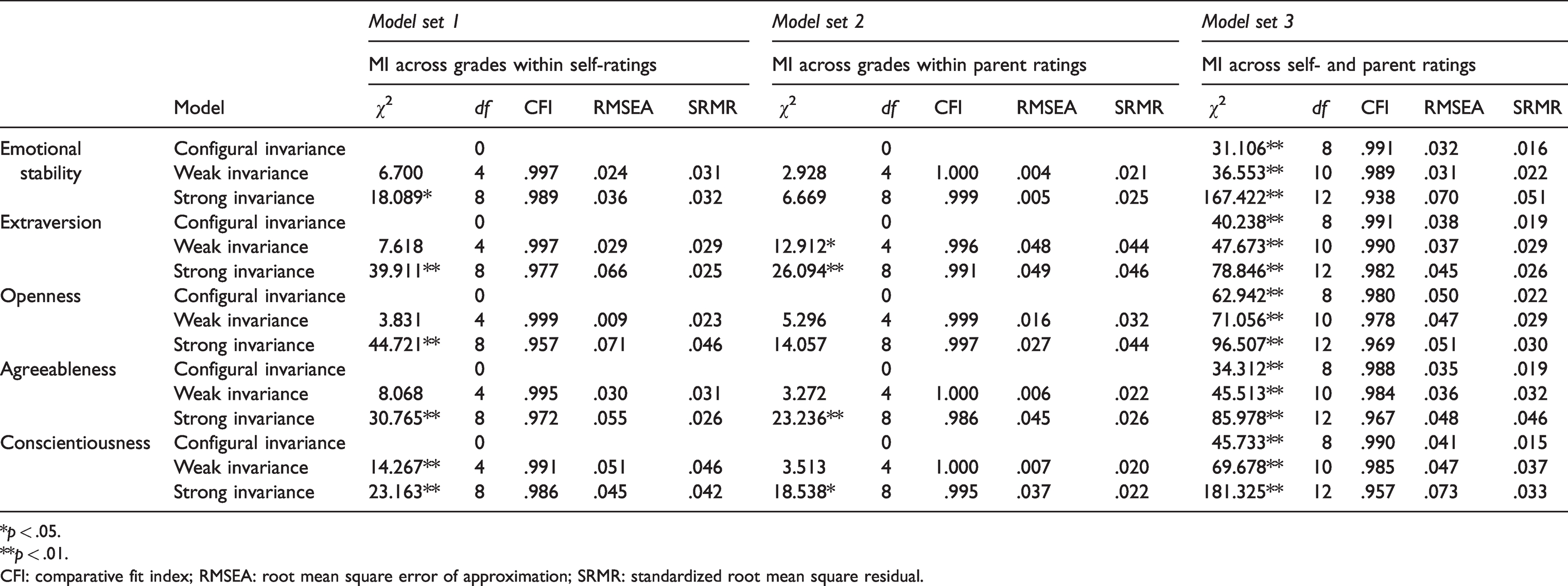
All three types of MI were tested in three steps (see Table 1) and by estimating each trait separately. We estimated increasingly restrictive measurement models and evaluated both their overall model fit and changes in the model-fit criteria. Using the comparison criteria according to Chen (2007), model fit in the more restrictive model should not exceed a change of .010 in the CFI, .015 in the RMSEA, and .030 in the SRMR. 1 Table 1 summarizes the results. Stepwise comparisons illustrated that in some cases, the implementation of strong MI was associated with model-fit changes that exceeded the criteria. At the same time, even these most restrictive models still had good overall model fit, that is, loadings and intercepts were set equal across grades within self-ratings (first model set), within parent ratings (second model set), and overall between raters (third model set). Accordingly, we decided to select the strong invariance models as the baseline models with respect to all traits and all raters for the following analyses. The results are in line with the notion of comparable measurement properties of the Big Five personality traits across different grades (already in fifth grade or from age 11) for self- and parent ratings of personality as well as between self- and parent ratings.
Fit indices for measurement invariance tests of personality across Grades (5, 7, and 9) and self- and parent ratings with item parcels.
*p < .05.
**p < .01.
CFI: comparative fit index; RMSEA: root mean square error of approximation; SRMR: standardized root mean square residual.
Associations between personality and psychosocial functioning
To analyze the associations between personality and psychosocial functioning, we conducted latent regression analyses based on the first and second multigroup CFA model of our MI analysis, that is, measurement models with comparable loadings, and intercepts across grades for both self- and parent ratings. For associations with psychosocial functioning, we estimated models with “grade” as the grouping factor and separately for the self- and parent ratings. The latent regression analyses were conducted separately for each personality trait, for both raters, and for each psychosocial functioning variable, resulting in 5 (Big Five traits) × 2 (raters) × 10 (psychosocial functioning variables) = 100 different models. The effect of interest was the regression effect of personality from each perspective on each psychosocial functioning variable in each grade. To take the great number of tests into account, but also to account for the typically small effect sizes in personality psychology (Funder & Ozer, 2019), we report only associations that were statistically significant at p < .01. In all regression analyses, we furthermore controlled for gender, IQ, SES, and immigration status. These variables are considered confounders of the investigated associations as they impact both personality and the variables related to developmental tasks.
We tested whether grade-specific effects were statistically significantly different by using pairwise comparisons and the multiparameter Wald test (Grund et al., 2016). The Wald test was used to evaluate the omnibus hypothesis according to which the effects of personality would be equal across grades, whereas the rejection of the hypothesis would indicate that they differed in a statistically significant way. Pairwise comparisons were then used to investigate specific differences between grades.
The two perspectives of self- and parent-rated personality share a substantial amount of variance (see Table OS2). As we were not interested in the associations with the unique personality part of each rater perspective, but we wanted to include all of the rater variance, we conducted separate analyses for students and parents. To take into account the dependencies of the parameter estimates when assessing whether the associations differed between rater perspectives (i.e. both models were based on the same sample and variables, with the exception of the personality ratings), we implemented a bootstrapping procedure. More specifically, we generated 100 bootstrapped samples for each imputed data set, resulting in a total of 50 (imputations) × 100 (samples) = 5000 bootstrapped samples. The models were then refit with all bootstrapped samples to obtain an estimate of the standard error of the difference between rater perspectives for each association and each imputation. Finally, we pooled the results across imputations using Rubin’s (1987) rules (for additional details on this procedure, see Schomaker & Heumann, 2018). Thus, this analytic strategy was applied to investigate whether the associations between personality and psychosocial functioning were robust across the different rater perspectives.
As 40% of our participants had an immigration status, we ran additional analyses that included interaction effects between latent self-rated personality and manifest immigration status on all outcomes. With these analyses, we tested the robustness of effects.
Results
In the following paragraphs, we summarize the associations of personality with the three domains of psychosocial functioning: achievement, social relationships, and psychosocial adjustment. We first report the overall pattern for the Big Five–psychosocial functioning associations. Then, we report grade- and rater-sensitive associations and highlight the statistically significant results. We describe our findings in terms of consistent and congruent effects: Consistent effects illustrate that effects show a similar pattern of significance across grades. Congruent effects illustrate a similar pattern of significance across raters.
To test the interrelatedness of personality with the three domains of psychosocial functioning, we established latent regression models for each combination of trait, psychosocial functioning variable, and rater perspective, separately. Tables 2 to 4 show all associations of personality with psychosocial functioning separated by the achievement, social relationship, and psychosocial adjustment domain. Moreover, each table contains the effects differentiated for the three grades, separated across the models of self- and parent ratings. In all reported models, the fit indices illustrated a good model fit. Please note that personality-grade models are based on only two cohorts (Grades 7 and 9), whereas the models for personality and the remaining psychosocial functioning variables include all three cohorts (see the Method section). Tables OS 5 to 7 present the standardized effects of the covariates. Additionally, to provide an overview of the large number of findings, Table OS 8 summarizes our hypotheses and the main results of the study.
Standardized regression effects of self- and parent-reported personality on the four achievement outcome variables in Grades 5, 7, and 9.
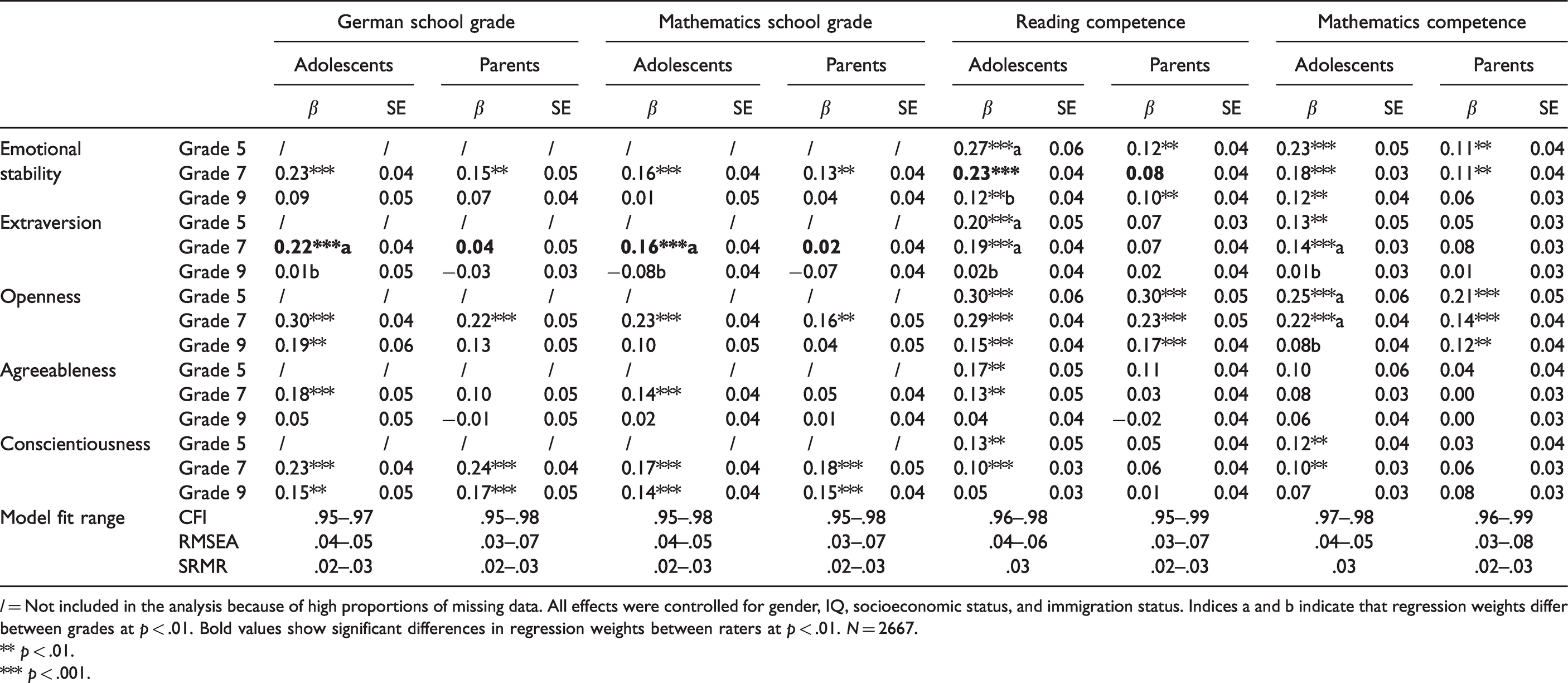
/ = Not included in the analysis because of high proportions of missing data. All effects were controlled for gender, IQ, socioeconomic status, and immigration status. Indices a and b indicate that regression weights differ between grades at p < .01. Bold values show significant differences in regression weights between raters at p < .01. N = 2667.
** p < .01.
*** p < .001.
Standardized regression effects of self- and parent-reported personality on the three social relationship variables in Grades 5, 7, and 9.
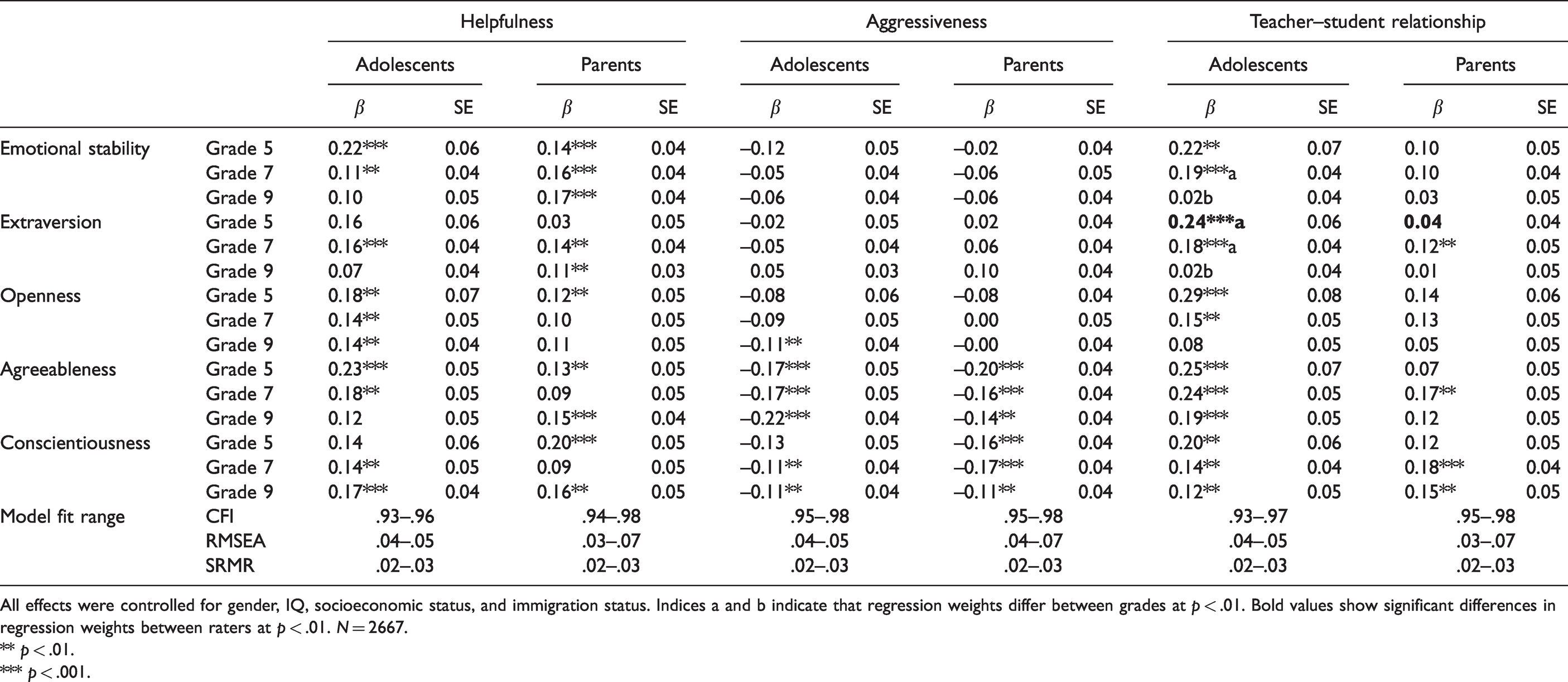
All effects were controlled for gender, IQ, socioeconomic status, and immigration status. Indices a and b indicate that regression weights differ between grades at p < .01. Bold values show significant differences in regression weights between raters at p < .01. N = 2667.
** p < .01.
*** p < .001.
Standardized regression effects of self- and parent-reported personality on the three psychosocial adjustment variables in Grades 5, 7, and 9.
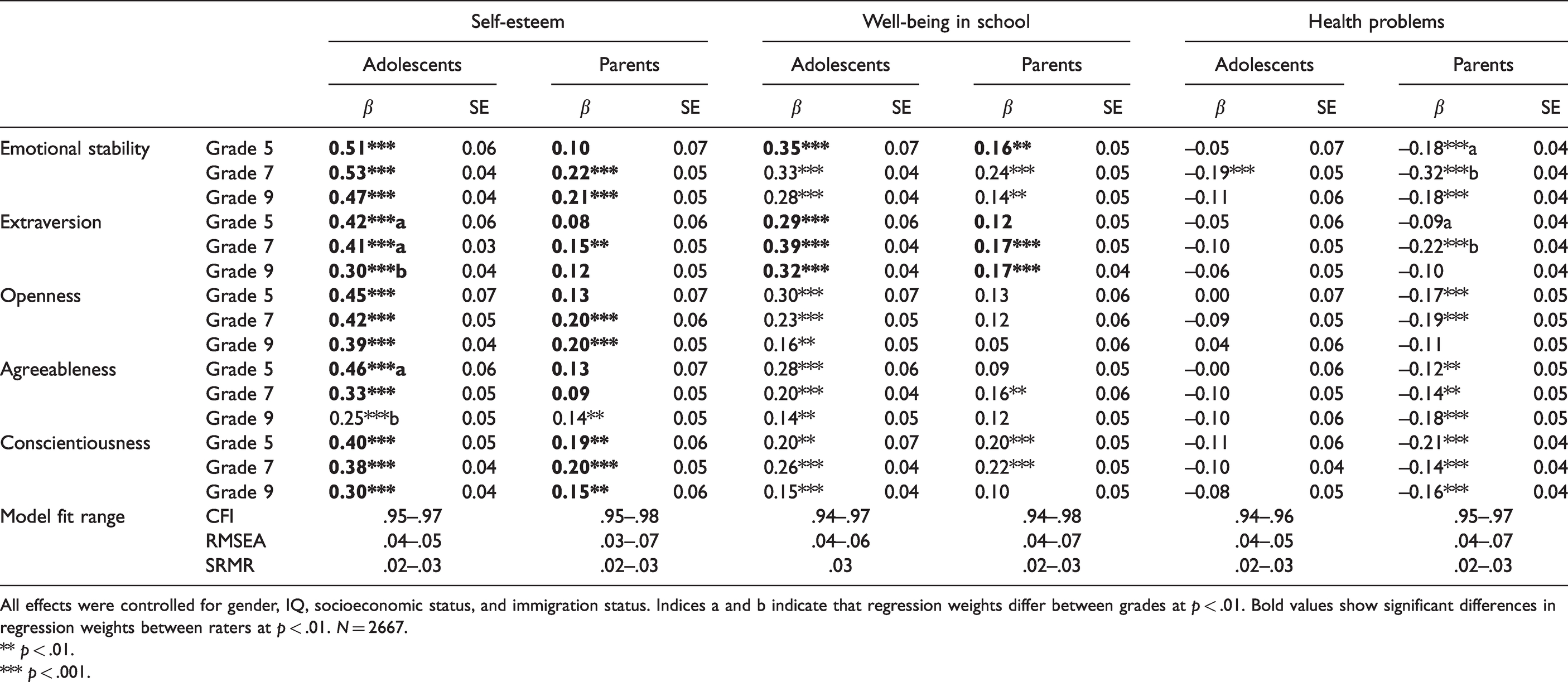
All effects were controlled for gender, IQ, socioeconomic status, and immigration status. Indices a and b indicate that regression weights differ between grades at p < .01. Bold values show significant differences in regression weights between raters at p < .01. N = 2667.
** p < .01.
*** p < .001.
Personality and achievement
German and mathematics school grades
In contrast to previous studies, we found positive associations between all self-reported personality factors and school grades in German and mathematics (Table 2). Most associations between personality and grades were found in seventh-graders. In ninth-graders, the results were more in line with previous work, as only openness and conscientiousness yielded significant associations with grades. Statistically testing grade-differential effects illustrated that adolescents in the seventh grade with higher levels of extraversion reported better grades, whereas in the ninth grade, extraversion was unrelated to German and mathematics school grades.
Overall, parent-rated personality resulted in fewer associations. Parent-reported emotional stability, openness, and conscientiousness were related to better German and mathematics school grades in the seventh grade, whereas only conscientiousness showed positive associations with German and mathematics school grades in the ninth grade. Despite this pattern, Wald tests comparing associations between seventh and ninth graders illustrated no statistically significant differences in the associations.
Importantly, all significant associations with parent-rated personality were congruent with the self-reported personality effects. However, rater-differential tests showed that associations between extraversion and both school grades were substantially stronger for the self-ratings than the parent ratings in seventh grade.
Reading and mathematics achievement tests
Comparable to the German grade associations, each of the self-reported Big Five traits were positively associated with reading achievement test scores. Specifically, the effects of extraversion, agreeableness, and conscientiousness were significant only in the fifth and seventh grades, whereas the associations with emotional stability and openness were substantial across all three grades. However, the grade-differential results illustrated that emotional stability and extraversion showed significantly higher associations in younger age groups. A similar pattern emerged for the associations between personality and mathematics competence: In the fifth and seventh grades, all Big Five factors, except for agreeableness, which had no association, showed positive associations with mathematics competence. The only grade-consistent significant association was found for emotional stability: A higher level of emotional stability was related to higher scores on the mathematics achievement tests in Grades 5, 7, and 9. Grade-differential tests indicated significantly higher associations in lower grades for extraversion and openness.
Students with higher parent ratings on emotional stability and openness also showed higher achievement test scores. Associations with emotional stability were most pronounced in fifth grade, whereas openness showed consistent associations in all grades. Wald tests indicated no statistically significant differences between grades in the models of parent-reported personality and achievement tests.
Parent-reported personality effects were largely congruent with the effects of self-reported personality. However, the rater-differential tests highlighted that in seventh grade, the association between emotional stability and reading competence was substantially stronger for self- than for parent-reported personality.
Personality and social relationships
Helpfulness
All Big Five personality factors were positively related to helpful behavior rated by classmates in at least one grade. Despite this general interrelatedness, the Big Five showed largely differential significance patterns across the three grades. In the fifth grade, higher self-reported emotional stability and agreeableness were related to being rated as more helpful by classmates, whereas in the seventh grade, all traits were consistently associated with helpfulness ratings. In the ninth grade, higher self-ratings of conscientiousness were positively related to helpfulness. As a consistent effect, students with higher openness levels were rated as more helpful by their classmates across all grades. Despite such differential significance levels, we found no statistically significant differences between grades according to the Wald test.
Along with the self-ratings of personality, the parent-rated personality traits were all positively related to helpfulness. Contrary to self-reports, students with higher levels of parent-rated openness showed one positive association in fifth grade, whereas adolescents with higher parent-rated agreeableness and conscientiousness were perceived as more helpful in the fifth and ninth grades. Parent-rated extraversion was positively related to more helpful behavior in the seventh and ninth grades. As a consistent effect, emotional stability was related to helpfulness across all grades. However, similar to self-ratings, Wald tests did not reveal any statistically significant differences between grades.
Interestingly, classmates’ ratings of helpfulness appeared to be an indicator with many incongruent associations when looking at the effects of self- and parent-rated personality. Despite this incongruency, statistical tests did not establish significant differences between raters.
Aggressiveness
Results concerning the associations between self-rated personality and average classmate ratings of aggressive behavior illustrated that adolescents with high self-ratings on openness, agreeableness, and conscientiousness were perceived as less aggressive by their classmates. Agreeableness was relevant across all three grades, whereas higher conscientiousness was only associated with less aggressive behavior in the seventh and ninth grades, and openness was associated with less aggressive behavior only in ninth grade. Despite these patterns, Wald tests did not indicate any significant differences between grade-specific effects.
Adolescents who were perceived as more agreeable and conscientious by their parents were also rated as less aggressive by their classmates. These associations were significant in all grades. In line with these consistent patterns, there were no significant differences between fifth-, seventh-, and ninth-graders as tested by the Wald test.
The results on classmate reports of aggressive behavior were largely congruent across self- and parent-rated personality. Again, we found no significant differences between raters.
Teacher–student relationships
Overall, personality was positively related to the quality of the teacher–student relationship. Agreeable and conscientious adolescents gave higher ratings to the quality of the teacher–student relationship across all three grades, whereas higher ratings on emotional stability, extraversion, and openness were related to higher quality of the teacher–student relationship in fifth and seventh but not in ninth grade. Grade-differential tests supported this notion of significantly higher associations in lower grades but only for emotional stability and extraversion.
Parent-rated extraversion, agreeableness, and conscientiousness were positively related to the quality of the teacher–student relationship, but only in seventh grade. Additionally, conscientiousness was significantly related to teacher–student relationship quality in ninth grade. Interestingly, none of the Wald tests revealed any statistically significant differences across grades.
Despite the existence of fewer associations in the context of parent-rated personality, these selected associations were found to be congruent with those of self-reported personality in adolescence. Testing for rater-differential results, only self-perceived extraversion was substantially and more strongly related to the teacher–student relationship in fifth grade.
Personality and psychosocial adjustment
Self-esteem
Students with higher ratings on emotional stability, extraversion, openness, agreeableness, and conscientiousness also reported higher self-esteem. Significant associations were found across all grades. Although the effects tended to be stronger in fifth than in the ninth grade in all models, statistically significant grade-specific differences were only found in the models for extraversion and agreeableness.
Similar to adolescents’ reports, all parent-rated personality traits were associated with self-esteem at least in one grade. In contrast to self-ratings, almost all associations with parent-reported personality occurred in the seventh and ninth grades, whereas only higher conscientiousness ratings were positively associated with self-esteem across all grades. Despite such patterns, Wald tests indicated no significant grade-specific effects.
Again, we found fewer associations of parent-rated personality with self-esteem, but these associations were congruent with those from self-reported personality. Interestingly, almost all associations were significantly smaller within the parent-reports than the self-reports.
Well-being in school
In general, personality was positively associated with well-being in school. These associations were again found across all grades. Despite differences in estimated effect sizes, Wald tests showed no significant differences across the three grades.
With respect to parent reports, we found positive associations for emotional stability, extraversion, agreeableness, and conscientiousness. Higher parent-rated conscientiousness in the fifth and seventh grades, higher agreeableness in seventh grade, and higher parent-rated extraversion in the seventh and ninth grades were related to higher well-being in school. Only students with higher parent ratings on emotional stability reported more well-being in school across all grades. As with the self-reports, we found no statistically significant differences between grades based on the Wald test results.
We again found fewer significant associations with parent-rated personality than with the self-ratings. In contrast to the self-ratings, parent-rated openness was unrelated to well-being in school, but all further associations were congruent across raters. However, associations within parent ratings were again significantly lower in the model for emotional stability in fifth grade and in the model for extraversion across all grades.
Somatoform health problems
As the single significant association for personality self-ratings, higher levels of emotional stability were related to fewer health problems reported by their parents in seventh grade. The Wald test did not reveal statistically significant grade-specific effects.
A different pattern emerged with respect to the associations between the parent-rated personality of their children and parent-rated health problems: All of the parent-rated Big Five traits were negatively associated with health problems. Higher parent-rated openness in fifth and seventh grade, extraversion in seventh grade, as well as emotional stability, agreeableness, and conscientiousness across all grades were related to fewer parent-reported health problems. The differences between grades reached statistical significance in the models for emotional stability and extraversion, indicating stronger associations in seventh compared with fifth grade.
In this domain of psychosocial adjustment, we found fewer statistically significant associations of self-rated personality compared with parent-reported personality. The one association with self-rated emotional stability was congruent with parent reports. Despite this discrepancy in result patterns across raters, we found no statistically significant differences.
Robustness check with immigration status
Findings of our robustness analyses with immigration status indicate that the pattern of results between personality and the selected variables of psychosocial functioning are comparable for students with and without immigration status. Overall, we did not find evidence for interaction effects between personality and immigration status except for two effects in grade 9. The association between openness and aggressive behavior was more negative for students with an immigration status than for native students. Unexpectedly, the association between conscientiousness and German school grades was less positive for students with an immigration status. Tables OS 9 to 11 summarize the unstandardized parameters of these analyses for each grade separately.
Discussion
The aim of the current study was to improve the understanding of age- and rater-differential interrelatedness between personality and psychosocial functioning in adolescence. We did so by investigating the associations of personality traits with different psychosocial functioning variables based on self-reports (school grades, teacher–student relationship, self-esteem, and well-being in school), peer reports (helpfulness and aggression), parent reports (health problems), and standardized assessments (academic achievement tests). Moreover, we examined self- and parent-rated personality associations across three different grades and additionally tested for differences between self- and parent reports. In line with research in adulthood, we found that personality and psychosocial functioning were highly interrelated in adolescence. Specifically, academic achievement was most consistently associated with emotional stability, openness, and conscientiousness, whereas agreeableness and conscientiousness showed the most consistent associations with social relationships, and all Big Five personality traits were associated with all adjustment indicators across adolescence. Interestingly, only a few age-differential associations occurred, and parent ratings of adolescents’ personality largely supported the associations with self-rated personality, albeit showing fewer effects. An interesting exception to these patterns was found for extraversion. Our study emphasized the role of personality in adolescence in a comprehensive and contextualized fashion with respect to a complex sample structure as well as psychosocial functioning variables. Thus, we hope to fuel further personality research in a still greatly understudied but very interesting period in life.
The interrelatedness of personality and psychosocial functioning
In line with notions that personality can be associated with many life outcomes in adulthood (Roberts et al., 2007), our results point to an interrelatedness between personality and psychosocial functioning across adolescence. Similar to what occurs in adulthood, personality can function as a resource for mastering developmental tasks in adolescence, whereas at the same time, different experiences in adolescence might also promote personality development. Besides largely replicating the associations of conscientiousness, openness, and emotional stability with achievement, agreeableness and conscientiousness were related to well-functioning social relationships, and all traits mattered for psychosocial adjustment. In the following paragraphs, we discuss the overall associations between personality and psychosocial functioning, whereas in the upcoming sections, we delve more deeply into differential association patterns for both age and raters.
Academic achievement
Consistent with our hypotheses and existing research, conscientiousness and openness were associated with both achievement indicators across the two subjects, German and mathematics (e.g. Dumfart & Neubauer, 2016; Spengler et al., 2013). In keeping with previous findings, conscientiousness showed slightly more associations with school grades, whereas openness had more associations with achievement tests (Brandt, Lechner, et al., 2020; Lechner et al., 2017; Meyer et al., 2019). These results support the assumption that conscientious students who work deliberately and thoroughly report better grades. Even when controlling for intelligence, more open students showed better achievement. It has been argued that higher curiosity, creativity, and different learning strategies (Komarraju et al., 2011) enable students to show better achievement and, hence, be more likely to succeed in acquiring basic competencies such as reading. Additionally, consistent with earlier studies (Laidra et al., 2007; Lechner et al., 2017), higher levels of emotional stability were related to better achievement, further suggesting that low emotional stability is a vulnerability factor. Most studies assume that personality characteristics shape the way we learn rather than the other way around. However, a first longitudinal study showed that the experience of competence (i.e. getting good grades and successfully acquiring new competencies) was related to adolescents’ motivation to work harder, enjoyment of learning, and curiosity (Israel et al., 2019). Further longitudinal research during adolescence is needed to disentangle the direction of effects.
Social relationships
Extending previous evidence, we showed that adolescents’ personality was also associated with all three social relationship variables. This is particularly interesting as two of the constructs (i.e. helpfulness and aggressiveness) were not assessed as self-reports but constitute valid average scores rated by classmates in an entire classroom, thus highlighting the validity of these associations.
As hypothesized and in line with previous research (Harris & Vazire, 2016; Tackett et al., 2014), agreeableness and conscientiousness were consistently related to the social relationship variables. This fits and extends the findings from Jensen-Campbell et al. (2003), who identified agreeableness as the most important personality trait for interpersonal relations among elementary school students. Likewise, a student’s conscientiousness was relevant for social relationships in the school context. This is in line with previous findings that showed a higher relevance of conscientiousness with respect to lower antisocial behavior, higher peer acceptance (Jensen-Campbell & Malcolm, 2007; Mõttus et al., 2012), and a better teacher–student relationship (Zee et al., 2013).
School is a place that evokes and rewards agreeable and conscientious behavior (Wentzel, 2009). Being more compliant, diligent, and responsible is also linked to better achievement in school (Poropat, 2009). Thus, having good grades (conscientiousness) and the willingness to share knowledge with one’s classmates (agreeableness) makes a student more likely to help others (e.g. with schoolwork). These kinds of students will hence be more likely to be perceived as helpful and are probably also liked more by classmates and teachers (Juvonen, 2006). At the same time, experiencing positive relationships could also foster agreeable and conscientious behavior with others. The roles and synergy of these traits (i.e. agreeableness and conscientiousness) for stable and lasting relationships have already been highlighted in adult samples (Berry et al., 2000; Wagner et al., 2014) and appear to generalize to adolescence.
Psychosocial adjustment
Our results indicate a remarkably consistent pattern of associations for all self-rated Big Five traits with self-esteem and well-being in school, which is in line with previous research in later adolescence and adulthood (Butkovic et al., 2012; Garcia, 2011; Robins et al., 2001). Relatively stable interindividual differences appear to matter for subjective well-being across diverse age groups and diverse contexts (Lucas, 2018). Importantly, the current study captured a comprehensive range of adjustment aspects that illustrated both consistent and differential effects.
Although emotional stability, extraversion, and conscientiousness showed strong effect sizes, contrary to our hypotheses, all traits were associated with psychosocial adjustment in early adolescence. One possible explanation can be found in the context of school where adolescents face many developmental tasks: Students with better grades also report higher self-esteem and more enjoyment when going to school (Metsäpelto et al., 2020; Pullmann & Allik, 2008). Possibly, the pertinent behaviors of openness and conscientiousness (e.g. enjoying learning and hard work) find a breeding ground in school and thus promote adjustment and well-being (Verkuyten & Thijs, 2002). The same holds for social traits such as extraversion and agreeableness: The enjoyment of many social encounters and social structures in school potentially increase students’ well-being (Verkuyten & Thijs, 2002; Wentzel, 2017). Health is the only exception to these general adjustment associations. As results are suspected to largely depend on rater effects, these findings will be discussed in more depth in the respective section.
In summary, the results show that in adolescence, all Big Five personality traits are associated with a broad variety of psychosocial functioning variables assessed in a multimethodological way. Despite this general finding, our grade-differential and multi-informant approach hints at several differential patterns that are discussed in the following paragraphs. Moreover, as adolescence is a very disruptive phase, all variables—personality and psychosocial variables—are subject to changes. Thus, regarding the direction of effects, reciprocal effects should be expected and investigated in future longitudinal studies.
Grades make a difference—But do they really?
To test for differential effects across adolescence, we applied two different strategies: First, and in line with previous studies (Laidra et al., 2006; Neuenschwander et al., 2013), we described similarities and differences in estimates and significance patterns, and second, we explicitly tested the differences by using pairwise comparisons and the multiparameter Wald test (Grund et al., 2016). As the two strategies test different hypotheses (i.e. statistically significant associations within a group vs. statistically significant associations across groups) and could provide different results, we decided to report both strategies and integrate the findings in the following.
Regarding within-group associations, personality was especially likely to show associations with psychosocial functioning in Grades 5 and 7. With only a few exceptions with respect to parent ratings, personality associations were strongest in fifth grade and became weaker or even statistically nonsignificant in later grades. Although these findings are in line with some earlier studies (Laidra et al., 2007; Poropat, 2009; Tetzner et al., 2020), potential drivers of such differences are largely unknown. Poropat (2009) argued that weaker associations in secondary school, compared with primary school, might be due to an increasingly heterogeneous and more demanding environment, which could lead to more differentiated associations between personality and academic achievement. Although we were unable to compare primary, secondary, and tertiary educational settings, our study was based on a sample of secondary schools that serve disadvantaged communities. Thus, it provides results for a heterogenous and understudied sample of students. However, because of this heterogeneity, we would like to argue that in early adolescence, we see a general interrelatedness between personality and psychosocial functioning, whereas over the course of middle and late adolescence, the role of personality and the relevance of different psychosocial variables become differentiated.
Nevertheless, we found one interesting result that can help explain an existing inconsistency in the literature, namely, the mixed associations of extraversion with academic achievement: Associations in previous studies range across positive, null, and negative effects (Laidra et al., 2007; Lechner et al., 2017; Poropat, 2009). With our more fine-grained grade-level analyses, results in the triangle between extraversion, achievement, and the teacher–student relationship appear to be particularly interesting. Being more energetic and sociable was related to better achievement and to a better teacher–student relationship quality in early but not in late adolescence. Interestingly, this positive association was previously found not only to diminish, but sometimes it even became negative in other samples (Eysenck & Eysenck, 1985; Laidra et al., 2007; Tetzner et al., 2019). One possible explanation that has been offered is that in later grades, adolescents with high scores on extraversion in particular become increasingly interested in peer relationships and social activities (Arnett, 2000; Chamorro-Premuzic & Furnham, 2008; Eysenck, 1992), which may entail an increasing avoidance of achievement-related tasks (Komarraju & Karau, 2005; Lubbers et al., 2010). Future longitudinal research might be able to shed light on the changing function of extraversion and its interrelatedness with diverse environments across adolescence.
Besides the results for extraversion and in contrast to our expectations, age-differential associations did not show clear patterns of differences between grades. Yet, we would like to argue that the results provide some indication of a general interrelatedness of personality and psychosocial functioning in early adolescence but a more differentiated picture of personality associations in later adolescence.
What different rater perspectives can(not) tell us
We further aimed to complement the understanding of associations of personality with psychosocial functioning in adolescence by including and comparing the self- and parent perspective. Again, first, we described similarities and differences in estimates and significance patterns, and second, we explicitly tested the differences between the associations from both perspectives. Student and parent ratings of personality showed both congruence and differences in their associations with psychosocial functioning as we hypothesized on the basis of the SOKA model (Vazire, 2010). Using the significance pattern within each domain of psychosocial functioning and between raters, we highlight three main findings.
First, although we found fewer and significantly lower associations with parent-reported personality compared with self-reports, existing effects were largely congruent between adolescent and parent reports. Results provide congruent associations of parent ratings with self-ratings in approximately 50% of all significant associations across all three domains of psychosocial functioning. With respect to each trait, the highest congruency was found for associations with conscientiousness (67%), confirming recent studies and the theoretical notions of the SOKA model (Branje et al., 2003; Göllner et al., 2017; Luan et al., 2017). Partly in line with previous findings and the SOKA model, congruence in associations of emotional stability with psychosocial functioning were also high (67%; cf. Luan et al., 2017; cf. van den Akker et al., 2014), and at the same time, this trait showed significant differences in effect sizes between raters. Not supporting our hypothesis, most significant differences were found in associations with extraversion. These results were somewhat surprising because emotional stability has been regarded as difficult to observe for others, whereas extraverted behavior can be well-observed without being highly evaluative (Vazire, 2010). With respect to emotional stability, one might argue that parents still spend a lot of time with their adolescent children and might gain more insights into their inner thoughts and feelings than one might expect in different relationship settings. Referring to extraversion, early adolescence might be a time when especially extraversion develops through the mastering of developmental tasks outside the family home (Göllner et al., 2017; Havighurst, 1956). Extraversion might also be a very context-sensitive trait in this age span: The context of school (with many peer interactions) might evoke (and reward) other extraverted behavior levels than the context of home (Fleeson, 2007; Nettle, 2005). Therefore, further other perspectives, such as personality ratings from peers, should be included in future studies, as they could provide an explanation for context-varying similarities and differences in personality-associations. Future longitudinal studies might also investigate whether and when (in)congruency in rater perspectives are useful for psychosocial functioning (Reitz et al., 2016). Together, parents might be better able to judge their children’s emotional stability and conscientiousness, showing significant and consistent associations with psychosocial functioning in early adolescence, but they might be less precise with respect to extraversion.
Second, this congruency in effects across raters is particularly interesting in light of the bivariate correlation patterns (see Table OS 3), which showed stronger agreement between the personality ratings of adolescents and their parents in later grades. This is also reflected in the percentage of congruent effects between adolescents and their parents from fifth through ninth grade: In fifth grade, 37% of all effects from self-reported personality were also significant when parents rated their children’s personality. In Grades 7 and 9, however, the percentages increased to 60 and 61%, respectively. Thus, from a developmental perspective, one might argue that the way adolescents see themselves is more aligned with how their parents perceive them (Luan et al., 2017; Rohrer et al., 2018).
Third, our study highlights the value of including different sources not only for personality but also for psychosocial functioning to test the robustness of findings. Beside the fact that most self-rated personality associations were also confirmed for parent-rated personality, it was especially valuable to include peer-rated variables. These different sources underlined the existence of personality–psychosocial functioning associations in adolescence regardless of the rater. However, making use of different sources additionally showed some distinct effects between raters. It is well-known that when personality and other variables are rated by the same source, associations are more likely and are often also stronger in size (Podsakoff et al., 2003). In our study, this was not only true with respect to self-rated constructs. Parent-rated personality also showed more and stronger associations with the parent-rated adjustment indicator, whereas self-rated personality did not. Besides possible substantive explanations, these effects point to the presence of common-method variance (Podsakoff et al., 2003). Notably, the part of the personality associations that is due to common-method variance seems to be higher when personality and psychosocial indicators are rated by parents than by adolescents. Departing from such within-person ratings, the peer-rated variables of helpfulness and aggressiveness were found to show both congruent and rater-specific associations. Helpfulness and aggressiveness are behaviors that are easy to observe, so other (peer) perspectives should provide reliable information (Reitz et al., 2016; Vazire & Mehl, 2008). As self- and parent-rated personality also showed single significant associations, we cannot explain the association pattern through common-method variance, nor can we favor one perspective over the other. Thus, the two rater perspectives appear to provide different personality information and may be regarded as complementary to each other. Contrary to previous findings favoring other-reports when studying personality–achievement associations in adolescence (Connelly & Ones, 2010; Poropat, 2014b), in our study, the interrelatedness between personality and psychosocial functioning was also confirmed by self-reports.
Overall, we found a high congruence in personality associations between adolescents and parents. Although parent-reported personality associations almost always had smaller effect sizes, such congruence emphasizes the robustness of effects. However, the results also demonstrate the possible existence of common-method variance, particularly when both the dependent and independent variables are reported by others.
Limitations and outlook
Our study has many strengths as we investigated a broad range of psychosocial functioning indicators in three different grades by applying a multimethodological approach on the side of personality and psychosocial functioning in a large heterogeneous sample of adolescents and their parents. However, we also need to discuss four main limitations of our study.
To begin with, as is the case with all cross-sectional studies, we cannot draw any conclusions about the directions or causality of effects (see Morgan & Winship, 2015). Although first longitudinal empirical evidence indicates that psychosocial functioning can also explain personality change in adolescence (Brandt et al., 2019; Israel et al., 2019), these studies also point to larger effect sizes of personality on performance indicators or social relationships (as aspects of psychosocial functioning) than vice versa. This is in line with other longitudinal studies in adulthood (e.g. Deventer et al., 2019; Neyer & Asendorpf, 2001; Scollon & Diener, 2006; Sutin et al., 2009). Moreover, by including three different grades, we could not exclude the possibility of cohort effects when considering grade-differential tendencies. We interpreted these tendencies with caution and generally found only weak evidence for grade-specific associations. Therefore, the results have to be replicated with similar age groups in longitudinal studies to explicitly investigate potential effects of personality on psychosocial functioning and vice versa, beginning in early adolescence. Although we controlled for several covariates, alternative moderators need to be considered when studying the association between personality and psychosocial functioning such as interest, self-concept, or social feedback (Marsh & O’Mara, 2008; Wagner et al., 2018).
Second, although we think that investigating non-White, Educated, Industrialized, Rich, and Democratic (Heinrich et al., 2010) samples is important and necessary, it also raises the question of the findings’ generalizability to the entire population, which might be less disadvantaged than the sample we studied. In order to investigate the robustness of the results, we controlled all analyses for relevant covariates, such as gender, SES, cognitive abilities, and immigration status. Most findings confirm the theoretically and empirically expected direction of effects. As investigations in culturally diverse samples are particularly scarce, the high percentage of first- and second-generation immigrants in our sample are a specificity allowing additional robustness analyses. Generally, our findings supported the robustness of the results with respect to two domains (social relationships and adjustment) but also showed changes in results with respect to the domain of academic achievement. The analyses revealed two significant interactions of immigration status with openness and conscientiousness, indicating that personality might show differential association patterns in these subgroups. Especially the reduced association between conscientiousness and German school grades for students with an immigration status might underscore a higher relevance of contextual factors compared to personality for this subgroup. Overall, replication of these effects is needed to shed light on whether group differences, for instance minority vs. non-minority groups, could help better to understand the conditions and samples in which personality might function as a resource or as a vulnerability factor with respect to psychosocial functioning.
Third, we found relatively high correlations between personality items and, thus, between the personality factors (Table OS 3). Therefore, it was not possible to implement a simple structure on the item level of the Big Five with confirmatory factor analyses in this sample. However, it is equally unlikely to find a simple structure on the item level among adult samples (Brandt, Becker, et al., 2020; Marsh et al., 2013; see also Church & Burke, 1994; Vassend & Skrondal, 1997). Interpretations of the associations could contain method bias, whereas it was also reasonable to suggest that higher correlations in adolescence have substantive reasons. Adolescents might show different agreeable or extraverted behaviors than adults or the behavioral range might be smaller in adolescence than later on. To validate the personality self-reports, we included parent ratings and compared the two perspectives statistically. Future research, however, should place a methodological focus on disentangling the higher interrelatedness of factors and how this can be interpreted in associations between personality and variables of interest.
Fourth, our aim was to investigate age- and rater-specific associations of personality and a broad range of psychosocial functioning variables in the first phase of adolescence. We decided to include three different age groups and two different rater perspectives on personality to account for the specificities of this turbulent age period. This led to an extensive number of analyses and thus increased the risk of rejecting the null hypothesis by chance. To address this point, we restricted our p-value to p < .01. Additionally, we controlled our findings for multiple testing. As there is still disagreement about the use of multiple testing procedures (e.g. Saville, 1990), we applied two different approaches, one by Benjamini and Yekutieli (2001) and one by Benjamini and Hochberg (1995). This maximum level of transparency will help readers to form an opinion based on the different information. Results contrasting the original and the two adjusted p-values for all effects of interest can be found in the Online Supplement Tables OS 12 to 20. Importantly, we thereby contrast the (conservative) criterion of p < .01 with the adjusted p-values using a cut-off of p < .05. Overall, the comparison of different criteria confirms the majority of the findings and support our current approach of a more restrictive p-value. Interestingly, the adjusted p-values of the procedure by Benjamini and Hochberg (1995) led to a more liberal testing than the alpha cut-off of p < .01, whereas the procedure by Benjamini and Yekutieli (2001) produced slightly more conservative decisions. In addition to some effects being omitted based on the correcting (especially differences between Grades), several additional effects were added (mostly among the personality–psychosocial-functioning-associations). The discussed grade differences between extraversion and achievement, however, stayed significant. Regardless of the consistency of results across different adjustment procedures, future studies need to replicate our findings to draw final conclusions about the interplay of personality and psychosocial functioning in adolescence.
Finally, despite the large number of different associations, one can still think of other relevant psychosocial functioning variables. Future research might want to focus on resource-oriented variables such as resiliency or motivation. Moreover, additional other reports of adolescents’ personalities, such as peer and teacher reports, could also shed light on the role of personality perspectives in adolescence (see for example Brandt et al., 2021; Plouffe et al., 2017; Reitz et al., 2016).
Conclusion
In summary, the current article provides evidence for the strong interrelatedness of Big Five personality traits and psychosocial functioning in the domains of academic achievement, social relationships, and psychosocial adjustment. Thereby, school can be seen as a crucial context that confronts students with different developmental tasks and rewards (or punishes) certain behaviors. In this light, the adolescent school context bears substantial importance for individual resources such as personality. Although the majority of personality associations did not differ across grades, we found some evidence that particularly the associations with extraversion vary across adolescence. This emphasizes the notion of possible differentiated and changing roles of some personality traits, which may reflect a turbulent stage in life with shifting social demands and developmental tasks (Eccles & Roeser, 2011; Havighurst, 1956; Hogan & Roberts, 2004). Our multirater perspective additionally confirmed most self-rated personality effects, pointing to meaningful and robust results. Altogether, we hope we have provided a starting point for even more detailed research on age- and rater-related personality phenomena. From our point of view, the most pressing next steps include longitudinal analyses to understand developmental trajectories in personality-outcome associations, differential functioning of personality traits, and the directions of the effects.
Supplemental Material
sj-pdf-1-erp-10.1177_08902070211005636 - Supplemental material for Personality and psychosocial functioning in early adolescence: Age-differential associations from the self- and parent perspective
Supplemental material, sj-pdf-1-erp-10.1177_08902070211005636 for Personality and psychosocial functioning in early adolescence: Age-differential associations from the self- and parent perspective by Anne Israel, Naemi D Brandt, Simon Grund, Olaf Köller, Oliver Lüdtke and Jenny Wagner in European Journal of Personality
Footnotes
Data accessibility statement

Declaration of conflicting interests
The author(s) declared no potential conflicts of interest with respect to the research, authorship, and/or publication of this article.
Funding
The author(s) disclosed receipt of the following financial support for the research, authorship, and/or publication of this article: This project was funded by the Senator for Education and Science of the Free Hanseatic City of Bremen and was co-financed by the European Regional Development Fund (ERDF).
Note
References
Supplementary Material
Please find the following supplemental material available below.
For Open Access articles published under a Creative Commons License, all supplemental material carries the same license as the article it is associated with.
For non-Open Access articles published, all supplemental material carries a non-exclusive license, and permission requests for re-use of supplemental material or any part of supplemental material shall be sent directly to the copyright owner as specified in the copyright notice associated with the article.
