




Abstract
Remittances following economic and wartime migration are behind the huge number of remittance houses and entire remittance landscapes that have grown up in Kosovo in recent decades. The houses emulate the style and comfort of the villas of European and American suburbia but also in many respects reflect the local life style, the traditional life of (joint) families, but also the dramatic changes that it is undergoing. A model in which two, three, four, or more brothers build a row of houses—one for each brother—has become popular in the building boom in rural and suburban Kosovo in the last two decades.
This article interprets these family projects as an attempt by joint families to adapt to the massive cultural change and globalization that (not only) Kosovo has been going through. As a proactive albeit problematic attempt to tackle the (otherwise) intractable tensions and ambivalences that rapid cultural transformations bring. The adaptation involved is a response to challenge at four levels: first, the growing economic inequality between brothers in joint family households; second, the physical absence of the owners of these houses, who are often living abroad; third, the growing desire for individuation and privacy; and finally, the disintegration/reformulation of the very institution of the joint family. It is unclear, however, whether it is really possible for architecture as agent of adaptation to counterbalance the immense social pressures generated by globalization or resolve the intractable contradictions with which it faces families and individuals.
Keywords
Introduction
Since the late twentieth century, many rural areas in the former Yugoslavia have been rapidly transformed from localized agrarian economies into economies exposed to and shaped by globalization. In the ethnically and economically diverse Yugoslav federation modernization was uneven. The speedy development of some areas led other areas to feel marginalized, in need of emancipation, and longing to live “like those people down in the city,” “in Belgrade,” “on the coast,” and “in the north in Croatia or Slovenia.” Communist state-directed modernization generated economic and power inequalities. 1 Although the communist regime tried to counter these regional differences, its attempts to modernize many of these marginal areas brought only with mixed results.
In the case of Kosovo, a number of industries and mines were opened and the region was granted a degree of autonomy after 1966, but this was far from enough to induce Albanians to identify with the state. The historian Xavier Bougarel, writing about the Yugoslav Dinaric populations who, like the Kosovo Albanians, found themselves outside their own (ethnically defined) federal state, shows how they decided to solve their lack of access to state-directed modernization by taking development in their own hands. 2 To increase their access to economic and political resources, they strengthened local clientele networks and bonds, engaged in the informal gray economy, or migrated to Western Europe. 3 We see a similar process in Kosovo. It undermined people’s identification with the state still further, and led to the globalization and westernization of the countryside but also a counter-current in the form of the revival of ethnic and religious identity and the reinforcement of traditional values relating to family, home, and gender divisions. In response to the insecurity induced by the massive cultural changes affecting the countryside, very high levels of unemployment, political discontent, and alienation, Kosovars searched for political certainty in nationalism. In the 1990s, this led to increasing ethnic conflict and then to the uprising of 1998 followed by war.
The “self-help” approach to modernization in rural areas as well as the ethnic conflict and war encouraged the migration of Kosovo Albanians, which draws on the widespread regional practice of seasonal migration for work (kurbet/gurbet). Over time, the traditional seasonal migration of men for work turned into the migration of entire families, many of whom, although they dream of returning to their homeland permanently, only come to Kosovo for the vacation or occasionally. 4 By 2016, as many as 870,000 people (nearly 50% of Kosovo’s population) lived mostly in Germany, Switzerland, Italy, Austria, Scandinavia, the United Kingdom, the United States, France, and Canada. 5 The great journey to modernity added another tension between the center and the periphery of the former Yugoslavia: there (in rich foreign countries) and here (home in Kosovo). These tensions are reflected in the construction boom of houses that emulate the style and comfort of West European suburban villas. Whole new parts of villages and suburbs have been coming into existence, indeed whole new “remittance landscapes.” 6
This article focuses on an unusual aspect of this building boom: the construction by brothers of identical houses lined up in a row, usually with identical dispositions and sometimes even with identical interiors (Figure 1). In Kosovo, Albania, the Albanian areas of Macedonia, and among Muslims in Sandžak, visitors cannot help but notice these rows of two, three, and sometimes even five or more identical houses (Figure 2). Sometimes these joint residences include a house for parents or, for various reasons, do not involve houses for every male sibling. They are neither remnants of the standardized family houses constructed in Yugoslav towns during communism nor projects by post-communist commercial developers, but the grand residences of large Kosovar joint families. Occasionally two brothers build mirror symmetrical semidetached houses with independent entrances, three or more brothers build a terraced row of housing, or in towns where space is at a premium brothers own different floors in a single detached building. These ostentatious family residences with identical houses for brothers first appeared in Kosovo. Since 2000, the largest concentration of such residences has been found in southern Kosovo (Malishevë, Has and Suharekë) in villages or in the possession of traditional families of rural migrants building homes in town suburbs. 7
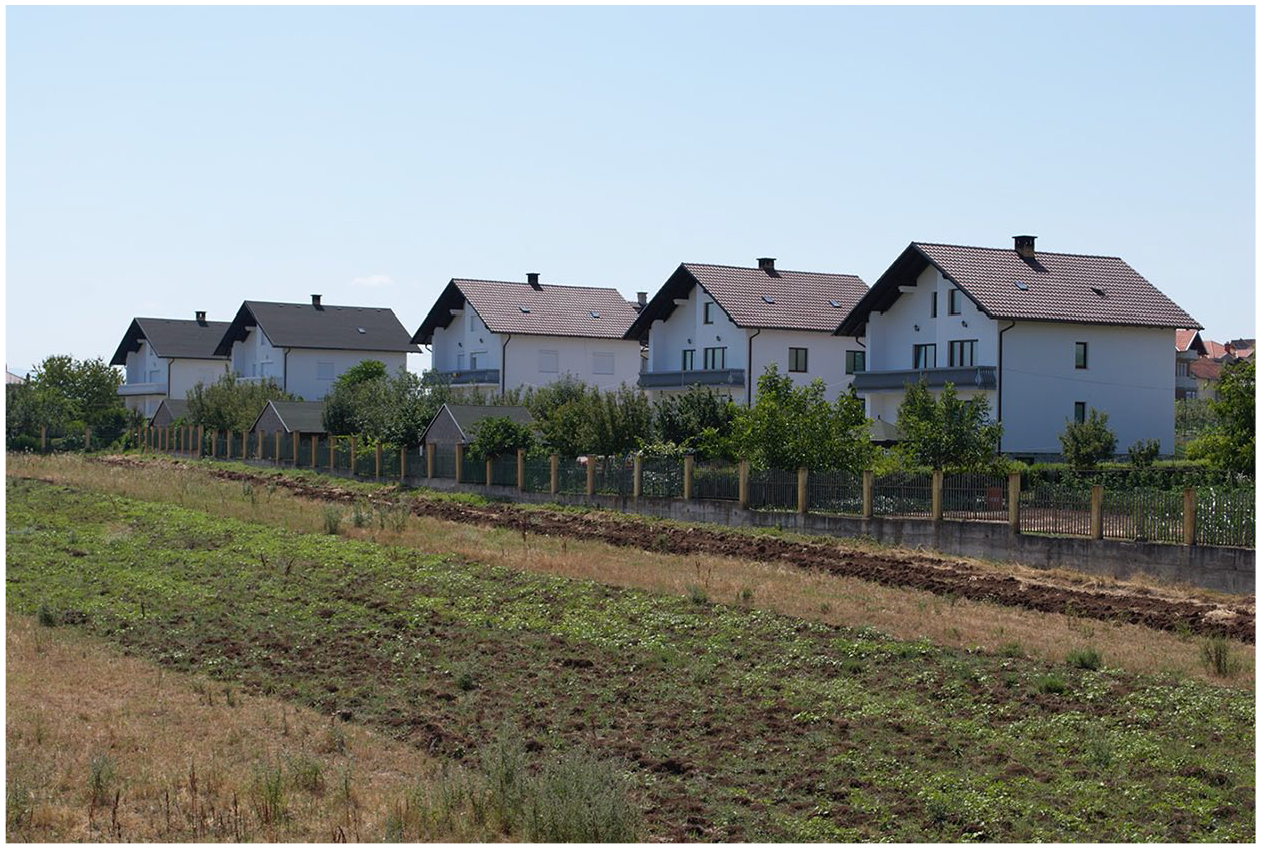
The impressive residences formed of identical houses for brothers project not just the wealth but the size and inner harmony of the joint family
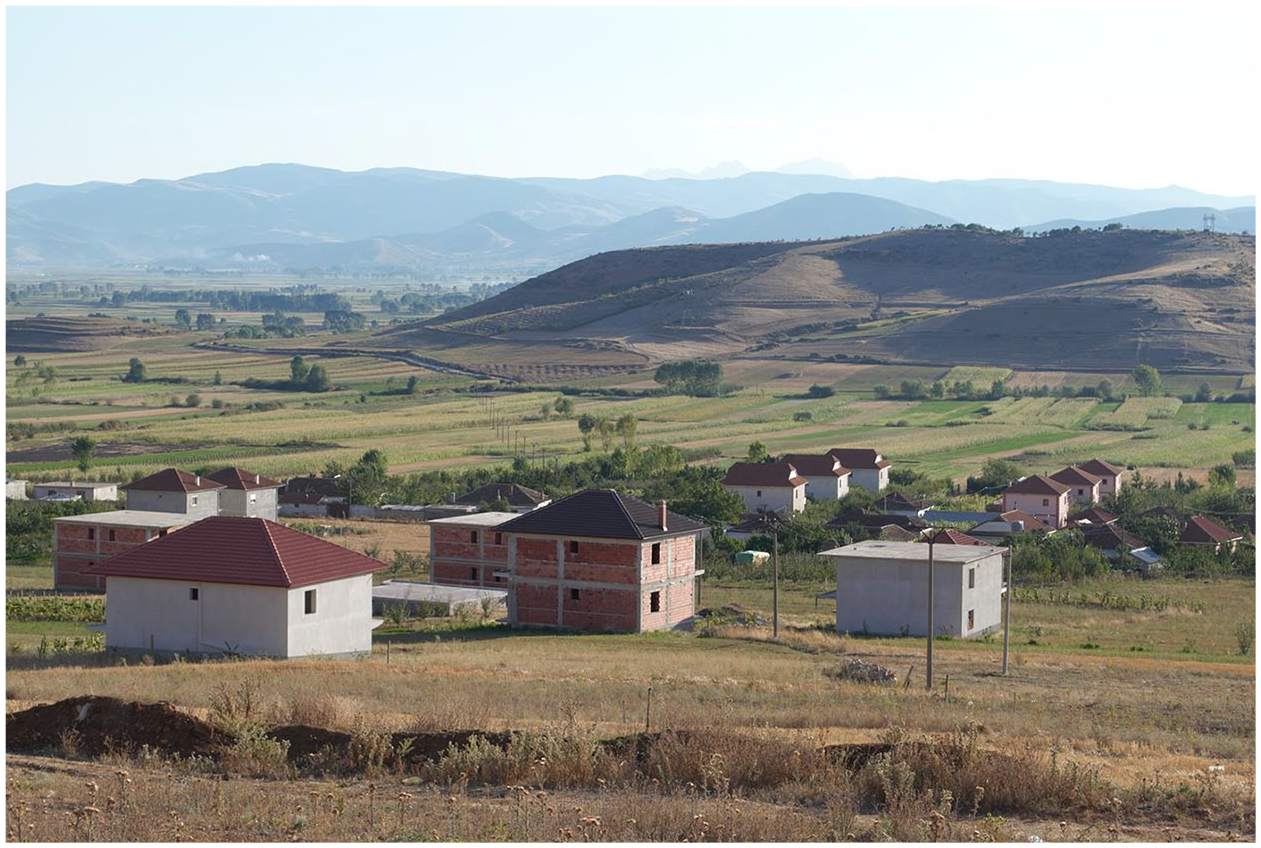
The trend for building identical houses for brothers has been spreading not only in Kosovo in recent years but also throughout the whole of the south-western Balkans, above all in ethnic Albanian areas
The traditional Balkan joint family lives in a joint family household, and shares a budget and consumption.
8
The current form of Albanian architectural (self)seclusion draws its ethos from the traditional fortified family tower houses (kulla), which occasionally provided safety in troubled Ottoman times, from the (self)seclusion of traditional Muslim families, who in the 1950s and the 1970s liked to build high walls around farmsteads, as well as from the general Albanian distrust for the Serbian-administered communist state, and the later economic chaos, power vacuum, and open ethnic conflict that characterized post-communist transition. “Albanian families have lived in joint family households until recently because of our Serbian enemy,” the 59-year old builder Haki from Prizren told me.
9
As he explained, my brothers and I could separate only after the war, when we got our own state. Before the end of the war Albanians didn’t have [their own] police, or army, nothing! One of the brothers [from the joint family household] worked abroad so his relatives could have something to eat, and another stayed at home to guard the family.
The joint family household and its residence, which act as a “fortress against the surrounding world” have become the symbolic center of Kosovar social life and politics.
Not much has been written about this phenomenon, which I will call “brother houses” for brevity. 10 The aim of this article is to offer an explanation for them, summarizing and covering four different explanations offered by the builders and residents of these houses themselves, as well as local observers. It attempts to explain the meaning of these houses as an adaptation to globalization, migration, and translocality, accompanied by rapid cultural change. These family residences grow directly from remittances and are therefore what we call “remittance houses” in the truest sense of the word. 11 Or, to a lesser extent, they are funded by family businesses that draw input capital from remittances (usually even directly from the construction industry, which is entirely dependent on remittances). 12 They all grow out of a complex transnational world, which is created by translocal life between here-at-home and there-abroad and the associated rapid cultural change.
Authors writing on migration emphasize that remittances flowing back to the home community are not “just money,” but also have symbolic and emotional value, representing their absent donors, their attachment to place, their love and care for the place and (joint) family. 13 Some authors dealing directly with remittance houses go even further, suggesting that their function is not so much mere housing as making absent owners (working and living abroad) present in the native community. 14 In this article, I want to show that in the case of identical brother houses, the pressures and counter-pressures behind the construction are more various and complex. Indeed, the project of their creation is a kind of new technology, with the help of which the current traditional joint families try to cope with some of the threatening effects of globalization and rapid cultural change, and even if they cannot be warded off entirely, at least to counterbalance them.
My interest in remittance houses began during field work in Kosovo in the 1990s. I made these houses the focus of my research in 2009, conducting additional field work on them in 2014, 2017, and 2022. As a social anthropologist of material culture I am primarily interested in their social life. In semi-structured interviews with the owners, I foregrounded the long-term financing for building these residences; questions of fairness in the family and equality among brothers; the construction of the houses by migrant workers living at a distance; the ways in which houses are inhabited as part of everyday life and during holidays; the owners’ plans for these houses’ future; the moving of the brothers’ families into separate houses and its impact on the joint family; and the increased emphasis on individuality and privacy. I have also interviewed admirers and opponents of these projects from the local community, taking photographs and making sketches of the houses with their owners.
My research is based on dozens of interviews, personal observations of brother houses in Kosovo, North Macedonia, Albania, and the Serbian Sandžak, as well as an in-depth analysis of ten such houses in Kosovo in 2017 and 2022. As a middle-aged foreign researcher, I found it difficult to conduct semi-structured interviews with women in the traditionalist Albanian joint families who built these houses. Also, given that in the Albanian countryside men are responsible for building such houses, by virtue of the traditional gendered division of labor, most of my participants were middle-aged men who built these houses with their brothers or fathers. Most had worked abroad for at least a few years. The interviews were conducted in Serbian and in a few cases in English.
“Eight Hands Can Do More than Two”
Three houses like peas in a pod, and behind them one larger unfinished house, stand in a row in a suburb of the town of Rahovec. The eldest brother, 60-year-old Jusuf, shows me the residence of his large joint family. 15 “We’re four brothers and one sister. She’s married—she has her place elsewhere.” Three identical houses were built for the brothers living in Kosovo, and a larger house for the brother who lives with his wife and son in Switzerland.
We’ve all been working hard to get it done. And we all had the same. We put up the money together as the work proceeds, so it’s not like “I’ve got the means now, but you haven’t!” Two hands can’t do as much as six, eight or even twelve hands!
Jusuf invokes the well-known Kosovar metaphor of the united fraternal hands of the joint family household and continues.
When there are two, three, four, or even five of the same houses, you know they are brothers. When they’re different, then you know they’re not necessarily brothers. They’re (maybe) family, but not brothers. [. . .] That’s how it works here in Kosovo.
Jusuf generalizes, although one of his brother houses is different from all others.
Jusuf and his brothers used to live together in a little five-room house in the center of the town. As was customary, the twelve-member joint family household pooled income, cooked, and ate together. Budget decisions were made by the head of the joint household, the father or later the eldest brother, as is customary in Kosovo, and even the large sums saved by the brother working abroad were transferred directly into the household pot. But times are changing, Jusuf states: “Now each has his own! Now everyone who works has his own house. One, two, three: as many houses as brothers. Not like in the past, with 10, 20, 25 people in one [joint family] house!” 16
The houses of Jusuf and his three brothers are identical, but their social lives are not. Jusuf and his family, which includes his already married son, are still living with Jusuf’s youngest brother in the crowded house that belongs to the latter. The second house in the row has been empty since its completion, waiting for the interior to be finished so that Jusuf’s family can move in. Currently, it houses a family workshop for concrete casts. The third brother and his family live in the third house, at the end of the row. Behind it, there is a big incomplete house of the fourth brother working in Switzerland, the family plans to add two more identical, large and luxurious houses next to it—for Jusuf’s son and the son of the third brother—to create a tier of another three identical houses different from the first row. Visible from every direction, the complex would show who they are, how many they are, and how much economic strength they have. After the completion of the first three houses, however, the project has lagged for years.
This case shows the distinctive features of the brother houses phenomenon. It is connected with the joint family household, which survives in rural Kosovo and the new suburbia around towns. “Identical houses for brothers aren’t so common; it’s for people who still live in a joint family union, as in old times. They work together and build identical houses so as to avoid disputes” between brothers, as the 70-year-old Bekim explains. “Where they’re building identical houses, it’s always a joint family of brothers, and the transformation of this family model,” he adds. 17
Although house builders and their neighbors stress the sameness of brother houses, the reality is more complicated. Many houses have identical exteriors and even interiors (including furniture and fittings), but many others combine several identical houses with one or two different ones, reflecting the different social situation of one (or more) brothers. Many joint families build similar, not identical, houses in a row or in the same place (Figure 3). This is also the case of Haki’s family, whose experience we consider below. The concept of “an identical house for each brother” is therefore more an ideotype that a rule, yet it is an important ideal which makes sense as a way of trying to tackle some of the problems that Kosovar joint families face today.
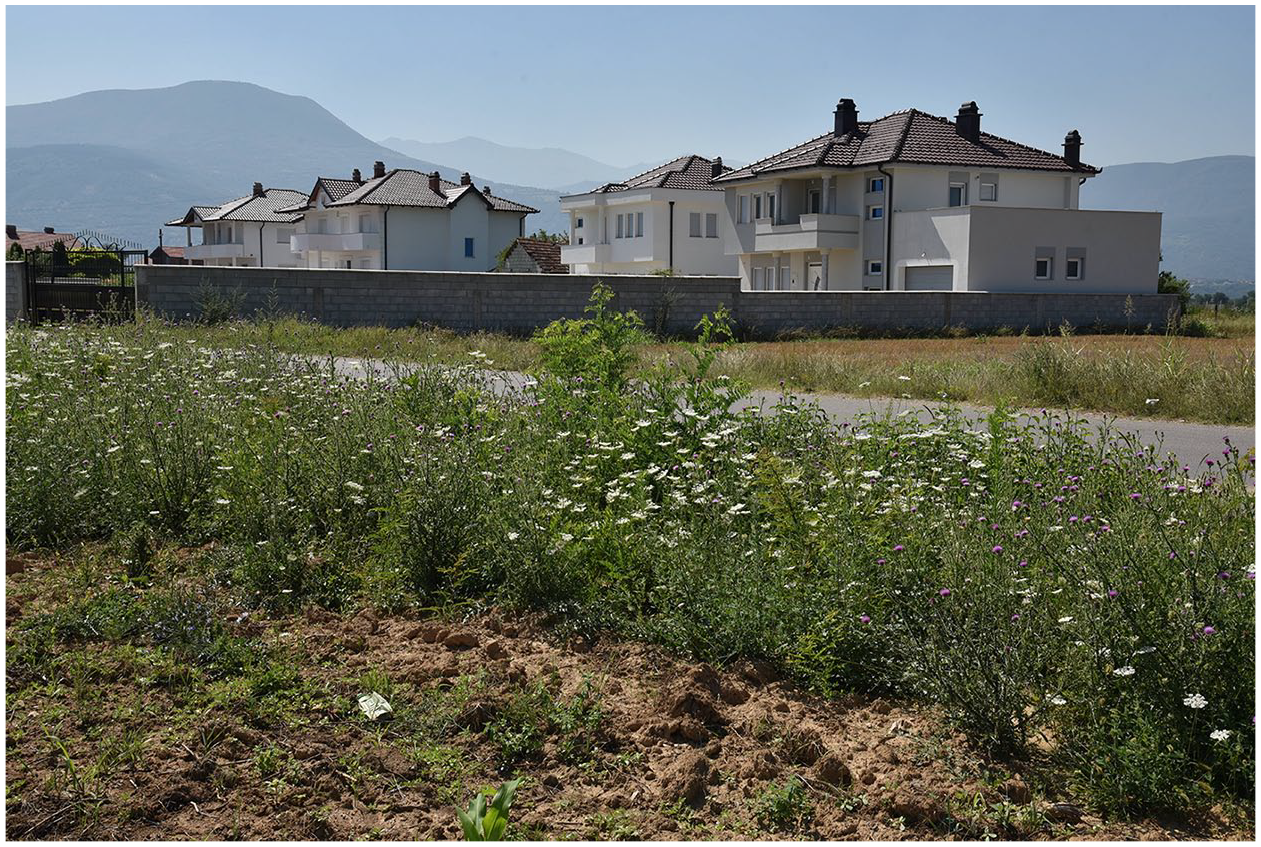
Houses of some of the joint family residences are not necessarily wholly identical, but only similar
Houses Intended to Resolve (Insoluble) Contradictions
Why so much investment in houses, and in making them identical? In his study of Albanian architecture in North Macedonia, Robert Pichler suggests that brother houses, as well as the other big empty houses of those who live and work abroad for years, evoke the idealized “image of home(land)” which is invested with power to reverse the irreversible. As he writes, “the deeply rooted desire for familial reunion . . . does not match the social reality” of the house builders, who have already been living in modern nuclear families for years, all over the world as a result of migration for work. Since people are aware of this discrepancy and of the social impact of emigration, the construction of large houses represents “a compensation for the loss of family co-residence and a reaction to social and political insecurity” and “the visual (architectural) manifestation of this ideal evinces the efforts to undo social and cultural changes, which have already been on the way for some time and are seen as threatening social ideas.” 18
Thus, the house is meant to reverse the change and help the family to adopt a post-modern retraditionalism to counter the pressure of globalization and modernity. As Meyer and Geschiere write in their Dialectics of Flow and Closure of Globalization, empirical evidence shows that people’s awareness of being involved in open-ended global flows seems to trigger a search for fixed orientation points and action frames, as well as determined efforts to affirm old and contract new boundaries. . . In a world characterized by flows, a great deal of energy is devoted to controlling and freezing them.
19
This article examines the effort to control, freeze, and hold back change. I see the construction of brother houses as an attempt by Kosovar families to adapt to and ease four basic social tensions or even direct contradictions: the growing economic inequality within joint families; the absence of house builders, who often live abroad; the growing desire of the brothers and their families for individuation and privacy (as parts of a new life style); and the loosening or disintegration of the joint family household.
Adaptation to the First Contradiction: To Be Equal in a Situation of Inequality
“I had a friend [who] didn’t have money! They had land, but a small house. . . And now one of his brothers built a house with 36 rooms!,” my friend the Kosovar Turk Sami, 60 years old, explains the popularity of brother houses among traditional Albanian families. 20
A house as big as a school! Bigger than the neighbors,’ bigger than his brother’s. These people are dreadfully envious of each other. (. . .) They’re jealous of a brother. My brother’s building a big house, so I want an even bigger house. My brother’s buying a Porsche, I’m buying a Lamborghini!
“And so they build identical houses, to avoid envy,” Sami opines. “Identical brother houses are built so that brothers won’t quarrel,” Ferid offers the same reason. 21 “Because here we have a tradition: for all brothers to have the same,” he is interrupted by his friend Nazim, who lives in a house identical to his brother’s next door. 22 Another of my respondents — Bekim offers a clarification: “then it’s – let’s build identical houses, so no one can say ‘you’ve built a better one than I have.’ That’s how it is: that’s the reason.” 23
Sociologist Nexhat Cocaj, who interviewed 120 owners of such houses, mainly heads of households or eldest brothers, argued that the building of identical houses seeks to preserve harmony and equality in the family. 24 As in joint enterprises and family firms, brothers could occupy very asymmetric positions, but still value harmony. In Kosovo, it is crucial to show “success in maintaining harmony between brothers, which means success in business.” 25 In this case, harmony among brothers can even extend to other (non-family) employees and is projected onto the wider community, says Cocaj.
The ability of brother houses to maintain social harmony in the joint family is also stressed by the Kosovar director Samir Karahoda. 26 His award-winning documentary on the phenomenon is based mainly on potent impressions and images but in our interviews he provided valuable analytic insights. 27 For him, these family residences solve two related problems: inheritance inside families in changing economic conditions, and the long-term migration of owners for work. If sons no longer live together in a traditional joint family household, parents face a dilemma if attempting to divide inheritance. Some brothers are deserving because they work abroad and send huge sums of money to their father, but the others are also deserving because they remain at home to care for the family farm or business, the property, and the parents. The inheritance may also include major assets acquired by the father, if he worked abroad, or land belonging to the joint family, especially if the building boom has greatly increased its market value.
The search for a consensual solution to inheritance involves several steps. The first step, says Karahoda, is taken by daughters and is invisible to the community. Daughters are expected to observe Albanian traditional customary law and renounce the inheritance to which by law they have the same claim as their brothers, since the family believes that they will “come into their own property in the family of their future husband” and “a daughter, when she gets to the husband’s house‚ belongs to them.” Daughters, therefore, “quietly renounce the inheritance.” In the second step, Karahoda continues, “to avoid conflict among the sons, some parents make their own rules” and tell them to build houses for [every brother], but they should be same, they should be equal, there should be the same investment for everyone to be happy. If some [brother] is not here, when he comes back from abroad he can live together [with other brothers] to support each other. Especially when [brothers] become old.
28
Thus, identical houses are built to avoid conflict within the family.
The decision to build identical homes for everyone requires sacrifice, comments Karahoda. “Those who are abroad invest more than those who are here,” while “those who are here in Kosovo, somehow sacrifice themselves to take care of the parents, of the inheritance in general.” 29 The capital value of remittances is balanced by the physical presence and care. “It was quite a brave decision for some sons,” Karahoda concludes. “They don’t care about the money, all they want is to avoid conflict and have solidarity with each other. (. . .) Maybe the whole concept is about more cooperation, more solidarity.” 30 The construction of identical houses is an attempt to maintain harmony in the family, above all between brothers.
The Hidden Casualties of the Project of Harmony among Brothers
Cocaj and Karahoda agree that the construction of identical houses for all brothers is an attempt to maintain harmony inside the family in the face of major socio-economic change, but this “preservation of harmony” has its silent casualties, the sisters who “voluntarily renounce their inheritance” and get no house. “Houses aren’t put up for sisters! A house is built by the man who marries [the woman]. A girl moves in with his family and they look after her,” says farmer Jahir, who is going to provide a house for each of his six sons but not for his three daughters. 31 The situation is similar in neighboring Macedonia or Montenegro. A resigned female economics student from a traditional Macedonian village tells me that “our new and old houses are large, but I won’t inherit anything. My [only] brother will get everything. The expectation is that I shall marry and my husband will provide a house.” 32 I never met a sister who was getting her own house in a Kosovar brother house residence, and heard of just one such case from relatives of one woman. Houses are not built for women, regardless of whether houses are identical or different, built all at once or progressively. Today, women own only 9 percent of all houses and apartments in Kosovo. 33
Law no. 26/2004 allows Kosovar women to inherit, but the Albanian customary law (kannun), which applies to inheritance cases, gives them no share. 34 Thus, in Kosovo there is a “discrepancy between the legal framework (perfectly drafted) and social norms (terribly wrong),” as a paper discussing “the gap between the legal framework and social order” argues. 35 Progressive families try to compensate by investing in their daughters’ education or professional training, but this investment usually represents only a fraction of the real legal claim and does not match the large sums devoted to building brother houses.
According to tradition, a woman is supposed to obtain housing in her husband’s family, but if she divorces, the woman may get nothing from the family of her husband or her own family. It is true that Kosovo’s divorce rate is the lowest in Europe, but law firms and non-governmental organizations report a growing number of divorced women who, finding themselves homeless or without means, sue their brothers or parents for at least part of their inheritance. 36 Thus, the building of identical homes for brothers may seek to secure equality and harmony in the family, but its effects confirm, embody and institutionalize deeply engrained gender stereotypes and inequality between brothers and sisters.
“How We Created a Common Language”
The solidarity and equality of brothers (not of brothers and sisters) is implicit in the building of identical brother houses. Let us look at how that sameness is negotiated.
Brothers can make different investments. Sometimes a brother manages or secures knowledge and know-how for the family firm and contributes the most to the creation of wealth; at other times, one or more brothers work abroad and send money back to the joint family purse. Before they plan the construction of the houses, they must “create a common language,” says small businessman Nazim, who built identical houses for himself and his brother. “The brothers get together, ‘we want such and such a plan, let’s do it this way, brothers’. . . And that’s how they do it, in unison!” 37 Like many others, Nazim insists that for houses to be truly the same, they must be identical not only in appearance but also in the quality of the building work. This means that they cannot be built one after the other. “All at once—we laid all the foundations, all the first floors, and so on, all at once,” says Haki, who built with his three brothers. 38 The same approach was applied to roofs, plastering, and all finishing works inside the houses.
The identical houses are erected on the same site, and are of the same quality, but inevitably they differ a little, in the location on the building site or by a mirror reversal of the basic plan of the house (Figure 4). To secure equality during construction, there is no prior decision on which house will belong to which brother. Houses are referred to by numbers. “Take the material to Four and go and get the tools in One!,” they shout on the site. And once houses are complete, they draw lots, as traditionally they once drew lots for the fair divisions of (inherited) fields. Nazim explains: We draw lots! We write down the number of a house – 1, 2, 3, 4, 5. . .on pieces of paper, and fold up the pieces so the numbers can’t be seen. If there are five brothers, then five pieces of paper are folded up. . ..and then the lots are drawn!
39
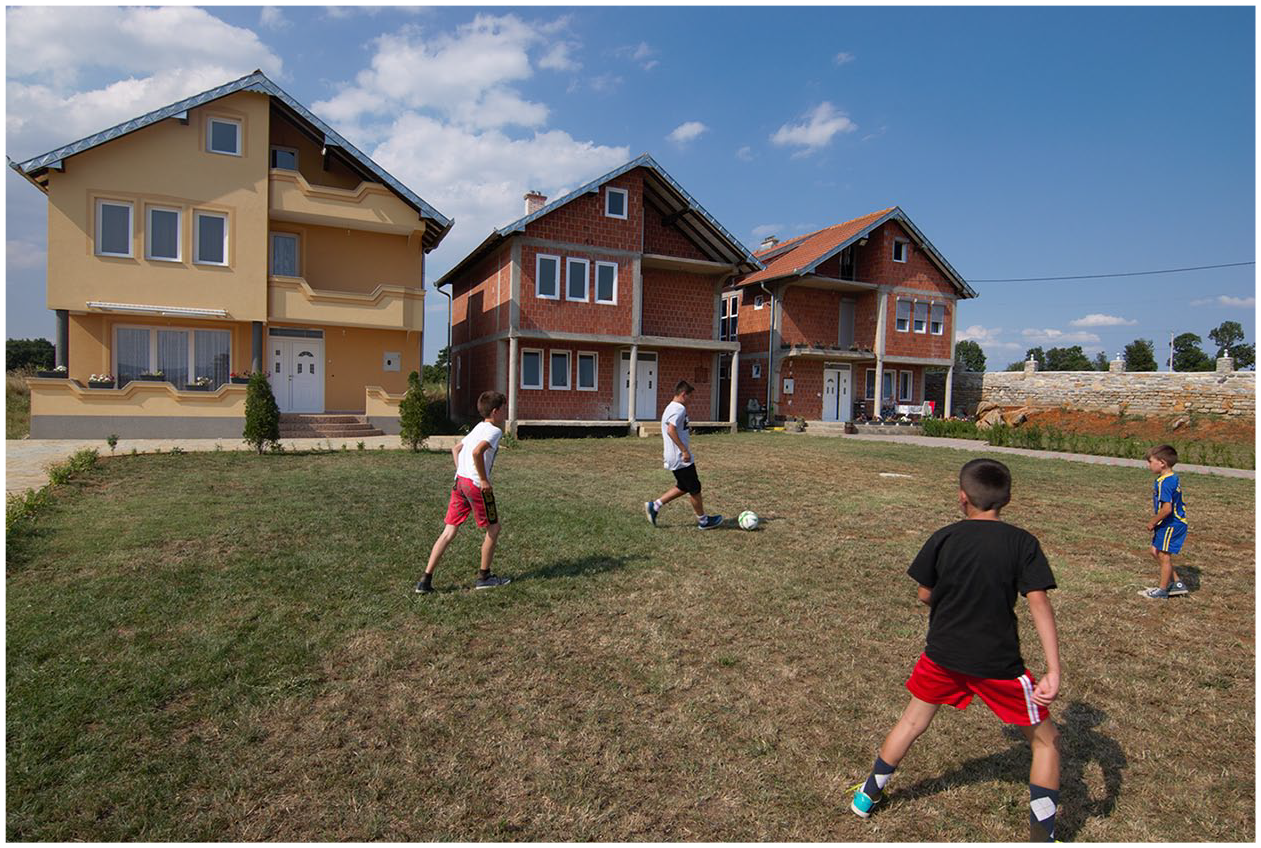
However, even “exactly the same” houses can differ just by the way they are mirror turned to each other (already on the plans—in the computer), just by their location on the plot or their level of completion
This effort to ensure complete fairness can even extend to the order in which the brothers draw lots. “First the youngest brother draws, then the next youngest. . .finally the oldest,” Nazim says. 40 House builders believe that the chances of getting a good house are greater for those who draw first (although this is a common statistical illusion). On the basis of this belief, the order aims at balancing out the age-power differences among brothers. It starts with the youngest, who has the least standing, and can be bossed around by all others, and ends with the eldest, most powerful brother and the head of the family.
The importance of insistence on the identical character of the houses is only highlighted by the problems that arise when, despite the best efforts, the houses ultimately differ (for example, because of a need for rational use of the site). When the experienced professional builders Haki and his three brothers constructed their “identical” four houses, the narrowness of the land parcel meant that two bigger houses stood comfortably “in the middle” and two smaller ones lined up wall to wall, looking into the courtyard and to the north. Haki, the head of the family firm, tells me that they built together from shared resources so that everyone would have the same, but “in such a way as to use the site from one end to the end.” The style, color, and number of rooms were the same, but the houses differed not only in their position in the lot but also in their size. If houses are not quite alike, there is more at stake in the lottery. “Isn’t it a problem that each of the houses is a little bit different?,” I ask Haki, who as the eldest brother, organized construction. “No. When we finished our four houses we drew lots,” he recalls.
Four houses—four little pieces of paper. Mum wrote the numbers [. . .] So 1, 2, 3, 4. . .! My youngest brother drew 3 [the smaller house up against mine]. And I wrote it down in the book—“this house is yours.” My second [youngest] brother drew 1, that one there [the biggest, the nearest the street]. My third brother here [the second larger house] in the middle of the site. And 4 [on the edge!] was left for me. . .Simply left. . . A left over!
41
There is definite bitterness in his voice and face.
Haki’s house is smaller, north-facing, and situated awkwardly in a corner of the site. 42 “Yes, these two houses (standing in the sunny center of the courtyard) are bigger, but we simply didn’t have so much space,” Haki explains, and he sighs before continuing, in a more optimistic tone: “but it’s not a problem! Each house has two salons [sitting rooms] downstairs, and three [bedrooms] upstairs. I also have two salons, and another [very small] to the side,” Haki gestures irritably to a permanently closed door. “It’s not a problem. We. Are. Brothers! One has more, another less, it’s not important,” he proclaims solidarity partly to convince himself. However, a moment later he adds, “but all of it was my work! It was me who got it all done! My brothers just obeyed me and did [what I told them to do] on the site.” 43 It had always worked that way in their family firm, which Haki, as the oldest brother, had run since the death of their father. That was how they built for clients, based on contracts he agreed, plans he drew up, and budgets he estimated. If they had put up the usual row of completely identical houses on the plot, the atmosphere in the family would definitely have been better.
The building of identical brother houses means that brothers often join from positions of considerable inequality, and this only makes them all try the harder for perfect similarity. Because when houses are just a little bit different, problems start. Perfectly identical houses are seen as chances for perfect justice.
Adaptation to the Second Contradiction: Instead of a Joint Family of Brothers—A Family of Houses
Passers-by admire the unified row of identical houses symbolizing fraternal concord, but let us not be carried away by all this outwardly declared harmony. Behind the facade of a well-executed project there are plenty of tensions. In fact, it is these tensions that are the driving force behind the whole project.
Like Haki, Nazim also has his grievances although the houses he built with his brother are entirely identical, externally and internally. Until recently, he and his younger brother jointly owned a small firm in Rahovec. He, like Haki, talks about the activities of the joint firm and the construction of the joint houses in the first-person singular, not plural. It is all “I was warning,” “I decided,” “I built”. . . 44
To listen to Nazim, one realizes that the sameness of the brother houses is just the first step to something else, not family consolidation but joint family household fission (partition): “Is your brother’s house the same as yours?,” I ask him. “My brother has the same, precisely the same [house]! (. . .) the same colors [outside]. Inside—the same tiles, walls, the same furniture, including the TV: everything—the same!,” Nazim declares proudly. “If I drop by at your brother’s place and yours, I won’t be able to tell which house is whose?,” I ask. “No! The same,” Nazim insists, but adds, “Now that we’ve separated, he can do [to the house] what he likes, but while we were together, he had to be the same.” In his case, as in many others, the building of identical brother houses was a step toward the split up of the joint family household (ndarja), as Albanian traditional customary law knows it.
We brothers have separated. While we were together, we had our money together. Now we’ve separated, he has his money, he works for his children, I work for my children. My wife can cook what I like eating, my taste, and his wife what he wants (. . .) Inside the houses we’ve done it to the same plan, the same fittings. . .later—if you like—you can change it. You can just do it, once you’ve separated! Until you separate you have everything the same, says Nazim.
“Brothers separate from each other as soon as they finish the houses?,” I ask. “No.” It is more complicated. “The day will come, we call it kismet. When kismet comes from Allah, then [we separate],” Nazim suggests. 45
Nazim’s case is typical. The brothers and their families continue to live together in a joint family household, as many rural families did until recently. Their sisters renounce their shares, the brothers divide the inheritance, and the parents remain with the youngest brother. The construction of brother houses shows the disintegration of the joint family household into nuclear households. “We must live together until we build houses to go our own ways. When everyone has his own house, then we will not want anything from one another,” the 70-year-old patriarch of joint family Izet sums up his family’s predicament. 46 The construction of houses is (usually) a key step toward family disintegration.
There was once a traditional sequence and order in household fission (ndarja) and the splitting process (damja), and both could vary across Albanian regions. 47 My research suggests that household fission and the building of brother houses are closely connected in no single sequential pattern: some brothers separate before the construction of identical houses and their move into separate houses is just a natural culmination of the process. Others, like Haki, start to separate during construction and “that very much speeds up the building” of the houses. Others, like Nazim, separate after the completion of the houses. And some other brothers live in their own identical houses but budget together, the head of the joint family assigns a monthly allowance to each of the brothers’ families who “definitely reckon with separation” in the future. Because (as with Jusuf’s family) identical brother houses often take years to build, the separation of brothers from the joint family may be slow and complicated. Finally, in some cases of very traditional joint families identical houses are completed, the brothers move into them, and continue to have a joint family budget, although each family cooks for itself.
Until recently, some brothers (mainly in rural areas) continued to live together in the traditional joint family household. Traditional fission occurred in an unending cycle: when over generations a joint family household became too large and had swollen to the point where tensions predominated, it divided into nuclear families and the cycle could begin again. 48 In the current economic and political conditions, however, the cycle is not restarting. The locals do not usually admit this. Owners boast of the unity expressed by the monumental row of identical houses. Cocaj speaks about efforts to maintain harmony within the family and Karahoda about the attempt to divide inheritance fairly and to live in family concord. 49 Yet, what really happens is not so much an attempt at consolidating relations between brothers, as an effort to moderate and negotiate the irreversible division of the joint family household into modern nuclear families corresponding to a new western lifestyle. Even in traditionalist Kosovar settlements, the joint family household is rapidly vanishing. 50 In 1986, the average household in Kosovo had eight members, and the size of the average Albanian rural household was in two digits. Since then, it has fallen steeply. In 2008, it included only 4.9 members per family, slowly approaching the household averages in other post-Yugoslav republics. The tradition of the last extended family in Europe has been dissapearing before our eyes. 51
The impressive rows of identical brother houses show not the growing power but the crisis of the joint family and its household. Because “united brothers don’t split from each other!,” as Ferid and others say. 52 “Divided brothers—united houses” is anthropologist Violeta Schubert’s take on ethnic Macedonian cases, when after the split of the joint family household brothers outwardly declare their unity by building semi-detached houses with two independent entrances (or a detached house for each brother but lined up neatly on a joint building plot) when in practice each one of them is already living separately. 53 Throughout the region, houses are built to declare that brothers are still together, are united, and their solidarity-based economic and political power is visibly expressed in material form more than ever before. But the opposite is true: they already lead separate lives, each in pursuit of his own goals and according to his own tastes. The houses are intended to represent and performatively create a unity that is compromised, disputed, threatened, and frequently imagined since brothers are often living abroad, distant, and absent. Instead of the joint family of brothers we see a joint family of houses. The gravitational pull of family unity and concord is converted into the materiality of bricks and concrete, a house as a non-human actor meant to ease tensions that people cannot resolve themselves.
Adaptation to the Third Contradiction: Present Even When Living Abroad
“There are four brothers: one is in Kosovo and three are abroad. And now, let’s all have the same houses! Each brother, the same! Everyone can go his own way forever, as he wants,” says Nazim. 54 He continues: “but the fatherland is the fatherland, look around you, mountains everywhere . . .! They’ve built houses in the middle of the cliffs and stones! You see those steep stony roads?! They draw you back to your place. If you are born here, it draws you back to the cliffs and stones!” Like Nazim, many of my respondents, when explaining the reasons for building brother houses, move from compensation of inequality between brothers straight to the topic of nostalgia for the homeland among long-term migrants for work. All of those who live abroad are “building the same houses for brothers! . . . Three, four, five houses: they build as many houses as there are brothers,” notes a Kosovar urban Turk Sami, who observes this custom from a distance. 55 “When there are four or five brothers, one of them [usually the youngest] must stay at home with the parents to guard the family and the houses. They don’t all go. The brothers who are abroad are obliged to send 200, 300 euros to the one who stays.” The result is chronic emptiness: “look around, there’s nobody here. Right now nobody’s living here!,” the well-dressed Bekim is showing me around in a suburb of Prizren, walking me along a row of similar houses that belong to him and his three brothers; beyond these are the semidetached homes of his two sons. As he names the countries where each of them has gone, he speaks of the empty houses as if they embody their owners. 56
Absence and emptiness. Instead of the real brothers and their families—houses (Figure 5). This is also a central motif of the documentary In Between by Karahoda. He tells me that most of these [brother] houses are empty and only the parents living there with the youngest son (. . .) Always when I go to those villages during the winter (. . .) You don’t see anyone. . . You have that fear inside, because it’s so silent, you hear only barking dogs. Somehow you feel the loneliness, the fear that something has happened here. . . or is going to happen.
57
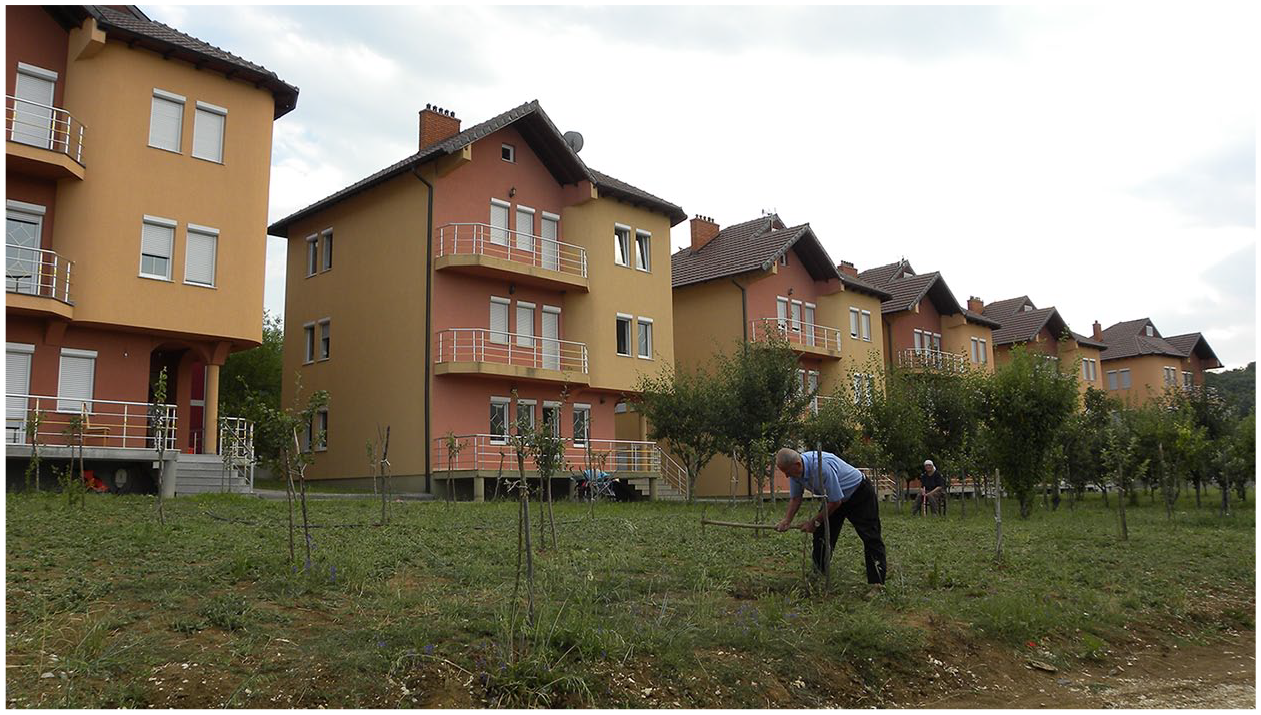
Although some of the brothers live long-term abroad and their houses remain with the blinds down, and part of their own business here in Kosovo, “the fundamental thing is for everyone to have the same”
The identical brother houses are often even emptier than the hundreds of thousands of empty remittance houses in Kosovo, as Karahoda and my research experience confirm. “They are living alone in huge buildings. And all they do is wait for holidays [when the children come from abroad]. Or for their phones to ring. . . Just to talk to someone!” says Krahoda.
According to Kaharoda, he had a hard time thinking of a title for his documentary on the brother houses.
What inspired me was a discussion with a family of migrants who came to Kosovo: One of them told me “our thoughts are always in Kosovo, but we live in Europe.” Whenever I asked questions, they were like: “I think about coming [to Kosovo], but I don’t know if I will come”; “I would like to come, but I don’t know if I can come”; “I would really like to come back and live here, but. . .,”
says Karahoda to explain why he chose the title In Between.
Like living between two countries. Somehow these people are in the middle! They can’t decide, the conditions don’t let them. They are “in between” here and there, two worlds (. . .) And their parents, trying to divide the property fairly among sons with identical houses, are also between their children. (. . .) So I used this metaphor of “keeping the balance.” Because you should be in balance with everyone. You should be “in between.”
58
In addition to the balancing act between inheritance-seeking brothers, we have a balancing act between actual work and life abroad (here) and the past and potential future in Kosovo (there). The tendency is to fall on one side because real physical presence and economic activity are in the West even if often accompanied by a feeling of deracination and alienation, while the family, local roots, nostalgic memories, and uncertain dreams of a future return are all non-material, almost imaginary. The construction of houses provides a counterweight in favor of the Kosovo side. As the disparity between the West and Kosovo is so great, the larger the house the better. And if a group of identical houses symbolizes bonds to the place and the joint family, even better! The houses imbue place and family with economic reality and embodied future (not misty memories of the past or dreams of the future) and can strengthen the bond with the extended family scattered for work across the world. These houses bridge the unbridgeable. People “want to be connected with bricks,” Karahoda says. They feel connected when saying “I have a home in my homeland.” 59
As noted earlier, Pichler speaks of the ostentatious houses of Albanian migrants as the “image of the home(land),” and together with Carolin Leutloff-Grandits writes that “houses become symbols for the longing for home, an incarnation of those who are absent but still part of the community, as well as symbol of success abroad that transcends into status ‘at home.’” 60 Other authors working in other parts of the world that are living off remittances notice the ability of remittance houses to represent their absent owner. 61 Paolo Boccagni and Marta Erdal discuss the ability of remittance houses “to affect day-to-day life in absentia,” while Dimitris Dalakoglou speaks of remittance houses in post-communist Albania as a “proxy presence for migrants in their community of origin.” 62 Some parents of migrant workers even believe that such houses can bring their children, who have lived for decades abroad, back to the fatherland. As Karahoda stated, “their fathers build the (identical) houses just as a reason for their sons to come back. ‘I am investing, this is your land, this is your place, one day you should come back!’” 63
Remittance houses can become major social players that reverse the apparently unavoidable reality and bridge the unbridgeable. This is particularly true of the joint family residences of identical brother houses, because they are an anchorage both in the joint family and in the homeland.
Adaptation to the Fourth Contradiction: Remaining Together, yet Separate
Although they are the pride of joint families, brother houses are controversial projects, especially for the young urban generation and those who have lived abroad for extended periods of time. First, the construction of large remittance houses in general is often criticized: “they pay 100,000, 200,000 or 300,000 euro for a house! That’s wasted investment! They’re throwing away cash needlessly,” says migrant worker Selim, who rents a nice flat in Italy. 64 He talks about houses built at home by people living abroad, and his dining companions nod. I often hear murmurs that these huge investments exhaust resources that could fund housing, education, or business abroad.
Second, brother houses are also criticized specifically: people build identical houses because it’s a tradition. For fathers, it’s a tradition—living together, common budget, common everything. But it’s different for children! They no longer need it that way. They would happily rent a place of their own, maybe just an (ordinary) apartment and get away!
says a 30-year-old Albanian. 65 The main point is that brother homes deny individuality. Jakov, a freshly university graduate and a member of the local educated non-Albanian elite, finds the construction of identical houses for brothers “a bit silly,” reactionary and immoral, getting in the way of individual development, because “it’s something like ‘I don’t want my brother to have something better than me! Let everyone have the same!’” 66
As not only cash but also cultural practices are imported from Western Europe, differences have increased within Kosovar families. It is not rare to see some families where a brother has remained at home with the parents to farm, another two have left to work abroad, and a fourth has gone to university and now works in Kosovo as a teacher or an official. Just a few years ago, brothers were sleeping in a shared room and eating from a shared bowl, but the situation has changed dramatically. Never in Kosovo’s history have brothers been so far apart economically and culturally. Differences also divide their wives, whom they have brought into the joint family, and adolescent children, although neither are mentioned in connection with the construction of extended family residences.
Brothers want the joint family residence to make a monumental impression, to be striking and memorable among the new houses, but they also want “a house like in Germany,” that is an individual house for the nuclear family. Thus, instead of one monumental house they build an even more monumental row of smaller and more private houses. This is a compromise and a practical solution: “each has his own, everything in one place and in the evening everyone [meets] together!,” as Haki says of his own fraternal four-house residence. 67 The identical brother houses are an attempt to overcome contradictions and find a balance between the joint family and the private individual. Like every compromise, for some it is too much and for others it is too little. Let examine these two ends of the spectrum to see how social pressures and counter-pressures impact identical houses.
For some it is too much: houses are complete and furnished, but uninhabited because the brothers did not leave their parents’ joint house. They would live a few meters apart without the constant chats, laughter, company, involvement, and empathy. Albanian builder Mr. R. constructed three identical houses with his two brothers, but continues to live with his parents more than a year after his new luxury house was completed and furnished. 68 His new house is primarily a symbol of his wealth and status. Karahoda offers another example of four brothers who work in Iceland. They built four identical houses but when they come “home” for vacation, they “stay only in one house all day. At night they go to sleep in their own houses but then stay together just to have fun. (. . .) It’s like they are having a party every day.” 69 The moving out takes years, if it is ever completed. What keeps brothers in the parents’ old house is family community.
But for others it is too little: they need more space for their individuation and privacy. When they leave the joint family house, they would like to go further than moving into boring identical brother houses. They exercise pressure for a compromise: the family has already agreed to build identical brother houses, and building might have already begun, but the project feels not individual enough. Even if the basic plan must be the same, they want “their own, simply different” house, adapted to their individual needs, different from all others at least in the layout of rooms, color, or details of facades and balconies. They often demand only small changes, but even those undermine the project as a monument to the joint family’s strength, success, harmony, and equality.
Apart from dissatisfied brothers, we can hear the voices of women married into the family, whose passivity and silent assent is assumed as a condition for family harmony and equality among brothers. I was unable to interview women from traditionalist families, but their subversive voices are sometimes so strong that their menfolk comment on them. For example, the patriarch Izet has three sons. The son working in Switzerland paid 70 percent of the costs for the construction of three identical brother homes. While Izet believes that the completed shells of the three houses allow for a fair division of assets among sons, he also feels a strong subversive pressure for individuation in the outer facade and inside layout coming from his daughters-in-law. And the sons are giving in: “she speaks to her husband and he comes and says, ‘I like it like this!’ But I know that someone’s pushing him from behind,” Izet complains. His sons prioritize their wives over their brothers and joint family because “they love their wives more than their brothers,” as Izet laments. 70
The lives of hundreds of thousands of migrant workers connect Kosovo to Western city culture. As a result, Kosovo is undergoing unprecedented cultural change, but the patriarchal traditionalist Izet stereotypically sees women as the hidden force behind the cultural changes he rejects. The joint family household is being undermined by individuation and privacy, but his only explanation is “every woman would like to have everything just for herself. Just as she wants it.” This is a whole new selfish lifestyle, the outraged Izet laments.
We [parents and sons] want to continue in [the traditional] joint family household, but women don’t like it! (. . .) Young women these days want to live just with their husband and don’t want to work on the whole (joint) large building, where there are more people and more work. Maybe she has just one daughter! And she goes out to eat [and does nothing at home]; but in the big house there’s a lot of people to take care of and a lot of work needed.
71
Izet’s lament is not unusual. Traditional gender roles are changing, as is the close relationship between spouses, at the expense of the relationship among brothers and brothers and parents. The “transformation of the husband-wife relationship in the direction of equality and parity,” “the formation of a nuclear family instead of the extended family,” and “the diminution in the number of children” are the three levels of the disintegration of the traditional joint family throughout the former Yugoslavia, say Sergej Flere and Rudi Klanjšek. 72
Hand in hand with this new emphasis on husband-wife relations and the new lifestyle is a new concern for the privacy of family members. The room layout in identical brother houses, which follows Western European suburban models (a sitting room and kitchen on the ground floor and private bedrooms upstairs; Figure 6A and B), encourages this change. The level of privacy that separate houses allow today is surprising (Figure 7). I expected that even the joint families divided into nuclear households would have lively everyday exchanges, family members would be in and out of each other’s houses, and departure from the family house (including collective cooking and dining) would not change the frequency and intensity of social relations. Yet I found that some families living in identical houses next to each other only visited each other a few times a year on the most important feast days, although the brothers would meet daily on the terrace in front of the house, at a plastic table in the garden, in a garage designed for informal extended family gatherings (Figure 6 C), or even in a café nearby. Generally, the wives and children circulate more often and children spend a lot of time together (Figure 4). “It’s not a problem that we’ve split up (. . .) in the family we function as one and like another [independent] state,” Haki commented on the newly established privacy policy in separate houses. 73
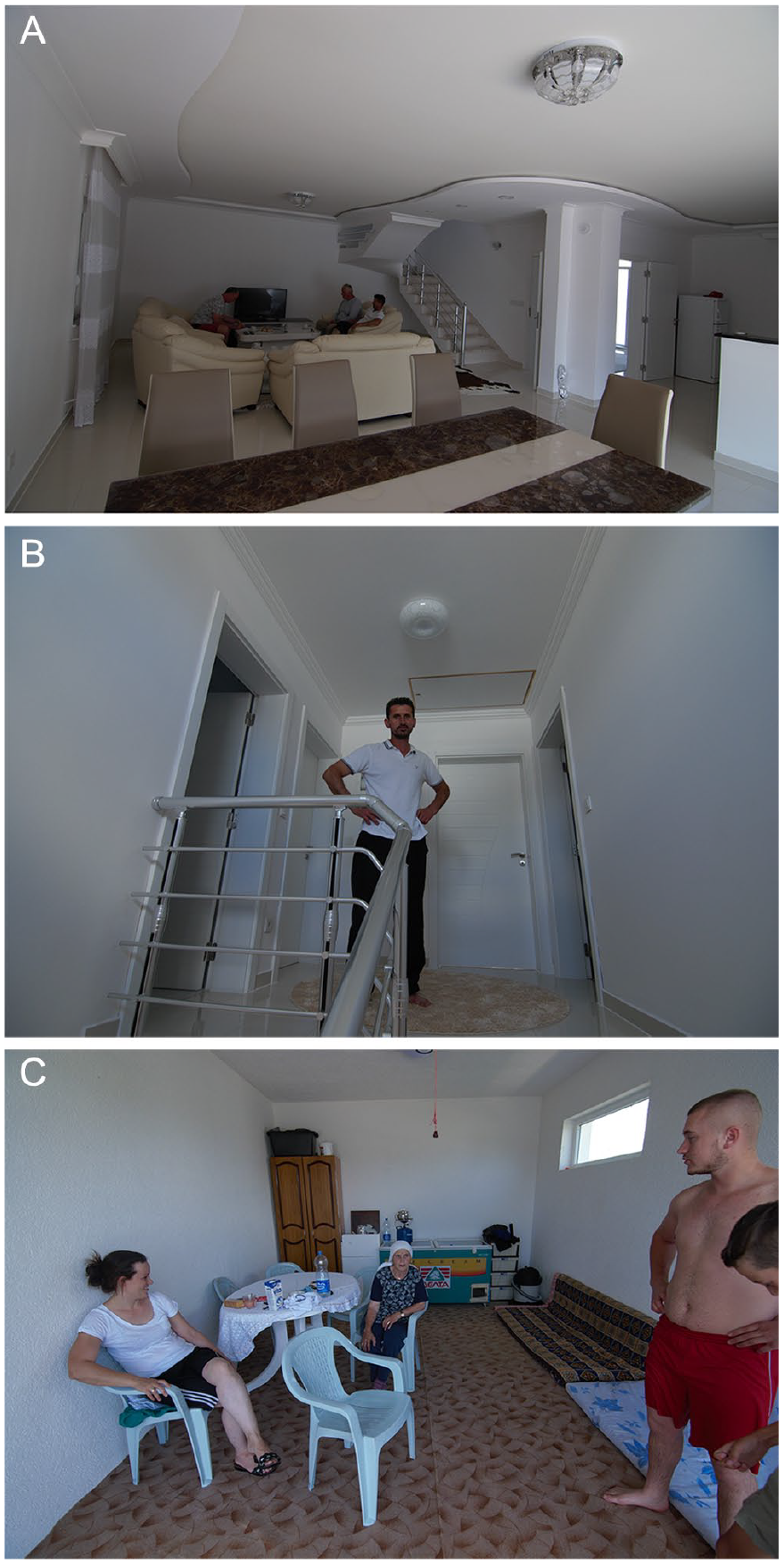
Three entirely identical houses built to plans imported from Germany foreshadow the trends of the western nuclear family—downstairs a living room and kitchen, upstairs a bedroom and two children’s rooms
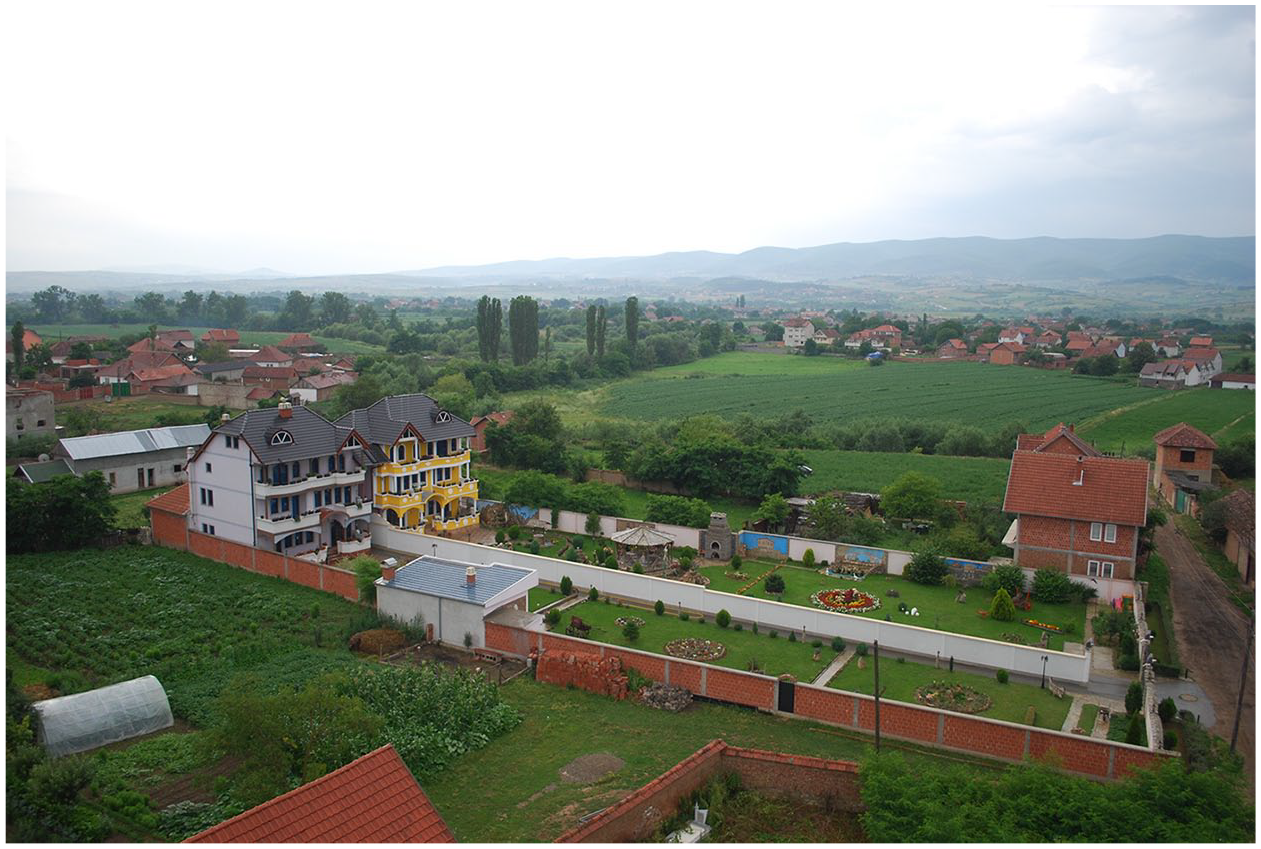
Identical houses next to each other enable the brothers’ families to stay together, but each in its own place
Critics of identical brother houses like Jakov above speak of silly uniformity—enforced by parents and envy between brothers—inhibited individuation and development. The houses sideline not only the sisters, who must renounce their share of inheritance, but also the wives married into the family, whose individual preferences and taste may be ignored. As Izet’s protests suggest, their voices only begin to be heard as the grandiose architectural project starts to crumble in its builders’ hands. At the same time, the construction of brother houses may be the brothers’ only possible way to leave the joint family household without bitterness and conflict to forge their own autonomous lives. These houses can help them transition from the joint family household to the nuclear household; they are a temporary stop on the way to a modern lifestyle. The way out of the traditional joint family relies on equal shares. Rather paradoxically, the uniformity of the identical houses is the gateway to modernity, independence and individuation so desired in Kosovo today.
Discussion and Conclusion
The Kosovar family and society have been undergoing massive changes that generate many tensions and intractable contradictions. This article discusses the construction of identical buildings for brothers as a social-architectural technology used by Kosovar joint families to reduce tensions. Brothers who live far from each other and have widely different income levels, taste and demands for privacy and individuation come together for the construction of identical homes. Homes that, in Karahoda’s words, “unite divided joint families at least by bricks.” 74
These processes, which at first sight seem to preserve the harmony and unity of the traditional joint family, actually lead to its transformation, anticipating its end. 75 In the past, joint family households grew, enlarged, and then again divided into nuclear households, but this cycle has recently been stopped by the economic and cultural tensions of modernization. The technology of brother houses is thus giving the Kosovar joint families a route for a seemingly painless break-up which does not seem final. This is a chance, as Haki said, for “everyone to have his own life, everything to be in one place and in the evening we’re all together!,” although the nuclear families will “function like independent states.” 76 It represents a hope, or perhaps just an illusion, that when the community of people disintegrates at least the highly visible monumental community of their houses remains.
The security that Kosovo has achieved since the end of the war has rendered null the advantages of life in a joint family household and opened the door to the fission of even traditional joint families. Thus, the identical brother houses are a tool of a separation that need not be experienced as separation. Perhaps that is the reason why the houses are so popular today. In 2020, at least 61 percent of the fathers or eldest brothers who head joint families are “very happy” with this model, and 28 percent others are “satisfied” (the survey included no women, younger brothers, or children). 77
Only time will tell what will happen to the brother house phenomenon. The future of the often empty identical houses, waiting for their distant owners to return, depends on the future of European migration policy, integration of migrants in host countries and globalization. Will future generations of brothers want to build identical houses? The extent to which the next generation will want to remain part of the joint family, and be “connected by bricks,” is hard to foresee, but the brothers who already built identical houses were born during the 1970s, the 1980s and the early 1990s, when natality rates were high, especially in rural areas. Birth rates have dropped ever since, from an average of 5.5 children per woman in 1970, to 3.6 in 1990, and 1.5 in 2020. 78 Houses are not built for daughters, and youngest sons may not need a house because they stay in the parents’ house. Thus, even if sons will continue to want to build identical houses in a row, they may not have enough brothers with whom to do so. One house doesn’t make a row. Unless brothers build houses for sisters or male cousins who grew up in neighboring houses, as Jusuf’s family planned to do, the ostentatious joint family residences will disappear. The identical brother houses already built will become monuments, mementos of a difficult transformation brought about by the economic change and political emancipation of the Albanian rural population, and of people’s attampts to bridge the contradictions of their epoch.
The identical brother houses as distinctive non-human actors and a social architectural technology are driven by the desire to mediate and ease great social contradictions. We must ask, however, if the hopes invested in them by their owners are too great. Can a house—by the power of architecture—solve problems unsatisfactorily addressed by societies and local and supranational institutions? Neither traditional customary law, nor modern law in Kosovo has created a safe environment for the family enterprise or functional legal inheritance procedures for joint family property. Can a house do it? Can a house representing an absent owner working in distant countries square circles with which local and national development policies, global migration policies and EU employment law struggle in vain? Is it in the power of a house—standing as a “monument to attempts to maintain roots”—to achieve what neither the ideologies of modernity nor nationalism have achieved, that is, to reconcile the mobility of global capitalism and transnlocal life with the alienation and deracination that so frequently accompany modernity?
Footnotes
Funding
This study is a result of the research funded by the Czech Science Foundation as a standard project GAČR No. 20-28848S—A Big House as a Traditional Response to the Challenges of Modernity: Tensions and Paradoxes of the Villas of Ethnic Minorities in the Western Balkans.
