




Abstract
This article asks if the measures of human capital, ethnic diversity, and gender equality from 1930 explain current levels of human capital in Romania, while also assessing the role of macro-regional differences in the manifestation of historical legacies. We focus on human capital, measured by educational attainment and by conscientiousness, a personality trait we estimate with a behavioral measure. The analysis is based on a recent large-scale national survey from 2019–20 and census data from 1930. We find that contemporary human capital levels are influenced by a combination of factors, including historical human capital levels, ethnic diversity, and gender equality. Additionally, we show that the long-term impact of these factors can vary by region. Specifically, our study identifies four distinct long-term effects within the historical region of Transylvania and two in the rest of the country. In Transylvania, the present educational attainment is shaped by both the 1930 literacy rate and gender equality, while in the other regions, only the literacy rate exerts a statistically significant influence. Similarly, when it comes to current levels of conscientiousness, Transylvania’s levels are affected by both the 1930 literacy rate and ethnolinguistic fractionalization, whereas in the rest of the country, only ethnolinguistic fractionalization has a statistically significant impact.
Keywords
Introduction
Long historical trajectories have been found to play significant roles in shaping current levels of democracy and development. In recent years, analyses of such mechanisms received more attention while producing strong evidence on the transmission of historical human capital long beyond the life of the regimes, institutions, and policies that gave birth to them. 1 At the same time, research on the effects of communist rule on the conveyance of human capital produced contradictory results. On the one hand, Darden and Grzymala-Busse and Pop-Eleches and Tucker found strong positive links between pre- and post-communist levels of human capital. 2 On the other hand, different studies highlight the important mediating role of additional factors, such as regional party membership, whose impact alters the enduring effect of pre-communist literacy. 3
Our study aims to contribute to this debate by evaluating the links between pre-communist regional attributes and current levels of human capital in Romania. More specifically, we are asking if the measures of human capital, ethnic diversity, and gender equality from 1930 predict current levels of human capital, while also assessing the role of macro-regional differences in the manifestation of historical legacies.
One novel contribution of our investigation is that human capital is assessed at the individual level by considering two categories of aspects: educational attainment and conscientiousness—one of the dimensions of the Big Five and HEXACO models of personality structure—as a key measure of human capital. Conscientiousness stands for people’s inclination to act responsibly and to invest a great deal of effort in their tasks and, accordingly, is found to be related to various measures of educational and job-related success. 4 Another novel contribution is that conscientiousness is assessed by a behavioral measure, namely careless responding in questionnaires (CR). As a result, our study aims to contribute to the new field of geographical psychology focused on explaining personality traits by geographical differences.
Our analyses are confined to Romania, but the questions we ask are highly relevant in the Eastern European context, particularly for countries that include highly dissimilar regions with regard to pre-communist levels of modernity and development. The structure of this article is as follows: First, we introduce the concept of human capital—its meanings and empirical measurement—while also discussing human capital in relation to non-cognitive skills, conscientiousness in particular. We proceed by reviewing part of the recent literature that documents the enduring effects of human capital in the past on a range of current aspects of development and, in line with the existing research, acknowledge the contribution that ethnic diversity and gender equality make to human capital. The following section shifts the focus to Romania, outlining the historically developed inter-regional discrepancies and human capital transformations under Romania’s successive political regimes. The empirical analyses are based on census data from 1930 and a recent national survey from 2019–20. As the data reflect a multi-level structure, we employ a multi-level modelling approach. The causal structure that we assess is represented in Figure 1. The model also considers several control variables, including gender, age, ethnicity, and type of locality.
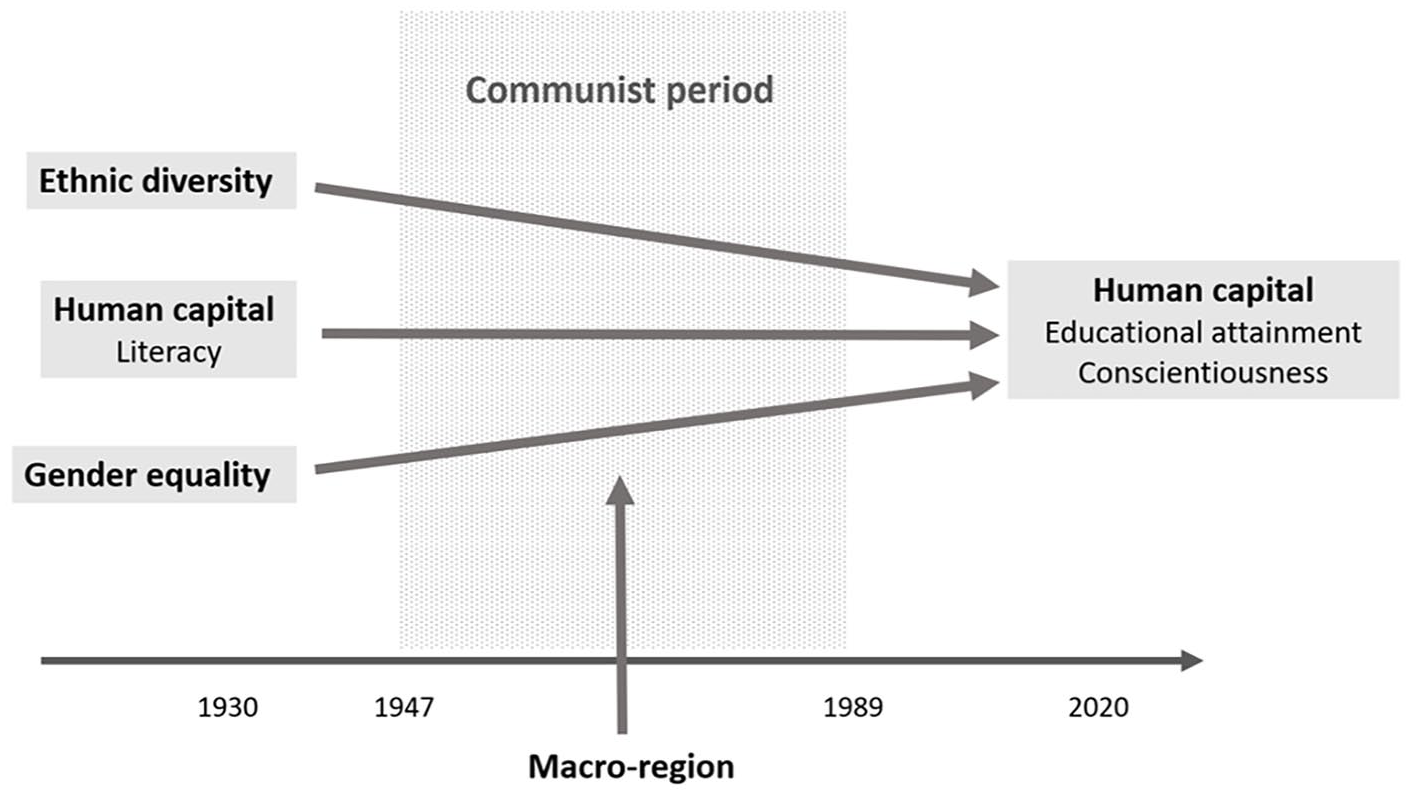
The Conceptual Framework Explaining Two Components of Human Capital, Educational Attainment, and Conscientiousness
We conclude with a discussion of the limitations of our study and the implications of the findings.
Historical Legacies and Human Capital
Human capital is an essentially economic idea, with early mentions going as far back as Adam Smith, in whose treatment of capital “the acquired and useful abilities of all the inhabitants or members of the society” were given great significance. 5 As the concept of human capital gained widespread visibility in the second half of the twentieth century, the decisive importance of investing in education for human capital development was brought to the fore. 6 While being a form of capital, the specificity of human capital lies in it being intrinsically linked to its holder, for “you cannot separate a person from his or her knowledge, skills, health or values.” 7 The importance of human capital is typically ascertained in relation to its positive economic outcomes for individuals, organizations, or societies as a whole, although broader conceptualizations encapsulate non-market returns of human capital investments related to health and to the overall quality of life. 8
The centrality of education in treating human capital is related to the development of skills and knowledge that schooling provides for individuals and that are subsequently used in their (primarily, but not exclusively) economic activity. In that view, education-related indicators are habitually used as proxy measures of human capital at both individual and aggregate levels. Despite the frequency of use, this measurement approach is criticized for its heavy focus on aspects of quantity, which leads to overlooking the role that quality of education has in the development of knowledge and skills. 9 A related observation is that formal schooling is not the only route for skills development, as learning is not confined to the duration of school-based instruction, being instead a life-long process enabled by a multitude of training contexts that are not always formal in nature. 10 The incomplete coverage that education-based indicators ensure for capturing the stock of human capital is further addressed by approaches that—while acknowledging the immense contribution of education in fostering cognitive skills—underline the critical input of individuals’ non-cognitive/soft skills in generating favorable professional outcomes. 11
Conscientiousness, a Key Aspect of Human Capital
Recent developments in research on human capital point toward a growing acceptance of the explanatory potential of non-cognitive skills for analyzing various measures of educational achievement and success in the labor market. 12 A review of current literature in the field confirms the value—as relevant predictors for attainment—of non-cognitive skills, which prove to have similar or better explanatory power than the customarily employed cognitive attributes. 13 Furthermore, the Big Five personality traits and general cognitive ability have been found to be interrelated. 14 Among the personality traits, we are interested in conscientiousness, described as “the tendency to be organized, responsible, and hardworking.” 15
Evidence from previous research suggests that “conscientious individuals fare better on several important life outcomes.” 16 Along these lines, conscientiousness is found to have an important predictive strength for educational attainment, as well as for job performance indicators across multiple occupational groups. 17 Further studies endorse the usefulness of including conscientiousness among the non-cognitive skills in analyses that explain the differences in success. For example, Damian et al. used longitudinal data to test the ability of cognitive measures, personality traits, and family characteristics of high-school students to predict the subjects’ various measures of attainment eleven years after the initial study. 18 Within this research, personality traits (conscientiousness included) were found to be important in predicting status in adult life, particularly when parents’ socioeconomic status had lower levels.
Although discussed in the framework of personality traits—which might suggest immovability—conscientiousness is acknowledged by recent literature as being influenced by social context, practice, and experiences, which may all impact individuals’ orientations and, thereby, behaviors. 19
Historical Legacies and Human Capital
Legacy research acknowledges the existence of multiple mechanisms by which the past may reverberate in current social, economic, and political realities. 20 Concerning human capital, the existing literature documents various instances where past educational developments leave a notable imprint on societies’ present social development, including the level of human capital. In a recent article, Valencia Caicedo examines the enduring impact of the educational input of Jesuit missionaries who were present in South America’s Guarani region in the seventeenth and eighteenth centuries, resulting in the acquisition by the indigenous population of important skills, including reading, writing, and the mastering of different crafts. 21 Thoroughly documented, Valencia Caicedo’s research reveals a lasting effect of these early acquisitions introduced by the Jesuit presence on current levels of educational attainment as well as on income levels.
Within a comparative analysis of 78 countries, Uslaner and Rothstein find that the level of education 140 years ago predicts more than half of the variance of the levels of education in 2010 (r2 = .578), and that “16 of the countries with the greatest increase in mean school years were in the 20 most educated countries in 1870; 17 of the 20 countries with the smallest growth in education were among the least educated third in 1870.” 22
Toews and Vézina explore the long-term consequences of the Soviet era’s forced relocations, when the educated elites, likely to be hostile to the regime, were the targets of forcible resettlement. 23 Many of those placed in the Gulag camps continued to live in the respective areas once the camps had been dismantled. The high educational stock of the new residents had a lasting effect on the current levels of development in the regions that accommodated the camps. Using various sources of historical information and recent economic and demographic data, Toews and Vézina find proof of inter-generational transmission of education, which in turn is a channel for regional economic prosperity.
A different stream of research explores the persisting effects of pre-communist development, with an emphasis on education. Accordingly, in Russia, the transformations produced by communism—focus on planned regional development, the universalization of education, and control over population movement—although important, failed to completely obliterate the relevance of imperial human capital for the current outlook of Russia’s regions, including levels of human capital. 24 Badescu finds that across 17 post-communist countries, literacy levels measured in 1920–30 predict more than three-quarters of the Programme for International Student Assessment (PISA) aggregate scores variation measured in 2018. 25
Emergence and Persistence of Geographic Variation in Human Capital
Examining human capital’s transmittal over time requires understanding the processes through which personality and values become expressed at the geographic level. Rentfrow, Gosling, and Potter propose a five-step dynamic model to explain the prevalence of certain traits and values at the geographic level. 26
S1. Personality and values affect behavior. Suppose a disproportionately large number of individuals within a region possess certain personality traits and values. In that case, there should be more behavioral manifestations of those attributes in that region than in other regions where they are less common.
S2. Group behavior affects geographic representation. If behavioral tendencies are pervasive in a region, then it is likely that they could lead to establishing institutions (e.g., universities, schools, associations, businesses) that reinforce the prevalent psychological traits.
S3. Social influence affects behavior. The behavioral manifestations of common traits could also affect individuals in the environment who score comparatively low on those traits.
S4. Institutions affect behavior. Social structural and institutional variables could influence the prevalence of psychological traits within regions by shaping experiences and available opportunities.
S5. Social norms affect trait prevalence. Individuals may be socialized to behave in ways consistent with the region’s social norms and eventually acquire the relevant traits. Also, the behavioral tendencies common in a region may entice people with similar traits from different regions to relocate there. Finally, some individuals who choose not to conform to those social norms may decide to live elsewhere.
Ethnic Diversity’s Effects on Human Capital and Development
Among the many aspects examined by researchers concerning human capital and prosperity, ethnic diversity is particularly relevant to our analysis. Homophily, which refers to the tendency for individuals to be more comfortable around people like themselves, supports the expectation that ethnic diversity has a negative effect on out-group interactions, which in turn depresses the social and human capital of ethnically heterogenous communities. 27 However, recent literature suggests that, in the presence of appropriate institutional policies and the absence of profound divisions, ethnic diversity can be a beneficial context for human capital development and for economic growth. Contact theory maintains that diverse contexts, such as ethnic or class make-up, facilitate positive out-group interactions that reduce social conflict. 28 Through social interaction, distinctions between in-groups and out-groups erode, and out-group solidarity becomes enhanced, thus lowering tendencies toward exclusion such as ethnocentrism and increasing the propensity to trust not only those with whom you interact but the broader, diverse, community to which you all belong. Trust is, in turn, a resource for human capital formation.
Acknowledging the mixed results produced by existing literature regarding the impact of ethnic diversity on various measures of development, Awaworyi Churchill, Madhoo, and Nath find that in India, ethnic diversity has a positive effect on two important components of human capital: health and education. 29 According to their argument, a key role in enforcing a positive influence of diversity in the Indian context is played by the institutional framework within which ethnic heterogeneity is accommodated. Rodríguez-Pose and von Berlepsch explore the long-term effect of county-level population diversity on current levels of regional wealth in the United States by looking both at the population fractionalization and degree of polarization. 30 By using demographic data going as far as the end of the nineteenth century (the onset of massive migration processes), their analysis found that “[c]ounties that attracted migrants from very diverse national and international origins over a century ago are significantly richer today than those that were marked by a more homogeneous population at the time.” 31 Driven mainly by the advantage of a varied pool of skills and ideas, the positive economic effects were, however, conditioned by low degrees of polarization.
Gender Equality and Human Capital
Another important aspect to take into consideration when discussing human capital is gender equality. Historically, we see improvements in gender equality, as women gain the right to vote, hold property, get an education, or hold a paid job. This leads to the improvement of women’s human capital. As a result, gender equality with regards to human capital (i.e., the female-to-male ratio of human capital) tends to increase linearly over the same historical period, which leads to reducing the gap between the value of men and women’s time. 32 This is reflected in the significant positive correlation between gender equality and human capital. 33 The increase in the equality between women’s and men’s time, in turn, leads to a decrease in fertility rates, as women have fewer children, in whom they invest more time and resources, leading to higher per-capita human capital and per-capita income growth. 34
Romania as a Case Study for Historical Legacies
Romania provides a good setting for testing the importance of historical legacies. It comprises large geographical regions with different historical and political dominations and correspondingly high ethnic diversity. 35 Transylvania, covering the Central, Western, and North-Western parts of Romania, was part of the Austro-Hungarian Empire. 36 At the same time, the rest of the country (the historical regions of Moldova, Muntenia, Oltenia, and Dobrogea, known as the Old Kingdom) was politically and economically dependent on the Ottoman Empire, with a large rural economy that formed the basis of economic development in the nineteenth century. As a result of very different local and regional economic and social conditions, Transylvania was a more developed macro-region than the rest of the country. The differences between these two major macro-regions have become evident since the end of the World War I when they formed the unitary state of Romania.
Romania has experienced three different political regimes: a mixed regime in the interwar period (which started as a formal democracy and ended up as a fascist authoritarian regime), a long communist period (1947–89), and finally, a post-communist transition of more than 30 years. Given Romania’s regional diversity, few empirical studies address the interplay between historical legacies, contemporary socioeconomic performance, and cultural traits. Along these lines, we propose a structural approach where the main assumption is that historical legacies related to two different political, cultural, and economic denominations—the Austro-Hungarian Empire and Ottoman Empire—have generated non-cognitive traits that have lasted over more than a century.
Romania’s Historical Regions: Separate Pasts and Shared Paths
Becoming a unitary state in 1918, Romania brought together highly dissimilar regions in terms of modernity and development. In the new configuration, Transylvania had a clear economic advantage over the rest of the country, reflected, for example, in the number of employees in industry, which in Transylvania exceeded by six times the numbers of the Old Kingdom. 37 Substantial regional inequalities were a significant historical legacy not only in the Transylvania—Old Kingdom comparison, but also inside the historical region of Transylvania, as a heritage of the Austro-Hungarian period. The Southern part of Banat was an early and highly industrialized territory, while in the Southern and Northern parts of Transylvania, with important German communities, the settlements accumulated important wealth. 38 In addition, a regionally balanced city network fueled early industrialization and urbanization. 39
Apart from economic differences, demographic and educational aspects added to the dissimilarity between the two macro-regions. Transylvania was characterized by higher ethnic and religious heterogeneity, owing to its peculiar historical trajectory. According to the 1930 census, Romanians represented 57.8 percent of Transylvania’s inhabitants, while the largest non-Romanian populations consisted of Hungarians (24.4 percent) and Germans (9.8 percent). 40 By contrast, the prevalence of Romanians in the Old Kingdom was far more imposing, with 88.5 percent at the 1930 population count. 41 Transylvania’s mixed ethnic composition also meant a more diversified religious landscape. 42 The higher speed of development and modernity that characterized Transylvania reflected, among other things, the educational capital of its inhabitants. 43 Transylvania had a higher literacy rate than the Old Kingdom both at the onset of the twentieth century and in the interwar period: 51.1 percent compared to 39.3 percent in 1897–1912 and 67 percent compared to 55.8 percent in 1930. 44
The specificity of Transylvania’s formal education system was shaped by the ethnic diversity of the population and the variety of schools in the region. In the early 1900s, various types of schools existed for different ethnicities and religious groups. 45 Along with state and confessional schools, Transylvania had, during the late 1920s, private schools for women—the Astra network of schools—aimed to educate women from rural areas. 46 These schools were important as they addressed a group otherwise discounted by the era’s educational system. Another particularity of education in Transylvania during the 1920s was the foundation of schools focused on commerce, industry, or economics, which were lacking in the rest of the country. 47 The number of organizations that established schools in the region might explain why there was, at the time, a significantly higher number of schools in Transylvania than the other Romanian regions. The higher number of schools, together with their diverse structures that targeted specific groups of students and provided them with a culturally familiar environment for learning in a society otherwise fraught with ethnic and religious tension, might have also been a factor in the higher literacy rate. Along these lines, the disparity in gender literacy between Transylvania and the rest of Romania by 1930 contributed to the specificity of the region. A final aspect that singles out Transylvania regards fertility levels in the late nineteenth century and the beginning of the 1990s. The period between 1871 and 1915 marked a change in fertility rates in the territories of modern Romania, with Transylvania undergoing a decrease, 48 which intensified after 1920. 49 In contrast, the rest of the country maintained fertility rates similar to those in the past. 50
An inevitable question regards the possibility that part of these early regional differences has been erased over time due to population movement. Bădescu and Sum argue that the inter-regional flows have not been strong enough to become a homogenizing factor. 51 Nevertheless, the cumulative effects of changes prompted by the coming decades cannot be disregarded.
The four decades of communism left important imprints on the economic and cultural configurations of these regions. From 1947 until 1989, the society was subjected to varying degrees of stricture and coercion. 52 While sharing many commonalities with the countries of Eastern Europe, Romania’s version of communism stood out through a particularly repressive nature and rejection of pluralism, as well as a stubborn emphasis on national ideology. 53
The post-World War II years were marked by important population policies, some of which affected the size of ethnic communities that traditionally stood out as bearers of high educational capital. The German and Jewish minorities are such illustrations. In the 1930 census, the German minority represented 4.1 percent of the entire population, whereas the Jewish community represented 4 percent of the inhabitants. 54 Subsequent developments (including the communist rule) raised notable, albeit specific, challenges for the two communities, resulting in deportation and/or substantial emigration. The German minority in Romania diminished drastically throughout the twentieth century, the latest census from 2011 recording a 96-percent decrease compared to the numbers collected by the 1930 count. 55 Its status within Transylvania was altered by the communist authorities, both through deportation and through gradual restrictions imposed on cultural institutions, including schools. 56 An important part of the German population left Romania during the late decades of communism, and after the regime change in 1989 allowed their free movement. As far as the Jewish minority is concerned, most of its departure from Romania began in the aftermath of World War II and gradually continued until the end of the 1970s. 57
The communist experience produced mixed results in the educational area. On the one hand, owing to a strong emphasis on improving population’s literacy and on raising educational enrollment, it brought increased access to and participation in education. 58 On the other hand, the postwar nationalization process drastically curtailed the diversity of the educational landscape, as private and confessional schools were no longer accepted by the new regime. 59 The nationalization process was particularly consequential for Transylvania, which previously enjoyed a vibrant and diverse educational sector. 60
As communism boosted urbanization, Romania went through further economic and demographic makeovers. 61 The Romanian communist urbanization is best understood in relation to the centrally planned nature of the regime, its drive toward massive industrialization, as well as the systematization program launched in the seventies. 62 Such processes were not without consequences. Hatos and Bernáth note that “through the industrialization of some backward regions and also by forced geographical mobility of the highly educated,” the early stages of communism contributed to the weakening of Transylvania’s educational affluence. 63 The economic transformations and urban growth impacted the dynamics of internal migration, which, in the last decades of communism, was largely dominated by rural-urban mobility. 64 However, as communism endorsed a wide range of repressive practices, during the first decades following its onset the rural-urban flows were somewhat shaped by authoritarian measures and less by economic opportunity seeking. 65 The connection between population’s mobility and economic dynamics became visible in the 1970s, and regional patterns of migration were noticeable in terms of residential flows and migrants’ profile; in this context, Transylvania has been one of the preeminent recipients within the rural-urban flow (typically associated with lower educational attainment of the moving population) and an important source within the urban-urban route (more likely among educated individuals). 66 In the aftermath of the regime change, the internal mobility of the population and, importantly, successive waves of external migration continued to remodel, however unevenly, the demographic landscape of Romania’s regions. 67
Hypotheses and Measures
Based on the existing literature, we develop four hypotheses and test these using Romanian census data from 1930 and a recent national survey from 2019–20. The first three hypotheses center on three potential legacy effects that explain two dimensions of the current levels of human capital—conscientiousness and educational attainment: the interwar level of human capital, interwar ethnocultural diversity, and interwar gender inequality of education. The fourth hypothesis asserts that the legacy effects assessed by H1–H3 are stronger in the macro-region of Transylvania.
Measures
Dependent variables
Educational attainment (EDU), with three categories: 1—less than high school, 2—high school, 3—university education (2019–20 survey data)
Careless responding in questionnaires (CR) (2019–20 survey data)
Careless responding is a behavioral measure of conscientiousness. It is common that personality traits, such as Big Five, are assessed by self-reported questionnaires. 68 However, answers from self-reports can be misleading when comparing levels of personality traits across different groups of people, and this is because most personality assessments do not anchor their measurements in any objective outcome. This measurement problem, called reference bias, has important consequences. Country-level reports of Big Five Conscientiousness, measured from self-reports, are found to be unrelated to the number of hours worked, and the correlation between hours worked and conscientiousness across countries is negative. These results go against studies showing that non-cognitive skills, including conscientiousness, are positively related to labor supply within individual countries. Reference bias is also likely to affect comparisons between groups of people at a lower level than national. To address this type of bias, some researchers measure conscientiousness using behaviors, such as walking speed, postal workers’ speed, and the accuracy of clocks in public banks. 69 Their study found that behavioral measures of conscientiousness, such as walking speed, postal workers’ speed, and the accuracy of clocks in public banks, have strong positive correlations with GDP, longevity, and perceptions of national character. More recently, Robinson and Boies found that conscientiousness correlated consistently with various subjective and objective indicators of carelessness. 70
More generally, people’s reactions to questionnaires generate a so-called response bias, i.e., “a systematic tendency to respond to a range of questionnaire items on some basis other than the specific item content.” 71 There is a distinction between social desirability, preferring extreme (or midpoint) answers and acquiescence, the tendency to rather say “yes” than “no,” independently of the content of the item, and careless responding (CR). It has been shown that CR is a reliable person variable that is related to personality traits. 72 Among the Big Five traits, conscientiousness is expected to correlate negatively with CR due to the conceptual overlap between conscientiousness and carefulness. Grau, Ebbeler, and Banse found support for this hypothesis in a recent study on 34 countries, including Romania. 73
CR is measured at an individual level in the 2019–20 survey by one of the standard measures in the literature, the maximum longstring. 74 It equals the number of six consecutive identical responses to the questions in a battery of 24 attitudinal items, representing an abbreviated version of the Attitudes and Belief Scale 2. 75
Independent variables
Proportion of adults with formal education measured at county (“plasa”) level in 1930 (literacy 1930)
The ethnolinguistic fractionalization variable (ELF), calculated as an Herfindahl-Hirschman concentration index, 76 applied to the county (“plasa”) level data in 1930.
Ratio between the literacy rates of men/women at county level in 1930.
Historical region: 1—Transylvania, 2—the rest of the country.
Control variables
Gender: 1—male, 2—female. (2019–20 survey data)
Age (2019–20 survey data)
Ethnicity: 1—Hungarian, 2—other ethnicities. (2019–20 survey data)
Type of locality of residence: 1—rural, 0—urban. (2019–20 survey data)
Data and Research Design
Our analyses combine citizen survey and census data. The survey was conducted face to face during December 2019 and February 2020, and it is representative of the Romanian adult population. It used a multistage random sampling, stratified by county (The Nomenclature of Territorial Units for Statistics (NUTS) level 3) and size of locality (seven categories), with a volume of 3,025 respondents. The census is from 1930, the first census after the historical region of Transylvania and other provinces joined the Kingdom of Romania in 1918.
Results and Observations
Before assessing whether human capital gets transmitted over time, it is worth evaluating the extent to which the current level of regional development is predicted by past development. We find that the variation of a development index at county level in 2017, built as an aggregate measure of mean income, life expectancy, and GDP per capita, can be explained to a large extent (R2 = 0.51) by an aggregate index of literacy rate, ELF, and literacy rates of men/women at the county level in 1930 (Figure 2). Therefore, human capital could potentially play a significant role in explaining this remarkable consistency over a 90-year period, three political regimes, and World War II.

Relationship between a 1930 Legacy Index and a Development Index in 2017 at the County Level. R2 = 0.51
Our research design consists of the evaluation of the determinants of two main components of human capital, educational attainment and conscientiousness, measured at the individual level, by looking at several contextual determinants, estimated almost 90 years ago: literacy rate, ELF, and literacy rates of men/women at the county level. The historical region (Transylvania vs. the rest of the countries) is a moderating variable.
As the data reflect a multi-level structure, where individuals at the first level are nested in counties (plasa) representing the second level, multi-level modelling is employed. Specifically, we use linear multi-level regression to analyze the numeric dependent variables. As in standard linear regression models, the coefficients can be interpreted as estimates for the unit change in the dependent variable for one unit change in the independent variable. The descriptive statistics are represented in Table 1.
Descriptive Statistics
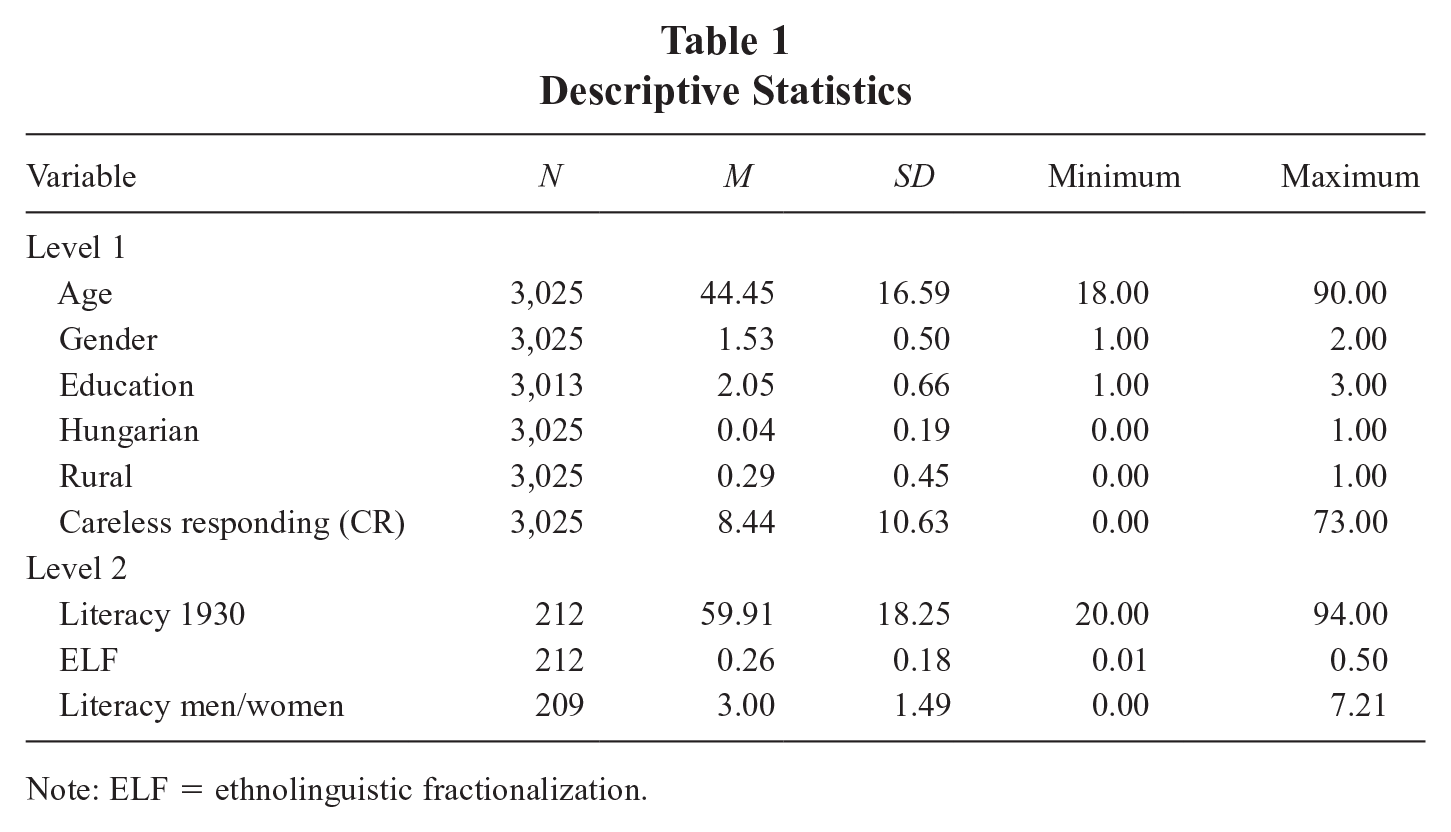
Note: ELF = ethnolinguistic fractionalization.
We begin the analysis with three models that consider predictors of educational attainment (EDU): with the entire sample, the subsample for Transylvania, and the subsample for the rest of the country (Table 2). Interwar literacy has a positive effect on EDU in both historical regions. For every 10-percent increase in literacy rate of a locality in 1930, the odds of having a person with less than high school education (i.True., EDU = 1 versus EDU = 2 or 3) living now in that locality is multiplied 0.85 times, holding constant all other variables. A 40-percent increase in literacy rate in 1930 halves the odds of having less than a high-school level of education. The effect of interwar legacy is significantly stronger in non-Transylvania than in Transylvania. A 10 percent increase in literacy rate in 1930 reduces the odds of having less than high school with 19 percent in non-Transylvania, compared to 10 percent in Transylvania. At the same time, literacy rates of men/women in 1930 have negative effects on current levels of education in Transylvania. More precisely, for every unit increase of the literacy rates of men/women of a locality in 1930, the odds of having a person with less than a high-school education living now in that locality is multiplied four times, holding constant all other variables.
Hierarchical Ordinal Regression Models for Educational Attainment (EDU) as the Dependent Variable and with Transylvania/Non-Transylvania as Moderating Variable: Unstandardized b and Standard Errors Shown
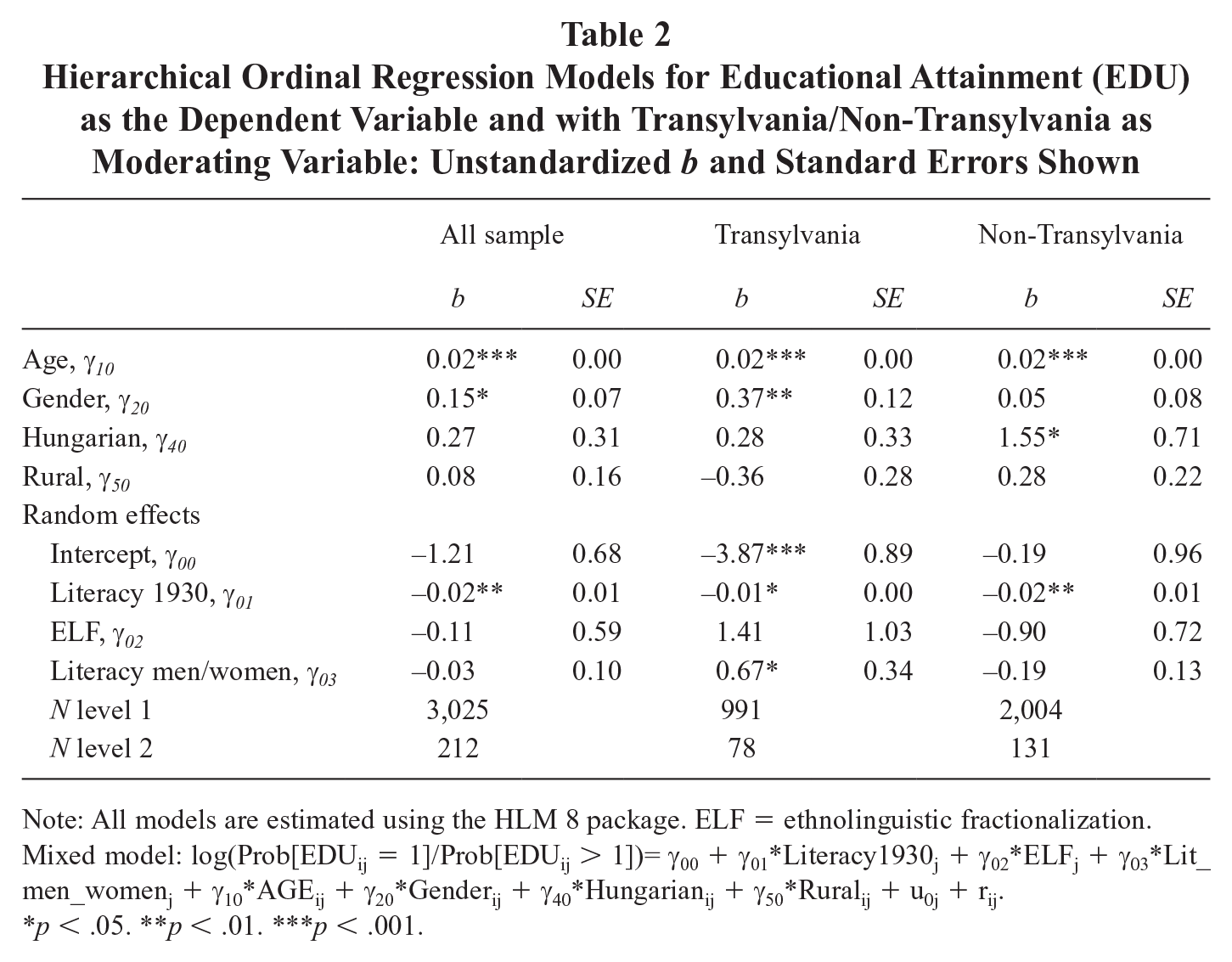
Note: All models are estimated using the HLM 8 package. ELF = ethnolinguistic fractionalization.
Mixed model: log(Prob[EDUij = 1]/Prob[EDUij > 1])= γ00 + γ01*Literacy1930j + γ02*ELFj + γ03*Lit_men_womenj + γ10*AGEij + γ20*Genderij + γ40*Hungarianij + γ50*Ruralij + u0j + rij.
p < .05. **p < .01. ***p < .001.
The second part of the analysis relies on three models that consider predictors of CR: with the entire sample, the subsample for Transylvania, and the subsample for the rest of the country (Table 3). Interwar literacy has a negative effect on CR in Transylvania, but not in the rest of the country. For every 10-percent increase in literacy rate of a locality in 1930, the CR score of a person living now in that locality tends to decrease by 1.4 points, holding constant all other variables. At the same time, the ELF has negative effects on CR in both regions. For every one-unit increase of the ELF index of a Transylvanian locality in 1930, the CR score of a person living now in that locality tends to decrease by 16.4 points, holding constant all other variables, whereas the decrease in the case of a non-Transylvanian locality would be by 10.3 points.
Hierarchical Linear Models for Careless Responding (CR) as the Dependent Variable and with Transylvania/Non-Transylvania as Moderating Variable: Unstandardized b and Robust Standard Errors Shown
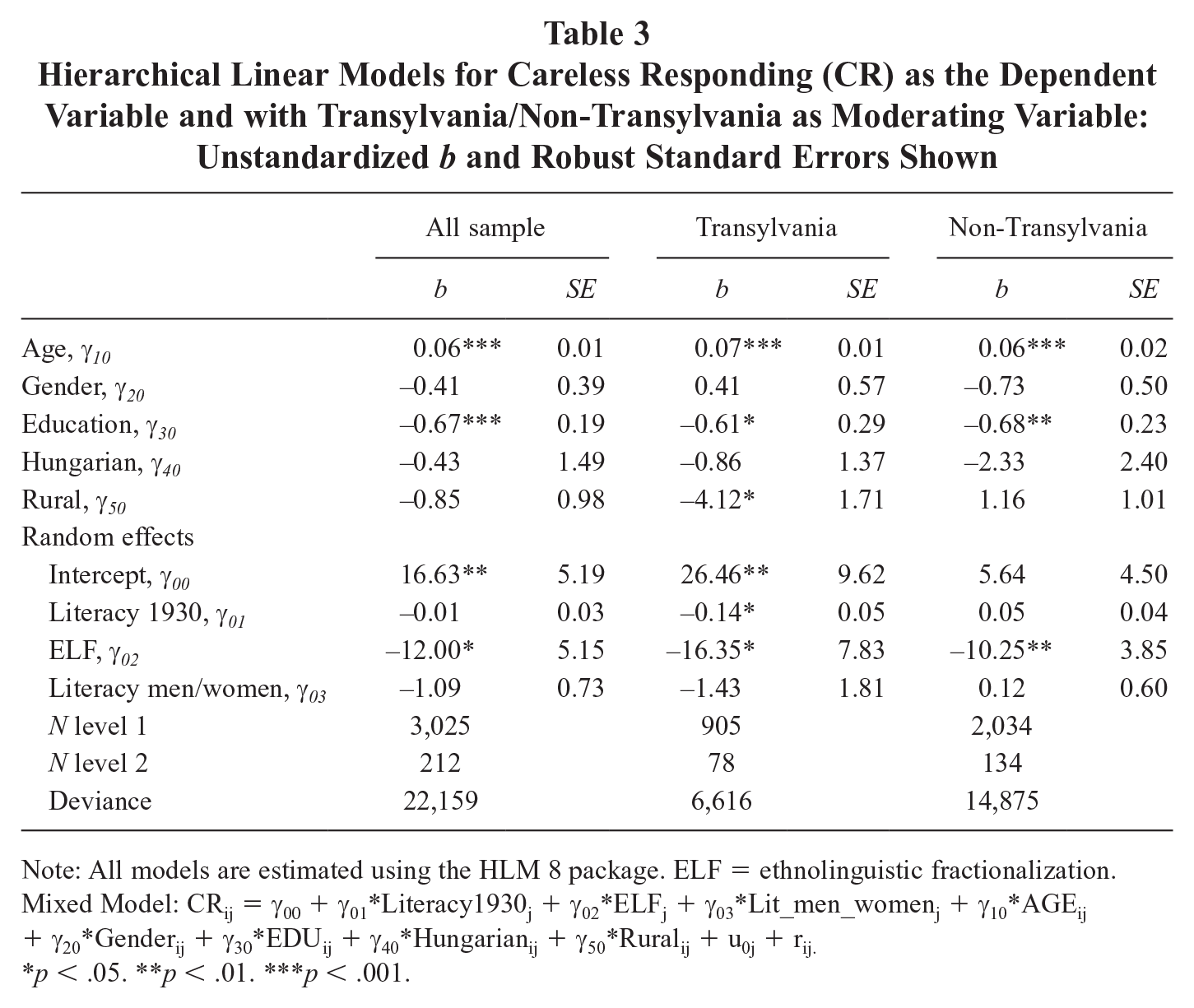
Note: All models are estimated using the HLM 8 package. ELF = ethnolinguistic fractionalization.
Mixed Model: CRij = γ00 + γ01*Literacy1930j + γ02*ELFj + γ03*Lit_men_womenj + γ10*AGEij
+ γ20*Genderij + γ30*EDUij + γ40*Hungarianij + γ50*Ruralij + u0j + rij.
p < .05. **p < .01. ***p < .001.
Literacy rates of men/women have no statistically significant effects on CR
We also ran explanatory models of EDU and CR, respectively, that include region as an independent variable (1 for localities in Transylvania, 0 for the others) and find that the region has no significant effects, holding constant all other variables (Table 4).
Hierarchical Models for Educational Attainment (EDU) and Careless Responding (CR) as the Dependent Variable and with Transylvania/Non-Transylvania (Region) as One of the Independent Variables: Unstandardized b and Robust Standard Errors Shown

Note: All models are estimated using the HLM 8 package. ELF = ethnolinguistic fractionalization.
Mixed models: log(Prob[EDUij = 1]/Prob[EDUij > 1])= γ00 + γ01*Literacy1930j + γ02*ELFj + γ03*Lit_men_womenj + γ10*AGEij + γ20*Genderij + γ40*Hungarianij + γ50*Ruralij + γ60*Regionij + u0j + rij.
CRij = γ00 + γ01*Literacy1930j + γ02*ELFj + γ03*Lit_men_womenj + γ10*AGEij.
+ γ20*Genderij + γ30*EDUij + γ40*Hungarianij + γ50*Ruralij + γ60*Regionij + u0j + rij.
p < .05. **p < .01. ***p < .001.
In summary, the effects of past levels of human capital are positive and statistically significant for both dimensions of present levels of human capital in one region, Transylvania, and for one dimension, educational attainment, in both regions, meeting in part our expectations for H1. The ELF has the positive effect on present human capital hypothesized by H2 in the case of conscientiousness, but not of educational attainment. Literacy rates of men/women have the effects asserted by H3 in Transylvania. Finally, the moderating effect of the regions stated by H4 can be observed for both dependent variables.
Discussion
Our study asks if the measures of human capital, ethnic diversity, and gender equality from 1930 explain current levels of human capital while also assessing the role of macro-regional differences in the manifestation of historical legacies.
We find that sub-regions smaller than the NUTS3 divisions but larger than localities matter for the transmission mechanisms. Since most legacy studies focus on larger geographical units, such as countries, macro-regions, and regions, this result presents a novel contribution to the literature on long historical trajectories.
Proving that a historical legacy exists requires showing a correlation between a potential antecedent and an outcome of interest and arguing that it involves a causal mechanism instead of being “instantiations of the same phenomenon measured at two different periods of time.” 77 Our research design, with multiple independent and control variables, alleviates the risks of endogeneity and spurious causality.
Finding significant transmission of human capital over almost one century is remarkable, given the strong imprints on the economic and cultural configurations of the four decades of a particularly repressive type of communism. At the same time, our results support the idea that the enduring effects of the past, far from being homogenous, are sensitive to the socio-cultural attributes of the contexts in which they manifest.
Thus, our study identifies four distinct long-term effects within the historical region of Transylvania and two in the rest of the country. In Transylvania, the present educational attainment is predicted by both the 1930 literacy rate and gender equality, while in the other regions, only the literacy rate exerts a statistically significant influence. Similarly, when it comes to current levels of conscientiousness, Transylvania’s levels are affected by both the 1930 literacy rate and ethnolinguistic fractionalization, whereas in other regions, only ethnolinguistic fractionalization has a statistically significant impact.
It is plausible that differences in terms of modernity and development, with Transylvania having a clear economic advantage over the rest of the country, are one of the key explanatory factors. This is because less-developed communities were more likely to have experienced more substantial state interventions, resulting in higher migration and institution restructuring levels. It is also plausible that the historically rooted cultural difference between macro-regions regarding social capital development, with higher levels in Transylvania, could explain increased resilience against pressure to reshape local norms and institutions in this macro-region. 78
At the same time, while current educational attainment is found to be influenced by the interwar literacy level in both regions, the finding that this effect is lower in Transylvania deserves further attention. A tentative explanation points in the direction highlighted by Bukowski in relation to Poland’s partitions and their effect on current educational performance. 79 In this study, the inter-generational diffusion of social norms toward education is believed to play a key role in explaining present differences in achievement between regions. Importantly, the content of these norms is context-sensitive; therefore, positive norms will emerge when quality of institutional educations is coupled with education being a realm where identity is promoted. In a similar fashion, we suggest that the interplay between the past educational landscapes of regions and the identity aspects could provide at least a partial answer to the varying impact of interwar literacy on current educational attainment. Compared to the Old Kingdom, Transylvania had, for a long time, the advantage of better and more diversified educational institutions. At the same time, the socio-political context prior to 1918 was not particularly conducive to the encouragement of Romanian identity in educational settings. This was not the case in the Old Kingdom, which—while lacking the robustness of educational institutions in Transylvania—maintained a less challenging environment with regard to identity promotion.
Another moderating effect of the macro-regions is that local contexts with smaller gaps between literacy rates of men and women in the interwar period tend to have now better-educated inhabitants in Transylvania but not in the rest of the country. This finding supports the idea that a relatively high level of initial development facilitates the transmittal of human capital since greater gender inequality in educational attainment indicates more precarious economic conditions. 80
Finally, we found that the ELF negatively affects CR in both regions. This result suggests that ethnically diverse contexts favor lower levels of carelessness, which implies higher levels of conscientiousness, and that the effect is long-lasting and robust to cultural specificities. Again, future developments should include additional measures of conscientiousness, both subjective and objective, and more variables describing the ethnic groups contributing to cultural diversity.
Our analysis adds to the existing knowledge about legacies and human capital in Eastern Europe in contexts that went through similar historical experiences, whereby the territories of a presently unified state were for a long time administered by distinct regional powers. In this regard, Poland is a relevant illustration, with further examples being Ukraine and Germany (with its East-West division during the Cold War). 81
Limitations of the Study
Our research design has several limitations that future inquiries should consider. First, using an indirect measure for conscientiousness gives a notable limitation of the analysis. While previous research validates our choice of assessing conscientiousness with the help of careless responding, we cannot dismiss the possibility that more direct measures of conscientiousness could have revealed conceivably more precise relationships or sharper regional differences. Even in the absence of first-hand measures for conscientiousness, further analyses could benefit from including, among the explanatory variables, migration aspects and demographic changes, supporting a better understanding of the role of regions in the conveyance of human capital. Second, the analyses would benefit from including spatial data and using the regression discontinuity (RD) methodology. Lastly, adding data at intermediate moments of time between 1990 and the present, such as variables that assess human capital and its potential determinants under the communist regime and at the beginning of the post-communist period, would alleviate the problems of endogeneity and provide a better assessment of the stability of human capital.
Conclusion
Our study shows that current levels of human capital in Romania are determined in part by historical measures of human capital, ethnic diversity, and gender equality measured at the sub-regional level. The empirical analyses are based on census data from 1930 and a recent national survey from 2019 to 2020 and employ a multi-level modelling approach. We assessed human capital at the individual level by considering two categories of aspects measured by the 2019–20 survey: educational attainment and conscientiousness, one of the dimensions of the personality structure. Conscientiousness was measured using a behavioral indicator, CR. The historical measures of human capital, ethnic diversity, and gender equality were measured at the sub-regional level by considering 1930 census data.
Within the framework of the dynamic-process model proposed by Rentfrow, Gosling, and Potter, our findings suggest that human capital leads to and is influenced by institutions and social norms whose specificity across small geographic units shows strong resilience over time. 82 By comparing a macro-region, Transylvania, with the rest of Romania, our analyses suggest that factors such as economic advantage, rooted cultural differences in social capital development, identity promotion, and gender equality in the interwar period contribute to enhanced resilience of human capital.
While our analyses are specific to Romania, the questions we raise hold substantial relevance within the broader Eastern European context. This is particularly pertinent for countries encompassing highly diverse regions with varying pre-communist levels of modernity and development. Future research regarding human capital transmission should delve deeper into understanding the intricate interactions between pre-communist and communist legacies, as they jointly shape contemporary levels of democracy and the development trajectories of post-communist societies. One powerful implication of our study is that investments in expanding access to education yield benefits that extend far beyond individual learners. They also contribute to the advancement of their communities and societies for generations, if not centuries, to come.
