




Abstract
We define tribalism as a mode of articulation that draws an antagonistic frontier between societal groups. Unlike populism, tribalism does not have a hegemonic character. It articulates groups through a horizontally oriented, shared value system; whereas populism is an essential part of a democratic system, tribalism disregards democracy. To conceptualize tribalism as a separate theoretical frame from populism or (ethno)nationalism, we used discourse theoretical analysis to analyze the Facebook pages of four political party leaders in Slovakia (Marian Kotleba, Krisztián Forró, Igor Matovič, and Boris Kollár). Kotleba’s page showed tribalistic features by articulating an antagonistic divide between “us,” the people, linked by shared values and identities, and anyone not sharing those values, or “them.” His representation of his party’s fight against oppressive forces, combined with their apathetic stance toward democracy, makes his a prime example of a tribalist party. While populism is an ever-expanding area of research and a framework widely used to analyze political entities and events, it is a word often thrown around and thus overused. Tribalism offers an alternative approach to analyze political instances in a national and transnational context in a more nuanced way, and to gain a better understanding of previously overlooked phenomena.
Introduction
Even though populism research has exploded in the last decades, its functionality as an analytic tool to explain political events has become limited by overuse. This overuse can result in mis-labeling movements and parties as populist, even though other labels, such as nationalist or illiberal, may be more fitting. 1 The prominent populism scholar Benjamin Moffitt, 2 for example, suggests that the “populist threat” in Western Europe is less about populism and more about nationalism. The lack of systematic and uniform use of “populism” resembles Sartori’s 3 cat-dog—a nonexistent animal, hypothetically created by biologists categorizing cats and dogs together because of seemingly shared similarities. 4 Populism falls prey to Sartori’s 5 problem of misclassification, where actors do not belong in the same category, but they are still treated (and thus analyzed) under the same blanket of “populism.” Using populism as a blanket statement can result in a lack of nuance when trying to understand current political movements and events. Consequently, in this article, we re-introduce and define the term tribalism. Through the tribalist framework, we provide an analytic tool that allows for a differentiation of movements, events, and parties from both nationalism and populism.
While tribalism has not been researched widely, many have mentioned it in the academic and popular press. Fukuyama 6 refers offhandedly to tribalism in his essay alongside identity politics without offering any definition of it, while Hogg and Goetsche-Astrup 7 claim that political tribalism involves beliefs that “the sovereignty of the people is actively subverted by outsiders.” In an article defining populism as a communication phenomenon, De Vreese et al. 8 mention “political tribalism” as a possible consequence of populism that can impede civil discourse and discourage political compromise, but again they do not define it. Generally, there seems to be a scholarly agreement that tribalism poses a danger to pluralism and liberal democracy, 9 yet none of the scholars working on it has provided a theoretically grounded definition of tribalism nor systematically applied it as an analytical tool.
We focus on Slovakia because of its representativeness and its uniqueness. While it resembles post-Communist Europe in miniature, 10 it also is unique in the divides and conflicts that shape its political arena around religion, ethnicity, corruption, and national identity. 11 Furthermore, of the two biggest ethnic minority groups, the Roma (1.23 percent) and the Hungarian Slovaks (7.75 percent), the latter is politically active, represented by an alliance of Hungarian minority parties (currently outside of parliament). In the Slovak political arena, there are also several populist parties: OĽaNO, SNS, SME Rodina, 12 and Smer-SD, as well as an extreme right party, ĽSNS. 13
We argue that, through the theoretical framework of tribalism, we can better understand and analyze the articulations of these parties, as they do not all aim to mobilize “the people” against “the corrupt elite.” Instead, tribalist groups aim to articulate and mobilize “their people” through certain identity-relevant issues, presenting themselves as the true representatives of certain groups only. While superficially this seems like a typical right-wing populist stance, we argue that even right-wing populist movements are universalist in nature, mobilizing supporters through demands that feed into an empty signifier with universalist appeal. Tribalist movements, on the other hand, mobilize a purposefully bounded group of supporters through particularistic demands, eschewing universalist appeal in the process.
Beyond Laclaudian Populism
As the field of populism studies has expanded, so have the different approaches researchers use to define it. These can be broadly divided into those based on the ideational approach and those based on the discourse-theoretical approach. Mudde’s 14 work epitomizes the ideational approach, defining populism as content rather than form, specifically as “a thin-centered ideology that considers society to be ultimately separated into two homogeneous and antagonistic groups, ‘the pure people’ versus ‘the corrupt elite’, and which argues that politics should be an expression of the volonté générale (general will) of the people.” 15 This approach, despite its wide adoption, can fall into the trap of conflating populism exclusively with its right-wing form, 16 and its normative definition of an ideology dividing the “pure people” and the “corrupt elite” makes it difficult if not impossible to apply in many situations, particularly when it occurs outside of Europe. 17
The discourse-theoretical approach views populism as form rather than content. Its greater theoretical depth both grants it better capabilities as an analytic tool and allows space for theoretical expansion and specification, as we aim to do in this article. According to Laclau’s 18 conception, populism is a “mode of articulation” or political logic that creates an antagonistic frontier between “the people” and “the other” that is heightened by affect. The performative approach, which views populism as performed by its leaders, builds off of the discourse-theoretical approach. In this view, populism has been described as a political style 19 or a transgressive bodily performance. 20 Through the discursive lens, the populist “dimension” of politics 21 is ever present on a sliding scale, not necessarily a threat to democracy as many have often claimed, 22 but in fact its “mirror,” in which “democracy can contemplate itself, warts and all,” 23 or, indeed, a necessary condition of radical democracy. 24 A populist movement is by nature counter-hegemonic, 25 and it begins when a series of diverse demands, drawn together by the logic of difference, coalesce into a chain of equivalence, with an empty signifier at its heart that captures all of these demands into one universal demand.
Against the backdrop of a democratic system, populist political movements compete to force their demands into a temporary status of universal representation. 26 According to Laclau, 27 even a movement centered exclusively on a particular group (e.g., a particular ethnic or national identity) still maintains demands that are universal in nature, because they still are making these demands in a (usually state) system that is in the position to fulfill them. A group whose demands were purely particularistic, that is, a group based purely on a differential identity, is “self-defeating,” in Laclau’s words, because it inherently recognizes the existence of other particularistic groups and thus grants them the same status. Laclau goes on to say that “the construction of differential identities on the basis of total closure is not a viable or progressive political alternative.” 28 We claim, however, that short of attempting to build a differential identity on the basis of total closure—understood in discourse theory to be an impossible political project—there is space for a political project that does not attempt to move its particularistic demands towards universalism.
We place tribalism in this particularistic space, unconcerned with either universal demands or democracy as a system. Unlike populist movements guided by an empty signifier that coalesces all demands equivalentially into a universal and counter-hegemonic claim, tribalism concerns itself only with the particularistic aspect. It does not intend to move toward universalism or hegemony. While tribalist groups may exist in democracies, they make no attempt to represent the whole, instead explicitly existing for the particular group defined by a system of values. In some cases, they may be entirely anti-democratic or anti-system in nature, rather than inherently connected to democratic systems as populism is. 29
The goal of a tribalist movement, we argue, is not necessarily to be electorally viable (i.e., to form, lead, or take part in a government), nor to be progressive. While we argue that tribalist groups can be described through the same language of Laclaudian populism, they create antagonistic frontiers differently. In populism the demands and identities are brought together into “chains of equivalences,” 30 which are then signified in “the people,” creating the antagonistic frontier between “the people” and “the elite” on a vertical up/down axis in spatial-orientational terms. 31 Tribalism, however, constructs these antagonistic frontiers on a horizontal axis, an “in”/“out” relation, where group membership is based on limited identities. This creates a similar “us” and “them” divide as we see in populism, but instead of appealing to “the people,” the appeal is made only to “my people,” and they are mobilized not necessarily against “the elite,” but against a group-based “other.” Unconcerned with universal demands, tribalism bases itself on specific demands and strives to create group-based collective identities, articulating in turn horizontally oriented antagonisms.
This differentiation between populism and tribalism alone still leaves open the possibility that tribalism is merely nationalism with a new name. However, we argue that tribalism and nationalism are also articulated differently. Nationalism is, at its basis, the idea that the nation should be at the basis of a political unit. 32 Gellner’s conception of the nation is territorially and ethnically based, with “the nation” tied to both an ethnic group and a specific homeland. 33 The prevailing theories view nations as socially constructed “imagined communities” 34 or “invented traditions” 35 that build collective identities. Ethnonationalism in particular, which we will use interchangeably with “nationalism” for the purpose of this article, refers to imagined communities centered around ethnic groups and the belief that self-aware ethnic groups, or nations, should be entitled to national self-determination. 36
Many movements already entangle nationalism and populism, though—a phenomenon that Brubaker 37 and De Cleen and Stavrakakis 38 have approached from differing perspectives. Addressing the two, we argue, reveals the need for tribalism as a separate analytical category. Their argument centers around what level of formalism is present in a group’s articulation of itself or whether—and what—meaning or significance comes attached to “the people” in a populist movement. Following Brubaker, Vulović and Palonen 39 take a radically anti-essentialist stance, viewing “the people as a completely empty form that, in the case of what Vulović and Palonen refer to as “peopleism,” is filled by the imagined community of a nation if the movement entangles nationalism and populism. De Cleen and Stavrakakis, on the other hand, present populism as a movement differentiated on a vertical basis, inherently arguing that the people as a signifier is not entirely devoid of form, because the vertical differentiation of the “the people” and “the other” includes an anti-elitist sentiment (although the people and the elite both still remain empty forms to be filled). We argue, however, that both of these approaches to populism and nationalism retain Laclau’s earlier presentation of populism as essentially universalist. Following De Cleen and Stavrakakis’ rejection of pure anti-essentialism, we conceptualize tribalism as a type of movement where “the people” is by nature exclusive. In viewing tribalism as articulated horizontally, we dispense with the conception of “the other” as elite in comparison to “the people”; in tribalism, “the other” remains totally empty. While the content of “the people” also remains an empty form in our conception of tribalism, we add an exclusive dimension by claiming that shared values, rather than a shared imagined community or socio-economic position, draws “the people” together.
In order to define nationalism through a discourse theoretical lens, De Cleen and Stavrakakis 40 draw on both modernist and constructionist conceptions of nationalism. Their differentiation of nationalism and populism argues that the two concepts rely on different subject positions and nodal points anchoring the chain of equivalence. We claim that tribalism depends on yet another subject position and nodal point anchoring the chain of equivalence, differentiating it from both populism and nationalism. While ethnonationalism refers to an identity created by a sense of shared loyalty to a mythical nation in ethnic terms, 41 tribalism does not necessarily depend on the nation—defined ethnically or indeed civically—as a nodal point. Instead, tribalist articulations have the potential to be both more exclusive and less exclusive than nationalist articulations. While members of the “tribe”—the subject position that tribalism offers—may be articulated as members of one nation, tribalism can exclude other members of that nation in its articulation of necessary shared values, thereby ignoring shared times and spaces and shrinking the imagined community.
This tribalist articulation of a more exclusive imagined community within a nation-state also has implications for tribalism’s relationship to democracy. By not signifying “the people” as the-people-as-demos, as democracy does, 42 but as the-people-as-certain-group, it denounces the need for a shared political community, which underlies democracy. According to Reicher 43 —based on social identity theory 44 —democracy is impossible without a shared psychological sense of belonging to a single community. Democratic debate is possible as long as the groups that disagree are still treated as part of the political community. While in populism the claim is often directed at “the people”—a wider political community—with tribalism the scope is limited to a section of the population, defined through sharp group boundaries. Appeals are then made to these identity/value-based groups without the need for wider political debate, thus making tribalism inherently disregard democracy as a system.
Finally, we argue that the position of the leader is different in tribalist and populist movements. In populist movements—according to Laclau 45 —the leader becomes the symbol of unity and the embodiment of the movement. 46 In other words, the leader acts on behalf of the people and, in doing so, brings them with him, but they are not encouraged to behave in the same way. With tribalism, however, we can see a leader-follower relation between the leader and “his people.” A key part of tribalism is the collective, shared identity that the members identify with, thus creating the tribe. According to the social identity theory of leadership, 47 the leader is usually the most prototypical member of a group, and leaders are seen as the ones who foster and preserve the social identity of the group. In tribalism, the followers therefore imitate the prototypical leader, creating a stronger collective identity.
Overall, we claim—and demonstrate through the Slovak case—that tribalism is not only a separate dimension of politics from nationalism and populism, but it can serve as a useful analytical tool, especially when we are trying to understand contemporary political struggles. Through tribalism we can also better detangle political entities’ stances toward power and democracy, as well as the politicization of tribalist culture groups. Table 1 provides an overview of our conceptualization.
Discourse-theoretical Conceptualization of Nationalism and Populism based on De Cleen and Stavrakakis 48 Compared with Tribalism
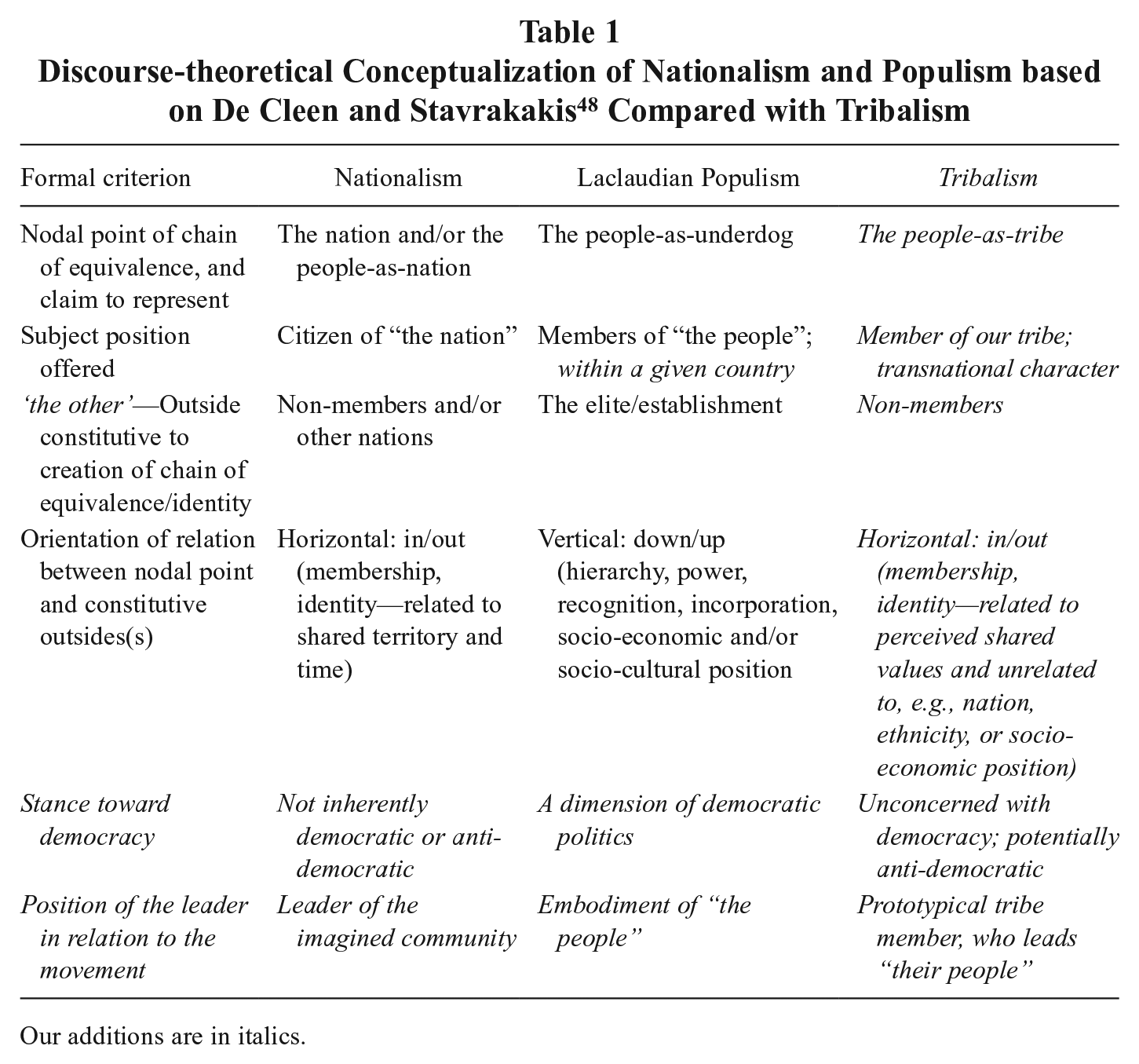
Our additions are in italics.
Slovakia as a Potential Tribalist Hotbed
Historical roots of tribalism
After Communism ended in east central Europe, the region underwent complex social and political transformations involving the establishment and consolidation of democracy as well as the redefinition of statehood. 49 While the perception of Slovak nationalism as the main wedge that drove Czechoslovakia apart is a false one, 50 the first prime minister of independent Slovakia, Vladimir Mečiar, spearheaded the founding of a constitutionally nationalist country, 51 which differentiated ethnic Slovak citizens from citizens belonging to ethnic minority groups in the language of the constitution even as it guaranteed broad legal and political rights for ethnic minorities. The establishment of the new Slovak state changed interethnic relations within the region. As Slovak language, culture, and ethnicity took a hegemonic position in the new state, it alienated minorities and resulted in mistrust between Slovakia and its Hungarian ethnic minority of 600,000 people. 52 The upholding of Slovak hegemony galvanized the kin-state, Hungary, to protect its co-ethnics in the newly nationalizing state, which kept the question of ethnicity at the center of political life in Slovakia. 53 From the very beginning of Slovakia’s existence as an independent country, the distinction of Slovaks from Hungarians and Czechs played a role in Slovak nation-building. 54
Mečiar and his allies did not pull this division out of thin air, but rather built upon more than a century of Slovak nation-building on an anti-Hungarian basis 55 and on Slovak ethnonationalism. The Slovak national movement began in the 19th century, when the land that now makes up Slovakia was part of the Hungarian Kingdom of the Austro-Hungarian Empire, and Ľudovít Štúr’s codification of the Slovak language in the face of Magyarization efforts in the Slovak lands provided an important cultural identity marker; 56 for example, Magyarization efforts in Slovak cities 57 and Hungary’s repeated refusal to recognize Slovaks as a specific national entity or allow for Slovak linguistic and cultural development 58 hindered the development of a Slovak political identity, until World War I (WWI) presented the opportunity for Slovak society to develop politically, with Czech help. 59 Thus, Slovakia, as recognized in the Treaty of Trianon after WWI, became a part of Czechoslovakia. In the immediate post-war period, state policies explicitly aimed at either removing or “Slovakizing” ethnic Hungarians within Czechoslovak borders. 60 This state-sponsored subjugation ended in 1948 with the beginning of the Czechoslovak Communist regime, which supported ethnic Hungarian cultural and linguistic activities 61 ; thus, Slovakia became an independent and democratic state with an ethnic Hungarian minority that was cohesive, differentiated from the Slovak majority, and closely linked to Hungary. 62
From the Hungarian perspective, the Treaty of Trianon is still viewed as the “the biggest tragedy of [Hungarian] history,” 63 since it left 3.5 million ethnic Hungarians living in historical Hungarian lands outside of the now significantly smaller state of Hungary, many in the Slovak part of Czechoslovakia. The idea of “healing” the fibers of the nation that Trianon “ripped apart” has come to play an important role in the collective identity policy of the Hungarian right 64 and visual communication of the current Hungarian Prime Minister, Viktor Orbán. 65 Naturally, Hungarian irredentist claims—and several policies aimed at Hungarians living abroad—pose an inherent threat to Slovak sovereignty.
Tribalism and party politics
The division between Slovaks and Hungarians in Slovakia has thus played a role in Slovak politics since 1993 66 well beyond just Mečiar and his Movement for a Democratic Slovakia party (Hnutie za demokratické Slovensko, HZDS). It has also appeared on the right wing and the extreme far right, where Slovakia is an outlier in that there have been so many parliamentary parties representing this range on the political spectrum. The extreme right has been efficient and active, especially at the level of political parties. 67 The parties have ranged from more mainstream (e.g., the Slovak National Party, SNS), to more fringe (e.g., the Slovak People’s Party, SĽS). The extreme right’s mobilizing issues have changed throughout the years; from 1993, their main theme was nationalism, thus they mobilized along the lines of “national defense” through anti-Hungarian and anti-Roma discourse. After 2010, though, they began to orient voters in line with anti-establishment issues. 68 Currently, both the fringe and the mainstream right have seats in the Slovak parliament. The extreme right-wing populist 69 and anti-system 70 Kotlebists—People’s Party Our Slovakia (Kotlebovci—Ľudová strana Naše Slovensko, ĽSNS), led by Marian Kotleba, won 8 percent of the vote in both 2016 and 2020; the more mainstream right-wing We Are Family (Sme Rodina) took 7 and 8 percent in the same elections, respectively. While SNS did not cross the 5 percent threshold to gain parliamentary representation in 2020 for only the third time since 1989, that still left the right wing and extreme right together with 34 out of 150 seats, and with Sme Rodina in the governing coalition.
Spáč 71 classifies six Slovak parties that have achieved parliamentary representation since 1989 as populist, including HZDS, Direction—Social Democracy (Smer—sociálna demokracia, currently known as SMER—slovenská sociálna demokracia), and Ordinary People and Independent Personalities (Obyčajní ľudia a nezávislé osobnosti, OĽaNO). Engler et al. 72 also add Freedom and Solidarity (Sloboda a Solidarita, SaS) and the newer Sme Rodina to the list of anti-establishment parties often understood as populist (and, disagreeing with Spáč, their analysis also groups SNS and ĽSNS into this same group). Together, this reveals a volatile and unpredictable party system 73 that has not crystallized into an “establishment,” but despite that, the salience of populist and anti-establishment rhetoric has remained high. Following the 2020 election, in which previously noted trends preferring more radical parties did not continue, 74 the centrist, anti-establishment OĽaNO 75 (with its governing partner Sme Rodina) have picked up where SMER left off, after SMER picked up where HZDS had left off.
While the Slovak political system’s preponderance of populist parties is not alone in the Visegrád Four group, it is unique in the continued presence of parties representing an ethnic minority: the Hungarian minority. The two former major ethnic Hungarian parties, the Party of the Hungarian Community (Hungarian: Magyar Közösség Pártja, Slovak: Strana maďarskej komunity, SMK-MKP) and Most–Híd (Bridge in Slovak and Hungarian, respectively) have drawn ire from right-wing Slovak parties, 76 particularly SMK-MKP. In 2019 a new movement, then party, Összefogás–Spolupatričnosť (Belonging Together) emerged, which negotiated electoral cooperation with the other ethnic Hungarian parties and was transformed into MKÖ–MKS (Magyar Közösségi Összefogás – Maďarská komunitná spolupatričnosť). After all Hungarian parties failed in the 2020 parliamentary elections, they founded a new party, Alliance (Szövetség–Aliancia), which formally merged all three of these parties (SMK-MKP, Most-Híd, MKÖ-MKS) and aims at representing the Hungarian minority. Despite their relevance and unique character in the region, they have received very little attention in the scholarly literature; this study, however, sees them as an important case given their focus on the Hungarian ethnic minority.
Analyzing Tribalism
In the present research we aim to clarify and differentiate the concept of tribalism from populism and (ethno)nationalism. In order to do that, we examine four parties with very different profiles in Slovak politics. The first is Alliance (Szövetség-Alliancia), the Hungarian minority party currently outside of parliament. OĽaNO, then, can be classified as centrist 77 or valence populist, meaning that instead of the left/right dimension, its focal points are non-positional issues such as anti-corruption, while it still maintains an anti-establishment appeal. 78 OĽaNO is currently in government along with another populist party that we analyze, Sme Rodina, which is described as right-wing. The fourth is ĽSNS, a far-right extremist party that has increasingly moved from the fringe into the mainstream and currently sits in opposition in parliament. We look at party leaders because social media focus is often on individual politicians rather than political parties, 79 and they often better represent the narratives of their party’s messaging. Furthermore, leadership is important in the concepts of both populism and tribalism, and through the party leaders, we can differentiate the two concepts better than through other party content.
Materials and Methods
Our data consist of the content of the last fifty posts on Facebook (beginning on the date of collection and going back) from four party leaders: Krisztián Forró (Alliance), Igor Matovič (OĽaNO), Marian Kotleba (ĽSNS), and Boris Kollár (Sme Rodina). We chose Facebook, because it is the most widely used social media platform in Slovakia, 80 and social media platforms in general have become important channels for candidates to reach voters directly. 81 The data were gathered through Facepager on 12 January 2022, except for the data from Igor Matovič’s page, which was collected manually. All data were analyzed in January 2022, so the reported follower counts represent this period (November–12 January). While this period could not be called a “politically heightened period”—there were, for example, no elections in this timeframe—the COVID-19 pandemic was still an ongoing crisis and relevant topic.
We analyzed the data using Discourse Theoretical Analysis (DTA), 82 a method based on Laclaudian discourse analysis, 83 because it allowed us to take a macro-approach to the posts and include analysis of text and visuals. We were not limited by the specific sociopolitical setting but could approach discourses as representations. As our goal was to entangle the complex relations between “representations, practices and identities,” 84 we found DTA to be the most beneficial. DTA views discourse in an expansive sense, considering not only linguistic articulations but also visual and performative articulations, along with the “discursive (or ideological) constructions behind linguistic (and other) signifying practices.” 85 In our analysis we did not assess the “audience’s” direct responses (likes, comments, reactions), but concentrated solely on the posts by the politicians themselves and how they articulate said audience in their political performance and rhetoric.
We used the core concepts of DTA, such as subject positions and antagonistic and hegemonic identities, with particular focus on the sensitizing concepts 86 of nodal points, antagonism, discursive fields, and subject positions to guide our analysis. We further added the sensitizing concept of the “tribe,” to which, drawing from our conception of tribalism described above, we connected articulations related to values, identities, stance toward democracy, and leader-follower relationships.
Results
In this section, we present the results of our analysis of each party leader’s Facebook posts. The analysis is structured so that it follows our definition of tribalism and the aforementioned sensitizing concepts. While all four analyses followed the same framework and sensitizing concepts, the material justified some analyses to be longer because of the nature of the data. In the discussion, we compare the four cases along the formal criteria of tribalism and highlight the features of tribalism and the contribution to existing research.
ĽSNS: Marian Kotleba’s Facebook Page
The fifty posts included in the analysis range from 11 November 2020 to 12 January 2022. Kotleba’s Facebook page, which had 47,000 followers as of January 2022, is his main space for communicating with his followers. He uses it not only to post original content, but also to share content posted elsewhere, for example longer YouTube videos or blog posts from the Kotlebovci.sk party website.
Almost all of the fifty posts analyzed included an articulation of antagonism, which suggests that the constitution of ĽSNS as a group is primarily formed through the constitution of an Other. The primary Other here is the existing Slovak government, which Kotleba describes as oppressive, a bully, fearmongering, deceptive, and determined to bring harm to the Slovak nation. The media also frequently figure into this Other alongside the government, for example as a force that attempted to block Kotleba from speaking or as something better ignored. Kotleba’s construction of the antagonistic Other further includes international elements, like the EU (specifically as a promoter of LGBTQ+ rights to the detriment of Christian values), the United States, or the “globalists,” a well-known anti-Semitic dog whistle, who, according to a link that Kotleba posted to his Facebook page, “convinced billions of people to voluntarily exterminate themselves.”
The “us” that Kotleba articulates in opposition to this oppressive and dangerous Other is alternatively free or free-thinking; protective of vulnerable groups in society like pensioners, pregnant women, or mistreated workers; unafraid and not vaccinated; and, very prominently, devoutly Catholic. Kotleba also articulates an ancient connection between the people and the homeland, which the people must defend. While Kotleba refers to the government as having “enslaved the nation,” he instructs his followers to “think royally and don’t behave like slaves.” This instruction to resist government restrictions is important enough to Kotleba’s articulation of his people that it even shows up in his Christmas greetings post.
Kotleba structures much of this discourse around the nodal points of the COVID-19 pandemic, the vaccine, and masks. He articulates the pandemic as an excuse for government oppression rather than a legitimate public health crisis. The vaccine, then, is not only oppressive and undesirable but also dangerous. He articulates proposed vaccine mandates for senior citizens as a threat from which they must be protected, for example, while also positioning vaccines as the new dividing line between privileged and oppressed citizens (and implicitly equating those who choose to remain unvaccinated with Jews during the Holocaust; this is further evidence of ĽSNS’ antisemitism, as it minimizes the Jews’ suffering during the Holocaust). In Kotleba’s articulation, those who have exercised their personal freedom to remain unvaccinated are being unfairly penalized, whereas those who have their “papers” (as Kotleba refers to the COVID-pass) are unfairly privileged.
The set of tribalist sensitizing concepts frequently turns up in Kotleba’s rhetoric as the means for drawing his followers together. While he occasionally turns to ethno-nationalist articulations, he more frequently does not define “the people” as explicitly Slovak, but rather as those sharing a set of values in a grouping that may even cross country lines. As described above, Catholicism is an important connecting factor, which Kotleba sometimes, but not always, articulates as particularly Slovak. When a priest posted a statement saying that “the vaccine is hope,” Kotleba expressed ĽSNS’ backing of a group of Slovak Catholics in insisting that “the true hope comes from Jesus Christ,” but ĽSNS still remains separate from that group. When organizing an anti-government rally on 17 November—the anniversary of the beginning of the Velvet Revolution—Kotleba made an expansive call for people to join “together against the government, vaccinated or unvaccinated, tested or untested,” saying in a later post that “we all have the same enemy.” This post, which includes an image, overlays the faces of the major members of the government onto coronavirus figures and further includes a phrase that could be interpreted as violent: “Let’s beat him until he beats us!” This post, in its articulation of the government as an “enemy” to be “beaten,” also articulates an anti-democratic sentiment. In addition to organizing this protest and celebrating the wide variety of people who took part, Kotleba also sends his greetings to demonstrators in Prague, who, on 28 November, organized an event similar to his; here, the values are more important than the nationality.
Kotleba’s values also appear in the people whom his rhetoric celebrates, like workers, soldiers, and policemen; senior citizens; pregnant women; and priests. While he articulates most of these in a position of needing protection, either physically or in terms of their human rights, he presents the priests as leaders, who advocate on behalf of the oppressed. Kotleba articulates the family, which he often posts about in connection with the outdoors, as a cause for joy and as the most important part of life, with time spent with his son in the outdoors being “the moments worth living for,” which he contrasts with time spent on “politics.”
Finally, Kotleba uses his position at the head of the party to advocate that his followers act as he does. When noting his success in getting himself reported for not following parliament mask-wearing rules, he urges followers toward similar acts of disobedience against an overreacting government and then later defends another man in parliament about his right to resist “mask totalitarianism.” He connects himself to his Facebook followers, calling them “
Alliance: Krisztián Forró’s Page
As of January 2022, Forró had 5,400 followers on his Facebook page, where he posts about his official appearances and shares his political opinions and some moments from his private life. The fifty posts included in the analysis range from 7 November 2021 to 12 January 2022.
In the posts, he is featured as he makes appearances at several online interviews, TV appearances, and press conferences. In the appearances, regional developments are especially emphasized, such as a new hospital being built or the importance of a new road. He also appears at the events of an organization supporting Hungarians across borders. Most of the texts of his posts are written in both Hungarian and Slovak, except for certain posts, for example when he commemorates the Day of Hungarian Language.
Much of the discourse on Forró’s page is structured around the COVID-19 pandemic. Under the umbrella of COVID issues, two main antagonisms are articulated. One is against the government, positioned as unable to deal with the crisis. This narrative appears in several posts, the most prominent depicting a bloody wrench, symbolizing how the government is bleeding the hospitality and restaurant sector out through a “pseudo-lockdown.” He also articulates antagonism between the vaccinated and unvaccinated, positioning the previous as desired behavior, as a post emphasizes that a large percentage of the party’s voters, “us,” is vaccinated. Overall, by thematizing COVID, the current Slovak government is constituted as the Other, who, through its inability to perform correctly, is worsening the life of the ordinary—Hungarian—people.
“Us” is articulated through posts positioning the Hungarian identity as opposing the Slovak majority. The Hungarian “us” is depicted as fighting for its rights and the use of the Hungarian language. As such, language here appears as the ethnic nation's tool of survival. The struggling “us” narrative is most prominent in a post that draws a parallel between the Slovak national holiday—the Day of Freedom and Democracy, which commemorates the Velvet Revolution—and the current situation of Hungarians in Slovakia. In his posts, he aims to “amplify the voices of our region,” promising to “bring back hope to the people living here.” Both Hungarian language and nationality appear as a nodal point in different discourses. Language performs as an integral part of a “healthy nation,” “because as long as the national language lives, the nation lives,” and as a choice that parents should make for their children, by “choosing Hungarian schools.” As such, the “ordinary people” are put into an emancipatory subject position, in which they become important enough to decide on the future of the language, and thus also the nation.
Forró articulates “the people” in a mostly regional sense, but pan-Hungarianism also appears in a post through a quote from Albert Wass, a Hungarian writer from Transylvania, posted by Forró, in which Wass says, “never forget that all Hungarians are your siblings, wherever they may live.” This idea is supported by Forró’s cooperation with an organization, Rákóczi Szövetség—which aims to “serve Hungarian people” (Rákóczi szövetség, 2022) in the Carpathian Basin. Throughout the posts, Forró appears as an opinion leader and the one who voices the will of the people whose voices would otherwise be silenced.
OĽaNO: Igor Matovič’s Facebook Page
As of January 2022, Matovič’s page had over 280,000 followers, and the fifty posts analyzed range from 16 November 2021 to 12 January 2022. He posts publicly to his personal profile rather than using a public page. As the former prime minister and current finance minister, Matovič often uses his profile to celebrate his government’s achievements and comment on issues that come up, but he also shares moments from his personal and family life.
Antagonism toward the corruption of previous Slovak governments turns up in the grand majority of the posts analyzed, and it also features in his cover photo, which shows the murdered journalist Ján Kuciak and his fiancee Martina Kušnírová. While this photo ostensibly shows support for the free press in Slovakia, the Kuciak and Kušnírová murders also sparked the scandal that eventually forced former SMER prime minister Robert Fico’s resignation. In other posts, Matovič criticizes the media for what he sees as misleading coverage of himself, but not in strong terms. His criticism of Fico, SMER, and Fico’s SMER successor Peter Pellegrini (who has since formed his own political party, Hlas) is much more frequent and in much stronger terms. For example, he refers to Fico in particular as a corrupt criminal and shared a colleague’s post saying that SMER “voluntarily handed Slovakia into the hands of the Mafia.” He also repeatedly expresses his disapproval of Slovak President Zuzana Čaputová, who he claims is trying to draw too much power to herself. Overall, Matovič almost exclusively articulates an antagonistic frontier walling off other “corrupt” Slovak politicians of various parties, who he says have been working against all of his government’s efforts to help people during the pandemic.
The main nodal point structuring Matovič’s discourse on this front would thus be corruption, which represents everything that Matovič and OĽaNO are fighting against. Slovakia is another nodal point, which anchors the chain of equivalence representing what Matovič and his government are fighting for, but it is articulated in an expansive, inclusive way, without any nationalist or otherwise exclusive associations. COVID vaccines are also a nodal point; he frequently mentions them as the way to protect senior citizens and end the pandemic and posts infographics showing their capability to prevent deaths. While the pandemic is not the main theme, Matovič emphasizes that he supports public health guidelines meant to slow the spread, like children wearing masks in school. Rather than articulating masks as a symbol of repression, as Kotleba did, Matovič supports them as a means of keeping schoolchildren from being “guinea pigs.”
Matovič’s posts generally articulate “the people” in an expansive sense, largely constituted by the Other, rather than articulating the existence of a “tribe.” Certain shared values do come up in his posts, like protecting senior citizens with the vaccine, Christianity (but not in a doctrinal, exclusive sense as Kotleba does), and a love for family. For example, Matovič posted about the holidays and family several times in the lead-up to Christmas. These posts connect Matovič to the majority of people in Slovakia who, like him, are also celebrating Christmas with their families and give followers an “authentic” glimpse into Matovič’s life as a human being, rather than merely a politician. He also emphasizes his and his government’s work on behalf of the people, for example with a photo he took of Prime Minister Eduard Heger still working in an official setting after midnight.
Sme Rodina: Boris Kollár’s Page
Boris Kollár’s page at the time of analysis (January, 2022) had 145,000 followers, and his last fifty posts range from 11 November 2021 to 12 January 2022. The majority of his posts are reposting Sme Rodina’s posts, with or without additional commentary. He further shares some of his interviews and some personal moments, but mainly he emphasizes the successes of the current Slovak government, of which Sme Rodina is a part.
The discourse on the page is structured around the nodal points of social and healthcare reforms. These different aids and financial support are provided by the government and target various groups in the population. “The people” are articulated as those living in rural areas, as, for example, Kollár and Sme Rodina “don’t support the demolition of hospitals” in these areas, and they voted against a healthcare reform that did not support the will of the people there. They articulate an antagonism based on regionality, implying that the “us,” the people in the rural areas, are less cared for than those living in larger cities, an “unthinkable approach” for Sme Rodina. He also juxtaposes small Slovak merchants with multinational companies, as the former had to close because of the lockdown, while large stores could stay open, creating a similar divide and articulating Sme Rodina as the representatives of the “ordinary people.” Another antagonism is articulated in opposition to the previous government, which “stole public money” and “didn’t do anything for 12 years.” On the other hand, the current government’s and the party’s efforts are displayed, such as reforms, additional pensions, and financial aid to those who need it.
Boris Kollár also articulates himself as a leader who personally helps where he can. In this he literally embodies his movement, as it is through his body that help comes to “the people.” He announced that he would pay the fine of emergency medical technicians (EMTs) who were protesting because they did not feel valued. Kollár is also photographed as he hands coffee machines to EMT workers, because their old ones broke. The post’s text emphasizes that the EMTs “contacted him for help,” and Kollár was happy to meet their requests. Kollár’s engagement in more personal, performative acts underpins the social messages of the party; these emphasize tradition, such as cooking traditional cabbage stew or spending time with family.
Discussion
Table 2 sums up the results of our analysis using the criteria from Table 1. Our analysis shows that a main feature of tribalism is its inherently apathetic stance towards democracy. Besides Kotleba, all three other party leaders’ discourses function within a democratic system. While Forró challenges both the government and the exclusively Slovak nation state, he strives to elevate the status of the Hungarian language and the ethnic nation within a democratic setting. For example, he does not want to “oust” the Slovak language from post offices, but instead wants them to function in both languages. The same is true for Kollár and his party Smer Rodina, which continues to challenge even their political allies—for example OĽaNO, about health care reforms—but they fully participate in the national government, which shows full systemic integration into the democratic system. 87 Matovič, whose performance during the pandemic matched that of a technocratic populist, 88 articulates himself as a pro-democracy actor with, for example, the cover photo of Kuciak and Kušnírová. However, at the same time, he also delegitimizes his political opponents in the democratic system by articulating his government’s decisions as informed by expertise and therefore above criticism, a frequent action of technocratic populists. 89 He does not, however, cross over into violent or extremist rhetoric, nor does he attack the country’s democratic institutions, which is a frequent theme in Kotleba’s posts. Kotleba not only articulates his democratic opponents as the constitutive Other, but instead he goes even further to articulate them as enemies and oppressors that should be “beaten.” Thus, while Matovič’s technocratic populist performance disregards democratic norms in a veiled way, Kotleba’s rhetoric explicitly disregards democratic norms through violent rhetoric.
Comparative Findings Following the Criteria of Tribalism
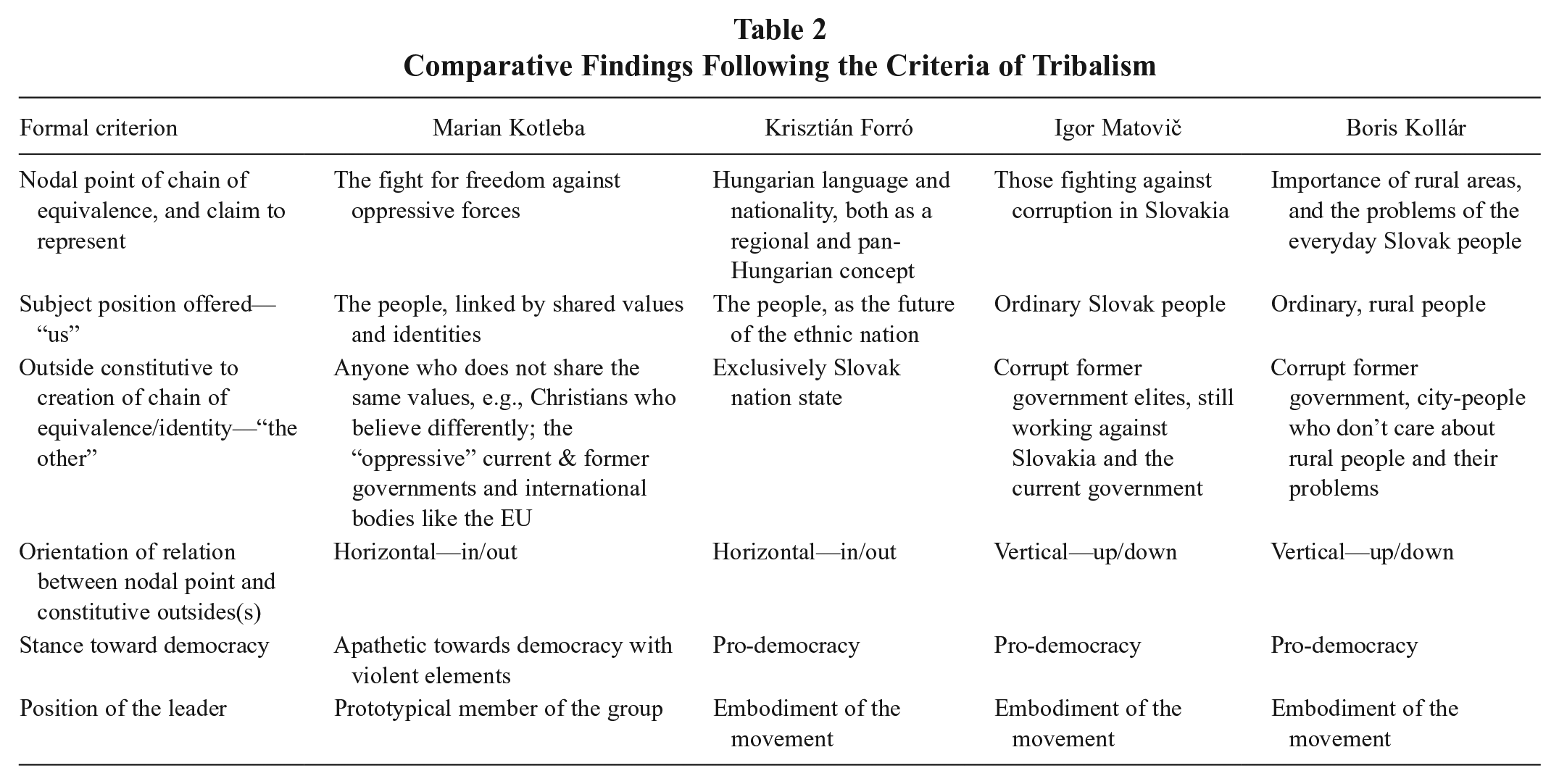
Regarding leadership, in Forró’s, Matovič’s, and Kollár’s discourses, they appear as the embodiment of their movement and the will of the people. Forró appears as the culmination of the voices of his people when he makes them heard in places where the people cannot go. Similarly, Kollár becomes the embodiment of the people who live in rural areas, as he fights against the demolition of local hospitals. Matovič also acts on behalf of the people—for example, even physically standing in front of Fico in parliament in order to confront him—rather than asking them to join him in his actions. Kotleba, on the other hand, articulates himself as the prototype of the group. It is through him and his actions—which he encourages people to follow—that the group’s identity is articulated, and how “we” behave, think, and react in contrast to “them.” The leader-follower dynamic is therefore more profound here as opposed to the other parties, which is also apparent in how Kotleba’s name is present in the party’s name; the movement is clearly his.
The subject position offered in Forró’s discourse is very sharply outlined: it defines “us” in ethnonationalistic terms, putting an especially large emphasis on language as the basis of this shared identity. Language use is portrayed as the tool of survival, thus “us, the ordinary people” are elevated into a position where they can decide the fate of the ethnic nation. The relation between “us” and “them,” the latter being the Slovak majority, is present on an in/out axis, as described by De Cleen and Stravrakakis 90 in their conceptualization of nationalism. “They” can be described as the exclusively Slovak nation-state. The antagonisms in Kollár’s discourses follow the populist articulation, in which “us” is mainly outlined by the ordinary people, while “they” are the former corrupt government. What is particular, though, is that the discourses put an emphasis on the values of the ordinary, rural people, who should be respected more. As Kollár and his party claim to represent the ordinary, rural Slovak, in their discourses the Other is constituted either as the “city people” or the multinational companies that do not give value to “the people.” This resembles the ideational populist articulation of the “pure people” versus the “corrupt elite,” but in a more particular, narrow sense.
Matovič, on the other hand, articulates a far more universalist conception of “the people” without articulating a value system to connect them, instead articulating this subject position mostly in opposition to a constitutive Other: the corrupt former Fico government. “The people” for Matovič are all Slovaks, but this is articulated in a civic way and in terms of universal shared values rather than relating to the nodal point of the ethnic nation. Kotleba’s discourse does often articulate a vertical divide between “the people” and “the oppressive elite,” but he articulates “the people” in a much more limited way. Rather than positioning ĽSNS as a party for all Slovaks, “the people” in Kotleba’s discourse are only those who share certain value systems: a particular understanding of Christianity; conspiratorial, false beliefs about the COVID-19 pandemic, COVID vaccines, and masks; and a general disdain for “politics.” Although he does occasionally make references to a mythical conception of the Slovak nation, his particularistic approach excludes even most Slovaks on a horizontal, in/out orientation. The Other to Kotleba, corresponding to the particularistic “people,” is expansive and oppressive, encompassing the government (both current and former), corruption, international bodies like the EU or the World Health Organization, Jews, and people who do not share the value system that Kotleba espouses. Kotleba’s discourse does thus to some extent rely on a populist mode of articulation in that it articulates antagonism between “the people” and a corrupt, oppressive elite, but the lack of any universalist or hegemonic character makes it overall more tribalist than populist.
Conclusion
In this study, we aimed to theoretically develop, conceptualize, and use tribalism as an analytic tool. We applied tribalism to the case of Slovakia, where we were able to differentiate tribalism from nationalism and populism. Our study contributes to the study of political movements and populism in several ways. First, it enriches the literature on populism, which has been criticized for the lack of systematic use of populism, 91 which might lead to mis-labeling of certain movements and events. By adding tribalism, we can—as demonstrated in our analysis—gain a more nuanced understanding of political articulations. Second, we provide a theoretically grounded definition of tribalism. While tribalism has previously come up in the literature, 92 it has lacked conceptualization and has not been used systematically as an analytic tool. Third, our study analyses the context of Slovakia, an east central European country that remains underrepresented in political science literature.
Adding tribalism as a concept alongside populism and nationalism opens up new avenues of inquiry into value-based political groups on both local and global scales, including their effects on previously crystallized party systems and their anti-democratic potential. Tribalism could be an especially useful analytic tool when analyzing transnational, value-driven groups that form temporary alliances and enter the political arena (e.g., anti-vaxx groups) or political entities that function in conjunction across borders (e.g., Kotleba reaching across the Czech/Slovak border to right-wing actors taking part in a Prague protest similar to his Bratislava event). It can further be used to widen our understanding of democracy and democratic decline. As research on populism has shown, populism remains democratic in so far as there are institutions that uphold pluralism and basic rights, independent from popular movements. 93 Unlike democratic movements that take place within and with the help of democratic institutions (such as populist ones), tribalism is inherently unconcerned with democracy, and thus it may be a better analytic tool to study movements that question pluralism and democratic principles.
Our study is not without limitations. Our sample included four political leaders, and while they represent a variety of political styles and ideologies, analyzing a wider scope of political entities could provide further ground for the concept of tribalism. Similarly, while our sample of social media posts provided sufficient input for analysis, a larger sample of social media posts, ideally from multiple platforms, could strengthen the case for tribalism and open new doors in its usability. Further research could also apply this concept in different countries and sociopolitical contexts, to explore regional differences in tribalist articulations.
We have defined tribalism as a mode of articulation that, like populism, draws an antagonist frontier between two societal groups; unlike populism, however, tribalism does not have a hegemonic character, and it articulates groups through a horizontally oriented shared value system as the “us” and the Other. Whereas populism is an essential part of a democratic system, tribalism is unconcerned with democracy. We find that Kotleba’s ĽSNS—in the Slovak context—is a particularly good example of a tribalist party, as it articulates a particularistic “us” defined by shared values that includes only a limited segment of the Slovak nation and disregards democracy. The analysis of Kotleba’s data, however, indicates that tribalism as a mode of articulation exists on a spectrum, much like populism, and that it can exist alongside other modes of articulation, like populism or nationalism.
Footnotes
Acknowledgements
We owe a great deal of thanks to Dr. Petra Guasti, for her incisive comments and support throughout multiple drafts of this paper. We also thank Dr. Marina Vulović for helping us to crystallize our argumentation. Finally, we greatly appreciated the early comments from the HEPPsinki research group, the later comments from the Czechoslovak Studies Group graduate workshop, and the formatting by Reko Elovainio.

Data Availability
The data associated with this study is available upon request.
Funding
The authors disclosed receipt of the following financial support for the research, authorship, and/or publication of this article: Ilana Hartikainen’s work was supported by the Kone Foundation under grant no. 201904639: Now-Time, Us Space: Hegemonic Mobilisations in Central and Eastern Europe. Zea Szebeni’s part in this study was part of the DECA (democratic epistemic capacities in the age of algorithms) project (Funding decision number: 352557; sub-project decision number: 352599, PI: Mervi Pantti). The project is funded by the Strategic Research Council (SRC) established within the Academy of Finland.