




Abstract
As people become increasingly connected online, more and more social and political movements sparked by new information and communication technologies emerge around the world. While these technologies enable quick mobilisation of a large number of participants for a particular cause, not all social media-empowered initiatives are equally successful in becoming sustainable and achieving their goals. This paper examines the role of social media in Ukraine's recent Euromaidan uprising. In particular, it looks at the strategic ways in which activists have used social media for protest mobilisation, internal and external communication and organising. It concludes by discussing the limits to the use of technology in Euromaidan as well as the particular challenges of online organising.
Introduction
‘We are meeting at 22:30 under the Monument of Independence. Dress warm, bring umbrellas, tea, coffee, good mood and friends. Reposts are highly encouraged!’ (Minchenko 2014a, translation by the present author).
This seemingly innocent Facebook post, made by well-known Ukrainian journalist Mustafa Nayyem on 21 November 2013, sparked the unprecedented popular uprising dubbed ‘Euromaidan’ (or ‘European Square’), which lasted three months, involved hundreds of thousands of citizens and ultimately toppled Ukrainian President Viktor Yanukovych.
It is no exaggeration to say that Euromaidan came as a surprise not only to the Yanukovych regime, but also to Ukraine's political opposition. Only five months earlier, the leading opposition parties–-the All-Ukrainian Union ‘Fatherland’ (‘Batkivshchyna’), the All-Ukrainian Union ‘Freedom’ (‘Svoboda’) and Klitschko's Ukrainian Democratic Alliance for Reform (UDAR)–-had attempted to organise a series of regional protests against the Yanukovych government. Ambitiously named ‘Rise up, Ukraine!’, the rallies were supposed to gather as many as 100,000 participants nationwide and demonstrate citizens’ acute dissatisfaction with the president and his policies. In the end, however, the efforts of Rise up, Ukraine! were largely futile, drawing between 20,000 and 30,000 demonstrators in opposition strongholds in western and central Ukraine, and failing to exert any significant pressure on the authorities (Pietsukh 2013).
As for Viktor Yanukovych, in spite of his declining popularity, he was clearly intending to run for a second term and had been consolidating financial resources, buying the loyalty of influential oligarchs and taking control of major internal security forces in preparation for a possible standoff with protesters during the 2015 presidential campaign (Ivanochko 2012).
Yet, the protests unexpectedly erupted outside the election cycle, on a random Thursday evening, and quickly spread beyond Kyiv. And while some observers have pointed out that Euromaidan began as Ukraine approached the ninth anniversary of the Orange Revolution, this was perhaps the only link to 2004. This time there were no election results to contest, no clear organisational structure behind the protesters and no popularly recognised political leaders. Perhaps the main difference between 2004 and 2013, however, was the availability of new information and communication technologies (ICTs), which activists used for organising and sustaining Euromaidan.
In this article I will provide an overview of the strategic ways in which Euromaidan activists used social media during the protests. I will start by describing how social networks facilitated protests. I will then offer a description of the way Euromaidan activists used social media and other ICT tools for effective communication and organisation. I will conclude by discussing the limitations of online organising as well as the extent to which new ICTs played a role in Euromaidan.
‘I am going to Maidan’: mobilisation through social media
The nature of organising though social media can offer valuable insights into why large popular uprisings like Euromaidan became possible despite the weakness of the political opposition, the lack of strong political or civic organisations behind the protests, or the seeming absence of a popularly recognised leader(s) calling people to action. First and foremost, ICTs enable collective action by dramatically reducing communication and organisation costs. The nature of social media, which permits simultaneous communication of ‘many to many’ allows all types of groups and activists to connect and cooperate, including previously unrepresented groups or users that have never been politically active before. In this way ordinary citizens can become powerful organisers simply because they happen to know how to use these tools better than others (Friedland and Rogerson 2009).
Yet, social media are not the only ingredients in the mix for a successful political action; much depends on the broader political environment and the inclinations of the users. Maksym Savanevsky (2013) of the new media website Watcher provides some necessary background to help us understand how one Facebook post could bring several thousand people to Kyiv's Maidan Nezalezhnosti (Independence Square) on a rainy Thursday night.
Media hype about Ukraine preparing to sign the EU Association Agreement had continued for several months, when, on 21 November, the Ukrainian government announced that it was suspending negotiations. This became the top news among social media users, as demonstrated by the unprecedented level of visits from social networks to online media outlets, and a topic of heated online discussions (Fig. 1). Judging from the majority of Facebook comments, many Ukrainians perceived the deferral of Ukraine's European integration as an end to much anticipated reforms as well as a treacherous move on the part of the Yanukovych government. By evening it seemed that the number of users outraged with the decision had become critical (Savanevsky 2013). Under such circumstances, Mustafa's call to action fell on fertile soil.
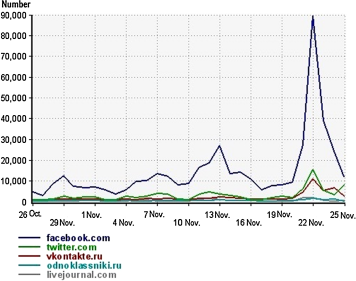
The spike in the number of visits from social networks to leading online news outlet Ukrainska Pravda on 21–2 November
It bears mentioning that although Facebook was only the tenth most popular website in the country as of October 2013, it was already the main Internet platform for discussing political news, and the primary source of visits to independent online media outlets in Ukraine (Minchenko 2013). When it comes to protests, online social networks mobilise people in the same way that offline social networks do: users are most motivated to join when someone from their own circle of friends decides to participate. Since Mustafa Nayyem was a popular journalist and because his call resonated with the general mood of social media users, his post collected thousands of likes and shares within hours, including those of other well-known journalists and activists. As the night approached, more and more Kyiv residents changed their Facebook status to ‘I'm going to Maidan’ or reported having already arrived at the square (Kapliuk 2013; Bohdanova 2013d; Savanevsky 2013).
This example illustrates that when conditions are right, social media can play a crucial role in facilitating the real-time mobilisation needed for a rapid and sometimes spontaneous action. Yet, questions of how effective such initiatives are or whether they can be sustained over time remain open. Below I shall argue that one of the reasons Euromaidan persisted as long as it did and ultimately resulted in the removal of President Yanukovych was activists’ clever use of ICTs for organising and sustaining the movement.
The revolution will be live-streamed, tweeted and posted on Facebook
The Internet does not only enable activists to effectively communicate with each other, but also allows them to communicate with a wider audience by either amplifying their message through the mainstream media or, where censorship exists, bypassing it altogether (Friedland and Rogerson 2009).
In the case of Euromaidan, Twitter was particularly instrumental in both helping protesters identify and connect with one another and in keeping wider audiences (including international observers) informed about developments on the ground (Barberá and Metzger 2013). In order to achieve this, activists used hashtags such as  (Ukrainian),
  (Russian), and #euro-maidan (English). The number of tweets with these hashtags in the first weeks of the protests gives a good idea of the scale of events. For instance, more than 8,000 tweets per hour were published on 22 November, the second day of the protests, and as many as 4,800 per hour on 30 November, the day of the first violent crackdown by the police (Texty 2013; Lokot 2013). However, according to media scholar Tetyana Lokot (2013), hashtags are only crucial during the first stage of organising, while activists consolidate their efforts online. In the case of Euromaidan, such consolidation was rather quick; within the first week, activists established ‘official’ protest Twitter accounts–-@euromaidan, @EuroMaydan, and @EuroMaydan_eng–-that rapidly accumulated tens of thousands of followers.
In turn, Euromaidan's newly established Facebook page set a record in Ukraine by having attracted more than 76,000 followers in just 8 days, and reaching more than 200,000 followers within the first 10 weeks of the protests (Savanevsky 2014). Euromaidan observers also noted a circular relationship between the social media, which helped to fuel collective action, and the protests, which, in turn, increased user demand for social media. Thus, the New York University Social Media and Political Participation lab recorded a spike in the creation of new Twitter accounts by Ukrainian users at the onset of Euromaidan (Barberá and Metzger 2013).
Yet, the communication efforts of Euromaidan activists might not have been so successful if Twitter, YouTube and other social media channels had not been amplified by traditional media outlets. In Ukraine, the key online news site Ukrainska Pravda provided updates and analysis on Euromaidan, while Radio Svoboda (Radio Free Europe/Radio Liberty); an online-based public television project, Hromadske.TV; and several other outlets offered ongoing live-streams of the protests (Savanevsky 2013). Because of its live broadcasts and interaction with viewers via social networks, Hromadske.TV was especially instrumental in providing timely updates and performing prompt fact checking to divert misinformation. In addition, some local and national television channels offered more or less balanced coverage of critical Euromaidan developments (although many others experienced censorship or provided skewed reports).
As for international coverage, activists used a variety of approaches to attract the attention of foreign media and to reach a foreign audience. These approaches included, but were not limited to, crowdsourcing prompt translations of the latest news about Euromaidan, 1 circulating viral video appeals to international viewers and organising ‘Twitter storms’ to bring Ukraine-related hashtags to the top of worldwide Twitter trending topics (Minchenko 2014b; Lokot 2014). An important role was also played by representatives of the Ukrainian diaspora, who helped increase Euromaidan's visibility and promote its message abroad (Bohdanova 2013b).
See, for example, Facebook (2013a) and (2013b).
Sustaining Euromaidan with crowdsourced ideas and resources
While Twitter, YouTube and Ustream were used to provide real-time information about the protests, Facebook became the main online platform for organising. Apart from the ‘official’ Euromaidan Facebook page and several of its regional counterparts, one of the most influential initiatives that used the social network was Euromaidan SOS ( SOS). Set up by human rights’ defenders and volunteers, Euromaidan SOS filled the continuous need for legal assistance and accumulated information about victims of government repression. As protests escalated and repression increased, the popularity of the page grew as well, garnering more than 21,000 likes within a week of its creation and climbing to nearly 90,000 by the end of 3 months (Bohdanova 2013a).
Following Euromaidan SOS, a number of other pages and websites have been set up to track the detained, find those gone missing during the protests or offer legal advice. 2 When the government failed to investigate instances of police brutality in a timely and transparent manner, activists also pooled photo and video records of the protests and called on the online community to help identify particular police officers and demand justice (Bohdanova 2013c).
See, for example, Facebook (2013c) or (2013d).
Another group that offered continuous assistance and used Facebook for some of its initial organising was the Euromaidan volunteer medical brigades, which later evolved into a full-fledged medical service and ended up saving the lives of people on all sides of the standoff (Bohdanova 2013a). Not only did such groups provide protesters with real-time help in the most pressing situations, but they also instilled in activists a much needed sense of solidarity and mutual support (Demchuk 2014).
However, it was the use of social media and other ICT tools for crowdsourcing physical and creative resources that was the most crucial for sustaining Euromaidan over a long period of time. Thus, activists made use of crowdmapping technology to visualise Euromaidan needs and connect those willing to fill them with protesters on the ground. 3 After one Kyiv-based NGO successfully pioneered collecting donations through the Internet to ‘help keep Euromaidan warm and fed’, activists began actively using online fund-raising (Yaroshchuk 2013).
See, for example, MaydanNeeds (2014) or Galas (2013).
It is unclear whether all of the activists who used ICT tools to help Euromaidan had had previous organising experience, but their technological skills allowed them to become visible and influential participants of Euromaidan nonetheless. Such was the case of IT Tent (IT hamet), a physical tent originally set up to offer free Internet access and computer equipment to protesters, which later evolved into a space where technology specialists met and collaborated with professional activists on a number of ICT-enabled social projects (Ukrainska Pravda 2013). 4
See, for example, IT-Namet (2013).
In addition to pooling physical and financial support, Euromaidan activists also tapped into people's creative resources and solicited ideas for actions, posters and slogans that were instrumental in keeping the movement going. Among the most active were the online/offline information centre Don't Ditch Maidan ( ) that aimed at keeping protesters motivated; the Euromaidan Civic Sector that promoted ideas of non-violent civil resistance; a group of designers, Strike Placard (
 ), who created and circulated free Euromaidan posters; and an online initiative of creative professionals called I'm a drop in the ocean (
 ) that designed posters, videos and a website about Euromaidan.
5
It was the last group that coined the idea that everyone's small contribution (‘a drop’) counted toward the achievement of a common goal, which helped inspire many to continue standing up against a powerful governmental machine (Ukrainiska Pravda 2014, Bohdanova 2013a).
) that designed posters, videos and a website about Euromaidan.
5
It was the last group that coined the idea that everyone's small contribution (‘a drop’) counted toward the achievement of a common goal, which helped inspire many to continue standing up against a powerful governmental machine (Ukrainiska Pravda 2014, Bohdanova 2013a).
See I am a drop in the ocean (2013).
The limits of technology in Euromaidan and a word of caution for social media enthusiasts
Although participants of the first Euromaidan rallies were mobilised through the social media and ICT tools played an essential role in growing and sustaining the movement, it is important not to overestimate the role of technology. As demonstrated by some of the preliminary research on Euromaidan, it was not social media but offline social ties, however amplified by online social network, that were crucial in bringing people to the streets. Thus, most protesters relied on telephone calls, e-mails and personal contacts rather than on Facebook or other online social network invitations when deciding to join the movement. The average age of protesters, 36, also indicates that some media reports and observers’ conclusions about Euromaidan being a social media–fuelled revolution of the ‘millennials’ might have been premature (Onuch 2013).
Moreover, once a critical number of people did join the protests, on many occasions it seemed that Euromaidan lacked a clear vision and a strategy for moving forward. Observers of online social movements note that the absence of leadership and clearly defined goals are particular challenges faced by a majority of ICT-enabled collective actions. These challenges result from the nature of online organising, since Facebook and other social networks are built to create loose, decentralised networks and not the hierarchical organisations capable of quick decision-making. Thus, once the critical mass of people is mobilised to participate in the protests, the lack of a centralised leadership and clear lines of authority can become real obstacles in reaching consensus and setting coherent goals (Gladwell 2010).
Euromaidan also faced this particular challenge. Although to an outside observer it might have seemed that the protests were led by a group of three opposition leaders, in reality the movement struggled with creating a functioning leadership body and formulating a list of clear demands for the authorities. On numerous occasions it seemed that the movement would fragment and die out without achieving anything (Pohlyad 2014). And while various grass-roots initiatives did help sustain the movement over time, including those enabled through social media, some observers noted that the activists were frequently busier keeping the square clean or organising various activities than trying to exert any real pressure on the government (Salamaniuk 2013).
The inability of such loosely connected movements to think strategically poses yet another threat: radicalisation. In fact, some of the bitter January clashes between Euromaidan protesters and the police were sparked by the failure of political leaders to offer any meaningful course of action against escalating government repressions.
Conclusion
Social media enthusiasts may be right to praise technology for the quickness and ease it allows in mobilising a large number of people, which was true for Euromaidan, especially in its early rallies. In the case of Ukraine, social media also allowed activists to keep each other informed, amplify their message in traditional media and organise many activities to help sustain the movement. However, before becoming Internet optimists, we must keep in mind that online organising also poses a set of serious challenges. Euromaidan has managed to overcome some of them and achieve its ultimate goal of ousting President Yanukovych, albeit at a great human cost. This does not mean that all social media–enabled movements are bound for success. After all, technology is only an instrument; it does not necessarily guarantee a specific type of outcome.
Footnotes
References
 [Angels of the revolution. Euromaidan SOS covered protesters’ backs and gave assurance]


 ]
] 


 [Which websites do Ukrainians use?]
 YouTube [I am a Ukrainian: A video about events in Ukraine has been viewed by eight million YouTube users]
 [Final outcomes of an intermediate ‘uprising’]
 [Self-organisation of Maidan is impressive. However, activists are busier improving their protest site than achieving victory]
 [#Euromaidan: Ukrainian digital revolution is the last chance for analogue politicians to go digital]
 [10 numbers about Ukrainian Facebook that you may not have known]

