




Abstract
This article explains the public engagement of the Catholic Church in Poland in the post-Communist period (from 1989 to approximately 2015) as a symbolic challenge to the state. It draws on Simon Harrison’s theory of symbolic conflicts—conflicts over symbolic capital—applied to power struggles involving religious actors in contemporary political systems. The Polish Church engaged in a valuation contest against the state in which it tried to champion its own religious interpretation of several key elements of Polish statehood and national identity using items from its own symbolic arsenal, including the notion of Pole-Catholic and an emphasis on the Christian origins of Poland. Similarly, by solemnizing state ceremonies with religious symbolism and politicizing the cult of religious figures, the Church sought to sacralize the public sphere. Although these challenges to the symbolic inventory of the state have not led to its total replacement by a competing set of religious symbols, the series of low-intensity conflicts generated a considerable amount of symbolic capital for the Church and contributed to maintaining its authority as a value-based public actor. This, ultimately, helped in sustaining the Church’s political leverage throughout most of the post-1989 period, well into the second decade of the twenty-first century. It is only in the last few years that the Church’s support for a more stringent abortion law, the scandals connected with sexual abuse by the clergy and its concealment by the hierarchy, and questions over Pope John Paul II’s moral integrity have considerably harmed its public image.
In post-Communist Poland, the Catholic Church has usually been portrayed as functioning in a political alliance, or at least on friendly terms, with the government, whatever its partisan composition. 1 Indeed, the Church 2 has been able to preempt a strict church–state separation for a much less hostile relationship and to realize much of the agenda of its value-based politics, as well as safeguard its material well-being and privileged status among religious communities. 3 While largely concurring with these conclusions, I argue, complementarily to such accounts, that the relative success of the Church as a political actor was predicated on conflict as much as on friendly cooperation: by engaging in a series of symbolic conflicts in which it challenged the secular state for the position of the true bearer of Polish national identity, the Church has been able to retain, in the decades after 1989, a substantial share of the symbolic capital it generated during the Communist era. This, in turn, made it possible for the Church to remain a force to be reckoned with in Polish politics and an influential public actor.
While public opinion polls confirm what is obvious to any observer of Polish public life, namely that the Church’s reputation has recently suffered serious erosion, the decline began only in the late 2010s. In fact, longitudinal data reveal that positive evaluations of the Church prevailed over negative ones throughout the entire post-1989 period, up to 2020. 4 Also, quite significantly, public approval of various expressions of the Church’s presence in the public realm was actually highest in 2005 and 2009, and not immediately after the democratic transition. 5 This shows that, in reality, the Church succeeded in generating symbolic capital well into the post-Communist period and, to some extent, reversed the downward trend in its public approval visible in the 1990s.
In what follows, I employ Simon Harrison’s conception of symbolic conflict to explain and interpret some of the Church’s public activity in post-1989 Poland as a contest for symbolic capital. I begin with Harrison’s typology of symbolic conflict, set against Pierre Bourdieu’s theoretical framework of types of capital and social spheres in which these “capitals” are employed in the struggle for power. Following an overview of the public activity of the Church qua political actor in post-1989 Poland, I apply Harrison’s typology to two case studies—symbolic contests over national identity formulas and the sacralization of the public sphere—which illustrate the kind of low-profile, protracted conflicts the Church engaged in against the state. In the final section, I recapitulate and attempt to assess to what extent these challenges were successful and how they contributed to the Church’s political influence.
Theoretical Framework: Harrison and Bourdieu 6
The cultural anthropologist Simon Harrison distinguishes four types of symbolic conflict—defined as conflict over symbolic capital—in which actors attempt to (1) enhance the value of their set of symbols (symbolic inventory) in relation to a competitor’s symbols (valuation contests); (2) appropriate or claim ownership of a contested symbol or symbols (proprietary contests); (3) create and promote new symbols (innovation contests); or (4) displace the symbols of the rival actor with their own symbolic inventory (expansionary contests; see Table 1). 7 Symbolic conflict is, thus, a power contest waged by means of manipulating symbolic capital, which, for Harrison, is inherently a political asset because it is exchangeable for prestige, status, and power. 8
Four Types of Symbolic Conflict
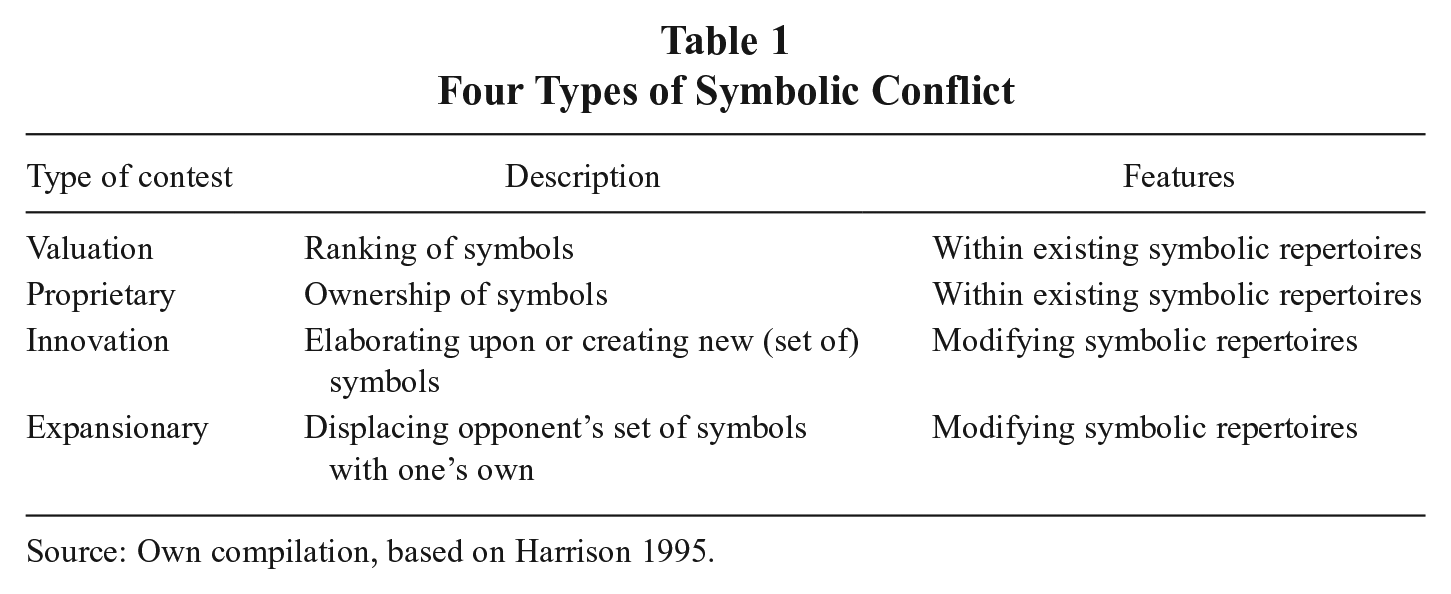
Source: Own compilation, based on Harrison 1995.
While the typology originates from anthropology, it can be fruitfully applied to symbolic conflicts involving religious actors in contemporary states. According to Harrison, the role of religion in symbolic conflicts is twofold: it supplies the repository of symbols, and it may itself become a part of an identity. 9 However, religious organizations in their capacity as political actors may also become symbolic contenders themselves. Thus, in a departure from Harrison, who links these contests mostly with ethnic/national divisions and identities, I apply the concept also to inter-group power struggles within ethnically homogeneous societies. Accordingly, such conflicts need not have far-reaching, state-creating, or highly disruptive consequences, 10 as often happens when representing opposing ethnic identities is at stake. In this way, the theory becomes useful for the analysis of the political behavior of non-state actors such as churches, who may engage in low-stakes, less disruptive challenges over the value of their symbolic arsenal vis-à-vis the state and other secular actors.
The concept of symbolic capital, on which the notion of symbolic conflict is predicated, is borrowed from the work of Pierre Bourdieu, whom, however, Harrison references without employing his entire theory. For Bourdieu, various forms of capital pertain to distinct social spheres (economic, cultural, social, political, etc.), but they are all linked to power insofar as they all constitute means of social stratification. Within this framework, symbolic capital “designates the social authority to impose symbolic meanings and classifications as legitimate.” 11 The struggle for political power takes place within the field of power, understood as “the space of play within which the holders of capital (of different species) struggle in particular for power over the State.” 12 The field of power is thus “a sort of “meta-field” that mediates and organizes the struggles that take place in the range of differentiated fields” 13 —a rough equivalent of the concept of a political system—to which actors bring and use (broker, exchange) various forms of capital produced in their respective fields.
Although the relationship of various forms of capital to political power in Bourdieu is complex and often unclear (he talks about political capital, statist capital, symbolic power, etc.), the notion of the political field is useful for conceptualizing the role of various social actors, especially those whose primary concern is not political—such as churches—in politics. A struggle for symbolic power is also “a classification struggle, over the right to monopolize the legitimate definition of what is to be the most valued form of capital for a particular field” 14 —somewhat similar to Harrison’s valuation contest. In our case, the Catholic Church is trying to bring religious ideas to bear on notions of nation, state, and national identity, thereby increasing the value of “religious capital”—a type of symbolic capital specific for religious organizations 15 —in the state/political field. And as, fundamentally, all forms of capital are mutually exchangeable, 16 the accumulation of symbolic capital may translate into the Church’s improved economic position and increased political influence.
The Catholic Church in Polish Politics
Despite the early predominance of a legal-constitutional perspective, viewing the public role of religious organizations in terms of institutional models of church–state relations, 17 the Roman Catholic Church in Poland has drawn the increasing attention of political scientists. From their perspective, the Church is a political actor, interacting with other actors within a pluralistic political system in the pursuit of its goals, both this- and otherworldly. 18 These goals have included creating a legal-institutional environment facilitating the Church’s public activity; safeguarding its material survival; and, ultimately, implementing its axiological agenda. The strategies employed by the Church throughout the post-1989 era have ranged from sponsoring political parties and supporting electoral candidates, to lobbying decision-makers and mobilizing its supporters behind salient political issues. 19
Not all of these strategies have proved equally effective for the Church. The attempts at creating its own party or allying closely with a single party in the 1900s largely failed and even backfired, insofar as such efforts were generally disapproved of by public opinion. 20 Lobbying was no doubt successful at times, especially in constitutional debates in the mid-1990s and in settling the financial claims of the Church. The institution’s most effective strategy, however, has been to act as a value-based public actor with a right to proclaim its stance on moral issues of public concern while avoiding an attachment to any particular political party. This is consistent with the public’s general approval of the Church taking position on public issues, as long as they are moral and not strictly political. 21 The Church can take advantage of this attitude by skillfully employing this distinction (however unclear it may be in principle) and thus clothing its political involvement in axiological terms. As a consequence, it managed to retain, at least until the late 2010s, much of the authority and trust it enjoyed under Communism.
Institutionally, the political engagement of the Church was made possible by the constitutionalization, in 1997, of a model of “autonomy,” “mutual independence,” and cooperation between church and state 22 rather than their strict separation. In addition, the process of post-Communist transformation, with the young democratic state searching for new self-definitions and symbols to replace those of the Communist past, created an especially favorable setting for this kind of strong public presence of the Church.
It is within this institutional-normative framework, augmented by a volatile multiparty system, 23 making parties more prone to seek the support of non-partisan organizations, that the Church has been able to challenge the government as the ultimate public authority on value-laden public issues ranging from reproductive rights to the meaning of Polishness and the nation’s identity. In what follows, I seek to focus on less visible conflicts that, unlike the highly publicized issues of abortion, in vitro fertilization, or LGBTQ (lesbian, gay, bisexual, transgender, queer or questioning) rights, do not pit the Church against large segments of the population or major political parties. Instead, these contests play out within a seemingly symbiotic relationship between the Church and the state, with the Church attempting to promote its interpretation of certain aspects of Polish statehood and nationhood, thereby expanding its share of symbolic capital relative to the state.
Two clarifications are in order here. First, when referring to the “state” in the context of symbolic contests with the Church, I do not identify the term with any particular government organ or a ruling party. Rather, the “state” is the institutional embodiment of the political community, as well as its symbolic point of reference: the bearer of its identity, guardian of its symbols and myths, creator of its self-descriptions and perceptions, interpreter of its history. In this capacity, the “state” competes with alternative creators of meaning and symbols—in our case, the Catholic Church—aspiring to perform the same functions for the political community (the nation).
Second, framing the relations between the Church and the state in terms of conflict, especially when these relations are generally perceived as fairly symbiotic, naturally raises the question of cost and benefit: why would it be in the Church’s interest to challenge the state, given its seemingly strong hold on public opinion and already significant influence on social and political life? The answer is twofold. To begin with, the Church’s hold on public opinion is rapidly diminishing, especially in younger generations—in fact, Poland leads the world in the magnitude of a generational gap in religiosity. 24 In addition, individual morality, as opposed to public norms and values, has long been beyond the Church’s reach, with only 13 percent of Poles treating God’s law as a source of moral norms 25 and the vast majority ignoring Catholic sexual ethics, including its restrictions on premarital sex and contraception. 26 Thus, to counter this double trend of a generational gap in religious practice and the radical secularization of individual morality, the Church has had to reinforce its public moral authority on symbolic grounds. 27 So far, the emptying pews have not precluded the continued influence of the Church on the definition of national identity and its symbolic expression.
Perhaps even more fundamentally, the Church needs to constantly assert its position as an independent source of public moral authority, and especially the pillar of national identity. It presents itself as a value-based public actor, grounded in a unique ideology (divine law, Catholic social teaching, etc.) whose source, in contrast to the secular ideology of the contemporary democratic state, is external and thus non-arbitrary, raising it above the political fray. This way it can avoid privatization—getting pushed out of the political system and relegated to a purely religious function—the fate of the Catholic Church in some other countries of the region, most notably the Czech Republic. And, even if it retains its political legitimacy, it must beware of allying too strongly with any particular party or coalition, as the Church’s public image may be compromised when this partisan actor falls out of favor. 28 In sum, it is in the interest of the Church to assert its independent public position and distance itself from both the secular ideology of the state and close partisan alliances. Small-scale symbolic contests against the state are a way to achieve this in a low-risk manner (without the danger of state repression or significant public backlash).
Thus, importantly, to present the relationship between the Church and the state in contemporary Poland in conflictual terms is not to imply that they have been active political opponents. On the contrary, most of the time ruling coalitions from the entire political spectrum, and especially the right-to-center Prawo i Sprawiedliwość (Law and Justice) government, have remained on generally friendly terms with the Church, trying to satisfy some of its demands (both ideological, such as restrictions on abortion or in vitro fertilization, and financial) and stave off its criticism. But this has been so precisely because, in a series of symbolic micro-conflicts, examples of which will be discussed below, the Church has succeeded in maintaining its claim to serve as the nation’s moral guardian and the keeper of its identity. It has never abdicated this role despite ultimately accepting an institutional and functional separation between the Church and the state and despite the aforementioned recent decline of the public’s trust in the Church.
It must be noted, finally, that the political use of religious ideas and symbols is by no means restricted to religious actors. Political parties and government institutions tend to instrumentalize religion whenever they ally with religious organizations, and Poland is no exception. As a matter of fact, such instrumentalization is a part of the deal the political effectiveness of the Church rests on: the Church can realize its goals (i.e., be politically effective) partly because it offers something in return to secular actors: ideological support, legitimacy, or mobilization potential.
The following two case studies illustrate the two areas in which the Church has sought to accumulate symbolic capital in the post-Communist era: the definition of national identity and the sacralization of the public sphere through infusing state ceremonies with religious elements and appropriating political symbolism in the cult of religious figures.
Pole-Catholic: The Identity Fusion
According to Anna Grzymała-Busse, the fusion of religious and national identities has been the key factor in perpetuating the Church’s political influence in Poland: by maintaining its high authority and trust in the eyes of the public, the Church has retained institutional access to decision-making. 29 The identity fusion discussed by Grzymała-Busse is epitomized by the idea of Pole-Catholic (“Polak-katolik”). “Pole-Catholic” is a traditional identity formula dating back to the nineteenth-century period of partitions, when confessional affiliation served as a shorthand for national identity, especially in the Russian- and German-occupied territories. The idea has been promoted by the Church and secular Catholic authors by describing Poles as a Christian nation from its very inception and highlighting the role the Catholic Church played in preserving national identity during the partitions and supporting anti-regime opposition under Communism. “The Pole-Catholic” formula is not merely based on the demographic prevalence of Catholics or the strength of the institutional Church; “rather, it is supported by a deeply ingrained but highly exclusionary telling of national history” 30 that tends to ignore or downplay both the religious diversity of pre-partition Poland and the wealth of secular historical and cultural factors that shaped the nation’s identity.
A major component of the kind of historical narrative enhancing this identity fusion is the issue of the “baptism of Poland.” Although the importance, both religious and political, of the baptism of Mieszko I, the duke of Poland in 966, has been widely accepted, the unequivocal equation of the origins of Polish statehood with the “baptism of Poland,” on which the Church has insisted, is by no means obvious. 31 Historically, while Mieszko I’s accepting baptism was no doubt a politically significant event, indicative of the country’s absorption into Christendom, 32 it is just one among many such events that could be symbolically appropriated as “the beginning of Poland.” 33
The controversy found its political expression in the 1950s, when the Church announced a nine-year cycle of celebrations (the Great Novena) leading up to the 1000th anniversary of Mieszko’s baptism in 1966, with large-scale, country-wide religious and patriotic ceremonies. 34 This challenged the Communist government to organize its own commemoration, carefully omitting any reference to “baptism” and presenting the event as the celebration of the millennium of Poland, culminating in the present period of development and progress. Whereas the Church insisted on the primarily religious significance of the occasion, presenting Christianization as fundamental for the entirety of Polish history, the state, predictably, downplayed the religious factor, 35 although, ironically, it found itself forced to accept the date itself—966—as the symbolic beginning of Poland.
No such distinctions were invoked fifty years later, when the 1050th anniversary of the baptism was celebrated in democratic Poland. According to the Poznań Archdiocese, the main organizer of the jubilee celebrations, Mieszko’s baptism “inaugurated both the history of the Church on Polish territories, and Polish statehood.” It also facilitated the “symbiotic coexistence of both institutions: the Church and the state,” and the baptism constituted “an unerasable seal of identity of the Polish nation.” 36 The Polish Parliament followed suit, both chambers officially recognizing 2016 as the “jubilee year of the 1050th anniversary of the Baptism of Poland” 37 and fully sharing, in their proclamations, the Church’s view of the fundamental significance of Christianity for Polish history and national identity. Accordingly, the 1050th anniversary was commemorated in full harmony between Church and state, with top state officials, including the president, in attendance during the largely religious celebrations in the cathedral churches of Gniezno and Poznań. Perhaps even more significantly, the Church’s message found fertile ground in public opinion, with 88 percent of the respondents convinced that the baptism was an important political, not just religious event. 38 In this way, the baptism issue reinforced the identity fusion, incorporating the religious ceremony into the state’s founding myth. While the actual symbolic contest took place six decades ago against the Communist regime, today’s acquiescence by the population and politicians is the consequence of the Church’s past success. 39
Invoking this heritage in recent years, the hierarchs insisted on championing Catholicism as the main ingredient of the nation’s identity, warning that its rejection would weaken national feelings, question the nation’s identity, and even jeopardize its sovereignty. 40 In its post-1989 incarnation, however, the Pole-Catholic is no longer a reaction to an external (the invaders) or internal (the Communists) enemy. Rather, it guards the nation against secularization and other cultural threats. According to Primate Cardinal Józef Glemp, secular values are no alternative, as they are not rich enough to provide a firm foundation for social and political life. 41 In a similar vein, Archbishop Stanisław Gądecki, head of the Bishop’s Conference of Poland, declared in 2014 that “the Church ought to be the soul of the state. Without the spiritual values it provides, the state’s body dies out. The two institutions depend on each other.” 42
This is not to suggest that the indispensability of religion for Polish national identity—the essence of the Pole-Catholic formula—is the sole, universally shared identity model. On one hand, some 64 percent of Poles were convinced in 2016 that it is very or somewhat important to be Catholic to be truly Polish. 43 On the other hand, when asked to choose the two most essential components of national identity, the respondents consistently picked self-identification and citizenship most frequently, with only 14 percent (in 2005) and 7 percent (2015) choosing “being Catholic” among the two. 44 Similarly, in a survey of the criteria of Polishness conducted every ten years by OBOP, the Catholic faith ranks a distant tenth in the percentage of respondents who consider a particular criterion very or rather important for being Polish. Only about half were convinced of the importance of religion, while around 90 percent thought language, self-identification, and familiarity with Polish culture and history are very or somewhat important. 45
These results seem to indicate that Pole-Catholic does not have to be the only game in town and that there exists the potential for an alternative, secular identity formula subscribed to by the majority of the population. It consists of civic-political (citizenship), biological (parental nationality), and cultural (language, tradition) components, as well as self-identification. This sociological decoupling of national identity from religion fails to translate, however, to a coherent secular identity narrative, juxtaposed in the public debate to the religious formula or consistently championed by a major political force. The left-wing parties, while challenging the presence of religious symbols in the public sphere or particular interventions by the Church in politics, can rarely come up with a constructive, coherent alternative to the identity fusion promoted by the Church. Thus a purely secular identity, lacking adequate ideological and symbolic expression, largely disappears from view. Despite secularization trends and the selective approach to Catholic morality, in the opinion of Lech Nijakowski “‘Pole-Catholic’ is an important discursive complex,” unlikely to be replaced by a secular identity discourse in the years to come. 46
Sacralization of the Public Sphere
José Casanova’s observation that, because of “the strong hold the church appeared to have over the public mind of the Poles on so-called national issues [. . .] Polish Catholicism historically has served more as a public civil religion than as a private religion of personal salvation” 47 certainly continues to ring true. The Church has sought to keep the public sphere in its area of moral competence, so to say, extending its normative authority beyond purely religious matters. 48 Symbolically, this effort has found its expression in state ceremonies being accompanied by religious events with the participation of public officials; propitiatory prayers in state settings 49 ; the parliament commemorating religious holidays (often overlapping with major national holidays), Catholic saints, or dates connected with Pope John Paul II; and the Church appropriating the insignia of political power for religious figures (Jesus Christ). But this also includes less spectacular, day-to-day attempts at infusing public life with religious meanings and symbols, such as Catholic priests dedicating everything from new public buildings, ships, and statues to military equipment and government vehicles; crosses adorning the walls of many public buildings, from classrooms to the main hall of the Sejm (lower chamber of parliament); and the clergy attending all sorts of local events, be it the inauguration of a school year, the starting of a new business, or harvest celebrations.
Such activities have led to actual political conflicts, both over particular symbolic actions and, more generally, over the extent of religion’s presence in the public realm. An example of the former is the issue of a cross in the main Sejm hall, hung by two right-wing MPs in 1997 under cover of night. The action, not authorized by the entire chamber, was unsuccessfully contested by Sojusz Lewicy Demokratycznej (the Democratic Left Alliance). Subsequently, over a decade later in 2011, Janusz Palikot and Roman Kotliński, the leaders of Twój Ruch (Your Movement), another left-wing party, demanded that the cross be removed and sued when the Sejm speaker refused. The court found the cross did not violate the constitution or other regulations, but the issue continued to be brought up by left-wing critics of what they perceived as undue sacralization of public spaces and a violation of church–state separation. 50
The controversy that perhaps best illustrates the contest for the symbolic control of the public domain was the issue of the intronization of Jesus Christ. The “intronization” idea, it must be noted, is not entirely new. It originates from the cult of the Heart of Jesus, initiated by a seventeenth-century French mystic, later canonized, Margaret Alacoque. Its Polish version was propagated by the nurse Rozalia Celakówna, who received a number of revelations between 1938 and 1941 calling on the nation to, variously, submit to the protection of the Holy Heart or to enthrone Jesus Christ. 51 Such acts were performed at various times, usually at dramatic turns in a nation’s history, both in Poland and elsewhere. In Poland, the episcopate entrusted the nation to Jesus’ Heart in 1920 and 1921, during the war with Russia, and then again in 1951, under the leadership of Cardinal Stefan Wyszyński. 52
The idea resurfaced in democratic Poland. In 2006, a group of Catholic MPs to the Sejm proposed a motion to “bestow on Jesus Christ the title: Jesus the King of Poland,” arguing that Poland should become “the real kingdom of Jesus and Mary.” 53 Although the proposal failed, the “intronization movement” gained considerable momentum within the Polish Church, with a number of Church-affiliated and secular organizations supporting the effort. 54
The initial reaction of the hierarchy was discouraging: in the pastoral letter “On the reign of Christ” in 2012, the episcopate conference considered the idea of Christ’s Kingdom spiritual and otherworldly, with the human nomination adding nothing to the glory of Christ. It is also no remedy to the country’s problems: “To think that just by declaring Christ the King of Poland things will improve right away—contended the bishops—is an illusion and it is harmful to the understanding and realization of Christ’s salvation in the world.”
55
However, the backlash from the intronization movement made the hierarchy reconsider its position.
56
Soon, the bishops joined the effort, culminating in the 2016 “Jubilee act of recognizing Jesus Christ as King and Lord.” The act was read during the celebrations of the 1050th anniversary of the “baptism of Poland” in the Łagiewniki Sanctuary in Kraków,
57
in the presence of several top government officials, MPs, and the President of Poland. While the act did not expressly speak of the intronization of Christ as the “King of Poland” (but merely as the King), its political ramifications are pretty obvious:
We, the Poles, stand in front of You (together with our religious and secular authorities) to recognize your Reign, submit to Your Law, and to entrust and commit our Fatherland and the whole Nation to You [. . .]. We affirm your reign over Poland and our whole Nation, both in the Fatherland and abroad.
58
The act differed from the previously mentioned ceremonies (in the 1920s and in 1951) in two important respects. First, the latter were entirely ecclesiastical affairs, without the active participation and, in the case of the 1951 act, against the wishes of the state. The 1951 act was thus also, under our interpretation, a symbolic challenge to the state, but not an entirely successful one. The 2016 intronization act, by contrast, was approved of and attended by the top state officials, making it, in the perception of many, a quasi-state ceremony. Second, the content of the 1920 and 1921 acts, similarly to other such ceremonies elsewhere, 59 entrusted the nation to the protection of the Heart of Jesus, rather than enacting Christ’s intronization as such. Whether or not the difference is significant theologically, kingship remains an important political symbol, pertaining to the “political field,” with its symbolic domain occupied by the state and perceived as such by the general public.
In addition to the debate within the Church (where the initial reservations gave way to approval under pressure from lay Catholics and after Bishop Andrzej Czaja was appointed the head of the episcopate’s committee for intronization movements), the intronization ceremony sparked public controversy that centered around the symbolic meaning of the act. In particular, three major concerns were raised by left-wing politicians and the liberal media:
(A) That the intronization contributes to the establishment of a confessional state, cementing the alliance between the throne and the altar and according preferential treatment, at least symbolically, to the Catholic majority. 60 To the Catholic commentators, these charges are groundless: the act is a Church document that has no effect on the state law, church–state relations, or the actual situation of the citizens, regardless of their religious affiliation. 61 The Church has a right to proclaim the universal validity of its teaching, as applicable to all spheres of life, including public and political domains. 62
(B) That the Church appropriates the nation, speaking on its behalf, and claims to represent it before God, including the non-religious or non-Catholic Poles, which, in fact, leads to more division rather than unity. 63 This problematic formulation (“We, the Poles”) caused some uneasiness also among the supporters of the intronization, who, however, proposed to interpret the declaration as a prophetic act rather than as a political proclamation 64 or as a protest against the liberal notion of privatization of religion. 65
(C) That the presence of state officials, and especially President Andrzej Duda, gave the ceremony a quasi-state character (although it was organized by the Church). This was apparently a concern even for some of the ruling coalition politicians, such as Deputy Prime Minister Jarosław Gowin, who insisted that Andrzej Duda attended privately, not in his official capacity. 66 Interestingly, a similar disclaimer was made by Archbishop Stanisław Gądecki, head of the Polish Bishops’ Conference. 67 The president’s own position is not entirely clear, however: his speaker Marek Magierowski confirmed that Duda’s attendance was official and that he “participated as the head of state, thereby expressing his respect for the role of the Catholic Church in the history and social life of our country.” 68
Discussion
In Harrison’s terms, the conflict over the national identity formula was a case of a valuation contest. By selectively invoking its historical role and portraying the purely secular definitions of Polishness as inadequate and non-genuine, the Church sought to establish Catholic affiliation as the critical, indispensable component of Polish national identity. Interestingly, whereas the sacralized vision of national identity holds firm among the Church’s most devoted members, 69 the majority of the population regards secular cultural, biological, and civic components as essential to Polishness. This potential, however, fails to translate to a coherent identity narrative capable of replacing the Pole-Catholic formula.
When it comes to the sacralization of the public sphere, the Church’s efforts to extend its influence over the public domain had the features of valuation and proprietary contests. With little formal regulation to this effect, the Church largely succeeded in making religious symbols and the presence of religious functionaries an indispensable component of many public/state occasions. This ritual appropriation of public ceremony complements ideological claims with respect to national identity described above (Case 1)—the political ritual being an expression of a state’s legitimation formula. 70 In the intronization ceremony, the Church appropriated the symbol of state authority—kinghood—and conferred it upon a figure from its own symbolic universe. In a fashion typical for identity fusion, the bishops declared themselves “religious authorities” of all Poles, entitled to speak on behalf of the entire nation (including emigrants) and to submit it to the power of the supreme religious figure of their Church. The fact that this elicited no rebuttal from the secular authorities who legitimized the whole event by their attendance and expressions of piety 71 suggests that the Church prevailed in this symbolic contest. The intronization case has also features of an innovation contest: the symbol was reinvented, “recycled” in a sense, as Poland had not been a (sovereign) monarchy since the late eighteenth century.
Public opinion polls provide some evidence as to the social impact of these symbolic contests over the religious versus secular character of important elements of the public sphere. The majority of Poles “do not feel offended” by crosses in public buildings, the religious character of the military oath, religious (non-compulsory) education in public schools, bishops attending state ceremonies and dedicating public buildings, and clergy appearing on TV, with the rates of acceptance ranging from 87 percent for crosses down to 59 percent for priests in TV programs. Significantly, these rates have been fairly stable recently, with only slight decreases between 2013 and 2021. 72 On the other hand, as Mirosława Grabowska, the author of the report, notes, “not feeling offended” by something is not the same as fully approving of it: if asked whether they actually want religion to be taught in public schools or bishops to participate in state ceremonies, not all of those “not offended” would respond in the affirmative. 73 However, the results show at least a passive acceptance of the Church’s symbolic presence in the public sphere, making religious symbolism and Church representatives permanent features of Polish civic culture.
In the realm of party politics, the symbolic capital created by the Church was instrumentally used by center and right-to-center parties seeking the support of the clergy. On the other hand, opposition to what was perceived as the growing symbolic presence of religion in the public sphere, as well as the actual political influence of the Church, has provided a mobilization potential of approximately 10–15 percent of the electorate. A succession of political leaders generated significant amounts of political capital and were elected on an anticlerical agenda between 2011 and 2015, most notably Janusz Palikot, the leader of Ruch Palikota (Palikot’s Movements, later changed to Twój Ruch—Your Movement) and Ryszard Petru, the leader of Nowoczesna (the Modern Party). 74 More recently, anticlericalism is on the agenda of segments of Nowa Lewica (the New Left), especially Robert Biedroń’s Wiosna (the Spring) and Adrian Zandberg’s Razem (Together). These parties’ platforms contain either direct demands for the Church’s withdrawal from the public sphere (e.g., a ban on religious instruction in public schools, cutting various forms of financing of the Church from the public coffers) or a challenge to important parts of Catholic social teaching (e.g., introduction of same-sex marriage, liberalization of abortion laws). For instance, the platform of Nowa Lewica demands the neutrality of public institutions (by removing religious symbols), banning religious instruction from schools, liquidating the Church Fund, removing chaplains from public institutions, terminating the concordat, and safeguarding the secular character of public ceremonies, among other points. All in all, as of 2022, the strictly anticlerical electoral agenda, demanding a radical withdrawal of religion from the public sphere, has attracted somewhat limited electoral support. This, however, is likely to change in the coming years due to both generational factors and criticism of the Church becoming more mainstream and open. This concerns issues such as the Church’s conservative sexual ethics, the concealment of sexual crimes in its ranks, and the alleged role of Pope John Paul II in this institutional cover-up. 75
Conclusion and Further Research
Using Simon Harrison’s modified conceptualization of symbolic conflict, the article discusses proprietary and valuation contests over symbolic capital between the Catholic Church and the state. These have been mainly low-intensity conflicts playing out within a seemingly symbiotic relationship between the Church and the state. They have concerned the religious versus secular definition of Polish national identity (with the Church insisting that religion is an essential part of Polishness and that Christianization marked the origin of the state) and the sacralization of the public sphere, both by the fusion of religious and secular symbolism in public ceremonies and by the cult of religious figures clothed in insignia of earthly power. As a result, the Church has been largely successful in promoting its interpretation of certain aspects of the Polish state and nationhood, thereby expanding its share of symbolic capital relative to the state. The Church has thus generated, in Bourdieu’s terms, a considerable amount of religious capital, which it has then brought to the field of power in an attempt to reinforce its political influence.
The plausibility of interpreting certain public activities of the Church as symbolic conflicts against the state, many of which have been decided in the institution’s favor, does not ultimately settle the question to what extent the Polish Church has been able to maintain its public authority and political influence. To make such an assessment more precise in future research, it may be useful to break down the evaluation of the Church’s success into (a) capital generation: the amount of symbolic capital it has been able to accumulate (by producing or retaining it from previous periods); and (b) the ability to use this capital politically to its advantage. This is in keeping with the essentially economic interpretation of symbolic capital Bourdieu employs (suggested as it is by the very metaphor of “capital”) and his conviction that all forms of capital are, ultimately, exchangeable and that it is thus appropriate “to extend economic calculation to all the goods, material and symbolic.” 76 The ability to “produce” capital is thus analytically distinct from the ability to effectively convert it into power and influence. The capital generated in the course of these low-profile symbolic confrontations over the definition of national identity and the place of religion in the public sphere could subsequently be invested in major conflicts, fundamental for the Church’s moral teaching, such as the abortion controversy, or for its institutional interest, such as the controversy over the model of church–state relations (including constitutional provisions, the concordat, and the issue of Church finances). 77 As these major issues themselves have little capital-generating potential—they are socially divisive and, in pursuing them, the Church cannot present itself as the guardian of the nation—it has had to rely on the capital accumulated from the types of conflicts described above to mobilize public support.
When it comes to operationalization of these two aspects, stage (a)—capital generation—could be measured by the public’s trust in the Church, while stage (b)—the “spending” or “investing” of capital—by the institution’s ability to influence decision-making: to promote or block legislation, impose its ideological stances on issues fundamental from the Church’s perspective, and thus, ultimately, attain its goals. As a rough indication of the Church’s relative success on the first count, trust in the institution remained consistently above 50 percent from the mid-1990s up until 2019. 78 As regards the Church’s political influence (b), it has acted as a societal veto player on a number of occasions, both in the 1990s (constitution, abortion, religious instruction in schools) and in the twenty-first century (European Union accession, same-sex marriage, abortion). 79 Whether this influence has been exerted through popular mobilization, electioneering or lobbying, and institutional access, 80 it has ultimately depended on the symbolic capital the Church has accumulated and can stake in support of its demands.
In sum, while challenges to the symbolic inventory of the secular state have not led to its total replacement by a competing set of religious symbols, it was never the real purpose of the contest in the first place. For this, the Church lacked consistency and unanimity within the episcopate 81 over whether and how far to push this challenge, as well as the full support of public opinion. Instead, this low-intensity conflict has contributed to maintaining the public presence of religious ideas and symbols and their positive valuation among large segments of the public, thereby ultimately increasing the Church’s political efficiency.
Footnotes
Acknowledgements
I thank the anonymous reviewers at East European Politics and Societies for thoughtful comments and helpful suggestions.
Funding
The research leading up to this paper was supported by a grant from Polish National Science Center (grant no.: UMO-2020/37/B/HS5/00310).
