




Abstract
In what ways do amicus curiae or friend of the court briefs shape the decisions of constitutional courts outside of the United States? Using a unique data set of more than nine hundred briefs from the Bulgarian Constitutional Court, hearing cases of constitutional review and legal interpretation, we analyze the Court’s propensities to both borrow language from briefs and cite the identity of interested parties. We find that the Court is more inclined to incorporate language from briefs by powerful government actors rather than non-governmental groups. Furthermore, the Court’s alignment with the governing coalition and the type of constitutional review also influence the propensity to borrow language from briefs. However, the Bulgarian Constitutional Court does not appear to favor citing any particular interested party. These results question whether the briefing process in Bulgaria lives up to democratic expectations for including less powerful civil society viewpoints into decision-making. The study is one of the few of its kind to explore how the reasoning found within the brief influences an important national high court outside of the United States.
Keywords
The use of amicus curiae or interested party briefs by apex national courts has the potential to democratize judicial decision-making by allowing new ideas and seldom heard voices to reach counter-majoritarian courts. 1 However, despite such ideals, decision-making is just as likely to be co-opted by powerful governmental and non-governmental actors as by elite interests. While the role of amicus curiae in the U.S. Supreme Court has been explored extensively, using a wide range of methods, 2 its influence has been rarely studied empirically in other national high courts. 3 Furthermore, as in other areas of judicial scholarship, determinants of decision-making have often revolved around easily coded case outcomes and votes, with little attention to judicial opinions. 4 Studying the reasoning and text of these decisions outside the United States within a large-N empirical context has evaded many scholars due to the limited availability of briefs and the need for translating court documents. This article adds to the growing scholarship on the influence of amicus briefs on decision-making in the Bulgarian Constitutional Court (BCC), a powerful and well-respected court in a country that is one of the newest members of the European Union (EU).
The influence of amicus briefs (hereinafter “briefs”) on high court decision-making in new democracies, such as Bulgaria, is an especially important area of inquiry, as it sheds light on the transparency of the Court’s decision-making processes and the question of whether the Court operates in an isolated manner or is willing to consider the opinions of important government actors and civil society. 5 As noted by Collins 6 in an influential review piece, “rich insights” 7 can be gained from the study of briefs outside of the United States. Analyzing amicus briefs allows questions about whether important assumptions about the influence of such briefs in the United States are even pertinent to other high courts, where interest group involvement in litigation and other matters has been more limited. In addition, the research on amicus curiae briefs in the U.S. Supreme Court may have “skewed our understanding” 8 of the use and goals of briefs by interest groups and judges in other countries.
A focus on briefs by amici curiae—“friends of the court” or interested parties—outside of the American context is also appropriate in the era of democratic backsliding and attacks on courts and the rule of law. Amid public criticism of would-be autocrats attacking their own courts, 9 scholars may seek to determine whether courts are subject to more subtle forms of manipulation through the use of briefs or whether courts can fortify their stature by well-reasoned decisions that encompass many viewpoints. This article seeks to provide a response to Collins’ call for more work on the influence of briefs outside the American context by focusing on the decisions of the powerful BCC in both its constitutional review 10 decisions and those involving constitutional interpretation. The focus on the BCC is especially timely, as Bulgaria is one of the newer members of the EU whose Court has not been subject to attacks by increasingly authoritarian leaders, as in Poland and Hungary. Furthermore, the study of the BCC tells us much about legal development and the work of civil society after this country’s democratic transition in 1990.
Literature on Amicus Curiae Briefs in High Court Decision-Making
While there has been no shortage of research on the influence of amicus curiae briefs on the U.S. Supreme Court, 11 their impact on decision-making on other national high courts has received much less attention, although there have been several studies on the use of briefs in the Canadian Supreme Court 12 and in international courts. 13 Of the U.S.-focused literature, inquiries focus quite substantially on who files briefs and why. 14 Furthermore, a number of studies highlight the impact of the number of briefs and their ideological direction on U.S. Supreme Court decision-making. 15 In the comparative context, Collins and McCarthy 16 find that institutional features and rules drive the submission of briefs on eleven English-speaking high courts.
A number of studies of the U.S. Supreme Court have focused on how the policy positions of groups filing amicus briefs influence case outcomes or judges’ votes. 17 Although these studies add much to our understanding of the role of briefs in judicial decision-making, it is difficult to ascertain whether all groups filing briefs have well-defined policy preferences and whether they seek to influence policy at all. Some actors file briefs for reasons of organizational maintenance, 18 to claim credit for their interaction with the court and the outcome should they prevail. In addition, it is unclear whether the Court reads and considers all the briefs submitted and whether they have their intended impact. 19
Additional studies pertinent to our inquiry focus on how the reasoning within briefs influences courts’ or judges’ decisions. This focus on the content of opinions appropriately highlights the role of courts’ decisions in a democracy namely to provide “reasoned justification” for the court’s position, not just a decision on a specific case. 20 Studying the reasoning of judges allows scholars to determine what facets of a case are most influential. Sophisticated reasoning by the courts further can add to their stature. As such, justices may borrow language from interested party briefs to bolster the strength of their decisions. Courts might want to produce decisions that would be respected by external actors, and to that end, they might want to infer the preferences of relevant players and the broader consequences of their decisions. 21 Because there might be significant uncertainty as to how decisions would be evaluated by broader audiences, briefs could provide feedback and additional information to justices. 22 They also can provide a measure of public support for a court’s decision.
In response to the need to study judicial reasoning, some studies of the U.S. Supreme Court focus specifically on the content of the interested party briefs and the extent to which they shape majority opinions, arguing that the overlap between the language used in the briefs and that in the majority opinion provides evidence of the influence of these briefs on judicial decision-making. To analyze this overlap, scholars have employed plagiarism software to evaluate the extent to which justices borrow exact language from briefs in their majority opinions. 23 These studies assert that justices tend to borrow language from briefs that are of better quality, come from credible interested parties, and reiterate arguments from other sources.
Another indicator of the impact of briefs on judges’ reasoning is the tendency of justices to cite briefs by the name of the interested party submitting them in majority opinions. Over time, the U.S. Supreme Court has increased its citations of the identity of the non-party brief writer. 24 Citing the identity of parties filing the brief within a court decision provides a public acknowledgment of the influence of that party on the Court’s decision-making, which may involve some strategic choices about what parties to cite by name. 25 Distinguishing between the two distinct uses of briefs (i.e., borrowing language or citing the identity of the party) “provides a unique opportunity to understand the extent to which justices balance policy preferences and legitimacy concerns.” 26 As such, our analysis of the BCC’s use of briefs focuses both on borrowed language and on citations to specific parties filing them.
In the next section, we provide information on the BCC so that we can distinguish it from the U.S. Supreme Court’s institutional context. Key features of this Kelsenian court are important for determining specific predictions related to this court’s use of briefs, which diverge from the expectations regarding the U.S. Supreme Court context.
Background on the BCC
This study focuses on the BCC, a fourth branch of the government, which is outside of the regular judiciary. While the Court has strong prerogatives, 27 it has not yet suffered constitutional crises, as in other eastern European countries. The BCC, along with similar courts in Romania, Slovakia, and Slovenia, has become an important political actor 28 and has remained a well-respected institution, despite some allegedly politicized decisions. From 1991 to 1997, when the country was ruled by mostly left-wing governments, the BCC had a center-right majority and was able to prevent the reversal of market-oriented reforms. 29 The Court, however, has been accused of exploiting conflicts between the judiciary and the executive and supporting the ordinary judiciary on important cases to magnify its own influence. 30 According to several experts, the “super independence” of the Bulgarian judiciary and the BCC has made them “self-serving and corporatist.” 31
The BCC has mandatory review and therefore has limited discretion to avoid consideration of any properly filed cases. The BCC has two kinds of abstract review powers. First, the BCC has the abstract power to determine the constitutionality of laws after they have been enacted without a case and controversy unless a proposed law is inconsistent with international laws or treaties (see Bulgarian Constitution, Article 149(1)(2)). If the Court finds a law unconstitutional, it must be stricken. Second, the BCC may abstractly, without a case or controversy, offer “binding” interpretations of the Constitution (Article 149(1)(1); see Sadurski 2008: 98) in the context of legislation that is being reviewed. This occurs in cases where the parliament has written broad legislation or not considered all of its implications. As indicated by Schwartz, 32 this abstract interpretive power, afforded by many courts, but not the U.S. Supreme Court, “is the clearest manifestation of the special advisory nature of these courts and their primary mission” to assist officials in legislating and governing “according to the law and the constitution.” The power to interpret statutes allows constitutional courts endowed with this power to “‘create’ the constitution” through the development of doctrine when no real dispute exists. It also may allow a court to appear either deferential to the legislature or more activist, as interpretation does not require striking down a statute outright. Due to the BCC’s abstract review powers, many see the Court as “a substitute for a second legislative chamber to play a role similar to the Senate.” 33 Most of the constitutional review and interpretive cases decided by the BCC involve the review of legislation passed by the National Assembly convocation at the time of the review.
Several mechanisms insulate BCC judges from political pressure. The Court’s twelve justices serve nine-year nonrenewable terms. Judges’ terms are staggered so that four justices are replaced every three years. The Court uses a majority rule requiring that more than half of the judges (i.e., seven of the twelve judges) agree. There is a minimum quorum requirement, and for most decisions, nine judges must be present for a vote to be considered valid (abstentions are not allowed). Judges who disagree with the majority write “dissenting opinions” that become a part of the public record. Justices on the BCC are largely self-disciplined and the BCC itself decides under what conditions a judge must resign. 34 To appoint constitutional justices, Bulgaria uses a mixed system, where the National Assembly, the President, and the Supreme Court of Cassation (SCC) with the Supreme Administrative Court (SAC), the country’s top appellate and administrative courts, choose four judges apiece. The mixed selection system is thought to improve judicial independence and make “it virtually impossible for a single political force to colonize the Court.” 35
The BCC reviews the constitutionality of laws and interprets them in the abstract when cases are referred to it by particular political actors, namely, the president, no less than one-fifth of all members of the National Assembly, the Council of Ministers, the SCC and SAC, the Prosecutor General or Procurator General (PG), the Ombudsman (since 2006), or the Supreme Bar Council (since 2015). These actors are not parties to the case in the sense of parties to litigation in the United States. No other individuals or entities can refer cases to the Court.
The inclusiveness of the decision-making process of the Court is enhanced by the participation of amicus curiae or “interested parties” through the filing of briefs. This procedure is not unique to Bulgaria; it applies to many high courts in Europe. 36 If the Court designates (or constitutes) a person or a body as an interested party, it may, but is not required to, file a brief with the Court stating its position in the law’s constitutionality. Normally, the referring party requests that a number of interested parties be constituted as such by the Court. Governmental and non-governmental parties may submit a request to be constituted as an interested party; however, only the Court selects the interested parties. Each case includes different combinations of interested parties, and it is not unusual for differences of opinions to arise within and between branches of government or for these branches to disagree with the positions of non-governmental actors (who may also disagree among themselves). In contrast to other countries that utilize the same procedure, the positions of the interested parties are published in the State Gazette along with the decisions of the Court and the opinions of the dissenting judges.
Despite many safeguards to ensure the BCC’s independence, the Bulgarian PG is a particularly powerful actor that can influence the BCC’s decisions by referring cases or submitting briefs. The ability of the PG to initiate an investigation against judges can be a powerful deterrent and discourage constitutional justices from alienating the PG. There is a widespread perception among experts and the public that the “bringing of charges” and the preliminary investigations are the most significant instrument of unchecked prosecutorial power used against politicians, members of the government, and magistrates. 37 Unlike judges from the regular judiciary, members of parliament, or other magistrates, the PG has not yet initiated pre-trial investigations against BCC judges. Still, the ability of the PG to potentially initiate investigations against any judge or even to start a pre-trial investigation or to bring charges not subject to judicial review and in the absence of strong evidence can discourage justices from alienating the powerful PG.
Predictions Regarding the Use of Amicus Briefs: Borrowing Language and Citing Interested Parties’ Identity
As shown above, there are few studies that focus on the influence of the reasoning found in briefs and their citations on high court decision-making, and this literature’s emphasis on the U.S. Supreme Court has precluded a more general understanding of their influence in newer democracies, many of which follow the civil law tradition, with high courts styled on the Kelsenian model of constitutional review. There are reasons to suggest that there are different assumptions related to the use and influence of briefs in common law countries versus civil law countries and in countries with concrete review rather than abstract review. Common law courts with concrete review generally decide cases within a “case and controversy” and thus are constrained by the facts and law of a particular case they hear. These courts, therefore, follow the reasoning of powerful special interest groups that address the concerns of a particular case. In abstract review cases, which courts such as the BCC decide, special interest concerns may be of less importance when answering broader questions about whether a law is constitutional or not.
Courts may be more likely to find that briefs submitted by government actors are more reliable, trustworthy, and legally sound than those submitted by civil society and special interest groups for a variety of reasons. Governmental actors are repeat players and experienced litigators. As such, the Court may be more willing to follow the reasoning of government briefs because government actors have built powerful reputations before the Court due to the frequency of their appearance and their perceived prestige. 38
In addition, unlike the U.S. Supreme Court, most constitutional courts, including the BCC, do not control their agenda and instead have mandatory review. As a result, such courts’ dockets are filled with cases involving many diverse issues that the justices would not have chosen to decide under discretionary review, or about which they lack expertise. In these instances, justices seek information from trusted actors whose reasoning is thought to be legally justified and informative. It is likely that government actors submitting briefs are more trusted and influential to the BCC than civil society or special interest groups. Based on the above arguments, we predict the following:
Our expectations about the effect of interested party briefs on majority opinions are somewhat different with respect to citations to the interested parties’ identity, in contrast to just borrowing language from those briefs with no attribution. Citations are a more visible and overt form of influence of interested parties on majority opinions. While justices might draw on the legal reasoning of governmental actors, they might be unwilling to reveal the name of the interested party they borrowed from, as they do not want to appear beholden to or dependent on powerful governmental actors. A similar finding was made by Canelo, 39 who found that the U.S. Supreme Court judges may attempt “to mask political behavior” 40 due to legitimacy concerns. Such incentives might be especially strong in formerly Communist countries, where after decades of “telephone justice,” courts and justices want to appear insulated from state pressure and disassociate themselves from the government.
Of the government briefs that the Court considers, certain government actors may be more influential than others. Extensive literature on the U.S. Supreme Court has well established that this Court is more likely to follow the reasoning of U.S. prosecutors compared with other governmental actors, as they are repeat players and have legal acumen and experience writing briefs. 41 This expectation may be even greater with certain courts, especially those with Soviet-style prosecutors, whose historical power and lack of accountability have continued throughout the democratic period. The BCC also has been found to follow the PG’s preferred decisional outcome 42 for a variety of reasons. Due to the long tenure of the Procurator General and his control over the Supreme Judicial Council (SJC), the governing body of the judiciary, BCC judges face strong incentives to avoid alienating the PG, especially if they plan on continuing with careers in the judiciary or politics, which many do. While the Procurator General has not targeted BCC justices, if they later move to the regular judiciary, they could still become a target of an investigation and possible suspension, which the Procurator has done against regular judges and a significant number of politicians. Finally, the PG is just as likely to be viewed as providing trusted legal reasoning and to be considered as a trusted repeat player. Based on the above arguments, we predict the following:
Turning to citations of the PG’s briefs specifically, we expect the opposite relationship. Although incumbent Bulgarian PGs are sometimes appointees of previous governments, they are usually seen as agents of the executive. In line with the reasoning behind Hypothesis 1b, we expect justices to cite briefs by the Procurator General less often. We hypothesize the following:
As mentioned in the literature review, the ideology of individual judges and courts may influence decision-making. While attitudinalists suggest that judges’ political preferences guide their decisions, 43 strategic scholars suggest that if courts are significantly aligned with the governing party, their decisions are less likely to be overturned and judges are less likely to be punished. Although this influential literature has guided much of the study of judicial politics, it has mainly been applied to empirical studies that look only at binary preferences of judges and courts (i.e., outcomes and votes). Despite this limitation, courts may be more likely to craft their own decisions and justifications with less outside influence when they are closely aligned to the governing coalition and have less fear that their decisions will be overturned or their jobs compromised. As such, when the Court is more politically aligned with the governing parties, it may be less inclined to provide decisions based on the justified reasoning found in government and other briefs. Furthermore, when the Court is highly aligned with the government, the need for the reasoning of the decision to appeal to the broader public to save the Court from government reprisals is less important. As a result, we predict the following:
We have a similar expectation about the BCC’s use of citations when it is politically aligned with the governing coalition. Given that citations are a more visible form of influence by interested parties, we expect the justices to avoid citing briefs when they are politically aligned with the government, to demonstrate their independence. We predict the following:
Hypotheses 3a and 3b should be conditioned by the type of review in which the BCC is engaged. As mentioned above, the BCC has the power to find laws unconstitutional in abstract review. In addition, the Court has the power to offer interpretations of the constitution related to laws under review. Scholars have indicated that judicial behavior and the influence of judges’ political preferences should vary by constitutional review type which sets the context for judges’ decision-making. 44 Similarly, we should expect differences when judges are engaged in abstract constitutional review versus constitutional interpretation. As suggested by Stone Sweet, 45 judges’ decisions related to constitutional interpretation are easily remedied by the legislature if they disagree with the court’s interpretation, and knowing this may influence judges who want to avoid such overrides. However, because constitutional interpretation related to a statute may lend itself to more creativity, 46 an aligned court will want to justify its interpretation with arguments from interested parties to help avoid a legislative override and to fortify the Court’s reputation for well-considered decisions. The need to do this increases as the Court becomes more aligned with the government, as some of its interpretations may be at odds with what the government wants. However, as argued previously, the need to cite the name of the brief writer should decrease with an aligned court.
Data and Research Strategy
We analyze both how the BCC borrows language from briefs and how it cites interested parties by name, and thus we have two distinct dependent variables. For the analysis on borrowing language, the dependent variable is the percentage of textual similarity between the majority opinions of the BCC and the briefs submitted by interested parties in each decision. We collected all opinions and briefs issued from 2000 to 2012 directly from the BCC website. We gathered data on 145 majority decisions and a total of 918 briefs. In total, we collected, cleaned, and analyzed 1,063 court documents. The number of briefs submitted per case varies widely—for some cases only a single brief was submitted, while for others up to 26 briefs were submitted, with an average of about 6 briefs per court case. The subjects of the majority decisions and the briefs also vary. For example, some decisions focus on interbranch conflict, while others discuss freedom of religion, military service, and property law. The briefs also vary in scope, length, and support. The submitted briefs represent a wide assortment of sectors, such as actors within the Bulgarian government, organized business interests, labor unions, scholars, and non-governmental organizations (NGOs). Notably, from across the Bulgarian government, the PG, along with the Supreme Cassation Court, Council of Ministers, National Assembly, Ministry of Labor, Ministry of Finance, and Ministry of Justice, often submitted briefs. Across unions and other associations, the Bulgarian Union of Jurists and the Bulgarian Union of Lawyers were frequent actors. Finally, NGOs, such as the Association for European Integration and Human Rights and the Bulgarian Lawyers for Human Rights Foundation, submitted briefs regularly.
We conducted a series of steps to ready our briefs and majority opinions to generate our borrowed language similarity and word count variables. Each document gathered from the Court was written in Bulgarian and presented as typed text, although the documents initially varied in their usability. Some documents collected directly from the website were in an easily usable format—in which the text could be converted to a standard text document (TXT file) for translation. Other documents, however, were more difficult to use. Many of the documents were image files in portable document format, which means that the text could not be copied or easily converted to a standard text document. For these, we converted the documents to portable graphics format, or image files, and subsequently used optical character recognition (OCR) to extract the Bulgarian text from the documents. Specifically, we used a system software called Tesseract, which is a commonly used optical character recognition engine. After OCR conversion, each document gathered from the Court’s website was converted into a separate and new text document.
The next step was to translate the documents originally written in Bulgarian, which makes text analysis difficult, as most software used to conduct text analysis can process text only in English and a small number of other languages. To circumvent this problem, we translated the documents to English using Google Translate, which has been found to be useful and accurate for text analysis. 47 In addition, a native speaker inspected a random sample of documents and confirmed that Google Translate provides highly accurate translations, albeit with some imperfections. Once the documents were converted to standard text documents and translated, we used the plagiarism software WcopyFind to measure the similarity between each brief and its corresponding majority opinion.
Generally following the approach of Collins et al., 48 we set the shortest phrase to match at six words and the shortest text string to be 100 characters. In addition, we set the minimum percent of matching words in a string of words to 80 percent and the maximum number of imperfections in a string to two words. This allowed us to capture similarities even though there may have been slight differences in some of the words or phrases used. We also ignored all punctuation, numbers, and letter cases and allowed the software to skip non-words and words longer than twenty characters. Those settings are the default (recommended parameters) that has become standard in the literature. 49
WcopyFind reports what percentage of the Court majority opinion matches with the brief, which provides us with an idea of the extent to which the court borrows language and integrates it into its written opinion. The WcopyFind reports also provide side-by-side comparisons of the two text documents and highlights the similarity across the documents so that the copied text is easily identifiable. This allows us to identify whether the facts of the case are being copied from the briefs or whether the substantive arguments are being copied. Generally, the software highlights similarities across arguments more than it highlights the facts of each case. The majority opinions do not tend to engage with language in the briefs in a negative way—arguments that the Court is critical of, it can simply choose not to include in the majority opinion. This is consistent with the findings of Collins and Ennis. 50 Ultimately, we use these reports to code for our key dependent variable Percentage of Borrowed Language, defined as the percentage of similarity between the majority opinion and each brief submitted for a given court case. Of the 918 similarity scores, on average, the BCC borrows phrases from each brief for about 5.5 percent of each written opinion. The standard deviation across these reports is 5.8 percent. The lowest reported similarity was 0 percent, and the highest reported similarity was 47 percent.
To fully understand what we mean by borrowed language, we provide an example below. 51 The BCC’s majority opinion in Decision 2 of 2002 demonstrates the BCC following the “reasoning” of a particular brief. In this case, the BCC was requested by the PG to make a mandatory interpretation of Articles 98 and 100 of the Constitution indicating that the Bulgarian President appoints and dismisses by decree heads of diplomatic missions and permanent representatives of the armed forces and international organizations. The question was whether proposals by the Council of Ministers to appoint or dismiss were separate administrative acts that could be subject to judicial review by the Constitutional Court. The BCC followed the reasoning in the brief of the Council of Ministers, as the majority indicated it was following the Council’s brief, and more importantly, it cited specifically the language of the Council of Ministers, which said that the proposals by the Council were separate administrative acts distinct from presidential decrees to appoint or dismiss, the latter being subject to review by the Constitutional Court but not the former. It should be noted that not all common phrases or sentences identified by the software capture borrowed legal reasoning. Sometimes, the same language is used because both the majority decision and the interested party brief draw on a law or previous decision of the court.
In our empirical analysis, the unit of analysis is the individual brief. Given that the dependent variable for this part of the analysis is a proportion, ordinary least squares (OLS) regression is inappropriate. Instead, we use a fractional logit model, a quasi-likelihood method estimated as a generalized linear model. 52 To account for the fact that majority opinions appear in the data multiple times, we cluster by case. For the citation analysis, we are interested in whether the BCC identifies and cites to a specific interested party filing a brief. For this analysis, the dependent variable is coded “1” if the BCC cites to a particular identified interested party brief and “0” otherwise. For this part of the analysis, we use a logit model and cluster by case. In our sample, 55 percent of the briefs were cited explicitly by the interested parties’ names in the majority opinion. Virtually all the uses of borrowing or citing to interested party briefs are positive or neutral.
Main Variables of Interest
Our main area of inquiry focuses on the extent to which the type of party filing a brief influences the amount that the BCC follows its reasoning in its majority opinion or cites the party. As noted previously, the briefing procedure might expose courts to different voices and unpopular or minority opinions, allowing the Court to serve as a counter-majoritarian institution. However, it is also likely that the Court could be co-opted by powerful government interests, which could be troubling in a relatively young democracy. To explore these issues, we include several main variables of interest related to the identity of the parties filing the briefs and the political composition of the BCC as well as control variables related to attributes of the briefs themselves, such as the total number filed on a case and the word count of each brief and majority opinion. We use these variables of interest with both dependent variables.
As to the identity of the interested party, we explore whether the entity filing a brief was a national government actor (excluding the PG) filing a brief or whether the interested party was specifically the PG. National Governmental Brief is coded “1” if the brief was submitted by a national branch of government or a governmental state or agency, excluding the PG, and 0 otherwise. Some of the examples of national government entities filing briefs with the BCC are the President, National Assembly, and Ministry of Justice. 53
PG Brief indicates whether a brief was submitted by the PG. 54 The opinions of the Procurator General are likely to have a stronger impact on majority opinions compared with other actors, including governmental ones, due to the fact that the PG is a significant governmental actor and due to its status as a repeat player and trusted legal voice, 55 analagous to the U.S. Solicitor General, whose specific words and reasoning found in its briefs influence the majority opinions of the U.S. Supreme Court. 56
We also analyze the influence of local government actors that file briefs. Local Government is a variable that refers to whether the brief was filed by a local government actor, and it included entities such as the National Association of the Municipalities in the Republic of Bulgaria, the Governor of Sofia, the Sofia Procuracy of Appeals, the National Union of Bulgarian Municipalities, and the Varna Court of Appeals. Although not analyzing briefs specifically, scholars have shown that high courts adjudicate matters differently depending on whether they represent national concerns with high political salience or more local concerns. 57
The influence of special interest groups in court litigation is well established in the literature 58 but is predominantly studied in the context of the U.S. judiciary, in which special interest groups can represent litigants in a case and controversy in court or in putting forth influential arguments in amicus briefs. 59 We code Public Interest Groups as a binary variable, indicating the identity and type of group filing a brief. Some examples of public interest groups include: the Helsinki Observer Association, the Institute for Modern Politics, and the Institute for Public Environment Development. We also analyze the impact of briefs from other types of groups, denoted by the variable Trade Unions/Peak Associations, which includes the Bulgarian Chamber of Commerce and Industry and the Bulgarian Industrial Association. Economic/Professional Organizations identifies organizations such as the Bulgarian Crafts Chamber, the Bulgarian Diplomatic Society, the Bulgarian Judges Association, and the Chamber of Investigators in Bulgaria. The base group consists of other groups, such as think tanks and research institutions.
Additional important variables include Interpretive Decision and Percent Court Aligned. A case was coded as interpretive using a binary variable if the Court provided an interpretation of the constitution as allowed under the Bulgarian Constitution. Courts may decide cases differently depending on whether they are striking down a law completely or interpreting a provision of the constitution. 60 The Percent Court Aligned variable was created by determining the percentage of judges who were aligned with the ruling coalition in Parliament on every case. We did this first by determining which judges on each case were aligned with the ruling coalition and then determining the number aligned over the total number of judges on a specific case. 61
Control Variables
Control variables capture features of the case and the briefs. Complex Case captures especially complex issues where legal acumen might be required. BCC judges might tend to rely more on external outside opinions and to borrow more language from them if the case is complex. Following Vanberg, 62 a case is coded as complex if it involves “economic regulation, state-mandated social insurance (unemployment, health, and retirement insurance), civil servant compensation, taxation, federal budget issues and party finance.”
We include the variable Number of Briefs for each case. Justices might be less inclined to borrow language from an individual interested party when many briefs are filed in a case. Based on personal interviews with a number of BCC justices, the BCC is likely to request briefs for cases that are considered more important or salient. Salient cases receive significant amounts of coverage and attention and are subject to more public scrutiny. Assuming that the number of briefs submitted per case is a good proxy for salience, it is not straightforward to infer a priori in which direction the salience of a case will affect the extent to which the Court borrows language in its majority opinion. It might be the case that the Court will defer more to opinions it perceives as more legitimate and in line with public opinion, and as a consequence, the Court might adopt more language from such briefs. On the other hand, the justices might be more cautious when incorporating language from briefs, realizing that they are subject to heavier scrutiny because of the salience of the case.
We also control for the number of words in the brief (Word Count, Brief) and the majority opinion (Word Count, Majority). To determine the word count, we removed all punctuations and numbers from the translated documents. Next, we transformed each document to lower-case text. After converting to lower case, we tokenized the text. In other words, we separated the sentences into separate tokens, or words, to be able to take out stop words. For context, stop words are words that often add little value to a sentence, such as articles or prepositions. We use an existing and commonly used stop word list from the Natural Language Toolkit in Python. Finally, after taking out stop words, we count each word to generate word counts. The cleaning of data in this way is a common practice when using text as data. This provides us with an imperfect but consistent count of the number of words in each document.
Empirical Results
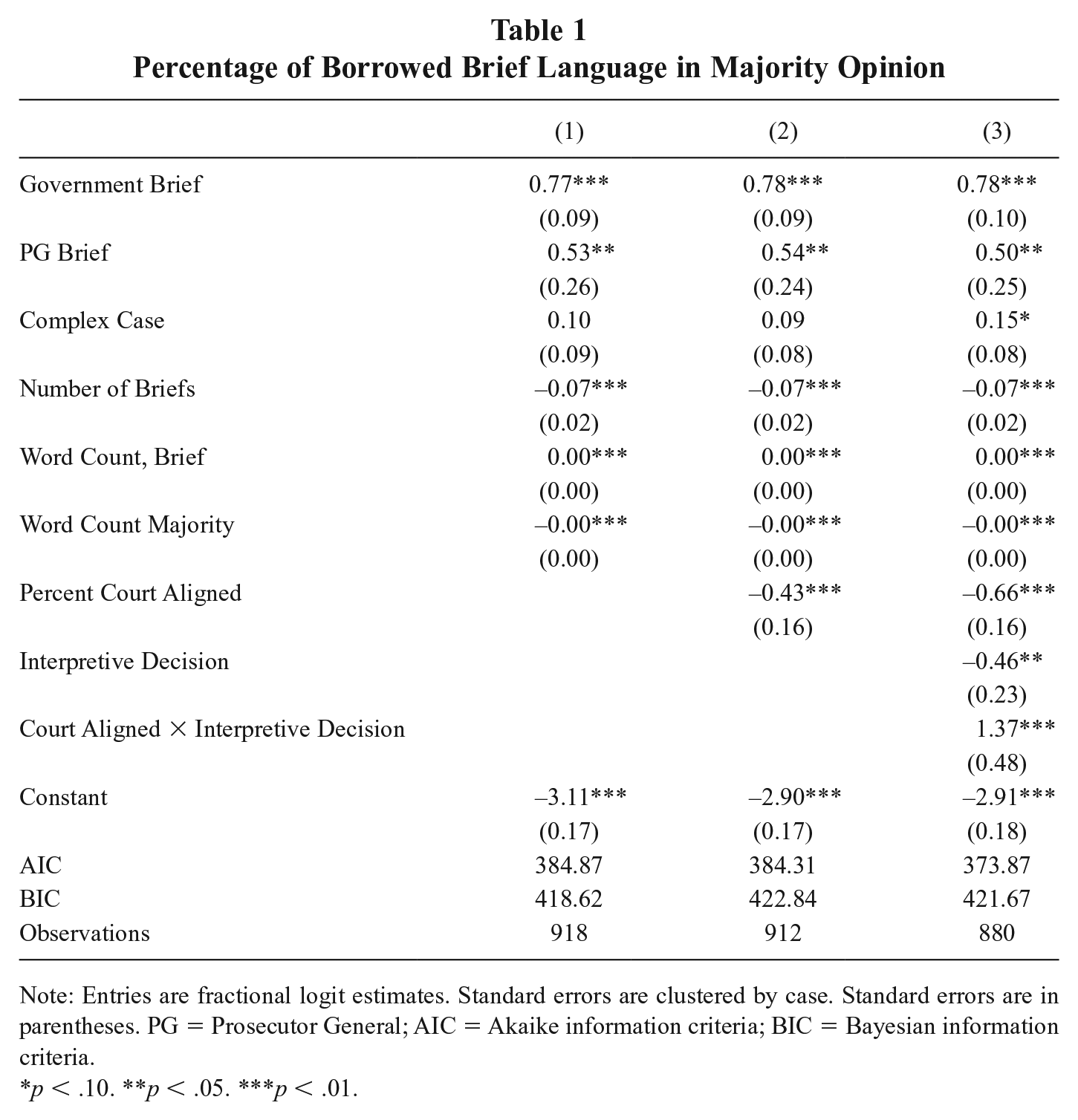
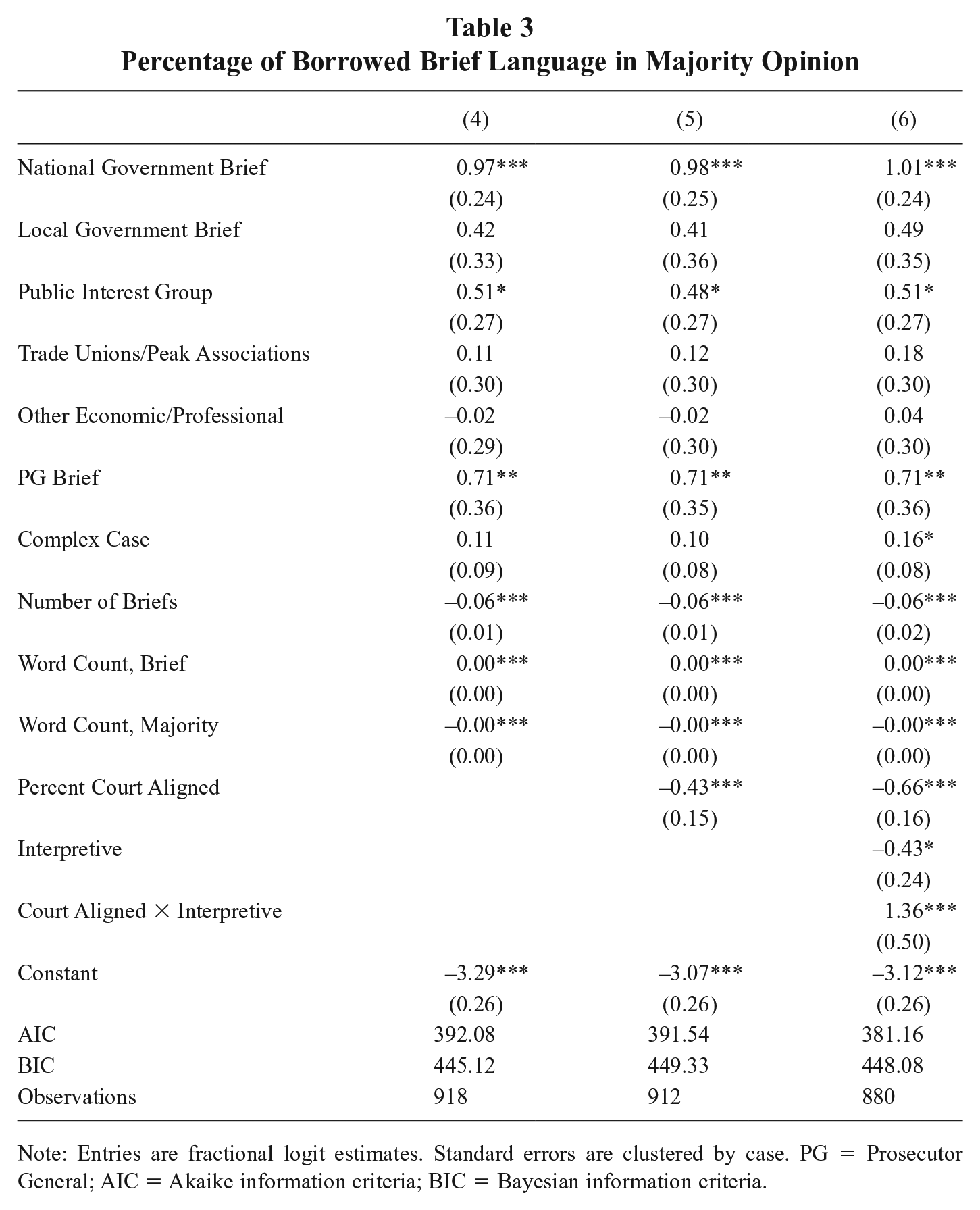
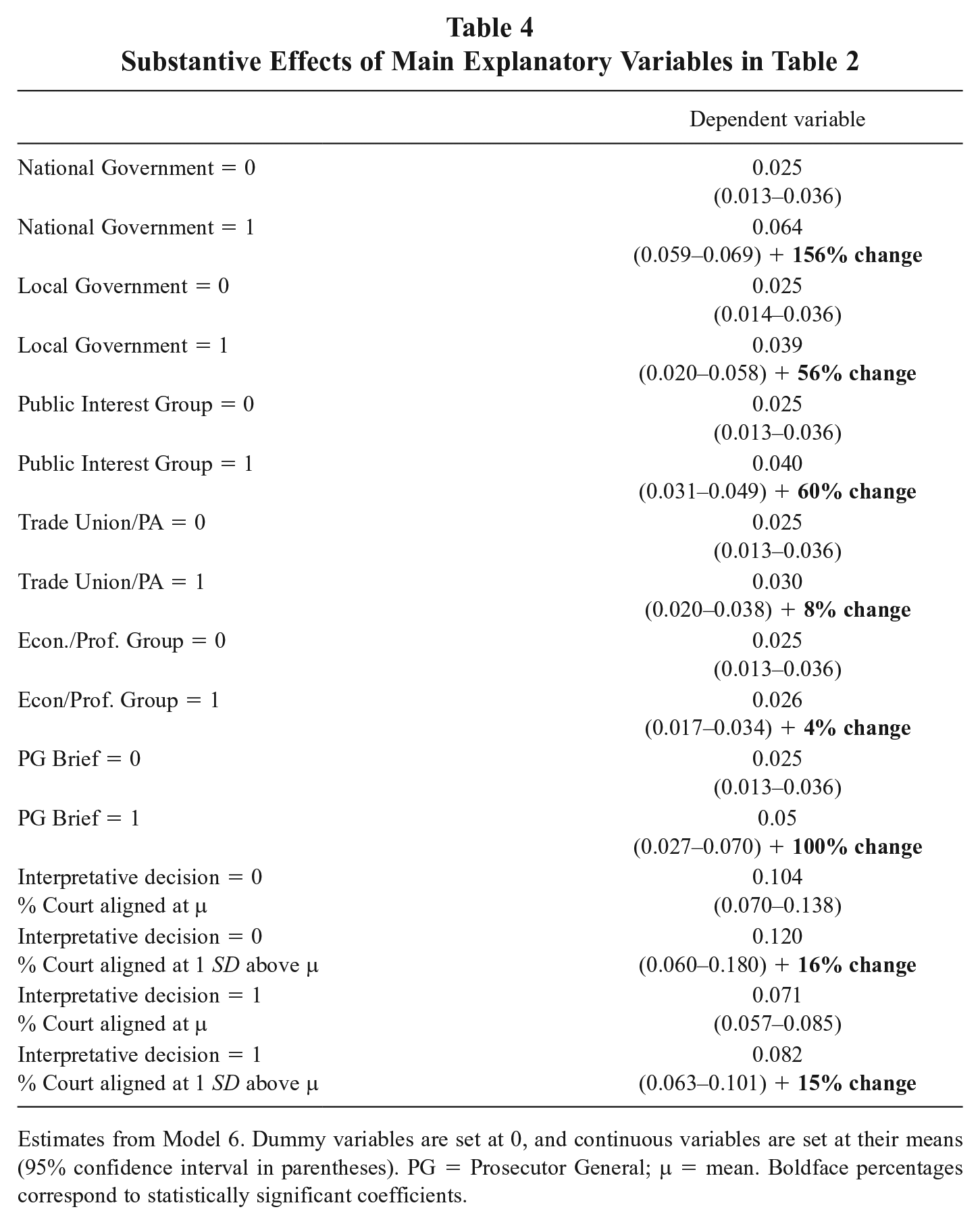
The main results appear in Tables 1 and 3, showing the coefficients on the regression analysis, and Tables 2 and 4, showing the corresponding predictive probabilities for substantive meaning. Across the two tables, Regressions 1 and 4 capture all variables described above except for the Percent Court Aligned variable, and Regressions 2 and 5 include it. Regressions 3 and 6 include the interaction terms Percent Court Aligned and Interpretive Decision.
Percentage of Borrowed Brief Language in Majority Opinion
Note: Entries are fractional logit estimates. Standard errors are clustered by case. Standard errors are in parentheses. PG = Prosecutor General; AIC = Akaike information criteria; BIC = Bayesian information criteria.
p < .10. **p < .05. ***p < .01.
Substantive Effects of Main Explanatory Variables in Table 1
Note: Estimates from Model 3. Dummy variables are set at 0, continuous variables are set at their means (95% confidence interval in parentheses). PG = Prosecutor General; μ = mean. Boldface percentages correspond to statistically significant coefficients.
Percentage of Borrowed Brief Language in Majority Opinion
Note: Entries are fractional logit estimates. Standard errors are clustered by case. PG = Prosecutor General; AIC = Akaike information criteria; BIC = Bayesian information criteria.
Substantive Effects of Main Explanatory Variables in Table 2
Estimates from Model 6. Dummy variables are set at 0, and continuous variables are set at their means (95% confidence interval in parentheses). PG = Prosecutor General; μ = mean. Boldface percentages correspond to statistically significant coefficients.
Borrowed Language Results
In Table 1, Governmental Brief is positive and statistically significant, suggesting that justices on the BCC are more likely to borrow language from briefs submitted from governmental or state actors, in line with Hypothesis 1a.
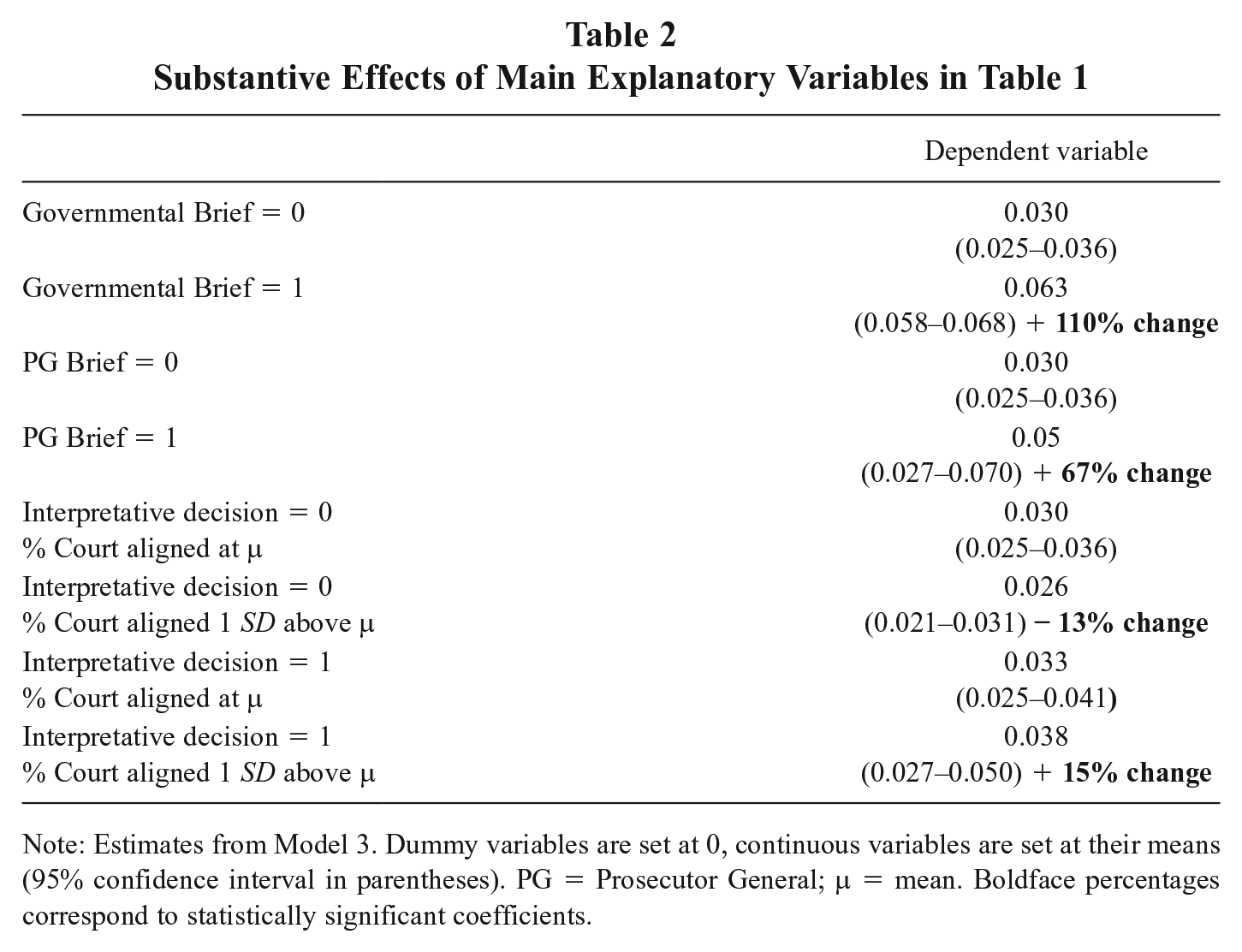
In Table 2, we show the values of the dependent variable when we change our main binary explanatory variables (Governmental Brief and PG Brief) from 0 to 1 and our continuous variables from their mean to 1 SD above it (Percent Court Aligned). According to these results, the justices tend to borrow more than double the amount from briefs submitted by governmental actors (with the exception of the PG) compared with those submitted by non-governmental actors. Changing the value of Governmental Brief from 0 to 1 increases the proportion of borrowed language by 110 percent. This important finding suggests that when their behavior might go unnoticed (as quite often the governmental briefs are not cited), justices borrow much more heavily from governmental sources.
In line with Hypothesis 2, the justices tend to borrow more from briefs submitted by the Procurator General. The coefficient for the PG Brief variable is positive and statistically significant, and its effect is also substantively significant. Compared with other briefs, the BCC adopts 67 percent more language when the brief is filed by the PG. This is in line with Collins, Corley, and Hamner’s 63 findings for the U.S. Solicitor General, but our effects are substantively even stronger. To what extent the Bulgarian constitutional justices borrow more language from the PG because they consider his briefs to be of higher quality or because they tend to defer to the expressed preferences of this powerful actor would require additional investigation, but in any case, this is an interesting finding.
The other main explanatory variable, Percent Court Aligned with the Governing Coalition, is statistically significant in Regressions 2 and 3. The interaction of this variable with Interpretative Decision has a significant conditional effect. According to the results from Model 3, the most comprehensive model, both Interpretative Decision and Percent Court Aligned have negative and statistically significant coefficients, and their interaction term has a positive and statistically significant coefficient. In substantive terms, as shown in Table 2, for decisions that are not interpretative, increasing Percent Court Aligned from its mean value to 1 SD above the mean is associated with a 13 percent drop in borrowed language. However, for interpretative decisions, increasing Percent Court Aligned from its mean value to 1 SD above the mean is associated with a 15 percent increase in the amount of borrowed language. Interpretative decisions decipher the normative sense of constitutional provisions and do not seek to review the constitutionality of laws enacted by the National Assembly. According to a former chair of the BCC, the interpretative decisions are “without a doubt” the most important decisions of the BCC—“The interpretative decisions complete the constitution, they derive its meaning . . . . They create mandatory interpretations for constitutional norms.” 64 This identified conditional effect indicates that, while in general the justices tend to voice more independent reasoned opinions when they are less worried about enforcement of those decisions by an ideologically aligned executive, when it comes to interpretative decisions, the dynamic is different. Justices seem to be more concerned about their perceived legitimacy and subsequent enforcement and draw more on the language in the briefs.
Turning to the controls, we find that justices tend to borrow more from longer briefs—Word Count, Brief and Word Count, Majority have statistically significant, but substantively small effects. Salience, captured by Number of Briefs, has a negative and statistically significant coefficient, indicating that justices borrow less language from briefs on salient cases. It appears that justices may be spending more time developing their own arguments on cases that are likely to get more attention. The complexity of the case does not seem to matter. The variable is not statistically significant in Models 1 and 2, and in Model 3 it reaches statistical significance only at the 90 percent confidence level. Model 3, the more complete model, is the better-fitting model as far as the Akaike information criteria (AIC) and Model 1 as far as the Bayesian information criteria (BIC) are concerned.
In Tables 3 and 4, we use alternative categorizations of interested parties, classifying them into a greater number of groups, namely, National Government, Local Government, Public Interest Group, Trade Union/Peak Association, and Other Economic/Professional Groups. The base group is all other interested parties described above and in the Supplemental Material. Using the alternative classification, we find that National Government, Public Interest Group, and PG Brief have a positive and statistically significant coefficient in all regressions. National Government (excluding the Procurator General) has the greatest substantive impact—changing its value from 0 to 1 is associated with a 156 percent increase in borrowed language, compared with a 60 percent increase for Public Interest Group and 100 percent for PG Brief. It is important substantively that organizations outside the formal government institutions have a substantial impact on the language of the court. The results with respect to the control variables are similar to those from Models 1–3. Salience captured by Number of Briefs has a negative and significant coefficient in all models, while Word Count, Brief has a positive and significant coefficient and Word Count, Majority a negative and significant coefficient in all models. Complex Case has a positive and significant coefficient (at the 90% confidence level) only in Model 3.
Whether a decision was interpretive and whether it was decided by an aligned court are both statistically significant in these models. Interacting these two variables provides results consistent with our prior models. The AIC/BIC results do not provide definitive results. The AIC is lowest for Model 6 and the BIC is lowest for Model 4.
Citation Results
Relationships and variables that predict the tendency to borrow language do not have explanatory power with respect to citations. In our models that only include governmental actors (similar to Table 1), the only significant variable related to who is submitting the brief (and only at the 90% significance level) is Governmental Brief—and only when it appears in the first regression. All other variables in these models and those which include non-governmental actors are insignificant, except for Word Count, Brief, which is significant but substantively meaningless. 65 As we expected, citations seem to be driven by a different dynamic. The results are not in line with Hypotheses 1b–3b. The effects are insignificant, indicating that justices are neither less likely to cite briefs submitted by governmental actors or the PG nor when they are politically aligned with the government. The alternative classification of interest groups does not improve the explanatory power of the regressions. These results suggest that justices treat citations differently. While they might be willing to borrow language more heavily from certain actors, they are unwilling to acknowledge this openly so as to avoid appearing politically influenced.
Implications and Conclusion
The study focused on how amicus briefs influence the decisions of a powerful and important national apex court outside of the United States. We chose to focus on the BCC as it is a good example of a court that has not yet been attacked by powerful government actors, as in Hungary and Poland, and it uses publicly available briefs on all decisions, a main limitation of studying briefs outside of a few common law and international courts. 66 The inquiry also focuses on whether briefs improve the decision-making and legitimacy of counter-majoritarian courts and whether these courts’ decisions consider the reasons provided by unpopular groups.
Despite the submission of such briefs, the BCC is more likely to borrow language from more established and powerful government elites, including the PG, rather than non-governmental or special interest groups. While a prior study showed that the BCC follows the decision or position of the PG, 67 it did not reveal whether the Court was simply following the PG’s preferred outcome on a case or something more. The BCC’s use of the PG’s language in the majority opinion suggests that the PG’s influence goes beyond just signaling an outcome to the Court about a preferred position.
While the results suggest that the democratic impetus underlying the availability of the briefing process to interest groups is not realized in the decisions of the Court itself, the results do not tell us whether interested parties have alternative motives for using the briefing process, such as organizational maintenance. Further research should attempt to determine what benefits non-governmental groups receive from filing these briefs. The research has also shown that judges’ and courts’ political alignment with the government is an important determinant of decision-making. However, rather than simply suggesting that the Court is willing to follow the position of the government for fear of reprisal, the research has shown an incongruity. The Court is less inclined to follow the reasoning from briefs when it is closely aligned with the government. As such, aligned courts may have more decisional independence as to reasoned justifications versus outcomes than the traditional attitudinal model suggests. This result, however, is conditioned on the type of constitutional review. In the study of democratic transitions and legal development, further inquiry should be made as to whether the Bulgarian government chose to use the amicus procedure to signal transparency and meet EU conditionality. Additional research could shed light on whether the briefing process is substantively meaningful to the Court.
Supplemental Material
sj-pdf-1-eep-10.1177_08883254221148485 – Supplemental material for Influenced by Power or Reasons? The Role of Amicus Curiae Briefs in Constitutional Court Decision-Making
Supplemental material, sj-pdf-1-eep-10.1177_08883254221148485 for Influenced by Power or Reasons? The Role of Amicus Curiae Briefs in Constitutional Court Decision-Making by Tanya Bagashka, Samantha Chapa and Lydia Tiede in East European Politics & Societies and Cultures
Footnotes
Acknowledgements
We would like to thank Joshua Fjelstul, Matthew Gabel, and Kevin Gray for valuable comments on a prior draft presented at the European Political Science Association’s Annual Meeting in Prague in July 2023. Additionally, we are thankful for research assistance from Roberto Alas and H. M. Kim.

Supplemental Material
Supplemental material for this article is available online.
Notes
Supplementary Material
Please find the following supplemental material available below.
For Open Access articles published under a Creative Commons License, all supplemental material carries the same license as the article it is associated with.
For non-Open Access articles published, all supplemental material carries a non-exclusive license, and permission requests for re-use of supplemental material or any part of supplemental material shall be sent directly to the copyright owner as specified in the copyright notice associated with the article.
