




Abstract
This article belongs to the special cluster, “Think Tanks in Central and Eastern Europe”, guest-edited by Katarzyna Jezierska and Serena Giusti.
Think tanks outside liberal democracies have distinctive features that go beyond the features of the original concept that emerged within the US context. Departing from this empirical observation, we investigate the sources of the organizational power of think tanks in Ukraine as a case of a limited access order (LAO), a social order where privileged individuals maintain discretionary access to societal resources, functions, and institutions. To accomplish this goal, we apply Thomas Medvetz’s analytical concept of a “boundary organization,” which allows us to highlight the hybridity and flexibility of think tanks and thus understand their methods of gaining political access in an LAO. The analysis of interviews with senior representatives of nongovernmental think tanks in Ukraine in 2016–2017 demonstrates that Ukrainian think tanks are resourceful and find indirect ways of influencing politics. These organizations publish their reports in the media and deliver assessments of Ukraine’s international commitments to the country’s donors, thereby indirectly influencing the policy process in the country. Ukrainian think tanks also comply with the expectations of a boundary organization, accumulating and converting economic, academic, and media capital into political capital, using advocacy and networking as conversion tools. One important difference between the expectations of Medvetz’s framework and our findings is that political capital seems to be the goal of think tank activity, while the three other types are used merely instrumentally.
Introduction
“In Ukraine, there is such a political culture among the government and politicians in general that if you pay or invest in a think tank, it has to follow your narrative—the one that matches political, party or oligarchic interests.” This quote from respondent 8, the head of one of the leading Ukrainian think tanks, summarizes the conditions under which policy research institutions operate in Ukraine.
Ukraine is one of the many different contexts into which the essentially liberal-democratic concept of “think tanks” has traveled since its emergence in the US during World War II. 1 While being exported to other countries, the original meaning of a think tank as “non-profit [organization], independent of the state, and dedicated to transforming policy problems into appropriate public policies” 2 has been debated. In particular, heated debate has evolved among scholars of think tanks in transitional countries who questioned think tanks’ ideological independence, both from the state 3 and from liberal international donors. 4 Other scholars have developed a more inclusive approach, taking into consideration the contextual limitations of think tanks in nonliberal-democratic contexts. 5 From this research, we learn that, despite differing political conditions, think tanks manage to develop and gain domestic policy relevance and international recognition. 6 These findings are puzzling considering that think tanks cannot rely on the typical consultation structures of liberal-democratic regimes. Hence, our research questions include the following: What are the sources of organizational power of think tanks outside of liberal democracies? How do these think tanks define their success?
Thomas Medvetz’s 7 concept of boundary organizations provides us with an initial analytical lens to approach our research question. Since this concept was developed in a liberal setting, we do not “export” it as a normative standard but apply it critically and provide a context-specific test of its application. Specifically, we borrow the notions of political, economic, media and academic capital and the idea of capital conversion as a boundary work of think tanks. In contrast with Medvetz, we demonstrate that there is a hierarchy among these four types of capital and that conversion occurs through advocacy and networking.
We selected and analyzed a cluster of think tanks from Ukraine. There are pertinent reasons to direct scholarly interest toward Ukrainian think tanks. We argue that the specificities of the political regime in the country—a “balanced openness” type of limited access order (LAO) 8 —form idiosyncratic conditions for policy advice that potentially might inform the very notion of a think tank. Unlike liberal democracies, LAOs 9 limit political and economic access essentially to neopatrimonial networks, 10 which restricts the spectrum of possible actors and ideas having impact on policy processes and outcomes. Nevertheless, compared to other types of hybrid regimes classified as LAOs in the post-Soviet space (e.g., Armenia or Azerbaijan), the Ukrainian regime creates at least some conditions for independent policy advice. Among these conditions are occasional competition between patronage networks, which have so far prevented the centralization of power, 11 and a relatively active and diverse civil society, which consistently ranks high in the Freedom House Civil Society rankings. 12
The article is organized as follows. After presenting our methods, we briefly define the concept of LAO and apply it to the case of Ukraine. Furthermore, we present an overview of the historical development of Ukrainian think tanks. Next, we discuss the theoretical framework of this article: the concept of “boundary organization,” 13 including its possible application to the Ukrainian case. On the basis of the empirical findings, we present three themes characterizing Ukrainian think tanks. The first theme is the position in the political field as a measure of think tanks’ success; the second focuses on the immersion in the economic field guided by concerns of independence; and the third addresses the use of advocacy and networking as capital conversion tools. In conclusion, we summarize our observations about the consequences of an LAO for think tanks with special focus on the sources of their organizational power.
Conceptual and Methodological Approach
Defining the Term Think Tanks
Between World War II and the end of the Cold War, the definitions of the term think tank were mainly based on an analysis of US think tanks and underlined the nonpartisan and nongovernmental nature of these research institutions. 14 As think tanks started to emerge in new democracies, some were established as research branches of governments, 15 while others, according to observers, were closely linked financially and ideologically to the neoliberal actors of external democratization. 16 Critics (e.g., Ivan Krastev, Diane Stone, and Andrew Rich) have remarked that policy research institutions outside the US do not meet the basic standard of a think tank, namely, independence. 17 Others (e.g., Takahiro Suzuki and Stella Ladi) 18 highlight the research and advice functions of think tanks as more important than independence. There is also another view (e.g., James McGann 19 and Kent Weaver) 20 that considers all policy research institutions that produce and advocate their policy solutions think tanks. In this perspective, think tanks are actors of democratization and carriers of new ideas, assuming that advocacy work is a crucial part of think tanks’ operations. 21
For the purpose of this article, the latter definition is more encompassing than the definitions focused on independence. In an LAO, it is reasonable to expect that policy research institutions must adapt flexibly to the ambiguous conditions of political access. Therefore, by applying a wider definition, we capture a larger variety of forms and activities that a policy research institution may undertake in an LAO.
We therefore define think tank as an organization that conducts policy research and strives to use it to influence policy processes. It is worth noting that think tank, just as in other Central and Eastern European (CEE) languages, does not have a fixed translation in Ukrainian. The most common reference to think tanks is currently “аналітичний центр” (“analitychnyǐ t͡sentr,” i.e., “analytical center”). The terms “фабрики думки” (“fabryky dumky,” i.e., “factories of thought”), think tanks (without translation) and “мозковий центр” (“mozkovyǐ t͡sentr,” i.e., “brain centers”) are used less frequently.
Method
From our working definition of a think tank, we move to look at who is forming these policy research institutions in Ukraine. This investigation is itself a challenge because observers include different functions in their conception of a think tank. As a result, the Global Go To Think Tank Report 2016 22 evaluated 47 think tanks in Ukraine, while the Ukrainian observer organization Think Twice UA counted 106 organizations for the same year. 23 Some of the differences may be attributed to the fact that, naturally, not all local think tanks seek or attain international awareness (therefore, they are not in the report by McGann). Moreover, Think Twice UA 24 used a more inclusive definition; they also included collaborative and educational platforms, which the Global Go To Think Tank Report does not do.
This article relies on an analysis of semistructured interviews with twelve heads of Ukrainian think tanks, which were conducted between November 2016 and January 2017 in Kyiv in person as well as over the phone and by Skype. 25 The think tanks were selected using a purposive sampling procedure 26 according to the following criteria: think tank’s domestic reputation according to domestic surveys 27 and international recognition by the Global Go To Think Tank Report 28 and expertise in diverse policy fields, including security, governance, international relations (including implementation of the EU–Ukraine Association Agreement), economic and sociological research, and energy and the environment. In addition, we reached out to think tanks that participate in formal consultative procedures with the government or the president, such as the National Reform Council. 29 This sample is balanced in terms of sex, with seven female and six male interviewees.
All the think tanks in our sample are nongovernmental organizations (NGOs). According to Think Twice UA, 30 there are only nine governmental and two academic think tanks out of 106 documented organizations in Ukraine, which motivates our focus on nongovernmental think tanks. Finally, the interviewed think tanks are all members of the Ukrainian Think Tank Liaison Office in Brussels, 31 and they all have a pro-EU policy agenda, which brings certain limitations to the generalizability of our study. However, think tanks’ policies per se are not the focus of this article; instead, we are interested in what constitutes their power. Thus, holding think tank agendas “constant” helps isolate sources of think tanks’ power from the ideological dimension of their work. As complementary empirical material, we used papers analyzing the think tank industry in Ukraine, which were prepared by two Ukrainian think tanks: the Razumkov Centre and Ilko Kucheriv Democratic Initiatives Foundation. 32 The findings of these reports were used to triangulate insights from the interviews about the role of expertise in an LAO and the (non)collaboration of think tanks with policy makers and donors.
The Context: Ukraine as a Limited Access Order
Because of a combination of authoritarian and democratic elements, Ukraine is often referred to as a “hybrid” regime. 33 As a result of conceptual vagueness about the notion of regime hybridity, 34 we have chosen an alternative concept, LAO, as introduced by Douglass North, John Wallis, Steven Webb, and Barry Weingast. 35
According to Douglas North and his colleagues, the underlying principle behind LAOs is “limiting access to perform key functions and to utilize organizational forms and contracts that the [dominant] coalition will enforce” 36 with the purpose of creating rents, which are built on the obtained privileges resulting from limiting access. These “profits,” or rents, are created because of the dominant coalition’s restrictions on and control of access to important resources (natural resources, labor, capital) and activities, such as education, trade, religion, and private property rights. LAOs manipulate the economy to create rents for the dominant coalition and subvert social and political orders in such a way that they strengthen the dominant coalition’s ability to obtain rents. It is notable that the dominant coalition in an LAO is rarely the “state”; instead, it is formed of networks of interdependent political and economic actors, which include different branches of power, where economic elites, civil society organizations, and even international actors, such as transnational corporations, benefit from privileged access.
LAOs in the post-Soviet space vary in terms of how much they limit access. Esther Ademmer, Julia Langbein, and Tanja Börzel have developed an informative typology of LAOs: “balanced openness,” “balanced closure,” “unbalanced closure,” and “unbalanced openness.” The principal criteria are the extent and the balance of limits to economic and political access. The LAOs that limit economic and political access in a balanced way are the most stable; the “openness” category includes Georgia, Moldova (both after 2015) and Ukraine (2003–2015 37 ); the “closure” category includes Azerbaijan and Belarus.
Ukraine, as noted above, is a case of a “balanced openness LAO.” This somewhat contradictory concept manifests empirically in differentiating the extent of restrictions for access between policy fields or within different branches of power. For example, some observers indicate attempts at the consolidation of power by the current president, 38 while those working on European integration note an increasing regime openness after 2014. 39
To summarize, we frame our investigation of the organizational power of think tanks with the specific conditions of an LAO. We assume that a “balanced openness” LAO, where some conditions for policy advice and debate are present despite general restrictions, represents a context in which we can trace the largest variety of activities of think tanks from which we can study the sources of their organizational power. To effectively gain political access, these actors have to be creative in choosing their methods and policy topics to even start the policy debate. Therefore, the choice of Ukraine is here motivated by the fact that it is the most likely case 40 of a “balanced openness” LAO.
Think Tanks in Ukraine
The development of think tanks in Ukraine follows the general patterns of that in the post-Soviet space, where it is possible to differentiate three generations of think tanks.
The first generation of think tanks was formed in the 1990s both within governmental and nongovernmental domains. In terms of governmental policy research, two state research institutions were established in 1992 within the National Academy of Sciences of Ukraine 41 : the Institute of World Economy and International Relations 42 and the Institute of Strategic Research. 43 These post-Soviet governmental research institutions were large, hierarchical, and could not provide advice under the new conditions of the Washington consensus because most of their staff “were oriented toward Soviet approaches to problems.” 44
The mismatch between governmental research capacities and the political and economic challenges of the transitional period catalyzed the formation of nonstate research institutions in three ways. First, some think tanks were formed by former members of the political elite in 1992–1994, such as the Market Reform Center, Society Transformation Center and Razumkov Centre, who saw an opportunity to continue their reform activity outside of the bureaucratic state structures. 45 Second, local teams of translators and assistants to international consultants who soon “grew tired of working as consultants or shadow researchers to their foreign counterparts . . . decided to set up their own policy analysis shop.” 46 CCC Creative Center’s 47 and the Ukrainian Center for Social Reform’s 48 founders used to work as consultants to international organizations before starting these think tanks. Third, such prominent think tanks as the Razumkov Centre 49 and Ilko Kucheriv Democratic Initiatives Foundation 50 brought together political activists with backgrounds in sociological research. 51
International donors, such as the International Renaissance Foundation (Open Society Foundations) Think Tank Fund, supported the development of the new research institutions. 52 The analysts in these think tanks focused on producing manuscripts for policy makers and did not question the agenda of foreign donors. 53 Western donors and local think tanks formed a “liberal coalition,” ensuring that the neoliberal economic course prevailed in the CEE transition countries, including Ukraine. 54
The second generation came to work in think tanks in the 2000s when “the rhetoric of a Washington consensus [had] been exhausted,” which “present[ed] post-communist think tanks with a window of opportunity.” 55 Interestingly, in Ukraine, the “window of opportunity” came in the form of growing authoritarian tendencies, which think tanks tried to counteract. In 2001–2004, President Kuchma’s attempts to consolidate his power included the adoption of legislation to limit international funding to NGOs and infringements to the rights of NGOs to access media or criticize the authorities. These restrictions were accompanied by campaigns accusing think tanks of being “foreign agents,” channeling the will of Western donors instead of working in the interest of Ukraine. In response, nongovernmental think tanks joined the anti-authoritarian coalition and supported the Orange Revolution.
After the Orange Revolution, in 2004–2005, under the presidency of Viktor Yushchenko, the authorities declared an openness toward civil society. There was indeed some opening of the government authorities compared to the presidency of Leonid Kuchma. Public councils at the ministries were established, and several think tank leaders joined the government (most notably, the director of the Razumkov Centre, Anatoliy Hrytsenko, was appointed Minister of Defense). This approach did not bring the results that many experts had hoped for in terms of the government’s willingness to engage in more institutionalized cooperation with think tanks. 56 In response to the failed expectations, think tanks developed more diverse communication styles, targeting audiences other than politicians. However, the think tanks still relied on donors in the formation of their research agendas. 57
The third generation (after approximately 2012) started to question the international donors’ approaches, developed diverse communication modes (including digital media) and paid more attention to advocacy among the general public. Although think tanks still receive most of their funding from Western donors, they experiment with crowdfunding and commercial research requests. 58 The government is likely to use research produced by a few governmental research units (for whom funding is awarded without competition) or the research produced by nongovernmental think tanks and funded by an international donor. 59 Hence, some think tanks lobby for new legislation that would allow competition in policy research so that not only governmental research units but also nonstate think tanks could participate. 60 As a whole, the third generation of think tankers has experienced improved access to decision makers since 2013–2014 compared to that under the presidency of Viktor Yanukovych (2010–2013). 61
The Power of Think Tanks: Theoretical Perspective
In trying to understand the sources of organizational power of Ukrainian think tanks, we apply the concept of boundary organizations developed by Thomas Medvetz. 62 Medvetz builds on the Bordieuan notion of “fields” and on the “boundary spanning” perspective from organizational theory to propose the idea that a think tank is the boundary itself. Thus, a think tank is a space between such fields as politics, economy, media and academia, and simultaneously, it is a bridge between these fields. What makes a think tank a boundary organization is “its ability to determine where one activity ‘officially’ ends and another begins.” 63 In other words, Medvetz argues that boundary-setting work occurs within think tanks themselves: In their dynamic relations with stakeholders, think tanks decide where their market, media or political activities end and where their expert work begins. 64
From where do boundary organizations derive their power? According to Medvetz, power is derived from think tanks’ ability to accumulate diverse types of resources from multiple fields and to effectively convert and reinvest these resources “in a particular way” 65 into new products (packages). These resources may be understood as academic, political, economic, and media capital. Academic capital means that think tanks accumulate signs of academic proficiency, such as the academic titles and degrees of their staff. In terms of political capital, think tanks utilize their knowledge products as a form of political expression to gain control over state policies (e.g., public opinion polls, policy papers). Their economic capital is not only their funding but also their ability to fundraise. Media capital is the ability of think tanks to gain publicity for their research in the traditional as well as social media. 66 Medvetz develops this argument further, suggesting that the conversion rates for the forms of capital are worked out in the competition between think tanks, which he formulates as struggles between holders of scholarly credibility and holders of ideological credibility.
Medvetz’s analytical tools are helpful in assessing the sources of power of Ukrainian think tanks. It is, however, necessary to remember that his theoretical approach is based on think tanks in the United States, so the application of the framework requires adjustments. For instance, Medvetz does not prioritize any of the four types of capital, while for Ukrainian think tanks, there is a clear hierarchy: Political capital seems to be the goal, while the three other types of capital are merely instruments. Next, Medvetz remains silent about how the conversion of capital occurs. In our contribution, we demonstrate that the processes of networking with decision makers and advocacy toward policy stakeholders and the general public are used by think tanks to convert their available resources into political capital. Finally, our analysis demonstrates that, in an LAO, the competition among think tanks is not between holders of scholarly and ideological credibility but between those who manage to effectively engage with the dominant coalition without being co-opted and those who do not.
Ukrainian Think Tanks as Boundary Organizations
In our interviews with think tankers about their notions of success and sources of power, three key themes emerged. First, think tanks measure their success in terms of their position in the political field: being recognized by decision makers, influencing policy outcomes, and even developing agendas are all features of a successful think tank. Second, think tanks place much value on financial independence from the local dominant coalition. In doing so, think tanks demonstrate their deep immersion in the economic field. Third, similar to Medvetz’s “conversion of capital,” the interviewees highlight the continuous accumulation of economic and media capital and, to a lesser extent, academic capital to convert them, using advocacy and networking processes, into political capital.
In the subsections below, we present the three core themes and analyze them through the theoretical lens of a boundary organization.
Theme 1: Ukrainian Think Tanks’ Position in the Political Field
Describing their own role in the political field, our interviewees stress that they are change makers and that they are critical partners of authorities in manufacturing change.
When reflecting on their role in the political field as change makers, think tanks find it important that their staff have a far-fetching ideational goal for their work or, in other words, are “driven by an idea” (respondent 11). At the same time, think tanks acknowledge the limitations of political access for new ideas, so they target their efforts on influencing changes in concrete policies rather than changing the policy agenda as such. The focus on policies results in the fact that think tanks prioritize gaining influence in the short term: “[Evidence of success is] short-term demand and clear recommendations. Therefore, we focus on short-term research with concrete recommendations, which may be used right away” (respondent 1). This approach may be problematic because the policy process entails a mix of different policy streams and actors; as Diane Stone states, “Proof of influence is elusive. There is no clear causal nexus between policy research or an idea espoused by an institute, and political decisions and policy change.” 67 While agreeing with Diane Stone about the problems with measuring influence, we argue that this is one of the ways think tanks can claim to have a voice in an LAO. Aiming for the implementation of their short-term recommendations, which is easier for public authorities, think tanks build strategic partnerships for future, longer-term changes by overcoming mutual distrust in incremental steps.
Reflecting on partnerships with the authorities, our interviewees reveal the tensions between their role as partners with and as challengers of the state, which has been summarized by Michael Walzer as the “civil society paradox.” 68 As respondent 4 states, “Keeping the balance, realizing that you are a mediator who must become a bridge between the authorities and the public and not just a critic of the authorities but also its helper.” This “helper” role boils down to bridging different audiences, the larger society and policy makers.
These two themes reflect what Thomas Medvetz calls political capital—the usage of analytical products to influence the decisions of incumbent governments. To increase the chances of their recommendations being used, think tanks adapt their research products to minimize the burdens of the analysis for authorities. For example, think tanks prepare draft legislation, which could be instantly used by an official without any adjustments: “We have always aimed our papers and products at a mid-level official so that he could borrow our research and recommendations in blocks. And, in many state documents and decisions, we spotted the blocks of our analytical materials, taken from our research papers” (respondent 6).
After the 2013–2014 Revolution of Dignity, 69 Ukrainian think tanks found themselves in a more favorable position than that of the preceding 20 years, and “now there are some think tanks that can doubtlessly take pride in their draft bills becoming part of Ukrainian legislation and a foundation of some sectoral reforms” (respondent 10). Explaining this development, respondents mention the low analytical capacity of governmental experts and an increase in the need for analytical products among decision makers in light of Ukraine’s commitments to the EU. Preparing texts that could easily be inserted into draft bills improves the chances of the adoption of their recommendations. At the same time, this approach requires that there is direct access to decision makers or their consultants and that they are open to considering the research results.
This access and willingness do not always exist in Ukraine due to the challenges of political access posed by an LAO; hence, the direct approach discussed in the literature is combined with an indirect mode of access to decision makers. The indirect approach constitutes seeking partners and engaging in coalitions within the political field. Such situational partners are often international donors, whose impacts on Ukraine have always been high, and other NGOs with whom think tanks form advocacy coalitions. In their work with international donors, think tanks resort to the “boomerang” strategy, which has been observed in the work of advocacy organizations outside Ukraine. 70 Of particular importance is the role of the EU, 71 which is expected to exert pressure on Ukrainian authorities in response to think tanks’ reports about the lack of implementation of Ukraine’s commitments to the EU–Ukraine Association Agreement: “When the activists go to the EU or communicate with visitors from there and complain that the state does not fulfill its obligations, it is an additional method of pressure. This is a simple mechanism, which works when the government is truly interested in either receiving international funding or in important political decisions” (respondent 10).
To increase their political capital, think tanks position themselves as active members of civil society and as values-based organizations. For example, respondent 12 is clear about expecting high moral standards from fellow think tankers: “An organization should not be a prostitute. Behind professionalism and competences must be a value-based core.” This approach allows them to capitalize on the relatively high trust to civil society organizations among the Ukrainian population (44 percent in 2017). The only more trusted entities are the Armed Forces of Ukraine, volunteers, and the Church. 72 Conversely, legislative and executive authorities entrusted with public policy making receive very low trust from citizens, with fewer citizens trusting than distrusting these institutions. In a society with such a negative balance of trust for all representative democratic institutions, the trust that think tanks enjoy as members of civil society is an asset. Previous research highlights this aspect, evidencing that governmental representatives motivate their cooperation with think tanks by referring to the high trust placed in civil society organizations. 73 High levels of trust among the population strengthen the position of think tanks both vis-à-vis political authorities and the media, making them desirable contributors to public debates. It is thanks to think tanks’ location within the civil society field that this conversion is possible.
Theme 2: Economic and Ideational Independence as a Basis for Political Capital
Our interviews show that as much as think tanks are embedded in the political field, they are also immersed in the economic field. As economic actors, think tanks apply entrepreneurial logic to their activities; they discuss organizational management, borrow marketing strategies to increase their visibility, and resort to fundraising. Think tanks accumulate economic capital in the form of financial resources and sustainability. From this view, fundraising activities are an important area for improvement in their work, whereby think tanks attempt to diversify sources of funding and use them for institutional capacity building rather than for project work.
The most immediate concern about funding voiced in the interviews centered on the adequate proportion of donor, business, and governmental funding in a think tank’s budget and the very possibility of sourcing funds from Ukrainian politicians or political parties. According to the respondents, in the Ukrainian political culture, a think tank accepting donations from any political actor is expected to follow the agenda of the donor: “In Ukraine, there is such a political culture among the government and politicians in general that if you pay or invest in a think tank, it has to follow your narrative—the one that matches political, party or oligarchic interests” (respondent 8).
The context of an LAO, where the dominant coalition determines the level and rules of access to the political field, makes this expected loyalty especially pertinent. In such a political culture, supporting research by the dominant coalition is an investment in maintaining an established order rather than a way to provide specialized policy advice for reform. Hence, some respondents admitted that they were quick to reject funding from businesses or politicians as a way to distance themselves from any political or business influence: “It is important even for organizations that have been around for 25 years to have such [donor] support, but not a support from the state, business or oligarchs” (respondent 7, emphasis added). Others accept contract-based relations in policy areas, which would not compromise their reputation as independent among international funders and policy makers. This reluctance to be drawn into dependent relationships with the dominant coalition is confirmed by the fact that the government is only a minor funder of nongovernmental think tanks (as opposed to, e.g., Germany 74 ) and only occasionally commissions research from them. At the same time, think tanks advocate more governmental funding but wish to develop clear and transparent rules based on competition for procurement of analytical services, which could ensure that the results of their analyses are not influenced by the government’s expectations. 75
In the absence of government interest to pay for research projects, international donors provide a lion’s share of the resources for Ukrainian think tanks and are among the main consumers of think tanks’ analyses, 76 alongside the media and other NGOs. Interestingly, the respondents generally perceive international donors, especially when there is a variety of them, as a way to ensure independence from national political and economic elites and financial sustainability: “Institutional grants would allow the organizations to continue being independent from political power and from business and also feel more stable” (respondent 7). The above-mentioned expectation of obedience in return for government funding as well as the lack of predictability characteristic of an LAO are probably the cause of this perspective.
Such reliance on foreign donors is criticized in the academic literature because financial dependency increases donors’ capacity to shape the policy agenda by linking their grants to certain topics. The adjustment to a donor’s agenda is clearly traced in some of the interviews when the choice of research topics is discussed: “Factors that influence the choice of [research] topics include relevance, demand [from prospective users], and the mandate of an international donor, which is where funding may be sourced from” (respondent 6, emphasis added). This consideration does not mean, however, that think tanks take donors’ agendas for granted. According to one of our respondents, the mandate of foreign donors needs to be updated to become more relevant to the current requirements in topics of policy research: “The support for buzz topics, such as civil society or European integration, has to be decreased, and funding for research in security, conflict, development of state security and military analytics has to be increased. There is also a lack of research on the social sector, pension reform and Russian affairs” (respondent 11).
The above quote shows that Ukrainian think tankers are quite aware of the mismatch between international donors’ demands and the actual needs of Ukrainian society. Moreover, the think tankers are aware of the risks that come with international funding but are more ready to accept these risks than to accept the demands of the local dominant coalition. Because the goal of think tanks is to reform the current situation, they must be careful to maintain their perceived independence from the actors that are responsible for the status quo.
One of the ways to mitigate the risks associated with too much dependence on international donors is for think tanks to engage in crowd and membership-based funding. Generally approving of this idea, think tankers admit that donations would not ensure the sustainability of Ukrainian think tanks, even in the medium term: “Citizens are more likely to support concrete, non-analytical initiatives. I think that our society has not yet matured to such a level, to understanding that we need analysis, that it is really needed and useful” (respondent 5). This perspective is at odds with the experience of American think tanks because the long-term philanthropic tradition in the United States makes individual citizens more prone to financially support NGOs and think tanks.
Theme 3: Capital Conversion through Advocacy and Networking
Ukrainian think tanks claim to have become more influential after the 2013–2014 Revolution of Dignity. The think tankers explain this evaluation using two factors: “think tanks matching increased public demand for reform after the Revolution of Dignity” (respondent 2) and the “aligning of Ukrainian think tanks’ agenda with that of international donors when Ukraine’s commitments to the EU were matched with think tanks’ recommendations” (respondent 10). These quotes reflect two ways in which Ukrainian think tanks convert various types of capital into political capital: advocacy work, especially the engagement of the general public, and networking, especially with international donors but also with local policy makers.
Trying to exert influence on policy makers, Ukrainian think tanks highlight advocacy work as their core activity: “Advocacy is a part of decision making and analysis; I mean, I make no division between them. Speaking about the Ukrainian situation, we would be weaker if we worked either in advocacy or in expertise. Insofar as we are a society in transformation, we have to operate on the border of advocacy-analytical activity” (respondent 4).
It would be an exaggeration to claim that advocacy work is important only in LAOs, but in a regime in which the dominant coalition is occupied with freezing the status quo, there is little interest from the coalition in any specialized analysis for reform. To quote respondent 5, “You may be writing great analytical papers, creating products with good infographics and explanations, but if the ministry for which you do this is not ready to receive this information, there will be no influence.” Indeed, politicians and civil servants rarely fund studies from external research organizations since they are confident that they can make decisions without any relevant research. 77 Under the conditions of an LAO, think tanks see themselves as promoters of democracy; therefore, they are not satisfied with simply engaging in research and would like to see the findings of their research implemented. Advocacy also becomes important for practical reasons: to obtain funding, think tanks need to demonstrate their influence and public awareness of their research to international donors.
For advocacy purposes, media capital seems to be a critical asset. The respondents uniformly highlighted the importance of media relations and publicity for raising their profile among decision makers as well as for shaping public opinion. Moreover, coming under the labels of “communication,” “publicity,” “media relations,” “social media outreach,” and “presence in public space,” the ability to mobilize media capital is by far the most referred to factor of a think tank’s success among our respondents. Such a focus on media presence is explained by the fact that politicians and civil servants rarely consider themselves consumers of think tanks’ analytical products. Decision makers often learn about think tanks’ work from the media. Think tanks note that authorities neither proactively contact them for advice nor follow already available research results. Being quoted by journalists becomes a way to access the political field. 78
Media capital is also considered important for respondents’ work with international donors and partners on a par with high-quality project work. For example, “the donors appreciate [a think tanks’] capacity to build the full cycle of project work, [including] a good visualization of results, which is effectively broadcasted into public space and is quoted and accessible on the Internet in several languages” (respondent 10, emphasis added).
Just like their counterparts in the United States, Ukrainian think tanks engage with the general public and aspire to shaping the public discourse concerning reform priorities. The think tanks hope to increase public support for their ideas by raising policy issues in the media and constructing opinion polls and citizen surveys. “The influence [on policy makers] may be in moderating public opinion, in consolidating public opinion and adding topics to the public discourse” (respondent 2). Such one-way communication is sometimes supplemented with more participatory practices. In the words of respondent 1: “[We strive for] wide coverage. We cover [via communication effort] not only public authorities but also local civil society organizations engaged in decentralization reform. We also support an introduction of regional competition for micro-projects at the community level.” This think tank directly engages with the public through discussions of its preferred policy solutions with representatives of local communities. Some other Kyiv-based think tanks develop their social media presence, thus creating opportunities for more interactive engagement.
The conversion of media capital into the political capital occurs through advocacy toward the general public, which gains strategic importance for positioning a think tank in the political field. “When think tanks work as partisans, when they participate in official but closed, intersectoral negotiations or unofficial meetings but are unable to shape and influence public opinion, their proposals have less weight in and impact on the final decision making” (respondent 3).
To be well received by the media and by the general public, think tanks mobilize their academic capital, that is, titles, degrees, and academic experience, which lends them scholarly credibility. 79 Think tanks legitimize their right to provide policy advice because they reportedly rely on research and evidence in formulating their preferred policy solutions. In this way, as respondent 3 highlights, think tanks can “feed intellectually into ongoing processes within the state and on a geopolitical level” (emphasis added). In addition to formal criteria for the scholarly competence of their staff, the continuous education of experts, research stays at other (preferably foreign) think tanks and on-site training of talented youth are considered factors that increase the scholarly credibility of a think tank.
Another activity that helps to convert various types of capital into political capital is networking. Networking emerged as one of the dominant themes in the questions about how think tanks exert influence on policy makers. Different types of capital are in play, depending on the target audience of think tanks’ networking activities. According to our respondents, traditional elements of political capital, that is, personal and institutional contacts with members of the political field, are crucial if a think tank aims to influence the policy agenda (e.g., through membership in public councils at ministries). “One needs to understand [that] to put an item onto the agenda, one needs to know who makes that decision, clearly define the targets [audience] and engage with them” (respondent 6). Personal contacts are also important to conduct surveys or other research among politicians and civil servants (otherwise, there is little interest in answering questions or providing data), to present research results to relevant decision makers and to be invited to governmental decision-making committees and other similar activities. At the same time, think tanks are concerned about being closely linked with the local dominant coalition because, in their view, too much embeddedness in the networks of decision makers will compromise think tanks’ independence. Therefore, think tanks constantly balance themselves on the thin line between being inside and outside of the dominant coalition. As part of this balancing act, think tanks intensively engage with international development donors in Ukraine.
Networking with donors has at least two aspects. First, the goal of networking is strictly economic—being able to secure funds for the sustainability and perceived independence of one’s organization. Second, think tanks convert their contacts within the donor community into political capital. By providing their research findings to international donors of the Ukrainian state, think tanks attempt to shape these donors’ agendas toward the country. For example, the Ukrainian Think Tanks Liaison Office in Brussels was created to influence the EU’s priorities in Ukraine. This approach is perceived by respondents as a source of indirect influence on Ukrainian decision makers, feeding into their political capital. This approach is also a tool to maintain a certain distance from the local dominant coalition.
Conclusions
The aim of this article was to unravel sources of organizational power and notions of success shared by think tanks in Ukraine, an LAO. Understanding think tanks as “boundary organizations” proved useful in highlighting the unconventional activities of think tanks in a context different from the one in which the perspective was originally developed. The specific qualities of think tanks made visible by this approach—the conversion of capital and functional hybridity between the research and advocacy of think tanks—appear to provide a framework flexible enough even for analyses of think tanks in a particular context such as an LAO.
We find indications that under conditions of limited political access, the features of think tanks as boundary organizations are rewarding. Combining the features of economic organizations, research institutions, and media savviness, think tanks can carve out niches to access the political decision-making process. They do so by engaging in advocacy toward the larger society and through networking with local decision makers and international donors who provide funding to Ukraine. These seemingly standard engagements of think tanks have specific manifestations in an LAO. Networking with donors not only helps to increase the financial sustainability of think tanks but also is used to maintain their perceived independence.
The very idea of independence in an LAO is relative. Think tanks recognize some problems with their financial reliance on international donors, but funding from local politicians, parties, or (large) businesses is deemed to be even more compromising. Similarly, in the face of limited direct access to policy makers, think tanks use their analyses and access to media to raise awareness of policy problems and their preferred solutions among Ukrainian society. An additional function of their media activity is to deliver messages to decision makers who are sometimes more receptive to information from large newspapers, television, and social media.
The results that this activity helps to achieve are twofold. One, in accordance with expectations, the accumulation and conversion of various types of capital constitutes think tanks’ ability to influence policy outcomes and even agendas. This result is also the primary measure of success among think tanks. The second result, we argue, is especially important for an LAO. The boundary-setting work allows think tanks to avoid co-optation by the dominant coalition. By seeking funds and political support from international donors and engaging with the larger public—two stakeholder groups outside the dominant coalition—think tanks maintain their reputation as civil society actors for (positive) change of the social order. From this perspective, think tanks navigate on the boundary between insiders and outsiders of the dominant coalition. Effective boundary work in this dimension is a secondary measure of think tanks’ success and is used in an instrumental way to achieve tangible results in the political field.
The recent arrival of a new dominant coalition in Ukraine, when a former comedian and the newly created “Servant of the People” party led by him won the elections with overwhelming support of the Ukrainian population, 80 may necessitate some adjustments in think tanks’ strategies. The President’s direct but virtual style of communicating with the “people” and his attention to public opinion 81 will likely make communication and advocacy to the general population even more crucial for the agenda-setting efforts of think tanks. Additionally, reshuffling of public authorities, caused by political changes, may weaken the informal ties of think tanks to the profile ministries and require new effort to establish themselves as go-to experts for policy solutions. This is exacerbated by the fact that at least some of the appointed top-officials are experts themselves, 82 so it may become more challenging to seek access to decision makers by using a lack of government capacity.
The “boundary organization” approach was applied in this study pertaining to the “balanced openness” type of an LAO—the type where access to political and economic resources is relatively balanced and open compared to those of other types. This approach bears the potential to be applied to the three other types of LAOs. The question then would be how (if at all) independent research may be influential for policy making in the conditions of “balanced closure,” which is characterized by significant restrictions on independent civil society organizations. For the conditions of “unbalanced closure,” further investigation could potentially determine whether limits to economic or political access are more detrimental to think tanks’ operations. For “unbalanced openness,” which is currently a historical type in post-Soviet Eastern Europe, further research could investigate the role of think tanks in the instability of this type of an LAO.
Footnotes
Appendix
Interviewees
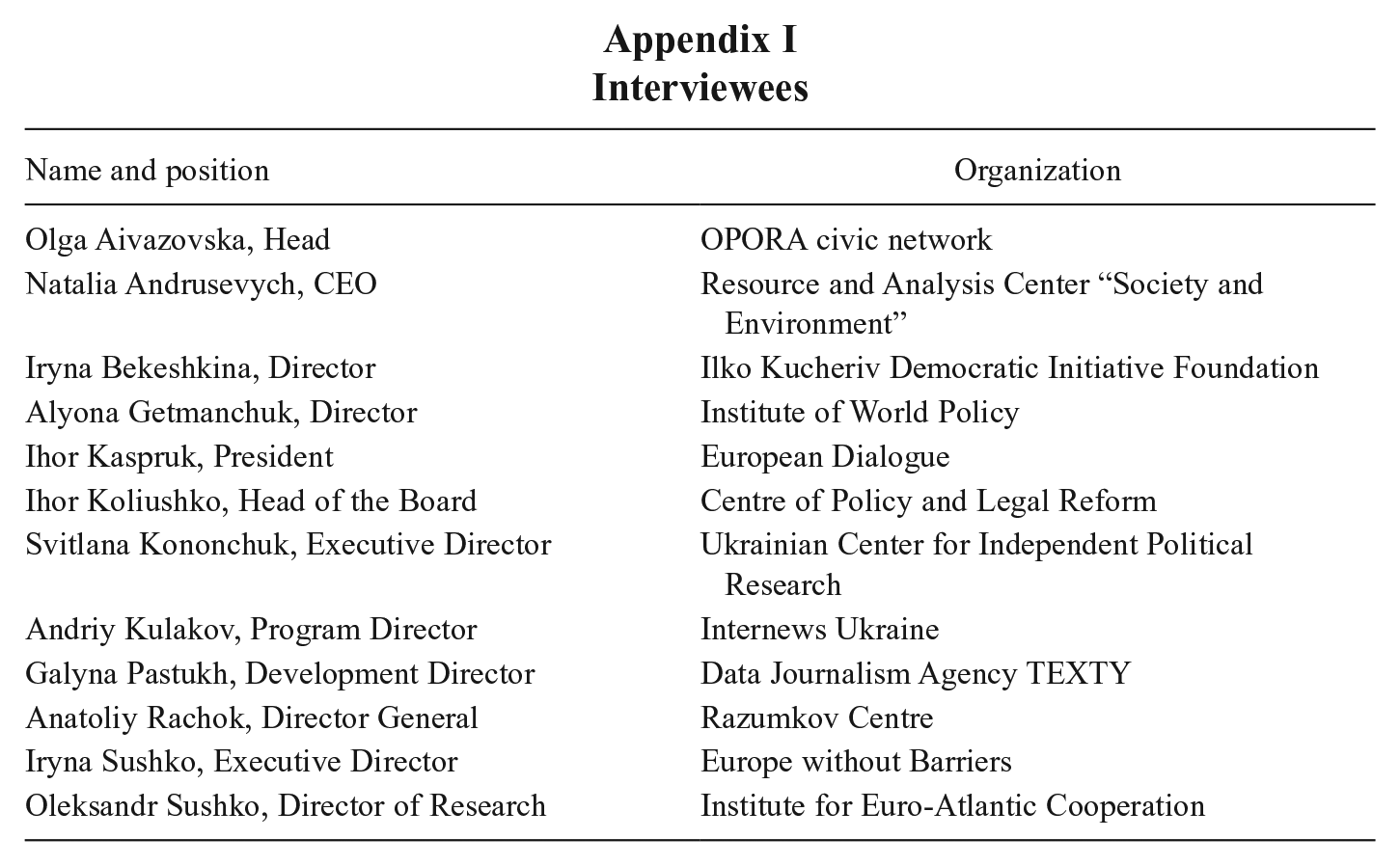
| Name and position | Organization |
|---|---|
| Olga Aivazovska, Head | OPORA civic network |
| Natalia Andrusevych, CEO | Resource and Analysis Center “Society and Environment” |
| Iryna Bekeshkina, Director | Ilko Kucheriv Democratic Initiative Foundation |
| Alyona Getmanchuk, Director | Institute of World Policy |
| Ihor Kaspruk, President | European Dialogue |
| Ihor Koliushko, Head of the Board | Centre of Policy and Legal Reform |
| Svitlana Kononchuk, Executive Director | Ukrainian Center for Independent Political Research |
| Andriy Kulakov, Program Director | Internews Ukraine |
| Galyna Pastukh, Development Director | Data Journalism Agency TEXTY |
| Anatoliy Rachok, Director General | Razumkov Centre |
| Iryna Sushko, Executive Director | Europe without Barriers |
| Oleksandr Sushko, Director of Research | Institute for Euro-Atlantic Cooperation |
