




Abstract
The article is based on a qualitative study of how Polishness is constructed in personal narratives about Karta Polaka (the Polish Card, Polish Charter). The interviews with possessors of the Polish Card, a document issued by the Polish state to the citizens of the former USSR identifying themselves as Poles, was conducted in 2015 in the city of Hrodna in western Belarus. The article uses the example of Karta Polaka to show how people who apply for the Polish Card perceive, negotiate, and reconstruct the idea of Polishness that this document implies. The author suggests that the demand for Karta Polaka among citizens of Belarus cannot be explained by ethnic opportunism entirely. Pragmatic and symbolic reasoning to apply for the document often overlap. Moreover, as the author argues, Karta Polaka evokes the process of negotiating ethnic belonging among participants of the study. The article departs from the theoretical standpoint that ethnic belonging is neither merely a matter of individual choice nor a passive absorption of ethnic discourses produced by states, laws, or ethnic entrepreneurs. Combining the premises of performative and dialogical approaches to identity construction, the author shows empirically which discourses influence people’s sense of ethnic belonging and how these discourses are negotiated in their personal stories.
Introduction
In 2007 Polish Sejm approved the Act on the Polish Charter (Karta Polaka, the Polish Card), the document issued to citizens of the successor states of the USSR who can prove their Polish descent or active involvement in the work of Polish organizations as well as attachment to Polishness and declare their belonging to the Polish nation in the presence of a Polish Consul. 1 The debates around the Polish Card were ongoing in Poland since 1990s. The supporters of Karta Polaka argued that it was the moral obligation of Poland towards its co-ethnics in the former Soviet Union who were the part of the Polish nation, state borders notwithstanding. The opponents stressed the possible high costs of implementation of the Act as well as the danger of manipulation by the law for economic reasons. 2
Poland accepted diaspora legislation, as Shevel defines it, 3 later than several other states in Eastern and Central Europe. The forerunner was Slovenia, where the parliamentary resolution “On the Slovenian Minorities in Neighboring Countries and the Duties of the Slovenian State in This Respect” was adopted in June 1996 (Shevel 2010). Slovakia (1997), Romania (1998), Russia (1999), Bulgaria (2000), Hungary (2001), and Ukraine (2004) followed Slovenian path earlier than Poland. The research on diaspora legislation covers such issues as the changing nature of states and boundaries of state territoriality/sovereignty, 4 compliance of this legislation with international standards and EU regulations, 5 and the tensions between kin-states and states of citizenship rising as a result of adopting diaspora legislation. 6 The literature on Karta Polaka in Polish follows this trend, primarily discussing the consequences of the Act on the Polish Charter from a political or legislative perspective. 7
The article offers a bottom–up perspective on the Polish Card that, with rare exceptions, remains underrepresented in the scholarly literature. 8 The research material for this article consists of semi-structured interviews with residents of the city of Hrodna in western Belarus who possess the Polish Card. Since Karta Polaka and other similar documents are based on an ethno-cultural understanding of extraterritorial citizenship, 9 the aim of this article is to investigate which notion of Polishness the Act on the Polish Card implements and how this notion is perceived, contested, and negotiated by the people who apply for the document. Thus, the current study shifts the focus from the discussion of national and citizenship policies of East and Central European states that dominates the research on diasporic legislation to the issues of ethnic belonging and identification. By doing so, the article seeks to contribute to empirically grounded theorization of ethnicity in Eastern and Central Europe where, as Curticapean claims, the essentialist notion of ethnicity often prevails. 10
The article consists of three parts. The first part discusses the theoretical foundation of my arguments placing Karta Polaka in a broader theoretical debate about agency and structure in constructing ethnic belonging. Further, the methodology, scope, and strategy of analysis and researcher’s positionality are presented. The third, empirical, part offers an analysis of the discourses on Karta Polaka, presents people’s motives to apply for the document, as well as some general findings that frame in-depth narrative analysis of two case studies that conclude the empirical part.
Agency and Structure in Constructing Ethnic Belonging
Since 1980s the constructivist approach to ethnic identity dominates in social sciences. 11 Constructivism considers ethnic identity as multiple and fluid, something that is not given once and for all but is constantly reinterpreted and negotiated on individual and collective levels. 12 The fact that ethnicity is the result of the active process of identity construction is almost taken for granted, leaving some scholars unsatisfied by the lack of a sophisticated analysis of how exactly, by whom, and in which circumstances such constructions are done. 13 Lustick calls the constructivist program on ethnicity “deadening,” arguing that constructivists should move beyond theoretical assumptions about the fact that identities are constructed towards “the testing of interesting, knowledge producing propositions.” 14 Among the main questions this particular scholar proposes to investigate are, for example, how many choices of different identity categories individuals have or how certain identities become institutionalized and why.
Another point of critique toward “clichéd constructivism” 15 lies in the fact that constructivism often fails to explain why ethnicity remains an important part of people’s self-understanding and for which reasons people stick to rigid ethnic categories instead of creatively employing the fluid hybrid notions of self-categorization. Brubaker and Alonso explain this failure of the constructivist theory of ethnicity by its elite bias. 16 According to Alonso, the ignorance of power relations, which limit the fluidity of ethnicity, “attests to the relative privilege of many of those writing on ethnicity.” 17 Brubaker argues that the main focus of constructivism is on “conspicuously visible constructions, such as those of political entrepreneurs, high-level state bureaucrats, or public intellectuals, to the neglect of the less visible (but not less “constructive”) activities of common people in their everyday life.” 18 Echoing Brubaker, Jenkins suggests that scholars look at what “ethnicity means for individuals.” 19
The focus on individual experience of ethnicity inevitably poses the question about agency and structure and, more broadly, about the limits and potentialities of individual choice in negotiating ethnic boundaries. The constructivist perspective with its schools of “instrumentalism,” “circumstantialism,” and “strategic manipulation” emphasizes the power of individuals in producing and negotiating ethnic identifications. 20 However, scholars also acknowledge that this individual power is limited and depends on external institutions and circumstances, including state policies, the extent of ethnic tensions, and the resources involved. 21 To access the interplay between agency and structure in different contexts, circumstances, and individual cases, researchers have started looking at ethnicity as processual rather than a stable category. 22 The choice of terminology used in relation to ethnic identities represents this trend. Brubaker argues that “identity” designates a condition rather than a process. He proposes to use such terms as identification, categorization, and self-understanding, which, in his opinion, suit the analytical aim of acknowledging an active, processual character of ethnic negotiations better. 23 Wimmer suggests that in order to advance the boundary-making approach in the study of ethnicity, researchers have to move from the earlier tradition in which ethnicity is considered “as a process of constituting and re-configuring groups by defining the boundaries between them” to a further investigation of “how ethnicity is made and unmade in everyday interactions.” 24
The notion of ethnic identification as a process rather than a category points out the inherently performative character of making/unmaking ethnicity. Therefore, while discussing ethnic belonging, some scholars find it useful to draw on gender theory and, in particular, on Butler’s theory of performativity.
25
Butler occupies a clearly anti-essentialist position in her understanding of gender. Yet, like some aforementioned scholars of ethnicity, she is also critical of certain threads of the constructivist tradition. In her critique, she foremost disagrees with the idea that “gender is a construction that one puts on, as one puts on clothes in the morning.”
26
She argues that gender cannot be just a matter of individual choice because there is no subject/individual who precedes the process of doing gender: Where there is an “I” who utters or speaks and thereby produces an effect in discourse, there is first “a discourse” which precedes and enables that “I” and forms in language the constraining trajectory of its will. Thus, there is no “I” who stands behind discourse and executes its volition or will through discourse.
27
According to Butler, the process of doing gender 28 as well as the process of making/unmaking ethnicity (or their overlap 29 ) consists of reiterating or repeating the norms about ethnicity or gender that are already discursively established. I find this strand of Butler’s theory particularly important for my study because departing from Foucauldian understanding of subjection and regulation, she draws our attention to the power of discourse and the law in evoking particular kinds of gendered/ethnic subjects. Her argument recalls that of Brubaker who suggests that by invoking ethnic groups as given categories, we simultaneously “evoke them, call them into being.” 30 This line of argumentation is instructive for the current research where the Act on the Polish Charter defines the context in which research participants negotiate their ethnic belonging.
However, as Yuval-Davis underlines, the performative approach to ethnic belonging hardly touches on out of what and how the discourses of gender and ethnicity get constructed. 31 To resolve a conundrum between agency and structure in analyzing the process of “becoming” an ethnic subject, Yuval-Davis 32 suggests taking into consideration another theoretical approach to belonging, namely, dialogical. She does not counterpose performative and dialogical approaches but, rather, considers them as mutually enriching. Analytically, her suggestion allows scholars to combine Butler’s performative theory with its attention to power relations and operating discourses with a more agentic understanding of the processes of constructing ethnic belonging. Moreover, Yuval-Davis opens up performative theory to intersectional investigation, arguing that the dialogical approach grasps how the process of negotiating ethnic belonging overlaps with negotiating gender, class position, or generational tensions. At the same time, Yuval-Davis also makes an important methodological suggestion—she shows that dialogical and performative approaches to belonging form the narrative approach. Thus, she considers conversational and narrative analysis as useful methods to study ethnic belonging as a process.
Scope of Analysis and Methodology
The empirical research for this article took place in 2015 in the city of Hrodna in the western part of Belarus. Hrodna is the administrative center for Hrodna voblasts’, one of six administrative units the country is divided into. The population of the city is 360,000. According to the Population Census of 2009, 20 per cent of Hrodna residents define themselves as Poles (Polish by nationality). 33 Hrodna is located close to the Belarus–Poland and Belarus–Lithuania borders. I have chosen Hrodna as a research site because it is known for the high concentration of the Polish minority and the number of Polish institutions functioning in the city, including two Unions of Poles, 34 one of two Polish secondary schools operating in Belarus (Figure 1), and the Polish Education Society (Polska Macierz Szkolna). My research position in relation to Hrodna is that of outsider/insider. I am a Belarusian citizen with experience of ethnographic research in the country. I originate from Minsk, the capital of Belarus, where the ethnic composition is different. When the fieldwork began, I had not been a resident of the country for five years. Thus, while I had a solid idea of the general situation in Belarus and a good knowledge of the language and culture, I had also been an outsider in relation to the ethnic question in Hrodna and Karta Polaka. As an external observer, I was also influenced by the general belief (discussed in details below) that the meaning of Karta Polaka was merely opportunistic. In the spirit of the instrumentalist approach, I assumed that people manipulated their ethnic identity in order to receive Karta Polaka for pragmatic reasons—foremost, for cross-border mobility. However, as I further argue, the current research complicates my initial assumption.
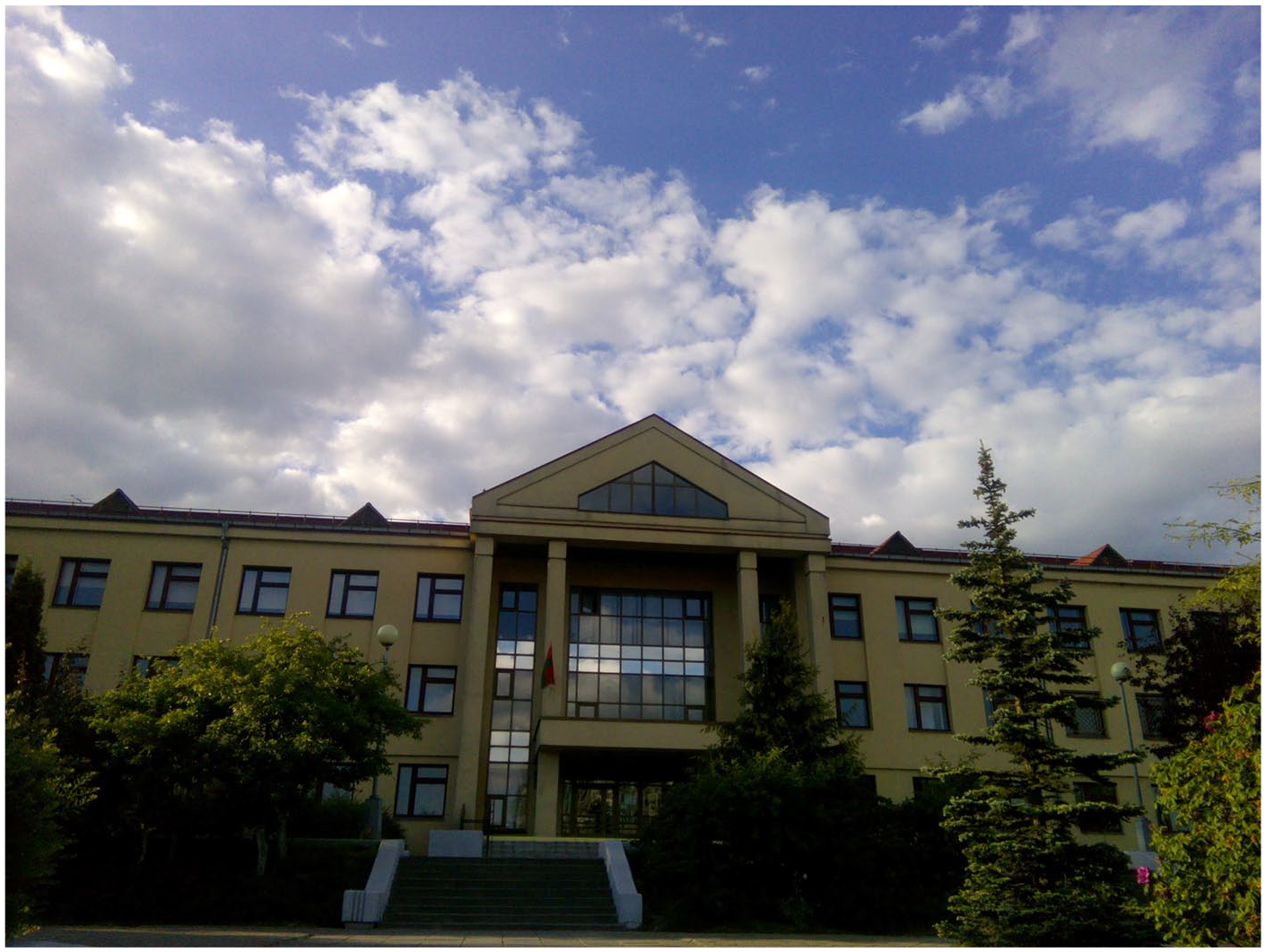
The Polish school in Hrodna
The empirical data for the research consist of twenty-nine in-depth interviews with Hrodna residents who have the Polish Card. The interviews took place in various settings depending on the interlocutors’ preferences: I visited people’s homes and workplaces, some informants came to the apartment that I had rented, and in some cases meetings took place in public spaces (cafes, parks). Most conversations occurred in the Russian language and, more rarely, in Belarusian or a mixture of Russian, Belarusian, and the local dialect. The respondents were recruited through the snowball method in accordance with one criterion—the possession of the Polish Card. The research data I received through this strategy gives me access to the experience of people from different social groups, genders, and generations. All interviews were transcribed verbatim and analyzed using nodes in NVivo11. While a detailed analysis of all interviews is beyond the scope of the article, the choice of two particular cases for the current study is informed by general tendencies that have been discovered in the process of analysis.
The two cases from the sample were selected through the extreme cases approach. 35 This approach stands on two assumptions: (1) extreme cases are not typical of or the most representative examples in the sample, while simultaneously (2) they reveal more information because they clarify the deeper processes behind a particular research problem and give more qualitative insights. 36 The two cases I analyze here are the most illustrative for understanding how people do and undo ethnicity and which particular personal (agentive) and institutional (structural) circumstances influence the process of negotiating ethnic belonging. The method applied to the analysis of these two cases is narrative analysis based on an understanding of identity as a narrative construction that, on the one hand, occurs within predetermined social discourses and, on the other hand, within a particular interaction. 37 The narrative analysis places individual biographies within the social and cultural situation while remaining attentive to its agentive aspects. 38 It also acknowledges that people produce their identity narratives for special purposes and in special circumstances, most often at the request and in dialogue with others. In the situation of a research interview, the other is a researcher herself whose questions and research interests significantly determines the context, rules, and discourse of narrative production. 39
The interviews conducted in this study are marked significantly by the discourse around Karta Polaka and the notion of Polishness that the Act on the Polish Card and practices of applying for this document contain and reproduce. The interviews also occur within a broader social discourse on Polishness/Belarusianness in Belarus where categories of confession/ethnicity/nationality/national belonging/citizenship are blurred. 40 In my topic guide and during interviews, I avoided using these analytical categories as commonsense categories of practice. I did not ask my interlocutors straightforwardly to identify their ethnic belonging or nationality. 41 Rather, I asked them how they applied for a Polish Card, how they proved their belonging to the Polish nation, and what this belonging implied. My questions worked as part of the discursive power to call into being people’s ethnic self-identification. It was apparent that some of them did not have a ready-made answer to my questions about their Polishness or Belarusianness; instead, many interlocutors negotiated ethnic boundaries with themselves and me in the process of our dialogue. These negotiations represent performative and dialogic aspects of ethnic belonging.
Karta Polaka: Between Ethnic Opportunism and Ethnic Belonging
The Act on the Polish Card was approved in 2007 under the government of the Polish nationalist Law and Justice Party (PiS). The moral rationale behind the idea of Karta Polaka for the Polish state is to acknowledge Polish minorities in the former Soviet Union who suffered under the Soviet regime. 42 Pragmatically, it is a soft-power tool aimed at promoting Polish cultural identity abroad and recruiting educated and culturally loyal youth to Poland. 43 According to the Act, the Polish Card is a document issued to citizens of the successor states of the USSR who declare their belonging to the Polish nation and meet the following conditions: (1) speak the Polish language, which they consider as their native one, and know and practice Polish traditions; (2) declare their belonging to the Polish nation in the presence of a Polish Consul; (3) show that one of their parents or grandparents or two grand-grandparents were of Polish nationality or Polish citizenship or provide proof from a local Polish organization that they are actively engaged in activities aimed at promoting Polish culture and language or supporting Polish national minority during the past three years. 44
As the criteria for granting Karta Polaka demonstrate, the document contains an ambiguous idea of Polishness. On the one hand, the Act refers explicitly to concepts of Polish nationality and Polish nation as a distinctive cultural entity based on common traditions, language, and active engagement in the work of Polish organizations. On the other hand, it also includes the notion of citizenship but in the context of descent/origin that can be read as an ethnic criterion. 45 In this light, some scholars and commentators suggest that the idea of Karta Polaka is based on an ethno-cultural understanding of Polishness. 46 Nonetheless, while descent/origin/family ties do play an important role in claiming the right to the Polish Card, this criterion is not decisive. 47 The Act on the Polish Card presupposes other ways to obtain the document, in particular, through proving active involvement in the work of Polish organizations and promoting Polish culture and language. Yet, in practice, proof of Polish descent is the easiest and most reliable way to obtain Karta Polaka because, as Jagielski and Pudzianowska argue, it belongs to objective criteria. 48 There are different ways to confirm Polish descent. 49 Most common among them is to show a birth certificate, usually issued by Soviet authorities, where the nationality of a person’s parents is stated. However, there are cases (one in my material) when a Polish Card is granted without proving or having Polish ancestry.
The literature on kin-state policies towards their external co-ethnics in Eastern and Central Europe suggests that documents such as the Act on the Polish Card in Poland or the Status Law in Hungary re-affirm the link between ethnicity and citizenship since eligibility to extraterritorial citizenship is based on membership in an ethnically defined community. 50 Although Karta Polaka does not guarantee the right to Polish citizenship in the full sense, it gives its possessors certain privileges on the territory of Poland, including access to emergency health care, free-of-charge education at Polish state universities, free entrance to Polish state museums, discounts on public transportation, exempt from the fee for a Polish national visa, and since 2016, an accelerated and simplified procedure of applying for Polish citizenship. Thus, Karta Polaka as well as similar documents issued by other Central and East European countries is defined as the form of “semi-,” “extraterritorial” or “fuzzy” citizenship. 51 It gives an ethnically bounded group of non-residents certain rights on the territory of a kin-state and requires some duties (such as loyalty) in exchange. However, the rights and duties of Karta Polaka holders in relation to the Polish state differ substantially from full citizenship or residential status.
Research on people’s motivation to apply for extraterritorial citizenship shows that motives usually oscillate between strategic/instrumental and symbolic/identitarian dimensions. 52 Instrumental and symbolic reasons are not mutually exclusive and can co-exist within the argumentation of the same group or even the same individual. For example, Pogonyi’s research on Hungarian diaspora demonstrates that there is a significant correlation between the instrumental and emotive aspects of extraterritorial citizenship, that is, the Hungarian citizenship “is valued as a symbolic asset more in locations where Hungarian citizenship has more instrumental benefits as well.” 53 This discovery may challenge the widespread assumption that people who apply for nonresidential citizenship including the Polish Card do it for merely opportunist reasons. 54
During 2007–2017, Belarusian citizens received approximately 100,000 Polish Cards. 55 Belarusians and Ukrainians represent the largest group of post-Soviet nationals who possess the document. In line with Pogonyi’s research, non-EU residents tend to express more interest in extra-territorial citizenship of the EU states since it opens opportunities for cross-border mobility, free-of-charge education, and employment rights. 56 Gieorgica’s and Bartnicki’s quantitative pilot research in Minsk proves that pragmatic reasoning indeed prevails among applicants from Belarus. 57 Among 125 of their respondents, 65.26 per cent state pragmatic reasons such as an access to labor market and education in Poland. The results of this research, however, do not necessarily describe the situation for the entire country and especially for western regions including Hrodna, which, unlike Minsk, were part of the Second Polish Republic during the interwar period. The Polish past is important for Hrodna history and the identity of its residents. As qualitative studies in Ukraine show, the role of this factor can be decisive. For example, in Kaczmarska’s research in a small town, Murafy, in the Vinnytsia region, people born before or right after World War II demonstrate general indifference to Karta Polaka. 58 At the same time, a similar cohort of people from research in Sambir and Lanovtsy in the Lviv region located within the borders of interwar Poland claim that Karta Polaka has a very important symbolic meaning as a document proving their belonging to Polish nation. 59 Moreover, as Kaczmarska shows, motivation can also vary among people from the same locality but from different generations. 60 As she argues, younger people tend to have a more pragmatic attitude toward Karta Polaka. Nonetheless, pragmatism does not exclude the symbolic dimension—the search for documents and the preparation for an interview with a consul lead to reflections on origin and ethnic belonging as well. 61
My own research confirms that people are motivated by complex reasons and that symbolic and instrumental dimensions of their motives usually overlap. Hrodna is located in direct proximity to the Belarus-Poland border, which is also the external border of the European Union and the Schengen area. Visits to Białystok, the closest Polish city, located at a distance of eighty kilometers from Hrodna, are a part of routinized daily life activities in the city. It is not surprising then that seventeen of the twenty-two respondents with whom we discussed the question of motivation explicitly designate pragmatic reasoning, such as access to cross-border mobility, a possibility to visit Poland on a regular basis, free travel within the Schengen area, and a free-of-charge access to Polish museums. For some people, mostly women, Karta Polaka is also a matter of educational opportunities for their children who can apply for the Polish Card more easily if at least one parent has it. These findings are in line with other research on extra-territorial citizenship among Polish and Hungarian diasporas outside of the EU. 62 Another possible motive I came across in my research material is to apply for Karta Polaka “just in case” or because everyone else does it. In such situations, respondents do not have any particular plan to use Karta Polaka but take an opportunity to have it in case it will be needed at some point. A less common reason was to have Karta Polaka for facilitating a visa process for pilgrimage travel to holy places organized by the Catholic Church in Hrodna or to visit graves of relatives buried in Poland.
Pragmatic reasoning by my respondents does not exclude symbolic understanding of Karta Polaka as confirmation of ethnic belonging and ethnic recognition from the Polish state. In several interviews, people explain their interest in the Polish Card by two motives: to have easy access to cross-border mobility and at the same time to acknowledge their origin. As one respondent puts it, “My main motivation was to acknowledge my ancestors; my granny was a Pole (pause). But there is also an opportunistic motivation so to say—cultural establishments are for free for us in Poland . . . and other benefits” (interview 4: A., male, 40 years old). There are also cases where respondents with a strong sense of Polishness consider material benefits provided by Karta Polaka as manifestation of symbolic recognition by the Polish state. P. argues, “If I am a Pole, and the Polish Card proves this, it is natural that the Polish side takes responsibility when I enter Poland (then the benefits are listed—Author)” (interview 27: P., male, 55 years old). Moreover, in some cases, the initially pragmatic decision to apply for the Polish Card raises ethnic awareness, as in the case of I., who says, “I had not known that it had been stated in my birth certificate that I had been a Pole before I started the process” (fieldwork notes: I., female, 20 years old).
Thus, as my research shows, the symbolic/identitarian dimension is only barely the primary motive to apply for Karta Polaka. There are only two respondents for whom symbolic affirmation of Polishness is the leading motivation for application. Yet, it does not mean that pragmatic reasoning overrules symbolic motivation entirely. Rather, both of them overlap. 63 Moreover, as Pogonyi points out, “bureaucratic classification as a full member may strengthen the individual’s sense of belonging to the national group.” 64 As my, and others’, 65 research demonstrates, even when people initiate the application for Karta Polaka for pragmatic reasons, the process may change their self-understanding and strengthen their sense of ethnic belonging.
Doing and Undoing Polishness
Framing Cases
The selection of two cases I analyze further is framed by some general findings based on the thematic analysis of twenty-nine interviews with nineteen women and ten men whose age varies from twenty-three to seventy-three years. Among them, most have a university education (twenty-one against seven with secondary education or vocational training and one with primary school education). All but two persons were born in Hrodna or Hrodna voblasts’. Almost half of the respondents state Russian as their native language. Four respondents consider Polish as their native language, four others think that all three languages spoken in the region—Polish, Russian, and Belarusian—are native for them. Six persons found it difficult to answer the question about the native language contesting the term itself or arguing that they use different languages interchangeably or in mixture (miashanka). A similar picture appears from the discussion of daily life language: fourteen people admit that they use Russian most often; others, however, speak Russian and Belarusian interchangeably or use a local dialect in their everyday communication and at home. The knowledge of Polish varies among interlocutors. Representatives of the younger generation are more likely to receive formal education in Polish at school or in Polska Macierz Szkolna. For people in their forties and fifties, Polish was a language of childhood and of communication with their grandparents. People over sixty spoke Polish in their parental families and learnt the language through the Catholic Church services while living in rural areas before moving to Hrodna in the course of Soviet urbanization. As other studies admit, 66 knowledge of the Polish language does not play a crucial role in defining people’s Polishness in Belarus. The distinction between Orthodox and Catholic confessional belonging is more important. 67
When I asked my interlocutors to distinguish what defined a Pole or what it meant to be a Pole as opposed to a Belarusian or Russian, they very often slipped into the discussion of confessional belonging and Catholic traditions. Even those who problematized such a linkage (usually people of the younger generation with university education) still admitted that the association between Polishness and Catholicism was the main line of distinction between Belarusians and Poles in the region. The questions about confessional belonging and church practices did not raise as many doubts and negotiations among people as my inquiries about their ethnic identification. When interlocutors talked about “Polish” traditions in their families, they often mentioned Catholic traditions of celebrating major religious holidays such as Christmas and Easter. Active Catholics also found it easier to apply for a Polish Card. The experience of Catholic services provided them with the knowledge of the Polish language and religious traditions that some people presented as Polish family traditions during their interviews with a consul preceding the decision to issue Karta Polaka.
My interest in the process of the interview with a consul and especially in people’s feelings about the necessity to sign the declaration about belonging to the Polish nation (an obligatory requirement of the application procedure) opened up interesting and self-reflexive conversations about interlocutors’ ethnic identification. Strikingly, only one-third of interlocutors clearly state their ethnic belonging. In other interviews, respondents demonstrate a very flexible and situated understanding of ethnic belonging. This flexibility is narrated differently. Some people use particular wording to talk about their ethnic belonging—instead of clearly stating who they are, they rather talk about their subjective self-understanding, for example, “I consider myself a Pole” or “I feel rather a Belarusian than a Pole.” Another common strategy is to put their mixed sense of ethnicity in percentage formulas (e.g., “eighty per cent Pole, twenty per cent Belarusian” or “half-Pole, half-Belarusian”). Less commonly, respondents start questioning categories (“What do they mean by belonging to the Polish nation”? or “What is nationality?”) or use nonethnic modes of identification (tuteishy, “local” 68 ). In several cases, interlocutors underline the circumstantial and instrumental character of ethnic sentiment (e.g., “I say that I am a Belarusian in Poland and a Pole in Belarus,” “I am mostly Polish but I say that I am a Belarusian during the Census to increase the percentage”). As these examples show, agentive and structural aspects of ethnic belonging overlap in narratives about ethnic identity. On the one hand, people construct their identifications within a set of particular discourses where national state and its institutional practices (law, population census, citizenship, territory) are of crucial importance. On the other hand, interviews reveal agency in contesting state discourses or employing them in an unexpected manner as well as a great level of awareness about the complexity and ambiguity of ethnic/national categories.
Case 1: “I Am Not a Pole but I Try”
The case of Tatiana (the name is fictitious), a 48-year-old woman with a college education, is unique in my sample. She is the only one among my interlocutors who received the Polish Card without proving any Polish descent. Tatiana moved to Hrodna from central Belarus after her studies. There she married a local man from a devout Catholic and Polish family, as she describes them in the interview. Her son went to a Polish group in the kindergarten and then to the Polish school. According to Tatiana, he strongly insisted on his Polish self-identification. Through her husband and son, Tatiana became an active member of the Polish community in Hrodna. She learnt vernacular Polish. The family regularly hosts visitors from Poland, helps the Polish Union in Belarus and the Catholic Church take care of abandoned Catholic cemeteries and of single elderly people residing in rural areas of the Hrodna region. Tatiana also converted from Orthodoxy to Catholicism and took a church marriage ceremony in the Catholic Church. To apply for the Polish Card, she obtained a letter of support from the Polish Union, which proved her active engagement in activities aimed at promoting the Polish language, culture and minority issues. When I ask Tatiana about her motivation to apply for Karta Polaka, she says that this act is a logical continuation of her earlier decision to be married in the Catholic Church and to have a united family with the same (Polish) culture, holidays and traditions. Later in her reply, she admits that her motivation is also determined by her son’s aspiration to study in Poland. However, unlike in other similar cases where parents apply for the Polish Card to give their children an opportunity to receive university education in Poland, Tatiana’s motivation is not univocally pragmatic. Tatiana does not need Karta Polaka to help her son receive one—he is eligible for the document because his father already has it. However, according to her narrative, she needs Karta Polaka to be close to her son if he decides to stay in Poland. The closeness Tatiana talks about is not merely spatial but rather symbolic. As she says, “Somewhere inside I am thinking—what if he stays there? I want to be closer to him. Therefore, I have decided that I want to continue these connections, cultural, to participate in [activities of] the church and the school.”
Looking at Tatiana’s narrative more closely, one can also notice that the process of doing Polishness implies complicated negotiations between previous and present belongings. In Tatiana’s case, it is also about belonging to her parental and her own family. She narrates her conversion from a Belarusian to a Pole and from an Orthodox to a Catholic as a very sensitive issue. Importantly, these two aspects of the process are inseparable in her story—while starting to talk about her ethnic conversion, she, like many other interlocutors, often slips into the talk about confession. In one fragment of her interview, she talks a lot about her son’s strong Polish self-identification. Immediately after that, I ask her about her own nationality, and she replies: I think it is the same as with my belief. I feel ambiguously. I think that still somewhere inside me there is this internal feeling that I am still a bit Orthodox because my grandma baptized me in childhood. But my main part is Catholic. I live within this [ . . . ], and probably I partially feel myself a Pole.
This excerpt demonstrates that the dominant discourse in accordance to which the Polish identity is linked to Catholicism very much informs Tatiana’s sense of Polishness. Undoing Belarusianness and doing Polishness is tightly linked to religious practices in her story. Thus, the dominant discursive formation shapes her ethnic subjectivity—in order to become a proper Pole, she also needs to become a devout Catholic. Her story also shows that undoing ethnic or confessional belonging is not an easily accomplished enterprise, as instrumentalists seem to suggest. It is not just a matter of one’s choice—her previous belonging haunts her. Even though she has undergone confessional conversion, she still feels her linkage to Orthodoxy and, consequently, Belarusianness because this signifies for her the ties with her parental family (“my grandma baptized me”). She returns to the issue of negotiating her identity between her parental and husband’s family several times throughout the interview. Thus, she does not dare to call herself a Pole unconditionally. Instead, like other respondents, she uses softer linguistic formulas.
At the same time, the quotation above also demonstrates the great extent of self-reflexivity that Tatiana possesses in relation to her ethnic identification. She does not take the categories of Polishness and Belarusianness for granted—her personal story and the context she lives in (“I live within this”) is more important for her Catholicism and Polishness than her descent. She sees the process of ethnic and confessional conversion as agentive experience that requires her active involvement—diligence, self-discipline. When I ask her what she thought about when she signed the declaration of her belonging to the Polish nation while applying for the Polish Card, she starts a long argumentation about complicated feelings raised in this process. She negotiates between two meanings of ethnic belonging—belonging as an active conscious process of doing Polishness, that is, learning Polish language, traditions, and culture; participating in the social life of the Polish community in Hrodna; and belonging as descent (“roots”). Here is a shortened quote from her narrative: And belonging is also a complicated question because, as I said, my husband insists that my ancestors have Catholic crosses on their graves. I have thought for some time to investigate my father’s part of the family to see—probably, I do have some [Polish] roots . . .
I wouldn’t say so. Roots say a lot. But I think that if a person tries to find out and all of this, it is probably a more significant factor than when you just come and say that your grandma was Polish.
This quote demonstrates that Karta Polaka does not merely affirm one’s Polishness, it involves people in a more nuanced process of thinking about their ethnic identification, descent, belonging. If performance of Polishness during application for the Card were merely instrumental, the fact of signing the declaration of belonging to the Polish nation would not be such a sensitive issue. Tatiana considers this step as significant for her own sense of ethnic identification. Negotiations around this process reveal agentive understanding of belonging. For Tatiana, belonging to Polishness is not a taken-for-granted fact of being a Pole through descent or roots; it is a process of becoming (trying, doing something). Identity is producing itself “through the combined processes of being and becoming, belonging and longing to belong.” 69 Nonetheless, Tatiana’s narrative of ethnic belonging is framed by a general social discourse (including understanding of Polishness constructed through the law and practices around Karta Polaka) where ethnic belonging is determined by roots and descent. That is why she returns to the issue of roots repeatedly in her narrative, implicitly expressing a sense of dissatisfaction with the fact that she lacks this formal aspect of her acquired Polish ethnicity.
Case 2: Undoing Polishness—Becoming a Belarusian
The social profile of Anna, a forty-seven-year old woman with a university degree, reminds one of Tatiana remarkably. They are of the same age, married and have children, and have a middle-class background. Both are active in community life: while Tatiana participates in the Polish community, Anna is involved in amateur sport and tourist activities in Hrodna. They both seem to be satisfied with their marriage. Moreover, for both of them marriage and family is a turning point in rethinking their ethnic identification. However, unlike Tatiana, Anna, born nearby Hrodna, comes from “a pure Polish family” with a strong emphasis on Polish language and Catholicism. During her school years, Anna was involved in Komsomol activities—she enjoyed the time she spent together with other youth under the Komsomol umbrella. According to her story, this was the first occurrence when she started rethinking her ethnic belonging and undoing her Polishness because the religiosity of her family did not fit into the Komsomol ideology, which she sincerely admired. Then she decided to marry a “Russian comrade,” as she ironically calls her husband. That caused strong resistance from her parental family and widened the gap between Anna, on the one hand, and her mother and their relatives, on the other. The sense of difference imposed on her by relatives made the Polishness of her family almost unbearable for Anna. In the interview, she considers her family’s insistence on ethnic and confessional identity as narrowmindedness and a result of lack of education: “My mom and her sisters were without higher education. They finished school and they perceived the world the way their parents and grandparents taught them—narrowly, insecurely.” This world does not fit Anna’s ideals of “enlightened” identity where civil identification matters more than ethnic, “The belonging to the state, I admit, it is good. But nationality? . . . All are the same and no one should claim that he [sic] is better.”
Anna strongly rejects Polishness as a part of her self-identification. That notwithstanding, she defines herself as a Pole automatically when I ask her about her nationality. Nonetheless, she starts negotiating her ethnic belonging almost immediately: I am rather a Pole, although I wouldn’t like to live in Poland. Probably, on the Belarusian territory I am a Belarusian, but of Polish, with some Polish specificity.
Anna’s rebellion against Polishness takes place within the discourse where ancestry/roots still determines ethnic belonging of people. Yet, she also demonstrates her agentive take on ethnicity when, acknowledging her Polish origin, she comes to another sense of belonging in the process of the interview. In the same fragment, she compares Belarus (her country of origin and citizenship) with Russia (where her husband comes from) and Poland (her kin-state) and concludes that she likes to live in Belarus and, therefore, she is a Belarusian—“neither a Russian nor a Pole.” Her Belarusianness is simultaneously a matter of her tolerance of the Belarusian state and the way to escape her ethnic roots, that is, Polishness. But it is also a way to overcome the dichotomy between Russianness of her husband and her parental family’s Polishness. In this sense, Anna’s negotiation of ethnic belonging overlaps with her sense of personal autonomy—unlike Tatiana who partially abandons her Belarusianness/Orthodoxy in order to be closer to her husband’s family and her son, Anna chooses to keep two traditions in her family with some critical distance to both.
Anna’s motivation to apply for Karta Polaka is pronouncedly opportunistic. She names two reasons for her application, notably, to open educational possibilities for her children and to gain easier access to a Polish visa and cross-border mobility. Even though Anna has unquestionable Polish roots, she never admits that Karta Polaka contains any symbolic significance for her. She presents it as a purely pragmatic document that helps people from borderlands “in their life, their education, freedom of movement.” Anna depicts her preparation for the interview with a consul (a course of the Polish culture and language) as an educational experience (“the improvement of qualification”).
However, I also argue that Anna is well aware of a potentially strong symbolic meaning that Karta Polaka implies. In particular, her narrative strikes me when she says that she did not sign any declaration of belonging to the Polish nation while applying for the Polish Card. I ask her once again, surprised since signing the declaration is an unavoidable part of the process. She says she does not remember such a document. Then I say, “But this is in accordance with the Law on the Polish Card.” Anna replies, “Well, maybe, but we haven’t signed anything like this.” While some other interviewees also happened to forget the fact of signing the declaration or did not pay a particular attention to what they signed, none of them ever insisted on signing nothing. Some people admitted that they did not remember signing such a document but that most likely they had done it. Some respondents recalled that they signed something after I had asked them but could not say for sure what that was exactly. In the light of this, I interpret Anna’s persistent denial of signing the declaration as her conscious attempt to downplay the symbolic significance of this act. While she is purposefully undoing her Polishness throughout her life and within her narrative, the fact of documental acceptance of her belonging to the Polish nation would prove otherwise. Thus, I argue, her insistence on the pragmatic aspects of Karta Polaka as well as her denial of signing the declaration underlines Anna’s awareness of the symbolic connotations Karta Polaka contains.
Concluding Discussion
The article extends the knowledge about negotiation and contestation of ethnic categories by individuals who apply for extra-territorial citizenship, in particular for the Polish Card. It responds to the scarcity of bottom–up research about identity construction and fuzzy citizenship in Eastern and Central Europe pointed out by ethnicity studies scholars. Analysis of in-depth interviews presented here demonstrates that the process of doing and undoing Polishness in Hrodna consists of constant negotiations between the existing social and state discourses on ethnic belonging/nationality/confession/citizenship and people’s self-reflexive narratives constructed in the dialogue with the researcher. The research also shows that the process of performing Polishness during application for Karta Polaka is not mere ethnic opportunism or aspiration to access certain privileges associated with the document. People’s pragmatic reasoning in relation to Karta Polaka does not exclude its symbolic meaning for strengthening or evoking people’s sense of belonging to Polish culture and traditions. Pogonyi argues that in the case of Hungarian extra-territorial citizenship, “naturalization did not create a new subjective feeling of belonging, only reinforced and reified existing ones.” 70 As mine and other similar research show, 71 in Belarus, where the notion of ethnicity/nationality is significantly blurred, Karta Polaka may also evoke the sense of ethnic belonging among people who were not particularly concerned about ethnic categories before applying and receiving the document. Thus, the discourse on the Polish Card is a powerful instrument to raise awareness of ethnic sentiments. Yet, as the research shows, people who receive Karta Polaka demonstrate their agentive engagement with this discourse through a careful and reflexive consideration of the notion of Polishness implied by the document. Thus, ethnic belonging is neither simply a matter of personal choice nor a passive absorption of discursive practices but the process of meaning making narrated in a dialogue.
Another important conclusion drawn from the analysis of two stories is that ethnic belonging does not exist in isolation; it intersects with other aspects of people’s self-identification such as age, class, gender, religiosity. Moreover, as Brubaker et al. underline, ethnicity is one among multiple ways of making sense of the social world—when people speak about ethnic differences, they may mean other sorts of social distinctions. 72 As is argued throughout the paper, ethnic identification in Hrodna strongly overlaps with confessional belonging and, more broadly, a sense of religiosity. While Tatiana is doing her Polishness through conversion from Orthodoxy to Catholicism, Anna is undoing her Polishness for the sake of a more secular and enlightened identity. Ethnic categorization also demarcates social distinctions between noneducated (more religious and traditional) people, such as Anna’s relatives, and educated/informed people, such as Anna and her social circle.
The biographical accounts of Tatiana’s and Anna’s narratives reveal that the question of ethnic belonging is tightly interwoven with gender choices and family patterns. As Fortier argues, performativity may mean simultaneous genderization and ethnicization of bodies and spaces. 73 In both analyzed cases, the process of (un)doing Polishness intersects with gender performances. Both Tatiana and Anna value their heterosexual marriages and distance themselves from parental families in order to create family bonds with their husbands and children. For Tatiana, doing Polishness is simultaneously about being a good mother who seeks bonding with her son and a devoted wife who is loyal to her husband’s family and their traditions. For Anna, undoing Polishness and doing Belarusianness is resistance against patriarchal norms and a claim for her personal autonomy.
Footnotes
Acknowledgements
This research has become viable thanks to research grant IN2014-15706 from Open Society Foundation, post-doctoral visiting scholarship from the German Historical Institute in Warsaw (September-October 2016), the research project “Spaces of Resistance. A Study of Gender and Sexualities in Times of Transformations” (Knut and Alice Wallenberg’s Foundation, project leader Mia Liinason), and the residential scholarship in Villa Martinson from Anna Ahrenbergs fond för vetenskapliga m.fl. ändamål. The preliminary results and theoretical ideas of this project were presented during research seminars in Leibniz-Institut für Länderkunde (Leipzig), Center for European Studies at Lund University and German Historical Institute in Warsaw. I am thankful to Kristina Müller and Judith Miggelbrink (Leipzig), Barbara Törnquist-Plewa (Lund), and Felix Ackermann (Warsaw) for arranging these seminars. Roman Urbanowicz and Mark Berman provided extremely fruitful commentaries on the first draft of the article; Darya Akhlamionak shared with me invaluable materials from Polish and Belarusian media. My sincere gratitude is to my Hrodna friends Hanna Paulouskaya and Iryna Novik for their assistance and hospitality and to all my interlocutors for sharing their stories with me. Finally, I am genuinely thankful to three anonymous reviewers who helped enormously to sharpen my arguments and improve the manuscript.
