




Abstract
This article focuses on Belarusians’ attitudes towards integration, the EU and Russia, as well as on their motives for choosing foreign allies. To judge by its values, Belarusian society is closer to the Customs Union of Russia, Belarus and Kazakhstan than to the EU. Nevertheless, Belarusians’ geopolitical preference is not the result of political or social values but is based on pragmatic calculations, according to which Europe successfully competes with Russia. Further growth of pro-European attitudes is limited by the frosty relations between Minsk and Brussels, difficulties with Schengen visas, and a general lack of knowledge about the EU.
Introduction
Belarus is now moving towards the Eurasian Economic Union and closer integration with Russia and Kazakhstan while simultaneously seeking to establish better relations with the EU. To what extent does such a strategy reflect the opinion of the population of Belarus, and how do Belarusians perceive European values? What could the EU do to make itself more attractive in Belarus?
Geopolitical orientation of Belarusian society
According to the latest public opinion poll, conducted in December 2013 by the Independent Institute of Socio-Economic and Political Studies (IISEPS 2014), 1 Belarusian society is gravitating more towards European integration than to closer ties with Russia. When asked to make a ‘one-answer choice’ between Russia and the EU, 36.6 % of the respondents selected Russia, whereas the EU option was chosen by 44.6 %. During the past five years, the numbers of pro-European and pro-Russian respondents have both fluctuated at about 40 %. But over a longer period of time, since the late 1990s, the pro-European trend is clearly evident (Fig. 1).
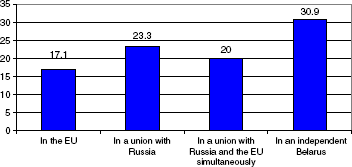
Answers to the question ‘Where would you prefer to live?’
IISEPS conducts quarterly nationwide public opinion polls. The standard volume of selection amounts to approximately 1,500 respondents. Sampling includes, on average, about 50 settlements (Minsk, large and small towns, as well as villages). Statistical error does not exceed 3 %. The poll was conducted using face-to-face interviews at respondents’ homes (IISEPS 2013).
According to a Belarusian Institute for Strategic Studies (BISS) sociological study (Melyantsou and Artsiomenka 2013), 2 in the group of answers to the first question ‘In your opinion, in which union of states would the people of Belarus have a better life?’ those modified by the adverb ‘rather’ obviously dominate, which attests to the instability of both the pro-Russian and pro-European orientations. This instability may result from the fact that the respondents see both pros and cons in each option. It is also noteworthy that a quarter of the respondents remained undecided. Such a large proportion of those unable to make up their minds may indicate that Belarusians believe that the list of development scenarios for the country extend beyond these two options (Fig. 2).
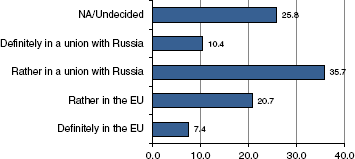
Answers to the question ‘In which union would the people of Belarus have a better life?’
The study was based on a public opinion poll conducted in December 2012 and January 2013. The sample was 1,352 respondents of 18 years and older from cities and villages. The possibility of statistical error does not exceed 3%. The poll was conducted using face-to-face interviews at respondents’ homes.
Thus, as soon as two more choices appear–-an independent Belarus and ‘integration of integrations’ (or two unions simultaneously)–-many of the respondents who previously supported a union with the Russian Federation or integration with the EU change their minds in favour of these options. However, most respondents would prefer to live in an independent Belarus without a union with another state (30.9 %).
At the same time, if a referendum were held tomorrow asking the Belarusians to vote for or against membership in the EU, the number of votes in favour would be higher than the number of votes against.
Belarusians’ understanding of the essence of integration with Russia is also worthy of note. Of the 43.3 % of citizens who support a union with Russia, 49.3 % believe that the most acceptable integration form is a free trade area, while 30.4 % are in favour of a common economic space with no political association, and only 6.3 % (2.7 % of the total number of respondents) would like to see Belarus as a part of Russia, incorporated as an autonomous entity (Melyantsou and Artsiomenka 2013).
Determinants of geopolitical choice
It is important to know what people choose as a preferred geopolitical orientation, but it is equally important to understand their motives and the rationale behind this choice. In the framework of the above-mentioned sociological study, BISS asked the respondents a direct question: what should Belarus's motives be in choosing allies?
Answers to this question confirmed that pragmatism prevails in the geopolitical choice of Belarusian society. Of the total number of respondents, 72.9 % said Belarus should be guided primarily by potential improvement in the country's economic standing. The only other conspicuous factor was security, mentioned by 10.6 % of the respondents. Ideological motives (democracy and human rights, preservation of culture and a unique identity, preservation of habitual lifestyles, restoration of the USSR, and so on) appeared to have a marginal influence on the choice of allies (Fig. 3).
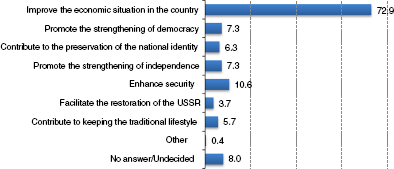
Answers to the question ‘What, in your opinion, should be the main factor determining the choice of Belarus's allies?’
Surprisingly, a larger proportion of ‘Euro-optimists’ chose economic motives than was the average for the sample (85.7 % and 72.9 %, respectively). Therefore, the assumption that advocates of EU integration are primarily value-oriented citizens has not been confirmed.
Overall, according to the research, Belarusian society is capable of making an adequate assessment of the possible consequences of accession to the EU. Cautious optimism about the possible increase in living standards is invariably accompanied by expectations of higher prices and utility fees and ‘brain drain’. However, society does not expect a collapse of the manufacturing sector or loss of national identity as a result of Belarus's integration into the EU (Melyantsou and Artsiomenka 2013).
Little knowledge about the EU
As was mentioned, Belarusians have in general a positive attitude towards the EU. Nevertheless, various sociological studies reveal a low level of knowledge about it and little understanding about how it works and what goals it sets in foreign policy, in particular towards Belarus. 3 For instance, according to a study commissioned by the Office for a Democratic Belarus (ODB) in 2013, only 40 % of Belarusians were aware of the EU's Eastern Partnership (EaP) programme (ODB 2013), 4 54 % thought that the EU did not offer any financial support for Belarus and less than 10 % had heard about the European Dialogue on Modernisation with Belarusian society. 5 Questioned about the EaP, 20.8 % of Belarusians believed that Russia participates in the initiative as well.
See, for instance, periodic quarterly reports by IISEPS, Melyantsou and Artsiomenka (2013) and ODB (2013).
The EaP is an EU initiative launched in 2009 with the aim of drawing its Eastern neighbours (Belarus, Ukraine, Moldova, Armenia, Azerbaijan and Georgia) closer to the EU. The ultimate goals of the initiative are a visa-free regime and a free trade area.
The European Dialogue on Modernisation is a multi-stakeholder exchange of views and ideas between the EU and representatives of the Belarusian civil society and political opposition on necessary reforms for the modernisation of Belarus and on the related potential development of relations with the EU, as well as possible EU support in this regard. The European Dialogue on Modernisation now only works with civil society groups; the Belarusian government does not participate in this initiative.
According to the BISS study, half of the respondents were unaware of the sanctions that the EU had imposed on the Belarusian authorities (Melyantsou and Artsiomenka 2013). As a result of the lopsided interpretation of these measures by the state media, a large proportion of Belarusian society perceived the sanctions as an instrument to put Belarus under pressure. Thus, 40.1 % of those who were aware of the sanctions tended to think that they were imposed because ‘Belarus pursues an independent policy’ and another 13.4 % thought that ‘the EU seeks a change of power in Belarus’. Also important, most of those who were aware of the EU sanctions (58.9 %) were certain that they would not influence the policy of the Belarusian authorities (Fig. 4).
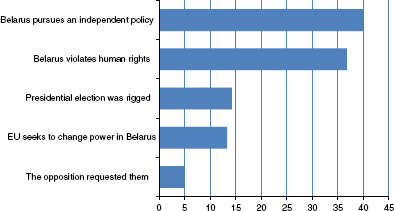
Answers to the question ‘Why do you think the sanctions were imposed?’
Looking at these numbers, it is difficult not to conclude that the EU's communications policy targeting Belarusian society has failed. However, the Belarusians appear to be keenly interested in the EU; 45.6 % of the respondents said that they would like to receive more information about it.
Values
In the summer and autumn of 2013 a wide-scale sociological study of Belarusian values was conducted, commissioned by the ODB, with the aim of revealing the most important values of Belarusians, to study how Belarusians perceive the EU's values as well as the values associated with the Customs Union (CU) (ODB 2013).
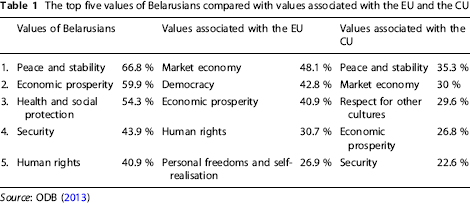
Among the five key values Belarusians named, peace and stability was at the top (66.8 %), followed by economic prosperity (59.9 %), health and social protection (54.3 %), security (43.9 %), and human rights (40.9 %). Democracy was a significant value for 25.4 % of respondents and the market economy for 16.8 %.
It is important to note that ‘human rights’ here should be interpreted rather as social rights (the right to work, free healthcare and so on), not political ones. For the latter, respondents chose other options in the questionnaire such as ‘democracy’, ‘personal freedoms and self-realisation’, and ‘media freedom’.
Among values that are associated with the EU, Belarusians mentioned a market economy (48.1 %), democracy (42.8 %), economic prosperity (40.9 %), human rights (30.7 %), and personal freedoms and self-realisation (26.9 %).
The top five values which Belarusians associate with the CU are as follows: peace and stability (35.3 %), market economy (30 %), respect for other cultures (29.6 %), economic prosperity (26.8 %) and security (22.6 %).
The table shows that based on their values and their perception of the EU and the CU, Belarusians view themselves as being closer to the CU. In particular, they share their main priority, ‘peace and stability’, with the image of the CU. Common values are also prosperity and security. At the same time, the EU is viewed, first of all, as a zone of democracy and market economy, which are not priorities for Belarusians (Table 1).
The top five values of Belarusians compared with values associated with the EU and the CU
Source: ODB (2013)
The most pressing problems for Belarus, according to the study, are the cost of living (35.1 %), jobs and pensions (15.7 %), and the quality of healthcare (10.6 %). Human rights and democracy are concerns for only 5.9 % and 5 %, respectively.
Thus we can draw the conclusion that the geopolitical choice of the Belarusian authorities, a pragmatic one certainly, nevertheless corresponds to the set of values held by the majority of the population, which is inclined to feel closer to the CU than the EU. At the same time, the relatively high level of pro-European attitudes mentioned in the first part of this article can be explained as a result of the tendency of Belarusians to make their geopolitical choice not according to values but based on economic expediency.
Despite the CU being closer in terms of values and historical ties, Belarusians believe that it is better to live in rich (though not entirely understandable) Europe (IISEPS 2009).
Why is Belarus dissatisfied with the EaP?
Regardless of the perception of the EU in the eyes of the Belarusian population, the government of Belarus, which favours authoritarian methods, does not always take into consideration the opinion of the majority. Therefore, it is important to understand the rationale offered by Minsk, which is not at all satisfied with its relations with the EU, particularly not with the framework of the EaP.
What stands behind the dissatisfaction of Minsk? First, the overall deterioration of political ties between Minsk and Brussels after the presidential elections of 2010 has significantly influenced cooperation in the EaP. The EU has resumed practices of coercive diplomacy towards Belarus, including limited contact, and sanctions against officials, journalists and private businesses. Minsk views this as an attempt to interfere in its internal affairs and sees a double standard at work. 6
Thus, the Belarusian Ministry of Foreign Affairs often refers to the example of Azerbaijan, which enjoys good relations with Brussels in spite of the fact that it holds dozens of political prisoners. The Ministry of Foreign Affairs has also published two reports on human rights violations in some Western countries.
Second, Minsk did not get what it expected from the EaP, namely the promised macro-financial assistance and funds for multilateral infrastructural projects. The European Commission has never responded to joint proposals submitted by Belarus, Lithuania and Ukraine within the EaP framework. 7
These project proposals, which were submitted within the multilateral track of the EaP, include among other things a project to build a Berlin–Moscow motorway via Belarus; an extension of the Odessa–Brody pipeline to Gdansk with sidelines to Belarusian oil refineries; an electricity transit project from Ukraine to Lithuania, which presupposes the construction of additional electrical power lines; the construction of a Klaipeda–Vilnius–Minsk–Kiev highway; and the modernisation of the customs infrastructure.
Third, Belarus has never become a fully institutionalised participant of the initiative and, as a result, continues to feel discriminated against. Belarus cannot participate in the bilateral dimension of the EaP, since the policy covers Belarus only partially. Belarus is excluded from inter-parliamentary cooperation (Euro-nest) because the EU does not recognise the Belarusian parliament; Belarus is not represented at the highest political level at the EaP summits, contrary to other partner countries. Nonetheless, Azerbaijani Members of Parliament, for example, participate in Euronest regardless of the electoral problems in their country.
Under the existing circumstances, one can hardly expect a breakthrough in Belarus–EU relations even if the government meets Brussels’ main condition and releases its political prisoners.
Conclusion: what to do with Belarus?
One should note that Minsk does not look on ties with the EU as an alternative to those with Russia and never has. Brussels is not capable of giving Belarus what Russia gives: multi-billion dollar subsidies in exchange for perceptible integration and assurances of an ongoing alliance. What relations with the EU have always represented for Minsk is leverage in negotiations with Moscow and a possible source of income and investments. This is why it is not realistic to expect the Belarusian government to limit its powers in response to EU conditions. In truth, the EU has nothing to offer to Belarus of sufficient value to stimulate quick reforms. So, goals of future bilateral cooperation should focus on establishing normal contractual relations rather than regime change.
Political change in Belarus, when it occurs, will be the result of a lengthy process of social transformation, including the transformation of elites. The EU can make a contribution to this process at the current stage only by reaching out to Belarusian society and rebuilding mutual trust with the government. The last point is very likely to be vital for effective work by the EU with the Belarusian people. The experience of the EaP and the Dialogue on Modernisation has clearly demonstrated this. Therefore, a double track approach may be appropriate in the EU's relations with Belarus, but with a different meaning from the usual definition of this term: political relations with the government should be improved, something that will also broaden opportunities for civil society's activities in the country. At the same time, communication with Belarusian society must be reinforced by using every chance to facilitate programmes for people-to-people contacts and educational and academic exchange, and, to the extent possible, to unilaterally liberalise the issuing of Schengen visas to Belarusian nationals. This could be a way for the EU to pursue two goals simultaneously: to socialise Belarusian society and its elites without pushing Belarus further towards Russia's grasp.
In the initial stage of normalising Belarus–EU relations, confidence building measures are very much needed: Belarusians need to see examples of constructive cooperation between Minsk and Brussels. It is also important to create a roadmap of normalisation and to set a concrete agenda of mutual steps and a timetable for their implementation. This roadmap could include non-politicised projects, which should reflect the common interests of the two parties: border management, fighting illegal migration, environment protection, food safety and so on. There could also be negotiation on visa facilitation and readmission agreements, sectoral projects, and consultation with European experts on the modernisation of the Belarusian economy. The roadmap could also include consultation on concluding an interim agreement which would temporarily act as a Partnership and Cooperation Agreement. 8
A Partnership and Cooperation Agreement between the EU and Belarus was signed in 1995 but was never ratified by the EU member states because of a lack of democracy in Belarus.
Footnotes