




Abstract
As a result of the rise of online communication and political divisions based on symbols, rather than structure (decrease in the importance of class-based voting), citizens are increasingly linked to news outlets that articulate and reinforce their views. The process is facilitated by the spontaneous processes of bottom–up communication that excludes, in an iterative process, people who express views that are inconsistent with the prevailing opinion. The emergence of “information verticals” is a significant influence on attitudes to some issues covered in political debate. These effects operate with regard to so-called easy issues, that is, those rooted in emotions and in the symbolic sphere. Our article is an empirical test of our hypotheses about the effects of media framing of “hard” and “easy” issues. We apply a survey experiment method to verify whether contact with news coverage has an effect on attitudes, taking into account the political orientation and cognitive skills of citizens. Our empirical analyses confirm that a hostile media framing of migration changes respondents’ attitudes no matter their level of cognitive engagement. The data come from Poland.
Introduction
Media audiences are becoming increasingly atomized. The pre-Internet common communication platform created by the so-called mainstream media is increasingly diminishing in importance. Partly as a result of the rise in online communication, and partly as a result of political divisions based on symbols, rather than structure (decrease in importance of class-based voting), citizens are increasingly linked to news outlets that articulate and reinforce their views. These transformations within the media context of political communication create the framework for issue-based political debate. Pluralization of the media and vertical linkages between citizens and media outlets creates a one-sided information flow in which issues are debated within ideologically uniform groups. Citizens are thus sheltered (or self-exclude themselves) from contact with opposing points of view.
Previous research has shown that restricted selection of news coupled with limited cognitive skills produces conditions in which opinions may be changed by news coverage. When both of these conditions are met, attitudes can significantly change. For citizens who use a number of different sources of information, contradictory sources cancel each other out. And those with adequate cognitive skills are in a position to hold their views regardless of news coverage. However, if a person is not deeply aware of the issues covered in the media, does not have the capacity to analyse them, and is subjected to a one-sided information flow, his or her opinions may be altered.
We argue that these effects operate with regard to so-called easy issues, that is, those rooted in emotions and in the symbolic sphere. Citizens with limited cognitive capabilities are especially prone to making political decisions based on such issues. On the other hand, “hard” issues, that is, those requiring analysis, rather than emotion, are far less affected by such a confluence of factors.
Our focus is the changing media landscape in a region experiencing a populist-nationalist turn. The region has been marked by a turn towards “illiberal democracy,” characterized by authoritarian clientelism with populist elements. Some East European countries, in particular Poland and Hungary, have been criticized for breaching the rule of law. In addition, the legitimacy of European political institutions has been called into question. These developments have occurred in the context of mass migration into the EU from the Middle East and Africa, which has coincided with an increase in xenophobic attitudes in some Central European states. Our central hypothesis is as follows: The changing media ecology exerts a measurable influence on the political landscape by modifying public opinion in the direction favoured by the agenda-setters. Following our theoretical assumptions, we expect opinions on the topic of Muslim migration to be malleable. Opinions on issues related to procedural democracy and the rule of law are expected to be durable regardless of the media agenda.
Our article is an empirical test of these hypotheses. We apply a survey experiment method to verify whether contact with news coverage has an effect on opinions on “easy” and “hard” politically charged issues, taking into account the political orientation and cognitive engagement of citizens. Our empirical analyses confirm that hostile media framing of migration (an easy issue) changes respondents’ opinions no matter their level of cognitive engagement. On the other hand, framing of the rule of law situation does not influence opinions, according to our survey in Poland.
Background
Looking from a medium-term perspective, Central Europe (Visegrad Four) appears to be a collective case of successful transformation from authoritarian socialism to free market liberal democracy both in economic terms, with regard to the development of internal political institutions, and in geopolitical terms. EU accession was sometimes treated as a symbolic endpoint of the transition; thus these states started to be treated as consolidated democracies in comparative research on democracy. The emerging consensus of different comparative studies of democracy (e.g., Freedom House, Bertelsmann Foundation indexes, Polity) could be summarized as follows: significant progress was made in terms of institution-building, but the civic foundations of democracy remained fragile. However, at this seemingly high point of success of democratic development, backsliding occurred. 1
In Poland, the reversal commenced with the 2015 presidential and parliamentary elections, which concentrated power in the hands of one party, the right-populist Law and Justice (PiS). The government of PiS broke the continuity of institutional development. Its actions were especially far-reaching in the areas where Polish democracy was the weakest. PiS activities strengthened the degree of clientelism (party colonization of state enterprises), weakened mass media (change of legal framework of public media and consequent takeover of state radio and TV), and undermined the rule of law (subordination of the legal branch to the executive). 2 The position of the Constitutional Tribunal and Supreme Court were compromised by a series of legislative acts that undermined their independence.
This reversal in democratic standards was accompanied by the rejection of further European integration and, more broadly, undermining the legitimacy of European political institutions. The overhaul of the court system in Poland has triggered multiple critical reactions from the European Parliament, the Venice Commission, and finally, from the European Commission. On 20 December 2017, the European Commission decided to launch Article 7 of the Treaty on European Union against Poland and asked the Council of the EU to declare the existence of a clear risk of a serious violation of European values in Poland. At the same time, the Commission issued a recommendation on the rule of law, in which it called on the Polish authorities to amend the laws reforming the judiciary and restore the independence and legitimacy of the Constitutional Tribunal. 3
Another area in which Poland, along with other EU member states from Central Europe, found itself at odds with European law was its policy towards refugees. According to the European Commission, three V4 countries violated the European Council decision on relocation of refugees from Greece and Italy, where crisis ensued after a wave of migration in 2014–2015. The temporary emergency relocation scheme was established in September 2015. Subsequently, infringement procedures were launched by the Commission against the Czech Republic, Hungary, and Poland for non-compliance with their obligations. The Council Decisions required member states to pledge available places for relocation every three months to ensure a swift and orderly relocation procedure: Hungary has not taken any action at all since the relocation scheme started; Poland did not relocate anyone and has not pledged since December 2015 (when the PiS government was formed).
Central European governments (especially, but not exclusively, Poland under PiS and Hungary) not only violated the EC decision but did it publicly and openly. A hostile attitude to migration and to receiving refugees is consistent with public opinion on this issue: According to the CBOS Center for Public Opinion Research, a reliable polling institute with more than thirty years of experience, the vast majority of Poles are against receiving refugees from war zones. Nevertheless, this view is not a permanent fixture of Polish society: As late as May 2015, only a minority rejected receiving refugees. The opinions are even more negative in Czech Republic and Slovakia. 4
Thus, our research starts with parallel observations: on the one hand, party colonization of the media, judiciary, and sections of the economy legitimized by nationalist rhetoric; on the other hand, increasingly nativist public opinion in sync with current state policy. Our question, therefore, is, Is there a causal mechanism? Our study strives to answer it.
Concepts
The ontological status and measurement of socio-political attitudes have been contentious issues since the beginning of the study of public opinion. 5 Attitudes were initially understood as mental states of readiness, organized through experience, influencing actions. 6 They contain axiological and emotional elements. However, measuring them may easily lead to producing artefacts, that is, respondents giving random answers: “large portions of an electorate simply do not have meaningful beliefs, even on issues that have formed the basis for intense political controversy among elites for substantial periods of time.” 7
Politics, or public affairs in general, are topics irrelevant to a large number of citizens. People tend to focus on problems related to their personal sphere, such as family, work, personal relations, and personal finances. 8 Therefore, they tend not to look for political information actively, but rather base it on information they acquire in everyday life. 9 Attitudes are formed on the basis of accidental contact with different sources, rather than conscious effort. As a result, many citizens lack developed cognitive schemata for developing political attitudes, which makes them unstable, susceptible to change, and dependent on personal experience. 10
The experience that produces attitude change can be media coverage of events. In this article, we use a theory of this link conceptualized by Zaller. 11 His concept highlights the role of the media in forging the link between latent attitudes and responses to survey questions. It is clear that individuals react differently to the same media message, and the level of political sophistication (knowledge of and interest in public affairs) may moderate its effects on individual’s opinions.
Highly aware persons tend to be little affected by . . . campaigns. . . . Meanwhile, at the lower end of the awareness spectrum, those who pay little attention to politics tend to get little or no information about . . . politics, hence they are also relatively unaffected. That leaves the moderately aware most susceptible to influence: they pay enough attention to be exposed to the blandishments of the incumbent, but lack the resources to resist.
12
Moreover, the actual content of the information flow may affect the activation of attitudes. If media messages are one-sided, it signifies a political consensus on the issue. Therefore, there is no basis for rejection of the content on the grounds that it is incompatible with the value-system of a respondent. In such a situation, the contact with the media should be a predictor of the strength of attitude. It is the mainstream effect.
On the other hand, if the information is mixed (several points of view are presented in an adversarial manner), there is no political consensus on an issue. Cognitive engagement is a key factor activating attitudes in the case of a (normally occurring) situation in which there is no media consensus on an issue. Individuals with low interest in politics (unsophisticated) do not usually come into contact with political information. People with high levels of cognitive engagement process information selectively, matching the input with their pre-existing beliefs. However, people in the middle of the scale of competence (not sophisticated, but reading or watching news) tend to be affected the most. This is the polarization effect: in the case of an evenly divided partisan elite and a balanced flow of partisan communication, the effect of political awareness is to promote the polarization of attitude reports. The more balanced the information to which individuals are exposed, the less likely we are to find a media effect, as opposite effects may cancel out. Polarization effect is possible in a cross-cutting media exposure, which means that people must be exposed to political perspectives that they do not find agreeable. It is the best overall description of the way in which citizens relate to the partisanship of their news sources outside of experimental settings. 13
The opposite is selective exposure: people expose themselves to like-minded media whenever possible. The latter type of exposure results in the “friendly media phenomenon” of citizens effectively selecting like media for contact. Evidence of selective exposure to media has been found in studies in laboratory experiments, and their findings may not be generalizable to “naturalistic settings where people may or may not have choices that reflect a range of political views, and where media choices may be largely habitual and long term, rather than on a story-by-story or day-by-day basis.” 14 Researchers studying the phenomenon have found partial evidence confirming the role of media flow on attitudes. News media are least likely to have an effect if the public is exposed to both sides of an issue, and the information received in conditions of one-sided information flow affects the least competent recipients most. 15
Weak vs. Strong Issues
Citizens do not respond to all issues with the same degree of involvement, interest, and competence. They are interested in some matters but not others. Some are better at policy analysis than other citizens. Highly accessible attitudes can be immediately retrieved. If they are not automatically accessible, a response will be constructed on the spot on the basis of information salient at the moment. This difference corresponds to the dichotomy of “easy” versus hard” issues.
“Hard-issue voting . . . presumes that . . . voting is a result of sophisticated decision calculus; that it represents a reasoned and thoughtful attempt by voters to use policy preferences to guide their electoral decision. Citizens, after examining policy positions . . . vote for the candidate who is closest to them in some issue space. Hard-issue voting should be best exemplified . . . among those who have the conceptual skills to do it well.” Easy-issue voting occurs “when a particular issue becomes so ingrained over a long period that it structures voters’ ‘gut responses’ to candidates and political parties. Because gut responses require no conceptual sophistication, they should be distributed reasonably evenly in the voting population.” 16 The requisites of “easy issues” are as follows:
The easy issue should be symbolic rather than technical: Symbolic conflicts are easily communicated to mass publics.
It would more likely deal with policy ends than means: Means of policy issues are technical, rather than symbolic.
It would be an issue long on the political agenda: an unresolved conflict long in the public eye.
More interested, more informed, and more involved citizens are more likely to discriminate by hard issues than their less interested, less informed and less involved counterparts. 17
Ideological Bubbles in Web 2.0
Internet media ecology introduced a new factor to the mechanism of media-generated attitude change. 18 Until the era of mass consumption of user-generated media content (web 2.0), media served as the source of professionally produced and verified information. Sources of information were shared: major networks in the US, BBC in the UK, and state TV in the socialist and post-socialist countries. The introduction of cable TV was the start of the process of change, in that ideologically leaning news networks appeared (e.g., “Democratic” CNN vs. “Republican” Fox News), but the production of news content remained the preserve of professional journalists.
The spread of user-generated content as source of information and the ability to “tune out” significant amounts of news content created a qualitatively new media environment. The possibility to customize information streams elevated micro-group cognitive biases to the mass level. Phenomena such as confirmation bias 19 and shared information bias 20 are well known in social psychology. People have a tendency to search for, interpret, favour, and recall information in a way that confirms one’s pre-existing beliefs, especially if they are emotionally charged and deep in consciousness. Members of groups tend to spend more time and be more involved discussing information that all members are already familiar with (shared information), and less effort discussing information that only some members are aware of. This creates asymmetry of knowledge between groups. Web 2.0 made it possible for groups to grow numerically and become mass phenomena. Ideological tribes emerged online due to self-selection. 21
This socio-psychological phenomenon is reinforced by technology. Search engines customize search results based on past user behaviour—the so-called filter bubble, described by Pariser. 22 It results in personal ecosystems of information. At the end of the line, groups of individuals living in similar ecosystems coalesce based on relevant orientations.
Media Framing of the European Union and Its Effects
The substantive topic of our study is the attitude to the European Union in the context of two events: mass migration (easy issue) and the controversy regarding the Constitutional Tribunal (hard issue). In this context, it is crucial to verify media influence, since “EU citizens consistently identify newspapers and television news as their most important sources of information about the EU.” 23 The theoretical insight and empirical research gathered to date indicate that the relation between media content and attitudes is complicated and mediated by a number of variables, and that there is no direct correspondence between media content and opinions. One of the key intervening variables is the existing cognitive structure. It is worth noting that attitudes to the European Union are not very deeply rooted in many societies (although generalization across twenty-seven countries is difficult) and that they can change rapidly. For instance, it was found that “public opinion on complex issues is volatile, and opinions on EU are not stable and are easily influenced by new information.” 24
There have been studies of media effects on EU attitudes. 25 However, most of these were either experimental or restricted in scope (covering West European societies only). A number of experimental studies 26 demonstrate that subjects exposed to news articles in which enlargement of the EU is negatively evaluated show lower support for it. A problem with experimental studies, however, is their ecological validity: Their generalizability to a natural environment is questionable. On the other hand, results obtained in northwestern Europe may scarcely be applicable to less consolidated political and media systems. “New membership” is salient for these attitudes. 27 Our study seeks to add value to existing research by (1) applying a setting as natural as possible (conditions of online reception of material) and (2) shifting regional focus to CEE, with research conducted in Poland.
Hypotheses, Methodology, and Data
In the study, we test hypotheses derived from existing theoretical and empirical work. They concern
the structure of the media flow (one- or two-sided, i.e., whether there is one- or multi-sided exposure);
the impact of media on developing and articulating opinions; and
the strength of cognitive engagement as an intervening variable in the relation between the media exposure and opinions.
We explicitly formulate three hypotheses:
Hypothesis 1: Cross-cutting exposure (contact with the opposing viewpoint) will create conditions in which opinions may change. Putting it another way, “living in a bubble” (customizing information streams based on partisan orientation) results in a stable worldview, while a confrontation may modify beliefs.
Hypothesis 2: Exposure to a news frame will have a different influence on opinions, depending on intervening variables. Following Zaller, we believe that moderately aware individuals will be more influenced by news coverage than the unsophisticated, as they will be in a position to process the information.
Hypothesis 3: Coverage of emotionally charged, symbolic issues (“easy” issues) has a stronger influence on opinions than coverage of complex policy matters (“hard” issues). This applies in particular to issues associated with polarized and politicized divisions within the society.
The analysis uses a survey experiment research design. Data come from online survey conducted by PBS, a reliable research institute, between 18 and 25 May 2017. The number of cases was 1,005.
In order to deal with the limitations of online surveys, related to limited sampling and respondent availability, we have taken measures to reduce the risk of unreliability of statistical inference. The survey was held on a quota sample with respect to selected sociodemographics (gender, age, region, size of locality) in order to represent the population of adult citizens of Poland. Moreover, we use post-stratification weighting, which corrects for education. According to the literature, weighting “eliminates the bias due to selection or coverage problems if, within each adjustment cell, the probability that each case completes the survey is unrelated to the case value on the survey variable of interest.” 28 The latter in our case is the effect of randomly assigned treatment. Such randomization in the experiment prevents selection bias, thus ensuring that subjects assigned to various groups do not differ in any systematic way. 29
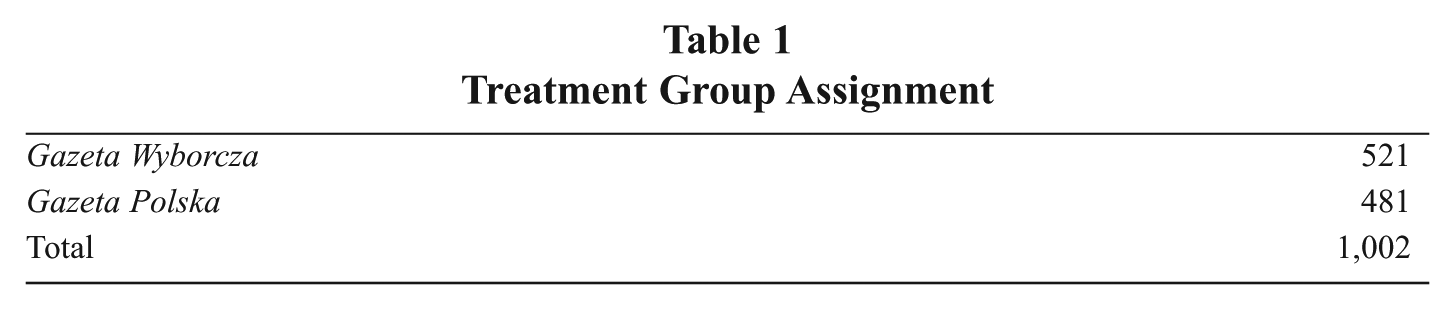
In the study, we use a two-group pretest–posttest experimental design, in which we compare the effect of two treatments (randomly assigned, as stated above; see Table 1). Such design is the best for our purpose, as our hypotheses concern not the presence or absence of media message but its content, structure, and effect.
Treatment Group Assignment
The pretest and posttest measured opinions on ten issues related to ongoing political debate that polarize society along socio-political cleavages. They were semantic differential items measured on an 11-point scale. Some issues were the topic of the experimental stimulus, while others were not. The issues concerned (1) right to abortion; (2) aligning policies with the European Union; (3) support for the ruling party versus the oppositional Committee for Defence of Democracy; (4) immigrants and refugees; (5) Church–state relations; (6) controversy around the Constitutional Tribunal; (7) autonomy of NGOs; (8) welfare state; (9) market economy; and (10) integration of the European Union (see Appendix A).
The stimulus concerned two issues: EU policy regarding the Constitutional Tribunal crisis in Poland and risks/opportunities posed by the influx of refugees and other migrants to the EU. Thus, opinions measured by items 2, 4, 6, and 10 were subject to experimental stimulus. We treat item nos. 4 and 10 as easy issues: they polarize society, they are based on deep-set emotions, and they divide the political scene (the previous pro-EU government agreed to accept a quota of refugees, as decided by the European Council, while the current government, sceptical towards further integration with the EU, refuses to accept the legal decision). Issue nos. 2 and 6 are “hard”: the legal intricacies regarding the Tribunal are obscure for citizens without a legal background, despite the fact that the controversy divides the political camps and can be perceived largely though a partisan lens. Also EU policies and their consequences are a highly specialized field of knowledge. EU membership does not generate obvious partisan divisions: The majority of electorates of all major political parties support it. Different EU policies are accepted or rejected in various configurations of partisan identities.
The stimulus was prepared in two versions. Each contained two short articles about European Union directives to Poland related to (1) the Constitutional Tribunal controversy and (2) the refugee crisis. They are authentic press materials edited for length to produce texts of equal size. The sources were the Gazeta Wyborcza (a leading left-liberal daily generally supportive of the opposition) and Gazeta Polska (a leading nationalist newspaper supporting the government). The sources were not marked. One version of the stimulus was applied randomly to a sub-sample. Framing used in these articles is typical for the two categories of print media: the (left)-liberal, associated with opposition, represented by GW, and national-populist, supportive of PiS government, represented by GP. The news extracts were prepared via iterative pilot testing. The texts are in Appendix B.
The empirical analyses were carried out in two steps. Firstly, we verified data reliability, testing the consistency of the pre- and post-test scores for issues not mentioned in the stimulus (the t-test). Secondly, we verified the hypotheses, using the changes in scores of the issues raised in the stimulus as dependent variables. The opinion change variables (measured separately for each issue) range from −10 to 10.
Our hypotheses require control of cognitive engagement and previous political predispositions. According to theoretical premises, susceptibility to media coverage can be a function of one’s level of ability to receive and process any kind of information (cognitive engagement) and particular capacity to comprehend political information (political sophistication). In our analyses, we focus on the former, which is more crucial to the reception of media messages. 30 We measure cognitive engagement using the Cognitive Reflection Test, which consists of three brainteaser items designed to assess an individual’s ability to suppress an intuitive, “gut” answer and engage in further reflection to find the right answer. 31 The cognitive engagement variable ranges from 0 to 3 (the higher the number of correct answers, the higher the level of engagement).
Previous political predispositions are controlled for using vote choice variables—dummies for main political parties PiS (Law and Justice) on one side and PO (Civic Platform) / Nowoczesna (Modern Party) on the other, placed on opposite sides of the ideological division line related to issues of interest. 32 Taking one of the two parties’ sides involves use of particular mass media (with pro- or anti-government coverage) and, as a consequence, is related to a specific system of opinions, attitudes, and beliefs. We did not choose to control for particular media use, as, because of a high level of declared media dispersion, it was impossible to specify a clear division line.
In our models we also control for interest in politics (low, medium, high), the level of education (primary, vocational, secondary, higher), and media exposure (the total time spent on consumption of various kinds of media), which may influence the effect of the treatment on the dependent variable, and a range of sociodemographic variables (age, gender, place of residence, subjective evaluation of household economic situation.
Following our initial hypotheses, we expect the effects of the stimulus to be minor (if any), if a respondent scores high on the cognitive skills test. On the other hand, we expect the stimulus to have significant effect on people who live in an information vacuum or derive information from sources with similar ideological orientation as the stimulus, or share partisan positions with the stimulus source. This will be the “bubble effect”: reinforcement of existing views. We think that these effects will be clearest on (emotionally charged) opinions on refugees.
Empirical Analyses
The first step of our analyses consists of the test of the reliability of our tool, based on the comparison of mean opinions on all issues included in the survey (Table 2).
Mean Comparison—Treatment
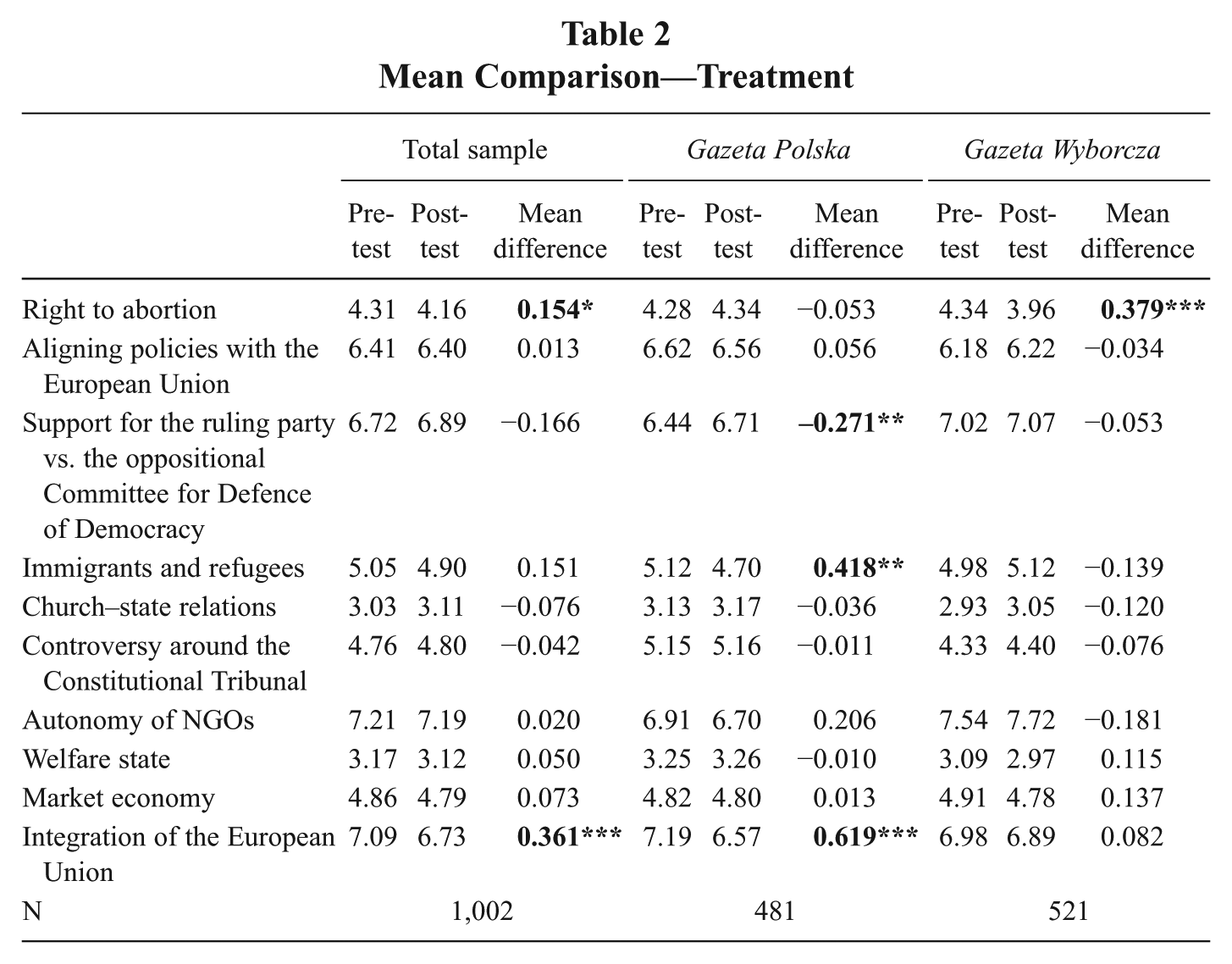
Lack of statistically significant changes in averages in the total sample in all but one issue affected by the stimulus enables us to claim the tool is reliable (the significant change of opinion towards the pro-life option after reading GW is discussed in more detail in the last part of the paper).
Other findings emerging from Table 2 are consistent with regression models (model 1, Tables 3-6). Contact with the message from Gazeta Polska significantly changed respondents’ opinions about acceptance of immigrants and refugees and further integration with the European Union. In both cases, the change of mean on the issue is as expected: article content exposure makes respondents less prone to accept migrants and refugees and less willing to support further integration with the European Union.
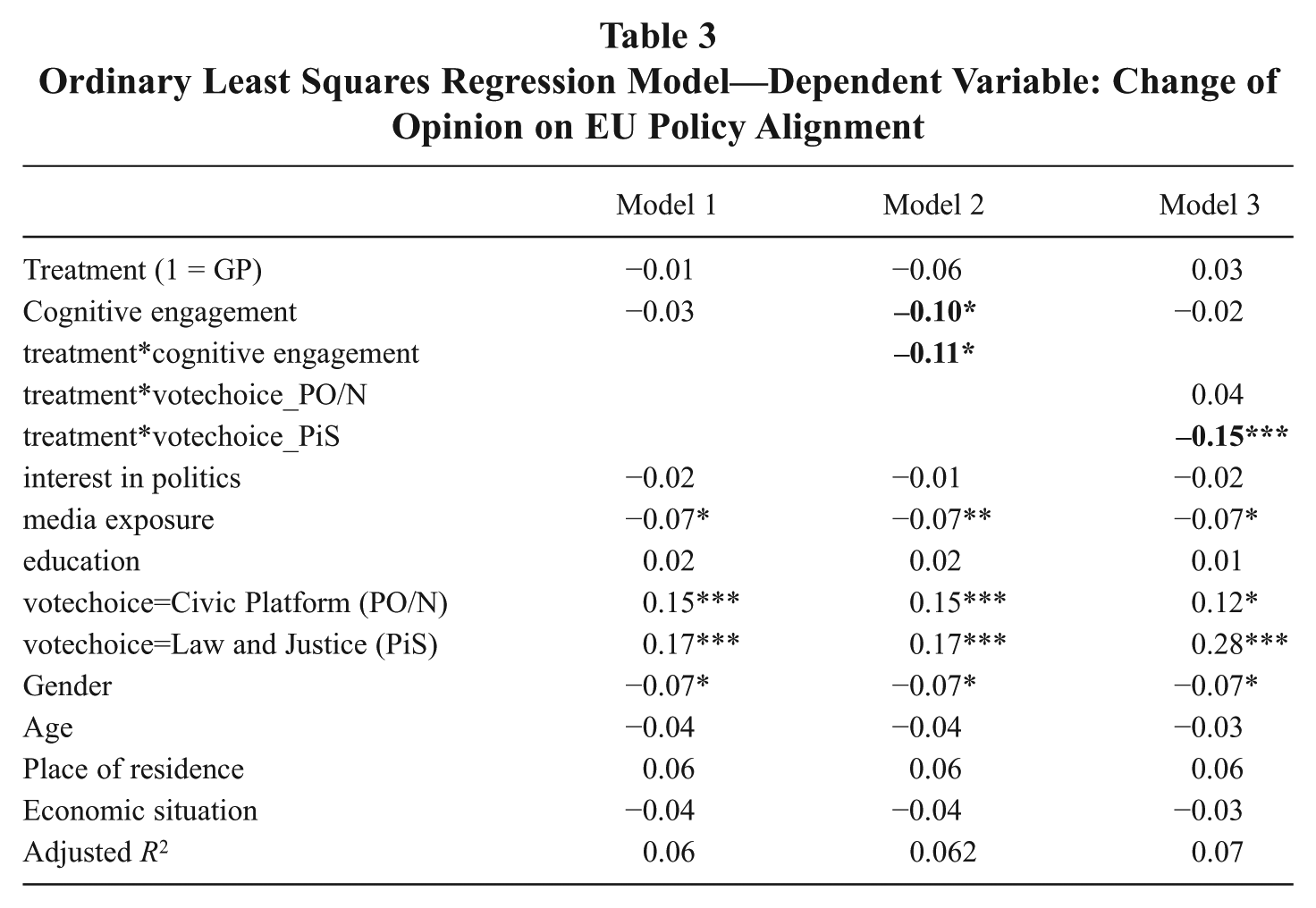
Ordinary Least Squares Regression Model—Dependent Variable: Change of Opinion on EU Policy Alignment
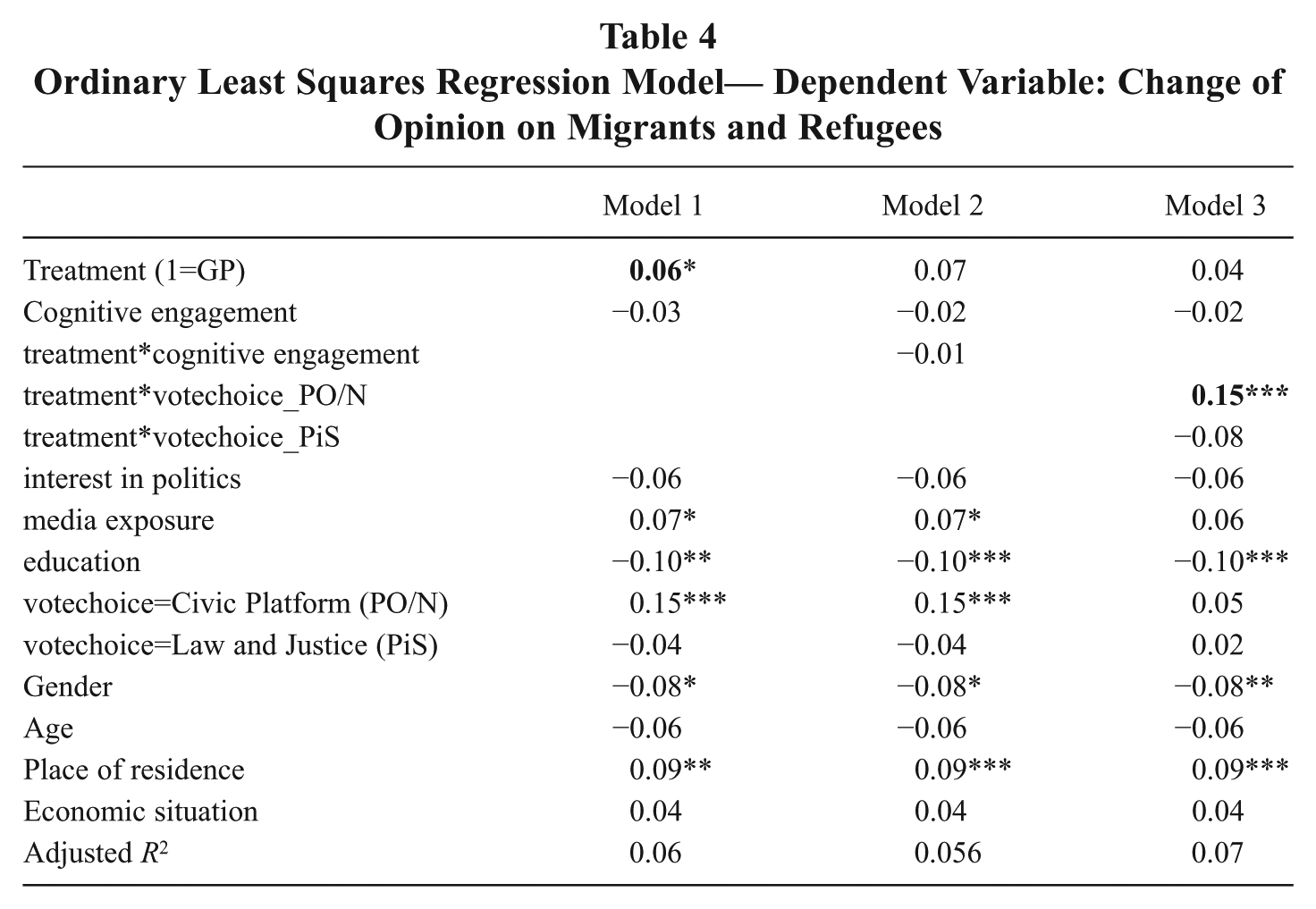
Ordinary Least Squares Regression Model— Dependent Variable: Change of Opinion on Migrants and Refugees
Ordinary Least Squares Regression Model—Dependent Variable: Change of Opinion on Constitutional Tribunal
Ordinary Least Squares Regression Model—Dependent Variable: Change of Opinion on Further EU Integration
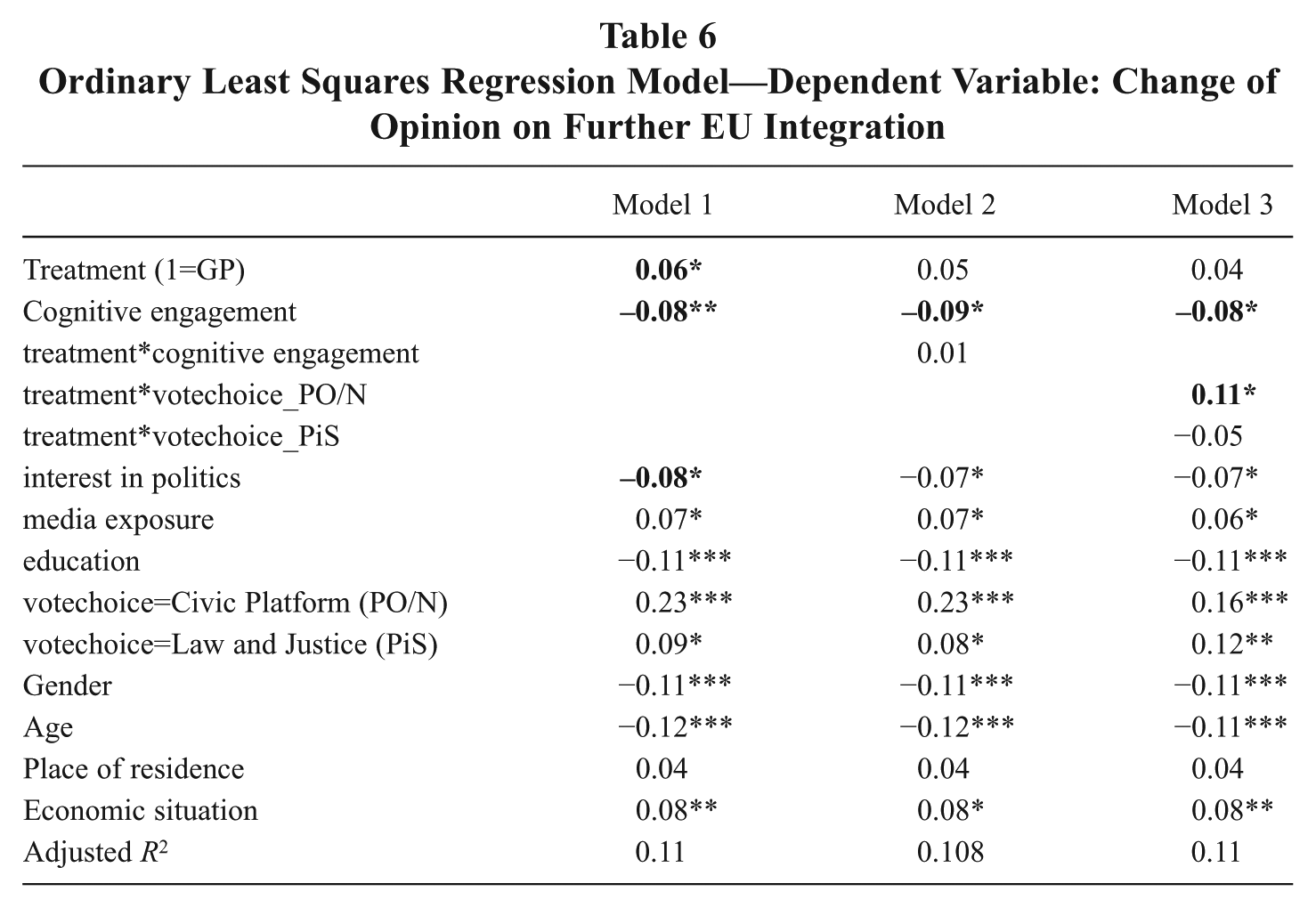
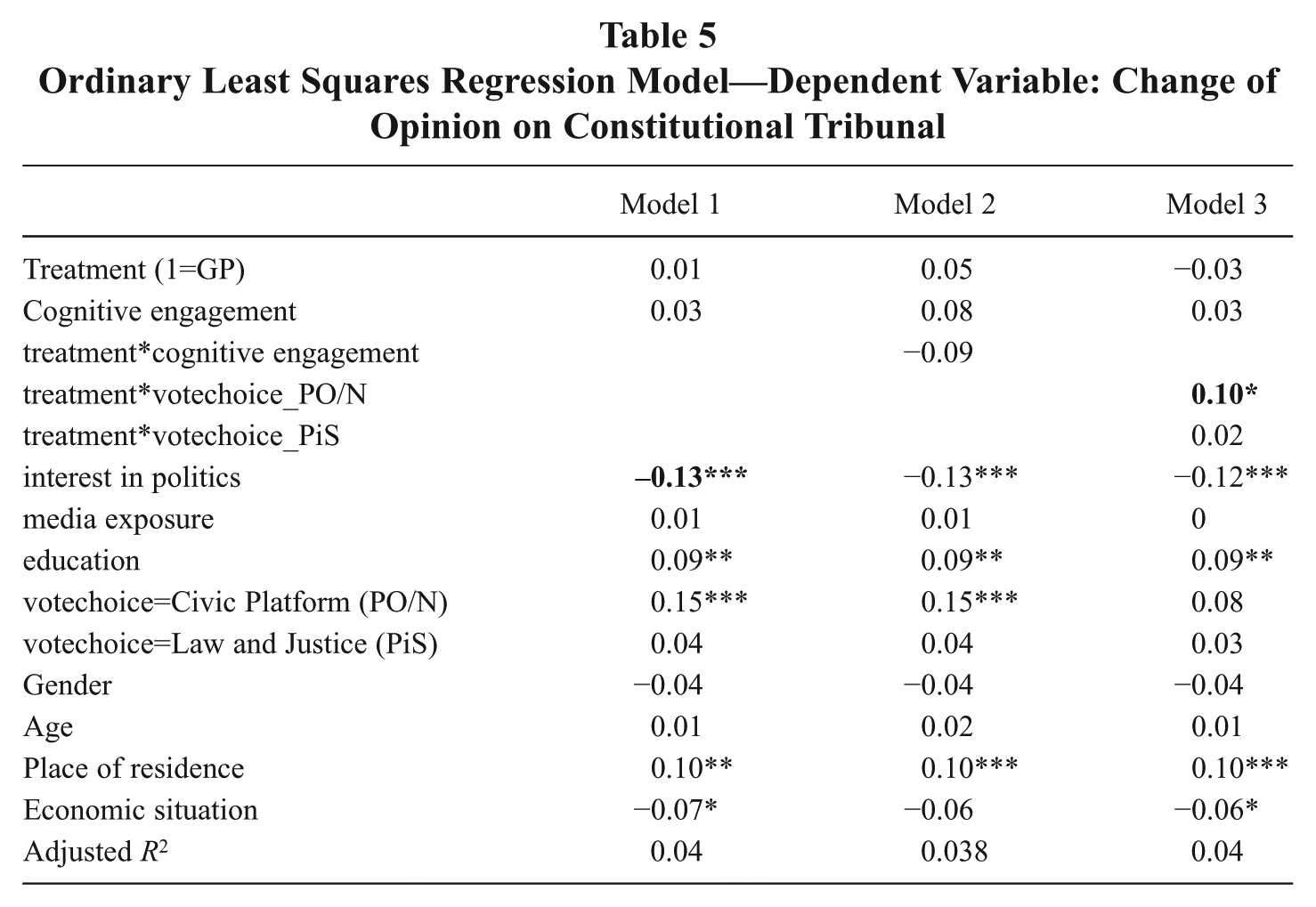
In subsequent analyses we verify to what extent the change of opinion between pre-test and post-test can be attributed to other factors, such as cognitive engagement and media friendliness or hostility. Having included a range of control variables, related to level of cognitive and political competence, political preferences, and socioeconomic status, the effect of treatment remained significant in case of the two above-mentioned issues: migrants and refugees and further EU integration (model 1, Tables 3-6). Cognitive engagement is a statistically significant determinant of the change only in case of the opinion about further integration with the European Union: the less engaged individuals are more prone to modify their views after media message exposure.
The effect of independent variables slightly changes when the model includes the interaction between treatment and the level of cognitive engagement (model 2, Tables 3-6). The effect of interaction between these two variables on the dependent variable is significant only in case of opinion about EU policy alignment. The plot of interaction effects gives us a better insight into the matter (Figure 1).
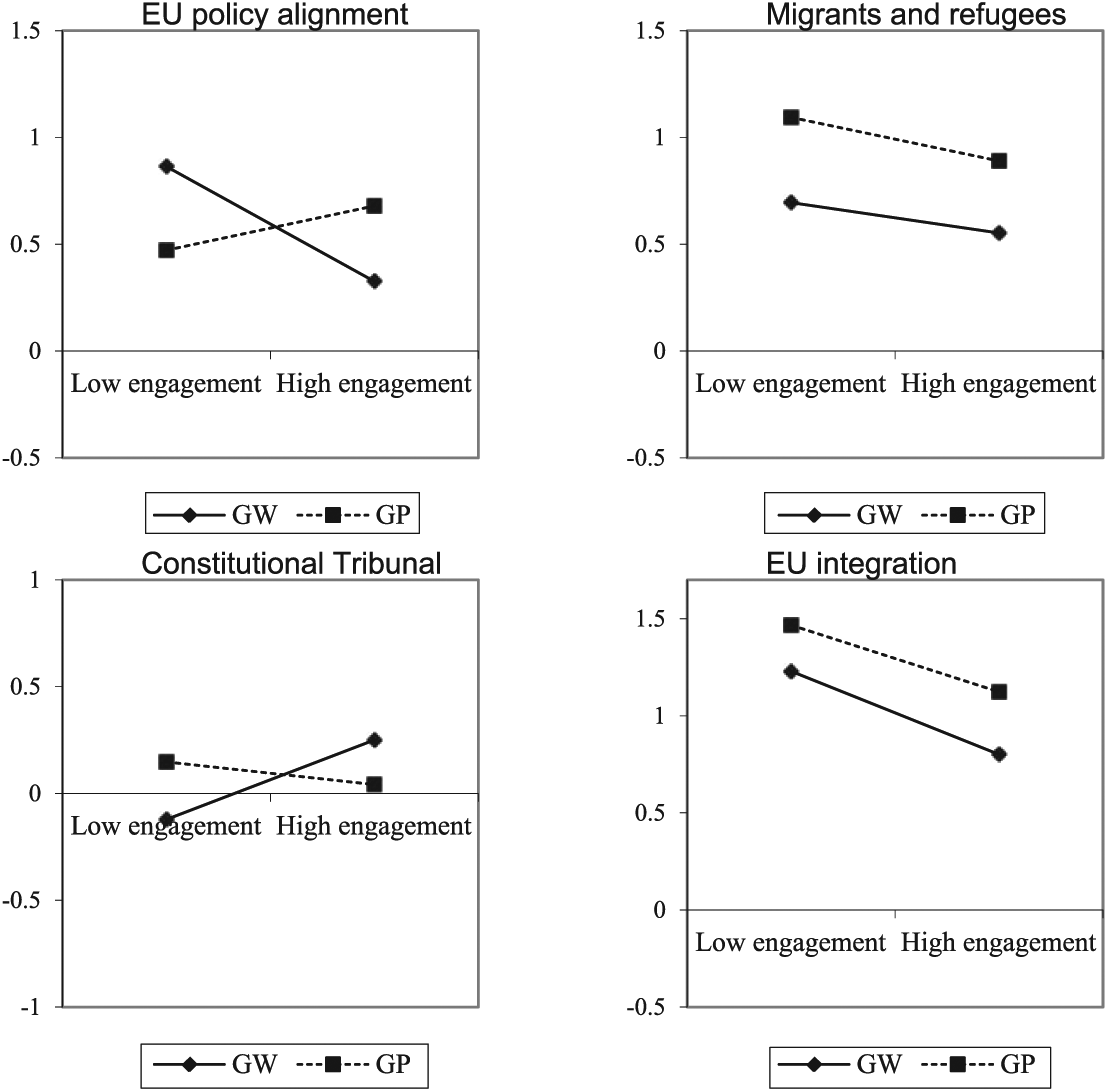
Interaction effects: treatment × level of cognitive engagement
In the case of EU policy alignment, the media message strengthens the opinions of more competent individuals, while less competent ones are more prone to change their views (those who read GP are more willing to defend Polish political independence, even if Polexit is a cost, while GW makes people more supportive of close cooperation with the EU). In the case of other dependent variables, the interaction effect is insignificant.
We hypothesized that friendly media should enforce existing views, while contact with hostile coverage may lead to changes in opinions. In further analyses, we focus on the division between the governing party PiS (Law and Justice) and two main parties of liberal opposition: PO (Civic Platform) and Nowoczesna (Modern Party). The support for these parties determines the selection of media (including the sources of treatment).
Our analyses reveal that while the effect of friendly media messages remains insignificant, the effect of hostile media differs as far as the issue and political preferences and the associated worldview are concerned (model 3, Tables 3-6).
In case of PiS partisans, exposure to hostile media message causes opinion change only in the case of alignment of Polish foreign policy with EU guidelines (Figure 2). PiS supporters after reading the Gazeta Wyborcza article are more prone to obey EU rules.
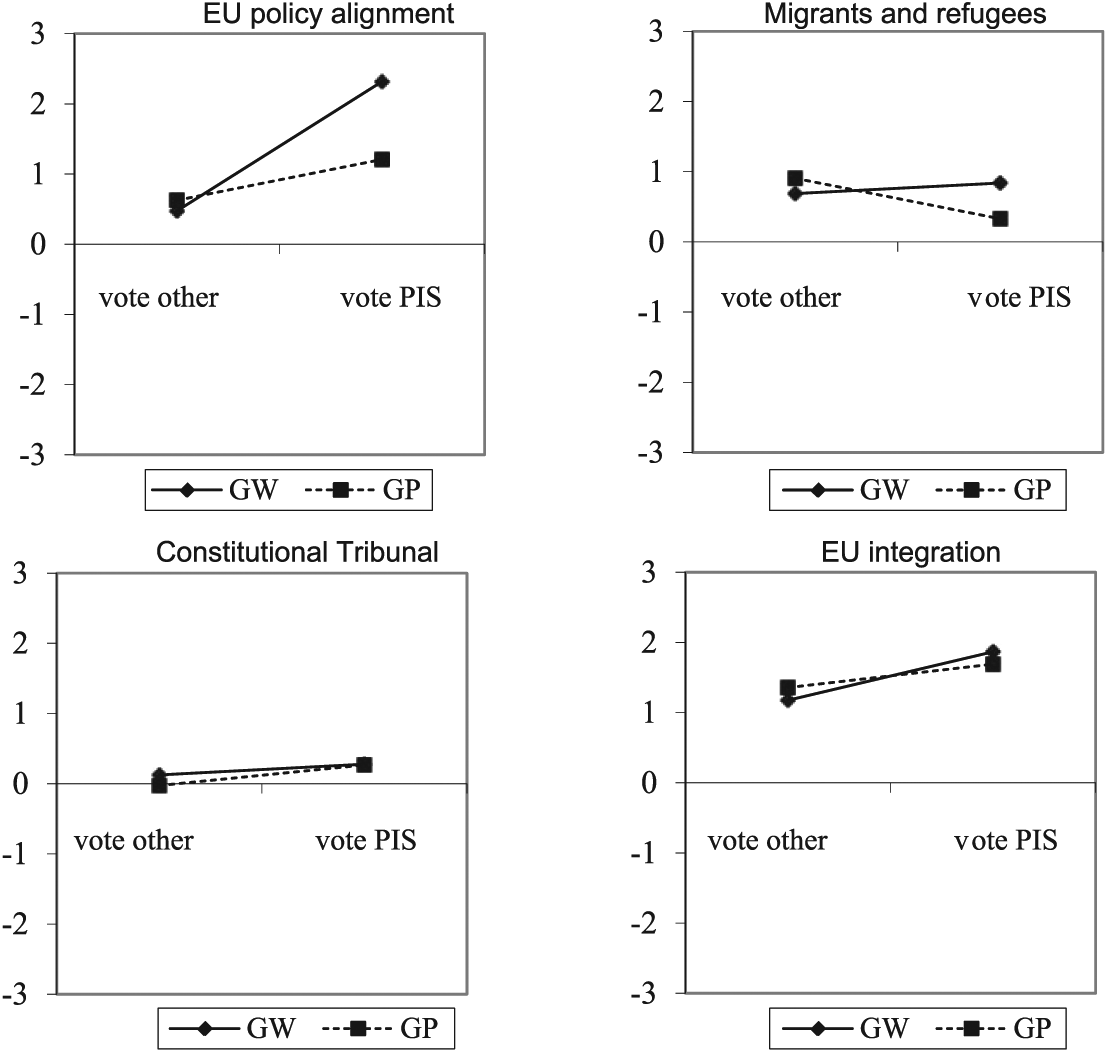
Interaction effects: treatment × vote for Law and Justice (PiS)
The Civic Platform and Modern voters are much less stable in opinions and much more susceptible to hostile media messages (Figure 3): the interaction between treatment and declared support for Civic Platform/Modern is significant in the case of all but EU policy alignment questions.
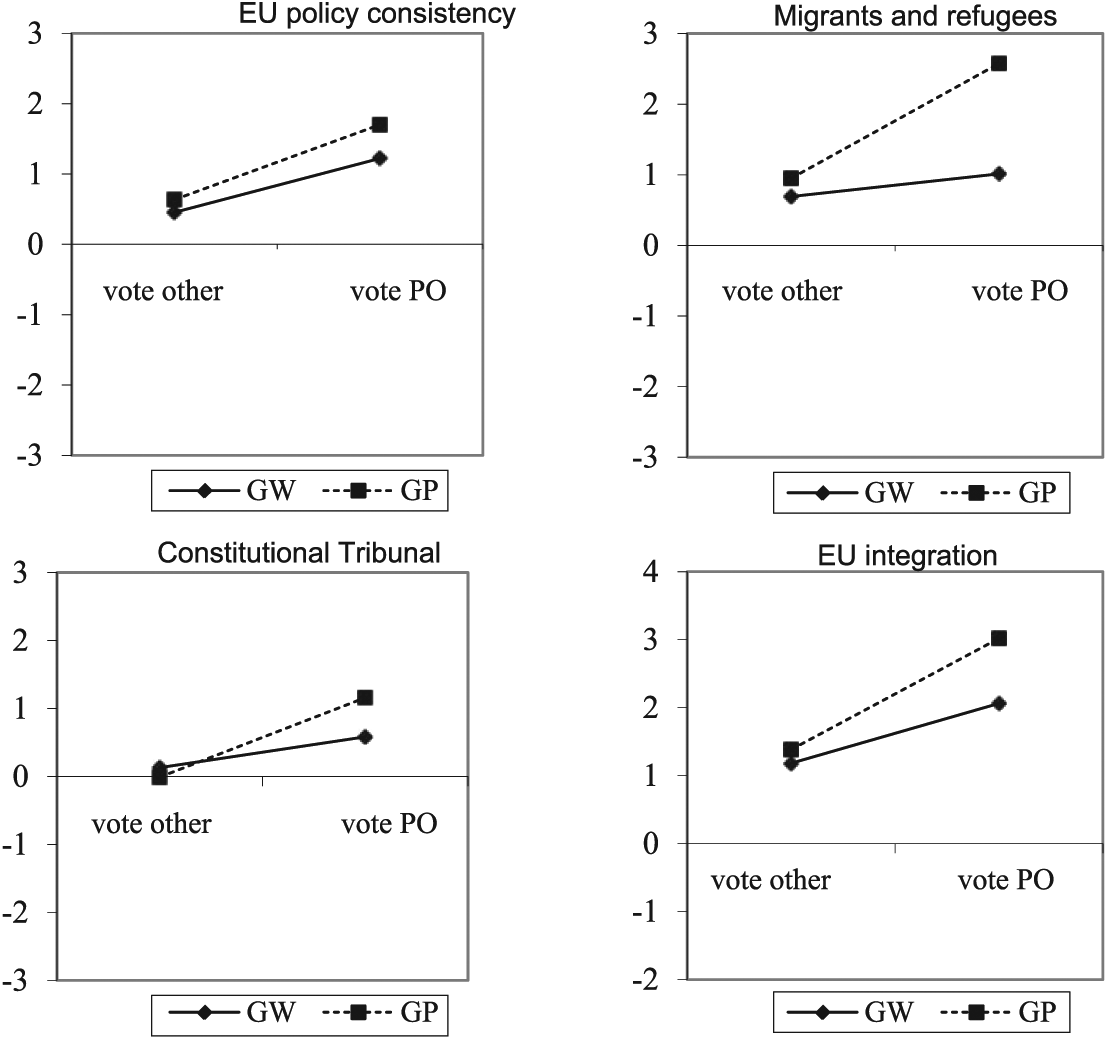
Interaction effects: treatment × vote for Civic Platform (PO)
Exposure to the Gazeta Polska message makes Civic Platform/Modern voters less willing to accept migrants and refugees and convinces them that EU integration has gone too far. The effect of hostile messages is also significant regarding the Constitutional Tribunal controversy, yet in the case of this issue the effect is the reverse: The GP content strengthens Civic Platform/Modern partisans’ conviction that the Constitutional Tribunal was reformed illegally.
Discussion
Let us collect and organize the results of our analyses. First of all, it is worth remembering Converse’s observations about the random or contextual character of survey responses. There is a lot of noise in the data, and the models explaining variance in mean differences of indicators under stimulus are weak. The low explanatory power of models explaining attitudes is to be expected.
However, there are also interesting regularities. Let us start with data reliability. It is expected that in the case of indicators not affected by stimulus, there should be no significant change. This is true in most cases: in cases of one indicator each (out of six indicators not under stimulus) in GW and GP sub-samples, there was a significant change. A vast majority (five of six) remained on an unchanged level. The registered changes in indicators not directly affected by stimulus may, moreover, be indirectly related to it. Reading news stories by GP/GW may have activated broader ideological frames. After reading a GW story, respondents became more sympathetic to abortion rights. While abortion was not mentioned in the stimulus, GW represents a left-liberal orientation and is generally pro-choice.
As regards items under stimulus, GP has more influence than GW. GP changed means for two of four items, while GW changed none. After reading GP, respondents became more inclined to treat refugees as a threat and less supportive of EU integration. The framing used in the article apparently had a significant effect on the perception of the readers.
Let us now explicitly refer back to the hypotheses. Hypothesis 1 is confirmed in some cases (one of four items for PiS voters and three items for PO voters). PO voters were swayed by the GP content, while PiS voters by the GW coverage. It appears that being confronted with news content outside of one’s own information ecosystem has transformative potential. On the other hand, contact with familiar framing does not change views (does not strengthen them).
Hypothesis 2 is confirmed to a limited degree. It is true in some cases that higher cognitive engagement strengthens media effects. In line with our suppositions, processing the news content requires cognitive skills. However, this effect is relatively weak and by no means universal.
Hypothesis 3 is confirmed. Migration is a soft issue, attitudes are based on emotions, rather than reason. It appears that framing based on fear, presented in GP, is more effective than that based on sympathy, as in the GW material. News coverage of a harder issue (Constitutional Tribunal) does not alter opinions in line with the framing.
Let us finish with a general note. After the migration crisis started in 2014–2015, attitudes to accepting refugees deteriorated in Central and Eastern Europe, including Poland. Some national-populist governments, in particular in Hungary and Poland, explicitly rejected the legally binding EC decision to relocate some refugees from Greece and Italy into these countries. Moreover, they enlisted the support of state-run and state-sponsored media, framing the refugee crisis as a cultural threat and the danger of terrorism. This article is a piece of evidence that such a campaign may have been effective, at least to an extent. Fear generated by placing stories about negative consequences of migration is a stronger factor than sympathy elicited by highlighting humanitarian factors and positive or neutral consequences. Large sections of the media landscape in Hungary and Poland are currently dominated by the state, ruled by nationalist parties. Party colonization of state media, unofficial state support for selected private media (e.g., via advertising from state-controlled enterprises), and efforts to weaken independent private media by regulation or administrative measures broaden the institutional base for such coverage.
Footnotes
Appendix A: Indicators
Opinions were measured with the following 10-item block of questions, given verbatim below. Responses were on an 11-point scale, where 1 was the statement on the left, 6 was the middle point, and 11 was the statement on the right end of the scale. Numbers were not shown in the questionnaire.
Q. You will now read pairs of statements. Please indicate which is closer to your own opinion. Please select the point on the scale below. Selecting the left end indicates that you completely agree with the statement on the left, while selecting the right end indicates that you completely agree with the statement on the right. Of course, you can choose any intermediate point.
Appendix B: Stimulus
Versions were randomly assigned to sub-samples. The source was not indicated in the questionnaire. Version 1 is from the online edition of Gazeta Polska, while version 2 is from the online edition of Gazeta Wyborcza. The texts were edited for length.
Funding
Research funded by grant no. 2015/19/B/HS5/01224 (Media Effects on Political Attitudes), awarded by National Science Centre, Poland, conducted at the Institute of Social Sciences, SWPS University of Social Sciences and Humanities in Warsaw.