




Abstract
Given the confrontational nature of citizen–police interactions, citizen complaints against the police are inevitable. In Trinidad and Tobago, citizen complaints are frequently ventilated via litigation or through a range of police-led and non-police-led investigations. However, it has been argued that these mechanisms for resolving citizen complaints against the police are ineffective. With this in mind, there is need for alternative mechanisms to resolve citizen complaints against police officers, and mediation has emerged as the leading contender. Despite the proclivity toward mediation, the phenomenon has attracted sparse scholarship in Trinidad and Tobago. As a result of this lacuna, this study employs a qualitative approach to measure (a) citizens preference for mediation or traditional mechanisms of complaint resolution and (b) citizens willingness to use mediation to resolve complaints against police officers in Trinidad and Tobago, if mediation becomes available.
The occurrence of conflict in every environment in which humans are present is normal (Doğan, 2016) and this applies to Trinidad and Tobago. Conflict is omnipresent in many societies and conflict between citizens and police officers is quite prevalent. This commonness is premised on the notion that policing is a profession that places it members in challenging situations, possibly more than other professions (Volpe, 2014) and this leads to conflict as well as the inevitability of citizen complaints against police officers.
Despite the presence of conflict between community residents and police officers, conspicuously absent from the alternative dispute resolution (ADR) movement is the mediation of citizen complaints against the police (Walker & Archbold, 2000). In Trinidad and Tobago, mediation is only used within the Family Court Division of the Judiciary in Trinidad and Tobago, and there are no programs offering mediation of citizen and police officer conflict on the island. Therefore, it appears that while mediation has become a significant factor in civil and criminal procedures in some jurisdictions (England and Trinidad and Tobago), it seems insignificant with respect to the resolution of citizen complaints against police officers for allegations of misconduct (McGillis, 1997). The earlier pronouncement by Walker and Archbold (2000) regarding the absence of mediation of citizen complaints against the police is applicable to Trinidad and Tobago as this remedy is conspicuously absent from conflict resolution frameworks on the island.
In Trinidad and Tobago, citizen complaints against the police have traditionally been ventilated in open court or via a range of police-led and non-police-led investigative mechanisms. However, it has been argued that existing mechanisms for resolving citizen complaints against police officers are inefficient. This has caused police management on the island to seek out alternative means of resolving these complaints. Importantly, both police departments and community residents are increasingly turning their attention to mediation as a way of resolving citizen complaints against the police (Stephens, 2011), but very little is available by way of current information about its practice in Trinidad and Tobago.
As with others concepts in the social sciences, there are many definitions for the term mediation. For example, mediation is defined as a formal program designed to resolve citizen complaints against the police through face-to-face meetings between the citizen complainant and the police officer with a neutral third party acting as mediator (Beer & Stief, 1997). According to the Police Assessment Resource Center (2008, p. 55), “Mediation is a voluntary process designed to resolve disputes through negotiation and constructive communication with the assistance of a trained neutral party mediator. It is an informal, non-disciplinary and non-adversarial process.” In this study, mediation is conceptualized using the definition proffered by the Police Assessment Resource Center (2008). Importantly, this definition was placed on interview guide so that the meaning of mediation was not mysterious to the participants.
With the lacuna of limited empirical data on the phenomenon under inquiry, this study sought to determine citizen’s willingness to use mediation to resolve complaints against the police as well as their preference between mediation and traditional mechanisms to resolve citizen complaints against police officers. The research was conducted solely through the lens of community residents in five cities in Trinidad and Tobago and employed a qualitative approach that was directed toward ways and means of attaining peace between conflicting parties. In a similar vein to previous scholarship by Williams (2020), this study considers the long-standing tension between the police and community members in Trinidad and Tobago.
The Context of Citizen Complaints Against the Police
Globally, police departments have had a long history of handling citizen complaints against police officers; however, this was traditionally conducted on an informal basis (Walker & Archbold, 2000). It is argued that these traditional informal practices are now a major part of the problem of the inadequacy of complaint procedures in contemporary times and while they are extremely limited in policing today, the practice is covertly present and practiced. Walker and Archbold (2000) posited that the informal resolution of citizen complaints against the police often involved officers receiving citizen complaints against the police and making attempts to dissuade them from pursuing the matter.
Walker and Archbold (2000) argued that this involved: (a) informing citizen complainants that they had no basis for a valid complaint, (b) informing citizen complainants that someone would take care of’ the matter, (c) threatening civilian complainants with arrest, and (d) in instances when the receiving officer actually recorded the citizen’s complaint against the police, more often than not, a formal investigation never occurred. The aforementioned uncanny features of policing were evidenced in the findings of the Christopher Commission (1991) in the United States which found that police officers in Los Angeles engaged in this practice as recently as the early 1990s. It should be noted that the postulations of Walker and Archbold (2000) are not the sole province of any singular police jurisdiction as there have been complaints of similar behaviors by police officers in Trinidad and Tobago.
Over the years, there have been numerous police-community confrontations in Trinidad and Tobago over alleged unjust treatment meted out to certain sectors of the community. This has often led to arrests by police officers and a concomitant reporting of police officers to the Police Complaints Authority, the Ombudsman, the Professional Standards Bureau and the Police Complaints Unit on the island. Quite often, these matters are either investigated by the aforementioned agencies and/or end up before the court for litigation. However, the court system is becoming increasingly clogged with such matters.
Due to the backlog of cases within the criminal justice system (CJS) in Trinidad and Tobago, the CJS faces a crisis and much discussion surrounding its perceived faults, especially the glacially immobile nature of case disposition of matters involving police officers. However, of great interest is the fact that “police-community mediation models are now appearing in the US, Australia, Canada and the UK” (Birgden & Lopez-Varona, 2011, p. 19). Therefore, the Trinidad and Tobago Police Service (TTPS) should consider using any of the police-community mediation models espoused by Birgden and Lopez-Varona (2011) so that the organization may potentially benefit from these forward-thinking initiatives.
In Trinidad and Tobago, complaint procedures for resolving reports made against police officers tend to resemble criminal trials, and whether internal or external of the police, the procedures are usually adversarial. However, adversarial mechanisms are not the only way to resolve allegations and complaints against police officers and the continued reverence and steadfast adherence to the usage of traditional dispute resolution systems based on investigation and litigation can be viewed as archaic. In traditional citizen complaint investigation procedures, most complaints are not sustained and both sides typically come away dissatisfied (Walker et al., 2002). With this is mind, police executives and community activists are looking for innovative ways to manage those complaints, while at the same time offering both parties (police officers and citizens) a role to play in this process. Instructively, in the United States, Australia, New Zealand, Canada and the United Kingdom, mediation provides this alternative forum for the potential resolution of conflicts as well as complaints made against police officers by citizens.
Mediating Citizen Complaints Against Police Officers
According to Riley et al. (2021), policing is a field of work that attracts large numbers of complaints. Indeed, this is the case with policing in Trinidad and Tobago as there is an increasing frequency of cases of conflicts between local residents and police officers who have led to incidents of death, serious injury, assaults, protest action, and subsequent complaints against the police. Internationally, complaints against the police is viewed as an important, but imprecise indicator of police conduct (Hickman, 2006; Smith, 2013). However, it is argued that formal complaints lodged against police officers only reflect a small fraction of persons with grievances against the police over allegations of improper conduct (Riley et al., 2018). Berger (2000) proffers the view that at the root of many police-community conflicts are misunderstandings of the work of the police, poor communication on the part of the police and the public, or simple misunderstandings.
There are many forms of ADR methods used to settle conflicts, including, but not limited to, mediation. Walker et al. (2002) point out that mediation is widely used in divorce cases, employee–employer disputes, small commercial disputes, and many other areas of life where disagreements and conflicts arise, while Singer (1994) and Stephens (2011) both submit that mediation has emerged as a popular means of settling disputes. In a similar vein, Kian (2011) argues that mediation is increasingly being recognized as a practical tool to address disputes and as an alternative to traditional justice models such as time-consuming litigation and formal investigations that do not repair relationships. Instructively, Berger (2000) submits that globally, communities are increasingly turning to mediation for the potential resolution of citizen complaints against the police.
Scholarly research has indicated that while there are pitfalls associated with officer involved mediation (tokenism, police apathy, and misuse as a convenient administrative means to dispose of complaints – Riley et al., 2018), attendance in the mediation process has more benefits than drawbacks and that mediation works in a transformative way to improve strained relations between police and the public (Berger, 2000). The finding of Berger (2000) is supported by Bartels and Silverman (2005) in a study which sought to provide an exploratory analysis of the level of citizen and police officer satisfaction of individuals who participated in mediation of citizen-police complaints and fully investigated matters in New York. Bartels and Silverman’s (2005) study indicate that individuals who participated in mediation were significantly more satisfied with mediated matters when compared to those whose cases were fully investigated. Furthermore, in a Denver study on community-police mediation, 79% of civilian complainants who experienced mediated sessions via an independent mediation vendor were satisfied with the process when compared with 11% in the non-mediation sample, while 63% were satisfied with the outcome in mediated cases when compared with 7% in non-mediated cases (Schaible et al., 2013).
According to the Police Accountability Task Force Report (2016), many studies report that citizen-police mediation programs produce positive outcomes for citizens as well as for the police. For example, a study of the Denver mediation program reported that almost 60% of civilian complainants were satisfied with the outcome and 75% were satisfied with the process, while police officers’ rates of satisfaction were high with 68% of the participants being satisfied with the outcome (Proctor et al., 2008). The literature points out that in terms of citizen complaints against police, mediation has several benefits as it can address allegations of police misconduct without litigation costs and excessive verdicts, as an alternative to the traditional complaint-handling process (Birgden & Lopez-Varona, 2011).
The use of mediation to resolve citizen complaints against the police is touted as a system that facilitates citizens having their complaint heard and investigated, by involving all disputing parties, provides the potential for an apology, promotes a sense of vindication, and may also trigger policy change (Stern, 2005). Mediation of citizen complaints against police officers are generally premised on the notion of citizen complainants generally preferring an apology or acknowledgment of their feelings rather than punitive sanctions against the alleged offender(s) (Bartels & Silverman, 2005). It is also argued that mediation of citizens’ complaints against police officers facilitates the opportunity for dialogue between the disputing parties in a safe space, allows each party to be heard and to gain a better understanding of each other’s perspective about the dispute, and that unlike courtroom occurrences, where one side wins and the other loses and where blame is ascribed, community-police mediation promotes mutual understanding and learning for both parties and this can prevent similar situations from re-occurring (Birgden & Lopez-Varona, 2011).
Research on the use of mediation to resolve complaints against police officers has demonstrated higher levels of efficacy when compared to nonmediated matters. For example, a 2005 evaluation of the New York City Civilian Complaint Review Board Mediation Program found that complainants who participated in mediation (n = 16) over a full investigation (n = 19) recorded higher rates of satisfaction (Bartels & Silverman, 2005). In addition, in an evaluation of the Denver Citizen/Police Complaint Mediation Program, the results revealed that since 2005, complainant satisfaction levels with the complaints process had shown incremental increases (Proctor et al., 2008).
Young et al. (2005) revealed complainant satisfaction with the mediation process revealed participant satisfaction with outcomes in the areas of “venting of feelings, hearing the other side of the story and the development of mutual understanding.” Mediation of complaints against police officers also offers an efficient and effective alternative to formal investigation processes (Hoffman, 2016), can lead to the strengthening of community-police relations (Hoffman, 2016; McCorkle & Reese, 2015) and help build trust and promote good relationships between the police and the community, thus contribute to the growth of safer and healthier communities (Hoffman, 2016).
While there is much excitement regarding the efficacy of community-police mediation (Bartels & Silverman, 2005; Berger, 2000; Birgden & Lopez-Varona, 2011; Hoffman, 2016; Schaible et al., 2013; Stern, 2005; Young et al., 2005), there are studies that are nonsupportive of mediation to resolve complaints against the police. In a study conducted by the Calgary Police Commission (1999), the results indicated that the majority of civilian complainants who were offered mediation refused it and cited a lack of faith that mediation would result in a positive outcome for them. Similarly, in a study conducted in England and Wales using a police-managed local resolution program, 51% of the sample reported their dissatisfaction with the outcomes (May et al., 2007). In a similar vein, the findings of an Australian study on community-police mediation, found that 72% of complainants who had their matter dealt with under a Management Intervention Model rated the process as unsatisfactory (Office of Police Integrity, 2008).
There are divergent positions held by citizens in disparate parts of the world in relation to the efficacy of mediation as a vehicle for the resolution of citizen complaints against police officers, with both opponents and proponents alike. Nonetheless, it is unviable to juxtapose and universalize such a system (community-police mediation) onto the populace in Trinidad and Tobago without pursuing a data driven approach to glean residents’ views. This position is aligned to the views of Milan and Treré (2019) who submit that researchers should avoid universalizing problem and solutions, as universalizing entails the erroneous view that problems manifests themselves in exactly the same manner everywhere, while disregarding local features to other approaches.
The Current Study
This study employed a qualitative approach to gather data on community viewpoints on mediating citizen complaints against the police in Trinidad and Tobago. The research was conducted in Trinidad and Tobago, a Caribbean country where citizen complaints about police misconduct have been a major controversy for the past half century and where poor police relations with citizens, especially with citizens in traditionally dysfunctional communities, is a pervasive issue (Pino & Johnson, 2011). Currently, a wide and voracious search for local scholarship on community-police mediation unearthed a study on the phenomenon under inquiry in Trinidad and Tobago’s context (Wallace & Lancaster-Ellis, 2023).
The study was premised on the notion that members of the public envisage high ethical standards from police officers and when breaches occur, complaints often follow. Over the years, numerous complaints have been lodged against police officers in Trinidad and Tobago with police-initiated investigations into these complaints being the usual course of action taken. As a result, the TTPS has grappled with the complex problem of allegations of police misconduct and voluminous citizen complaints against police officers. Investigations into complaints against the police are important to the maintenance of law, order, and justice (Riley et al., 2021) and mediation has emerged as a contemporary alternative to existing investigations, for example, police-led investigations and litigation. This study, therefore adds to the limited existing research on mediating citizen complaints against the police by examining the demographic characteristics of residents in five cities in Trinidad and Tobago relative to the use of mediation as ADR mechanism to resolve citizen complaints against members of the TTPS.
Influence of Black’s Framework
Existing research has framed much of the traditional, and to some extent, contemporary complaint procedures, as being similar to criminal trials (Walker & Archbold, 2000; Walker & Wright Kreisel, 1996). In fact, Walker and Archbold (2000) submit that many contemporary complaint procedures represent a penal style of social control, with the end result often being punishment. Instructively, this study is undergirded by Donald Black’s (1976) framework of alternative styles of social control, whereby punishment is not the goal or the outcome of investigations into complaints against police officers.
According to Black’s (1976) framework, there are three alternative styles of social control and respective solutions. Eschewing for the moment a consideration of the alternative styles of social control, their solutions and what this might mean, Black (1976) cogitates that the basic traits of the three alternative styles of social control and their respective solutions are (a) compensation (payment), (b) therapy (help), and (c) conciliation (resolution). It is submitted that existing complaint mechanisms to address complaints against police officers do not fall within any of those categories, as they do no facilitate payment to civilian complainants, provide help to either complainant or police officer, and/or afford conciliation to complaints (Black, 1976). It is also submitted by Black (1976) that mediation falls within the conciliatory style of social control as emphasis is placed on resolution of conflict and does not seek or result in punishment of police officers. Black’s framework is used in this article to demonstrate that mediation can be used to resolve community-police conflict, while not necessarily being punitive to errant officers.
Data
A qualitative approach was used to develop an interview guide based on questions gleaned from previous research by the Police Assessment Resource Center (2008), Riley et al. (2021), Volpe (2014), and Walker et al. (2002). The qualitative approach was seen as most applicable in this study’s context as the researcher aimed to gather in-depth insights on the topic as it appeared to be sparsely researched in Trinidad and Tobago. Furthermore, the researcher envisaged the study as being exploratory and aimed to locate commonalities and patterns which might be difficult to elicit using quantitative data. In light of the aforementioned, numerical data would have hampered the study’s ability to probe for contextual information (Silverman, 2006).
Two research questions (RQ) are the focus of this project study, namely:
The Interview Guide
Section 1 of the interview guide collected demographic data from the study’s participants, while section 2 gathered the participants’ narratives via open-ended questions. The questions included, but were not limited to: Will you be willing to attend a session with a neutral mediator to resolve complaints against police officers in Trinidad and Tobago?, If available, will you prefer to use traditional methods of resolving complaints against police officers (Police Complaints Authority, the Court, the TTPS) or will you prefer to use mediation?, What are the reasons for your choice of mediation/traditional methods of conflict resolution?, and What are your views on mediation as a tool to resolve complaints against police officers? Prior to distribution, the interview guide was pilot tested with 15 citizens who did not form part of the final sample. After the pilot testing, errors with the content of two questions were identified and subsequently altered so that questions were not esoteric to the participants.
Data Collection
Data for this study emanated from the narratives of 110 study participants from the main cities of Trinidad and Tobago (Port-of-Spain, Scarborough, Chaguanas, Arima and San Fernando). The major cities in Trinidad and Tobago were selected as sites for the conduct of the study as the headquarters of Police Station Divisions are generally situated in those locales and it is at the headquarters where the Heads of the Police Division (Senior Superintendents of Police) oversee the operational and administrative aspects of policing. Thus, complaints made to police stations by citizens against police officers eventually reach the police headquarters. The study was advertised on social media, community noticeboards, community chat groups, community centers and other locations where people usually gather, requesting that potential participants contact the researcher. The study was advertised for 1 month before the study begun.
Participants who had previous contact with the police were purposively recruited and these individuals recommended other participants (snowball sampling) to the researcher. Seventy-four of the participants were recruited via communal advertising, 24 via social media and 12 via snowball sampling. Fifty-five percent of the interviews were face-to-face, conducted by the researcher, and took 20 to 25 minutes to complete. Thirty-five percent of the interviews were conducted by mailing the interview guide to the participants who completed and returned the instrument (follow-up emails were used to clarify unclear issues). Ten percent of the interviews were conducted using the Zoom platform due to the distance between some participants and the researcher. The response rate for this study was 44%, and this was deemed suitable as it has been proffered that in quantitative research, acceptable response rates range from 40% to 75%.
Data Analysis
The semistructured interviews were recorded and subsequently transcribed. After transcription, the responses were collated, thematically analyzed via data familiarization and themes sought from the narratives (Clarke & Braun, 2006). Clarke and Braun (2018) submit that thematic analysis is the process of identifying, analyzing, and reporting patterns within data. Within this process, the researcher was immersed within the data by reading, re-reading, and becoming familiar with the transcribed narratives of the participants before producing initial observations. Initial codes pertinent to the research were generated and applied using NVivo across the data set to distill the data and produce themes. Importantly, this process of refinement and review was consistently applied throughout the analysis of the data. To make sense of the qualitative data, participants in this study were identified numerically, as well as by gender, age range, and location.
Participant Demographics
This study’s participants included 46 males and 64 females. The participants’ ages ranged from 18 to 50+; however, the highest number of participants fell within the 18–25 and 26–30 age groups. The sample included participants from the five major cities within Trinidad and Tobago as follows: Arima – 23 participants, Chaguanas – 17 participants, Port-of-Spain – 33 participants, San Fernando – 25 participants, and Scarborough – 12 participants. Thirty-seven percent of the participants indicated that they were of African descent, 33% were East Indians, 27% were mixed descent, and 3% of the participants indicated other (Chinese and Caucasian) as their ethnic grouping. The demographic data are contained at Table 1. All of the participants indicated that they had contact with the police in their personal and professional capacities.
Participant Demographics.
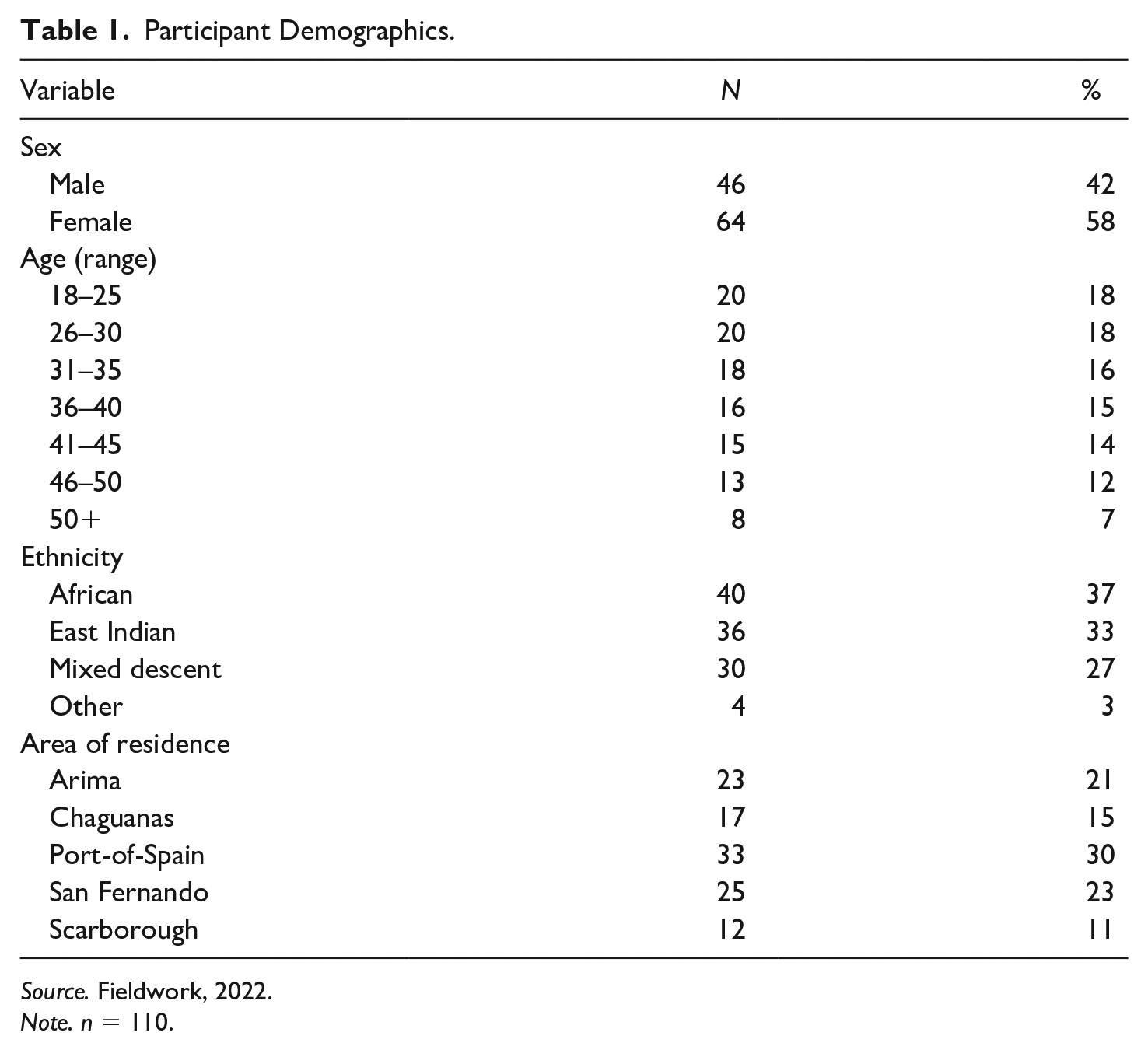
Source. Fieldwork, 2022.
Note. n = 110.
Results
Answer to RQ1
The responses to RQ1 (To what extent will community residents prefer mediation to resolve complaints against police officers when compared to traditional investigative processes?) indicated that to a large extent, participants were willing to utilize mediation as an ADR mechanism when compared to traditional investigative processes. Overall, 52% of the study’s participants preferred to use mediation rather than the traditional investigative processes, 12% of the participants indicated that they would not be willing to use mediation over traditional investigative processes and 36% of the participants remained neutral. When distilled by gender, 35% of the female participants and 65% of the male participants preferred the use mediation when compared to the traditional methods of investigating complaints against police officers.
Community residents between the ages of 18–25 and 36–40 preferred to use mediation rather than traditional complaint investigation procedures, while community residents aged 26–30 preferred the traditional investigative processes to resolve officer involved complaints. An interesting finding gleaned from the dataset was that participants who indicated their areas of residence as being Arima, Scarborough and Chaguanas were more likely to attend mediation by a ratio of 3 to 1 when compared to participants who indicated their areas of residence as Port-of-Spain and San Fernando (major cities).
Answer to RQ2
As it relates to RQ 2 (If mediation becomes available, to what extent will individuals be willing to attend mediated sessions to resolve citizen complaints against police officers?), 67% of the study’s participants indicated that if mediation became available, then they would be willing to attend mediated sessions, while 24% remained neutral, and 9% indicated that they would not be willing to attend mediation to resolve complaints against police officers. When disaggregated by gender, 72% of the males in the sample were willing to attend mediated sessions, while 71% of the female sample were willing to attend mediation. As it relates to age, individuals within the 31–35 and 46–50 age groups were more willing to attend mediated sessions, persons between the ages of 26–30 were less willing to attend these sessions, and persons between the ages of 18–25 generally adopted a neutral stance.
Themes Elicited From Participant’s Narrative
Seven themes emerged from the narratives of the participants after data elicitation was conducted on the transcripts and these are discussed below. Quotes emanating from the participants narratives were used to illuminate their voices (Wallace et al., 2021) and to bring content to life (White et al., 2014). The quotes used in this article were selected based on their applicability to the respective themes as well as their support for the interpretations and explanations presented (Yin, 2011). It should be noted that though the study reports 110 participants, when tallied, the numbers related to the themes will amount to more than 110 as there were overlaps of themes used by several participants.
Theme 1—Corruption/Lack of Trust
Corruption/lack of trust was the most prevalent theme emanating from the participants’ narratives as 31 participants mentioned that corruption and lack of trust in the police as a main reason for their unwillingness to attend mediated sessions to resolve citizen-police conflicts. For example, participant 17 opined that his unwillingness to attend mediation was due to a: “Lack of confidence and trust that such a program would bear fruit or last beyond inception,” while participant 27 submitted: “corrupt officers.” Participant 53 opined “lack of trust in the police [mediation] protocol” her reason for being unwillingness to attend mediated sessions involving police officers. In a similar vein, participant 44 stated “I don’t trust that the police will be fair and honest when attending mediation. If they lie in court, they will lie in mediation too.”
Theme 2—Victimization/Fear of Police Victimization
Victimization/fear of police victimization was the second most prevalent theme that emanated from the narratives as 30 participants made mention of this theme. According to participant 68, “People being victimized or targeted because of their opinions against someone within the police service,” while participant 59 stated: “I don’t think some police officers perceive themselves as being wrong in situations and therefore for me attending mediation with them, the fear of victimization is real.” For participant 20, “Police in this country like to victimize people. I am going to the court to seek redress. Nowhere else.”
Theme 3—Financial Feasibility
The theme “financial feasibility” emanated from the narratives of 15 participants. For instance, participant 63 quipped: “The financial benefit would be cheaper than litigation.” In a similar vein, another participant submitted: “Mediation will provide the opportunity to save time and expenses of court and lawyer fees,” while for participant 5, her rationale was “Money—mediation should cost less than taking the matter to the courts.” In a similar vein, participant 11 submitted “Lawyer fees are really exorbitant and they always absent from court and wanting more money. Give me mediation any day and not court with lawyer fees.”
Theme 4—Neutral/Qualified Mediator
A prevalent theme espoused by 15 of the study’s participants was that they would be willing to attend a mediated session involving allegations of misconduct against police officers if the mediator is neutral and qualified. Participant 70 submitted: “I will be willing to attend the mediation if the mediator is a highly qualified individual, but not a police officer,” while participant 96 was of the view that she will attend mediation as a means of resolving community-police conflict, however, “The mediator must be neutral and professionally qualified.”
Theme 5—Sharing Stories
Fifteen of the participants reported that they would attend and use mediation as it would give them the opportunity to share their stories and thus allow the police to know how their (police) actions impacted them. According to participant 44, “I am willing to attend a mediation session as it will allow me to hear the other side, i.e., why the police acted the way they did.” Similarly, another of the study’s participants indicated that she would attend a mediated session: “To attain a better understanding of each other’s stance and perspectives and to let the officers know how I feel and how their actions impacted myself and others.”
Theme 6—Avoidance of the Court Process/Lengthy Court Process
Thirteen individuals submitted that they would be willing to attend a mediated session to resolve complaints against police officers so as to avoid the process of going to court as court attendance is time-consuming. According to participant 31, “The court process takes up too much personal time/affects personal and professional life extensively,” while for participant 10 attending mediation was premised on the notion that she would “Spend less time in the mediation process as opposed to the litigation process.” “Spending less time in the mediation process as opposed to the litigation process” was the rationale for attending mediation of complaints against police officers as proffered by participant 110. Participants 101 and 102, two women in different age groups were similar in their response as they stated that they would most likely attend mediation and not the court as mediation is “An alternative to the lengthy judicial system” and “It would result in a speedy resolution. It is less time consuming than going to court.”
Theme 7—Police Attitude
Eleven of the participants proffered the view that they would be unlikely to attend mediation sessions involving police officers as a result of police officer’s poor/bad/negative based on previous past interactions with members of the TTPS. For instance, participant 9 opined that she would not be minded to attend any mediation sessions for the following reason: “The willingness of police officers to participate in the process and their inability to be objective.” In a similar vein, participant 69 indicated that she would not attend mediation sessions to resolve allegations of misconduct against police officers due to “The attitude of police officers and their inability to separate their personal feelings from their professional feelings towards complainants.”
Discussion
This study set out to determine the extent of residents’ willingness to utilize mediation to resolve complaints lodged by citizens against police officers as well as their preference for mediation (if it becomes available) or traditional dispute resolution mechanisms (police led and non-led investigations and litigation) in Trinidad and Tobago. The findings showed that the majority of the sample were willing to attend mediated sessions to settle complaints against members of the TTPS. This willingness was facilitated by a host of factors, for example, avoidance of the court, timeliness, and cost effectiveness, and the ability to share their experiences with the offending police officers. However, this willingness was negated by caveats, such as, lack of trust in the police, fear, victimization, negative police attitudes, and corruption.
Citizen willingness to attend mediated sessions within the framework of a police complaints management system has previous support from Prenzler et al. (2013). In addition, the willingness of participants in the sample to attend mediation as a mean of resolving complaints against police officers was premised on their desire to “share their stories and experiences.” This was similar to the findings that emanated from a study by Young et al. (2005) where the participants revealed complainant satisfaction with the mediation process in the context of being able to vent their feelings and hear the other side of the story. On the contrary, the factors that negated residents’ willingness to attend mediation sessions with police officers as a dispute resolution mechanism has not found support within the mediation literature. However, some factors, for example, corruption, lack of trust in the police and fear of victimization are common themes associated with policing and are commonly found in the literature on policing (see Pino & Johnson, 2011, for example).
One participant suggested the creation of a mediation scheme within the PCA in Trinidad and Tobago to resolve complaints against the police. According to participant 100 “If a mediation scheme is to be implemented to assist in reducing police-resident conflict and a host of complaints against the police, then such a scheme should fall under the neutral PCA and not be left to the police to manage.” This lack of trust and the desire for mediation to fall under the purview of a body that is independent of the police is similar to what obtains in Europe as most of their police complaints management systems are characterized by oversight agencies that work at arms-length from police organizations (Riley & Prenzler, 2020).
An interesting finding from the dataset was that participants residing in Arima, Scarborough, and Chaguanas (less populous, semi-urban towns) were more likely to attend mediated sessions to resolve complaints against police officers by a ratio of 3 to 1 when compared to their counterparts in the more populous cities of San Fernando and Port-of-Spain. This finding is new and novel as the police-mediation scholarship does not speak to this. However, the author of this article posits that the exuberance of sample participants in the less-populous areas to mediate complaints against police officers in Trinidad and Tobago might be premised on the notion that residents in semiurban areas are more conservative than their urban counterparts and thus less likely to gravitate toward adversarial approaches to dispute resolution.
As a process, formal mediation is currently unused within the CJS in Trinidad and Tobago to resolve citizen complaints against police officers. This is a divergent position when compared with the growth of mediation in other aspects of life on the island as mediation is commonly used in divorce, separation, children custody, employment, and industrial matters. The nonutilization of mediation to resolve citizen complaints against the police in Trinidad and Tobago can be attributed to a combination of two factors, namely: (a) the polarized nature of the citizen complaints against the police and (b) the lack of information about community-police mediation. Despite this, the study’s participants were generally in favor of using mediation as an ADR mechanism to resolve complaints against the police. However, this position was mediated by lack of trust in the police, issues of corruption, fear, and fear of victimization.
The findings also indicate that a small number of females preferred mediation to traditional adversarial processes of dealing with citizen complaints against police officers and this was surprising. Indeed, the finding was a surprise, given the tendency for criminological literature to portray males as being more aggressive than females (Rand, 2008; Thureau et al., 2015) and thus more likely to use adversarial methods to settle disputes.
As an ADR mechanism, mediation has been used in many different cultures for thousands of years (McCorkle & Reese, 2015). However, the idea of mediating citizens’ complaints against police officers is relatively new (McCorkle & Reese, 2015) and this is applicable to policing in Trinidad and Tobago. In the current climate, there are existing tensions between residents and police officers in Trinidad and Tobago as a result of allegations of extra-judicial police killings that are voiced in the print and electronic media on the island (see Clyne, 2020—“Protests continue over police killings”; La Vende, 2022—“Anger, fiery protests over police-involved killings in Port of Spain”), it is imperative that police executives and community residents focus on alternative ways to address complaints against police officers without recourse to costly and time consuming litigation by using more peaceful, collaborative, and problem-solving approaches.
It is important to note that significant portion of this study’s findings are aligned to Black’s (1976) framework of alternative styles of social control and respective solutions. Keeping in mind Black’s (1976) framework of three alternative styles of social control and their respective solutions (compensation, therapy, and conciliation), the results indicated that civilian complaints against police officers do not always desire to have them charged, disciplined, or dismissed from their jobs, but to allow for a discussion of the acrimonious/contentious act(s) complained of, and this can lead to therapy, healing, and building of relationships.
Despite the need for thorough investigations of citizen complaints against police officers, investigations should not be the only method by which complaints against police officers are resolved. This becomes even more poignant when the complaint revolves around citizens and police officer’s perspective and behaviors. In such situations, mediation may resolve the complaint to the satisfaction of both parties in ways that detailed investigations and litigation cannot accomplish (McEllhiney, 2020).
Importantly, though the themes elicited from the analysis of the participant’s narratives numbered seven and were distinct in their ontology, there appeared to be some interconnection between the themes. For example, avoidance of the court process/lengthy court process is connected to financial feasibility. Indeed, there is no doubt that delays in court trials are prevalent in Trinidad and Tobago. These delays invariably lead to more monies being expended by clients to retain and pay attorneys. Therefore, in the eyes of the participants, it might be more financially prudent to attend mediation than run the risk of inordinate trial delays with attendant costs. In addition, there appears to be a connection between police attitude and corruption/lack of trust. Indeed, local literature has identified the dysfunctional relationship between some segments of communities in Trinidad and Tobago and the police which has led to lack of trust in members of the TTPS (Pino & Johnson, 2011; Wallace, 2012) as well as perceptions of corruption by members of the organization (Wallace, 2012). Based on the data gleaned from this study, the article provides significant contributions to knowledge in the domain of conflict resolution and policing, via mediation, as a mechanism to resolve complaints against the police in Trinidad and Tobago.
Limitations and Directions for Future Research
All studies have limitations (Aguinis & Edwards, 2014) and this study is no exception. The major limitation of this study is the utilization of participants from five major cities in Trinidad and Tobago and this limited participation from persons who are non-urban residents. For some people, this is tantamount to silencing the voice of rural dwellers. While the researcher is uncertain, there is a distinct possibility that participants from non-urban communities might have yielded additional and/or different perspectives. However, the use of participants from the major cities was a function of the study being self-financed, which limited a broader scope of the research. Apart from the study’s urban bias, another limitation of the study was the limited representativeness of the entire population of Trinidad and Tobago. Therefore, the findings of the study cannot be generalized.
Despite the study’s limitations, there is efficacy in the study as it adds to the limited body of scholarship on police-community mediation in Trinidad and Tobago and contributes to the global body of literature. This study should not be viewed as the endpoint, but rather, as a starting point for further and future research on resolving community-police conflict in Trinidad and Tobago, the Caribbean, and potentially, the Global South.
Conclusion
While the use of mediation as an ADR mechanism among the sample is promising, obstacles exist to its usage by community residents, and this was made pellucidly clear by the study’s participants as their willingness to use mediation was tempered by participants’ fear of victimization, perceptions of police corruption and lack of trust in members of the TTPS. Instructively, while community-police mediated sessions may appear feasible, the political climate of conflict as well as the lack of trust surrounding police officers and investigations into allegations of misconduct against police officers does very little to foster an atmosphere in which mediation procedures for reconciling community-police conflict is likely to thrive in Trinidad and Tobago at this time. While this study cannot be generalized onto the larger population in Trinidad and Tobago, it provides an initial snapshot of a local views regarding the use of mediation as an ADR mechanism to resolve citizen complaints against the police in Trinidad and Tobago, and this can be used as a starting point for further, larger research on this topical issue.
Footnotes
Acknowledgements
The author acknowledge the 110 persons who participated in the study. The author also acknowledges the work of Dr. Karen-Lancaster-Ellis who assisted in conceptualizing the study.
Declaration of Conflicting Interests
The author(s) declared no potential conflicts of interest with respect to the research, authorship, and/or publication of this article.
Funding
The author(s) received no financial support for the research, authorship, and/or publication of this article.
Ethical Approval
This study was conducted in accordance with the protocols established by the Declaration of Helsinki (1964).
