




Abstract
Perceptions of law enforcement ineffectiveness, injustice, and illegitimacy are prevalent among individuals living in Black communities in the United States. Prior research links these attitudes with differential orientations toward cooperation with police. The current study used data collected from a representative sample of 522 Pennsylvania residents to measure public perceptions of police. Analyses examined racial differences in perceptions of police and determined whether normative (i.e., perceptions of procedural justice) and/or instrumental (i.e., perceptions of police effectiveness) assessments of police could explain racial differences in anticipated cooperation with law enforcement through perceptions of legitimacy. Findings revealed the presence of a significant indirect relationship between race and perceptions of legitimacy through perceptions of police effectiveness and procedural justice, as well as a significant indirect relationship between race and cooperation through police effectiveness, procedural justice, and legitimacy. Theoretical and practical implications stemming from these findings are discussed within.
Keywords
Introduction
In the United States, the legitimacy of policing tactics, police officers, and police departments have been called into question as part of a nationwide discourse on policing. This comes in response to injustices individuals have experienced, directly and vicariously, at the hands of police and the criminal justice system writ large—particularly injustices experienced by persons of color (Chandek, 1999; Engel, 2005; Peck, 2015; Spencer & Kochel, 2021). Such injustices dampen perceptions of policing, causing many, especially those in racial minority communities, to question the utilitarian value, role, and legitimacy of American police departments, leading to what Johnson et al. (2017) termed a “growing legitimacy crisis in policing” (p. 1185).
Perceptions of police, specifically legitimacy assessments, are “intrinsically important” to study because scholars have found that they lead to other valuable justice-relevant outcomes, including adherence to law and cooperation with police (Worden & McLean, 2017, p. 42). Negative perceptions of police hinder their effectiveness as institutions of social control and social service. Researchers have shown that policing needs both support and cooperation from the public to be effective (Murphy et al., 2008; Police Executive Research Forum, 2014). Police, themselves, cannot police—or provide a myriad of other services—without cooperation and input from the public who act as “co-producers” of these services (Bayley & Nixon, 2010). Public trust and cooperation are significant contributors to effective community policing (National Criminal Justice Training Center, 2021; Pearson et al., 2021; President’s Task Force on 21st Century Policing, 2015), furthering investigations and solving crimes (Fagan & Tyler, 2004). Public mistrust and perceptions of illegitimacy, unsurprisingly, lead to a lack of cooperation with police, which can be problematic for both law enforcement and members of the public. For example, Braga et al. (2019) found lack of public cooperation with police hindered investigations into gang and drug-related homicides, when compared with other homicide cases, and, ultimately, affected case clearance rates. Other researchers reported similar findings (e.g., Brunson & Wade, 2019). Thus, understanding factors associated with perceptions of police, especially attitudes toward legitimacy and cooperation, is a key step in improving policing outcomes.
Legitimacy is also considered by some scholars to be an outcome variable itself (Sunshine & Tyler, 2003). For instance, in his process-based model of regulation, Tyler argued that perceptions of legitimacy were influenced by process-based, normative assessments that individuals make about policing, in particular, perceptions of procedural justice, defined as public judgments about the norms of policing and fairness of the processes police use to make decisions (Sunshine & Tyler, 2003; Tyler, 2004, 2006b; Tyler & Huo, 2002). Tyler convincingly argued that “legitimacy develops from and is maintained by the fair exercise of authority on the part of the police when they deal with the public—that is, through the provision of procedural justice” (Tyler et al., 2015, p. 76). Procedural justice, therefore, is conceptualized as a key antecedent of legitimacy and outcomes related to legitimacy. On balance, however, instrumental-based assessments related to policing effectiveness (i.e., whether the public perceives the police as effective at fighting crime, assisting the public, and keeping community members safe) also likely influence legitimacy assessments and related outcomes (Pryce & Grant, 2020; Sunshine & Tyler, 2003; Tankebe, 2009). There is empirical support for both the procedural justice-based model and the instrumental-based model of legitimacy, and researchers have suggested that they are distinct concepts with varying degrees of impact on legitimacy (Sunshine & Tyler, 2003; Worden & McLean, 2017). Thus, consistent with past research, any test of legitimacy theory should include both of these concepts.
Within this line of research, scholars identified racial differences in perceptions of police, with perceptions of illegitimacy and ineffectiveness being prevalent in minority communities, especially Black communities (Desmond et al., 2016; Kirk & Papachristos, 2011). The literature shows that members of racial minority groups, especially those who identify as Black, generally hold attitudes that are less favorable toward compliance with law and cooperation with law enforcement, and that these differences may be influenced by differences in instrumental, normative, and/or legitimacy assessments of officers (Johnson et al., 2017; Peck, 2015; Sargeant & Kochel, 2018; Tyler & Jackson, 2014; Viki et al., 2006). Yet, to date, there has been insufficient effort made in the scholarly literature to synthesize research on legitimacy theory and use it to explain racial differences in perceptions of police. The current study addresses this gap in the literature. Specifically, using survey data collected from a representative sample of Pennsylvania residents (n = 522), the current study provides a timely examination of public perceptions of police by examining the influence of both procedural justice-based assessments of police and instrumental-based assessments of police on shaping perceptions of police legitimacy, and, subsequently, respondents’ anticipated cooperation with law enforcement.
Legitimacy
There are at least two competing views of legitimacy noted in the scholarly literature, one is related to trust and the other is related to obligation (Worden & McLean, 2017). For the purposes of this study, we adhered to the latter view and utilized Tyler’s approach to measuring legitimacy, which is defined as “the property that a rule or an authority has when others feel obligated to voluntarily defer to that rule or authority” (Fagan & Tyler, 2004, p. 3). Tyler, and others (see Peyton et al., 2019), suggested that a felt obligation to obey an authority is the hallmark of that authority’s legitimacy (see also Worden & McLean, 2017). To wit, in a seminal paper, “Enhancing Police Legitimacy,” Tyler (2004) argued, “when people feel that an authority is legitimate, they authorize that authority to determine what their behavior will be within a given set of situations” (p. 87). In this view, legitimacy is demonstrated through felt obligations (Tyler, 2006b).
It is important to note that other scholars disagree on this conceptual framework (Bottoms & Tankebe, 2012; Sun et al., 2018; Tankebe, 2009, 2013). Bottoms and Tankebe (2012) and Sun et al. (2018) viewed legitimacy as the right of an authority to brandish power, which is determined by perceptions of police lawfulness (i.e., whether police follow the law), procedural fairness (i.e., whether police are fair and respectful of others in their procedural application of law), distributive fairness (i.e., fairness related to outcomes in policing procedures), and perceptions of police effectiveness (i.e., utilitarian assessments of police officers) (Jackson & Bradford, 2019; Kearns et al., 2020). In this regard, unlike Tyler (2004), Tankebe (2013) and Sun et al. (2018) viewed procedural justice and utilitarian assessments as components of legitimacy, not distinct precursors to it. Furthermore, Tankebe’s (2009) earlier work also showed how obligation to obey police can be achieved in ways very different from the normative/affective manner aspired in democracies, such as through fear, oppression, and dull compulsion in corrupt totalitarian regimes. While a full review of this literature is beyond the scope of this article, it is important to note that we used the Tyler approach to measuring police legitimacy in the current study because of methodological and conceptual problems related to Tankebe’s and Sun et al.’s views of legitimacy discussed by Trinkner (2019) and cautioned against by Jackson and Bradford (2019).
Researchers have demonstrated that legal compliance and cooperation with police are influenced by perceptions of legitimacy (Johnson et al., 2017; Kochel et al., 2013; Tyler, 2006a, 2006b; Tyler et al., 2015). A recent meta-analysis published by Walters and Bolger (2019) indicated that the effect of perceived legitimacy on compliance with law estimated across 65 primary studies was significant. Available empirical data suggests that those who perceive law and legal institutions as legitimate social institutions feel an enhanced obligation to comply with legal authorities and follow laws as compared with those who view these institutions as illegitimate (Tyler & Jackson, 2014). This work found that those who perceived police officers as members of illegitimate institutions were less likely to submit to their “authority” and less willing to call for help or cooperate with their investigations than those who perceived officers as members of a legitimate social institution (Carr et al., 2007; Kochel et al., 2013)—as such, legitimacy is a crucial component of effective policing and crime prevention (Peyton et al., 2019; Reisig & Lloyd, 2009; Skogan & Frydl, 2004).
Procedural Justice Model
As originally defined in its most broad form, procedural justice refers to perceptions of satisfaction with procedures followed by officers in decision-making processes (Thibaut & Walker, 1975). Perceptions of fairness and impartiality are at the core of this concept. The procedural justice model of policing posits that community members’ assessments of the appropriateness of policing procedures influences their level of satisfaction with law enforcement and the likelihood that they perceive officers as legitimate (Henry & Franklin, 2019; Pryce & Grant, 2020; Sunshine & Tyler, 2003; Tyler, 2004). When judging police officers, this perspective assumes that community members are more concerned with the process of policing interactions (i.e., how officers exercise their authority) rather than with the outcomes of those interactions (Worden & McLean, 2017). There are four key elements of procedural justice, including perceptions of neutrality in decision making (e.g., lacking bias and making decisions based on law), showing dignity, respect, and value toward others (e.g., officers showing that they value the citizens with whom they interact), exhibiting trustworthy motives, and enabling citizen participation (Henry & Franklin, 2019; Jonathan-Zamir et al., 2015; Pryce & Grant, 2020). In his process-based model of procedural justice, Tyler suggested that normative assessments of police, such as perceptions of fairness and justice in relation to police-citizen interactions, influence perceptions of legitimacy (see, Sunshine & Tyler, 2003; Tyler, 2004, 2006b; Tyler & Huo, 2002), and these legitimacy assessments in turn, as discussed above, influence other important policing outcomes, including cooperation with law enforcement.
A growing body of literature supports the procedural justice model (e.g., Henry & Franklin, 2019; Mazerolle et al., 2013; Pryce & Grant, 2020; Reisig et al., 2014; Sunshine & Tyler, 2003; Tyler & Wakslak, 2004). In one of the first tests of this model, Sunshine and Tyler (2003) showed that procedural justice was the strongest predictor of New York City residents’ perceptions of police legitimacy, even stronger than perceptions of police performance. Of particular importance for this study, their findings demonstrated the link between procedural justice and cooperation with police was influenced by legitimacy. Similarly, both Wolfe et al. (2016) and Henry and Franklin (2019) used national data to demonstrate that the effects of procedural justice on legitimacy are invariantly strong. Findings from other studies confirm these results based on samples from around the United States (e.g., Reisig et al., 2007; Tyler, 2004; Tyler & Huo, 2002; Tyler & Wakslak, 2004) and from other Western countries, including England and Wales (Huq et al., 2017), Australia (e.g., Hinds & Murphy, 2007), and Jamaica (e.g., Pryce & Grant, 2020).
Instrumental Model
The instrumental model of policing assumes that “instrumental” assessments, or judgments, made by community members about police officers’ abilities to fight crime, maintain order, and assist the public are at the crux of their perceptions of the utilitarian role law enforcement fulfills. Accordingly, if officers are seen as effective instruments of social control and social service, then community members will perceive them as members of legitimate social institutions and those community members will, in turn, be more likely to cooperate with officers and assist them with their investigations (Pryce & Grant, 2020; Sunshine & Tyler, 2003). This model assumes that citizens make rational decisions about the utility of police work and then use this information to decide the merits of obeying officers, submitting to their authority, and helping them do their job. Instrumental models are often tested using measures of police effectiveness, also referred to as perceptions of police performance, operationalized as perceptions of officers’ abilities to effectively fight crime, provide services, and keep communities safe (Davis & Henderson, 2003; Peyton et al., 2019; Pryce, 2019; Pryce & Grant, 2020). Research in this area has produced more mixed results and is relatively limited compared with research testing normative procedural justice models. Still, scholars in this area have demonstrated an empirical relationship between perceptions of police effectiveness and legitimacy (Kochel et al., 2013; Pryce & Grant, 2020; Sunshine & Tyler, 2003), as well as other desirable police-citizen outcomes (e.g., cooperation; Tankebe, 2009), although on a less consistent basis. For instance, Sunshine and Tyler (2003) found perceptions of police effectiveness to be positively related to legitimacy, which in turn influenced citizens’ willingness to cooperate, comply, and empower police. The effects of police performance on legitimacy, however, were not as strong as the effects of procedural justice. Their results highlighted the important roles that both instrumental and normative assessments of police play in shaping public assessments of police legitimacy. In an extension of that work, Fagan and Tyler (2004) mirrored findings reported by Sunshine and Tyler (2003), with one caveat: only one of their measures of perceptions of police performance (i.e., perceived neighborhood conditions) was found to relate to perceptions of legitimacy; their direct measure of perceptions of police performance (e.g., police efficacy) was found to be unrelated to perceptions of legitimacy, a finding demonstrated in other research also (e.g., Tankebe, 2009).
In comparing these two models, Pryce and Grant (2020) caution that “a policing model’s usefulness and effectiveness may depend on social, geographical, and political contexts” (p. 36). Typically, research using data from Western and developed countries has found that normative factors out-explain instrumental factors in shaping policing success (e.g., Sunshine & Tyler, 2003). Other researchers, using data from developing countries, and samples of immigrants living in the United States, found that perceptions of police effectiveness outweigh measures of procedural justice in shaping attitudes toward law and legal authorities, including cooperation with police (e.g., Pryce et al., 2017; Tankebe, 2009), although some have not (Kochel et al., 2013). While the relationship between procedural justice, legitimacy, and other policing-related perceptions variables is well established in the scholarly literature, the relationship between perceptions of police effectiveness and these outcome variables remains less clear. The comparative substantive effects of the procedural justice policing model and instrumental policing model across cultural contexts and between individuals living within the same communities is also unclear. Accordingly, further research is needed in this area.
Method
Sample
Data for this project originated from a larger study intended to measure general attitudes of Pennsylvania residents about a variety of social phenomena, including school security measures, campus carry, and perceptions of the police (see Kruis et al., 2022). A 64-question original survey created by the authors and administered through Qualtrics was used for data collection. Qualtrics maintains active market research panels of more than 6 million English-speaking, non-institutionalized adults capable of giving consent. Participants join a Qualtrics panel through one of three different methods, including a “double opt-in,” direct recruitment by the Qualtrics marketing research team, or through voluntary sign-up. Panelists were compensated with small point-based incentives that can be redeemed in various forms, such as airline miles or gift cards. Research has shown Qualtrics panels to be diverse, representative, and to produce higher quality data than platforms that use crowdsourcing methodologies (Boas et al., 2020; Zack et al., 2019).
In the Fall of 2020, representatives from the Qualtrics marketing research team sent an invitation link to panelists inviting them to participate in the survey. Panelists who indicated interest were screened to determine eligibility. Quota-based sampling was used to help ensure that the final sample would be representative of the Pennsylvania general population in terms of race, age, and biological sex. All participants were shown an informed consent document specifying the goals of the study, potential risks and benefits, and contact information for the principal investigator and Institutional Review Board (IRB). Consenting participants were then directed to the online survey, where they were presented with 64 Likert-type scale, text entry, and essay-based questions. Complete and reliable data were collected from 522 participants. 1 Comparisons with population estimates revealed that the sample data were representative of the Pennsylvania general population in terms of race, sex, income, and geographical location at the time of data collection. However, it is important to note that the median age of the sample (47; mean was 49.03) was slightly older than that of the general Pennsylvania population (~41).
Measures
Legitimacy
Legitimacy was captured using responses to three measures 2 adapted from Peyton et al.’s (2019) field experiment on community policing, including (a) “If the police tell you to do something, you should do it”; (b) “It is your duty to accept the decisions made by the police even when you disagree with them”; and (c) “It is your duty to do what the police tell you to do, even if you do not like the way they treat you.” These statements reflect the Tyler approach to measuring legitimacy through felt obligation. Response categories followed a 5-point Likert-type scale ranging from “Strongly Disagree” (1) to “Strongly Agree” (5). Responses were averaged to create a continuous measure with larger numbers indicative of greater perceived legitimacy. Factor analysis and reliability estimates (α = .852) supported the creation of this measure.
Cooperation With Police Officers
A measure of anticipated cooperation with police was also captured using responses to three measures 3 from Peyton et al.’s (2019) field experiment on community policing, including (a) “If the police were looking for a suspect who was hiding, and you knew where that person was, how likely would you be to provide the police with information?” (b) “How likely would you be to call the police to report a crime?” and (c) “How likely would you be to report suspicious activity to the police?” Response categories followed a 5-point Likert-type scale ranging from “Strongly Disagree” (1) to “Strongly Agree” (5). Responses were averaged to create a continuous measure with larger numbers indicative of greater anticipated cooperation with police. Factor analysis and reliability estimates (α = .873) supported the creation of this measure.
Perceived Effectiveness
Perceived effectiveness was measured using responses to four variables adapted from Peyton et al. (2019), including (a) “I have confidence that the police in my community can do their job well”; (b) “The police in my community are effective at fighting crime”; (c) “The police in my community are effective at helping people who ask for help”; and (d) “When people in your neighborhood call the police for help, they respond quickly.” Response categories followed a 5-point Likert-type scale ranging from “Strongly Disagree” (1) to “Strongly Agree” (5). Responses were averaged to create a continuous measure with larger numbers indicating that respondents felt police officers in their community performed their job well. Factor analysis and reliability estimates (α = .928) also supported the creation of this measure.
Procedural Justice
Perceptions of police procedural justice were captured using six measures adapted from Peyton et al. (2019) and Tyler and Jackson (2014) that assess elements of perceptions of officer neutrality in decision making, showing dignity, respect, and value to others, and exhibiting trustworthy motives. Specifically, respondents were asked to indicate their level of agreement or disagreement with the following six statements as they relate to the police in their community: (a) “They care about the well-being of everyone they deal with”; (b) “They make fair and impartial decisions”; (c) “They act in ways consistent with your own ideas about what is right and wrong”; (d) “They have the same sense of right and wrong that you do”; (e) “They stand up for values that are important to you”; and (f) “They behave according to the law when dealing with people.” Response categories followed a 5-point Likert-type scale ranging from “Strongly Disagree” (1) to “Strongly Agree” (5). Responses were averaged to create a continuous measure with larger numbers indicating greater perceptions of procedural justice. Factor analysis and reliability estimates (α = .953) supported the creation of this measure.
Demographics
Race was the key demographic variable of interest for this study. 4 Race was measured using a nominal variable with three response categories, including “1” = “White,” “2” = “Black,” and “3” = “Other.” Measures of biological sex (1 = “Male,” 2 = “Female”), age (18–93), and political affiliation (0 = “left leaning liberal” and 10 = “right leaning conservative”) were also captured and included as control variables in the analyses.
Analytic Strategy
Data were analyzed using SPSS version 27. The data analysis consisted of four main steps. First, all data were cleaned, coded, and preliminary analyses were conducted to assess measures of central tendency and dispersion. Confirmatory factor analysis (CFA) was used along with reliability estimations (i.e., alpha statistics and inter-item correlations) to help support the construction of scale variables defined above. Second, bivariate analyses (i.e., analyses of variance [ANOVAs] and correlations) were conducted to examine the relationship between measures. 5 Third, ordinary least squares (OLS) regression analyses were estimated to help establish a relationship between race and our dependent measures at the multivariable level. All assumptions of OLS regression were checked prior to constructing the models reported below. All variables inputted into the regression models had tolerances above 0.1 and variance inflation scores (VIFs) below 10 (Pallant, 2016). Normal Quantile-Quantile and Probability-Probability plots indicated the presence of relatively normal distributions, and skewness and kurtosis values for the dependent variables fell within the acceptable range for analyses (−2.00 and +2.00, Field, 2016). Fourth, Path Analysis conducted in SPSS AMOS was used to test the mediating effects of perceptions of police effectiveness and procedural justice on the relationship between race and perceptions of police legitimacy and race and anticipated cooperation with police. 6 Final models are reported below. 7
Sample and Descriptive Statistics
Table 1 displays participant demographic information and descriptive statistics for all variables assessed in this study. The majority of participants identified as White (76.4%), female (50.4%), and moderately politically conservative (M = 6.08, SD = 2.86). The average age of participants was 49.03 years old (SD = 18.04). In the aggregate, participants held moderately positive perceptions of police effectiveness (M = 3.91, SD = 1.02) and procedural justice (M = 3.69, SD = 1.06). Participants also indicated moderately high scores for perceptions of legitimacy (M = 3.77, SD = 1.01) and anticipated cooperation (M = 4.21, SD = 0.91) with police officers.
Sample Descriptive Statistics.
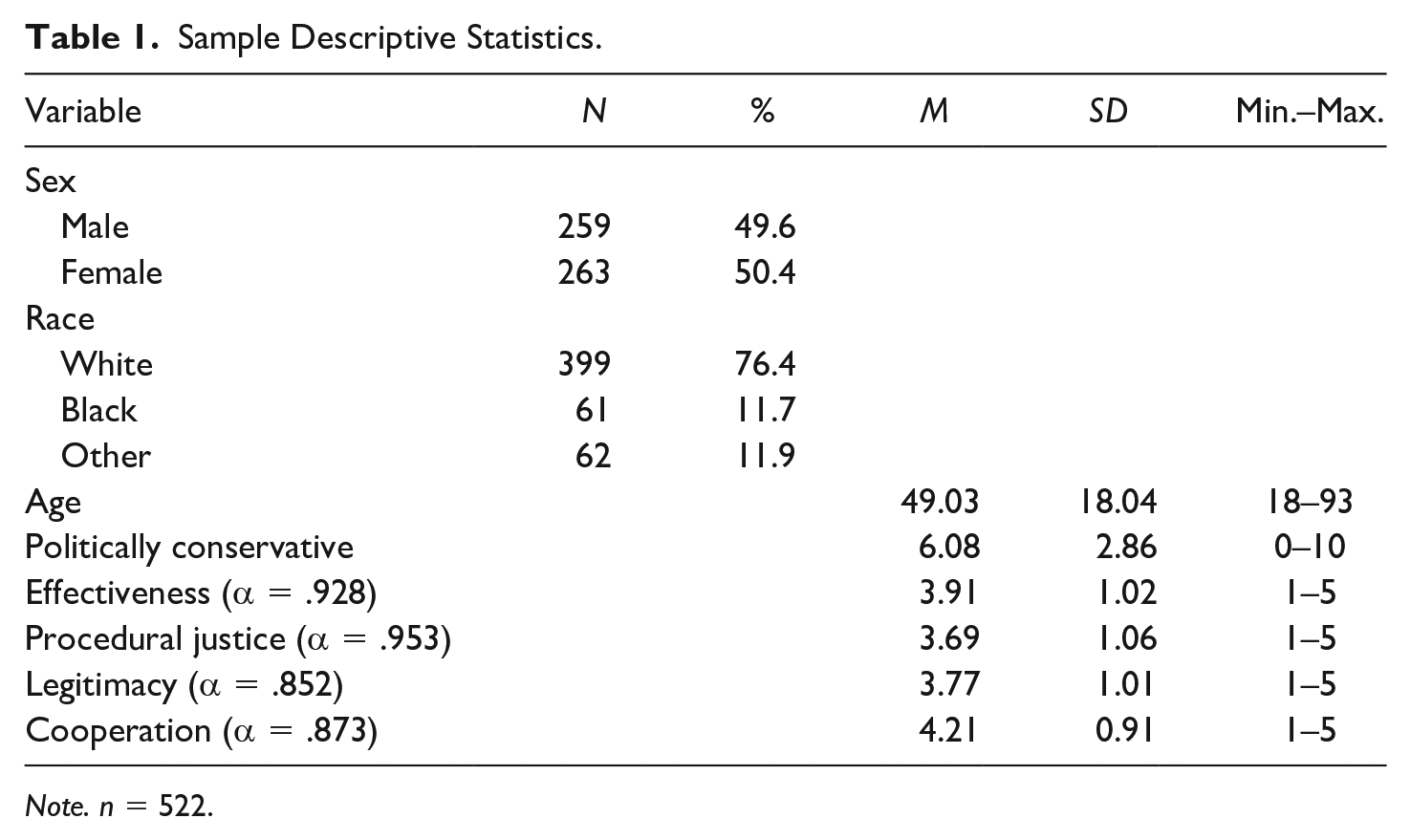
Note. n = 522.
Results
Table 2 shows results from the path analysis predicting 8 racial differences in anticipated cooperation with police through perceptions of police effectiveness, procedural justice, and legitimacy. The first model in Table 2 displays findings from OLS analysis regressing perceptions of police effectiveness onto key demographic variables. Overall, the demographic variables in that model explained approximately 24% of the variance in perceptions of police effectiveness (R2 = .235). As anticipated, being Black was a negative predictor of perceptions of police effectiveness, with results showing Black respondents indicated more negative perceptions of police effectiveness than White respondents (β = −.14, p ≤ .001). Interestingly, there was no statistically significant difference found in perceptions of effectiveness between White respondents and members of Other racial minority groups (β = −.02, p > .05). Other significant predictors in the model included age (β = .32, p ≤ .001) and political conservativism (β = .25, p ≤ .001). Results show that compared with younger respondents and those who identified as more politically liberal, older respondents and more politically conservative respondents reported believing that the police in their community were more effective at doing their job.
Results From Path Analysis.
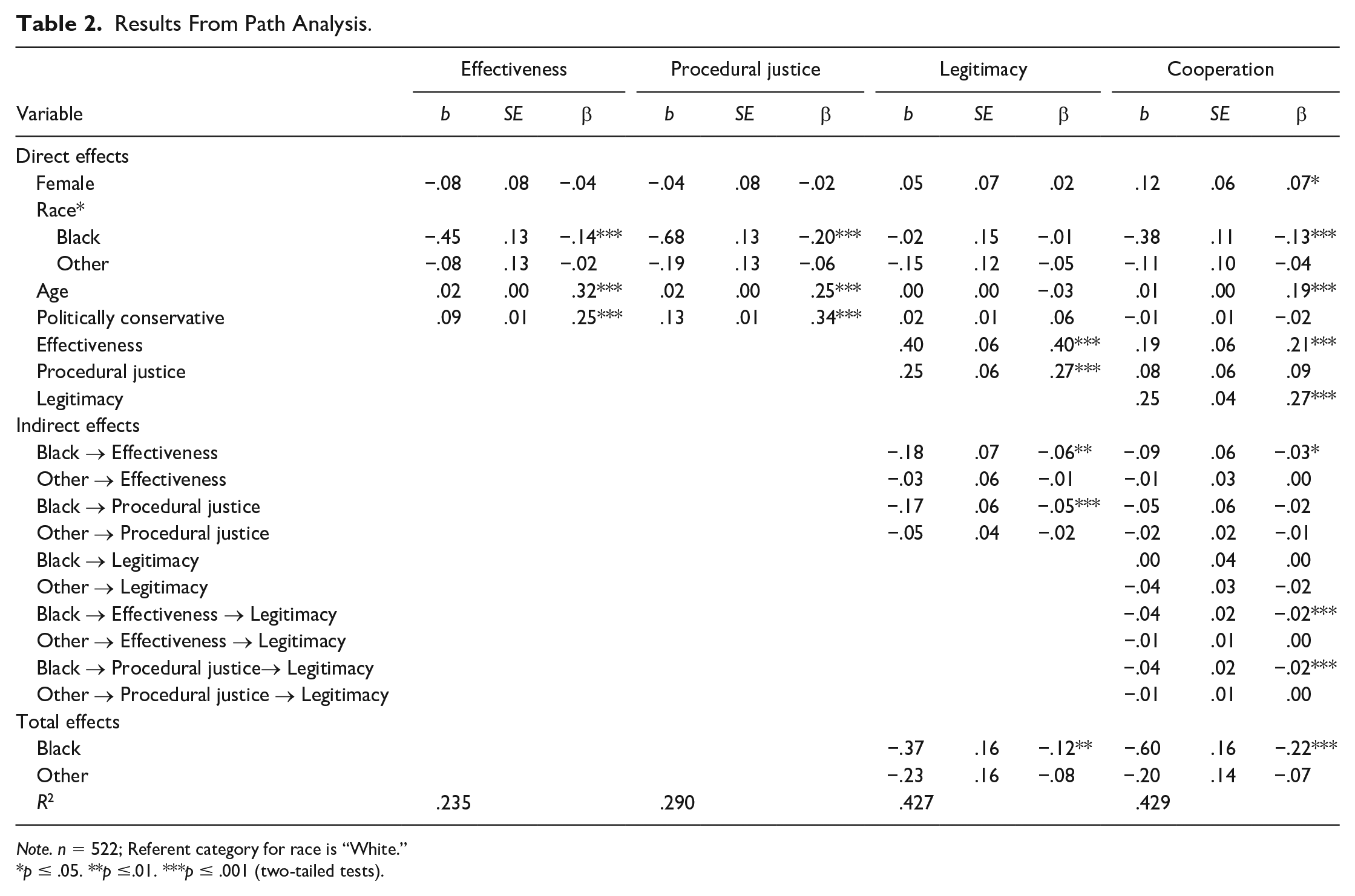
Note. n = 522; Referent category for race is “White.”
p ≤ .05. **p ≤.01. ***p ≤ .001 (two-tailed tests).
The second model depicted in Table 2 displays findings from OLS analysis regressing perceptions of procedural justice onto key demographic variables. The model explained approximately 29% of the variance in perceptions of procedural justice (R2 = .290). Again, as hypothesized, being Black was found to be a significant predictor in this model, with findings revealing that, compared with White respondents, Black respondents perceived police in their community as being less procedurally just (β = −.20, p ≤ .001). There were no differences found between White respondents and members of Other racial minority groups (β = −.06, p > .05) in this model. Political conservativism (β = .34, p ≤ .001) and age (β = .25, p ≤ .001) were also found to be statistically significantly related to perceptions of procedural justice, with positive associations noted for both variables.
The third model displayed in Table 2 shows results from the mediation model estimating perceptions of police legitimacy through perceptions of police effectiveness and procedural justice. The direct effects are displayed in the top rows of the table while the indirect and total effects are shown on the bottom rows of the table. Overall, the estimated path analysis explained approximately 43% of the variance in perceptions of police legitimacy (R2 = .427). Perceptions of police effectiveness and procedural justice included in baseline models rendered the direct relationship between being Black and perceptions of police legitimacy noted in baseline models (see Appendix) insignificant, as hypothesized. Thus, collectively, findings revealed that racial differences between Whites’ and Blacks’ perceptions of police legitimacy were fully mediated by perceptions of police effectiveness and procedural justice, as expected. Significant indirect effects were found for Black respondents through both variables with similar substantive effects observed (β = −.06, p ≤ .01, and β = −.05, p ≤ .001, respectively). Perceptions of police effectiveness (β = .40, p ≤ .001) and procedural justice (β = .27, p ≤ .001) exhibited significant and direct positive effects on perceptions of police legitimacy, absorbing the effects other variables had on perceptions of police legitimacy in baseline modeling; however, the substantive effects of perceptions of police effectiveness on perceptions of police legitimacy were stronger than the substantive effects of perceptions of procedural justice on perceptions of police legitimacy.
The final model in Table 2 shows results from the full path analysis. Overall, the model explained approximately 43% of the variance in anticipated cooperation with police (R2 = .429). Perceptions of police effectiveness (β = .21, p ≤ .001) and police legitimacy (β = .27, p ≤ .001) were found to be significant direct predictors of anticipated cooperation with police, whereas perceptions of procedural justice was not (β = .09, p > .05). Being Black exhibited a significant negative indirect effect on anticipated cooperation through perceptions of police effectiveness (β = −.03, p ≤ .05), but not through perceptions of procedural justice alone (β = −.02, p > .05). However, the effects perceptions of police effectiveness and procedural justice had on the relationship between being Black and anticipated cooperation with police through legitimacy exhibited statistically significant and negative indirect relationships (β = −.02, p ≤ .001, and β = −.02, p ≤ .001, respectively). Still, the direct effects of being Black were significantly related to perceptions of anticipated cooperation (β = −.13, p ≤ .001), suggesting partial, as opposed to full, mediation effects, meaning some, but not all of the differences between Blacks’ and Whites’ orientations toward cooperation with police can be explained by utilitarian assessments and perceptions of procedural justice, which help shape perceptions of legitimacy, and influence perceptions of cooperation. Age (β = .21, p ≤ .001) and sex (β = .07, p ≤ .001) were also statistically significant in the model with findings showing older respondents and females indicated greater anticipated cooperation than did younger respondents and males.
Discussion
Building on prior research (e.g., Henry & Franklin, 2019; Kochel et al., 2013; Pryce & Grant, 2020; Sunshine & Tyler, 2003; Tyler & Jackson, 2014), the current study tested the effects of the procedural justice model of policing and the instrumental model of policing for explaining racial differences in anticipated cooperation with law enforcement. This was done using data collected from a representative sample of 522 Pennsylvania residents. There are several findings from analyses that warrant further discussion.
First, results from bivariate analyses indicated racial differences in perceptions of police effectiveness, procedural justice, perceived legitimacy, and anticipated cooperation. Results revealed that, compared with White respondents, Black and Other racial minority respondents held less favorable views of police. These findings were consistent with our research hypotheses and results found in previous studies demonstrating that minorities hold less favorable views of law enforcement and legal authorities (see, for example, Dowler, 2002; Johnson et al., 2017; Peck, 2015). Even with the inclusion of relevant controls in multivariable modeling (e.g., political identification, sex, age), racial differences persisted, although they were significant only for respondents who identified as being Black. Results showed that Black respondents, as compared with White respondents, viewed police in their community as being less effective at completing the duties of their job, perceived them as being more procedurally unjust and less legitimate, and indicated being less willing to cooperate with officers, controlling for other relevant demographic predictors (see Appendix). However, there were no statistically significant differences found between Whites and members of other racial minority groups noted in “final” multivariable models.
Second, as hypothesized, results showed an indirect relationship between race and perceptions of legitimacy through perceptions of police effectiveness and procedural justice. This finding indicates that racial differences in perceptions of legitimacy between Whites and Blacks present in baseline models could be explained by perceptions of police effectiveness and procedural justice, confirming findings from previous research and providing support for both theoretical policing models (Kochel et al., 2013; Pryce & Grant, 2020; Sunshine & Tyler, 2003). There was also a partial mediation effect found for the relationship between respondent race and anticipated cooperation, showing that these differences could be, at least partially, explained by instrumental (i.e., perceptions of police effectiveness) and normative assessments (i.e., perceptions of procedural justice) that shape respondent assessments of police legitimacy, which, in turn, influences their anticipated cooperation. That said, race was still a significant direct predictor of anticipated cooperation with police, even controlling for perceptions of police effectiveness, procedural justice, and legitimacy, indicating that Black respondents anticipated lower levels of cooperation with police for reasons in addition to and, conceivably, unrelated to these variables. Future research should seek to discover these variables.
Third, the direct effects of our measure of instrumental policing assessments (i.e., perceptions of police effectiveness) trumped our measure of normative assessments (i.e., procedural justice) in predicting legitimacy and anticipated cooperation with police. In fact, our measure of procedural justice was not significantly related to anticipated cooperation in multivariable modeling. These findings support those indicated by Tankebe (2009) and Pryce et al. (2017), suggesting that instrumental assessments may matter more than normative assessments in shaping perceptions of police, and police outcome variables, in certain contexts.
Implications
These findings are important to consider, both theoretically and practically. Theoretically, this work demonstrates a relationship between both instrumental and normative assessments of officers and legitimacy and shows that these models can be used to explain racial differences in perceptions of police. Practically, this work suggests that instrumental assessments, or utilitarian beliefs, about policing may matter more than previously thought, in terms of shaping opinions about officers, and could have a strong influence on police–citizen interactions. Negative attitudes and lack of cooperation with police can hinder the success of policing investigations, crime detection, and community service. For these reasons, it is important to study variables related to cooperation with officers as such cooperation is fundamental to the effectiveness of policing (Peyton et al., 2019; Police Executive Research Forum, 2014). Our results show that perceptions of police effectiveness and procedural justice influence anticipated cooperation with police through legitimacy assessments for Black participants, compared with White participants. Thus, to enhance perceptions of legitimacy and improve cooperation with police, departments should consider directing increased energies toward improving perceptions of both instrumental and normative assessments, especially in Black communities. Greater focus should be directed at improving community perceptions of the instrumental utility of law enforcement, as such perceptions exhibited larger substantive effects on outcome variables in our statistical models. Admittedly, doing so is easier said than done, although prior research offers a few promising approaches.
Peyton et al. (2019) and Worden and McLean (2017) advocate for returning to “actual community policing.” For instance, in their analysis of the New Haven Community Policing intervention, Peyton et al. (2019) showed how community engagement with law enforcement can improve public relations. In that intervention, the department engaged uniformed officers in a series of proactive, positive, and non-enforcement interactions with citizens living in randomly selected homes in one of the city’s 10 police districts. Analysis of the intervention showed that it had a strong positive effect on perceptions of police performance, legitimacy, and cooperation.
There are similar efforts that could be implemented targeting specific communities that have potential to increase perceptions of legitimacy and cooperation. For example, agencies should consider proactive, non-enforcement efforts aimed at increasing legitimacy, such as those found effective for youths by Fine et al. (2022) and Freiburger (2019). These interventions served to improve youths’ perceptions with police, perhaps laying a foundation for greater early trust in police, and, in turn, future cooperation and compliance. It is especially important to target youth, as perceptions of the police tend to decline during adolescence (Piquero et al., 2005), but not lose sight of the demonstrative fact that legitimacy, compliance, and cooperation with police affect individuals of all ages. We suggest that such strategies used by Peyton et al. (2019), Fine et al. (2022), and Freiburger (2019) could be expanded to include educational campaigns that highlight metrics of police effectiveness (i.e., crimes solved, services provided, etc.) and made available to all members of the community—which could help enhance utilitarian assessments. The use of door-to-door educational contact campaigns could be a promising approach, as well as community forums and the use of strategic communication platforms (i.e., police social media accounts, websites, etc.), to increase understanding of policing successes and hopefully improve perceptions of police effectiveness. In this regard, departments could also use interventions as informational opportunities in which they elicit information from the public to help prevent crime and further ongoing investigations.
In addition, there is promise in procedural justice and related training for officers (Council on Criminal Justice, 2021). It should be recognized that there are mixed results on compliance (see, for example, Dai et al., 2011), and overall benefits may not affect crime but could have secondary, intangible benefits (Nagin & Telep, 2020). Recent studies such as Wood et al. (2020) show that procedural justice training reduced the use of force and complaints about officer behavior over time in Chicago, and, in Dai’s (2021) research, citizens rated interactions with police positively following procedural justice training in Norfolk. Our data showed that procedural justice was related to perceptions of legitimacy and cooperation. As such, we argue that programs that enhance procedural justice have promise and could be complemented by objective evaluation.
Limitations
There are several limitations to our study that merit disclosure. First, the data analysis was secondary, and, as such, key variables of interest were missing (i.e., prior victimization). For instance, our measure of procedural justice does not capture community citizen participation in policing encounters. Second, our measure of police effectiveness, while grounded in prior research, was also limited; it could certainly be expanded based on traditional, police-based effectiveness measures as well as community expectations. Third, this study used cross-sectional data, from a small (yet representative) sample of Pennsylvania residents and examined attitudinal responses, not behavioral responses. Therefore, while the results are illuminating, we cannot assume temporal ordering, or generalizability, and findings may not materialize into action in terms of levels of actual cooperation with police. Future work should better attempt to expand these findings to behavioral responses and use more complete measures of predictor variables and covariates when assessing indirect effects. In addition, the timing of the research and variables related to both police effectiveness and legitimacy could be significantly affected by the national crisis in policing, especially as they relate to race, that started in the summer of 2020. However, we feel that this is also a strength of the study, leaving a solid foundation for important follow-up research in this area.
Conclusion
In the contemporary U.S. context, there is strain on race relations as well as police–community relations. The results of this study have shown that there is a relationship between race and anticipated cooperation with law enforcement, and that this relationship can be, at least partially, explained by racial differences in instrumental and normative beliefs about policing, which, in turn, influence assessments of police legitimacy. As such, police agencies may want to consider enacting strategies to improve community perceptions, especially those related to normative, instrumental, and legitimacy assessments. In particular, training and outreach programs geared toward creating positive interactions and impressions within Black communities. In closing, a major contribution of this work was in demonstrating the need for future research to assess both procedural justice and instrumental models of policing.
Footnotes
Appendix
Baseline OLS Models Predicting Anticipated Cooperation.
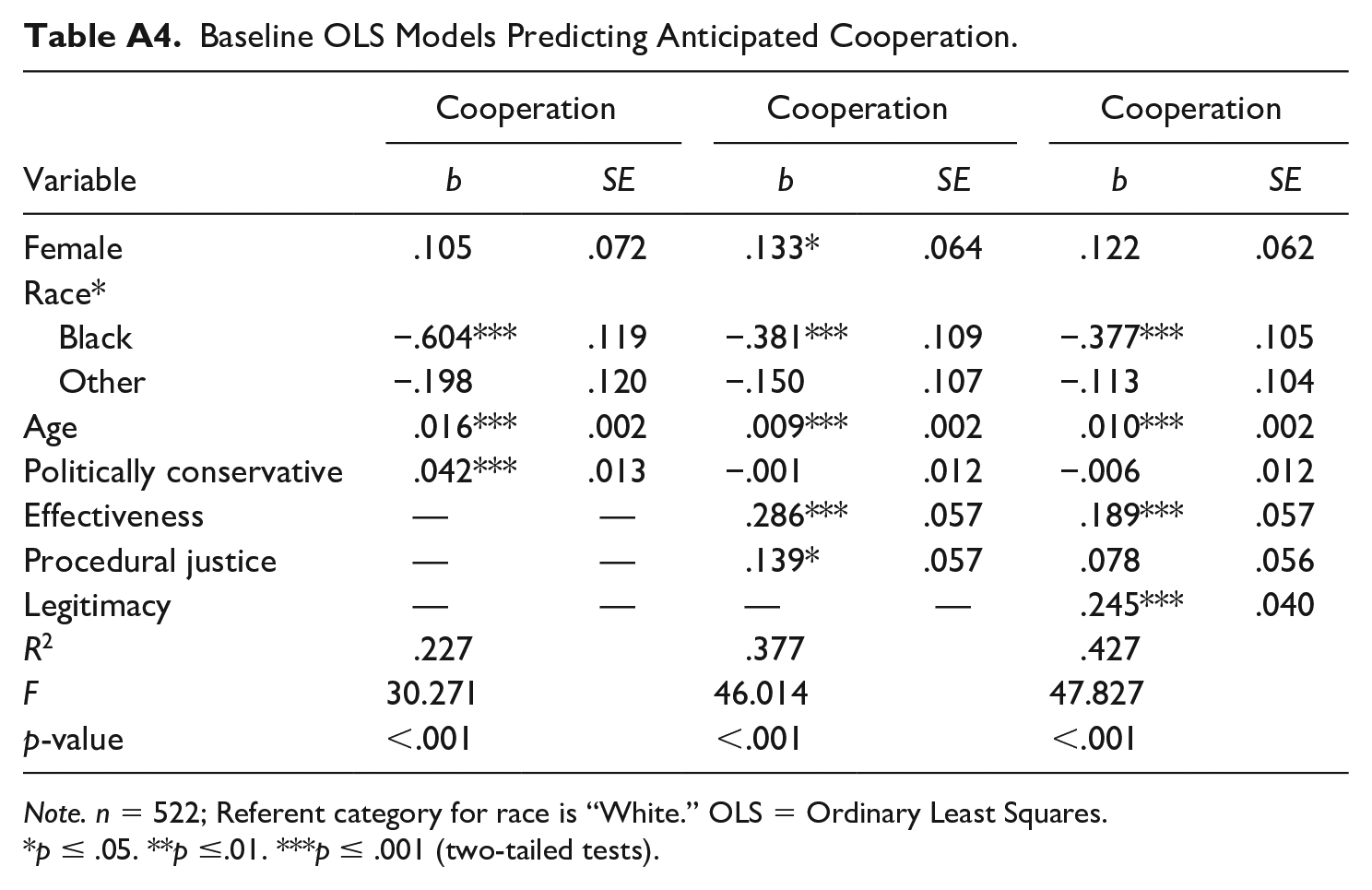
| Variable | Cooperation | Cooperation | Cooperation | |||
|---|---|---|---|---|---|---|
| b | SE | b | SE | b | SE | |
| Female | .105 | .072 | .133* | .064 | .122 | .062 |
| Race* | ||||||
| Black | −.604*** | .119 | −.381*** | .109 | −.377*** | .105 |
| Other | −.198 | .120 | −.150 | .107 | −.113 | .104 |
| Age | .016*** | .002 | .009*** | .002 | .010*** | .002 |
| Politically conservative | .042*** | .013 | −.001 | .012 | −.006 | .012 |
| Effectiveness | — | — | .286*** | .057 | .189*** | .057 |
| Procedural justice | — | — | .139* | .057 | .078 | .056 |
| Legitimacy | — | — | — | — | .245*** | .040 |
| R 2 | .227 | .377 | .427 | |||
| F | 30.271 | 46.014 | 47.827 | |||
| p-value | <.001 | <.001 | <.001 | |||
Note. n = 522; Referent category for race is “White.” OLS = Ordinary Least Squares.
p ≤ .05. **p ≤.01. ***p ≤ .001 (two-tailed tests).
Declaration of Conflicting Interests
The author(s) declared no potential conflicts of interest with respect to the research, authorship, and/or publication of this article.
Funding
The author(s) received no financial support for the research, authorship, and/or publication of this article.
