




Abstract
This study capitalizes on a successful researcher–practitioner partnership to conduct a systematic social observation (SSO) of police body-worn camera (BWC) footage in Newark, NJ. To demonstrate the utility of BWCs as performance monitoring tools, we measure officer adherence to procedural justice standards throughout use of force events as mandated in the Newark Police Division’s updated policies pursuant to an ongoing federal consent decree. Overall, a slim majority of use of force events are procedurally just. However, results indicate several instances of policy noncompliance. Results are discussed, and policy recommendations related to procedural justice policy violations and BWCs for performance monitoring are provided.
Keywords
Introduction
Although the central focus of body-worn camera (BWC) research has primarily been summative in nature (Lum et al., 2020), researchers have explored connections between BWC use and indicators of procedural justice (e.g., McClure et al., 2017; McCluskey et al., 2019). In addition, Makin et al. (2020) demonstrate that BWC footage enables researchers to contextualize outcomes of police–citizen encounters and other social events of interest. Thus, BWCs offer utility for performance monitoring to assess adherence to various policing policies, including policies around procedural justice. Providing a description of such utility constitutes a useful information product for police departments seeking to reimagine performance management.
As such, we leverage the research benefits of BWC footage to conduct a systematic social observation (SSO) of police use of force events in Newark, NJ. In May 2011, the U.S. Department of Justice Civil Rights Division opened an investigation into the Newark Police Division (NPD). The investigation found an unconstitutional pattern or practice by the NPD in its use of physical force (U.S. Department of Justice Civil Rights Division, 2014). In place of litigation, the city of Newark entered into a consent decree with the Department of Justice. The consent decree required NPD to deploy BWCs and update policies. Updated policies compel officers to engage in a range of activities falling within a procedural justice framework during interactions with civilians. This study, an outgrowth of an applied partnership between the research team and the NPD, uses BWCs as a performance monitoring tool to measure police officer adherence to these updated policies.
Review of Relevant Literature
BWCs, Procedural Justice, and NPD Policies
Research on the effect of BWCs has developed at a much more rapid pace than most (if not all) other police technologies (Lum et al., 2015; Piza, 2018). Lum and colleagues (2020) conducted a meta-analysis measuring the effect of BWCs on police officer and citizen behavior as reported through 30 experiments and quasi-experiments. Results of the meta-analysis indicate that BWCs can reduce citizen complaints against police officers. Although the overall results did not find any changes in officer use of force, moderator analyses found that BWCs are more likely to reduce use of force when agencies highly restrict officers’ discretion pertaining to camera activation.
There is a small, but growing body of research exploring connections between BWCs and procedural justice (e.g., McClure et al., 2017; McCluskey et al., 2019). Procedural justice generally refers to the “perceived fairness of the procedures involved in decision-making and implementation, and the treatment people receive from the authority” (Murphy et al., 2008, p. 139). With that said, scholars have emphasized a distinction between perceptions of fairness and actual officer actions—the latter of which is much more easily articulated in policing policies, more amenable to direct observation by a third party, and less influenced by the personal biases of the targets (Braga et al., 2014; McCluskey et al., 2019). Officer actions that adhere to a procedural justice framework include providing the public with explanations of police policies and practices, listening to citizen concerns, responding to citizen concerns, and treating community members with respect and dignity (G. Wood et al., 2020).
Much research has incorporated in-person SSO to measure procedural justice indicators during police–citizen interactions. Particularly relevant to this study, McCluskey and colleagues (2019) conducted in-person SSO to measure the effect of BWCs on officer adherence to procedural justice in Los Angeles. The authors measured 18 indicators of procedural justice, as identified by prior research. These indicators were then collapsed into four separate components: participation, neutrality, dignity and respect, and trustworthy motives. McCluskey et al. (2019) found that BWCs significantly increased officer adherence to procedural justice standards in Los Angeles, and that certain contextual factors (e.g., citizen behavior and race) influenced procedural justice at the incident level.
Officer adherence to procedural justice has predicted citizen perceptions of police legitimacy (Mazerolle et al., 2013) and recent research has shown that procedural justice training is associated with a reduction in use of force and complaints against police (G. Wood et al., 2020). In contrast, when the public views agents of the law unfavorably, the ability of such agents to maintain social order is lost (Kirk & Matsuda, 2011), and police officers who subscribe to a police culture in alignment with more unjust practices are more likely to use force (Terrill et al., 2003). Lack of confidence in the criminal justice system is described by Sampson and Bartusch (1998) as legal cynicism, or a cultural belief that the law and law enforcers are illegitimate and unable to ensure the safety of the public (see also Kirk & Papachristos, 2011).
Legal cynicism came to a head in Newark, NJ when, in May 2011, the U.S. Department of Justice Civil Rights Division opened an investigation into the NPD after receiving allegations of repeated civil rights violations by the agency. Among many other conclusions, the investigation found an unconstitutional pattern or practice by the NPD in its use of physical force (U.S. Department of Justice Civil Rights Division, 2014). Use of force by NPD was found to be unreasonable, underreported by officers, and inadequately investigated. In place of litigation, the city of Newark entered into a consent decree with the Department of Justice, with the goals that police services delivered to the people of Newark fully comply with the Constitution and the laws of the United States, promote public and officer safety, and increase public confidence in the Newark Department of Public Safety and Newark Police Division (collectively “NPD”) and its officers. (U.S. v. City of Newark, 2016, p. 1)
The consent decree required NPD to adopt a wide range of reforms, including the deployment of BWCs and updating policies.
Many of the NPD’s updated policies include instructions to officers to engage in a range of activities falling within the procedural justice framework during interactions with civilians. One such policy is the Bias-Free Policing policy (NPD, 2017). The purpose of this policy is to prevent discriminatory practices and ensure fair and respectful treatment of citizens. The policy explicitly states that officers shall “Be courteous, respectful, and professional. . . state the reason for the stop as soon as practical. . . [and] Answer any questions the citizen may have” (NPD, 2017, p. 4). Similarly, the purpose of the updated use of force policy is to guide use of force practices and “ensure that Police Division members treat all persons with dignity and respect as they execute the duties they have been entrusted to perform” (NPD, 2018b, p. 2). Procedural justice–related officer activities described by this policy include providing subjects with a reason for their arrest prior to the need for physical force, de-escalation of the situation through verbal commands and information gathering, and recognizing that officer demeanor (i.e., “tone and body language”) can influence escalation—resulting in an increased likelihood of force being used (NPD, 2018b, p. 14). Finally, due to the deployment of BWCs mandated by the consent decree, a BWC policy was developed. Pertaining to principles of procedural justice, the BWC policy states that “members shall notify the subject that the camera is recording at the earliest opportunity that is safe and feasible” (NPD, 2018a, p. 4).
Police Reform and Performance Monitoring
In 1994, the U.S. Congress passed the Violent Crime Control and Law Enforcement Act. This Act gave the U.S. Department of Justice the ability to enter into consent decrees with jurisdictions when police departments engage in a pattern or practice of conduct that violates the civil rights of civilians (Powell et al., 2017). Research has shown that consent decrees can reduce the risk of civil rights complaints and improve accountability processes and police officer training (Davis et al., 2005; Powell et al., 2017). Furthermore, whereas consent decree outcomes have been found to dissipate over time (see Chanin, 2014), persistent monitoring of key outcome measures can increase long-term sustainability of effects, and consent decrees can result in police adopting new, often data-driven, measures to track outputs mandated by the Department of Justice (Morgan et al., 2017).
The use of consent decrees as a tool for police reform has grown in popularity, particularly over the past 5 years. From 2015 to 2020, eight police departments were placed under consent decrees (compared with seven over the previous 10 years; U.S. Department of Justice Civil Rights Division, 2017; 2020). With this increased popularity, affected police organizations have had to innovate to comply with the changes imposed upon them by the Department of Justice. For example, the New Orleans Police Department (NOPD) created a scorecard system to quickly track consent decree compliance with BWC activation requirements by platoon level (Morgan et al., 2017). With the success of the scorecard system in gaining compliance around BWC activation, NOPD began measuring a variety of indicators of consent decree compliance with high frequency and built-up strong capacity for self-monitoring. In Newark, an independent monitor has been tasked with ensuring implementation of and compliance with orders of the consent decree through audits, compliance reviews, and summative evaluations, and by analyzing a wide variety of data sources. As of this writing, NPD has not yet reached full operational compliance, a term that signifies NPD has satisfied a consent decree requirement by demonstrating routine adherence in its daily operations.
In tandem with the oversight provided by consent decree monitors, the proliferation of BWCs provides additional opportunities for in-depth analysis of police–citizen encounters recorded on video. In doing so, BWC use offers utility for assessing adherence to various policies by independent monitors, by researchers, and for self-monitoring purposes over the long term. Whereas police–citizen encounters are typically analyzed indirectly (e.g., through officer/citizen statements or written reports), BWC footage allows observers to view and analyze encounters as they unfold, thereby enabling researchers to systematically measure key situational and transactional aspects of police–citizen encounters (Makin et al., 2020).
Makin et al. (2020) demonstrate that BWC footage enables researchers to contextualize outcomes of police–citizen encounters and other social events of interest. Researchers have recently leveraged such a benefit by using BWC footage to study a range of policing topics, including negative emotional states in police–community interactions (Makin et al., 2019), passenger aggression toward officers during citation events (Friis et al., 2020), police–citizen interactions during traffic stops (Voigt et al., 2017), opportunities for problem-oriented policing during routine police–citizen encounters (Pollock et al., 2020), and the duration of police use of physical force (Willits & Makin, 2018). Worden and McLean (2017) conducted an SSO of police in-car camera footage to measure officer adherence to procedural justice principles during a random sample of police–citizen encounters in Schenectady, NY. Worden and McLean’s (2017) analysis provides support for using remote observational methods in the study of procedural justice.
Evidence-Based Policing (EBP) and the Role of Researcher–Practitioner Partnerships
In Newark, NJ, there are several policies that can be assessed for compliance using BWC footage. For instance, NPD BWC policy mandates that officers announce to subjects the presence of the BWC—an activity that can be confirmed to have taken place upon review of the video footage. With that said, although research suggests consent decrees can be an effective method of police reform (Davis et al., 2005; Powell et al., 2017), persistent and long-term monitoring of key outcome measures is necessary (Chanin, 2014). Police agencies with and without consent decrees may lack the capacity to collect BWC data for self-monitoring and other purposes, and practical challenges inherent in day-to-day policing commonly prevent the integration of research and practice.
Researcher–practitioner partnerships have often been advanced as a vehicle for better integrating EBP into police functions. Practitioners benefit from the analytical expertise of their research partners in exchange for the data access necessary to explore real-world problems, which can elude researchers outside of such partnerships (Piza & Feng, 2017). The analytical benefits to researchers vary in scope and have the potential to inform performance monitoring activities. Braga (2010, p. 177) speaks to the need for academics to provide practitioner stakeholders with “strategic information products” and communicate their importance to police officials in a range of venues (Braga & Davis, 2014). Within such an arrangement, strategic information products may differ from the experimental and quasi-experimental evaluation research typically privileged in EBP as outcomes represent only one of many important pieces of information that police require (Greene, 2019). Sparrow (2011) noted that exploratory and descriptive methods commonly employed in natural science inquiry may better inform the design of police strategies than program evaluation efforts.
These types of practical research benefits may be especially likely to occur when police agencies develop the internal capacity to generate scientific knowledge (Sherman, 2013). Although different models have been advanced to support a move toward such police-led science (Piza et al., 2020), prior accounts suggest that benefits are maximized when the line between researcher and practitioner becomes blurred. In recognition of such benefits, embedded criminologists (ECs) (outside academic researchers taking an active role in the day-to-day routine of public safety agencies) have been increasingly incorporated in policing (Braga, 2013; Braga & Davis, 2014) following successful application of this model in corrections (Petersilia, 2008). Researcher–practitioner partnerships and the EC model can be expanded further to assist police agencies to monitor daily performance. For example, researchers and police agencies can work together to determine adherence to many agency policies using BWC footage as a data source, while building self-monitoring capacity.
Scope of the Current Study
This study was conducted in Newark, NJ. Newark is the largest municipality in the state, with a population of more than 280,000 according to the most recently available figures from the U.S. Census Bureau (2019). Blacks comprise nearly 50% of the population, with about 36% of residents identifying as Latino. In 2018, Newark had a violent crime rate of 733 per 100,000 residents, which is larger than the national average for cities with populations of 250,000 and above (451.5 per 100,000) according to the Uniform Crime Report (Federal Bureau of Investigation [FBI], 2018).
In May 2011, the U.S. Department of Justice’s Civil Rights Division opened an investigation into the NPD after receiving allegations of civil rights violations by the agency. Following an initial investigation, a “findings letter” was produced by the Department of Justice in May of 2014, alleging the NPD had been engaged in unlawful policing practices, particularly against Newark’s Black population, dating back to 2009. This investigation resulted in a Department of Justice consent decree which required the NPD to adopt specific reforms to address the violations, including the deployment of BWCs and revised policies on bias-free policing and use of force (U.S. v. City of Newark, 2016). Given that the initial investigation found an unconstitutional pattern or practice by the NPD in its use of physical force (U.S. Department of Justice Civil Rights Division, 2014), the NPD partnered with the research team for the purpose of providing a detailed description of use of force events, and BWC footage served as the data source. In carrying out this work, the potential of the BWC as a performance monitoring tool became apparent.
To demonstrate the value of BWCs for performance monitoring, we explore one research question:
In relying on SSO, we acknowledge that prior research conceptualizes procedural justice largely as a psychological measure reflecting citizen impressions of treatment by the police (Reisig et al., 2007; Tyler, 2004). However, research has also noted that citizen perceptions of police actions can largely be affected by emotions and other contextual factors (Barkworth & Murphy, 2015; Braga et al., 2014), and that citizen evaluations of police actions do not always match what officers actually do in the field (Worden & McLean, 2017). As such, a large body of research has opted to measure procedural justice in the context of police actions, specifically through SSO methods (Mastrofski et al., 2010; McCluskey et al., 2019; Todak & James, 2018). Furthermore, as discussed subsequently, the NPD identifies precise officer actions in their conception of procedural justice, as outlined in the revised policies. Therefore, this study is particularly interested in procedural justice as defined by police policy, given the interest in BWCs as a performance monitoring tool. For these reasons, we conceptualize procedural justice in terms of officer actions in this study.
It should be noted that NPD deployed BWCs in stages and this study reflects early stages of BWC deployment. Mandatory consent decree training on several topics had not been completed when some of the earlier use of force cases explored here took place; and, while the use of force policy had not yet come into effect during the study period examined here, timing of policy implementation is not relevant to the larger goal of demonstrating the value of BWCs for performance monitoring.
To access the data required to carry out this work, we leveraged the role of the “insider/outsider” (Petersilia, 2008). The principal investigator of the project was employed as a crime analyst at NPD prior to becoming an academic. This previous experience afforded him the legitimacy associated with being a policing insider, while seeking data access as an academic outsider. We also benefited from the availability of a researcher from a local university who was embedded at the NPD. During our project, this EC compiled and triangulated administrative datasets associated with the BWC footage on behalf of the research team. Finally, the principal investigator met with the NPD to request input on how the research could be conducted in a manner most beneficial to their mission and goals. Through this action, we welcomed practitioner participation in the knowledge-generating process (see Crawford, 2017; Katz & Huff, 2020) and the result is an information product that demonstrates the utility of BWC footage as a tool for monitoring adherence to departmental policies around principles of procedural justice.
Method
Design and Sampling
This study is an SSO video data analysis of arrests captured on BWC by the NPD, which involved police use of force. SSO is a systematic method of data collection developed by Reiss (1968, 1971) wherein data collection is independent of the phenomena being observed. Video data analysis, involving the analysis of preexisting video footage, provides an innovative venue for SSO (Nassauer & Legewie, 2018). As Nassauer and Legewie (2018) point out, video data analysis allows researchers to observe and record “what the visual captures about situational dynamics of human social life” (p. 136). Because video footage has the potential to capture and archive entire events from various perspectives, it is an ideal data source for researchers seeing to identify key situational factors of outcomes, events, and processes.
In establishing a sampling frame for this study, arrests emerged as being of particular interest. While the opportunity to behave in a procedurally just manner is presented during all police–civilian encounters, the potential for use of force is presumed to be much lower during non-arrest scenarios—as in the case of a member of the public asking for directions, for example. This is because, during the course of an arrest, police must secure suspect compliance. Furthermore, while arrests bring a higher degree of risk of use of force compared with other types of encounters, arrests also impact millions of people per year in the United States. More than 10,000,000 arrests by law enforcement occurred in the United States in 2019 (FBI, 2019).
Similar to Mastrofski et al.’s (2010) description of an event as a social construct, the unit of analysis for this study is use of force events during the course of an arrest, which includes at least one instance of police use of physical force. Use of force events include a period of time preceding and following the use of force incident(s), beginning when the officers are first visibly seen interacting with any involved parties (e.g., suspects, bystanders, or victims). The exception to this is cases in which the video footage begins after police had already begun interacting with involved parties (see Table 1). 1 The end of the use of force event can be described as the time at which full suspect compliance is secured, making the likelihood of physical force minimal. This may include the period following an arrest, the time at which suspects were secured within a patrol car, or the time at which the officers left the scene.
Frequency and Percent Procedural Justice Indicators.
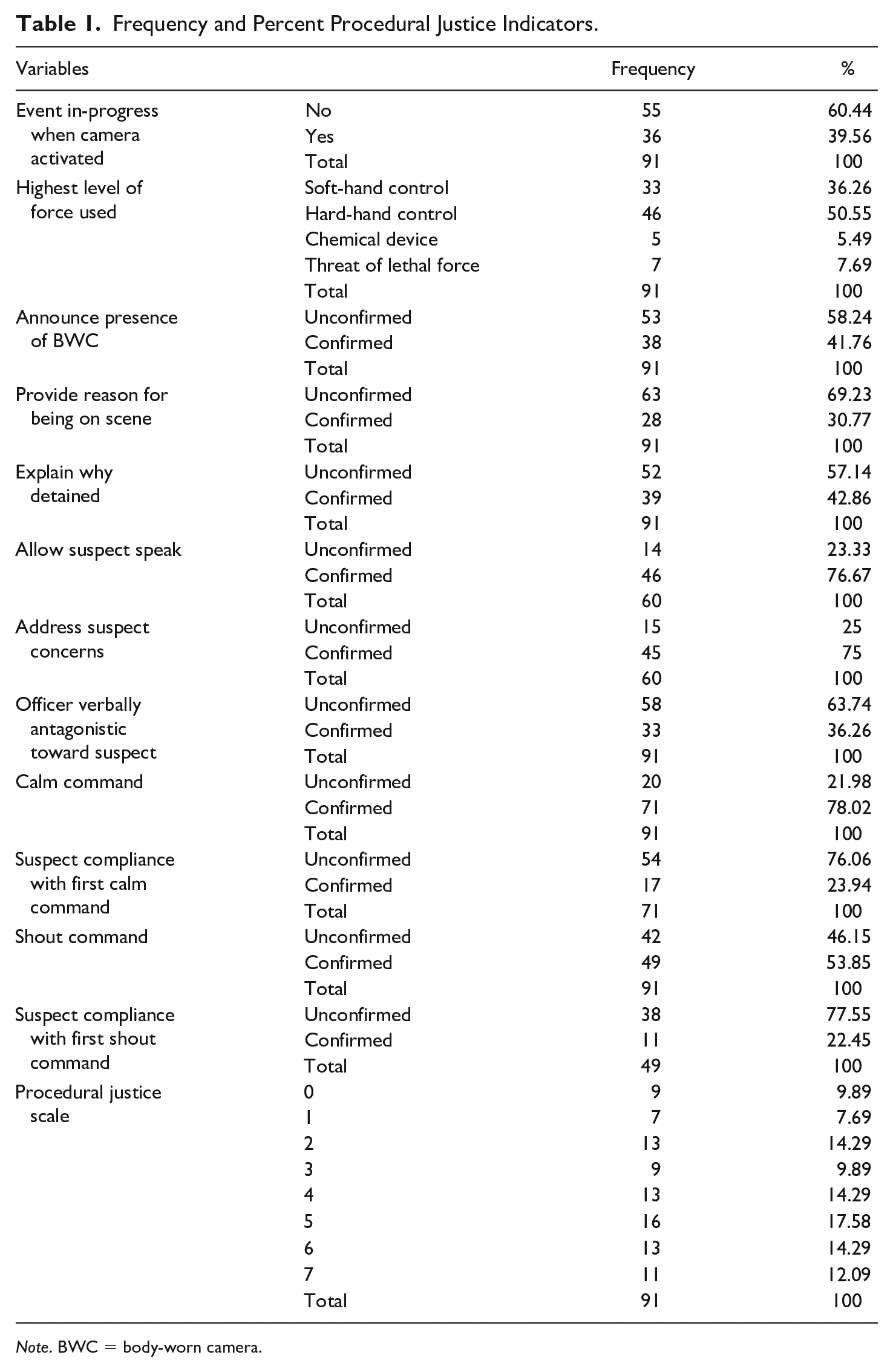
Note. BWC = body-worn camera.
We focus on the 122 use of force events recorded by BWCs between December 2017 and the end of 2018. Thirty events were excluded from the analysis for a variety of reasons. The most common reason for exclusion (n = 18) is that the use of force event was not actually captured by BWC. In these cases, the BWC-equipped officer(s) arrived on scene after force had been applied. In five cases, use of force occurred after arrest processing—at either a police precinct or hospital. These cases fell outside our sampling frame, which is use of force cases that occurred during the course of an arrest. In these five cases, compliance had already been secured when force occurred. Six cases were excluded either because the use of force only constituted the application of handcuffs (n = 3) or because the internal affairs unit was actively investigating the cases (n = 3), thus restricting access to the video from NPD servers pending the conclusion of the investigation. Finally, a single incident was incorrectly tagged as two events in the BWC database.
The final sample consists of 91 cases. In 50.55% (n = 46) of cases, the highest level of force used during the event is hard, empty hand control and, in 36.26% (n = 33) of cases, the highest level is soft, empty hand control (see Table 1). In 7.69% (n = 7) of cases, the highest level of force is threat of lethal force and, in 5.49% (n = 5) of cases, it is use of a chemical device (i.e., pepper spray). There are zero instances of either blunt object impact or deadly force. 2 These findings are consistent with statistics reported from the Bureau of Justice Statistics’ 2018 Police–Public Contact Survey, which found that chemical agents and pointing or shooting of a firearm were much less common than lower levels of force (Harrell & Davis, 2020).
Coding and Measurement
In-depth footage reviews have become a common method of focusing research involving video data (Nassauer & Legewie, 2019). As such, prior to beginning data collection, the authors met for a 5-day data retreat to review video footage. Due to technological limitations preventing coders from viewing the video footage remotely, a single coder was responsible for data collection and tests for intra-coder reliability were conducted. 3 The central coder of this project engaged in training during the data retreat. Coding occurred at NPD headquarters across 8 months and it took approximately 300 hr to review and code all use of force events. In SSOs of video data, naive realism refers to the notion that anyone observing the same video data will arrive at a shared conclusion (Morrison, 2017). Observations are not independent of the observer and, in Finlay’s (2002) discussion of reflexivity as intersubjective reflection, she notes, “Psychodynamic researchers remind us to explore how conversation or text affects us and to reflect on what we bring to it ourselves” (p. 217). Thus while prior SSOs have included a single coder when appropriate (e.g., Porter et al., 2018; Sytsma et al., 2020), we acknowledge that the results presented here owe to the positionality of a single coder.
Despite relying on a single coder, to maintain a team approach to the coding (Lindegaard & Bernasco, 2018), members of the research team were consulted throughout the process to discuss issues related to the coding and to reach consensus on appropriate codes. This exercise was crucial as scenes can quickly escalate from calm interactions with few people, to chaotic and frenzied with multiple bystanders, multiple suspects, officers arriving on scene at different points, foot and vehicle pursuits, and emotionally-difficult to view situations. In contrast to the frenzied nature of the action depicted on video, despite video resolution limitations found in other video data research (e.g., Keval & Sasse, 2010), video and audio quality seldom proved problematic over the course of this research. Because NPD requires all officers to wear BWCs, we often had various vantage points of a single event. In addition, microphones located in BWCs are close to users’ mouths, ensuring audio is relatively audible and clear.
Cases were coded for four procedural justice dimensions, as informed by the NPD Bias-Free Policing policy, the updated use of force policy, and the newly developed BWC policy (NPD, 2017, 2018a, 2018b). Several dimensions are consistent with prior procedural justice literature, as is conceptualizing procedural justice as directly observable officer actions, rather than civilian perceptions (see Braga et al., 2014; McCluskey et al., 2019; Tyler & Wakslak, 2004). Observing procedural justice indicators remotely, rather than through an in-person SSO is also consistent with recent developments in the procedural justice literature (Worden & McLean, 2017). We coded (a) officer announcement of BWC and operationalized this dimension as a binary variable: confirmed announcement of BWC/unconfirmed. Cases are “confirmed” if the coder explicitly heard such an announcement in the video footage.
We also measured the extent to which (b) officers addressed suspect concerns, as indicated by binary variables measuring whether or not officers can be confirmed (by verbal indication audible to the coder) to have explained to suspects why they were responding to the scene, why the suspect was being detained, whether the suspect can be confirmed to have attempted to speak for the purpose of expressing their views, and the number of times the suspect attempted to speak. We captured, of those who attempted to speak, whether the officer can be confirmed to have allowed the suspect to speak on each occasion an attempt was made. We also captured whether the officer addressed the suspect’s concerns by making attempts to answer suspect questions on each occasion an attempt was made.
Another procedural justice dimension captured in these data is (c) officer displays of verbally antagonistic behavior, such as shouting, berating phrases, or name-calling. Officer displays of verbally antagonistic behavior are operationalized as a binary variable (confirmed/unconfirmed). The target of such behavior (i.e., suspect or bystander) is captured, as is the number of occasions such behavior occurred during the course of a use of force event.
(d) Nature of officer commands is captured by these data, and command types include calm commands and shout commands. A calm command is a nonthreatening, verbal command. Examples of a calm, nonthreatening verbal command include, “Let me see your identification” and “Open your backpack.” That said, the focus is not on the words used, but on the tone with which the command is delivered. A shout command is an increased volume (i.e., yelling) command. Again, the focus is not on the words used, but on the tone with which the command is delivered. Both command types are operationalized as binary variables (confirmed/unconfirmed) and whether the suspect can be confirmed to have complied with the command (binary). The number of occasions each command type was given during the use of force event was also captured.
Finally, to assess “central tendency” of use of force events, an 8-point procedural justice scale was created, which combines many of the binary items described above. Items were coded in the same direction, thus a higher score indicates a more procedurally just interaction. The following indicators are each valued at 1 point: announcement of BWC, explanation of why suspect was being detained, explanation of the reason for responding to the scene, giving a calm command, allowing the suspect to speak, and addressing concerns for those who attempted to speak. Cases in which officers gave suspects a shout command without also giving a calm command were given a score of 0 (cases in which this did not happen were given 1 point). These items are highly reliable (α = .8). Officer displays of verbally antagonistic behavior was not included in the scale. Based on eigenvalues and Kaiser–Meyer–Olkin measures of sampling adequacy, this indicator is conceptually different from the other procedural justice indicators (KMO = .38). 4 In contrast to the items listed above, it may be that verbally antagonistic behavior is representative of the personality and demeanor of the individual officer, independent of policy-level directives. All results are presented as descriptive statistics.
Results
Officer Announcing BWC Presence
An officer can be confirmed to have announced the presence of a BWC in 38 cases (41.76%; see Table 1). In 10 of the 38 cases in which an officer announced the presence of a BWC, the officers are visibly seen interacting with involved parties immediately when the video begins, indicating that the event was already in-progress when the camera was activated. Similarly, in 26 of the 53 cases in which BWC announcement is not observed, the interaction was already in-progress when the footage began. Thus, it is possible that BWC announcement occurred in as many as 64 (70.33%) cases. Generally, this more liberal estimate should be considered low policy compliance. However, in the case of Newark, because BWCs were deployed in stages with a likely adjustment period needed for each new group of officers to be equipped with cameras, compliance with the BWC policy based on these data can be considered acceptable and may have increased since 2018.
Officer Addressing Suspect Concerns
In 30.77% (n = 28) of cases, an officer can be observed providing a reason to the suspect as to why the officer was on the scene (see Table 1). In the 63 cases in which there is no evidence of an officer providing a reason to the suspect as to why the officer was on the scene, 31 events were in-progress when the camera was activated. In other words, the percentage of cases in which a reason is provided to the suspect may be as high as 64.84%; but even this liberal estimate suggests that in more than one third of incidents officers were not following the Bias-Free Policing policy. Because this policy was in place well prior to the study period, compliance with the policy is expected to be higher.
In 42.86% (n = 39) of cases, an officer explained to the suspect why they were being detained (see Table 1). Of the 52 cases in which there is no evidence of such an explanation, 24 events were in-progress when the camera was activated. Thus, it is possible that as many as 63 or 69.23% of events include an officer explaining to the suspect why the suspect was being detained. Because such a directive can be found in the updated use of force policy, which was not officially in effect during the study period, if the most liberal estimate of policy compliance is accurate, policy compliance can be considered satisfactory. However, as the purpose of this article is to demonstrate the potential of BWCs for performance monitoring, the timing of policy implementation is not entirely relevant.
In 65.93% (n = 60) of cases, the suspect attempted to speak for the purposes of expressing their views at least once during the event and, in 76.67% of those cases, an officer allowed the suspect to speak (see Table 1). Of the 60 cases during which a suspect attempted to speak for the purpose of expressing views, in 75% of cases, a police officer addressed the suspect’s concerns by making attempts to answer any questions posed by the suspect (see Table 1). Because the directive to answer suspect questions comes from the Bias-Free Policing policy—which was disseminated prior to the study period, this level of compliance with the policy can be considered unsatisfactory. However, of the 60 cases wherein a suspect attempted to speak for the purpose of expressing views, in 24 cases, the suspect made a second attempt to speak (table not shown). Of these 24 cases, 17 were permitted to speak and all 17 had their concerns addressed by police. Of the 24 cases wherein suspects attempted to speak on two occasions for the purpose of expressing their views, 12 attempted a third time to speak. Of those 12 who attempted to speak on a third occasion, all were permitted and 10 had their concerns addressed by police. Several suspects continued to attempt to speak for the purpose of expressing their views after this third attempt.
Results suggest that, with additional attempts to express views, suspects become more persistent or committed to sharing their perspective and police may be less receptive to allowing suspects to express their views. Although compliance with the Bias-Free Policing policy is low for first attempts, with repeated attempts by the suspect to speak, those officers who permit suspects to speak are consistent in their adherence to procedural justice principles in that they tend to address suspect concerns.
Officer Verbally Antagonistic
In 36.26% (n = 33) of cases, at least one officer displayed verbally antagonistic behavior toward the suspect (see Table 1). In nine cases, there was a second instance of verbally antagonistic behavior and, in two cases, there was a third instance of an officer displaying verbally antagonistic behavior toward the suspect (table not shown). These results indicate low compliance with the Bias-Free Policing policy, which calls for officers to “Be courteous, respectful, and professional” (NPD, 2017, p. 4).
Nature of Officer Commands
In 78.02% of cases, an officer gave the force recipient a calm command (see Table 1). The use of force policy, indicating officers must use verbal commands to de-escalate, officially came into effect after the study period; thus, had the policy been in place sooner, these results might point to a low level of officer compliance with the policy. Given the timing of the updated use of force policy implementation, the number of officers already relying on calm directives toward suspects is encouraging.
Suspects complied with the calm command in 23.94% of cases (see Table 1). In other words, suspect compliance with an officer command is low. In many cases, there were several sets of calm commands. Two sets of commands were observed in 37 cases (table not shown). In 35.14% of cases with a second set of calm commands, the suspect complied with the command. In 10 cases, there was a third series of calm commands. In 40% of cases with a third series of calm commands, the suspect complied. Five cases involved more than three sets of commands. In addition, of the 71 cases where a calm command was given, 59.15% (n = 42) resulted in use of force greater than soft-hand control, compared with 80% of those cases where no calm command was given (table not shown).
In 53.85% of cases, an officer gave the force recipient a shout command (see Table 1). It should be noted that of the 49 shout command cases, most (77.55%) also included at least one calm command. Suspects complied with the shout command in 22.45% of cases (see Table 1)—again, suspect compliance with officer commands is low. In 10 cases, a second series of shout commands took place (table not shown). In 40% of cases with a second series of shout commands, the suspect complied with the command. There is one case with three occasions of commands. Finally, of the 49 observed instances of shout commands, 69.39% (n = 34) resulted in use of force greater than soft-hand control, compared with 57.14% of those cases where no shout command was given.
Results around commands suggest that, despite suspects often not complying with commands, many officers are quite committed to the command directive itself, and they are committed to remaining calm in their delivery of a command.
Procedural Justice Scale
As indicated by Figure 1 (see also Table 1), use of force events do trend toward more procedurally just, with most of the sample (58%) scoring between 4 and 7 on the procedural justice scale. With that said, a substantial portion (42%) of events are below the median, and nearly 18% of cases (n = 16) have a score of 0 or 1. These results paint a more general picture of officer actions relative to the specific indicators discussed above and suggest that officer conduct could be improved during use of force events.
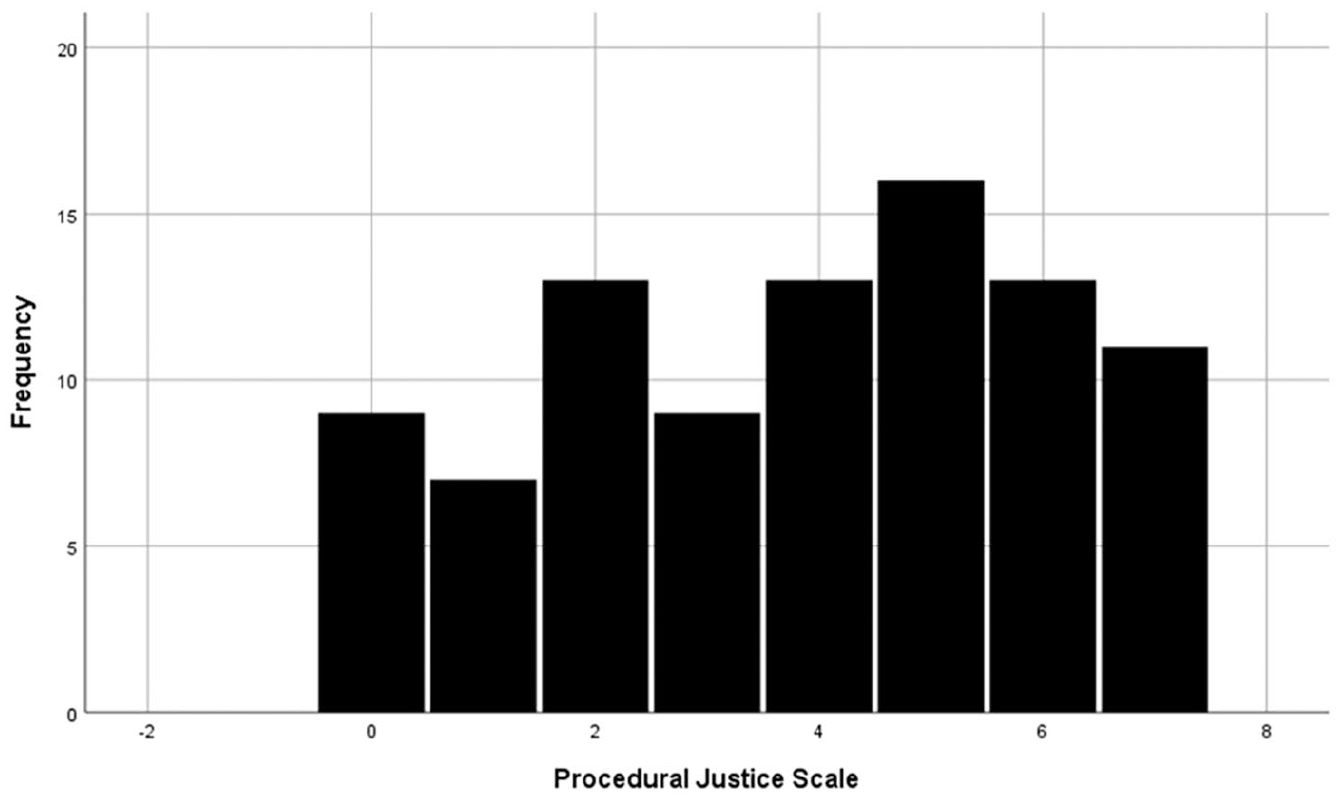
Histogram: Distribution of procedural justice scale.
Discussion
This study capitalizes on a successful research–practitioner partnership to demonstrate the utility of the BWC as a performance monitoring tool. Using BWC footage, we provide a detailed description of the extent to which use of force events are otherwise procedurally just as required by NPD policy. We feel that such methods can benefit police reform efforts as prior research demonstrates the importance of persistent and long-term monitoring of key outcomes (Chanin, 2014), particularly in the context of federal consent decrees (Davis et al., 2005; Morgan et al., 2017; Powell et al., 2017).
Study results demonstrate that, in many cases, no reason was provided to the suspect as to why the officer was on the scene. With that said, although we find that many officers involved in the use of force events explored here did not announce the presence of a BWC, and often no explanation was provided to the suspect as to why they were being detained, it is possible that compliance with BWC and use of force policy on these indicators has improved since 2018. In most (78%) cases, an officer gave the force recipient a calm command and, in just over half of cases, an officer gave a shout command. In most cases of shout commands, calm commands were also given. This indicates most officers adhered to the NPD policy of using escalating verbal commands before resorting to physical force. However, officers often did not attempt to answer questions posed by suspects unless suspects persisted in their inquiries. It was also quite common for at least one officer to display verbally antagonistic behavior toward the force recipient. Finally, when procedural justice is operationalized more generally using a procedural justice scale, while most (58%) events are somewhat procedurally just in nature, officer conduct could be improved during use of force events. Of particular concern is the 18% of cases that have a score of between 0 and 1 on the procedural justice scale.
Many officer actions observed through this research violate the Bias-Free Policing policy and would have violated the updated use of force policy had it been officially in effect during the study period. Observed policy violations could compound the legitimacy-eroding effects of the use of force incident and this can have negative consequences for criminal justice and civic engagement (Kirk & Matsuda, 2011; Kirk & Papachristos, 2011). That said, NPD procedures for responding to policy violations for corrective and accountability purposes are quite comprehensive, and responses vary depending on the perceived severity of the policy violation (see Office of the Attorney General, 2017). Furthermore, while under federal consent decree, the Consent Decree and Planning Division of NPD conducts internal audits and can also forward incidents to internal affairs. The existence of this auditing unit speaks to questions about how monitoring duties can be fulfilled once consent decrees expire. Prior research on CCTV cameras has shown that implementing cameras without a succinct number of dedicated monitors can compromise intended effects (Piza et al., 2014). NPD and other police agencies interested in capitalizing on BWC deployment for performance monitoring should consider implementing a unit dedicated to actively observing BWC footage for adherence to departmental policy.
In addition, should police agencies wish to exploit BWCs for monitoring policy adherence, such an endeavor can be built into existing police practices. For example, following NOPD’s success with monitoring consent decree compliance, the department expanded the scope of accountability captured by the existing CompStat model, which had traditionally relied on crime-related measures for performance management (Morgan et al., 2017). NOPD’s new performance management approach monitors a wide range of organizational activities and outcomes, including response time, misconduct, and investigatory activities. We advocate that officer conduct identified though BWC monitoring be tracked by performance management systems, such as CompStat.
Although this study demonstrates the utility of the BWC as a performance monitoring tool, the limitations of relying on BWCs for performance monitoring mirror limitations of BWCs in general, and include unreliable hardware such as inoperability in extreme cold temperatures (see Hung et al., 2016); equipment, data storage, and labor costs (Letourneau, 2015); concerns around third-party vendors’ access to video evidence (S. E. Wood, 2017); subjective interpretation of video footage (Williams et al., 2016); and many more (see Laming, 2019). Limitations specific to performance monitoring include the costs and challenges around creating and maintaining a dedicated auditing unit, and challenges and costs associated with developing data tracking infrastructure. We further recognize that our study focuses on the first year of NPD’s BWC program and federal government oversight through the consent decree. In the time since, the NPD has implemented strategies aimed at improving police–community relations, including officer training, increased public outreach in the form of regular community meetings, and the solicitation of community feedback on the BWC program. As such, it is possible that our measures of procedural justice policy adherence are specific to the study period and not reflective of current officer behavior in Newark. Future research can apply SSO to BWC footage to determine how officer adherence to procedural justice standards change over time.
As Terrill and colleagues (2016) point out, BWCs “rely on officer activation, which does not occur equally for all citizen encounters and fails to capture events preceding activation, which is a problematic gap” (p. 67). To control for this, where possible, we present liberal estimates of results that account for cases in which the event was in-progress when the camera footage began. In addition, similar to the work of Tyler and Wakslak (2004), the procedural justice scale created here is fairly simplistic in nature and does not differently weight various actions. Finally, as in the work of McCluskey et al. (2019) and Worden and McLean (2017), we rely on officer actions to indicate adherence to procedural justice principles. This approach does not account for the perceptual nature of procedural justice. A survey of arrestee perceptions of the police–citizen interaction would more directly measure public perceptions of procedural justice. However, because the purpose of this article is to demonstrate the utility of BWCs as a performance monitoring tool, data collection of arrestee perceptions is beyond the scope of this work.
Despite limitations, this work contributes a novel application of BWCs. Lum and colleagues (2020) have shown that BWCs are unlikely to impact a range of police and citizen behaviors. That said, the benefits of officer fidelity to procedural justice principles have been displayed in the literature (Mazerolle et al., 2013; G. Wood et al., 2020), and video footage has been leveraged by researchers to observe the occurrence of procedurally just activities during police–citizen interactions (Worden & McLean, 2017). We exploit BWCs to provide a detailed description of the extent to which use of force events are procedurally just, thereby highlighting the potential of BWCs as tools for monitoring adherence to a variety of policies. Ours is a notable contribution, given that performance monitoring is key to achieving lasting reform and reducing legal cynicism (Chanin, 2014; Davis et al., 2005; Morgan et al., 2017; Powell et al., 2017; Sampson & Bartusch, 1998). It is our hope that this information product will persuade readers to reimagine performance management. Police departments are encouraged to employ creative approaches to monitoring a range of activities and outcomes.
Footnotes
Author’s Note
Leigh S. Grossman is now affiliated with Oakland Police Department, City of Oakland.
Declaration of Conflicting Interests
The author(s) declared no potential conflicts of interest with respect to the research, authorship, and/or publication of this article.
Funding
The author(s) disclosed receipt of the following financial support for the research, authorship, and/or publication of this article: This research was supported by Charles Koch Foundation, Criminal Justice and Policing Reform Program, USA.
