




Abstract
The current study applies Systematic Social observation (SSO) to body-worn camera (BWC) footage of use of physical force events in Newark, NJ. The analysis tests the effect of suspect resistance and police officer interpersonal and informational justice tactics on time until use of physical force in police-citizen encounters. The results indicate police officer actions have a greater effect on the time until physical force than does suspect resistance. Officer adherence to informational justice is negatively associated to the time until both first use of force and highest level of force. Suspect resistance did not achieve statistical significance in any model. This study has implications for research and police practice, and demonstrates the benefits of leveraging video footage in criminological research.
Keywords
Introduction
The capacity to use force is widely considered the defining characteristic of the police officer’s role in American society (Bittner, 1970). Despite its central role in the police mission, use of force is by no ways completely controlled by organizational powers. Davis (1969) argued that the discretionary power of public officers should be reduced. He argued that when such power is necessary, it should be confined and clearly structured. While agency policy and legal considerations do constrain use of force to particular types of situations, over 50 years after Davis’ (1969) essay, police officers continue to enjoy a great deal of discretion in most instances (Walker & Katz, 2005). A large body of research has explored the factors that influence a police officer’s decision to use force, with situational factors considered the most salient influencers (Bolger, 2015). Researchers have consistently found significant links between suspect resistance to officers and police use of physical force (Bolger, 2015; Klahm & Tillyer, 2010). Pursuant to this fact, police officer actions and behaviors that can de-escalate confrontational citizen encounters has emerged as a point of emphasis in contemporary policing (Engel et al., 2020; Todak & James, 2018).
The research literature offers important insights on factors of police-citizen encounters that can aggravate or mitigate the likelihood of physical force. However, it is important to note that commonly employed data sources present some inherent limitations. Official police records are largely incomplete and sometimes inaccurate (Klinger & Brunson, 2009) while in-person observational methods commonly involve threats to validity (Mustante & DeWalt, 2010). Navigating the challenges of these data sources has been facilitated by recent occurrences in the police reform movement, particularly the rapid proliferation of body-worn cameras (BWCs). BWC footage allows for the in-depth observation and analysis of police-citizen encounters, with participant behaviors and actions directly visible to researchers. The coding and analysis of BWC footage extends the emergent video data analysis (VDA) framework, which emphasizes the analysis of pre-existing footage to understand the consequences of situational dynamics within native settings (Nassauer & Legewie, 2019, 2021).
The current study leverages the benefits of VDA and BWC footage to analyze police use of force events in Newark, NJ. The analysis expands upon the approach of Willits and Makin (2018) by testing the effect of suspect resistance and police officer interpersonal and informational justice tactics on time until use of force in police-citizen encounters. This study contributes to the recently developed body of scholarship focusing on interpersonal and tactical—as opposed to legalistic—aspects of police use of force (Garrett & Stoughton, 2017; Stoughton et al., 2020). The results indicate police officer actions have a greater effect on the time until force than suspect resistance. This study has implications for research and police practice. We begin with a discussion of the prior research that motivated the current study.
Review of Relevant Literature
Police Use of Force: Tactical and Temporal Considerations
Police use of force has been subjected to a large amount of legal scrutiny, with case law from the United States Supreme Court and district circuit courts providing a legal framework by which to evaluate officer decisions. Collectively, these court rulings provide bedrock principles of police use of force, including the prohibition of officers from shooting fleeing felons unless escape poses a significant threat of death or serious bodily injury to the officer or others (Tennessee v. Garner, 1985) and requirement that an officer’s use of force must be “objectively reasonable” (Graham v. Connor, 1989). However, legal scholars have noted that case law largely overlooks situational decisions of police officers. For example, while police officer use of force must be deemed “objectively reasonable” the court did not explain exactly how to evaluate a given use of force as reasonable or excessive (Shane & Swenson, 2019). The Graham ruling set out severity of the crime, the level of immediate threat, and active resistance and/or evasion by the suspects are factors that should be considered when assessing objective reasonableness; yet each factor contains aleatory elements that complicates such analysis (Stoughton et al., 2020).
In this sense, Garrett and Stoughton (2017) argue that the nature of situational police tactics should play a larger role in both legal and empirical analysis of use of force. Garrett and Stoughton (2017) note the over emphasis on case law has led to the common assessment that police use of force revolves around “split-second judgments” where officers immediately process and respond to suspect actions and behaviors. However, such a “split-second” framework may not reflect the reality of use of force events, as police-citizen encounters involving force typically extend across fairly lengthy time periods (Stoughton, 2014). While the decision to use force may have come in immediate response to a given stimuli, the actions of both officers and suspects preceding the event influence the outcome.
Prior scholarship emphasizes the importance of considering use of force as a transactional process in which successive actions and reactions of officers and citizens influence the likelihood force (Alpert & Dunham, 2004; Binder & Scharf, 1980; Terrill, 2005). Empirical perspectives from psychology further explain how use of force events unfold over time. Kahneman (2011) offered a dual-process theory of human decision-making. This first process is “system 1 thinking,” which involves quick, subconscious decisions. This contrasts with “system 2 thinking,” which consist of slower, more deliberate modes of processing information and determining a subsequent course of action. Kahneman (2011) suggests system 1 thinking primarily functions to minimize reaction time in threatening situations. Within the context of police use of force, police should operate with the goal of minimizing the need for system 1 thinking to allow for the careful deliberation that classifies system 2 thinking (Stoughton et al., 2020). Such a goal may be complicated by police culture that can include the “danger imperative” which privileges officer safety from violence above all else (Sierra-Arévalo, 2021, p. 75). This cultural emphasis on the constant potential for violence can result in the inability of officers to carry out objective and/or accurate risk-assessments (Sierra-Arévalo, 2021). That said when the goal of minimizing the need for system 1 thinking is achieved, police can draw out citizen encounters and delay physical force. Considering use of force from such a perspective focuses on the importance of time in police-citizen encounters. Specifically, the actions and behaviors of both officers and citizens can influence exactly when during an encounter physical force occurs. Using tactics that “create time” can help officers minimize their potential reliance on system 1 thinking (Stoughton et al., 2020).
De-escalation techniques have recently emerged as a widely-supported method for avoiding the need for force (Engel et al., 2020). A point of emphasis in de-escalation involves officer adherence to procedural, interpersonal, and informational justice principles. Procedural justice refers to “perceived fairness of the procedures involved in decision-making and implementation, and the treatment people receive from the authority” (Murphy et al., 2008, p. 139). In contrast to notions around “fairness,” interpersonal justice in the context of policing refers to officers treating civilians with respect and dignity (Liang et al., 2021; Tyler & Jackson, 2014), and informational justice refers to providing civilians with information that is accurate and useful (Liang & Ma, 2021). Dimensions of fairness are difficult to examine at the situational level because they are largely perception-based and thus are heavily influenced by “social contextual framing factors” (Braga et al., 2014). In contrast, indicators of interpersonal and informational justice are particularly useful avenues for exploring possible situational-level impacts as these forms of justice are far less subjective and more amenable to observation.
Research has identified a number of ecological and situational predictors of use of force, including suspect weapon possession (Garner et al., 2002); the number of officers on the scene (Bolger, 2015; Garner et al., 2002; Terrill, 2005); arrest of a subject (Bolger, 2015); the incident taking place during nighttime hours, indoors, and in private settings compared to public (Reiss, 1972; Sytsma et al., 2021); and lower visibility conditions (Garner et al., 2002). Just as officer tactics can “create time,” suspect actions can impede these efforts in a manner that requires increased use of system 1 thinking and further entrenchment of the assumption of the danger imperative (see Sierra-Arévalo, 2021). Of the many situational predictors of use of force explored in the literature, suspect resistance has received perhaps the most empirical attention as a factor that significantly impacts police officer decisions to use force (see Alpert & Dunham, 1997; Boivin & Lagacé, 2016; Bolger, 2015; MacDonald et al., 2003;). Sykes and Clark’s (1975) theory of deference exchange offers that when the police encounter a citizen as a suspect there is an expectation—on the part of officers and the general public—of deference. Suspects refusing to show deference indicates open rejection of the principles of the legal and moral community, making force more likely. Alpert and Dunham (2004) build upon research on social rituals (see Goffman, 1959) by demonstrating that police and citizen encounters are contingent upon the principle of reciprocity. Social rituals require each party to show respect and regard to one another. However, given their different levels of authority, police-citizen encounters commonly violate the principle of reciprocity. When reciprocity breaks down, the likelihood of suspect resistance and/or officer use of force increases (Alpert & Dunham, 2004). Prior research demonstrates an empirical link between suspect resistance and police use of force (Bolger, 2015; Klahm & Tillyer, 2010; Terrill & Mastrofski, 2002).
Body-Worn Camera Footage and Police Use of Force Research
Data sources commonly employed in use of force research limit the ability of scholars to explore situational dynamics of police-citizen encounters. Police use of force has predominately been analyzed via three sources: official police records, field observations, and lab experiments. Policing scholars have noted that each of these sources present potential biases that may hinder the validity of research findings. Police records have been critiqued as incomplete (and sometimes inaccurate) sources of information on use of force decisions (Klinger & Brunson, 2009). While currently the authoritative source of research on police-citizen encounters, field observations are subject to the Hawthorne effect and the potential lack of objectivity on the part of the participant observers (Mustante & DeWalt, 2010). Despite the appeal of their technological ingenuity and the convenience offered by laboratory settings, simulation experiments do not carry the same risk as the real-life situations that may provoke an officer to use force (Fridell, 2016; Terrill, 2016).
The proliferation of body-worn cameras in policing provides an opportunity for in-depth observations and analysis of police-citizen encounters culminating in use of physical force. Whereas police-citizen encounters are typically analyzed indirectly BWC footage allows researchers to analyze encounters directly as they unfold (Todak, 2019). The use of BWC footage as a data source follows in the tradition of criminologists using video to analyze issues of crime and justice (Sampson & Raudenbush, 1999). More recently, scholars have leveraged the video data analysis (VDA) framework (Nassauer & Legewie, 2021) by using pre-existing footage of events of interest to understand the consequences situational dynamics and behaviors have for social outcomes of interest (Nassauer & Legewie, 2019, 2021). BWC footage in particular has been highlighted as a technology that can facilitate event modeling methodologies that deconstruct aggregate events (e.g., police-citizen encounters) into disparate interactions that influence event outcomes (Makin et al., 2021).
Incorporating video footage in observational research offers several benefits. Researchers can overcome traditional limitations of qualitative research—such as recall error, reactivity, and embellishment (or blatant dishonesty) on the part of research participants—through in-depth analysis of video footage (Chillar et al., 2021; Makin et al., 2021; Piza & Sytsma, 2016). Video footage allows repeated viewing of the same event and rewinding/viewing footage in slow motion, allowing for variables to be measured at a more granular level (Lindegaard & Bernasco, 2018). VDA reflects Jacques’ (2019) theory that offenders possess the best data on criminal events given their direct involvement. We feel this perspective extends to police officers and police actions in the context of BWCs, which present the paradoxical situation of officers being both the agents and subjects of surveillance given that the technology is largely meant as a tool for observing (and controlling) police behavior (Marx, 2021).
Scholars have recently used VDA of BWC footage to contribute to research on police use of force. Some of this research has been descriptive in nature. Both Todak and White (2019) and Mangels et al. (2020) used BWC videos as a prompt to elicit officer opinions on effective and ineffective de-escalation tactics. Both studies found responses vary across the perceived de-escalation skill levels of officers. McLean et al. (2022) surveyed officers after they viewed BWC footage of confrontational police-citizen encounters to measure their perceptions of the suspect’s level of resistance, threat the suspect posed to officers, and whether it was necessary to use physical force. The authors found high levels of agreement around suspect levels of resistance and threat, but significant heterogeneity on officer assessments of the necessity of force. Sytsma et al. (2021) used BWC footage to measure officer adherence to procedural justice standards during use of force events recorded on BWCs. They found that a slim majority of use of force events are procedurally just, but certain standards (e.g., addressing suspect concerns and using respectful language) were observed in a minority of cases. Further, most officers in Sytsma et al.s’ (2021) sample adhere to the agency policy of using escalating verbal commands before resorting to physical force.
Research conducted by Sytsma et al. (2021) and Willits and Makin (2018) is more inferential in nature. Sytsma et al. (2021) used data generated from BWC footage to identify use-of-force escalation scripts through the conjunctive analysis of case configurations method (see Hart, 2020; Miethe et al., 2008). The dominant case configurations identified by Sytsma et al. (2021) indicate suspect impairment is an important contributor to increased risk of force escalation, procedurally just officer behavior is associated with the lowest risk of escalation, presence of a victim increases the risk of escalation, and the presence of non-antagonistic bystanders minimizes the risk of escalation. Most related to the current study, Willits and Makin (2018) analyzed unedited BWC footage to understand the context and circumstances surrounding police use of physical force. They were particularly interested in the amount of time it took for force to occur, the duration of that force, and the type and severity of force used. They found that force is used more quickly against Black suspects and males, suspect resistance predicts both time to and duration of force, and police are more likely to use greater levels of force in more time drawn-out interactions.
Scope of the Current Study
The current study explores the impact of resistance level on time until use of physical force with and without consideration of interpersonal and informational justice. We also investigate the extent to which risk of use of physical force changes over time. We follow the analytical approach of Willits and Makin (2018) by incorporating survival analysis to test the effect of suspect resistance on time until physical force.
The study setting is the City of Newark, New Jersey. Newark is New Jersey’s largest municipality and boasts the largest police department, with a 2018 (the final year of the current study period) residential population of more than 280,000 and police agency size of 1,155 officers. Nearly 50% of residents are Black with about 36% of residents identifying as Latino. Newark’s poverty rate of 28% is more than three times the statewide rate (9.2%). Newark’s 2018 Part I crime rate ranked ninth in the state at 2,743 per 10,000 residents.
Subsequent to a U.S. Department of Justice (DOJ) investigation into the Newark Police Department (NPD; see U.S. Department of Justice Civil Rights Division, 2014) the City of Newark entered into a federal consent decree. The DOJ found evidence that the NPD engaged in a pattern or practice of civil rights violations, many pertaining to officer use of physical force. DOJ mandates requiring the NPD to enact use of force reforms are central to the consent decree. One such reform is the deployment of BWCs to uniformed police officers. The current study is an outgrowth of an applied research-practice partnership between the authors and NPD aimed at using BWC footage to better understand police-citizen encounters resulting in use of physical force.
The study centers on three separate research questions:
Does suspect resistance level influence time until the first instance of use of physical force, controlling for indicators of interpersonal and informational justice?
Does suspect resistance level influence time until use of the highest level of physical force, controlling for indicators of interpersonal and informational justice?
How does risk of use of physical force change over time?
Methods
Design and Sampling
The current study involves a Systematic Social Observation (SSO) of video footage recorded on BWCs by the NPD. Developed by Reiss (1968, 1971) SSO is a qualitative method of data collection that involves the direct observation of social phenomena in a systematic, replicable manner, involving a means of observation that is independent of the phenomena being observed. We focus on use of physical force events recorded by BWCs between December 2017 and December 2018. This study period reflects the first phase of the NPD’s BWC deployment. Only one of the seven NPD precincts completed BWC deployment prior to the beginning of the study period. BWC deployment for all other precincts began sometime between May and November 2018, with deployment taking between 1 and 4 months to complete. Over the study period, 91 use of physical force events were recorded in their entirety on BWC. Four cases were removed because the start point and failure points occurred at the same time (meaning they did not adhere to the structure needed for the analytical approach described later), bringing the final sample to 87 cases.
The unit of analysis is use of physical force events. Use of physical force events were operationalized as beginning when officers are first visibly seen interacting with involved parties and ending when suspect full compliance was secured. The endpoint for the unit of analysis (which differs from the endpoints contained within the operationalizations of the dependent variables described below) was operationalized as the time of resolution, defined as a natural break in the event upon which full suspect compliance was secured—making the likelihood of physical force minimal. The time of resolution took a number of forms in the current study, including the period following an arrest, the time at which officers placed the suspect in the back of the patrol car, and the time at which the officers left the scene.
Measures
There are two dependent variables used in this study: time until first use of physical force and time until use of highest level of force. Time is measured in minutes in both cases. The “stset” command in Stata was used to create the dependent variables, with the origin time being the point in the video at which the officers are first visibly seen interacting with any involved parties (e.g., suspects, bystanders, or victims). The endpoints are the times at which physical force is used (first and highest). “Highest” level of force refers to the most severe type of force applied in a use of force event and severity was determined based on hierarchical categories found in the use of force continuum (National Institute of Justice, 2009). Categories range from soft empty-hand control (least severe) to hard empty-hand control to less lethal methods of control (blunt impact and chemical weapon) to threat of lethal force (most severe). In approximately 47% of cases the first instance of use of physical force is also the most severe instance of use of force. Of those cases in which multiple instances of physical force are used on the same subject (69%), all either follow a continuum in that at least one less severe form of physical force is also used, or each instance of physical force is the same type of force applied multiple times. For example, of the six cases that involve threat of lethal force, five also include hard-hand control, and the one that does not include hard-hand control does include soft-hand control. Of the five cases that include either blunt impact or chemical weapon, two also include hard-hand control and the remaining three include soft-hand control. With that said of the 69% of cases in which multiple instances of physical force are used on the same subject, in five cases the more severe form of force occurred before the less severe form of force.
Suspect resistance is operationalized similar to that of Hickman et al. (2015) and the National Use of Force Framework (Canada; Canadian Association of Chiefs of Police, 2000). A 6-point resistance scale was created which includes (0) no resistance observed; (1) verbal resistance indicated by the subject’s use of verbally antagonistic language, such as shouting berating phrases at or name calling officers; (2) passive physical resistance to calm commands as indicated by non-compliance with a calm command; (3) passive physical resistance to shout commands as indicated by non-compliance with a shout command; (4) significant physical resistance as indicated by a subject fleeing the scene; and (5) assault as indicated by subjects engaging in actions such as pushing, punching, or kicking officers. A calm command is a non-threatening, verbal command. Examples of a calm, non-threatening verbal command include, “Let me see your identification” and “Open your backpack.” The focus is not on the words used, but on the tone with which the command is delivered. A shout command is an increased volume (i.e., yelling) command. Again, the focus is not on the words used, but on the tone. Attributes of the resistance scale were coded as present if they were explicitly confirmed to have occurred based on visual or verbal indications apparent to the coder.
In a recent experiment, Liang and Ma (2021) found that informational justice can lessen the impact that a negative interaction with an authority figure has on perception of legitimacy of that authority figure. Liang and Ma (2021) used authority figure providing an explanation as an indicator of informational justice. Similarly, we use as an indicator of informational justice, officer explaining to suspect why the suspect was being detained. Similar to the work of Tyler (2005), which found interpersonal treatment of civilians by police to be a predictor of trust in police, we include a respectfulness dimension of interpersonal justice as indicated by officer verbally antagonistic toward suspect, such as shouting berating phrases or name-calling. These variables are binary, measuring whether or not officers can be confirmed (by verbal indication audible to the coder) to have engaged in the activity.
As a control variable, a 4-point ordinal scale measuring the type of physical force used during the event. Again, this was created based on categories found in the use of force continuum (National Institute of Justice, 2009). A score of “1” represents soft empty-hand control, such a grabs and holds; “2” represents hard empty-hand control, such as kicks or punches; “3” refers to less lethal weapons methods of control, including blunt impact and chemical weapon (NPD does not use conducted energy weapons); and “4” represents threat of lethal force. There are no cases of lethal force in these data. For cases in which multiple types of physical force were used on the same subject (61%), only the highest level or most severe type of force was indicated. Suspect in possession of a weapon is included as a control, as are officer and suspect ethnicity. Ethnicity variables are operationalized as binary in nature, with “0” indicating white, and “1” indicting Black or Hispanic. Finally, while not a control variable resulting from most participants being male, sex of officer and of suspect is presented for descriptive purposes. Video data was supplemented by NPD arrest records to ascertain officer and suspect sex and ethnicity.
Analytical Framework
Survival analysis was used to determine the impact that suspect resistance level has on time until the first incident of use of physical force, controlling for various covariates, as well as time until the highest level or most severe type of force, controlling for various covariates. Survival or failure analysis is a statistical technique which focuses on the time it takes for a given outcome to occur. This approach has roots in medical research concerned with mortality or relapse (Tabachnick & Fidell, 2007), but hast been used regularly in the field of criminology to explore a wide range of topics such as prisoner re-entry and care programs for abused children (Braga et al., 2009; Wilson & Davis, 2006; Yampolskaya et al., 2011). It was also used by Willits & Makin (2018) in their analysis of use of force recorded on BWCs. While ordinary least squares regression assumes normality of the time until event and assumes all cases will be removed from analysis at the same time point, survival analysis does not bring these assumptions (Cleves et al., 2008; Long, 1997).
The semiparametric Cox regression was used to determine hazard ratios in models containing covariates. Cox is the most popular tool used in survival analysis because no assumptions are made regarding the distribution of the hazard function—it does not matter if it is riskier for individuals when they first come in contact with police, or if risk of police use of physical force increases as the duration of the police-citizen interaction increases (Cleves et al., 2008). Using the language of survival analysts, these data are considered “non-censored” because all cases eventually “fail” during the study period (Cleves et al., 2008). Prior to the main analyses, diagnostic tests for Cox regression were carried out. The proportional-hazards assumption was tested using the link test (Cleves et al., 2008) for the full models. Results support proportionality or good model specification in both the time until first use of physical force and the time until use of highest level of force models. Overall model fit for each of the full models was tested by utilizing the Nelson-Aalen cumulative hazard function and estimating it with the Cox-Snell residuals. When the Nelson-Aalen cumulative hazard estimator was plotted for Cox-Snell residuals using a 45 ̊ line, model fit was found to be acceptable for the time until first use of physical force model, as well as the time until use of highest level of force—particularly given that according to Cleves et al. (2008) variability on the right-hand side is expected (see Figures 1 and 2).
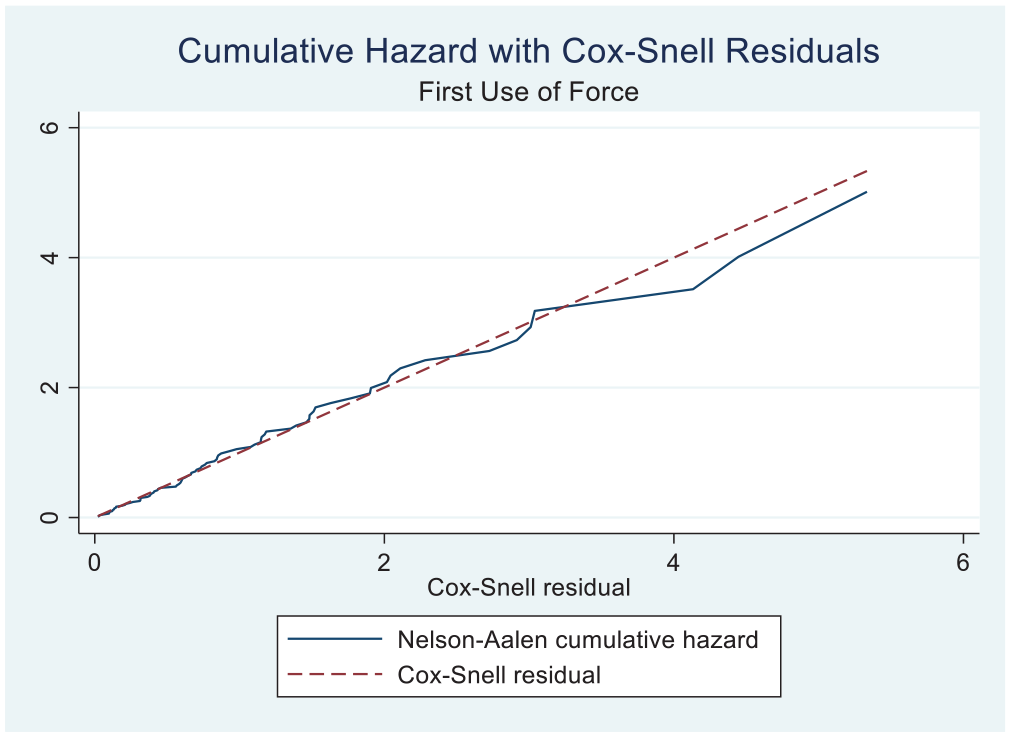
Cumulative hazard with Cox-Snell residuals: first use of force.
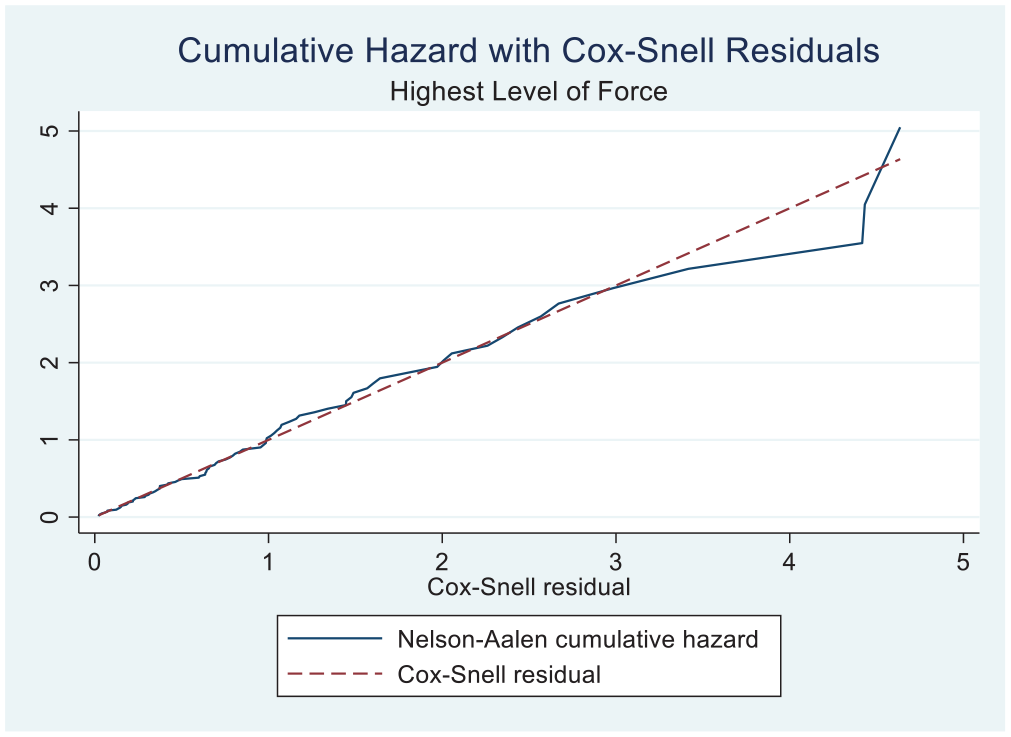
Cumulative hazard with Cox-Snell residuals: highest level of force.
The nonparametric Kaplan-Meier method was used to calculate survival estimates and graph risk over time by notable predictors as identified through the Cox models. Results are presented following the presentation of descriptive statistics.
Results
Descriptive Statistics
Descriptive statistics are presented in Table 1. The median time until the first instance of use of physical force within an event is 1.42 minutes, with the maximum time being around 1 hour and 7 minutes. The median time until use of highest level of force is just over 2 minutes, with the maximum time being nearly 1 hour and 9 minutes. More severe forms of suspect resistance, including significant physical resistance as indicated by subjects fleeing the scene and assaults against officers, are the most common forms of suspect resistance and account for 23% (n = 20) and 40% (n = 35) of the sample, respectively. No resistance and verbal resistance are the least common forms of suspect resistance and account for 8% (n = 7) and 2% (n = 2) of the sample, respectively. In majority of cases (56%), officers were not observed engaging in informational justice as indicated by the officer explaining to suspect why the suspect was being detained; and in majority of cases (64%) officers were not observed engaging in interpersonal justice as indicated by behaving in a verbally antagonistic manner. Most commonly the most severe type of force used in an event is hard-hand control (55%), followed by soft-hand control (32%). Less lethal control as indicated by use of blunt impact or chemical weapon is relatively rare, as is threat of lethal force. Majority of suspects (80%) were not observed to be in possession of a weapon. While racial and ethnic minorities (Black and Hispanic) were grouped together for the purpose of model building due to limited variability of the data, suspects are predominately Black (n = 68; 78%). Approximately 53% of officers are Hispanic (n = 46), 21.98% are white (n = 23), and 26% are Black (n = 18). Again, sex was not included as a control variable in regression models but is presented here for descriptive purposes. Suspects are predominately male (n = 69; 79%) and officers are almost exclusively male (n = 86; 99%).
Descriptive Statistics.
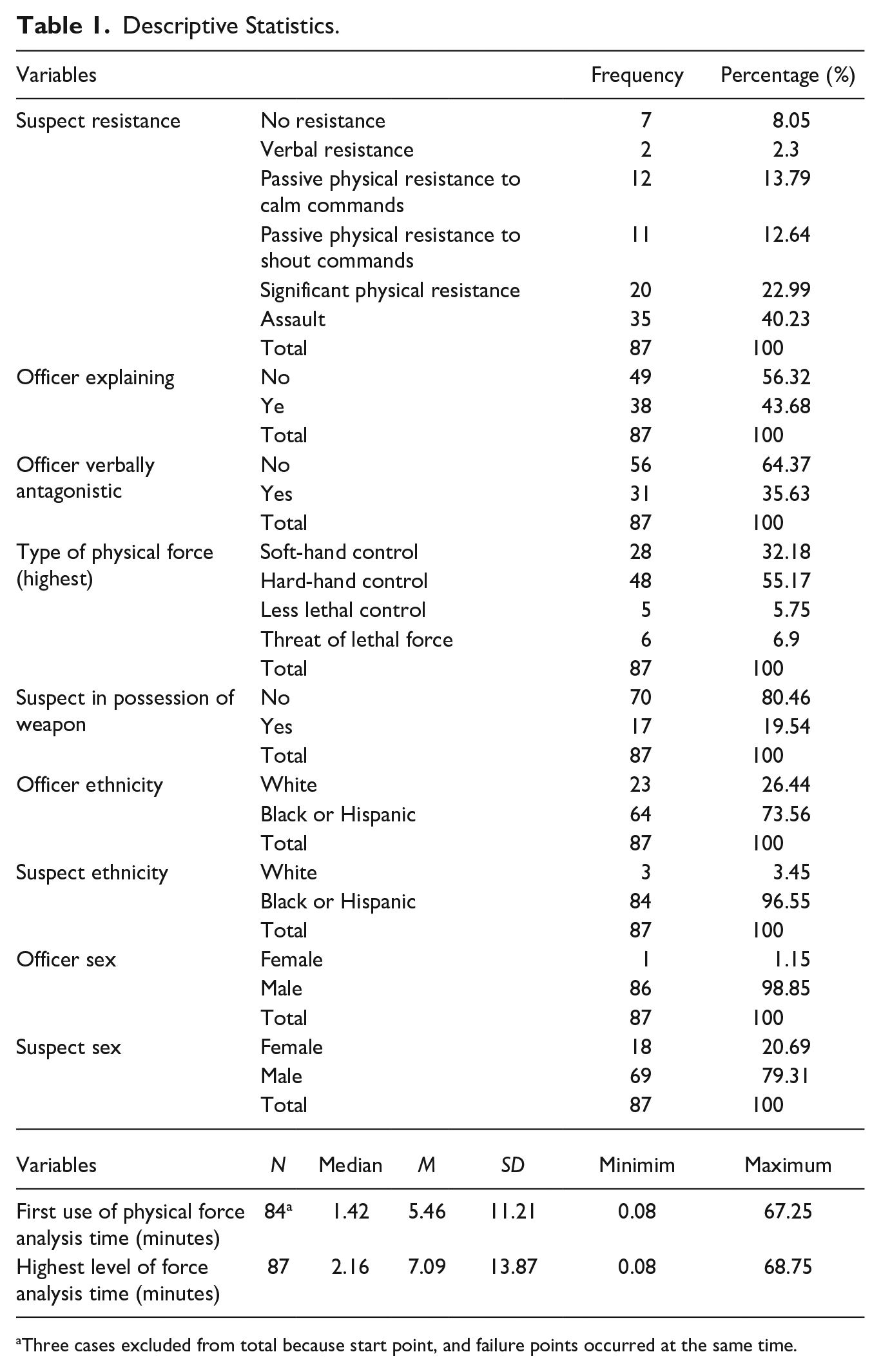
Three cases excluded from total because start point, and failure points occurred at the same time.
Main Findings
First use of physical force
Hazard ratios produced by Cox regression models indicate that when suspect resistance level is the only predictor in the model, resistance decreases the odds of event probability (thus increasing time until the first instance of physical force used in the event)—however, it is not a significant predictor of time until use of physical force (see Table 2, Model 1). As additional predictors are added to the model, suspect resistance remains non-significant. When resistance and indicators of informational (officer explaining) and interpersonal (officer not verbally antagonistic) justice are included in the model (see Table 2, Model 2), informational justice is a significant predictor of time until first instance of use of physical force: officers explaining to subjects why they are being detained decreases the odds of event probability, thus increasing time until physical force is first used. When most severe type of force is used in the event, suspect weapon possession, and officer and suspect ethnicity are added to the model (see Table 2, Model 3), informational justice remains significant. Suspect weapon possession is also significant and increases the odds of event probability; thus, decreasing time until physical force is first used.
Cox Regression: Time Until First Use of Physical Force.
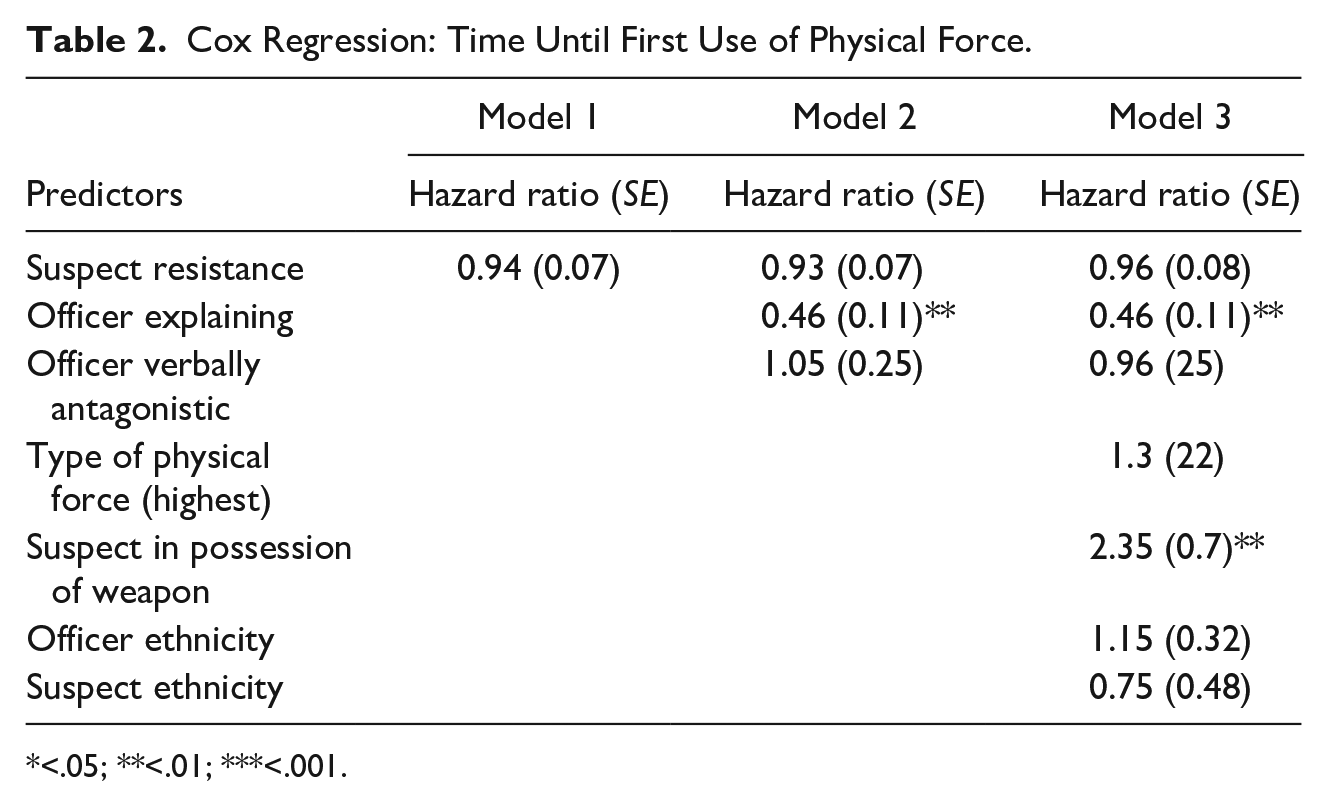
<.05; **<.01; ***<.001.
Kaplan-Meier survival functions were estimated for the indicator of informational justice (officer explaining) and suspect weapon possession by time point for the first instance of physical force in each event (see Figures 3 and 4). Figure 3 indicates that between the 10 and 15-minute point all but one case remained in which officers did not explain to the suspect why the suspect was being detained. In other words, the first incident of physical force occurred in nearly all informationally unjust cases within 15-minutes. In contrast, by the 20-minute mark, use of physical force still had not yet occurred in 4 of the 38 cases (10.5%) in which officers did explain to the suspect why the suspect was being detained. Additionally, in those cases in which the officer explained to the suspect why the suspect was being detained, the median time until first use of physical force is 3.33 minutes, compared to 0.83 minutes for those in which an explanation was not given. The log-rank test for equality of survival function indicates that the survival function differences between the officer explanation groups is significant (p = .001).
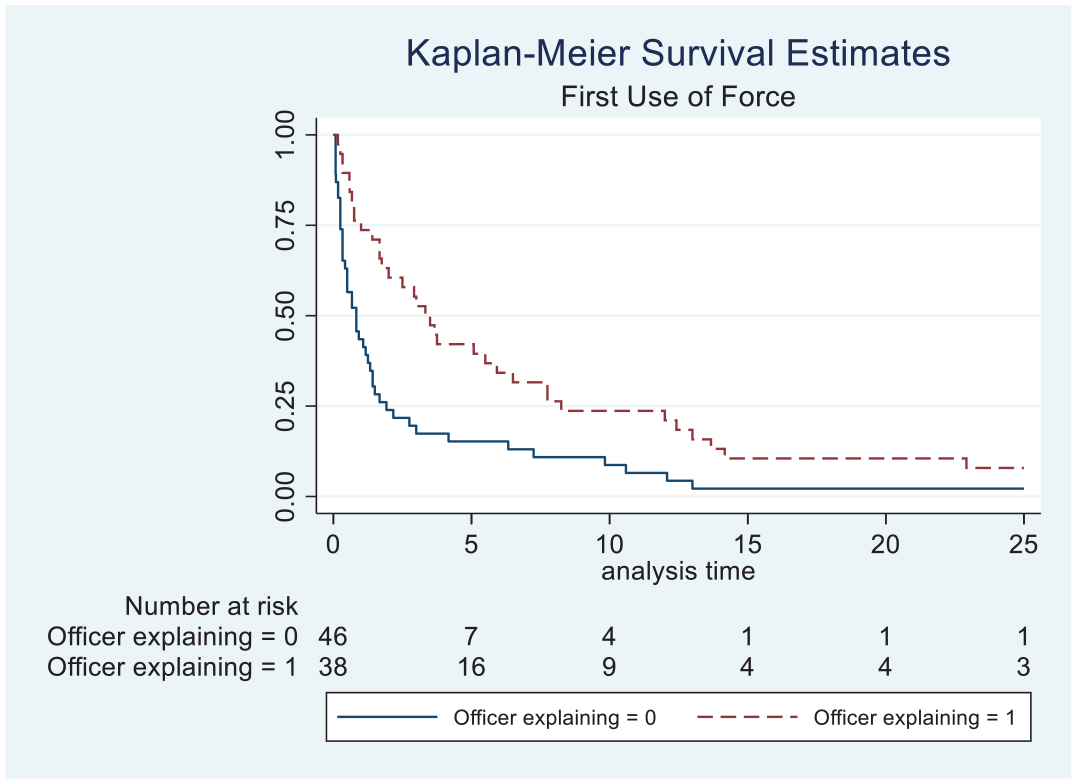
Estimated Kaplan-Meier survival functions: first use of physical force—officer explaining why suspect detained.
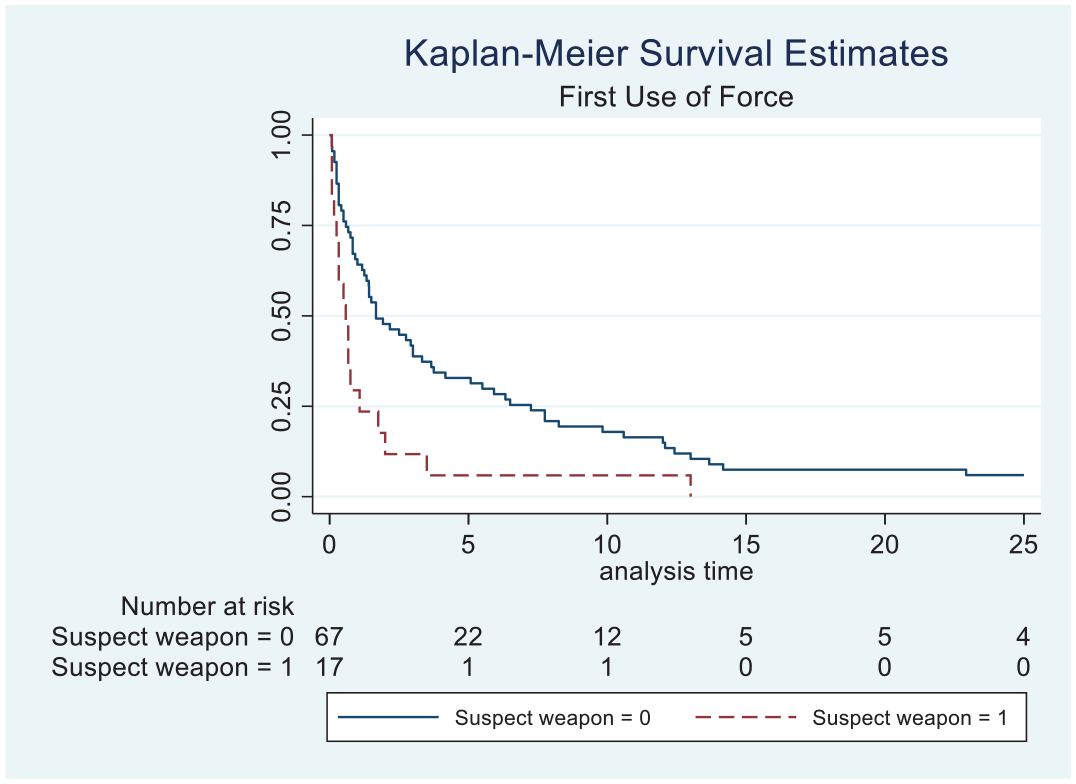
Estimated Kaplan-Meier survival functions: First use of physical force-suspect weapon possession.
Figure 4 indicates that the first incident of physical force occurred before 15-minutes in all cases but one in which the suspect was known to have a weapon; but after 25-minutes, four cases remain in which there is no evidence that the suspect possessed a weapon. The median time until final use of force incident is 1.67 minutes when there is no weapon and 0.58 minutes when there is evidence the suspect is in possession of a weapon. The log-rank test indicates that the survival function differences between the weapon possession groups is significant (p = .002).
Highest level of force
Results for models containing the dependent variable, time until use of highest level of force are nearly identical to those of time until first use of physical force. Again, when suspect resistance level is the only predictor in the model (see Table 3, Model 1), resistance decreases the odds of event probability (thus increasing time until the most severe level of force used in the event), but resistance is not significant in any of the models. As with time until first use of physical force, when informational (officer explaining) and interpersonal (officer not verbally antagonistic) justice are included in the highest level of force model (see Table 3, Model 2), informational justice is a significant predictor of time until use of highest level of force: officers explaining to subjects why they are being detained decreases the odds of event probability, thus increasing time until the most severe level of force of the event is used. When type of physical force, suspect weapon possession, and officer and suspect ethnicity are added to the model (see Table 3, Model 3), informational justice remains significant. Suspect weapon possession is also significant and increases the odds of event probability, decreasing time until the highest level of force is used.
Cox Regression: Time Until Use of Highest Level of Force.
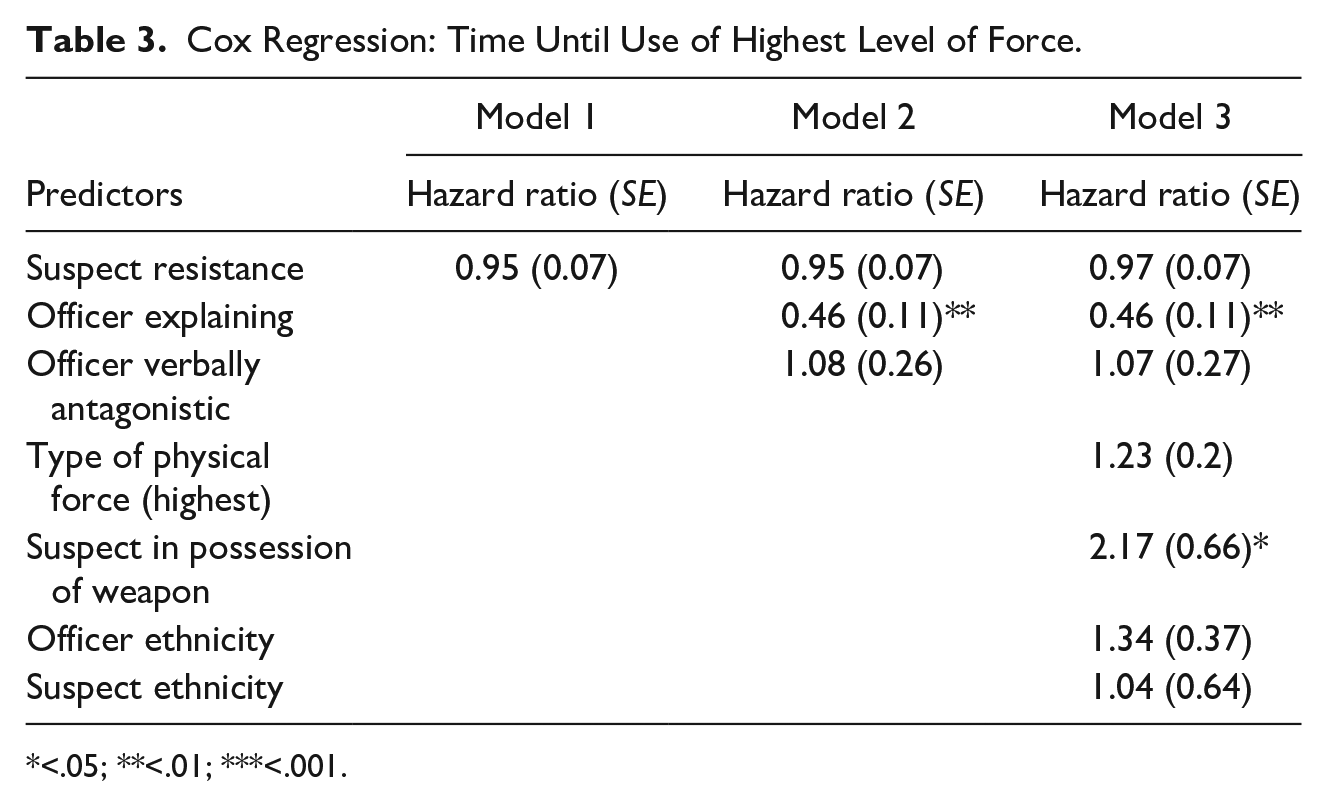
<.05; **<.01; ***<.001.
As with the Cox results, Kaplan-Meier survival function estimates for time until use of highest level of force are very similar to those of time until first use of physical force. Again, survival functions were estimated for the indicator of informational justice (officer explaining) and suspect weapon possession by time point for the highest level of force in each event (see Figures 5 and 6). Figure 5 indicates that the highest level of force of the event occurred in nearly all informationally unjust cases within 15-minutes of officers interacting with any involved parties. In cases considered informationally just, by 20-minutes into the event the highest level of force of the event had not yet occurred in 5 of 38 cases (13%). Additionally, in those cases in which the officer explained to the suspect why the suspect was being detained (informationally just), the median time until the highest level of force was used is 5.5 minutes, compared to 1.5 minutes for those in which an explanation was not given. The log-rank test for equality of survival function indicates that the survival function differences between the officer explanation groups is significant (p = .000).
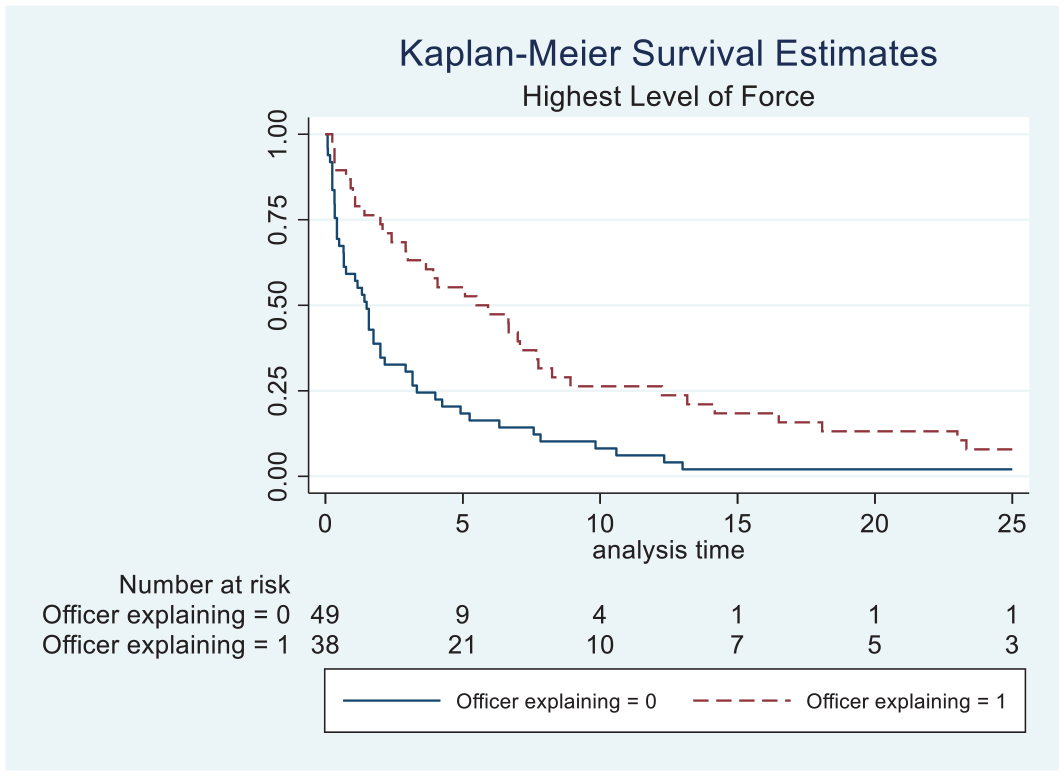
Estimated Kaplan-Meier survival functions: highest level of force—officer explaining why suspect detained.
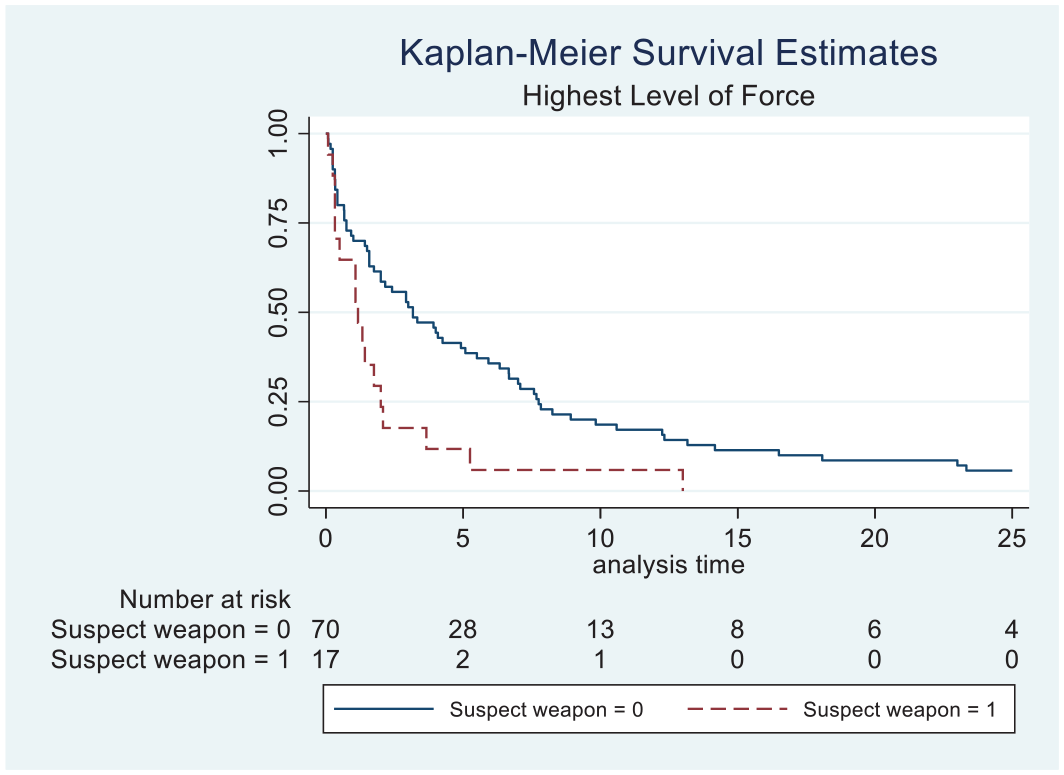
Estimated Kaplan-Meier survival functions: highest level of force—suspect weapon possession.
Figure 6 indicates that the final incident of force occurred before 15-minutes in all cases but one in which the suspect was known to have a weapon, but after 25-minutes four cases remained in which there is no evidence that the suspect possessed a weapon. The median time until highest level of force of the event is 3.17 minutes when there is no weapon and 1.17 minutes when there is evidence the suspect is in possession of a weapon. The log-rank test indicates that the survival function differences between the weapon possession groups is significant (p = .003).
Discussion and Conclusion
Results have important implications for the understanding of police use of physical force. Suspect resistance did not influence how quickly into a police-citizen encounter physical force occurred. This runs somewhat contrary to the overall literature, as suspect resistance has been associated with quicker time to force (Willits & Makin, 2018) and the use of physical force more generally (Bolger, 2015; Klahm & Tillyer, 2010). However, recent scholarship suggests a more nuanced relationship between suspect resistance and various aspects of police use of force. For example, McLean et al. (2022) found that officers commonly consider factors in addition to suspect resistance when determining threat of harm and the necessity to use force. MacDonald et al. (2003) found that police force was greatest in situations involving little suspect resistance. The current study findings reflect this emerging body of literature.
In the current study, incidents in which suspects possessed a weapon experienced physical force much sooner than when weapons were absent. This suggests that discovering a weapon activates system 1 thinking in officers, with cognitive shortcuts causing immediate use of force upon identifying a given stimulus. The finding around weapon possession is also consistent with Sierra-Arévalo’s (2021) findings indicating officers are constantly assuming the potential for violence due to a danger imperative culture and are thus prepared to use force rather immediately. Notably, neither suspect nor officer ethnicity significantly impacted the time to physical force—a noteworthy result given prior research finding system 1 thinking may be activated due to officer bias around such demographic factors (Mears et al., 2017). Police officers explaining the reason for detainment to suspects—a measure of informational justice—significantly increased time to physical force. This supports prior arguments that specific officer tactics may “create time” during confrontational citizen encounters (Stoughton et al., 2020). This added time allows for system 2 thinking during which officers can contemplate alternative responses to the situation. Ideally, potential responses may negate the need for physical force. However, even when physical force is used, system 2 thinking may allow for physical force to be applied in the manner that poses the least amount of harm to both suspects and officers.
At this point we must acknowledge that we are unable to speak to causal aspects of police use of physical force given the lack of a counterfactual. All cases in our sample included the use of physical force by police; we have no measure of suspect or officer actions during encounters where physical force did not occur. Future SSOs of BWC footage should create control conditions to uncover which suspect and officer actions, and officer decision-making processes more generally, distinguish between police-citizen encounters resulting in physical force and those that conclude peacefully. Our analysis was also affected by the limited number of use of physical force events we were able to view and code within our study period. However, the number of incidents we viewed is comparable to the sample size of Willits and Makin (2018; N = 95), whose analysis directly informed the current study. Nonetheless, a larger sample size would have allowed us to include a larger number of suspect and officer actions in our statistical models. Future SSOs of BWC footage should maximize sample size to allow for such analysis (see Terrill & Zimmerman, 2022 for a description of such a project).
Despite these limitations, this study illustrates the benefits SSO of video footage can provide crime research, including research focused on police use of force. Most of the variables included in the current study could not be measured through more traditional sources. While administrative police reports can be coded in a manner that enables the measurement of sequential actions during police citizen encounters (Terrill, 2005; Terrill et al., 2003; Tillyer, 2022), variables such as the precise minutes between incident start and the application of physical force and officer adherence to informational/interpersonal justice can only be measured through observational means. These benefits are enjoyed despite the challenges of working with BWC footage. For example, given their mounting on officer uniforms, BWCs do not reflect officer line-of-sight and cannot track officer body language or facial expressions (Terrill & Zimmerman, 2022). Common aspects of BWC data systems, such as the muting of the first 30 seconds of recorded video, may present additional challenges to data coding efforts (Chillar et al., 2020). Nonetheless, BWC footage allows researchers to record most variables of importance measured during in-person SSOs—and at a greater level of detail (Terrill & Zimmerman, 2022). SSO of BWC footage also allows for a dramatic cost-savings over in-person SSO. For example, Terrill and Zimmerman (2022) report that the Project on Policing Neighborhoods—perhaps the largest and most well-known SSO of police-citizen encounters—cost $1.9 million over 25 years ago, $3.2 in current dollars when inflation is accounted for. BWC footage allows researchers to systematically view and analyze police-citizen encounters at a small fraction of the cost. We encourage social scientist to continue building upon this methodology.
Footnotes
Declaration of Conflicting Interests
The author(s) declared no potential conflicts of interest with respect to the research, authorship, and/or publication of this article.
Funding
The author(s) disclosed receipt of the following financial support for the research, authorship, and/or publication of this article: This research was supported by Charles Koch Foundation, Criminal Justice and Policing Reform Program.
