




Abstract
Trend forecasting is a challenging and important aspect of the fashion industry. The authors design a novel fashion trend analysis system called “Neo-Fashion,” which provides recommendations to fashion researchers and practitioners about potential fashion trends using computer vision and machine learning. Neo-Fashion includes three modules, a data collection and labeling module, an instance segmentation module and a trend analysis module. Diffusion of innovation theory is used as the main theoretical framework to understand fashion trends. 32,702 catwalk images from 2019 fashion week were collected, and 769 images were labeled as training data. Neo-fashion is able to identify and segment fashion items in the given images, and indicate the fashion trends in colors, styles, clothing combinations, and other fashion attributes. To optimize the system, more data sources can be included to not only reflect trends in even more categories but also aid in understanding the trickle-up or trickle-across process in fashion.
From fitting in with the lifestyle of their social group to expressing their individuality, consumers utilize fashion for various reasons, and they are always on the lookout for new and different ways to express themselves aesthetically. Therefore, fashion trends tend to be volatile and time-dependent. Nowadays, the global fashion industry has a long supply chain that includes fashion design, sourcing, manufacturing, marketing, etc. Because of this, it is crucially important to foresee the often swift changes in fashion trends and focus on the right products for success (Bikhchandani et al., 1992). However, it is challenging for fashion practitioners to provide accurate predictions of trends from available data resources and methods.
In the fashion world, trend forecasting is defined as the search for a means to predict the mood, behavior, and buying habits of the consumer by identifying trends (Holland & Jones, 2017). With the advent of computational approaches to consumer trends, fashion forecasting has been an emerging research area in computer vision and machine learning (Choi et al., 2011; Liu, Luo, et al., 2016; Zhao & Sun, 2018). It is possible to translate the creativity and inspiration of fashion practitioners into a data-driven structure, especially for short-term forecasting. Many researchers have attempted to bring in computational models to predict fashion trends. Choi et al. (2011) combined a gray model and neural network model to create a new hybrid model that predicts color trends using journal data. Gray model aims to solve the problems of gray systems, which often face uncertainties with both known and unknown information, while the neural network model imitates the structure of biological neuro network, to “learn” data patterns and make predictions (Choi et al., 2011). Al-Halah et al. (2017) introduced an approach to forecast the popularity of visual styles using a convolutional neural network and data from Amazon fashion products. Convolutional neural network, a subclass of neural network, extracts (“learn”) the relevant patterns of data through the convolution operations, is widely used to analyze and classify visual images (Al-Halah et al., 2017).
But up to this point, most studies related to fashion trend forecasting only focused on the prediction of one aspect of fashion products. None of them provide a systematic way to holistically forecast broader fashion trends, including colors, styles, silhouettes and unique attributes. Researchers have utilized various data sources to foresee the trends. Both text and visual data on social media, fashion magazines, e-commerce websites have been used by previous studies. For example, Park et al. (2016) successfully predicted the most popular fashion models from social media posts and comments. However, very limited research has focused specifically on catwalk analysis, the pattern analysis of fashion images captured from the high-end runway shows (Zhao & Min, 2019). Grounded in theories of fashion innovation, new fashion ideas usually start on designer runways. Catwalk images convey the latest design ideas and trends and provide fashion designers and buyers with valuable information.
With the success of deep learning algorithms in computer vision over recent years, especially in image classification (Chen et al., 2017; He et al., 2016) and object detection (Liu, Anguelov, et al., 2016; Redmon & Farhadi, 2017), we were able to devise a data-driven artificial intelligence (AI) system using machine learning to analyze complex images. With this in mind, our study aims to build a data-driven trend forecasting system to predict seasonal trends based on catwalk analysis. Specifically, with large-scale catwalk data, our study (1) classifies catwalk images, recognizes fashion items from the given images and validates the accuracy of the recognition; (2) reveals three key components in trend forecasting including dominant colors, popular styles, and clothing combinations; (3) explores design details in terms of fabric, pattern, print, silhouette, etc.; and (4) provides quantitative evidences and supports for fashion brands and companies to forecast seasonal trends.
Literature Review
Fashion Trend Forecasting and Catwalk Analysis
A trend is defined as “a pattern or direction of change: a way of behaving or dressing that is developing or becoming more visible” (Holland & Jones, 2017, p. 50). A trend could be a popular item, a way of dressing or styling, or color combinations that are popular at a given time. Trend forecasting is gleaning what will inspire designers and other key influencers; and determining how these inspirations will then be turned into products that appears in stores and in consumers’ wardrobes. Trend forecasters mainly contribute at the beginning of the creative process. Based on trend forecasting research, fashion designers, producers, and buyers are able to predict what is likely to be “in fashion,” then create the product (Jackson, 2007). In addition, short-term and long-term forecasting are commonly mentioned when companies predict fashion trends. While long-term forecasting creates a shared vision for a brand or company’s development, short-term forecasting involves color forecasting, textile development, and style development throughout the whole product life cycle (Keiser et al., 2017).
Most trend forecasting services today focus on short-term forecasting, with trend forecasters usually working 1–2 years ahead of the season for most fashion collections (Kim et al., 2013). With the development of digital technology, especially the emergence of social media, some fashion-forward brands move quickly from the catwalk to the stores to meet the new trends within just a few months or even a few weeks (Stein, 2019). Trend forecasters use their knowledge of fashion design and their understanding of fashion history to conduct in-depth research and identify past and future trends. A variety of information sources are involved in trend forecasting research. From catwalk shows, popular culture, street style, retail data, art, and lifestyle, to digital culture and technology, trend forecasters look for ideas and inspiration to find out what is new and next (Keiser et al., 2017). The catwalk remains a crucial part of fashion delivery, and seasonal catwalk shows always play an important role in providing information on which designs are resonating most with the press and buyers. At the same time, catwalk reports and analysis are the most valuable trend services used by many trend agencies in the early inspiration stage (Holland & Jones, 2017).
Theoretical framework
Some studies have applied different theories to explain why and how trends spread. In this study, Rogers’ diffusion of innovation (DOI) theory is used as the main theoretical framework to understand the phenomenon of trend forecasting. Diffusion of innovation theory originated in the communication field to explain how, over time, an idea or product gains momentum and diffuses (or spreads) through a specific population or social system (Rogers, 2010). The end result of this diffusion is that people, as part of a social system, adopt a new idea, behavior, or product. DOI helps us understand the progression of a trend, which typically starts with a small group of innovators, who then spread the idea to early adopters. The latter form the gateway to the early majority, who bring a trend to its peak before it is taken on by the late majority, and eventually the few stragglers who have not yet tried it. Then the trend is replaced by a new one. This is consistent with the product life cycle in the fashion industry, so for successful trend forecasting, it has to be spotted at the innovator or early-adopter stage. It allows enough leeway to analyze and develop for the interest of mass-market. Hence, catwalk analysis serves as a valuable information source for trend forecasters because high-end brands, top designers and celebrities are key influencers. They are usually the innovators and early adopters who kick-start a trend.
In addition, trickle-down theory is used as a supplemental theory to further understand the impact of catwalk analysis on trend forecasting. The trickle-down theory has long been identified as a central principle behind the historical study of fashion and its sociological implications (King, 1963). According to this theory, style in the top strata of society is gradually spread to subordinate groups. Thus, fashion flows vertically downward from the upper classes to the lower classes within society, and each social class is influenced by a higher social class. Two conflicting principles drive this diffusion dynamic. Lesser social groups seek to establish new status claims by adopting the fashions of higher social groups in imitation, while higher social groups then respond by adopting new fashions to differentiate themselves. This provokes an endless cycle of change, driving fashion-forward in a continual process of innovation. As most runway shows are presented by top fashion brands and introduced by “elite” consumers, lower social level consumers then copy these glamorous and aspirational looks with cheaper versions of trends. In the months between when a garment is on the runway and when it appears in stores, “fast-fashion” purveyors create knock-offs. Although today’s fashion ideas also follow trickle-across and trickle-up processes (for example, street fashions are often reinterpreted by designers and mass market), catwalk trends remain the most compelling and powerful tool in the forecasting system (Holland & Jones, 2017).
The life cycle of a fashion trend can vary, but successful examples last at least one season. Seasonal trends are often catwalk-inspired trends that manifest as key items, colors, silhouettes or ways of styling an outfit. They become the dominating looks during the season, but they drift out of favor after 6–12 months as consumers move on the next trend. According to DOI, the catwalk images from fashion garment shows provide previous and up-to-date design ideas and inspirations. As new ideas gain visibility, they are reinterpreted at lower price points (Bikhchandani et al., 1992). From color specialists, materials and textile specialists, print and surface specialists, product designers, and retail and marketing specialists, catwalk analysis is utilized across the supply chain for fashion trend forecasting.
Even though accurate trend prediction is a critical problem in the fashion industry because it is often arbitrary and hard to quantify, annual runway shows still provide a useful index for evaluating potential fashion trends. Researchers have studied the contributions made by catwalk models in the construction of ethnic and national identities (Soley-Beltran, 2015). Supermodels in catwalk shows reveal the current ideal “model identity” and thus impact the trend of body aesthetics. Designers also indicate the importance of catwalk design on fashion trends, since runway couture shows often feature showpieces that are intended to provide inspiration to fashion companies and consumers (Ames, 2008). However, many trends forecasters still rely on gut feelings and intuition to interpret information from different sources, including catwalk data (Holland & Jones, 2017). With the large number of catwalk images available online, we believe a quantifiable trend forecasting tool using a computer-assisted method can be developed to provide trend forecasters and designers a strong research tool.
Fashion Trend Forecasting in the Digital Age
In the past few years, fashion trend forecasting has received increasing attention within computer vision, machine learning, data mining and multimedia communities. Most studies related to trend forecasting utilize social media or google search to identify and predict trends in the fashion industry. For example, one previous study looked at posts and tags of the top-twenty fashion brands on Twitter and Instagram to reveal diversification of trends after linguistic and visual clustering analysis (Manikonda et al., 2015). Gabale and Subramanian (2018) identified Indian social media trends using an improved object detector model, which was pre-trained on unlabeled images from Facebook and Instagram in an unsupervised manner and then trained on Open Images V4 dataset. In addition, Checco et al. (2017) envisioned a fashion trend forecast system fed by images from Instagram’s well-known fashion bloggers. After processing data by combining image analysis algorithms with human crowdsourcing, the system was able to predict trends using times series analysis. Researchers also detected fashion trends and seasonal cycles by modeling clients’ reactions on websites to changes in style units over time (Sanchis-Ojeda et al., 2016). Queries related to the apparel category in Google search have also been used to identify fashion trends by time series clustering (Silva et al., 2019).
Trends in fashion are reflected through a variety of design elements, including color, style, silhouette, etc. However, most studies only focus on the prediction of one or two aspects of trends. Choi et al. (2011) built mathematical models to predict color trends. With the help of an object detection model, Gabale and Subramanian (2018) predicted the potential popular color and styles in India. Getman et al. (2020) visualized the patterns of baseball caps and tracked the trend frequency from 2000 to 2018. For fashion practitioners, it is more crucial, although more difficult, to predict the trending colors for each individual fashion item (e.g., color trends for shirts versus color trends for jean), rather than only predicting the overall trending color for an upcoming cycle. However, there has been little research up to this point that provides a systematic pipeline for efficiently extracting specific attributes and holistically predicting trends through given images.
Another fascinating research stream is related to popular image processing and classification technologies, although most studies in this area aim to classify and categorize fashion items, not necessarily to predict fashion trends. These methods have opened the door for summarizing key design elements. For example, one previous study used a supervised deep convolutional model to discover a “vocabulary” of latent styles using non-negative matrix factorization. Then a forecasting model was trained to represent trends in the latent styles over time and to predict their popularity in the future. Even though this work mainly focused on long-term forecasting, it provides a holistic view of the life cycle of visual styles in fashion (Al-Halah et al., 2017). Other researchers have presented novel approaches to recognize the category, sub-category and attributes of fashion images, from the high-end fashion website Farfetch through an end-to-end architecture by embedding the hierarchical nature of the annotations directly into the model (Ferreira et al., 2018). This new method identifies visual information in fashion images thoroughly, thus potentially helping in trend forecasting. Despite the importance of rich catwalk data, none of the previous studies or systems have focused on forecasting seasonal trends via catwalk analysis. A systematic tool is needed to categorize and analyze such images by following fashion forecasting principles.
Analyzing Catwalk Images With Computational Approaches
To analyze catwalk images, it is crucial to recognize and retrieve clothing items from the given images first. Since most of the original images have complex backgrounds and the clothing is worn by fashion models, it is challenging to distinguish clothing items from other objects in an image. This process is quite time-consuming and sometimes subjective if done manually. Therefore, computer-assisted image segmentation is brought into this type of research as an important data pre-processing step. Image segmentation is a process of partitioning a digital image into multi segments, typically used to locate objects and boundaries. Recently, with the development of deep learning in object detection, deep learning object detectors, such as Single Short Detector (SSD) (Liu, Anguelo et al., 2016), “You Only Look Once” object detector (YOLO) (Redmon & Farhadi, 2017) and Region Convolutional Neural Network (RCNN) (Sun et al., 2018), have been widely used in multiple domains. The quantity of labeled images for classification are much more than that of object-detection images. Therefore, YOLO uses a hierarchical view of object classification to utilize the classification dataset to detect objects (Redmon & Farhadi, 2017). SSD, a single-shot detector, detects objects in images by predicting bounding box offsets for a fixed set of bounding boxes (Liu, Anguelo, et al., 2016). The algorithm in RCNN attempts to selectively search the region proposals, and predicts the presence of an object within a region proposal, which usually is a bounding box (Sun et al., 2018). All these models have fast and accurate performance in object-detection tasks. However, to generate a more robust system for fashion trend forecasting, a general object detector may not be a promising solution since most of them only provide a bounding box of each object and it may keep the complexity of background within each bounding box. To solve this problem, Mask Region Convolutional Neural Network (Mask RCNN) (He et al., 2017) was developed by computer researchers to not only mark out object regions with bounding boxes but also extract object regions from the background at the pixel level. Yu et al. (2019) have proposed a strawberry fruit detection algorithm based on Mask RCNN, and the result has overcome the difficulties of poor universality and robustness. Vuola et al. (2019) have utilized Mask RCNN in nuclei segmentation tasks and found promising future application of this algorithm in the biomedical domain. The above research demonstrated that Mask RCNN showed a preferable performance for target detection in various unstructured scenes and areas. However, to the best of our knowledge, this cutting-edge image segmentation method has not been used in fashion image processing yet. This approach is very useful to analyze catwalk data and precisely recognize fashion items in a given image.
Trends in fashion are reflected through design elements. That is, trends have to be broken down to color, texture, fabric, silhouette, etc. For catwalk images, once clothing items are recognized and categorized, some key fashion elements can be extracted from these items. In this study, colors, styles, clothing combinations, and key attributes were analyzed and interpreted.
Method
To achieve our research goal, we propose an automatic data-driven AI system called Neo-Fashion to summarize and analyze catwalk images, and provide assistance to fashion trend forecasting. As shown in Figure 1, the Neo-Fashion system has three modules: data collection, instance segmentation, and fashion trend analysis.
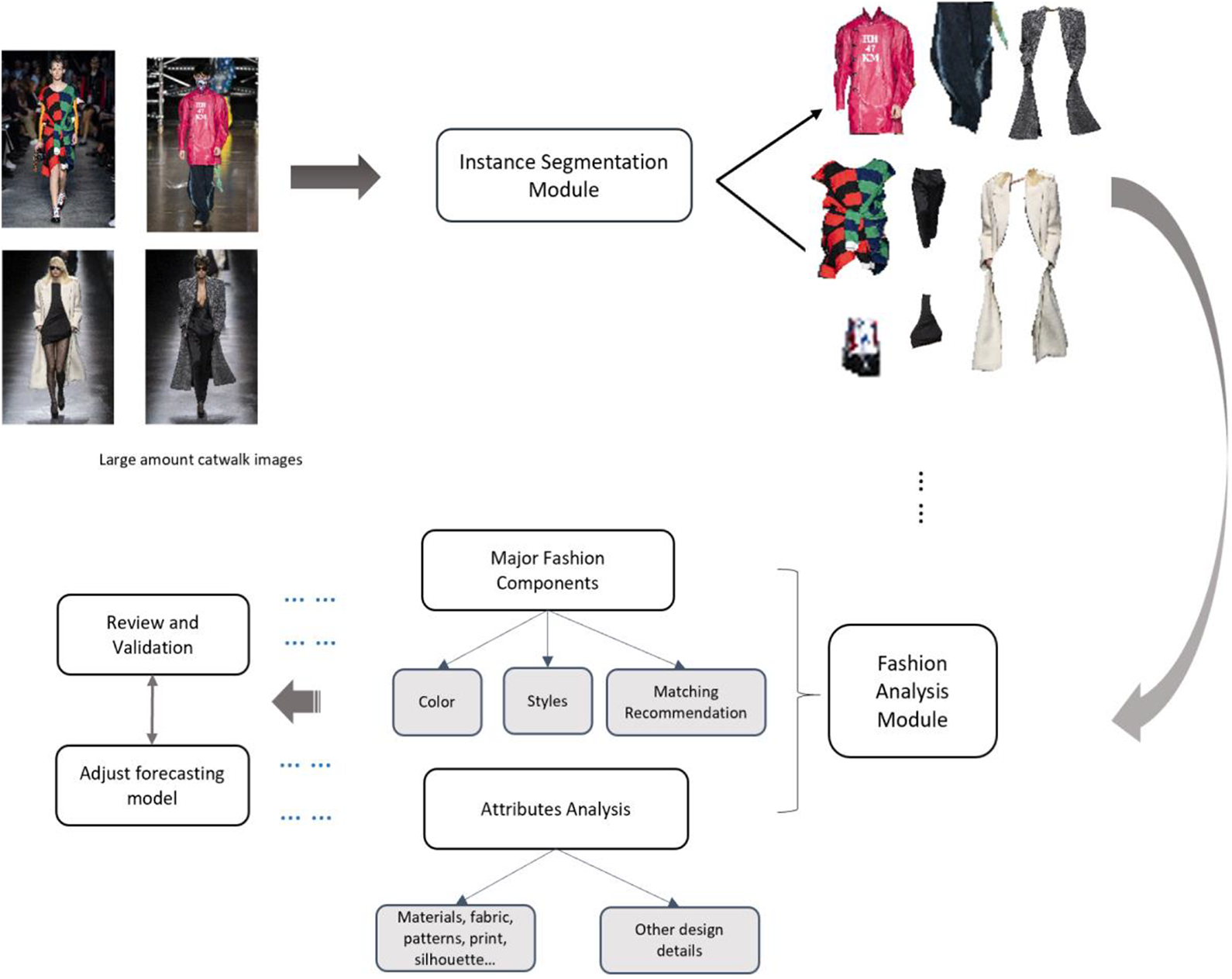
The schema of Neo-Fashion system.
Module 1: Data Collection and Labeling Process
In this study, we mainly focus on analyzing catwalk images from 2019 collections across various famous brands in big four fashion capitals. Generally, fashion companies will show their collections for next year in fashion weeks. In total, 32,702 catwalk images were gathered from the WGSN database in 2018 to predict trends in 2019. To better forecast the seasonal trends, we separated all the images into four groups based on their corresponding seasons, including spring-summer, autumn-winter, pre-summer and pre-fall.
The first step is to recognize fashion items in catwalk images. Most original catwalk images feature the fashion models walking on the runway with images in the background blurred, including the audience and other models. Each image usually contains more than one fashion item. For example, one outfit may have a coat, a sweater, a skirt, a pair of boots and other accessories. Therefore, without any data preparation process, it is impossible to implement further analysis. In this light, Neo-Fashion system first develops a module to automatically segment fashion items from the original images. To achieve this goal, a sample dataset was prepared with 2,000 random selected images from the 2019 autumn/winter collection, to be labeled. All of the labeled data would be split into training data and validation data. For machine-learning projects, algorithms learn to find patterns from the input data. The input is referred to as training data. Once algorithms have learnt the underlying patterns of the training data and build the model, it needs to be validated on the validation data. In our case, if the model performs well on the validation data, the Neo-Fashion segmentation module could be considered as a machine-learning model that can segment fashion items from the whole dataset (32,702 catwalk images) and could be generalized to a much larger dataset.
Fashion major students who are knowledgeable about fashion styles were recruited for the labeling process to prepare the training dataset. LabelMe (Torralba et al., 2010), an open annotation tool, was used to assist labeling process. A detailed instruction and short training were provided to students who participated in the labeling process. For each given image, students were asked to outline each fashion item, and label the category and corresponding attributes of that fashion item, including color, texture, shape, and type. In total, out of 2,000 random selected images, 769 labeled images with accepted quality in 23 categories were returned to our server. These categories included: sneakers, leggings, shoes, vests, boots, skirts, belts, blouses, bags, cardigans, shirts, dresses, pants, hats, heels, accessories, trench coats, shorts, blazers, jumpsuits, coats, and jackets. Figure 2 shows the number of images for each season and indicates how students use LabelMe to complete labeling process.
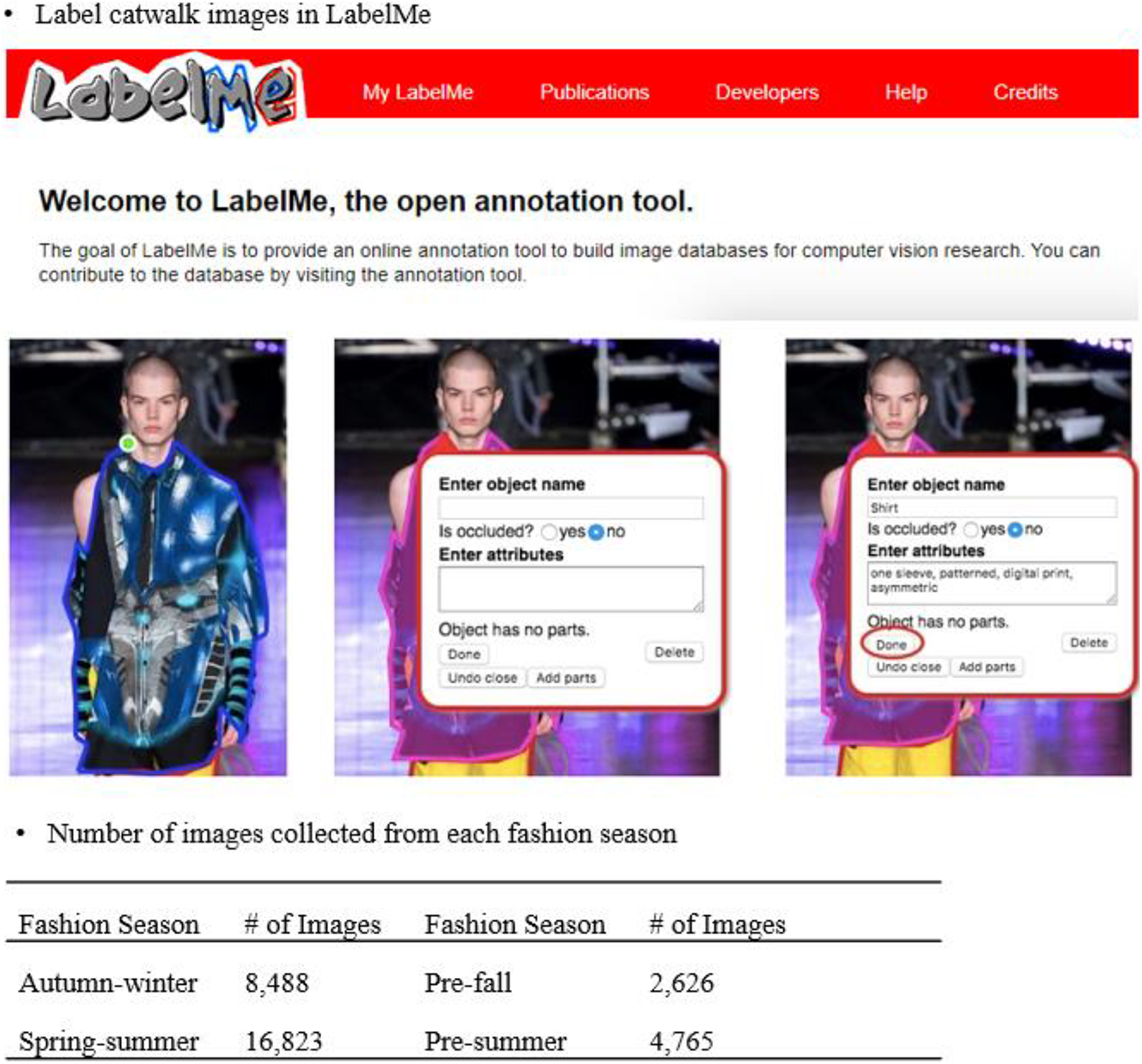
Data preparation stage.
Module 2: Instance Segmentation
For the Neo-Fashion system, we use RCNN, a state-of-the-art object detection algorithm in computer vision to detect the clothes on the model for further analysis. RCNN is a deep neural network aimed at solving instance segmentation problems. There are two stages of Mask RCNN. First, it generates proposals about the regions where there might be an object in the given image. Second, it predicts the class of the object, refines the bounding box, and segments the object (Vuola et al., 2019). Therefore, there are three types of output in Mask RCNN, namely, the bounding box, segment, and category of each fashion item in each image.
To apply this algorithm, first, we needed labeled training data to build the model and labeled validation data to prove the accuracy of the model. In Neo-Fashion system, out of 769 human-labeled catwalk images, 669 were used to train the Mask RCNN model and the rest 100 images were used for the validation of the robustness of model. The architecture of the network remains the same as the original Mask RCNN from (He et al., 2017). To generate segmentations more accurately, we doubled the weight of mask loss in the loss function of network. Meanwhile, some hyper-parameters were also adjusted. Optimizer was modified to Adam optimizer with 0.001 as initial learning rate. Anchors sizes were set smaller than original ones to catch small objects, such as shoes and heels. Other hyper-parameters were kept the same (He et al., 2017).
The computer scanned each training images, differentiated the outlined fashion items and the remaining background region, and “learned” the patterns of training images through the Mask RCNN algorithm. The patterns were then stored in the Mask RCNN model for our Neo-fashion system. Next, 100 validation images were tested to demonstrate the accuracy of the segmentation process of our system. Finally, 32,702 catwalk images were input into the Neo-Fashion system to acquire the segment, classification and bounding box of each fashion item, which was then utilized in the next analysis module. Figure 3 shows a sample result of Instance Segmentation Module. In the images of the generated bounding box part, the red dotted rectangles frame each fashion items, including coats, pants and dresses. The segments from two images consist of various categories of fashion items, such as dresses, shoes, coat, etc.
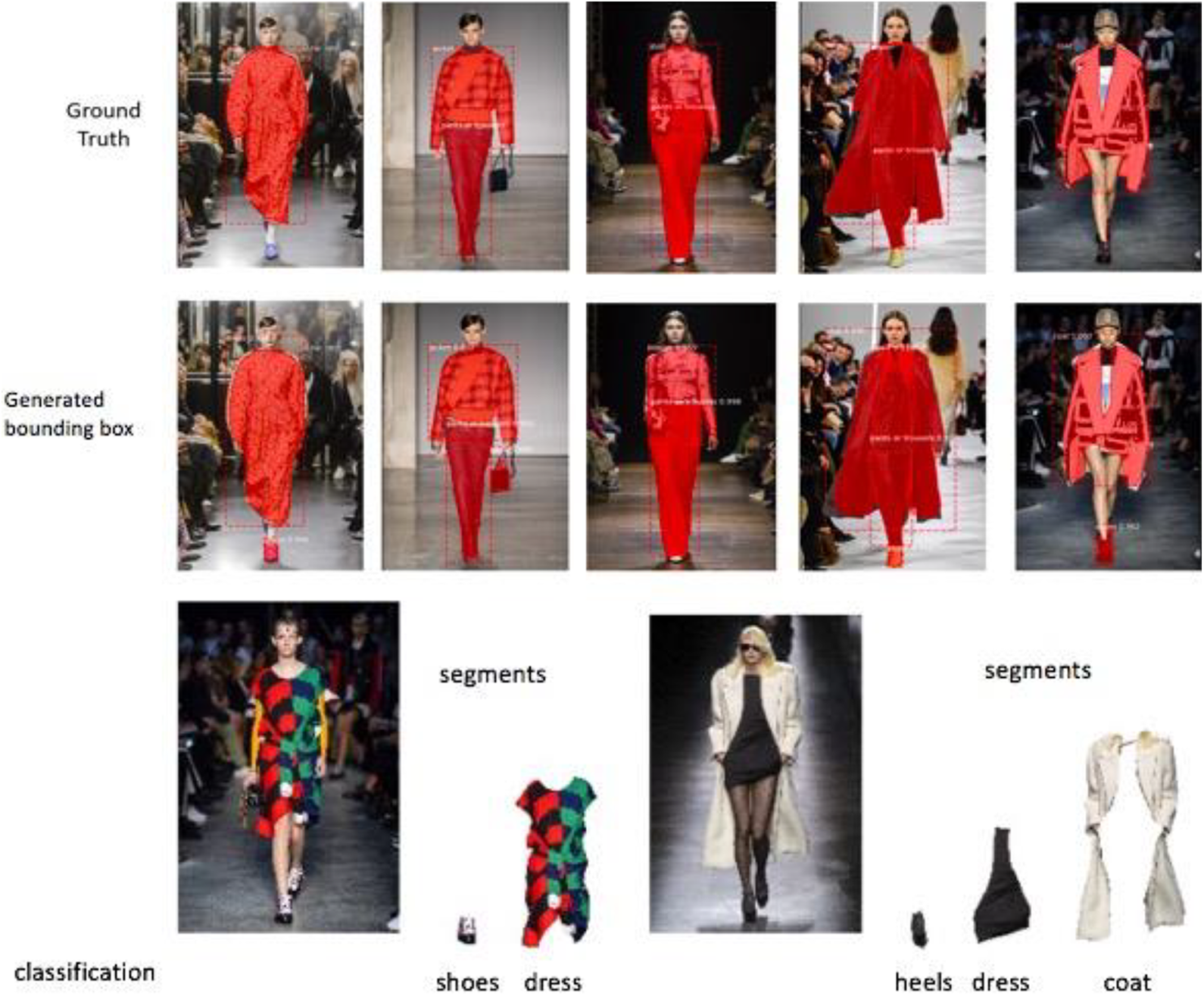
A sample result of segmentation module.
Module 3: Fashion Trend Analysis and Forecasting
In the trend analysis module, two submodules are included. One is to forecast fashion trends based on 32,702 catwalk images, while the other is to analyze attributes of recognized fashion items based on 769 human-labeled images. As aforementioned, Neo-Fashion mainly focuses on three crucial aspects of fashion trend forecasting based on design principles, including color, style, and clothing combination.
For color forecasting, Neo-Fashion identifies the most prevalent color of each category and then decides the most trending color for each product category in a given season. Unlike traditional trend forecasters who mainly rely on their experiences and intuitions to analyze color trends, Neo-Fashion system helps reduce research time and bias through computer assisted analysis. To recognize the dominant color in each product category, a K-means clustering algorithm was applied to summarize the top colors across all images provided in 2019 collections. K-means clustering is a popular cluster analysis tool in data mining. In our research, each image consists of a large number of pixels, and each pixel has a color. We first choose a product category, then input the segments of fashion items in this category into our system. The K-means clustering algorithm then partitions all pixel colors of these segments into K clusters, in which each pixel color belongs to the cluster with the nearest means. The mean of each cluster serves as a prototype of the whole cluster (Klimenko, 2018). Through this way, the 10 most popular colors for each category of fashion items were identified.
Style and cloth combination are the other two major functions provided in Neo-Fashion system. To predict the potential popular styles for each season, we calculated the occurrence frequency of each category, based on the category classification result of 32,072 catwalk images from Instance Segmentation module. Given the input catwalk image, instance segmentation module using Mask RCNN outputs styles included in this image. Then the automatic summarization of frequency for each style is generated. In addition, with styles demonstrated in each image, if two or three fashion categories appear simultaneously with a higher frequency across the whole season, we consider it as a popular clothing combination in that season. To calculate the clothing combination, the tabulate data were prepared and generated by season. Then the co-occurrence frequency of the categories in dataset across all images in each season were calculated and sorted in the prepared tabulate data. The top clothing combinations then can be generated for each season. In the Neo-Fashion system, the dominant clothing combinations for each fashion season can be demonstrated to fashion researchers.
Even though Neo-Fashion aimed at three major domains to forecast fashion trends, at this stage of the study, it did not yet fully capture all aspects of fashion trends. Materials, patterns, prints, structures, textures, and other details still needed to be investigated. Therefore, fashion students were asked to label key attributes for fashion items as well during the data preparation stage. Because of the exploratory nature of this study, we only used selected catwalk images to demonstrate the potential application of analyzing attributes of fashion items in trend forecasting. To provide more accurate and understandable recommendation to researchers, the Neo-Fashion system generated word clouds of image attributes for each category of fashion item based on 769 labeled images. In a word cloud, the larger and bolder the word appears, the more it is mentioned in the dataset and the more important it is. Therefore, the attribute word clouds provide an intuitive way to visualize the trending attributes of each fashion category.
Results and Discussion
To evaluate the instance segmentation module of Neo-Fashion system, mean Average Precision (mAP) between ground truth and segments is calculated. The mAP of validation dataset is 32.27, similar performance compared with previous Mask RCNN research (Vuola et al., 2019). Figure 3 shows some examples of bounding boxes, segments, and classifications. Compared with ground truth, our result is quite accurate on each sample fashion item. In addition, our model is able to identify and segment all the fashion items in catwalk images, even those not labeled by human coders. The main potential error might come from misclassification, because some of these clothes in catwalk images are unusual compared with common everyday clothes and sometimes the boundaries between different clothes in one image are not obvious. However, our overall results with Neo-fashion system are quite acceptable despite the complexity of the catwalk image dataset.
The goal of the Neo-Fashion system is to give recommendations to fashion researchers and professionals about potential fashion trends for the coming season or year using catwalk images. In our fashion trend analysis module, the trend forecasting of color, style, and clothing combination was provided via the Neo-Fashion system. Figure 4 shows the top 10 major colors in each category for each fashion season based on the trend analysis and forecasting results. The major colors in spring-summer and pre-summer are much brighter and lighter than those in pre-fall and autumn-winter. Designers prefer to use black and darker colors in winter, which is not surprising. For example, the trending colors for dresses was found to be bright blue in spring and summer, while in autumn and winter the trending color changes to dark blue. In addition, the variation of colors in spring-summer is wider than in autumn-winter. For instance, coats and dresses were both trending toward bright colors. Light colors and dark colors were shown to be trending in spring-summer, while in autumn-winter the trending colors only focus on dark tones. Blue and brown are relatively widely used in various fashion items. However, other color hues were also shown being adopted for particular fashion items. For instance, light yellow was used often for jumpsuits in pre-fall and grass green was used for sweaters in pre-summer.
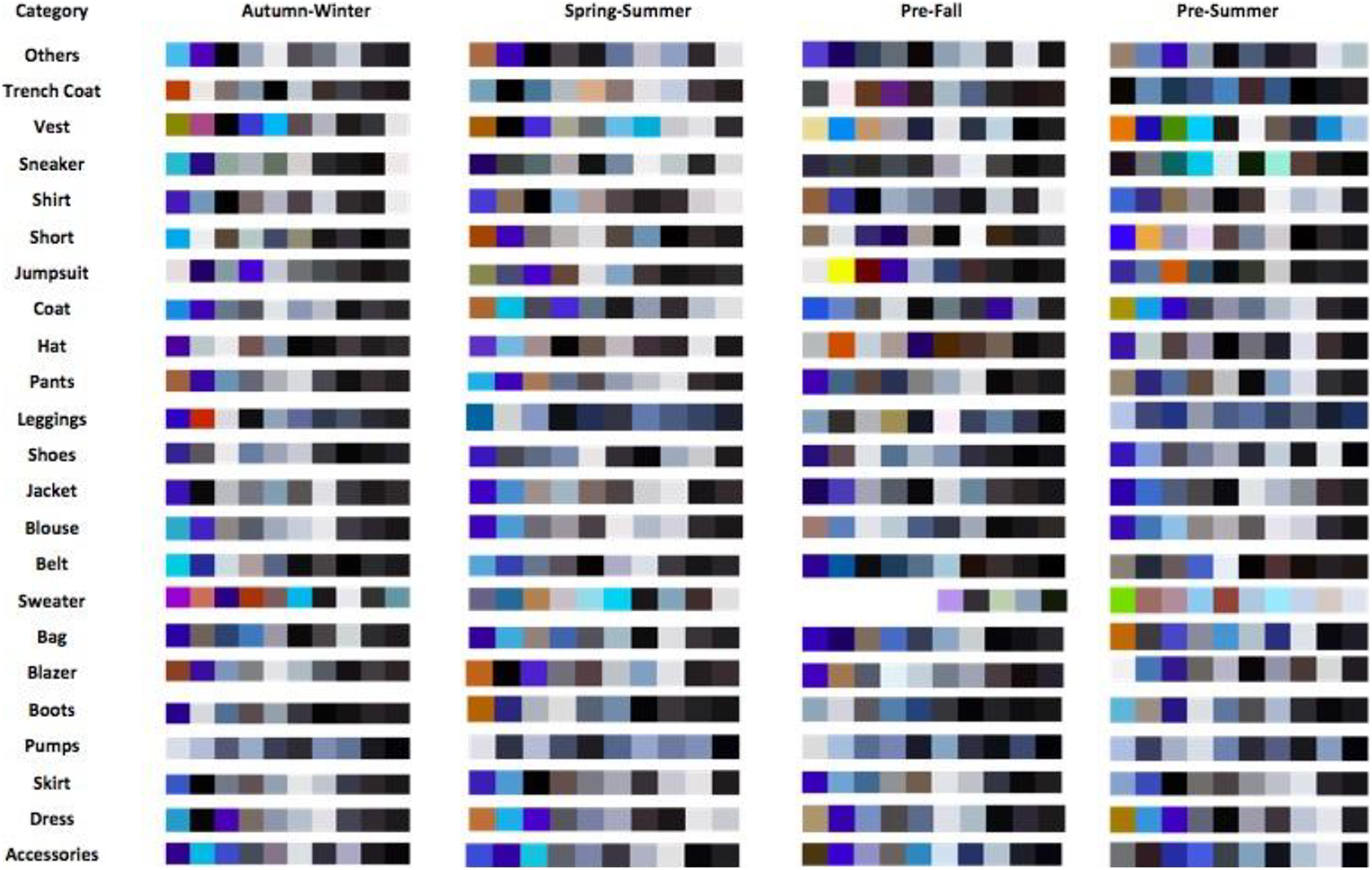
Results of color trend forecasting in fashion analysis module.
In terms of style trend forecasting, the frequency of each category in each season’s fashion week is provided in the Neo-Fashion system, as shown in Table 1. For example, there were 93 trench coats presented by top fashion brands for 2019 autumn-winter collections, 50 in Spring-summer, only 15 and 16 in Pre-fall and Pre-summer, respectively. The table indicates that the most popular styles in 2019 may be dresses, skirts, and pumps in spring-summer, while dresses, boots, and jackets are popular in autumn-winter. In addition, the relative ratio for each category varies for different seasons. For example, considering that the number of images in spring-summer is much more than autumn-winter, even though the frequency of coats in spring-summer is similar to autumn-winter, the relative ratio would be quite different. Coats should be more popular in autumn-winter than in spring-summer.
Results of Style Trend Forecasting.
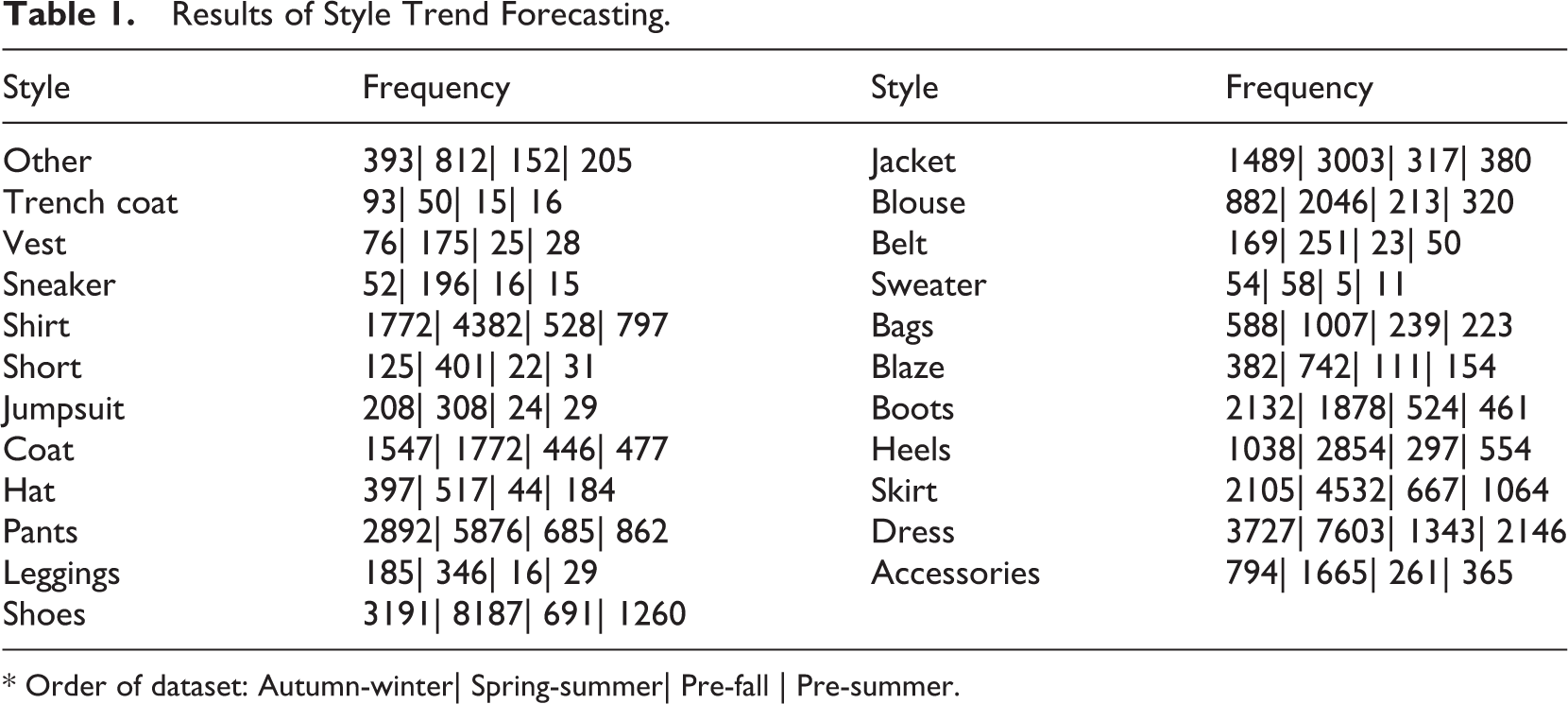
* Order of dataset: Autumn-winter| Spring-summer| Pre-fall | Pre-summer.
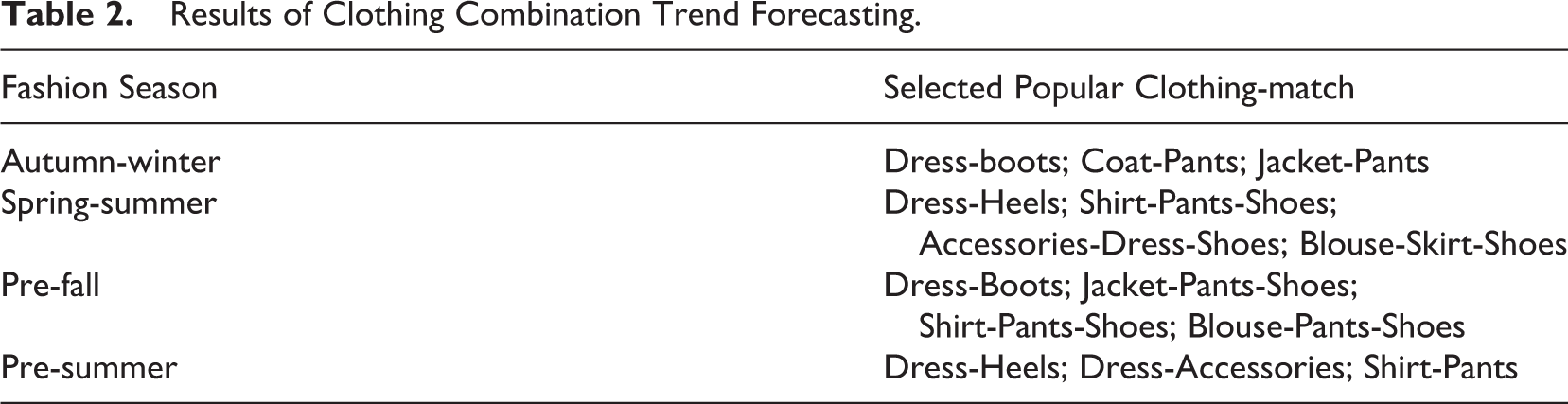
When we analyze the result of clothing combinations data in Table 2, the recommendation for 2019 provided by our system is dress-heels and blouse-skirt-shoes in spring-summer and dress-boots and coat-pants in autumn-winter. In spring and summer, designers focus more on shirt-pants combination, and in winter it changes from shirts to jackets. This result seems to remain consistent with common sense that people wear boots and jackets in cold weather, while they wear heels and shirts in summer. However, if connected with the results of trending colors and styles, fashion designers would have a more intuitive and holistic picture about the clothing, style, and popular coordinates for each season.
Results of Clothing Combination Trend Forecasting.
Another submodule of fashion trend discovery is to use word clouds to analyze various fashion attributes. According to the attributes cloud in Figure 5, we were able to conclude potential attributes related to colors, silhouettes, materials, prints, patterns, and other key details of fashion items in catwalk images based on product categories. In general, dominant colors were consistent with the analysis done by Neo-Fashion across different product categories. Some interesting findings were shown in the clouds. For coat and jackets, puff, belted, and oversized are seen as key trending styles in AW19. Leather, fur, and printed coats may also be big trends. For pants and shorts, pockets and belts remain major design details. Multicolored, plaid, and patterns are shown as new details in this category. Also, the influence of street styles and sports throughout this category should be noted as loose styles commonly emerged in the word clouds. For dresses and shirts, necklines and shoulders contain more design details. Asymmetrical dresses and plaid skirts seen on the catwalk are expected to trend.
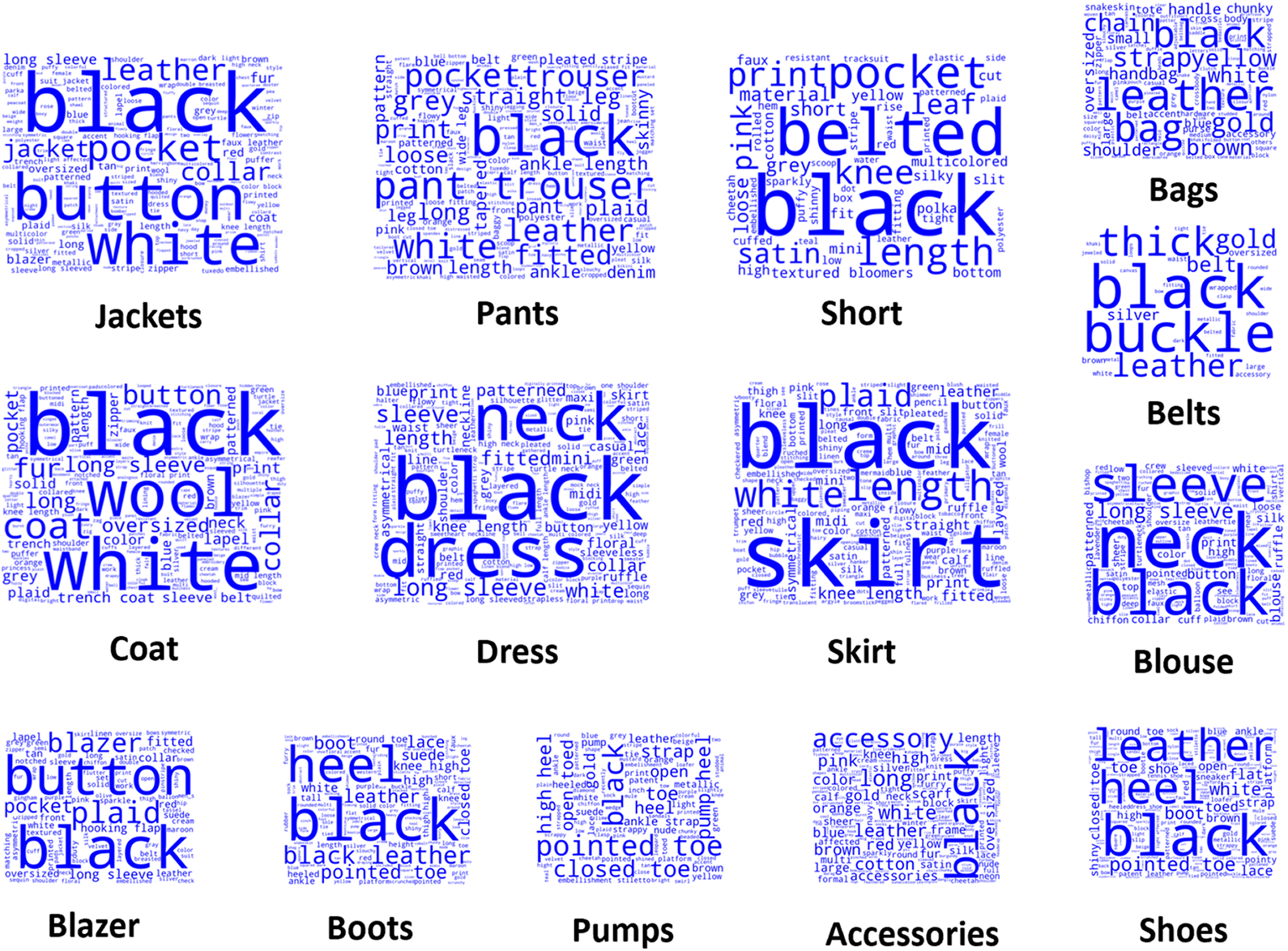
Sample word clouds of fashion attributes in 2019 Autumn-Winter season.
To briefly discover how these findings may assist fashion practitioners, we invited three experts including researchers and Ph.D. students in the fashion field to review the outcomes of Neo-Fashion system. Through expert reviews, we wished to discover how people may view this system as a digital product or service. Experts provided positive feedback and commented that this system could be a powerful tool to supplement the traditional trend forecasting approaches.
Conclusions and Implications
In this study, we proposed a novel, data-driven fashion trend forecasting system called Neo-Fashion. To provide recommendations of fashion trends for fashion researchers, the system primarily focuses on analyzing catwalk images using machine learning algorithms, including deep learning object detectors for instance segmentation, big data analysis, and K-means clustering. Based on our knowledge, this is the first system using cutting-edge AI algorithms in computer vision and machine learning, as well as the first to provides a holistic and integrated fashion trend forecasting system using existing fashion catwalk images.
The findings suggest that Neo-fashion system is able to detect and segment almost all categories of fashion items, including sneakers, dresses, and coats. The findings also indicated the 10 most dominant colors of each category in each season, the trending seasonal styles and the potential popular combination from 32,702 catwalk images. For example, in autumn-winter, designers focus more on dress-boots combinations than other seasons. The dominant colors for dresses in autumn-winter are blue, black, and white, and the popular colors for boots would be purple, black, or white. The attributes word cloud in Figure 5 suggested other fashion design elements in detail such as fabric, print, patterns, and silhouettes. For instance, oversized and puff are key trending elements for coats and jackets. Therefore, by providing these trending design elements, the results give fashion researchers a more holistic trending recommendation. This comprehensive fashion trend forecasting analyzed through the catwalk images can be a powerful tool to provide quantifiable evidence for forecasters to analyze fashion trends in an efficient and accurate way.
This research has some theoretical contributions. This study contributed to the existing trend forecasting literature of fashion diffusion theory and trickle-down theory. By forecasting fashion trends from a large number of catwalk images through a computational approach, the results quantifiably imply that runway shows and catwalk analysis do play an important role in the fashion diffusion process, thus demonstrating the potential application of diffusion of innovation theory and trickle-down theory in the digital age. Through the combination of DOI theory, trickle-down theory, and theories in computer vision, this research suggested an objective way to understand the fashion diffusion phenomenon. This novel approach also provides more insights on quantitative analysis in the trend forecasting literature.
This research also provides some managerial contributions to fashion researchers and practitioners. The instance segmentation module of Neo-fashion shows accurate performance in the identification and extraction of fashion items from catwalk images. Using a Mask RCNN algorithm, this module could provide three types of results: item segments, item classification and bounding boxes. Fashion researchers and practitioners could choose the different types of results based on their needs. The bounding box was widely used in fashion item identification; segments could be used to understand the distinctions between fashion items, and classification could indicate the category of the specific fashion item in images automatically. While previous research only provides one or two aspects of trend forecasting, such as color and style, the trend forecasting module in the Neo-fashion system shows the trending colors of different categories, trending styles in different seasons, trending combinations and key attributes together. Combined, these results imply an integrated and comprehensive understanding of trending fashion. Fashion companies and trend forecasting agencies are able to utilize the advanced functions in Neo-Fashion, feed images of interest and use this system to simplify their forecasting research.
Limitation and Future Work
This study has some limitations at the current stage and still needs future work. First, 23 categories of fashion items are still limited and some categories (e.g., shoes) are still broad. Therefore, in the future, more fashion images with fashion items can be labeled and fed into the Neo-fashion system to refine the instance segmentation module and extend product categories. Second, even though the trickle-down process plays an important role in fashion diffusion, and catwalk images provide insights for fashion trends, more images from various sources such as social media and street shots would be further collected and analyzed through Neo-fashion to reflect the impact of the trickle-down, trickle-up, and trickle-across processes and provide more comprehensive understanding of fashion trend forecasting. Third, it would be useful to conduct a large-scale expert review via interviews or survey to evaluate and optimize NEO-Fashion system, as well as explore the potential use for the fashion industry from users’ perspective. Embedding Neo-Fashion system in a user-friendly interactive platform would be a promising direction, which is worth pursing for trend forecasters to test and improve the current model.
Footnotes
Declaration of Conflicting Interests
The author(s) declared no potential conflicts of interest with respect to the research, authorship, and/or publication of this article.
Funding
The author(s) received no financial support for the research, authorship, and/or publication of this article.
