




Abstract
People with lived experience of trafficking are increasingly called upon to do anti-trafficking work, yet little research has explored how this work affects their well-being. This qualitative study draws on semi-structured interviews with nine survivor leaders, using a tool co-developed by a research team that included individuals both with and without lived experience. Through thematic analysis, the study identified both benefits and harms associated with survivor leaders’ involvement in anti-trafficking work. Survivor leaders described harmful experiences including lack of inclusivity, re-exploitation, devaluing interactions, vicarious trauma, and poor pay. They also identified positive influences such as payment, organizational policies, and interpersonal interactions. This study provides the anti-trafficking sector a better understanding about how various policies, structures, and interpersonal interactions impact survivor leader well-being and provides recommendations on how to ethically collaborate with survivor leaders.
Introduction
Individuals who self-identify as having lived experience of labor or sex trafficking have been called upon to provide direct services, inform policy, and educate both professionals and the general public (Ash, 2024; Ash & Otiende, 2023; Clawson & Goldblatt Grace, 2007; Robitz et al., 2015). People with lived experience of human trafficking involved in anti-trafficking efforts work as employees, volunteers, and consultants and are identified in many ways including, but not limited to, “survivor leader,” “lived experience expert,” or “subject matter expert.” For simplicity of language, this study refers to individuals with lived experience doing anti-trafficking work as “survivor leaders.” Throughout the duration of this study the authors’ preferred terminology shifted from “survivor leader” to “individual with lived experience,” but the authors continued to use “survivor leader” in this paper for consistency.
Increasingly, there is a push to ensure that all services for trafficking survivors are survivor-informed defined by the Human Trafficking Leadership Academy as “A survivor-informed practice includes meaningful input from a diverse community of survivors at all stages of a program or project, including development, implementation and evaluation” (National Human Trafficking Training and Technical Assistance Center [NHTTAC], 2017). Understanding the terminology used to describe survivor engagement is important for contextualizing how organizational structures impact well-being. Three key terms describe different levels of survivor involvement, each representing distinct power dynamics and decision-making structures: survivor-informed, survivor-centered, and survivor-led.
Survivor-informed approaches incorporate input from individuals with lived experience into organizational programs, policies, and services, while primary decision-making authority remains with leadership typically without lived experience (NHTTAC, 2017). In this model, survivors serve as consultants or advisors whose perspectives inform but do not determine organizational direction. Survivor-centered approaches prioritize individual survivor autonomy in service delivery, emphasizing self-determination and respect for survivor choice in their own decision-making. Survivor-led approaches represent the highest level of power-sharing, where individuals with lived experience hold majority leadership positions and maintain final decision-making authority over organizational direction (Smith, 2018). These distinctions reflect fundamentally different assumptions about expertise, power, and whose knowledge is valued in anti-trafficking work. The level of engagement and power-sharing may significantly impact survivor leader well-being, as it determines whether they serve primarily as sources of trauma narratives, as consultants whose input may or may not be implemented, or as leaders with genuine authority and decision-making power.
Ash and Otiende describe a spectrum of survivor leadership where at one end they are informed of how the work impacts them to more meaningful engagement where they are empowered to make final decisions about anti-trafficking work (Ash & Otiende, 2023). Survivors have expressed interest in not only sharing their stories but also in informing and building social service programming (Dang, 2018). In direct service settings, survivor leaders bring a unique perspective. They not only help build trust, but they can also be positive role models (Clawson & Goldblatt Grace, 2007; Deer, 2017). Increasingly, experts in the field have called for more survivor leadership as a way to make services more relevant which can in turn reach more individuals who have been trafficked (Abbott et al., 2019; Ash & Otiende, 2023; Asquith, 2022; Gerassi & Nichols, 2018; Lloyd, 2011; Lockyer, 2022). The contributions of survivor leaders are essential for understanding and solving the health inequities experienced by individuals who have or are being trafficked. We know that diversity of people in work environments is a driver of excellence because it enhances the likelihood for problem solving and innovation (Page, 2017; Swartz et al., 2019). When working groups include representation and perspectives from communities experiencing health inequities, the chances of solving disparities and preventing harm are increased (Ackerman-Barger et al., 2023).
While the anti-trafficking movement has benefited from the work of survivor leaders, we are just beginning to understand the harms that can be done if survivor leaders are not brought into an inclusive working environment. An inclusive work environment is one in which the workplace aims to a create space for a diverse group of employees where everyone feels heard, respected, and valued (Shore et al., 2018). While there is more extensive literature about what an inclusive work environment means for other minoritized or structurally marginalized groups, we are just starting to understand how to create an inclusive work environment for individuals with lived experience of trafficking (Aysola et al., 2018; Hur, 2020).
In August of 2022, Humanity United and National Survivor Network assembled a working group which extensively outlined the harms that have occurred to survivors by the anti-trafficking sector, and how understanding and acknowledging harm is the first step toward changing approaches. One form of this harm is through implementation of “strategies that replicate stigmas, power dynamics, biases, and cultural oppressions that make people vulnerable to violence,” through forced or unhelpful services or not recognizing a survivor’s ability to identify their own needs (Ash, 2023, p. 9). This report documents categories of harm ranging from exclusion from decision-making spaces, labor exploitation by the human trafficking sector, and identity-based or oppression-based harms, among other categories of harm (Ash, 2023). A 2024 study by Gerassi et al. documents similar harms including “(1) inadequate pay, (2) devaluation of their experiential knowledge, (3) the requirement of advanced degrees for their perspectives to be valued, and (4) lack of structure to support their job advancement” (Gerassi et al., 2024). Survivor leaders face unique challenges while doing this work, but research on how best to ethically employ them has been historically limited, though improving in recent years. Understanding how survivor leaders’ work in anti-trafficking organizations affects their well-being is crucial to developing responsible and ethical work environments.
Current literature indicates that there are a variety of strategies that can be taken to ensure a trauma-informed and empowerment-based organizational culture (Bowman & Dunn, 2023; Countryman-Roswurm, 2015; Lloyd, 2011; Lockyer, 2022). These strategies include policies such as program evaluation, evaluating work readiness in the pre-hire period, planning for tensions when working with survivors, being thoughtful about language about survivorship, and professional development (Dang, 2018; Lockyer, 2022; NHTTAC, 2023; Smith, 2018). Steps to avoid inclusion and tokenism include hiring survivors across the organization, creating methods for soliciting meaningful input, appropriate compensation, and ensuring that survivor leaders’ confidentiality and choice are respected (Asquith, 2022; Bowman & Dunn, 2023; Dang, 2018; Gerassi & Nichols, 2018; Hart, 2018; Helpingstine et al., 2023; Lockyer, 2022; NHTTAC, 2023; Smith, 2018).
Multiple entities such as the Human Trafficking Leadership Academy, organized through the National Human Trafficking Training and Technical Assistance Center (NHTTAC), and the National Survivor Network have created toolkits to provide guidance to service providers who are looking to be more survivor-informed or to better engage those with lived experience (Ash & Otiende, 2023; NHTTAC, 2023). Common themes across these toolkits include meaningful inclusion, equity, self-determination, and the recognition of diverse experiences (Ash & Otiende, 2023; NHTTAC, 2023). While current literature provides guidance on how best to employ survivor leaders through expert opinion or analyses of written literature, there is a gap in literature describing a diverse group of survivor leaders’ experiences doing anti-trafficking work in their own words.
The primary objectives of our qualitative study are to describe how organizational culture, practices, and policies of organizations impact the well-being of employees, volunteers, or consultants with lived experience of human trafficking from the perspective of individuals with lived experience. This qualitative study helps to inform the anti-trafficking sector in how best to partner with and employ survivor leaders.
Methods
Research Design
All the findings were presented according to Standards for Reporting Qualitative Research Equator guidelines (O’Brien, 2014). Using the research method of phenomenology, we interviewed survivor leaders. Used often in social and health sciences, phenomenology is a qualitative method used to study the lived experience of a shared concept or phenomenon (Creswell & Poth, 2023; Merriam & Tisdell, 2016). Phenomenology is an approach particularly suited to depict the essence of intense human experiences (Merriam & Tisdell, 2016) such as that of survivor leaders.
Inclusion criteria was self-identification of being a survivor leader. In this study, we identified survivor leaders as those individuals who self-identified as having lived experience of labor or sex trafficking and who had one or more years’ experience working in an organization doing anti-trafficking work as an employee, volunteer, or consultant. Finally, to participate in the study participants have to have been at least 5 years removed from the trafficking situation they had experienced and needed to be over 18.
Research Team
The research was conducted by a public academic health center in Sacramento, CA in collaboration with survivor leaders from different organizations who contributed as content consultants and co-investigators. The research team included an interprofessional group of five scholars, all cisgender women, including three physicians with expertise in anti-trafficking approaches, two master’s prepared social workers with expertise in anti-trafficking, and a doctorally prepared registered nurse with expertise in health equity. Two of the research team members identify as having lived experience of trafficking. The racial and ethnic backgrounds represented by this research team include white, Cambodian, and Black.
Ethical Considerations
Institutional review board approval was obtained from the University of California Davis. Informed consent was obtained for each interview. To ensure that interviews were conducted ethically and to minimize harm, principles discussed in the WHO Ethical and Safety Recommendations for Interviewing Trafficked Women report were used (Zimmerman & Watts, 2003). Also, the interview guide and study protocols were reviewed by two study consultants with lived experience of trafficking to ensure that questions would appropriately gather the desired information while minimizing re-traumatization.
Further protocols to minimize harm were established prior to interviews. These included that if a participant expressed feeling re-traumatized during the study or exhibited signs of increasing distress, the interviewer would offer to stop the interview and the participant would be encouraged to follow-up with their current mental health provider if they had one. If they did not have one, they would be offered a local mental health intake line or the SAMHSA hotline to find local mental health resources: 888-662-HELP. Second, if the participant disclosed information indicating that they were at acute risk of harm toward themselves or others, then the interview would be stopped, and PI would call Emergency Services to transport the subject to a health facility for further evaluation. Third, if the participant disclosed information that fell into mandated reporting categories such as abuse of a child or of a dependent adult, then the interview would end, and appropriate mandated reports would be made. None of these protocols had to be used during data collection.
Procedure: Recruitment and Data Collection
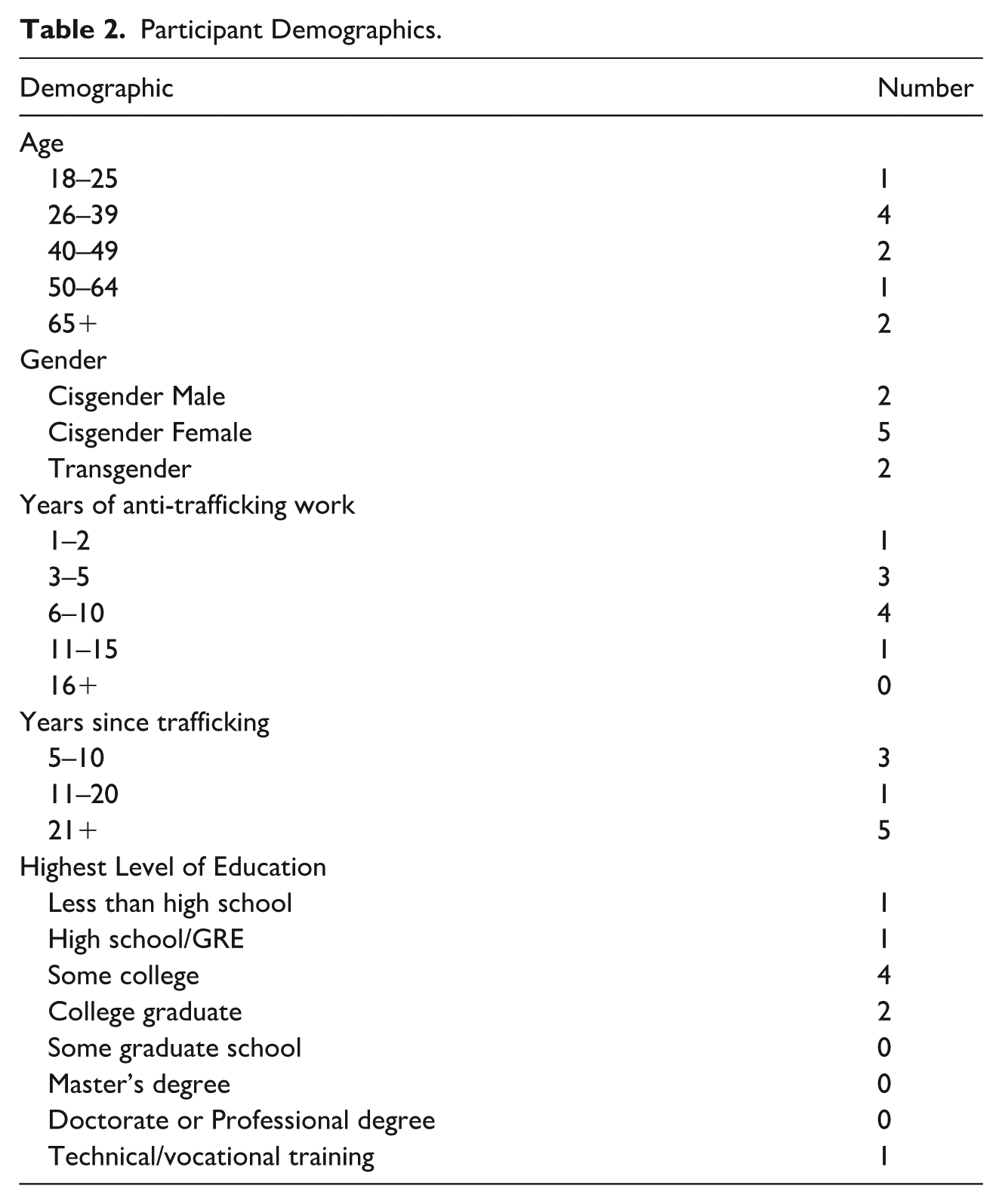
Recruitment was conducted through professional network connections and snowball sampling. Roughly 10 individuals were contacted directly and asked to participate and also to share the recruitment material with their networks. Ultimately, some of the study participants were known to the researchers prior to the study and some were not known to the researchers but were recruited through snowball sampling. Recruitment was stopped when the recurrence of themes began to appear. This is often referred to as data saturation. However, it should be noted that with such a diverse group of individuals who comprise the survivor leader community, it is likely that there is an infinite number of unique experiences to be discovered. Data were collected from April 2019 through August 2019 using Qualtrics to obtain demographic information and interviews to obtain lived experiences. Because of the small and intimate nature of the survivor leader community, we collected and reported only necessary demographic information to maintain the confidentiality of our participants.
The research team first created a conceptual model to describe how a survivor leader’s work impacts their well-being. This conceptual model was created with the input of the research team as well as from a review of the literature (Clawson & Goldblatt Grace, 2007; Countryman-Roswurm, 2015; Deer, 2017; NHTTAC, 2017). Using this model as a guide, a semi-structured interview guide was created with collaboration by members of the research team both with and without lived experience (Supplemental Appendix A). Interviews were conducted either by phone or video conferencing technology or in person depending on the logistical convenience of the interviewee. Interviews followed a semi-structured format (Supplemental Appendix B). Interviews were audio-recorded and then transcribed. All the participant identifiers were removed from transcripts, and each interview was assigned a code rather than a name to preserve anonymity. Interviews ranged in time from 30 min to 90 min long. All the participants were compensated for their time with a $40 visa gift card.
Data Analysis
Data were analyzed using a thematic analysis. Thematic analysis is a method, often used in phenomenological approaches, for analyzing qualitative data across data sets when the goal is to understand experiences, thoughts, or behaviors (Braun & Clarke, 2006; Sundler et al., 2019). Braun and Clark created a six-point guideline for conducting thematic analysis, which was followed for this study. The steps included the following: the research team familiarizing themselves with the data; generating initial codes; searching for themes; reviewing themes; defining and naming themes; and producing a report. The researchers reviewed the data sets multiple times for familiarity. Words and phrases were coded by hand and then using NVivo 12.0 software (QSR International Ltd.). Then patterns were identified, reviewed, defined, and named.
The research team met weekly to once per month to create and revise a codebook as well as to compare and discuss findings. Although the team did not experience disagreements in coding or theming, we engaged in conversations that helped us refine and clarify shared meaning of terms, concepts, and interpretations. We spent many hours in contemplation ensuring that the meanings of themes were clear and mutually agreed upon and would best describe our findings. The two consultants with lived experience of trafficking and who had experience with writing and research reviewed the themes for plausibility. From there, we created a data report, the results of which are included in the “Results” section.
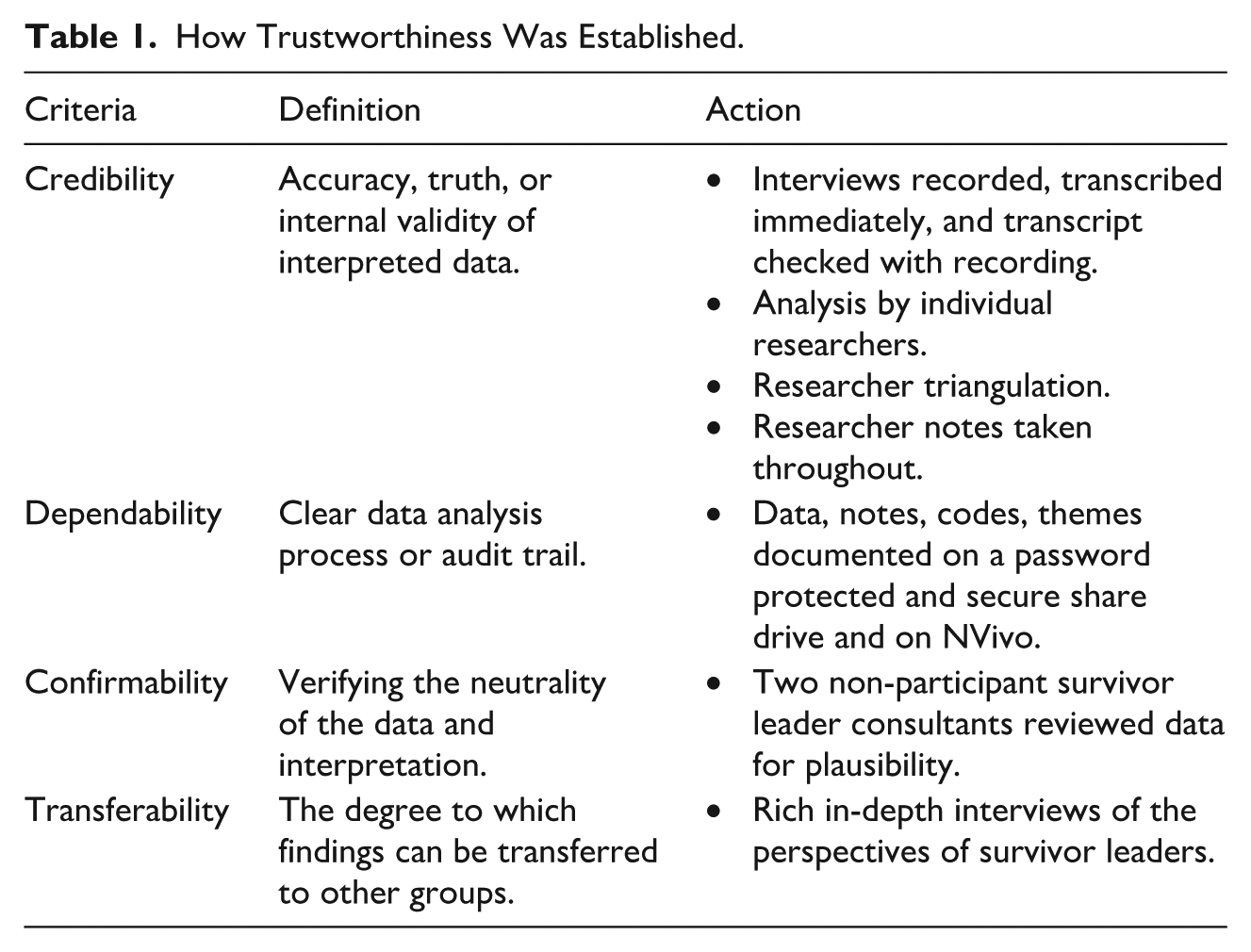
In qualitative research, rigor refers to the completeness of data collection and analysis (Yardley, 2000). Yardley suggests that rigor can be established through “prolonged contemplative and empathic exploration” as well as through “triangulation” and “transparent methods” (Yardley, 2000, pp 219, 222). To ensure rigor and trustworthiness of the data based on established qualitative research standards, we used Lincoln and Guba’s trustworthiness criteria (Lincoln & Guba, 1985; Table 1).
How Trustworthiness Was Established.
Results
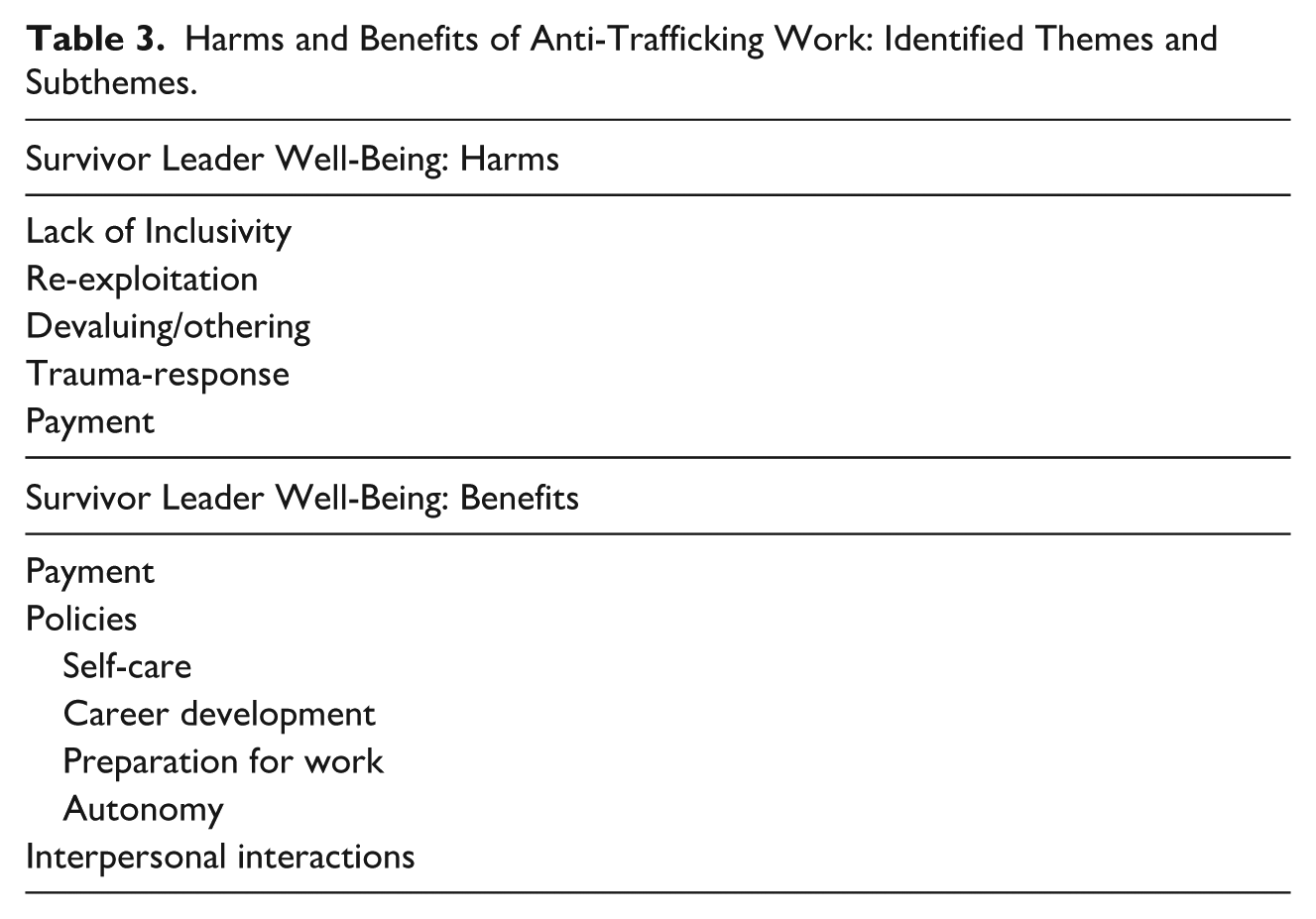
There were nine participants who ranged in age, gender, years of experience, years since trafficking, and level of education broadly (Table 2). Participants described themes of both harms and benefits to survivor leader well-being. These themes were further divided into subthemes. Table 3 provides an overview of the identified themes and subthemes (Table 3).
Participant Demographics.
Harms and Benefits of Anti-Trafficking Work: Identified Themes and Subthemes.
Survivor Leader Well-Being: Harms
Participants described various harms related to lack of inclusivity, re-exploitation, devaluing/othering, trauma-response, and payment. There were numerous ways in which survivor leaders experienced harm, and we will therefore identify several categories or subthemes related to “harm.”
Lack of Inclusivity
Well-being of survivor leaders was negatively impacted when anti-trafficking work focused solely on sex trafficking, lacked awareness of the racial diversity of people who are trafficked, and included religious pressuring. Multiple survivor leaders discussed the challenges of doing anti-trafficking work as a survivor leader when the movement only focuses on a narrow population and is not inclusive of their own experience or the experience of those with whom they work. Participants reported various values and qualities of the anti-trafficking movement which caused harm. For example, the lack of inclusivity of the movement made the work difficult for participants. Participant R1 describes this harm in reference to race, gender, and type of trafficking:
R1: “I have buried my entire circle of friends and I’ve buried a lot of the kids that I’ve worked with through systemic oversight and lack of recognition and I’m sick and tired of burying everybody I deal with simply because they’re not the sex trafficked white girls that everybody wants to work with.”
Participant R2 focuses on the harms they have experienced by a lack of focus on labor trafficking within the movement:
R2: “They’re invisible. They’re like ghosts. The organization that I work with is getting better about it, quite a lot better. But they just don’t get discussed . . . it also feels as though there is no reason to care about me, that I don’t deserve to be visible and to exist in survivor spaces . . . It has quite a lot to do with skewed demographics and as members of the organization with regard to the demographics for survivors in general. And you’ll see I think quite a lot worse treatment of labor trafficking and labor trafficking survivors in other organizations.”
Other movement qualities, including pushing a religious agenda, were also pointed to as qualities that negatively impacted well-being:
R2: “They might be evasive of racial diversity. They are definitely evasive of labor trafficking . . . They treat sex trafficking survivors in a way that are again exploitive and there are organizations that are incredibly controlling over them and push religious agendas on them and a focus on sexual purity and gaining sexual purity.”
Moreover, multiple participants discussed ways in which U.S. politics particularly around immigration impacted their ability to do their work which they experienced as re-exploitation.
Re-Exploitation
Participants shared thoughts about how anti-trafficking work can be re-exploitative, for example when it focuses on a survivor leader’s story through a sensationalized lens or lacks adequate pay. One participant, R8, shared “You know one of the reasons why the survivors keep saying we’re supposed to be getting paid for this work is because it could be considered re-exploitation,” and another, R2, shared “Try to have the survivor leader focus on the story and use the sensational aspect of that story to their own benefit, which is exploitation, re-exploitation.” One participant compared this re-exploitation to the exploitation experienced during their trafficking situation:
R3: “So like that’s what I think is to exploit. And like having a survivor come out and talk about their experience and not paying them properly to me is the same thing that a trafficker does. Like you’re using a person’s trauma against them or using a person’s trauma to get the benefit from it but you’re not properly compensating for what it is that their experience, what their experience had been.”
Devaluing/Othering
Multiple participants talked about experiences in which their colleagues treated them differently or their contributions were devalued when colleagues knew of their lived experience. For example, a participant discusses an example of this:
R9: “And I’ve heard from colleagues that have had things like that done to them where a survivor with a law degree is not invited to a thing where they have a law student presenting who is an advocate, and they have a survivor who has the law degree. But they chose this student. Nothing against students, but it’s just like how come the survivor wasn’t on that panel, you know.”
Some colleagues without lived experience might treat them differently than other colleagues by asking them details about their trauma history that they would never consider asking another colleague:
R4: “If I were to ask a colleague about, you know if I were to have a coworker whose parents got divorced or if I had a coworker who experienced sexual assault, right, it’s completely inappropriate to ask that person about their personal history right off the bat, right if you’re in a team meeting or if you’re in a staff meeting, if you’re in a policy meeting whatever you’re in. So the same should be said about survivors of human trafficking.”
Trauma-Response
Participants talked about how the vicarious trauma related to this work is complicated by their personal trauma. They describe the way that they’ve noticed their bodies and their minds responding to either reminders of their past trauma or ongoing vicarious traumatization. One participant eloquently described the way that this trauma-response impacted them even though they didn’t fully understand that that’s what was happening when they began doing the work:
R3: “. . . I would talk and I would educate and I would give my experience but at the same time my body is going through all these changes and my mind is going through all these changes and I didn’t quite understand why for days after the presentation I would be like in the state of, my mind would be in a totally different state. Like my body would be sore or my body would be like tense and I would be angry or I would be frustrated. Or my husband like I would be just so super hostile with him in my words, my verbiage or I would be accusatory. Or I would be like, what are you doing, or suspicious or paranoid or you know whatever the case may be to follow. Or my kids like I would be just super hypervigilant and just like certain things that I would be super irritable, and I didn’t quite understand the correlation between the two of me like presenting.”
A participant discussed how their trauma-response could be triggered if their employer or an audience who they are training is not thoughtful:
R5: “Well when I train law enforcement I have called out many law enforcement people, we are [at a] law enforcement training . . . And on the first row there’s a guy with a gun knowing the survivors probably were at gunpoint at one point, right? . . . I just don’t want to talk no more and that could prevent even for me to deliver a good training.”
Participants also discussed how an employer could use knowledge of their trauma history and concern for their trauma-response to harm them:
R1: “. . . it is assumed that you are just not capable of doing the work because of your trauma response. With the one survivor that I was working with where they drove her into mental health issues and then started gaslighting and condemning us because she was not capable of doing the work where the issue was actually they were overworking her and overstressing her and throwing her into situations that no human should have been dealt or dealing with.”
Compensation
Participants talked quite a bit about compensation and the potential harms that can be done by inadequately or unfairly compensating a survivor leader. For example, multiple participants talked about how they get paid differently because they don’t have a degree with one participant, R3, saying, “I see sometimes like people doing the same kind of work that I’m doing but getting paid triple the amount of money just because I don’t have a degree.” One participant talked about how they don’t openly identify as a survivor because it impacts their compensation:
R4: “So when I go into spaces I don’t call myself a survivor I call myself a subject matter expert. And I expect to be paid for that. And I’ve noticed that if I’m changing my title instead of me being called a survivor and instead changing it to subject matter expert I actually get paid more.”
When discussing compensation’s impact on well-being, participants talked not just about the negative impacts of not being appropriately paid but also the challenges of doing anti-trafficking work while living in poverty or near poverty. Participants shared the following:
R1: “Constant stress of being well below the poverty level in the US and constantly struggling with how am I going to get food, how am I going to pay for utilities and just the everyday struggle of being poor.”
and
R3: “Some months I make enough money to be able to survive and some months I’m trying to figure out if I’m going to get EBT to be able to feed my kids. It’s not consistent. I don’t get any medical benefits so although I’m getting paid these amounts of money, different amounts of money, I still have to depend on Medicaid to take care of my kids. And different programs to take care of my kids.”
Multiple participants talked about the inconsistent nature of anti-trafficking work leading to economic instability. This was complicated by the fact that consulting work can require upfront costs from the consultant with a participant, R6, sharing “a lot of times consultants have to put the money upfront [for travel] and you don’t get paid, you don’t get reimbursed for a long time. So that was a struggle.” Lastly, multiple participants talked about being asked to do work with no or inadequate compensation. One of the most extreme examples is shared here:
R6: “And so this organization was doing a documentary and they wanted me to be in the documentary. And I said, if you want me to be in the documentary I need to be paid . . . But the person berated me over it. I remember I was sitting my car, I was on the phone with her and she was saying things like, if you really care about this issue you wouldn’t ask for money, you would share your story on camera willingly.”
Survivor Leader Well-Being: Benefits
Along with identified harms, there were also benefits to doing this work that were identified. Participants highlighted certain qualities of their work such as adequate pay and policies that support self-care, support for career development, autonomy, and adequate preparation for the work. Lastly there were interpersonal strategies used by employers and/or colleagues that were identified as beneficial.
Compensation
While poor compensation or conflict around compensation can lead to harms, good compensation can also contribute to a survivor leader’s well-being:
R2: “I felt human. I felt like somebody who was contributing to society. I’m pretty sure some taxes were paid out of that paycheck. Yeah it was amazing . . . I felt satisfied and whole and complete. In addition I was able to buy like clothing and toothpaste. Hand lotion, I don’t remember the last time it was that I bought hand lotion.”
Participants also described policies that can improve well-being including support for self-care, career development, preparation for work, and autonomy. Participants described self-care activities organized by their employer as follows.
Policies: Self-Care
Participants identified space for self-care while at work as beneficial to their well-being. Policies which allowed both time and resources were noted to be helpful:
R4: “. . . but the company itself they do a lot of self-care activities. So they would invite us to like Happy Hour or like an exercise or hiking or just like an outing, a lot of opportunities to have like a social life and have social gatherings. So I think that’s been helpful. The agency I work for has a gym as well that I get to utilize. So those are some of the ways that I look at self-care.”
Policies: Career Development
Multiple participants talked about the importance of integrating career development strategies into their positions with one participant, R3, stating, “. . . something that is a plan to support the survivor beyond them just being a survivor. Like what is their career goals? What do they want to do?” When employers treated survivor leaders as professionals to develop rather than positions to fill, survivor leaders experienced positive impacts on their well-being. For example, an employer might consider meeting with a survivor leader to identify career goals and identify strategies to support them in attaining these goals.
Policies: Preparation for Work
Some participants talked about the importance of having policies in place to be sure that the people you’re hiring are prepared for the work. They recognized the need to both identify survivor leaders who were well-equipped emotionally to do the work, and they also recognized the importance of providing training in necessary skills once they have hired someone. Here a participant discussed strategies to ensure that survivor leaders are well-equipped to do the work through the hiring process:
R3: “I think that if a person is going to be hired on as a survivor, they should have another survivor present for that interview who has been doing leadership for some time. Because they’re seeing that I can read, that an employer can’t read . . . I think that a therapist should be present during an interview. And just a part of making sure that we’re providing proper support to you but also making sure that we have the proper structure in place to hire you on. Because we want to make sure that you feel supported and that our organization supports you properly during your transition of becoming a survivor leader for this organization.”
Policies: Autonomy
Participants also described the importance of giving survivors some autonomy and control over their work: “But if they’re willing to lay down some power and control and give me a space to create and promote new thought and like talk about the intersections and equity of survivors then I believe I can be a great asset. Because I don’t live in a box.” Allowing survivor leaders to be leaders or provide input which is valued or heard contributes to improving their well-being.
Interpersonal Interactions
Lastly, there are ways that organizations and individuals working for them can contribute to a positive working relationship with various interpersonal interactions. Multiple survivor leaders discussed the importance of not asking them to share their stories. There was also a focus on acknowledging one’s own privilege and not making assumptions about the survivor leaders you’re working with. This was highlighted in quotes about how a survivor leader’s perspective may impact how they deliver services:
R1: “I think the one thing that would be most critically important is accepting the privilege lens of engaging with survivors. When an organization is so accustomed to the process of formal education coming into this almost savior complex of we’re going to rescue individuals versus the lived experience and we recognize the autonomy and albeit we may not always agree with choices doing that inclusive harm reduction type of approach where we’re having conversations, we’re not mandating how an individual will accept services.”
This was also highlighted in a quote that discussed not making assumptions about someone’s ability to navigate the logistics of doing survivor leadership work:
R6: “The logistics, don’t assume that a person can get their own Uber. Don’t assume that a person can even get their own parking. But once you know that they can don’t baby them.”
They also highlighted the importance of valuing the survivor beyond their survivorhood. This is demonstrated in quotes such as the following:
R4: “Provide reassurance to that person to let them know that you’re not here because you’re a survivor you are here because you’re the expert. You’re an expert and never pressure somebody to tell their story. Never bring up the idea of bringing up somebody else’s past.”
and
R7: “They have to realize that these survivors are absolutely resilient human beings.”
Along with valuing their expertise, it is important that they are treated as a valued partner and collaborator:
R4: “The idea, the sole idea of being survivor informed is you’re not only gonna bring this person in regardless of what position you want them to serve but you’re bringing them in with an idea that we’re going to partner with this person. It’s a partnership where their ideas on evaluation, on policy, on curriculum they will be heard and they will be elevated just for the sole fact that this person understands what trafficking can look like from an inside and outside perspective.”
Discussion
To our knowledge, this is one of the first few studies to highlight how the qualities of a human trafficking survivor leader’s employment can benefit or harm their well-being from the perspective of survivor leaders themselves. We learned that survivors can be harmed by doing anti-trafficking work due to certain qualities of the anti-trafficking movement, re-exploitation, a devaluing/othering by colleagues, trauma-response, and poor/no payment. Things that can benefit survivor leaders are adequate payment; company/organization policies which support self-care, career development, adequate preparation for work, and autonomy; and interpersonal interactions with colleagues and supervisors which recognize the value of survivors beyond their survivorhood and treat them as individuals.
While existing literature is limited, this study does support the literature that exists. It identifies similar harms to those that have been specified in reports and toolkits written by individuals with lived experience including examples of re-exploitation and othering (Ash, 2024; Ash & Otiende, 2023; Dang, 2018). It also highlights many of the same strategies to support well-being that have been shown in the existing literature such as ensuring appropriate preparation for work, avoiding tokenization, ensuring appropriate pay, only involving survivor leaders in telling their stories, and ensuring that work environments are trauma-informed (Bowman & Dunn, 2023; Dang, 2018; Gerassi et al., 2024; Helpingstine et al., 2023; Lockyer, 2022; NHTTAC, 2023).
Many of these findings are consistent with literature, more generally, about creating inclusive work environments. Literature about other minoritized or structurally marginalized groups has shown that there have been challenges around tokenization, othering, and unequal pay (Bishu & Alkadry, 2017; Mik-Meyer, 2016; Wingfield & Wingfield, 2014). Of note, because having other minoritized or structurally marginalized identities increases risk of trafficking, survivor leaders often have multiple minoritized or structurally marginalized identities, such as race, gender, and immigration status, which can contribute to intersectional harms that they might experience in the workplace (Booysen, 2018; Fukushima et al., 2020).
Limitations
Because this is a qualitative study with a small number of interviews, it limits the ability to generalize. In addition, demographic data may overrepresent categories of individuals such as those who are college educated. However, generalizability is not necessarily the goal with qualitative methods. Instead, qualitative data seeks transferability. Transferability is established through thick rich descriptions which allows researchers to consider whether transferring the findings to other groups or settings is possible (Lincoln & Guba, 1985). The rigor of our work suggests that our findings could be replicated and that the themes could be transferable to other demographic groups.
In addition, this paper can serve as a foundational study for future quantitative studies that can address generalizability. Because this study focused on survivor leaders in the United States, it may not capture the unique experiences of survivor leaders, globally. Also, we did not initially collect information about the type of trafficking experienced by the survivor leaders (e.g., sex trafficking, labor trafficking, or both). We know that our participants experienced both labor and sex trafficking based on our interviews, but because we did not formally collect this information we cannot report it.
Another potential limitation is that data collection began 5 years prior to submission, and in that period of time there had been more work done on this issue. While there may be some changes that have occurred over time, likely many of the themes remain relevant as they have been highlighted in recent publications and toolkits. Our findings align with findings from recent studies (Bowman & Dunn, 2023; Dang, 2018; Gerassi et al., 2024; Helpingstine et al., 2023; Lockyer, 2022; NHTTAC, 2023).
This study points to the need for further exploration of solutions to address some of the harms caused by the anti-trafficking movement to survivor leaders. Some solutions proposed by participants in our study have also been supported by other reports including ensuring appropriate pay, not only asking survivors to share their story, and creating workplace policies which support survivor leader autonomy, professional development, and self-care (Ash & Otiende, 2023; Asquith, 2022; Lockyer, 2022; NHTTAC, 2023). Because these findings point to similarities in studies about creating inclusive work environments for other minoritized groups, the sector could look to existing literature about strategies to create inclusive work environments for other groups who have minoritized for other characteristics such as by race, gender, and sexual orientation. Future study could look to adapt tools that are used to create inclusive work environments more broadly for this more specific population and study their effectiveness.
Implications
From the time that the authors began working on this study to the time of submission, they have mostly transitioned from using the term “survivor leader” to using terms such as “individual with lived experience” or “subject matter expert.” The authors intentionally chose to continue using the term “survivor leader” throughout the paper as that was the term used when interviews were initially conducted with participants. That being said, this transition from “survivor leader” to “subject matter expert” or “individual with lived experience” is supported by the findings of the study. This transition of languages reduces “othering” and allows individuals with lived experience to identify the language that they would like to use to identify themselves.
Moreover, these findings demonstrate the importance of being intentional about how to integrate lived experience expertise into anti-trafficking work. Organizations seeking to employ individuals who identify as having lived experience should consider how their policies related to hiring, training, promotion and advancement, employee well-being support, and pay may impact their trainees both with and without lived experience. Each organization’s situation is unique, so when considering how to create these policies it can be helpful to look to toolkits and training and technical assistance that are available through various national and international survivor-led organizations (Ash & Otiende, 2023; NHTTAC, 2023). Organizations should also consider what roles individuals with lived experience hold within their organization and seek to ensure lived experience is represented in leadership roles and that survivor leaders are not being employed simply for the purpose of sharing their trauma narrative. Lastly, organizations should consider expanding training about diversity, equity, and inclusion to include training about implicit biases that people may have about colleagues with lived experience. Employees should be trained to recognize and address these implicit biases appropriately.
Conclusion
This research highlights the way that doing anti-trafficking work both improves and harms the well-being of survivor leaders working in this space. While the harm is often inadvertent, related to lack of deliberate planning and intentionality, this study highlights the importance of being thoughtful in creating an inclusive work environment which honors a survivor leader’s experience, does not devalue the employee/volunteer, and is trauma-aware. Moreover, many of the principles of creating a diverse and inclusive work environment apply to working with people who have lived experience of trafficking to ensure that they are respected, valued, and treated as individuals who can contribute more than their trauma history. More work is needed to systematically evaluate methods for reducing and repairing harm to survivor leaders doing anti-trafficking work.
Supplemental Material
sj-docx-1-jiv-10.1177_08862605261422773 – Supplemental material for Ethically Collaborating With Human Trafficking Survivor Leaders
Supplemental material, sj-docx-1-jiv-10.1177_08862605261422773 for Ethically Collaborating With Human Trafficking Survivor Leaders by Rachel Robitz, Jacqueline Tasarz, Ummra Hang, Margaret Howard, Hanni Stoklosa and Kupiri Ackerman in Journal of Interpersonal Violence
Supplemental Material
sj-docx-2-jiv-10.1177_08862605261422773 – Supplemental material for Ethically Collaborating With Human Trafficking Survivor Leaders
Supplemental material, sj-docx-2-jiv-10.1177_08862605261422773 for Ethically Collaborating With Human Trafficking Survivor Leaders by Rachel Robitz, Jacqueline Tasarz, Ummra Hang, Margaret Howard, Hanni Stoklosa and Kupiri Ackerman in Journal of Interpersonal Violence
Footnotes
Acknowledgements
Alex Asera, BS; Ben Katz; Uyen Trinh Nguyen, MD.

Ethical Considerations
Institutional review board approval was obtained from the University of California Davis.
Funding
The authors disclosed receipt of the following financial support for the research and/or authorship of this article: Research was funded through a departmental grant from the University of California Davis Department of Psychiatry and Behavioral Sciences.
Declaration of Conflicting Interests
The authors declared no potential conflicts of interest with respect to the authorship and/or publication of this article.
Data Availability Statement
Coded and de-identified data available for review at the request of the corresponding author.*
Supplemental Material
Supplemental material for this article is available online.
Author Biographies
References
Supplementary Material
Please find the following supplemental material available below.
For Open Access articles published under a Creative Commons License, all supplemental material carries the same license as the article it is associated with.
For non-Open Access articles published, all supplemental material carries a non-exclusive license, and permission requests for re-use of supplemental material or any part of supplemental material shall be sent directly to the copyright owner as specified in the copyright notice associated with the article.
