




Abstract
Workplace bullying is conceptualized as a systematic exposure to harassing behavior accompanied by feelings of defenselessness. Yet, most research has solely focused on exposure, thereby ignoring the role of defenselessness regarding victimization from bullying. Using a person-centered approach, this cross-sectional study addresses this gap by investigating the relation between employees’ profiles of exposure to bullying behaviors and their profiles of defenselessness. Latent profile analyses of 491 employees identified four distinct exposure profiles: (a) no exposure, (b) rare exposure, (c) occasional exposure, and (d) exposure to isolating acts (work isolation). A parallel four-profile solution emerged for defenselessness, reflecting (a) no, (b) low, and (c) moderate levels across most indicators, as well as (d) specific defenselessness linked to isolating behaviors. Profile membership overlapped strongly between exposure and defenselessness, except for one-third of employees in the rare exposure profile, who showed moderate rather than low defenselessness. The profile reflecting the highest levels of exposure and defenselessness (occasional exposure and moderate defenselessness) reported the most negative outcomes (higher perceived victimization, exhaustion, and job dissatisfaction), whereas the no exposure/no defenselessness profile showed the most adaptive outcomes. Importantly, the rare exposure profile experienced significantly worse outcomes when defenselessness was moderate rather than low. The work isolation profile showed outcomes similar to the rare exposure profile with low defenselessness, highlighting the harmful nature of isolating actions. The findings highlight the need for organizations to actively prevent and manage negative behaviors among employees.
Keywords
Introduction
Research on workplace bullying – defined as the repeated and persistent exposure to negative acts from others at work against which the targets find it gradually more difficult to defend themselves (Einarsen et al., 2020; Rosander & Nielsen, 2023) – has intensified substantially in the last decade (Farley et al., 2023; Nielsen & Einarsen, 2018). Using rigorous research designs and statistical approaches, this research has helped achieve a better understanding of the contextual risk factors associated with workplace bullying, as well as its short-term (e.g., need frustration; Trépanier et al., 2023) and long-term (e.g., insomnia; Nielsen, Harris, et al., 2020) outcomes.
Notwithstanding our current understanding of antecedents and outcomes of workplace bullying, there remains a gap between the formal theoretical definition of workplace bullying and how it is operationalized in empirical studies (Nielsen, Notelaers, & Einarsen, 2020). Indeed, most research measures workplace bullying through inventories of unwanted behaviors assessing the frequency and persistence of exposure to negative acts (i.e., harassment). However, few studies have assessed its third component, namely defenselessness (Nielsen, Notelaers, & Einarsen, 2020; Nielsen et al., 2022). This is unfortunate since defenselessness (i.e., the perception of not being able to defend oneself against the mistreatment) is the key to differentiating bullying from other social stressors at work (e.g., incivility; Hershcovis, 2011).
The present study seeks to address this gap by (a) explicitly assessing defenselessness, (b) analyzing how it relates to the frequency of exposure to bullying behaviors, and (c) testing how both components (i.e., exposure and defenselessness) combine in their associations with employee outcomes. To this aim, this study, which relies on a person-centered approach, investigates employees’ profiles of exposure to bullying behaviors at work and their profiles of perceived defenselessness when facing these acts. This study also aims to investigate the links between both sets of profiles, as well as the outcomes (i.e., perceived victimization, emotional exhaustion, and job satisfaction) of these linked profiles.
Workplace Bullying
Conceptualization
Anchored in the formal definition given above, workplace bullying reflects a process of escalation over time in the number, frequency and intensity of one’s exposure to negative behaviors at work (e.g., offensive remarks, depreciation of professional competencies or social exclusion; Notelaers & Van der Heijden, 2021). Targets can initially be exposed to indirect and infrequent negative acts of an ambiguous meaning and intent. Over time, as these negative acts become more direct, intense, and frequent, targets become increasingly isolated and may develop feelings of defenselessness (i.e., having little recourse; Brodsky, 1976). Targets’ sense of defenselessness is a psychological state derived from a perceived power imbalance between themselves and the perpetrator and increases as the bullying process evolves. This power imbalance can be formal (e.g., differences in position within the organizational structure) or informal (e.g., based on the perpetrator’s access to support, knowledge, or experience; Einarsen et al., 2020). As the bullying process evolves, and irrespective of the type of power imbalance involved in the target-perpetrator relationship, the lack of control experienced by targets is likely to increase their perception of being in a disadvantageous position from which it is difficult to extract themselves, resulting in feelings of helplessness and defenselessness (Einarsen et al., 2020).
Operationalization
Existing approaches to measure workplace bullying are usually limited to assessing exposure (frequency and duration) to specific behaviors (Nielsen, Notelaers, & Einarsen, 2020). That is, most empirical studies to date have used the behavioral experience method, which assesses the frequency of exposure to negative acts that can reflect bullying when they occur regularly and persistently (Neall & Tuckey, 2014). Common examples of inventories are the Negative Acts Questionnaire-Revised (NAQ-R; Einarsen et al., 2009) and its shorter version (S-NAQ; Notelaers et al., 2019). These scales measure the frequency (from “never” to “daily”) to which employees are exposed to various negative acts (including work-related behaviors and behaviors reflecting social exclusion) over the last 6 months. The behavioral experience method has the advantage of providing insight into the nature of the behaviors encountered by the target as well as their frequency of occurrence over time, therefore capturing the temporal component of bullying.
However, this method does not provide an explicit assessment of the targets’ perception of their (in)ability to defend themselves (Nielsen, Notelaers, & Einarsen, 2020). It has been previously argued that this dimension of workplace bullying is implicitly captured when assessing the frequency and persistence of negative acts (i.e., mistreatment should stop when one is able to efficiently defend oneself; Nielsen, Notelaers, & Einarsen, 2020). This assumption may explain why defenselessness has been overlooked in empirical studies up to now. However, as bullying behaviors are likely to be experienced differently, and be associated with distinct outcomes, depending on whether the target feels able, or not, to respond to this mistreatment and take back control it appears important to better capture this component of the bullying experience. Indeed, employees may assess the situation and the negative acts to which they are confronted to differently depending on individual and contextual resources at their disposal, as these resources can influence their coping strategies, especially in contexts of milder forms of exposure (Nielsen et al., 2017). Overall, given that employees’ perceived (in)ability to defend themselves is likely to alter both the impact of bullying behaviors (Nielsen et al., 2022) and the possible (de)escalation of the bullying process (Notelaers & Van der Heijden, 2021; Salin, 2003), it is essential to consider more formally this component of workplace bullying to investigate how it relates to exposure and to the outcomes of this exposure.
Past Research on Defenselessness
Some studies have recently attempted to explicitly investigate defenselessness (Rosander & Nielsen, 2023). In a cross-sectional study, Nielsen et al. (2017) showed that more than 40% of the targets of bullying behaviors (those exposed to at least one negative act at work in the past 6 months) felt unable to defend themselves and that this perception of defenselessness increased as a function of the frequency of exposure. Results also showed that both exposure and defenselessness predicted anxiety and that defenselessness moderated the relation between exposure and anxiety. More specifically, when exposure was low, levels of anxiety were higher when defenselessness was high. However, when exposure was high, targets reported similar levels of anxiety regardless of whether or not they felt able to defend themselves. Similar results were found in a subsequent cross-sectional study (Nielsen et al., 2022), highlighting that in a context of low exposure, targets who felt able to defend themselves reported lower turnover intention, while high exposure resulted in higher turnover, regardless of perceived defenselessness. Lastly, in a two-wave longitudinal study, Rosander and Nielsen (2023) assessed gender differences in relation to how perceived defenselessness related to persistent exposure to bullying behaviors over time. For male targets, lower levels of defenselessness at Time 2 reduced the positive association between Time 1 exposure and Time 2 exposure. No statistically significant effects were found for female targets, regardless of the type of bullying behaviors involved.
Overall, these previous findings highlight that the sense of defenselessness experienced by targets is distinct from their actual exposure to bullying behaviors and can, in some situations, have a protective effect on employee outcomes as well as contribute to the de-escalation of the bullying process. They also highlight the relevance of further exploring the interplay between exposure to bullying behaviors and targets’ perception of defenselessness when attempting to empirically capture workplace bullying and its outcomes.
The Present Study
This study aims to contribute to our understanding of workplace bullying through an explicit attention to targets’ experience of defenselessness in addition to the more common emphasis on the frequency of their exposure to various harassing behaviors (Nielsen, Notelaers, & Einarsen, 2020). In contrast to previous variable-centered research (focusing on average associations among variables observed in a sample; e.g., Rosander & Nielsen, 2023), this study relies on a person-centered approach to investigate how defenselessness relates to exposure to bullying behaviors, as well as to employee outcomes. Emerging evidence has highlighted the benefits of such an approach, which has the advantage of identifying subpopulations (or profiles) of workers displaying different patterns of responses to a set of indicators (Morin et al., 2018). For example, Notelaers et al. (2019) identified four profiles characterized by their differential exposure to bullying behaviors (1-not bullied; 2-infrequent work-related criticism; 3-occasionally bullied; and 4-severe target of bullying). Their results showed that profiles characterized by a more frequent exposure to bullying behaviors were associated with a more impaired functioning (e.g., more presenteeism, somatic symptoms, sickness absenteeism). Similarly, Reknes et al. (2017) identified five profiles of exposure to bullying behavior (1-no bullying; 2-hardly any bullying; 3-rarely bullied; 4-occasionally bullied; and 5-frequently bullied) and found that employees in the profile characterized by a frequent exposure to bullying behaviors (frequently bullied) reported a significantly lower quality of life than those corresponding to the other profiles.
Objectives and Research Hypothesis
This study first seeks to identify the various configurations of bullying behaviors to which different subpopulations, or profiles, of employees report being exposed to. To complement these profiles, similar profiles based on employees’ reports of defenselessness when exposed to these behaviors will also be investigated. Since no study has thus far investigated, using a person-centered approach, the relation between exposure to bullying behaviors and perceptions of defenselessness, or their combined effects on employees, it would not be realistic to formulate precise hypotheses regarding the number and nature of those profiles, nor in relation to the expected interrelations among both sets of profiles. Importantly, this inductive approach to research is entirely consistent with the methodological exploratory nature of person-centered analyses, which do not require a deductive approach to produce valid results (Morin et al., 2018).
This study also seeks to investigate the associations between profile membership and key employee outcomes. Perceived victimization was chosen as an outcome, as past research shows that both the frequency of exposure to bullying behaviors and one’s perceived inability to defend oneself are linked to self-labeling as a victim of bullying (Nielsen et al., 2022). Furthermore, given that research shows that exposure to bullying is associated with both emotional and attitudinal job-related impairment (Boudrias et al., 2021), we also assess emotional exhaustion and job satisfaction as additional outcomes of profile membership. Based upon past findings showing that targets’ inability to defend themselves and profiles characterized by higher levels of exposure are both linked to higher levels of ill-being and impaired work-related functioning (e.g., lower mental and physical health, lower job satisfaction, higher presenteeism; Nielsen et al., 2017; Notelaers et al., 2019) as well as the fact that self-labeling oneself as a victim occurs when targets perceive themselves as defenseless against the increasing negative behaviors to which they are exposed to (Notelaers & Van der Heijden, 2021), we propose that:
Method
Procedure and Participants
Participants were recruited via the Prolific Academic crowdsourcing platform in 2021. Inclusion criteria included having frequent interactions with one’s colleagues and/or supervisor at work, working full-time (31 hr or more per week) and having at least 5 months of experience in their current position. Participants matching these criteria first received information on the purpose of the study and were informed that participation was voluntary and that responses were confidential. Free and informed consent was actively obtained from participants before they completed the online questionnaire (i.e., clicking “agree”). Participants received £2.84 ($4 US) in compensation for completing the questionnaire. The sample included 491 participants (58.53% female; Mage = 36.43, SDage = 9.94). Average job experience was 6.70 years (SD = 6.75) and 62.2% of the sample had supervisory responsibilities. More than half of the participants were from the United Kingdom (58.9%), whereas the others were from the United States (30.5%) or Canada (10.6%). Participants worked either in government and public administration (43.2%), in finance (39.9%), or in business management and administration (16.9%).
Measures
Exposure to Bullying Behaviors
Exposure to bullying behaviors was assessed using the S-NAQ (Notelaers et al., 2009). This scale includes nine items (α = .82) measuring the frequency of exposure to bullying behaviors at work (e.g., “Being ignored or excluded”). On a five-point frequency scale ranging from 0 to 4 (0 = never, 1 = rarely, 2 = sometimes, 3 = often, 4 = daily), participants were asked to indicate how often, in the past 6 months, they were exposed to the listed behaviors.
Defenselessness
Following previous research (e.g., Nielsen et al., 2022; Rosander & Nielsen, 2023), we introduced new items to the S-NAQ to capture targets’ sense of defenselessness regarding the negative behaviors to which they reported being exposed in the past 6 months (α = .79). More specifically, for each negative behavior of the S-NAQ for which participants reported some degree of exposure (score of 1 and more), they were asked to indicate, on a scale ranging from 1 to 5 (1 = not at all, 2 = a little, 3 = moderately, 4 = a lot, 5 = very much), the extent to which they “felt helpless when facing this act (i.e., perceiving oneself defenseless and unable to respond effectively to stop the behavior).” When no exposure was reported for a behavior, a defenselessness score of 0 was attributed.
Perceived Victimization
Participants were provided with a definition of workplace bullying (Einarsen & Skogstad, 1996) and asked to indicate on a 5-point scale (1-never to 5-daily) how often they had experienced bullying at work in the last 6 months.
Emotional Exhaustion
The emotional exhaustion subscale (five items; e.g., “I feel emotionally drained from my work”; α = .94) of the Maslach Burnout Inventory General Survey (Schaufeli et al., 1996) was used to assess emotional exhaustion. These items were rated on a seven-point scale ranging from 1 (never) to 7 (everyday).
Job Satisfaction
A short version of the Index of Job Satisfaction (Brayfield & Rothe, 1951) was used to assess job satisfaction (five items; e.g., “I find real enjoyment in my work”; α = .90). These items were rated on a seven-point scale (1-never to 7-everyday).
Analyses
Latent Profile Analyses
Our main analyses relied on the maximum likelihood robust estimator implemented in Mplus 8.10 (Muthén & Muthén, 2023) and on full information maximum likelihood (Enders, 2022) procedures to handle the limited amount of missing responses at the item level (0.01%–4.89%). Solutions including one to eight profiles were first estimated separately for the bullying exposure and defenselessness indicators, which were properly modeled according to a Poisson (i.e., frequency) distribution (Agresti, 2002). 1 With a Poisson distribution, the mean of the indicators is allowed to differ across profiles, but no within-profile variability is estimated (McLachlan & Peel, 2000). These models were estimated using 5,000 random starts, 1,000 iterations, and 200 optimizations (Hipp & Bauer, 2006).
Identifying the optimal number of profiles is a complex procedure requiring the consideration of various sources of information (Morin & Litalien, 2019): (a) the meaningfulness of each additional profile; (b) the theoretical relevance of each additional profile; and (c) the statistical acceptability of each solution (e.g., convergence, lack of negative variance estimates). This decision is loosely guided by statistical indicators (McLachlan & Peel, 2000), so that a lower value on the Akaïke Information Criterion (AIC), Bayesian Information Criterion (BIC), Consistent AIC (CAIC), and sample-size adjusted BIC (ABIC) indicate better models, whereas statistically significant bootstrap likelihood ratio test (BLRT) and adjusted Lo et al’s (2001) likelihood ratio test (aLMR) support a model relative to one including fewer profiles. Statistical research has demonstrated that the BIC, CAIC, ABIC, and BLRT are efficient guides of the optimal number of latent profiles, whereas the AIC and aLMR are not (e.g., Diallo et al., 2016, 2017). These indicators are thus only reported to ensure complete disclosure. Lastly, we also report the entropy, which should not be used to guide selecting the optimal number of profiles but provides useful descriptive information on classification accuracy (Morin & Litalien, 2019).
Once the optimal number of profiles was selected for the bullying exposure and defenselessness indicators, both solutions were combined into a single model via a latent Markov (or latent transition) link function (Collins & Lanza, 2009) to assess how individual profile membership generalized across both set of profiles (i.e., whether employees displayed similar, or distinct, profiles across solutions; e.g., Houle et al., 2024; Nylund-Gibson et al., 2014). To ensure that the nature of the profiles remained unchanged in this combined solution, as well as in analyses of predictors and outcomes, profiles were defined using the start values corresponding to the final solutions (Houle et al., 2024; Morin & Litalien, 2019).
Demographic Predictors of Profile Membership
We investigated the relevance of demographic characteristics (gender [coded 0: Male; 1: Female], age, job experience, supervisory responsibilities [coded 0: No; 1: Yes], employment sector [dummy coded as 1-government and public administration vs. business management and administration; and 2- finance vs. business management and administration], and country [dummy coded as 1-Canada vs. United Kingdom; 2-United States vs. United Kingdom]) as predictors of profile membership and potential controls in upcoming analyses. These variables were incorporated in the solution using a multinomial logistic regression link, and four alternative models were contrasted. A first null effects model assumed no relation between demographic characteristics and the profiles. A second model freely estimated the effects of these variables on both sets of profiles, and predictions involving the defenselessness profiles were allowed to differ across exposure profiles (i.e., reflecting the effect of these variables on specific profile combinations). A third model only allowed predictions to differ across both sets of profiles. A last model (predictive similarity) constrained these predictions to equality across the most similar profiles forming both sets.
Outcomes of Profile Membership
Outcomes were finally incorporated into the solution, and their average levels were allowed to differ across profiles. Three specifications were contrasted. In the first model, outcome levels were allowed to differ across all possible combinations of profiles (i.e., corresponding to an interaction between exposure and defenselessness profiles). Second, outcomes were allowed to vary primarily across exposure profiles (i.e., corresponding to a main effect of exposure). In a third model, outcomes were allowed to vary primarily across defenselessness profiles (i.e., corresponding to a main effect of defenselessness). The statistical significance of outcome differences was assessed in a single step using the multivariate delta method (Raykov & Marcoulides, 2004) implemented in Mplus via the Model Constraint function. For the multi-item outcome measures (i.e., emotional exhaustion and job satisfaction), we relied on factor scores from preliminary confirmatory factor analytic models in standardized units (M = 0; SD = 1), providing a partial control for measurement error (Morin et al., 2016). 2
Results
Latent Profile Analyses
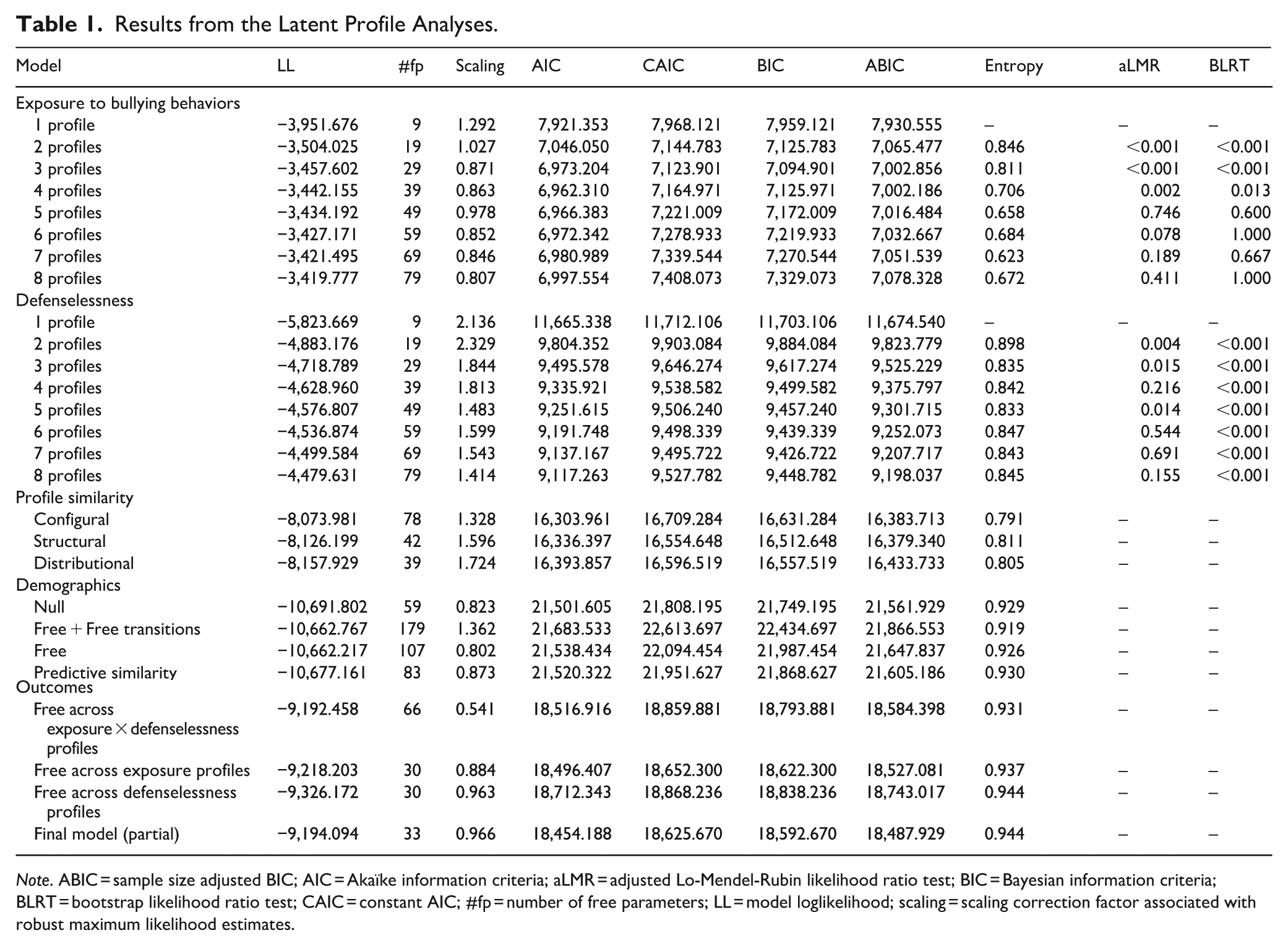
The model fit indicators associated with the latent profile analyses are reported in the top section of Table 1 for exposure, and in the second section of Table 1 for defenselessness. For exposure, while the CAIC and BIC reached their lowest point at three-profiles, the ABIC and BLRT supported a four-profile solution. For defenselessness, although the CAIC and BIC kept on decreasing until seven profiles and the ABIC and BLRT suggested to keep adding profiles without reaching a minimum, the rate of decrease in the value of the information criteria reached a plateau around four profiles (Morin & Litalien, 2019). For exposure, the three-profile solution revealed profiles characterized by no, rare, and occasional exposure across most indicators, while adding a fourth profile resulted in the addition of a meaningfully large profile dominated by exposure to acts of social or informational isolation and reminders of past errors. For defenselessness, results reveal four matching (identical configuration) profiles, reflecting respectively no, low and moderate defenselessness across most indicators as well as low or moderate defenselessness regarding specific work-related isolation acts. Adding a fifth profile to the sets of indicators of both exposure and defenselessness simply resulted in the extraction of smaller profiles with a shape corresponding to profiles showing only negligible differences with the profiles already present in the model.
Results from the Latent Profile Analyses.
Note. ABIC = sample size adjusted BIC; AIC = Akaïke information criteria; aLMR = adjusted Lo-Mendel-Rubin likelihood ratio test; BIC = Bayesian information criteria; BLRT = bootstrap likelihood ratio test; CAIC = constant AIC; #fp = number of free parameters; LL = model loglikelihood; scaling = scaling correction factor associated with robust maximum likelihood estimates.
Based on these considerations, we retained the four-profile solution for both sets of indicators. Both solutions revealed profiles with virtually identical shapes. As a result, we decided to formally test their similarity (Morin et al., 2016). Random starts were increased to 10,000 for these analyses. Starting from a solution including the same number of profiles (configural similarity), equality constraints were first implemented on the within-profile means of the indicators (structural similarity) and then on the size of the profiles (distributional similarity). 3 Each step is supported when two indicators out of the CAIC, BIC, and ABIC is lower relative to the previous model (Morin et al., 2016). The results from these tests are reported in the third section of Table 1 and support the structural (i.e., same shape) but not distributional (i.e., different sizes) similarity of the solution across sets of indicators.
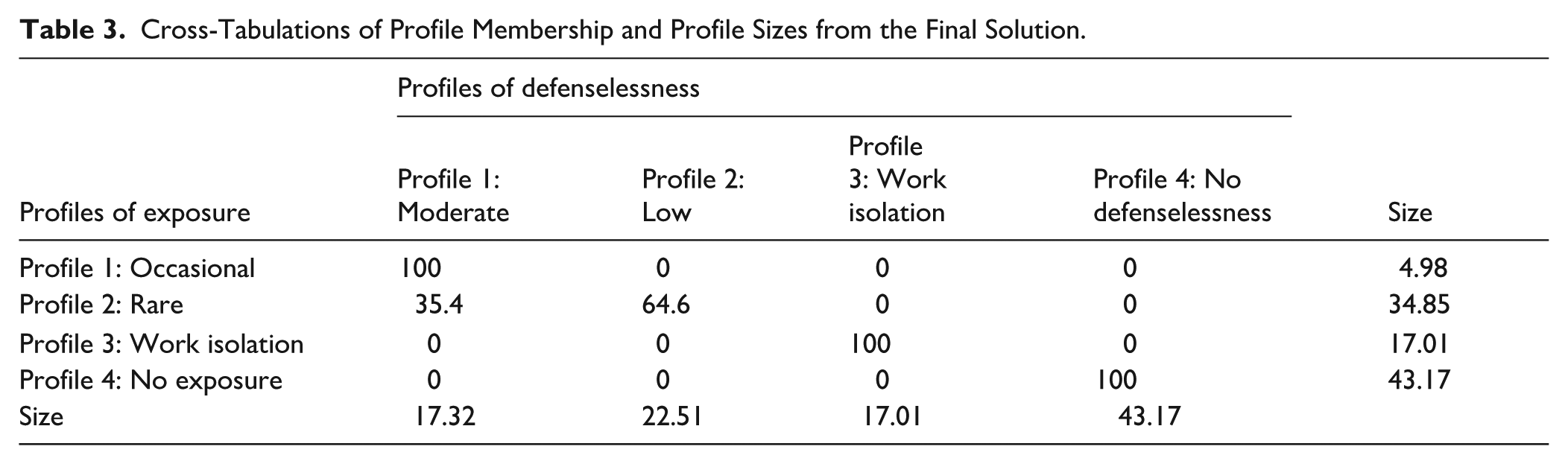
The results from the final solution of structural similarity are graphically displayed in Figure 1 and detailed results are reported in Table 2. The size of the profiles, as well as the cross-tabulations of participants’ probability of profile membership across types of indicators, are reported in Table 3. These results revealed a first profile displaying occasional exposure and moderate levels of defenselessness across most indicators (Occasional Exposure and Moderate Defenselessness). Although this exposure profile corresponded only to 4.98% of the sample, the matching defenselessness profile corresponded to 17.32% of the sample. The second profile displayed rare exposure and low defenselessness across most indicators (Rare Exposure and Low Defenselessness). This exposure profile corresponded to 34.85% of the sample, whereas the matching defenselessness profile corresponded to 22.51% of the sample. The third profile was dominated by occasional (withholding information, being ignored or excluded) and rare (being ignored or met with hostility when approaching, being reminded of past errors) exposure, as well as matching levels (moderate or low) of defenselessness, on indicators primarily capturing work-related negative acts and attempts at isolation and was thus labeled Work Isolation. This profile corresponded to 17.01% of the sample for both exposure and defenselessness. Finally, the last profile displayed almost no exposure and hardly any defenselessness across most indicators and was thus labeled No Bullying. This profile was the largest and corresponded to 43.17% of the sample for both exposure and defenselessness. Looking at the cross-tabulations, it is very interesting to note that everyone corresponding to the Occasional Exposure and Moderate Defenselessness, Work Isolation, or No Bullying profile corresponded to identical profiles of exposure and defenselessness. In contrast, whereas 64.6% of the participants corresponding to a Rare exposure profile also corresponded to a Low defenselessness profile, the remaining 35.4% rather displayed a Moderate defenselessness profile.
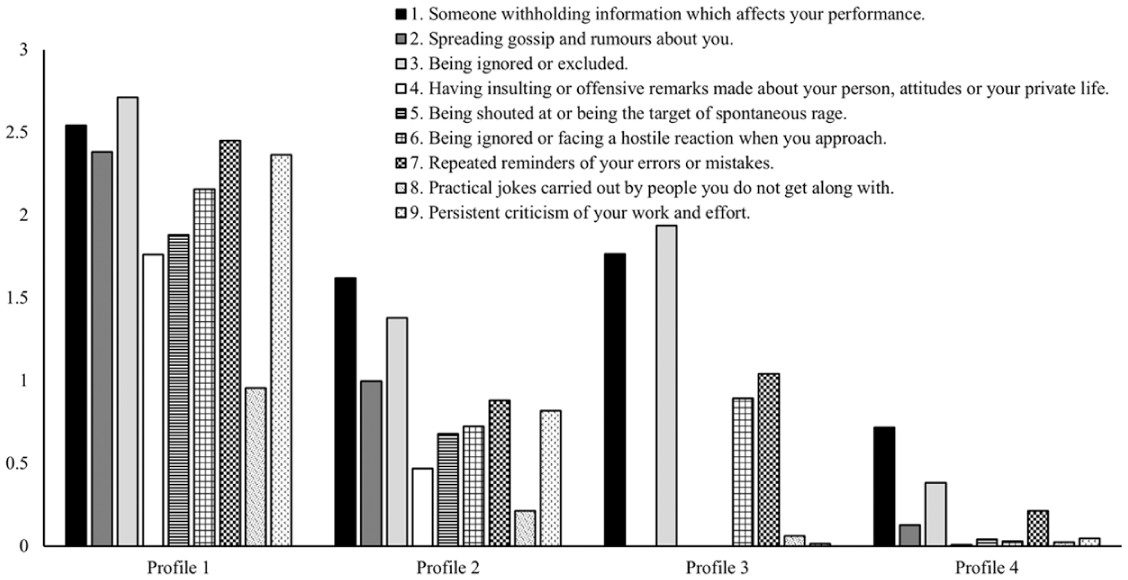
Final four-profile solution (structural similarity across exposure to bullying behaviors and defenselessness indicators).
Detailed Parameter Estimates from the Final Latent Profile Analysis Solution (Structural Similarity).
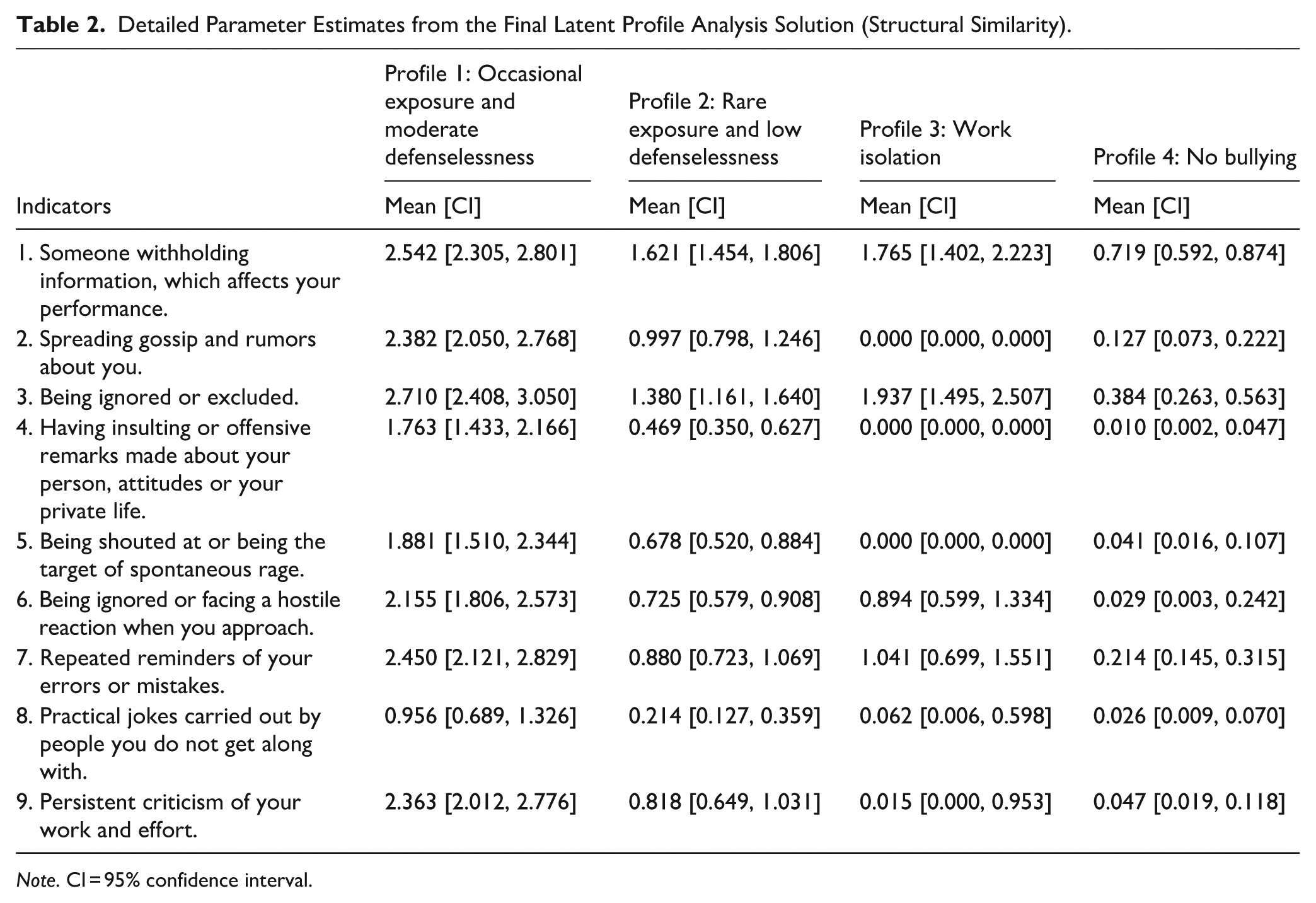
Note. CI = 95% confidence interval.
Cross-Tabulations of Profile Membership and Profile Sizes from the Final Solution.
Demographic Predictors
In relation to the demographic characteristics, the results reported in the fourth section of Table 1 revealed that all information criteria were at their lowest for the null effects model, indicating a lack of association between the demographic controls and the profiles, a conclusion that was also consistent with the parameter estimates from these models. For these reasons, demographic variables were not retained for the next stages of analyses.
Outcomes of Profile Membership
The results from the models assessing associations between the profiles and the outcomes are reported in the lowest section of Table 1 and illustrated in Figure 2. Consistent with the previous observation that profile membership was virtually identical for exposure and defenselessness (at least for the profiles Occasional Exposure and Moderate Defenselessness, Work Isolation, and No Bullying), outcome associations seemed primarily driven by participants’ exposure profiles (this model had the lowest CAIC, BIC, and ABIC). However, because unmatched profile membership was limited to a subset of participants from the Rare exposure profile who experienced a Moderate defenselessness profile, we estimated a final model in which we allowed outcome associations to differ only across the Moderate and Low defenselessness profile only for participants with a Rare exposure profile. This model resulted in a further decrease in the value of the information criteria and was supported by the data. The results from this model are reported in Table 4.
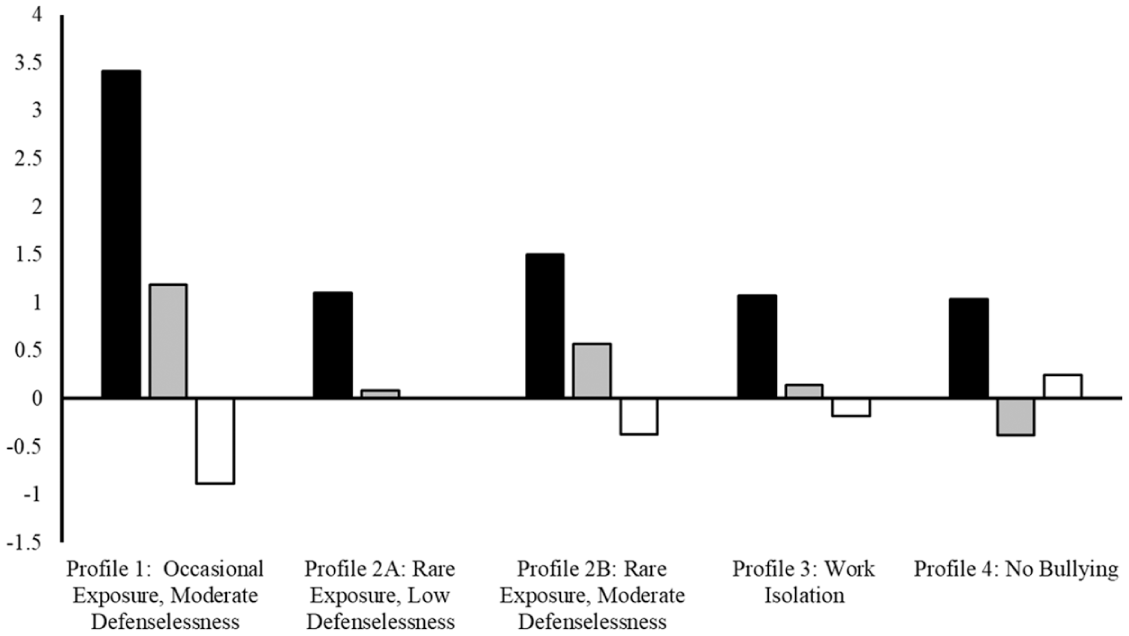
Associations between profile membership and the outcomes.
Associations Between Profile Membership and the Outcomes.
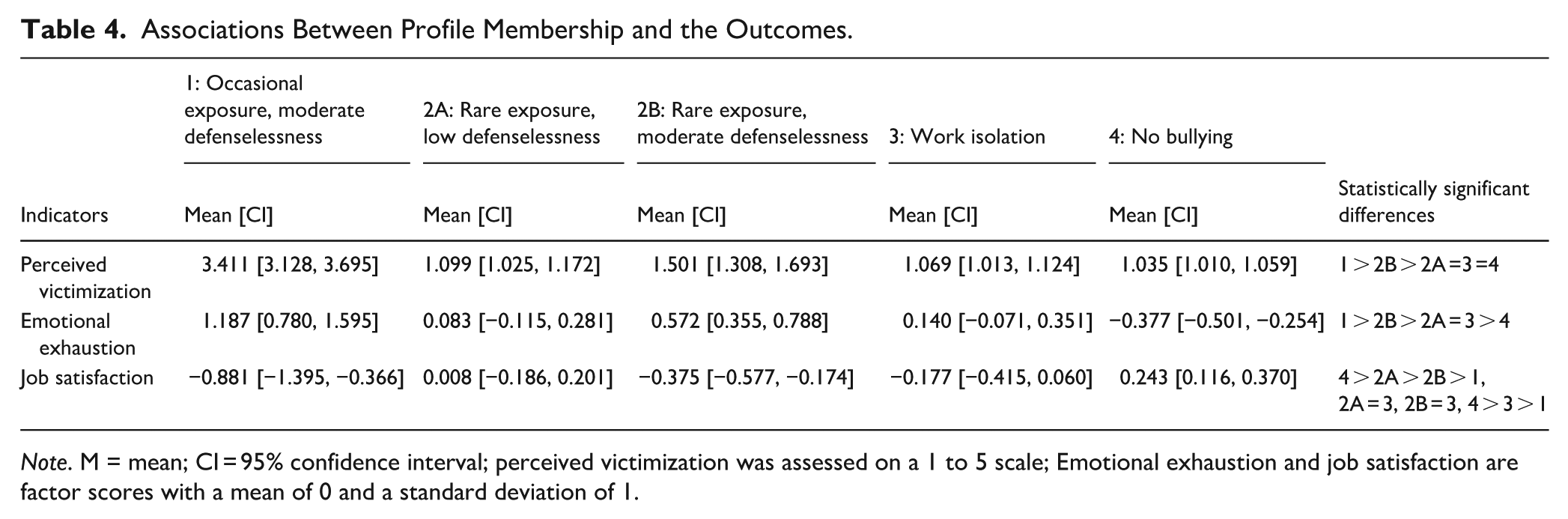
Note. M = mean; CI = 95% confidence interval; perceived victimization was assessed on a 1 to 5 scale; Emotional exhaustion and job satisfaction are factor scores with a mean of 0 and a standard deviation of 1.
Levels of perceived victimization were highest among participants corresponding to Profile 1 (Occasional Exposure and Moderate Defenselessness), followed by participants corresponding to Profile 2b (Rare exposure and Moderate Defenselessness), and were equally lowest among participants corresponding to Profiles 2a (Rare exposure and Low Defenselessness), 3 (Work Isolation), or 4 (No Bullying). Levels of emotional exhaustion were highest among participants corresponding to Profile 1 (Occasional Exposure and Moderate Defenselessness), followed by participants corresponding to Profile 2b (Rare Exposure and Moderate Defenselessness), followed equally by participants corresponding to Profile 2a (Rare Exposure and Low Defenselessness) and 3 (Work Isolation), and were lowest among participants corresponding to Profile 4 (No Bullying). Finally, levels of job satisfaction were highest among participants corresponding to Profile 4 (No Bullying), followed by those corresponding to Profile 2b (Rare exposure and Moderate Defenselessness) or to Profile 3 (Work Isolation), and were lowest in Profile 1 (Occasional Exposure and Moderate Defenselessness). Although levels of job satisfaction did not differ between participants corresponding to Profile 3 (Work Isolation) and those corresponding to Profile 2a (Rare exposure and Low Defenselessness) and Profile 2b (Rare exposure and Moderate Defenselessness), these levels were higher among participants reporting occasional exposure and experiencing low (Rare Exposure and Low Defenselessness) rather than moderate (Rare exposure and Moderate Defenselessness) defenselessness. These results support Hypothesis 1, while revealing differences related to the configurations of each profile, particularly the Work Isolation one, in response to our Research Question.
Discussion
This study was designed to investigate the nature and connections between profiles of exposure to bullying behaviors and profiles of defenselessness to help reconnect typical operationalization of bullying (usually focused on exposure) with the theoretical conceptualization of this phenomenon attributing a key role of targets’ sense of defenselessness. In this regard, our results revealed four distinct profiles of exposure to bullying behaviors and four matching profiles of defenselessness. These profiles displayed a matching configuration across indicators of exposure and defenselessness but differed in size across these two sets of indicators. Three of these profiles displayed levels reflecting respectively no, rare, and occasional exposure to bullying behaviors, as well as no, low, and moderate defenselessness across most indicators. The last profile displayed an isolated configuration (characterized by higher exposure and levels of defenselessness stemming from acts of social and informational isolation accompanied by reminders of past errors). Interestingly, our findings revealed a complete (i.e., 100%) overlap in profile membership across the two sets of indicators (exposure and defenselessness) for the No Bullying, Work Isolation, and Occasional Exposure and Moderate Defenselessness profiles, but an important proportion of employees corresponding to the occasional exposure profile (33%) displayed a moderate rather than low defenselessness profile.
Theoretical Implications
Interconnection Between Exposure to Bullying Behaviors and Defenselessness
The obtained results allow us to achieve a finer-grained understanding of how the various components of the workplace bullying experience combine with one another in a way that differs from other social stressors at work (Hershcovis, 2011). More precisely, they revealed that for most employees (~65% corresponding to the Occasional, Work Isolation, and No Exposure profiles), the experience of defenselessness completely overlapped that of exposure to bullying behaviors. These findings are consistent with previous reports showing that targets’ sense of defenselessness tends to increase proportionally to their level of exposure to workplace bullying (Nielsen et al., 2017; Notelaers & Van der Heijden, 2021).
From a theoretical standpoint, the Personal Control Model (Wortman & Brehm, 1975) suggests that people are more likely to feel helpless, or defenseless, when facing undesirable situations upon which they feel unable to exert some degree of personal control, and that this sense of helplessness can lead to substantial psychological costs for exposed individuals. Several factors are known to influence the emergence of feelings of helplessness, or defenselessness, including the repetitive exposure to undesirable and uncontrollable situations, initial expectations of being able to control the situation, and the importance of the outcomes associated with the situation (Krishna et al., 2023; Wortman & Brehm, 1975). Given that workplace bullying entails recurrent exposure to negative behaviors occurring within a critically important life setting and posing a significant threat, targets are likely to be negatively impacted. These considerations are also consistent with the conservation of resources theory (Hobfoll, 1989), which proposes that people strive to retain, protect, and build resources and that stress occurs when resources are lost or threatened. In such instances, individuals are more vulnerable to a loss spiral, where it becomes increasingly difficult to regain resources and to stop the loss of subsequent resources. Workplace bullying represents such a resource-depleting situation, as it is a severe chronic social stressor that intensifies over time and that undermines important psychological resources (e.g., optimism, self-efficacy, emotional energy; Tuckey & Neall, 2014). Employees exposed to this mistreatment are thus likely to perceive this situation as increasingly threatening (e.g., feeling helpless and defenseless). This effect may be particularly present when targets lack access to environmental resources (e.g., supervisor support, organizational justice, etc.) to adequately address the situation (Rai & Agarwal, 2018).
No significant differences were found on any of the outcomes between the profile characterized by rare exposure and low defenselessness and the work isolation profile. This lack of difference is important, as it indicates that exposure to a limited number of specific isolating acts carries the same consequences as a more generalized rare exposure to a broader set of bullying behaviors, at least when this exposure is not accompanied by a higher level of defenselessness. These isolating behaviors (e.g., withholding information, being ignored or excluded, etc.) may undermine targets’ sense of relatedness (i.e., sense of belonging and being connected to others at work; Deci & Ryan, 2000). In this sense, our results are consistent with past research showing that the lack of satisfaction, or active frustration, of the need for relatedness is associated with a wide range of negative outcomes (e.g., burnout, turnover intention, somatic symptoms, stress, depression, anxiety; Olafsen et al., 2021; Rouse et al., 2020) in normative contexts as well as in a context of workplace bullying (e.g., life dissatisfaction, Trépanier et al., 2016).
The Role of Defenselessness
Our results showed that roughly a third of those reporting rare exposure to bullying behavior displayed a moderate defenselessness profile (rather than low defenselessness). This distinction is important to take into account, as this combination was associated with more adverse consequences than a matched profile characterized by rare exposure and low defenselessness. More specifically, employees exposed to some negative acts experience more strain (i.e., emotional exhaustion), are less satisfied with their job (i.e., reduced job satisfaction) and are more likely to label themselves as victims (i.e., higher perceived victimization) when they feel more defenseless in the face of this exposure, compared to employees experiencing a lower sense of defenselessness. These results thus support, and add to our current understanding of, the key role of defenselessness as well as of the underlying target-perpetrator power imbalance in the bullying process. More specifically, while it has been proposed that feelings of defenselessness arise in later stages of the bullying process, when the frequency and intensity of the negative behaviors to which targets are confronted increase (Einarsen & Skogstad, 1996; Einarsen et al., 2020; Notelaers & Van der Heijden, 2021), our results show that this sense of defenselessness may appear in earlier stages of the process, characterized by more infrequent, indirect and ambiguous behavior.
Our results are also consistent with the transactional theory of stress (Lazarus & Folkman, 1984), proposing that stressors appraised as uncontrollable threats should be more taxing for exposed individuals, resulting in more negative emotions and distress. Likewise, the results support the importance of employees’ sense of control over their environment as an important personal resource (Xanthopoulou et al., 2007), helping them achieve a favorable level of functioning (e.g., emotional well-being, organizational commitment, reduced negative mood and turnover intention), despite their exposure to various work-related demands and stressors or adverse contexts (Barling & Kelloway, 1996; Schat & Kelloway, 2000).
However, we should keep in mind that the most adverse outcomes (highest perceived victimization and emotional exhaustion, lowest job satisfaction) were observed among employees displaying a profile characterized by an occasional exposure and a moderate level of defenselessness. These results further support previous results showing that employees’ evaluation of the situation (i.e., sense of defenselessness) plays a salient role in modulating the effect of exposure to negative acts, but only in the context of lower levels of mistreatment (Rosander & Nielsen, 2023).
Limitations and Future Research
Although this study contributes to workplace bullying research by shedding light on the person-centered interplay between exposure to bullying behavior and target’s sense of defenselessness, it also has limitations that should be addressed in future research. First, the use of self-reported measures may have introduced some biases, including social desirability, self-consistency, and reluctance to report unpleasant events. However, given the nature of most of the investigated variables (e.g., sense of defenselessness, job satisfaction), measures from alternative sources would not have adequately captured these personal experiences. Second, we relied on a cross-sectional design, although it can be argued that knowledge about how variables are associated, even without knowing their causal connections, is extremely valuable as a basis for theory and for developing interventions (Spector, 2019). Nevertheless, given the inherent temporal nature of bullying, future longitudinal research will be needed to replicate, and extend, our findings. The use of longitudinal designs would provide valuable insight into the bullying process as it unfolds over time by shedding light on the temporal dynamic underlying the associations between the key characteristics of bullying (i.e., frequent and prolonged exposure to negative acts against which it is difficult to defend oneself). In particular, future research is encouraged to look into potential profile membership transitions over time, which could shed light into how targets’ sense of defenselessness evolves over time and its role in the escalation of the bullying process. Third, participants were recruited using the Prolific Academic crowdsourcing platform. Although this platform has been shown to support the collection of quality research data (Peer et al., 2017) and has been used in several studies on workplace mistreatment and more generally in occupational health psychology (e.g., Martin et al., 2023; Zhou et al., 2022), our findings remain based on a heterogeneous, non-representative sample of workers. Future research is encouraged to replicate our findings in specific organizational settings.
Fourth, we relied on a single-item measure of defenselessness, developed specifically for this study, in relation to each type of bullying behavior considered in this study, which made it possible to assess behavior-specific perceptions of defenselessness. However, such a method could have introduced dependency between both sets of items (exposure to bullying behavior and the associated sense of defenselessness) and the use of a single-item limited the possibility of fully covering the whole phenomenological experience of defenselessness. Furthermore, although this new measure had a satisfactory scale score reliability, its validity was not thoroughly examined. Despite these limitations, it is important to note that previous research has also assessed defenselessness with a single-item measure generic to all bullying behaviors (i.e., Nielsen et al., 2017: “did you find it difficult to defend yourself against this exposure?”; Rosander & Nielsen, 2023: “to what extent can you ward off or stop the negative acts you are exposed to?”), whereas only one previous study relied on a multi-item measure, also generic to all bullying behaviors (Nielsen et al., 2022: e.g., “did you experience a sense of hopelessness, and resignation in relation to what you have been exposed to?”). In this sense, our consideration of the sense of defenselessness specific to each bullying behavior contributes by offering a close-up perspective of targets’ experience. Although single-item measures have been found to strongly overlap with multi-item scales (Matthews et al., 2022), it would be interesting for future research to move beyond single-items and generic measures and propose a new scale to better capture the complete phenomenological experience of defenselessness as it evolves over time and rigorously investigate its psychometric properties (e.g., factor structure, divergent and convergent validity, measurement invariance).
Fifth, we only considered outcomes of workplace bullying profiles. It would be important for future research to build upon our findings to also consider antecedents of exposure, defenselessness, and combined profiles. Indeed, although previous studies have sought to understand the contextual and personal antecedents of exposure to bullying behaviors in the workplace, to our knowledge, no empirical research has yet investigated the factors associated with the emergence of a sense of defenselessness when facing bullying behaviors. For example, future research could investigate the role of personal (e.g., trait anger and trait anxiety; Reknes et al., 2021) and contextual (e.g., role conflict, job insecurity, and social support; Trépanier et al., 2021; Van den Brande et al., 2016) factors known to increase one’s risk of exposure to bullying behaviors to see how these factors are related to targets’ sense of defenselessness and how they contribute to combined profile membership, as identified in the present study. Finally, the estimation of latent profile analyses, to be able to properly account for the Poisson distribution underlying our measures of exposure and defenselessness, made it impossible to model within-profile variability on these measures. This limitation made it impossible to properly account for inter-individual differences among profile membership, an approach that has been demonstrated (when relying on continuous indicators) to achieve an even more accurate picture of the results (Diallo et al., 2016; Morin et al., 2011; Peugh & Fan, 2013). Future research may consider relying on multi-item scales to capture defenselessness, as using factor scores obtained from multiple indicators would allow researchers to rely on the more flexible approaches available for continuous variables.
Practical Implications and Conclusion
Our results show that profiles characterized by occasional exposure to bullying behaviors were more strongly associated with maladaptive outcomes (perceived victimization, emotional exhaustion, and job dissatisfaction). These results highlight the importance of organizational actions aimed at limiting and at actively intervening in the presence of negative behaviors within workgroups. This can be facilitated by interventions aimed at (a) providing employees with healthy work environments (managing job stressors, offering job resources; Notelaers et al., 2010; Trépanier et al., 2021), (b) developing teams’ ability to constructively handle interpersonal conflicts (strong conflict management climate; Einarsen et al., 2018) as well as by (c) developing and maintaining a strong anti-bullying organizational culture, notably through formal procedures such as policies, training, recurrent communication and sanctions (Einarsen et al., 2019). Our results also show that rare exposure to bullying behaviors was associated with more adverse outcomes when targets experience a higher sense of defenselessness. This result highlights the importance of supporting employees at the very start of the bullying process to alleviate this sense of defenselessness. Organizational training on how to deal with workplace mistreatment (Schat & Kelloway, 2000) as well as awareness-raising training on the role of bystanders and on how to effectively take action when witnessing bullying (Niven et al., 2020) may not only contribute to restoring targets’ sense of control but also to stop or reduce the escalation of the bullying process.
Footnotes

Ethical Considerations
The Human Research Ethics Committee of Université du Québec à Trois-Rivières (Canada) approved this project (CER-19-255-07.11) on April 5, 2019.
Consent to Participate
Respondents gave written consent before completing the online questionnaire.
Funding
The authors disclosed receipt of the following financial support for the research and/or authorship of this article: This work was supported by the Canada research chair in social climate and workplace health and a grant from the Social Sciences and Humanities Research Council of Canada (435-2018-1338).
Declaration of Conflicting Interests
The authors declared no potential conflicts of interests with respect to the authorship and/or publication of this article.
Data Availability Statement
The data supporting the conclusions of this article will be made available by the authors, without undue reservation. Requests to access the dataset should be directed to the first author.